


Jerkin (garment)

Encyclopedia
Jacket
A jacket is a hip- or waist-length garment for the upper body. A jacket typically has sleeves, and fastens in the front. A jacket is generally lighter, tighter-fitting, and less insulating than a coat, which is outerwear...
, made usually of light-colored leather
Leather
Leather is a durable and flexible material created via the tanning of putrescible animal rawhide and skin, primarily cattlehide. It can be produced through different manufacturing processes, ranging from cottage industry to heavy industry.-Forms:...
, and often without sleeve
Sleeve
Sleeve is that part of a garment which covers the arm, or through which the arm passes or slips. The pattern of the sleeve is one of the characteristics of fashion in dress, varying in every country and period...
s, worn over the doublet
Doublet (clothing)
A doublet is a man's snug-fitting buttoned jacket that is fitted and shaped to the man's body which was worn in Western Europe from the Middle Ages through to the mid-17th century. The doublet was hip length or waist length and worn over the shirt or drawers. Until the end of the 15th century the...
in the sixteenth and seventeenth centuries. The term is also applied to a similar sleeveless garment worn by the British Army
British Army
The British Army is the land warfare branch of Her Majesty's Armed Forces in the United Kingdom. It came into being with the unification of the Kingdom of England and Scotland into the Kingdom of Great Britain in 1707. The new British Army incorporated Regiments that had already existed in England...
in the twentieth century.
The stock phrase, buff jerkin
Buff coat
The European Buff coat was an item of leather clothing worn by both the infantry and cavalry during the 17th century, usually worn under armour...
, refers to an oiled oxhide jerkin, as worn by soldiers.
The origin of the word is unknown. The Dutch
Dutch language
Dutch is a West Germanic language and the native language of the majority of the population of the Netherlands, Belgium, and Suriname, the three member states of the Dutch Language Union. Most speakers live in the European Union, where it is a first language for about 23 million and a second...
word jurk, a child's frock
Frock
Frock has been used since Middle English as the name for an article of clothing for men and women .- History of the frock :...
, often taken as the source, is modern, and represents neither the sound nor the sense of the English word.
Sixteenth and seventeenth centuries
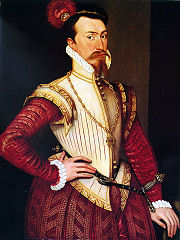
Leather jerkins of the sixteenth century were often slashed and punched, both for decoration and to improve the fit.Jerkins were worn closed at the neck and hanging open over the peascod-bellied fashion of doublet. At the turn of the seventeenth century, the fashion was to wear the jerkin buttoned at the waist and open above to reflect the fashionable narrow-waisted silhouette.
By the mid-seventeenth century, jerkins were high-waisted and long-skirted like doublets of the period.
Twentieth century
During the First World WarWorld War I
World War I , which was predominantly called the World War or the Great War from its occurrence until 1939, and the First World War or World War I thereafter, was a major war centred in Europe that began on 28 July 1914 and lasted until 11 November 1918...
, the British army issued brown leather jerkins to the troops as a measure to protect against the cold but to allow freedom of movement. These garments generally had four buttons and were lined with khaki wool
Wool
Wool is the textile fiber obtained from sheep and certain other animals, including cashmere from goats, mohair from goats, qiviut from muskoxen, vicuña, alpaca, camel from animals in the camel family, and angora from rabbits....
. They were practical, hardwearing and extremely appreciated by officers and other ranks alike. By the time of the Second World War
World War II
World War II, or the Second World War , was a global conflict lasting from 1939 to 1945, involving most of the world's nations—including all of the great powers—eventually forming two opposing military alliances: the Allies and the Axis...
, the leather jerkins were still on issue to all the Commonwealth forces and were universally popular. Jerkins made in Canada were dark brown with black wool linings and differed in general appearance from the British jerkins.
The jerkins from the Second World War had bakelite buttons instead of the brass or brown leather of the originals, and were each unique in that they were finished around the bottom edges with offcuts in a bid to eliminate waste. (It has been suggested that many of the WWII jerkins were made up from leather left over from the Irvin flying jackets also in production in the UK - however, the flying jackets were made of sheepskin so this may not be the case). Jerkins remained warm and comfortable garments to wear whilst fighting, working or driving, and came to characterise the British forces as a preferred alternative to the heavy greatcoats that other armies persisted with.
A practical garment known as the Battle Jerkin was developed in 1942 by Colonel Rivers-MacPherson of the British Army; a modification of the English hunting vest, it was developed into a garment made of leather (canvas versions were also created) with multiple pockets, intended to replace the conventional web gear then in use. It was issued to assault troops for the Normandy landings and was used widely by commando personnel in 1944–45.
During the post war period, a much less distinctive PVC
PVC
Polyvinyl chloride is a plastic.PVC may also refer to:*Param Vir Chakra, India's highest military honor*Peripheral venous catheter, a small, flexible tube placed into a peripheral vein in order to administer medication or fluids...
version was introduced to the forces. WD surplus leather jerkins flooded the UK during the 1950s and 1960s and were a common sight on manual workmen across the country. Wartime vintage leather jerkins are now collector's items, and at least one UK firm has produced a facsimile. The Belgian Army also produced vinyl jerkins in the postwar era.
Leather Jerkin wearers in the Media
- Richard Warwick in the final scenes of film If….
- James Garner (as the Scrounger) in film The Great Escape
- Harry H. Corbett (as Harold Steptoe) in Steptoe And Son (early episodes).
- Tony Robinson (as Private Baldrick) in Black Adder Goes Forth.
- Andy Partridge (of UK rock group XTC) in publicity photographs circa 1985.
- Ian Anderson (of UK rock group Jethro Tull) on cover of Jethro Tull’s Songs From The Wood 1976.
- James Wilby (as Siegfried Sassoon) in film Regeneration
- Jonny Lee Miller (as Billy Prior) in film Regeneration
- Bernard Lee (as Sgt Paine) in The Third Man