


Najd

Encyclopedia
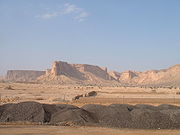
Arabian Peninsula
The Arabian Peninsula is a land mass situated north-east of Africa. Also known as Arabia or the Arabian subcontinent, it is the world's largest peninsula and covers 3,237,500 km2...
.
Boundaries
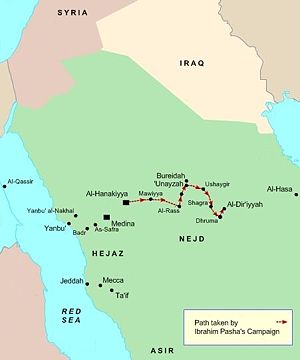
Hejaz
al-Hejaz, also Hijaz is a region in the west of present-day Saudi Arabia. Defined primarily by its western border on the Red Sea, it extends from Haql on the Gulf of Aqaba to Jizan. Its main city is Jeddah, but it is probably better known for the Islamic holy cities of Mecca and Medina...
and Yemen
Yemen
The Republic of Yemen , commonly known as Yemen , is a country located in the Middle East, occupying the southwestern to southern end of the Arabian Peninsula. It is bordered by Saudi Arabia to the north, the Red Sea to the west, and Oman to the east....
and to the east by the historical region of Bahrain
Bahrain (historical region)
Bahrain is a historical region in eastern Arabia that was known as the Province of Bahrain until the 16th Century. It stretched from the south of Basra along the Persian Gulf coast and included the regions of Kuwait, Al-Hasa, Qatif, Qatar, and the Awal Islands, now known as Bahrain. The name...
and the north by Iraq
Iraq
Iraq ; officially the Republic of Iraq is a country in Western Asia spanning most of the northwestern end of the Zagros mountain range, the eastern part of the Syrian Desert and the northern part of the Arabian Desert....
and Syria
Syria
Syria , officially the Syrian Arab Republic , is a country in Western Asia, bordering Lebanon and the Mediterranean Sea to the West, Turkey to the north, Iraq to the east, Jordan to the south, and Israel to the southwest....
.
Medieval Muslim
Muslim
A Muslim, also spelled Moslem, is an adherent of Islam, a monotheistic, Abrahamic religion based on the Quran, which Muslims consider the verbatim word of God as revealed to prophet Muhammad. "Muslim" is the Arabic term for "submitter" .Muslims believe that God is one and incomparable...
geographers spent a great amount of time debating the exact boundaries between Hejaz and Nejd in particular, but generally set the western boundaries of Nejd to be wherever the western mountain ranges and lava
Lava
Lava refers both to molten rock expelled by a volcano during an eruption and the resulting rock after solidification and cooling. This molten rock is formed in the interior of some planets, including Earth, and some of their satellites. When first erupted from a volcanic vent, lava is a liquid at...
beds began to slope eastwards, and set the eastern boundaries of Nejd at the narrow strip of red sand dunes known as the Ad-Dahna Desert
Ad-Dahna Desert
ad-Dahna Desert is the central division of the Arabian Desert. It is a corridor of sandy terrain forming a bow-like shape that connects an-Nafud desert in the north to Rub' al-Khali desert in the south. Its length is more than 1000 km siding Twaik Mountains from the east and does not exceed...
, some 100 km (62.1 mi) east of modern-day Riyadh
Riyadh
Riyadh is the capital and largest city of Saudi Arabia. It is also the capital of Riyadh Province, and belongs to the historical regions of Najd and Al-Yamama. It is situated in the center of the Arabian Peninsula on a large plateau, and is home to 5,254,560 people, and the urban center of a...
. The southern border of Nejd has always been set at the large sea of sand dune
Dune
In physical geography, a dune is a hill of sand built by wind. Dunes occur in different forms and sizes, formed by interaction with the wind. Most kinds of dunes are longer on the windward side where the sand is pushed up the dune and have a shorter "slip face" in the lee of the wind...
s known today as Rub' al Khali (the Empty Quarter), while the southwestern boundaries are marked by the valleys of Wadi Ranyah, Wadi Bisha, and Wadi Tathlith.
The northern boundaries of Nejd have fluctuated greatly historically and received far less attention from the medieval geographers. In the early Islamic centuries, Nejd was considered to extend as far north as the River Euphrates
Euphrates
The Euphrates is the longest and one of the most historically important rivers of Western Asia. Together with the Tigris, it is one of the two defining rivers of Mesopotamia...
, or more specifically, the "Walls of Khosrau
Khosrau
Khusro, Khosrau, Khusrau, Khosro, or Khusraw is the name of a mythical Persian leader, in the Avesta of the Zoroastrians known as Kavi Haosravah, with the meaning "with good reputation"...
", constructed by the Persian Empire
Sassanid Empire
The Sassanid Empire , known to its inhabitants as Ērānshahr and Ērān in Middle Persian and resulting in the New Persian terms Iranshahr and Iran , was the last pre-Islamic Persian Empire, ruled by the Sasanian Dynasty from 224 to 651...
as a barrier between Arabia and Iraq
Iraq
Iraq ; officially the Republic of Iraq is a country in Western Asia spanning most of the northwestern end of the Zagros mountain range, the eastern part of the Syrian Desert and the northern part of the Arabian Desert....
immediately prior to the advent of Islam
Islam
Islam . The most common are and . : Arabic pronunciation varies regionally. The first vowel ranges from ~~. The second vowel ranges from ~~~...
. The modern usage of the term encompasses the region of Al-Yamama
Al-Yamama
Al-Yamamah is an ancient district lying to the east of the plateau of Najd in modern-day Saudi Arabia, or sometimes more specifically, the now-extinct ancient village of Jaww Al-Yamamah, near Al-Kharj, after which the rest of the region was named...
, which was not always considered part of Nejd historically.
Topography
Nejd, as its name suggests, is a plateauPlateau
In geology and earth science, a plateau , also called a high plain or tableland, is an area of highland, usually consisting of relatively flat terrain. A highly eroded plateau is called a dissected plateau...
ranging from 762 to 1525 m (2,500 to 5,003.3 ft) in height and sloping downwards from west to east. The eastern sections (historically better known as Al-Yamama) are marked by oasis settlements with lots of farming and trading activities, while the rest has traditionally been sparsely occupied by nomad
Nomad
Nomadic people , commonly known as itinerants in modern-day contexts, are communities of people who move from one place to another, rather than settling permanently in one location. There are an estimated 30-40 million nomads in the world. Many cultures have traditionally been nomadic, but...
ic Bedouins. The main topographical features include the twin mountains of Aja and Salma in the north near Ha'il
Ha'il
Ha'il , also spelled Hail, Ha'yel, or Hayil, is an oasis city in Nejd in northwestern Saudi Arabia. It is the capital of the Ha'il Province. The city has a population of 356,876 according to Ha'il Province....
, the high land of Jabal Shammar and the Tuwaiq
Tuwaiq
Jebel Tuwaiq is a narrow escarpment that cuts through the plateau of Nejd in central Arabia, running approximately 800 km from the southern border of Al-Qasim in the north, to the northern edge of the Empty Quarter desert near Wadi ad-Dawasir in the south. The eastern side slopes downwards...
mountain range running through its center from north to south. Also important are the various dry river-beds (wadi
Wadi
Wadi is the Arabic term traditionally referring to a valley. In some cases, it may refer to a dry riverbed that contains water only during times of heavy rain or simply an intermittent stream.-Variant names:...
s) such as Wadi Hanifa
Wadi Hanifa
Wadi Hanifa is a wadi or valley in the Nejd region in central Saudi Arabia. The valley runs for a length of from north to south, cutting through the city of Riyadh, the capital of Saudi Arabia...
near Riyadh, Wadi Na'am in the south, Wadi Al-Rumah in the Al-Qassim Province in the north, and Wadi ad-Dawasir
Wadi ad-Dawasir
Wadi Al Dawasir is a town in Najd, Saudi Arabia , in the Dawasir valley. The town is the homeland of the tribe of Al-Dawasir, which is the biggest tribe in Saudi Arabia....
at the southernmost tip of Nejd on the border with Najran. Most Nejdi villages and settlements are located along these wadis, due to ability of these wadis to preserve precious rainwater in the arid desert climate, while others are located near oases
Oasis
In geography, an oasis or cienega is an isolated area of vegetation in a desert, typically surrounding a spring or similar water source...
. Historically, Nejd itself has been divided into small provinces made up of constellations of small towns, villages and settlements, with each one usually centered around one "capital". These subdivisions are still recognized by Nejdis today, as each province retains its own variation of the Nejdi dialect and Nejdi customs. The most prominent among these provinces are Al-'Aridh, which includes Riyadh and the historical Saudi capital of Diriyah
Diriyah
Al-Diriyah is a town in Saudi Arabia located on the northwestern outskirts of the Saudi capital, Riyadh. Diriyah was the original home of the Saudi royal family, and served as the capital of the first Saudi dynasty from 1744 to 1818...
; Al-Qassim, with its capital in Buraidah
Buraidah
Buraidah is the capital of Al-Qassim Province in northcentral Saudi Arabia in the heart of the Arabian peninsula. Buraidah lies equidistant from the Red Sea to the west and the Persian Gulf to the east...
; Sudair
Sudair
Sudair or Sudayr is a historical region in Najd in the central of Saudi Arabia, and is located approximately 150 km north of the Saudi capital, Riyadh...
, centered around Al Majma'ah
Al Majma'ah
Al Majma'ah is a city and a governorate in Ar Riyad Province, Saudi Arabia. It is located at around , and has an area of 30 000 square kilometers. The population of the town is around 45,000, while the population of the governorate as a whole is approximately 97,349...
; Al-Washm, centered around Shaqraa
Shaqraa
Shaqra is a town in central Saudi Arabia, located near Ushaiger and about 190 kilometers north-west of the capital Riyadh.The name "Shagra" means "blonde" or "blondie" which is taken from "the blonde mountain" which is north of Shagra....
; and Jebel Shammar
Jebel Shammar
Jebel Shammar was a sovereign state, also known as the Emirate of Ha'il, located in what is today northern Saudi Arabia. It was founded in 1835. Following a period of conflict between the Al Saud and the Shammar's ruling Al Rashid family, the emirate was conquered by Saudi led coalition on August...
, with its capital, Ha'il. Under modern-day Saudi Arabia
Saudi Arabia
The Kingdom of Saudi Arabia , commonly known in British English as Saudi Arabia and in Arabic as as-Sa‘ūdiyyah , is the largest state in Western Asia by land area, constituting the bulk of the Arabian Peninsula, and the second-largest in the Arab World...
, however, Nejd is divided into three administrative regions: Ha'il, Al-Qassim, and Riyadh, comprising a combined area of 554000 km² (213,900.6 sq mi).
Major towns
RiyadhRiyadh
Riyadh is the capital and largest city of Saudi Arabia. It is also the capital of Riyadh Province, and belongs to the historical regions of Najd and Al-Yamama. It is situated in the center of the Arabian Peninsula on a large plateau, and is home to 5,254,560 people, and the urban center of a...
is the largest city in Nejd, as well as the largest city in the country as a whole, with a population of more than 4,700,000 in 2009. Other cities include Buraidah
Buraidah
Buraidah is the capital of Al-Qassim Province in northcentral Saudi Arabia in the heart of the Arabian peninsula. Buraidah lies equidistant from the Red Sea to the west and the Persian Gulf to the east...
(505,845 in 2005), Unaizah
Unaizah
Unaizah or officially The Governorate of Unaizah is a Saudi Arabian city in the Al Qassim Province. It lies south of Buraydah and north of Riyadh, the capital of the Kingdom of Saudi Arabia...
(138,351 in 2005) and Ar Rass
Ar Rass
Rass is a Saudi Arabian town, located in the Al Qassim Province. It lies southwest of Buraydah, the capital of the province and also north of Riyadh, the national capital....
(116,164 in 2005). Smaller towns and villages include Sudair
Sudair
Sudair or Sudayr is a historical region in Najd in the central of Saudi Arabia, and is located approximately 150 km north of the Saudi capital, Riyadh...
, Al-Kharj, Dawadmi
Dawadmi
Ad Dawadimi , is located on top of Najd hill, the central area of Saudi Arabia. Another name for the city is عالية نجد which literally translates into "The High of Najd". It's located approximately 300 km west of the capital Riyadh. Dwadmi has over 50,000 inhabitants in the city alone...
, Al-Zilfi, Al Majma'ah, Shaqraa, Tharmada'a
Tharmada'a
Tharmada'a is Saudi Arabian town, located about 170 kilometers north of the capital Riyadh.-External Links:...
, Dhurma
Dhurma
Dhurma is a small town located some 40 km to the west of Riyadh, Saudi Arabia. It is the center of the small Dhruma Governorate, and has a population of approximately 15,000 people. It lies in the wide Al-Batin valley, which it shares with its larger twin, Muzahmiyya...
, Al-Gway'iyyah
Al-Gway'iyyah
Al Gwei'iyyah is a Saudi Arabian municipality, built in the 5th century BC. Located about 170 kilometers from the capital Riyadh....
, Al-Hareeq
Al-Hareeq
Al Hareeq is a Saudi Arabian town , belong to Riyadh . with population est. of 6000 ....
, Hotat Bani Tamim
Hotat Bani Tamim
Hotat Bani Tamim is a Saudi Arabian town, belonging to Riyadh. Its population is estimated at 36,000....
, Layla, As Sulayyil
As Sulayyil
As Sulayyil is a city in Ar Riyad Province, Saudi Arabia.As Sulayil is a town in the southern Riyadh region. Along with the nearby village of [Wadi Addawasir] are the main towns of the area which considered one of richest farming areas in the kingdom although its very close to the largest sand...
, and Wadi ad-Dawasir
Wadi ad-Dawasir
Wadi Al Dawasir is a town in Najd, Saudi Arabia , in the Dawasir valley. The town is the homeland of the tribe of Al-Dawasir, which is the biggest tribe in Saudi Arabia....
, the southernmost settlement in Nejd.
Social and ethnic groups
Prior to the formation of the modern Kingdom of Saudi Arabia, the native population of Nejd consisted mainly of members of several Arabian tribesTribes of Arabia
Tribes of Arabia refers to Arab clans hailing from the Arabian Peninsula.Much of the lineage provided before Ma'ad relies on biblical genealogy and therefore questions persist concerning the accuracy of this segment of Arab genealogy...
, who were either nomads (bedouins), or sedentary farmers and merchants. The rest of the population consisted mainly of Arab
Arab
Arab people, also known as Arabs , are a panethnicity primarily living in the Arab world, which is located in Western Asia and North Africa. They are identified as such on one or more of genealogical, linguistic, or cultural grounds, with tribal affiliations, and intra-tribal relationships playing...
s who were, for various reasons, unaffiliated with any tribes, and who mostly lived in the towns and villages of Nejd working in various trades such as carpentry or as Sonnaa (craftsmen). There was also a small segment of the population made up of Africa
Africa
Africa is the world's second largest and second most populous continent, after Asia. At about 30.2 million km² including adjacent islands, it covers 6% of the Earth's total surface area and 20.4% of the total land area...
n as well as some East and South Eastern European slaves or freedmen.
Most of the Nejdi tribes are of Adnan
Adnan
Adnan is the traditional ancestor of the Adnani Arabs of northern, central and western Arabia, as opposed to the Qahtani of Southern and south eastern Arabia who descend from Qahtan.-Origin:...
i Arabic origin and had immigrated in ancient times from Hijaz to Najd. The most famous Nejdi tribes in the pre-Islamic era were Banu Hanifa
Banu Hanifa
Banu Hanifa were an ancient Arab tribe inhabiting the area of al-Yamama in the central region of modern-day Saudi Arabia. The tribe belonged to the great Rabi'ah branch of North Arabian tribes, which also included 'Anizzah, Abd al-Qays, Bakr, and Taghlib...
, who occupied the area around modern-day Riyadh, `Anizzah
`Anizzah
`Anazzah are the largest Arab tribal confederation of the Saudi Arabia, Iraq, and the Levant.-Genealogy and Origins:Currently the largest of the Arab tribes, `Anazzah's existence as an autonomous tribal group, unlike that of many prominent modern tribes, predates the rise of Islam in the 7th...
, Banu Tamim
Banu Tamim
Banī Tamīm Tamim is one of the largest of all Arab tribes. Their history goes back to pre-Islamic times....
, who occupied areas further north, the tribe of Banu Abs
Banu Abs
The ' is an ancient Bedouin tribe from central Arabia, they branch from the powerful Ghatafan tribes. They still inhabit the Arabian Peninsula and North Africa. Of the earliest stories concerning this tribe was the famous classical love and war story of Antar and Abla...
who were centered in Al-Qassim, the tribe of Tayy
Tayy
Tayy is a large and ancient Arabian tribe belonging to the southern or Qahtanite branch of Arab tribes. Their original homeland was the area of the two mountains Aja and Salma in north central Arabia , though, like all Qahtanite tribes, it is believed they originally moved there from Yemen...
, centered around modern-day Ha'il, and the tribe of Banu 'Amir
Banu 'Amir
Banu 'Amir ibn Sa'sa'ah or Banu 'Amir were a large and ancient Arab tribal confederation originating from central and southwestern Arabia that dominated Nejd for centuries after the rise of Islam. The tribe is of North Arabian stock, tracing its lineage to Adnan through Hawazin, and its original...
in southern Nejd. In the 15th through 18th centuries, there was considerable tribal influx from the west, increasing both the nomadic and settled population of the area and providing fertile soil for the Wahhabi movement. By the 20th century, many of the ancient tribes had morphed into new confederations or emigrated to other areas of the Middle East
Middle East
The Middle East is a region that encompasses Western Asia and Northern Africa. It is often used as a synonym for Near East, in opposition to Far East...
, and many tribes from other regions of the Peninsula had moved into Nejd. However, the largest proportion of native Nejdis today still belong to these ancient Nejdi tribes or to their newer incarnations. Many of the Nejedi tribes even in ancient times were not nomadic or bedouin but rather very well settled farmers and merchants. The royal family of Saudi Arabia, Al Saud
House of Saud
The House of Saud , also called the Al Saud, is the ruling royal family of Saudi Arabia and one of the wealthiest and most powerful dynasties in the world. The family holds thousands of members...
, for example, trace their lineage to Banu Hanifa. On the eve of the formation of Saudi Arabia, the major nomadic tribes of Nejd included Dawasir
Dawasir
The Al Dawasir is an Arabian bedouin tribe divided into clans and families. The word Dawasir is plural for Dosari...
, Mutayr
Mutayr
Mutayr is one of the largest Sunni tribes of the Arabian Peninsula. The traditional leaders of Mutayr are the Doshan clan . The main branches of Mutayr today are Banu Abdullah, Al-'Olwa, and Braih....
(historically known as Banu Abs), Shammar
Shammar
The tribe of Shammar is one of the largest tribes of Nejd-Saudi Arabia, with an estimated 1 million in Iraq, over 2.5 million in Saudi Arabia , a Kuwaiti population of around 100,000, a Syrian population is thought to exceed 1 million and with an unknown number in Jordan...
(historically known as Tayy), 'Utaybah
'Utaybah
Utaybah is a large Arab tribe of the Arabian Peninsula. As is the case with many other large tribal confederations in the region, the name Otaibah only appeared within the last few centuries. Otaibah's original territory was concentrated in the area around Taif, but in the 18th century, their...
(historically known as Hawazen), Subay'
Subay'
Subay are a Sunni Muslim tribe of central Saudi Arabia. The tribe is of North Arabian stock, and traces its lineage to the large, ancient tribe of Banu 'Amir, also known as 'Amir ibn Sa'sa'a, who came to dominate Nejd in the medieval period....
, Harb, the Suhool
Suhool
The Suhool are an Arab tribe of the region of Nejd in central Saudi Arabia. They are descendants of the larger tribe of Banu 'Amir, also known as 'Amir ibn Sa'sa'a, and are considered the cousins of Subay'....
, and the Qahtanite
Qahtanite
The terms Qahtanite and Qahtani refer to Semitic peoples either originating in, or claiming genealogical descent from the southern extent of the Arabian Peninsula, especially from Yemen....
. In addition to those tribes, many of the sedentary population belonged to Banu Tamim, `Anizzah (historically known as Bakr), Banu Hanifa
Banu Hanifa
Banu Hanifa were an ancient Arab tribe inhabiting the area of al-Yamama in the central region of modern-day Saudi Arabia. The tribe belonged to the great Rabi'ah branch of North Arabian tribes, which also included 'Anizzah, Abd al-Qays, Bakr, and Taghlib...
, Banu Khalid, and Banu Zayd
Banu Zayd
Banu Zayd or Bani Zaid or Bany Zaid is a Nejdi tribe that traces its roots to Zayd who is believed to have immigrated from Southern Arabia and settled Shaqraa in Nejd....
.
Most of the nomadic tribes are now settled either in cities such as Riyadh, or in special settlements, known as hijras, that were established in the early part of the 20th century as part of a country-wide policy undertaken by King Abdul-Aziz
Ibn Saud of Saudi Arabia
King Abdul-Aziz of Saudi Arabia was the first monarch of the Third Saudi State known as Saudi Arabia. He was commonly referred to as Ibn Saud....
to put an end to nomadic life. Nomads still exist in the Kingdom, however, in very small numbers — a far cry from the days when they made up the majority of the people of the Arabian Peninsula.
Since the formation of modern Saudi Arabia, Nejd, and particularly Riyadh, has seen an influx of immigrants from all regions of the country and from virtually every social class. The native Nejdi population has also largely moved away from its native towns and villages to the capital, Riyadh. However, most of these villages still retain a small number of their native inhabitants. About a quarter of the population of Nejd, including about a third of the population of Riyadh, are non-Saudi expatriates, including both skilled professionals and unskilled laborers.
Slavery was abolished in Saudi Arabia by King Faisal
Faisal of Saudi Arabia
Faisal bin Abdul-Aziz Al Saud was King of Saudi Arabia from 1964 to 1975. As king, he is credited with rescuing the country's finances and implementing a policy of modernization and reform, while his main foreign policy themes were pan-Islamic Nationalism, anti-Communism, and pro-Palestinian...
in 1962. Some of those freed slaves chose to continue working for their former slave-owners, particularly those whose former owners were members of the royal family.
Religion
Nejd is mostly Sunni MuslimSunni Islam
Sunni Islam is the largest branch of Islam. Sunni Muslims are referred to in Arabic as ʾAhl ūs-Sunnah wa āl-Ǧamāʿah or ʾAhl ūs-Sunnah for short; in English, they are known as Sunni Muslims, Sunnis or Sunnites....
, with the Hanbali
Hanbali
The Hanbali school is one the schools of Fiqh or religious law within Sunni Islam. The jurisprudence school traces back to Imam Ahmad ibn Hanbal but was institutionalized by his students. Hanbali jurisprudence is considered very strict and conservative, especially regarding questions of dogma...
madhab (school) dominant. The region is known for its puritanical interpretation of Islam and is generally considered a bastion of religious conservatism, known today as Salafi
Salafi
A Salafi come from Sunni Islam is a follower of an Islamic movement, Salafiyyah, that is supposed to take the Salaf who lived during the patristic period of early Islam as model examples...
sm. While religions such as Christianity, Hinduism, and Buddhism are represented in Nejd by members of the expatriate communities, Saudi law prohibits non-Muslim religious services in public.
Language
The people of Nejd have spoken ArabicArabic language
Arabic is a name applied to the descendants of the Classical Arabic language of the 6th century AD, used most prominently in the Quran, the Islamic Holy Book...
, in one form or another, for practically all of recorded history. As in other regions of the Peninsula, there is a divergence between the dialect of the nomadic Bedouins and the dialect of the sedentary townspeople. The variation, however, is far less pronounced in Nejd than it is elsewhere in the country, and the Nejdi sedentary dialect seems to be descended from the Bedouin dialect, just as most sedentary Nejdis are descendants of nomadic Bedouins themselves. The Nejdi dialect is seen by some to be the least foreign-influenced of all modern Arabic dialects, due to the isolated location and harsh climate of the Nejdi plateau, as well as the apparent absence of any substratum from a previous language. Indeed, not even the ancient South Arabian
Old South Arabian
Old South Arabian is the term used to describe four extinct, closely related languages spoken in the far southern portion of the Arabian Peninsula. There were a number of other Sayhadic languages , of which very little evidence survived, however...
language appears to have been widely spoken in Nejd in ancient times, unlike southern Saudi Arabia, for example. Within Nejd itself, the different regions and towns have their own distinctive accents and sub-dialects. However, these have largely merged in recent times and have become heavily influenced by Arabic dialects
Varieties of Arabic
The Arabic language is a Semitic language characterized by a wide number of linguistic varieties within its five regional forms. The largest divisions occur between the spoken languages of different regions. The Arabic of North Africa, for example, is often incomprehensible to an Arabic speaker...
from other regions and countries. This is particularly the case in Riyadh.
In popular culture
Bahiyyih NakhjavaniBahiyyih Nakhjavani
Bahiyyih Nakhjavani is a Persian writer who grew up in Uganda and was educated in the United Kingdom and the United States. She now lives in France where she teaches. She taught European and American literature in Belgium....
’s first novel The Saddlebag – A Fable for Doubters and Seekers describes events set in the Najd plateau along the pilgrim
Hajj
The Hajj is the pilgrimage to Mecca, Saudi Arabia. It is one of the largest pilgrimages in the world, and is the fifth pillar of Islam, a religious duty that must be carried out at least once in their lifetime by every able-bodied Muslim who can afford to do so...
route between Mecca
Mecca
Mecca is a city in the Hijaz and the capital of Makkah province in Saudi Arabia. The city is located inland from Jeddah in a narrow valley at a height of above sea level...
and Medina
Medina
Medina , or ; also transliterated as Madinah, or madinat al-nabi "the city of the prophet") is a city in the Hejaz region of western Saudi Arabia, and serves as the capital of the Al Madinah Province. It is the second holiest city in Islam, and the burial place of the Islamic Prophet Muhammad, and...
in 1844–1845.
See also
- Al Rashid
- Arabian tribes that interacted with MuhammadArabian tribes that interacted with Muhammad-Introduction:The most prominent of such Arabian tribes were the Banu Quraish which were in turn divided into several sub-clans. The Qur'aish sub-clan of Banu Hashim was the clan of Muhammad, while their sister sub-clan, the Banu Abd-Shams became known as his most staunch enemies...
- Hadith of NajdHadith of NajdThe Hadith of Najd is a famous hadith with several chains of narration about three geographical locations. While all Sunni Muslims accept the group of hadith as authentic, the exact location of the area referred to as "Najd" is disputed by a small group of notable people.-Text of the...
- Hijaz
- KindahKindahThe kingdom of Kindah was a vassal kingdom which ruled from Qaryah dhat Kahl in Nejd, Central Arabia . The kingdom controlled much of the northern Arabian peninsula in the 4th and 5th centuries AD.-Origin:...
- History of Saudi ArabiaHistory of Saudi ArabiaThe modern state of Saudi Arabia was founded in 1932 with the union of the kingdoms of the Hejaz and Nejd. Although the territory within the Kingdom of Saudi Arabia's boundaries is largely arid desert or rocky infertile terrain – home for much of its history to tribal nomadic societies with...
- Kingdom of Nejd and Hejaz
- Nejd ExpeditionNejd ExpeditionThe Egyptian Attack on Nejd 1817-1818 was a series of military conflicts waged by Egypt on behalf of the Ottoman Empire from 1817-1818. It was part of the Ottoman–Saudi War that lasted from 1811 to 1818...