

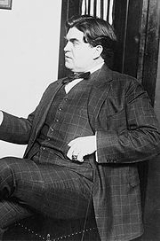
John L. Lewis

Encyclopedia
John Llewellyn Lewis was an American leader of organized labor
who served as president of the United Mine Workers of America
(UMW) from 1920 to 1960. A major player in the history of coal mining
, he was the driving force behind the founding of the Congress of Industrial Organizations
(CIO), which established the United Steel Workers of America and helped organize millions of other industrial workers in the 1930s. After resigning as head of the CIO in 1941, he took the Mine Workers out of the CIO in 1942 and in 1944 took the union into the American Federation of Labor
(AFL).
A leading liberal
, he played a major role in helping Franklin D. Roosevelt
win a landslide in 1936, but as an isolationist
broke with Roosevelt in 1940 on foreign policy. Lewis was a brutally effective and aggressive fighter and strike
leader who gained high wages for his membership while steamrolling over his opponents, including the United States government. Lewis was one of the most controversial and innovative leaders in the history of labor, gaining credit for building the industrial unions of the CIO into a political and economic powerhouse to rival the AFL, yet was widely hated as he called nationwide coal
strikes damaging the American economy in the middle of World War II. His massive leonine head, forest-like eyebrow
s, firmly set jaw, powerful voice and ever-present scowl thrilled his supporters, angered his enemies, and delighted cartoonists. Coal miners for 40 years hailed him as the benevolent dictator who brought high wages, pensions and medical benefits, and damn the critics.
]
from Wales
. Cleveland was a company town
built around a coal mine one mile east of Lucas
. The mother was a Mormon and the boy adopted her rigid views regarding alcohol and sexual propriety, but not her religion. He attended three years of high school in Des Moines and at the age of 17 went to work in the Big Hill Mine at Lucas
. In 1907 he ran for mayor of Lucas and launched a feed-and-grain distributorship. Both were failures and Lewis returned to coal mining; in 1906 was elected a delegate to the United Mine Workers
(UMW) national convention. He moved to Panama, Illinois
, and in 1909 was elected president of the UMW local. In 1911 Samuel Gompers
, the head of the AFL, hired Lewis as a full-time union organizer
. Lewis traveled throughout Pennsylvania
and the Midwest
as an organizer and trouble-shooter, especially in coal and steel districts.
and then as vice-president for the UMWA, Lewis became that union's acting president in 1919. On November 1, 1919, he called the first major coal union strike, as 400,000 miners walked off their jobs. President Wilson obtained an injunction, which Lewis obeyed, telling the rank and file, "We cannot fight the Government.". In 1920 he was elected president of the UMWA. Lewis quickly asserted himself as a dominant figure in what was then the largest and most influential trade union
in the country.
Coal miners worldwide were sympathetic to socialism
, and in the 1920s Communists systematically tried to seize control of UMWA locals. William Z. Foster
, the Communist leader, opposed dual unions in favor of organizing within the UMWA. The radicals were most successful in the bituminous (soft) coal regions of the Midwest, where they used local organizing drives to gain control of locals, sought a national labor political party, and demanded federal nationalization of the industry. Lewis, committed to cooperation among labor, management and government, took tight control of the union. He placed the once-autonomous districts under centralized receivership, packed the union bureaucracy with men directly beholden to him, and used UMWA conventions and publications to discredit his critics. The fight was bitter but Lewis used armed force, red-baiting, and ballot-box stuffing and in 1928 expelled the leftists. As Hudson (1952) shows, they started a separate union, the National Miners' Union. In southern Illinois, amidst widespread violence, the Progressive Mine Workers
of America challenged Lewis, but was beaten back. After 1935 Lewis invited the radical organizers to work for his CIO organizing drives, and they soon gained powerful positions in CIO unions, including auto workers and electrical workers.
Lewis was often denounced as a despotic leader. He repeatedly expelled his political rivals from the UMWA, including John Brophy
, Alexander Howat and Adolph Germer
. Communists in District 26 (Nova Scotia
), including Canadian labor legend J.B. McLachlan, were banned from running for the union executive after a strike in 1923. McLachlan described him as "a traitor" to the working class. Lewis nonetheless commanded great loyalty from many of his followers, even those he had exiled in the past.
A powerful speaker and strategist, Lewis used the nation's dependence on coal to increase the wages and improve the safety of miners, even during several severe recessions. He masterminded a five-month strike, ensuring that the increase in wages gained during World War I
would not be lost. Lewis challenged Samuel Gompers
, who had led the AFL for nearly forty years, for the Presidency of the AFL in 1921. William Green
, one of his subordinates within the Mine Workers at the time, nominated him; William Hutcheson
, the President of the Carpenters
, supported him. Gompers won. Three years later, on Gompers' death, Green succeeded him as AFL President.
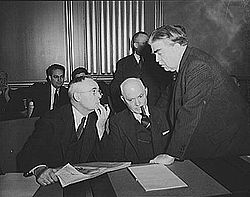 In 1924, Lewis a Republican
, framed a plan for a three year contract between the UMWA and the coal operators, providing for a pay rate of $7.50 per day (about $93.29 in 2009 dollars when adjusted for inflation). President Coolidge and then-Secretary of Commerce Herbert Hoover were impressed with the plan and Lewis was actually offered the post of Secretary of Labor
in Coolidge's cabinet. Lewis declined, a move he later regretted. Without government support, the contract talks failed and coal operators hired non-union miners. The UMWA treasury was drained, but Lewis was able to maintain the union and his position within it. He was successful in winning the 1925 anthracite miners' strike by his oratorical skills.
for president in 1928; in 1932 as the Great Depression
bore brutally on the mining camps, he officially backed Hoover but quietly supported Democrat Franklin D. Roosevelt
. In 1936 his union made the largest single contribution, over $500,000, to Roosevelt's successful campaign for reelection.
Lewis was appointed a member of the Labor Advisory Board and the National Labor Board of the National Recovery Administration
in 1933, and used it to raise wages of miners and reduce competition. He gambled on a massive membership drive, and won, as he piggy-backed on FDR's popularity: "The President wants you to join the UMW!" Coal miners represented many ethnic groups, and Lewis shrewdly realized they shared a faith in Roosevelt; he was careful not to antagonize any of the ethnic groups, and he appealed to African American members as well. He secured the passage of the Guffey Coal Act in 1935, and a second Guffey Act in 1937, both of them favorable to miners. Lewis had long had the idea that the highly competitive bituminous coal industry, with its sharp ups and downs and cut-throat competition, could be stabilized by a powerful union that set a standard wage scale and could keep recalcitrant owners in line with selective strikes. The Guffey acts made this possible, and coal entered a golden era. At all times Lewis rejected socialism and promoted competitive capitalism.
was nominated and elected President in 1932, and Lewis benefited from the New Deal
programs that followed. many of his members received relief. Lewis helped secure passage of the Guffey Coal Act of 1935, which raised prices and wages, but was declared unconstitutional by the Supreme Court. Thanks to the National Labor Relations Act of 1935
(the Wagner Act), union membership grew rapidly, especially in the UMWA. Lewis and the UMW were major backers of Roosevelt's reelection in 1936, and were firmly committed to the New Deal
.
Lewis obtained from the American Federation of Labor
, at its annual convention in 1934, an endorsement of the principle of industrial unionism, as opposed to limitations to skilled workers. His goal was to unionize 400,000 steel workers, using his UMWA resources (augmented by leftists he had expelled in 1928). With the leaders of nine other large industrial unions and the UMWA in November 1935 Lewis formed the "Committee for Industrial Organization" to promote the organization of workers on an industry-wide basis. Key allies were Philip Murray
(the UMWA man Lewis picked to head the steel union); Sidney Hillman
, president of the Amalgamated Clothing Workers of America
(ACWA); and David Dubinsky
of the International Ladies' Garment Workers' Union
(ILGWU).
The entire CIO group was expelled from the AFL in November 1938 and became the Congress of Industrial Organizations
(CIO) with Lewis as the first president. The growth of the CIO was phenomenal in steel, rubber, meat, autos, glass and electrical equipment. In early 1937 his CIO affiliates won collective-bargaining contracts with two of the most powerful anti-union corporations, General Motors
and United States Steel. General Motors surrendered as a result of the great Flint Sit-Down Strike
, during which Lewis negotiated with company executives, Governor Frank Murphy
of Michigan, and President Roosevelt. U.S. Steel conceded without a strike as Lewis secretly negotiated an agreement with Myron Taylor, chairman of U.S. Steel. the CIO gained enormous strength and prestige from the victories in automobiles and steel, and escalated its organizing drives, now targeting industries that the AFL have long claimed, especially meatpacking, textiles, and electrical products. The AFL fought back, and gained even more members, but the two rivals spent much of their energy fighting each other for members and for power inside local Democratic organizations.
limousine like yours, Mr. _____..." (staring at another operator). They are asking only for a slim crust of bread."
, the Republican candidate, fearing Roosevelt's intention for American involvement in World War II at a time when the Soviet Union supported Germany. Over 85% of CIO members voted for Roosevelt, thus rejecting Lewis's leadership. Lewis resigned as president of the CIO, but kept control of the UMWA and withdrew it from the CIO. After the German attack on the Soviets and the Japanese attack on Pearl Harbor
the miners issued a no-strike pledge "for the duration" in support of the war effort. However, Lewis repeatedly violated the pledge, most notably in 1943 when half a million workers walked off the job. Throughout World War II Lewis repeatedly called his miners out on strike, defying the government, outraging public opinion, and strengthening the hand of anti-union Congressmen. Public opinion was extremely angry and demanded and got tough new anti-union laws. President Roosevelt, a traditional ally of labor, felt he had no choice but to seize the mines. Even so, some steel mills closed for weeks and power shortages crippled production.
denounced as threats to national security. In response, industry, railroads and homeowners rapidly switched from coal to oil.
After briefly affiliating with the AFL, Lewis broke with them over signing non-Communist oaths required by the 1947 Taft-Hartley Act
, making the UMW independent again. Lewis, never a Communist himself, refused to allow any of his officials to take the non-Communist oath required by the Taft-Hartley Act; the UMW was therefore denied legal rights protected by the National Labor Relations Board. He denounced Taft-Hartley as authorizing "government by injunction" and refused to follow its provisions, saying he would not be dictated to. Lewis made an outstanding achievement in the postwar years when he secured a welfare fund financed entirely by management but administered by the union. In May 1950 he signed a new contract with the coal operators, ending nine months of regional strikes and opening an era of peaceful negotiations that brought wage increases and new medical benefits, including regional hospitals in the hills.
, maintaining standards for his members by insisting that small operators agree to contract terms that effectively put many of them out of business. Mechanization
nonetheless eliminated many of the jobs in his industry while scattered non-union operations persisted.
Lewis continued to be as autocratic as ever within the UMWA, padding the union payrolls with his friends and family, ignoring or suppressing demands for a rank-and-file voice in union affairs. Finally in 1959 the passage of the Landrum-Griffin Act
forced reform. It ended the practice where the UMWA had kept a number of its districts in trusteeship for decades, meaning that Lewis appointed union officers who otherwise would have been elected by the membership.
He retired in early 1960, as the highly paid membership slipped below 190,000 because of mechanization, strip mining, and competition from oil. He was succeeded as president by Thomas Kennedy
until his death in 1963, when he was succeeded by Lewis-anointed successor W. A. Boyle, who was just as dictatorial, but without any of Lewis' leadership skills or vision.
by President Lyndon B. Johnson
, his citation reading: "[An] eloquent spokesman of labor, [Lewis] has given voice to the aspirations of the industrial workers of the country and led the cause of free trade unions within a healthy system of free enterprise."
Lewis retired to his family home, the Lee-Fendall House
in Alexandria, Virginia
, where he had lived since 1937. He lived there until his death on June 11, 1969. He is buried in Oak Ridge Cemetery
, Springfield, Illinois
.
Labor unions in the United States
Labor unions in the United States are legally recognized as representatives of workers in many industries. The most prominent unions are among public sector employees such as teachers and police...
who served as president of the United Mine Workers of America
United Mine Workers
The United Mine Workers of America is a North American labor union best known for representing coal miners and coal technicians. Today, the Union also represents health care workers, truck drivers, manufacturing workers and public employees in the United States and Canada...
(UMW) from 1920 to 1960. A major player in the history of coal mining
History of coal mining
Due to its abundance, coal has been mined in various parts of the world throughout history and continues to be an important economic activity today. Compared to wood fuels, coal yields a higher amount of energy per mass and could be obtained in areas where wood is not readily available...
, he was the driving force behind the founding of the Congress of Industrial Organizations
Congress of Industrial Organizations
The Congress of Industrial Organizations, or CIO, proposed by John L. Lewis in 1932, was a federation of unions that organized workers in industrial unions in the United States and Canada from 1935 to 1955. The Taft-Hartley Act of 1947 required union leaders to swear that they were not...
(CIO), which established the United Steel Workers of America and helped organize millions of other industrial workers in the 1930s. After resigning as head of the CIO in 1941, he took the Mine Workers out of the CIO in 1942 and in 1944 took the union into the American Federation of Labor
American Federation of Labor
The American Federation of Labor was one of the first federations of labor unions in the United States. It was founded in 1886 by an alliance of craft unions disaffected from the Knights of Labor, a national labor association. Samuel Gompers was elected president of the Federation at its...
(AFL).
A leading liberal
Liberalism in the United States
Liberalism in the United States is a broad political philosophy centered on the unalienable rights of the individual. The fundamental liberal ideals of freedom of speech, freedom of the press, freedom of religion for all belief systems, and the separation of church and state, right to due process...
, he played a major role in helping Franklin D. Roosevelt
Franklin D. Roosevelt
Franklin Delano Roosevelt , also known by his initials, FDR, was the 32nd President of the United States and a central figure in world events during the mid-20th century, leading the United States during a time of worldwide economic crisis and world war...
win a landslide in 1936, but as an isolationist
Isolationism
Isolationism is the policy or doctrine of isolating one's country from the affairs of other nations by declining to enter into alliances, foreign economic commitments, international agreements, etc., seeking to devote the entire efforts of one's country to its own advancement and remain at peace by...
broke with Roosevelt in 1940 on foreign policy. Lewis was a brutally effective and aggressive fighter and strike
Strike action
Strike action, also called labour strike, on strike, greve , or simply strike, is a work stoppage caused by the mass refusal of employees to work. A strike usually takes place in response to employee grievances. Strikes became important during the industrial revolution, when mass labour became...
leader who gained high wages for his membership while steamrolling over his opponents, including the United States government. Lewis was one of the most controversial and innovative leaders in the history of labor, gaining credit for building the industrial unions of the CIO into a political and economic powerhouse to rival the AFL, yet was widely hated as he called nationwide coal
Coal mining
The goal of coal mining is to obtain coal from the ground. Coal is valued for its energy content, and since the 1880s has been widely used to generate electricity. Steel and cement industries use coal as a fuel for extraction of iron from iron ore and for cement production. In the United States,...
strikes damaging the American economy in the middle of World War II. His massive leonine head, forest-like eyebrow
Eyebrow
The eyebrow is an area of thick, delicate hairs above the eye that follows the shape of the lower margin of the brow ridges of some mammals. Their main function is to prevent sweat, water, and other debris from falling down into the eye socket, but they are also important to human communication and...
s, firmly set jaw, powerful voice and ever-present scowl thrilled his supporters, angered his enemies, and delighted cartoonists. Coal miners for 40 years hailed him as the benevolent dictator who brought high wages, pensions and medical benefits, and damn the critics.
]
Early life and rise to power
Lewis was born in Cleveland, Iowa, the son of Thomas H. Lewis and Ann Watkins Lewis, both of whom had immigratedImmigration to the United States
Immigration to the United States has been a major source of population growth and cultural change throughout much of the history of the United States. The economic, social, and political aspects of immigration have caused controversy regarding ethnicity, economic benefits, jobs for non-immigrants,...
from Wales
Wales
Wales is a country that is part of the United Kingdom and the island of Great Britain, bordered by England to its east and the Atlantic Ocean and Irish Sea to its west. It has a population of three million, and a total area of 20,779 km²...
. Cleveland was a company town
Company town
A company town is a town or city in which much or all real estate, buildings , utilities, hospitals, small businesses such as grocery stores and gas stations, and other necessities or luxuries of life within its borders are owned by a single company...
built around a coal mine one mile east of Lucas
Lucas, Iowa
Lucas is a city in Lucas County, Iowa, United States. The population was 243 at the 2000 census.-History:The Burlington and Missouri River Railroad Company established a station at Lucas in 1866, named after Lucas County and Robert Lucas. A plat for the town was filed on May 9, 1868 and the town...
. The mother was a Mormon and the boy adopted her rigid views regarding alcohol and sexual propriety, but not her religion. He attended three years of high school in Des Moines and at the age of 17 went to work in the Big Hill Mine at Lucas
Lucas, Iowa
Lucas is a city in Lucas County, Iowa, United States. The population was 243 at the 2000 census.-History:The Burlington and Missouri River Railroad Company established a station at Lucas in 1866, named after Lucas County and Robert Lucas. A plat for the town was filed on May 9, 1868 and the town...
. In 1907 he ran for mayor of Lucas and launched a feed-and-grain distributorship. Both were failures and Lewis returned to coal mining; in 1906 was elected a delegate to the United Mine Workers
United Mine Workers
The United Mine Workers of America is a North American labor union best known for representing coal miners and coal technicians. Today, the Union also represents health care workers, truck drivers, manufacturing workers and public employees in the United States and Canada...
(UMW) national convention. He moved to Panama, Illinois
Panama, Illinois
Panama is a village in Montgomery and Bond Counties, Illinois, United States. The population was 323 at the 2000 census.-Notable residents:Famous union organizer John L...
, and in 1909 was elected president of the UMW local. In 1911 Samuel Gompers
Samuel Gompers
Samuel Gompers was an English-born American cigar maker who became a labor union leader and a key figure in American labor history. Gompers founded the American Federation of Labor , and served as that organization's president from 1886 to 1894 and from 1895 until his death in 1924...
, the head of the AFL, hired Lewis as a full-time union organizer
Union organizer
A union organizer is a specific type of trade union member or an appointed union official. A majority of unions appoint rather than elect their organizers....
. Lewis traveled throughout Pennsylvania
Pennsylvania
The Commonwealth of Pennsylvania is a U.S. state that is located in the Northeastern and Mid-Atlantic regions of the United States. The state borders Delaware and Maryland to the south, West Virginia to the southwest, Ohio to the west, New York and Ontario, Canada, to the north, and New Jersey to...
and the Midwest
Midwestern United States
The Midwestern United States is one of the four U.S. geographic regions defined by the United States Census Bureau, providing an official definition of the American Midwest....
as an organizer and trouble-shooter, especially in coal and steel districts.
United Mine Workers of America
After serving as statisticianStatistician
A statistician is someone who works with theoretical or applied statistics. The profession exists in both the private and public sectors. The core of that work is to measure, interpret, and describe the world and human activity patterns within it...
and then as vice-president for the UMWA, Lewis became that union's acting president in 1919. On November 1, 1919, he called the first major coal union strike, as 400,000 miners walked off their jobs. President Wilson obtained an injunction, which Lewis obeyed, telling the rank and file, "We cannot fight the Government.". In 1920 he was elected president of the UMWA. Lewis quickly asserted himself as a dominant figure in what was then the largest and most influential trade union
Labor unions in the United States
Labor unions in the United States are legally recognized as representatives of workers in many industries. The most prominent unions are among public sector employees such as teachers and police...
in the country.
Coal miners worldwide were sympathetic to socialism
Socialism
Socialism is an economic system characterized by social ownership of the means of production and cooperative management of the economy; or a political philosophy advocating such a system. "Social ownership" may refer to any one of, or a combination of, the following: cooperative enterprises,...
, and in the 1920s Communists systematically tried to seize control of UMWA locals. William Z. Foster
William Z. Foster
William Foster was a radical American labor organizer and Marxist politician, whose career included a lengthy stint as General Secretary of the Communist Party USA...
, the Communist leader, opposed dual unions in favor of organizing within the UMWA. The radicals were most successful in the bituminous (soft) coal regions of the Midwest, where they used local organizing drives to gain control of locals, sought a national labor political party, and demanded federal nationalization of the industry. Lewis, committed to cooperation among labor, management and government, took tight control of the union. He placed the once-autonomous districts under centralized receivership, packed the union bureaucracy with men directly beholden to him, and used UMWA conventions and publications to discredit his critics. The fight was bitter but Lewis used armed force, red-baiting, and ballot-box stuffing and in 1928 expelled the leftists. As Hudson (1952) shows, they started a separate union, the National Miners' Union. In southern Illinois, amidst widespread violence, the Progressive Mine Workers
Progressive Mine Workers
The Progressive Miners of America was a coal miners' union organized in 1932 in downstate Illinois. It was formed after United Mine Workers President John L. Lewis, sided with coal operators and subverted a contract referendum which would have reduced a miner's daily wage from $6.10 to $5.00.In...
of America challenged Lewis, but was beaten back. After 1935 Lewis invited the radical organizers to work for his CIO organizing drives, and they soon gained powerful positions in CIO unions, including auto workers and electrical workers.
Lewis was often denounced as a despotic leader. He repeatedly expelled his political rivals from the UMWA, including John Brophy
John Brophy (labor)
John Brophy was an important figure in the United Mine Workers of America in the 1920s and the Congress of Industrial Organizations in the 1930s and 1940s. He was the last major challenger to John L...
, Alexander Howat and Adolph Germer
Adolph Germer
Adoph Germer was an American socialist political functionary and union organizer. He is best remembered as National Executive Secretary of the Socialist Party of America from 1916 to 1919. It was during this period that the Left Wing Section of the Socialist Party emerged as an organized faction...
. Communists in District 26 (Nova Scotia
Nova Scotia
Nova Scotia is one of Canada's three Maritime provinces and is the most populous province in Atlantic Canada. The name of the province is Latin for "New Scotland," but "Nova Scotia" is the recognized, English-language name of the province. The provincial capital is Halifax. Nova Scotia is the...
), including Canadian labor legend J.B. McLachlan, were banned from running for the union executive after a strike in 1923. McLachlan described him as "a traitor" to the working class. Lewis nonetheless commanded great loyalty from many of his followers, even those he had exiled in the past.
A powerful speaker and strategist, Lewis used the nation's dependence on coal to increase the wages and improve the safety of miners, even during several severe recessions. He masterminded a five-month strike, ensuring that the increase in wages gained during World War I
World War I
World War I , which was predominantly called the World War or the Great War from its occurrence until 1939, and the First World War or World War I thereafter, was a major war centred in Europe that began on 28 July 1914 and lasted until 11 November 1918...
would not be lost. Lewis challenged Samuel Gompers
Samuel Gompers
Samuel Gompers was an English-born American cigar maker who became a labor union leader and a key figure in American labor history. Gompers founded the American Federation of Labor , and served as that organization's president from 1886 to 1894 and from 1895 until his death in 1924...
, who had led the AFL for nearly forty years, for the Presidency of the AFL in 1921. William Green
William Green (labor leader)
William Green was an American trade union leader. Green is best remembered for serving as the President of the American Federation of Labor from 1924 to 1952.-Early years:...
, one of his subordinates within the Mine Workers at the time, nominated him; William Hutcheson
William Hutcheson
William Hutcheson was the leader of the United Brotherhood of Carpenters and Joiners of America from 1915 until 1952. A conservative craft unionist, he opposed the organization of workers in mass production industries such as steel and automobile manufacturing into industrial unions...
, the President of the Carpenters
United Brotherhood of Carpenters and Joiners of America
The United Brotherhood of Carpenters and Joiners of America is one of the largest building trades union in the United States. One of the unions that formed the American Federation of Labor in 1886, it left the AFL-CIO in 2001.-Early years:...
, supported him. Gompers won. Three years later, on Gompers' death, Green succeeded him as AFL President.
History of the United States Republican Party
The United States Republican Party is the second oldest currently existing political party in the United States after its great rival, the Democratic Party. It emerged in 1854 to combat the Kansas Nebraska Act which threatened to extend slavery into the territories, and to promote more vigorous...
, framed a plan for a three year contract between the UMWA and the coal operators, providing for a pay rate of $7.50 per day (about $93.29 in 2009 dollars when adjusted for inflation). President Coolidge and then-Secretary of Commerce Herbert Hoover were impressed with the plan and Lewis was actually offered the post of Secretary of Labor
United States Secretary of Labor
The United States Secretary of Labor is the head of the Department of Labor who exercises control over the department and enforces and suggests laws involving unions, the workplace, and all other issues involving any form of business-person controversies....
in Coolidge's cabinet. Lewis declined, a move he later regretted. Without government support, the contract talks failed and coal operators hired non-union miners. The UMWA treasury was drained, but Lewis was able to maintain the union and his position within it. He was successful in winning the 1925 anthracite miners' strike by his oratorical skills.
Great Depression
Lewis supported Republican Herbert HooverHerbert Hoover
Herbert Clark Hoover was the 31st President of the United States . Hoover was originally a professional mining engineer and author. As the United States Secretary of Commerce in the 1920s under Presidents Warren Harding and Calvin Coolidge, he promoted partnerships between government and business...
for president in 1928; in 1932 as the Great Depression
Great Depression in the United States
The Great Depression began with the Wall Street Crash of October, 1929 and rapidly spread worldwide. The market crash marked the beginning of a decade of high unemployment, poverty, low profits, deflation, plunging farm incomes, and lost opportunities for economic growth and personal advancement...
bore brutally on the mining camps, he officially backed Hoover but quietly supported Democrat Franklin D. Roosevelt
Franklin D. Roosevelt
Franklin Delano Roosevelt , also known by his initials, FDR, was the 32nd President of the United States and a central figure in world events during the mid-20th century, leading the United States during a time of worldwide economic crisis and world war...
. In 1936 his union made the largest single contribution, over $500,000, to Roosevelt's successful campaign for reelection.
Lewis was appointed a member of the Labor Advisory Board and the National Labor Board of the National Recovery Administration
National Recovery Administration
The National Recovery Administration was the primary New Deal agency established by U.S. president Franklin D. Roosevelt in 1933. The goal was to eliminate "cut-throat competition" by bringing industry, labor and government together to create codes of "fair practices" and set prices...
in 1933, and used it to raise wages of miners and reduce competition. He gambled on a massive membership drive, and won, as he piggy-backed on FDR's popularity: "The President wants you to join the UMW!" Coal miners represented many ethnic groups, and Lewis shrewdly realized they shared a faith in Roosevelt; he was careful not to antagonize any of the ethnic groups, and he appealed to African American members as well. He secured the passage of the Guffey Coal Act in 1935, and a second Guffey Act in 1937, both of them favorable to miners. Lewis had long had the idea that the highly competitive bituminous coal industry, with its sharp ups and downs and cut-throat competition, could be stabilized by a powerful union that set a standard wage scale and could keep recalcitrant owners in line with selective strikes. The Guffey acts made this possible, and coal entered a golden era. At all times Lewis rejected socialism and promoted competitive capitalism.
Founding the CIO
With the support of the AFL and the UMWA, Franklin D. RooseveltFranklin D. Roosevelt
Franklin Delano Roosevelt , also known by his initials, FDR, was the 32nd President of the United States and a central figure in world events during the mid-20th century, leading the United States during a time of worldwide economic crisis and world war...
was nominated and elected President in 1932, and Lewis benefited from the New Deal
New Deal
The New Deal was a series of economic programs implemented in the United States between 1933 and 1936. They were passed by the U.S. Congress during the first term of President Franklin D. Roosevelt. The programs were Roosevelt's responses to the Great Depression, and focused on what historians call...
programs that followed. many of his members received relief. Lewis helped secure passage of the Guffey Coal Act of 1935, which raised prices and wages, but was declared unconstitutional by the Supreme Court. Thanks to the National Labor Relations Act of 1935
National Labor Relations Act
The National Labor Relations Act or Wagner Act , is a 1935 United States federal law that limits the means with which employers may react to workers in the private sector who create labor unions , engage in collective bargaining, and take part in strikes and other forms of concerted activity in...
(the Wagner Act), union membership grew rapidly, especially in the UMWA. Lewis and the UMW were major backers of Roosevelt's reelection in 1936, and were firmly committed to the New Deal
New Deal
The New Deal was a series of economic programs implemented in the United States between 1933 and 1936. They were passed by the U.S. Congress during the first term of President Franklin D. Roosevelt. The programs were Roosevelt's responses to the Great Depression, and focused on what historians call...
.
Lewis obtained from the American Federation of Labor
American Federation of Labor
The American Federation of Labor was one of the first federations of labor unions in the United States. It was founded in 1886 by an alliance of craft unions disaffected from the Knights of Labor, a national labor association. Samuel Gompers was elected president of the Federation at its...
, at its annual convention in 1934, an endorsement of the principle of industrial unionism, as opposed to limitations to skilled workers. His goal was to unionize 400,000 steel workers, using his UMWA resources (augmented by leftists he had expelled in 1928). With the leaders of nine other large industrial unions and the UMWA in November 1935 Lewis formed the "Committee for Industrial Organization" to promote the organization of workers on an industry-wide basis. Key allies were Philip Murray
Philip Murray
Philip Murray was a Scottish born steelworker and an American labor leader. He was the first president of the Steel Workers Organizing Committee , the first president of the United Steelworkers of America , and the longest-serving president of the Congress of Industrial Organizations .-Early...
(the UMWA man Lewis picked to head the steel union); Sidney Hillman
Sidney Hillman
Sidney Hillman was an American labor leader. Head of the Amalgamated Clothing Workers of America, he was a key figure in the founding of the Congress of Industrial Organizations and in marshaling labor's support for Franklin Delano Roosevelt and the Democratic Party.-Early years:Sidney Hillman was...
, president of the Amalgamated Clothing Workers of America
Amalgamated Clothing Workers of America
The Amalgamated Clothing Workers of America was a United States labor union known for its support for "social unionism" and progressive political causes. Led by Sidney Hillman for its first thirty years, it helped found the Congress of Industrial Organizations...
(ACWA); and David Dubinsky
David Dubinsky
David Dubinsky was an American labor leader...
of the International Ladies' Garment Workers' Union
International Ladies' Garment Workers' Union
The International Ladies' Garment Workers' Union was once one of the largest labor unions in the United States, one of the first U.S. unions to have a primarily female membership, and a key player in the labor history of the 1920s and 1930s...
(ILGWU).
The entire CIO group was expelled from the AFL in November 1938 and became the Congress of Industrial Organizations
Congress of Industrial Organizations
The Congress of Industrial Organizations, or CIO, proposed by John L. Lewis in 1932, was a federation of unions that organized workers in industrial unions in the United States and Canada from 1935 to 1955. The Taft-Hartley Act of 1947 required union leaders to swear that they were not...
(CIO) with Lewis as the first president. The growth of the CIO was phenomenal in steel, rubber, meat, autos, glass and electrical equipment. In early 1937 his CIO affiliates won collective-bargaining contracts with two of the most powerful anti-union corporations, General Motors
General Motors
General Motors Company , commonly known as GM, formerly incorporated as General Motors Corporation, is an American multinational automotive corporation headquartered in Detroit, Michigan and the world's second-largest automaker in 2010...
and United States Steel. General Motors surrendered as a result of the great Flint Sit-Down Strike
Flint Sit-Down Strike
The 1936–1937 Flint Sit-Down Strike changed the United Automobile Workers from a collection of isolated locals on the fringes of the industry into a major labor union and led to the unionization of the domestic United States automobile industry....
, during which Lewis negotiated with company executives, Governor Frank Murphy
Frank Murphy
William Francis Murphy was a politician and jurist from Michigan. He served as First Assistant U.S. District Attorney, Eastern Michigan District , Recorder's Court Judge, Detroit . Mayor of Detroit , the last Governor-General of the Philippines , U.S...
of Michigan, and President Roosevelt. U.S. Steel conceded without a strike as Lewis secretly negotiated an agreement with Myron Taylor, chairman of U.S. Steel. the CIO gained enormous strength and prestige from the victories in automobiles and steel, and escalated its organizing drives, now targeting industries that the AFL have long claimed, especially meatpacking, textiles, and electrical products. The AFL fought back, and gained even more members, but the two rivals spent much of their energy fighting each other for members and for power inside local Democratic organizations.
Lewis rhetoric
Journalist C.L. Sulzberger described Lewis's rhetorical skill in the "Crust of Bread" speech. Operators who opposed a contract were often shamed into agreement by Lewis's accusations. A typical Lewis speech to operators would go, "Gentlemen, I speak to you for the miners' families... The little children are gathered around a bare table without anything to eat. They are not asking for a $100,000 yacht like yours, Mr.______..." (here, he would gesture with his cigar toward an operator), "...or for a Rolls-RoyceRolls-Royce Limited
Rolls-Royce Limited was a renowned British car and, from 1914 on, aero-engine manufacturing company founded by Charles Stewart Rolls and Henry Royce on 15 March 1906 as the result of a partnership formed in 1904....
limousine like yours, Mr. _____..." (staring at another operator). They are asking only for a slim crust of bread."
World War II
In the Presidential election of 1940, Lewis, heavily dependent on pro-Soviet organizers, rejected Roosevelt and supported Wendell WillkieWendell Willkie
Wendell Lewis Willkie was a corporate lawyer in the United States and a dark horse who became the Republican Party nominee for the president in 1940. A member of the liberal wing of the GOP, he crusaded against those domestic policies of the New Deal that he thought were inefficient and...
, the Republican candidate, fearing Roosevelt's intention for American involvement in World War II at a time when the Soviet Union supported Germany. Over 85% of CIO members voted for Roosevelt, thus rejecting Lewis's leadership. Lewis resigned as president of the CIO, but kept control of the UMWA and withdrew it from the CIO. After the German attack on the Soviets and the Japanese attack on Pearl Harbor
Attack on Pearl Harbor
The attack on Pearl Harbor was a surprise military strike conducted by the Imperial Japanese Navy against the United States naval base at Pearl Harbor, Hawaii, on the morning of December 7, 1941...
the miners issued a no-strike pledge "for the duration" in support of the war effort. However, Lewis repeatedly violated the pledge, most notably in 1943 when half a million workers walked off the job. Throughout World War II Lewis repeatedly called his miners out on strike, defying the government, outraging public opinion, and strengthening the hand of anti-union Congressmen. Public opinion was extremely angry and demanded and got tough new anti-union laws. President Roosevelt, a traditional ally of labor, felt he had no choice but to seize the mines. Even so, some steel mills closed for weeks and power shortages crippled production.
Postwar
In the postwar years he continued his militancy; his miners went on strikes or "work stoppages" annually. In 1945, 1946, 1948, and 1949–1950, he led strikes that President Harry S. TrumanHarry S. Truman
Harry S. Truman was the 33rd President of the United States . As President Franklin D. Roosevelt's third vice president and the 34th Vice President of the United States , he succeeded to the presidency on April 12, 1945, when President Roosevelt died less than three months after beginning his...
denounced as threats to national security. In response, industry, railroads and homeowners rapidly switched from coal to oil.
After briefly affiliating with the AFL, Lewis broke with them over signing non-Communist oaths required by the 1947 Taft-Hartley Act
Taft-Hartley Act
The Labor–Management Relations Act is a United States federal law that monitors the activities and power of labor unions. The act, still effective, was sponsored by Senator Robert Taft and Representative Fred A. Hartley, Jr. and became law by overriding U.S. President Harry S...
, making the UMW independent again. Lewis, never a Communist himself, refused to allow any of his officials to take the non-Communist oath required by the Taft-Hartley Act; the UMW was therefore denied legal rights protected by the National Labor Relations Board. He denounced Taft-Hartley as authorizing "government by injunction" and refused to follow its provisions, saying he would not be dictated to. Lewis made an outstanding achievement in the postwar years when he secured a welfare fund financed entirely by management but administered by the union. In May 1950 he signed a new contract with the coal operators, ending nine months of regional strikes and opening an era of peaceful negotiations that brought wage increases and new medical benefits, including regional hospitals in the hills.
The 1950s
In the 1950s, Lewis won periodic wage and benefit increases for miners and led the campaign for the first Federal Mine Safety Act in 1952. Lewis tried to impose some order on a declining industry through collective bargainingCollective bargaining
Collective bargaining is a process of negotiations between employers and the representatives of a unit of employees aimed at reaching agreements that regulate working conditions...
, maintaining standards for his members by insisting that small operators agree to contract terms that effectively put many of them out of business. Mechanization
Mechanization
Mechanization or mechanisation is providing human operators with machinery that assists them with the muscular requirements of work or displaces muscular work. In some fields, mechanization includes the use of hand tools...
nonetheless eliminated many of the jobs in his industry while scattered non-union operations persisted.
Lewis continued to be as autocratic as ever within the UMWA, padding the union payrolls with his friends and family, ignoring or suppressing demands for a rank-and-file voice in union affairs. Finally in 1959 the passage of the Landrum-Griffin Act
Labor Management Reporting and Disclosure Act
The Labor Management Reporting and Disclosure Act of 1959 , is a United States labor law that regulates labor unions' internal affairs and their officials' relationships with employers.-Background:...
forced reform. It ended the practice where the UMWA had kept a number of its districts in trusteeship for decades, meaning that Lewis appointed union officers who otherwise would have been elected by the membership.
He retired in early 1960, as the highly paid membership slipped below 190,000 because of mechanization, strip mining, and competition from oil. He was succeeded as president by Thomas Kennedy
Thomas Kennedy (unionist)
Thomas Kennedy was a miner and president of the United Mine Workers of America from 1960 to 1963....
until his death in 1963, when he was succeeded by Lewis-anointed successor W. A. Boyle, who was just as dictatorial, but without any of Lewis' leadership skills or vision.
Retirement and Final Years
On September 14, 1964, four years after his retirement from the UMWA, Lewis was awarded the Presidential Medal of FreedomPresidential Medal of Freedom
The Presidential Medal of Freedom is an award bestowed by the President of the United States and is—along with thecomparable Congressional Gold Medal bestowed by an act of U.S. Congress—the highest civilian award in the United States...
by President Lyndon B. Johnson
Lyndon B. Johnson
Lyndon Baines Johnson , often referred to as LBJ, was the 36th President of the United States after his service as the 37th Vice President of the United States...
, his citation reading: "[An] eloquent spokesman of labor, [Lewis] has given voice to the aspirations of the industrial workers of the country and led the cause of free trade unions within a healthy system of free enterprise."
Lewis retired to his family home, the Lee-Fendall House
Lee-Fendall House
The Lee-Fendall House is an urban plantation family home in Old Town Alexandria, Virginia. Since its construction in 1785 the house has served as home to thirty-seven members of the Lee family , hundreds of convalescing Union soldiers , the prominent Downham family , and powerful labor leader John L...
in Alexandria, Virginia
Alexandria, Virginia
Alexandria is an independent city in the Commonwealth of Virginia. As of 2009, the city had a total population of 139,966. Located along the Western bank of the Potomac River, Alexandria is approximately six miles south of downtown Washington, D.C.Like the rest of northern Virginia, as well as...
, where he had lived since 1937. He lived there until his death on June 11, 1969. He is buried in Oak Ridge Cemetery
Oak Ridge Cemetery
Oak Ridge Cemetery is a cemetery located in Springfield, Illinois in the United States.Lincoln's Tomb, which serves as the final resting place of Abraham Lincoln, his wife and all but one of his children, is located at Oak Ridge...
, Springfield, Illinois
Springfield, Illinois
Springfield is the third and current capital of the US state of Illinois and the county seat of Sangamon County with a population of 117,400 , making it the sixth most populated city in the state and the second most populated Illinois city outside of the Chicago Metropolitan Area...
.
Primary sources
See also
- Labor history of the United StatesLabor history of the United StatesThe labor history of the United States describes the history of organized labor, as well as the more general history of working people, in the United States. Pressures dictating the nature and power of organized labor have included the evolution and power of the corporation, efforts by employers...
- New Deal CoalitionNew Deal coalitionThe New Deal Coalition was the alignment of interest groups and voting blocs that supported the New Deal and voted for Democratic presidential candidates from 1932 until the late 1960s. It made the Democratic Party the majority party during that period, losing only to Dwight D. Eisenhower in 1952...
External links
- Lewis's biography on the United Mine Workers of America's website
- Medium-length biography from a history site
- John L. Lewis Labor and the Nation, delivered 3 September 1937 in Washington D.C., American Rhetoric, top 100 Speeches, transcript of speech.
- John L. Lewis Museum of Mining and Labor in Lucas, Iowa
- Footage John L. Lewis leading s strike in 1919.
- FBI file on John L. Lewis
- Lee-Fendall House