

Liberalism in the United States

Encyclopedia
Liberalism in the United States is a broad political philosophy centered on the unalienable rights of the individual. The fundamental liberal
ideals of freedom of speech
, freedom of the press
, freedom of religion
for all belief systems, and the separation of church and state
, right to due process
and equality under the law are widely accepted as a common foundation across the spectrum of liberal thought. The main focus of modern liberalism in the United States includes issues such as voting rights for all adult citizens, equal rights
, protection of the environment
, and the provision by the government of social services, such as: equal education opportunities, access to health care, transportation infrastructure, basic food for the hungry and basic shelter for the homeless. Some American liberals, who call themselves classical liberals
, neoliberals
, or libertarians
, support fundamental liberal ideals but disagree with modern liberal thought, holding that economic freedom
is more important than equality of opportunity, and that promoting the general welfare of society exceeds the legitimate role of government.
Without a qualifier, the term "liberalism" since the 1930s in the United States usually refers to "modern liberalism", a political philosophy exemplified by Franklin Delano Roosevelt's New Deal
and, later, Lyndon Johnson's Great Society
. It is a form of social liberalism
, whose accomplishments include the Works Progress Administration
and the Social Security Act in 1935, the Civil Rights Act of 1964
, the Community Reinvestment Act
and the Voting Rights Act of 1965.
According to Louis Hartz
, liberalism in the United States differs from liberalism elsewhere in the world
because America never had a resident hereditary aristocracy
, and so avoided the worst of the class warfare that swept Europe.
. The Constitution of the United States set up one of the first modern republic
s, with no monarch and no hereditary aristocracy. However, the Constitution limited liberty by accepting slavery
. The Founding Fathers recognized the contradiction, and most expected slavery to wither away. Indeed it was abolished in all the Northern states by 1804, but due to the demand for raw cotton by the Industrial Revolution
, plantation slavery continued to flourish in the Deep South.
From the time of the American Civil War to the present day, America has extended liberty to ever broader classes of people. These extensions of liberty usually came through action of the federal government. The constitution was amended in 1865 to abolish slavery, in 1870 to extend the vote to Black men, in 1920 to extend the vote to women, in 1964 to abolish the poll tax used in many Southern states to deny the vote to Blacks, and in 1971 to lower the voting age to 18. The Jim Crow system of the South between the 1870s and 1960s relegated blacks to second class citizenship, until it was overthrown by the Civil Rights Movement
and new federal laws in 1964 and 1965.
Thomas Jefferson believed that America should remain a nation of small farmers. As America became more and more a nation of businessmen, liberals began to fear threats to liberty from corruption and monopolies (called "trusts" at the time). Wealth was concentrated in the hands of a few—especially in the new fast-growing cities—raised questions whether political democracy could survive the power of the rich.
The dominance of the Republican Party for most of the era 1860-1932, the Third Party System
, and the Fourth Party System
, prevented any major reversal of the concentration of wealth
. During the Progressive Era
of the early 20th century, laws were passed restricting monopolies (the antitrust movement) and regulating railroad rates.
After 1933, modern liberals used the New Deal
to provide jobs during the Great Depression
. The Social Security act of 1935
provided retirement and disability income for Americans unable to work or unable to find jobs. In the Social Security Act of 1965
, this was extended to provide benefits for Americans unable to work due to illness.
In the 1960s, liberals fought for the rights of blacks and women, and for protection of the environment. They split on the issue of the Vietnam War.
A reaction against modern American liberalism began with the Reagan era, starting with the election of Ronald Reagan
in 1980. The intellectual foundations of this conservative resurgence included the works of free-market economists Milton Friedman
and the Chicago School of Economics, who argued against central economic planning, regulation of business, and Keynesian economics. Deregulation began in the mid-1970s and had broad support from both liberals and conservatives. Reagan successfully lowered income tax rates and closed many tax loopholes. He brokered Social Security reforms with a compromise that won support from liberals and conservatives. Democratic president Bill Clinton
(1993–2001) worked with conservatives, against strong liberal opposition, to end some of the main welfare programs and to implement NAFTA, linking the economies of the U.S., Canada, and Mexico. Clinton pushed to extend modern liberal ideals especially in the areas of health care (where he failed) and environmental protection (where he had more success).
According to Louis Hartz
, liberalism was the only significant political tradition in the United States. However in the 1970s, Bernard Bailyn
, Gordon Wood
and J. G. A. Pocock saw republicanism
as the main political tradition. In the 1980s, J. David Green returned to Hartz's thesis, but saw two different types of liberalism in the tradition, which he called humanist and reform. More recently, writers have seen a multitude of traditions, including liberalism, republicanism and protestantism.
and other philosophers of the Enlightenment, with no monarchy, no hereditary aristocracy, and no established religion. The American Bill of Rights
guarantees every citizen the freedoms advocated by the liberal philosophers: freedom of religion, freedom of speech, freedom of the press, the right to gather in peaceful assembly, the right to petition the government for redress of grievances, and the right to bear arms, among other freedoms and rights. In this sense, virtually all Americans are liberals. However, questions arose, both before and after the country was founded. In the Dred Scott
decision of 1856-57, the Supreme Court ruled that these rights only applied to White men, and that Blacks had no rights what-so-ever that any White man was obliged to respect. Therefore the constitution was amended several times to extend these rights to ever larger classes of citizens, to all citizens in 1868, then specifically to Blacks in 1870, to women in 1919, and to people unable to afford a poll tax in 1964.
in the United States (also called laissez-faire liberalism) is the belief that a free market economy is the most productive. It may be represented by Henry David Thoreau
's statement "that government is best which governs least." Classical liberalism is a philosophy of individualism and self-responsibility. Classical liberals in the United States believe that if the economy is left to the natural forces of supply and demand, free of government intervention, the result is the most abundant satisfaction of human wants. Modern classical liberals oppose the concepts of social democracy
and the welfare state
.
(1841–1913) published Dynamic Sociology: Or Applied social science as based upon statical sociology and the less complex sciences and laid out the basic tenets of modern American liberalism while at the same time attacking the laissez-faire policies advocated by Herbert Spencer
and William Graham Sumner
. Ward was a passionate advocate for a sociology which would intelligently and scientifically direct the development of society.
Another influential thinker in the Progressive Era
was Herbert Croly
(1869 – 1930). He effectively combined classical liberal theory with progressive
philosophy and founded the periodical The New Republic
to present his ideas. Croly presented the case for a mixed economy
, increased spending on education, and the creation of a society based on the "brotherhood of mankind." In 1909, Croly published The Promise of American Life
, in which he proposed raising the general standard of living by means of economic planning, though he opposed aggressive unionization. In The Techniques of Democracy
(1915) he argued against both dogmatic individualism and dogmatic socialism. As editor of the New Republic
, Croly had the forum to reach the intellectual community.
(1882 – 1945), came to office in 1933 amid the economic calamity of the Great Depression
, offering the nation a New Deal
intended to alleviate economic want and joblessness, provide greater opportunities, and restore prosperity. His presidency from 1933 to 1945, the longest in U.S. history, was marked by an increased role for the Federal government in addressing the nation's economic and other problems. Work relief programs provided jobs, ambitious projects such as the Tennessee Valley Authority
were created to promote economic development, and a Social Security system was established. The Great Depression dragged on through the 1930s, however, despite the New Deal programs, which met with mixed success in solving the nation's economic problems. Economic progress for minorities was hindered by discrimination, about which the Roosevelt administration did less than subsequent administrations, but more than had been done before. The New Deal provided direct relief for minorities in the 1930s (through the Works Progress Administration
, Civilian Conservation Corps
and other agencies); and, during World War II, executive orders and the FEPC opened millions of new jobs to minorities and forbade discrimination in companies with government contracts. The 1.5 million black veterans in 1945 were fully entitled to generous veteran benefits from the GI Bill on the same basis as everyone else.
The New Deal consisted of three types of programs designed to produce "Relief, Recovery and Reform":
Relief was the immediate effort to help the one-third of the population that was hardest hit by the depression. Roosevelt expanded Hoover's FERA work relief program, and added the Civilian Conservation Corps
(CCC), Public Works Administration
(PWA), and starting in 1935 the Works Progress Administration
(WPA). In 1935 the Social Security Act (SSA) and unemployment insurance programs were added. Separate programs were set up for relief in rural areas, such as the Resettlement Administration
and Farm Security Administration
.
Recovery was the goal of restoring the economy to pre-depression levels. It involved "pump priming" (deficit spending), dropping the gold standard
, efforts to re-inflate farm prices that were too low, and efforts to increase foreign trade. New Deal efforts to help corporate America
were chiefly channeled through a Hoover program, the Reconstruction Finance Corporation
(RFC).
Reform was based on the assumption that the depression was caused by the inherent instability of the market and that government intervention was necessary to rationalize and stabilize the economy, and to balance the interests of farmers, business and labor. Reform measures included the National Industrial Recovery Act
(NIRA), regulation of Wall Street by the Securities Exchange Act
(SEA), the Agricultural Adjustment Act
(AAA) for farm programs, Federal Deposit Insurance Corporation
(FDIC) insurance for bank deposits enacted through the Glass–Steagall Act of 1933, and the National Labor Relations Act
(NLRA) (also known as the Wagner Act) dealing with labor-management relations. Despite urgings by some New Dealers, there was no major anti-trust program. Roosevelt opposed socialism
(in the sense of state ownership of the means of production), and only one major program, the Tennessee Valley Authority
(TVA), involved government ownership of the means of production.
In international affairs, Roosevelt's presidency was dominated by isolationism until 1938, followed by an increasingly central role in World War II
, especially after America's formal entry into the war in 1941. Anticipating the post-war period, Roosevelt strongly supported proposals to create a United Nations
organization as a means of encouraging mutual cooperation to solve problems on the international stage. His commitment to internationalist ideals was in the tradition of Woodrow Wilson
, architect of the failed League of Nations
, and led to his support for the establishment of the United Nations
, with the proviso that the U.S. would have a veto power.
era was the immediate heir to Franklin Delano Roosevelt's New Deal
and the slightly more distant heir to the Progressives
of the early 20th century. Sol Stern
wrote, "Cold War liberalism deserves credit for the greatest American achievement since World War II
— winning the Cold War."
The essential tenets of Cold War liberalism can be found in Roosevelt's Four Freedoms
(1941): of these, freedom of speech
and of religion
were classic liberal freedoms, as was "freedom from fear" (freedom from tyrannical government), but "freedom from want" was another matter. Roosevelt proposed a notion of freedom that went beyond government non-interference in private lives. "Freedom from want" could justify positive government action to meet economic needs, a concept more associated with the concepts of Lincoln's Republican party, Clay's Whig Party, and Hamilton's economic principles of government intervention and subsidy than the more radical socialism
and social democracy
of European thinkers or with prior versions of classical liberalism as represented by Jefferson's Democratic-Republican and Jackson's Democratic party.
In the 1950s and '60s
, both major U.S. political parties included liberal and conservative factions. The Democratic Party
had two wings: on the one hand, Northern and Western liberals, on the other generally conservative Southern whites. Difficult to classify were the northern urban
Democratic "political machine
s". The urban machines had supported New Deal economic policies, but would slowly come apart over racial issues. Some historians have divided the Republican Party
into liberal Wall Street
and conservative Main Street
factions; others have noted that the GOP's conservatives came from landlocked states (Robert Taft of Ohio and Barry Goldwater of Arizona) and the liberals tended to come from California (Earl Warren and Paul N. "Pete" McCloskey), New York (Nelson Rockefeller
), and other coastal states.
Opposing both communism
and conservatism, Cold War liberalism resembled earlier "liberalisms" in its views on many social issues and personal liberty, but its economic views were not those of free-market
Jeffersonian liberalism nor those of European social democrats. They never endorsed state socialism, but did call for spending on education, science, and infrastructure, notably the expansion of NASA
and the construction of the Interstate Highway System
. Their progressive ideas continued the legacy of Lincoln, Woodrow Wilson, Theodore Roosevelt, and Franklin Delano Roosevelt.
Most prominent and constant among the positions of Cold War liberalism were:
At first liberals generally did not see FDR's successor Harry S. Truman
as one of their own, viewing him as a Democratic Party hack. However, liberal politicians and liberal organizations such as the Americans for Democratic Action
(ADA) sided with Truman in opposing communism both at home and abroad, sometimes at the sacrifice of civil liberties
. Hubert Humphrey
, for example, in 1950 put before the Senate a bill to establish detention centers where those declared subversive by the President
could be held without trial. It did not pass.
Liberals were united in their opposition to McCarthyism
.
could write that "liberalism is not only the dominant but even the sole intellectual tradition... there are no conservative or reactionary ideas in circulation."
For almost two decades, Cold War liberalism remained the dominant paradigm in U.S. politics, peaking with the landslide victory of Lyndon B. Johnson
over Barry Goldwater
in the 1964 presidential election. Lyndon Johnson had been a New Deal Democrat in the 1930s and by the 1950s had decided that the Democratic Party had to break from its segregationist past and endorse racial liberalism as well as economic liberalism. In the face of the disastrous defeat of Goldwater, the Republicans accepted more than a few of Johnson's ideas as their own, so to a very real extent, the policies of President Johnson became the policies of the Republican administrations of Richard M. Nixon and Gerald R. Ford.
s were politically and economically disenfranchised. Beginning with To Secure These Rights, an official report issued by the Truman White House in 1947, self-proclaimed liberals increasingly embraced the civil rights movement. In 1948, President Truman desegregated the armed forces and the Democrats inserted a strong civil rights plank in the party platform, even though delegates from the Deep South walked out, and nominated a third party ticket, called Dixiecrat, headed by Strom Thurmond
. Truman abolished discrimination in the Armed Forces, which led to the integration of military units in the early 1950s. However, no civil rights legislation was passed until a weak bill was passed in 1957.
During the 1960s, relations between white liberals and the civil rights movement became increasingly strained; civil rights leaders accused liberal politicians of temporizing and procrastinating, although they realize they needed the support of Northern lights to pass any legislation over Southern obstructionism. The white liberals believed the grassroots movement for civil rights would only anger many Southern whites and make it even more difficult to pass civil rights laws through Congress. Thereafter, in response to that concern, civil rights leader Martin Luther King, Jr.
agreed to tone down the March on Washington
in 1963. Kennedy finally endorsed the March on Washington, and proposed what would become the Civil Rights Act of 1964
, but he could not get it passed during his lifetime. Lyndon Johnson, who took office in November 1963, used the image of Kennedy's martyrdom to mobilize northern support, along with the black leadership community, to pass major civil rights legislation, the Civil Rights Act of 1964
and the Voting Rights Act of 1965. The result was an end to segregation, and an end to restrictions on black voting, but also a wave of black riots in the inner cities, but made for "long hot summers" in every major city from 1964 through 1970. The riots alienated much of the white working class, that had been the base of the labor union element in the civil rights coalition.
The civil rights movement itself was becoming fractured. On 8 March 1964, Malcolm X
stated he was going to organize a black nationalist
organization that would try to "heighten the political consciousness" of African Americans. By 1966, a Black Power
movement had emerged; Black Power advocates accused white liberals of trying to control the civil rights agenda. Proponents of Black Power wanted African-Americans to follow an "ethnic model" for obtaining power, not unlike that of Democratic political machines in large cities. This put them on a collision course with urban machine politicians. And, on its edges, the Black Power movement contained racial separatists who wanted to give up on integration altogether — a program that could not be endorsed by American liberals of any race. The mere existence of such individuals (who always got more media attention than their actual numbers might have warranted) contributed to "white backlash" against liberals and civil rights activists.
protesters of the late 1960s and early 1970s began to organize into a recognizable school of thought known as the New Left
, many "anti-Soviet liberals and social democrats in the tradition of Roosevelt, Truman, Kennedy, Johnson, Humphrey and Henry ("Scoop") Jackson… preferred to call themselves 'paleoliberals'", according to historian Michael Lind
.
Lind also notes that some of these people became neoconservatives
. , although paleoliberals such as Peter Beinart
exist to this day.
threw a wedge into the liberal ranks, dividing pro-war "hawks" such as Senator Henry M. Jackson
from "doves" such as Senator (and 1972 presidential candidate) George McGovern
. As the war became the leading political issue of the day, agreement on domestic matters was not enough to hold the liberal consensus together.
Vietnam was part of the strategy of containment
of Soviet Communism. In the 1960 presidential campaign, the liberal Kennedy was more hawkish on Southeast Asia
than the conservative Richard Nixon. Although it can be argued that the war expanded only under the less liberal Johnson, there was much continuity of their cabinets
.
As opposition to the war grew, a large portion of that opposition came from within liberal ranks. In 1968, the Dump Johnson movement
forced Democratic President Johnson out of the race for his own party's nomination for the presidency. Assassination removed Robert Kennedy from contention and Vice President
Hubert Humphrey emerged from the disastrous 1968 Democratic National Convention
with the presidential nomination of a deeply divided party. The party's right wing
had seceded to run Alabama
governor
George Wallace
, and some on the left chose to sit out the election rather than vote for a man so closely associated with the Johnson administration (and with Chicago
mayor Richard J. Daley
). The result was a narrow victory for Republican Richard Nixon, a man who, although a California
native, was largely regarded as from the old Northeast Republican
Establishment, and quite liberal in many areas. Nixon enacted many liberal policies, including the establishment of the Environmental Protection Agency
, normalizing relations with Communist China
, and starting the Strategic Arms Limitation Talks
to reduce the availability of ballistic missile
s.
and William Scranton
, and Nixon overtly placed an emphasis on "law and order" over civil liberties, and Nixon's Enemies List
was composed largely of liberals – in some ways the continuity of many of Nixon's policies with those of the Kennedy-Johnson years is more remarkable than the differences. Pointing at this continuity, Noam Chomsky
has called Nixon, "in many respects the last liberal president."
Although liberals turned increasingly against the Vietnam War, to the point of running the very dovish George McGovern
for President in 1972, the war had, as noted above, been of largely liberal origin. Similarly, while many liberals condemned actions such as the Nixon administrations support for the 1973 Chilean coup, it was not entirely dissimilar to the Bay of Pigs Invasion
in 1961 or the marine landing in the Dominican Republic in 1965
.
The political dominance of the liberal consensus, even into the Nixon years, can best be seen in policies such as the establishment of the Environmental Protection Agency or in Nixon's (failed) proposal to replace the welfare system with a guaranteed annual income by way of a negative income tax
. Affirmative action
in its most quota-oriented form was a Nixon administration policy. Even the Nixon "War on Drugs
" allocated two-thirds of its funds for treatment, a far higher ratio than was to be the case under any subsequent President, Republican or Democrat. Additionally, Nixon's normalization of diplomatic relations with the People's Republic of China
and his policy of détente with the Soviet Union were probably more popular with liberals than with his conservative base.
An opposing view, offered by Cass R. Sunstein, in The Second Bill of Rights (Basic Books, 2004, ISBN 0-465-08332-3) argues that Nixon, through his Supreme Court appointments, effectively ended a decades-long expansion under U.S. law of economic rights along the lines of those put forward in the Universal Declaration of Human Rights
, adopted in 1948 by the United Nations General Assembly
.
 During the Nixon years (and through the 1970s), the liberal consensus began to come apart. The alliance with white Southern Democrats had been lost in the Civil Rights era. While the steady enfranchisement of African Americans expanded the electorate to include many new voters sympathetic to liberal views, it was not quite enough to make up for the loss of some Southern Democrats. Organized labor, long a bulwark of the liberal consensus, was past the peak of its power in the U.S. and many unions had remained in favor of the Vietnam War even as liberal politicians increasingly turned against it. Within the Democratic party leadership, there was a turn of moderation after the defeat of arch-liberal George McGovern in 1972.
Meanwhile, in the Republican ranks, a new wing of the party emerged. The libertarian
Goldwater Republicans laid the groundwork for, and partially fed in to the Reagan
Republicans. In 1980, Ronald Reagan was the Republican party's Presidential nominee. More centrist
groups such as the Democratic Leadership Council
(DLC) were on equal footing with liberals for control of the Democratic Party in this time. The centrist-liberal alliance of the federal level Democrats lasted through the 1980s, but declined in the 1990s when more conservative political figures sided with the Republican party.
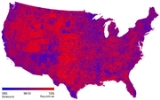
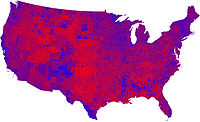
The voting maps to the right show the outcome of the 2008 presidential election
, in which Barack Obama
, the Democratic candidate, became the first African-American to be elected to the White House.
and CBS News
, between 18% and 27% of American adults identify as liberal, versus moderate or conservative. In the 2008 presidential election
, exit polls showed that 22% of the electorate self-identified as "liberal." According to a 2004 study by the Pew Research Center, liberals were tied with the conservative sub-group, the "Enterprisers", for the most affluent group, and were the ideological demographic with the highest rate of college education. Of those who identified as liberal, 49% were college graduates and 41% had household incomes exceeding $75,000, compared to 27% and 28% as the national average, respectively.
Liberalism also remains the dominant political ideology in academia, with 72% of full-time faculty identifying as liberal in a 2004 study. The social sciences
and humanities
were most liberal, whereas business and engineering departments were the least liberal, though even in the business departments, liberals outnumbered conservatives 49% to 39%. Generally, the more educated a person is the more likely he or she is to hold liberal beliefs.
In the 2000, 2004 and 2006 elections, the vast majority of liberals voted in favor of the Democrats
, though liberals may also show support for the Greens
.
Liberalism
Liberalism is the belief in the importance of liberty and equal rights. Liberals espouse a wide array of views depending on their understanding of these principles, but generally, liberals support ideas such as constitutionalism, liberal democracy, free and fair elections, human rights,...
ideals of freedom of speech
Freedom of speech
Freedom of speech is the freedom to speak freely without censorship. The term freedom of expression is sometimes used synonymously, but includes any act of seeking, receiving and imparting information or ideas, regardless of the medium used...
, freedom of the press
Freedom of the press
Freedom of the press or freedom of the media is the freedom of communication and expression through vehicles including various electronic media and published materials...
, freedom of religion
Freedom of religion
Freedom of religion is a principle that supports the freedom of an individual or community, in public or private, to manifest religion or belief in teaching, practice, worship, and observance; the concept is generally recognized also to include the freedom to change religion or not to follow any...
for all belief systems, and the separation of church and state
Separation of church and state
The concept of the separation of church and state refers to the distance in the relationship between organized religion and the nation state....
, right to due process
Due process
Due process is the legal code that the state must venerate all of the legal rights that are owed to a person under the principle. Due process balances the power of the state law of the land and thus protects individual persons from it...
and equality under the law are widely accepted as a common foundation across the spectrum of liberal thought. The main focus of modern liberalism in the United States includes issues such as voting rights for all adult citizens, equal rights
Equal rights
Equal rights can refer to:*Equality before the law, when all people have the same rights*Human rights, when such rights are held in common by all people*Civil rights, when such rights are held in common by all citizens of a nation...
, protection of the environment
Environmental justice
Environmental justice is "the fair treatment and meaningful involvement of all people regardless of race, color, sex, national origin, or income with respect to the development, implementation and enforcement of environmental laws, regulations, and policies." In the words of Bunyan Bryant,...
, and the provision by the government of social services, such as: equal education opportunities, access to health care, transportation infrastructure, basic food for the hungry and basic shelter for the homeless. Some American liberals, who call themselves classical liberals
Classical liberalism
Classical liberalism is the philosophy committed to the ideal of limited government, constitutionalism, rule of law, due process, and liberty of individuals including freedom of religion, speech, press, assembly, and free markets....
, neoliberals
Neoliberalism
Neoliberalism is a market-driven approach to economic and social policy based on neoclassical theories of economics that emphasizes the efficiency of private enterprise, liberalized trade and relatively open markets, and therefore seeks to maximize the role of the private sector in determining the...
, or libertarians
Libertarianism
Libertarianism, in the strictest sense, is the political philosophy that holds individual liberty as the basic moral principle of society. In the broadest sense, it is any political philosophy which approximates this view...
, support fundamental liberal ideals but disagree with modern liberal thought, holding that economic freedom
Economic freedom
Economic freedom is a term used in economic and policy debates. As with freedom generally, there are various definitions, but no universally accepted concept of economic freedom...
is more important than equality of opportunity, and that promoting the general welfare of society exceeds the legitimate role of government.
Without a qualifier, the term "liberalism" since the 1930s in the United States usually refers to "modern liberalism", a political philosophy exemplified by Franklin Delano Roosevelt's New Deal
New Deal
The New Deal was a series of economic programs implemented in the United States between 1933 and 1936. They were passed by the U.S. Congress during the first term of President Franklin D. Roosevelt. The programs were Roosevelt's responses to the Great Depression, and focused on what historians call...
and, later, Lyndon Johnson's Great Society
Great Society
The Great Society was a set of domestic programs in the United States promoted by President Lyndon B. Johnson and fellow Democrats in Congress in the 1960s. Two main goals of the Great Society social reforms were the elimination of poverty and racial injustice...
. It is a form of social liberalism
Social liberalism
Social liberalism is the belief that liberalism should include social justice. It differs from classical liberalism in that it believes the legitimate role of the state includes addressing economic and social issues such as unemployment, health care, and education while simultaneously expanding...
, whose accomplishments include the Works Progress Administration
Works Progress Administration
The Works Progress Administration was the largest and most ambitious New Deal agency, employing millions of unskilled workers to carry out public works projects, including the construction of public buildings and roads, and operated large arts, drama, media, and literacy projects...
and the Social Security Act in 1935, the Civil Rights Act of 1964
Civil Rights Act of 1964
The Civil Rights Act of 1964 was a landmark piece of legislation in the United States that outlawed major forms of discrimination against African Americans and women, including racial segregation...
, the Community Reinvestment Act
Community Reinvestment Act
The Community Reinvestment Act is a United States federal law designed to encourage commercial banks and savings associations to help meet the needs of borrowers in all segments of their communities, including low- and moderate-income neighborhoods...
and the Voting Rights Act of 1965.
According to Louis Hartz
Louis Hartz
Louis Hartz was an American political scientist and influential liberal proponent of the idea of American exceptionalism....
, liberalism in the United States differs from liberalism elsewhere in the world
Liberalism worldwide
This article gives information on liberalism in diverse countries around the world. It is an overview of parties that adhere more or less to the ideas of political liberalism and is therefore a list of liberal parties around the world....
because America never had a resident hereditary aristocracy
Aristocracy (class)
The aristocracy are people considered to be in the highest social class in a society which has or once had a political system of Aristocracy. Aristocrats possess hereditary titles granted by a monarch, which once granted them feudal or legal privileges, or deriving, as in Ancient Greece and India,...
, and so avoided the worst of the class warfare that swept Europe.
History
The origins of American liberalism lie in the political ideals of The EnlightenmentAge of Enlightenment
The Age of Enlightenment was an elite cultural movement of intellectuals in 18th century Europe that sought to mobilize the power of reason in order to reform society and advance knowledge. It promoted intellectual interchange and opposed intolerance and abuses in church and state...
. The Constitution of the United States set up one of the first modern republic
Republic
A republic is a form of government in which the people, or some significant portion of them, have supreme control over the government and where offices of state are elected or chosen by elected people. In modern times, a common simplified definition of a republic is a government where the head of...
s, with no monarch and no hereditary aristocracy. However, the Constitution limited liberty by accepting slavery
Slavery
Slavery is a system under which people are treated as property to be bought and sold, and are forced to work. Slaves can be held against their will from the time of their capture, purchase or birth, and deprived of the right to leave, to refuse to work, or to demand compensation...
. The Founding Fathers recognized the contradiction, and most expected slavery to wither away. Indeed it was abolished in all the Northern states by 1804, but due to the demand for raw cotton by the Industrial Revolution
Industrial Revolution
The Industrial Revolution was a period from the 18th to the 19th century where major changes in agriculture, manufacturing, mining, transportation, and technology had a profound effect on the social, economic and cultural conditions of the times...
, plantation slavery continued to flourish in the Deep South.
From the time of the American Civil War to the present day, America has extended liberty to ever broader classes of people. These extensions of liberty usually came through action of the federal government. The constitution was amended in 1865 to abolish slavery, in 1870 to extend the vote to Black men, in 1920 to extend the vote to women, in 1964 to abolish the poll tax used in many Southern states to deny the vote to Blacks, and in 1971 to lower the voting age to 18. The Jim Crow system of the South between the 1870s and 1960s relegated blacks to second class citizenship, until it was overthrown by the Civil Rights Movement
Civil rights movement
The civil rights movement was a worldwide political movement for equality before the law occurring between approximately 1950 and 1980. In many situations it took the form of campaigns of civil resistance aimed at achieving change by nonviolent forms of resistance. In some situations it was...
and new federal laws in 1964 and 1965.
Thomas Jefferson believed that America should remain a nation of small farmers. As America became more and more a nation of businessmen, liberals began to fear threats to liberty from corruption and monopolies (called "trusts" at the time). Wealth was concentrated in the hands of a few—especially in the new fast-growing cities—raised questions whether political democracy could survive the power of the rich.
The dominance of the Republican Party for most of the era 1860-1932, the Third Party System
Third Party System
The Third Party System is a term of periodization used by historians and political scientists to describe a period in American political history from about 1854 to the mid-1890s that featured profound developments in issues of nationalism, modernization, and race...
, and the Fourth Party System
Fourth Party System
The Fourth Party System is the term used in political science and history for the period in American political history from about 1896 to 1932 that was dominated by the Republican party, excepting the 1912 split in which Democrats held the White House for eight years. History texts usually call it...
, prevented any major reversal of the concentration of wealth
Concentration of wealth
"Concentration of wealth" often refers to:*Wealth condensationRelated:*Distribution of wealth*Income disparity*Economic inequality*Income inequality metrics*International inequality...
. During the Progressive Era
Progressive Era
The Progressive Era in the United States was a period of social activism and political reform that flourished from the 1890s to the 1920s. One main goal of the Progressive movement was purification of government, as Progressives tried to eliminate corruption by exposing and undercutting political...
of the early 20th century, laws were passed restricting monopolies (the antitrust movement) and regulating railroad rates.
After 1933, modern liberals used the New Deal
New Deal
The New Deal was a series of economic programs implemented in the United States between 1933 and 1936. They were passed by the U.S. Congress during the first term of President Franklin D. Roosevelt. The programs were Roosevelt's responses to the Great Depression, and focused on what historians call...
to provide jobs during the Great Depression
Great Depression
The Great Depression was a severe worldwide economic depression in the decade preceding World War II. The timing of the Great Depression varied across nations, but in most countries it started in about 1929 and lasted until the late 1930s or early 1940s...
. The Social Security act of 1935
Social Security (United States)
In the United States, Social Security refers to the federal Old-Age, Survivors, and Disability Insurance program.The original Social Security Act and the current version of the Act, as amended encompass several social welfare and social insurance programs...
provided retirement and disability income for Americans unable to work or unable to find jobs. In the Social Security Act of 1965
Social Security Act of 1965
The Social Security Amendments of 1965 was legislation in the United States whose most important provisions resulted in creation of two programs: Medicare and Medicaid. The legislation initially provided federal health insurance for the elderly and for poor families. While President Lyndon B...
, this was extended to provide benefits for Americans unable to work due to illness.
In the 1960s, liberals fought for the rights of blacks and women, and for protection of the environment. They split on the issue of the Vietnam War.
A reaction against modern American liberalism began with the Reagan era, starting with the election of Ronald Reagan
Ronald Reagan
Ronald Wilson Reagan was the 40th President of the United States , the 33rd Governor of California and, prior to that, a radio, film and television actor....
in 1980. The intellectual foundations of this conservative resurgence included the works of free-market economists Milton Friedman
Milton Friedman
Milton Friedman was an American economist, statistician, academic, and author who taught at the University of Chicago for more than three decades...
and the Chicago School of Economics, who argued against central economic planning, regulation of business, and Keynesian economics. Deregulation began in the mid-1970s and had broad support from both liberals and conservatives. Reagan successfully lowered income tax rates and closed many tax loopholes. He brokered Social Security reforms with a compromise that won support from liberals and conservatives. Democratic president Bill Clinton
Bill Clinton
William Jefferson "Bill" Clinton is an American politician who served as the 42nd President of the United States from 1993 to 2001. Inaugurated at age 46, he was the third-youngest president. He took office at the end of the Cold War, and was the first president of the baby boomer generation...
(1993–2001) worked with conservatives, against strong liberal opposition, to end some of the main welfare programs and to implement NAFTA, linking the economies of the U.S., Canada, and Mexico. Clinton pushed to extend modern liberal ideals especially in the areas of health care (where he failed) and environmental protection (where he had more success).
According to Louis Hartz
Louis Hartz
Louis Hartz was an American political scientist and influential liberal proponent of the idea of American exceptionalism....
, liberalism was the only significant political tradition in the United States. However in the 1970s, Bernard Bailyn
Bernard Bailyn
Bernard Bailyn is an American historian, author, and professor specializing in U.S. Colonial and Revolutionary-era History. He has been a professor at Harvard University since 1953. Bailyn has won the Pulitzer Prize for History twice . In 1998 the National Endowment for the Humanities selected...
, Gordon Wood
Gordon Wood
Gordon Wood may refer to:* Gordon S. Wood , American historian* Gordon Wood , high school football coach in Texas* Gordon Wood , Australian...
and J. G. A. Pocock saw republicanism
Republicanism in the United States
Republicanism is the political value system that has been a major part of American civic thought since the American Revolution. It stresses liberty and inalienable rights as central values, makes the people as a whole sovereign, supports activist government to promote the common good, rejects...
as the main political tradition. In the 1980s, J. David Green returned to Hartz's thesis, but saw two different types of liberalism in the tradition, which he called humanist and reform. More recently, writers have seen a multitude of traditions, including liberalism, republicanism and protestantism.
Early Liberalism
The United States of America was the first country to be founded on the liberal ideas of John LockeJohn Locke
John Locke FRS , widely known as the Father of Liberalism, was an English philosopher and physician regarded as one of the most influential of Enlightenment thinkers. Considered one of the first of the British empiricists, following the tradition of Francis Bacon, he is equally important to social...
and other philosophers of the Enlightenment, with no monarchy, no hereditary aristocracy, and no established religion. The American Bill of Rights
Bill of rights
A bill of rights is a list of the most important rights of the citizens of a country. The purpose of these bills is to protect those rights against infringement. The term "bill of rights" originates from England, where it referred to the Bill of Rights 1689. Bills of rights may be entrenched or...
guarantees every citizen the freedoms advocated by the liberal philosophers: freedom of religion, freedom of speech, freedom of the press, the right to gather in peaceful assembly, the right to petition the government for redress of grievances, and the right to bear arms, among other freedoms and rights. In this sense, virtually all Americans are liberals. However, questions arose, both before and after the country was founded. In the Dred Scott
Dred Scott
Dred Scott , was an African-American slave in the United States who unsuccessfully sued for his freedom and that of his wife and their two daughters in the Dred Scott v...
decision of 1856-57, the Supreme Court ruled that these rights only applied to White men, and that Blacks had no rights what-so-ever that any White man was obliged to respect. Therefore the constitution was amended several times to extend these rights to ever larger classes of citizens, to all citizens in 1868, then specifically to Blacks in 1870, to women in 1919, and to people unable to afford a poll tax in 1964.
Classical liberalism
Classical liberalismClassical liberalism
Classical liberalism is the philosophy committed to the ideal of limited government, constitutionalism, rule of law, due process, and liberty of individuals including freedom of religion, speech, press, assembly, and free markets....
in the United States (also called laissez-faire liberalism) is the belief that a free market economy is the most productive. It may be represented by Henry David Thoreau
Henry David Thoreau
Henry David Thoreau was an American author, poet, philosopher, abolitionist, naturalist, tax resister, development critic, surveyor, historian, and leading transcendentalist...
's statement "that government is best which governs least." Classical liberalism is a philosophy of individualism and self-responsibility. Classical liberals in the United States believe that if the economy is left to the natural forces of supply and demand, free of government intervention, the result is the most abundant satisfaction of human wants. Modern classical liberals oppose the concepts of social democracy
Social democracy
Social democracy is a political ideology of the center-left on the political spectrum. Social democracy is officially a form of evolutionary reformist socialism. It supports class collaboration as the course to achieve socialism...
and the welfare state
Welfare state
A welfare state is a "concept of government in which the state plays a key role in the protection and promotion of the economic and social well-being of its citizens. It is based on the principles of equality of opportunity, equitable distribution of wealth, and public responsibility for those...
.
Modern liberalism
In 1883 Lester Frank WardLester Frank Ward
Lester F. Ward was an American botanist, paleontologist, and sociologist. He served as the first president of the American Sociological Association.-Biography:...
(1841–1913) published Dynamic Sociology: Or Applied social science as based upon statical sociology and the less complex sciences and laid out the basic tenets of modern American liberalism while at the same time attacking the laissez-faire policies advocated by Herbert Spencer
Herbert Spencer
Herbert Spencer was an English philosopher, biologist, sociologist, and prominent classical liberal political theorist of the Victorian era....
and William Graham Sumner
William Graham Sumner
William Graham Sumner was an American academic and "held the first professorship in sociology" at Yale College. For many years he had a reputation as one of the most influential teachers there. He was a polymath with numerous books and essays on American history, economic history, political...
. Ward was a passionate advocate for a sociology which would intelligently and scientifically direct the development of society.
Another influential thinker in the Progressive Era
Progressive Era
The Progressive Era in the United States was a period of social activism and political reform that flourished from the 1890s to the 1920s. One main goal of the Progressive movement was purification of government, as Progressives tried to eliminate corruption by exposing and undercutting political...
was Herbert Croly
Herbert Croly
Herbert David Croly was an intellectual leader of the Progressive Movement as an editor, and political philosopher and a co-founder of the magazine The New Republic in early twentieth-century America...
(1869 – 1930). He effectively combined classical liberal theory with progressive
Progressivism
Progressivism is an umbrella term for a political ideology advocating or favoring social, political, and economic reform or changes. Progressivism is often viewed by some conservatives, constitutionalists, and libertarians to be in opposition to conservative or reactionary ideologies.The...
philosophy and founded the periodical The New Republic
The New Republic
The magazine has also published two articles concerning income inequality, largely criticizing conservative economists for their attempts to deny the existence or negative effect increasing income inequality is having on the United States...
to present his ideas. Croly presented the case for a mixed economy
Mixed economy
Mixed economy is an economic system in which both the state and private sector direct the economy, reflecting characteristics of both market economies and planned economies. Most mixed economies can be described as market economies with strong regulatory oversight, in addition to having a variety...
, increased spending on education, and the creation of a society based on the "brotherhood of mankind." In 1909, Croly published The Promise of American Life
The Promise of American Life
The Promises of American Life is a book published by Herbert Croly, founder of The New Republic, in 1909. This book opposed aggressive unionization and supported economic planning to raise general quality of life...
, in which he proposed raising the general standard of living by means of economic planning, though he opposed aggressive unionization. In The Techniques of Democracy
The Techniques of Democracy
The Techniques of Democracy is a book written by Herbert Croly, founder of the magazine The New Republic. It was published in 1942 by New York City publishers Duell, Sloan and Pearce. In this book, Croly argues against both dogmatic individualism and dogmatic socialism....
(1915) he argued against both dogmatic individualism and dogmatic socialism. As editor of the New Republic
The New Republic
The magazine has also published two articles concerning income inequality, largely criticizing conservative economists for their attempts to deny the existence or negative effect increasing income inequality is having on the United States...
, Croly had the forum to reach the intellectual community.
The New Deal
President Franklin D. RooseveltFranklin D. Roosevelt
Franklin Delano Roosevelt , also known by his initials, FDR, was the 32nd President of the United States and a central figure in world events during the mid-20th century, leading the United States during a time of worldwide economic crisis and world war...
(1882 – 1945), came to office in 1933 amid the economic calamity of the Great Depression
Great Depression
The Great Depression was a severe worldwide economic depression in the decade preceding World War II. The timing of the Great Depression varied across nations, but in most countries it started in about 1929 and lasted until the late 1930s or early 1940s...
, offering the nation a New Deal
New Deal
The New Deal was a series of economic programs implemented in the United States between 1933 and 1936. They were passed by the U.S. Congress during the first term of President Franklin D. Roosevelt. The programs were Roosevelt's responses to the Great Depression, and focused on what historians call...
intended to alleviate economic want and joblessness, provide greater opportunities, and restore prosperity. His presidency from 1933 to 1945, the longest in U.S. history, was marked by an increased role for the Federal government in addressing the nation's economic and other problems. Work relief programs provided jobs, ambitious projects such as the Tennessee Valley Authority
Tennessee Valley Authority
The Tennessee Valley Authority is a federally owned corporation in the United States created by congressional charter in May 1933 to provide navigation, flood control, electricity generation, fertilizer manufacturing, and economic development in the Tennessee Valley, a region particularly affected...
were created to promote economic development, and a Social Security system was established. The Great Depression dragged on through the 1930s, however, despite the New Deal programs, which met with mixed success in solving the nation's economic problems. Economic progress for minorities was hindered by discrimination, about which the Roosevelt administration did less than subsequent administrations, but more than had been done before. The New Deal provided direct relief for minorities in the 1930s (through the Works Progress Administration
Works Progress Administration
The Works Progress Administration was the largest and most ambitious New Deal agency, employing millions of unskilled workers to carry out public works projects, including the construction of public buildings and roads, and operated large arts, drama, media, and literacy projects...
, Civilian Conservation Corps
Civilian Conservation Corps
The Civilian Conservation Corps was a public work relief program that operated from 1933 to 1942 in the United States for unemployed, unmarried men from relief families, ages 18–25. A part of the New Deal of President Franklin D...
and other agencies); and, during World War II, executive orders and the FEPC opened millions of new jobs to minorities and forbade discrimination in companies with government contracts. The 1.5 million black veterans in 1945 were fully entitled to generous veteran benefits from the GI Bill on the same basis as everyone else.
The New Deal consisted of three types of programs designed to produce "Relief, Recovery and Reform":
Relief was the immediate effort to help the one-third of the population that was hardest hit by the depression. Roosevelt expanded Hoover's FERA work relief program, and added the Civilian Conservation Corps
Civilian Conservation Corps
The Civilian Conservation Corps was a public work relief program that operated from 1933 to 1942 in the United States for unemployed, unmarried men from relief families, ages 18–25. A part of the New Deal of President Franklin D...
(CCC), Public Works Administration
Public Works Administration
The Public Works Administration , part of the New Deal of 1933, was a large-scale public works construction agency in the United States headed by Secretary of the Interior Harold L. Ickes. It was created by the National Industrial Recovery Act in June 1933 in response to the Great Depression...
(PWA), and starting in 1935 the Works Progress Administration
Works Progress Administration
The Works Progress Administration was the largest and most ambitious New Deal agency, employing millions of unskilled workers to carry out public works projects, including the construction of public buildings and roads, and operated large arts, drama, media, and literacy projects...
(WPA). In 1935 the Social Security Act (SSA) and unemployment insurance programs were added. Separate programs were set up for relief in rural areas, such as the Resettlement Administration
Resettlement Administration
The Resettlement Administration was a U.S. federal agency that, between April 1935 and December 1936, relocated struggling urban and rural families to communities planned by the federal government....
and Farm Security Administration
Farm Security Administration
Initially created as the Resettlement Administration in 1935 as part of the New Deal in the United States, the Farm Security Administration was an effort during the Depression to combat American rural poverty...
.
Recovery was the goal of restoring the economy to pre-depression levels. It involved "pump priming" (deficit spending), dropping the gold standard
Gold standard
The gold standard is a monetary system in which the standard economic unit of account is a fixed mass of gold. There are distinct kinds of gold standard...
, efforts to re-inflate farm prices that were too low, and efforts to increase foreign trade. New Deal efforts to help corporate America
Corporate America
Corporate America is an informal phrase describing the world of corporations within the United States not under government ownership....
were chiefly channeled through a Hoover program, the Reconstruction Finance Corporation
Reconstruction Finance Corporation
The Reconstruction Finance Corporation was an independent agency of the United States government, established and chartered by the US Congress in 1932, Act of January 22, 1932, c. 8, 47 Stat. 5, during the administration of President Herbert Hoover. It was modeled after the War Finance Corporation...
(RFC).
Reform was based on the assumption that the depression was caused by the inherent instability of the market and that government intervention was necessary to rationalize and stabilize the economy, and to balance the interests of farmers, business and labor. Reform measures included the National Industrial Recovery Act
National Industrial Recovery Act
The National Industrial Recovery Act , officially known as the Act of June 16, 1933 The National Industrial Recovery Act (NIRA), officially known as the Act of June 16, 1933 The National Industrial Recovery Act (NIRA), officially known as the Act of June 16, 1933 (Ch. 90, 48 Stat. 195, formerly...
(NIRA), regulation of Wall Street by the Securities Exchange Act
Securities Exchange Act of 1934
The Securities Exchange Act of 1934 , , codified at et seq., is a law governing the secondary trading of securities in the United States of America. It was a sweeping piece of legislation...
(SEA), the Agricultural Adjustment Act
Agricultural Adjustment Act
The Agricultural Adjustment Act was a United States federal law of the New Deal era which restricted agricultural production by paying farmers subsidies not to plant part of their land and to kill off excess livestock...
(AAA) for farm programs, Federal Deposit Insurance Corporation
Federal Deposit Insurance Corporation
The Federal Deposit Insurance Corporation is a United States government corporation created by the Glass–Steagall Act of 1933. It provides deposit insurance, which guarantees the safety of deposits in member banks, currently up to $250,000 per depositor per bank. , the FDIC insures deposits at...
(FDIC) insurance for bank deposits enacted through the Glass–Steagall Act of 1933, and the National Labor Relations Act
National Labor Relations Act
The National Labor Relations Act or Wagner Act , is a 1935 United States federal law that limits the means with which employers may react to workers in the private sector who create labor unions , engage in collective bargaining, and take part in strikes and other forms of concerted activity in...
(NLRA) (also known as the Wagner Act) dealing with labor-management relations. Despite urgings by some New Dealers, there was no major anti-trust program. Roosevelt opposed socialism
Socialism
Socialism is an economic system characterized by social ownership of the means of production and cooperative management of the economy; or a political philosophy advocating such a system. "Social ownership" may refer to any one of, or a combination of, the following: cooperative enterprises,...
(in the sense of state ownership of the means of production), and only one major program, the Tennessee Valley Authority
Tennessee Valley Authority
The Tennessee Valley Authority is a federally owned corporation in the United States created by congressional charter in May 1933 to provide navigation, flood control, electricity generation, fertilizer manufacturing, and economic development in the Tennessee Valley, a region particularly affected...
(TVA), involved government ownership of the means of production.
In international affairs, Roosevelt's presidency was dominated by isolationism until 1938, followed by an increasingly central role in World War II
World War II
World War II, or the Second World War , was a global conflict lasting from 1939 to 1945, involving most of the world's nations—including all of the great powers—eventually forming two opposing military alliances: the Allies and the Axis...
, especially after America's formal entry into the war in 1941. Anticipating the post-war period, Roosevelt strongly supported proposals to create a United Nations
United Nations
The United Nations is an international organization whose stated aims are facilitating cooperation in international law, international security, economic development, social progress, human rights, and achievement of world peace...
organization as a means of encouraging mutual cooperation to solve problems on the international stage. His commitment to internationalist ideals was in the tradition of Woodrow Wilson
Woodrow Wilson
Thomas Woodrow Wilson was the 28th President of the United States, from 1913 to 1921. A leader of the Progressive Movement, he served as President of Princeton University from 1902 to 1910, and then as the Governor of New Jersey from 1911 to 1913...
, architect of the failed League of Nations
League of Nations
The League of Nations was an intergovernmental organization founded as a result of the Paris Peace Conference that ended the First World War. It was the first permanent international organization whose principal mission was to maintain world peace...
, and led to his support for the establishment of the United Nations
United Nations
The United Nations is an international organization whose stated aims are facilitating cooperation in international law, international security, economic development, social progress, human rights, and achievement of world peace...
, with the proviso that the U.S. would have a veto power.
Liberalism during the Cold War
U.S. liberalism of the Cold WarCold War
The Cold War was the continuing state from roughly 1946 to 1991 of political conflict, military tension, proxy wars, and economic competition between the Communist World—primarily the Soviet Union and its satellite states and allies—and the powers of the Western world, primarily the United States...
era was the immediate heir to Franklin Delano Roosevelt's New Deal
New Deal
The New Deal was a series of economic programs implemented in the United States between 1933 and 1936. They were passed by the U.S. Congress during the first term of President Franklin D. Roosevelt. The programs were Roosevelt's responses to the Great Depression, and focused on what historians call...
and the slightly more distant heir to the Progressives
Progressive Era
The Progressive Era in the United States was a period of social activism and political reform that flourished from the 1890s to the 1920s. One main goal of the Progressive movement was purification of government, as Progressives tried to eliminate corruption by exposing and undercutting political...
of the early 20th century. Sol Stern
Sol Stern
Sol Stern is a senior fellow with the conservative Manhattan Institute and a contributing editor to its quarterly magazine City Journal. He is the author of Breaking Free: Public School Lessons and the Imperative of School Choice , and has written extensively on education reform...
wrote, "Cold War liberalism deserves credit for the greatest American achievement since World War II
World War II
World War II, or the Second World War , was a global conflict lasting from 1939 to 1945, involving most of the world's nations—including all of the great powers—eventually forming two opposing military alliances: the Allies and the Axis...
— winning the Cold War."
The essential tenets of Cold War liberalism can be found in Roosevelt's Four Freedoms
Four Freedoms
The Four Freedoms were goals articulated by US President Franklin D. Roosevelt on January 6, 1941. In an address known as the Four Freedoms speech , he proposed four fundamental freedoms that people "everywhere in the world" ought to enjoy:# Freedom of speech and expression# Freedom of worship#...
(1941): of these, freedom of speech
Freedom of speech
Freedom of speech is the freedom to speak freely without censorship. The term freedom of expression is sometimes used synonymously, but includes any act of seeking, receiving and imparting information or ideas, regardless of the medium used...
and of religion
Freedom of religion
Freedom of religion is a principle that supports the freedom of an individual or community, in public or private, to manifest religion or belief in teaching, practice, worship, and observance; the concept is generally recognized also to include the freedom to change religion or not to follow any...
were classic liberal freedoms, as was "freedom from fear" (freedom from tyrannical government), but "freedom from want" was another matter. Roosevelt proposed a notion of freedom that went beyond government non-interference in private lives. "Freedom from want" could justify positive government action to meet economic needs, a concept more associated with the concepts of Lincoln's Republican party, Clay's Whig Party, and Hamilton's economic principles of government intervention and subsidy than the more radical socialism
Socialism
Socialism is an economic system characterized by social ownership of the means of production and cooperative management of the economy; or a political philosophy advocating such a system. "Social ownership" may refer to any one of, or a combination of, the following: cooperative enterprises,...
and social democracy
Social democracy
Social democracy is a political ideology of the center-left on the political spectrum. Social democracy is officially a form of evolutionary reformist socialism. It supports class collaboration as the course to achieve socialism...
of European thinkers or with prior versions of classical liberalism as represented by Jefferson's Democratic-Republican and Jackson's Democratic party.
In the 1950s and '60s
1960s
The 1960s was the decade that started on January 1, 1960, and ended on December 31, 1969. It was the seventh decade of the 20th century.The 1960s term also refers to an era more often called The Sixties, denoting the complex of inter-related cultural and political trends across the globe...
, both major U.S. political parties included liberal and conservative factions. The Democratic Party
Democratic Party (United States)
The Democratic Party is one of two major contemporary political parties in the United States, along with the Republican Party. The party's socially liberal and progressive platform is largely considered center-left in the U.S. political spectrum. The party has the lengthiest record of continuous...
had two wings: on the one hand, Northern and Western liberals, on the other generally conservative Southern whites. Difficult to classify were the northern urban
Urban area
An urban area is characterized by higher population density and vast human features in comparison to areas surrounding it. Urban areas may be cities, towns or conurbations, but the term is not commonly extended to rural settlements such as villages and hamlets.Urban areas are created and further...
Democratic "political machine
Political machine
A political machine is a political organization in which an authoritative boss or small group commands the support of a corps of supporters and businesses , who receive rewards for their efforts...
s". The urban machines had supported New Deal economic policies, but would slowly come apart over racial issues. Some historians have divided the Republican Party
Republican Party (United States)
The Republican Party is one of the two major contemporary political parties in the United States, along with the Democratic Party. Founded by anti-slavery expansion activists in 1854, it is often called the GOP . The party's platform generally reflects American conservatism in the U.S...
into liberal Wall Street
Wall Street
Wall Street refers to the financial district of New York City, named after and centered on the eight-block-long street running from Broadway to South Street on the East River in Lower Manhattan. Over time, the term has become a metonym for the financial markets of the United States as a whole, or...
and conservative Main Street
Main Street
Main Street is the metonym for a generic street name of the primary retail street of a village, town, or small city in many parts of the world...
factions; others have noted that the GOP's conservatives came from landlocked states (Robert Taft of Ohio and Barry Goldwater of Arizona) and the liberals tended to come from California (Earl Warren and Paul N. "Pete" McCloskey), New York (Nelson Rockefeller
Nelson Rockefeller
Nelson Aldrich Rockefeller was the 41st Vice President of the United States , serving under President Gerald Ford, and the 49th Governor of New York , as well as serving the Roosevelt, Truman and Eisenhower administrations in a variety of positions...
), and other coastal states.
Opposing both communism
Communism
Communism is a social, political and economic ideology that aims at the establishment of a classless, moneyless, revolutionary and stateless socialist society structured upon common ownership of the means of production...
and conservatism, Cold War liberalism resembled earlier "liberalisms" in its views on many social issues and personal liberty, but its economic views were not those of free-market
Free market
A free market is a competitive market where prices are determined by supply and demand. However, the term is also commonly used for markets in which economic intervention and regulation by the state is limited to tax collection, and enforcement of private ownership and contracts...
Jeffersonian liberalism nor those of European social democrats. They never endorsed state socialism, but did call for spending on education, science, and infrastructure, notably the expansion of NASA
NASA
The National Aeronautics and Space Administration is the agency of the United States government that is responsible for the nation's civilian space program and for aeronautics and aerospace research...
and the construction of the Interstate Highway System
Interstate Highway System
The Dwight D. Eisenhower National System of Interstate and Defense Highways, , is a network of limited-access roads including freeways, highways, and expressways forming part of the National Highway System of the United States of America...
. Their progressive ideas continued the legacy of Lincoln, Woodrow Wilson, Theodore Roosevelt, and Franklin Delano Roosevelt.
Most prominent and constant among the positions of Cold War liberalism were:
- Support for a domestic economy built on a balance of power between labor (in the form of organized unionsTrade unionA trade union, trades union or labor union is an organization of workers that have banded together to achieve common goals such as better working conditions. The trade union, through its leadership, bargains with the employer on behalf of union members and negotiates labour contracts with...
) and management (with a tendency to be more interested in large corporations than in small businessSmall businessA small business is a business that is privately owned and operated, with a small number of employees and relatively low volume of sales. Small businesses are normally privately owned corporations, partnerships, or sole proprietorships...
). - A foreign policy focused on containing the Soviet UnionSoviet UnionThe Soviet Union , officially the Union of Soviet Socialist Republics , was a constitutionally socialist state that existed in Eurasia between 1922 and 1991....
and its allies. - The continuation and expansion of New Deal social welfare programs (in the broad sense of welfare, including programs such as Social SecuritySocial Security (United States)In the United States, Social Security refers to the federal Old-Age, Survivors, and Disability Insurance program.The original Social Security Act and the current version of the Act, as amended encompass several social welfare and social insurance programs...
). - An embrace of Keynesian economicsKeynesian economicsKeynesian economics is a school of macroeconomic thought based on the ideas of 20th-century English economist John Maynard Keynes.Keynesian economics argues that private sector decisions sometimes lead to inefficient macroeconomic outcomes and, therefore, advocates active policy responses by the...
. By way of compromise with political groupings to their right, this often became, in practice military KeynesianismMilitary KeynesianismMilitary Keynesianism is the accusation that John Maynard Keynes advocated government economic policy in which the government devotes large amounts of spending to the military in an effort to increase economic growth. In fact, the English economist John Maynard Keynes advocated that government...
.
At first liberals generally did not see FDR's successor Harry S. Truman
Harry S. Truman
Harry S. Truman was the 33rd President of the United States . As President Franklin D. Roosevelt's third vice president and the 34th Vice President of the United States , he succeeded to the presidency on April 12, 1945, when President Roosevelt died less than three months after beginning his...
as one of their own, viewing him as a Democratic Party hack. However, liberal politicians and liberal organizations such as the Americans for Democratic Action
Americans for Democratic Action
Americans for Democratic Action is an American political organization advocating progressive policies. ADA works for social and economic justice through lobbying, grassroots organizing, research and supporting progressive candidates.-History:...
(ADA) sided with Truman in opposing communism both at home and abroad, sometimes at the sacrifice of civil liberties
Civil liberties
Civil liberties are rights and freedoms that provide an individual specific rights such as the freedom from slavery and forced labour, freedom from torture and death, the right to liberty and security, right to a fair trial, the right to defend one's self, the right to own and bear arms, the right...
. Hubert Humphrey
Hubert Humphrey
Hubert Horatio Humphrey, Jr. , served under President Lyndon B. Johnson as the 38th Vice President of the United States. Humphrey twice served as a United States Senator from Minnesota, and served as Democratic Majority Whip. He was a founder of the Minnesota Democratic-Farmer-Labor Party and...
, for example, in 1950 put before the Senate a bill to establish detention centers where those declared subversive by the President
President of the United States
The President of the United States of America is the head of state and head of government of the United States. The president leads the executive branch of the federal government and is the commander-in-chief of the United States Armed Forces....
could be held without trial. It did not pass.
Liberals were united in their opposition to McCarthyism
McCarthyism
McCarthyism is the practice of making accusations of disloyalty, subversion, or treason without proper regard for evidence. The term has its origins in the period in the United States known as the Second Red Scare, lasting roughly from the late 1940s to the late 1950s and characterized by...
.
The liberal consensus
By 1950, the liberal ideology was so intellectually dominant that the literary critic Lionel TrillingLionel Trilling
Lionel Trilling was an American literary critic, author, and teacher. With wife Diana Trilling, he was a member of the New York Intellectuals and contributor to the Partisan Review. Although he did not establish a school of literary criticism, he is one of the leading U.S...
could write that "liberalism is not only the dominant but even the sole intellectual tradition... there are no conservative or reactionary ideas in circulation."
For almost two decades, Cold War liberalism remained the dominant paradigm in U.S. politics, peaking with the landslide victory of Lyndon B. Johnson
Lyndon B. Johnson
Lyndon Baines Johnson , often referred to as LBJ, was the 36th President of the United States after his service as the 37th Vice President of the United States...
over Barry Goldwater
Barry Goldwater
Barry Morris Goldwater was a five-term United States Senator from Arizona and the Republican Party's nominee for President in the 1964 election. An articulate and charismatic figure during the first half of the 1960s, he was known as "Mr...
in the 1964 presidential election. Lyndon Johnson had been a New Deal Democrat in the 1930s and by the 1950s had decided that the Democratic Party had to break from its segregationist past and endorse racial liberalism as well as economic liberalism. In the face of the disastrous defeat of Goldwater, the Republicans accepted more than a few of Johnson's ideas as their own, so to a very real extent, the policies of President Johnson became the policies of the Republican administrations of Richard M. Nixon and Gerald R. Ford.
Liberals and civil rights
Cold War liberalism emerged at a time when most African AmericanAfrican American
African Americans are citizens or residents of the United States who have at least partial ancestry from any of the native populations of Sub-Saharan Africa and are the direct descendants of enslaved Africans within the boundaries of the present United States...
s were politically and economically disenfranchised. Beginning with To Secure These Rights, an official report issued by the Truman White House in 1947, self-proclaimed liberals increasingly embraced the civil rights movement. In 1948, President Truman desegregated the armed forces and the Democrats inserted a strong civil rights plank in the party platform, even though delegates from the Deep South walked out, and nominated a third party ticket, called Dixiecrat, headed by Strom Thurmond
Strom Thurmond
James Strom Thurmond was an American politician who served as a United States Senator. He also ran for the Presidency of the United States in 1948 as the segregationist States Rights Democratic Party candidate, receiving 2.4% of the popular vote and 39 electoral votes...
. Truman abolished discrimination in the Armed Forces, which led to the integration of military units in the early 1950s. However, no civil rights legislation was passed until a weak bill was passed in 1957.
During the 1960s, relations between white liberals and the civil rights movement became increasingly strained; civil rights leaders accused liberal politicians of temporizing and procrastinating, although they realize they needed the support of Northern lights to pass any legislation over Southern obstructionism. The white liberals believed the grassroots movement for civil rights would only anger many Southern whites and make it even more difficult to pass civil rights laws through Congress. Thereafter, in response to that concern, civil rights leader Martin Luther King, Jr.
Martin Luther King, Jr.
Martin Luther King, Jr. was an American clergyman, activist, and prominent leader in the African-American Civil Rights Movement. He is best known for being an iconic figure in the advancement of civil rights in the United States and around the world, using nonviolent methods following the...
agreed to tone down the March on Washington
March on Washington for Jobs and Freedom
The March on Washington for Jobs and Freedom was the largest political rally for human rights in United States history and called for civil and economic rights for African Americans. It took place in Washington, D.C. on Wednesday, August 28, 1963. Martin Luther King, Jr...
in 1963. Kennedy finally endorsed the March on Washington, and proposed what would become the Civil Rights Act of 1964
Civil Rights Act of 1964
The Civil Rights Act of 1964 was a landmark piece of legislation in the United States that outlawed major forms of discrimination against African Americans and women, including racial segregation...
, but he could not get it passed during his lifetime. Lyndon Johnson, who took office in November 1963, used the image of Kennedy's martyrdom to mobilize northern support, along with the black leadership community, to pass major civil rights legislation, the Civil Rights Act of 1964
Civil Rights Act of 1964
The Civil Rights Act of 1964 was a landmark piece of legislation in the United States that outlawed major forms of discrimination against African Americans and women, including racial segregation...
and the Voting Rights Act of 1965. The result was an end to segregation, and an end to restrictions on black voting, but also a wave of black riots in the inner cities, but made for "long hot summers" in every major city from 1964 through 1970. The riots alienated much of the white working class, that had been the base of the labor union element in the civil rights coalition.
The civil rights movement itself was becoming fractured. On 8 March 1964, Malcolm X
Malcolm X
Malcolm X , born Malcolm Little and also known as El-Hajj Malik El-Shabazz , was an African American Muslim minister and human rights activist. To his admirers he was a courageous advocate for the rights of African Americans, a man who indicted white America in the harshest terms for its...
stated he was going to organize a black nationalist
Black nationalism
Black nationalism advocates a racial definition of indigenous national identity, as opposed to multiculturalism. There are different indigenous nationalist philosophies but the principles of all African nationalist ideologies are unity, and self-determination or independence from European society...
organization that would try to "heighten the political consciousness" of African Americans. By 1966, a Black Power
Black Power
Black Power is a political slogan and a name for various associated ideologies. It is used in the movement among people of Black African descent throughout the world, though primarily by African Americans in the United States...
movement had emerged; Black Power advocates accused white liberals of trying to control the civil rights agenda. Proponents of Black Power wanted African-Americans to follow an "ethnic model" for obtaining power, not unlike that of Democratic political machines in large cities. This put them on a collision course with urban machine politicians. And, on its edges, the Black Power movement contained racial separatists who wanted to give up on integration altogether — a program that could not be endorsed by American liberals of any race. The mere existence of such individuals (who always got more media attention than their actual numbers might have warranted) contributed to "white backlash" against liberals and civil rights activists.
Paleoliberalism
As the civil rights and anti-warAnti-war
An anti-war movement is a social movement, usually in opposition to a particular nation's decision to start or carry on an armed conflict, unconditional of a maybe-existing just cause. The term can also refer to pacifism, which is the opposition to all use of military force during conflicts. Many...
protesters of the late 1960s and early 1970s began to organize into a recognizable school of thought known as the New Left
New Left
The New Left was a term used mainly in the United Kingdom and United States in reference to activists, educators, agitators and others in the 1960s and 1970s who sought to implement a broad range of reforms, in contrast to earlier leftist or Marxist movements that had taken a more vanguardist...
, many "anti-Soviet liberals and social democrats in the tradition of Roosevelt, Truman, Kennedy, Johnson, Humphrey and Henry ("Scoop") Jackson… preferred to call themselves 'paleoliberals'", according to historian Michael Lind
Michael Lind
Michael Lind is an American writer. Currently Lind is Policy Director of the Economic Growth Program at the New America Foundation in Washington, D.C., Editor of New American Contract and its blog Value Added, and a columnist for Salon magazine. Lind was a guest lecturer at Harvard Law School and...
.
Lind also notes that some of these people became neoconservatives
Neoconservatism
Neoconservatism in the United States is a branch of American conservatism. Since 2001, neoconservatism has been associated with democracy promotion, that is with assisting movements for democracy, in some cases by economic sanctions or military action....
. , although paleoliberals such as Peter Beinart
Peter Beinart
-Early life and education:Beinart was born in Cambridge, Massachusetts, the son of South African immigrants. His mother, Doreen, works at the John F. Kennedy School of Government, and his father, Julian Beinart, is a professor at the Massachusetts Institute of Technology. His stepfather is theatre...
exist to this day.
Liberals and Vietnam
While the civil rights movement isolated liberals from their erstwhile allies, the Vietnam WarVietnam War
The Vietnam War was a Cold War-era military conflict that occurred in Vietnam, Laos, and Cambodia from 1 November 1955 to the fall of Saigon on 30 April 1975. This war followed the First Indochina War and was fought between North Vietnam, supported by its communist allies, and the government of...
threw a wedge into the liberal ranks, dividing pro-war "hawks" such as Senator Henry M. Jackson
Henry M. Jackson
Henry Martin "Scoop" Jackson was a U.S. Congressman and Senator from the state of Washington from 1941 until his death...
from "doves" such as Senator (and 1972 presidential candidate) George McGovern
George McGovern
George Stanley McGovern is an historian, author, and former U.S. Representative, U.S. Senator, and the Democratic Party nominee in the 1972 presidential election....
. As the war became the leading political issue of the day, agreement on domestic matters was not enough to hold the liberal consensus together.
Vietnam was part of the strategy of containment
Containment
Containment was a United States policy using military, economic, and diplomatic strategies to stall the spread of communism, enhance America’s security and influence abroad, and prevent a "domino effect". A component of the Cold War, this policy was a response to a series of moves by the Soviet...
of Soviet Communism. In the 1960 presidential campaign, the liberal Kennedy was more hawkish on Southeast Asia
Southeast Asia
Southeast Asia, South-East Asia, South East Asia or Southeastern Asia is a subregion of Asia, consisting of the countries that are geographically south of China, east of India, west of New Guinea and north of Australia. The region lies on the intersection of geological plates, with heavy seismic...
than the conservative Richard Nixon. Although it can be argued that the war expanded only under the less liberal Johnson, there was much continuity of their cabinets
United States Cabinet
The Cabinet of the United States is composed of the most senior appointed officers of the executive branch of the federal government of the United States, which are generally the heads of the federal executive departments...
.
As opposition to the war grew, a large portion of that opposition came from within liberal ranks. In 1968, the Dump Johnson movement
Dump Johnson movement
The Dump Johnson movement was a movement within the United States Democratic Party to oppose the candidacy of President of the United States Lyndon B. Johnson to become the party's nominee in the 1968 presidential election...
forced Democratic President Johnson out of the race for his own party's nomination for the presidency. Assassination removed Robert Kennedy from contention and Vice President
Vice President of the United States
The Vice President of the United States is the holder of a public office created by the United States Constitution. The Vice President, together with the President of the United States, is indirectly elected by the people, through the Electoral College, to a four-year term...
Hubert Humphrey emerged from the disastrous 1968 Democratic National Convention
1968 Democratic National Convention
The 1968 Democratic National Convention of the U.S. Democratic Party was held at the International Amphitheatre in Chicago, Illinois, from August 26 to August 29, 1968. Because Democratic President Lyndon Johnson had announced he would not seek a second term, the purpose of the convention was to...
with the presidential nomination of a deeply divided party. The party's right wing
Right-wing politics
In politics, Right, right-wing and rightist generally refer to support for a hierarchical society justified on the basis of an appeal to natural law or tradition. To varying degrees, the Right rejects the egalitarian objectives of left-wing politics, claiming that the imposition of equality is...
had seceded to run Alabama
Alabama
Alabama is a state located in the southeastern region of the United States. It is bordered by Tennessee to the north, Georgia to the east, Florida and the Gulf of Mexico to the south, and Mississippi to the west. Alabama ranks 30th in total land area and ranks second in the size of its inland...
governor
Governor
A governor is a governing official, usually the executive of a non-sovereign level of government, ranking under the head of state...
George Wallace
George Wallace
George Corley Wallace, Jr. was the 45th Governor of Alabama, serving four terms: 1963–1967, 1971–1979 and 1983–1987. "The most influential loser" in 20th-century U.S. politics, according to biographers Dan T. Carter and Stephan Lesher, he ran for U.S...
, and some on the left chose to sit out the election rather than vote for a man so closely associated with the Johnson administration (and with Chicago
Chicago
Chicago is the largest city in the US state of Illinois. With nearly 2.7 million residents, it is the most populous city in the Midwestern United States and the third most populous in the US, after New York City and Los Angeles...
mayor Richard J. Daley
Richard J. Daley
Richard Joseph Daley served for 21 years as the mayor and undisputed Democratic boss of Chicago and is considered by historians to be the "last of the big city bosses." He played a major role in the history of the Democratic Party, especially with his support of John F...
). The result was a narrow victory for Republican Richard Nixon, a man who, although a California
California
California is a state located on the West Coast of the United States. It is by far the most populous U.S. state, and the third-largest by land area...
native, was largely regarded as from the old Northeast Republican
Republican Party (United States)
The Republican Party is one of the two major contemporary political parties in the United States, along with the Democratic Party. Founded by anti-slavery expansion activists in 1854, it is often called the GOP . The party's platform generally reflects American conservatism in the U.S...
Establishment, and quite liberal in many areas. Nixon enacted many liberal policies, including the establishment of the Environmental Protection Agency
United States Environmental Protection Agency
The U.S. Environmental Protection Agency is an agency of the federal government of the United States charged with protecting human health and the environment, by writing and enforcing regulations based on laws passed by Congress...
, normalizing relations with Communist China
People's Republic of China
China , officially the People's Republic of China , is the most populous country in the world, with over 1.3 billion citizens. Located in East Asia, the country covers approximately 9.6 million square kilometres...
, and starting the Strategic Arms Limitation Talks
Strategic Arms Limitation Talks
The Strategic Arms Limitation Treaty refers to two rounds of bilateral talks and corresponding international treaties involving the United States and the Soviet Union—the Cold War superpowers—on the issue of armament control. There were two rounds of talks and agreements: SALT I and SALT...
to reduce the availability of ballistic missile
Ballistic missile
A ballistic missile is a missile that follows a sub-orbital ballistic flightpath with the objective of delivering one or more warheads to a predetermined target. The missile is only guided during the relatively brief initial powered phase of flight and its course is subsequently governed by the...
s.
Nixon and the liberal consensus
While the differences between Nixon and the liberals are obvious – the liberal wing of his own party favored politicians like Nelson RockefellerNelson Rockefeller
Nelson Aldrich Rockefeller was the 41st Vice President of the United States , serving under President Gerald Ford, and the 49th Governor of New York , as well as serving the Roosevelt, Truman and Eisenhower administrations in a variety of positions...
and William Scranton
William Scranton
William Warren Scranton is a former U.S. Republican Party politician. Scranton served as the 38th Governor of Pennsylvania from 1963 to 1967. From 1976 to 1977, he served as United States Ambassador to the United Nations.-Early life:...
, and Nixon overtly placed an emphasis on "law and order" over civil liberties, and Nixon's Enemies List
Nixon's Enemies List
Nixon’s Enemies List is the informal name of what started as a list of President of the United States Richard Nixon’s major political opponents compiled by Charles Colson, written by George T. Bell , and sent in memorandum form to John Dean on September 9, 1971...
was composed largely of liberals – in some ways the continuity of many of Nixon's policies with those of the Kennedy-Johnson years is more remarkable than the differences. Pointing at this continuity, Noam Chomsky
Noam Chomsky
Avram Noam Chomsky is an American linguist, philosopher, cognitive scientist, and activist. He is an Institute Professor and Professor in the Department of Linguistics & Philosophy at MIT, where he has worked for over 50 years. Chomsky has been described as the "father of modern linguistics" and...
has called Nixon, "in many respects the last liberal president."
Although liberals turned increasingly against the Vietnam War, to the point of running the very dovish George McGovern
George McGovern
George Stanley McGovern is an historian, author, and former U.S. Representative, U.S. Senator, and the Democratic Party nominee in the 1972 presidential election....
for President in 1972, the war had, as noted above, been of largely liberal origin. Similarly, while many liberals condemned actions such as the Nixon administrations support for the 1973 Chilean coup, it was not entirely dissimilar to the Bay of Pigs Invasion
Bay of Pigs Invasion
The Bay of Pigs Invasion was an unsuccessful action by a CIA-trained force of Cuban exiles to invade southern Cuba, with support and encouragement from the US government, in an attempt to overthrow the Cuban government of Fidel Castro. The invasion was launched in April 1961, less than three months...
in 1961 or the marine landing in the Dominican Republic in 1965
History of the Dominican Republic
The Dominican Republic occupies the eastern two-thirds of the island of Hispaniola, in the Greater Antilles.Successive waves of Arawak migrants, moving northward from the Orinoco delta in South America, settled the islands of the Caribbean. Around AD 600, the Taíno Indians, an Arawak culture,...
.
The political dominance of the liberal consensus, even into the Nixon years, can best be seen in policies such as the establishment of the Environmental Protection Agency or in Nixon's (failed) proposal to replace the welfare system with a guaranteed annual income by way of a negative income tax
Negative income tax
In economics, a negative income tax is a progressive income tax system where people earning below a certain amount receive supplemental pay from the government instead of paying taxes to the government. Such a system has been discussed by economists but never fully implemented...
. Affirmative action
Affirmative action
Affirmative action refers to policies that take factors including "race, color, religion, gender, sexual orientation or national origin" into consideration in order to benefit an underrepresented group, usually as a means to counter the effects of a history of discrimination.-Origins:The term...
in its most quota-oriented form was a Nixon administration policy. Even the Nixon "War on Drugs
War on Drugs
The War on Drugs is a campaign of prohibition and foreign military aid and military intervention being undertaken by the United States government, with the assistance of participating countries, intended to both define and reduce the illegal drug trade...
" allocated two-thirds of its funds for treatment, a far higher ratio than was to be the case under any subsequent President, Republican or Democrat. Additionally, Nixon's normalization of diplomatic relations with the People's Republic of China
People's Republic of China
China , officially the People's Republic of China , is the most populous country in the world, with over 1.3 billion citizens. Located in East Asia, the country covers approximately 9.6 million square kilometres...
and his policy of détente with the Soviet Union were probably more popular with liberals than with his conservative base.
An opposing view, offered by Cass R. Sunstein, in The Second Bill of Rights (Basic Books, 2004, ISBN 0-465-08332-3) argues that Nixon, through his Supreme Court appointments, effectively ended a decades-long expansion under U.S. law of economic rights along the lines of those put forward in the Universal Declaration of Human Rights
Universal Declaration of Human Rights
The Universal Declaration of Human Rights is a declaration adopted by the United Nations General Assembly . The Declaration arose directly from the experience of the Second World War and represents the first global expression of rights to which all human beings are inherently entitled...
, adopted in 1948 by the United Nations General Assembly
United Nations General Assembly
For two articles dealing with membership in the General Assembly, see:* General Assembly members* General Assembly observersThe United Nations General Assembly is one of the five principal organs of the United Nations and the only one in which all member nations have equal representation...
.
Liberal consensus, 1970 to the present day
Meanwhile, in the Republican ranks, a new wing of the party emerged. The libertarian
Libertarianism
Libertarianism, in the strictest sense, is the political philosophy that holds individual liberty as the basic moral principle of society. In the broadest sense, it is any political philosophy which approximates this view...
Goldwater Republicans laid the groundwork for, and partially fed in to the Reagan
Ronald Reagan
Ronald Wilson Reagan was the 40th President of the United States , the 33rd Governor of California and, prior to that, a radio, film and television actor....
Republicans. In 1980, Ronald Reagan was the Republican party's Presidential nominee. More centrist
Moderate
In politics and religion, a moderate is an individual who is not extreme, partisan or radical. In recent years, political moderates has gained traction as a buzzword....
groups such as the Democratic Leadership Council
Democratic Leadership Council
The Democratic Leadership Council was a non-profit 501 corporation that, upon its formation, argued the United States Democratic Party should shift away from the leftward turn it took in the late 1960s, 1970s, and 1980s...
(DLC) were on equal footing with liberals for control of the Democratic Party in this time. The centrist-liberal alliance of the federal level Democrats lasted through the 1980s, but declined in the 1990s when more conservative political figures sided with the Republican party.
The voting maps to the right show the outcome of the 2008 presidential election
United States presidential election, 2008
The United States presidential election of 2008 was the 56th quadrennial presidential election. It was held on November 4, 2008. Democrat Barack Obama, then the junior United States Senator from Illinois, defeated Republican John McCain, the senior U.S. Senator from Arizona. Obama received 365...
, in which Barack Obama
Barack Obama
Barack Hussein Obama II is the 44th and current President of the United States. He is the first African American to hold the office. Obama previously served as a United States Senator from Illinois, from January 2005 until he resigned following his victory in the 2008 presidential election.Born in...
, the Democratic candidate, became the first African-American to be elected to the White House.
Demographics of American liberals
While it is difficult to gather demographic information on ideological groups, recent surveys by the New York TimesThe New York Times
The New York Times is an American daily newspaper founded and continuously published in New York City since 1851. The New York Times has won 106 Pulitzer Prizes, the most of any news organization...
and CBS News
CBS News
CBS News is the news division of American television and radio network CBS. The current chairman is Jeff Fager who is also the executive producer of 60 Minutes, while the current president of CBS News is David Rhodes. CBS News' flagship program is the CBS Evening News, hosted by the network's main...
, between 18% and 27% of American adults identify as liberal, versus moderate or conservative. In the 2008 presidential election
United States presidential election, 2008
The United States presidential election of 2008 was the 56th quadrennial presidential election. It was held on November 4, 2008. Democrat Barack Obama, then the junior United States Senator from Illinois, defeated Republican John McCain, the senior U.S. Senator from Arizona. Obama received 365...
, exit polls showed that 22% of the electorate self-identified as "liberal." According to a 2004 study by the Pew Research Center, liberals were tied with the conservative sub-group, the "Enterprisers", for the most affluent group, and were the ideological demographic with the highest rate of college education. Of those who identified as liberal, 49% were college graduates and 41% had household incomes exceeding $75,000, compared to 27% and 28% as the national average, respectively.
Liberalism also remains the dominant political ideology in academia, with 72% of full-time faculty identifying as liberal in a 2004 study. The social sciences
Social sciences
Social science is the field of study concerned with society. "Social science" is commonly used as an umbrella term to refer to a plurality of fields outside of the natural sciences usually exclusive of the administrative or managerial sciences...
and humanities
Humanities
The humanities are academic disciplines that study the human condition, using methods that are primarily analytical, critical, or speculative, as distinguished from the mainly empirical approaches of the natural sciences....
were most liberal, whereas business and engineering departments were the least liberal, though even in the business departments, liberals outnumbered conservatives 49% to 39%. Generally, the more educated a person is the more likely he or she is to hold liberal beliefs.
In the 2000, 2004 and 2006 elections, the vast majority of liberals voted in favor of the Democrats
Democratic Party (United States)
The Democratic Party is one of two major contemporary political parties in the United States, along with the Republican Party. The party's socially liberal and progressive platform is largely considered center-left in the U.S. political spectrum. The party has the lengthiest record of continuous...
, though liberals may also show support for the Greens
Green Party (United States)
The Green Party of the United States is a nationally recognized political party which officially formed in 1991. It is a voluntary association of state green parties. Prior to national formation, many state affiliates had already formed and were recognized by other state parties...
.
See also
- LibertarianismLibertarianismLibertarianism, in the strictest sense, is the political philosophy that holds individual liberty as the basic moral principle of society. In the broadest sense, it is any political philosophy which approximates this view...
- Progressive ChristianityProgressive ChristianityProgressive Christianity is the name given to a movement within contemporary Christianity characterized by willingness to question tradition, acceptance of human diversity with a strong emphasis on social justice or care for the poor and the oppressed and environmental stewardship of the Earth...
- Progressivism in the United StatesProgressivism in the United StatesProgressivism in the United States is a broadly based reform movement that reached its height early in the 20th century and is generally considered to be middle class and reformist in nature. It arose as a response to the vast changes brought by modernization, such as the growth of large...
- Conservatism in the United States