

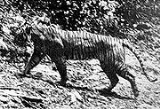
Javan Tiger

Encyclopedia
The Javan tiger is an extinct tiger
subspecies that inhabited the Indonesia
n island of Java until the mid-1970s. It was one of the three subspecies limited to islands.Mazák, J.H., Groves, C.P. (2006) A taxonomic revision of the tigers (Panthera tigris). Mammalian Biology 71 (5): 268–287.
n mainland, but larger in size than Bali tiger
s. Males weighed between 100 and 140 kg (220.5 and 308.6 lb) on average with a body length of 200 to 245 cm (6.6 to 8 ft). Females were smaller than males and weighed between 75 and 115 kg (165.3 and 253.5 lb) on average.
Their nose was long and narrow, occipital plane remarkably narrow and carnassial
s relatively long. They usually had long and thin stripes, which were slightly more numerous than of the Sumatran Tiger
.
The smaller body size of the Javan Tiger is attributed to Bergmann’s rule and the size of the available prey species in Java, which are smaller than the cervid
and bovid
species distributed on the Asian mainland. However, the diameter of their tracks are larger than of Bengal Tiger
in Bangladesh
, India
and Nepal
.
They preyed on rusa deer
, banteng
and wild boar, less often on water fowl and reptile
s. Nothing is known about their gestation period, life span in the wild and in captivity. Up to World War II
Javan tigers were kept in some Indonesian zoos, but these were closed down during the war. After the war, Javan Tiger were so rare already that it was easier to obtain Sumatran tiger
s.
was insufficient to adequately supply the growing human population, so that within 15 years 150% more land was cleared for cultivating rice. In 1938 natural forest covered 23% of the island. 1975 only 8% forest stand remained; the human population had increased to 85 million people.
In this human-dominated landscape the extirpation of the Javan Tiger was a process intensified by the conjunction of several circumstances and events:
 Until the mid-1960s tigers survived in three protected areas, which had been established during the 1920-1930s: Ujung Kulon
, Leuwen Sancang and Baluran
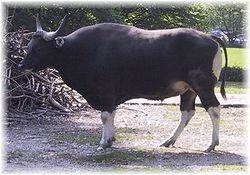
. But following the period of civil unrest no tigers were sighted there any more. In 1971 an older female was shot in a plantation near Mount Betiri in the southeast of Java. Since then not a single cub has been recorded in this last known refuge of the big cats. The area was upgraded to a wildlife reserve in 1972, at which time a small guard force was established and four habitat management projects initiated. The reserve was severely disrupted by two large plantations in the major river valleys, occupying the most suitable habitat for the tiger and its prey. In 1976, tracks were found in the eastern part of the reserve, suggesting the presence of 3-5 tigers. Only a few banteng
survived close to the plantations, but tracks of rusa deer, the preferred prey of the Javan tiger, were not sighted.
After 1979, there were no more confirmed sightings of tigers in Meru Betiri. In 1980, Seidensticker and Suyono recommended extending the wildlife reserve and completely eliminating the disruptive influence of humans on the fragile ecosystem. The Indonesian Nature Conservation Authority implemented these recommendations in 1982 by gazetting the reserve as a national park. These measures were however too late to save the few remaining tigers in the region.
In 1987, a group of 30 students of the Indonesian Agricultural University of Bogor (Institut Pertanian Bogor) conducted an expedition to Meru Betiri National Park. In groups of five they searched the complete area and found tiger scat and tracks.
In the West of Java lies the Halimun Reserve, today integrated into the Mount Halimun Salak National Park. In 1984, a tiger was killed there; and in 1989, pugmarks were found that were the size of a tiger’s. However, an expedition of six biologists conducted in 1990 did not yield any definite, direct evidence for the existence of tigers.
A subsequent survey was planned in the Meru Betiri National Park in autumn 1992 with the support of WWF Indonesia, deploying camera trap
s for the first time. From March 1993 to March 1994 cameras were positioned at 19 sites, which did not yield a single picture of a tiger. During this period, no tracks indicating the presence of tigers were discovered. After the final report of this survey had been published, the Javan tiger was declared extinct.
Rumours and indications of the possible presence of tigers in the Meru Betiri National Park prompted the park’s Chief Warden Bapak Indra Arinal to initiate another search. With support of the Sumatran Tiger Project, twelve members of the park staff were trained in autumn 1999 to set up camera trap
s and map their observations. The Canadian The Tiger Foundation provided infrared cameras. Despite a year of work, they photographed no tigers, few prey, and lots of poachers.
In 1995 a group of villagers from Resapombo sighted a tiger with its cubs, high up the mountains of Purworejo Blitar in East Java
. Cubs of these tiger were sold on the market in Malang
, where today is a market for all kinds of animals.
In November 2008, an unidentified body of a female mountain hiker was found in Mount Merbabu
National Park, Central Java
, allegedly died from tiger attack. Villagers who discovered the body have also claimed some tiger sightings in the vicinity.
Another alleged sighting occurred in Magetan Regency, East Java, in January 2009. Some villagers claimed to have seen a tigress with two cubs wandering near a village adjacent to Lawu Mountain. This news triggered mass panic. Local authorities found several fresh tracks in the location. However, by that time, those animals had already vanished.
Following the October 2010 eruption of Mount Merapi
, two Indonesian villagers have claimed sightings of a big cat paw print in the residual ash, which sparked rumours a tiger or leopard was roaming abandoned farms in search for food. Personnel of the near-by national park did not think it likely that this paw print was a tiger's.
Tiger
The tiger is the largest cat species, reaching a total body length of up to and weighing up to . Their most recognizable feature is a pattern of dark vertical stripes on reddish-orange fur with lighter underparts...
subspecies that inhabited the Indonesia
Indonesia
Indonesia , officially the Republic of Indonesia , is a country in Southeast Asia and Oceania. Indonesia is an archipelago comprising approximately 13,000 islands. It has 33 provinces with over 238 million people, and is the world's fourth most populous country. Indonesia is a republic, with an...
n island of Java until the mid-1970s. It was one of the three subspecies limited to islands.Mazák, J.H., Groves, C.P. (2006) A taxonomic revision of the tigers (Panthera tigris). Mammalian Biology 71 (5): 268–287.
Characteristics
Javan tigers were very small compared to other subspecies of the AsiaAsia
Asia is the world's largest and most populous continent, located primarily in the eastern and northern hemispheres. It covers 8.7% of the Earth's total surface area and with approximately 3.879 billion people, it hosts 60% of the world's current human population...
n mainland, but larger in size than Bali tiger
Bali Tiger
The Bali Tiger , harimau Bali in Indonesian, or referred to as samong in archaic Balinese language, was a subspecies of Tiger which was found solely on the small Indonesian island of Bali...
s. Males weighed between 100 and 140 kg (220.5 and 308.6 lb) on average with a body length of 200 to 245 cm (6.6 to 8 ft). Females were smaller than males and weighed between 75 and 115 kg (165.3 and 253.5 lb) on average.
Their nose was long and narrow, occipital plane remarkably narrow and carnassial
Carnassial
Carnassials are large teeth found in many carnivorous mammals, used for shearing flesh and bone in a scissor- or shear-like way. In the Carnivora, the carnassials are the modified last upper premolar and the first molar, but in the prehistoric creodonts, the carnassials were further back in the...
s relatively long. They usually had long and thin stripes, which were slightly more numerous than of the Sumatran Tiger
Sumatran Tiger
The Sumatran tiger is a tiger subspecies that inhabits the Indonesian island of Sumatra and has been classified as critically endangered by IUCN in 2008 as the population is projected at 176 to 271 mature individuals, with no subpopulation having an effective population size larger than 50...
.
The smaller body size of the Javan Tiger is attributed to Bergmann’s rule and the size of the available prey species in Java, which are smaller than the cervid
Deer
Deer are the ruminant mammals forming the family Cervidae. Species in the Cervidae family include white-tailed deer, elk, moose, red deer, reindeer, fallow deer, roe deer and chital. Male deer of all species and female reindeer grow and shed new antlers each year...
and bovid
Bovid
A bovid is any of almost 140 species of cloven-hoofed ruminant mammal at least the males of which bear characteristic unbranching horns covered in a permanent sheath of keratin....
species distributed on the Asian mainland. However, the diameter of their tracks are larger than of Bengal Tiger
Bengal Tiger
The Bengal tiger is a tiger subspecies native to the Indian subcontinent that in 2010 has been classified as endangered by IUCN...
in Bangladesh
Bangladesh
Bangladesh , officially the People's Republic of Bangladesh is a sovereign state located in South Asia. It is bordered by India on all sides except for a small border with Burma to the far southeast and by the Bay of Bengal to the south...
, India
India
India , officially the Republic of India , is a country in South Asia. It is the seventh-largest country by geographical area, the second-most populous country with over 1.2 billion people, and the most populous democracy in the world...
and Nepal
Nepal
Nepal , officially the Federal Democratic Republic of Nepal, is a landlocked sovereign state located in South Asia. It is located in the Himalayas and bordered to the north by the People's Republic of China, and to the south, east, and west by the Republic of India...
.
Habitat and ecology
At the end of the 18th century tigers inhabited most of Java. Around 1850, the people living in the rural areas still considered them a plague. Until 1940, tigers had retreated to remote mountainous and forested areas. Around 1970, the only known tigers lived in the region of Mount Betiri, with an altitude of 1192 metres (3,910.8 ft) the highest mountain in Java's southeast, which hadn’t been settled due to the rugged and slopy terrain. In 1972, the 500 km² (193.1 sq mi) area was gazetted as wildlife reserve. The last tigers were sighted there in 1976.They preyed on rusa deer
Rusa Deer
The Javan Rusa or Sunda Sambar is a deer native to the islands of Java, Bali and Timor in Indonesia...
, banteng
Banteng
The banteng , also known as tembadau, is a species of wild cattle found in Southeast Asia.Banteng have been domesticated in several places in Southeast Asia, and there are around 1.5 million domestic banteng, which are called Bali cattle. These animals are used as working animals and for their meat...
and wild boar, less often on water fowl and reptile
Reptile
Reptiles are members of a class of air-breathing, ectothermic vertebrates which are characterized by laying shelled eggs , and having skin covered in scales and/or scutes. They are tetrapods, either having four limbs or being descended from four-limbed ancestors...
s. Nothing is known about their gestation period, life span in the wild and in captivity. Up to World War II
World War II
World War II, or the Second World War , was a global conflict lasting from 1939 to 1945, involving most of the world's nations—including all of the great powers—eventually forming two opposing military alliances: the Allies and the Axis...
Javan tigers were kept in some Indonesian zoos, but these were closed down during the war. After the war, Javan Tiger were so rare already that it was easier to obtain Sumatran tiger
Sumatran Tiger
The Sumatran tiger is a tiger subspecies that inhabits the Indonesian island of Sumatra and has been classified as critically endangered by IUCN in 2008 as the population is projected at 176 to 271 mature individuals, with no subpopulation having an effective population size larger than 50...
s.
Extirpation
At the beginning of the 20th century 28 million people lived on the island of Java. The annual production of riceRice
Rice is the seed of the monocot plants Oryza sativa or Oryza glaberrima . As a cereal grain, it is the most important staple food for a large part of the world's human population, especially in East Asia, Southeast Asia, South Asia, the Middle East, and the West Indies...
was insufficient to adequately supply the growing human population, so that within 15 years 150% more land was cleared for cultivating rice. In 1938 natural forest covered 23% of the island. 1975 only 8% forest stand remained; the human population had increased to 85 million people.
In this human-dominated landscape the extirpation of the Javan Tiger was a process intensified by the conjunction of several circumstances and events:
- Tigers and their prey were poisoned in many places during the period when their habitat was rapidly being reduced;
- Natural forests were increasingly fragmented after World War IIWorld War IIWorld War II, or the Second World War , was a global conflict lasting from 1939 to 1945, involving most of the world's nations—including all of the great powers—eventually forming two opposing military alliances: the Allies and the Axis...
for plantations of teakTeakTeak is the common name for the tropical hardwood tree species Tectona grandis and its wood products. Tectona grandis is native to south and southeast Asia, mainly India, Indonesia, Malaysia, and Burma, but is naturalized and cultivated in many countries, including those in Africa and the...
, coffeeCoffeaCoffea is a genus of flowering plants in the Rubiaceae family. They are shrubs or small trees native to tropical and southern Africa and tropical Asia. Seeds of several species are the source of the popular beverage coffee. Coffee ranks as one of the world's most valuable and widely traded...
and rubberPara rubber treeHevea brasiliensis, the Pará rubber tree, often simply called rubber tree, is a tree belonging to the family Euphorbiaceae, and the most economically important member of the genus Hevea...
, which was unsuitable habitat for wildlife; - Rusa deer, the tiger's most important prey species, was lost to disease in several reserves and forests during the 1960s;
- During the period of civil unrest after 1965 armed groups retreated to reserves, where they killed the remaining tigers.
Last efforts
Ujung Kulon National Park
Ujung Kulon National Park is located at the western-most tip of Java, Banten, Indonesia. It includes the volcanic island group of Krakatoa and other islands including Panaitan, Handeuleum and Peucang on the Sunda Strait.-Geography:...
, Leuwen Sancang and Baluran
Baluran National Park
Baluran National Park is located in East Java, Indonesia. It has a relatively dry climate and consists of lowland forests, savanna, mangrove forests and hills, with Mount Baluran as its highest peak....
. But following the period of civil unrest no tigers were sighted there any more. In 1971 an older female was shot in a plantation near Mount Betiri in the southeast of Java. Since then not a single cub has been recorded in this last known refuge of the big cats. The area was upgraded to a wildlife reserve in 1972, at which time a small guard force was established and four habitat management projects initiated. The reserve was severely disrupted by two large plantations in the major river valleys, occupying the most suitable habitat for the tiger and its prey. In 1976, tracks were found in the eastern part of the reserve, suggesting the presence of 3-5 tigers. Only a few banteng
Banteng
The banteng , also known as tembadau, is a species of wild cattle found in Southeast Asia.Banteng have been domesticated in several places in Southeast Asia, and there are around 1.5 million domestic banteng, which are called Bali cattle. These animals are used as working animals and for their meat...
survived close to the plantations, but tracks of rusa deer, the preferred prey of the Javan tiger, were not sighted.
After 1979, there were no more confirmed sightings of tigers in Meru Betiri. In 1980, Seidensticker and Suyono recommended extending the wildlife reserve and completely eliminating the disruptive influence of humans on the fragile ecosystem. The Indonesian Nature Conservation Authority implemented these recommendations in 1982 by gazetting the reserve as a national park. These measures were however too late to save the few remaining tigers in the region.
In 1987, a group of 30 students of the Indonesian Agricultural University of Bogor (Institut Pertanian Bogor) conducted an expedition to Meru Betiri National Park. In groups of five they searched the complete area and found tiger scat and tracks.
In the West of Java lies the Halimun Reserve, today integrated into the Mount Halimun Salak National Park. In 1984, a tiger was killed there; and in 1989, pugmarks were found that were the size of a tiger’s. However, an expedition of six biologists conducted in 1990 did not yield any definite, direct evidence for the existence of tigers.
A subsequent survey was planned in the Meru Betiri National Park in autumn 1992 with the support of WWF Indonesia, deploying camera trap
Camera trap
A camera trap is a remotely activated camera that is equipped with a motion sensor or an infrared sensor, or uses a light beam as a trigger. Camera trapping is a method for capturing wild animals on film when researchers are not present, and has been used in ecological research for decades...
s for the first time. From March 1993 to March 1994 cameras were positioned at 19 sites, which did not yield a single picture of a tiger. During this period, no tracks indicating the presence of tigers were discovered. After the final report of this survey had been published, the Javan tiger was declared extinct.
Rumours and indications of the possible presence of tigers in the Meru Betiri National Park prompted the park’s Chief Warden Bapak Indra Arinal to initiate another search. With support of the Sumatran Tiger Project, twelve members of the park staff were trained in autumn 1999 to set up camera trap
Camera trap
A camera trap is a remotely activated camera that is equipped with a motion sensor or an infrared sensor, or uses a light beam as a trigger. Camera trapping is a method for capturing wild animals on film when researchers are not present, and has been used in ecological research for decades...
s and map their observations. The Canadian The Tiger Foundation provided infrared cameras. Despite a year of work, they photographed no tigers, few prey, and lots of poachers.
Alleged sightings
Occasional reports still surface of enthusiasts who believe that the tiger still exists in Java.In 1995 a group of villagers from Resapombo sighted a tiger with its cubs, high up the mountains of Purworejo Blitar in East Java
East Java
East Java is a province of Indonesia. It is located on the eastern part of the island of Java and includes neighboring Madura and islands to its east and to its north East Java is a province of Indonesia. It is located on the eastern part of the island of Java and includes neighboring Madura and...
. Cubs of these tiger were sold on the market in Malang
Malang
Malang is the second largest city in East Java province, Indonesia. It has an ancient history dating back to the Mataram Kingdom. The city population at the 2010 Census was 819,708. During the period of Dutch colonization, it was a popular destination for European residents. The city is famous for...
, where today is a market for all kinds of animals.
In November 2008, an unidentified body of a female mountain hiker was found in Mount Merbabu
Mount Merbabu
Mount Merbabu is a dormant stratovolcano in Central Java province on the Indonesian island of Java. The name Merbabu could be loosely translated as 'Mountain of Ash' from the Javanese combined words; Meru means "mountain" and awu or abu means "ash".The active volcano Mount Merapi is directly...
National Park, Central Java
Central Java
Central Java is a province of Indonesia. The administrative capital is Semarang. It is one of six provinces on the island of Java.This province is the province of high Human Development in Indonesia and its Points Development Index countries is equivalent to Lebanon. The province of Central Java...
, allegedly died from tiger attack. Villagers who discovered the body have also claimed some tiger sightings in the vicinity.
Another alleged sighting occurred in Magetan Regency, East Java, in January 2009. Some villagers claimed to have seen a tigress with two cubs wandering near a village adjacent to Lawu Mountain. This news triggered mass panic. Local authorities found several fresh tracks in the location. However, by that time, those animals had already vanished.
Following the October 2010 eruption of Mount Merapi
Mount Merapi
Mount Merapi, Gunung Merapi , is an active stratovolcano located on the border between Central Java and Yogyakarta, Indonesia. It is the most active volcano in Indonesia and has erupted regularly since 1548...
, two Indonesian villagers have claimed sightings of a big cat paw print in the residual ash, which sparked rumours a tiger or leopard was roaming abandoned farms in search for food. Personnel of the near-by national park did not think it likely that this paw print was a tiger's.