All Topics  
Coffea

 
Coffea

   Email Print
   Bookmark   Link


Coffea


Coffea (coffee) is a large genus (containing more than 90 species) of flowering plant
Flowering plant

The flowering plants or angiosperms are the most widespread group of Embryophytes. The flowering plants and the gymnosperms are the only extant groups of Spermatophyte....
s in the family Rubiaceae
Rubiaceae

Rubiaceae is a family of flowering plants, variously called the madder family, bedstraw family or Coffea family. Other common plants included here are gardenia, cinchona, sweet woodruff, Mitchella, uncaria, ixora, and noni....
. They are shrub
Shrub

A shrub or bush is a horticulture rather than strictly Botany category of woody plant, distinguished from a tree by its multiple stems and lower height, usually less than 5-6 m tall....
s or small tree
TREE

TREE was a Boston hardcore punk band formed in the summer of 1990. They were active in the Boston music scene until disbanding in 2002....
s, native to subtropical Africa
Africa

Africa is the world's second-largest and second most-populous continent, after Asia. At about 30.2 million km? including adjacent islands, it covers 6% of the Earth's total surface area and 20.4% of the total land area....
 and southern Asia
Asia

Asia is the world's largest and most populous continent. It covers 8.6% of the Earth's total surface area and, with over 4 billion people, it contains more than 60% of the world's current human population....
. Seeds of several species are the source of the beverage
Drink

A drink, or beverage, is a liquid specifically prepared for human consumption. In addition to basic needs, beverages form part of the culture of human society....
 coffee
Coffee

Coffee is a brewed drink prepared from roasted seeds, commonly called coffee beans, of the Coffea. Caffeinated coffee has a stimulating effect in humans....
. The seeds are called "beans" in the trade. Coffee beans are widely cultivated in tropical countries in plantations for both local consumption and export to temperate
Temperate

In geography, temperate or tepid latitudes of the globe lie between the tropics and the polar circles. The changes in these regions between summer and winter are generally mild, rather than extreme hot or cold....
 countries.


Discussion
Ask a question about 'Coffea'
Start a new discussion about 'Coffea'
Answer questions from other users
Full Discussion Forum


Encyclopedia


Coffea (coffee) is a large genus (containing more than 90 species) of flowering plant
Flowering plant

The flowering plants or angiosperms are the most widespread group of Embryophytes. The flowering plants and the gymnosperms are the only extant groups of Spermatophyte....
s in the family Rubiaceae
Rubiaceae

Rubiaceae is a family of flowering plants, variously called the madder family, bedstraw family or Coffea family. Other common plants included here are gardenia, cinchona, sweet woodruff, Mitchella, uncaria, ixora, and noni....
. They are shrub
Shrub

A shrub or bush is a horticulture rather than strictly Botany category of woody plant, distinguished from a tree by its multiple stems and lower height, usually less than 5-6 m tall....
s or small tree
TREE

TREE was a Boston hardcore punk band formed in the summer of 1990. They were active in the Boston music scene until disbanding in 2002....
s, native to subtropical Africa
Africa

Africa is the world's second-largest and second most-populous continent, after Asia. At about 30.2 million km? including adjacent islands, it covers 6% of the Earth's total surface area and 20.4% of the total land area....
 and southern Asia
Asia

Asia is the world's largest and most populous continent. It covers 8.6% of the Earth's total surface area and, with over 4 billion people, it contains more than 60% of the world's current human population....
. Seeds of several species are the source of the beverage
Drink

A drink, or beverage, is a liquid specifically prepared for human consumption. In addition to basic needs, beverages form part of the culture of human society....
 coffee
Coffee

Coffee is a brewed drink prepared from roasted seeds, commonly called coffee beans, of the Coffea. Caffeinated coffee has a stimulating effect in humans....
. The seeds are called "beans" in the trade. Coffee beans are widely cultivated in tropical countries in plantations for both local consumption and export to temperate
Temperate

In geography, temperate or tepid latitudes of the globe lie between the tropics and the polar circles. The changes in these regions between summer and winter are generally mild, rather than extreme hot or cold....
 countries. Coffee ranks as one of the world's major commodity
Commodity

A commodity is anything for which there is demand, but which is supplied without qualitative product differentiation across a market. It is a product that is the same no matter who produces it, such as petroleum, notebook paper, or milk....
 crops and is the major export product of some countries.

Botany

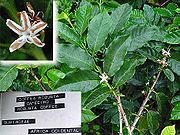
Detail of Coffea Canephora Branch and Leaves
When grown in the tropics
Tropics

The Tropics, seated in the equatorial regions of the world, are limited in latitude by the Tropic of Cancer in the northern hemisphere at approximately 23?26' N latitude, and the Tropic of Capricorn in the southern hemisphere at 23?26' S latitude....
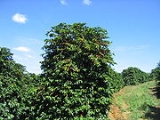
, coffee is a vigorous bush or small tree easily grown to a height of 3–3.5 m (10–12 feet). It is capable of withstanding severe pruning. It cannot be grown where there is a winter frost. Bushes grow best at high elevations. To produce a maximum yield of coffee berries (800-1400 kg per hectare
Hectare

A hectare is a unit of area equal to , or one square hectometre , and commonly used for surveying.The hectare is used in most countries around the world, especially in domains concerned with land ownership, land planning, and land management, including law , agriculture, forestry, and town planning....
), the plants need substantial amounts of water and fertilizer. Calcium carbonate
Calcium carbonate

Calcium carbonate is a chemical compound with the chemical formula CalciumCarbonOxygen3. It is a common substance found as Rock in all parts of the world, and is the main component of seashells, snails, and eggshells....
 and other lime minerals
Lime (mineral)

Lime is a general term for calcium-containing inorganic materials, in which carbonates, oxides and hydroxides predominate. Strictly speaking, lime is calcium oxide or calcium hydroxide....
 are sometimes used to reduce acid
Acid

An acid is traditionally considered any chemical compound that, when dissolved in water, gives a solution with a hydrogen ion Activity greater than in pure water, i.e....
ity in the soil, which can occur due to run off of minerals from the soil in mountainous areas. The caffeine
Caffeine

Caffeine is a bitter, white crystalline xanthine alkaloid that acts as a psychoactive stimulant drug and a mild diuretic. Caffeine was discovered by a German chemist, Friedrich Ferdinand Runge, in 1819....
 content in coffee "beans" is a natural defense, the toxic substance repelling many creatures that would otherwise eat the seeds, as with nicotine
Nicotine

Nicotine is an alkaloid found in the nightshade family of plants which constitutes approximately 0.6?3.0% of dry weight of tobacco, with biosynthesis taking place in the roots, and accumulating in the leaves....
 in tobacco
Tobacco

Tobacco is an agricultural product processed from the fresh leaves of plants in the genus Nicotiana. It can be consumed, used as an organic pesticide, and in the form of nicotine tartrate it is used in some medicines....
 leaves.

There are several species of Coffee that may be grown for the beans, but Coffea arabica is considered to have the best quality. The other species (especially Coffea canephora (var. robusta)) are grown on land unsuitable for Coffea arabica
Coffea arabica

Coffea arabica is a species of coffee indigenous to Ethiopia and Yemen. It is also known as the "coffee shrub of Arabia", "mountain coffee" or "arabica coffee"....
. The tree produces red or purple fruits (drupe
Drupe

In botany, a drupe is a fruit in which an outer fleshy part surrounds a shell of hardened endocarp with a seed inside. These fruits develop from a single carpel, and mostly from flowers with superior ovary....
s), which contain two seeds (the "coffee beans", which — despite their name — are not true beans). In about 5-10% of any crop of coffee cherries, the cherry will contain only a single bean, rather than the two usually found. This is called a 'peaberry
Peaberry

File:Peaberry coffee beans, close up.jpgPeaberry, also known as caracoli, is a type of coffee bean. Normally the fruit of the Coffea develops as two halves of a bean within a single cherry, but sometimes only one of the two seeds gets fertilized so there is nothing to flatten it....
', which is smaller and rounder than a normal coffee bean. It is often removed from the yield and either sold separately (as in New Guinea Peaberry), or discarded.

The coffee tree will grow fruits after 3–5 years, for about 50–60 years (although up to 100 years is possible). The blossom of the coffee tree is similar to jasmine
Jasmine

Jasmine is a genus of shrubs and vines in the olive family ,with about 200 species, native to tropical and warm temperate regions of the Old World....
 in color and smell. The fruit takes about nine months to ripen. Worldwide, an estimate of 15 billion coffee trees are growing on 100,000 km˛ of land.

Coffee is used as a food plant by the larva
Larva

A larva is a young form of animal with indirect developmental biology, going through or undergoing metamorphosis .The larva can look completely different from the adult form, for example, a caterpillar differs from a butterfly....
e of some Lepidoptera
Lepidoptera

Lepidoptera is an order of insect that includes moths and butterfly. It is one of the most speciose orders in the class Insecta, encompassing moths and the three superfamilies of butterfly, skipper , and Hedylidae....
 (butterfly
Butterfly

A butterfly is an insect of the Order Lepidoptera. Like all Lepidoptera, butterflies are notable for their unusual Biological life cycle with a larval caterpillar stage, an inactive pupal stage, and a spectacular metamorphosis into a familiar and colourful winged adult form....
 and moth
Moth

A moth is an insect closely related to the butterfly, both being of the Order Lepidoptera. The differences between butterflies and moths are more than just taxonomy....
) species including Dalcera abrasa
Dalcera

Dalcera is a genus of moths of the family Dalceridae with four Neotropical species. The larva of one species, D. abrasa, is a pest of Coffea....
, Turnip Moth
Turnip Moth

The Turnip Moth is a moth of the family Noctuidae. It is a common European species.This is a very variable species with the forewings ranging from pale buff through to almost black....
 and some members of the genus Endoclita
Endoclita

Endoclita is a genus of moths of the family Hepialidae. There are 60 described species found in eastern and southeast Asia and the Indian subcontinent....
 including E. damor and E. malabaricus.
Eth1 Coffeelady

Shade-grown coffee

In its natural environment, coffea grows under the shade. Most coffee is produced on full-sun plantations, some of which were prepared through deforestation. Shade-grown coffee naturally mulches its environment, lives twice as long as sun-grown varieties, and depletes less of the soil's resources. Shade-grown coffee is also believed by some to be of higher quality than sun-grown varieties, as the cherries produced by the coffea plants under the shade are not as large as commercial varieties. Some believe that this smaller cherry concentrates the flavors of the cherry into the seed (bean) itself. Shade-grown coffee is also associated with environmentally friendly ecosystems that provide a wider variety and number of migratory birds than those of sun-grown coffea farms.
Coffee Immature

Chemistry: Green-Coffee-Bean

In this paragraph the expression “green coffee bean” refers to both mature and immature coffee beans, having been processed by wet or dry method for removing the pulp and mucilage, with an intact wax layer on the outer surface, a green (immature) and brown to yellow colour, and a weight of 300 to 330 mg per dried coffee bean. Non-volatile and volatile compounds of green coffee beans are responsible for their attraction of insects but also distraction of animals preventing them from eating the coffee fruit and beans. Further, both non-volatile and volatile compounds are contributing to the flavor of the roasted coffee bean. Among the non-volatile compounds nitrogenous compounds together with carbohydrates are of major importance for the full aroma of roasted coffee and its biological action. The nitrogenous compound are consisting of alkaloids, trigonelline, proteins and free amino acids.

Non-volatile Alkaloids

Caffeine (1,3,7-trimethyl-xanthine) is the most important molecule of the alkaloids being present in green and roasted coffee beans. Dried green coffee beans have a weight of 300 mg to 330 mg. The content of caffeine is between 1% (w/w) and 2,5% (w/w of dry green coffee). The content of caffeine does not change during maturation of green coffee beans. Lower concentrations of theophylline
Theophylline

Theophylline, also known as dimethylxanthine, is a methylxanthine drug used in therapy for respiratory diseases such as COPD or asthma under a variety of brand names....
, theobromine
Theobromine

Theobromine, also known as xantheose, is a bitter alkaloid of the cacao plant, found in chocolate, as well as in a number of chocolate-free foods made from theobromine sources including the leaves of the tea plant, the kola or cola nut, and acai berries....
, paraxanthine
Paraxanthine

Paraxanthine, or 1,7-dimethylxanthine, is a dimethyl derivative of xanthine, structurally related to caffeine. Like caffeine, paraxanthine is a psychoactive central nervous system stimulant....
, liberine, and methylliberine can be found. The concentration of theophylline, a major alkaloid of green tea
Green tea

'Green tea' is a type of tea made solely with the leaves of Camellia sinensis, that has undergone minimal oxidation during processing. Green tea originates from China and has become associated with many cultures in Asia from Japan to the Middle East....
, is gradually reduced along the roasting time of green coffee (15 min, 230 degrees Celsius) whereas the other alkaloids are not changed. The solubility of caffeine in water increases with temperature and with the addition of chlorogenic acid
Chlorogenic acid

Chlorogenic acid is a family of esters formed between certain trans cinnamic acids and -quinic acid and is a major phenol in coffee, found widespread in plants, and can be isolated from the leaves and fruit....
s, citric acid
Citric acid

Citric acid is a weak organic chemistry acid, and it is a natural preservative and is also used to add an acidic, or sour, taste to foods and soft drinks....
, tartaric acid
Tartaric acid

Tartaric acid is a white crystalline organic acid. It occurs naturally in many plants, particularly grapes, bananas, and tamarinds, and is one of the main acids found in wine....
, all of which are present in green coffee beans (e.g. 1 g caffeine dissolves in 46 mL of water at room temperature, and 5,5 mL at 80 degrees Celsius). The xanthine alkaloids are odorless but have a bitter taste in water, which however is masked by organic acids being present in green coffee. Trigonelline
Trigonelline

Trigonelline is an alkaloid with chemical formula 772. It is an inner salt formed by the addition of a methyl group to the nitrogen atom of niacin....
 (N-methyl-nicotinate) is a derivative of vitamin B6
Vitamin B6

Vitamin B6 is a water-soluble vitamin and is part of the vitamin B complex group. Pyridoxal phosphate is the active form and is a cofactor in many reactions of amino acid metabolism, including transamination, deamination, and decarboxylation....
 with a low bitter taste compared to caffeine. In green coffee beans the content is between 0,6% (w/w) and 1% (w/w). At roasting temperature (230 degrees Celsius) trigonelline is degraded to nicotinic acid by 85% leaving small amounts of the unchanged molecule in the roasted beans. In green coffee beans, trigonelline is synthesized from nicotinic acid (pyridinium-3-carboxylic acid) by methylation from methionine
Methionine

Methionine is an a-amino acid with the chemical formula HO2CCHCH2CH2SCH3. This Essential amino acid is classified as nonpolar....
, a sulfur containing amino acid. Mutagenic activity of trigonelline has been reported.

Proteins and amino acids

Protein
Protein

Proteins are organic compounds made of amino acids arranged in a linear chain and joined together by peptide bonds between the carboxyl and amino groups of adjacent amino acid Residue ....
s account for 8% (w/w) to 12% (w/w) of dried green coffee beans, presenting a valuable source of amino acids. Major part of the proteins are consisting of 11-S-storage proteins (alpha - component of 32 kDa, beta – component of 22 kDa), which are degraded during maturation of green coffee beans to free amino acids. Further, 11-S-storage proteins are degraded to the individual amino acids under roasting temperature and thus being an additional source of bitter components due to generation of Maillard product
Maillard reaction

The Maillard reaction is a chemical reaction between an amino acid and a reducing sugar, usually requiring heat. It is vitally important in the preparation or presentation of many types of food, and, like caramelization, it is a form of non-enzymatic browning....
s. High temperature, oxygen concentration and low pH degrade 11-S-storage–proteins of green coffee beans to low molecular weight peptides and amino acids. The degradation is accelerated in the presence of organic acids such as chlorogenic acids and their derivatives. Other proteins are consisting of enzymes such as catalase
Catalase

Catalase is a common enzyme found in nearly all living organisms which are exposed to oxygen, where it functions to catalyst the decomposition of hydrogen peroxide to water and oxygen....
, and polyphenoloxydase which are important for the maturation of green coffee beans. Mature coffee contains free amino acids (4.0 mg amino acid / g robusta coffee and up to 4 .5 mg amino acid /g arabica coffee). In arabica, alanine is the amino acid with the highest concentration, i.e. 1.2 mg / g followed by asparagine of 0.66 mg/g, whereas in robusta alanine is present with 0.8 mg/g and asparagine with 0.36 mg/g. The free hydrophobic amino acids in fresh green coffee beans contribute to the unpleasant taste making it impossible to prepare a beverage with such compounds. The concentrations of free hydrophobic amino acids in fresh green coffee from Peru have been determined as follows: isoleucine
Isoleucine

Isoleucine is an a-amino acid with the chemical formula HO2CCHCHCH2CH3. It is an essential amino acid, which means that humans cannot synthesize it, so it must be part of our diet....
 81 mg /kg, leucine
Leucine

Leucine is an a-amino acid with the chemical formula HO2CCHCH2CH2. It is an essential amino acid, which means that humans cannot synthesise it....
 100 mg/kg, valine
Valine

Valine is an a-amino acid with the chemical formula HO2CCHCH2. L-Valine is one of 20 proteogenic amino acids....
 93 mg/kg, tyrosine
Tyrosine

Tyrosine or 4-hydroxyphenylalanine, is one of the 20 amino acids that are used by cell to protein biosynthesis proteins. This is a non-essential amino acid and it is found in casein....
 81 mg/kg, phenylalanine
Phenylalanine

Phenylalanine is an a-amino acid with the chemical formula HO2CCHCH2C6H5, which is found naturally in the breast milk of mammals and manufactured for food and drink products and are also sold as nutritional supplements for their reputed analgesic and antidepressant effects....
 133 mg /kg. The concentration of gamma amino butyric acid (a neurotransmitter) has been determined between 143 mg/ kg and 703 mg/kg in green coffee beans from Tanzania
Tanzania

Tanzania , officially the United Republic of Tanzania , is a country in East Africa that is bordered by Kenya and Uganda on the north, Rwanda, Burundi and the Democratic Republic of the Congo on the west, and Zambia, Malawi and Mozambique on the south....
. Roasted coffee beans do not contain any free amino acids. Amino acids from green coffee beans are degraded under roasting temperature to Maillard products (reaction products between the aldehyde group of sugar and the alpha-amino-group of the amino acids). Further, diketopiperazines, e.g. cyclo(proline-proline), cyclo(proline-leucine), cyclo(proline-isoleucine), are generated from the corresponding amino acids, being the major source of bitter taste of roasted coffee. The bitter perception of diketopiperazines starts around 20 mg/ 1 liter water. The content of diketopiperazines in espresso is about 20 mg to 30 mg which is responsible for the bitter taste perception of an espresso.

Carbohydrates

Green coffee beans are a valuable source of carbohydrates which make up about 50% of the dry weight of green coffee beans. The carbohydrate fraction of green coffee is dominated by polysaccharides such as arabinogalactan
Arabinogalactan

Arabinogalactan is a biopolymer consisting of arabinose and galactose monosaccharides in their furanose configurations and is a major structural component of the mycobacterial cell wall....
, galactomanan, and cellulose
Cellulose

File:Cellulose Sessel.svgCellulose is an organic compound with the chemical formula , a polysaccharide consisting of a linear chain of several hundred to over ten thousand ? linked D-glucose units....
 contributing to the tasteless flavor of green coffee. Arabinogalactan makes up to 17% of dry weight of green coffee beans with a molecular weight of 90 kDa to 200 kDa. It is composed of beta-1-3-linked galactan main chain with frequent members of arabinose (pentose) and galactose (hexose) residues at the side chains comprising immunomodulating properties by stimulating the cellular defense system (Th-1 response) of the body. Mature brown to yellow coffee beans contain fewer residues of galactose and arabinose at the side chain of the polysaccharides, making the green coffee bean more resistant against physical breakdown and less soluble in water. The molecular weight of the arabiniogalactan in coffee is higher than it is in other plants, making an improvement of the cellular defense system of the digestive tract compared to arabinogalactan with lower molecular weight).Free monosaccharides are present in mature brown to yellow-green coffee beans. The free part of monosaccharides contains sucrose (gluco-fructose) up to 9000 mg/ 100g of arabica green coffee bean, a lower amount in robustas, i.e. 4500 mg/100g. In arabica green coffee beans the content of free glucose was 30 mg to 38 mg / 100 g, free fructose 23 mg to 30 mg/ 100 g; free galactose 35 mg/ 100g and mannitol
Mannitol

Mannitol is an organic compound with the formula . This polyol is used as an osmosis diuretic agent and a weak kidney vasodilator. It was originally isolated from the secretions of the flowering ash, called manna after their resemblance to the Biblical food, and is also be referred to as mannite and manna sugar....
 50 mg/100g dried coffee beans, respectively. Mannitol is a powerful scavenger for hydroxyl radicals which are generated during the peroxidation of lipids in biological membranes.

Lipids

The lipids found in green coffee include: linoleic acid
Linoleic acid

Linoleic acid is an unsaturated omega-6 fatty acid. It is a colorless liquid. In physiological literature, it is called 18:2. Chemically, linoleic acid is a carboxylic acid with an 18-carbon chain and two cis double bonds; the first double bond is located at the sixth carbon from the omega end....
, palmitic acid
Palmitic acid

Palmitic acid,CH314COOH or hexadecanoic acid in IUPAC nomenclature, is one of the most common saturated fatty acids found in animals and plants....
, oleic acid
Oleic acid

Oleic acid is a monounsaturated omega-9 fatty acid fatty acid found in various animal and vegetable sources. It has the formula C18H34O2 ....
, stearic acid
Stearic acid

Stearic acid or 18:0 is a saturated fatty acid. It is a waxy solid, and its chemical formula is C18H36O2....
, arachidic acid
Arachidic acid

Arachidic acid, also called eicosanoic acid, is a saturated fatty acid found in peanut oil. Its name derives from the Latin arachis — peanut....
, diterpenes, triglycerides, unsaturated long-chain fatty acids, esters and amides. The total content of lipids from dried green coffee is between 11.7 g and 14 g / 100 g. Lipids are present on the surface and in the interior matrix of green coffee beans. On the surface they include derivatives of carboxylic acid-5-hydroxytryptamides with an amide bond to fatty acids (unsaturated C6 to C24) making up to 3% (w/w) of total lipid content or 1200 to 1400 microgram / g dried green coffee bean. Such compounds form a wax cover on the surface of the coffee bean (200 mg to 300 mg lipids / 100 g dried green coffee beans) protecting the interior matrix against oxidation and insects. Further, such molecules have anti-oxidative activity due to their chemical structure. Lipids of the interior tissue are triglycerides, linoleic acid (46% of total free lipids), palmitic acid (30% to 35% of total free lipids), and esters. Arabica have a higher content of lipids (13,5 g to 17,4 g lipids/100 g dried green coffee beans) than robustas (9,8 g to 10,7 g lipids / 100 g dried green coffee beans). The content of diterpenes is about 20% of the lipid fraction. The diterpenes found in green coffee include cafestol
Cafestol

Cafestol is a diterpene molecule present in coffee.A typical bean of Coffea arabica contains about 0.6% cafestol by weight. Cafestol is present in highest quantity in unfiltered coffee drinks such as French press coffee or Turkish coffee....
, kahweol
Kahweol

Kahweol is a diterpene molecule found in the beans of Coffea arabica. It is structurally related to cafestol....
, 16-O-methyl-kafestol, cafestal, kahweal. Diterpenes are known for their in-vitro protection of liver tissue against chemical oxidation. In coffee oil from green coffee beans the diterpenes are esterified with saturated long chain fatty acids.

Non-volatine Chlorogenic acids

Chlorogenic acids belong to a group consisting of compounds which are known as polyphenol
Polyphenol

Polyphenols are a group of chemical substances found in plants, characterized by the presence of more than one phenol unit or building block per molecule....
s which are antioxidants. The content of chlorogeneic acid in dried green coffee beans of robusta is 65 mg/ g and of arabica 140 mg / g, depending on time of harvesting. At roasting temperature chlorogenic acids are destroyed by more than 70% or leaving a residue of less than 30 mg/g roasted coffee bean. In contrast to green coffee, green tea contains an average of 85 mg polyphenols/g. Therefor chlorogenic acids could be a valuable inexpensive source of antioxydants. Chlorogenic acids are homologous compounds comprising caffeic acid, ferulic acid and 3,4 dimethoxycinnamic acid which are connected by an ester-bond to the hydroxy groups of quinic acid (1alpha, 3R, 4 alpha, 5R-tetrahydroxy-cyclohexane carboxylic acid) The anti-oxydation capacity of Chlorogenic acid is more potent than of ascorbic acid (vitamine-C) or mannitol, which is a selective hydroxy-radical scavenger. Chlorgenic acids have a bitter taste in low concentrations such as 50 mg / 1 L water. At higher concentrations of 1 g/ 1 L water they appear with a sour taste. Chlorogenic acid increase the solubility of caffeine and are important modulaters of taste.

Volatile compounds of Green Coffee

Volatile compounds of green coffee beans are comprising short chain fatty acids, aldehydes, and nitrogen containing aromatic molecules such as derivatives of pyrazines green-herbeaceous-earthy odor. Briefly, such volatile compounds are responsible for the unpleasant odor and taste of green coffee being capable of causing nausea and vomiting on inspiration of the odor of ground green coffee beans or ingestion of a beverage made up by pulverised green coffee beans. Due to this nauseating odor green coffee beens have never been used first hand for the preparation of a refreshing beverage, which in fact would cause vomiting, although green coffee beans are containing the same amount of caffeine as rosted coffee. On roasting of green coffee beans other molecules with the typical pleasant aroma of coffee are generated, which is not present in fresh green coffee. Other tried to neutralise or transform the nauseating odor-molecules of green coffee beans into innovative flavor by fermentation of the intact mature brown to yellow coffee bean similar to the wet processing of the mature coffee fruit. However such fermented green coffee beans must be further roasted in order to obtain an organoleptic accepted beverage based on coffee. On roasting major part of the unpleasant tasting volatile compounds are neutralised. Unfortunately other important molecules such as antioxydants and vitamines being present in green coffee are destroyed. Such volatile compounds with nauseating odor for humans which have been identified are e.g. acetic acid
Acetic acid

Acetic acid, CH3COOH, also known as ethanoic acid, is an organic acid which gives vinegar its sour taste and pungent smell. Pure, water-free acetic acid is a colourless liquid that absorbs water from the environment , and freezes at 16.7 Celsius to a colourless crystalline solid....
 (pungent, unpleasant odor); propionic acid
Propionic acid

Propionic acid is a naturally-occurring carboxylic acid with chemical formula CarbonHydrogen3CH2COxygenOH. In the pure state, it is a colorless liquid with a pungent odor....
 (odor of sour milk, or butter); butanoic acid (odor of rancid butter, present in green coffee with 2 mg/100 g coffee beans); pentanoic acid (unpleasant fruity flavor, present in green coffee with 40 mg/100 g coffee beans); hexanoic acid
Hexanoic acid

Hexanoic acid , is the carboxylic acid derived from hexane with the general formula C5H11COOH. It is a colorless oily liquid with an odor reminiscent of goats or other barnyard animals....
 (fatty-rancid odor), heptanoic acid
Heptanoic acid

Heptanoic acid, also called enanthic acid, is an organic compound composed of a seven-carbon chain terminating in a carboxylic acid. It is an oily liquid with an unpleasant, rancid odor....
 (fatty odor); octanoic acid (repulsive oily rancid odor); nonanoic acid
Nonanoic acid

Nonanoic acid, also called pelargonic acid, is an organic compound composed of a nine-carbon chain terminating in a carboxylic acid with structural formula CH37COOH....
 (mild nut-like fatty odor); decanoic acid
Decanoic acid

Decanoic acid, or capric acid, is a saturated fatty acid.Its formula is CH38COOH. Salts and esters of decanoic acid are called decanoates....
 (sour repulsive odor); and derivatives of such fatty acids. 3-methyl-valericacid (sour, green-herbaceous, unpleasant odor); acetaldehyde
Acetaldehyde

Acetaldehyde is an organic compound with the chemical formula CarbonHydrogen3CHOxygen or MeCHO. It is a flammable liquid with a fruity smell....
 (pungent-nauseating odor, even in high dilutions; present in dried green coffee beans with 5 mg/1 kg); propanal (chocking effect on respiratory system, penetrating-nauseating), butanal
Butanal

Butyraldehyde, also known as butanal, is an organic compound that is the aldehyde analog of butane as well as an isomer of butanone. It is a colorless flammable liquid with an acrid smell....
 (nauseating effect; present in dried green coffee beans with 2 to 7 mg /1 kg); pentanal
Pentanal

Pentanal, also called pentanaldehyde or valeraldehyde, is an alkyl aldehyde, molecular formula C5H10O. It is used in flavorings, resin chemistry, and rubber accelerators....
 or valerianic aldehyde very repulsive nauseating effect.

Health properties of Green Coffee

Green coffee beans are a rich source of antioxydants such as polyphenols and mannitol with a high protecting effect against chemical oxydation. The high content of arabinogalactans can stimulate the immune system (e.g. the macrophages) of the gastrointestinal tract and might help to overcome problems of colon irritabile or inflammable bowl diseases. Extracts of green coffee have been shown to improve vasoactivity in humans. Green coffee can only be consumed by humans in capsules because of the nauseating odor of the volatile compounds of the green coffee beans.

New coffee-species

Recently, two new species
Species

In biology, a species is one of the basic units of biological classification and a taxonomic rank. A species is often defined as a group of organisms capable of interbreeding and producing fertile offspring....
 of coffee plant have been discovered in Cameroon
Cameroon

The Republic of Cameroon is a unitary state of central and western Africa. It is bordered by Nigeria to the west; Chad to the northeast; the Central African Republic to the east; and Equatorial Guinea, Gabon, and the Republic of the Congo to the south....
: Coffea charrieriana and Coffea anthonyi. Through the field of bionics
Bionics

Bionics is the application of biological Scientific method and systems found in nature to the study and design of engineering systems and modern technology....
, these species could introduce two new features to cultivated coffee plants: 1) beans without caffeine
Caffeine

Caffeine is a bitter, white crystalline xanthine alkaloid that acts as a psychoactive stimulant drug and a mild diuretic. Caffeine was discovered by a German chemist, Friedrich Ferdinand Runge, in 1819....
, and 2) self-pollination
Pollination

Pollination in flowering plants and gymnosperms is the process that transfers pollen, which contain the male gametes to where the female gamete are contained within the carpel; in gymnosperms the pollen is directly applied to the ovule itself....
. By crossing the new species with other known coffees (e.g., C. arabica and C. robusta), new coffee hybrid
Hybrid

In biology, hybrid has two meanings. The first meaning is the result of interbreeding between two animals or plants of different Taxon. Hybrids between different species within the same genus are sometimes known as interspecific hybrids or crosses....
s might allow these new improvements at regular coffee plantations (e.g. in Kenya
Kenya

The Republic of Kenya is a country in East Africa. It is bordered by Ethiopia to the north, Somalia to the northeast, Tanzania to the south, Uganda to the west, and Sudan to the northwest, with the Indian Ocean running along the southeast border....
, since C. arabica and C. robusta are accustomed to these growing conditions).

See also

  • Coffee
    Coffee

    Coffee is a brewed drink prepared from roasted seeds, commonly called coffee beans, of the Coffea. Caffeinated coffee has a stimulating effect in humans....
  • Kopi Luwak
    Kopi Luwak

    Kopi Luwak or Civet coffee is coffee made from coffea which have been eaten by and passed through the digestive tract of the Asian Palm Civet ....
  • Colombian coffee
    Colombian coffee

    Colombian Coffee is a Protected designation of origin granted by the European Union that applies to the coffee produced in Colombia The Colombian coffee has been recognized worldwide as having high quality and distinctive taste....
  • List of coffee companies
    List of coffee companies

    This is a list of companies that roast and/or distribute Coffee .* Altria Group, formerly Phillip Morris, holding company for** Jacobs Coffee** Kraft Foods, holder of the following trademarks...


External links

  • - Many resources on sustainable coffee, including reviews, especially shade coffee and biodiversity