

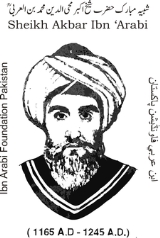
Ibn Arabi

Encyclopedia
Ibn ʿArabī (Murcia July 28, 1165 – Damascus November 10, 1240) was an Andalusian
Moorish Sufi
mystic
and philosopher. His full name was Abū 'Abdillāh Muḥammad ibn 'Alī ibn Muḥammad ibn `Arabī ().
, Taifa of Murcia
on the 17th of Ramaḍān
561 AH (27th or 28 July 1165 AD). Muḥyiddin Muḥammad ibn ‘Alī ibn Muḥammad ibn ‘Arabī was widely known as al-Shaykh al-Akbar; in medieval
Europe he was called Doctor Maximus.
.
, in 578 AH. Most of his teachers were the clergy of the Almohad era and some of them also held the official posts of Qadi
or Khatib
. He was a young boy when his father sent him to the renowned jurist Abū Bakr ibn Khalaf to study the Qur'an
. ibn ‘Arabī learned the recitation of the Qur'an from the book of Al-Kafi in the seven different Qira'at
. The same work was also transmitted to him by another ‘Abd al-Raḥmān ibn Ghālib ibn al-Sharrāt. At the age of ten, he was well-versed in the Qira’āt; afterwards he learned the sciences of Hadith
, Fiqh
and Sirah from the famous scholars of the time such as Al-Suhayli
.
. Another important cause of this retreat was a vision of the three great Prophets
, Jesus
, Moses
and Muḥammad
.
As a consequence of this retreat and the spiritual insights granted to him, ibn ‘Arabī was sent by his father to meet the great philosopher Averroes
. The meeting was very significant in that ibn ‘Arabī answered his questions in ‘Yes’ and ‘No.’ Ibn Rushd declared: I myself was of the opinion that spiritual knowledge without learning is possible, but never met anyone who had experienced it.
, a personification of an ancient fertility deity connected with spring, and a prophet in Islam, three times over the course of his life. The first occurred while `Ibn Arabi was a youth in the service of the king, Shaykh al-‘Uryabī. Ibn ‘Arabī said of their encounter:
In 1193 at the age of 28 Ibn ‘Arabī visited Tunis
to meet the disciples of Abu Madyan
, notably ‘Abd al-‘Aziz al-Mahdawī and Abū Muḥammad ‘Abdallāh al-Kinānī. He stayed there for less than a year. Ibn `Arabi met Khidr for the second time while he was returning from Tunis. One night, traveling by boat, he saw a man walking on the water towards him. Upon reaching the boat, Khidr stood on the sea and showed him that his feet were still dry. After that Khiḍr conversed with Ibn ‘Arabī in a language which is peculiar to him (OY: III, 182). Ibn ‘Arabī had his third meeting with Khidr upon reaching Andalusia in late 590 AH. Khidr performed a miracle
to provide evidence for a skeptical companion of Ibn ‘Arabī.
, Ibn ‘Arabī had a vision in which he met all the Prophets from the time of Adam to Muḥammad in their spiritual reality. Hud
spoke to him and explained him the reason for their gathering: “We came to visit Abū Muḥammad Makhlūf al-Qabā’ili” (Ibn ‘Arabī, “Rūh al-Quds” 116). However, according to a tradition among the direct disciples of Ibn ‘Arabī, Hūd explained that the real reason for their gathering was to welcome him (Ibn ‘Arabī) as the Seal of Muhammadan Sainthood (khatm al-wilāya al-muḥammadiyya), the supreme heir (Addas 76).
Stephen Hartenstein writes in his book Unlimited Mercifier: “It is from his return from Tunis, we find the first evidence of Ibn ‘Arabī beginning to write; later in 1194, he wrote one of his first major works, Mashāhid al-Asrār al-Qudusiyya (Contemplation of the Holy Mysteries) for the companions of al-Mahdawī and perhaps around the same time, in a space of four days, also composed the voluminous Tadbīrāt al-Ilāhiyya (Divine Governance) in Mawrūr for Shaykh Abū Muḥammad al-Mawrūrī.” (Hirtenstein 91)
, where they settled.
In Fes Ibn ‘Arabī met two men of remarkable spirituality, one of them was a sufi Pillar (awtād), his name was Ibn Ja’dūn. The second was known as al-Ashall (literally “the withered,” due to a withered hand). It was a happy period of his life, where he could utterly dedicate himself to spiritual work. In Fes in 593 AH, when he was leading a Prayer in the al-Azhar Mosque, he experienced a vision of light:
“I lost the sense of behind [or front]. I no longer had a back or the nape of a neck. While the vision lasted, I had no sense of direction, as if I had been completely spherical (dimensionless).” (II, 486)
“[He is a man] of unadulterated clarity, a pure light, he is a Ḥabashī named ‘Abdallāh, and like a full moon (badr) without eclipse
. He acknowledges each person’s right and renders it to him; he assigns to each his right, without going further. He has attained the degree of true discrimination. He was purified at the time of fusion like pure gold
. His word is true, his promise sincere” (OY: I, 72; Hirtenstein 123).
In the year 595 AH Ibn ‘Arabī returned to the Iberian Peninsula for the last time and it seems he had two intentions: to introduce al-Habashī to his friends and masters and to depart finally from the land of his birth. In December 595 AH, Ibn ‘Arabī was in Cordoba, at the funeral of Ibn Rushd, whom once he met some 18 years earlier. When the coffin was loaded upon a beast of burden, his works were placed upon the other side to counterbalance it. Ibn ‘Arabī said the following verse on that day:
"Here the master, there his works –
Would that I know if his hopes have been fulfilled!"
From Cordoba they traveled to Granada
and met with ‘Abdallāh al-Mawrūrī and Abū Muḥammad al-Shakkāz. From Granada to Murcia, the town of his birth and stayed with an old friend Abū Ahmed Ibn Saydabūn, a famous disciple of Abū Madyan who at the time of their meeting was evidently going through a period of fatra or suspension. They traveled again to Almeria, where they spent the month of Ramadan in 595 AH and Ibn ‘Arabī wrote Mawāqi‘ al-Nujūm over a period of eleven nights. Perhaps in Almeria also, he started writing ‘Anqā’ Mughrib where full explanation about the Seal of Saints can be found.
These were his last days in the West, where he started visiting his masters for the last time, and he collected his writings and ensured that he must at least have a single copy of all of his works as now he was departing toward the East forever. When he left Andalusia for the last time he appeared to have a vision of his future destiny at the shores of the Mediterranean as he later told his stepson Ṣadr al-dīn al-Qūnawī:
“I turned towards God with total concentration and in a state of contemplation and vigilance that was perfect: God then showed me all of my future states, both internal and external, right through to the end of my days. I saw that your father, Isḥāq ibn Muḥammad, would be my companion and you as well” (Hirtenstein 127).
In the year 597 AH/1200 AD, he was in Morocco and took his final leave from his master Yūsuf al-Kūmī, who was living in the village of Salé at that time. This shows that he had finally completed his training under the teachers of his early years and was now ready to go to a new world. On his way to Marrakesh of that year he entered the Station of Proximity (maqām al-qurba).
“I entered this station in the month of Muḥarram in 597 AH… In joy I began to explore it, but on finding absolutely no one else in it, I felt anxiety at the solitude. Although I was realized in [this station], but I still did not know its name” (II, 261).
Later Ibn ‘Arabī finds Abū ‘Abd al-Raḥmān al-Sulamī in it and he told Ibn ‘Arabī that this station is called, the station of proximity (maqām al-qurba) (Hirtenstein 128).
with all the star
s of heavens, after the stars the letters were given his union, and he united with all of them (Ibn ‘Arabī, “Kitāb al-Bā’” 10-11). This dream was later interpreted as the great Divine knowledge which was bestowed upon Ibn ‘Arabī.
His next stop was Tunis 598 AH where he happened to see Syakh ‘Abd al-‘Aziz al-Mahdawī whom he had met about six years before. At the same time he continued writing works like Inshā’ al-Dawā’ir for his friend al-Ḥabashī. Resuming his travels, he arrived in Cairo in 598 AH/1202 AD where he met his childhood friends, the two brothers, ‘Abdallāh Muhammad al-Khayyāt and Abū al-Abbās Aḥmad al-Ḥarrārī and stayed at their house in the month of Ramaḍān. That was a period of great devastation, terrible famine
and plague for Egypt. Perhaps the death of his companion Muḥammad al-Haṣṣār was due to this plague. Ibn ‘Arabī saw this devastation with his own eyes and a passage of Rūh al-Quds tells us that when people made light of Allāh’s statutes He imposes the strictures of His Law upon them (yūsuf 240).
Ibn ‘Arabī resumed travelling toward Palestine
, and his route took him to all the major burial places of the great Prophets: Hebron
, where Abraham
and other Prophets are buried; Jerusalem, the city of David and the later Prophets; and then Medina
, the final resting place of Prophet Muhammad.
when he met a young beautiful girl Qurrat al-‘Ayn (Hirtenstein 148). In the second vision, during his circumambulations of the Kaaba, he met the mysterious figure who had appeared at the beginning of his ascension and here at Makkah. He said to Ibn ‘Arabī, you should circumambulate in my footstep and observe me in the light of my moon, so that you may take from my constitution that which you write in your book and transmit to your readers (OY: I, 218). The third vision also occurs at Kaaba in a spiritual conversation with the Ḥaram and the Zamzam stream; Kaaba ordered him to circumambulate it and the Zamzam told him to drink this pure water but a soft refusal made Kaaba angry and he took revenge on a cold and rainy night in the year 600 AH. Shaykh heard the voice of Kaaba loud and clear; later in a meditation God taught him the lesson and to express this gratitude Ibn ‘Arabī composed a collection of letters in rhymed prose, entitled the Tāj al-Rasā’il, in homage to the Kaaba. The next vision is also related to Kaaba, in the year 599 AH in Makkah Ibn ‘Arabī saw a dream which confirms once again his accession to the office of the Seal of the Muhammadian Sainthood. He saw two bricks – one of Gold and the other of Silver – were missing from two rows of the wall of Kaaba. He says: “In the mean time I was observing that, standing there, I feel without doubt that I was these two bricks and these two bricks were me …. And perhaps it is through me that God has sealed sainthood” (Addas 213). In the year 599 AH during circumambulating the Kaaba, he encountered the son of Caliph Hārūn al-Rashīd, who had been dead for four centuries and was famous for choosing Saturday for work to gather food for rest of the week. Ibn ‘Arabī asked him: “Who are you?” He replied: “I am al-Sabtī ibn Hārūn al-Rashīd.” Later Ibn ‘Arabī asked him: “What was the reason of choosing Saturday for work?” He replied: “As God has made this universe in six days from Sunday to Friday, and he rested on Saturday(This is refuted by the Quranic verse "We created the heavens and the earth and all that is between them in six days, nor did any sense of weariness touch Us" (50:38)), so I, as His servant worked on Saturday and devoted myself to worshipping Lord for the rest of the week.” In another glorious vision at Kaaba Ibn ‘Arabī saw his forefathers and asked one of them his time, he replied he had been dead around forty thousand years ago. Finally, at Kaaba, behind the wall of Hanbalites, Ibn ‘Arabī was granted the privilege of being able to join a meeting of the seven Abdāl (Addas 216).
“I was standing in front of my Lord, head lowered and fearing that He would punish me for my short comings but he said to me: “Servant of Mine, fear nothing! All I ask of you is that you should counsel My servants” (Addas 218).
Faithful to this assurance he would spend the rest of his life giving advice to people from all walks of life, direct disciples, religious authorities and political rulers. This vision probably occurred in the year 600 AH at Makkah, as the very first page of the Rūḥ al-Quds, written following this revelational order mentions it vividly. According to Osman Yahia; Ibn ‘Arabī produced 50 of his works after this Divine order, some of which are short epistles of less than 10 pages but all of these are rooted in the Divine order: “Counsel My servants.”
, yet this physical activity stood in no way in his spiritual pursuits and obligations. The two dimension activity had indeed the same spiritual provenance and was motivated by the sublime purpose of higher life unrelated to egocentricity. The year 600 AH witnessed a meeting between Ibn Arabi and Shaykh Majduddīn Isḥāq ibn Yūsuf, a native of Malatya and a man of great standing at the Seljuk
court. This time Ibn ‘Arabī was travelling north; first they visited the city of Muḥammad and in 601 AH they entered Baghdad. This visit besides other benefits offered him a chance to meet the direct disciples of Shaykh ‘Abd al-Qādir Jīlānī. Ibn Arabi stayed there only for 12 days because he wanted to visit Mosul to see his friend ‘Alī ibn ‘Abdallāh ibn Jāmi’, a disciple of Qaḍīb al-Bān. There he spent the month of Ramaḍan and composed Tanazzulāt al-Mawṣiliyya, Kitāb al-Jalāl wa’l-Jamāl and Kunh mā lā Budda lil-MurīdMinhu (Hirtenstein 176). Here he was invested with the khirqa
of Khiḍr , transmitted to him by ‘Alī ibn ‘Abdallāh ibn Jāmi’. Later the group travelled north and arrived at Malatya, Majduddīn’s hometown and then to Konya. In Konya Ibn ‘Arabī met with Awḥaduddīn Ḥamīd Kirmānī, who became his friend like Majduddīn. He transmitted to Ibn ‘Arabī teachings and stories of the many great spiritual masters of the East. Over the next 20 years Ibn ‘Arabī and Kirmānī remained close friends and companions (Hirtenstein 179).
After spending 9 months in Konya, he returned to Malatya where Kaykā’ūs, one of the Kaykhusraw’s sons, had been made ruler of Malatya. Majduddīn was appointed as his tutor and Ibn ‘Arabī also became involved in the young prince’s education.
Later in 604 AH he returned to Makkah where he continued to study and write, spending his time with his friend Abū Shujā bin Rustem and family, including the beautiful Niẓām (II, 376; Hirtenstein 181). The next 4 to 5 years of Ibn ‘Arabī’s life were spent in these lands and he also kept travelling and holding the reading sessions of his works in his own presence.
According to Osman Yahia in Baghdad Ibn ‘Arabī met with the famous Sufi Shihābuddīn Suharwardī (d. 632), author of the ‘Awārif al-ma’ārif who was personal advisor to Caliph al-Nāṣir. In this meeting, they stayed together for a while, with lowered heads and departed without exchanging a single word. Later Ibn ‘Arabī said about Suharwardī: “He is impregnated with the Sunna from tip to toe” and Suharwardī said about Ibn ‘Arabī: “He is an ocean of essential truths (baḥr al-Ḥaqāiq).
or Malatya
and in the year 610/611 he returned to Aleppo
. In Aleppo this work caused uproar and consternation in certain quarters, since he came under the blame of writing erotic verses under the cover of poetic allusions. The jurists from Aleppo severely criticized the claim that this poetry was a mystical or expresses Divine realities, which made his disciples very upset. Later on the request of his two disciples, Ibn Sawdakīn and Badr al-Ḥabashī he wrote a commentary on these poems by the title of “Dhakhā’ir al-A’lāq” in a great hurry. It was completed in Anatolia
in 612. When the jurists heard this commentary, they felt sorry for unjustly exposing Ibn ‘Arabī to scathing criticism (Yūsuf 335).
. He wrote a poem in which he enlightened the Sultan of the vision and his future victory. Later Ibn ‘Arabī returned to Malatya and according to Stephen Hartenstein he met Bahā’uddīn Walad, father of the famous Persian Poet Jallaluddin Rumi, the famous Persian poet of that time. Little Rūmī was with his father and after the meeting when Bahā’uddīn left with his son tagging along behind him, Shaykh al-Akbar said: “What an extraordinary sight, a sea followed by an ocean!” (Hirtenstein 188).
His reading and writings continued in Malatya, where in 615 AH, we find hearings of Rūḥ al-Quds, finalization of The Tarjumān al-Ashwāq and compilation of a short epistle on the technical terms of Sufism: the Iṣṭilāhāt al-ṣūfiyya. The year 617 was the year of mourning for him as he lost one of his best friends Majduddīn Isḥāq, Ibn ‘Arabī took charge of the upbringing of the young Ṣadruddīn and married the widow as it was necessary according to the customs of the time. (Hirtenstein 189). Lastly his close companion and valet, friend and fellow, traveller on the way of God Badr al-Ḥabashī died.
and spent the last 17 years of his life in Damascus
. The city was already known quite well to him, he had several contacts with leading notables there. He was greeted in Damascus as a spiritual master and a spacious house was provided to him by the Grand Qadi of the town Ibn Zakī. In Damascus, he devoted himself to writing and teaching to fulfil the commandment of his Lord: “Counsel My servants.” The first thing he did was to collect and disseminate the works which had already been written, copies were made and reading sessions took place in his house. Kitāb al-Tajalliyāt was one of these first books to record such a certificate (sima‘) in the presence of his disciple Ibn Sawdakīn. In the year 621 AH eight more works bore these hearing certificates, among these were: Kitāb al-Yaqīn, Al-Maqsid al-Asmá, Kitāb al-Mīm wal-Wāw wal-Nun, Mafātīh al-Ghayūb and Kitāb al-Ḥaqq. At the same time, Ibn ‘Arabī devoted his attention to complete the lengthy Futūḥāt, many volumes of this book came into being in this period.
During this period of his life, he imparted direct instructions to many of his disciples including Ṣadruddīn al-Qūnawī. He was brought up alongside Ibn ‘Arabī own family in Malatya and after the death of his real father Qūnawī joined Shaykh al-Akbar in Damascus. He accompanied and served Kirmānī on his travels in Egypt
, Hijaz and Iran
. In his private collection Ṣadruddīn wrote that he had studied 10 works of Ibn ‘Arabī under him and later Ibn ‘Arabī gave him a certificate to freely relate them on his authority. He studied and discussed with Ibn ‘Arabī no less than 40 works, including the whole text of Futūḥāt in 20 volumes.
Chapter 559 contains the mysteries and secrets of all the chapters of the book (some may deem it a summary of the whole Futūḥāt). In the 48th chapter of the Futūhāt, he says that the content of the message and the form of its presentation have been determined by Divine Inspiration.
Three years later in 632 AH, on the first of Muḥarram, Ibn ‘Arabī embarked on a second draft of the Futūḥāt; this he explained, included a number of additions and a number of deletions as compared with the previous draft. This revision completed in the year 636 (Addas 286). After completion of this 2nd draft, he started teaching it to his disciples. Dr. Osman Yahia has mentioned hundreds of these hearings or public readings that occur between the year 633 AH and 638 AH. These hearings show that the Futūḥāt was a primary document of his concepts and was widespread in his life in comparison with the Fuṣūṣ al-Hikam, which has only one Samā’ given to only Ṣadruddīn al-Qūnawī.
rites. He was buried in the family tomb of the Banū Zakī in the small beautiful district of Al-Salihiyah
at Jabal Qāsiyūn
.
, who had studied the book with Ibn 'Arabī; the second by Qunawī's student, Mu'ayyad al-Dīn al-Jandī, which was the first line-by-line commentary; the third by Jandī's student, Dawūd al-Qaysarī, which became very influential in the Persian-speaking world. There were many others, in the Ottoman world (e.g. 'Abdullah al-Bosnawī), the Arab world (e.g. 'Abd al-Ghanī al-Nabulusī) and the Persian world (e.g. Haydar Āmolī). It is estimated that there are over fifty commentaries on the Fuṣūṣ, most of which only exist in manuscript form. The more famous (such as Qunawī's Fukūk) have been printed in recent years in Iran. A recent English translation of Ibn 'Arabī's own summary of the Fuṣūṣ, Naqsh al-Fuṣūṣ (The Imprint or Pattern of the Fusus) as well a commentary on this work by 'Abd al-Raḥmān Jāmī
, Naqd al-Nuṣūṣ fī Sharḥ Naqsh al-Fuṣūṣ (1459), by William Chittick
was published in Volume 1 of the Journal of the Muhyiddin Ibn 'Arabi Society (1982).
The Fuṣūṣ was first critically edited in Arabic by 'Afīfī (1946). The first English translation was done in partial form by Angela Culme-Seymour from the French translation of Titus Burckhardt
as Wisdom of the Prophets (1975), and the first full translation was by Ralph Austin as Bezels of Wisdom (1980). There is also a complete French translation by Charles-Andre Gilis, entitled Le livre des chatons des sagesses (1997). The only major commentary to have been translated into English so far is entitled Ismail Hakki Bursevi's translation and commentary on Fusus al-hikam by Muhyiddin Ibn 'Arabi, translated from Ottoman Turkish by Bulent Rauf in 4 volumes (1985–1991).
In Urdu, the most widespread and authentic translation was made by Bahr-ul-uloom Hazrat Muhammad Abdul Qadeer Siddiqi Qadri Hasrat
, the former Dean and Professor of Theology of the Osmania University
, Hyderabad. It is due to this reason that his translation is in the curriculum of Punjab University. Maulvi Abdul Qadeer Siddiqui has made an interpretive translation and explained the terms and grammar while clarifying the Shaikh's opinions.
Al-Andalus
Al-Andalus was the Arabic name given to a nation and territorial region also commonly referred to as Moorish Iberia. The name describes parts of the Iberian Peninsula and Septimania governed by Muslims , at various times in the period between 711 and 1492, although the territorial boundaries...
Moorish Sufi
Sufism
Sufism or ' is defined by its adherents as the inner, mystical dimension of Islam. A practitioner of this tradition is generally known as a '...
mystic
Mysticism
Mysticism is the knowledge of, and especially the personal experience of, states of consciousness, i.e. levels of being, beyond normal human perception, including experience and even communion with a supreme being.-Classical origins:...
and philosopher. His full name was Abū 'Abdillāh Muḥammad ibn 'Alī ibn Muḥammad ibn `Arabī ().
Biography
ibn ‘Arabī was born into a respectable family in MurciaMurcia
-History:It is widely believed that Murcia's name is derived from the Latin words of Myrtea or Murtea, meaning land of Myrtle , although it may also be a derivation of the word Murtia, which would mean Murtius Village...
, Taifa of Murcia
Taifa of Murcia
The Taifa of Murcia was one of the Taifas of medieval Al-Andalus, in what is now southern Spain. It became independent as a taifa centered on the Moorish city of Murcia after the fall of the Omayyad Caliphate of Córdoba...
on the 17th of Ramaḍān
Ramadan
Ramadan is the ninth month of the Islamic calendar, which lasts 29 or 30 days. It is the Islamic month of fasting, in which participating Muslims refrain from eating, drinking, smoking and sex during daylight hours and is intended to teach Muslims about patience, spirituality, humility and...
561 AH (27th or 28 July 1165 AD). Muḥyiddin Muḥammad ibn ‘Alī ibn Muḥammad ibn ‘Arabī was widely known as al-Shaykh al-Akbar; in medieval
Middle Ages
The Middle Ages is a periodization of European history from the 5th century to the 15th century. The Middle Ages follows the fall of the Western Roman Empire in 476 and precedes the Early Modern Era. It is the middle period of a three-period division of Western history: Classic, Medieval and Modern...
Europe he was called Doctor Maximus.
Youth
His father, ‘Ali ibn Muḥammad, served in the Army of ibn Mardanīsh. When ibn Mardanīsh died in 1172 AD, ‘Ali ibn Muḥammad swiftly shifted his allegiance to the Almohad Sultan, Abū Ya’qūb Yūsuf I, and became one of his military advisers. His family then relocated from Murcia to SevilleSeville
Seville is the artistic, historic, cultural, and financial capital of southern Spain. It is the capital of the autonomous community of Andalusia and of the province of Seville. It is situated on the plain of the River Guadalquivir, with an average elevation of above sea level...
.
Education
ibn ‘Arabī’s dogmatic and intellectual training began in Seville, then the cultural and civilized center of Muslim IberiaAl-Andalus
Al-Andalus was the Arabic name given to a nation and territorial region also commonly referred to as Moorish Iberia. The name describes parts of the Iberian Peninsula and Septimania governed by Muslims , at various times in the period between 711 and 1492, although the territorial boundaries...
, in 578 AH. Most of his teachers were the clergy of the Almohad era and some of them also held the official posts of Qadi
Qadi
Qadi is a judge ruling in accordance with Islamic religious law appointed by the ruler of a Muslim country. Because Islam makes no distinction between religious and secular domains, qadis traditionally have jurisdiction over all legal matters involving Muslims...
or Khatib
Khatib
Khatib or khateeb is an Arabic term used to describe a person who delivers the sermon , during the Friday prayer and Eid prayers....
. He was a young boy when his father sent him to the renowned jurist Abū Bakr ibn Khalaf to study the Qur'an
Qur'an
The Quran , also transliterated Qur'an, Koran, Alcoran, Qur’ān, Coran, Kuran, and al-Qur’ān, is the central religious text of Islam, which Muslims consider the verbatim word of God . It is regarded widely as the finest piece of literature in the Arabic language...
. ibn ‘Arabī learned the recitation of the Qur'an from the book of Al-Kafi in the seven different Qira'at
Qira'at
In Islam, Qira'at, which means literally the readings, terminologically means the method of recitation. Traditionally, there are 10 recognised schools of qira'at, and each one derives its name from a famous reader of Qur'an recitation....
. The same work was also transmitted to him by another ‘Abd al-Raḥmān ibn Ghālib ibn al-Sharrāt. At the age of ten, he was well-versed in the Qira’āt; afterwards he learned the sciences of Hadith
Hadith
The term Hadīth is used to denote a saying or an act or tacit approval or criticism ascribed either validly or invalidly to the Islamic prophet Muhammad....
, Fiqh
Fiqh
Fiqh is Islamic jurisprudence. Fiqh is an expansion of the code of conduct expounded in the Quran, often supplemented by tradition and implemented by the rulings and interpretations of Islamic jurists....
and Sirah from the famous scholars of the time such as Al-Suhayli
Al-Suhayli
Sidi Abu al-Qasim Abd al-Rahman b. Abd Allah al-Suhayli , was born in Al-Andalus, Fuengirola and died in Marrakesh. He is one of the seven saints of that city. Al-Suhayli wrote books on grammar and Islamic law. He is especially well known as an Islamic scholar by his commentary on the sira of Ibn...
.
The Sufi Path
Ibn ‘Arabī was about sixteen when he went into seclusion. There is a story that ibn ‘Arabī was at a dinner party which ended with a round of wine. As he took the wine cup to his lips, he heard a voice: O Muḥammad, it was not for this that you were created! This gave him an urge to quit worldly pursuits and to embark upon the search of GodGod
God is the English name given to a singular being in theistic and deistic religions who is either the sole deity in monotheism, or a single deity in polytheism....
. Another important cause of this retreat was a vision of the three great Prophets
Prophets
Prophets may refer to:* High Prophets , The Covenant leaders in Halo 2* Prophets , one of the five Ascension Gift Ministries* LDS Prophets, modern day Prophets of The Church of Jesus Christ of Latter-day Saints...
, Jesus
Jesus
Jesus of Nazareth , commonly referred to as Jesus Christ or simply as Jesus or Christ, is the central figure of Christianity...
, Moses
Moses
Moses was, according to the Hebrew Bible and Qur'an, a religious leader, lawgiver and prophet, to whom the authorship of the Torah is traditionally attributed...
and Muḥammad
Muhammad
Muhammad |ligature]] at U+FDF4 ;Arabic pronunciation varies regionally; the first vowel ranges from ~~; the second and the last vowel: ~~~. There are dialects which have no stress. In Egypt, it is pronounced not in religious contexts...
.
As a consequence of this retreat and the spiritual insights granted to him, ibn ‘Arabī was sent by his father to meet the great philosopher Averroes
Averroes
' , better known just as Ibn Rushd , and in European literature as Averroes , was a Muslim polymath; a master of Aristotelian philosophy, Islamic philosophy, Islamic theology, Maliki law and jurisprudence, logic, psychology, politics, Arabic music theory, and the sciences of medicine, astronomy,...
. The meeting was very significant in that ibn ‘Arabī answered his questions in ‘Yes’ and ‘No.’ Ibn Rushd declared: I myself was of the opinion that spiritual knowledge without learning is possible, but never met anyone who had experienced it.
Mystical Meetings with Khidr
Ibn ‘Arabī claimed to have met with Khidr, The Green ManGreen Man
A Green Man is a sculpture, drawing, or other representation of a face surrounded by or made from leaves. Branches or vines may sprout from the nose, mouth, nostrils or other parts of the face and these shoots may bear flowers or fruit...
, a personification of an ancient fertility deity connected with spring, and a prophet in Islam, three times over the course of his life. The first occurred while `Ibn Arabi was a youth in the service of the king, Shaykh al-‘Uryabī. Ibn ‘Arabī said of their encounter:
In 1193 at the age of 28 Ibn ‘Arabī visited Tunis
Tunis
Tunis is the capital of both the Tunisian Republic and the Tunis Governorate. It is Tunisia's largest city, with a population of 728,453 as of 2004; the greater metropolitan area holds some 2,412,500 inhabitants....
to meet the disciples of Abu Madyan
Abu Madyan
Abu Madyan , also known as Abū Madyan S̲h̲uʿayb, Abū Madyan, or Sidi Abu Madyan Shuayb ibn al-Hussein al-Ansari, was an influential Andalusian mystic and Sufist. Some even refer to him as the national figure of Maghreb mysticism as he was such a forerunner of Sufism in this geographical area...
, notably ‘Abd al-‘Aziz al-Mahdawī and Abū Muḥammad ‘Abdallāh al-Kinānī. He stayed there for less than a year. Ibn `Arabi met Khidr for the second time while he was returning from Tunis. One night, traveling by boat, he saw a man walking on the water towards him. Upon reaching the boat, Khidr stood on the sea and showed him that his feet were still dry. After that Khiḍr conversed with Ibn ‘Arabī in a language which is peculiar to him (OY: III, 182). Ibn ‘Arabī had his third meeting with Khidr upon reaching Andalusia in late 590 AH. Khidr performed a miracle
Miracle
A miracle often denotes an event attributed to divine intervention. Alternatively, it may be an event attributed to a miracle worker, saint, or religious leader. A miracle is sometimes thought of as a perceptible interruption of the laws of nature. Others suggest that a god may work with the laws...
to provide evidence for a skeptical companion of Ibn ‘Arabī.
Mystical Great Vision in Cordoba
In the year 586, while visiting the dying saint al-Qabā’ili in CordobaCórdoba, Spain
-History:The first trace of human presence in the area are remains of a Neanderthal Man, dating to c. 32,000 BC. In the 8th century BC, during the ancient Tartessos period, a pre-urban settlement existed. The population gradually learned copper and silver metallurgy...
, Ibn ‘Arabī had a vision in which he met all the Prophets from the time of Adam to Muḥammad in their spiritual reality. Hud
Hud (prophet)
Hud is the name of a prophet of ancient Arabia, who is mentioned in the Qur'an. The eleventh chapter of the Qur'an, Hud, is named after him, though the narrative of Hud comprises only a small portion of the chapter.-Historical context:...
spoke to him and explained him the reason for their gathering: “We came to visit Abū Muḥammad Makhlūf al-Qabā’ili” (Ibn ‘Arabī, “Rūh al-Quds” 116). However, according to a tradition among the direct disciples of Ibn ‘Arabī, Hūd explained that the real reason for their gathering was to welcome him (Ibn ‘Arabī) as the Seal of Muhammadan Sainthood (khatm al-wilāya al-muḥammadiyya), the supreme heir (Addas 76).
Stephen Hartenstein writes in his book Unlimited Mercifier: “It is from his return from Tunis, we find the first evidence of Ibn ‘Arabī beginning to write; later in 1194, he wrote one of his first major works, Mashāhid al-Asrār al-Qudusiyya (Contemplation of the Holy Mysteries) for the companions of al-Mahdawī and perhaps around the same time, in a space of four days, also composed the voluminous Tadbīrāt al-Ilāhiyya (Divine Governance) in Mawrūr for Shaykh Abū Muḥammad al-Mawrūrī.” (Hirtenstein 91)
Ibn 'Arabī in Fes
The next five years were a time when Ibn ‘Arabī entered into a different world. Having been brought up under the instruction and guidance of various spiritual masters of the West, he now came into his own as a Muhammadan heir. As from this point the real genius of Ibn ‘Arabī began to emerge and he became universal. Shortly after his return to Andalusia from North Africa in 1194 AD, Ibn ‘Arabī’s father died and within a few months his mother also died. Now the responsibility of the upbringing of his two young sisters fell upon his shoulders. His cousin came to him with the request that he should take up his wordly duties, and give up the spiritual life (Hirtenstein 110). It was a time of great uncertainty for Seville because of War. The third Sultan, Abū Yūsuf Ya’qūb al Manṣūr offered him a job but Ibn ‘Arabī refused both the job and an offer to marry off his sisters and within days he left Seville heading toward FesFes
Fes or Fez is the second largest city of Morocco, after Casablanca, with a population of approximately 1 million . It is the capital of the Fès-Boulemane region....
, where they settled.
In Fes Ibn ‘Arabī met two men of remarkable spirituality, one of them was a sufi Pillar (awtād), his name was Ibn Ja’dūn. The second was known as al-Ashall (literally “the withered,” due to a withered hand). It was a happy period of his life, where he could utterly dedicate himself to spiritual work. In Fes in 593 AH, when he was leading a Prayer in the al-Azhar Mosque, he experienced a vision of light:
“I lost the sense of behind [or front]. I no longer had a back or the nape of a neck. While the vision lasted, I had no sense of direction, as if I had been completely spherical (dimensionless).” (II, 486)
A Lifetime Friend
In Fes 594 AH, ‘Abdallāh Badr al-Habshi first met Ibn ‘Arabī and for the rest of his life became a soul mate and a faithful friend, accepting Ibn ‘Arabī as his master and guide. Al-Shaykh al-Akbar said about him in Futūḥāt:“[He is a man] of unadulterated clarity, a pure light, he is a Ḥabashī named ‘Abdallāh, and like a full moon (badr) without eclipse
Eclipse
An eclipse is an astronomical event that occurs when an astronomical object is temporarily obscured, either by passing into the shadow of another body or by having another body pass between it and the viewer...
. He acknowledges each person’s right and renders it to him; he assigns to each his right, without going further. He has attained the degree of true discrimination. He was purified at the time of fusion like pure gold
Gold
Gold is a chemical element with the symbol Au and an atomic number of 79. Gold is a dense, soft, shiny, malleable and ductile metal. Pure gold has a bright yellow color and luster traditionally considered attractive, which it maintains without oxidizing in air or water. Chemically, gold is a...
. His word is true, his promise sincere” (OY: I, 72; Hirtenstein 123).
In the year 595 AH Ibn ‘Arabī returned to the Iberian Peninsula for the last time and it seems he had two intentions: to introduce al-Habashī to his friends and masters and to depart finally from the land of his birth. In December 595 AH, Ibn ‘Arabī was in Cordoba, at the funeral of Ibn Rushd, whom once he met some 18 years earlier. When the coffin was loaded upon a beast of burden, his works were placed upon the other side to counterbalance it. Ibn ‘Arabī said the following verse on that day:
"Here the master, there his works –
Would that I know if his hopes have been fulfilled!"
From Cordoba they traveled to Granada
Granada
Granada is a city and the capital of the province of Granada, in the autonomous community of Andalusia, Spain. Granada is located at the foot of the Sierra Nevada mountains, at the confluence of three rivers, the Beiro, the Darro and the Genil. It sits at an elevation of 738 metres above sea...
and met with ‘Abdallāh al-Mawrūrī and Abū Muḥammad al-Shakkāz. From Granada to Murcia, the town of his birth and stayed with an old friend Abū Ahmed Ibn Saydabūn, a famous disciple of Abū Madyan who at the time of their meeting was evidently going through a period of fatra or suspension. They traveled again to Almeria, where they spent the month of Ramadan in 595 AH and Ibn ‘Arabī wrote Mawāqi‘ al-Nujūm over a period of eleven nights. Perhaps in Almeria also, he started writing ‘Anqā’ Mughrib where full explanation about the Seal of Saints can be found.
These were his last days in the West, where he started visiting his masters for the last time, and he collected his writings and ensured that he must at least have a single copy of all of his works as now he was departing toward the East forever. When he left Andalusia for the last time he appeared to have a vision of his future destiny at the shores of the Mediterranean as he later told his stepson Ṣadr al-dīn al-Qūnawī:
“I turned towards God with total concentration and in a state of contemplation and vigilance that was perfect: God then showed me all of my future states, both internal and external, right through to the end of my days. I saw that your father, Isḥāq ibn Muḥammad, would be my companion and you as well” (Hirtenstein 127).
In the year 597 AH/1200 AD, he was in Morocco and took his final leave from his master Yūsuf al-Kūmī, who was living in the village of Salé at that time. This shows that he had finally completed his training under the teachers of his early years and was now ready to go to a new world. On his way to Marrakesh of that year he entered the Station of Proximity (maqām al-qurba).
“I entered this station in the month of Muḥarram in 597 AH… In joy I began to explore it, but on finding absolutely no one else in it, I felt anxiety at the solitude. Although I was realized in [this station], but I still did not know its name” (II, 261).
Later Ibn ‘Arabī finds Abū ‘Abd al-Raḥmān al-Sulamī in it and he told Ibn ‘Arabī that this station is called, the station of proximity (maqām al-qurba) (Hirtenstein 128).
Mystical Voyage to Center of Earth
Having left behind all the traces of his past, Ibn ‘Arabī began his long journey to the East from Marrakesh where he had a marvelous vision of the Divine Throne. In that vision, he saw the treasures beneath the Throne and the beautiful birds flying about within them. One bird greeted Ibn ‘Arabī, saying that he should take him as his companion to the East. This companion was Muḥammad al-Haṣṣār of Fes. He started travelling with his friends towards the East. After visiting the tombs of his uncle Yaḥyā and Abū Madyan in ‘Ubbād near Tlemcen, he stopped at Bijāya (Bougie) during Ramaḍān and saw a remarkable dream about the secrets of letters and stars. He saw himself united like the union in marriageMarriage
Marriage is a social union or legal contract between people that creates kinship. It is an institution in which interpersonal relationships, usually intimate and sexual, are acknowledged in a variety of ways, depending on the culture or subculture in which it is found...
with all the star
Star
A star is a massive, luminous sphere of plasma held together by gravity. At the end of its lifetime, a star can also contain a proportion of degenerate matter. The nearest star to Earth is the Sun, which is the source of most of the energy on Earth...
s of heavens, after the stars the letters were given his union, and he united with all of them (Ibn ‘Arabī, “Kitāb al-Bā’” 10-11). This dream was later interpreted as the great Divine knowledge which was bestowed upon Ibn ‘Arabī.
His next stop was Tunis 598 AH where he happened to see Syakh ‘Abd al-‘Aziz al-Mahdawī whom he had met about six years before. At the same time he continued writing works like Inshā’ al-Dawā’ir for his friend al-Ḥabashī. Resuming his travels, he arrived in Cairo in 598 AH/1202 AD where he met his childhood friends, the two brothers, ‘Abdallāh Muhammad al-Khayyāt and Abū al-Abbās Aḥmad al-Ḥarrārī and stayed at their house in the month of Ramaḍān. That was a period of great devastation, terrible famine
Famine
A famine is a widespread scarcity of food, caused by several factors including crop failure, overpopulation, or government policies. This phenomenon is usually accompanied or followed by regional malnutrition, starvation, epidemic, and increased mortality. Every continent in the world has...
and plague for Egypt. Perhaps the death of his companion Muḥammad al-Haṣṣār was due to this plague. Ibn ‘Arabī saw this devastation with his own eyes and a passage of Rūh al-Quds tells us that when people made light of Allāh’s statutes He imposes the strictures of His Law upon them (yūsuf 240).
Ibn ‘Arabī resumed travelling toward Palestine
Palestine
Palestine is a conventional name, among others, used to describe the geographic region between the Mediterranean Sea and the Jordan River, and various adjoining lands....
, and his route took him to all the major burial places of the great Prophets: Hebron
Hebron
Hebron , is located in the southern West Bank, south of Jerusalem. Nestled in the Judean Mountains, it lies 930 meters above sea level. It is the largest city in the West Bank and home to around 165,000 Palestinians, and over 500 Jewish settlers concentrated in and around the old quarter...
, where Abraham
Abraham
Abraham , whose birth name was Abram, is the eponym of the Abrahamic religions, among which are Judaism, Christianity and Islam...
and other Prophets are buried; Jerusalem, the city of David and the later Prophets; and then Medina
Medina
Medina , or ; also transliterated as Madinah, or madinat al-nabi "the city of the prophet") is a city in the Hejaz region of western Saudi Arabia, and serves as the capital of the Al Madinah Province. It is the second holiest city in Islam, and the burial place of the Islamic Prophet Muhammad, and...
, the final resting place of Prophet Muhammad.
Pilgrim at Makkah
At the end of his long journey he finally arrived at Makkah, the mother of all cities, in 598 AH (July 1202 AD). The Makkan period of Ibn ‘Arabī’s life can be viewed as the fulcrum of his earthly existence; he spent 36 years of his life in the West and the upcoming 36 years in the East, with about 3 years in Makkah in between. This three year period both connects and differentiates the two halves of his life. It was in Makkah that he started writing the very best of his works Al-Futūḥāt al-Makkiyya, It was in Makkah that his status as Seal of Muhammadian sainthood was confirmed in the glorious vision of the Prophet; it was in Makkah that he had the dream of the two bricks and his encounter with the Ka‘ba; (Hirtenstein 148) it was in Makkah that the love of women was first evoked in his heart by the beautiful Niẓām, (Hirtenstein, 149) who became the personification of wisdom and beauty. It was in Makkah that he first savoured the pleasures of married life, marrying and becoming a father. His first wife was Fāṭima bint Yūnus and their first son Muḥammad ‘Imāduddin was probably born in Makkah (Hirtenstein 150). Again it was in Makkah that he produced the very best of his works, like the first chapters of Futūḥāt, the Rūḥ al-Quds, the Tāj al-Rasā’il, the Ḥilyat al-Abdāl and a collections of hadīth qudsī named “Mishkat al-Anwār”. It is also worth mentioning that in Makkah he met some of the eminent scholars of Ḥadīth of his time. Amongst them was Abū Shujā’ Ẓāhir bin Rustam, father of the beautiful Niẓām and Yūnus ibn Yaḥyā al-Ḥāshimī, who had been a pupil of the great ‘Abd al-Qādir al-Jīlānī in Baghdad. He not only introduced Ibn ‘Arabī to the Prophetic tradition but also transmitted to him the teachings of the most famous saint in Egypt in the ninth century, Dhū’l-Nūn al-Miṣrī. Yūnus ibn Yaḥyā also invested him in front of the Ka‘ba with the Khirqa (Mantle) of ‘Abd al-Qādir al-Jīlānī. (Ibn ‘Arabī, “Nasab al-Khirqa”; Elmore “Mantle of Initiation” 1-33). It is believed that after wearing this Khirqa Ibn ‘Arabī formally joined the Qadriyya Tarīqa.Mystical Visions at Kaaba
Apart from all this, several visions were granted to him in Makkah. The first took place at night during his circumambulations of the KaabaKaaba
The Kaaba is a cuboid-shaped building in Mecca, Saudi Arabia, and is the most sacred site in Islam. The Qur'an states that the Kaaba was constructed by Abraham, or Ibraheem, in Arabic, and his son Ishmael, or Ismaeel, as said in Arabic, after he had settled in Arabia. The building has a mosque...
when he met a young beautiful girl Qurrat al-‘Ayn (Hirtenstein 148). In the second vision, during his circumambulations of the Kaaba, he met the mysterious figure who had appeared at the beginning of his ascension and here at Makkah. He said to Ibn ‘Arabī, you should circumambulate in my footstep and observe me in the light of my moon, so that you may take from my constitution that which you write in your book and transmit to your readers (OY: I, 218). The third vision also occurs at Kaaba in a spiritual conversation with the Ḥaram and the Zamzam stream; Kaaba ordered him to circumambulate it and the Zamzam told him to drink this pure water but a soft refusal made Kaaba angry and he took revenge on a cold and rainy night in the year 600 AH. Shaykh heard the voice of Kaaba loud and clear; later in a meditation God taught him the lesson and to express this gratitude Ibn ‘Arabī composed a collection of letters in rhymed prose, entitled the Tāj al-Rasā’il, in homage to the Kaaba. The next vision is also related to Kaaba, in the year 599 AH in Makkah Ibn ‘Arabī saw a dream which confirms once again his accession to the office of the Seal of the Muhammadian Sainthood. He saw two bricks – one of Gold and the other of Silver – were missing from two rows of the wall of Kaaba. He says: “In the mean time I was observing that, standing there, I feel without doubt that I was these two bricks and these two bricks were me …. And perhaps it is through me that God has sealed sainthood” (Addas 213). In the year 599 AH during circumambulating the Kaaba, he encountered the son of Caliph Hārūn al-Rashīd, who had been dead for four centuries and was famous for choosing Saturday for work to gather food for rest of the week. Ibn ‘Arabī asked him: “Who are you?” He replied: “I am al-Sabtī ibn Hārūn al-Rashīd.” Later Ibn ‘Arabī asked him: “What was the reason of choosing Saturday for work?” He replied: “As God has made this universe in six days from Sunday to Friday, and he rested on Saturday(This is refuted by the Quranic verse "We created the heavens and the earth and all that is between them in six days, nor did any sense of weariness touch Us" (50:38)), so I, as His servant worked on Saturday and devoted myself to worshipping Lord for the rest of the week.” In another glorious vision at Kaaba Ibn ‘Arabī saw his forefathers and asked one of them his time, he replied he had been dead around forty thousand years ago. Finally, at Kaaba, behind the wall of Hanbalites, Ibn ‘Arabī was granted the privilege of being able to join a meeting of the seven Abdāl (Addas 216).
Order to "Counsel my Servants"
The message was clear and it was from God; in a passage of Kitab al-Mubashshirāt Ibn ‘Arabī admits that one evening in Makkah he experienced a brief spell of despondency on the face of his disciples, he thought of leaving all counselling, abandon men to their fate and to devote his future efforts to himself alone as those who truly enter the Path are rare. On the same night, he saw himself in dream facing God on the Day of Judgment. In that dream, He said:“I was standing in front of my Lord, head lowered and fearing that He would punish me for my short comings but he said to me: “Servant of Mine, fear nothing! All I ask of you is that you should counsel My servants” (Addas 218).
Faithful to this assurance he would spend the rest of his life giving advice to people from all walks of life, direct disciples, religious authorities and political rulers. This vision probably occurred in the year 600 AH at Makkah, as the very first page of the Rūḥ al-Quds, written following this revelational order mentions it vividly. According to Osman Yahia; Ibn ‘Arabī produced 50 of his works after this Divine order, some of which are short epistles of less than 10 pages but all of these are rooted in the Divine order: “Counsel My servants.”
Journeys to the North
Ibn Arabī’s life, spanning between 600 to 617 AH is full of journeys, he frequently kept crossing and re-crossing Syria, Palestine, Anatolia, Egypt, Iraq and the HejazHejaz
al-Hejaz, also Hijaz is a region in the west of present-day Saudi Arabia. Defined primarily by its western border on the Red Sea, it extends from Haql on the Gulf of Aqaba to Jizan. Its main city is Jeddah, but it is probably better known for the Islamic holy cities of Mecca and Medina...
, yet this physical activity stood in no way in his spiritual pursuits and obligations. The two dimension activity had indeed the same spiritual provenance and was motivated by the sublime purpose of higher life unrelated to egocentricity. The year 600 AH witnessed a meeting between Ibn Arabi and Shaykh Majduddīn Isḥāq ibn Yūsuf, a native of Malatya and a man of great standing at the Seljuk
Great Seljuq Empire
The Great Seljuq Empire was a medieval Persianate, Turko-Persian Sunni Muslim empire, originating from the Qynyq branch of Oghuz Turks. The Seljuq Empire controlled a vast area stretching from the Hindu Kush to eastern Anatolia and from Central Asia to the Persian Gulf...
court. This time Ibn ‘Arabī was travelling north; first they visited the city of Muḥammad and in 601 AH they entered Baghdad. This visit besides other benefits offered him a chance to meet the direct disciples of Shaykh ‘Abd al-Qādir Jīlānī. Ibn Arabi stayed there only for 12 days because he wanted to visit Mosul to see his friend ‘Alī ibn ‘Abdallāh ibn Jāmi’, a disciple of Qaḍīb al-Bān. There he spent the month of Ramaḍan and composed Tanazzulāt al-Mawṣiliyya, Kitāb al-Jalāl wa’l-Jamāl and Kunh mā lā Budda lil-MurīdMinhu (Hirtenstein 176). Here he was invested with the khirqa
Khirqa
The khirqa is the initiatory cloak of the Sufi chain of spirituality, with which esoteric knowledge and barakah is passed from the master to the aspirant . The khirqa initiates an aspirant into the silsilah, the chain or lineage of sheikhs that goes back to the Prophet Muhammad...
of Khiḍr , transmitted to him by ‘Alī ibn ‘Abdallāh ibn Jāmi’. Later the group travelled north and arrived at Malatya, Majduddīn’s hometown and then to Konya. In Konya Ibn ‘Arabī met with Awḥaduddīn Ḥamīd Kirmānī, who became his friend like Majduddīn. He transmitted to Ibn ‘Arabī teachings and stories of the many great spiritual masters of the East. Over the next 20 years Ibn ‘Arabī and Kirmānī remained close friends and companions (Hirtenstein 179).
After spending 9 months in Konya, he returned to Malatya where Kaykā’ūs, one of the Kaykhusraw’s sons, had been made ruler of Malatya. Majduddīn was appointed as his tutor and Ibn ‘Arabī also became involved in the young prince’s education.
Return to South
In the year 602 AH he visited Jerusalem, Makkah and Egypt. It was his first time that he passed through Syria, visiting Aleppo and Damascus. In Jerusalem, he continued writing, and 5 more works were completed. These are: Kitāb al-Bā’, Ishārāt al-Qur'an. In May 602 AH he visited Hebron, where he wrote Kitāb al-Yaqīn at Masjīd al-Yaqīn near the tomb of Ibrāhīm (Yūsuf 307). The following year he headed toward Cairo, staying there with his old Andalusian friends , including Abū al-‘Abbās al-Ḥarrār, his brother Muḥammad al-Khayyāt and ‘Abdallāh al-Mawrūrī. In Cairo Rūḥ al-Quds and Kitāb Ayyām al-Sha’n were read again before Ibn ‘Arabī, with the reader this time being a young man named Ismā’il ibn Sawdakīn al-Nūrī (Yūsuf 309). Like Badr al-Ḥabashī, Ibn Sawdakīn attached himself to Ibn ‘Arabī forever. He left value-oriented commentaries on the works of Ibn ‘Arabī notably Mashāhid al-Asrār, Kitāb al-Isrā’ and the Kitāb al-Tajalliyāt. His house in Aleppo was often used for the reading of Ibn ‘Arabī’s works over the next 40 years (Yūsuf 311).Later in 604 AH he returned to Makkah where he continued to study and write, spending his time with his friend Abū Shujā bin Rustem and family, including the beautiful Niẓām (II, 376; Hirtenstein 181). The next 4 to 5 years of Ibn ‘Arabī’s life were spent in these lands and he also kept travelling and holding the reading sessions of his works in his own presence.
Baghdad, City of the Saints
In the year 608 we find him in Baghdad with his friend Majduddīn Isḥāq and there he met the famous historian Ibn al-Dubaythī and his disciple Ibn al-Najjār. In Baghdad, he had a terrifying vision regarding the Divine deception (makr), In which he saw the gates of heaven open and the treasures of Divine deception fell like rain on everyone. He awoke terrified and looked for a way of being safe from these deceptions. The only safe way he found is by knowing the balance of the Divine law.According to Osman Yahia in Baghdad Ibn ‘Arabī met with the famous Sufi Shihābuddīn Suharwardī (d. 632), author of the ‘Awārif al-ma’ārif who was personal advisor to Caliph al-Nāṣir. In this meeting, they stayed together for a while, with lowered heads and departed without exchanging a single word. Later Ibn ‘Arabī said about Suharwardī: “He is impregnated with the Sunna from tip to toe” and Suharwardī said about Ibn ‘Arabī: “He is an ocean of essential truths (baḥr al-Ḥaqāiq).
Tarjumān al-Ashwāq
In the year 611 he was again in Makkah, where his friend Abū Shujā had died two years before. Ibn ‘Arabī performed Ḥajj and started compilation of his most famous poetic work the Tarjumān al-Ashwāq. After Ḥajj Ibn ‘Arabī left Makkah, travelling north towards the Roman lands, probably KonyaKonya
Konya is a city in the Central Anatolia Region of Turkey. The metropolitan area in the entire Konya Province had a population of 1,036,027 as of 2010, making the city seventh most populous in Turkey.-Etymology:...
or Malatya
Malatya
Malatya ) is a city in southeastern Turkey and the capital of its eponymous province.-Overview:The city site has been occupied for thousands of years. The Assyrians called the city Meliddu. Following Roman expansion into the east, the city was renamed in Latin as Melitene...
and in the year 610/611 he returned to Aleppo
Aleppo
Aleppo is the largest city in Syria and the capital of Aleppo Governorate, the most populous Syrian governorate. With an official population of 2,301,570 , expanding to over 2.5 million in the metropolitan area, it is also one of the largest cities in the Levant...
. In Aleppo this work caused uproar and consternation in certain quarters, since he came under the blame of writing erotic verses under the cover of poetic allusions. The jurists from Aleppo severely criticized the claim that this poetry was a mystical or expresses Divine realities, which made his disciples very upset. Later on the request of his two disciples, Ibn Sawdakīn and Badr al-Ḥabashī he wrote a commentary on these poems by the title of “Dhakhā’ir al-A’lāq” in a great hurry. It was completed in Anatolia
Anatolia
Anatolia is a geographic and historical term denoting the westernmost protrusion of Asia, comprising the majority of the Republic of Turkey...
in 612. When the jurists heard this commentary, they felt sorry for unjustly exposing Ibn ‘Arabī to scathing criticism (Yūsuf 335).
In Sivas and Malatya
The period of extensive travelling came to an end and for the next few years he seems to have made his home in the Seljuk Kingdom. In the year 612 AH, at Sivas he had a vision anticipating Kaykā’ūs victory at Antioch over the FranksFranks
The Franks were a confederation of Germanic tribes first attested in the third century AD as living north and east of the Lower Rhine River. From the third to fifth centuries some Franks raided Roman territory while other Franks joined the Roman troops in Gaul. Only the Salian Franks formed a...
. He wrote a poem in which he enlightened the Sultan of the vision and his future victory. Later Ibn ‘Arabī returned to Malatya and according to Stephen Hartenstein he met Bahā’uddīn Walad, father of the famous Persian Poet Jallaluddin Rumi, the famous Persian poet of that time. Little Rūmī was with his father and after the meeting when Bahā’uddīn left with his son tagging along behind him, Shaykh al-Akbar said: “What an extraordinary sight, a sea followed by an ocean!” (Hirtenstein 188).
His reading and writings continued in Malatya, where in 615 AH, we find hearings of Rūḥ al-Quds, finalization of The Tarjumān al-Ashwāq and compilation of a short epistle on the technical terms of Sufism: the Iṣṭilāhāt al-ṣūfiyya. The year 617 was the year of mourning for him as he lost one of his best friends Majduddīn Isḥāq, Ibn ‘Arabī took charge of the upbringing of the young Ṣadruddīn and married the widow as it was necessary according to the customs of the time. (Hirtenstein 189). Lastly his close companion and valet, friend and fellow, traveller on the way of God Badr al-Ḥabashī died.
Damascus, the last days
After criss-crossing the east for a period of 20 years Ibn ‘Arabī now decided to settle in SyriaSyria
Syria , officially the Syrian Arab Republic , is a country in Western Asia, bordering Lebanon and the Mediterranean Sea to the West, Turkey to the north, Iraq to the east, Jordan to the south, and Israel to the southwest....
and spent the last 17 years of his life in Damascus
Damascus
Damascus , commonly known in Syria as Al Sham , and as the City of Jasmine , is the capital and the second largest city of Syria after Aleppo, both are part of the country's 14 governorates. In addition to being one of the oldest continuously inhabited cities in the world, Damascus is a major...
. The city was already known quite well to him, he had several contacts with leading notables there. He was greeted in Damascus as a spiritual master and a spacious house was provided to him by the Grand Qadi of the town Ibn Zakī. In Damascus, he devoted himself to writing and teaching to fulfil the commandment of his Lord: “Counsel My servants.” The first thing he did was to collect and disseminate the works which had already been written, copies were made and reading sessions took place in his house. Kitāb al-Tajalliyāt was one of these first books to record such a certificate (sima‘) in the presence of his disciple Ibn Sawdakīn. In the year 621 AH eight more works bore these hearing certificates, among these were: Kitāb al-Yaqīn, Al-Maqsid al-Asmá, Kitāb al-Mīm wal-Wāw wal-Nun, Mafātīh al-Ghayūb and Kitāb al-Ḥaqq. At the same time, Ibn ‘Arabī devoted his attention to complete the lengthy Futūḥāt, many volumes of this book came into being in this period.
During this period of his life, he imparted direct instructions to many of his disciples including Ṣadruddīn al-Qūnawī. He was brought up alongside Ibn ‘Arabī own family in Malatya and after the death of his real father Qūnawī joined Shaykh al-Akbar in Damascus. He accompanied and served Kirmānī on his travels in Egypt
Egypt
Egypt , officially the Arab Republic of Egypt, Arabic: , is a country mainly in North Africa, with the Sinai Peninsula forming a land bridge in Southwest Asia. Egypt is thus a transcontinental country, and a major power in Africa, the Mediterranean Basin, the Middle East and the Muslim world...
, Hijaz and Iran
Iran
Iran , officially the Islamic Republic of Iran , is a country in Southern and Western Asia. The name "Iran" has been in use natively since the Sassanian era and came into use internationally in 1935, before which the country was known to the Western world as Persia...
. In his private collection Ṣadruddīn wrote that he had studied 10 works of Ibn ‘Arabī under him and later Ibn ‘Arabī gave him a certificate to freely relate them on his authority. He studied and discussed with Ibn ‘Arabī no less than 40 works, including the whole text of Futūḥāt in 20 volumes.
Visions at Damascus
Ibn ‘Arabī had several visions of Muḥammad at Damascus. In 624 AH he had been told by Muhammad that angels are superior to men. In the same year, he had another discussion with Muḥammad, this time Muḥammad replied to him regarding the resurrection of animals: “Animals will not be resurrected on the Day of Judgement.” (I, 527; Addas 275) In the third vision he was ordered by the Prophet to write a poem in favour of al-Anṣār. In this vision Ibn ‘Arabī was informed that his mother was from al-Anṣār’s tribe (I, 267). In the fourth vision, at the end of Muḥarram 627 AH the Prophet came to him once again and handed him the book Fuṣūṣ al-Ḥikam (The Bezels of Wisdoms). Ibn ‘Arabī started writing this book with all the purity of his intentions and his deepest aspirations. He said: “I state nothing that has not been projected toward me; I write nothing except what has been inspired in me. I am not a Prophet nor a Messenger but simply an inheritor; and I labour for my future life” (Ibn ‘Arabī, “Fuṣūṣ al-Ḥikam” 47). In the same year just over two months after receiving the book of the Fuṣūṣ he had a vision of Divine Ipseity, it’s exterior and interior which he had not seen before in any of his witnessings.The Futūḥāt al-Makkiyya
In 629 AH the first draft of al-Futūḥāt al-Makkiyya was completed. The book has hundreds of manuscript in various libraries of the world, the most important of them is the manuscript of Konya, written by its author. This book had taken the best part of his thirty years and Ibn ‘Arabī dedicated it to his eldest son, ‘Imāduddīn Muḥammad. It contains 560 chapters of esoteric knowledge and is truly the encyclopaedia of Islamic Sufism. The book is divided into six sections and these are:- 13. Spiritual Knowledge (al-ma‘ārif)
- 14. Spiritual Behaviour (al-ma‘lūmāt)
- 15. Spiritual States (al-aḥwāl)
- 16. Spiritual Abodes (al-manāzil)
- 17. Spiritual Encounters (al-munāzalāt)
- 18. Spiritual Stations (al-maqāmāt)
Chapter 559 contains the mysteries and secrets of all the chapters of the book (some may deem it a summary of the whole Futūḥāt). In the 48th chapter of the Futūhāt, he says that the content of the message and the form of its presentation have been determined by Divine Inspiration.
Three years later in 632 AH, on the first of Muḥarram, Ibn ‘Arabī embarked on a second draft of the Futūḥāt; this he explained, included a number of additions and a number of deletions as compared with the previous draft. This revision completed in the year 636 (Addas 286). After completion of this 2nd draft, he started teaching it to his disciples. Dr. Osman Yahia has mentioned hundreds of these hearings or public readings that occur between the year 633 AH and 638 AH. These hearings show that the Futūḥāt was a primary document of his concepts and was widespread in his life in comparison with the Fuṣūṣ al-Hikam, which has only one Samā’ given to only Ṣadruddīn al-Qūnawī.
Death
Finally on 22 Rabī‘ al-Thānī 638 AH at the age of seventy-five, Ibn ‘Arabī’s terrestrial life came to an end. He was present at the house of Qaḍī Ibn Zakī at the time of death, Jamāluddīn ibn ‘Abd al-Khāliq, ‘Imād Ibn Naḥḥās and his son ‘Imāduddīn performed his funeralFuneral
A funeral is a ceremony for celebrating, sanctifying, or remembering the life of a person who has died. Funerary customs comprise the complex of beliefs and practices used by a culture to remember the dead, from interment itself, to various monuments, prayers, and rituals undertaken in their honor...
rites. He was buried in the family tomb of the Banū Zakī in the small beautiful district of Al-Salihiyah
Al-Salihiyah
Al-Salihiyah is a neighborhood of Damascus, Syria. It lies to the north and northwest of the old walled city of Damascus about from the Citadel at the foot of Mount Qasioun. The quarter is famous for its cemetery of holy men. It houses the Parliament building. It has also has the Hanabila Mosque....
at Jabal Qāsiyūn
Mount Qasioun
Mount Qasioun is a mountain overlooking the city of Damascus, Syria. It has a range of restaurants, from which the whole city can be viewed. As the city expanded over the years, some districts have been established on the foot of the mountain...
.
Works
Some 800 works are attributed to Ibn Arabi, although only some have been authenticated. Recent research suggests that over 100 of his works have survived in manuscript form, although most printed versions have not yet been critically edited and include many errors.- The Ringstones of Wisdom (also translated as The Bezels of Wisdom), or Fusus al-Hikam.
- The Meccan Illuminations (Al-Futūḥāt al-Makkiyya), his largest work in 37 volumes originally and published in 4 or 8 volumes in modern times, discussing a wide range of topics from mystical philosophy to Sufi practices and records of his dreams/visions.
- The Dīwān, his collection of poetry spanning five volumes, mostly unedited. The printed versions available are based on only one volume of the original work.
- The Holy Spirit in the Counselling of the Soul (Rūḥ al-quds), a treatise on the soul which includes a summary of his experience from different spiritual masters in the Maghrib. Part of this has been translated as Sufis of Andalusia, reminiscences and spiritual anecdotes about many interesting people whom he met in al-AndalusAl-AndalusAl-Andalus was the Arabic name given to a nation and territorial region also commonly referred to as Moorish Iberia. The name describes parts of the Iberian Peninsula and Septimania governed by Muslims , at various times in the period between 711 and 1492, although the territorial boundaries...
. - Contemplation of the Holy Mysteries Mashāhid al-Asrār probably his first major work, consisting of fourteen visions and dialogues with God.
- Divine Sayings Mishkāt al-Anwār, an important collection made by Ibn 'Arabī of 101 hadīth qudsī
- The Book of Annihilation in Contemplation (K. al-Fanā' fi'l-Mushāhada), a short treatise on the meaning of mystical annihilation (fana).
- Devotional Prayers Awrād, a widely read collection of fourteen prayers for each day and night of the week.
- Journey to the Lord of Power (Risālat al-Anwār), a detailed technical manual and roadmap for the "journey without distance".
- The Book of God's Days (Ayyām al-Sha'n), a work on the nature of time and the different kinds of days experienced by gnostics
- The Fabulous Gryphon of the West (Unqā' Mughrib), a book on the meaning of sainthood and its culmination in Jesus and the MahdīMahdiIn Islamic eschatology, the Mahdi is the prophesied redeemer of Islam who will stay on Earth for seven, nine or nineteen years- before the Day of Judgment and, alongside Jesus, will rid the world of wrongdoing, injustice and tyranny.In Shia Islam, the belief in the Mahdi is a "central religious...
- The Universal Tree and the Four Birds al-Ittihād al-Kawnī, a poetic book on the Complete Human and the four principles of existence
- Prayer for Spiritual Elevation and Protection ('al-Dawr al-A'lā, a short prayer which is still widely used in the Muslim world
- The Interpreter of Desires (Tarjumān al-Ashwāq) love poetry (ghazals) which, in response to critics, Ibn Arabi republished with a commentary explaining the meaning of the poetic symbols.
- Divine Governance of the Human Kingdom (At-Tadbidrat al-ilahiyyah fi islah al-mamlakat al-insaniyyah).
- The Four Pillars of Spiritual Transformation Hilyat al-abdāl a short work on the essentials of the spiritual Path
Commentaries and translations of Fuṣūṣ al-Ḥikam
There have been many commentaries on Ibn 'Arabī's Fuṣūṣ al-Ḥikam: the first, al-Fukūk, was written by his stepson and heir, Ṣadr al-Dīn al-QunawīSadr al-Din al-Qunawi
Sadr ad-Din Qunawi was a Persian Sufi who wrote the first and most influential commentary on Ibn Arabi's Setting of Wisdom. He was adopted by Ibn Arabi and remained his disciple throughout his life.-Biography:...
, who had studied the book with Ibn 'Arabī; the second by Qunawī's student, Mu'ayyad al-Dīn al-Jandī, which was the first line-by-line commentary; the third by Jandī's student, Dawūd al-Qaysarī, which became very influential in the Persian-speaking world. There were many others, in the Ottoman world (e.g. 'Abdullah al-Bosnawī), the Arab world (e.g. 'Abd al-Ghanī al-Nabulusī) and the Persian world (e.g. Haydar Āmolī). It is estimated that there are over fifty commentaries on the Fuṣūṣ, most of which only exist in manuscript form. The more famous (such as Qunawī's Fukūk) have been printed in recent years in Iran. A recent English translation of Ibn 'Arabī's own summary of the Fuṣūṣ, Naqsh al-Fuṣūṣ (The Imprint or Pattern of the Fusus) as well a commentary on this work by 'Abd al-Raḥmān Jāmī
Jami
Nur ad-Dīn Abd ar-Rahmān Jāmī also known as DJāmī, Mawlanā Nūr al-Dīn 'Abd al-Rahmān or Abd-Al-Rahmān Nur-Al-Din Muhammad Dashti who is commonly known as Jami , is known for his achievements as a scholar, mystic, writer, composer of numerous lyrics and idylls, historian, and one of the greatest...
, Naqd al-Nuṣūṣ fī Sharḥ Naqsh al-Fuṣūṣ (1459), by William Chittick
William Chittick
William C. Chittick is a leading translator and interpreter of classical Islamic philosophical and mystical texts. He is best known for his groundbreaking work on Rumi and Ibn 'Arabi, and has written extensively on the school of Ibn 'Arabi, Islamic philosophy, Shi'ism, and Islamic...
was published in Volume 1 of the Journal of the Muhyiddin Ibn 'Arabi Society (1982).
The Fuṣūṣ was first critically edited in Arabic by 'Afīfī (1946). The first English translation was done in partial form by Angela Culme-Seymour from the French translation of Titus Burckhardt
Titus Burckhardt
Titus Burckhardt , a German Swiss, was born in Florence, Italy in 1908 and died in Lausanne, Switzerland in 1984. He devoted all his life to the study and exposition of the different aspects of Wisdom and Tradition.He was an eminent member of the "traditionalist school" of twentieth-century authors...
as Wisdom of the Prophets (1975), and the first full translation was by Ralph Austin as Bezels of Wisdom (1980). There is also a complete French translation by Charles-Andre Gilis, entitled Le livre des chatons des sagesses (1997). The only major commentary to have been translated into English so far is entitled Ismail Hakki Bursevi's translation and commentary on Fusus al-hikam by Muhyiddin Ibn 'Arabi, translated from Ottoman Turkish by Bulent Rauf in 4 volumes (1985–1991).
In Urdu, the most widespread and authentic translation was made by Bahr-ul-uloom Hazrat Muhammad Abdul Qadeer Siddiqi Qadri Hasrat
Hasrat
Hasrat is a popular pen name for Urdu poets in India and Pakistan. It is an Urdu word meaning "unfulfilled wish", which is derived from the Arabic word "Hasrah". One reason this word is favored by Urdu poets is that it has melancholy undertones. Notable Urdu poets that use this pen name include:...
, the former Dean and Professor of Theology of the Osmania University
Osmania University
Osmania University , , since 1918, is a public university located in Hyderabad, Andhra Pradesh, India. It was established and named after the last Nizam of Hyderabad, Mir Osman Ali Khan. It is one of the oldest modern universities in India. It is the first Indian University to have Urdu and...
, Hyderabad. It is due to this reason that his translation is in the curriculum of Punjab University. Maulvi Abdul Qadeer Siddiqui has made an interpretive translation and explained the terms and grammar while clarifying the Shaikh's opinions.
See also
- SufismSufismSufism or ' is defined by its adherents as the inner, mystical dimension of Islam. A practitioner of this tradition is generally known as a '...
- MujaddidMujaddidA Mujaddid , according to the popular Muslim tradition, refers to a person who appears at the turn of every century of the Islamic calendar to revive Islam, remove from it any extraneous elements and restore it to its pristine purity...
- Al AkbariyyaAl AkbariyyaAl Akbariyya was a secret Sufi society founded in Paris in 1911 by the wandering Swedish Sufi 'Abdu l-Hadi Aguéli. Among its first members was René Guénon. Its purpose was to promote the teachings of Muhyeddin Ibn al-Arabi among the "scholarly, educated and freethinking classes..." through the...
- Ivan AguéliIvan AguéliIvan Aguéli also named Sheikh 'Abd al-Hādī 'Aqīlī upon his acceptance of Islam, was a Swedish wandering Sufi, painter and author. As a devotee of Ibn Arabi, his metaphysics applied to the study of Islamic esoterism and its similarities with other esoteric traditions of the world...
- Mahmud ShabistariMahmud ShabistariMahmūd Shabistarī is one of the most celebrated Persian Sufi poets of the 14th century.-Life and work:Shabistari was born in the town of Shabestar near Tabriz in 1288 , where he received his education. He became deeply versed in the symbolic terminology of Ibn Arabi...
- Miguel Asín Palacios
- List of Sufis influenced by Ibn 'Arabī
Sources
- As of [ this edit], this article uses content from "A Concise biography of Ibn 'Arabi", which is licensed in a way that permits reuse under the Creative Commons Attribution-ShareAlike 3.0 Unported License and the GFDL. All relevant terms must be followed.
In Arabic
- Ibn ‘Arabī. Al-Futūḥāt al-Makkiyya, Vols. 1–4. Beirut: n.p.; photographic reprint of the old edition of Bulaq 1329/1911 which comprises four volumes each about 700 pages of 35 lines; the page size is 20 by 27cm. Print.
- Ibn ‘Arabī, Ibrāhīm Madkūr, and ''ʻUthmān Yaḥyá. Al-Futūḥāt al-Makkiyya, Vols. 1–14,. al-Qāhirah: al-Hayʼah al-Miṣrīyah al-ʻĀmmah lil-Kitāb, 1972. Print. this is the critical edition by Osman Yahya. This version was not completed, and the 14 volumes correspond to only volume I of the standard Bulaq/Beirut edition.
- Ibn ‘Arabī, Fuṣūṣ al-Ḥikam. Beirut: Dar al-Kitab al-'Arabī. Print.
- Ibn ‘Arabī. Sharḥ Risālat Rūḥ Al-quds fī Muḥāsabat Al-nafs. Comp. Mahmud Ghurab. 2nd ed. Damascus: Naḍar, 1994. Print.
- Ibn ‘Arabī. Inshā’ al-Dawā’ir, Beirut: Dar al-kutub al-‘Ilmiyya. 2004. Print.
- Ibn ‘Arabī. Rasā’il Ibn ‘Arabī (Ijāza li Malik al-Muẓaffar). Beirut: Dar al-kutub al-‘Ilmiyya, 2001. Print.
- Ibn ‘Arabī. Rasā'il Ibn al-'Arabî (Kitāb al-Jalāla). Hyberadad-Deccan: Dā’irat al-Ma‘ārif al-‘Uthmāniyya, 1948. Print.
- Ibn ‘Arabī. Kitāb al Bā’. Cairo: Maktabat al-Qāhira, 1954. Print.
- Ibn ‘Arabī, Risālat ila Imām al-Rāzī. Hyberadad-Deccan: Dā’irat al-Ma‘ārif al-‘Uthmāniyya, 1948. Print.
In English
- Ibn ‘Arabī. Divine Governance of the Human Kingdom Including What the Seeker Needs and The One Alone. Louisville: Fons Vitae, 1997. Print.
- Ibn ‘Arabī. Nasab al-Khirqa. Trans. Gerald Elmore. Vol. XXVI. Oxford: Journal of the Muhyiddin Ibn ‘Arabi Society, 1999. Print.
- Ibn ‘Arabī. Divine Sayings The Mishkāt Al-Anwār of Ibn 'Arabi. Oxford: Anqa, 2005. Print.
Books about Ibn Arabi
- Hirtenstein, The Unlimited Mercifier, ISBN 0-9534513-2-1
- Addas, Quest for the Red Sulphur, ISBN 0-946621-45-4
- Akkach, Samer, Ibn 'Arabî's Cosmogony and the Sufi Concept of Time, in: Constructions of Time in the Late Middle Ages, ed. Carol Poster and Richard Utz. Evanston, IL: Northwestern University Press, 1997. Pp. 115-42.
- Titus BurckhardtTitus BurckhardtTitus Burckhardt , a German Swiss, was born in Florence, Italy in 1908 and died in Lausanne, Switzerland in 1984. He devoted all his life to the study and exposition of the different aspects of Wisdom and Tradition.He was an eminent member of the "traditionalist school" of twentieth-century authors...
& Bulent Rauf (translator), Mystical Astrology According to Ibn 'Arabi (The Fons Vitae Titus Burckhardt Series) ISBN 1-887752-43-9 - Torbjörn Säfve, "Var inte rädd" ('Do not be afraid'), ISBN 91-7221-112-1
- Elmore, Gerald T. Ibn Al-'Arabī’s Testament on the Mantle of Initiation (al-Khirqah). Journal of the Muhyiddin Ibn ‘Arabi Society XXVI (1999): 1-33. Print.
- Elmore, Gerald T. Islamic Sainthood in the Fullness of Time: Ibn Al-‘Arabī's Book of the Fabulous Gryphon. Leiden: Brill, 1999. Print.
- Hirtenstein, Stephen, and Jane Clark. Ibn 'Arabi Digital Archive Project Report for 2009. Muhyiddin Ibn 'Arabi 1165AD - 1240AD and the Ibn 'Arabi Society. Dec. 2009. Web. 20 Aug. 2010. http://www.ibnarabisociety.org/articles/mssarchivereport2009.html>.
- Yahia, Osman. Mu'allafāt Ibn ʻarabī: Tārīkhuhā Wa-Taṣnīfuhā. Cairo: Dār al-Ṣābūnī, 1992. Print.
- Yousef, Mohamed Haj. Ibn 'Arabi - Time and Cosmology (London, Routledge, 2007) (Culture and Civilization in the Middle East).
- Yūsuf, Muhammad Haj. Shams Al-Maghrib. Allepo: Dār al-Fuṣṣilat, 2006. Print.
External links
- Ibn Arabi society page about Ibn Arabi
- Information about Ibn 'Arabi's life and works
- Home page of Ibn Arabi Foundation in Pakistan
- The Seals of Wisdom (فصوص الحكم)
- Ibn Arabi & Mystical Journey:The Journey to the Lord of Power -(John G. Sullivan Department of Philosophy Elon College)
- Correspondences between the Sufi Ideas of Ibn Arabi and Physics