


German Romanticism

Encyclopedia
For the general context, see Romanticism
.
In the philosophy
, art
, and culture
of German
-speaking countries, German Romanticism was the dominant movement of the late 18th and early 19th centuries. German Romanticism developed relatively late compared to its English
counterpart, coinciding in its early years with the movement known as German Classicism or Weimar Classicism
. In contrast to the seriousness of English Romanticism, the German variety is notable for valuing humor and wit as well as beauty.
The early German romantics tried to create a new synthesis of art, philosophy, and science, looking to the Middle Ages
as a simpler, more integrated period. As time went on, however, they became increasingly aware of the tenuousness of the unity they were seeking. Later German Romanticism emphasized the tension between the everyday world and the seemingly irrational and supernatural projections of creative genius. Heinrich Heine
in particular criticized the tendency of the early romantics to look to the medieval past for a model of unity in art and society.
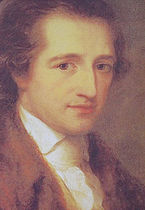 Key figures of German romanticism include:
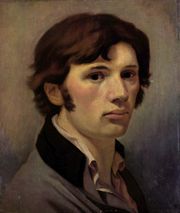
Romanticism
Romanticism was an artistic, literary and intellectual movement that originated in the second half of the 18th century in Europe, and gained strength in reaction to the Industrial Revolution...
.
In the philosophy
Philosophy
Philosophy is the study of general and fundamental problems, such as those connected with existence, knowledge, values, reason, mind, and language. Philosophy is distinguished from other ways of addressing such problems by its critical, generally systematic approach and its reliance on rational...
, art
Art
Art is the product or process of deliberately arranging items in a way that influences and affects one or more of the senses, emotions, and intellect....
, and culture
Culture
Culture is a term that has many different inter-related meanings. For example, in 1952, Alfred Kroeber and Clyde Kluckhohn compiled a list of 164 definitions of "culture" in Culture: A Critical Review of Concepts and Definitions...
of German
German language
German is a West Germanic language, related to and classified alongside English and Dutch. With an estimated 90 – 98 million native speakers, German is one of the world's major languages and is the most widely-spoken first language in the European Union....
-speaking countries, German Romanticism was the dominant movement of the late 18th and early 19th centuries. German Romanticism developed relatively late compared to its English
English language
English is a West Germanic language that arose in the Anglo-Saxon kingdoms of England and spread into what was to become south-east Scotland under the influence of the Anglian medieval kingdom of Northumbria...
counterpart, coinciding in its early years with the movement known as German Classicism or Weimar Classicism
Weimar Classicism
Weimar Classicism is a cultural and literary movement of Europe. Followers attempted to establish a new humanism by synthesizing Romantic, classical and Enlightenment ideas...
. In contrast to the seriousness of English Romanticism, the German variety is notable for valuing humor and wit as well as beauty.
The early German romantics tried to create a new synthesis of art, philosophy, and science, looking to the Middle Ages
Middle Ages
The Middle Ages is a periodization of European history from the 5th century to the 15th century. The Middle Ages follows the fall of the Western Roman Empire in 476 and precedes the Early Modern Era. It is the middle period of a three-period division of Western history: Classic, Medieval and Modern...
as a simpler, more integrated period. As time went on, however, they became increasingly aware of the tenuousness of the unity they were seeking. Later German Romanticism emphasized the tension between the everyday world and the seemingly irrational and supernatural projections of creative genius. Heinrich Heine
Heinrich Heine
Christian Johann Heinrich Heine was one of the most significant German poets of the 19th century. He was also a journalist, essayist, and literary critic. He is best known outside Germany for his early lyric poetry, which was set to music in the form of Lieder by composers such as Robert Schumann...
in particular criticized the tendency of the early romantics to look to the medieval past for a model of unity in art and society.
Literary and philosophical figures
Composers
- Ludwig van BeethovenLudwig van BeethovenLudwig van Beethoven was a German composer and pianist. A crucial figure in the transition between the Classical and Romantic eras in Western art music, he remains one of the most famous and influential composers of all time.Born in Bonn, then the capital of the Electorate of Cologne and part of...
. In his earlier works, Beethoven was a Classicist in the traditions of MozartWolfgang Amadeus MozartWolfgang Amadeus Mozart , baptismal name Johannes Chrysostomus Wolfgangus Theophilus Mozart , was a prolific and influential composer of the Classical era. He composed over 600 works, many acknowledged as pinnacles of symphonic, concertante, chamber, piano, operatic, and choral music...
and HaydnJoseph HaydnFranz Joseph Haydn , known as Joseph Haydn , was an Austrian composer, one of the most prolific and prominent composers of the Classical period. He is often called the "Father of the Symphony" and "Father of the String Quartet" because of his important contributions to these forms...
(his tutor), but his Middle Period, beginning with his third symphony (the 'EroicaEroicaThe name Eroica may refer to:*The Eroica Symphony, by Ludwig van Beethoven;*The Eroica Variations for piano, also by Beethoven;*The Eroica Piano Trio, an American chamber ensemble;...
'), bridges the worlds of Classical and Romantic music. Because Beethoven wrote some of his greatest music after he became totally deaf, he embodies the Romantic ideal of the tragic artist who defies all odds to conquer his own fate. His later works portray the triumph of the human spirit, most notably his 'Choral' Symphony No. 9; the stirring 'Ode to JoySymphony No. 9 (Beethoven)The Symphony No. 9 in D minor, Op. 125, is the final complete symphony of Ludwig van Beethoven. Completed in 1824, the symphony is one of the best known works of the Western classical repertoire, and has been adapted for use as the European Anthem...
' from this symphony has been adopted as the anthem of the European UnionEuropean UnionThe European Union is an economic and political union of 27 independent member states which are located primarily in Europe. The EU traces its origins from the European Coal and Steel Community and the European Economic Community , formed by six countries in 1958...
. - Johannes BrahmsJohannes BrahmsJohannes Brahms was a German composer and pianist, and one of the leading musicians of the Romantic period. Born in Hamburg, Brahms spent much of his professional life in Vienna, Austria, where he was a leader of the musical scene...
. His works are cast in the formal moulds of Classicism; he had a profound reverence for Beethoven. Brahms was also attracted to the exoticism of Hungarian folk music, and used it in such pieces as his famous 'Hungarian Dances', the final movement of his Violin Concerto, and the 'Rondo alla zingarese' from his Piano Quartet No. 1, op. 25, in G minor. - Franz LisztFranz LisztFranz Liszt ; ), was a 19th-century Hungarian composer, pianist, conductor, and teacher.Liszt became renowned in Europe during the nineteenth century for his virtuosic skill as a pianist. He was said by his contemporaries to have been the most technically advanced pianist of his age...
. Liszt was by nationality a HungarianHungaryHungary , officially the Republic of Hungary , is a landlocked country in Central Europe. It is situated in the Carpathian Basin and is bordered by Slovakia to the north, Ukraine and Romania to the east, Serbia and Croatia to the south, Slovenia to the southwest and Austria to the west. The...
, but nevertheless he spent many years in GermanyGermanyGermany , officially the Federal Republic of Germany , is a federal parliamentary republic in Europe. The country consists of 16 states while the capital and largest city is Berlin. Germany covers an area of 357,021 km2 and has a largely temperate seasonal climate...
, and his first language was GermanGerman languageGerman is a West Germanic language, related to and classified alongside English and Dutch. With an estimated 90 – 98 million native speakers, German is one of the world's major languages and is the most widely-spoken first language in the European Union....
. Credited as the inventor of the tone poem. In his old age, Liszt adopted a more dissonant, ominous flavour, characteristic works being 'la Lugubre Gondola' and 'Die Zelle in Nonnenwerth'—predating ImpressionismImpressionist musicImpressionism in music was a tendency in European classical music, mainly in France, which appeared in the late nineteenth century and continued into the middle of the twentieth century. Similarly to its precursor in the visual arts, musical impressionism focuses on a suggestion and an atmosphere...
and 20th-century atonality. - Felix Mendelssohn Bartholdy. A composer of the Early Romantic period, together with such figures as Schumann, Chopin and Liszt. One of the persons responsible for reviving interest in the almost-forgotten music of Johann Sebastian BachJohann Sebastian BachJohann Sebastian Bach was a German composer, organist, harpsichordist, violist, and violinist whose sacred and secular works for choir, orchestra, and solo instruments drew together the strands of the Baroque period and brought it to its ultimate maturity...
. - Franz SchubertFranz SchubertFranz Peter Schubert was an Austrian composer.Although he died at an early age, Schubert was tremendously prolific. He wrote some 600 Lieder, nine symphonies , liturgical music, operas, some incidental music, and a large body of chamber and solo piano music...
. Universally acknowledged as the greatest composer of German Lieder. - Robert SchumannRobert SchumannRobert Schumann, sometimes known as Robert Alexander Schumann, was a German composer, aesthete and influential music critic. He is regarded as one of the greatest and most representative composers of the Romantic era....
. His works recall the nostalgia of lost childhood innocence, first love, and the magnificence of the German countryside. As an influential critic, he played a major role in discovering new talents, among them Chopin and Brahms. - Richard WagnerRichard WagnerWilhelm Richard Wagner was a German composer, conductor, theatre director, philosopher, music theorist, poet, essayist and writer primarily known for his operas...
. The greatest composer of German opera; was an exponent of LeitmotifLeitmotifA leitmotif , sometimes written leit-motif, is a musical term , referring to a recurring theme, associated with a particular person, place, or idea. It is closely related to the musical idea of idée fixe...
. One of the main figures in the so-called War of the RomanticsWar of the RomanticsThe War of the Romantics is a term used by music historians to describe the aesthetic schism among prominent musicians in the second half of the 19th century. Musical structure, the limits of chromatic harmony, and program music versus absolute music were the principal areas of contention. The...
. - Carl Maria von WeberCarl Maria von WeberCarl Maria Friedrich Ernst von Weber was a German composer, conductor, pianist, guitarist and critic, one of the first significant composers of the Romantic school....
. Perhaps the very first of Romantic musicians, if we exclude Beethoven, in the sense that Weber was the first major composer to emerge wholly as a product of the Romantic school, as contrasted with Beethoven, who had started off as a Classicist. The emotional intensity and supernatural, folklore-based themes in his operas presented a radical break from the Neoclassical traditions of that time.
Visual Artists
- Johan Christian DahlJohan Christian DahlJohan Christian Claussen Dahl , often known as was a Norwegian landscape painter, who was connected to the Norwegian romantic nationalism. He is often considered have been "the father of Norwegian landscape painting"....
- Caspar David FriedrichCaspar David FriedrichCaspar David Friedrich was a 19th-century German Romantic landscape painter, generally considered the most important German artist of his generation. He is best known for his mid-period allegorical landscapes which typically feature contemplative figures silhouetted against night skies, morning...
- Joseph Anton KochJoseph Anton KochJoseph Anton Koch was an Austrian painter of the German Romantic movement.-Biography:The Tyrolese painter was born in Elbigenalp. He started life tending cattle. Through the recommendation of Bishop Umgelder , he received academic training in the Karlsschule Stuttgart, a strict military academy...
- Gerhard von KügelgenGerhard von KügelgenFranz Gerhard von Kügelgen was a German painter, noted for his portraits and history paintings. He was a professor at the Academy of Arts in Dresden and a member of both the Prussian and Russian Academies of Arts. His twin brother, Karl von Kügelgen, was also a painter of note.Gerhard von Kügelgen...
- Adrian Ludwig RichterAdrian Ludwig RichterAdrian Ludwig Richter , a German painter and etcher, was born at Dresden, the son of the engraver Karl August Richter, from whom he received his training; but he was strongly influenced by Erhard and Chodowiecki....
- Philipp Otto RungePhilipp Otto RungePhilipp Otto Runge was a Romantic German painter and draughtsman. He made a late start to his career and died young, nonetheless he is considered among the best German Romantic painters.- Life and work :...
- Friedrich Wilhelm SchadowFriedrich Wilhelm SchadowFriedrich Wilhelm Schadow was a German Romantic painter.-Biography:He was born in Berlin and was the second son of the sculptor Johann Gottfried Schadow....
- Carl SpitzwegCarl SpitzwegCarl Spitzweg was a German romanticist painter and poet. He is considered to be one of the most important artists of the Biedermeier era....
- Eberhard WächterEberhard Wächter (painter)Eberhard Wächter was a German painter.Wächter was born and died in Stuttgart. He studied painting at Paris under Jean-Baptiste Regnault, Jacques-Louis David, and Antoine-Jean, Baron Gros, and later went to Rome, where he improved his French classical style of painting by the study of Italian art...
Architecture
- Karl Friedrich SchinkelKarl Friedrich SchinkelKarl Friedrich Schinkel was a Prussian architect, city planner, and painter who also designed furniture and stage sets. Schinkel was one of the most prominent architects of Germany and designed both neoclassical and neogothic buildings.-Biography:Schinkel was born in Neuruppin, Margraviate of...
Suggested reading
- Benz, Ernst. The Mystical Sources of German Romantic Philosophy, translated by Blair R. Reynolds and Eunice M. Paul. London: Pickwick Publications, 2009. ISBN 978-0-915138-50-0. (Original French edition: Les Sources mystiques de la philosophie romantique allemande. Paris : Vrin, 1968.)
- Börsch-Supan, Helmut. Caspar David FriedrichCaspar David FriedrichCaspar David Friedrich was a 19th-century German Romantic landscape painter, generally considered the most important German artist of his generation. He is best known for his mid-period allegorical landscapes which typically feature contemplative figures silhouetted against night skies, morning...
, translated by Sarah Twohig. New York: George Braziller, 1974. ISBN 0-8076-0747-9. - Breckman, Warren. "Introduction: A Revolution in Culture," in European Romanticism: A Brief History with Documents. Ed. W. Breckman. New York: Bedford/St Martin's, 2007.http://www.amazon.com/dp/0312450230
- Gossman, LionelLionel GossmanLionel Gossman is a Scottish-American scholar of French literature. He taught Romance Languages at Johns Hopkins University and Princeton University, and has written extensively on the history, theory and practice of historiography, and more recently, on aspects of German cultural...
. “Making of a Romantic Icon: The Religious Context of Friedrich Overbeck’s ‘Italia und Germania.’” American Philosophical Society, 2007. ISBN 0-87169-975-3. http://dianepub.wordpress.com/2010/06/30/lionel-gossman-making-of-a-romantic-icon-the-religious-context-of-friedrich-overbeck%E2%80%99s-italia-und-germaniaamerican-philosophical-society-transaction-97-5-isbn-0871699753/ - Gossman, Lionel. “Orpheus Philologus: Bachofen versus Mommsen on the Study of Antiquity.” American Philosophical Society Transactions, 1983. ISBN 1-4223-7467-X.
- Grewe, Cordula. Painting the Sacred in the Age of German Romanticism. Aldershot: Ashgate Books, 2009.http://www.amazon.com/dp/0754606457
- Johnston, Catherine, et al. Baltic Light: Early Open-Air Painting in Denmark and North Germany. New Haven and London: Yale University Press, 1999. ISBN 0-300-08166-9.
- Safrankski, Rüdiger. Romantik. Eine deutsche Affäre. Munich: Carl Hanser Verlag, 2007. ISBN 978-3-446-20944-2.
- Siegel, Linda. Caspar David FriedrichCaspar David FriedrichCaspar David Friedrich was a 19th-century German Romantic landscape painter, generally considered the most important German artist of his generation. He is best known for his mid-period allegorical landscapes which typically feature contemplative figures silhouetted against night skies, morning...
and the Age of German Romanticism. Branden Publishing Co, 1978. ISBN 0-8283-1659-7. - Vaughan, William. German Romantic Painting. New Haven and London: Yale University Press, 1980. ISBN 0-300-02387-1.
- Vaughan, William. Friedrich. London: Phaidon Press, 2004. ISBN 0-7148-4060-2
- Wolf, Norbert. Friedrich. Cologne: Taschen, 2003. ISBN 3-8228-2293-0
See also
- List of German-language philosophers
- Culture of GermanyCulture of GermanyGerman culture began long before the rise of Germany as a nation-state and spanned the entire German-speaking world. From its roots, culture in Germany has been shaped by major intellectual and popular currents in Europe, both religious and secular...
- List of Austrian intellectual traditions
- War of the RomanticsWar of the RomanticsThe War of the Romantics is a term used by music historians to describe the aesthetic schism among prominent musicians in the second half of the 19th century. Musical structure, the limits of chromatic harmony, and program music versus absolute music were the principal areas of contention. The...
- AthenaeumAthenaeum (literary journal)The Athenaeum was a literary journal started in 1798 by August Wilhelm and Karl Wilhelm Friedrich Schlegel. It is considered to be the founding publication of German Romanticism.-Contributors:...
- RomanticismRomanticismRomanticism was an artistic, literary and intellectual movement that originated in the second half of the 18th century in Europe, and gained strength in reaction to the Industrial Revolution...
- Prussian virtuesPrussian virtuesThe term Prussian virtues refers to an unfixed canon of several Lutheran virtues dating from the Enlightenment. Prussian virtues and the Prussian value system have influenced aspects of wider German culture.- Historical Development :...