


Marble Palace

Encyclopedia
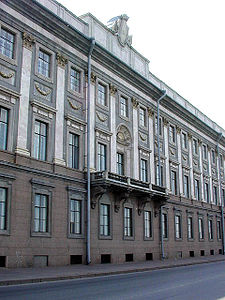
Marble Palace is one of the first Neoclassical
palace
s in Saint Petersburg
, Russia
. It is situated between the Field of Mars and Palace Quay, slightly to the east from New Michael Palace
.
The palace was built by Count Grigory Orlov, the favorite of Empress Catherine the Great
and the most powerful Russian nobleman of the 1760s. Construction started in 1768 to designs by Antonio Rinaldi, who previously had helped decorate the grand palace at Caserta
near Naples
. The combination of sumptuous ornamentation with rigorously classicizing monumentality, as practiced by Rinaldi, may be attributed to his earlier work under Luigi Vanvitelli
in Italy
.
The palace takes its name from its opulent decoration in a wide variety of polychrome marble
s. A rough-grained Finnish
granite
on the ground floor is in subtle contrast to polished pink Karelia
n marble of the pilaster
s and white Urals marble of capital
s and festoon
s. Panels of veined bluish gray Urals marble separate the floors, while Tallinn
dolomite
was employed for ornamental urn
s. In all, 32 disparate shades of marble were used to decorate the palace.
The plan of the edifice is trapezoid
al: each of its four facade
s, though strictly symmetrical, has a different design. One of the facades conceals a recessed courtyard, where an armored car employed by Lenin
during the October Revolution
used to be mounted on display between 1937 and 1992. Nowadays, the court is dominated by a sturdy equestrian statue of Alexander III of Russia
, the most famous work of sculptor Paolo Troubetzkoy
; formerly it graced a square before the Moscow Railway Station
. Fedot Shubin
, Mikhail Kozlovsky
, Stefano Torelli
and other Russian and foreign craftsmen decorated the interior with inlaid coloured marbles, stucco
, and statuary until 1785, by which time Count Orlov fell out of favour with the Empress, who had the palace purchased for her own heirs. In 1797–1798 the structure was leased to Stanisław August Poniatowski, the last king of Poland
. Thereafter the palace belonged to Grand Duke Constantine Pavlovich and his heirs from the Konstantinovichi branch of the Romanov
family.
In 1843, Grand Duke Constantine Nikolayevich
decided to redecorate the edifice, renaming it Constantine Palace and engaging Alexander Brullov
as the architect. An adjacent church and other outbuildings were completely rebuilt, while the interior of the palace was refurbished in keeping with the eclectic
tastes of its new owner. Only the main staircase and the Marble Hall survived that refacing and still retain the refined stucco work and elaborate marble pattern of Rinaldi's original decor.
During the Soviet
era, the palace successively housed the Ministry of Labour (1917–19), the Academy of Material Culture (1919–36), and the Lenin Museum (1937–91). Currently, the palace accommodates permanent exhibitions of the Russian State Museum, notably "Foreign Artists in Russia (18th and 19th centuries)" and the "Peter Ludwig Museum at the Russian Museum", featuring canvases by Andy Warhol
and other Pop Art
idols.
Neoclassical architecture
Neoclassical architecture was an architectural style produced by the neoclassical movement that began in the mid-18th century, manifested both in its details as a reaction against the Rococo style of naturalistic ornament, and in its architectural formulas as an outgrowth of some classicizing...
palace
Palace
A palace is a grand residence, especially a royal residence or the home of a head of state or some other high-ranking dignitary, such as a bishop or archbishop. The word itself is derived from the Latin name Palātium, for Palatine Hill, one of the seven hills in Rome. In many parts of Europe, the...
s in Saint Petersburg
Saint Petersburg
Saint Petersburg is a city and a federal subject of Russia located on the Neva River at the head of the Gulf of Finland on the Baltic Sea...
, Russia
Russia
Russia or , officially known as both Russia and the Russian Federation , is a country in northern Eurasia. It is a federal semi-presidential republic, comprising 83 federal subjects...
. It is situated between the Field of Mars and Palace Quay, slightly to the east from New Michael Palace
New Michael Palace
The New Michael Palace was the third Saint Petersburg palace designed by Andrei Stackenschneider for Nicholas I's children...
.
The palace was built by Count Grigory Orlov, the favorite of Empress Catherine the Great
Catherine II of Russia
Catherine II, also known as Catherine the Great , Empress of Russia, was born in Stettin, Pomerania, Prussia on as Sophie Friederike Auguste von Anhalt-Zerbst-Dornburg...
and the most powerful Russian nobleman of the 1760s. Construction started in 1768 to designs by Antonio Rinaldi, who previously had helped decorate the grand palace at Caserta
Caserta Palace
The Royal Palace of Caserta is a former royal residence in Caserta, southern Italy, constructed for the Bourbon kings of Naples. It was the largest palace and one of the largest buildings erected in Europe during the 18th century...
near Naples
Naples
Naples is a city in Southern Italy, situated on the country's west coast by the Gulf of Naples. Lying between two notable volcanic regions, Mount Vesuvius and the Phlegraean Fields, it is the capital of the region of Campania and of the province of Naples...
. The combination of sumptuous ornamentation with rigorously classicizing monumentality, as practiced by Rinaldi, may be attributed to his earlier work under Luigi Vanvitelli
Luigi Vanvitelli
Luigi Vanvitelli was an Italian engineer and architect. The most prominent 18th-century architect of Italy, he practiced a sober classicizing academic Late Baroque style that made an easy transition to Neoclassicism.-Biography:Vanvitelli was born at Naples, the son of a Dutch painter of land and...
in Italy
Italy
Italy , officially the Italian Republic languages]] under the European Charter for Regional or Minority Languages. In each of these, Italy's official name is as follows:;;;;;;;;), is a unitary parliamentary republic in South-Central Europe. To the north it borders France, Switzerland, Austria and...
.
The palace takes its name from its opulent decoration in a wide variety of polychrome marble
Marble
Marble is a metamorphic rock composed of recrystallized carbonate minerals, most commonly calcite or dolomite.Geologists use the term "marble" to refer to metamorphosed limestone; however stonemasons use the term more broadly to encompass unmetamorphosed limestone.Marble is commonly used for...
s. A rough-grained Finnish
Finland
Finland , officially the Republic of Finland, is a Nordic country situated in the Fennoscandian region of Northern Europe. It is bordered by Sweden in the west, Norway in the north and Russia in the east, while Estonia lies to its south across the Gulf of Finland.Around 5.4 million people reside...
granite
Granite
Granite is a common and widely occurring type of intrusive, felsic, igneous rock. Granite usually has a medium- to coarse-grained texture. Occasionally some individual crystals are larger than the groundmass, in which case the texture is known as porphyritic. A granitic rock with a porphyritic...
on the ground floor is in subtle contrast to polished pink Karelia
Karelia
Karelia , the land of the Karelian peoples, is an area in Northern Europe of historical significance for Finland, Russia, and Sweden...
n marble of the pilaster
Pilaster
A pilaster is a slightly-projecting column built into or applied to the face of a wall. Most commonly flattened or rectangular in form, pilasters can also take a half-round form or the shape of any type of column, including tortile....
s and white Urals marble of capital
Capital (architecture)
In architecture the capital forms the topmost member of a column . It mediates between the column and the load thrusting down upon it, broadening the area of the column's supporting surface...
s and festoon
Festoon
Festoon , a wreath or garland, and so in architecture a conventional arrangement of flowers, foliage or fruit bound together and suspended by ribbons, either from a decorated knot, or held in the mouths of lions, or suspended across the back of bulls heads as...
s. Panels of veined bluish gray Urals marble separate the floors, while Tallinn
Tallinn
Tallinn is the capital and largest city of Estonia. It occupies an area of with a population of 414,940. It is situated on the northern coast of the country, on the banks of the Gulf of Finland, south of Helsinki, east of Stockholm and west of Saint Petersburg. Tallinn's Old Town is in the list...
dolomite
Dolomite
Dolomite is a carbonate mineral composed of calcium magnesium carbonate CaMg2. The term is also used to describe the sedimentary carbonate rock dolostone....
was employed for ornamental urn
Urn
An urn is a vase, ordinarily covered, that usually has a narrowed neck above a footed pedestal. "Knife urns" placed on pedestals flanking a dining-room sideboard were an English innovation for high-style dining rooms of the late 1760s...
s. In all, 32 disparate shades of marble were used to decorate the palace.
The plan of the edifice is trapezoid
Trapezoid
In Euclidean geometry, a convex quadrilateral with one pair of parallel sides is referred to as a trapezoid in American English and as a trapezium in English outside North America. A trapezoid with vertices ABCD is denoted...
al: each of its four facade
Facade
A facade or façade is generally one exterior side of a building, usually, but not always, the front. The word comes from the French language, literally meaning "frontage" or "face"....
s, though strictly symmetrical, has a different design. One of the facades conceals a recessed courtyard, where an armored car employed by Lenin
Vladimir Lenin
Vladimir Ilyich Lenin was a Russian Marxist revolutionary and communist politician who led the October Revolution of 1917. As leader of the Bolsheviks, he headed the Soviet state during its initial years , as it fought to establish control of Russia in the Russian Civil War and worked to create a...
during the October Revolution
October Revolution
The October Revolution , also known as the Great October Socialist Revolution , Red October, the October Uprising or the Bolshevik Revolution, was a political revolution and a part of the Russian Revolution of 1917...
used to be mounted on display between 1937 and 1992. Nowadays, the court is dominated by a sturdy equestrian statue of Alexander III of Russia
Alexander III of Russia
Alexander Alexandrovich Romanov , historically remembered as Alexander III or Alexander the Peacemaker reigned as Emperor of Russia from until his death on .-Disposition:...
, the most famous work of sculptor Paolo Troubetzkoy
Paolo Troubetzkoy
Prince Paolo or Paul Troubetzkoy was an artist and a sculptor, of Russia's Troubetzkoy princely family, who was described by G.B. Shaw as "the most astonishing sculptor of modern times".-Life:He worked in Russia, America, England and Italy...
; formerly it graced a square before the Moscow Railway Station
Vosstaniya Square
Vosstaniya Square is a major square in the Central Business District of Saint Petersburg, Russia. The square lies at the crossing of Nevsky Prospekt, Ligovsky Prospekt, Vosstaniya Street and Goncharnaya Street, in front of the Moskovsky Rail Terminal, which is the northern terminus of the line...
.
Fedot Shubin
Fedot Ivanovich Shubin is widely regarded as the greatest sculptor of 18th-century Russia.A peasant's son, Shubin was born in a Pomor village near Kholmogory and, inspired by the example of his neighbour Mikhail Lomonosov, he walked all the way to St Petersburg at the age of 18...
, Mikhail Kozlovsky
Mikhail Kozlovsky
Mikhail Ivanovich Kozlovsky was a Russian Neoclassical sculptor active during the Age of Enlightenment....
, Stefano Torelli
Stefano Torelli
Stefano Torelli was an Italian painter. He was born in Bologna. He studied first under his father, Felice Torelli, and then under Francesco Solimena. The future King of Poland, Augustus III, brought him to Dresden in 1740, where he painted altar-pieces and ceiling decorations, many destroyed in...
and other Russian and foreign craftsmen decorated the interior with inlaid coloured marbles, stucco
Stucco
Stucco or render is a material made of an aggregate, a binder, and water. Stucco is applied wet and hardens to a very dense solid. It is used as decorative coating for walls and ceilings and as a sculptural and artistic material in architecture...
, and statuary until 1785, by which time Count Orlov fell out of favour with the Empress, who had the palace purchased for her own heirs. In 1797–1798 the structure was leased to Stanisław August Poniatowski, the last king of Poland
Polish-Lithuanian Commonwealth
The Polish–Lithuanian Commonwealth was a dualistic state of Poland and Lithuania ruled by a common monarch. It was the largest and one of the most populous countries of 16th- and 17th‑century Europe with some and a multi-ethnic population of 11 million at its peak in the early 17th century...
. Thereafter the palace belonged to Grand Duke Constantine Pavlovich and his heirs from the Konstantinovichi branch of the Romanov
Romanov
The House of Romanov was the second and last imperial dynasty to rule over Russia, reigning from 1613 until the February Revolution abolished the crown in 1917...
family.
In 1843, Grand Duke Constantine Nikolayevich
Grand Duke Konstantin Nikolayevich of Russia
Grand Duke Konstantin Nikolayevich of Russia was the second son of Tsar Nicholas I of Russia.During the reign of his brother Alexander II, Konstantin was an admiral of the Russian fleet and reformed the Russian Navy. He was also an instrumental figure in the emancipation of the serfs...
decided to redecorate the edifice, renaming it Constantine Palace and engaging Alexander Brullov
Alexander Brullov
Alexander Pavlovich Brullov was a Russian artist associated with the latest phase of the Russian Neoclassicism.Alexander Brullov was born in Saint Petersburg into a family of French artists: his great grandfather, his grandfather, his father and his brothers were artists. His first teacher was...
as the architect. An adjacent church and other outbuildings were completely rebuilt, while the interior of the palace was refurbished in keeping with the eclectic
Eclecticism
Eclecticism is a conceptual approach that does not hold rigidly to a single paradigm or set of assumptions, but instead draws upon multiple theories, styles, or ideas to gain complementary insights into a subject, or applies different theories in particular cases.It can sometimes seem inelegant or...
tastes of its new owner. Only the main staircase and the Marble Hall survived that refacing and still retain the refined stucco work and elaborate marble pattern of Rinaldi's original decor.
During the Soviet
Soviet Union
The Soviet Union , officially the Union of Soviet Socialist Republics , was a constitutionally socialist state that existed in Eurasia between 1922 and 1991....
era, the palace successively housed the Ministry of Labour (1917–19), the Academy of Material Culture (1919–36), and the Lenin Museum (1937–91). Currently, the palace accommodates permanent exhibitions of the Russian State Museum, notably "Foreign Artists in Russia (18th and 19th centuries)" and the "Peter Ludwig Museum at the Russian Museum", featuring canvases by Andy Warhol
Andy Warhol
Andrew Warhola , known as Andy Warhol, was an American painter, printmaker, and filmmaker who was a leading figure in the visual art movement known as pop art...
and other Pop Art
Pop art
Pop art is an art movement that emerged in the mid 1950s in Britain and in the late 1950s in the United States. Pop art challenged tradition by asserting that an artist's use of the mass-produced visual commodities of popular culture is contiguous with the perspective of fine art...
idols.