

Early Scots

Encyclopedia
Early Scots
describes the emerging literary language of the Northern Middle English
speaking parts of Scotland
in the period before 1450. The northern forms of Middle English descended from Northumbrian
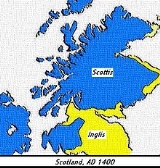
Old English. During this period, speakers referred to the language as "English" (Inglis, Ynglis, and variants).
Early examples such as Barbour’s The Brus
and Wyntoun
’s Chronicle are better explained as part of Northern Middle English than as isolated forerunners of later Scots, a name first used to describe the language later in the Middle Scots
period.
Old English had been established in south-eastern Scotland as far as the River Forth
in the 7th century and largely remained there until the 13th century, which is why in the late 12th century Adam of Dryburgh described his locality as "in the land of the English in the Kingdom of the Scots" and why the early 13th century author of de Situ Albanie
wrote that the Firth of Forth
"divides the kingdoms of the Scots and of the English".
Political developments in the 12th century facilitated the spread of the English language. Institutions such as the burgh
s first established by David I
, mostly in the south and east of Scotland, brought new communities into the areas in which they were established. Incoming burghers were mainly English (especially from Northumbria
, and the Earldom of Huntingdon
), Dutch
and French
. Although the military aristocracy employed French and Gaelic, these small urban communities appear to have been using English as something more than a by the end of the 13th century, although this may not be surprising as the area under the Forth in east lowland Scotland was already English speaking and had been since Anglo-Saxon times. Although the population of the largest burghs would have been counted in hundreds rather than thousands, radical social shift occurred whereby many Gaels became assimilated into the new social system and its language.
The increasing economic influence of the burghs attracted further English, Fleming
and Scandinavia
n immigration. As the economic power of the burghs grew, Gaelic-speakers from the hinterland
found it advantageous to acquire a working knowledge of English. The institutional language of the burghs consisted of vocabulary that was Germanic
in origin, such English terms as toft (homestead and land), croft
(smallholding), ruid
(land let by a burgh), guild
(a trade association), bow (an arched gateway), wynd
(lane) and raw (row of houses).
Multi-lingualism and cultural diversity became increasingly the norm after David I. People in one part of the realm could be addressed as "" (French, English, Scots and Galloway
-men). The end of the House of Dunkeld
led to the throne being passed to three families of Anglo-French origin, the Balliol
s, Bruces and Stewart
s. After the death of King Robert I
, the kings of Scotland (with the exception of King Robert II
) increasingly identified themselves with the English-speaking part of the kingdom. As a result, by the reign of King James I of Scotland
, the political heartland of the Scottish king moved from the area around Scone and Perth
to the traditionally English area around Edinburgh
in the lowlands.
By the 14th and 15th centuries, the variety of English that resulted from the above influences had replaced Gaelic in much of the lowlands and Norman French had ceased to be used as the language of the elite. By this time differentiation into Southern, Central and Northern dialects had perhaps occurred. Scots was also beginning to replace Latin as a language for records and literature. In Caithness
, it came into contact with both Norn
and Gaelic.
via ecclesiastical and legal Latin
and French, was much the same as that of contemporary English but was often different in detail because of the continuing influence of the Auld Alliance
and the imaginative use of Latinisms in literature.
During this period a number of words of Anglo-Saxon origin, such as anerly (alone), berynes (grave), clenge (cleanse), halfindall (a half part), scathful (harmful), sturting (contention), thyrllage (bondage) and umbeset (surround), were now almost or completely unique to Scots.
French derived warfare terms such as arsoun (saddle-bow), bassynet (helmet), eschell (battalion), hawbrek (coat of mail), qwyrbolle (hardened leather), troppell (troop), vaward (vanguard) and vyre (crossbow bolt) became part of the language along with other French vocabulary such as cummer (godmother), disjone (breakfast), dour (stern, grim), fasch (annoy), grosar (gooseberry), ladron (rascal), moyen (means), plenissing (furniture) and vevaris (provisions).
The vocabulary of Scots was augmented by the speech of Scandinavians, Flemings, Dutch
and Middle Low German
speakers through trade with, and immigration from, the low countries
.
From Scandinavian (often via Scandinavian influenced Middle English
) came at (that/who), byg (build), bak (bat), bla (blae), bra (brae
), ferlie (marvel), flyt remove, fra (from), gar (compel), gowk (cuckoo), harnis (brains), ithand (industrious), low (flame), lug (an appendage, ear), man (must), neve (fist), sark (shirt), spe (prophesy), þa (those), til (to), tinsell (loss), wycht (valiant) and wyll (lost, confused).
The Flemings introduced bonspell
(sporting contest), bowcht (sheep pen), cavie (hen coop), crame (a booth), furisine (flint
striker), grotkyn (a gross
), howff (courtyard), kesart (cheese vat), lunt (match), much (a cap), muchkin (a liquid measure), skaff (scrounge), wapinschaw (muster of militia), wyssill (change of money) and the coins plak, stek and doyt.
A number of Gaelic words such as breive (judge), cane (a tribute), couthal
(court of justice), davach (a measure of land), duniwassal (nobleman), kenkynolle (head of the kindred), mare (tax collector) and toschachdor (leader) occurred in early legal documents but most became obsolete early in the period. Gaelic words for topographical features have endured bogg (bog), carn (pile of stones), corrie (hollow in a hill), crag (rock), inch (small island), knok (hill), loch (lake or fjord) and strath (river valley).
and Anglo-Norman
French. The reduced set of verb agreement endings in particular give the language an uncannily modern appearance when compared to the writing of English contemporaries such as Geoffrey Chaucer
.
Some orthographic features distinguishing Northern Middle English and Early Scots from other regional variants of written Middle English are:
By the end of the period when Middle Scots
began to emerge, orthography
and phonology
had diverged significantly from that of Northern Middle English
.
The major differences to contemporary southern English are the outcome of Anglo-Saxon /oː/ as /øː/, the distribution of the unchanged Anglo-Saxon /aː/ and /oː/ from Anglo-Saxon /o/. The Scandinavian-influenced /k/ in words such as birk (birch), brekis (breeches
), brig (bridge), kirk (church), kist (chest), mekil (much) and rig (ridge), and the retention of Germanic /ou/ in words such as lowp (leap), cowp (cf. cheap, to trade) and nowt (cattle).
Scots language
Scots is the Germanic language variety spoken in Lowland Scotland and parts of Ulster . It is sometimes called Lowland Scots to distinguish it from Scottish Gaelic, the Celtic language variety spoken in most of the western Highlands and in the Hebrides.Since there are no universally accepted...
describes the emerging literary language of the Northern Middle English
Middle English
Middle English is the stage in the history of the English language during the High and Late Middle Ages, or roughly during the four centuries between the late 11th and the late 15th century....
speaking parts of Scotland
Scotland
Scotland is a country that is part of the United Kingdom. Occupying the northern third of the island of Great Britain, it shares a border with England to the south and is bounded by the North Sea to the east, the Atlantic Ocean to the north and west, and the North Channel and Irish Sea to the...
in the period before 1450. The northern forms of Middle English descended from Northumbrian
Northumbrian (Anglo-Saxon)
Northumbrian was a dialect of the Old English language spoken in the Anglian Kingdom of Northumbria. Together with Mercian, Kentish and West Saxon, it forms one of the sub-categories of Old English devised and employed by modern scholars....
Old English. During this period, speakers referred to the language as "English" (Inglis, Ynglis, and variants).
Early examples such as Barbour’s The Brus
The Brus
The Brus is a long narrative poem of just under 14,000 octosyllabic lines composed by John Barbour which gives a historic and chivalric account of the actions of Robert the Bruce and the Black Douglas in the Scottish Wars of Independence during a period from the circumstances leading up the English...
and Wyntoun
Andrew of Wyntoun
Andrew Wyntoun, known as Andrew of Wyntoun was a Scottish poet, a canon and prior of Loch Leven on St Serf's Inch and later, a canon of St...
’s Chronicle are better explained as part of Northern Middle English than as isolated forerunners of later Scots, a name first used to describe the language later in the Middle Scots
Middle Scots
Middle Scots was the Anglic language of Lowland Scotland in the period from 1450 to 1700. By the end of the 13th century its phonology, orthography, accidence, syntax and vocabulary had diverged markedly from Early Scots, which was virtually indistinguishable from early Northumbrian Middle English...
period.
History
NorthumbrianNorthumbrian (Anglo-Saxon)
Northumbrian was a dialect of the Old English language spoken in the Anglian Kingdom of Northumbria. Together with Mercian, Kentish and West Saxon, it forms one of the sub-categories of Old English devised and employed by modern scholars....
Old English had been established in south-eastern Scotland as far as the River Forth
River Forth
The River Forth , long, is the major river draining the eastern part of the central belt of Scotland.The Forth rises in Loch Ard in the Trossachs, a mountainous area some west of Stirling...
in the 7th century and largely remained there until the 13th century, which is why in the late 12th century Adam of Dryburgh described his locality as "in the land of the English in the Kingdom of the Scots" and why the early 13th century author of de Situ Albanie
De Situ Albanie
De Situ Albanie is the name given to the first of seven Scottish documents found in the so-called Poppleton Manuscript, now in the Bibliothèque Nationale, Paris...
wrote that the Firth of Forth
Firth of Forth
The Firth of Forth is the estuary or firth of Scotland's River Forth, where it flows into the North Sea, between Fife to the north, and West Lothian, the City of Edinburgh and East Lothian to the south...
"divides the kingdoms of the Scots and of the English".
Political developments in the 12th century facilitated the spread of the English language. Institutions such as the burgh
Burgh
A burgh was an autonomous corporate entity in Scotland and Northern England, usually a town. This type of administrative division existed from the 12th century, when King David I created the first royal burghs. Burgh status was broadly analogous to borough status, found in the rest of the United...
s first established by David I
David I of Scotland
David I or Dabíd mac Maíl Choluim was a 12th-century ruler who was Prince of the Cumbrians and later King of the Scots...
, mostly in the south and east of Scotland, brought new communities into the areas in which they were established. Incoming burghers were mainly English (especially from Northumbria
Northumbria
Northumbria was a medieval kingdom of the Angles, in what is now Northern England and South-East Scotland, becoming subsequently an earldom in a united Anglo-Saxon kingdom of England. The name reflects the approximate southern limit to the kingdom's territory, the Humber Estuary.Northumbria was...
, and the Earldom of Huntingdon
Earl of Huntingdon
Earl of Huntingdon is a title which has been created several times in the Peerage of England. The title is associated with the ruling house of Scotland, and latterly with the Hastings family.-Early history:...
), Dutch
Dutch language
Dutch is a West Germanic language and the native language of the majority of the population of the Netherlands, Belgium, and Suriname, the three member states of the Dutch Language Union. Most speakers live in the European Union, where it is a first language for about 23 million and a second...
and French
French language
French is a Romance language spoken as a first language in France, the Romandy region in Switzerland, Wallonia and Brussels in Belgium, Monaco, the regions of Quebec and Acadia in Canada, and by various communities elsewhere. Second-language speakers of French are distributed throughout many parts...
. Although the military aristocracy employed French and Gaelic, these small urban communities appear to have been using English as something more than a by the end of the 13th century, although this may not be surprising as the area under the Forth in east lowland Scotland was already English speaking and had been since Anglo-Saxon times. Although the population of the largest burghs would have been counted in hundreds rather than thousands, radical social shift occurred whereby many Gaels became assimilated into the new social system and its language.
The increasing economic influence of the burghs attracted further English, Fleming
Flemish people
The Flemings or Flemish are the Dutch-speaking inhabitants of Belgium, where they are mostly found in the northern region of Flanders. They are one of two principal cultural-linguistic groups in Belgium, the other being the French-speaking Walloons...
and Scandinavia
Scandinavia
Scandinavia is a cultural, historical and ethno-linguistic region in northern Europe that includes the three kingdoms of Denmark, Norway and Sweden, characterized by their common ethno-cultural heritage and language. Modern Norway and Sweden proper are situated on the Scandinavian Peninsula,...
n immigration. As the economic power of the burghs grew, Gaelic-speakers from the hinterland
Hinterland
The hinterland is the land or district behind a coast or the shoreline of a river. Specifically, by the doctrine of the hinterland, the word is applied to the inland region lying behind a port, claimed by the state that owns the coast. The area from which products are delivered to a port for...
found it advantageous to acquire a working knowledge of English. The institutional language of the burghs consisted of vocabulary that was Germanic
Germanic languages
The Germanic languages constitute a sub-branch of the Indo-European language family. The common ancestor of all of the languages in this branch is called Proto-Germanic , which was spoken in approximately the mid-1st millennium BC in Iron Age northern Europe...
in origin, such English terms as toft (homestead and land), croft
Croft (land)
A croft is a fenced or enclosed area of land, usually small and arable with a crofter's dwelling thereon. A crofter is one who has tenure and use of the land, typically as a tenant farmer.- Etymology :...
(smallholding), ruid
Rood (Scots)
A Scottish rood was a land measurement of Anglo-Saxon origin. It was in greatest use in the South East of Scotland, and along the border, whereas in the north various other systems were used, based on the land's productivity, rather than actual area...
(land let by a burgh), guild
Guild
A guild is an association of craftsmen in a particular trade. The earliest types of guild were formed as confraternities of workers. They were organized in a manner something between a trade union, a cartel, and a secret society...
(a trade association), bow (an arched gateway), wynd
Wynd
Wynd is a Scots word for what is typically a narrow path snaking through houses to join two major roads. In many places wynds link streets at different heights and thus are mostly thought of as being ways up or down hills...
(lane) and raw (row of houses).
Multi-lingualism and cultural diversity became increasingly the norm after David I. People in one part of the realm could be addressed as "" (French, English, Scots and Galloway
Galloway
Galloway is an area in southwestern Scotland. It usually refers to the former counties of Wigtownshire and Kirkcudbrightshire...
-men). The end of the House of Dunkeld
House of Dunkeld
The so-called House of Dunkeld, in Scottish Gaelic Dùn Chailleann , is a historiographical and genealogical construct to illustrate the clear succession of Scottish kings from 1034 to 1040 and from 1058 to 1290.It is dynastically sort of a continuation to Cenél nGabráin of Dál Riata, "race of...
led to the throne being passed to three families of Anglo-French origin, the Balliol
House of Balliol
The House of Balliol was a Picard and Anglo-Norman family who began to rule some estates in England in the reign of William Rufus. In the late 13th and 14th centuries, two members of the house were kings of Scotland....
s, Bruces and Stewart
House of Stuart
The House of Stuart is a European royal house. Founded by Robert II of Scotland, the Stewarts first became monarchs of the Kingdom of Scotland during the late 14th century, and subsequently held the position of the Kings of Great Britain and Ireland...
s. After the death of King Robert I
Robert I of Scotland
Robert I , popularly known as Robert the Bruce , was King of Scots from March 25, 1306, until his death in 1329.His paternal ancestors were of Scoto-Norman heritage , and...
, the kings of Scotland (with the exception of King Robert II
Robert II of Scotland
Robert II became King of Scots in 1371 as the first monarch of the House of Stewart. He was the son of Walter Stewart, hereditary High Steward of Scotland and of Marjorie Bruce, daughter of Robert I and of his first wife Isabella of Mar...
) increasingly identified themselves with the English-speaking part of the kingdom. As a result, by the reign of King James I of Scotland
James I of Scotland
James I, King of Scots , was the son of Robert III and Annabella Drummond. He was probably born in late July 1394 in Dunfermline as youngest of three sons...
, the political heartland of the Scottish king moved from the area around Scone and Perth
Perth, Scotland
Perth is a town and former city and royal burgh in central Scotland. Located on the banks of the River Tay, it is the administrative centre of Perth and Kinross council area and the historic county town of Perthshire...
to the traditionally English area around Edinburgh
Edinburgh
Edinburgh is the capital city of Scotland, the second largest city in Scotland, and the eighth most populous in the United Kingdom. The City of Edinburgh Council governs one of Scotland's 32 local government council areas. The council area includes urban Edinburgh and a rural area...
in the lowlands.
By the 14th and 15th centuries, the variety of English that resulted from the above influences had replaced Gaelic in much of the lowlands and Norman French had ceased to be used as the language of the elite. By this time differentiation into Southern, Central and Northern dialects had perhaps occurred. Scots was also beginning to replace Latin as a language for records and literature. In Caithness
Caithness
Caithness is a registration county, lieutenancy area and historic local government area of Scotland. The name was used also for the earldom of Caithness and the Caithness constituency of the Parliament of the United Kingdom . Boundaries are not identical in all contexts, but the Caithness area is...
, it came into contact with both Norn
Norn language
Norn is an extinct North Germanic language that was spoken in Shetland and Orkney, off the north coast of mainland Scotland, and in Caithness. After the islands were pledged to Scotland by Norway in the 15th century, it was gradually replaced by Scots and on the mainland by Scottish...
and Gaelic.
Vocabulary
The core vocabulary is of Anglo-Saxon origin although many of the differences in the phonology, morphology and lexicon in the northern and southern dialects of Middle English have been traced to the linguistic influence in the North of the eighth and ninth century Viking invaders who first plundered, then conquered and settled in, large territories in Northumbria, Lincolnshire and East Anglia. Scots also retained many words which became obsolete farther south. The pattern of foreign borrowings, such as RomanceRomance languages
The Romance languages are a branch of the Indo-European language family, more precisely of the Italic languages subfamily, comprising all the languages that descend from Vulgar Latin, the language of ancient Rome...
via ecclesiastical and legal Latin
Latin
Latin is an Italic language originally spoken in Latium and Ancient Rome. It, along with most European languages, is a descendant of the ancient Proto-Indo-European language. Although it is considered a dead language, a number of scholars and members of the Christian clergy speak it fluently, and...
and French, was much the same as that of contemporary English but was often different in detail because of the continuing influence of the Auld Alliance
Auld Alliance
The Auld Alliance was an alliance between the kingdoms of Scotland and France. It played a significant role in the relations between Scotland, France and England from its beginning in 1295 until the 1560 Treaty of Edinburgh. The alliance was renewed by all the French and Scottish monarchs of that...
and the imaginative use of Latinisms in literature.
During this period a number of words of Anglo-Saxon origin, such as anerly (alone), berynes (grave), clenge (cleanse), halfindall (a half part), scathful (harmful), sturting (contention), thyrllage (bondage) and umbeset (surround), were now almost or completely unique to Scots.
French derived warfare terms such as arsoun (saddle-bow), bassynet (helmet), eschell (battalion), hawbrek (coat of mail), qwyrbolle (hardened leather), troppell (troop), vaward (vanguard) and vyre (crossbow bolt) became part of the language along with other French vocabulary such as cummer (godmother), disjone (breakfast), dour (stern, grim), fasch (annoy), grosar (gooseberry), ladron (rascal), moyen (means), plenissing (furniture) and vevaris (provisions).
The vocabulary of Scots was augmented by the speech of Scandinavians, Flemings, Dutch
Dutch language
Dutch is a West Germanic language and the native language of the majority of the population of the Netherlands, Belgium, and Suriname, the three member states of the Dutch Language Union. Most speakers live in the European Union, where it is a first language for about 23 million and a second...
and Middle Low German
Middle Low German
Middle Low German is a language that is the descendant of Old Saxon and is the ancestor of modern Low German. It served as the international lingua franca of the Hanseatic League...
speakers through trade with, and immigration from, the low countries
Low Countries
The Low Countries are the historical lands around the low-lying delta of the Rhine, Scheldt, and Meuse rivers, including the modern countries of Belgium, the Netherlands, Luxembourg and parts of northern France and western Germany....
.
From Scandinavian (often via Scandinavian influenced Middle English
Middle English
Middle English is the stage in the history of the English language during the High and Late Middle Ages, or roughly during the four centuries between the late 11th and the late 15th century....
) came at (that/who), byg (build), bak (bat), bla (blae), bra (brae
Brae
Brae is a settlement on the mainland of the Shetland Islands in Scotland. It is located at the northeast end of Busta Voe, on the narrow isthmus that separates the mainland from Northmavine...
), ferlie (marvel), flyt remove, fra (from), gar (compel), gowk (cuckoo), harnis (brains), ithand (industrious), low (flame), lug (an appendage, ear), man (must), neve (fist), sark (shirt), spe (prophesy), þa (those), til (to), tinsell (loss), wycht (valiant) and wyll (lost, confused).
The Flemings introduced bonspell
Bonspiel
A bonspiel is a curling tournament, traditionally held outdoors on a frozen freshwater loch. The word comes from the Scottish Gaelic and means league match . Though not mandatory, curling teams involved in bonspiels often wear theme costumes...
(sporting contest), bowcht (sheep pen), cavie (hen coop), crame (a booth), furisine (flint
Flint
Flint is a hard, sedimentary cryptocrystalline form of the mineral quartz, categorized as a variety of chert. It occurs chiefly as nodules and masses in sedimentary rocks, such as chalks and limestones. Inside the nodule, flint is usually dark grey, black, green, white, or brown in colour, and...
striker), grotkyn (a gross
Gross (unit)
A gross is equal to a dozen dozen, i.e. 12 × 12 = 144.It can be used in duodecimal counting. The use of gross likely originated from the fact that 144 can be counted on the fingers using the fingertips and first two joints of each finger when marked by the thumb of one hand. The other hand...
), howff (courtyard), kesart (cheese vat), lunt (match), much (a cap), muchkin (a liquid measure), skaff (scrounge), wapinschaw (muster of militia), wyssill (change of money) and the coins plak, stek and doyt.
A number of Gaelic words such as breive (judge), cane (a tribute), couthal
Comhdhail
A comhdhail or couthal was a popular court in medieval Scotland. The word derives from Old Gaelic comdal, "tryst" or "assembly". Distinct from courts of the king, mormaers and senior barons, such courts were organized at a lower level of society, by peasant communities for themselves...
(court of justice), davach (a measure of land), duniwassal (nobleman), kenkynolle (head of the kindred), mare (tax collector) and toschachdor (leader) occurred in early legal documents but most became obsolete early in the period. Gaelic words for topographical features have endured bogg (bog), carn (pile of stones), corrie (hollow in a hill), crag (rock), inch (small island), knok (hill), loch (lake or fjord) and strath (river valley).
Orthography
The language first appeared in written form in the mid-14th century, when its written form differed little from that of northern English dialects, and so Scots shared many Northumbrian borrowings from Old NorseOld Norse
Old Norse is a North Germanic language that was spoken by inhabitants of Scandinavia and inhabitants of their overseas settlements during the Viking Age, until about 1300....
and Anglo-Norman
Anglo-Norman language
Anglo-Norman is the name traditionally given to the kind of Old Norman used in England and to some extent elsewhere in the British Isles during the Anglo-Norman period....
French. The reduced set of verb agreement endings in particular give the language an uncannily modern appearance when compared to the writing of English contemporaries such as Geoffrey Chaucer
Geoffrey Chaucer
Geoffrey Chaucer , known as the Father of English literature, is widely considered the greatest English poet of the Middle Ages and was the first poet to have been buried in Poet's Corner of Westminster Abbey...
.
Some orthographic features distinguishing Northern Middle English and Early Scots from other regional variants of written Middle English are:
- The notable use of the Northern subject ruleNorthern subject ruleThe Northern Subject Rule is a grammatical pattern inherited from Northern Middle English. Present tense verbs may take the verbal ‑s suffix, except when they are directly adjacent to one of the personal pronouns I, you, we, or they as their subject...
, which according to one hypothesis, is thought to have arisen through contact with the Celtic languages of Britain during the early medieval period. Another hypothesis proposes a possible path of developments from the reduction of verbal affixes followed by originally enclitic postverbal pronouns.
- The forms of the third person plural pronounPronounIn linguistics and grammar, a pronoun is a pro-form that substitutes for a noun , such as, in English, the words it and he...
they/their/them (derived from Old Norse) which later moved southwards to replace the older Southern he/here/hem forms (derived from Old English). One reason why the Northern forms were ultimately successful is that they got rid of the ambiguity of early Southern Middle English he (which could mean 'he', 'they', or even in some dialects 'she') and hir(e), her(e) (which could mean either 'her' or 'their').
- The reduced set of verbVerbA verb, from the Latin verbum meaning word, is a word that in syntax conveys an action , or a state of being . In the usual description of English, the basic form, with or without the particle to, is the infinitive...
agreement endings originating in the 9th or 10th centuries. In Northern Middle English, in the present tense, in all persons and numbers but the first singular, which had –e, the ending was –(e)s; and in Scotland even the first person singular was occasionally –s. Whereas the Old English and Southern and Midlands Middle English pattern had –e, -(e)s(t), -(e)th in the three persons of the singular and –(a)th (-(e)n in the Midlands) in all persons of the plural.
- Loss of the Old English prefix ge- often y- or i- further south.
- The single syllable northern infinitiveInfinitiveIn grammar, infinitive is the name for certain verb forms that exist in many languages. In the usual description of English, the infinitive of a verb is its basic form with or without the particle to: therefore, do and to do, be and to be, and so on are infinitives...
(sing rather than the Old English singan), whereas the past participle -en inflection was used in the South. The finalSilent ESilent e is a writing convention in English spelling. A silent letter e at the end of a word often signals a specific pronunciation of the preceding vowel letter, as in the difference between "rid" and "ride" . This orthographic pattern followed the phonological changes of the Great Vowel Shift...
eSilent ESilent e is a writing convention in English spelling. A silent letter e at the end of a word often signals a specific pronunciation of the preceding vowel letter, as in the difference between "rid" and "ride" . This orthographic pattern followed the phonological changes of the Great Vowel Shift...
was silent in the North but still pronounced further south.
- The northern present participleParticipleIn linguistics, a participle is a word that shares some characteristics of both verbs and adjectives. It can be used in compound verb tenses or voices , or as a modifier...
–and, whereas –inge(e), -ynge(e) was used in the South, and the northern past participle of strong verbs, in for example, drive(n) and southern ydrive.
- The Scottish -yt/-it for the past tensePast tenseThe past tense is a grammatical tense that places an action or situation in the past of the current moment , or prior to some specified time that may be in the speaker's past, present, or future...
, the northern form was usually -yd/-id where further south -ed was used.
- In the North and in the Northeast Midlands evidence from poetry indicates a pattern unlike that of Old English reflecting contact with a Scandinavian-influenced one. Whereas in the West Midlands and Southern dialects of early Middle English the verb-secondV2 word orderIn syntax, verb-second word order is the rule in some languages that the second constituent of declarative main clauses is always a verb, while this is not necessarily the case in other types of clauses.- V2 effect :...
(V2) pattern of Old English is largely maintained.
- Other differences between Northern and Southern Middle English were the adoption of function words of Norse origin, but also phonological effects such as the replacement of Old English /ʃ/ sh by /sk/ sk, sc and /k/ and /ɡ/ for the palatalized /tʃ/ and /dʒ/. Other phonological differences included the simplification in the initial sc/sh- /ʃ/ fricative to /s/ (suld, should; sall, shall). The retention of Old English long a in where, further south, this long a had "rounded" to an open o: (hayly holy, ane one, wald would awne own, hald hold). The practice of indicating a long vowel by means of a following –y or –i: (boite boot, doyne done, soyne soon, boythe both). The spelling quh for wh, ch for gh or 3, 3 for /j/, y for th, double ff to indicate unvoiced final consonants (haiff have, gyff give) and, of course, the use of words, or forms of words, that were common only in the northern dialects.
By the end of the period when Middle Scots
Middle Scots
Middle Scots was the Anglic language of Lowland Scotland in the period from 1450 to 1700. By the end of the 13th century its phonology, orthography, accidence, syntax and vocabulary had diverged markedly from Early Scots, which was virtually indistinguishable from early Northumbrian Middle English...
began to emerge, orthography
Orthography
The orthography of a language specifies a standardized way of using a specific writing system to write the language. Where more than one writing system is used for a language, for example Kurdish, Uyghur, Serbian or Inuktitut, there can be more than one orthography...
and phonology
Phonology
Phonology is, broadly speaking, the subdiscipline of linguistics concerned with the sounds of language. That is, it is the systematic use of sound to encode meaning in any spoken human language, or the field of linguistics studying this use...
had diverged significantly from that of Northern Middle English
Middle English
Middle English is the stage in the history of the English language during the High and Late Middle Ages, or roughly during the four centuries between the late 11th and the late 15th century....
.
Phonology
The Early Scots vowel system (c 1375)| Long vowel Vowel In phonetics, a vowel is a sound in spoken language, such as English ah! or oh! , pronounced with an open vocal tract so that there is no build-up of air pressure at any point above the glottis. This contrasts with consonants, such as English sh! , where there is a constriction or closure at some... s |
Diphthong Diphthong A diphthong , also known as a gliding vowel, refers to two adjacent vowel sounds occurring within the same syllable. Technically, a diphthong is a vowel with two different targets: That is, the tongue moves during the pronunciation of the vowel... s |
Short vowels | |||
|---|---|---|---|---|---|
| Realisation | Examples | Realisation | Examples | Realisation | Examples |
| 1: /iː/ | mine | 8: /ai/ | pain | 15: /ɪ/ | pin |
| 2: /eː/ | sene (seen) | 9: /oi/ | noise | 16: /ɛ/ | men |
| 3: /ɛː/ | lene (lean) | 10: /ui/ | point | 17: /a/ | man |
| 4: /aː/ | bane (bone) | 11: /ei/ | dey (die) | 18: /o/ | fon (folly) |
| 5: /oː/ | cole (coal) | 12: /au/ | law | 19: /u/ | gun |
| 6: /uː/ | doun (down) | 13: /ou/ | lown (calm) | ||
| 7: /øː/ (/yː/) | mone (moon) | 14a: /iu/ | spew, grew | ||
| 14b: /ɛu, ɛou/ | dew | ||||
The major differences to contemporary southern English are the outcome of Anglo-Saxon /oː/ as /øː/, the distribution of the unchanged Anglo-Saxon /aː/ and /oː/ from Anglo-Saxon /o/. The Scandinavian-influenced /k/ in words such as birk (birch), brekis (breeches
Breeches
Breeches are an item of clothing covering the body from the waist down, with separate coverings for each leg, usually stopping just below the knee, though in some cases reaching to the ankles...
), brig (bridge), kirk (church), kist (chest), mekil (much) and rig (ridge), and the retention of Germanic /ou/ in words such as lowp (leap), cowp (cf. cheap, to trade) and nowt (cattle).
Sample text
Renunciation by Alexander Lindsay, knight, Lord of Glenesk, of certain lands, in favour of Margaret Countess of Marr and her sister Elizabeth. 12 March 1379.See also
- History of the Scots languageHistory of the Scots languageThe history of the Scots language refers to how Anglic varieties spoken in parts of Scotland developed into modern Scots.-Origins:Speakers of Northumbrian Old English settled in south eastern Scotland in the 7th century, at which time Celtic Brythonic was spoken in the south of Scotland to a little...
- Phonological history of the Scots languagePhonological history of the Scots languageThis is a presentation of the phonological history of the Scots language.Scots has its origins in Old English via early Northern Middle English; though loanwords from Old Norse and Romance sources are common, especially from ecclesiastical and legal Latin, Anglo-Norman and Middle French borrowings...
- Dictionary of the Scots LanguageDictionary of the Scots LanguageThe Dictionary of the Scots Language is an online Scots-English dictionary, now run by Scottish Language Dictionaries Ltd, a charity and limited company...