


Historical provinces of Finland

Encyclopedia

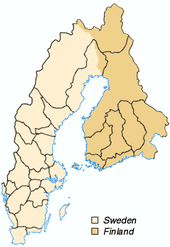
Finland
Finland , officially the Republic of Finland, is a Nordic country situated in the Fennoscandian region of Northern Europe. It is bordered by Sweden in the west, Norway in the north and Russia in the east, while Estonia lies to its south across the Gulf of Finland.Around 5.4 million people reside...
are a legacy of the country's joint history with Sweden
Sweden
Sweden , officially the Kingdom of Sweden , is a Nordic country on the Scandinavian Peninsula in Northern Europe. Sweden borders with Norway and Finland and is connected to Denmark by a bridge-tunnel across the Öresund....
. The provinces ceased to be administrative entities in 1634 when they were superseded by the counties, a reform which remained in force in Finland until 1997. The provinces remain as a tradition, but have no administrative function today. The spread of [Finnish language]] dialects approximately follow their borders.
The first name in the parentheses is the Finnish name and the second is the Swedish one.
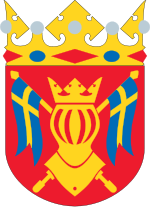 Finland ProperFinland Proper (historical province)Finland Proper, , is a historical province in south western Finland, centred on the historic city of Turku and the Turku Castle. It borders Satakunta, Tavastia and Uusimaa. It is also bounded by the Baltic sea facing Åland. There is also a modern region by the name Finland Proper...
(Varsinais-Suomi, Egentliga Finland)
 Karelia (Karjala, Karelen)
 LaponiaLaponia (historical province of Finland)Laponia is a historical Finnish Province in the north of Finland. The present-day Finnish region, modern province of Lapland contains also an Ostrobothnian area outside of the historical Laponia. The historical province formed a part of a larger Swedish historical province of Laponia before...
(Lappi, Lappland)
- OstrobothniaOstrobothnia (historical province)Ostrobothnia, and , is a historical province of Finland to the west and north in Finland. It borders on Karelia, Savonia, Tavastia and Satakunda in the south, and on Västerbotten in Sweden, and Laponia in the north...
(Pohjanmaa, Österbotten)
 SatakuntaSatakunta (Historical province)Satakunta is a historical province of Finland. It borders the historical provinces of Finland Proper, Tavastia and Ostrobothnia, also the Gulf of Bothnia....
(Satakunta, Satakunda)
- SavoniaSavonia (historical province)Savonia is a historical province in the east of Finland. It borders to Uusimaa, Tavastia, Ostrobothnia, and Karelia. Largest cities in Savo by population are Kuopio, Mikkeli, Savonlinna and Varkaus.-Administration:...
(Savo, Savolax)
 TavastiaTavastia (historical province)Tavastia, Tavastland or Häme, Russian Emi or Yemi, is a historical province in the south of Finland. It borders Finland Proper, Satakunta, Ostrobothnia, Savonia and Uusimaa.- Administration :...
(Häme, Tavastland)
 Uusimaa (Uusimaa, Nyland)
 ÅlandÅland IslandsThe Åland Islands form an archipelago in the Baltic Sea. They are situated at the entrance to the Gulf of Bothnia and form an autonomous, demilitarised, monolingually Swedish-speaking region of Finland...
(Ahvenanmaa, Åland)
Heraldry
At the funeral of King Gustav VasaGustav I of Sweden
Gustav I of Sweden, born Gustav Eriksson of the Vasa noble family and later known simply as Gustav Vasa , was King of Sweden from 1523 until his death....
in 1560, the coats of arms for the provinces were displayed together for the first time and several of them had been granted for that particular occasion. After the separation of Finland from Sweden in 1809 the traditions for the provincial arms have somewhat diverged. Finland maintains the distinction between Ducal
Duke
A duke or duchess is a member of the nobility, historically of highest rank below the monarch, and historically controlling a duchy...
and Count
Count
A count or countess is an aristocratic nobleman in European countries. The word count came into English from the French comte, itself from Latin comes—in its accusative comitem—meaning "companion", and later "companion of the emperor, delegate of the emperor". The adjective form of the word is...
al dignity shown in the coronets for arms of the historical provinces while all the Swedish
Provinces of Sweden
The provinces of Sweden, landskap, are historical, geographical and cultural regions. Sweden has 25 provinces and they have no administrative function, but remain historical legacies and the means of cultural identification....
provinces have carried the Swedish style Ducal coronet since 1884. The division of Lapland also necessitated a distinction between the Finnish and the Swedish coats of arms.
During the reign of king Karl IX there was emigration from Savonia to the western parts of Sweden
Sweden
Sweden , officially the Kingdom of Sweden , is a Nordic country on the Scandinavian Peninsula in Northern Europe. Sweden borders with Norway and Finland and is connected to Denmark by a bridge-tunnel across the Öresund....
and eastern Norway
Norway
Norway , officially the Kingdom of Norway, is a Nordic unitary constitutional monarchy whose territory comprises the western portion of the Scandinavian Peninsula, Jan Mayen, and the Arctic archipelago of Svalbard and Bouvet Island. Norway has a total area of and a population of about 4.9 million...
, to the Finnskogen
Finnskogen
Finnskogen is an area of Norway situated in the county of Hedmark, named so because of immigration of Finnish people in the 17th century, the so-called Skogfinner/"Forest Finns"....
or "Finnish forest." The ancient Savonian dialect was preserved in these areas until the last speakers died in the 1960s
1960s
The 1960s was the decade that started on January 1, 1960, and ended on December 31, 1969. It was the seventh decade of the 20th century.The 1960s term also refers to an era more often called The Sixties, denoting the complex of inter-related cultural and political trends across the globe...
.
The coats of arms of the historical provinces have served as a basis for the arms of newer administrative divisions.
See also
- Historical provinces of Sweden and FinlandProvinces of SwedenThe provinces of Sweden, landskap, are historical, geographical and cultural regions. Sweden has 25 provinces and they have no administrative function, but remain historical legacies and the means of cultural identification....
- ÖsterlandÖsterlandÖsterland or Österlanden , one of the four traditional lands of Sweden, was a medieval term used for the southern part of Finland. It gradually fell out of use by the 15th century...
- NorrlandNorrlandNorrland is one of the three lands of Sweden , the northern part, consisting of nine provinces. The term Norrland is not used for any administrative purpose, but it is common in everyday language, e.g...
- Provinces of FinlandProvinces of FinlandThe state of Finland consisted of six provinces between the years 1997 and 2009. The provincial authority was part of the central government's executive branch, not directly elected. The system was created in 1634, and its makeup was changed drastically in 1997, when the number of the provinces...
- Regions of FinlandRegions of FinlandFinland consists of 19 regions called in Finnish and in Swedish. The regions are governed by regional councils, which serve as forums of cooperation for the municipalities of a region. The main tasks of the regions are regional planning and development of enterprise and education. In addition,...