

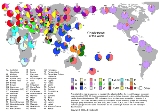
Human Y-chromosome DNA haplogroups

Encyclopedia
In human genetics
, a Human Y-chromosome DNA haplogroup is a haplogroup
defined by differences in the non-recombining
portions of DNA
from the Y chromosome
(called Y-DNA).
The Y chromosome consortium
has established a system of defining Y-DNA haplogroup
s by letters A through to T, with further subdivisions using numbers and lower case letters.
Y-chromosomal Adam
is the name given by researchers to a theoretical male who is the most recent common patrilineal (male-lineage) ancestor
of all living humans. Estimations of the date of this common ancestor have varied significantly in different studies.
.jpg) The groups descending from haplogroup F are found in some 90% of the world's population, but almost exclusively outside of sub-Saharan Africa. The mutation of IJ corresponds to a wave of migration out of the Middle East or South Asia some 45 ka that subsequently spread into Europe (Cro-Magnon
The groups descending from haplogroup F are found in some 90% of the world's population, but almost exclusively outside of sub-Saharan Africa. The mutation of IJ corresponds to a wave of migration out of the Middle East or South Asia some 45 ka that subsequently spread into Europe (Cro-Magnon
).
Haplogroup G originated in the Middle East or perhaps further east as far as Pakistan
some 30 ka, and spread to Europe with the Neolithic Revolution
. Haplogroup H probably occurred in India
some 30-40 ka, and remains prevalent there, spreading westwards in historical times with the Romani migration. Haplogroup K spread widely to Eurasia, Australia and the South Pacific.
. Haplogroup M is most prevalent in Melanesia
. The NO haplogroup appeared ca. 35-40 ka in Asia
.
Haplogroup N probably originated in Mongolia
and spread both east into Siberia
and west, being the most common group found in Uralic peoples. Haplogroup O is found at its highest frequency in East Asia
and Southeast Asia
, with lower frequencies in the South Pacific
, Central Asia
, and South Asia
. Haplogroup P gave rise to groups Q and R, and is rarely found in its undifferentiated stage. It probably originated in Central Asia or the Altai region. Haplogroup Q also originated in Central Asia, migrating east to North America.
. Haplogroup N possibly originated in eastern Asia and spread both west into Siberia
and north, being the most common group found in some Uralic speaking peoples. Haplogroup O is found at its highest frequency in East Asia
and Southeast Asia
, with lower frequencies in the South Pacific
, Central Asia
, and South Asia
.
has two branches. They are Q-M242 and R-M207, which share the common marker M45 in addition to at least 18 other SNPs.
Haplogroup Q
Q is defined by the SNP M242. It is believed to have arisen in Central Asia
approximately 35-40 000 years ago. The subclade
s of Haplogroup Q with their defining mutation(s), according to the 2008 ISOGG tree are provided below. ss4 bp, rs41352448, is not represented in the ISOGG 2008 tree because it is a value for an STR. This low frequency value has been found as a novel Q lineage (Q5) in Indian populations
The 2008 ISOGG tree
Haplogroup R
.jpg) Haplogroup R is defined by the SNP M207. The bulk of Haplogroup R
Haplogroup R is defined by the SNP M207. The bulk of Haplogroup R
is represented in lineages R1a and R1b.
R1a likely originated in the Eurasian Steppes, and is associated with the Kurgan
culture and Proto-Indo-European
expansion. It is primarily found in Central Asia, South Asia, and Eastern Europe
. R1b probably originated in Central Asia. It is the dominant haplogroup of Western Europe and also found sparsely distributed among various peoples of Asia
and Africa
. Its subclade R1b1a2 (M269) is the haplogroup that is most commonly found among modern European populations, especially those of Western Europe
.
Human genetics
Human genetics describes the study of inheritance as it occurs in human beings. Human genetics encompasses a variety of overlapping fields including: classical genetics, cytogenetics, molecular genetics, biochemical genetics, genomics, population genetics, developmental genetics, clinical genetics,...
, a Human Y-chromosome DNA haplogroup is a haplogroup
Haplogroup
In the study of molecular evolution, a haplogroup is a group of similar haplotypes that share a common ancestor having the same single nucleotide polymorphism mutation in both haplotypes. Because a haplogroup consists of similar haplotypes, this is what makes it possible to predict a haplogroup...
defined by differences in the non-recombining
Genetic recombination
Genetic recombination is a process by which a molecule of nucleic acid is broken and then joined to a different one. Recombination can occur between similar molecules of DNA, as in homologous recombination, or dissimilar molecules, as in non-homologous end joining. Recombination is a common method...
portions of DNA
DNA
Deoxyribonucleic acid is a nucleic acid that contains the genetic instructions used in the development and functioning of all known living organisms . The DNA segments that carry this genetic information are called genes, but other DNA sequences have structural purposes, or are involved in...
from the Y chromosome
Y chromosome
The Y chromosome is one of the two sex-determining chromosomes in most mammals, including humans. In mammals, it contains the gene SRY, which triggers testis development if present. The human Y chromosome is composed of about 60 million base pairs...
(called Y-DNA).
The Y chromosome consortium
Y chromosome consortium
The Y Chromosome Consortium is a collection of scientists who work toward the understanding of human Y chromosomal phylogenetics and evolution. The consortium has the following objectives: web resources that communicate information relating to the non-recombinant region of the Y-chromosome...
has established a system of defining Y-DNA haplogroup
Haplogroup
In the study of molecular evolution, a haplogroup is a group of similar haplotypes that share a common ancestor having the same single nucleotide polymorphism mutation in both haplotypes. Because a haplogroup consists of similar haplotypes, this is what makes it possible to predict a haplogroup...
s by letters A through to T, with further subdivisions using numbers and lower case letters.
Y-chromosomal Adam
Y-chromosomal Adam
In human genetics, Y-chromosomal Adam is the theoretical most recent common ancestor from whom all living people are descended patrilineally . Many studies report that Y-chromosomal Adam lived as early as around 142,000 years ago and possibly as recently as 60,000 years ago...
is the name given by researchers to a theoretical male who is the most recent common patrilineal (male-lineage) ancestor
Most recent common ancestor
In genetics, the most recent common ancestor of any set of organisms is the most recent individual from which all organisms in the group are directly descended...
of all living humans. Estimations of the date of this common ancestor have varied significantly in different studies.
Tree view
Groups A and B
Haplogroups A is the African macrohaplogroup from which all modern haplogroups descend. BT is a subclade of Haplogroup A. It has two major lineages Haplogroup B and CT.- Haplogroup AHaplogroup A (Y-DNA)In human genetics, Haplogroup A refers to a group of y-chromosome lineages that were among the first to branch off from the root of the human y-chromosome phylogeny...
(M91) Found in AfricaAfricaAfrica is the world's second largest and second most populous continent, after Asia. At about 30.2 million km² including adjacent islands, it covers 6% of the Earth's total surface area and 20.4% of the total land area...
, especially the KhoisanKhoisanKhoisan is a unifying name for two ethnic groups of Southern Africa, who share physical and putative linguistic characteristics distinct from the Bantu majority of the region. Culturally, the Khoisan are divided into the foraging San and the pastoral Khoi...
, EthiopiaEthiopiaEthiopia , officially known as the Federal Democratic Republic of Ethiopia, is a country located in the Horn of Africa. It is the second-most populous nation in Africa, with over 82 million inhabitants, and the tenth-largest by area, occupying 1,100,000 km2...
ns (especially Beta IsraelBeta IsraelBeta Israel Israel, Ge'ez: ቤተ እስራኤል - Bēta 'Isrā'ēl, modern Bēte 'Isrā'ēl, EAE: "Betä Ǝsraʾel", "Community of Israel" also known as Ethiopian Jews , are the names of Jewish communities which lived in the area of Aksumite and Ethiopian Empires , nowadays divided between Amhara and Tigray...
) and Nilotes- BTHaplogroup BT (Y-DNA)In human genetics, Haplogroup BT is a Y-chromosome haplogroup. The notation BT refers to the derived set of haplogroups between B and T which forms its own cladistic set....
(M42, M94, M139, M299) ca. 55 ka BPBefore PresentBefore Present years is a time scale used in archaeology, geology, and other scientific disciplines to specify when events in the past occurred. Because the "present" time changes, standard practice is to use AD 1950 as the origin of the age scale, reflecting the fact that radiocarbon...
- Haplogroup BHaplogroup B (Y-DNA)In human genetics, Haplogroup B is a Y-chromosome haplogroup.-Distribution:Haplogroup B is localized to sub-Saharan Africa, especially to tropical forests of West-Central Africa. After Y-haplogroup A, it is the second oldest and one of the most diverse human Y-haplogroups...
(M60) Found in Africa, especially the Pygmies and HadzabeHadzabeThe Hadza, or Hadzabe, are an ethnic group in north-central Tanzania, living around Lake Eyasi in the central Rift Valley and in the neighboring Serengeti Plateau. The Hadza number just under 1000... - CT (see below)
- Haplogroup B
- BT
Groups with mutation M168 (CT)
The defining mutations separating CT (all haplogroups excepting A and B) are M168 and M294. These mutations predate the "Out of Africa" migration. The defining mutations of DE probably occurred in Northeastern Africa some 65,000 years ago. The P143 mutation that defines Haplogroup CF may have occurred at that time, bringing modern humans to the southern coast of Asia.- Haplogroup CFHaplogroup CF (Y-DNA)In human genetics, Haplogroup CF is a human male Y-DNA Haplogroup defined by the SNP P143. Along with and parallel to Haplogroup DE, it is a descendant of Haplogroup CT. As its compound name implies, it is the ancestral haplogroup to both Haplogroup C and Haplogroup F. The haplogroup is...
(P143) Found outside of Africa, throughout Eurasia, Oceania, and the Americas- Haplogroup CHaplogroup C (Y-DNA)In human genetics, Haplogroup C is a Y-chromosome haplogroup, defined by UEPs M130/RPS4Y711, M216, P184, P255, and P260, which are all SNP mutations. It is a sibling clade of Haplogroup F, within the more ancient grouping of Haplogroup CF...
(M130, M216) Found in AsiaAsiaAsia is the world's largest and most populous continent, located primarily in the eastern and northern hemispheres. It covers 8.7% of the Earth's total surface area and with approximately 3.879 billion people, it hosts 60% of the world's current human population...
, OceaniaOceaniaOceania is a region centered on the islands of the tropical Pacific Ocean. Conceptions of what constitutes Oceania range from the coral atolls and volcanic islands of the South Pacific to the entire insular region between Asia and the Americas, including Australasia and the Malay Archipelago...
, and North AmericaNorth AmericaNorth America is a continent wholly within the Northern Hemisphere and almost wholly within the Western Hemisphere. It is also considered a northern subcontinent of the Americas...
- Haplogroup C1 (M8, M105, M131) Found in JapanJapanJapan is an island nation in East Asia. Located in the Pacific Ocean, it lies to the east of the Sea of Japan, China, North Korea, South Korea and Russia, stretching from the Sea of Okhotsk in the north to the East China Sea and Taiwan in the south...
- Haplogroup C2 (M38) Found in IndonesiaIndonesiaIndonesia , officially the Republic of Indonesia , is a country in Southeast Asia and Oceania. Indonesia is an archipelago comprising approximately 13,000 islands. It has 33 provinces with over 238 million people, and is the world's fourth most populous country. Indonesia is a republic, with an...
, New GuineaNew GuineaNew Guinea is the world's second largest island, after Greenland, covering a land area of 786,000 km2. Located in the southwest Pacific Ocean, it lies geographically to the east of the Malay Archipelago, with which it is sometimes included as part of a greater Indo-Australian Archipelago...
, MelanesiaMelanesiaMelanesia is a subregion of Oceania extending from the western end of the Pacific Ocean to the Arafura Sea, and eastward to Fiji. The region comprises most of the islands immediately north and northeast of Australia...
, MicronesiaMicronesiaMicronesia is a subregion of Oceania, comprising thousands of small islands in the western Pacific Ocean. It is distinct from Melanesia to the south, and Polynesia to the east. The Philippines lie to the west, and Indonesia to the southwest....
, and PolynesiaPolynesiaPolynesia is a subregion of Oceania, made up of over 1,000 islands scattered over the central and southern Pacific Ocean. The indigenous people who inhabit the islands of Polynesia are termed Polynesians and they share many similar traits including language, culture and beliefs... - Haplogroup C3Haplogroup C3 (Y-DNA)In human genetics, Haplogroup C3 is a Y-chromosome DNA haplogroup mainly found in indigenous Siberians, Kazakhs and Mongolians. Haplogroup C3 is the most widespread and frequently occurring branch of the greater Haplogroup C...
(M217, P44) Found throughout EurasiaEurasiaEurasia is a continent or supercontinent comprising the traditional continents of Europe and Asia ; covering about 52,990,000 km2 or about 10.6% of the Earth's surface located primarily in the eastern and northern hemispheres...
and North AmericaNorth AmericaNorth America is a continent wholly within the Northern Hemisphere and almost wholly within the Western Hemisphere. It is also considered a northern subcontinent of the Americas...
, but especially among MongolsMongolsMongols ) are a Central-East Asian ethnic group that lives mainly in the countries of Mongolia, China, and Russia. In China, ethnic Mongols can be found mainly in the central north region of China such as Inner Mongolia...
, KazakhsKazakhsThe Kazakhs are a Turkic people of the northern parts of Central Asia ....
, Tungusic peoplesTungusic peoplesTungusic peoples are the peoples who speak Tungusic languages. The word originated in Tunguska, an ill-defined region of Siberia.-Peoples:Tungusic peoples are:*Evenks*Evens*Jurchens *Manchu*Negidals...
, Paleosiberians, and Na-DenéNa-Dené languagesNa-Dene is a Native American language family which includes at least the Athabaskan languages, Eyak, and Tlingit languages. An inclusion of Haida is controversial....
-speaking peoples - Haplogroup C4 (M347) Found among the indigenous peoplesIndigenous AustraliansIndigenous Australians are the original inhabitants of the Australian continent and nearby islands. The Aboriginal Indigenous Australians migrated from the Indian continent around 75,000 to 100,000 years ago....
in AustraliaAustraliaAustralia , officially the Commonwealth of Australia, is a country in the Southern Hemisphere comprising the mainland of the Australian continent, the island of Tasmania, and numerous smaller islands in the Indian and Pacific Oceans. It is the world's sixth-largest country by total area... - Haplogroup C5 (M356) Found in the Indian subcontinentIndian subcontinentThe Indian subcontinent, also Indian Subcontinent, Indo-Pak Subcontinent or South Asian Subcontinent is a region of the Asian continent on the Indian tectonic plate from the Hindu Kush or Hindu Koh, Himalayas and including the Kuen Lun and Karakoram ranges, forming a land mass which extends...
, the Arabian PeninsulaArabian PeninsulaThe Arabian Peninsula is a land mass situated north-east of Africa. Also known as Arabia or the Arabian subcontinent, it is the world's largest peninsula and covers 3,237,500 km2...
, and northern ChinaPeople's Republic of ChinaChina , officially the People's Republic of China , is the most populous country in the world, with over 1.3 billion citizens. Located in East Asia, the country covers approximately 9.6 million square kilometres...
- Haplogroup C1 (M8, M105, M131) Found in Japan
- Haplogroup F (M89, M213) (see below)
- Haplogroup C
- Haplogroup DEHaplogroup DE (Y-DNA)In human genetics, Haplogroup DE is a human Y-chromosome DNA haplogroup. It is defined by the single nucleotide polymorphism mutations, or UEPs, M1, M145, M203, P144, P153, P165, P167, P183....
(M1, M145, M203) ca. 65 ka- Haplogroup DHaplogroup D (Y-DNA)In human genetics, Haplogroup D is a Y-chromosome haplogroup. Both D and E lineages also exhibit the single-nucleotide polymorphism M168 which is present in all Y-chromosome haplogroups except A and B, as well as the YAP unique-event polymorphism, which is unique to Haplogroup...
(M174) Found in JapanJapanJapan is an island nation in East Asia. Located in the Pacific Ocean, it lies to the east of the Sea of Japan, China, North Korea, South Korea and Russia, stretching from the Sea of Okhotsk in the north to the East China Sea and Taiwan in the south...
, ChinaPeople's Republic of ChinaChina , officially the People's Republic of China , is the most populous country in the world, with over 1.3 billion citizens. Located in East Asia, the country covers approximately 9.6 million square kilometres...
(especially TibetTibetTibet is a plateau region in Asia, north-east of the Himalayas. It is the traditional homeland of the Tibetan people as well as some other ethnic groups such as Monpas, Qiang, and Lhobas, and is now also inhabited by considerable numbers of Han and Hui people...
), the Andaman IslandsAndaman IslandsThe Andaman Islands are a group of Indian Ocean archipelagic islands in the Bay of Bengal between India to the west, and Burma , to the north and east...
- Haplogroup D1Haplogroup D1 (Y-DNA)In human genetics, Haplogroup D1 is a Y-chromosome DNA haplogroup. Haplogroup D1 is a descendant branch of the greater Haplogroup D.Its phylogenetically closest relatives are found among the peoples of Japan, Central Asia, and the Andaman Islands in the Bay of Bengal...
(M15) - Haplogroup D2 (M55, M57, M64.1, M179, P12, P37.1, P41.1 (M359.1), 12f2.2)
- Haplogroup D3 (P47)
- Haplogroup D1
- Haplogroup EHaplogroup E (Y-DNA)In human genetics, Haplogroup E is a human Y-chromosome DNA haplogroup. Haplogroup E is one of the two main branches of the older Haplogroup DE, the other main branch being haplogroup D. The E clade is divided into two subclades: E1 and E2 .-Origins:Underhill et al. proposed that haplogroup E...
(M40, M96) Found primarily in Africa- Haplogroup E1Haplogroup E1 (Y-DNA)In human genetics, Haplogroup E1 is a human Y-chromosome DNA haplogroup. Haplogroup E1, along with haplogroup E2, is one of the two main branches of the older Haplogroup E. The E1 clade is divided into two subclades: E1a & E1b.- External links :*...
(P147)- Haplogroup E1aHaplogroup E1a (Y-DNA)In human genetics, Haplogroup E1a is a human Y-chromosome DNA haplogroup. Haplogroup E1a, along with haplogroup E1b, is one of the two main branches of the older E1. The E1a clade is divided into several subclades.- Distribution :...
(M33, M132) formerly E1 - Haplogroup E1bHaplogroup E1b (Y-DNA)In human genetics, Haplogroup E1b is a human Y-chromosome DNA haplogroup.Haplogroup E1b, along with haplogroup E1a, make up the two main components of the older E1. So far there are no attested exempliars of E1b*. The clade is dominated by subclade E1b1 , which is by far the most frequent...
(P177)- Haplogroup E1b1Haplogroup E1b1 (Y-DNA)In human genetics, Haplogroup E1b1 is a human Y-chromosome DNA haplogroup.-Origin:E1b1 is likely to have originated in the highlands of East Africa's Ethiopia, as this is the place with the high frequency of ancestral subclades of this haplogroup. E1b1 is the ancestor of the majority of E...
(P2, DYS391p); formerly E3- Haplogroup E1b1a (V38) Found in Africa, specially in Niger–CongoNiger–Congo languagesThe Niger–Congo languages constitute one of the world's major language families, and Africa's largest in terms of geographical area, number of speakers, and number of distinct languages. They may constitute the world's largest language family in terms of distinct languages, although this question...
speakers; formerly E3a - Haplogroup E1b1b (M215) Found in East Africa, North Africa, the Middle EastMiddle EastThe Middle East is a region that encompasses Western Asia and Northern Africa. It is often used as a synonym for Near East, in opposition to Far East...
, and Europe (especially in areas near the MediterraneanMediterranean SeaThe Mediterranean Sea is a sea connected to the Atlantic Ocean surrounded by the Mediterranean region and almost completely enclosed by land: on the north by Anatolia and Europe, on the south by North Africa, and on the east by the Levant...
); formerly E3b
- Haplogroup E1b1a (V38) Found in Africa, specially in Niger–Congo
- Haplogroup E1b1
- Haplogroup E1a
- Haplogroup E2Haplogroup E2 (Y-DNA)In human genetics, Haplogroup E2 is a human Y-chromosome DNA haplogroup. Haplogroup E2, along with haplogroup E1, is one of the two main branches of the older Haplogroup E.-Distribution:...
(M75)
- Haplogroup E1
- Haplogroup D
Groups descended from Haplogroup F (G, H & IJK)
Cro-Magnon
The Cro-Magnon were the first early modern humans of the European Upper Paleolithic. The earliest known remains of Cro-Magnon-like humans are radiometrically dated to 35,000 years before present....
).
Haplogroup G originated in the Middle East or perhaps further east as far as Pakistan
Pakistan
Pakistan , officially the Islamic Republic of Pakistan is a sovereign state in South Asia. It has a coastline along the Arabian Sea and the Gulf of Oman in the south and is bordered by Afghanistan and Iran in the west, India in the east and China in the far northeast. In the north, Tajikistan...
some 30 ka, and spread to Europe with the Neolithic Revolution
Neolithic Revolution
The Neolithic Revolution was the first agricultural revolution. It was the transition from hunting and gathering to agriculture and settlement. Archaeological data indicates that various forms of plants and animal domestication evolved independently in 6 separate locations worldwide circa...
. Haplogroup H probably occurred in India
India
India , officially the Republic of India , is a country in South Asia. It is the seventh-largest country by geographical area, the second-most populous country with over 1.2 billion people, and the most populous democracy in the world...
some 30-40 ka, and remains prevalent there, spreading westwards in historical times with the Romani migration. Haplogroup K spread widely to Eurasia, Australia and the South Pacific.
- Paragroup F* Found in Southern IndiaIndiaIndia , officially the Republic of India , is a country in South Asia. It is the seventh-largest country by geographical area, the second-most populous country with over 1.2 billion people, and the most populous democracy in the world...
, Sri LankaSri LankaSri Lanka, officially the Democratic Socialist Republic of Sri Lanka is a country off the southern coast of the Indian subcontinent. Known until 1972 as Ceylon , Sri Lanka is an island surrounded by the Indian Ocean, the Gulf of Mannar and the Palk Strait, and lies in the vicinity of India and the...
, YunnanYunnanYunnan is a province of the People's Republic of China, located in the far southwest of the country spanning approximately and with a population of 45.7 million . The capital of the province is Kunming. The province borders Burma, Laos, and Vietnam.Yunnan is situated in a mountainous area, with...
, KoreaKoreaKorea ) is an East Asian geographic region that is currently divided into two separate sovereign states — North Korea and South Korea. Located on the Korean Peninsula, Korea is bordered by the People's Republic of China to the northwest, Russia to the northeast, and is separated from Japan to the... - Haplogroup GHaplogroup G (Y-DNA)In human genetics, Haplogroup G is a Y-chromosome haplogroup. It is a branch of Haplogroup F . Haplogroup G has an overall low frequency in most populations but is widely distributed within many ethnic groups of the Old World in Europe, northern and western Asia, northern Africa, the Middle East,...
(M201) ca. 21 ka Found in many ethnic groups in Eurasia; most common in the CaucasusCaucasusThe Caucasus, also Caucas or Caucasia , is a geopolitical region at the border of Europe and Asia, and situated between the Black and the Caspian sea...
, IranIranIran , officially the Islamic Republic of Iran , is a country in Southern and Western Asia. The name "Iran" has been in use natively since the Sassanian era and came into use internationally in 1935, before which the country was known to the Western world as Persia...
, AnatoliaAnatoliaAnatolia is a geographic and historical term denoting the westernmost protrusion of Asia, comprising the majority of the Republic of Turkey...
and other eastern Mediterranean coastal areas. Found in almost all European countries, but most common in GagauziaGagauziaGagauzia , formally known as the Autonomous Territorial Unit of Găgăuzia , is an autonomous region of...
, southeastern RomaniaRomaniaRomania is a country located at the crossroads of Central and Southeastern Europe, on the Lower Danube, within and outside the Carpathian arch, bordering on the Black Sea...
, GreeceGreeceGreece , officially the Hellenic Republic , and historically Hellas or the Republic of Greece in English, is a country in southeastern Europe....
, ItalyItalyItaly , officially the Italian Republic languages]] under the European Charter for Regional or Minority Languages. In each of these, Italy's official name is as follows:;;;;;;;;), is a unitary parliamentary republic in South-Central Europe. To the north it borders France, Switzerland, Austria and...
, SpainSpainSpain , officially the Kingdom of Spain languages]] under the European Charter for Regional or Minority Languages. In each of these, Spain's official name is as follows:;;;;;;), is a country and member state of the European Union located in southwestern Europe on the Iberian Peninsula...
, PortugalPortugalPortugal , officially the Portuguese Republic is a country situated in southwestern Europe on the Iberian Peninsula. Portugal is the westernmost country of Europe, and is bordered by the Atlantic Ocean to the West and South and by Spain to the North and East. The Atlantic archipelagos of the...
, TyrolCounty of TyrolThe County of Tyrol, Princely County from 1504, was a State of the Holy Roman Empire, from 1814 a province of the Austrian Empire and from 1867 a Cisleithanian crown land of Austria-Hungary...
, and BohemiaBohemiaBohemia is a historical region in central Europe, occupying the western two-thirds of the traditional Czech Lands. It is located in the contemporary Czech Republic with its capital in Prague...
with highest concentrations on some Mediterranean islands; uncommon in Northern EuropeNorthern EuropeNorthern Europe is the northern part or region of Europe. Northern Europe typically refers to the seven countries in the northern part of the European subcontinent which includes Denmark, Estonia, Latvia, Lithuania, Norway, Finland and Sweden...
Found in small numbers in northwestern ChinaChinaChinese civilization may refer to:* China for more general discussion of the country.* Chinese culture* Greater China, the transnational community of ethnic Chinese.* History of China* Sinosphere, the area historically affected by Chinese culture...
and IndiaIndiaIndia , officially the Republic of India , is a country in South Asia. It is the seventh-largest country by geographical area, the second-most populous country with over 1.2 billion people, and the most populous democracy in the world...
, PakistanPakistanPakistan , officially the Islamic Republic of Pakistan is a sovereign state in South Asia. It has a coastline along the Arabian Sea and the Gulf of Oman in the south and is bordered by Afghanistan and Iran in the west, India in the east and China in the far northeast. In the north, Tajikistan...
, Sri LankaSri LankaSri Lanka, officially the Democratic Socialist Republic of Sri Lanka is a country off the southern coast of the Indian subcontinent. Known until 1972 as Ceylon , Sri Lanka is an island surrounded by the Indian Ocean, the Gulf of Mannar and the Palk Strait, and lies in the vicinity of India and the...
, Malaysia, and North AfricaNorth AfricaNorth Africa or Northern Africa is the northernmost region of the African continent, linked by the Sahara to Sub-Saharan Africa. Geopolitically, the United Nations definition of Northern Africa includes eight countries or territories; Algeria, Egypt, Libya, Morocco, South Sudan, Sudan, Tunisia, and...
- Haplogroup G1Haplogroup G1 (Y-DNA)In human genetics, Haplogroup G1 is a Y-chromosome haplogroup. G1 is a branch of Haplogroup G Y-DNA . Haplogroup G1 has an extremely low frequency in almost all countries except Iran and the countries adjoining Iran on the west....
- Haplogroup G2
- Haplogroup G2a
- Haplogroup G2a1Haplogroup G2a1 (Y-DNA)In human genetics, Haplogroup G2a1 is a Y-chromosome haplogroup. It is a branch of haplogroup G , and more specifically of haplogroup G2 and most specifically of haplogroup G2a...
- Haplogroup G2a2
- Haplogroup G2a3
- Haplogroup G2a3aHaplogroup G2a3a (Y-DNA)In human genetics, Haplogroup G2a3a is a Y-chromosome haplogroup. G2a3a is a branch of Haplogroup G Y-DNA . More specifically in descending order, G2a3a is a subbranch also of G2 , G2a and finally G2a3 Haplogroup G2a3a seems most common in Turkey and Greece...
- Haplogroup G2a3b
- Haplogroup G2a3b1Haplogroup G2a3b1 (Y-DNA)In human genetics, Haplogroup G2a3b1 is a Y-chromosome haplogroup. It is a branch of haplogroup G . In descending order, G2a3b1 is additionally a branch of G2 , G2a , G2a3 and finally G2a3b . This haplogroup represents the majority of haplogroup G men in most areas of Europe west of Russia and...
- Haplogroup G2a3b1
- Haplogroup G2a3a
- Haplogroup G2a1
- Haplogroup G2b
- Haplogroup G2cHaplogroup G2c (Y-DNA)In human genetics, Haplogroup G2c is a Y-chromosome haplogroup and is defined by the presence of the M377 mutation. It is a branch of Haplogroup G, which in turn is defined by the presence of the M201 mutation....
(formerly Haplogroup G5)- Haplogroup G2c1
- Haplogroup G2a
- Haplogroup G1
- Haplogroup HHaplogroup H (Y-DNA)In human genetics, Haplogroup H is a Y-chromosome haplogroup.This haplogroup is found at a high frequency in South Asia. It is generally rare outside of the South Asia but is common among the Romani people, particularly the H-M82 subgroup.-Origins:...
(M69) Found mainly in South AsiaSouth AsiaSouth Asia, also known as Southern Asia, is the southern region of the Asian continent, which comprises the sub-Himalayan countries and, for some authorities , also includes the adjoining countries to the west and the east...
- Haplogroup H1
- Haplogroup H2
- Haplogroup IJKHaplogroup IJK (Y-DNA)In human genetics, Haplogroup IJK is a human Y-chromosome DNA haplogroup.Haplogroup IJK is a descendant branch of the macrohaplogroup F with haplogroup IJ and haplogroup K as its attested descendants....
- Haplogroup IJHaplogroup IJ (Y-DNA)In human genetics, Haplogroup IJ is a human Y-chromosome DNA haplogroup.Haplogroup IJ is a descendant branch of Haplogroup IJK which in turn derives from the greater Haplogroup F. Descendants are Haplogroup I and Haplogroup J...
(P123, P124, P125, P126, P127, P129, P130) ca. 45 ka- Haplogroup IHaplogroup I (Y-DNA)In human genetics, Haplogroup I is a Y-chromosome DNA haplogroup, a subgroup of haplogroup IJ, itself a derivative of Haplogroup IJK....
(M170, M258) Found in EuropeEuropeEurope is, by convention, one of the world's seven continents. Comprising the westernmost peninsula of Eurasia, Europe is generally 'divided' from Asia to its east by the watershed divides of the Ural and Caucasus Mountains, the Ural River, the Caspian and Black Seas, and the waterways connecting...
and parts of the Near EastNear EastThe Near East is a geographical term that covers different countries for geographers, archeologists, and historians, on the one hand, and for political scientists, economists, and journalists, on the other...
- Haplogroup I1Haplogroup I1 (Y-DNA)In human genetics, Haplogroup I1 is a Y chromosome haplogroup occurring at greatest frequency in Scandinavia, associated with the mutations identified as M253, M307, P30, and P40. These are known as single nucleotide polymorphisms . It is a subclade of Haplogroup I. Before a reclassification in...
(M253) Found mainly in northern Europe - Haplogroup I2Haplogroup I2 (Y-DNA)In human genetics, Haplogroup I2 is a Y-chromosome haplogroup. Until 2008, it was known as Haplogroup I1b. Haplogroup I2 might have originated in Southeastern Europe some 15,000 - 17,000 years ago and developed into three main subgroups : I2*, I2a, and I2b.-Subclades:Note: The systematic subclade...
(P215) Found mainly in southeast Europe and Sardinia save for I2B1 (m223) which is primarily found in Western, Central, and Northern Europe.
- Haplogroup I1
- Haplogroup JHaplogroup J (Y-DNA)In human genetics, Haplogroup J is a Y-chromosome DNA haplogroup. It is one of the major male lines of all living men...
(M304, S6, S34, S35)- Haplogroup J* (Rare outside of SocotraSocotraSocotra , also spelt Soqotra, is a small archipelago of four islands in the Indian Ocean. The largest island, also called Socotra, is about 95% of the landmass of the archipelago. It lies some east of the Horn of Africa and south of the Arabian Peninsula. The island is very isolated and through...
) - Haplogroup J1Haplogroup J1 (Y-DNA)In human genetics, Y DNA haplogroup J1, also known as J-M267, is a sub-haplogroup of Y DNA haplogroup J, along with its sibling clade Y DNA haplogroup J2. Men with this type of Y DNA share a common paternal ancestry, which is demonstrated and defined by the presence of the SNP mutation referred to...
Associated with Northeast CaucasianNortheast Caucasian languagesThe Northeast Caucasian languages constitute a language family spoken in the Russian republics of Dagestan, Chechnya, Ingushetia, northern Azerbaijan, and in northeastern Georgia, as well as in diaspora populations in Russia, Turkey, and the Middle East...
peoples in DagestanDagestanThe Republic of Dagestan is a federal subject of Russia, located in the North Caucasus region. Its capital and the largest city is Makhachkala, located at the center of Dagestan on the Caspian Sea...
and SemiticSemiticIn linguistics and ethnology, Semitic was first used to refer to a language family of largely Middle Eastern origin, now called the Semitic languages...
peoples in Mesopotamia, the Levant, the Arabian Peninsula, EthiopiaEthiopiaEthiopia , officially known as the Federal Democratic Republic of Ethiopia, is a country located in the Horn of Africa. It is the second-most populous nation in Africa, with over 82 million inhabitants, and the tenth-largest by area, occupying 1,100,000 km2...
, and North AfricaNorth AfricaNorth Africa or Northern Africa is the northernmost region of the African continent, linked by the Sahara to Sub-Saharan Africa. Geopolitically, the United Nations definition of Northern Africa includes eight countries or territories; Algeria, Egypt, Libya, Morocco, South Sudan, Sudan, Tunisia, and... - Haplogroup J2Haplogroup J2 (Y-DNA)In human genetics, Haplogroup J2 is a Y-chromosome haplogroup which is a subdivision of haplogroup J. It is further divided into two complementary clades, J2a-M410 and J2b-M12.-Origins:...
(M172) Found mainly in MesopotamiaMesopotamiaMesopotamia is a toponym for the area of the Tigris–Euphrates river system, largely corresponding to modern-day Iraq, northeastern Syria, southeastern Turkey and southwestern Iran.Widely considered to be the cradle of civilization, Bronze Age Mesopotamia included Sumer and the...
, AnatoliaAnatoliaAnatolia is a geographic and historical term denoting the westernmost protrusion of Asia, comprising the majority of the Republic of Turkey...
, LevantLevantThe Levant or ) is the geographic region and culture zone of the "eastern Mediterranean littoral between Anatolia and Egypt" . The Levant includes most of modern Lebanon, Syria, Jordan, Israel, the Palestinian territories, and sometimes parts of Turkey and Iraq, and corresponds roughly to the...
, GreeceGreeceGreece , officially the Hellenic Republic , and historically Hellas or the Republic of Greece in English, is a country in southeastern Europe....
, the BalkansBalkansThe Balkans is a geopolitical and cultural region of southeastern Europe...
, ItalyItalyItaly , officially the Italian Republic languages]] under the European Charter for Regional or Minority Languages. In each of these, Italy's official name is as follows:;;;;;;;;), is a unitary parliamentary republic in South-Central Europe. To the north it borders France, Switzerland, Austria and...
and the CaucasusCaucasusThe Caucasus, also Caucas or Caucasia , is a geopolitical region at the border of Europe and Asia, and situated between the Black and the Caspian sea...
- Haplogroup J* (Rare outside of Socotra
- Haplogroup I
- Haplogroup KHaplogroup K (Y-DNA)In human genetics, Haplogroup K is a Human Y-chromosome DNA haplogroup. This haplogroup is a descendant of Haplogroup IJK. Its major descendant haplogroups are Haplogroup LT and Haplogroup K...
(M9) Spread all over EurasiaEurasiaEurasia is a continent or supercontinent comprising the traditional continents of Europe and Asia ; covering about 52,990,000 km2 or about 10.6% of the Earth's surface located primarily in the eastern and northern hemispheres...
, OceaniaOceaniaOceania is a region centered on the islands of the tropical Pacific Ocean. Conceptions of what constitutes Oceania range from the coral atolls and volcanic islands of the South Pacific to the entire insular region between Asia and the Americas, including Australasia and the Malay Archipelago...
and AmericasAmericasThe Americas, or America , are lands in the Western hemisphere, also known as the New World. In English, the plural form the Americas is often used to refer to the landmasses of North America and South America with their associated islands and regions, while the singular form America is primarily...
- LT (see below)
- Haplogroup IJ
Groups descended from Haplogroup K (M9)
Haplogroup L is mainly found in South AsiaSouth Asia
South Asia, also known as Southern Asia, is the southern region of the Asian continent, which comprises the sub-Himalayan countries and, for some authorities , also includes the adjoining countries to the west and the east...
. Haplogroup M is most prevalent in Melanesia
Melanesia
Melanesia is a subregion of Oceania extending from the western end of the Pacific Ocean to the Arafura Sea, and eastward to Fiji. The region comprises most of the islands immediately north and northeast of Australia...
. The NO haplogroup appeared ca. 35-40 ka in Asia
Asia
Asia is the world's largest and most populous continent, located primarily in the eastern and northern hemispheres. It covers 8.7% of the Earth's total surface area and with approximately 3.879 billion people, it hosts 60% of the world's current human population...
.
Haplogroup N probably originated in Mongolia
Mongolia
Mongolia is a landlocked country in East and Central Asia. It is bordered by Russia to the north and China to the south, east and west. Although Mongolia does not share a border with Kazakhstan, its western-most point is only from Kazakhstan's eastern tip. Ulan Bator, the capital and largest...
and spread both east into Siberia
Siberia
Siberia is an extensive region constituting almost all of Northern Asia. Comprising the central and eastern portion of the Russian Federation, it was part of the Soviet Union from its beginning, as its predecessor states, the Tsardom of Russia and the Russian Empire, conquered it during the 16th...
and west, being the most common group found in Uralic peoples. Haplogroup O is found at its highest frequency in East Asia
East Asia
East Asia or Eastern Asia is a subregion of Asia that can be defined in either geographical or cultural terms...
and Southeast Asia
Southeast Asia
Southeast Asia, South-East Asia, South East Asia or Southeastern Asia is a subregion of Asia, consisting of the countries that are geographically south of China, east of India, west of New Guinea and north of Australia. The region lies on the intersection of geological plates, with heavy seismic...
, with lower frequencies in the South Pacific
Oceania
Oceania is a region centered on the islands of the tropical Pacific Ocean. Conceptions of what constitutes Oceania range from the coral atolls and volcanic islands of the South Pacific to the entire insular region between Asia and the Americas, including Australasia and the Malay Archipelago...
, Central Asia
Central Asia
Central Asia is a core region of the Asian continent from the Caspian Sea in the west, China in the east, Afghanistan in the south, and Russia in the north...
, and South Asia
South Asia
South Asia, also known as Southern Asia, is the southern region of the Asian continent, which comprises the sub-Himalayan countries and, for some authorities , also includes the adjoining countries to the west and the east...
. Haplogroup P gave rise to groups Q and R, and is rarely found in its undifferentiated stage. It probably originated in Central Asia or the Altai region. Haplogroup Q also originated in Central Asia, migrating east to North America.
- Haplogroup K*Haplogroup K (Y-DNA)In human genetics, Haplogroup K is a Human Y-chromosome DNA haplogroup. This haplogroup is a descendant of Haplogroup IJK. Its major descendant haplogroups are Haplogroup LT and Haplogroup K...
Found in MelanesiaMelanesiaMelanesia is a subregion of Oceania extending from the western end of the Pacific Ocean to the Arafura Sea, and eastward to Fiji. The region comprises most of the islands immediately north and northeast of Australia...
and AustraliaAustraliaAustralia , officially the Commonwealth of Australia, is a country in the Southern Hemisphere comprising the mainland of the Australian continent, the island of Tasmania, and numerous smaller islands in the Indian and Pacific Oceans. It is the world's sixth-largest country by total area... - Haplogroup K1 (formerly Haplogroup K3) Found in Indian subcontinentIndian subcontinentThe Indian subcontinent, also Indian Subcontinent, Indo-Pak Subcontinent or South Asian Subcontinent is a region of the Asian continent on the Indian tectonic plate from the Hindu Kush or Hindu Koh, Himalayas and including the Kuen Lun and Karakoram ranges, forming a land mass which extends...
- Haplogroup K2 (formerly Haplogroup K4)
- Haplogroup K3 (formerly Haplogroup K6) Found in MelanesiaMelanesiaMelanesia is a subregion of Oceania extending from the western end of the Pacific Ocean to the Arafura Sea, and eastward to Fiji. The region comprises most of the islands immediately north and northeast of Australia...
and PolynesiaPolynesiaPolynesia is a subregion of Oceania, made up of over 1,000 islands scattered over the central and southern Pacific Ocean. The indigenous people who inhabit the islands of Polynesia are termed Polynesians and they share many similar traits including language, culture and beliefs... - Haplogroup K4 Found in BaliBaliBali is an Indonesian island located in the westernmost end of the Lesser Sunda Islands, lying between Java to the west and Lombok to the east...
- Haplogroup LT (L298/P326)
- Haplogroup LHaplogroup L (Y-DNA)In human genetics, Haplogroup L is a Y-chromosome DNA haplogroup.-Origins:Haplogroup L is associated with South Asia. It has also been found at low frequencies among populations of Central Asia, Southwest Asia, and Southern Europe along the coast of the Mediterranean Sea...
(M20) Found in South Asia, Central Asia, Southwest Asia, the Mediterranean - Haplogroup THaplogroup T (Y-DNA)In human genetics, Haplogroup T is a human Y-chromosome DNA haplogroup. From 2002 to 2008, it was known as Haplogroup K2. It should not be confused with the mitochondrial DNA haplogroup T, of the same name....
(formerly known as Haplogroup K2) (M184, M70, M193, M272) Found in Africa (mainly Afro-AsiaticAfro-Asiatic languagesThe Afroasiatic languages , also known as Hamito-Semitic, constitute one of the world's largest language families, with about 375 living languages...
-speaking peoples), the Middle EastMiddle EastThe Middle East is a region that encompasses Western Asia and Northern Africa. It is often used as a synonym for Near East, in opposition to Far East...
, the Mediterranean, South AsiaSouth AsiaSouth Asia, also known as Southern Asia, is the southern region of the Asian continent, which comprises the sub-Himalayan countries and, for some authorities , also includes the adjoining countries to the west and the east...
. Found in a significant minority of SciaccensiSciaccaSciacca , also Schiacca, is a town and comune in the province of Agrigento on the southwestern coast of Sicily...
, SomalisSomali peopleSomalis are an ethnic group located in the Horn of Africa, also known as the Somali Peninsula. The overwhelming majority of Somalis speak the Somali language, which is part of the Cushitic branch of the Afro-Asiatic language family...
, EivissencsIbizaIbiza or Eivissa is a Spanish island in the Mediterranean Sea 79 km off the coast of the city of Valencia in Spain. It is the third largest of the Balearic Islands, an autonomous community of Spain. With Formentera, it is one of the two Pine Islands or Pityuses. Its largest cities are Ibiza...
, StilfsStilfsStilfs is a comune in South Tyrol in the Italian region of Trentino-Alto Adige/Südtirol. It is located near the northern ramp of the Stelvio Pass....
er, EthiopiansDemographics of EthiopiaThis article is about the demographic features of the population of Ethiopia, including population density, ethnicity, education level, health of the populace, economic status, religious affiliations and other aspects of the population....
, FulbeFula peopleFula people or Fulani or Fulbe are an ethnic group spread over many countries, predominantly in West Africa, but found also in Central Africa and Sudanese North Africa...
, Egyptians, and OmanOmanOman , officially called the Sultanate of Oman , is an Arab state in southwest Asia on the southeast coast of the Arabian Peninsula. It is bordered by the United Arab Emirates to the northwest, Saudi Arabia to the west, and Yemen to the southwest. The coast is formed by the Arabian Sea on the...
is; also found at low frequency throughout the Mediterranean and parts of IndiaIndiaIndia , officially the Republic of India , is a country in South Asia. It is the seventh-largest country by geographical area, the second-most populous country with over 1.2 billion people, and the most populous democracy in the world...
- Haplogroup L
- Haplogroup MNOPS (rs2033003/M526)
- Haplogroup MHaplogroup M (Y-DNA)In human genetics, Haplogroup M is a Y-chromosome DNA haplogroup. The Karafet's 2008 paper introduced a number of changes, compared to the previous...
(P256) Found in New Guinea and Melanesia - Haplogroup NOHaplogroup NO (Y-DNA)In human genetics, Haplogroup NO is a human Y-chromosome DNA haplogroup.Haplogroup NO is a descendant branch of the greater Haplogroup MNOPS and a phylogenetic sibling of Haplogroup M, Haplogroup P, and Haplogroup S.-Origins:...
(M214) 35-40 kya- Haplogroup NO*Haplogroup NO (Y-DNA)In human genetics, Haplogroup NO is a human Y-chromosome DNA haplogroup.Haplogroup NO is a descendant branch of the greater Haplogroup MNOPS and a phylogenetic sibling of Haplogroup M, Haplogroup P, and Haplogroup S.-Origins:...
(minimal distribution) - Haplogroup NHaplogroup N (Y-DNA)In human genetics, Haplogroup N is a Y-chromosome DNA haplogroup, defined by the presence of the marker M231. The b2/b3 deletion in the AZFc region of the human Y-chromosome is a characteristic of Haplogroup N haplotypes. This deletion, however, appears to have occurred independently on four...
(M231) Found in northernmost Eurasia, especially among the Uralic peoples - Haplogroup OHaplogroup O (Y-DNA)In human genetics, Haplogroup O is a Y-chromosome DNA haplogroup. Haplogroup O is a close cladistic brother group with Haplogroup N, and is one of several descendants of Haplogroup K ....
(M175) Found in East Asia, Southeast Asia, the South Pacific
- Haplogroup NO*
- Haplogroup PHaplogroup P (Y-DNA)In human genetics, Haplogroup P is a Y-chromosome DNA haplogroup.This haplogroup contains the patrilineal ancestors of most Europeans and almost all of the indigenous peoples of the Americas...
(M45)- Haplogroup P*Haplogroup P (Y-DNA)In human genetics, Haplogroup P is a Y-chromosome DNA haplogroup.This haplogroup contains the patrilineal ancestors of most Europeans and almost all of the indigenous peoples of the Americas...
(minimal distribution) - Haplogroup QHaplogroup Q (Y-DNA)In human genetics, Haplogroup Q is a Y-chromosome DNA haplogroup.-Origins:Haplogroup Q is one of the two branches of haplogroup P . Haplogroup Q is believed to have arisen in Central Asia approximately 15,000 to 20,000 years ago. It has had multiple origins proposed...
(MEH2, M242, P36) Found in SiberiaSiberiaSiberia is an extensive region constituting almost all of Northern Asia. Comprising the central and eastern portion of the Russian Federation, it was part of the Soviet Union from its beginning, as its predecessor states, the Tsardom of Russia and the Russian Empire, conquered it during the 16th...
and the AmericasAmericasThe Americas, or America , are lands in the Western hemisphere, also known as the New World. In English, the plural form the Americas is often used to refer to the landmasses of North America and South America with their associated islands and regions, while the singular form America is primarily... - Haplogroup RHaplogroup R (Y-DNA)In human genetics, haplogroup R is a Y-chromosome DNA haplogroup very common throughout Europe, Central Asia and South Asia, and also common in parts of the Middle East and Africa...
(M207, M306) Found in EuropeEuropeEurope is, by convention, one of the world's seven continents. Comprising the westernmost peninsula of Eurasia, Europe is generally 'divided' from Asia to its east by the watershed divides of the Ural and Caucasus Mountains, the Ural River, the Caspian and Black Seas, and the waterways connecting...
, West Asia, Central AsiaCentral AsiaCentral Asia is a core region of the Asian continent from the Caspian Sea in the west, China in the east, Afghanistan in the south, and Russia in the north...
, and South AsiaSouth AsiaSouth Asia, also known as Southern Asia, is the southern region of the Asian continent, which comprises the sub-Himalayan countries and, for some authorities , also includes the adjoining countries to the west and the east...
- Haplogroup P*
- Haplogroup SHaplogroup S (Y-DNA)In human genetics, Haplogroup S is a human Y-chromosome DNA haplogroup. From 2002 to 2008, it was known as Haplogroup K5.-Distribution:Haplogroup S is commonly found among populations of the highlands of Papua New Guinea...
(M230) (formerly known as Haplogroup K5) Found in the highlands of New Guinea
- Haplogroup M
Groups descended from Haplogroup NO (M214)
The NO haplogroup appeared ca. 35-40 ka in East AsiaEast Asia
East Asia or Eastern Asia is a subregion of Asia that can be defined in either geographical or cultural terms...
. Haplogroup N possibly originated in eastern Asia and spread both west into Siberia
Siberia
Siberia is an extensive region constituting almost all of Northern Asia. Comprising the central and eastern portion of the Russian Federation, it was part of the Soviet Union from its beginning, as its predecessor states, the Tsardom of Russia and the Russian Empire, conquered it during the 16th...
and north, being the most common group found in some Uralic speaking peoples. Haplogroup O is found at its highest frequency in East Asia
East Asia
East Asia or Eastern Asia is a subregion of Asia that can be defined in either geographical or cultural terms...
and Southeast Asia
Southeast Asia
Southeast Asia, South-East Asia, South East Asia or Southeastern Asia is a subregion of Asia, consisting of the countries that are geographically south of China, east of India, west of New Guinea and north of Australia. The region lies on the intersection of geological plates, with heavy seismic...
, with lower frequencies in the South Pacific
Oceania
Oceania is a region centered on the islands of the tropical Pacific Ocean. Conceptions of what constitutes Oceania range from the coral atolls and volcanic islands of the South Pacific to the entire insular region between Asia and the Americas, including Australasia and the Malay Archipelago...
, Central Asia
Central Asia
Central Asia is a core region of the Asian continent from the Caspian Sea in the west, China in the east, Afghanistan in the south, and Russia in the north...
, and South Asia
South Asia
South Asia, also known as Southern Asia, is the southern region of the Asian continent, which comprises the sub-Himalayan countries and, for some authorities , also includes the adjoining countries to the west and the east...
.
- Haplogroup NOHaplogroup NO (Y-DNA)In human genetics, Haplogroup NO is a human Y-chromosome DNA haplogroup.Haplogroup NO is a descendant branch of the greater Haplogroup MNOPS and a phylogenetic sibling of Haplogroup M, Haplogroup P, and Haplogroup S.-Origins:...
(M214) 35-40 ka (minimal distribution)- Haplogroup NHaplogroup N (Y-DNA)In human genetics, Haplogroup N is a Y-chromosome DNA haplogroup, defined by the presence of the marker M231. The b2/b3 deletion in the AZFc region of the human Y-chromosome is a characteristic of Haplogroup N haplotypes. This deletion, however, appears to have occurred independently on four...
(M231) Found in northernmost Eurasia, especially among the Uralic peoples- Haplogroup N1 (LLY22g)
- Haplogroup OHaplogroup O (Y-DNA)In human genetics, Haplogroup O is a Y-chromosome DNA haplogroup. Haplogroup O is a close cladistic brother group with Haplogroup N, and is one of several descendants of Haplogroup K ....
(M175) Found in East Asia, Southeast Asia, the South Pacific- Haplogroup O1Haplogroup O1 (Y-DNA)In human genetics, Haplogroup O1 is a Y-chromosome DNA haplogroup. Haplogroup O1 is a descendent branch of the greater Haplogroup O.The great majority of Y-chromosomes within Haplogroup O1 belong to its subgroup O1a .-Origins:...
(MSY2.2) Found in eastern and southern ChinaChinaChinese civilization may refer to:* China for more general discussion of the country.* Chinese culture* Greater China, the transnational community of ethnic Chinese.* History of China* Sinosphere, the area historically affected by Chinese culture...
, TaiwanTaiwanTaiwan , also known, especially in the past, as Formosa , is the largest island of the same-named island group of East Asia in the western Pacific Ocean and located off the southeastern coast of mainland China. The island forms over 99% of the current territory of the Republic of China following...
, and Southeast AsiaSoutheast AsiaSoutheast Asia, South-East Asia, South East Asia or Southeastern Asia is a subregion of Asia, consisting of the countries that are geographically south of China, east of India, west of New Guinea and north of Australia. The region lies on the intersection of geological plates, with heavy seismic...
, especially among AustronesianAustronesian peopleThe Austronesian-speaking peoples are various populations in Oceania and Southeast Asia that speak languages of the Austronesian family. They include Taiwanese aborigines; the majority ethnic groups of East Timor, Indonesia, Malaysia, the Philippines, Brunei, Madagascar, Micronesia, and Polynesia,...
and Kradai peoples - Haplogroup O2Haplogroup O2 (Y-DNA)In human genetics, Haplogroup O2 is a Y-chromosome DNA haplogroup.Haplogroup O2 is a descendent branch of the greater Haplogroup O.-Distribution:...
(P31, M268)- Haplogroup O2aHaplogroup O2a (Y-DNA)In genetics, Haplogroup O2a is a human Y-chromosome DNA haplogroup.Haplogroup O2a is a descendent branch of Haplogroup O2. Its closest extant phylogenetic relatives are the Haplogroup O2* Y-chromosomes found at a low frequency throughout most of East Eurasia and the Haplogroup O2b Y-chromosomes...
(M95) Found in JapanJapanJapan is an island nation in East Asia. Located in the Pacific Ocean, it lies to the east of the Sea of Japan, China, North Korea, South Korea and Russia, stretching from the Sea of Okhotsk in the north to the East China Sea and Taiwan in the south...
, southern China, Southeast Asia, and the Indian subcontinentIndian subcontinentThe Indian subcontinent, also Indian Subcontinent, Indo-Pak Subcontinent or South Asian Subcontinent is a region of the Asian continent on the Indian tectonic plate from the Hindu Kush or Hindu Koh, Himalayas and including the Kuen Lun and Karakoram ranges, forming a land mass which extends...
, especially among Austro-AsiaticAustro-Asiatic languagesThe Austro-Asiatic languages, in recent classifications synonymous with Mon–Khmer, are a large language family of Southeast Asia, also scattered throughout India and Bangladesh. The name Austro-Asiatic comes from the Latin words for "south" and "Asia", hence "South Asia"...
peoples, Kradai peoples, Malays, and Indonesians - Haplogroup O2bHaplogroup O2b (Y-DNA)Haplogroup O2b is a human Y-chromosome DNA haplogroup. It is a descendant haplogroup of Haplogroup O2. Haplogroup O2b is found mainly in the northernmost parts of East Asia, from the Uriankhai and Zakhchin peoples of western Mongolia to the Japanese of Japan, though it also has been detected...
(SRY465, M176) Found in Japan, KoreaKoreaKorea ) is an East Asian geographic region that is currently divided into two separate sovereign states — North Korea and South Korea. Located on the Korean Peninsula, Korea is bordered by the People's Republic of China to the northwest, Russia to the northeast, and is separated from Japan to the...
, ManchuriaManchuriaManchuria is a historical name given to a large geographic region in northeast Asia. Depending on the definition of its extent, Manchuria usually falls entirely within the People's Republic of China, or is sometimes divided between China and Russia. The region is commonly referred to as Northeast...
, and Southeast Asia
- Haplogroup O2a
- Haplogroup O3Haplogroup O3 (Y-DNA)In human genetics, Haplogroup O3 is a Y-chromosome haplogroup.-Origins:Haplogroup O3 is a descendant haplogroup of haplogroup O. Some researchers believe that it first appeared in China approximately 10,000 years ago, while others believe it to have had an origin in Southeast Asia approximately...
(M122) Found throughout East Asia, Southeast Asia, and AustronesiaAustronesiaAustronesia, in historical terms, refers to the homeland of the peoples who speak Austronesian languages, including Malay, Filipino, Indonesian, Maori, Malagasy, native Hawaiian, the Fijian language and around a thousand other languages...
including PolynesiaPolynesiaPolynesia is a subregion of Oceania, made up of over 1,000 islands scattered over the central and southern Pacific Ocean. The indigenous people who inhabit the islands of Polynesia are termed Polynesians and they share many similar traits including language, culture and beliefs...
- Haplogroup O1
- Haplogroup N
Groups descended from Haplogroup P (M45)
Haplogroup P (M45)Haplogroup P (Y-DNA)
In human genetics, Haplogroup P is a Y-chromosome DNA haplogroup.This haplogroup contains the patrilineal ancestors of most Europeans and almost all of the indigenous peoples of the Americas...
has two branches. They are Q-M242 and R-M207, which share the common marker M45 in addition to at least 18 other SNPs.
Haplogroup Q
Haplogroup Q (Y-DNA)
In human genetics, Haplogroup Q is a Y-chromosome DNA haplogroup.-Origins:Haplogroup Q is one of the two branches of haplogroup P . Haplogroup Q is believed to have arisen in Central Asia approximately 15,000 to 20,000 years ago. It has had multiple origins proposed...
Q is defined by the SNP M242. It is believed to have arisen in Central Asia
Central Asia
Central Asia is a core region of the Asian continent from the Caspian Sea in the west, China in the east, Afghanistan in the south, and Russia in the north...
approximately 35-40 000 years ago. The subclade
Subclade
In genetics, subclade is a term used to describe a subgroup of a subgenus or haplogroup. It is commonly used today in describing genealogical DNA tests of human mitochondrial DNA haplogroups and human Y-chromosome DNA haplogroups....
s of Haplogroup Q with their defining mutation(s), according to the 2008 ISOGG tree are provided below. ss4 bp, rs41352448, is not represented in the ISOGG 2008 tree because it is a value for an STR. This low frequency value has been found as a novel Q lineage (Q5) in Indian populations
The 2008 ISOGG tree
- Q (M242)
- Q*
- Q1 (P36.2)
- Q1*
- Q1a (MEH2)
- Q1a*
- Q1a1 (M120, M265/N14) Found with low frequency among Dungans, Han ChineseHan ChineseHan Chinese are an ethnic group native to China and are the largest single ethnic group in the world.Han Chinese constitute about 92% of the population of the People's Republic of China , 98% of the population of the Republic of China , 78% of the population of Singapore, and about 20% of the...
, Hazaras, JapaneseJapanese peopleThe are an ethnic group originating in the Japanese archipelago and are the predominant ethnic group of Japan. Worldwide, approximately 130 million people are of Japanese descent; of these, approximately 127 million are residents of Japan. People of Japanese ancestry who live in other countries...
, Koreans, and Tibetans - Q1a2 (M25, M143) Found at low to moderate frequency among some populations of Southwest AsiaSouthwest AsiaWestern Asia, West Asia, Southwest Asia or Southwestern Asia are terms that describe the westernmost portion of Asia. The terms are partly coterminous with the Middle East, which describes a geographical position in relation to Western Europe rather than its location within Asia...
, Central AsiaCentral AsiaCentral Asia is a core region of the Asian continent from the Caspian Sea in the west, China in the east, Afghanistan in the south, and Russia in the north...
, and SiberiaSiberiaSiberia is an extensive region constituting almost all of Northern Asia. Comprising the central and eastern portion of the Russian Federation, it was part of the Soviet Union from its beginning, as its predecessor states, the Tsardom of Russia and the Russian Empire, conquered it during the 16th... - Q1a3 (M346)
- Q1a3* Found at low frequency in PakistanPakistanPakistan , officially the Islamic Republic of Pakistan is a sovereign state in South Asia. It has a coastline along the Arabian Sea and the Gulf of Oman in the south and is bordered by Afghanistan and Iran in the west, India in the east and China in the far northeast. In the north, Tajikistan...
, IndiaIndiaIndia , officially the Republic of India , is a country in South Asia. It is the seventh-largest country by geographical area, the second-most populous country with over 1.2 billion people, and the most populous democracy in the world...
, and TibetTibetTibet is a plateau region in Asia, north-east of the Himalayas. It is the traditional homeland of the Tibetan people as well as some other ethnic groups such as Monpas, Qiang, and Lhobas, and is now also inhabited by considerable numbers of Han and Hui people... - Q1a3aHaplogroup Q3 (Y-DNA)In human genetics, Haplogroup Q1a3a1 and/or Q-M3 is a Y-chromosome DNA haplogroup . Haplogroup Q1a3a1 is a subclade of Haplogroup Q...
(M3) Typical of indigenous peoples of the AmericasIndigenous peoples of the AmericasThe indigenous peoples of the Americas are the pre-Columbian inhabitants of North and South America, their descendants and other ethnic groups who are identified with those peoples. Indigenous peoples are known in Canada as Aboriginal peoples, and in the United States as Native Americans...
- Q1a3a*
- Q1a3a1 (M19) Found among some indigenous peoples of South AmericaSouth AmericaSouth America is a continent situated in the Western Hemisphere, mostly in the Southern Hemisphere, with a relatively small portion in the Northern Hemisphere. The continent is also considered a subcontinent of the Americas. It is bordered on the west by the Pacific Ocean and on the north and east...
, such as the Ticuna and the WayuuWayuuWayuu is an Amerindian ethnic group of the La Guajira Peninsula in northern Colombia and northwest Venezuela. They are part of the Maipurean language family.- Geography :... - Q1a3a2 (M194)
- Q1a3a3 (M199, P106, P292)
- Q1a3* Found at low frequency in Pakistan
- Q1a4 (P48)
- Q1a5 (P89)
- Q1a6 (M323) Found in a significant minority of Yemeni JewsYemenite JewsYemenite Jews are those Jews who live, or whose recent ancestors lived, in Yemen . Between June 1949 and September 1950, the overwhelming majority of Yemen's Jewish population was transported to Israel in Operation Magic Carpet...
- Q1b (M378) Found at low frequency among samples of Hazara and SindhisSindhi peopleSindhis are a Sindhi speaking socio-ethnic group of people originating from Sindh, a province Formerly of British India, now in Pakistan. Today Sindhis that live in Pakistan belong to various religious denominations including Islam, Zoroastrianism, Hinduism, Sikhism and Christianity...
Haplogroup R
Haplogroup R (Y-DNA)
In human genetics, haplogroup R is a Y-chromosome DNA haplogroup very common throughout Europe, Central Asia and South Asia, and also common in parts of the Middle East and Africa...
Haplogroup R (Y-DNA)
In human genetics, haplogroup R is a Y-chromosome DNA haplogroup very common throughout Europe, Central Asia and South Asia, and also common in parts of the Middle East and Africa...
is represented in lineages R1a and R1b.
R1a likely originated in the Eurasian Steppes, and is associated with the Kurgan
Kurgan
Kurgan is the Turkic term for a tumulus; mound of earth and stones raised over a grave or graves, originating with its use in Soviet archaeology, now widely used for tumuli in the context of Eastern European and Central Asian archaeology....
culture and Proto-Indo-European
Proto-Indo-Europeans
The Proto-Indo-Europeans were the speakers of the Proto-Indo-European language , a reconstructed prehistoric language of Eurasia.Knowledge of them comes chiefly from the linguistic reconstruction, along with material evidence from archaeology and archaeogenetics...
expansion. It is primarily found in Central Asia, South Asia, and Eastern Europe
Eastern Europe
Eastern Europe is the eastern part of Europe. The term has widely disparate geopolitical, geographical, cultural and socioeconomic readings, which makes it highly context-dependent and even volatile, and there are "almost as many definitions of Eastern Europe as there are scholars of the region"...
. R1b probably originated in Central Asia. It is the dominant haplogroup of Western Europe and also found sparsely distributed among various peoples of Asia
Asia
Asia is the world's largest and most populous continent, located primarily in the eastern and northern hemispheres. It covers 8.7% of the Earth's total surface area and with approximately 3.879 billion people, it hosts 60% of the world's current human population...
and Africa
Africa
Africa is the world's second largest and second most populous continent, after Asia. At about 30.2 million km² including adjacent islands, it covers 6% of the Earth's total surface area and 20.4% of the total land area...
. Its subclade R1b1a2 (M269) is the haplogroup that is most commonly found among modern European populations, especially those of Western Europe
Western Europe
Western Europe is a loose term for the collection of countries in the western most region of the European continents, though this definition is context-dependent and carries cultural and political connotations. One definition describes Western Europe as a geographic entity—the region lying in the...
.
- Haplogroup R1Haplogroup R1 (Y-DNA)In human genetics, Haplogroup R1 is a Y-chromosome DNA haplogroup, a subgroup of haplogroup R, associated with the M173 mutation. It is dominated in practice by two very common Eurasian clades, R1a and R1b, which together are found all over Eurasia except in Southeast Asia and East Asia...
(M173) Found throughout western Eurasia- Haplogroup R1aHaplogroup R1a (Y-DNA)Haplogroup R1a is the phylogenetic name of a major clade of Human Y-chromosome DNA haplogroups. In other words, it is a way of grouping a significant part of all modern men according to a shared male-line ancestor. It is common in many parts of Eurasia and is frequently discussed in human...
(M17) Found in Central Asia, South Asia, and Central, Northern and Eastern Europe - Haplogroup R1bHaplogroup R1b (Y-DNA)The point of origin of R1b is thought to lie in Eurasia, most likely in Western Asia. T. Karafet et al. estimated the age of R1, the parent of R1b, as 18,500 years before present....
(M343) Found in Western Europe, West Asia, Central AsiaCentral AsiaCentral Asia is a core region of the Asian continent from the Caspian Sea in the west, China in the east, Afghanistan in the south, and Russia in the north...
, North AfricaNorth AfricaNorth Africa or Northern Africa is the northernmost region of the African continent, linked by the Sahara to Sub-Saharan Africa. Geopolitically, the United Nations definition of Northern Africa includes eight countries or territories; Algeria, Egypt, Libya, Morocco, South Sudan, Sudan, Tunisia, and...
, and northern CameroonCameroonCameroon, officially the Republic of Cameroon , is a country in west Central Africa. It is bordered by Nigeria to the west; Chad to the northeast; the Central African Republic to the east; and Equatorial Guinea, Gabon, and the Republic of the Congo to the south. Cameroon's coastline lies on the...
- Haplogroup R1a
- Haplogroup R2Haplogroup R2 (Y-DNA)- Paragroup R2a* :Paragroup is a term used in population genetics to describe lineages within a haplogroup that are not defined by any additional unique markers...
(M124) Found in South Asia, Caucasus, Central Asia, and Eastern Europe
Chronological development of Haplogroups in Europe
| Haplogroup | Possible time of origin | Possible place of origin | Highest frequencies |
| K | 40,000 years ago | South Asia or West Asia | |
| T | 30,000 years ago | West Asia | |
| J | 30,000 years ago | Middle East | |
| R | 28,000 years ago | Central Asia | |
| E1b1b-M35 | 26,000 years ago | East Africa | |
| I | 25,000 years ago | Balkans | |
| R1a1 | 21,000 years ago | Southern Russia | |
| R1b | 20,000 years ago | Around the Caspian Sea or Central Asia | |
| E1b1b-M78 | 18,000 years ago | Egypt/Libya Libya Libya is an African country in the Maghreb region of North Africa bordered by the Mediterranean Sea to the north, Egypt to the east, Sudan to the southeast, Chad and Niger to the south, and Algeria and Tunisia to the west.... |
|
| G | 17,000 years ago | Between India and the Caucasus | |
| I2 | 17,000 years ago | Balkans | |
| J2 | 15,000 years ago | Northern Mesopotamia | |
| I2b | 13,000 years ago | Central Europe | |
| N1c1 | 12,000 years ago | Siberia | |
| I2a | 11,000 years ago | Balkans | |
| R1b1b2 | 10,000 years ago | North or south of the Caucasus | |
| J1 | 10,000 years ago | Arabian peninsula | |
| E1b1b-V13 | 10,000 years ago | Balkans | Albanians |
| I2b1 | 9,000 years ago | Germany | |
| I2a1 | 8,000 years ago | Sardinia | |
| I2a2 | 7,500 years ago | Dinaric Alps | |
| E1b1b-M81 | 5,500 years ago | Maghreb | Berbers |
| I1 | 5,000 years ago | Scandinavia | |
| R1b-L21 | 4,000 years ago | Central or Eastern Europe | |
| R1b-S28 | 3,500 years ago | around the Alps | |
| R1b-S21 | 3,000 years ago | Frisia or Central Europe | |
| I2b1a | < 3,000 years ago | Britain | |
See also
- Y-chromosome haplogroups by populationsY-chromosome haplogroups by populationsThe following articles are lists of human Y-chromosome DNA haplogroups found in populations and various ethnic groups by regions or continents around the world based on relevant studies, and the samples have been taken from individuals identified by linguistic designation.General*Y-DNA haplogroups...
- Y-DNA haplogroups by European populationsY-DNA haplogroups by groups in Europe-Frequencies in some ethnic groups in Europe:Listed here are notable groups and ethnic groups from Europe by human Y-chromosome DNA haplogroups based on relevant studies...
- List of Y-DNA single-nucleotide polymorphisms
- List of Y-STR markers
- Human mitochondrial DNA haplogroupsHuman mitochondrial DNA haplogroupsIn human genetics, a human mitochondrial DNA haplogroup is a haplogroup defined by differences in human mitochondrial DNA. Haplogroups are used to represent the major branch points on the mitochondrial phylogenetic tree...
- * (haplogroup)* (haplogroup)Paragroup is a term used in population genetics to describe lineages within a haplogroup that are not defined by any additional unique markers. In human Y-chromosome DNA haplogroups, paragroups are typically represented by an asterisk placed after the main haplogroup...
- Molecular phylogenyMolecular phylogenyMolecular phylogenetics is the analysis of hereditary molecular differences, mainly in DNA sequences, to gain information on an organism's evolutionary relationships. The result of a molecular phylogenetic analysis is expressed in a phylogenetic tree...
- Genetic genealogyGenetic genealogyGenetic genealogy is the application of genetics to traditional genealogy. Genetic genealogy involves the use of genealogical DNA testing to determine the level of genetic relationship between individuals.-History:...
- Genealogical DNA testGenealogical DNA testA genealogical DNA test examines the nucleotides at specific locations on a person's DNA for genetic genealogy purposes. The test results are not meant to have any informative medical value and do not determine specific genetic diseases or disorders ; they are intended only to give genealogical...
- Conversion table for Y chromosome haplogroupsConversion table for Y chromosome haplogroupsY chromosome haplogroups are a frequent topic of discussion in human population genetics and genetic genealogy. Men in the same Y DNA haplogroup share a set of differences, or markers, on their Y chromosome, which distinguish them from men in other haplogroups. Often these UEPs, or markers used to...
External links
- ISOGG Y-DNA Haplogroup Tree
- Chart of the speed of different Y chromosomal STR mutation rates
- Map of Y Haplogroups
- Atlas of the Human Journey, from the Genographic Project, National Geographic
- DNA Heritage's Y-haplogroup map
- Video tutorial on Discovering Paternal Ancestry with Y-Chromosomes
- Haplogroup Predictor
- DNA Consulting's Conversion Chart for Male Haplogroups (PDF)
- Semino et al. (2000) The Genetic Legacy of Paleolithic Homo sapiens sapiens in Extant Europeans: A Y Chromosome Perspective Paper that defined "Eu" haplogroups
- Worldfamilies Y Haplogroup & Sub-clade Projects
- Kerchner's YDNA Haplogroup Descriptions, Projects & Links
- Y-DNA Testing Company STR Marker Comparison Chart