All Topics  
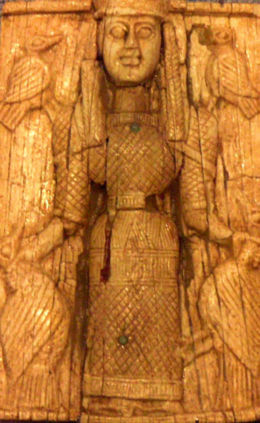
Potnia Theron


   Email Print
   Bookmark   Link


Potnia Theron


Potnia Theron ("Mistress of the Animals") is an ancient title of the Minoan
Minoan civilization

The Minoan civilization was a Bronze Age civilization which arose on the island of Crete. The Minoan culture flourished from approximately 27th century BC to 1450 BC; afterwards, Mycenaean Greece culture became dominant at Minoan sites in Crete....
 Goddess, an aspect of her power that was assumed by Artemis
Artemis

In Greek mythology, Artemis was the daughter of Zeus and Leto, and the twin sister of Apollo. She was the Hellenic goddess of forests and hills, child birth/virginity/fertility, the hunt and was often depicted as a huntress carrying a bow and arrows.....
 among others in the Olympian hierarchy
Twelve Olympians

The Twelve Olympians or younger gods, also known as the Dodekatheon , in Greek mythology, were the principal Greek Godss of the Greek pantheon , residing atop Mount Olympus, having supplanted the Titan or older gods in the greek mythogical narrative....
 that was later introduced in mainland Greece. "In particular, it seems as if an ancient Great Goddess
Great Goddess

Great Goddess refers to the concept of an almighty goddess, or to the concept of a mother goddess, including:*Great Goddess, anglicized form of the Latin Magna Dea...
, especially qua Mistress of the Animals, has been individualized in Greece in various ways, as Hera
Hera

In the Twelve Olympians of classical Greek Mythology, Hera or Here was the wife and older sister of Zeus. Her chief function was as goddess of women and marriage....
, Artemis
Artemis

In Greek mythology, Artemis was the daughter of Zeus and Leto, and the twin sister of Apollo. She was the Hellenic goddess of forests and hills, child birth/virginity/fertility, the hunt and was often depicted as a huntress carrying a bow and arrows.....
, Aphrodite
Aphrodite

Aphrodite is the classical Greek mythology goddess of love, sex, and beauty. According to Greek oral poet Hesiod, she was born when Uranus was castrated by his son Cronus....
, Demeter
Demeter

File:Demeter in horse chariot w daughter kore 83d40m wikiC Tempio Y di Selinunte sec VIa.JPGDemeter , in Greek mythology, is the Goddess of cereal and fertility, the pure....
, and Athena
Athena

In Greek mythology, Athena is the shrewd companion of Hero and the goddess of Hero endeavour. She is the virgin patron of Athens, which built the Parthenon to worship her....
," Walter Burkert
Walter Burkert

Walter Burkert , a scholar of Greek mythology and Cult , is an emeritus professor of classics at the University of Zurich, Switzerland, and also has taught in the United Kingdom and the United States....
 allows, but adds "The idea of a Master or Mistress of the Animals who must be won over to the side of the hunters is widespread and very possibly Paleolithic in origin; in the official religion of the Greeks this survives at little more than the level of folklore." (Burkert 1985, p.


Discussion
Ask a question about 'Potnia Theron'
Start a new discussion about 'Potnia Theron'
Answer questions from other users
Full Discussion Forum


Encyclopedia


Potnia Theron ("Mistress of the Animals") is an ancient title of the Minoan
Minoan civilization

The Minoan civilization was a Bronze Age civilization which arose on the island of Crete. The Minoan culture flourished from approximately 27th century BC to 1450 BC; afterwards, Mycenaean Greece culture became dominant at Minoan sites in Crete....
 Goddess, an aspect of her power that was assumed by Artemis
Artemis

In Greek mythology, Artemis was the daughter of Zeus and Leto, and the twin sister of Apollo. She was the Hellenic goddess of forests and hills, child birth/virginity/fertility, the hunt and was often depicted as a huntress carrying a bow and arrows.....
 among others in the Olympian hierarchy
Twelve Olympians

The Twelve Olympians or younger gods, also known as the Dodekatheon , in Greek mythology, were the principal Greek Godss of the Greek pantheon , residing atop Mount Olympus, having supplanted the Titan or older gods in the greek mythogical narrative....
 that was later introduced in mainland Greece. "In particular, it seems as if an ancient Great Goddess
Great Goddess

Great Goddess refers to the concept of an almighty goddess, or to the concept of a mother goddess, including:*Great Goddess, anglicized form of the Latin Magna Dea...
, especially qua Mistress of the Animals, has been individualized in Greece in various ways, as Hera
Hera

In the Twelve Olympians of classical Greek Mythology, Hera or Here was the wife and older sister of Zeus. Her chief function was as goddess of women and marriage....
, Artemis
Artemis

In Greek mythology, Artemis was the daughter of Zeus and Leto, and the twin sister of Apollo. She was the Hellenic goddess of forests and hills, child birth/virginity/fertility, the hunt and was often depicted as a huntress carrying a bow and arrows.....
, Aphrodite
Aphrodite

Aphrodite is the classical Greek mythology goddess of love, sex, and beauty. According to Greek oral poet Hesiod, she was born when Uranus was castrated by his son Cronus....
, Demeter
Demeter

File:Demeter in horse chariot w daughter kore 83d40m wikiC Tempio Y di Selinunte sec VIa.JPGDemeter , in Greek mythology, is the Goddess of cereal and fertility, the pure....
, and Athena
Athena

In Greek mythology, Athena is the shrewd companion of Hero and the goddess of Hero endeavour. She is the virgin patron of Athens, which built the Parthenon to worship her....
," Walter Burkert
Walter Burkert

Walter Burkert , a scholar of Greek mythology and Cult , is an emeritus professor of classics at the University of Zurich, Switzerland, and also has taught in the United Kingdom and the United States....
 allows, but adds "The idea of a Master or Mistress of the Animals who must be won over to the side of the hunters is widespread and very possibly Paleolithic in origin; in the official religion of the Greeks this survives at little more than the level of folklore." (Burkert 1985, p. 154, 172)

Potnia, meaning mistress, lady, or wife is a feminine form related to potis, a masculine form meaning master, lord, or husband. Potnia was a Mycenaean word inherited by Classical Greek
Ancient Greek

Ancient Greek is the historical stage in the development of the Greek language spanning across the Archaic Greece , Classical Greece , and Hellenistic civilization periods of ancient Greece and the classical antiquity....
, with the same meaning, which has an exact parallel in Sanskrit
Sanskrit

Sanskrit is a historical Indo-Aryan language, one of the liturgical languages of Hinduism and Buddhism, and one of the 22 official languages of India....
 .

When Homer mentions a potnia theron (Iliad
ILiad

The iLiad is an electronic handheld device, or e-book device, which can be used for document reading and editing. Like the Sony Reader or Amazon Kindle, the iLiad makes use of an electronic paper display....
 xxi.470), it is Artemis
Artemis

In Greek mythology, Artemis was the daughter of Zeus and Leto, and the twin sister of Apollo. She was the Hellenic goddess of forests and hills, child birth/virginity/fertility, the hunt and was often depicted as a huntress carrying a bow and arrows.....
 he means, and the formula appears already tried-and-true. But in the Homeric Hymn to Aphrodite
Aphrodite

Aphrodite is the classical Greek mythology goddess of love, sex, and beauty. According to Greek oral poet Hesiod, she was born when Uranus was castrated by his son Cronus....
, she is followed across the sacred slopes of Phrygian Mount Ida
Mount Ida

In Greek mythology, two sacred mountains are called Mount Ida, the "Mountain of the Goddess": Mount Ida, Crete, and Mount Ida, Turkey, known as Mount Ida, Turkey in Classical times....
—ordinarily the haunt of Cybele
Cybele

Cybele , was the Phrygian deification of the Earth Mother. As with Greek Gaia , or her Minoan civilization equivalent Rhea , Cybele embodies the fertile Earth, a goddess of caverns and mountains, walls and fortresses, nature, wild animals ....
, the Mountain Mother—by fawning wolves, lions, bears, and panthers. Under her spell they couple in their lairs.

A famous Minoan seal impression unearthed by Sir Arthur Evans
Arthur Evans

Sir Arthur John Evans was a British archaeologist most famous for unearthing the palace of Knossos on the Greece island of Crete at Kephala Hill and for creating the concept of Minoan civilization from the structures and artifacts there and elsewhere in Crete and the eastern Mediterranean....
 shows a nameless goddess brandishing a spear and standing upon a representation of a mountain
Mountain

A mountain is a landform that stretches above the surrounding land in a limited area usually in the form of a peak. A mountain is generally steeper than a hill....
, flanked by rampant lions in just the same position they occupy in the Lion Gate at Mycenae
Mycenae

Mycenae , is an archaeology in Greece, located about 90 km south-west of Athens, in the north-eastern Peloponnese. Argos is 6 km to the south; Corinth, 48 km to the north....
. Horned altars of the type still to be seen in Cyprus
Cyprus

Cyprus , officially the Republic of Cyprus , is an island country situated in the eastern Mediterranean Sea, east of Greece, west of Lebanon, Syria, and Israel, south of Turkey and north of Egypt....
 stand behind her, and a son/consort/king/worshipper raises his hands in adoration (illustrated by Joseph Campbell
Joseph Campbell

Joseph John Campbell was an United States mythologist, writer, and lecturer best known for his work in the fields of comparative mythology and comparative religion....
 1964, fig. 12). Whatever Minoans may have actually called her, this is one form of Potnia, the Mistress. A similar Bronze Age
Bronze Age

The Bronze Age is, with respect to a given prehistory, the period in that society when the most advanced metalworking included smelting copper and tin from naturally-occurring outcroppings of copper and tin ores, creating a bronze alloy by melting those metals together, and casting them into bronze artifact s....
 goddess was worshipped throughout the Aegean basin
Aegean Sea

The Aegean Sea is an elongated embayment of the Mediterranean Sea located between the southern Balkans and Anatolian peninsulas, i.e., between the mainlands of Greece and Turkey respectively....
 and in the Ancient Near East
Ancient Near East

The Ancient Near East refers to early civilizations within a region roughly corresponding to the modern Middle East: Mesopotamia , Fars Province, Elam and Medes , Anatolia , the Levant , and Ancient Egypt, from the rise of Sumer in the 4th millennium BCE until the region's conquest by Alexander the Great in the 4th century BCE, or covering both th...
, where the origin of a Mistress of the Animals seems to lie as Cybele. Possible connections with an even earlier, Neolithic Mother Goddess
Mother goddess

A mother goddess is a term used to refer to any goddess associated with motherhood, fertility, creation or the bountiful embodiment of the Earth....
 are vague, but tantalizing. An early Naqada
Naqada

Naqada is a town on the west bank of the Nile in the Egyptian governorate of Qena Governorate. It was known in Ancient Egypt as Nubt and in classical antiquity as Ombos....
 Culture (4400-3000 BCE) painting from Egypt also shows a figure flanked by two rampant lionesses.

Not every aspect of the Mistress can be identified with Potnia theron or with the Olympian descendants of this aspect of the Goddess, Artemis and others. Among the Mycenaean tablets inscribed in Linear B
Linear B

Linear B is a script that was used for writing Mycenaean language, an early form of Greek language. It predated the Greek alphabet by several centuries and seems to have died out with the fall of Mycenaean Greece civilization....
 at Pylos
Pylos

This article is about the Greek geographical feature and town. For the mythological figure see Pylus . For board game see Pylos .Pylos, or P?los , is a large bay and a town on the west coast of the Peloponnese, in the district of Messenia in southern Greece....
, John Chadwick
John Chadwick

John Chadwick was an England Linguistics and Classics scholar most famous for his role in deciphering Linear B, along with Michael Ventris....
 identified one bearing the phrase a-ta-na-po-ti-ni-ja: "No Greek scholar could read the first word without dividing it Athana potnia 'Mistress Athena
Athena

In Greek mythology, Athena is the shrewd companion of Hero and the goddess of Hero endeavour. She is the virgin patron of Athens, which built the Parthenon to worship her....
,' almost echoing the Homeric form: potni(a) Athenaie," he wrote (Chadwick 1976). In the Mycenaean tablets at Pylos, potnia is almost always accompanied by an epithet
Epithet

An epithet is a descriptive word or phrase accompanying or occurring in place of the name of a person or thing, which has become a fixed formula....
, characterizing a particular place or function of the Mistress. Chadwick, Karl Kerenyi
Karl Kerényi

One of the founders of modern studies in Greek mythology, K?roly Ker?nyi was born in Temesv?r, Hungary , and then lived in Hungary....
 and others assert that these Potniai were associated by the classical Greeks with Demeter
Demeter

File:Demeter in horse chariot w daughter kore 83d40m wikiC Tempio Y di Selinunte sec VIa.JPGDemeter , in Greek mythology, is the Goddess of cereal and fertility, the pure....
 and her daughter Persephone
Persephone

In Greek mythology, Persephone was the embodiment of the Earth's fertility at the same time that she was the Queen of the Greek Underworld, the kore , and the parthenogenesis daughter of Demeter and, in later Classical myths, a daughter of Demeter and Zeus....
, who became the queen of Hades
Hades

Hades refers both to the ancient Greek underworld, the abode of Hades, and to the god of the underworld. Hades in Homer referred just to the god; the genitive case , Haidou, was an elision to denote locality: "[the house/dominion] of Hades"....
. At Pylos, tablets identify the "Two Queens and Poseidon
Poseidon

In Greek mythology, Poseidon was the god of the sea and, as "Earth-Shaker," of earthquakes. The name of the god Nethuns in Etruscan mythology was adopted in Latin for Neptune in Roman mythology: both were sea gods analogous to Poseidon....
" and the "Two Queens and the King" (Campbell 1964), with "Poseidon" (archaic Potidaon) an apt cognate of potis (see above).

The goddess identified simply as Orthia in inscriptions at her sanctuary near Sparta
Sparta

Sparta was a city-state in ancient Greece, situated on the Eurotas River in the southern part of the Peloponnese. From circa 650 BC it rose to become the dominant military power in the region and as such was recognized as the overall leader of the combined Greek forces during the Greco-Persian Wars....
 (illustration) was conflated with Artemis under the influence of Olympian culture, as Artemis Orthia
Artemis Orthia

File:Artemis Orthia location en.svgThe Sanctuary of Artemis Orthia, an Archaic Greece devoted in Classical times to Artemis, was one of the most important religious sites in the Ancient Greece polis of Sparta....
. The cult image
Cult image

In the practice of religion, a cult image is a man-made object that is venerated for the deity, spirit or daemon that it embodies or represents....
 at her shrine was an ancient wooden image, a xoanon
Xoanon

A xoanon was an Archaic period in Greece wooden cult image of Ancient Greece. Classical Greeks associated such cult objects, whether aniconic or effigy, with the legendary Daedalus....
.

See also

  • Pashupati
    Pashupati

    Pashupati , "Lord of cattle", is an epithet of the Hindu deity Shiva. In Vedic times it was used as an epithet of Rudra. The Rigveda has the related pashupa "protector of cattle" as a name of Pushan....