

Dionysius I of Syracuse

Encyclopedia
Dionysius I or Dionysius the Elder (ca. 432–367 BC) was a Greek
tyrant
of Syracuse
, in what is now Sicily
, southern Italy. He conquered several cities in Sicily and southern Italy, opposed Carthage
's influence in Sicily and made Syracuse the most powerful of the Western Greek
colonies. He was regarded by the ancients as an example of the worst kind of despot—cruel, suspicious and vindictive.
Syracuse represents both the very worst and the very best of the mercenary
-leader. Dionysius’ career as a despot occurred after he was given six hundred personal mercenaries to guard his person after faking an attack on his own life. He was able to increase this guard to one thousand and gradually consolidated his power and established himself as a tyrant. He imposed his mercenaries on all parts of the polis
community. Such an act would have truly wiped out any suggestion that democracy was still in force. His rule was “unconstitutional and illegitimate and could not fail to provoke rebellions among the partisans of democratic government”. Dionysius’ position at home would be threatened even as early as 403 by those philosophically opposed to tyranny. Interestingly, Sparta, which had in the past deposed
tyrants from Corinth
to Athens, did not damn Dionysius and his autocracy
. In fact relations between the two were very positive:
Dionysius would even have the privilege of being allowed to conscript mercenaries from lands under Spartan authority. The demise of a prominent democratic polis in the classical world
and the subsequent tenure of Dionysius represented what would become a recurring norm in fourth century Greece, thanks to the prevalence of mercenaries. The mercenary and the tyrant went hand-in-hand; Polybius
for example noted how “the security of despots rests entirely on the loyalty and power of mercenaries”. Aristotle
wrote how some form of ‘guard’ (viz. a personal army) is needed for absolute kingship, and for an elected tyrant a very particular number of professional soldiers should be employed; too few undermines the tyrants power and too many threatens the polis itself. The philosopher notes how based on this observation, the people of Syracuse were warned to not let Dionysius conscript too many ‘guards’ during his reign.
from 397 BC to 392 BC with varying success; his attempts to drive the Carthaginians entirely out of the island of Sicily failed, and at his death they were masters of at least a third of it. He also carried on an expedition against Rhegium capturing it and attacking its allied cities in Magna Graecia
. In one campaign, in which he was joined by the Lucanians, he devastated the territories of Thurii
and Croton
in an attempt to defend Locri
.
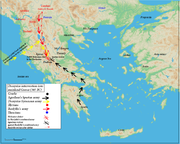 After a protracted siege he took Rhegium
(386), and sold the inhabitants as slaves
. He joined the Illyria
ns in an attempt to plunder the temple of Delphi
, pillaged the temple of Caere
(then allied with Rome) on the Etruscan
coast. In the Adriatic, to facilitate trade, Dionysius founded Ancona
, Adria
and Issa
. After him Adriatic became a sea of Syracuse
. In the Peloponnesian War
he espoused the side of the Sparta
ns, and assisted them with mercenaries.
In 385 BC Alcetas of Epirus was a refugee in Dionysus' court. Dionysus wanted a friendly monarch in Epirus
and so sent 2,000 Greek hoplites and five hundred suits of Greek armour
to help the Illyrians
under Bardyllis
in attacking the Molossians
of Epirus. They ravaged the region and killed 15,000 Molossians, and Alcetas regained his throne. Sparta however intervened; under Agesilaus
and with aid from Thessaly, Macedonia and the Molossians themselves, the Spartans expelled the Illyrians.
who succeeded him as ruler of Syracuse. His life was written by Philistus
, but the work is not extant.
Additionally, it is said that upon hearing news of his play, The Ransom of Hector, winning the competition at the Lanaean festival at Athens, he celebrated so fiercely that he drank himself to death. Others report that he died of natural causes shortly after learning of his play's victory in 367 BC. The third theory suggests that "The Company", of which he was a member, had taken revenge on his earlier purges and taxation imposed upon them, in an attempt to raise money for the war with Carthage.
, tyrant of Athens
, Dionysius was fond of having literary men about him, such as the historian Philistus
, the poet Philoxenus
, and the philosopher Plato
, but treated them in a most arbitrary manner. Once he had Philoxenus arrested and sent to the quarries for voicing a bad opinion about his poetry. A few days later, he released Philoxenus because of his friends' requests, and brought the poet before him for another poetry reading. Dionysius read his own work and the audience applauded. When he asked Philoxenus how he liked it, the poet replied only "Take me back to the quarries."
He also posed as an author and patron of literature; his poems, severely criticized by Philoxenus
, were hissed at the Olympic games; but having gained a prize for a tragedy on the Ransom of Hector at the Lenaea at Athens
, he was so elated that he engaged in a debauch which proved fatal.
His name is also known for the legend of Damon and Pythias
, and he features indirectly (via his son) in the legend of the Sword of Damocles
. The Ear of Dionysius
in Syracuse is an artificial limestone cave named after Dionysius.
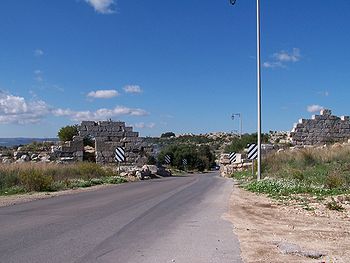 In 402 BC Dionysius I began building the Circuit Walls of Syracuse. They were completed in 397 BC and had the following characteristics:
Building so big a fortress would have involved installing well over 300 tons of stone every day for 5 years.
's Inferno
(of the Divine Comedy) (1308–21) as a tyrant who indulged in blood and rapine and suffers in a river of boiling blood. A fictional version of Dionysius is a character in Mary Renault
's historical novel The Mask of Apollo
(1966). He also features prominently in L. Sprague de Camp
's historical novel
The Arrows of Hercules
(1965) as a patron of inventors on the island of Ortygia
near Syracuse. He is the main character in Valerio Massimo Manfredi
's novel Tyrant (2003). He is also featured in the 1962 film Damon and Pythias
.
Greeks
The Greeks, also known as the Hellenes , are a nation and ethnic group native to Greece, Cyprus and neighboring regions. They also form a significant diaspora, with Greek communities established around the world....
tyrant
Tyrant
A tyrant was originally one who illegally seized and controlled a governmental power in a polis. Tyrants were a group of individuals who took over many Greek poleis during the uprising of the middle classes in the sixth and seventh centuries BC, ousting the aristocratic governments.Plato and...
of Syracuse
Syracuse, Italy
Syracuse is a historic city in Sicily, the capital of the province of Syracuse. The city is notable for its rich Greek history, culture, amphitheatres, architecture, and as the birthplace of the preeminent mathematician and engineer Archimedes. This 2,700-year-old city played a key role in...
, in what is now Sicily
Sicily
Sicily is a region of Italy, and is the largest island in the Mediterranean Sea. Along with the surrounding minor islands, it constitutes an autonomous region of Italy, the Regione Autonoma Siciliana Sicily has a rich and unique culture, especially with regard to the arts, music, literature,...
, southern Italy. He conquered several cities in Sicily and southern Italy, opposed Carthage
Carthage
Carthage , implying it was a 'new Tyre') is a major urban centre that has existed for nearly 3,000 years on the Gulf of Tunis, developing from a Phoenician colony of the 1st millennium BC...
's influence in Sicily and made Syracuse the most powerful of the Western Greek
Ancient Greece
Ancient Greece is a civilization belonging to a period of Greek history that lasted from the Archaic period of the 8th to 6th centuries BC to the end of antiquity. Immediately following this period was the beginning of the Early Middle Ages and the Byzantine era. Included in Ancient Greece is the...
colonies. He was regarded by the ancients as an example of the worst kind of despot—cruel, suspicious and vindictive.
Early life
Dionysius I began life as a clerk in a public office. Because of his achievements in the war against Carthage that had begun in 409 BC, he was elected supreme military commander in 406 BC; in the following year he seized total power and became tyrant. In subsequent years he consolidated his position ruthlessly.Mercenaries and Autocracy
Dionysius the Elder’s victory over the democraticDemokratia
Demokratia is a direct democracy, as opposed to the modern representative democracy.It was used in ancient Greece, most notably Athens, and began its use around 500 BC....
Syracuse represents both the very worst and the very best of the mercenary
Mercenary
A mercenary, is a person who takes part in an armed conflict based on the promise of material compensation rather than having a direct interest in, or a legal obligation to, the conflict itself. A non-conscript professional member of a regular army is not considered to be a mercenary although he...
-leader. Dionysius’ career as a despot occurred after he was given six hundred personal mercenaries to guard his person after faking an attack on his own life. He was able to increase this guard to one thousand and gradually consolidated his power and established himself as a tyrant. He imposed his mercenaries on all parts of the polis
Polis
Polis , plural poleis , literally means city in Greek. It could also mean citizenship and body of citizens. In modern historiography "polis" is normally used to indicate the ancient Greek city-states, like Classical Athens and its contemporaries, so polis is often translated as "city-state."The...
community. Such an act would have truly wiped out any suggestion that democracy was still in force. His rule was “unconstitutional and illegitimate and could not fail to provoke rebellions among the partisans of democratic government”. Dionysius’ position at home would be threatened even as early as 403 by those philosophically opposed to tyranny. Interestingly, Sparta, which had in the past deposed
Deposition (politics)
Deposition by political means concerns the removal of a politician or monarch. It may be done by coup, impeachment, invasion or forced abdication...
tyrants from Corinth
Ancient Corinth
Corinth, or Korinth was a city-state on the Isthmus of Corinth, the narrow stretch of land that joins the Peloponnesus to the mainland of Greece, roughly halfway between Athens and Sparta. The modern town of Corinth is located approximately northeast of the ancient ruins...
to Athens, did not damn Dionysius and his autocracy
Autocracy
An autocracy is a form of government in which one person is the supreme power within the state. It is derived from the Greek : and , and may be translated as "one who rules by himself". It is distinct from oligarchy and democracy...
. In fact relations between the two were very positive:
When the Lacedaemonians had settled the affairs of Greece to their own taste, they dispatched Aristus, one of their distinguished men, to Syracuse, ostensibly pretending that they would overthrow the government, but in truth with intent to increase the power of the tyranny; for they hoped that by helping to establish the rule of Dionysius they would obtain his ready service because of their benefactions to him.
Dionysius would even have the privilege of being allowed to conscript mercenaries from lands under Spartan authority. The demise of a prominent democratic polis in the classical world
Classical antiquity
Classical antiquity is a broad term for a long period of cultural history centered on the Mediterranean Sea, comprising the interlocking civilizations of ancient Greece and ancient Rome, collectively known as the Greco-Roman world...
and the subsequent tenure of Dionysius represented what would become a recurring norm in fourth century Greece, thanks to the prevalence of mercenaries. The mercenary and the tyrant went hand-in-hand; Polybius
Polybius
Polybius , Greek ) was a Greek historian of the Hellenistic Period noted for his work, The Histories, which covered the period of 220–146 BC in detail. The work describes in part the rise of the Roman Republic and its gradual domination over Greece...
for example noted how “the security of despots rests entirely on the loyalty and power of mercenaries”. Aristotle
Aristotle
Aristotle was a Greek philosopher and polymath, a student of Plato and teacher of Alexander the Great. His writings cover many subjects, including physics, metaphysics, poetry, theater, music, logic, rhetoric, linguistics, politics, government, ethics, biology, and zoology...
wrote how some form of ‘guard’ (viz. a personal army) is needed for absolute kingship, and for an elected tyrant a very particular number of professional soldiers should be employed; too few undermines the tyrants power and too many threatens the polis itself. The philosopher notes how based on this observation, the people of Syracuse were warned to not let Dionysius conscript too many ‘guards’ during his reign.
Conquests
He carried on war with CarthageSicilian Wars
The Greek-Punic wars or, less properly, Sicilian Wars, were a series of conflicts fought between Carthaginians and the Greeks headed by Syracusans, over control of Sicily and western Mediterranean between the years 600 to 265 BC....
from 397 BC to 392 BC with varying success; his attempts to drive the Carthaginians entirely out of the island of Sicily failed, and at his death they were masters of at least a third of it. He also carried on an expedition against Rhegium capturing it and attacking its allied cities in Magna Graecia
Magna Graecia
Magna Græcia is the name of the coastal areas of Southern Italy on the Tarentine Gulf that were extensively colonized by Greek settlers; particularly the Achaean colonies of Tarentum, Crotone, and Sybaris, but also, more loosely, the cities of Cumae and Neapolis to the north...
. In one campaign, in which he was joined by the Lucanians, he devastated the territories of Thurii
Thurii
Thurii , called also by some Latin writers Thurium , for a time also Copia and Copiae, was a city of Magna Graecia, situated on the Tarentine gulf, within a short distance of the site of Sybaris, whose place it may be considered as having taken...
and Croton
Crotone
Crotone is a city and comune in Calabria, southern Italy, on the Ionian Sea. Founded circa 710 BC as the Achaean colony of Croton , it was known as Cotrone from the Middle Ages until 1928, when its name was changed to the current one. In 1994 it became the capital of the newly established...
in an attempt to defend Locri
Locri
Locri is a town and comune in the province of Reggio Calabria, Calabria, southern Italy. The name derives from the ancient Greek town Locris.-History:...
.
Siege of Rhegium
The Siege of Rhegium was fought in 386 BC. between a Syracusan force and the city of Rhegium. The Syracusans were led by the tyrant Dionysius I. Dionysius took the city, and sold its inhabitants into slavery....
(386), and sold the inhabitants as slaves
Slavery
Slavery is a system under which people are treated as property to be bought and sold, and are forced to work. Slaves can be held against their will from the time of their capture, purchase or birth, and deprived of the right to leave, to refuse to work, or to demand compensation...
. He joined the Illyria
Illyria
In classical antiquity, Illyria was a region in the western part of the Balkan Peninsula inhabited by the Illyrians....
ns in an attempt to plunder the temple of Delphi
Delphi
Delphi is both an archaeological site and a modern town in Greece on the south-western spur of Mount Parnassus in the valley of Phocis.In Greek mythology, Delphi was the site of the Delphic oracle, the most important oracle in the classical Greek world, and a major site for the worship of the god...
, pillaged the temple of Caere
Caere
Caere is the Latin name given by the Romans to one of the larger cities of Southern Etruria, the modern Cerveteri, approximately 50-60 kilometres north-northwest of Rome. To the Etruscans it was known as Cisra and to the Greeks as Agylla...
(then allied with Rome) on the Etruscan
Etruscan civilization
Etruscan civilization is the modern English name given to a civilization of ancient Italy in the area corresponding roughly to Tuscany. The ancient Romans called its creators the Tusci or Etrusci...
coast. In the Adriatic, to facilitate trade, Dionysius founded Ancona
Ancona
Ancona is a city and a seaport in the Marche region, in central Italy, with a population of 101,909 . Ancona is the capital of the province of Ancona and of the region....
, Adria
Adria
Adria is a town and comune in the province of Rovigo in the Veneto region of Northern Italy, situated between the mouths of the rivers Adige and Po....
and Issa
Vis (island)
Vis is the most outerly lying larger Croatian island in the Adriatic Sea, and is part of the Central Dalmatian group of islands, with an area of 90.26 km² and a population of 3,617 . Of all the inhabited Croatian islands, it is the farthest from the coast...
. After him Adriatic became a sea of Syracuse
Syracuse
Syracuse, as a place name, may refer to:In Italy:* Syracuse, Sicily* the Province of SyracuseIn the United States:* Syracuse, New York* Syracuse, Indiana* Syracuse, Kansas* Syracuse, Missouri* Syracuse, Nebraska* Syracuse, Ohio* Syracuse, Utah...
. In the Peloponnesian War
Peloponnesian War
The Peloponnesian War, 431 to 404 BC, was an ancient Greek war fought by Athens and its empire against the Peloponnesian League led by Sparta. Historians have traditionally divided the war into three phases...
he espoused the side of the Sparta
Sparta
Sparta or Lacedaemon, was a prominent city-state in ancient Greece, situated on the banks of the River Eurotas in Laconia, in south-eastern Peloponnese. It emerged as a political entity around the 10th century BC, when the invading Dorians subjugated the local, non-Dorian population. From c...
ns, and assisted them with mercenaries.
In 385 BC Alcetas of Epirus was a refugee in Dionysus' court. Dionysus wanted a friendly monarch in Epirus
Epirus
The name Epirus, from the Greek "Ήπειρος" meaning continent may refer to:-Geographical:* Epirus - a historical and geographical region of the southwestern Balkans, straddling modern Greece and Albania...
and so sent 2,000 Greek hoplites and five hundred suits of Greek armour
Armour
Armour or armor is protective covering used to prevent damage from being inflicted to an object, individual or a vehicle through use of direct contact weapons or projectiles, usually during combat, or from damage caused by a potentially dangerous environment or action...
to help the Illyrians
Illyrians
The Illyrians were a group of tribes who inhabited part of the western Balkans in antiquity and the south-eastern coasts of the Italian peninsula...
under Bardyllis
Bardyllis
Bardyllis was a king of the Dardanian Kingdom and probably its founder.Bardyllis created one of the most powerful Illyrian states, that of the Dardanians...
in attacking the Molossians
Molossians
The Molossians were an ancient Greek tribe that inhabited the region of Epirus since the Mycenaean era. On their northeast frontier they had the Chaonians and to their southern frontier the kingdom of the Thesprotians, to their north were the Illyrians. The Molossians were part of the League of...
of Epirus. They ravaged the region and killed 15,000 Molossians, and Alcetas regained his throne. Sparta however intervened; under Agesilaus
Agesilaus II
Agesilaus II, or Agesilaos II was a king of Sparta, of the Eurypontid dynasty, ruling from approximately 400 BC to 360 BC, during most of which time he was, in Plutarch's words, "as good as thought commander and king of all Greece," and was for the whole of it greatly identified with his...
and with aid from Thessaly, Macedonia and the Molossians themselves, the Spartans expelled the Illyrians.
Death
According to others, he was poisoned by his physicians at the instigation of his son, Dionysius the YoungerDionysius II of Syracuse
Dionysius the Younger or Dionysius II ruled Syracuse, Sicily from 367 BC to 357 BC and again from 346 BC to 344 BC....
who succeeded him as ruler of Syracuse. His life was written by Philistus
Philistus
Philistus , son of Archomenidas, was Greek historian of Sicily. Philistus was born at Syracuse about the beginning of the Peloponnesian War. He was a faithful supporter of the elder Dionysius, and commander of the citadel. Cicero who had a high opinion of his work, calls him the miniature Thucydides...
, but the work is not extant.
Additionally, it is said that upon hearing news of his play, The Ransom of Hector, winning the competition at the Lanaean festival at Athens, he celebrated so fiercely that he drank himself to death. Others report that he died of natural causes shortly after learning of his play's victory in 367 BC. The third theory suggests that "The Company", of which he was a member, had taken revenge on his earlier purges and taxation imposed upon them, in an attempt to raise money for the war with Carthage.
Intellectual tastes
Like PisistratusPeisistratos (Athens)
Peisistratos was a tyrant of Athens from 546 to 527/8 BC. His legacy lies primarily in his institution of the Panathenaic Festival and the consequent first attempt at producing a definitive version for Homeric epics. Peisistratos' championing of the lower class of Athens, the Hyperakrioi, can be...
, tyrant of Athens
Athens
Athens , is the capital and largest city of Greece. Athens dominates the Attica region and is one of the world's oldest cities, as its recorded history spans around 3,400 years. Classical Athens was a powerful city-state...
, Dionysius was fond of having literary men about him, such as the historian Philistus
Philistus
Philistus , son of Archomenidas, was Greek historian of Sicily. Philistus was born at Syracuse about the beginning of the Peloponnesian War. He was a faithful supporter of the elder Dionysius, and commander of the citadel. Cicero who had a high opinion of his work, calls him the miniature Thucydides...
, the poet Philoxenus
Philoxenus of Cythera
Philoxenus of Cythera was a Greek dithyrambic poet, an exponent of the "new music."On the conquest of the island by the Athenians he was taken as a slave to Athens, where he came into the possession of the dithyrambic poet Melanippides, who educated him and set him free...
, and the philosopher Plato
Plato
Plato , was a Classical Greek philosopher, mathematician, student of Socrates, writer of philosophical dialogues, and founder of the Academy in Athens, the first institution of higher learning in the Western world. Along with his mentor, Socrates, and his student, Aristotle, Plato helped to lay the...
, but treated them in a most arbitrary manner. Once he had Philoxenus arrested and sent to the quarries for voicing a bad opinion about his poetry. A few days later, he released Philoxenus because of his friends' requests, and brought the poet before him for another poetry reading. Dionysius read his own work and the audience applauded. When he asked Philoxenus how he liked it, the poet replied only "Take me back to the quarries."
He also posed as an author and patron of literature; his poems, severely criticized by Philoxenus
Philoxenus
Philoxenus or Philoxenos is the name of several prominent ancient Greeks:*Philoxenus of Cythera, an ancient Greek dithyrambic poet*Philoxenus of Leucas, a legendary glutton*King Philoxenus, an Indo-Greek king...
, were hissed at the Olympic games; but having gained a prize for a tragedy on the Ransom of Hector at the Lenaea at Athens
Athens
Athens , is the capital and largest city of Greece. Athens dominates the Attica region and is one of the world's oldest cities, as its recorded history spans around 3,400 years. Classical Athens was a powerful city-state...
, he was so elated that he engaged in a debauch which proved fatal.
His name is also known for the legend of Damon and Pythias
Damon and Pythias
In Greek mythology, the legend of Damon and Pythias symbolizes trust and loyalty in a true friendship.- Greek legend :As told by Aristoxenus, and after him Cicero , Diodorus Siculus , and others, around the 4th century BC, Pythias and his friend Damon, both followers of the philosopher...
, and he features indirectly (via his son) in the legend of the Sword of Damocles
Damocles
Damocles is a figure featured in a single moral anecdote commonly referred to as "the Sword of Damocles," which was a late addition to classical Greek culture. The figure belongs properly to legend rather than Greek myth. The anecdote apparently figured in the lost history of Sicily by Timaeus of...
. The Ear of Dionysius
Ear of Dionysius
The Ear of Dionysius is an artificial limestone cave carved out of the Temenites hill in the city of Syracuse, on the island of Sicily in Italy. Its name comes from its similarity in shape to the human ear.-Geology:...
in Syracuse is an artificial limestone cave named after Dionysius.
Walls of Syracuse
- Length: 27 kilometers
- Width at base: 3.3 m to 5.35 m
- Number of known towers on circuit: 14 (including Euryalos)
- Largest tower: 8.5 m x 8.5 m
- Deepest ditch (at Euryalos fortress): 9 m
Building so big a fortress would have involved installing well over 300 tons of stone every day for 5 years.
Fictional references
Dionysius I is mentioned in DanteDANTE
Delivery of Advanced Network Technology to Europe is a not-for-profit organisation that plans, builds and operates the international networks that interconnect the various national research and education networks in Europe and surrounding regions...
's Inferno
Inferno (Dante)
Inferno is the first part of Dante Alighieri's 14th-century epic poem Divine Comedy. It is followed by Purgatorio and Paradiso. It is an allegory telling of the journey of Dante through what is largely the medieval concept of Hell, guided by the Roman poet Virgil. In the poem, Hell is depicted as...
(of the Divine Comedy) (1308–21) as a tyrant who indulged in blood and rapine and suffers in a river of boiling blood. A fictional version of Dionysius is a character in Mary Renault
Mary Renault
Mary Renault born Eileen Mary Challans, was an English writer best known for her historical novels set in Ancient Greece...
's historical novel The Mask of Apollo
The Mask of Apollo
The Mask of Apollo is a historical novel written by Mary Renault. It is set in ancient Greece shortly after the Peloponnesian War. The story involves the world of live theatre and political intrigue in the Mediterranean at the time...
(1966). He also features prominently in L. Sprague de Camp
L. Sprague de Camp
Lyon Sprague de Camp was an American author of science fiction and fantasy books, non-fiction and biography. In a writing career spanning 60 years, he wrote over 100 books, including novels and notable works of non-fiction, including biographies of other important fantasy authors...
's historical novel
Historical novel
According to Encyclopædia Britannica, a historical novel is-Development:An early example of historical prose fiction is Luó Guànzhōng's 14th century Romance of the Three Kingdoms, which covers one of the most important periods of Chinese history and left a lasting impact on Chinese culture.The...
The Arrows of Hercules
The Arrows of Hercules
The Arrows of Hercules is an historical novel by L. Sprague de Camp, first published in hardback by Doubleday in 1965 and in paperback by Curtis Books in 1970...
(1965) as a patron of inventors on the island of Ortygia
Ortygia
Ortygia is a little island and it is the historical centre of the city of Syracuse, Sicily. The island, also known as Città Vecchia , contains many historical landmarks...
near Syracuse. He is the main character in Valerio Massimo Manfredi
Valerio Massimo Manfredi
Valerio Massimo Manfredi is an Italian historian, writer, archaeologist and journalist.-Biography:He was born in Piumazzo di Castelfranco Emilia, province of Modena and is married to Christine Fedderson Manfredi, who translates his published works from Italian to English...
's novel Tyrant (2003). He is also featured in the 1962 film Damon and Pythias
Damon and Pythias (film)
Damon and Pythias is a 1962 Italian / American film directed by Curtis Bernhardt. The film is based on the Greek legend, and set during the reign of Dionysius I of Syracuse .-Cast:...
.
See also
- Diod. Sic.Diodorus SiculusDiodorus Siculus was a Greek historian who flourished between 60 and 30 BC. According to Diodorus' own work, he was born at Agyrium in Sicily . With one exception, antiquity affords no further information about Diodorus' life and doings beyond what is to be found in his own work, Bibliotheca...
xii., xiv., xv.; J Bass, Dionysius I von Syrakus (Vienna, 1881). - "Tyrant" a novel by Valerio Massimo Manfredi, ISBN 0-330-42654-0