


Iyo Province

Encyclopedia
Japan
Japan is an island nation in East Asia. Located in the Pacific Ocean, it lies to the east of the Sea of Japan, China, North Korea, South Korea and Russia, stretching from the Sea of Okhotsk in the north to the East China Sea and Taiwan in the south...
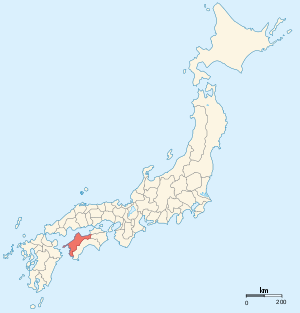
in the area that is today Ehime Prefecture
Ehime Prefecture
is a prefecture in northwestern Shikoku, Japan. The capital is Matsuyama.-History:Until the Meiji Restoration, Ehime prefecture was known as Iyo Province...
on Shikoku
Shikoku
is the smallest and least populous of the four main islands of Japan, located south of Honshū and east of the island of Kyūshū. Its ancient names include Iyo-no-futana-shima , Iyo-shima , and Futana-shima...
. Iyo bordered on Awa
Awa Province (Tokushima)
was an old province of Japan in the area that is today a part of Tokushima Prefecture on Shikoku. Awa was bordered by Tosa, Sanuki, and Iyo Provinces. It was sometimes called .-References:...
, Sanuki
Sanuki Province
was an old province of Japan on the island of Shikoku, with the same boundaries as modern Kagawa Prefecture. It was sometimes called .It faced the Inland Sea and bordered on Awa and Iyo Provinces. Across Naruto strait it bordered Awaji Province too. Administratively it was included as a part of...
, and Tosa
Tosa Province
is the name of a former province of Japan in the area that is today Kōchi Prefecture on Shikoku. Tosa was bordered by Iyo and Awa Provinces. It was sometimes called .-History:The ancient capital was near modern Nankoku...
Provinces. It was sometimes called .
The ancient provincial capital was near modern Imabari
Imabari, Ehime
is a city located in Ehime, Japan. It is the second largest city in Ehime prefecture.Following a recent merger, the city has an estimated population of 172,384 and density of 410.87 persons per km². The total area is .-Transportation:...
. During the Sengoku Period
Sengoku period
The or Warring States period in Japanese history was a time of social upheaval, political intrigue, and nearly constant military conflict that lasted roughly from the middle of the 15th century to the beginning of the 17th century. The name "Sengoku" was adopted by Japanese historians in reference...
it was split into several fiefs, the largest one usually being run from Matsuyama Castle
Matsuyama Castle (Iyo)
is a flatland-mountain castle that was built in 1603 on Mount Katsuyama, whose height is 132 meters, in Matsuyama city in Ehime Prefecture . It is not to be confused with Bitchū Matsuyama Castle.- History :...
in Matsuyama
Matsuyama, Ehime
is the capital city of Ehime Prefecture on the Shikoku island of Japan. It is located on the northeastern portion of the Dōgo Plain. Its name means "pine mountain." The city was founded on December 15, 1889....
. It was briefly unified by the Chōsokabe clan
Chosokabe clan
The was a Japanese samurai clan of the Sengoku period, that controlled Tosa Province , and later Shikoku Island. The clan is sometimes also known as...
of neighboring Tosa, but Toyotomi Hideyoshi
Toyotomi Hideyoshi
was a daimyo warrior, general and politician of the Sengoku period. He unified the political factions of Japan. He succeeded his former liege lord, Oda Nobunaga, and brought an end to the Sengoku period. The period of his rule is often called the Momoyama period, named after Hideyoshi's castle...
invaded Shikoku in 1584 and reallocated the fiefs. During the Edo Period
Edo period
The , or , is a division of Japanese history which was ruled by the shoguns of the Tokugawa family, running from 1603 to 1868. The political entity of this period was the Tokugawa shogunate....
the province was controlled by Uwajima Domain
Uwajima Domain
The was a feudal domain in Iyo Province of Japan during the Edo period. It was ruled from 1608 to 1613 by the Tomita clan. After a brief period as Tokugawa-controlled tenryō territory, the domain passed into the hands of the Date clan. The founder was Date Hidemune , first-born son of Date Masamune...
.
The people spoke Iyo-ben.