
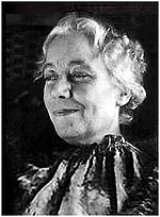
Karen Horney born
Danielsen (16 September 1885 – 4 December 1952) was a German-American psychoanalyst. Her theories questioned some traditional Freudian views, particularly his theory of sexuality, as well as the instinct orientation of
psychoanalysisPsychoanalysis is a psychological theory developed in the late 19th and early 20th centuries by Austrian neurologist Sigmund Freud. Psychoanalysis has expanded, been criticized and developed in different directions, mostly by some of Freud's former students, such as Alfred Adler and Carl Gustav...
and its genetic psychology. As such, she is often classified as
Neo-FreudianThe Neo-Freudian psychiatrists and psychologists were a group of loosely linked American theorists of the mid-twentieth century, who were all influenced by Sigmund Freud, but who extended his theories, often in social or cultural directions...
.
Early life
Horney was born Karen Danielsen on 16 September 1885 in Blankenese, Germany, near
Hamburg-History:The first historic name for the city was, according to Claudius Ptolemy's reports, Treva.But the city takes its modern name, Hamburg, from the first permanent building on the site, a castle whose construction was ordered by the Emperor Charlemagne in AD 808...
. Her father, Berndt Wackels Danielsen (1836-1910), was a ship's captain, a traditional devout with a patriarchal thinking (his children nicknamed him "the Bible-thrower"). Her mother, Clotilde, née van Ronzelen (1853-1911), known as "Sonni", was very different, being much more open-minded than Berndt. Horney's elder brother was also named Berndt, and Karen cared for him deeply. She also had four elder half-siblings from her father's previous marriage.
According to Horney's adolescent diaries her father was "a cruel disciplinary figure" holding his son Berndt in higher regard than herself. Instead of being offended or feeling indignation over Karen's perceptions of him, her father brought her gifts from far-away countries. Despite this, Karen always felt deprived of her father's affection and instead becoming attached to her mother.
From roughly the age of nine Karen changed her perspective on life, becoming ambitious and somewhat rebellious. She felt that she could not become pretty and instead decided to vest her energies into her intellectual qualities—despite the fact she was seen by most as pretty. At this time she developed a crush on her older brother, who became embarrassed by her attentions—soon pushing her away. She suffered her first of several bouts of
depressionMajor depressive disorder is a mental disorder characterized by an all-encompassing low mood accompanied by low self-esteem, and by loss of interest or pleasure in normally enjoyable activities...
- an issue that would plague her for the rest of her life.
Education and youth
In 1904, Karen's mother left her father (though they were never divorced), taking the children with her. In 1906, Karen entered medical school against her parent's wishes.
http://www.muskingum.edu/~psych/psycweb/history/horney.htm The University of Freiburg was in fact one of the first institutions throughout
GermanyGermany , officially the Federal Republic of Germany , is a federal parliamentary republic in Europe. The country consists of 16 states while the capital and largest city is Berlin. Germany covers an area of 357,021 km2 and has a largely temperate seasonal climate...
to enroll women in medical courses—with higher education only becoming available to women in Germany in 1900. By 1908, Horney had transferred to the University of Göttingen, and would transfer once more to the University of Berlin before her graduation in 1913.
It was during her time as a medical student that she met Oskar Horney, whom she married by 1909. The following year Horney gave birth to a daughter,
BrigitteBrigitte Horney was a German theatre and film actress. Best remembered was her role as Empress Katherine the Great in the 1943 version of the UFA film version of Baron Munchhausen, directed by Josef von Báky, with Hans Albers in the title role.-Life and work:Brigitte Horney was the daughter of...
, who was to be the first of three daughters. By this time Karen had refined her interests and was keen to pursue study in the then pioneering pursuit of
psychoanalysisPsychoanalysis is a psychological theory developed in the late 19th and early 20th centuries by Austrian neurologist Sigmund Freud. Psychoanalysis has expanded, been criticized and developed in different directions, mostly by some of Freud's former students, such as Alfred Adler and Carl Gustav...
. Horney's mother died in 1911, an event which put much strain on the young Karen. Her marriage with Oskar proved consistent with Freudian theory; he was just as authoritarian and strict with his children as Karen's own father was with his. During these years, Karen was receptive to having her children raised in this atmosphere; it was only later, during the 1920s, that her attitude towards rearing children changed.
Career and works
In 1920, Horney took up a position within the Institute for Psychoanalysis in
BerlinBerlin is the capital city of Germany and is one of the 16 states of Germany. With a population of 3.45 million people, Berlin is Germany's largest city. It is the second most populous city proper and the seventh most populous urban area in the European Union...
, where she lectured on psychoanalysis for several years. She also taught at
The New SchoolThe New School is a university in New York City, located mostly in Greenwich Village. From its founding in 1919 by progressive New York academics, and for most of its history, the university was known as the New School for Social Research. Between 1997 and 2005 it was known as New School University...
in
New York CityNew York is the most populous city in the United States and the center of the New York Metropolitan Area, one of the most populous metropolitan areas in the world. New York exerts a significant impact upon global commerce, finance, media, art, fashion, research, technology, education, and...
.
Karl Abraham-Further reading:* Freud, S. . Mourning and Melancholia. Standard Edition, 14, 305-307.* May-Tolzmann, U. . The Discovery of the Bad Mother: Abraham’s contribution to the theory of Depression...
, a correspondent of
Sigmund FreudSigmund Freud , born Sigismund Schlomo Freud , was an Austrian neurologist who founded the discipline of psychoanalysis...
, regarded Karen Horney as an extensively gifted analyst and teacher of psychoanalysis.
By 1923, Oskar Horney's firm had become
insolventInsolvency means the inability to pay one's debts as they fall due. Usually used to refer to a business, insolvency refers to the inability of a company to pay off its debts.Business insolvency is defined in two different ways:...
, with Oskar developing
meningitisMeningitis is inflammation of the protective membranes covering the brain and spinal cord, known collectively as the meninges. The inflammation may be caused by infection with viruses, bacteria, or other microorganisms, and less commonly by certain drugs...
soon thereafter. Oskar rapidly became embittered, morose and argumentative. It was also in 1923 that Karen's brother died of a pulmonary infection. Both these events contributed to a worsening of Karen's mental health. She entered into a second state of abject depression; she swam out to sea during a
vacationTourism is travel for recreational, leisure or business purposes. The World Tourism Organization defines tourists as people "traveling to and staying in places outside their usual environment for not more than one consecutive year for leisure, business and other purposes".Tourism has become a...
and considered committing
suicideSuicide is the act of intentionally causing one's own death. Suicide is often committed out of despair or attributed to some underlying mental disorder, such as depression, bipolar disorder, schizophrenia, alcoholism, or drug abuse...
.
In 1926, Karen and her three daughters moved out of Oskar's house. Four years later, they emigrated to the
United StatesThe United States of America is a federal constitutional republic comprising fifty states and a federal district...
, eventually settling in
BrooklynBrooklyn is the most populous of New York City's five boroughs, with nearly 2.6 million residents, and the second-largest in area. Since 1896, Brooklyn has had the same boundaries as Kings County, which is now the most populous county in New York State and the second-most densely populated...
. Brooklyn was home to a large
intellectualAn intellectual is a person who uses intelligence and critical or analytical reasoning in either a professional or a personal capacity.- Terminology and endeavours :"Intellectual" can denote four types of persons:...
community, due in part to a high influx of
JewishJudaism ) is the "religion, philosophy, and way of life" of the Jewish people...
refugees from
EuropeEurope is, by convention, one of the world's seven continents. Comprising the westernmost peninsula of Eurasia, Europe is generally 'divided' from Asia to its east by the watershed divides of the Ural and Caucasus Mountains, the Ural River, the Caspian and Black Seas, and the waterways connecting...
, particularly Germany. It was in Brooklyn that Karen became friends with academics such as
Erich FrommErich Seligmann Fromm was a Jewish German-American social psychologist, psychoanalyst, sociologist, humanistic philosopher, and democratic socialist. He was associated with what became known as the Frankfurt School of critical theory.-Life:Erich Fromm was born on March 23, 1900, at Frankfurt am...
and
Harry Stack SullivanHarry Stack Sullivan was a U.S. psychiatrist whose work in psychoanalysis was based on direct and verifiable observation .-Life and works:Sullivan was a child of Irish immigrants and allegedly grew up in an...
, at one point embarking on an intimate relationship with the former, which ended bitterly.
Horney quickly set about establishing herself. Her first career posting in the United States was as the Associate Director of the
ChicagoChicago is the largest city in the US state of Illinois. With nearly 2.7 million residents, it is the most populous city in the Midwestern United States and the third most populous in the US, after New York City and Los Angeles...
Institute for Psychoanalysis. It was while living in Brooklyn that Horney developed and advanced her composite theories regarding
neurosisNeurosis is a class of functional mental disorders involving distress but neither delusions nor hallucinations, whereby behavior is not outside socially acceptable norms. It is also known as psychoneurosis or neurotic disorder, and thus those suffering from it are said to be neurotic...
and
personalityPersonality psychology is a branch of psychology that studies personality and individual differences. Its areas of focus include:* Constructing a coherent picture of the individual and his or her major psychological processes...
, based on experiences gained from working in
psychotherapyPsychotherapy is a general term referring to any form of therapeutic interaction or treatment contracted between a trained professional and a client or patient; family, couple or group...
. In 1937 she published the book
The Neurotic Personality of Our Time, which had wide popular readership. By 1941, Horney was
DeanIn academic administration, a dean is a person with significant authority over a specific academic unit, or over a specific area of concern, or both...
of the American Institute of Psychoanalysis, a training institute for those who were interested in Horney's own organization, the Association for the Advancement of Psychoanalysis. Horney founded this organization after becoming dissatisfied with the generally strict, orthodox nature of the psychoanalytic community.
Horney's deviation from Freudian psychology led to her resigning from her post, and she soon took up teaching in the
New YorkNew York is a state in the Northeastern region of the United States. It is the nation's third most populous state. New York is bordered by New Jersey and Pennsylvania to the south, and by Connecticut, Massachusetts and Vermont to the east...
Medical College. She also founded a journal, named the
American Journal of Psychoanalysis. She taught at the New York Medical College and continued practicing as a psychiatrist until her death in 1952.
Theory of neurosis
Horney looked at
neurosisNeurosis is a class of functional mental disorders involving distress but neither delusions nor hallucinations, whereby behavior is not outside socially acceptable norms. It is also known as psychoneurosis or neurotic disorder, and thus those suffering from it are said to be neurotic...
in a different light from other psychoanalysts of the time. Her expansive interest in the subject led her to compile a detailed theory of neurosis, with data from her patients. Horney believed neurosis to be a continuous process—with neuroses commonly occurring sporadically in one's lifetime. This was in contrast to the opinions of her contemporaries who believed neurosis was, like more severe mental conditions, a negative malfunction of the mind in response to external stimuli, such as
bereavementGrief is a multi-faceted response to loss, particularly to the loss of someone or something to which a bond was formed. Although conventionally focused on the emotional response to loss, it also has physical, cognitive, behavioral, social, and philosophical dimensions...
,
divorceDivorce is the final termination of a marital union, canceling the legal duties and responsibilities of marriage and dissolving the bonds of matrimony between the parties...
or negative experiences during
childBiologically, a child is generally a human between the stages of birth and puberty. Some vernacular definitions of a child include the fetus, as being an unborn child. The legal definition of "child" generally refers to a minor, otherwise known as a person younger than the age of majority...
hood and
adolescenceAdolescence is a transitional stage of physical and mental human development generally occurring between puberty and legal adulthood , but largely characterized as beginning and ending with the teenage stage...
.
Horney believed these assumptions to be less important, except for influences during childhood. Rather, she placed significant emphasis on
parentalParenting is the process of promoting and supporting the physical, emotional, social, and intellectual development of a child from infancy to adulthood...
indifference towards the child, believing that a child's perception of events, as opposed to the parent's intentions, is the key to understanding a person's neurosis. For instance, a child might feel a lack of warmth and affection should a parent make fun of the child's feelings. The parent may also casually neglect to fulfill promises, which in turn could have a detrimental effect on the child's mental state.
From her experiences as a psychiatrist, Horney named ten patterns of neurotic needs. These ten needs are based upon things which she thought all humans require to succeed in life. Horney modified these needs somewhat to correspond with what she believed were individuals' neuroses. A neurotic person could theoretically exhibit all of these needs, though in practice much fewer than the ten here need to be present for a person to be considered a neurotic. The ten needs, as set out by Horney, (classified according to her so-called
coping strategiesCoping Strategies is treatment designed for posttraumatic stress disorder within United States Armed Forces personnel and their families by the charitable organization Patriot Outreach...
) are as follows:
Moving Toward People
- 1. The need for affection and approval; pleasing others and being liked by them.
- 2. The need for a partner; one whom they can love
Love is an emotion of strong affection and personal attachment. In philosophical context, love is a virtue representing all of human kindness, compassion, and affection. Love is central to many religions, as in the Christian phrase, "God is love" or Agape in the Canonical gospels...
and who will solve all problems.
Moving Against People
- 3. The need for power; the ability to bend wills
Will, in philosophical discussions, consonant with a common English usage, refers to a property of the mind, and an attribute of acts intentionally performed. Actions made according to a person's will are called "willing" or "voluntary" and sometimes pejoratively "willful"...
and achieve control over others—while most persons seek strength, the neurotic may be desperate for it.
- 4. The need to exploit others; to get the better of them. To become manipulative
Psychological manipulation is a type of social influence that aims to change the perception or behavior of others through underhanded, deceptive, or even abusive tactics. By advancing the interests of the manipulator, often at the other's expense, such methods could be considered exploitative,...
, fostering the belief that people are there simply to be used.
- 5. The need for social recognition; prestige
Prestige is a word commonly used to describe reputation or esteem, though it has three somewhat related meanings that, to some degree, may be contradictory. Which meaning applies depends on the historical context and the person using the word....
and limelight.
- 6. The need for personal admiration; for both inner and outer qualities—to be valued.
- 7. The need for personal achievement; though virtually all persons wish to make achievements, as with No. 3, the neurotic may be desperate for achievement.
Moving Away from People
- 8. The need for self sufficiency and independence; while most desire some autonomy
Autonomy is a concept found in moral, political and bioethical philosophy. Within these contexts, it is the capacity of a rational individual to make an informed, un-coerced decision...
, the neurotic may simply wish to discard other individuals entirely.
- 9. The need for perfection; while many are driven to perfect their lives in the form of well being, the neurotic may display a fear of being slightly flawed.
- 10. Lastly, the need to restrict life practices to within narrow borders; to live as inconspicuous a life as possible.
Upon investigating the ten needs further, Horney found she was able to condense them into three broad categories:
Compliance
Needs one and two were assimilated into the "
compliance" category. This category is seen as a process of "moving towards people", or self-effacement. Under Horney's theory children facing difficulties with parents often use this strategy. Fear of
helplessnessLearned helplessness, as a technical term in animal psychology and related human psychology, means a condition of a human person or an animal in which it has learned to behave helplessly, even when the opportunity is restored for it to help itself by avoiding an unpleasant or harmful circumstance...
and abandonment occurs—phenomena Horney refers to as "
basic anxietyBasic Anxiety is a term used by the psychologist Karen Horney to explain the ramifications of poor parenting. Basic anxiety is deep insecurity and fear that have developed in the child because of the way they were treated by their parents. It is developed because of the conflict with dependency and...
". Those within the compliance category tend to exhibit a need for affection and approval on the part of their peers. They may also seek out a partner, somebody to confide in, fostering the belief that, in turn, all of life's problems would be solved by the new cohort. A lack of demands and a desire for inconspicuousness both occur in these individuals.
Aggression
Needs three through seven were assimilated into the "
aggression" category, also called the "moving against people", or the "expansive" solution. Neurotic children or adults within this category often exhibit
angerAnger is an automatic response to ill treatment. It is the way a person indicates he or she will not tolerate certain types of behaviour. It is a feedback mechanism in which an unpleasant stimulus is met with an unpleasant response....
or
basic hostilityBasic hostility is a psychological concept first described by psychoanalyst Karen Horney. It is an effect of basic evil which is also known as parental abuse. Horney described it as a bad attitude which develops in the child as a result of basic evil, such as parental abuse...
to those around them. That is, there is a need for power, a need for control and exploitation, and a maintenance of a facade of
omnipotenceOmnipotence is unlimited power. Monotheistic religions generally attribute omnipotence to only the deity of whichever faith is being addressed...
. Manipulative qualities aside, under Horney's assertions the aggressive individual may also wish for social recognition, not necessarily in terms of limelight, but in terms of simply being known (perhaps
fearFear is a distressing negative sensation induced by a perceived threat. It is a basic survival mechanism occurring in response to a specific stimulus, such as pain or the threat of danger...
ed) by subordinates and peers alike. In addition, the individual has needs for a degree of personal admiration by those within this person's social circle and, lastly, for raw personal achievement. These characteristics comprise the "aggressive" neurotic type. Aggressive types also tend to keep people away from them. On the other hand, they only care about their wants and needs. They would do whatever they can to be happy and wouldn't desist from hurting anyone.
Detachment
Needs eight through ten were assimilated into the "
detachment" category, also called the "moving-away-from" or "resigning" solution or a detached personality. As neither aggression nor compliance solve parental indifference, Horney recognized that children might simply try to become
self-sufficientSelf-sufficiency refers to the state of not requiring any outside aid, support, or interaction, for survival; it is therefore a type of personal or collective autonomy...
. The withdrawing neurotic may disregard others in a non-aggressive manner, regarding
solitudeSolitude is a state of seclusion or isolation, i.e., lack of contact with people. It may stem from bad relationships, deliberate choice, infectious disease, mental disorders, neurological disorders or circumstances of employment or situation .Short-term solitude is often valued as a time when one...
and independence as the way forth. The stringent needs for
perfectionPerfection is, broadly, a state of completeness and flawlessness.The term "perfection" is actually used to designate a range of diverse, if often kindred, concepts...
comprise another part of this category; those withdrawing may strive for perfection above all else, to the point where being flawed is utterly unacceptable. Everything the "detached" type does must be unassailable and refined. They suppress or deny all feelings towards others, particularly love and hate.
Narcissism
Horney saw narcissism quite differently from Freud, Kohut and other mainstream
psychoanalyticPsychoanalysis is a psychological theory developed in the late 19th and early 20th centuries by Austrian neurologist Sigmund Freud. Psychoanalysis has expanded, been criticized and developed in different directions, mostly by some of Freud's former students, such as Alfred Adler and Carl Gustav...
theorists in that she did not posit a primary narcissism but saw the narcissistic personality as the product of a certain kind of early environment acting on a certain kind of temperament. For her, narcissistic needs and tendencies are not inherent in human nature.
Narcissism is different from Horney's other major
defensive strategiesIn Freudian psychoanalytic theory, defence mechanisms are unconscious psychological strategies brought into play by various entities to cope with reality and to maintain self-image. Healthy persons normally use different defences throughout life...
or solutions in that it is not compensatory. Self-idealization is compensatory in her theory, but it differs from narcissism. All the defensive strategies involve self-idealization, but in the narcissistic solution it tends to be the product of indulgence rather than of deprivation. The narcissist's
self-esteemSelf-esteem is a term in psychology to reflect a person's overall evaluation or appraisal of his or her own worth. Self-esteem encompasses beliefs and emotions such as triumph, despair, pride and shame: some would distinguish how 'the self-concept is what we think about the self; self-esteem, the...
is not strong, however, because it is not based on genuine accomplishments.
Mature theory
Near the end of her career, Karen Horney summarized her ideas in
Neurosis and Human Growth: The Struggle Toward Self-Realization, her major work published in 1950. It is in this book that she summarizes her ideas regarding neurosis, clarifying her three neurotic "solutions" to the stresses of life. The
expansive solution became a tripartite combination of narcissistic, perfectionistic and arrogant-vindictive approaches to life. (Horney had previously focused on the psychiatric concept of
narcissismNarcissism is a term with a wide range of meanings, depending on whether it is used to describe a central concept of psychoanalytic theory, a mental illness, a social or cultural problem, or simply a personality trait...
in a book published in 1939,
New Ways in Psychoanalysis). Her other two neurotic "solutions" were also a refinement of her previous views:
self-effacement, or submission to others, and
resignation, or detachment from others. She described case studies of symbiotic relationships between arrogant-vindictive and self-effacing individuals, labeling such a relationship bordering on
sadomasochismSadomasochism broadly refers to the receiving of pleasure—often sexual—from acts involving the infliction or reception of pain or humiliation. The name originates from two authors on the subject, Marquis de Sade and Leopold von Sacher-Masoch...
as a
morbid dependency. She believed that individuals in the neurotic categories of narcissism and resignation were much less susceptible to such relationships of co-dependency with an arrogant-vindictive neurotic.
While non-neurotic individuals may strive for these needs, neurotics exhibit a much deeper, more willful and concentrated desire to fulfill the said needs.
Neo-Freudianism
Horney, together with fellow psychoanalyst
Alfred AdlerAlfred Adler was an Austrian medical doctor, psychotherapist, and founder of the school of individual psychology. In collaboration with Sigmund Freud and a small group of Freud's colleagues, Adler was among the co-founders of the psychoanalytic movement as a core member of the Vienna...
, formed the
Neo-FreudianThe Neo-Freudian psychiatrists and psychologists were a group of loosely linked American theorists of the mid-twentieth century, who were all influenced by Sigmund Freud, but who extended his theories, often in social or cultural directions...
discipline.
While Horney acknowledged and agreed with Freud on many issues, she was also critical of him on several key beliefs. Freud's notion of "
penis envyPenis envy in Freudian psychoanalysis refers to the theorized reaction of a girl during her psychosexual development to the realization that she does not have a penis....
" in particular was subject to genital criticism by Horney. She thought Freud had merely stumbled upon women's jealousy of men's generic power in the world. Horney accepted that penis envy might occur occasionally in neurotic women, but stated that "
womb envyIn Feminist psychology the terms womb envy and vagina envy denote the unexpressed anxiety that some men feel in natural envy of the biological functions of women — emotions which impel their social subordination of women, and to drive themselves to succeed in perpetuating their names via material...
" occurs just as much in men: Horney felt that men were envious of a woman's ability to bear children. The degree to which men are driven to success may be merely a substitute for the fact that they cannot carry, nurture and bear children.
Horney was bewildered by psychiatrists' tendency to place so much emphasis on the
male sexual organThe penis is a biological feature of male animals including both vertebrates and invertebrates...
. Horney also reworked the Freudian Oedipal complex of the sexual elements, claiming that the clinging to one parent and jealousy of the other was simply the result of anxiety, caused by a disturbance in the parent-child relationship.
Despite these variances with the prevalent Freudian view, Horney strove to reformulate Freudian thought, presenting a
holisticHolism is the idea that all the properties of a given system cannot be determined or explained by its component parts alone...
,
humanisticHumanism is an approach in study, philosophy, world view or practice that focuses on human values and concerns. In philosophy and social science, humanism is a perspective which affirms some notion of human nature, and is contrasted with anti-humanism....
view of the individual psyche which placed much emphasis on
culturalCulture is a term that has many different inter-related meanings. For example, in 1952, Alfred Kroeber and Clyde Kluckhohn compiled a list of 164 definitions of "culture" in Culture: A Critical Review of Concepts and Definitions...
and
socialA society, or a human society, is a group of people related to each other through persistent relations, or a large social grouping sharing the same geographical or virtual territory, subject to the same political authority and dominant cultural expectations...
differences worldwide.
Theory of the self
Horney also shared
Abraham MaslowAbraham Harold Maslow was an American professor of psychology at Brandeis University, Brooklyn College, New School for Social Research and Columbia University who created Maslow's hierarchy of needs...
's view that self-actualization is something that all people strive for. By "self" she understood the core of one's own being and potential. Horney believed that if we have an accurate conception of our own self, then we are free to realize our potential and achieve what we wish, within reasonable boundaries. Thus, she believed that self-actualization is the healthy person's aim through life—as opposed to the neurotic's clinging to a set of key needs.
According to Horney we can have two views of our self: the "
real selfThe Real self theory in politics and philosophy proposes that people often have a private "real will" , that is different from their public "expressed will".-References:...
" and the "ideal self". The real self is who and what we actually are. The ideal self is the type of person we feel that we should be. The real self has the potential for growth, happiness, will power, realization of gifts, etc., but it also has deficiencies. The ideal self is used as a model to assist the real self in developing its potential and achieving self-actualization. (Engler 125) But it is important to know the differences between our ideal and real self.
The neurotic person's self is split between an idealized self and a real self. As a result, neurotic individuals feel that they somehow do not live up to the ideal self. They feel that there is a flaw somewhere in comparison to what they "should" be. The goals set out by the neurotic are not realistic, or indeed possible. The real self then degenerates into a "despised self", and the neurotic person assumes that this is the "true" self. Thus, the neurotic is like a clock's pendulum, oscillating between a fallacious "perfection" and a manifestation of
self-hateSelf-hatred refers to an extreme dislike and hatred of oneself, or being angry at or even prejudiced towards oneself. The term is also used to designate a dislike or hatred of a group, family, social class, mental illness, or stereotype to which one belongs and/or has...
. Horney referred to this phenomenon as the "tyranny of the shoulds" and the neurotic's hopeless "search for glory". She concluded that these ingrained traits of the psyche forever prevent an individual's potential from being actualized unless the cycle of neurosis is somehow broken, through treatment or otherwise.
Feminine psychology
Horney was also a pioneer in the discipline of feminine psychiatry. As one of the first female psychiatrists, she was the first of her gender to present a paper regarding feminine psychiatry. The fourteen papers she wrote between 1922 and 1937 were amalgamated into a single volume titled
Feminine Psychology. As a woman, she felt that the mapping out of trends in female behaviour was a neglected issue. In her essay entitled "The Problem of Feminine Masochism" Horney felt she proved that cultures and societies worldwide encouraged women to be dependent on men for their
loveLove is an emotion of strong affection and personal attachment. In philosophical context, love is a virtue representing all of human kindness, compassion, and affection. Love is central to many religions, as in the Christian phrase, "God is love" or Agape in the Canonical gospels...
, prestige,
wealthWealth is the abundance of valuable resources or material possessions. The word wealth is derived from the old English wela, which is from an Indo-European word stem...
, care and protection. She pointed out that in the society, a will to please, satiate and overvalue men had emerged. Women were regarded as objects of charm and beauty—at variance with every human being's ultimate purpose of self-actualization.
Women, according to Horney, traditionally gain value only through their children and the wider family. She touched further on this subject in her essay "The Distrust Between the Sexes" in which she compared the husband-wife relationship to a parent-child relationship—one of misunderstanding and one which breeds detrimental neuroses. Most notably her work "The Problem of the Monogamous Ideal" was fixed upon marriage, as were six other of Horney's papers. Her essay "Maternal Conflicts" attempted to shed new light on the problems women experience when raising adolescents.
Horney believed that both men and women have a motive to be ingenious and productive. Women are able to satisfy this need normally and interiorly—to do this they become pregnant and give birth. Men please this need only through external ways; Horney proposed that the striking accomplishments of men in work or some other field can be viewed as
compensationIn psychology, compensation is a strategy whereby one covers up, consciously or unconsciously, weaknesses, frustrations, desires, feelings of inadequacy or incompetence in one life area through the gratification or excellence in another area. Compensation can cover up either real or imagined...
for their inability to give birth to children.
Horney developed her ideas to the extent that she released one of the first "
self-helpSelf-help, or self-improvement, is a self-guided improvement—economically, intellectually, or emotionally—often with a substantial psychological basis. There are many different self-help movements and each has its own focus, techniques, associated beliefs, proponents and in some cases, leaders...
" books in 1946, entitled
Are You Considering Psychoanalysis?. The book asserted that those, both male and female, with relatively minor neurotic problems could, in effect, be their own psychiatrists. She continually stressed that
self-awarenessSelf-awareness is the capacity for introspection and the ability to reconcile oneself as an individual separate from the environment and other individuals...
was a part of becoming a better, stronger, richer human being.
Karen Horney Clinic
The Karen Horney Clinic opened on May 6, 1955 in
New York CityNew York is the most populous city in the United States and the center of the New York Metropolitan Area, one of the most populous metropolitan areas in the world. New York exerts a significant impact upon global commerce, finance, media, art, fashion, research, technology, education, and...
, in honor of Horney's achievements. The institution seeks to
researchResearch can be defined as the scientific search for knowledge, or as any systematic investigation, to establish novel facts, solve new or existing problems, prove new ideas, or develop new theories, usually using a scientific method...
and train medical professionals, particularly in the psychiatric fields, as well as serving as a low-cost treatment center.
Works
The following are all still in print:
- Neurosis and Human Growth, Norton, New York, 1950. ISBN 0-393-00135-0
- Are You Considering Psychoanalysis? Norton, 1946. ISBN 0-393-00131-8
- Our Inner Conflicts, Norton, 1945. ISBN 0-393-00133-4
- Self-analysis, Norton, 1942. ISBN 0-393-00134-2
- New Ways in Psychoanalysis, Norton, 1939. ISBN 0-393-00132-6 (alternate link)
- The Neurotic Personality of our Time, Norton, 1937. ISBN 0-393-01012-0
- Feminine Psychology (reprints), Norton, 1922-37 1967. ISBN 0-393-00686-7
- The Collected Works of Karen Horney (2 vols.), Norton, 1950. ISBN 1-199-36635-8
- The Adolescent Diaries of Karen Horney, Basic Books, New York, 1980. ISBN 046500055X
- The Therapeutic Process: Essays and Lectures, ed. Bernard J. Paris, Yale University Press, New Haven, 1999. ISBN 0-300-07527-8
- The Unknown Karen Horney: Essays on Gender, Culture, and Psychoanalysis, ed. Bernard J. Paris, Yale University Press, New Haven, 2000. ISBN 0-300-08042-5
- Final Lectures, ed. Douglas H. Ingram, Norton, 1991. — 128 p. ISBN 0393307557 ISBN 9780393307559
See also
- History of psychology
The history of psychology as a scholarly study of the mind and behavior dates back to the Ancient Greeks. There is also evidence of psychological thought in ancient Egypt. Psychology was a branch of philosophy until the 1870s, when psychology developed as an independent scientific discipline in...
- Mental illness
A mental disorder or mental illness is a psychological or behavioral pattern generally associated with subjective distress or disability that occurs in an individual, and which is not a part of normal development or culture. Such a disorder may consist of a combination of affective, behavioural,...
- History of narcissism
The concept of excessive selfishness has been recognized throughout history. The term "narcissism" is derived from the Greek mythology of Narcissus, but was only coined at the close of the nineteenth century....
- Narcissistic abuse
Narcissistic abuse is a term that emerged in the late twentieth century, and became more prominent in the early 21st century. It originally referred to a specific form of emotional abuse by narcissistic parents of their children - parents who 'require the child to give up his or her own wants and...
- Neurosis
Neurosis is a class of functional mental disorders involving distress but neither delusions nor hallucinations, whereby behavior is not outside socially acceptable norms. It is also known as psychoneurosis or neurotic disorder, and thus those suffering from it are said to be neurotic...
- Unconscious mind
The unconscious mind is a term coined by the 18th century German romantic philosopher Friedrich Schelling and later introduced into English by the poet and essayist Samuel Taylor Coleridge...
- Basic Hostility
Basic hostility is a psychological concept first described by psychoanalyst Karen Horney. It is an effect of basic evil which is also known as parental abuse. Horney described it as a bad attitude which develops in the child as a result of basic evil, such as parental abuse...
- Basic Anxiety
Basic Anxiety is a term used by the psychologist Karen Horney to explain the ramifications of poor parenting. Basic anxiety is deep insecurity and fear that have developed in the child because of the way they were treated by their parents. It is developed because of the conflict with dependency and...
- Coping strategies
Coping Strategies is treatment designed for posttraumatic stress disorder within United States Armed Forces personnel and their families by the charitable organization Patriot Outreach...
External links