

Concerto delle donne

Encyclopedia
The concerto delle donne (lit. consort
of ladies) was a group of professional female singers in the late Renaissance court
of Ferrara
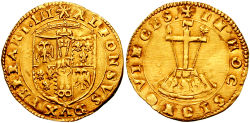
, Italy, renowned for their technical and artistic virtuosity. The ensemble was founded by Alfonso II, Duke of Ferrara
, in 1580 and was active until the court was dissolved in 1597. Giacomo Vincenti
, a music publisher, praised the women as "virtuose giovani" (young virtuosa
s), echoing the sentiments of contemporaneous diarists and commentators.
The origins of the ensemble lay in an amateur group of high-placed courtiers who performed for each other within the context of the Duke's informal musica secreta in the 1570s. The ensemble evolved into an all-female group of professional musicians, the concerto delle donne, who performed formal concerts for members of the inner circle of the court and important visitors. Their signature style of florid, highly ornamented singing brought prestige to Ferrara and inspired composers of the time.
The concerto delle donne revolutionized the role of women in professional music, and continued the tradition of the Este
court as a musical center. Word of the ladies' ensemble spread across Italy, inspiring imitations in the powerful courts of the Medici
and Orsini. The founding of the concerto delle donne was the most important event in secular Italian music in the late sixteenth century; the musical innovations established in the court were important in the development of the madrigal
, and eventually the seconda pratica
.
and caught the Duke's interest. This group, which led to the formation of the concerto delle donne, performed within the context of the Duke's musica secreta, a regular series of chamber music
concerts performed for an exclusive audience. This preliminary group was originally made up of talented but amateur members of the court: the sisters Lucrezia
and Isabella Bendidio
, Leonora Sanvitale
, and Vittoria Bentivoglio
. They were joined by bass Giulio Cesare Brancaccio
, who was specifically brought to the court in 1577 for his singing ability. The preliminary ensemble was active throughout the 1570s, and its membership solidified in 1577. Only later did professionals replace these original singers.
The Duke did not announce the creation of a professional, all-female ensemble; instead, the group infiltrated and gradually dominated the musica secreta, so that after the dismissal of Brancaccio for insubordination in 1583, no more male members of the musica secreta were hired. Even when Brancaccio was performing with the consort it was referred to as a ladies' ensemble, because women singing together was the most exciting aspect of the group. This new ensemble, the concerto delle donne, was created by Alfonso in part to amuse his young new wife, Margherita Gonzaga d'Este
(she was only fourteen when they wed in 1579), and in part to help the Duke achieve his artistic goals for the court. According to Grana, a contemporary correspondent, "Signora Machiavella [Lucrezia], Signora Isabella, and Signora Vittoria have abandoned the field, having lost the backing of Luzzaschi". The first recorded performance by the professional ladies was on November 20, 1580; by carnival
season in 1581, they were performing together regularly.
This new "consort of ladies" was viewed as an extraordinary and novel phenomenon; most witnesses did not connect the second period of the concerto delle donne with the group of ladies who sang in the musica secreta. Today, however, the earlier group is viewed as a crucial part of the creation and development of the social and vocal genre of the concerto delle donne.
, followed by Livia d'Arco
and Anna Guarini
, daughter of the prolific poet Giovanni Battista Guarini
. Giovanni wrote poems for many of the madrigals which were set for the ensemble, and choreographed scenes for the balletto delle donne. Judith Tick believes Tarquinia Molza
sang with the group, but Anthony Newcomb
says she was involved solely as an advisor and instructor. Whether Tarquinia Molza ever performed with them or not, she was ousted from any role in the group after her affair with the composer Giaches de Wert
came to light in 1589. Luzzasco Luzzaschi directed and composed music to showcase the ensemble, and accompanied them on the harpsichord
. Ippolito Fiorini
was the maestro di capella, in charge of the entire court's musical activities. In addition to his duties to the overall court, he accompanied the concerto on the lute
. Vittorio Baldini
was brought to the court as ducal music printer in 1582.
The singers of the second era of the concerto delle donne were officially ladies-in-waiting
of Duchess Margherita Gonzaga d'Este, but were hired primarily as singers. Peverara's musical abilities prompted the Duke to specifically ask his wife Margherita to bring Peverara from Mantua
as part of her retinue. The new singers played instruments, including the lute
, harp
, and viol
, but focused their energies on developing vocal virtuosity. This skill became highly prized in the mid-sixteenth century, beginning with basses like Brancaccio, but by the end of the century virtuosic bass singing went out of style, and higher voices came into vogue. The ladies' musical duties included performing with the duchess' balletto delle donne, a group of female dancers who frequently crossdressed
. Despite their upper-class background, the singers would not have been welcomed into the court's inner circle had they not been such skilled performers. D'Arco belonged to the nobility, but a minor family only. Peverara was the daughter of a wealthy merchant, and Molza came from a prominent family of artists.
 The women performed up to six hours a day, either singing their own florid repertoire from memory, sight-reading from partbook
s, or participating in the balletti as singers and dancers. Thomasin LaMay posits that the women of the concerti delle donne provided sexual favors for members of the court, but there is no evidence for this, and the circumstances of their marriages and dowries
argues against this interpretation. The women were paid salaries and received other benefits, such as dowries and apartments in the ducal palace. Peverara received 300 scudi a year and lodging in the ducal palace for herself, her husband, and her mother - as well as a dowry of 10,000 scudi upon her marriage.
Despite having married three times in the hopes of producing an heir, Alfonso II died in 1597 without issue, legitimate or otherwise. His cousin Cesare
inherited the Duchy, but the city of Ferrara, which was legally a Papal fief, was annexed to the Papal States
in 1598 through a combination of "firm diplomacy and unscrupulous pressure" by Pope Clement VIII
. The Este court had to abandon Ferrara
in disarray and the concerto delle donne was disbanded.
.jpg) The greatest musical innovation of the concerto delle donne was the multiplication of the ornamented
The greatest musical innovation of the concerto delle donne was the multiplication of the ornamented
upper voices, from one voice singing diminution
s above an instrumental accompaniment to two or three voices singing varying diminutions at once. This practice, which listeners found remarkable, was imitated by many composers, including Carlo Gesualdo
, Luca Marenzio
and Claudio Monteverdi
.
These composers wrote music either inspired by the concerto delle donne or specifically for them. Such works are characterized by a high tessitura
, a virtuosic
and florid style, and a wide range
. Lodovico Agostini
's third book of madrigal
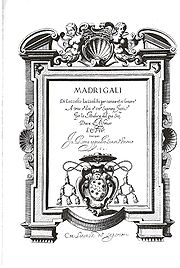
s was perhaps the first publication fully dedicated to the new singing style. Agostini dedicated songs to Guarini, Peverara, and Luzzaschi. Gesualdo wrote music for the group in 1594 while visiting Ferrara to marry the Duke's niece Leonora d’Este. De Wert's Seventh Book of Madrigals à 5 and Marenzio's First Book à 6 were the first true musical monuments to the new concerto delle donne. Monteverdi's Canzonette a tre voci was probably influenced by the "Ladies of Ferrara". Although the only works clearly intended for or inspired by the concerto delle donne were works for multiple high voices executing written-out diminutions, in practice concerts with the concerto delle donne included the older style of solo ornamented madrigals with instrumental accompaniment. Peverara was singularly lauded for her skill in this genre. Works written for the concerto delle donne were not limited to music: Torquato Tasso
and G.B. Guarini wrote poems dedicated to the ladies in the concerto, some of which were later set by composers. Tasso wrote over seventy-five poems to Peverara alone.
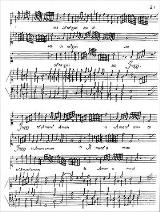
Luzzaschi's book of madrigals for one, two, and three sopranos with keyboard accompaniment, published in 1601, comprises works written throughout the 1580s. This music may have been kept back from publication in order to maintain the secrecy of Alfonso's musica secreta, and to maintain control over it. Newcomb considers this publication the exemplar of the ladies' signature musical style. In 1584, Alessandro Striggio
, responding to requests from Francesco I de' Medici, Grand Duke of Tuscany
, described the ladies and composed pieces imitating their style so that Francesco could start his own concerto delle donne. Striggio mentioned an ornamented four voice madrigal for three sopranos and a dialogue
with imitative diminutions for two sopranos. He added that he had forgotten the intabulation
for the madrigal in Mantua, and noted that the skilled singer Giulio Caccini
could play the bass part on either lute or harpsichord
. This indicates both that male singers were probably not used after Brancaccio, and that instrumental accompaniments were a common and acceptable means of filling in the counterpoint
.
The output of the ducal printer, Baldini, consisted largely of music written for the concerto delle donne, including the works of the foremost madrigalists: Luzzaschi, Gesualdo, and Alfonso Fontanelli
. His first publication for the Duke was Il lauro secco (1582), which was followed by Il lauro verde (1583), both containing music by the leading composers of Rome
and Northern Italy
. Music in honor of the concerto was printed as far away as Venice
, with Paolo Virchi
's First Book à 5, published by Giacomo Vincenti
and Ricciardo Amadino
containing the madrigal which begins SeGU'ARINAscer LAURA e prenda LARCO / Amor soave e dolce / Ch'ogni cor duro MOLCE. This capitalization is in the original, clearly spelling out the equivalent of the names Anna Guarini, Laura Peverara, Livia d'Arco, and Tarquinia Molza.
With the obvious exception of Brancaccio, all the singers in the concerto were female soprano
s. Although the music written for the concerto focused on high voices, there is no evidence that the ensemble used either castrati or falsettists
. This fact is surprising, considering that castrati were shortly to become the biggest stars of a new art form, opera
. In 1607, Monteverdi's Orfeo
featured four castrato roles out of a cast of nine, showing the new dominance of this vocal type. It also contrasts with Margherita's father's court, where Guglielmo Gonzaga actively sought out eunuch
s.
Polyphonic arrangements called for the women to sing diminutions (melodic divisions of longer notes) and other ornaments in consort. Diminutions were traditionally improvised in performance. However, to coordinate their voices, they transcribed and rehearsed the music in advance, transforming these improvisations into highly developed musical forms that composers would emulate. The singers may have used the more traditional practice in their solo repertoire, performing ornaments extemporaneously. Specific ornaments used by the concerto delle donne, mentioned in a source from 1581, were such popular sixteenth-century devices as passaggi (division of a long note into many shorter notes, usually stepwise
), cadenze
(decoration of the penultimate note, sometimes quite elaborate), and tirate (rapid scales). Accenti (connection of two longer notes, using dotted rhythms), a staple of early Baroque music
, are absent from the list. In 1592 Caccini claimed that Alfonso II asked him to teach his ladies the new accenti and passaggi styles.
 There are two separate styles of madrigal
s written for and inspired by the concerto delle donne. The first is the "luxuriant" style of the 1580s. The second is music in the style of the seconda pratica
, written in the 1590s. Luzzaschi wrote music in both of these styles. The style of the earlier period, as exemplified in the works of Luzzaschi, involves the use of madrigal texts written by poets within the Ferrarese sphere, such as Tasso and G.B. Guarini. These poems tend to be short and witty with single sections. Musically, Luzzaschi's works are highly sectionalized and based on melodic themes, rather than harmonic
structures. Luzzaschi lessens the sectionalizing effect of his compositional techniques by weakening cadences
. His tendency to reiterate melodies in different voices, including the bass voice, leads to tonal creations which are sometimes bewildering. These aspects make Luzzaschi's music much more polyphonic than Monteverdi's later compositions, and thus more conservative; however, Luzzaschi's use of jarring melodic leaps and harmonic dissonance
are individualistic. These dissonances, which contrast sharply with the careful treatment of dissonance during most of the 16th century, is closely connected with the ornamented polyphonic madrigals of the concerto delle donne. In Giovanni Artusi
's socratic
dialogue, the character defending Monteverdi connects haphazard treatment of dissonance with ornamental singing.
The elite, hand-selected audience members favored with admission to performances by the concerto delle donne demanded diversions and entertainment beyond the pleasures of beautiful music alone. During the concerts, members of the concertos audience would sometimes play cards. Orazio Urbani, ambassador of the Grand Duke of Tuscany, having waited several years to see the concerto, complained that he was forced not only to play cards, distracting him from the performance, but also simultaneously admire and praise the women's music to their patron Alfonso. After at least one concert, to continue the entertainment, a dwarf
couple danced. Alfonso was not as interested in these peripheral entertainments, and in one instance excused himself from the party to go sit under a tree to listen to the ladies, and follow along with the madrigal texts and musical score
s, including embellishments, which were made available to listeners.
Despite the dissolution of the court in 1597, the musical style which was inspired by the concerto delle donne spread throughout Europe, and remained prominent for almost fifty years. The concerto delle donne was so influential and often imitated that it became a cliché of northern Italian courts. The concerto brought Alfonso and his court international prestige, as the ladies' reputation spread throughout Italy and southern Germany. It functioned as a powerful tool of propaganda
, projecting an image of strength and affluence.
Having seen the concerto delle donne in Ferrara, Caccini created a rival group made up of his family and a pupil. This ensemble was sponsored by the Medici
, and traveled as far abroad as Paris
to perform for Marie de' Medici
. Francesca Caccini
had much success composing and singing in the style of the concerto delle donne. Beginning in 1585, rival groups were created in Florence
by the Medici, Rome
by the Orsini, and Mantua
by the Gonzaga
. There was even a rival group in Ferrara based in the Castello Estense, the very palace where the concerto delle donne performed. This group was formed by Alfonso's sister Lucrezia d'Este
, Duchess of Urbino
. She had lived at the Este court since 1576, and shortly after Margherita's marriage to Alfonso in 1579, Alfonso and his henchmen killed Lucrezia's lover. Lucrezia was unhappy about being replaced as the matron of the house by Margherita, and upset by the murder of her lover, leading to her desire to be separate from the rest of her family during her evening entertainments.
Barbara Strozzi
was among the last composers and performers in this style, which by the mid-seventeenth century was considered archaic.
Consort of instruments
A consort of instruments was a phrase used in England during the sixteenth and seventeenth centuries to indicate an instrumental ensemble. These could be of the same or a variety of instruments. Consort music enjoyed considerable popularity at court and in households of the wealthy in the...
of ladies) was a group of professional female singers in the late Renaissance court
Italian Renaissance
The Italian Renaissance began the opening phase of the Renaissance, a period of great cultural change and achievement in Europe that spanned the period from the end of the 13th century to about 1600, marking the transition between Medieval and Early Modern Europe...
of Ferrara
Ferrara
Ferrara is a city and comune in Emilia-Romagna, northern Italy, capital city of the Province of Ferrara. It is situated 50 km north-northeast of Bologna, on the Po di Volano, a branch channel of the main stream of the Po River, located 5 km north...
, Italy, renowned for their technical and artistic virtuosity. The ensemble was founded by Alfonso II, Duke of Ferrara
Alfonso II, Duke of Ferrara
Alfonso II d'Este was duke of Ferrara from 1559 to 1597. He was a member of the house of Este.-Biography:...
, in 1580 and was active until the court was dissolved in 1597. Giacomo Vincenti
Giacomo Vincenti
Giacomo Vincenti was an Italian bookseller and music printer from Venice. He also spelled his name Vincenci and Vincenzi. He started printing in 1583. His partner was Ricciardo Amadino, and between 1583 and 1586 they printed about twenty books a year, mostly editions of music...
, a music publisher, praised the women as "virtuose giovani" (young virtuosa
Virtuoso
A virtuoso is an individual who possesses outstanding technical ability in the fine arts, at singing or playing a musical instrument. The plural form is either virtuosi or the Anglicisation, virtuosos, and the feminine form sometimes used is virtuosa...
s), echoing the sentiments of contemporaneous diarists and commentators.
The origins of the ensemble lay in an amateur group of high-placed courtiers who performed for each other within the context of the Duke's informal musica secreta in the 1570s. The ensemble evolved into an all-female group of professional musicians, the concerto delle donne, who performed formal concerts for members of the inner circle of the court and important visitors. Their signature style of florid, highly ornamented singing brought prestige to Ferrara and inspired composers of the time.
The concerto delle donne revolutionized the role of women in professional music, and continued the tradition of the Este
Este
The House of Este is a European princely dynasty. It is split into two branches; the elder is known as the House of Welf-Este or House of Welf historically rendered in English, Guelf or Guelph...
court as a musical center. Word of the ladies' ensemble spread across Italy, inspiring imitations in the powerful courts of the Medici
Medici
The House of Medici or Famiglia de' Medici was a political dynasty, banking family and later royal house that first began to gather prominence under Cosimo de' Medici in the Republic of Florence during the late 14th century. The family originated in the Mugello region of the Tuscan countryside,...
and Orsini. The founding of the concerto delle donne was the most important event in secular Italian music in the late sixteenth century; the musical innovations established in the court were important in the development of the madrigal
Madrigal (music)
A madrigal is a secular vocal music composition, usually a partsong, of the Renaissance and early Baroque eras. Traditionally, polyphonic madrigals are unaccompanied; the number of voices varies from two to eight, and most frequently from three to six....
, and eventually the seconda pratica
Seconda pratica
Seconda prattica, literally "second practice", is the counterpart to prima pratica and is more commonly referred to as Stile moderno. The term "Seconda prattica" was coined by Claudio Monteverdi to distance his music from that of e.g...
.
Formation
At the court in Ferrara, a collection of ladies skilled in music inspired the composer Luzzasco LuzzaschiLuzzasco Luzzaschi
Luzzasco Luzzaschi was an Italian composer, organist, and teacher of the late Renaissance. He was born and died in Ferrara, and despite evidence of travels to Rome it is assumed that Luzzaschi spent the majority of his life in his native city.As a pupil of Cipriano de Rore, Luzzaschi developed...
and caught the Duke's interest. This group, which led to the formation of the concerto delle donne, performed within the context of the Duke's musica secreta, a regular series of chamber music
Chamber music
Chamber music is a form of classical music, written for a small group of instruments which traditionally could be accommodated in a palace chamber. Most broadly, it includes any art music that is performed by a small number of performers with one performer to a part...
concerts performed for an exclusive audience. This preliminary group was originally made up of talented but amateur members of the court: the sisters Lucrezia
Lucrezia Bendidio
Lucrezia Bendidio was an Italian singer and noblewoman from Ferrara. She started as a lady-in-waiting for Leonora d'Este in 1561. Many poets wrote of her great skill as a singer, including Torquato Tasso and Giovanni Battista Pigna...
and Isabella Bendidio
Isabella Bendidio
Isabella Bendidio was a Ferrarese noblewoman who, along with her sister Lucrezia Bendidio, sang in the first incarnation of the concerto delle donne as part of the court's musica secreta...
, Leonora Sanvitale
Leonora Sanvitale
Leonora Sanvitale was a noblewoman and singer at the Este court at Ferrara, and along with her stepmother Barbara Sanseverino, was among the most "brilliant" noblewomen at the court. She joined the court in 1576 when she married Giulio Tiene, Count of Scandiano. Before this she had been at the...
, and Vittoria Bentivoglio
Vittoria Bentivoglio
Vittoria Bentivoglio was a singer in the 16th century Ferrarese court of Alfonso II d'Este and a member of the first period of the court's concerto delle donne. She was born into the noble Cybò family, and later married a member of the renowned Bentivoglio family. She remained a prominent member of...
. They were joined by bass Giulio Cesare Brancaccio
Giulio Cesare Brancaccio
Giulio Cesare Brancaccio was a courtier, cavalier, actor, writer, and singer in a number of northern Italian courts throughout the sixteenth century, most notably the court at Ferrara.He was born in Naples to a noble family...
, who was specifically brought to the court in 1577 for his singing ability. The preliminary ensemble was active throughout the 1570s, and its membership solidified in 1577. Only later did professionals replace these original singers.
The Duke did not announce the creation of a professional, all-female ensemble; instead, the group infiltrated and gradually dominated the musica secreta, so that after the dismissal of Brancaccio for insubordination in 1583, no more male members of the musica secreta were hired. Even when Brancaccio was performing with the consort it was referred to as a ladies' ensemble, because women singing together was the most exciting aspect of the group. This new ensemble, the concerto delle donne, was created by Alfonso in part to amuse his young new wife, Margherita Gonzaga d'Este
Margherita Gonzaga d'Este
Margherita Gonzaga d'Este, Duchess of Ferrara was an Italian noblewoman, the daughter of William I, Duke of Mantua and Eleonora of Austria, and the sister of Vincent I, Duke of Mantua and Anna Caterina Gonzaga. She was the wife of Alfonso II d'Este, Duke of Ferrara and Modena, whom she married...
(she was only fourteen when they wed in 1579), and in part to help the Duke achieve his artistic goals for the court. According to Grana, a contemporary correspondent, "Signora Machiavella [Lucrezia], Signora Isabella, and Signora Vittoria have abandoned the field, having lost the backing of Luzzaschi". The first recorded performance by the professional ladies was on November 20, 1580; by carnival
Carnival
Carnaval is a festive season which occurs immediately before Lent; the main events are usually during February. Carnaval typically involves a public celebration or parade combining some elements of a circus, mask and public street party...
season in 1581, they were performing together regularly.
This new "consort of ladies" was viewed as an extraordinary and novel phenomenon; most witnesses did not connect the second period of the concerto delle donne with the group of ladies who sang in the musica secreta. Today, however, the earlier group is viewed as a crucial part of the creation and development of the social and vocal genre of the concerto delle donne.
Roster and duties
The most prominent member of the new ensemble was Laura PeveraraLaura Peverara
Laura Peverara or Peperara was an Italian virtuoso singer who was also a harpist and dancer; born and raised in Mantua. Her father, Vincenzo, was a merchant, an intellectual who tutored princes, leading to Laura being brought up in courtly society...
, followed by Livia d'Arco
Livia d'Arco
Livia d'Arco was an Italian singer in the court of Alfonso II d'Este in Ferrara. She was sent there with the household of Margherita Gonzaga d'Este at the time of Margherita's marriage to Alfonso in 1579, and was a young woman at the time, around fifteen...
and Anna Guarini
Anna Guarini
Anna Guarini, Contessa Trotti, was an Italian virtuoso singer of the late Renaissance. She was one of the most renowned singers of the age, and was one of the four concerto di donne at the Ferrara court of the d'Este family, for whom many composers wrote in a progressive style.- Life and murder...
, daughter of the prolific poet Giovanni Battista Guarini
Giovanni Battista Guarini
Giovanni Battista Guarini was an Italian poet, dramatist, and diplomat.- Life :He was born in Ferrara, and spent his early life both in Padua and Ferrara, entering the service of Alfonso II d'Este, Duke of Ferrara, in 1567...
. Giovanni wrote poems for many of the madrigals which were set for the ensemble, and choreographed scenes for the balletto delle donne. Judith Tick believes Tarquinia Molza
Tarquinia Molza
Tarquinia Molza was an Italian singer and poet. She was considered a great virtuosa and many artistic works were dedicated to her; Francesco Patrizi wrote about her singing in his treatise L'amorosa filosofia, and she was perhaps the first singer to have a published biography dedicated to her...
sang with the group, but Anthony Newcomb
Anthony Newcomb
Anthony Newcomb is an American musicologist. He was born in New York and studied at the University of California, Berkeley where he graduated with a Bachelor of Arts in 1962. He then studied with Gustav Leonhardt in Holland while on a Fulbright Scholarship...
says she was involved solely as an advisor and instructor. Whether Tarquinia Molza ever performed with them or not, she was ousted from any role in the group after her affair with the composer Giaches de Wert
Giaches de Wert
Giaches de Wert was a Franco-Flemish composer of the late Renaissance, active in Italy. Intimately connected with the progressive musical center of Ferrara, he was one of the leaders in developing the style of the late Renaissance madrigal...
came to light in 1589. Luzzasco Luzzaschi directed and composed music to showcase the ensemble, and accompanied them on the harpsichord
Harpsichord
A harpsichord is a musical instrument played by means of a keyboard. It produces sound by plucking a string when a key is pressed.In the narrow sense, "harpsichord" designates only the large wing-shaped instruments in which the strings are perpendicular to the keyboard...
. Ippolito Fiorini
Ippolito Fiorini
Ippolito Fiorini was a composer and lutenist, and the maestro di capella at the court of Alfonso II d'Este in Ferrara during its entire existence...
was the maestro di capella, in charge of the entire court's musical activities. In addition to his duties to the overall court, he accompanied the concerto on the lute
Lute
Lute can refer generally to any plucked string instrument with a neck and a deep round back, or more specifically to an instrument from the family of European lutes....
. Vittorio Baldini
Vittorio Baldini
Vittorio Baldini was an Italian printer and engraver. He started publishing in Venice, where he was born, and later moved to Ferrara, joining the court of Duke Alfonso II d'Este in mid-to-late 1582, where he was the official ducal music printer...
was brought to the court as ducal music printer in 1582.
The singers of the second era of the concerto delle donne were officially ladies-in-waiting
Lady-in-waiting
A lady-in-waiting is a female personal assistant at a royal court, attending on a queen, a princess, or a high-ranking noblewoman. Historically, in Europe a lady-in-waiting was often a noblewoman from a family highly thought of in good society, but was of lower rank than the woman on whom she...
of Duchess Margherita Gonzaga d'Este, but were hired primarily as singers. Peverara's musical abilities prompted the Duke to specifically ask his wife Margherita to bring Peverara from Mantua
Mantua
Mantua is a city and comune in Lombardy, Italy and capital of the province of the same name. Mantua's historic power and influence under the Gonzaga family, made it one of the main artistic, cultural and notably musical hubs of Northern Italy and the country as a whole...
as part of her retinue. The new singers played instruments, including the lute
Lute
Lute can refer generally to any plucked string instrument with a neck and a deep round back, or more specifically to an instrument from the family of European lutes....
, harp
Harp
The harp is a multi-stringed instrument which has the plane of its strings positioned perpendicularly to the soundboard. Organologically, it is in the general category of chordophones and has its own sub category . All harps have a neck, resonator and strings...
, and viol
Viol
The viol is any one of a family of bowed, fretted and stringed musical instruments developed in the mid-late 15th century and used primarily in the Renaissance and Baroque periods. The family is related to and descends primarily from the Renaissance vihuela, a plucked instrument that preceded the...
, but focused their energies on developing vocal virtuosity. This skill became highly prized in the mid-sixteenth century, beginning with basses like Brancaccio, but by the end of the century virtuosic bass singing went out of style, and higher voices came into vogue. The ladies' musical duties included performing with the duchess' balletto delle donne, a group of female dancers who frequently crossdressed
Cross-dressing
Cross-dressing is the wearing of clothing and other accoutrement commonly associated with a gender within a particular society that is seen as different than the one usually presented by the dresser...
. Despite their upper-class background, the singers would not have been welcomed into the court's inner circle had they not been such skilled performers. D'Arco belonged to the nobility, but a minor family only. Peverara was the daughter of a wealthy merchant, and Molza came from a prominent family of artists.
Partbook
A partbook is a format for printing or copying sheet music in which each book contains the part for a single voice or instrument, especially popular during the renaissance and baroque. This is in contrast to the large choirbook which could be shared by an entire choir, and appears to have been a...
s, or participating in the balletti as singers and dancers. Thomasin LaMay posits that the women of the concerti delle donne provided sexual favors for members of the court, but there is no evidence for this, and the circumstances of their marriages and dowries
Dowry
A dowry is the money, goods, or estate that a woman brings forth to the marriage. It contrasts with bride price, which is paid to the bride's parents, and dower, which is property settled on the bride herself by the groom at the time of marriage. The same culture may simultaneously practice both...
argues against this interpretation. The women were paid salaries and received other benefits, such as dowries and apartments in the ducal palace. Peverara received 300 scudi a year and lodging in the ducal palace for herself, her husband, and her mother - as well as a dowry of 10,000 scudi upon her marriage.
Despite having married three times in the hopes of producing an heir, Alfonso II died in 1597 without issue, legitimate or otherwise. His cousin Cesare
Cesare d'Este
Cesare d'Este was Duke of Modena and Reggio from 1597 until his death. During his reign, in 1598, the House of Este lost the Duchy of Ferrara.-Biography:...
inherited the Duchy, but the city of Ferrara, which was legally a Papal fief, was annexed to the Papal States
Papal States
The Papal State, State of the Church, or Pontifical States were among the major historical states of Italy from roughly the 6th century until the Italian peninsula was unified in 1861 by the Kingdom of Piedmont-Sardinia .The Papal States comprised territories under...
in 1598 through a combination of "firm diplomacy and unscrupulous pressure" by Pope Clement VIII
Pope Clement VIII
Pope Clement VIII , born Ippolito Aldobrandini, was Pope from 30 January 1592 to 3 March 1605.-Cardinal:...
. The Este court had to abandon Ferrara
Ferrara
Ferrara is a city and comune in Emilia-Romagna, northern Italy, capital city of the Province of Ferrara. It is situated 50 km north-northeast of Bologna, on the Po di Volano, a branch channel of the main stream of the Po River, located 5 km north...
in disarray and the concerto delle donne was disbanded.
Music
Ornament (music)
In music, ornaments or embellishments are musical flourishes that are not necessary to carry the overall line of the melody , but serve instead to decorate or "ornament" that line. Many ornaments are performed as "fast notes" around a central note...
upper voices, from one voice singing diminution
Diminution
In Western music and music theory, diminution has four distinct meanings. Diminution may be a form of embellishment in which a long note is divided into a series of shorter, usually melodic, values...
s above an instrumental accompaniment to two or three voices singing varying diminutions at once. This practice, which listeners found remarkable, was imitated by many composers, including Carlo Gesualdo
Carlo Gesualdo
Carlo Gesualdo, known as Gesualdo di Venosa or Gesualdo da Venosa , Prince of Venosa and Count of Conza, was an Italian nobleman, lutenist, composer, and murderer....
, Luca Marenzio
Luca Marenzio
Luca Marenzio was an Italian composer and singer of the late Renaissance. He was one of the most renowned composers of madrigals, and wrote some of the most famous examples of the form in its late stage of development, prior to its early Baroque transformation by Monteverdi...
and Claudio Monteverdi
Claudio Monteverdi
Claudio Giovanni Antonio Monteverdi – 29 November 1643) was an Italian composer, gambist, and singer.Monteverdi's work, often regarded as revolutionary, marked the transition from the Renaissance style of music to that of the Baroque period. He developed two individual styles of composition – the...
.
These composers wrote music either inspired by the concerto delle donne or specifically for them. Such works are characterized by a high tessitura
Tessitura
In music, the term tessitura generally describes the most musically acceptable and comfortable range for a given singer or, less frequently, musical instrument; the range in which a given type of voice presents its best-sounding texture or timbre...
, a virtuosic
Virtuoso
A virtuoso is an individual who possesses outstanding technical ability in the fine arts, at singing or playing a musical instrument. The plural form is either virtuosi or the Anglicisation, virtuosos, and the feminine form sometimes used is virtuosa...
and florid style, and a wide range
Vocal range
Vocal range is the measure of the breadth of pitches that a human voice can phonate. Although the study of vocal range has little practical application in terms of speech, it is a topic of study within linguistics, phonetics, and speech and language pathology, particularly in relation to the study...
. Lodovico Agostini
Lodovico Agostini
Lodovico Agostini was an Italian composer, singer, priest, and scholar of the late Renaissance. He was a close associate of the Ferrara Estense court, and one of the most skilled representatives of the progressive secular style which developed there at the end of the 16th century.- Life :He was...
's third book of madrigal
Madrigal (music)
A madrigal is a secular vocal music composition, usually a partsong, of the Renaissance and early Baroque eras. Traditionally, polyphonic madrigals are unaccompanied; the number of voices varies from two to eight, and most frequently from three to six....
s was perhaps the first publication fully dedicated to the new singing style. Agostini dedicated songs to Guarini, Peverara, and Luzzaschi. Gesualdo wrote music for the group in 1594 while visiting Ferrara to marry the Duke's niece Leonora d’Este. De Wert's Seventh Book of Madrigals à 5 and Marenzio's First Book à 6 were the first true musical monuments to the new concerto delle donne. Monteverdi's Canzonette a tre voci was probably influenced by the "Ladies of Ferrara". Although the only works clearly intended for or inspired by the concerto delle donne were works for multiple high voices executing written-out diminutions, in practice concerts with the concerto delle donne included the older style of solo ornamented madrigals with instrumental accompaniment. Peverara was singularly lauded for her skill in this genre. Works written for the concerto delle donne were not limited to music: Torquato Tasso
Torquato Tasso
Torquato Tasso was an Italian poet of the 16th century, best known for his poem La Gerusalemme liberata , in which he depicts a highly imaginative version of the combats between Christians and Muslims at the end of the First Crusade, during the siege of Jerusalem...
and G.B. Guarini wrote poems dedicated to the ladies in the concerto, some of which were later set by composers. Tasso wrote over seventy-five poems to Peverara alone.
Luzzaschi's book of madrigals for one, two, and three sopranos with keyboard accompaniment, published in 1601, comprises works written throughout the 1580s. This music may have been kept back from publication in order to maintain the secrecy of Alfonso's musica secreta, and to maintain control over it. Newcomb considers this publication the exemplar of the ladies' signature musical style. In 1584, Alessandro Striggio
Alessandro Striggio
Alessandro Striggio was an Italian composer, instrumentalist and diplomat of the Renaissance. He composed numerous madrigals as well as dramatic music, and by combining the two, became the inventor of madrigal comedy...
, responding to requests from Francesco I de' Medici, Grand Duke of Tuscany
Francesco I de' Medici, Grand Duke of Tuscany
Francesco I de' Medici, Grand Duke of Tuscany was the second Grand Duke of Tuscany, ruling from 1574 to 1587.- Biography :...
, described the ladies and composed pieces imitating their style so that Francesco could start his own concerto delle donne. Striggio mentioned an ornamented four voice madrigal for three sopranos and a dialogue
Dialogue
Dialogue is a literary and theatrical form consisting of a written or spoken conversational exchange between two or more people....
with imitative diminutions for two sopranos. He added that he had forgotten the intabulation
Intabulation
Intabulation, from the Italian word intavolatura, refers to an arrangement of a vocal or ensemble piece for keyboard, lute, or other plucked string instrument, written in tablature. It was a common practice in 14th-16th century keyboard and lute music...
for the madrigal in Mantua, and noted that the skilled singer Giulio Caccini
Giulio Caccini
Giulio Caccini , also known as Giulio Romano, was an Italian composer, teacher, singer, instrumentalist and writer of the very late Renaissance and early Baroque eras. He was one of the founders of the genre of opera, and one of the single most influential creators of the new Baroque style...
could play the bass part on either lute or harpsichord
Harpsichord
A harpsichord is a musical instrument played by means of a keyboard. It produces sound by plucking a string when a key is pressed.In the narrow sense, "harpsichord" designates only the large wing-shaped instruments in which the strings are perpendicular to the keyboard...
. This indicates both that male singers were probably not used after Brancaccio, and that instrumental accompaniments were a common and acceptable means of filling in the counterpoint
Counterpoint
In music, counterpoint is the relationship between two or more voices that are independent in contour and rhythm and are harmonically interdependent . It has been most commonly identified in classical music, developing strongly during the Renaissance and in much of the common practice period,...
.
The output of the ducal printer, Baldini, consisted largely of music written for the concerto delle donne, including the works of the foremost madrigalists: Luzzaschi, Gesualdo, and Alfonso Fontanelli
Alfonso Fontanelli
Alfonso Fontanelli was an Italian composer, writer, diplomat, courtier, and nobleman of the late Renaissance...
. His first publication for the Duke was Il lauro secco (1582), which was followed by Il lauro verde (1583), both containing music by the leading composers of Rome
Rome
Rome is the capital of Italy and the country's largest and most populated city and comune, with over 2.7 million residents in . The city is located in the central-western portion of the Italian Peninsula, on the Tiber River within the Lazio region of Italy.Rome's history spans two and a half...
and Northern Italy
Northern Italy
Northern Italy is a wide cultural, historical and geographical definition, without any administrative usage, used to indicate the northern part of the Italian state, also referred as Settentrione or Alta Italia...
. Music in honor of the concerto was printed as far away as Venice
Venice
Venice is a city in northern Italy which is renowned for the beauty of its setting, its architecture and its artworks. It is the capital of the Veneto region...
, with Paolo Virchi
Paolo Virchi
Paolo Virchi was an Italian composer and instrumentalist. He was born in Brescia, and his father was Girolamo Virchi, an instrument maker. He joined the court of Alfonso II d'Este between 1579 and 1580. On the court rolls he is referred to as a singer, but in his publications he refers to himself...
's First Book à 5, published by Giacomo Vincenti
Giacomo Vincenti
Giacomo Vincenti was an Italian bookseller and music printer from Venice. He also spelled his name Vincenci and Vincenzi. He started printing in 1583. His partner was Ricciardo Amadino, and between 1583 and 1586 they printed about twenty books a year, mostly editions of music...
and Ricciardo Amadino
Ricciardo Amadino
Ricciardo Amadino was a Venetian printer. He briefly attempted to publish music on his own in 1579, but was unsuccessful. He joined with Giacomo Vincenti, with whom he published over 80 books between 1583 and 1586. Many of these were re-prints of popular madrigal books, but some were first printings...
containing the madrigal which begins SeGU'ARINAscer LAURA e prenda LARCO / Amor soave e dolce / Ch'ogni cor duro MOLCE. This capitalization is in the original, clearly spelling out the equivalent of the names Anna Guarini, Laura Peverara, Livia d'Arco, and Tarquinia Molza.
With the obvious exception of Brancaccio, all the singers in the concerto were female soprano
Soprano
A soprano is a voice type with a vocal range from approximately middle C to "high A" in choral music, or to "soprano C" or higher in operatic music. In four-part chorale style harmony, the soprano takes the highest part, which usually encompasses the melody...
s. Although the music written for the concerto focused on high voices, there is no evidence that the ensemble used either castrati or falsettists
Falsetto
Falsetto is the vocal register occupying the frequency range just above the modal voice register and overlapping with it by approximately one octave. It is produced by the vibration of the ligamentous edges of the vocal folds, in whole or in part...
. This fact is surprising, considering that castrati were shortly to become the biggest stars of a new art form, opera
Opera
Opera is an art form in which singers and musicians perform a dramatic work combining text and musical score, usually in a theatrical setting. Opera incorporates many of the elements of spoken theatre, such as acting, scenery, and costumes and sometimes includes dance...
. In 1607, Monteverdi's Orfeo
Orfeo
L'Orfeo , sometimes called L'Orfeo, favola in musica, is an early Baroque opera by Claudio Monteverdi, with a libretto by Alessandro Striggio. It is based on the Greek legend of Orpheus, and tells the story of his descent to Hades and his fruitless attempt to bring his dead bride Eurydice back to...
featured four castrato roles out of a cast of nine, showing the new dominance of this vocal type. It also contrasts with Margherita's father's court, where Guglielmo Gonzaga actively sought out eunuch
Eunuch
A eunuch is a person born male most commonly castrated, typically early enough in his life for this change to have major hormonal consequences...
s.
Polyphonic arrangements called for the women to sing diminutions (melodic divisions of longer notes) and other ornaments in consort. Diminutions were traditionally improvised in performance. However, to coordinate their voices, they transcribed and rehearsed the music in advance, transforming these improvisations into highly developed musical forms that composers would emulate. The singers may have used the more traditional practice in their solo repertoire, performing ornaments extemporaneously. Specific ornaments used by the concerto delle donne, mentioned in a source from 1581, were such popular sixteenth-century devices as passaggi (division of a long note into many shorter notes, usually stepwise
Steps and skips
In music, a step, or conjunct motion, is a linear or successive interval between two pitches which are consecutive scale degrees. Any larger interval is called a skip , or disjunct motion...
), cadenze
Cadenza
In music, a cadenza is, generically, an improvised or written-out ornamental passage played or sung by a soloist or soloists, usually in a "free" rhythmic style, and often allowing for virtuosic display....
(decoration of the penultimate note, sometimes quite elaborate), and tirate (rapid scales). Accenti (connection of two longer notes, using dotted rhythms), a staple of early Baroque music
Baroque music
Baroque music describes a style of Western Classical music approximately extending from 1600 to 1760. This era follows the Renaissance and was followed in turn by the Classical era...
, are absent from the list. In 1592 Caccini claimed that Alfonso II asked him to teach his ladies the new accenti and passaggi styles.
Styles
Madrigal (music)
A madrigal is a secular vocal music composition, usually a partsong, of the Renaissance and early Baroque eras. Traditionally, polyphonic madrigals are unaccompanied; the number of voices varies from two to eight, and most frequently from three to six....
s written for and inspired by the concerto delle donne. The first is the "luxuriant" style of the 1580s. The second is music in the style of the seconda pratica
Seconda pratica
Seconda prattica, literally "second practice", is the counterpart to prima pratica and is more commonly referred to as Stile moderno. The term "Seconda prattica" was coined by Claudio Monteverdi to distance his music from that of e.g...
, written in the 1590s. Luzzaschi wrote music in both of these styles. The style of the earlier period, as exemplified in the works of Luzzaschi, involves the use of madrigal texts written by poets within the Ferrarese sphere, such as Tasso and G.B. Guarini. These poems tend to be short and witty with single sections. Musically, Luzzaschi's works are highly sectionalized and based on melodic themes, rather than harmonic
Harmonic
A harmonic of a wave is a component frequency of the signal that is an integer multiple of the fundamental frequency, i.e. if the fundamental frequency is f, the harmonics have frequencies 2f, 3f, 4f, . . . etc. The harmonics have the property that they are all periodic at the fundamental...
structures. Luzzaschi lessens the sectionalizing effect of his compositional techniques by weakening cadences
Cadence (music)
In Western musical theory, a cadence is, "a melodic or harmonic configuration that creates a sense of repose or resolution [finality or pause]." A harmonic cadence is a progression of two chords that concludes a phrase, section, or piece of music...
. His tendency to reiterate melodies in different voices, including the bass voice, leads to tonal creations which are sometimes bewildering. These aspects make Luzzaschi's music much more polyphonic than Monteverdi's later compositions, and thus more conservative; however, Luzzaschi's use of jarring melodic leaps and harmonic dissonance
Consonance and dissonance
In music, a consonance is a harmony, chord, or interval considered stable, as opposed to a dissonance , which is considered to be unstable...
are individualistic. These dissonances, which contrast sharply with the careful treatment of dissonance during most of the 16th century, is closely connected with the ornamented polyphonic madrigals of the concerto delle donne. In Giovanni Artusi
Giovanni Artusi
Giovanni Maria Artusi was an Italian theorist, composer, and writer.Artusi was one of the most famous reactionaries in musical history, fiercely condemning the new style developing around 1600, the innovations of which defined the early Baroque era...
's socratic
Socratic method
The Socratic method , named after the classical Greek philosopher Socrates, is a form of inquiry and debate between individuals with opposing viewpoints based on asking and answering questions to stimulate critical thinking and to illuminate ideas...
dialogue, the character defending Monteverdi connects haphazard treatment of dissonance with ornamental singing.
Performance
The concerto delle donne transformed the musica secreta. In the past, members of the audience would perform, and performers would become audience members. During the ascendancy of the concerto delle donne the roles within the musica secreta became fixed, as did the roster of those who performed for the Duke's pleasure every night.The elite, hand-selected audience members favored with admission to performances by the concerto delle donne demanded diversions and entertainment beyond the pleasures of beautiful music alone. During the concerts, members of the concertos audience would sometimes play cards. Orazio Urbani, ambassador of the Grand Duke of Tuscany, having waited several years to see the concerto, complained that he was forced not only to play cards, distracting him from the performance, but also simultaneously admire and praise the women's music to their patron Alfonso. After at least one concert, to continue the entertainment, a dwarf
Dwarfism
Dwarfism is short stature resulting from a medical condition. It is sometimes defined as an adult height of less than 4 feet 10 inches , although this definition is problematic because short stature in itself is not a disorder....
couple danced. Alfonso was not as interested in these peripheral entertainments, and in one instance excused himself from the party to go sit under a tree to listen to the ladies, and follow along with the madrigal texts and musical score
Sheet music
Sheet music is a hand-written or printed form of music notation that uses modern musical symbols; like its analogs—books, pamphlets, etc.—the medium of sheet music typically is paper , although the access to musical notation in recent years includes also presentation on computer screens...
s, including embellishments, which were made available to listeners.
Influence
The concerto delle donne was a revolutionary musical establishment that helped effect a shift in women's role in music; its success took women from obscurity to "the apex of the profession". Women were openly brought to court to train as professional musicians, and by 1600, a woman could have a viable career as a musician, independent of her husband or father. New women's ensembles inspired by the concerto delle donne resulted in more positions for women as professional singers and more music for them to perform.Despite the dissolution of the court in 1597, the musical style which was inspired by the concerto delle donne spread throughout Europe, and remained prominent for almost fifty years. The concerto delle donne was so influential and often imitated that it became a cliché of northern Italian courts. The concerto brought Alfonso and his court international prestige, as the ladies' reputation spread throughout Italy and southern Germany. It functioned as a powerful tool of propaganda
Propaganda
Propaganda is a form of communication that is aimed at influencing the attitude of a community toward some cause or position so as to benefit oneself or one's group....
, projecting an image of strength and affluence.
Having seen the concerto delle donne in Ferrara, Caccini created a rival group made up of his family and a pupil. This ensemble was sponsored by the Medici
Medici
The House of Medici or Famiglia de' Medici was a political dynasty, banking family and later royal house that first began to gather prominence under Cosimo de' Medici in the Republic of Florence during the late 14th century. The family originated in the Mugello region of the Tuscan countryside,...
, and traveled as far abroad as Paris
Paris
Paris is the capital and largest city in France, situated on the river Seine, in northern France, at the heart of the Île-de-France region...
to perform for Marie de' Medici
Marie de' Medici
Marie de Médicis , Italian Maria de' Medici, was queen consort of France, as the second wife of King Henry IV of France, of the House of Bourbon. She herself was a member of the wealthy and powerful House of Medici...
. Francesca Caccini
Francesca Caccini
Francesca Caccini was an Italian composer, singer, lutenist, poet, and music teacher of the early Baroque era. She was the daughter of Giulio Caccini, and was one of the best-known and most influential female European composers between Hildegard of Bingen in the 12th century and the 19th century...
had much success composing and singing in the style of the concerto delle donne. Beginning in 1585, rival groups were created in Florence
Florence
Florence is the capital city of the Italian region of Tuscany and of the province of Florence. It is the most populous city in Tuscany, with approximately 370,000 inhabitants, expanding to over 1.5 million in the metropolitan area....
by the Medici, Rome
Rome
Rome is the capital of Italy and the country's largest and most populated city and comune, with over 2.7 million residents in . The city is located in the central-western portion of the Italian Peninsula, on the Tiber River within the Lazio region of Italy.Rome's history spans two and a half...
by the Orsini, and Mantua
Mantua
Mantua is a city and comune in Lombardy, Italy and capital of the province of the same name. Mantua's historic power and influence under the Gonzaga family, made it one of the main artistic, cultural and notably musical hubs of Northern Italy and the country as a whole...
by the Gonzaga
House of Gonzaga
The Gonzaga family ruled Mantua in Northern Italy from 1328 to 1708.-History:In 1433, Gianfrancesco I assumed the title of Marquis of Mantua, and in 1530 Federico II received the title of Duke of Mantua. In 1531, the family acquired the Duchy of Monferrato through marriage...
. There was even a rival group in Ferrara based in the Castello Estense, the very palace where the concerto delle donne performed. This group was formed by Alfonso's sister Lucrezia d'Este
Lucrezia d'Este
*Lucrezia d'Este, born ca 1477. daughter of Ercole I d'Este. Married Annibale II Bentivoglio .*Lucrezia d'Este , daughter of Ercole II d'Este....
, Duchess of Urbino
Urbino
Urbino is a walled city in the Marche region of Italy, south-west of Pesaro, a World Heritage Site notable for a remarkable historical legacy of independent Renaissance culture, especially under the patronage of Federico da Montefeltro, duke of Urbino from 1444 to 1482...
. She had lived at the Este court since 1576, and shortly after Margherita's marriage to Alfonso in 1579, Alfonso and his henchmen killed Lucrezia's lover. Lucrezia was unhappy about being replaced as the matron of the house by Margherita, and upset by the murder of her lover, leading to her desire to be separate from the rest of her family during her evening entertainments.
Barbara Strozzi
Barbara Strozzi
Barbara Strozzi was an Italian Baroque singer and composer.-Life:...
was among the last composers and performers in this style, which by the mid-seventeenth century was considered archaic.