

Coloured

Encyclopedia
In the South Africa
n, Namibia
n, Zambia
n, Botswana
and Zimbabwe
an context, the term Coloured (also known as Bruinmense, Kleurlinge or Bruin Afrikaners in Afrikaans
) refers to an heterogenous ethnic group
who possess ancestry from Europe
, various Khoisan
and Bantu
tribes of Southern Africa
, West Africa
, Indonesia
, Madagascar
, Malaya
, India
, Mozambique
, Mauritius
, and Saint Helena
. Besides the extensive combining of these diverse heritages in the Western Cape
— in which a distinctive 'Cape Coloured' and affiliated Cape Malay culture developed — in other parts of Southern Africa, their development has usually been the result of the meeting of two distinct groups. Genetic studies suggest the group has the highest levels of mixed ancestry in the world. However, the maternal (female) contribution to the Coloured population, measured by mitochondrial DNA
studies, was found to come mostly from the Khoisan
population.
, most Coloureds come from British
and Zulu heritage, while Zimbabwean Coloureds come from Shona
or Ndebele
mixing with British and Afrikaner
settlers. Griqua, on the other hand, are descendants of Khoisan
and Afrikaner trekboers. Despite these major differences, the fact that they draw parentage from more than one 'naturalised' racial group means that they are 'coloured' in the southern African context. Such people did not necessarily self-identify this way; some preferred to call themselves 'black' or 'Khoisan' or just 'South African'. The history of racial segregation and labelling in South Africa and neighbouring countries has meant that the governments placed all such 'mixed race' people in a certain relationship together. The imperial and apartheid governments categorized them as Coloureds. In addition, other ethnic groups also traditionally viewed them as a separate group.
During the apartheid era
, in order to keep divisions and maintain a race-focused society, the government used the term Coloured to describe one of the four main racial groups identified by law: Blacks, Whites, Coloureds and Indians
. (All four terms were capitalised in apartheid-era law.)
Many Griqua began to self-identify as "Coloureds" during the apartheid era. There were certain advantages in becoming classified as "Coloured". For example, Coloureds did not have to carry a dompas (an identity document designed to limit the movements of the non-white populace), while the Griqua, who were seen as another indigenous African group, did.
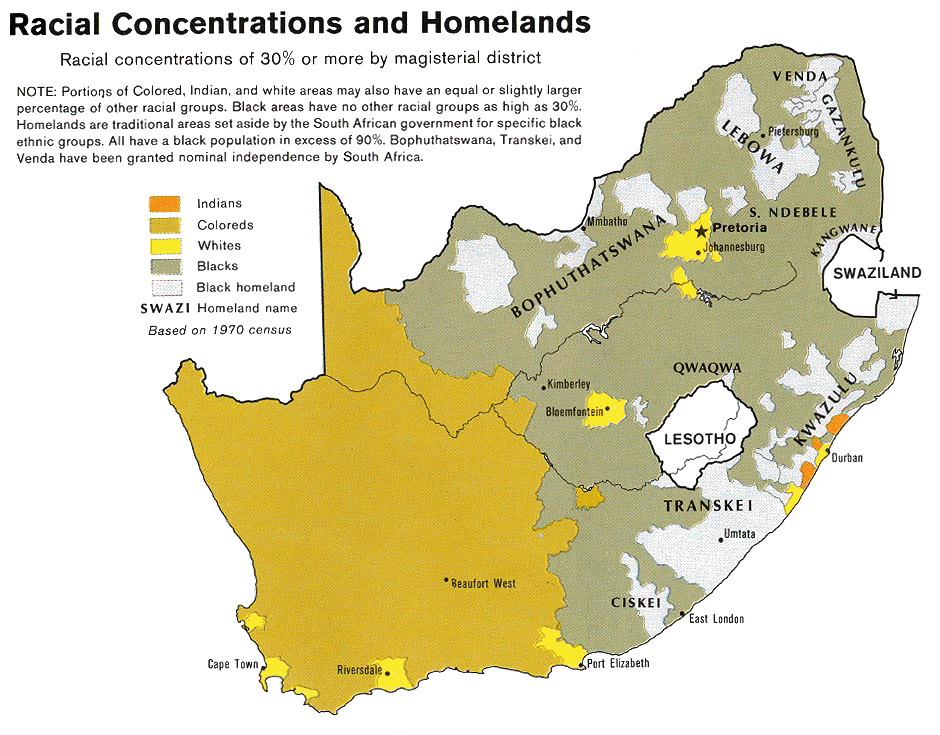
Coloured people constitute a majority of the population in Western Cape
and Northern Cape
provinces. Most speak Afrikaans
, while about ten percent of Coloureds speak English as their mother tongue, mostly in the Eastern Cape and KwaZulu-Natal. However, virtually all Cape Town Coloureds are bilingual. Some can comfortably codeswitch
between 'Kaapse taal' (a creolized dialect of Afrikaans spoken mostly in the Cape Flats
), 'suiwer Afrikaans' (formal Afrikaans as taught at school), and English.
rallied Coloured political efforts for many years. Many Coloured people later joined the African National Congress
and the United Democratic Front
. Whether in these organisations or others, many Coloured people were active in the fight against apartheid.
The political rights of Coloured people varied by location and over time. In the 19th century they theoretically had similar rights to Whites in the Cape Colony
(though income and property qualifications affected them disproportionately.) In the Transvaal Republic or the Orange Free State
, they had few rights. Coloured members were elected to Cape Town
's municipal authority (including, for many years, Abdurahman). The establishment of the Union of South Africa
gave Coloured people the franchise, although by 1930 they were restricted to electing White representatives. They conducted frequent voting boycotts in protest. This may have helped the election of the National Party in 1948, as their apartheid programme intended to strip Coloured people of their remaining voting powers.
Coloured people were also subject to forced relocation. For instance, the government relocated Coloured from the multicultural Cape Town area of District Six, which was later bulldozed. Inhabitants were moved to racially designated sections of the metropolitan area on the Cape Flats
. Additionally, under apartheid, Coloured people received educations inferior to that of Whites, albeit better than that provided to Black South Africans.
, known as 'The Lion of the North', worked to restrict Coloured rights. He removed their ability to exercise their franchise.
Strijdom's government expanded the Senate's numbers from 48 to 89. All of the additional 41 members hailed from the National Party. It increased its representation in the Senate to 77 in total. The Appellate Division Quorum Bill increased the number of judges necessary for constitutional decisions in the Appeal Court from five to eleven.
Strijdom, knowing that he had his two-thirds majority, held a joint sitting of parliament in May 1956. The entrenchment clause regarding the Coloured vote, known as the South African Act, was amended.
Coloureds were placed on a separate voters' roll, which could elect four whites to represent them in the House of Assembly
. Two whites would be elected to the Cape Provincial Council
, and the governor general could appoint one senator
.
There was a great deal of opposition, both black and white, to this. The Torch Commando
was very prominent, while the Black Sash
(white women, uniformly dressed, standing on street corners with placards) also made themselves heard.
Many Coloureds refused to register for the new voters' roll. The number of Coloured voters dropped dramatically. In the next election, only 50.2% of them voted. They had no interest in voting for white representatives—an activity which many of them saw as pointless.
Under the Population Registration Act
, as amended, Coloureds were formally classified into various subgroups, including Cape Coloureds
, Cape Malays
and "other coloured". A portion of the small Chinese South African community was also classified as a coloured subgroup.http://heritage.thetimes.co.za/memorials/wc/RaceClassificationBoard/article.aspx?id=591128http://books.google.co.za/books?id=JkMOAAAAQAAJ&lpg=PA70&dq=Population%20Registration%20Act%2C%201959%20cape%20coloured&pg=PA70#v=onepage&q=Population%20Registration%20Act%2C%201959%20cape%20coloured&f=false
The 1964 Coloured Peoples' Representative Council turned out to be a constitutional hitch which never really got going. In 1969, the Coloureds elected forty onto the council to supplement the twenty nominated by the government, taking the total number to sixty.
In 1983, the Constitution
was reformed to allow the Coloured and Asian
minorities limited participation in separate and subordinate Houses in a tricameral Parliament
. This development had limited support. This was part of a change in which the Coloured minority was to be allowed limited rights, but the Black majority were to become citizens of independent homelands. These separate arrangements were removed by the negotiations which took place from 1990 to provide all South Africans with the vote.
, which had formerly oppressed them. The National Party recast itself as the New National Party, partly to woo non-White voters. This political alliance, often befuddling to outsiders, has sometimes been explained in terms of the common Afrikaans language of White and Coloured New National Party members, opposition to affirmative action programmes that might give preference to non-Coloured Black people, or old privileges (e.g., municipal jobs) that Coloured people feared giving up under African National Congress
leadership.
Since then, Coloured identity politics
has continued to be important in the Western Cape, particularly for opposition parties. They see the Western Cape, in particular, as a place where they might gain ground against the dominant African National Congress. The Democratic Alliance wooed away some former New National Party voters and won considerable Coloured support. The New National Party collapsed in the 2004 elections. Coloured support aided the Democratic Alliance's victory in the 2006 Cape Town municipal elections.
Patricia de Lille
, leader of the Independent Democrats, does not use the label Coloured to describe herself but would be considered a Coloured person by many. The Independent Democrats party has sought the Coloured vote and gained significant ground in the municipal and local elections in 2006, particularly in districts with heavily Coloured constituencies in the Western Cape. The firebrand Peter Marais
(formerly a provincial leader of the New National Party) has also sought to portray his New Labour Party
as the political voice for Coloured people.
There has been substantial Coloured support for and membership in the African National Congress before, during and after the apartheid era: Ebrahim Rasool
(previously Western Cape premier), Dipuo Peters
, Beatrice Marshoff
, Manne Dipico
, John Schuurman and Allan Hendrickse
have been noteworthy Coloured politicians affiliated with the African National Congress. The Democratic Alliance won control over the Western Cape during the 2009 National and Provincial Elections and has since brokered an alliance with the Independent Democrats. The Congress has had some success in winning Coloured votes, particularly among labour-affiliated and middle-class Coloured voters. Some Coloureds express distrust of the ANC with the comment, "not white enough under apartheid, and not black enough under the ANC."
In the 2004 election, voter apathy was high in historically Coloured areas.
 The term Coloured
is also used to describe persons of mixed race in Namibia
, to refer to those of part Khoisan, part white descent. The Baster
s of Namibia constitute a separate ethnic group
that are sometimes considered a sub-group of the Coloured population of that country. Under South African rule, the policies and laws of apartheid were extended to what was then called South West Africa
, and the treatment of Namibian Coloureds
was comparable to that of South African Coloureds.
The term Coloured or 'Goffal
' is also used in Zimbabwe
, where, unlike South Africa and Namibia, most people of mixed race have African and European ancestry, being descended from the offspring of European men and Shona and Ndebele women; however some Coloured families descended from male Coloured migrants from South Africa who married local women. Under white minority rule in Rhodesia
, Coloureds had more privileges than black Africans, including full voting rights, but still faced serious discrimination. In Swaziland
, the term Coloured is also used.
, where "Free people of color" legally denoted people of mixed European and sub-Saharan African ancestry. The use of the term to describe people of African descent is now considered archaic and offensive in most contexts. It remains part of the title of the National Association for the Advancement of Colored People
, a prominent African-American organisation established in 1909. In addition, some members of the African-American community use "colored" as a legitimate ethnic/racial label when intentionally self-chosen and used in a respectful manner. 'People of color' is currently used more frequently than 'colored'. In the United States usage, the phrase refers more generally to all people who do not describe themselves as 'white', including people of Asian
, Native American
and African descent. In Great Britain, 'coloured' has also been used to refer to anyone who could not describe themselves as white.
South Africa
The Republic of South Africa is a country in southern Africa. Located at the southern tip of Africa, it is divided into nine provinces, with of coastline on the Atlantic and Indian oceans...
n, Namibia
Namibia
Namibia, officially the Republic of Namibia , is a country in southern Africa whose western border is the Atlantic Ocean. It shares land borders with Angola and Zambia to the north, Botswana to the east and South Africa to the south and east. It gained independence from South Africa on 21 March...
n, Zambia
Zambia
Zambia , officially the Republic of Zambia, is a landlocked country in Southern Africa. The neighbouring countries are the Democratic Republic of the Congo to the north, Tanzania to the north-east, Malawi to the east, Mozambique, Zimbabwe, Botswana and Namibia to the south, and Angola to the west....
n, Botswana
Botswana
Botswana, officially the Republic of Botswana , is a landlocked country located in Southern Africa. The citizens are referred to as "Batswana" . Formerly the British protectorate of Bechuanaland, Botswana adopted its new name after becoming independent within the Commonwealth on 30 September 1966...
and Zimbabwe
Zimbabwe
Zimbabwe is a landlocked country located in the southern part of the African continent, between the Zambezi and Limpopo rivers. It is bordered by South Africa to the south, Botswana to the southwest, Zambia and a tip of Namibia to the northwest and Mozambique to the east. Zimbabwe has three...
an context, the term Coloured (also known as Bruinmense, Kleurlinge or Bruin Afrikaners in Afrikaans
Afrikaans
Afrikaans is a West Germanic language, spoken natively in South Africa and Namibia. It is a daughter language of Dutch, originating in its 17th century dialects, collectively referred to as Cape Dutch .Afrikaans is a daughter language of Dutch; see , , , , , .Afrikaans was historically called Cape...
) refers to an heterogenous ethnic group
Ethnic group
An ethnic group is a group of people whose members identify with each other, through a common heritage, often consisting of a common language, a common culture and/or an ideology that stresses common ancestry or endogamy...
who possess ancestry from Europe
Europe
Europe is, by convention, one of the world's seven continents. Comprising the westernmost peninsula of Eurasia, Europe is generally 'divided' from Asia to its east by the watershed divides of the Ural and Caucasus Mountains, the Ural River, the Caspian and Black Seas, and the waterways connecting...
, various Khoisan
Khoisan
Khoisan is a unifying name for two ethnic groups of Southern Africa, who share physical and putative linguistic characteristics distinct from the Bantu majority of the region. Culturally, the Khoisan are divided into the foraging San and the pastoral Khoi...
and Bantu
Bantu
Bantu is used as a general label for 300-600 ethnic groups in Africa of speakers of Bantu languages, distributed from Cameroon east across Central Africa and Eastern Africa to Southern Africa...
tribes of Southern Africa
Southern Africa
Southern Africa is the southernmost region of the African continent, variably defined by geography or geopolitics. Within the region are numerous territories, including the Republic of South Africa ; nowadays, the simpler term South Africa is generally reserved for the country in English.-UN...
, West Africa
West Africa
West Africa or Western Africa is the westernmost region of the African continent. Geopolitically, the UN definition of Western Africa includes the following 16 countries and an area of approximately 5 million square km:-Flags of West Africa:...
, Indonesia
Indonesia
Indonesia , officially the Republic of Indonesia , is a country in Southeast Asia and Oceania. Indonesia is an archipelago comprising approximately 13,000 islands. It has 33 provinces with over 238 million people, and is the world's fourth most populous country. Indonesia is a republic, with an...
, Madagascar
Madagascar
The Republic of Madagascar is an island country located in the Indian Ocean off the southeastern coast of Africa...
, Malaya
Malay Peninsula
The Malay Peninsula or Thai-Malay Peninsula is a peninsula in Southeast Asia. The land mass runs approximately north-south and, at its terminus, is the southern-most point of the Asian mainland...
, India
India
India , officially the Republic of India , is a country in South Asia. It is the seventh-largest country by geographical area, the second-most populous country with over 1.2 billion people, and the most populous democracy in the world...
, Mozambique
Mozambique
Mozambique, officially the Republic of Mozambique , is a country in southeastern Africa bordered by the Indian Ocean to the east, Tanzania to the north, Malawi and Zambia to the northwest, Zimbabwe to the west and Swaziland and South Africa to the southwest...
, Mauritius
Mauritius
Mauritius , officially the Republic of Mauritius is an island nation off the southeast coast of the African continent in the southwest Indian Ocean, about east of Madagascar...
, and Saint Helena
Saint Helena
Saint Helena , named after St Helena of Constantinople, is an island of volcanic origin in the South Atlantic Ocean. It is part of the British overseas territory of Saint Helena, Ascension and Tristan da Cunha which also includes Ascension Island and the islands of Tristan da Cunha...
. Besides the extensive combining of these diverse heritages in the Western Cape
Western Cape
The Western Cape is a province in the south west of South Africa. The capital is Cape Town. Prior to 1994, the region that now forms the Western Cape was part of the much larger Cape Province...
— in which a distinctive 'Cape Coloured' and affiliated Cape Malay culture developed — in other parts of Southern Africa, their development has usually been the result of the meeting of two distinct groups. Genetic studies suggest the group has the highest levels of mixed ancestry in the world. However, the maternal (female) contribution to the Coloured population, measured by mitochondrial DNA
Mitochondrial DNA
Mitochondrial DNA is the DNA located in organelles called mitochondria, structures within eukaryotic cells that convert the chemical energy from food into a form that cells can use, adenosine triphosphate...
studies, was found to come mostly from the Khoisan
Khoisan
Khoisan is a unifying name for two ethnic groups of Southern Africa, who share physical and putative linguistic characteristics distinct from the Bantu majority of the region. Culturally, the Khoisan are divided into the foraging San and the pastoral Khoi...
population.
Background
In KwaZulu-NatalKwaZulu-Natal
KwaZulu-Natal is a province of South Africa. Prior to 1994, the territory now known as KwaZulu-Natal was made up of the province of Natal and the homeland of KwaZulu....
, most Coloureds come from British
British people
The British are citizens of the United Kingdom, of the Isle of Man, any of the Channel Islands, or of any of the British overseas territories, and their descendants...
and Zulu heritage, while Zimbabwean Coloureds come from Shona
Shona people
Shona is the name collectively given to two groups of people in the east and southwest of Zimbabwe, north eastern Botswana and southern Mozambique.-Shona Regional Classification:...
or Ndebele
Ndebele people (Zimbabwe)
The Ndebele are a branch of the Zulus who split from King Shaka in the early 1820s under the leadership of Mzilikazi, a former general in Shaka's army....
mixing with British and Afrikaner
Afrikaner
Afrikaners are an ethnic group in Southern Africa descended from almost equal numbers of Dutch, French and German settlers whose native tongue is Afrikaans: a Germanic language which derives primarily from 17th century Dutch, and a variety of other languages.-Related ethno-linguistic groups:The...
settlers. Griqua, on the other hand, are descendants of Khoisan
Khoisan
Khoisan is a unifying name for two ethnic groups of Southern Africa, who share physical and putative linguistic characteristics distinct from the Bantu majority of the region. Culturally, the Khoisan are divided into the foraging San and the pastoral Khoi...
and Afrikaner trekboers. Despite these major differences, the fact that they draw parentage from more than one 'naturalised' racial group means that they are 'coloured' in the southern African context. Such people did not necessarily self-identify this way; some preferred to call themselves 'black' or 'Khoisan' or just 'South African'. The history of racial segregation and labelling in South Africa and neighbouring countries has meant that the governments placed all such 'mixed race' people in a certain relationship together. The imperial and apartheid governments categorized them as Coloureds. In addition, other ethnic groups also traditionally viewed them as a separate group.
During the apartheid era
History of South Africa in the apartheid era
Apartheid was a system of racial segregation enforced by the National Party governments of South Africa between 1948 and 1994, under which the rights of the majority 'non-white' inhabitants of South Africa were curtailed and white supremacy and Afrikaner minority rule was maintained...
, in order to keep divisions and maintain a race-focused society, the government used the term Coloured to describe one of the four main racial groups identified by law: Blacks, Whites, Coloureds and Indians
Indian South Africans
Indian South Africans are people of Indian descent living in South Africa and mostly live in and around the city of Durban, making it 'the largest 'Indian' city outside India'. Most Indians in South Africa are descendents of migrants from colonial India during late 19th-century through early...
. (All four terms were capitalised in apartheid-era law.)
Many Griqua began to self-identify as "Coloureds" during the apartheid era. There were certain advantages in becoming classified as "Coloured". For example, Coloureds did not have to carry a dompas (an identity document designed to limit the movements of the non-white populace), while the Griqua, who were seen as another indigenous African group, did.
Coloured people constitute a majority of the population in Western Cape
Western Cape
The Western Cape is a province in the south west of South Africa. The capital is Cape Town. Prior to 1994, the region that now forms the Western Cape was part of the much larger Cape Province...
and Northern Cape
Northern Cape
The Northern Cape is the largest and most sparsely populated province of South Africa. It was created in 1994 when the Cape Province was split up. Its capital is Kimberley. It includes the Kalahari Gemsbok National Park, part of an international park shared with Botswana...
provinces. Most speak Afrikaans
Afrikaans
Afrikaans is a West Germanic language, spoken natively in South Africa and Namibia. It is a daughter language of Dutch, originating in its 17th century dialects, collectively referred to as Cape Dutch .Afrikaans is a daughter language of Dutch; see , , , , , .Afrikaans was historically called Cape...
, while about ten percent of Coloureds speak English as their mother tongue, mostly in the Eastern Cape and KwaZulu-Natal. However, virtually all Cape Town Coloureds are bilingual. Some can comfortably codeswitch
Code-switching
In linguistics, code-switching is the concurrent use of more than one language, or language variety, in conversation. Multilinguals—people who speak more than one language—sometimes use elements of multiple languages in conversing with each other...
between 'Kaapse taal' (a creolized dialect of Afrikaans spoken mostly in the Cape Flats
Cape Flats
The Cape Flats is an expansive, low-lying, flat area situated to the southeast of the central business district of Cape Town. To many people in Cape Town, the area is known simply as 'The Flats'....
), 'suiwer Afrikaans' (formal Afrikaans as taught at school), and English.
Pre-apartheid
Coloured people played an important role in the struggle against apartheid and its predecessor policies. The African Political Organisation, established in 1902, had an exclusively Coloured membership; its leader Abdullah AbdurahmanAbdullah Abdurahman
Abdullah Abdurahman was a South African politician and physician, born in Wellington, South Africa...
rallied Coloured political efforts for many years. Many Coloured people later joined the African National Congress
African National Congress
The African National Congress is South Africa's governing Africanist political party, supported by its tripartite alliance with the Congress of South African Trade Unions and the South African Communist Party , since the establishment of non-racial democracy in April 1994. It defines itself as a...
and the United Democratic Front
United Democratic Front (South Africa)
The United Democratic Front was one of the most important anti-apartheid organisations of the 1980s. The non-racial coalition of about 400 civic, church, students', workers' and other organisations was formed in 1983, initially to fight the just-introduced idea of the Tricameral Parliament The...
. Whether in these organisations or others, many Coloured people were active in the fight against apartheid.
The political rights of Coloured people varied by location and over time. In the 19th century they theoretically had similar rights to Whites in the Cape Colony
Cape Colony
The Cape Colony, part of modern South Africa, was established by the Dutch East India Company in 1652, with the founding of Cape Town. It was subsequently occupied by the British in 1795 when the Netherlands were occupied by revolutionary France, so that the French revolutionaries could not take...
(though income and property qualifications affected them disproportionately.) In the Transvaal Republic or the Orange Free State
Orange Free State
The Orange Free State was an independent Boer republic in southern Africa during the second half of the 19th century, and later a British colony and a province of the Union of South Africa. It is the historical precursor to the present-day Free State province...
, they had few rights. Coloured members were elected to Cape Town
Cape Town
Cape Town is the second-most populous city in South Africa, and the provincial capital and primate city of the Western Cape. As the seat of the National Parliament, it is also the legislative capital of the country. It forms part of the City of Cape Town metropolitan municipality...
's municipal authority (including, for many years, Abdurahman). The establishment of the Union of South Africa
Union of South Africa
The Union of South Africa is the historic predecessor to the present-day Republic of South Africa. It came into being on 31 May 1910 with the unification of the previously separate colonies of the Cape, Natal, Transvaal and the Orange Free State...
gave Coloured people the franchise, although by 1930 they were restricted to electing White representatives. They conducted frequent voting boycotts in protest. This may have helped the election of the National Party in 1948, as their apartheid programme intended to strip Coloured people of their remaining voting powers.
Coloured people were also subject to forced relocation. For instance, the government relocated Coloured from the multicultural Cape Town area of District Six, which was later bulldozed. Inhabitants were moved to racially designated sections of the metropolitan area on the Cape Flats
Cape Flats
The Cape Flats is an expansive, low-lying, flat area situated to the southeast of the central business district of Cape Town. To many people in Cape Town, the area is known simply as 'The Flats'....
. Additionally, under apartheid, Coloured people received educations inferior to that of Whites, albeit better than that provided to Black South Africans.
Apartheid era
J. G. StrijdomJohannes Gerhardus Strijdom
Johannes Gerhardus Strijdom, commonly called JG Strydom or Hans Strydom , nicknamed the Lion of the North, was Prime Minister of South Africa from 30 November 1954 to 24 August 1958...
, known as 'The Lion of the North', worked to restrict Coloured rights. He removed their ability to exercise their franchise.
Strijdom's government expanded the Senate's numbers from 48 to 89. All of the additional 41 members hailed from the National Party. It increased its representation in the Senate to 77 in total. The Appellate Division Quorum Bill increased the number of judges necessary for constitutional decisions in the Appeal Court from five to eleven.
Strijdom, knowing that he had his two-thirds majority, held a joint sitting of parliament in May 1956. The entrenchment clause regarding the Coloured vote, known as the South African Act, was amended.
Coloureds were placed on a separate voters' roll, which could elect four whites to represent them in the House of Assembly
House of Assembly of South Africa
The House of Assembly was the lower house of the Parliament of South Africa from 1910 to 1984, and latterly the white representative house of the Tricameral Parliament from 1984 to 1994, when it was replaced by the current National Assembly...
. Two whites would be elected to the Cape Provincial Council
Cape Provincial Council
The Cape Provincial Council was the legislature of the Cape Province of South Africa. It was created by the South Africa Act 1909, with effect from the formation of the Union of South Africa on 31 May 1910...
, and the governor general could appoint one senator
Senate of South Africa
The Senate was the upper house of the Parliament of South Africa between 1910 and its abolition from 1 January 1981, and between 1994 and 1997.-1910-1981:...
.
There was a great deal of opposition, both black and white, to this. The Torch Commando
Torch Commando
The Torch Commando was born out of the work of the Springbok Legion, a South African organisation of World War II veterans, founded in 1941 during the second world war by progressive anti-fascist servicemen, and the War Veterans Action Committee established with the involvement of Springbok...
was very prominent, while the Black Sash
Black Sash
The Black Sash was a non-violent white women's resistance organization founded in 1955 in South Africa by Jean Sinclair. The Black Sash initially campaigned against the removal of Coloured or mixed race voters from the voters' roll in the Cape Province by the National Party government...
(white women, uniformly dressed, standing on street corners with placards) also made themselves heard.
Many Coloureds refused to register for the new voters' roll. The number of Coloured voters dropped dramatically. In the next election, only 50.2% of them voted. They had no interest in voting for white representatives—an activity which many of them saw as pointless.
Under the Population Registration Act
Population Registration Act
The Population Registration Act of 1950 required that each inhabitant of South Africa be classified and registered in accordance with their racial characteristics as part of the system of apartheid. Social rights, political rights, educational opportunities, and economic status were largely...
, as amended, Coloureds were formally classified into various subgroups, including Cape Coloureds
Cape Coloureds
The Cape Coloureds form a minority group within South Africa, however they are the predominant population group in the Western Cape. They are generally bilingual, however subsets within the group can be exclusively Afrikaans speakers, whereas others primarily speak English...
, Cape Malays
Cape Malays
The Cape Malay community is an ethnic group or community in South Africa. It derives its name from the present-day Western Cape of South Africa and the people originally from Maritime Southeast Asia, mostly Javanese from modern-day Indonesia, a Dutch colony for several centuries, and Dutch...
and "other coloured". A portion of the small Chinese South African community was also classified as a coloured subgroup.http://heritage.thetimes.co.za/memorials/wc/RaceClassificationBoard/article.aspx?id=591128http://books.google.co.za/books?id=JkMOAAAAQAAJ&lpg=PA70&dq=Population%20Registration%20Act%2C%201959%20cape%20coloured&pg=PA70#v=onepage&q=Population%20Registration%20Act%2C%201959%20cape%20coloured&f=false
1956-1983
In 1958, the government established the Department of Coloured Affairs, followed in 1959 by the Union for Coloured Affairs. The latter had 27 members and served as an advisory link between the government and the Coloured people.The 1964 Coloured Peoples' Representative Council turned out to be a constitutional hitch which never really got going. In 1969, the Coloureds elected forty onto the council to supplement the twenty nominated by the government, taking the total number to sixty.
In 1983, the Constitution
South African Constitution of 1983
The Constitution of 1983 was South Africa's third constitution. It replaced the republican constitution that had been adopted when South Africa became a republic in 1961 and was in force for ten years before it was superseded by the Interim Constitution on 27 April 1994, which in turn led to the...
was reformed to allow the Coloured and Asian
Asians in South Africa
The majority of the Asian South African population is Indian in origin, most of them descended from indentured workers transported to work in the 19th century on the sugar plantations of the eastern coastal area, then known as Natal. They are largely English speaking, although many also retain the...
minorities limited participation in separate and subordinate Houses in a tricameral Parliament
Parliament of South Africa
The Parliament of South Africa is South Africa's legislature and under the country's current Constitution is composed of the National Assembly and the National Council of Provinces....
. This development had limited support. This was part of a change in which the Coloured minority was to be allowed limited rights, but the Black majority were to become citizens of independent homelands. These separate arrangements were removed by the negotiations which took place from 1990 to provide all South Africans with the vote.
Post-apartheid
During the 1994 all-race elections, many Coloured people voted for the white National PartyNational Party (South Africa)
The National Party is a former political party in South Africa. Founded in 1914, it was the governing party of the country from 4 June 1948 until 9 May 1994. Members of the National Party were sometimes known as Nationalists or Nats. Its policies included apartheid, the establishment of a...
, which had formerly oppressed them. The National Party recast itself as the New National Party, partly to woo non-White voters. This political alliance, often befuddling to outsiders, has sometimes been explained in terms of the common Afrikaans language of White and Coloured New National Party members, opposition to affirmative action programmes that might give preference to non-Coloured Black people, or old privileges (e.g., municipal jobs) that Coloured people feared giving up under African National Congress
African National Congress
The African National Congress is South Africa's governing Africanist political party, supported by its tripartite alliance with the Congress of South African Trade Unions and the South African Communist Party , since the establishment of non-racial democracy in April 1994. It defines itself as a...
leadership.
Since then, Coloured identity politics
Identity politics
Identity politics are political arguments that focus upon the self interest and perspectives of self-identified social interest groups and ways in which people's politics may be shaped by aspects of their identity through race, class, religion, sexual orientation or traditional dominance...
has continued to be important in the Western Cape, particularly for opposition parties. They see the Western Cape, in particular, as a place where they might gain ground against the dominant African National Congress. The Democratic Alliance wooed away some former New National Party voters and won considerable Coloured support. The New National Party collapsed in the 2004 elections. Coloured support aided the Democratic Alliance's victory in the 2006 Cape Town municipal elections.
Patricia de Lille
Patricia de Lille
Patricia de Lille is a South African politician and Mayor of Cape Town. She is also, concurrently, the leader of the Independent Democrats, a South African political party which she formed in 2003 during a floor-crossing window...
, leader of the Independent Democrats, does not use the label Coloured to describe herself but would be considered a Coloured person by many. The Independent Democrats party has sought the Coloured vote and gained significant ground in the municipal and local elections in 2006, particularly in districts with heavily Coloured constituencies in the Western Cape. The firebrand Peter Marais
Peter Marais
Peter Marais is a South African politician who participated in the Tricameral Parliament and became the Mayor of Cape Town after the 2000 election and later Premier of the Western Cape province....
(formerly a provincial leader of the New National Party) has also sought to portray his New Labour Party
New Labour Party (South Africa)
The New Labour Party was a minor South African political party founded by Peter Marais via floor crossing legislation after he left the New National Party in some disrepute. The name was chosen to evoke the former Labour Party led by the late Reverend Allan Hendrickse as an anti-apartheid Coloured...
as the political voice for Coloured people.
There has been substantial Coloured support for and membership in the African National Congress before, during and after the apartheid era: Ebrahim Rasool
Ebrahim Rasool
Ebrahim Rasool was the Premier of the Western Cape province in South Africa. He is a member of the African National Congress.Anti-Apartheid Struggle Activist:...
(previously Western Cape premier), Dipuo Peters
Dipuo Peters
Elizabeth Dipuo Peters, born on 13 May 1960, is the Minister of Energy of the Republic of South Africa , in the Zuma administration, having served as successor to Manne Dipico as the second Premier of the Northern Cape Province, 22 April 2004 to 10 May 2009...
, Beatrice Marshoff
Beatrice Marshoff
Frances Beatrice Marshoff was Premier of the Free State from 2004 to 2009. She succeeded Winkie Direko to the position on 22 April 2004, and was replaced by Ace Magashule on 6 May 2009....
, Manne Dipico
Manne Dipico
Manne Emsley Dipico, first Premier of the Northern Cape Province, South Africa, was born in Kimberley on 21 April 1959. He was appointed Chairman of the Nuclear Energy Corporation of South Africa in 2006...
, John Schuurman and Allan Hendrickse
Allan Hendrickse
Helenard Joe Hendrickse was a South African politician, Congregationalist minister, and teacher. He participated in an act of defiance by swimming at a South African beach reserved for whites only. He was born in Uitenhage in the Eastern Cape and died of a heart attack at Port Elizabeth's airport...
have been noteworthy Coloured politicians affiliated with the African National Congress. The Democratic Alliance won control over the Western Cape during the 2009 National and Provincial Elections and has since brokered an alliance with the Independent Democrats. The Congress has had some success in winning Coloured votes, particularly among labour-affiliated and middle-class Coloured voters. Some Coloureds express distrust of the ANC with the comment, "not white enough under apartheid, and not black enough under the ANC."
In the 2004 election, voter apathy was high in historically Coloured areas.
Southern Africa
Coloured People in Namibia
A Coloured identity in Namibia is difficult to define, since it implies that that they can have one unified identity across a mix of races and societal classes. Roughly speaking, they are people with both European and African ancestry. Coloureds have immigrated to Namibia, been born in Namibia or...
is also used to describe persons of mixed race in Namibia
Namibia
Namibia, officially the Republic of Namibia , is a country in southern Africa whose western border is the Atlantic Ocean. It shares land borders with Angola and Zambia to the north, Botswana to the east and South Africa to the south and east. It gained independence from South Africa on 21 March...
, to refer to those of part Khoisan, part white descent. The Baster
Baster
The Basters are the descendants of Cape Colony Dutch and indigenous African women. They largely live in Namibia and are similar to Coloured or Griqua people in South Africa....
s of Namibia constitute a separate ethnic group
Ethnic group
An ethnic group is a group of people whose members identify with each other, through a common heritage, often consisting of a common language, a common culture and/or an ideology that stresses common ancestry or endogamy...
that are sometimes considered a sub-group of the Coloured population of that country. Under South African rule, the policies and laws of apartheid were extended to what was then called South West Africa
South West Africa
South-West Africa was the name that was used for the modern day Republic of Namibia during the earlier eras when the territory was controlled by the German Empire and later by South Africa....
, and the treatment of Namibian Coloureds
Coloured People in Namibia
A Coloured identity in Namibia is difficult to define, since it implies that that they can have one unified identity across a mix of races and societal classes. Roughly speaking, they are people with both European and African ancestry. Coloureds have immigrated to Namibia, been born in Namibia or...
was comparable to that of South African Coloureds.
The term Coloured or 'Goffal
Goffal
Goffal is a term used for people of mixed race from Zimbabweand Zambia, the former Southern and Northern Rhodesias respectively, particularly white people of British & Dutch descent with black people....
' is also used in Zimbabwe
Zimbabwe
Zimbabwe is a landlocked country located in the southern part of the African continent, between the Zambezi and Limpopo rivers. It is bordered by South Africa to the south, Botswana to the southwest, Zambia and a tip of Namibia to the northwest and Mozambique to the east. Zimbabwe has three...
, where, unlike South Africa and Namibia, most people of mixed race have African and European ancestry, being descended from the offspring of European men and Shona and Ndebele women; however some Coloured families descended from male Coloured migrants from South Africa who married local women. Under white minority rule in Rhodesia
Rhodesia
Rhodesia , officially the Republic of Rhodesia from 1970, was an unrecognised state located in southern Africa that existed between 1965 and 1979 following its Unilateral Declaration of Independence from the United Kingdom on 11 November 1965...
, Coloureds had more privileges than black Africans, including full voting rights, but still faced serious discrimination. In Swaziland
Swaziland
Swaziland, officially the Kingdom of Swaziland , and sometimes called Ngwane or Swatini, is a landlocked country in Southern Africa, bordered to the north, south and west by South Africa, and to the east by Mozambique...
, the term Coloured is also used.
Cuisine
Numerous South African cuisines can be traced back to Coloured people. Bobotie, snoek based dishes,koeksisters, bredies, Malay roti are staple diets of Coloureds and other South Africans as well. Most dishes are passed down for many generations.Other usage
The American English term (spelled as colored) had a related but different meaning. It was primarily used to refer to people of African descent, except in the state of LouisianaLouisiana
Louisiana is a state located in the southern region of the United States of America. Its capital is Baton Rouge and largest city is New Orleans. Louisiana is the only state in the U.S. with political subdivisions termed parishes, which are local governments equivalent to counties...
, where "Free people of color" legally denoted people of mixed European and sub-Saharan African ancestry. The use of the term to describe people of African descent is now considered archaic and offensive in most contexts. It remains part of the title of the National Association for the Advancement of Colored People
National Association for the Advancement of Colored People
The National Association for the Advancement of Colored People, usually abbreviated as NAACP, is an African-American civil rights organization in the United States, formed in 1909. Its mission is "to ensure the political, educational, social, and economic equality of rights of all persons and to...
, a prominent African-American organisation established in 1909. In addition, some members of the African-American community use "colored" as a legitimate ethnic/racial label when intentionally self-chosen and used in a respectful manner. 'People of color' is currently used more frequently than 'colored'. In the United States usage, the phrase refers more generally to all people who do not describe themselves as 'white', including people of Asian
Asian people
Asian people or Asiatic people is a term with multiple meanings that refers to people who descend from a portion of Asia's population.- Central Asia :...
, Native American
Indigenous peoples of the Americas
The indigenous peoples of the Americas are the pre-Columbian inhabitants of North and South America, their descendants and other ethnic groups who are identified with those peoples. Indigenous peoples are known in Canada as Aboriginal peoples, and in the United States as Native Americans...
and African descent. In Great Britain, 'coloured' has also been used to refer to anyone who could not describe themselves as white.
See also
- ColoredColoredColored is a term once widely used in the United States to describe black people and Native Americans...
- Coloured People in NamibiaColoured People in NamibiaA Coloured identity in Namibia is difficult to define, since it implies that that they can have one unified identity across a mix of races and societal classes. Roughly speaking, they are people with both European and African ancestry. Coloureds have immigrated to Namibia, been born in Namibia or...
- GoffalGoffalGoffal is a term used for people of mixed race from Zimbabweand Zambia, the former Southern and Northern Rhodesias respectively, particularly white people of British & Dutch descent with black people....
- One-drop ruleOne-drop ruleThe one-drop rule is a historical colloquial term in the United States for the social classification as black of individuals with any African ancestry; meaning any person with "one drop of black blood" was considered black...
- Pencil testPencil testPencil test may refer to:* Pencil test , an early version of an animated scene* Pencil Test , a 1988 animated short by Apple Inc....
- Passing (racial identity)Passing (racial identity)Racial passing refers to a person classified as a member of one racial group attempting to be accepted as a member of a different racial group...
- Culture of South AfricaCulture of South AfricaSouth Africa is known for its ethnic and cultural diversity. Therefore, there is no single culture of South Africa.The South African black majority still has a substantial number of rural inhabitants who lead largely impoverished lives...
- Griqua
- Basters
- BurghersBurgher peopleThe Burghers are a Eurasian ethnic group, historically from Sri Lanka, consisting for the most part of male-line descendants of European colonists from the 16th to 20th centuries and local women, with some minorities of Swedish, Norwegian, French and Irish.Today the mother tongue of the Burghers...
- Anglo-IndianAnglo-IndianAnglo-Indians are people who have mixed Indian and British ancestry, or people of British descent born or living in India, now mainly historical in the latter sense. British residents in India used the term "Eurasians" for people of mixed European and Indian descent...
- Anglo-Burmese
- MelungeonMelungeonMelungeon is a term traditionally applied to one of a number of "tri-racial isolate" groups of the Southeastern United States, mainly in the Cumberland Gap area of central Appalachia, which includes portions of East Tennessee, Southwest Virginia, and East Kentucky. Tri-racial describes populations...
- MestizoMestizoMestizo is a term traditionally used in Latin America, Philippines and Spain for people of mixed European and Native American heritage or descent...
- Métis people (Canada)Métis people (Canada)The Métis are one of the Aboriginal peoples in Canada who trace their descent to mixed First Nations parentage. The term was historically a catch-all describing the offspring of any such union, but within generations the culture syncretised into what is today a distinct aboriginal group, with...
- Sandra LaingSandra LaingSandra Laing, is a woman who was born to white parents but reclassified as Coloured during the apartheid era in South Africa as she has dark skin...
- Zoë WicombZoe WicombZoë Wicomb is an author.She attended the University of the Western Cape, and after graduating left South Africa for England in 1970, where she continued her studies at Reading University....
External links
- Beyond Identity - A blog about mixed race, multiracial people from South Africa
- The documented Griqua history
- 2001 Digital Census Atlas
- KakDuidelik.co.za - Die ding ruk mal, a coloured community portal
- Children of the Mist - The Griqua history in word and images
- Bruin-ou.com - A lifestyle portal for Coloured people in South Africa
- Bruin Development Forum