

Bantu

Encyclopedia
Bantu is used as a general label for 300-600 ethnic groups in Africa of speakers of Bantu languages
, distributed from Cameroon
east across Central Africa
and Eastern Africa to Southern Africa
. There are about 250 Bantu languages by the criterion of mutual intelligibility
, though the distinction between language and dialect is often unclear, and Ethnologue
counts 535 languages.
The Bantu family is fragmented into hundreds of individual groups, none of them larger than a few million people (the largest being the Zulu
with some 10 million). The Bantu language Swahili
with its merely 5-10 million native speakers is of super-regional importance as tens of millions fluently command it as a second language.
, batu in Lingala
,bato in Duala
,abantu in Zulu
and Ganda, Vanhu in Shona
and Vandu in some Luhya dialects.
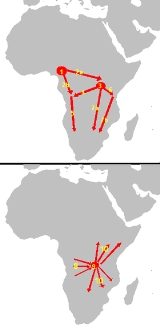
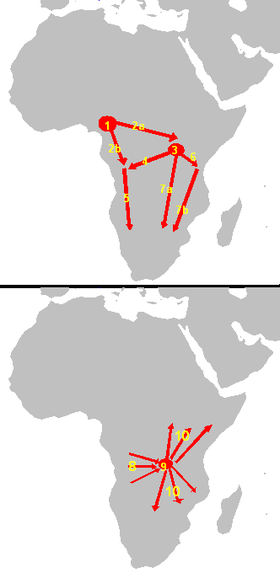 Current scholarly understanding places the ancestral proto-Bantu homeland near the southwestern modern boundary of Nigeria and Cameroon ca. 4,000 years ago (2000 B.C.), and regards the Bantu languages as a branch of the Niger–Congo
language family
. This view represents a resolution of debates in the 1960s over competing theories advanced by Joseph Greenberg
and Malcolm Guthrie
, in favor of refinements of Greenberg's theory. Based on wide comparisons including non-Bantu languages, Greenberg argued that Proto-Bantu, the hypothetical ancestor of the Bantu languages, had strong ancestral affinities with a group of languages spoken in Southeastern Nigeria
. He proposed that Bantu languages had spread east and south from there, to secondary centers of further dispersion, over hundreds of years.
Using a different comparative method focused more exclusively on relationships among Bantu languages, Guthrie argued for a single central African dispersal point spreading at a roughly equal rate in all directions. Subsequent research on loanwords for adaptations in agriculture and animal husbandry and on the wider Niger–Congo language family rendered that thesis untenable. In the 1990s Jan Vansina
proposed a modification of Greenberg's ideas, in which dispersions from secondary and tertiary centers resembled Guthrie's central node idea, but from a number of regional centers rather than just one, creating linguistic clusters.
It is unclear when exactly the spread of Bantu-speakers began from their core area as hypothesized ca. 5,000 years ago. By 3,500 years ago (1500 B.C.) in the west, Bantu-speaking communities had reached the great Central African rain forest, and by 2,500 years ago (500 B.C.) pioneering groups had emerged into the savannah
s to the south, in what are now the Democratic Republic of Congo, Angola
and Zambia
. Another stream of migration, moving east, by 3,000 years ago (1000 B.C.) was creating a major new population center near the Great Lakes of East Africa, where a rich environment supported a dense population. Movements by small groups to the southeast from the Great Lakes region were more rapid, with initial settlements widely dispersed near the coast and near rivers, due to comparatively harsh farming conditions in areas farther from water. Pioneering groups had reached modern KwaZulu-Natal in South Africa by A.D. 300 along the coast, and the modern Northern Province (encompassed within the former province of the Transvaal
) by A.D. 500.
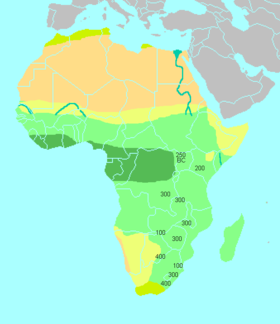 Before the expansion of farming and herding peoples, including those speaking Bantu languages, Africa
south of the equator was populated by neolithic
hunting and foraging peoples. Some of them were ancestral to modern Central African forest peoples (so-called Pygmies) who now speak Bantu languages. Others were proto-Khoisan
-speaking peoples, whose few modern hunter-forager and linguistic descendants today occupy the arid regions around the Kalahari desert. Many more Khoekhoe and San
descendants have a Coloured
identity in South Africa
and Namibia
, speaking Afrikaans
and English
. The small Hadza and Sandawe populations in Tanzania
comprise the other modern hunter-forager remnant in Africa
.
Over a period of many centuries, most hunting-foraging peoples were displaced and absorbed by incoming Bantu-speaking communities, as well as by Ubangian, Nilotic and Central Sudanic language-speakers in North Central and Eastern Africa. The Bantu expansion was a long series of physical migrations, a diffusion of language and knowledge out into and in from neighboring populations, and a creation of new societal groups involving inter-marriage among communities and small groups moving to communities and small groups moving to new areas.
.jpg) After their movements from their original homeland in West Africa, Bantus also encountered in East Africa
After their movements from their original homeland in West Africa, Bantus also encountered in East Africa
peoples of Cushitic
origin. As cattle terminology in use amongst the few modern Bantu pastoralist groups suggests, the Bantu migrants would acquire cattle
from their new Cushitic neighbors. Linguistic evidence also indicates that Bantus likely borrowed the custom of milking cattle directly from Cushitic peoples in the area. Later interactions between Bantu and Cushitic peoples resulted in Bantu groups with significant Cushitic admixture and culturo-linguistic influences, such as the Herero herdsmen of southern Africa.
On the coastal section of East Africa, another mixed Bantu community developed through contact with Muslim
Arab
and Persian
traders. The Swahili culture
that emerged from these exchanges evinces many Arab and Islamic influences not seen in traditional Bantu culture, as do the many Afro-Arab
members of the Bantu Swahili people
. With its original speech community centered on the coastal parts of Zanzibar
, Kenya
and Tanzania
-- a seaboard referred to as the Swahili Coast
-- the Bantu Swahili language
contains many Arabic
loan-words as a consequence of these interactions.
Between the 14th and 15th centuries, Bantu-speaking states began to emerge in the Great Lakes region in the savannah south of the Central African rainforest. On the Zambezi river, the Monomatapa kings built the famous Great Zimbabwe
complex, a civilization whose origins and ethnic affiliations are uncertain. From the 16th century onward. processes of state formation amongst Bantu peoples increased in frequency. This was probably due to denser population (which led to more specialized divisions of labor, including military power, while making emigration more difficult); to increased interaction amongst Bantu-speaking communities with Chinese
, Europe
an, Indonesia
n and Arab traders on the coasts; to technological developments in economic activity; and to new techniques in the political-spiritual ritualization of royalty as the source of national strength and health.
") to refer collectively to Bantu-speaking South Africans. After World War II
, the racialist National Party
governments adopted that usage officially, while the growing African nationalist movement and its liberal white allies turned to the term "African" instead, so that "Bantu" became identified with the policies of apartheid. By the 1970s this so discredited "Bantu" as an ethno-racial designation that the apartheid government switched to the term "Black" in its official racial categorizations, restricting it to Bantu-speaking Africans, at about the same time that the Black Consciousness Movement
led by Steve Biko
and others were defining "Black" to mean all racially oppressed South Africans (Africans, Coloureds and Indians
).
Examples of South African usages of "Bantu" include:
Bantu languages
The Bantu languages constitute a traditional sub-branch of the Niger–Congo languages. There are about 250 Bantu languages by the criterion of mutual intelligibility, though the distinction between language and dialect is often unclear, and Ethnologue counts 535 languages...
, distributed from Cameroon
Cameroon
Cameroon, officially the Republic of Cameroon , is a country in west Central Africa. It is bordered by Nigeria to the west; Chad to the northeast; the Central African Republic to the east; and Equatorial Guinea, Gabon, and the Republic of the Congo to the south. Cameroon's coastline lies on the...
east across Central Africa
Central Africa
Central Africa is a core region of the African continent which includes Burundi, the Central African Republic, Chad, the Democratic Republic of the Congo, and Rwanda....
and Eastern Africa to Southern Africa
Southern Africa
Southern Africa is the southernmost region of the African continent, variably defined by geography or geopolitics. Within the region are numerous territories, including the Republic of South Africa ; nowadays, the simpler term South Africa is generally reserved for the country in English.-UN...
. There are about 250 Bantu languages by the criterion of mutual intelligibility
Mutual intelligibility
In linguistics, mutual intelligibility is recognized as a relationship between languages or dialects in which speakers of different but related languages can readily understand each other without intentional study or extraordinary effort...
, though the distinction between language and dialect is often unclear, and Ethnologue
Ethnologue
Ethnologue: Languages of the World is a web and print publication of SIL International , a Christian linguistic service organization, which studies lesser-known languages, to provide the speakers with Bibles in their native language and support their efforts in language development.The Ethnologue...
counts 535 languages.
The Bantu family is fragmented into hundreds of individual groups, none of them larger than a few million people (the largest being the Zulu
Zulu language
Zulu is the language of the Zulu people with about 10 million speakers, the vast majority of whom live in South Africa. Zulu is the most widely spoken home language in South Africa as well as being understood by over 50% of the population...
with some 10 million). The Bantu language Swahili
Swahili language
Swahili or Kiswahili is a Bantu language spoken by various ethnic groups that inhabit several large stretches of the Mozambique Channel coastline from northern Kenya to northern Mozambique, including the Comoro Islands. It is also spoken by ethnic minority groups in Somalia...
with its merely 5-10 million native speakers is of super-regional importance as tens of millions fluently command it as a second language.
Etymology
Bantu or its various forms means the people or humans. The word appears in all Bantu languages in various forms, for example as watu in SwahiliSwahili language
Swahili or Kiswahili is a Bantu language spoken by various ethnic groups that inhabit several large stretches of the Mozambique Channel coastline from northern Kenya to northern Mozambique, including the Comoro Islands. It is also spoken by ethnic minority groups in Somalia...
, batu in Lingala
Lingala language
Lingala, or Ngala, is a Bantu language spoken throughout the northwestern part of the Democratic Republic of the Congo and a large part of the Republic of the Congo , as well as to some degree in Angola and the Central African Republic. It has over 10 million speakers...
,bato in Duala
Duala language
Duala is the language spoken by the Duala people of Cameroon. The language belonges to the Bantu language family, and a subgroup of it called the Duala languages...
,abantu in Zulu
Zulu language
Zulu is the language of the Zulu people with about 10 million speakers, the vast majority of whom live in South Africa. Zulu is the most widely spoken home language in South Africa as well as being understood by over 50% of the population...
and Ganda, Vanhu in Shona
Shona language
Shona is a Bantu language, native to the Shona people of Zimbabwe and southern Zambia; the term is also used to identify peoples who speak one of the Shona language dialects: Zezuru, Karanga, Manyika, Ndau and Korekore...
and Vandu in some Luhya dialects.
Origins and expansion
Niger–Congo languages
The Niger–Congo languages constitute one of the world's major language families, and Africa's largest in terms of geographical area, number of speakers, and number of distinct languages. They may constitute the world's largest language family in terms of distinct languages, although this question...
language family
Language family
A language family is a group of languages related through descent from a common ancestor, called the proto-language of that family. The term 'family' comes from the tree model of language origination in historical linguistics, which makes use of a metaphor comparing languages to people in a...
. This view represents a resolution of debates in the 1960s over competing theories advanced by Joseph Greenberg
Joseph Greenberg
Joseph Harold Greenberg was a prominent and controversial American linguist, principally known for his work in two areas, linguistic typology and the genetic classification of languages.- Early life and career :...
and Malcolm Guthrie
Malcolm Guthrie
Malcolm Guthrie , professor of Bantu languages, is known primarily for his classification of Bantu languages...
, in favor of refinements of Greenberg's theory. Based on wide comparisons including non-Bantu languages, Greenberg argued that Proto-Bantu, the hypothetical ancestor of the Bantu languages, had strong ancestral affinities with a group of languages spoken in Southeastern Nigeria
Nigeria
Nigeria , officially the Federal Republic of Nigeria, is a federal constitutional republic comprising 36 states and its Federal Capital Territory, Abuja. The country is located in West Africa and shares land borders with the Republic of Benin in the west, Chad and Cameroon in the east, and Niger in...
. He proposed that Bantu languages had spread east and south from there, to secondary centers of further dispersion, over hundreds of years.
Using a different comparative method focused more exclusively on relationships among Bantu languages, Guthrie argued for a single central African dispersal point spreading at a roughly equal rate in all directions. Subsequent research on loanwords for adaptations in agriculture and animal husbandry and on the wider Niger–Congo language family rendered that thesis untenable. In the 1990s Jan Vansina
Jan Vansina
Jan Vansina is a historian and anthropologist specializing in Africa. He is the foremost authority on the history of the peoples of Central Africa.-Biography:...
proposed a modification of Greenberg's ideas, in which dispersions from secondary and tertiary centers resembled Guthrie's central node idea, but from a number of regional centers rather than just one, creating linguistic clusters.
It is unclear when exactly the spread of Bantu-speakers began from their core area as hypothesized ca. 5,000 years ago. By 3,500 years ago (1500 B.C.) in the west, Bantu-speaking communities had reached the great Central African rain forest, and by 2,500 years ago (500 B.C.) pioneering groups had emerged into the savannah
Savannah
Savannah or savanna is a type of grassland.It can also mean:-People:* Savannah King, a Canadian freestyle swimmer* Savannah Outen, a singer who gained popularity on You Tube...
s to the south, in what are now the Democratic Republic of Congo, Angola
Angola
Angola, officially the Republic of Angola , is a country in south-central Africa bordered by Namibia on the south, the Democratic Republic of the Congo on the north, and Zambia on the east; its west coast is on the Atlantic Ocean with Luanda as its capital city...
and Zambia
Zambia
Zambia , officially the Republic of Zambia, is a landlocked country in Southern Africa. The neighbouring countries are the Democratic Republic of the Congo to the north, Tanzania to the north-east, Malawi to the east, Mozambique, Zimbabwe, Botswana and Namibia to the south, and Angola to the west....
. Another stream of migration, moving east, by 3,000 years ago (1000 B.C.) was creating a major new population center near the Great Lakes of East Africa, where a rich environment supported a dense population. Movements by small groups to the southeast from the Great Lakes region were more rapid, with initial settlements widely dispersed near the coast and near rivers, due to comparatively harsh farming conditions in areas farther from water. Pioneering groups had reached modern KwaZulu-Natal in South Africa by A.D. 300 along the coast, and the modern Northern Province (encompassed within the former province of the Transvaal
Transvaal Province
Transvaal Province was a province of the Union of South Africa from 1910 to 1961, and of its successor, the Republic of South Africa, from 1961 until the end of apartheid in 1994 when a new constitution subdivided it.-History:...
) by A.D. 500.
Africa
Africa is the world's second largest and second most populous continent, after Asia. At about 30.2 million km² including adjacent islands, it covers 6% of the Earth's total surface area and 20.4% of the total land area...
south of the equator was populated by neolithic
Neolithic
The Neolithic Age, Era, or Period, or New Stone Age, was a period in the development of human technology, beginning about 9500 BC in some parts of the Middle East, and later in other parts of the world. It is traditionally considered as the last part of the Stone Age...
hunting and foraging peoples. Some of them were ancestral to modern Central African forest peoples (so-called Pygmies) who now speak Bantu languages. Others were proto-Khoisan
Khoisan languages
The Khoisan languages are the click languages of Africa which do not belong to other language families. They include languages indigenous to southern and eastern Africa, though some, such as the Khoi languages, appear to have moved to their current locations not long before the Bantu expansion...
-speaking peoples, whose few modern hunter-forager and linguistic descendants today occupy the arid regions around the Kalahari desert. Many more Khoekhoe and San
Bushmen
The indigenous people of Southern Africa, whose territory spans most areas of South Africa, Zimbabwe, Lesotho, Mozambique, Swaziland, Botswana, Namibia, and Angola, are variously referred to as Bushmen, San, Sho, Barwa, Kung, or Khwe...
descendants have a Coloured
Coloured
In the South African, Namibian, Zambian, Botswana and Zimbabwean context, the term Coloured refers to an heterogenous ethnic group who possess ancestry from Europe, various Khoisan and Bantu tribes of Southern Africa, West Africa, Indonesia, Madagascar, Malaya, India, Mozambique,...
identity in South Africa
South Africa
The Republic of South Africa is a country in southern Africa. Located at the southern tip of Africa, it is divided into nine provinces, with of coastline on the Atlantic and Indian oceans...
and Namibia
Namibia
Namibia, officially the Republic of Namibia , is a country in southern Africa whose western border is the Atlantic Ocean. It shares land borders with Angola and Zambia to the north, Botswana to the east and South Africa to the south and east. It gained independence from South Africa on 21 March...
, speaking Afrikaans
Afrikaans
Afrikaans is a West Germanic language, spoken natively in South Africa and Namibia. It is a daughter language of Dutch, originating in its 17th century dialects, collectively referred to as Cape Dutch .Afrikaans is a daughter language of Dutch; see , , , , , .Afrikaans was historically called Cape...
and English
English language
English is a West Germanic language that arose in the Anglo-Saxon kingdoms of England and spread into what was to become south-east Scotland under the influence of the Anglian medieval kingdom of Northumbria...
. The small Hadza and Sandawe populations in Tanzania
Tanzania
The United Republic of Tanzania is a country in East Africa bordered by Kenya and Uganda to the north, Rwanda, Burundi, and the Democratic Republic of the Congo to the west, and Zambia, Malawi, and Mozambique to the south. The country's eastern borders lie on the Indian Ocean.Tanzania is a state...
comprise the other modern hunter-forager remnant in Africa
Africa
Africa is the world's second largest and second most populous continent, after Asia. At about 30.2 million km² including adjacent islands, it covers 6% of the Earth's total surface area and 20.4% of the total land area...
.
Over a period of many centuries, most hunting-foraging peoples were displaced and absorbed by incoming Bantu-speaking communities, as well as by Ubangian, Nilotic and Central Sudanic language-speakers in North Central and Eastern Africa. The Bantu expansion was a long series of physical migrations, a diffusion of language and knowledge out into and in from neighboring populations, and a creation of new societal groups involving inter-marriage among communities and small groups moving to communities and small groups moving to new areas.
East Africa
East Africa or Eastern Africa is the easterly region of the African continent, variably defined by geography or geopolitics. In the UN scheme of geographic regions, 19 territories constitute Eastern Africa:...
peoples of Cushitic
Cushitic languages
The Cushitic languages are a branch of the Afroasiatic language family spoken in the Horn of Africa, Tanzania, Kenya, Sudan and Egypt. They are named after the Biblical character Cush, who was identified as an ancestor of the speakers of these specific languages as early as AD 947...
origin. As cattle terminology in use amongst the few modern Bantu pastoralist groups suggests, the Bantu migrants would acquire cattle
Cattle
Cattle are the most common type of large domesticated ungulates. They are a prominent modern member of the subfamily Bovinae, are the most widespread species of the genus Bos, and are most commonly classified collectively as Bos primigenius...
from their new Cushitic neighbors. Linguistic evidence also indicates that Bantus likely borrowed the custom of milking cattle directly from Cushitic peoples in the area. Later interactions between Bantu and Cushitic peoples resulted in Bantu groups with significant Cushitic admixture and culturo-linguistic influences, such as the Herero herdsmen of southern Africa.
On the coastal section of East Africa, another mixed Bantu community developed through contact with Muslim
Muslim
A Muslim, also spelled Moslem, is an adherent of Islam, a monotheistic, Abrahamic religion based on the Quran, which Muslims consider the verbatim word of God as revealed to prophet Muhammad. "Muslim" is the Arabic term for "submitter" .Muslims believe that God is one and incomparable...
Arab
Arab
Arab people, also known as Arabs , are a panethnicity primarily living in the Arab world, which is located in Western Asia and North Africa. They are identified as such on one or more of genealogical, linguistic, or cultural grounds, with tribal affiliations, and intra-tribal relationships playing...
and Persian
Persian people
The Persian people are part of the Iranian peoples who speak the modern Persian language and closely akin Iranian dialects and languages. The origin of the ethnic Iranian/Persian peoples are traced to the Ancient Iranian peoples, who were part of the ancient Indo-Iranians and themselves part of...
traders. The Swahili culture
Swahili culture
Swahili culture is the culture of the Swahili people living on the east coast of Tanzania, Kenya, and Mozambique as well as on the islands in the area, from Zanzibar to Comoros, who speak Swahili as their native language....
that emerged from these exchanges evinces many Arab and Islamic influences not seen in traditional Bantu culture, as do the many Afro-Arab
Afro-Arab
Afro-Arab refers to people of mixed Black African and genealogical Arab ancestral heritage and/or linguistically and culturally Arabized Black Africans...
members of the Bantu Swahili people
Swahili people
The Swahili people are a Bantu ethnic group and culture found in East Africa, mainly in the coastal regions and the islands of Kenya, Tanzania and north Mozambique. According to JoshuaProject, the Swahili number in at around 1,328,000. The name Swahili is derived from the Arabic word Sawahil,...
. With its original speech community centered on the coastal parts of Zanzibar
Zanzibar
Zanzibar ,Persian: زنگبار, from suffix bār: "coast" and Zangi: "bruin" ; is a semi-autonomous part of Tanzania, in East Africa. It comprises the Zanzibar Archipelago in the Indian Ocean, off the coast of the mainland, and consists of numerous small islands and two large ones: Unguja , and Pemba...
, Kenya
Kenya
Kenya , officially known as the Republic of Kenya, is a country in East Africa that lies on the equator, with the Indian Ocean to its south-east...
and Tanzania
Tanzania
The United Republic of Tanzania is a country in East Africa bordered by Kenya and Uganda to the north, Rwanda, Burundi, and the Democratic Republic of the Congo to the west, and Zambia, Malawi, and Mozambique to the south. The country's eastern borders lie on the Indian Ocean.Tanzania is a state...
-- a seaboard referred to as the Swahili Coast
Swahili Coast
The Swahili Coast refers to the coast or coastal area of East Africa inhabited by the Swahili people, mainly Kenya, Tanzania, and north Mozambique...
-- the Bantu Swahili language
Swahili language
Swahili or Kiswahili is a Bantu language spoken by various ethnic groups that inhabit several large stretches of the Mozambique Channel coastline from northern Kenya to northern Mozambique, including the Comoro Islands. It is also spoken by ethnic minority groups in Somalia...
contains many Arabic
Arabic language
Arabic is a name applied to the descendants of the Classical Arabic language of the 6th century AD, used most prominently in the Quran, the Islamic Holy Book...
loan-words as a consequence of these interactions.
Between the 14th and 15th centuries, Bantu-speaking states began to emerge in the Great Lakes region in the savannah south of the Central African rainforest. On the Zambezi river, the Monomatapa kings built the famous Great Zimbabwe
Great Zimbabwe
Great Zimbabwe is a ruined city that was once the capital of the Kingdom of Zimbabwe, which existed from 1100 to 1450 C.E. during the country’s Late Iron Age. The monument, which first began to be constructed in the 11th century and which continued to be built until the 14th century, spanned an...
complex, a civilization whose origins and ethnic affiliations are uncertain. From the 16th century onward. processes of state formation amongst Bantu peoples increased in frequency. This was probably due to denser population (which led to more specialized divisions of labor, including military power, while making emigration more difficult); to increased interaction amongst Bantu-speaking communities with Chinese
China
Chinese civilization may refer to:* China for more general discussion of the country.* Chinese culture* Greater China, the transnational community of ethnic Chinese.* History of China* Sinosphere, the area historically affected by Chinese culture...
, Europe
Europe
Europe is, by convention, one of the world's seven continents. Comprising the westernmost peninsula of Eurasia, Europe is generally 'divided' from Asia to its east by the watershed divides of the Ural and Caucasus Mountains, the Ural River, the Caspian and Black Seas, and the waterways connecting...
an, Indonesia
Indonesia
Indonesia , officially the Republic of Indonesia , is a country in Southeast Asia and Oceania. Indonesia is an archipelago comprising approximately 13,000 islands. It has 33 provinces with over 238 million people, and is the world's fourth most populous country. Indonesia is a republic, with an...
n and Arab traders on the coasts; to technological developments in economic activity; and to new techniques in the political-spiritual ritualization of royalty as the source of national strength and health.
The use of the term "Bantu" in South Africa
In the 1920s relatively liberal white South Africans, missionaries and the small black intelligentsia began to use the term "Bantu" in preference to "Native" and more derogatory terms (such as "KaffirKaffir (racial term)
The word kaffir, sometimes spelled kaffer or kafir, is an offensive term for a black person, most common in South Africa and other African countries...
") to refer collectively to Bantu-speaking South Africans. After World War II
World War II
World War II, or the Second World War , was a global conflict lasting from 1939 to 1945, involving most of the world's nations—including all of the great powers—eventually forming two opposing military alliances: the Allies and the Axis...
, the racialist National Party
National Party (South Africa)
The National Party is a former political party in South Africa. Founded in 1914, it was the governing party of the country from 4 June 1948 until 9 May 1994. Members of the National Party were sometimes known as Nationalists or Nats. Its policies included apartheid, the establishment of a...
governments adopted that usage officially, while the growing African nationalist movement and its liberal white allies turned to the term "African" instead, so that "Bantu" became identified with the policies of apartheid. By the 1970s this so discredited "Bantu" as an ethno-racial designation that the apartheid government switched to the term "Black" in its official racial categorizations, restricting it to Bantu-speaking Africans, at about the same time that the Black Consciousness Movement
Black Consciousness Movement
The Black Consciousness Movement was a grassroots anti-Apartheid activist movement that emerged in South Africa in the mid-1960s out of the political vacuum created by the jailing and banning of the African National Congress and Pan Africanist Congress leadership after the Sharpeville Massacre in...
led by Steve Biko
Steve Biko
Stephen Biko was a noted anti-apartheid activist in South Africa in the 1960s and 1970s. A student leader, he later founded the Black Consciousness Movement which would empower and mobilize much of the urban black population. Since his death in police custody, he has been called a martyr of the...
and others were defining "Black" to mean all racially oppressed South Africans (Africans, Coloureds and Indians
Asians in South Africa
The majority of the Asian South African population is Indian in origin, most of them descended from indentured workers transported to work in the 19th century on the sugar plantations of the eastern coastal area, then known as Natal. They are largely English speaking, although many also retain the...
).
Examples of South African usages of "Bantu" include:
- One of South Africa's politicians of recent times, General Bantubonke Harrington Holomisa (Bantubonke is a compound noun meaning "all the people"), is known as Bantu HolomisaBantu HolomisaBantubonke Harrington Holomisa is a South African Member of Parliament and President of the United Democratic Movement.Holomisa was born in Mqanduli, Eastern Cape. He joined the Transkei Defence Force in 1976 and had become a Brigadier by 1985...
. - The South African apartheid governments originally gave the name "bantustanBantustanA bantustan was a territory set aside for black inhabitants of South Africa and South West Africa , as part of the policy of apartheid...
s" to the eleven rural reserve areas intended for a spurious, ersatz independence to deny Africans South African citizenship. "Bantustan" originally reflected an analogy to the various ethnic "-stans" of Western and Central Asia. Again association with apartheid discredited the term, and the South African government shifted to the politically appealing but historically deceptive term "ethnic homelands". Meanwhile the anti-apartheid movement persisted in calling the areas bantustans, to drive home their political illegitimacy. - The abstract noun ubuntu, humanity or humaneness, is derived regularly from the Nguni noun stem -ntu in isiXhosa, isiZulu and siNdebele. In siSwati the stem is -ntfu and the noun is buntfu.
- In the Sotho–Tswana languages of southern Africa, batho is the cognate term to Nguni abantu, illustrating that such cognates need not actually look like the -ntu root exactly. The early African National CongressAfrican National CongressThe African National Congress is South Africa's governing Africanist political party, supported by its tripartite alliance with the Congress of South African Trade Unions and the South African Communist Party , since the establishment of non-racial democracy in April 1994. It defines itself as a...
of South Africa had a newspaper called Abantu-Batho from 1912–1933, which carried columns in English, isiZulu, Sesotho, and isiXhosa.
See also
- Centre International des Civilisations BantuCentre International des Civilisations BantuThe Centre International des Civilisations Bantu is a cultural organization based in Libreville, Gabon. Established at the initiative of Gabonese president Omar Bongo on January 8, 1983, it is the world's primary organization dedicated to the study of the Bantu peoples.CICIBA's member nations...
- Candomblé BantuCandomblé BantuBantu, also called Batuque or Angola, is one of the major sects of Candomblé, an African faith tradition practiced in Brazil. It developed among slaves who spoke Bantu languages.-Deities:...
- Bantu Educational Kinema ExperimentBantu Educational Kinema ExperimentThe Bantu Educational Kinema Experiment was a project of the International Missionary Council in coordination with the Carnegie Corporation of New York and British colonial governments of Tanganyika, Kenya, Uganda, Northern Rhodesia and Nyasaland in the mid-1930s...