

Caniformia

Encyclopedia
Caniformia, or Canoidea (literally "dog-like"), is a suborder within the order Carnivora
. They typically possess a long snout and non-retractile claws (in contrast to the cat-like carnivorans, the Feliformia
). The Pinnipedia (seals
, sea lions and walruses) evolved from caniform ancestors and are accordingly assigned to this group. Most members of this group have non-retractile claws (the fisher
, marten
, red panda
and ringtail have retractile or semi-retractile claws) and tend to be plantigrade
(with the exception of Canidae
). Other traits that separate Caniformia from Feliformia is that caniforms have longer jaw
s and have more teeth, with less specialized carnassial teeth. They also tend more towards omnivorous
and opportunistic feeding, while the feliforms are more specialized for eating meat. Caniforms have single-chambered or partially divided auditory bullae, composed of a single bone, while in feliforms the auditory bullae are double-chambered, composed of two bones joined by a septum
.
The Family Canidae
(canids, commonly known as either dogs or canines) includes wolves, dog
s and fox
es. They are the most social of all the caniforms, living in packs. The dog is the most diverse of all mammals in terms of body structure variants. The Canidae family is divided into the "true dogs" of the tribe Canini and the "foxes" of the tribe Vulpini. The two species of the basal Caninae are more primitive and don't fit into either tribe.
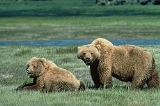
The Family Ursidae (the bears) are the largest of all the land caniforms. They range from the large polar bear
(males, 775–1500+ lb) to the small sun bear
(males, 66–132 lb) and from the endangered giant panda
to the very common black bear
. Common characteristics of modern bears include a large body with stocky legs, a long snout, shaggy hair, plantigrade
paws with five nonretractile claws and a short tail. While the polar bear
is mostly carnivorous and the giant panda
feeds almost entirely on bamboo
, the remaining six species are omnivorous, with largely varied diets including both plants and animals.
The Family Ailuridae
(red panda
) was once thought to be either part of the Procyonidae or the Ursidae. It is now placed in its own family. It is found in the Himalayas
, including southern China
, Nepal
, Bhutan
, India
and Pakistan
; fossil species of the family also lived in North America
.
The Family Mephitidae (skunks), once thought to be part of the Mustelidae
, is now recognized as a group in its own right. There are 11 species of skunks, which are divided into four genera
: Mephitis
(hooded and striped skunks, two species), Spilogale (spotted skunks, two species), Mydaus
(stink badgers, two species) and Conepatus (hog-nosed skunk
s, five species). The two skunk species in the Mydaus genus inhabit Indonesia
and the Philippines
; all other skunks inhabit the Americas
from Canada
to central South America
.
The Family Mustelidae
(badgers, weasels and otters) is the most diverse of the group. While highly variable in shape, size and behavior, most mustelids are smaller animals with short legs, short round ears and thick fur. Mustelids are predominantly carnivorous. While not all mustelids share identical dentition
, they all possess teeth adapted for eating flesh, including the presence of shearing carnassial
s.
.jpg) The Family Procyonidae
The Family Procyonidae
(raccoons, coatis, etc.), are smallish animals, with generally slender bodies and long tails. Except for the kinkajou
, all procyonids have banded tails and distinct facial markings and, like bears, are plantigrade
, walking on the soles of their feet. Most species have non-retractile claws. It has been suggested that early procyonids were an offshoot of the canids
that adapted to a more omnivorous diet.
The clade
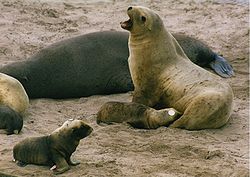
Pinnipedia (seals, sea lions, walruses) are a widely distributed and diverse group of semi-aquatic marine mammal
s descended from a common ancestor
most closely related to modern bears. The group comprises three families:
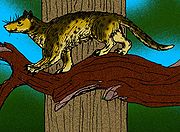 Caniforms first appeared as tree-climbing, superficially marten
-like carnivores in the Eocene
around 42 million years ago. Miacis cognitus
was probably an early caniform. Like many other early carnivorans, it was well suited for tree climbing with needle sharp claws, and had limbs and joints that resemble those of modern carnivorans. Miacis cognitus was probably a very agile forest dweller that preyed on smaller animals, such as small mammal
s, reptile
s and bird
s. Maybe Miacis cognitus also ate egg
s and fruit
s, which would mean it was an omnivore
.
Recent molecular evidence suggests that pinnipeds evolved from a bearlike ancestor about 23 million years ago during the late
Oligocene
or early Miocene
epochs, a transitional period between the warmer Paleogene
and cooler Neogene
period.
Carnivora
The diverse order Carnivora |Latin]] carō "flesh", + vorāre "to devour") includes over 260 species of placental mammals. Its members are formally referred to as carnivorans, while the word "carnivore" can refer to any meat-eating animal...
. They typically possess a long snout and non-retractile claws (in contrast to the cat-like carnivorans, the Feliformia
Feliformia
The Feliformia are a suborder within the order Carnivora and includes cats , hyenas, mongooses, civets and related taxa. The other suborder of Carnivora is Caniformia...
). The Pinnipedia (seals
Pinniped
Pinnipeds or fin-footed mammals are a widely distributed and diverse group of semiaquatic marine mammals comprising the families Odobenidae , Otariidae , and Phocidae .-Overview: Pinnipeds are typically sleek-bodied and barrel-shaped...
, sea lions and walruses) evolved from caniform ancestors and are accordingly assigned to this group. Most members of this group have non-retractile claws (the fisher
Fisher (animal)
The fisher is a medium-size mammal native to North America. It is a member of the mustelid family, commonly referred to as the weasel family. The fisher is closely related to but larger than the American Marten...
, marten
Marten
The martens constitute the genus Martes within the subfamily Mustelinae, in family Mustelidae.-Description:Martens are slender, agile animals, adapted to living in taigas, and are found in coniferous and northern deciduous forests across the northern hemisphere. They have bushy tails, and large...
, red panda
Red Panda
The red panda , is a small arboreal mammal native to the eastern Himalayas and southwestern China. It is the only species of the genus Ailurus. Slightly larger than a domestic cat, it has reddish-brown fur, a long, shaggy tail, and a waddling gait due to its shorter front legs...
and ringtail have retractile or semi-retractile claws) and tend to be plantigrade
Plantigrade
right|151px|thumb|Human skeleton, showing plantigrade habitIn terrestrial animals, plantigrade locomotion means walking with the podials and metatarsals flat on the ground. It is one of three forms of locomotion adopted by mammals...
(with the exception of Canidae
Canidae
Canidae is the biological family of carnivorous and omnivorous mammals that includes wolves, foxes, jackals, coyotes, and domestic dogs. A member of this family is called a canid . The Canidae family is divided into two tribes: Canini and Vulpini...
). Other traits that separate Caniformia from Feliformia is that caniforms have longer jaw
Jaw
The jaw is any opposable articulated structure at the entrance of the mouth, typically used for grasping and manipulating food. The term jaws is also broadly applied to the whole of the structures constituting the vault of the mouth and serving to open and close it and is part of the body plan of...
s and have more teeth, with less specialized carnassial teeth. They also tend more towards omnivorous
Omnivore
Omnivores are species that eat both plants and animals as their primary food source...
and opportunistic feeding, while the feliforms are more specialized for eating meat. Caniforms have single-chambered or partially divided auditory bullae, composed of a single bone, while in feliforms the auditory bullae are double-chambered, composed of two bones joined by a septum
Septum
In anatomy, a septum is a wall, dividing a cavity or structure into smaller ones.-In human anatomy:...
.
Extant families
Caniformia consists of twelve families, with nine extant and three extinct. The extant Caniform families are monophyletic according to their molecular phylogeny. At one time, Hyaenidae were included, but are now grouped with feliforms. Terrestrial caniforms in the wild are found on all continents with the exception of Antarctica, while pinnipeds are distributed throughout the world's oceans.The Family Canidae
Canidae
Canidae is the biological family of carnivorous and omnivorous mammals that includes wolves, foxes, jackals, coyotes, and domestic dogs. A member of this family is called a canid . The Canidae family is divided into two tribes: Canini and Vulpini...
(canids, commonly known as either dogs or canines) includes wolves, dog
Dog
The domestic dog is a domesticated form of the gray wolf, a member of the Canidae family of the order Carnivora. The term is used for both feral and pet varieties. The dog may have been the first animal to be domesticated, and has been the most widely kept working, hunting, and companion animal in...
s and fox
Fox
Fox is a common name for many species of omnivorous mammals belonging to the Canidae family. Foxes are small to medium-sized canids , characterized by possessing a long narrow snout, and a bushy tail .Members of about 37 species are referred to as foxes, of which only 12 species actually belong to...
es. They are the most social of all the caniforms, living in packs. The dog is the most diverse of all mammals in terms of body structure variants. The Canidae family is divided into the "true dogs" of the tribe Canini and the "foxes" of the tribe Vulpini. The two species of the basal Caninae are more primitive and don't fit into either tribe.
The Family Ursidae (the bears) are the largest of all the land caniforms. They range from the large polar bear
Polar Bear
The polar bear is a bear native largely within the Arctic Circle encompassing the Arctic Ocean, its surrounding seas and surrounding land masses. It is the world's largest land carnivore and also the largest bear, together with the omnivorous Kodiak Bear, which is approximately the same size...
(males, 775–1500+ lb) to the small sun bear
Sun Bear
The sun bear , sometimes known as the honey bear, is a bear found primarily in the tropical rainforests of Southeast Asia; North-East India, Bangladesh, Myanmar, Thailand, Laos, Cambodia, Vietnam, Southern China, Peninsular Malaysia, and the islands of Sumatra and Borneo.-Description:The sun bear...
(males, 66–132 lb) and from the endangered giant panda
Giant Panda
The giant panda, or panda is a bear native to central-western and south western China. It is easily recognized by its large, distinctive black patches around the eyes, over the ears, and across its round body. Though it belongs to the order Carnivora, the panda's diet is 99% bamboo...
to the very common black bear
American black bear
The American black bear is a medium-sized bear native to North America. It is the continent's smallest and most common bear species. Black bears are omnivores, with their diets varying greatly depending on season and location. They typically live in largely forested areas, but do leave forests in...
. Common characteristics of modern bears include a large body with stocky legs, a long snout, shaggy hair, plantigrade
Plantigrade
right|151px|thumb|Human skeleton, showing plantigrade habitIn terrestrial animals, plantigrade locomotion means walking with the podials and metatarsals flat on the ground. It is one of three forms of locomotion adopted by mammals...
paws with five nonretractile claws and a short tail. While the polar bear
Polar Bear
The polar bear is a bear native largely within the Arctic Circle encompassing the Arctic Ocean, its surrounding seas and surrounding land masses. It is the world's largest land carnivore and also the largest bear, together with the omnivorous Kodiak Bear, which is approximately the same size...
is mostly carnivorous and the giant panda
Giant Panda
The giant panda, or panda is a bear native to central-western and south western China. It is easily recognized by its large, distinctive black patches around the eyes, over the ears, and across its round body. Though it belongs to the order Carnivora, the panda's diet is 99% bamboo...
feeds almost entirely on bamboo
Bamboo
Bamboo is a group of perennial evergreens in the true grass family Poaceae, subfamily Bambusoideae, tribe Bambuseae. Giant bamboos are the largest members of the grass family....
, the remaining six species are omnivorous, with largely varied diets including both plants and animals.
The Family Ailuridae
Ailuridae
Ailuridae is a family in the mammal order Carnivora. The family includes the Red Panda and its extinct relatives.-Classification history:...
(red panda
Red Panda
The red panda , is a small arboreal mammal native to the eastern Himalayas and southwestern China. It is the only species of the genus Ailurus. Slightly larger than a domestic cat, it has reddish-brown fur, a long, shaggy tail, and a waddling gait due to its shorter front legs...
) was once thought to be either part of the Procyonidae or the Ursidae. It is now placed in its own family. It is found in the Himalayas
Himalayas
The Himalaya Range or Himalaya Mountains Sanskrit: Devanagari: हिमालय, literally "abode of snow"), usually called the Himalayas or Himalaya for short, is a mountain range in Asia, separating the Indian subcontinent from the Tibetan Plateau...
, including southern China
China
Chinese civilization may refer to:* China for more general discussion of the country.* Chinese culture* Greater China, the transnational community of ethnic Chinese.* History of China* Sinosphere, the area historically affected by Chinese culture...
, Nepal
Nepal
Nepal , officially the Federal Democratic Republic of Nepal, is a landlocked sovereign state located in South Asia. It is located in the Himalayas and bordered to the north by the People's Republic of China, and to the south, east, and west by the Republic of India...
, Bhutan
Bhutan
Bhutan , officially the Kingdom of Bhutan, is a landlocked state in South Asia, located at the eastern end of the Himalayas and bordered to the south, east and west by the Republic of India and to the north by the People's Republic of China...
, India
India
India , officially the Republic of India , is a country in South Asia. It is the seventh-largest country by geographical area, the second-most populous country with over 1.2 billion people, and the most populous democracy in the world...
and Pakistan
Pakistan
Pakistan , officially the Islamic Republic of Pakistan is a sovereign state in South Asia. It has a coastline along the Arabian Sea and the Gulf of Oman in the south and is bordered by Afghanistan and Iran in the west, India in the east and China in the far northeast. In the north, Tajikistan...
; fossil species of the family also lived in North America
North America
North America is a continent wholly within the Northern Hemisphere and almost wholly within the Western Hemisphere. It is also considered a northern subcontinent of the Americas...
.
The Family Mephitidae (skunks), once thought to be part of the Mustelidae
Mustelidae
Mustelidae , commonly referred to as the weasel family, are a family of carnivorous mammals. Mustelids are diverse and the largest family in the order Carnivora, at least partly because in the past it has been a catch-all category for many early or poorly differentiated taxa...
, is now recognized as a group in its own right. There are 11 species of skunks, which are divided into four genera
Genus
In biology, a genus is a low-level taxonomic rank used in the biological classification of living and fossil organisms, which is an example of definition by genus and differentia...
: Mephitis
Mephitis (genus)
The genus Mephitis is one of several genera of skunks, which has two species and a North American distribution.*Striped Skunk *Hooded Skunk...
(hooded and striped skunks, two species), Spilogale (spotted skunks, two species), Mydaus
Mydaus
Mydaus is a genus of Old World carnivore comprising two species of stink badger. There are two species - the Palawan stink badger , and the Sunda stink badger or Teledu...
(stink badgers, two species) and Conepatus (hog-nosed skunk
Hog-nosed skunk
The hog-nosed skunks belong to the genus Conepatus and are members of the family Mephitidae . They are native to the Americas. They have white backs and tails and black underparts...
s, five species). The two skunk species in the Mydaus genus inhabit Indonesia
Indonesia
Indonesia , officially the Republic of Indonesia , is a country in Southeast Asia and Oceania. Indonesia is an archipelago comprising approximately 13,000 islands. It has 33 provinces with over 238 million people, and is the world's fourth most populous country. Indonesia is a republic, with an...
and the Philippines
Philippines
The Philippines , officially known as the Republic of the Philippines , is a country in Southeast Asia in the western Pacific Ocean. To its north across the Luzon Strait lies Taiwan. West across the South China Sea sits Vietnam...
; all other skunks inhabit the Americas
Americas
The Americas, or America , are lands in the Western hemisphere, also known as the New World. In English, the plural form the Americas is often used to refer to the landmasses of North America and South America with their associated islands and regions, while the singular form America is primarily...
from Canada
Canada
Canada is a North American country consisting of ten provinces and three territories. Located in the northern part of the continent, it extends from the Atlantic Ocean in the east to the Pacific Ocean in the west, and northward into the Arctic Ocean...
to central South America
South America
South America is a continent situated in the Western Hemisphere, mostly in the Southern Hemisphere, with a relatively small portion in the Northern Hemisphere. The continent is also considered a subcontinent of the Americas. It is bordered on the west by the Pacific Ocean and on the north and east...
.
The Family Mustelidae
Mustelidae
Mustelidae , commonly referred to as the weasel family, are a family of carnivorous mammals. Mustelids are diverse and the largest family in the order Carnivora, at least partly because in the past it has been a catch-all category for many early or poorly differentiated taxa...
(badgers, weasels and otters) is the most diverse of the group. While highly variable in shape, size and behavior, most mustelids are smaller animals with short legs, short round ears and thick fur. Mustelids are predominantly carnivorous. While not all mustelids share identical dentition
Dentition
Dentition pertains to the development of teeth and their arrangement in the mouth. In particular, the characteristic arrangement, kind, and number of teeth in a given species at a given age...
, they all possess teeth adapted for eating flesh, including the presence of shearing carnassial
Carnassial
Carnassials are large teeth found in many carnivorous mammals, used for shearing flesh and bone in a scissor- or shear-like way. In the Carnivora, the carnassials are the modified last upper premolar and the first molar, but in the prehistoric creodonts, the carnassials were further back in the...
s.
Procyonidae
Procyonidae is a New World family of the order Carnivora. It includes the raccoons, coatis, kinkajous, olingos, ringtails and cacomistles. Procyonids inhabit a wide range of environments, and are generally omnivorous.-Characteristics:...
(raccoons, coatis, etc.), are smallish animals, with generally slender bodies and long tails. Except for the kinkajou
Kinkajou
The kinkajou , also known as the honey bear , is a rainforest mammal of the family Procyonidae related to olingos, coatis, raccoons, and the ringtail and cacomistle. It is the only member of the genus Potos. Kinkajous may be mistaken for ferrets or monkeys, but are not closely related...
, all procyonids have banded tails and distinct facial markings and, like bears, are plantigrade
Plantigrade
right|151px|thumb|Human skeleton, showing plantigrade habitIn terrestrial animals, plantigrade locomotion means walking with the podials and metatarsals flat on the ground. It is one of three forms of locomotion adopted by mammals...
, walking on the soles of their feet. Most species have non-retractile claws. It has been suggested that early procyonids were an offshoot of the canids
Canidae
Canidae is the biological family of carnivorous and omnivorous mammals that includes wolves, foxes, jackals, coyotes, and domestic dogs. A member of this family is called a canid . The Canidae family is divided into two tribes: Canini and Vulpini...
that adapted to a more omnivorous diet.
The clade
Clade
A clade is a group consisting of a species and all its descendants. In the terms of biological systematics, a clade is a single "branch" on the "tree of life". The idea that such a "natural group" of organisms should be grouped together and given a taxonomic name is central to biological...
Pinnipedia (seals, sea lions, walruses) are a widely distributed and diverse group of semi-aquatic marine mammal
Marine mammal
Marine mammals, which include seals, whales, dolphins, and walruses, form a diverse group of 128 species that rely on the ocean for their existence. They do not represent a distinct biological grouping, but rather are unified by their reliance on the marine environment for feeding. The level of...
s descended from a common ancestor
Enaliarctos
Enaliarctos is an extinct genus of pinniped.Prior to the discovery of Puijila, the five species in the genus Enaliarctos represented the oldest known pinniped fossils, having been recovered from late Oligocene and early Miocene strata of California and Oregon.It had a short tail and developed...
most closely related to modern bears. The group comprises three families:
- Phocidae: (true seals or earless seals) comprise around 19 species of highly aquatically adapted, barrel-shaped animals ranging from 45 kg and 1.2 meters in length (the Ringed SealRinged SealThe ringed seal , also known as the jar seal and as netsik or nattiq by the Inuit, is an earless seal inhabiting the Arctic and sub-Arctic regions...
), to 2,400 kg and 5 meters (Southern Elephant SealSouthern Elephant SealThe Southern Elephant Seal is one of the two extant species of elephant seal. It is both the most massive pinniped and member of the order Carnivora living today...
). Phocids are found throughout the world's oceans.
- Otariidae: (the eared seals, including sea lions and fur seals) Distributed throughout the world's oceans with the exception of the North Atlantic, the 16 species of otariid are distinguished from the phocids by visible external ears (pinnae), more dog-like faces and the ability to turn their rear flippers forward.
- OdobenidaeOdobenidaeOdobenidae is a family of Pinnipeds. The only living species is walrus.In the past, however, the group was much more diverse, and includes more than ten fossil genera.- Taxonomy :All genera, except Odobenus, are extinct.*Prototaria...
(the walrusWalrusThe walrus is a large flippered marine mammal with a discontinuous circumpolar distribution in the Arctic Ocean and sub-Arctic seas of the Northern Hemisphere. The walrus is the only living species in the Odobenidae family and Odobenus genus. It is subdivided into three subspecies: the Atlantic...
is the only surviving member). A large (2000 kg), distinctive pinniped with long whiskersVibrissaeVibrissae , or whiskers, are specialized hairs usually employed for tactile sensation. The term may also refer to the thick hairs found inside human nostrils, but these have no sensorial function and only operate as an airborne particulate barrier...
and tusks, the walrus has a discontinuous circumpolar distribution in the Arctic OceanArctic OceanThe Arctic Ocean, located in the Northern Hemisphere and mostly in the Arctic north polar region, is the smallest and shallowest of the world's five major oceanic divisions...
and sub-Arctic seas of the Northern HemisphereNorthern HemisphereThe Northern Hemisphere is the half of a planet that is north of its equator—the word hemisphere literally means “half sphere”. It is also that half of the celestial sphere north of the celestial equator...
. It is primarily a benthic forager of bivalve mollusks and other marine invertebratesMarine invertebratesMarine invertebrates are animals that inhabit a marine environment and are invertebrates, lacking a vertebral column. In order to protect themselves, they may have evolved a shell or a hard exoskeleton, but this is not always the case....
.
Evolutionary history
Marten
The martens constitute the genus Martes within the subfamily Mustelinae, in family Mustelidae.-Description:Martens are slender, agile animals, adapted to living in taigas, and are found in coniferous and northern deciduous forests across the northern hemisphere. They have bushy tails, and large...
-like carnivores in the Eocene
Eocene
The Eocene Epoch, lasting from about 56 to 34 million years ago , is a major division of the geologic timescale and the second epoch of the Paleogene Period in the Cenozoic Era. The Eocene spans the time from the end of the Palaeocene Epoch to the beginning of the Oligocene Epoch. The start of the...
around 42 million years ago. Miacis cognitus
Miacis cognitus
Miacis cognitus is the only species of the diverse genus Miacis that is regarded as belonging to the crown-group Carnivora, within the Caniformia. The type specimen or holotype was discovered in Reeve's bonebed, western Texas, in the Chambers Tuff Formation in 1986. The University of Texas holds...
was probably an early caniform. Like many other early carnivorans, it was well suited for tree climbing with needle sharp claws, and had limbs and joints that resemble those of modern carnivorans. Miacis cognitus was probably a very agile forest dweller that preyed on smaller animals, such as small mammal
Mammal
Mammals are members of a class of air-breathing vertebrate animals characterised by the possession of endothermy, hair, three middle ear bones, and mammary glands functional in mothers with young...
s, reptile
Reptile
Reptiles are members of a class of air-breathing, ectothermic vertebrates which are characterized by laying shelled eggs , and having skin covered in scales and/or scutes. They are tetrapods, either having four limbs or being descended from four-limbed ancestors...
s and bird
Bird
Birds are feathered, winged, bipedal, endothermic , egg-laying, vertebrate animals. Around 10,000 living species and 188 families makes them the most speciose class of tetrapod vertebrates. They inhabit ecosystems across the globe, from the Arctic to the Antarctic. Extant birds range in size from...
s. Maybe Miacis cognitus also ate egg
Egg (biology)
An egg is an organic vessel in which an embryo first begins to develop. In most birds, reptiles, insects, molluscs, fish, and monotremes, an egg is the zygote, resulting from fertilization of the ovum, which is expelled from the body and permitted to develop outside the body until the developing...
s and fruit
Fruit
In broad terms, a fruit is a structure of a plant that contains its seeds.The term has different meanings dependent on context. In non-technical usage, such as food preparation, fruit normally means the fleshy seed-associated structures of certain plants that are sweet and edible in the raw state,...
s, which would mean it was an omnivore
Omnivore
Omnivores are species that eat both plants and animals as their primary food source...
.
Recent molecular evidence suggests that pinnipeds evolved from a bearlike ancestor about 23 million years ago during the late
Chattian
The Chattian is, in the geologic timescale, the youngest of two ages or upper of two stages of the Oligocene epoch/series. It spans the time between and . The Chattian is preceded by the Rupelian and is followed by the Aquitanian .-Stratigraphic definition:The Chattian was introduced by Austrian...
Oligocene
Oligocene
The Oligocene is a geologic epoch of the Paleogene Period and extends from about 34 million to 23 million years before the present . As with other older geologic periods, the rock beds that define the period are well identified but the exact dates of the start and end of the period are slightly...
or early Miocene
Miocene
The Miocene is a geological epoch of the Neogene Period and extends from about . The Miocene was named by Sir Charles Lyell. Its name comes from the Greek words and and means "less recent" because it has 18% fewer modern sea invertebrates than the Pliocene. The Miocene follows the Oligocene...
epochs, a transitional period between the warmer Paleogene
Paleogene
The Paleogene is a geologic period and system that began 65.5 ± 0.3 and ended 23.03 ± 0.05 million years ago and comprises the first part of the Cenozoic Era...
and cooler Neogene
Neogene
The Neogene is a geologic period and system in the International Commission on Stratigraphy Geologic Timescale starting 23.03 ± 0.05 million years ago and ending 2.588 million years ago...
period.