

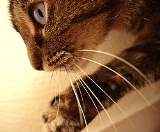
Vibrissae

Encyclopedia


Vibrissae or whiskers, are specialized hair
Hair
Hair is a filamentous biomaterial, that grows from follicles found in the dermis. Found exclusively in mammals, hair is one of the defining characteristics of the mammalian class....
s (or, in certain bird
Bird
Birds are feathered, winged, bipedal, endothermic , egg-laying, vertebrate animals. Around 10,000 living species and 188 families makes them the most speciose class of tetrapod vertebrates. They inhabit ecosystems across the globe, from the Arctic to the Antarctic. Extant birds range in size from...
species, specialized feather
Feather
Feathers are one of the epidermal growths that form the distinctive outer covering, or plumage, on birds and some non-avian theropod dinosaurs. They are considered the most complex integumentary structures found in vertebrates, and indeed a premier example of a complex evolutionary novelty. They...
s) usually employed for tactile sensation. The term may also refer to the thick hairs found inside human
Human
Humans are the only living species in the Homo genus...
nostrils, but these have no sensorial function and only operate as an airborne particulate barrier. Vibrissae hair grow around the nostril
Nostril
A nostril is one of the two channels of the nose, from the point where they bifurcate to the external opening. In birds and mammals, they contain branched bones or cartilages called turbinates, whose function is to warm air on inhalation and remove moisture on exhalation...
s, above the lips, and on other parts of the face of most mammal
Mammal
Mammals are members of a class of air-breathing vertebrate animals characterised by the possession of endothermy, hair, three middle ear bones, and mammary glands functional in mothers with young...
s, and all primates except man, as well as on the forelegs and feet of some animals. The presence of mystacial (where a moustache would be) vibrissae in distinct lineages (Rodentia, Afrotheria
Afrotheria
Afrotheria is a clade of mammals, the living members of which belong to groups from Africa or of African origin: golden moles, sengis , tenrecs, aardvarks, hyraxes, elephants and sea cows. The common ancestry of these animals was not recognized until the late 1990s...
, Marsupials) with remarkable conservation of operation suggests that they may be an old feature present in a common ancestor of all therian mammals
Theria
Theria is a subclass of mammals that give birth to live young without using a shelled egg, including both eutherians and metatherians . The only omitted extant mammal group is the egg-laying monotremes....
. Indeed, some humans even still develop vestigial vibrissal muscles in the upper lip, consistent with the hypothesis that our lineage had mystacial vibrissae in the past.
Anatomy
Vibrissae are usually thicker and stiffer than other types of hair but consist of inert material and contain no nerveNerve
A peripheral nerve, or simply nerve, is an enclosed, cable-like bundle of peripheral axons . A nerve provides a common pathway for the electrochemical nerve impulses that are transmitted along each of the axons. Nerves are found only in the peripheral nervous system...
s, like other hairs. However, vibrissae are different from other hairs because they are implanted in a special Hair follicle
Hair follicle
A hair follicle is a skin organ that produces hair. Hair production occurs in phases, including a growth phase , and cessation phase , and a rest phase . Stem cells are principally responsible for the production of hair....
incorporating a capsule of blood
Blood
Blood is a specialized bodily fluid in animals that delivers necessary substances such as nutrients and oxygen to the cells and transports metabolic waste products away from those same cells....
called a blood sinus
Sinus (anatomy)
Sinus is Latin for "bay", "pocket", "curve", or "bosom". In anatomy, the term is used in various contexts.A sinus is a sack or cavity in any organ or tissue, or an abnormal cavity or passage caused by the destruction of tissue...
and heavily innervated by sensory nerves.
A wide range of species have a similar arrangement of mystacial vibrissae (see images). The arrangement of whiskers is not random: they form an ordered grid of arcs (columns) and rows, with shorter whiskers at the front and longer whiskers at the rear (see images). In mouse, gerbil, hamster, rat, guinea pig, rabbit, and cat, each individual follicle is innvervated by 100-200 primary afferent nerve cells . These cells serve an even larger number of Mechanoreceptors of at least eight distinct types. Accordingly, even small deflections of the vibrissal hair can evoke a sensory response in the animal. Seal whiskers, which are similarly arrayed across the mystacial region, are served by as many as 1,500 nerve cells each.
Rats and mice typically sport around 30 whiskers on each side of the face, with whisker lengths up to around 50mm in (laboratory) rats and 30mm in (laboratory) mice. Thus, a rough estimate for the total number of sensory nerve cells serving the vibrissal array on the face of a rat or mouse might be over 9000. Manatees, remarkably, have around 600 vibrissae on or around their lips - indeed, it seems that all of their hairs, all over their body, are vibrissae rather than Fur
Fur
Fur is a synonym for hair, used more in reference to non-human animals, usually mammals; particularly those with extensives body hair coverage. The term is sometimes used to refer to the body hair of an animal as a complete coat, also known as the "pelage". Fur is also used to refer to animal...
(pelagic hairs).
Whiskers can be very long in some species; the length of a chinchilla
Chinchilla
Chinchillas are crepuscular rodents, slightly larger and more robust than ground squirrels, and are native to the Andes mountains in South America. Along with their relatives, viscachas, they make up the family Chinchillidae....
's whiskers can be more than a third of its body length (see image). Even in species with shorter whiskers, they can be very prominent appendages (see images).
Whisker movement
In some mammals, some vibrissa follicles are motile. Typically, these are the large vibrissae (macrovibrissae) towards the rear of the mystacial area, whilst the supraorbital (above the eye) vibrissae and the much shorter vibrissae arrayed around the mouth or on the lips (microvibrissae) are immotile (see the whiskers held to the side, and out in front, in the two images of cats, below). A small muscle 'sling' is attached to each macrovibrissa and can move it more-or-less independently of the others, whilst larger muscles in the surrounding tissue move many or all of the whiskers together.Dorothy Souza, in her book "Look What Whiskers Can Do" has:
"Whiskers bend forward as the cat pounces. Teeth grasp the mouse tightly around its neck. The cat holds on until the prey stops wriggling."
Amongst those species with motile whiskers, some (rats, mice, flying squirrels, gerbils, chincillas, hamsters, shrews, porcupines, opossums) palpate their vibrissae, a movement known as 'whisking' (Video of rat whisking), while other species (cats, dogs, racoons, pandas) do not appear to. The distribution of mechanoreceptor types in the whisker follicle differs between rats and cats, which may correspond to this difference in the way they are used. Whisking movements are amongst the fastest produced by mammals. In all whisking animals in which it has so far been measured, these whisking movements are precisely and rapidly controlled in response to behavioural and environmental conditions.
The purpose of whisking is presumed to be to serve tactile sensing in some way, though the exact answer to the question 'Why whisk?' is a matter of debate, and is probably multi-faceted. Scholarpedia offers:
"Since rapid movement of the vibrissae consumes energy, and has required the evolution of specialised musculature, it can be assumed that whisking must convey some sensory advantages to the animal. Likely benefits are that it provides more degrees of freedom for sensor positioning, that it allows the animal to sample a larger volume of space with a given density of whiskers, and that it allows control over the velocity with which the whiskers contact surfaces."
Function
Why might an animal be driven "to beat the night with sticks", as one researcher once put it? Generally, vibrissae are considered to mediate a tactile sense, complementary to the tactile sense offered by skin. This is advantageous in particular to animals that cannot always rely on sight to navigate or to find food (for example, nocturnal animals).Vibrissae have been shown to be required for, or to contribute to: object localization, orienting of the snout, detection of movement, texture discrimination, shape discrimination. Deprived of their vibrissal sense, rats and shrews have shown deficits in exploration, thigmotaxis
Taxis
A taxis is an innate behavioral response by an organism to a directional stimulus or gradient of stimulus intensity. A taxis differs from a tropism in that the organism has motility and demonstrates guided movement towards or away from the stimulus source ...
, locomotion, maintenance of equilibrium, maze learning, swimming, locating food pellets, and fighting. The function of vibrissae is a very active research area. Sensing function aside, movements of the vibrissae may indicate something of the state of mind of the animal, and the whiskers play a role in social behaviour in rats.
Whilst contact with the whiskers is the most obvious stimulus to evoke a behavioural response, air currents are also effective. Indeed, some aquatic mammals (such as seals) probably make the most use of their whiskers in detecting water currents, which enables them to follow the path of an object that 'swam' ahead several minutes past and even to discriminate the species and/or size of the fish responsible for the trail.
Anecdotally, it is often stated that cats use their whiskers to gauge whether an opening is wide enough for their body to pass through (e.g. Why Do Cats Have Whiskers?, Cat Behaviour Explained). This is sometimes supported by the statement that the whiskers of individual cats extend out to about the same width as the cat's body, but at least one report indicates that whisker length is genetically determined and does not vary as the cat grows thinner or fatter. Certainly, rats have been shown in the laboratory to be able to accurately (within 5-10%) discriminate the size of an opening, so it seems likely that cats can use their whiskers for this task. However, reports of cats (particularly, kittens) with their heads firmly stuck in some discarded receptacle are commonplace (e.g. Cops save kitten with head stuck in can) indicating that, if a cat has this information available, it doesn't always make best use of it.
Neuroanatomy
A large part of the brainBrain
The brain is the center of the nervous system in all vertebrate and most invertebrate animals—only a few primitive invertebrates such as sponges, jellyfish, sea squirts and starfishes do not have one. It is located in the head, usually close to primary sensory apparatus such as vision, hearing,...
of whisker-specialist mammals is involved in the processing of nerve impulses from vibrissae, a fact that presumably corresponds to the important position the sense occupies for the animal. Information from the vibrissae arrives in the brain via the trigeminal nerve
Trigeminal nerve
The trigeminal nerve contains both sensory and motor fibres. It is responsible for sensation in the face and certain motor functions such as biting, chewing, and swallowing. Sensory information from the face and body is processed by parallel pathways in the central nervous system...
and is delivered first into the trigeminal sensory complex of brainstem. From there, the most studied pathways are those leading up through parts of thalamus
Thalamus
The thalamus is a midline paired symmetrical structure within the brains of vertebrates, including humans. It is situated between the cerebral cortex and midbrain, both in terms of location and neurological connections...
and into barrel cortex
Barrel cortex
The barrel cortex refers to the dark-staining regions of layer four of the somatosensory cortex where somatosensory inputs from the contralateral side of the body come in from the thalamus. Barrels are found in some species of rodents and species of at least two other orders. The rest of this...
, though other major pathways through Superior colliculus
Superior colliculus
The optic tectum or simply tectum is a paired structure that forms a major component of the vertebrate midbrain. In mammals this structure is more commonly called the superior colliculus , but, even in mammals, the adjective tectal is commonly used. The tectum is a layered structure, with a...
in midbrain (a major visual structure in visual animals) and Cerebellum
Cerebellum
The cerebellum is a region of the brain that plays an important role in motor control. It may also be involved in some cognitive functions such as attention and language, and in regulating fear and pleasure responses, but its movement-related functions are the most solidly established...
, to name but a couple, are increasingly coming under scrutiny. Aside from its use as a model sensory system, neuroscientists studying many aspects of brain function favour the system for a number of reasons (see Barrel cortex
Barrel cortex
The barrel cortex refers to the dark-staining regions of layer four of the somatosensory cortex where somatosensory inputs from the contralateral side of the body come in from the thalamus. Barrels are found in some species of rodents and species of at least two other orders. The rest of this...
).
Artificial whiskers
Recently, researchers have begun to build artificial whiskers of a variety of types, both to help them to understand how biological whiskers work and as a possibly useful tactile sense for robots. These efforts range from the fairly abstract , through feature-specific models (Sculpted Face, AMouse), to attempts to reproduce complete whiskered animals in robot form (ScratchBot, ShrewBot (incorrectly labelled), ShrewBot again, both robots by Bristol Robotics Laboratory). An upcoming article at Scholarpedia will discuss the history of Whiskered Robots in detail.Further reading
- A night in the life of a rat, Annals of the New York Academy of Sciences, 1225:110–118, April 2011.