


South Africa national rugby union team

Encyclopedia
The South African national rugby union
team (the Springboks) are 2009 British and Irish Lions
Series winners. They are currently ranked as the fourth best team in the IRB World Rankings
and were named 2008 World Team of the Year at the prestigious Laureus World Sports Awards.
Although South Africa was instrumental in the creation of the Rugby World Cup competition, the Springboks did not compete in the first two World Cups in 1987
and 1991
because of anti-apartheid
sporting boycotts of South Africa. The team made its World Cup debut in 1995
, when the newly democratic South Africa hosted the tournament. The Springboks then defeated the All Blacks
15–12 in the final
, which is now remembered as one of the greatest moments in South Africa's sporting history, and a watershed moment in the post-Apartheid nation-building process. South Africa regained their title as champions 12 years later, when they defeated England
15–6 in the 2007 final
. As a result of the 2007 World Cup tournament the Springboks were promoted to first place in the IRB World Rankings; a position they held until July the following year when New Zealand regained the top spot.
The Springboks play in green and gold jerseys, and their emblems are the Springbok and the Protea
. The side have been playing international rugby since 1891, when a British Isles
side toured the nation, playing South Africa in their first Test on 30 July. South Africa was coached by Jake White
, who led the Boks to the 2007 World Cup title, announced his resignation effective at the end of 2007. His replacement Peter de Villiers
contract expired in 2011, following a 11-9 defeat to Australia in the Rugby World Cup quarter-final and stated he would not be signing a new deal. The current captain is John Smit
, who has played hooker for most of his career, although he has also been a prop, mainly in 2008 and 2009. Due to Smit being unavailable for the November 2010 Tests
after surgery, lock Victor Matfield
took Smit's place as captain for that tour.
 The first British Isles
tour took place in 1891, with the trip financially underwritten by Cape Colony
Prime Minister Cecil Rhodes. These were the first representative games played by South African sides, who were still learning the game. The tourists played and won a total of twenty matches, conceding only one point in the process. South Africa's first Tests were played, although South Africa did not exist as political unit until 1910. In a notable event of the tour, the British side presented the Currie Cup
to Griqualand West
, the province they thought produced the best performance on the tour.
The British Isles' success continued on their 21 game tour of 1896
. The British Isles won three out of the four Tests against South Africa. South Africa's play improved markedly from 1891. Their forwards were particularly impressive, and their first Test win in the final game was a pointer to the future. For the first time South Africa had worn myrtle green shirts, which their captain, Barry Heatlie, borrowed from his Old Diocesans club. Rugby was given a huge boost by the early Lions tours, which created great interest in the South African press.
Rugby was so popular that in 1902 there was a temporary ceasefire in the Second Boer War
so that a game could be played between British and Boer forces. The game had spread among the Afrikaner population through POW
games during the Boer War, and afterwards Stellenbosch University
became a training ground for future players and administrators.
In 1903 the British Isles lost a series for the first time in South Africa, drawing the opening two Tests before losing the last 8–0. In all, the tourists won just 11 of their 22 tour games. By contrast, South Africa would not lose another series—home or away—until 1956.
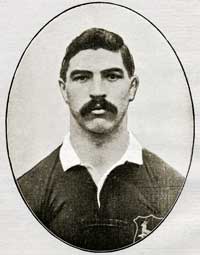
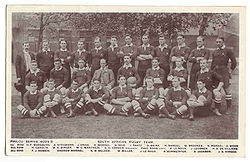 Paul Roos
was the captain of the first South African team to tour the British Isles and France
. The team was largely dominated by players from Western Province, and took place over 1906–07. The team played 29 matches; including Tests against all four Home Nations
. England managed a draw, but Scotland was the only one of the Home unions to gain a victory.
During this tour the nickname Springboks was first used. There is often confusion as to the springbok symbol being worn before the name was invented, but this may be down to the fact the tour manager, J.C. Carden, spoke of having no 'uniforms or blazers' with the icon, though he did not appear to mean the jerseys. It was reported in the Daily Mail on the 20 September 1906, seven days before the first match, that 'The team's colours will be myrtle green with gold collar... and will have embroidered in mouse-coloured silk on the left breast a Springbok'. Carden later stated:
Newspaper reporters were to call the team "De Springbokken", and later The Daily Mail printed an article referring to the "Springboks". The team thereafter wore blazers with a springbok on the left breast pocket. Historically the term 'Springbok' was applied to any team or individual representing South Africa in international competition regardless of sporting discipline. This tradition was abandoned with the advent of South Africa's new democratic government in 1994. The trip helped heal wounds after the Boer War and instilled a sense of national pride among South Africans.
The South Africans crossed the channel to play an unofficial match against a 'France' team drawn from the two Parisian clubs: Stade Français and Racing Club de France
. The official French team were in England at the time. The Springboks won 55–6 and scored 13 tries in the process.
The 1910 British Isles tour of South Africa was the first to include representatives from all four Home unions. The team performed moderately against the non-test parties, claiming victories in just over half their matches. The tourists won just one of their three Tests.
The Boks' second European tour took place in 1912–13. They beat the four Home nations to earn their first Grand Slam
and also went on to defeat France.
The 1924 British and Irish Lions team to South Africa struggled with injuries and won only nine of 21 games. They lost all four Tests to the Springboks, but despite the results, the tour produced some attractive rugby. This was the first side to pick up the name Lions, apparently picked up from the Lions embroidered on their ties.
The All Blacks first toured South Africa in 1928, and again the Test series finished level. Despite playing most of the second half with only 14 men, with a dominant scrum and fly-half Bennie Osler
, the Springboks won the first Test 17–0 to inflict the All Blacks' heaviest defeat since 1893. The All Blacks rebounded to win the second Test 7–6. After a Springbok win in the third Test, the Springboks needed to win the fourth to secure a series victory. The New Zealanders bought back Mark Nicholls for his only Test of the series, and their captain Maurice Brownlie
told the team a week before the Test that "Under no circumstances whatever is anyone of you so much as to touch a rugby ball until we play the Springboks in the last test." Their tactics were successful and the All Blacks won 13–5 to draw the series.
Despite winning South Africa's second Grand Slam, the Springbok tourists of 1931–32 were an unloved team. They had a jumbo pack and a kicking fly-half in captain Bennie Osler
. Their tactics of kicking for territory earned them criticism both in South Africa and abroad. It was successful however, the team winning against England, Ireland, Scotland and Wales, as well as defeating all their Welsh opponents for the first time.
In 1937 South Africa toured New Zealand and Australia
and broke the deadlock with a series win in New Zealand. Their 2–1 series win prompted them to be called "the best team to ever leave New Zealand". Despite the All Blacks winning the first Test, the Springboks' won in the third Test 17–6 and scored five tries to none. The All Blacks' loss was considered a humiliation in New Zealand.
The British Isles toured South Africa again in 1938, winning more than half of their normal matches. The Springboks easily claimed the first two tests. But the tourists recorded a surprise win in the third Test, the first Lions win in South Africa since 1910.
was appointed coach in 1949, and started his coaching career with a bang. The Springboks won ten matches in a row, including a 4–0 whitewash of New Zealand on their 1949 tour to South Africa. Prop Okey Geffin helped kick the Springboks to victory—they won all four Tests despite the All Blacks scoring more tries in three of them. The 1951–52 team that toured Europe was considered amongst the finest Springbok sides to tour. The team won the Grand Slam as well as defeating France. Hennie Muller
captained the side after original captain Basil Kenyon suffered a serious eye injury. The South African highlight of the tour was a 44–0 defeat of Scotland. The defeat of Scotland included nine tries, and was a record at the time. The team finished with only one loss, to London Counties, from 31 matches.
In 1954, Australia toured South Africa for the second time and although they lost the series they were given a standing ovation after defeating South Africa 18–14 in a thrilling 2nd Test at Newlands. Wallaby Captain John Solomon was chaired off the field by two South African players. This was the first Springbok defeat for 15 years.
During their 1955 tour to South Africa, the Lions won 19 and drew one from the 25 fixtures. The four-test series ended in a draw. In 1956 the All Blacks won its first series over the Springboks, in what Chris Hewett called "in the most bitterly fought series in history." Surprise selection Don Clarke
from Waikato
—nicknamed the Boot—kicked the decisive penalties in the final Tests.
South Africa had defeated France 25–3 at Colombes Stadium in 1952, and when France toured South Africa in 1958 they were not expected to compete. Georges Duthen described the mood of the French players before their first Test in 1958: "They were going into battle. A Battle for France. And they hadn't a hope..." France exceeded expectations and drew 3–3 with after a drop goal to French scrum-half Pierre Danos and unconverted try to South Africa's Butch Lochner. The French then secured a Test series victory in South Africa with their 9–5 victory in front of 90,000 spectators in Johannesburg. The French feared the South African forwards, especially their scrum, and focused much of their training before the series on improving the "South African" style of their forwards. The decisive moment of the match was French forward Jean Barthe's tackle on Jan Prinsloo
near the French try-line prevented a certain try. The momentum then swung to France who scored drop-goals—one each to Pierre Lacaze and Roger Martine—to secure the historic victory.
and Jimmy Mill from the 1928 All Blacks tour, and the dropping of Ranji Wilson
from the New Zealand Army team nine years before that, had attracted little comment at the time. However, in 1960 international criticism of apartheid grew in the wake of the The Wind of Change
speech and the Sharpeville massacre
.
From this point onward, the Springboks were increasingly the target of international controversy and protest. The All Blacks toured in 1960, despite a campaign based on the slogan of "No Maoris, No Tour", and a 150,000 signature petition opposing it. The Springboks avenged their 1956 series defeat by winning the Test series 2–1 with a Test drawn. The first match was won 13–0 by the Springboks with two tries to Hennie van Zyl. New Zealand journalist Noel Holmes said after the match "I hang my head in shame for having suggested that your forwards might be slow, even unfit." The All Blacks won the second Test 11–3 which they did so with a dominant forward pack and the tactical kicking of Don Clarke. The players selected for the third and fourth Tests formed the core of Springboks side for the next three seasons. The third Test was drawn 11–11 after a last minute sideline conversion from All Black Don Clarke. The deciding Test was won 8–3 by the Springboks with the decisive try scored by Martin Pelser.
Later that same year the Springboks themselves toured, and led by Avril Malan they defeated all four Home unions for their fourth Grand Slam. On a four-month, 34 game sweep through Europe they played a ruthless, forward-oriented game in which intimidation was a key part, and opposition players suffered a string of controversial injuries. However, they lost their final game 6–0 against the Barbarians
in Cardiff
, beaten when perhaps the Barbarians' pack played an uncharacteristically pragmatic game.
In 1962 the British Isles, won 16 of their 25 games on their tour to South Africa, but did not do so well in the Tests—losing all three. In 1963 the touring Wallabies beat the Springboks in consecutive Tests, the first team to do so since the 1896 British team.
Wales toured South Africa and played several games and one Test in 1964—their first overseas tour. They lost the Test against South Africa in Durban
24–3, their biggest defeat in 40 years. At the Welsh Rugby Union
(WRU) annual general meeting that year, the outgoing WRU President D. Ewart Davies declared that "it was evident from the experience of the South African Tour that a much more positive attitude to the game was required in Wales... Players must be prepared to learn, and indeed re-learn, to the absolute point of mastery, the basic principles of Rugby Union football."
South Africa had a disastrous year in 1965, losing on tour to Ireland, Scotland, Australia (twice) and New Zealand (three times) while winning just once against New Zealand. The planned 1967 tour by the All Blacks was cancelled by the New Zealand Rugby Football Union after the South African government refused to allow Maori players.
In 1968 the Lions toured and won 15 of their 16 provincial matches, but lost three Tests and drew one. Next year the 1969 Springbok tour to Britain and Ireland found a new spirit and confidence had developed in Home nations rugby, and the tourists lost two of their seven games in Wales—against Newport and a composite side from Monmouthshire
. Wales nearly claimed their first win against the Springboks as the game ended 6–6. The Springboks lost the Test matches against England and Scotland, drawing the one against Ireland. Throughout the tour however, large anti-apartheid demonstrations were a feature, and many matches had to be played behind barbed wire fences.
The Springbok tour of Australia in 1971
began with matches in Perth
, then Adelaide
and Melbourne. The Springboks won all three Tests, scoring 18–6, 14–6, and 19–11. As in Britain three years before however, massive anti-apartheid demonstrations greeted the team, and they had to be transported by the Royal Australian Air Force
after the trade unions refused to service planes or trains transporting them. Although a tour of New Zealand had been planned for 1973, it was blocked by New Zealand Prime Minister Norman Kirk
on the grounds of public safety.
The Lions team that toured South Africa in 1974 led by Willie John McBride
was unbeaten over 22 games, and triumphed 3–0 (with one drawn) in the Test series. A key feature was the Lions' infamous '99 call'. Lions management had decided that the Springboks dominated their opponents with physical aggression, so decided "to get their retaliation in first". At the call of '99' each Lions player would attack their nearest rival player. The idea was that a South African referee would be unlikely to send off all of the Lions. At the "battle of Boet Erasmus Stadium
"—one of the most violent matches in rugby history—JPR Williams famously ran over half of the pitch and launched himself at 'Moaner' van Heerden after such a call.
The 1976 All Blacks tour of South Africa went ahead, and the Springboks won by three Tests to one, but coming shortly after the Soweto riots
the tour attracted international condemnation and 28 countries boycotted the 1976 Summer Olympics
in protest, and the next year, in 1977, the Commonwealth signed the Gleneagles Agreement
, which discouraged any sporting contact with South Africa. In response to the growing pressure the segregated South African rugby unions merged in 1977. Four years later Errol Tobias
would became the first non-white South African to represent his country when he took the field against Ireland. A planned 1979 Springbok tour of France was stopped by the French government, who announced that it was inappropriate for South African teams to tour France.
The 1981 tour of New Zealand
went ahead in defiance of the Gleneagles Agreement. South Africa lost the series 2–1, but the tour and the massive civil disruption in New Zealand had ramifications far beyond rugby.
South Africa sought to counteract its sporting isolation by inviting the South American Jaguars
to tour. The team contained mainly Argentinian players, whose national team had struggled to attract strong international opposition. Eight matches were played between the two teams in the early 1980s—all awarded Test status.
In 1984
England toured losing both test matches on tour. Of the players selected, only Ralph Knibbs of Bristol refused to tour for political reasons.
In 1985, a planned All Black tour of South Africa was stopped by the New Zealand High Court. A rebel tour took place the next year by a team known as the Cavaliers
. The team was not sanctioned by the New Zealand Rugby Football Union, yet consisted of all but two of the original squad that had been selected. For some of the tests, the team was advertised, inside South Africa as the All Blacks whilst at the others they were advertised as the New Zealand Cavaliers. The Springboks won the series 3–1.
In 1989, a World XV sanctioned by the International Rugby Board went on a mini-tour of South Africa. All traditional rugby nations bar New Zealand supplied players to the team with ten Welshmen, eight Frenchmen, six Australians, four Englishmen, one Scot and one Irishman.
accepted an offer to take over from McIntosh.
South Africa was selected to host the 1995 Rugby World Cup
, and there was a remarkable surge of support for the Springboks among the white and black communities in the lead-up to the tournament. This was the first major event to be held in what Archbishop Desmond Tutu
had dubbed "the Rainbow Nation
." South Africans got behind the 'one team, one country' slogan.
By the time they hosted the 1995 World Cup, the Springboks were seeded ninth. They defeated Australia, Romania
, Canada
, Western Samoa
and France
to play in the final.
South Africa narrowly won the epic 1995 Rugby World Cup Final
15–12 against traditional rivals the All Blacks. A drop goal by Joel Stransky
secured victory in extra-time.
Wearing a Springbok shirt, Nelson Mandela
presented the trophy to captain Francois Pienaar
, a white Afrikaner. The gesture was widely seen as a major step towards the reconciliation of white and black South Africans. Mandela's enthusiasm and support for the Springboks is portrayed in the 2009 film Invictus
. SARFU President Louis Luyt
caused controversy at the post-match dinner by declaring that the Springboks would have won the previous two World Cups if they had been allowed to compete. The day after the World Cup victory, the Xhosa
word for Springbok, Amabokoboko! appeared as the headline of The Sowetan
's sports page.
 A series of crises followed in 1995 through 1997 as it became clear that South African rugby was an unreformed element of the new Rainbow Nation. The team was also struck by tragedy, as Christie, who had led them to victory in all 14 Tests he coached, was forced to resign in 1996 after battling leukaemia for more than a decade. An on-field slump saw South African sides struggle in the new Super 12
and Tri-Nations competitions. Under new coach John Hart
and the captaincy of Sean Fitzpatrick
, the All Blacks won a Test series in South Africa for the first time in 1996. Fitzpatrick even rated the series win higher than the 1987 World Cup victory in which he had participated. The 1997 Lions completed their South African tour with only two losses in total, winning the Test series two games to one.
Coach Andre Markgraaff
was fired in 1997 over a racial comment he made. Despite a successful career as a player, Markgraaff's replacement Carel du Plessis
led the team to successive defeats in the British and Irish Lions 1997 tour
and the 1997 Tri Nations Series
. He was replaced later in 1997 by Nick Mallett
, who went on to coach the unbeaten 1997 South Africa rugby union tour of Britain and France in late 1997. In 1998 Mallett and new captain Gary Teichmann
tied the then-existing record of the 1965–69 All Blacks for longest Test winning streak, winning 17 consecutive Tests, including the 1998 Tri-Nations. In the same year, South Africa mourned as Christie's illness claimed his life. The Springboks entered the 1999 Rugby World Cup
competition with little hope. Reverting to a kicking game and forward strength, they showed they were still a force to be reckoned with, losing to eventual champions Australia in a tense semi-final at Twickenham
.
 At Twickenham in November 2002 England defeated South Africa 53–3, which was their worst ever loss, after Springbok Jannes Labuscagne was red-carded after 23 minutes and the Boks played three quarters of the match one man short. An increasingly frustrated South African side began physically targeting England players during the match, with footage showing captain Corné Krige
as a leader. In the 2002 and 2003 seasons, the Springboks also lost by record margins to France, Scotland and New Zealand. They defeated Argentina
by only one point, and were eliminated from the 2003 World Cup
in the quarter final round – their worst ever showing in a World Cup record of 2 gold and 1 bronze from 4 appearances.
During a pre-World Cup training camp, there was a highly publicised dispute between Geo Cronjé (an Afrikaner) and Quinton Davids (a coloured). Both were dropped from the team, and Cronjé was called before a tribunal to answer charges that his actions in the dispute were racially motivated. Cronjé was eventually cleared. Later, the Boks were sent to a military-style boot camp in the South African bush called Kamp Staaldraad
(literal English translation "Camp Steel-wire", idiomatically "Camp Barbed Wire"). After the World Cup, then- coach Rudolph Straeuli
was under fire, not only because of the team's poor results, but because of his role in organising Kamp Staaldraad. He eventually resigned, and in February 2004 Jake White
was named as new national coach.
The Springboks then swept Ireland in a two-Test series and defeated Wales during their opponents' June 2004 tours of the Southern Hemisphere. Next came a win in the most closely contested Tri Nations in history
—their only Tri Nations trophy since 1998. In November 2004, the Springboks went on a Grand Slam tour of the Home Nations. They were decisively defeated by England, and lost controversially to Ireland. They then won a hard-fought match against Wales, and prevailed comfortably against Scotland. The Springbok resurgence was honoured with a sweep of the major International Rugby Board
awards. The Boks were named Team of the Year, White Coach of the Year, and flanker Schalk Burger
Player of the Year.
In 2005 the Springboks defeated an embarrassed Uruguay
by a world record margin. Zimbabwean-born new cap, Tonderai Chavanga, scored a record six tries in the match, surpassing Stefan Terblanche
's previous record of five. The side finished second in the Tri-Nations that year, losing their final match to New Zealand. The springboks thought they had the match before Keven Mealamu scored the match winning try for the All Blacks in the 27–31 loss. The year ended positively with close victories away from home against Argentina, among others.
With several new players aboard, the 2006 Springboks defeated Scotland twice in South Africa, before a loss in a closely contested match to France ended their long undefeated home record. A very bad start to the 2006 Tri Nations Series
saw them lose 49–0 to the Wallabies. The Springboks put together better games in the following two matches, losing in the final minutes in the second test against Australia. Answering the call from many South African supporters to play a more expansive style of rugby, coach Jake White fielded a far more adventurous team. They broke South Africa's five game losing streak by beating the All Blacks 21–20 at Royal Bafokeng Stadium
—the first time a Test match had been played at this rural venue near Rustenburg. The All Blacks' defeat to the South Africans was their only loss of the year. The highlight of South Africa's tour to Europe was the 24–15 win over England at Twickenham, after a loss to Ireland and one to England the previous week. A South Africa XV also played a World XV on this tour at the Walkers Stadium
in Leicester.
In July 2006, Springbok coach Jake White
told the press he had been unable to pick some white players for his squad "because of transformation"—a reference to the ANC government’s policies attempting to redress the racial imbalances in national sport.
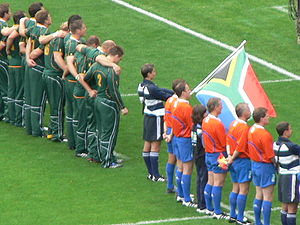 Grouped in Pool A at the 2007 Rugby World Cup
in France, they opened their campaign in Paris with a 59–7 victory over Samoa. Next up was England at the Stade de France, where the Springboks triumphed 36–-0. The third pool game against Tonga in Lens was more competitive and they narrowly won 30–25. The final pool game against the USA in Montpellier produced a 64–15 win.
Having won all their pool games, they advanced to the quarter finals to defeat Fiji 37–20 before accounting for Argentina 37–13 in the semi-finals.
They prevailed 15–6 over England to lift the Webb Ellis Cup for a second time on 20 October 2007. Some members of the English media claimed that the match was controversial because they felt that an England try was disallowed by the Australian fourth official. The Springboks won the match joining Australia as the only other national team to have won the trophy twice.
was appointed as the first non-white coach of the Springboks. De Villiers's first squad included ten of colour and managed two victories against Wales
(43–17 and 37–21) and one against Italy
(26–0) in Incoming Tours. They had an ultimately disappointing Tri Nations
ending up last with only two wins. They did manage a historic triumph in Dunedin
, a city in which they had never tasted victory in over 100 years. The Springboks did enough to beat Wales
and Scotland
before thrashing England
on the end of year tour
. This was good preparation for the upcoming British and Irish Lions Tour
.
, sweeping the All Blacks and losing only to the Wallabies in Brisbane. In the process, they added the Freedom Cup
(against New Zealand) and the Mandela Challenge Plate
(against Australia) to their trophy cabinet.
However, the Boks' busy year finally took its toll when they toured Europe in the November Test window
. They lost their top spot in the IRB rankings with a loss to France, while a midweek side lost two non-Tests to Leicester Tigers
and Saracens
. The first-string Boks returned to defeat Italy, but were beaten by Ireland to close out the year.
Nonetheless, the Boks were named IRB International Team of the Year
, beating out Six Nations
Grand Slam
winners Ireland.
. Because of the historic significance of this match, the Boks had agreed to wear their change strip to allow Ireland to wear their regular green. (Normally, the home team changes in case of a colour clash.) The match was the opener of their first attempted Grand Slam tour since 2004, with the Ireland match followed by encounters with Wales, Scotland and England. The Boks followed the tour up with a match against the Barbarians
.
The Boks began their 2010 Test campaign on 5 June, defeating Wales 34–31 at Millennium Stadium in Cardiff. Controversy arose prior to the game as Bath
-based Butch James
was withdrawn from the team at the last minute due to the refusal of Premier Rugby, which runs England's Premiership, to grant James permission on the grounds that the match fell outside the IRB-recognised June Test window. The victory over Wales was achieved without some of the regular Springbok stalwarts such as Fourie du Preez, Bakkies Botha, Schalk Burger, Pierre Spies, Bryan Habana and JP Pietersen.
Afer defeating Wales, the Springboks headed back to Cape Town to play against France on the 12 June for their second international in 2010, which they won 42–17. The Springbok victory over the French was their first since 2005. Victor Matfield believes the victory will give the Springboks a psychological advantage over the French as they may meet in the knock out stages of the Rugby World Cup 2011. The crushing victory over the French was achieved through five tries with Pierre Spies , Guthro Steenkamp , and Francois Louw each scoring one try and Gio Aplon, the 75 kg wing, scoring two tries. Their final preparations for the 2010 Tri-Nations tournament includes two internationals against Italy. In the first test a lacklustre Springbok team beat Italy by 29–13. The Springboks acquitted themselves much better in the second test crushing the Azzuri 55–11.
The Boks were widely fancied to beat the All Blacks at Eden Park in Auckland in the first Tri-Nations test of 2010. The Boks had only previously won twice at Eden park, the last time being in 1937. However, the first test of the 2010 Tri Nations campaign turned out to be a nightmare for the Boks. They went down 32–12 and in the process conceded four tries. Since then, the Boks lost consecutive tests to again succeed both the Tri-Nations trophy and Freedom Cup to the world number one ranked All Blacks, as well as lose the Mandela Plate and second place IRB World Ranking to Australia.
In the 2011 Rugby World Cup
the Boks, defending champions, were eliminated by Australia
11–9 in the quarter-finals.
(ANC) instituted a policy of transformation in South African sport. In this context transformation can be defined as "a complete alternation of the appearance or character of South African rugby", and one aim is to transform the Springboks into a team more representative of South Africa's race and class.
South Africa's World Cup winning side of 1995 fielded only one non-white player (Chester Williams
). This continued in the team's biggest matches of the 1999 and 2003 World Cups, and in the 2007 World Cup final the team fielded two non-white players (Bryan Habana
and JP Pietersen
). South African Rugby Union president Oregan Hoskins considered the number of non-white players in the 2007 World Cup squad too low, and in 2008 the first non-white coach of the side was appointed. The political pressure on rugby coaches and administrators to select non-white players is strong; 16 of the 35 new Springboks appointed by former coach Jake White were non-white. ANC Minister of Parliament Butana Komphela expressed a view held by many politicians in the country when he said "Sport cannot be excluded from imperatives of empowerment and transformation." Currently, 15 of the 49 players in training for the World Cup are non-white.
has wanted to replace the Springbok across all national teams, as emblem of the racially segregated sporting codes, with a neutral symbol that would represent a decisive break with a repressive past. The king protea
as South Africa's national flower was chosen for this purpose, so that the national cricket
team became known as the Proteas, for example. A similar change was envisioned for the national rugby squad's springbok emblem. Paul Roos
's team had first introduced the Springbok in 1906, and it had promoted a measure of unity among white English and Afrikaans-speaking players after the two Anglo-Boer Wars of the late 19th century.
The Springbok was regarded as representing both the exclusion of players who were not designated white under apartheid legislation and, by extension, of apartheid itself. Although the Springbok was adopted briefly by the first coloured national rugby team in 1939 and by their first black counterparts in 1950, it became exclusively associated with segregated sporting codes afterwards. South African rugby officials in particular, and the national rugby team itself, have an historical association with racism from 1906 on. The first rugby Springboks initially refused to play against a Devon side that included Jimmy Peters, the first black player to represent England. Legendary official, national coach, and Springbok scrumhalf Danie Craven
had acquiesced with government officials who had demanded that Māori players be excluded from visiting All Black teams. Craven had also indicated that the Springbok was exclusively tied to the white identity of the national rugby team.
As a result of political pressure the national rugby team jersey from 1992 on featured a king protea alongside the springbok. As portrayed in the film Invictus
, pressure to replace the Springbok as emblem for the rugby team came to a head in 1994, just before the Rugby World Cup
that would take place in South Africa. As a result of Nelson Mandela
's direct interference, the ANC's executive decided not to do away with the emblem at the time. After the national team won the 1995 Rugby World Cup
, black rugby pioneer Dan Qeqe
said that "The Springboks play for all of us".
In March 2004 the South African Sports Commission ratified a decision that the protea be the official rugby emblem on blazers and caps, with the concession that the springbok could remain on the team jersey. And in November 2007 the ANC's special conference at Polokwane
again endorsed the need for a single symbol for all sporting codes. While detractors like Qondisa Ngwenya foresaw a loss of revenue from dumping the springbok emblem, others like Cheeky Watson
urged the need for an alternative, unifying symbol.
on the sleeve and traditionally has a gold collar. The strip is made by Canterbury of New Zealand
and their shirt sponsor is South African bank ABSA
. The green jersey was first adopted when the British Isles toured South Africa in 1896. On their first tour to Great Britain and Ireland in 1906–07 the South Africa wore a green jersey with white collar, blue shorts, and blue socks. A replica strip was worn in 2006 against Ireland in Dublin to mark the centenary of the tour. When Australia first toured South Africa in 1933, the visitors wore sky blue jerseys to avoid confusion, as at the time, both wore dark green strips. In 1953, when Australia toured again, the Springboks wore white jerseys for the test matches. In 1961 Australia changed their jersey to gold to avoid further colour clashes.
The Springbok nickname and logo also dates from the 1906–7 tour of Britain. The springbok was chosen to represent the team by tour captain Paul Roos in an attempt to prevent the British press from inventing their own name. The logo was not restricted to the white team alone, the first coloured national team used the springbok in 1939 and the first black team in 1950. After the fall of apartheid in 1992 a wreath of protea
s was added to the logo. When the ANC was elected in 1994 the team's name was not changed to the Proteas like that of other South African sporting teams only because of the intervention of President Nelson Mandela
. The movie Invictus
starring Morgan Freeman
and Matt Damon
depicts this story.
In December 2008, the SARU decided to place the protea on the left side of the Boks' jersey, in line with other South African national teams, and move the springbok to the right of the jersey. The new jersey was worn for the first time during the British and Irish Lions
' 2009 tour of South Africa
.
in Johannesburg
(known commercially as Coca-Cola Park) was the main venue for the 1995 World Cup
, where the Springboks defeated the All Blacks in the final. Other regular venues for tests include Pretoria
's Loftus Versfeld Stadium
, DHL Newlands
in Cape Town
, Mr Price Kings Park
in Durban
, Vodacom Park
in Bloemfontein
, and the EPRU Stadium in Port Elizabeth. The Springboks played their first test match at Soccer City on 21 August 2010, a Tri Nations match against New Zealand.
Other stadiums which have been used for test matches include Buffalo City Stadium
in East London, the Royal Bafokeng Sports Palace
outside of Rustenburg and Puma Stadium
in Witbank
.
The first South African international took place at Port Elizabeth's St George’s Park Cricket Ground in 1891. Ellis Park was built in 1928, and in 1955 hosted a record 100,000 people in a Test between South Africa and the British and Irish Lions.
The Springboks are said to have a notable advantage over touring sides when playing at high altitude on the Highveld
. Games at Ellis Park, Loftus Versfeld, or Vodacom Park are said to present physical problems, and to influence a match in a number of other ways, such as the ball travelling further when kicked. Experts disagree on whether touring team's traditionally poor performances at altitude are more due to a state of mind rather than an actual physical challenge.
and 2004
and 2009
. South Africa also participates in the Mandela Challenge Plate
with Australia, and the Freedom Cup
with New Zealand as part of the Tri-Nations.
and 1991 World Cups
because of the sporting boycott that apartheid brought against them. South Africa's introduction to the event was as hosts. They defeated defending champions Australia 27–18 in the opening match, and went on to defeat the All Blacks 15–12 after extra time in the 1995 Rugby World Cup Final
, with a drop goal from 40 metres by Joel Stransky
.
In 1999
South Africa suffered their first World Cup loss when they were defeated 21–27 by Australia in their semi-final; they went on to defeat the All Blacks 22–18 in the third-fourth play-off match. The worst ever South African performance at a World Cup was in 2003 when they lost a pool game to England, and then were knocked out of the tournament by the All Blacks in their quarter-final. In 2007
the Springboks defeated Fiji in the quarter-finals and Argentina in the semi-finals. They then defeated England in the final
15–6 to win the tournament for a second time. In 2011 the Springboks were defeated by Australia 9-11 in the quarter-finals after winning all four their pool games.
Rugby union
Rugby union, often simply referred to as rugby, is a full contact team sport which originated in England in the early 19th century. One of the two codes of rugby football, it is based on running with the ball in hand...
team (the Springboks) are 2009 British and Irish Lions
British and Irish Lions
The British and Irish Lions is a rugby union team made up of players from England, Scotland, Ireland and Wales...
Series winners. They are currently ranked as the fourth best team in the IRB World Rankings
IRB World Rankings
The IRB World Rankings is a ranking system for men's national teams in rugby union, managed by the International Rugby Board , the sport's governing body. The teams of the IRB's member nations are ranked based on their game results, with the most successful teams being ranked highest...
and were named 2008 World Team of the Year at the prestigious Laureus World Sports Awards.
Although South Africa was instrumental in the creation of the Rugby World Cup competition, the Springboks did not compete in the first two World Cups in 1987
1987 Rugby World Cup
The 1987 Rugby World Cup was the first Rugby World Cup. New Zealand and Australia agreed to co-host the first ever tournament with New Zealand hosting seventeen pool stage matches, two quarter-finals and the final with Australia being the junior partner hosting seven pool matches, two...
and 1991
1991 Rugby World Cup
The 1991 Rugby World Cup was the second edition of the Rugby World Cup, and was jointly hosted by England, Scotland, Wales, Ireland and France; at that time, the five European countries that participated in the Five Nations Championship making it the first Rugby World Cup to be staged in the...
because of anti-apartheid
Anti-Apartheid Movement
Anti-Apartheid Movement , originally known as the Boycott Movement, was a British organization that was at the center of the international movement opposing South Africa's system of apartheid and supporting South Africa's Blacks....
sporting boycotts of South Africa. The team made its World Cup debut in 1995
1995 Rugby World Cup
The 1995 Rugby World Cup was the third Rugby World Cup. It was hosted and won by South Africa, and was the first Rugby World Cup in which every match was held in one country....
, when the newly democratic South Africa hosted the tournament. The Springboks then defeated the All Blacks
All Blacks
The New Zealand men's national rugby union team, known as the All Blacks, represent New Zealand in what is regarded as its national sport....
15–12 in the final
1995 Rugby World Cup
The 1995 Rugby World Cup was the third Rugby World Cup. It was hosted and won by South Africa, and was the first Rugby World Cup in which every match was held in one country....
, which is now remembered as one of the greatest moments in South Africa's sporting history, and a watershed moment in the post-Apartheid nation-building process. South Africa regained their title as champions 12 years later, when they defeated England
England national rugby union team
The England national rugby union team represents England in rugby union. They compete in the annual Six Nations Championship with France, Ireland, Scotland, Italy, and Wales. They have won this championship on 26 occasions, 12 times winning the Grand Slam, making them the most successful team in...
15–6 in the 2007 final
2007 Rugby World Cup
The 2007 Rugby World Cup was the sixth Rugby World Cup, a quadrennial international rugby union competition inaugurated in 1987. Twenty nations competed for the Webb Ellis Cup in the tournament, which was hosted by France from 7 September to 20 October. France won the hosting rights in 2003,...
. As a result of the 2007 World Cup tournament the Springboks were promoted to first place in the IRB World Rankings; a position they held until July the following year when New Zealand regained the top spot.
The Springboks play in green and gold jerseys, and their emblems are the Springbok and the Protea
Protea
Protea is both the botanical name and the English common name of a genus of flowering plants, sometimes also called sugarbushes.-Etymology:...
. The side have been playing international rugby since 1891, when a British Isles
British and Irish Lions
The British and Irish Lions is a rugby union team made up of players from England, Scotland, Ireland and Wales...
side toured the nation, playing South Africa in their first Test on 30 July. South Africa was coached by Jake White
Jake White
Jake White is a rugby union coach and former coach of the South Africa national rugby union team, the Springboks. His most notable achievements as coach include leading the Springboks to victory in 2007 Rugby World Cup and the 2004 Tri Nations title...
, who led the Boks to the 2007 World Cup title, announced his resignation effective at the end of 2007. His replacement Peter de Villiers
Peter de Villiers
Peter de Villiers is a South African rugby union coach who is the coach of the South Africa national rugby union team. After his successes with South African U19 and U21 squads, de Villiers was named as the coach of South Africa's national team, the Springboks in January 2008, the first-ever...
contract expired in 2011, following a 11-9 defeat to Australia in the Rugby World Cup quarter-final and stated he would not be signing a new deal. The current captain is John Smit
John Smit
John William Smit is the 50th and current captain of the South African national rugby union team, the Springboks. He has played most of his career as a hooker, but played twice for the Springboks off the bench as a prop prior to the South Africa coaching staff's decision to use him as a tighthead...
, who has played hooker for most of his career, although he has also been a prop, mainly in 2008 and 2009. Due to Smit being unavailable for the November 2010 Tests
2010 end of year rugby tests
The 2010 end of year rugby tests, also known as the Autumn internationals in the northern hemisphere, will see Argentina, Australia, New Zealand and South Africa and tour the northern hemisphere. Test matches will also be arranged involving the various Pacific island teams and other non-Tier 1...
after surgery, lock Victor Matfield
Victor Matfield
Victor Matfield is a South African rugby union player. He has played for, and captained the Springbok rugby team as well as the Blue Bulls in the Currie Cup and the Bulls franchise in the Super 14...
took Smit's place as captain for that tour.
First internationals
British and Irish Lions
The British and Irish Lions is a rugby union team made up of players from England, Scotland, Ireland and Wales...
tour took place in 1891, with the trip financially underwritten by Cape Colony
Cape Colony
The Cape Colony, part of modern South Africa, was established by the Dutch East India Company in 1652, with the founding of Cape Town. It was subsequently occupied by the British in 1795 when the Netherlands were occupied by revolutionary France, so that the French revolutionaries could not take...
Prime Minister Cecil Rhodes. These were the first representative games played by South African sides, who were still learning the game. The tourists played and won a total of twenty matches, conceding only one point in the process. South Africa's first Tests were played, although South Africa did not exist as political unit until 1910. In a notable event of the tour, the British side presented the Currie Cup
Currie Cup
The Currie Cup tournament is South Africa's premier domestic rugby union competition, played each winter and spring , featuring teams representing either entire provinces or substantial regions within provinces...
to Griqualand West
Wildeklawer Griquas
The GWK Griquas are a South African rugby union team that participates in the annual Currie Cup tournament. Their home ground is Hoffe Park Stadium, known for sponsorship reasons as GWK Park in Kimberley, and they draw their players from Northern Cape Province. They were previously known as...
, the province they thought produced the best performance on the tour.
The British Isles' success continued on their 21 game tour of 1896
1896 British Lions tour to South Africa
1896 British Isles tour to South Africa was a rugby union tour undertaken by the British Isles, one of the first British and Irish Lions tours. The team toured South Africa for the second time in 1896. Between July 11 and September 5, they played 21 games, including four tests against South Africa...
. The British Isles won three out of the four Tests against South Africa. South Africa's play improved markedly from 1891. Their forwards were particularly impressive, and their first Test win in the final game was a pointer to the future. For the first time South Africa had worn myrtle green shirts, which their captain, Barry Heatlie, borrowed from his Old Diocesans club. Rugby was given a huge boost by the early Lions tours, which created great interest in the South African press.
Rugby was so popular that in 1902 there was a temporary ceasefire in the Second Boer War
Second Boer War
The Second Boer War was fought from 11 October 1899 until 31 May 1902 between the British Empire and the Afrikaans-speaking Dutch settlers of two independent Boer republics, the South African Republic and the Orange Free State...
so that a game could be played between British and Boer forces. The game had spread among the Afrikaner population through POW
Prisoner of war
A prisoner of war or enemy prisoner of war is a person, whether civilian or combatant, who is held in custody by an enemy power during or immediately after an armed conflict...
games during the Boer War, and afterwards Stellenbosch University
Stellenbosch University
Stellenbosch University is a public research university situated in the town of Stellenbosch, South Africa. Other nearby universities are the University of Cape Town and University of the Western Cape....
became a training ground for future players and administrators.
In 1903 the British Isles lost a series for the first time in South Africa, drawing the opening two Tests before losing the last 8–0. In all, the tourists won just 11 of their 22 tour games. By contrast, South Africa would not lose another series—home or away—until 1956.
Springboks
Paul Roos (rugby player)
Paul Johannes Roos was one of the first South African Springbok rugby union captains and led the first South African rugby team to tour overseas – to Britain in 1906...
was the captain of the first South African team to tour the British Isles and France
1906 South Africa rugby union tour
The 1906-07 South Africa tour of Britain, Ireland and France was a collection of friendly rugby union games undertaken by the South Africa national rugby union team against the four British Home Nation teams...
. The team was largely dominated by players from Western Province, and took place over 1906–07. The team played 29 matches; including Tests against all four Home Nations
Home Nations
Home Nations is a collective term with one of two meanings depending on the context. Politically, it means the nations of the constituent countries of the United Kingdom...
. England managed a draw, but Scotland was the only one of the Home unions to gain a victory.
During this tour the nickname Springboks was first used. There is often confusion as to the springbok symbol being worn before the name was invented, but this may be down to the fact the tour manager, J.C. Carden, spoke of having no 'uniforms or blazers' with the icon, though he did not appear to mean the jerseys. It was reported in the Daily Mail on the 20 September 1906, seven days before the first match, that 'The team's colours will be myrtle green with gold collar... and will have embroidered in mouse-coloured silk on the left breast a Springbok'. Carden later stated:
Newspaper reporters were to call the team "De Springbokken", and later The Daily Mail printed an article referring to the "Springboks". The team thereafter wore blazers with a springbok on the left breast pocket. Historically the term 'Springbok' was applied to any team or individual representing South Africa in international competition regardless of sporting discipline. This tradition was abandoned with the advent of South Africa's new democratic government in 1994. The trip helped heal wounds after the Boer War and instilled a sense of national pride among South Africans.
The South Africans crossed the channel to play an unofficial match against a 'France' team drawn from the two Parisian clubs: Stade Français and Racing Club de France
Racing Metro 92 Paris
Racing Métro 92 is a French rugby union club based in suburban Paris that was formed in 2001 with the collaboration of the Racing Club de France and US Métro. "92" is the number of Hauts-de-Seine, the département of Île-de-France, bordering Paris to the west, where they play, and whose council...
. The official French team were in England at the time. The Springboks won 55–6 and scored 13 tries in the process.
The 1910 British Isles tour of South Africa was the first to include representatives from all four Home unions. The team performed moderately against the non-test parties, claiming victories in just over half their matches. The tourists won just one of their three Tests.
The Boks' second European tour took place in 1912–13. They beat the four Home nations to earn their first Grand Slam
Grand Slam (Rugby Union)
In rugby union, a Grand Slam occurs when one team in the Six Nations Championship manages to beat all the others during one year's competition...
and also went on to defeat France.
Inter war
By the first World War New Zealand and South Africa had established themselves as rugby's two greatest powers. A New Zealand Army match tour of South Africa in 1919 paved the way for a Springbok tour to New Zealand and Australia in 1921. The tour was billed as "The World Championship of Rugby". The All Blacks won the first Test 13–5, which included a try by All Blacks winger Jack Steel who had sprinted 50 metres with the ball trapped between his right hand and back to score. The Springboks recovered to win the second Test 9–5 thanks to a Gerhard Morkel drop-goal. The final Test was drawn 0–0 after being played in terrible conditions—resulting in a series draw.The 1924 British and Irish Lions team to South Africa struggled with injuries and won only nine of 21 games. They lost all four Tests to the Springboks, but despite the results, the tour produced some attractive rugby. This was the first side to pick up the name Lions, apparently picked up from the Lions embroidered on their ties.
The All Blacks first toured South Africa in 1928, and again the Test series finished level. Despite playing most of the second half with only 14 men, with a dominant scrum and fly-half Bennie Osler
Bennie Osler
Benjamin Louwrens Osler was a rugby union footballer who played internationally for South Africa. Osler played mainly at fly-half for both South Africa, and his provincial team of Western Province....
, the Springboks won the first Test 17–0 to inflict the All Blacks' heaviest defeat since 1893. The All Blacks rebounded to win the second Test 7–6. After a Springbok win in the third Test, the Springboks needed to win the fourth to secure a series victory. The New Zealanders bought back Mark Nicholls for his only Test of the series, and their captain Maurice Brownlie
Maurice Brownlie
Maurice Brownlie was a New Zealand Rugby Union player. Along with his brothers Cyril and Laurence he represented the country during the 1920s. Maurice Brownlie played 61 matches for the All Blacks, scoring 21 tries. These matches included eight tests. Maurice was a member of The Invincibles during...
told the team a week before the Test that "Under no circumstances whatever is anyone of you so much as to touch a rugby ball until we play the Springboks in the last test." Their tactics were successful and the All Blacks won 13–5 to draw the series.
Despite winning South Africa's second Grand Slam, the Springbok tourists of 1931–32 were an unloved team. They had a jumbo pack and a kicking fly-half in captain Bennie Osler
Bennie Osler
Benjamin Louwrens Osler was a rugby union footballer who played internationally for South Africa. Osler played mainly at fly-half for both South Africa, and his provincial team of Western Province....
. Their tactics of kicking for territory earned them criticism both in South Africa and abroad. It was successful however, the team winning against England, Ireland, Scotland and Wales, as well as defeating all their Welsh opponents for the first time.
In 1937 South Africa toured New Zealand and Australia
1937 Springbok tour to Australasia
The 1937 South Africa tour to Australasia was one of the most successful Springbok tours in history, so much so that the touring team was nicknamed the "Invincibles". The squad was captained by Philip Nel....
and broke the deadlock with a series win in New Zealand. Their 2–1 series win prompted them to be called "the best team to ever leave New Zealand". Despite the All Blacks winning the first Test, the Springboks' won in the third Test 17–6 and scored five tries to none. The All Blacks' loss was considered a humiliation in New Zealand.
The British Isles toured South Africa again in 1938, winning more than half of their normal matches. The Springboks easily claimed the first two tests. But the tourists recorded a surprise win in the third Test, the first Lions win in South Africa since 1910.
Post-war era
Danie CravenDanie Craven
Daniël Hartman Craven , more famously known as Danie Craven or simply Doc Craven, is a former Western Province, Eastern Province, Northern Transvaal and Springbok rugby union player as well as arguably South Africa's best and best-known rugby administrator...
was appointed coach in 1949, and started his coaching career with a bang. The Springboks won ten matches in a row, including a 4–0 whitewash of New Zealand on their 1949 tour to South Africa. Prop Okey Geffin helped kick the Springboks to victory—they won all four Tests despite the All Blacks scoring more tries in three of them. The 1951–52 team that toured Europe was considered amongst the finest Springbok sides to tour. The team won the Grand Slam as well as defeating France. Hennie Muller
Hennie Muller
Hendrik "Hennie" Scholtz Vosloo Muller was a South African rugby union footballer. Born in Witbank, Muller is considered one of the greatest South African footballers, captaining the national side, the Springboks in nine tests, and is a member of the International Rugby Hall of Fame...
captained the side after original captain Basil Kenyon suffered a serious eye injury. The South African highlight of the tour was a 44–0 defeat of Scotland. The defeat of Scotland included nine tries, and was a record at the time. The team finished with only one loss, to London Counties, from 31 matches.
In 1954, Australia toured South Africa for the second time and although they lost the series they were given a standing ovation after defeating South Africa 18–14 in a thrilling 2nd Test at Newlands. Wallaby Captain John Solomon was chaired off the field by two South African players. This was the first Springbok defeat for 15 years.
During their 1955 tour to South Africa, the Lions won 19 and drew one from the 25 fixtures. The four-test series ended in a draw. In 1956 the All Blacks won its first series over the Springboks, in what Chris Hewett called "in the most bitterly fought series in history." Surprise selection Don Clarke
Don Clarke
Donald Barry Clarke was a New Zealand rugby union player who played 89 times as a New Zealand international from 1956 until 1964...
from Waikato
Waikato Rugby Union
The Waikato Rugby Union is the official governing body of rugby union in the Waikato area in the North Island of New Zealand. Its senior representative team competes in the ITM Cup , and won the inaugural Air New Zealand Cup in 2006.Waikato Rugby Union was founded in 1921...
—nicknamed the Boot—kicked the decisive penalties in the final Tests.
South Africa had defeated France 25–3 at Colombes Stadium in 1952, and when France toured South Africa in 1958 they were not expected to compete. Georges Duthen described the mood of the French players before their first Test in 1958: "They were going into battle. A Battle for France. And they hadn't a hope..." France exceeded expectations and drew 3–3 with after a drop goal to French scrum-half Pierre Danos and unconverted try to South Africa's Butch Lochner. The French then secured a Test series victory in South Africa with their 9–5 victory in front of 90,000 spectators in Johannesburg. The French feared the South African forwards, especially their scrum, and focused much of their training before the series on improving the "South African" style of their forwards. The decisive moment of the match was French forward Jean Barthe's tackle on Jan Prinsloo
Jan Prinsloo
Johannes "Jan" Albertus Prinsloo was a South African rugby union and professional rugby league footballer of the 1950s and '60s who at representative level played rugby union for South Africa, and at provincial level for Western Province, playing at Wing, i.e. number 11 or 14, and at...
near the French try-line prevented a certain try. The momentum then swung to France who scored drop-goals—one each to Pierre Lacaze and Roger Martine—to secure the historic victory.
1960s
Even before the apartheid laws were passed after 1948, sporting teams going to South Africa had felt it necessary to exclude non-white players. New Zealand rugby teams in particular had done this, and the exclusion of George NepiaGeorge Nepia
George Nepia was a Māori rugby union and rugby league player. He is remembered as an exceptional full-back and one of the most famous Māori rugby players. He was inducted into the New Zealand Sports Hall of Fame in 1990. In 2004 he was selected as number 65 by the panel of the New Zealand's Top...
and Jimmy Mill from the 1928 All Blacks tour, and the dropping of Ranji Wilson
Ranji Wilson
Nathaniel Arthur "Ranji" Wilson was an early All Black, rugby football player for New Zealand. He was born in Christchurch of English/West Indian parentage, his father being West Indian....
from the New Zealand Army team nine years before that, had attracted little comment at the time. However, in 1960 international criticism of apartheid grew in the wake of the The Wind of Change
Wind of Change (speech)
The Wind of Change speech was a historically important address made by British Prime Minister Harold Macmillan to the Parliament of South Africa, on 3 February 1960 in Cape Town. He had spent a month in Africa visiting a number of British colonies, as they were at the time...
speech and the Sharpeville massacre
Sharpeville massacre
The Sharpeville Massacre occurred on 21 March 1960, at the police station in the South African township of Sharpeville in the Transvaal . After a day of demonstrations, at which a crowd of black protesters far outnumbered the police, the South African police opened fire on the crowd, killing 69...
.
From this point onward, the Springboks were increasingly the target of international controversy and protest. The All Blacks toured in 1960, despite a campaign based on the slogan of "No Maoris, No Tour", and a 150,000 signature petition opposing it. The Springboks avenged their 1956 series defeat by winning the Test series 2–1 with a Test drawn. The first match was won 13–0 by the Springboks with two tries to Hennie van Zyl. New Zealand journalist Noel Holmes said after the match "I hang my head in shame for having suggested that your forwards might be slow, even unfit." The All Blacks won the second Test 11–3 which they did so with a dominant forward pack and the tactical kicking of Don Clarke. The players selected for the third and fourth Tests formed the core of Springboks side for the next three seasons. The third Test was drawn 11–11 after a last minute sideline conversion from All Black Don Clarke. The deciding Test was won 8–3 by the Springboks with the decisive try scored by Martin Pelser.
Later that same year the Springboks themselves toured, and led by Avril Malan they defeated all four Home unions for their fourth Grand Slam. On a four-month, 34 game sweep through Europe they played a ruthless, forward-oriented game in which intimidation was a key part, and opposition players suffered a string of controversial injuries. However, they lost their final game 6–0 against the Barbarians
Barbarian F.C.
The Barbarian Football Club, usually referred to as the Barbarians and nicknamed the "Baa-Baas", is an invitational rugby union team based in Britain...
in Cardiff
Cardiff
Cardiff is the capital, largest city and most populous county of Wales and the 10th largest city in the United Kingdom. The city is Wales' chief commercial centre, the base for most national cultural and sporting institutions, the Welsh national media, and the seat of the National Assembly for...
, beaten when perhaps the Barbarians' pack played an uncharacteristically pragmatic game.
In 1962 the British Isles, won 16 of their 25 games on their tour to South Africa, but did not do so well in the Tests—losing all three. In 1963 the touring Wallabies beat the Springboks in consecutive Tests, the first team to do so since the 1896 British team.
Wales toured South Africa and played several games and one Test in 1964—their first overseas tour. They lost the Test against South Africa in Durban
Durban
Durban is the largest city in the South African province of KwaZulu-Natal and the third largest city in South Africa. It forms part of the eThekwini metropolitan municipality. Durban is famous for being the busiest port in South Africa. It is also seen as one of the major centres of tourism...
24–3, their biggest defeat in 40 years. At the Welsh Rugby Union
Welsh Rugby Union
The Welsh Rugby Union is the governing body of rugby union in Wales, recognised by the International Rugby Board.The union's patron is Queen Elizabeth II, and her grandson Prince William of Wales became the Vice Royal Patron of the Welsh Rugby Union as of February 2007.-History:The roots of the...
(WRU) annual general meeting that year, the outgoing WRU President D. Ewart Davies declared that "it was evident from the experience of the South African Tour that a much more positive attitude to the game was required in Wales... Players must be prepared to learn, and indeed re-learn, to the absolute point of mastery, the basic principles of Rugby Union football."
South Africa had a disastrous year in 1965, losing on tour to Ireland, Scotland, Australia (twice) and New Zealand (three times) while winning just once against New Zealand. The planned 1967 tour by the All Blacks was cancelled by the New Zealand Rugby Football Union after the South African government refused to allow Maori players.
In 1968 the Lions toured and won 15 of their 16 provincial matches, but lost three Tests and drew one. Next year the 1969 Springbok tour to Britain and Ireland found a new spirit and confidence had developed in Home nations rugby, and the tourists lost two of their seven games in Wales—against Newport and a composite side from Monmouthshire
Monmouthshire County RFC
Monmouthshire County RFC is a Welsh rugby union club that manages an invitational team, known as Monmouthshire that originally played rugby at county level...
. Wales nearly claimed their first win against the Springboks as the game ended 6–6. The Springboks lost the Test matches against England and Scotland, drawing the one against Ireland. Throughout the tour however, large anti-apartheid demonstrations were a feature, and many matches had to be played behind barbed wire fences.
1970s
In 1970 the All Blacks toured South Africa once again—after the 1967 stand-off, the South African government now agreed to treat Maoris in the team, and Maori spectators, as 'honorary whites'. The Springboks won the test series 3–1.The Springbok tour of Australia in 1971
1971 Springbok tour
The 1971 South Africa rugby union tour of Australia was a controversial six-week rugby union tour by the South African national team to Australia. Anti-apartheid protests came to being all around the country. The tour is perhaps most infamous for a state of emergency being declared in Queensland...
began with matches in Perth
Perth, Western Australia
Perth is the capital and largest city of the Australian state of Western Australia and the fourth most populous city in Australia. The Perth metropolitan area has an estimated population of almost 1,700,000....
, then Adelaide
Adelaide
Adelaide is the capital city of South Australia and the fifth-largest city in Australia. Adelaide has an estimated population of more than 1.2 million...
and Melbourne. The Springboks won all three Tests, scoring 18–6, 14–6, and 19–11. As in Britain three years before however, massive anti-apartheid demonstrations greeted the team, and they had to be transported by the Royal Australian Air Force
Royal Australian Air Force
The Royal Australian Air Force is the air force branch of the Australian Defence Force. The RAAF was formed in March 1921. It continues the traditions of the Australian Flying Corps , which was formed on 22 October 1912. The RAAF has taken part in many of the 20th century's major conflicts...
after the trade unions refused to service planes or trains transporting them. Although a tour of New Zealand had been planned for 1973, it was blocked by New Zealand Prime Minister Norman Kirk
Norman Kirk
Norman Eric Kirk was the 29th Prime Minister of New Zealand from 1972 until his sudden death in 1974. He led the Parliamentary wing of the New Zealand Labour Party from 1965 to 1974. He was the fourth Labour Prime Minister of New Zealand, but the first to be born in New Zealand...
on the grounds of public safety.
The Lions team that toured South Africa in 1974 led by Willie John McBride
Willie John McBride
William James McBride, MBE, better known as Willie John McBride is a former rugby union footballer who played as a lock for Ireland and the British and Irish Lions. He played 63 Tests for Ireland including eleven as captain, and toured with the Lions five times — a record that gave him 17...
was unbeaten over 22 games, and triumphed 3–0 (with one drawn) in the Test series. A key feature was the Lions' infamous '99 call'. Lions management had decided that the Springboks dominated their opponents with physical aggression, so decided "to get their retaliation in first". At the call of '99' each Lions player would attack their nearest rival player. The idea was that a South African referee would be unlikely to send off all of the Lions. At the "battle of Boet Erasmus Stadium
EPRFU Stadium
EPRU Stadium, also known by its original name of Boet Erasmus Stadium, is a stadium in Port Elizabeth, South Africa. The stadium has a capacity of 33,852 people. The original name Boet Erasmus Stadium was named after Boet Erasmus, a former mayor of Port Elizabeth.It was used mostly for rugby union...
"—one of the most violent matches in rugby history—JPR Williams famously ran over half of the pitch and launched himself at 'Moaner' van Heerden after such a call.
The 1976 All Blacks tour of South Africa went ahead, and the Springboks won by three Tests to one, but coming shortly after the Soweto riots
Soweto riots
The Soweto Uprising, also known as June 16, was a series of high school student-led protests in South Africa that began on the morning of June 16, 1976. Students from numerous Sowetan schools began to protest in the streets of Soweto, in response to the introduction of Afrikaans as the medium of...
the tour attracted international condemnation and 28 countries boycotted the 1976 Summer Olympics
1976 Summer Olympics
The 1976 Summer Olympics, officially known as the Games of the XXI Olympiad, was an international multi-sport event celebrated in Montreal, Quebec, Canada, in 1976. Montreal was awarded the rights to the 1976 Games on May 12, 1970, at the 69th IOC Session in Amsterdam, over the bids of Moscow and...
in protest, and the next year, in 1977, the Commonwealth signed the Gleneagles Agreement
Gleneagles Agreement
The Gleneagles Agreement was unanimously approved by the Commonwealth of Nations at a meeting at Gleneagles, Auchterarder, Scotland. In 1977, Commonwealth Presidents and Prime Ministers agreed, as part of their support for the international campaign against apartheid, to discourage contact and...
, which discouraged any sporting contact with South Africa. In response to the growing pressure the segregated South African rugby unions merged in 1977. Four years later Errol Tobias
Errol Tobias
Errol George Tobias is a former South African rugby union footballer, the first Coloured man to start a test for the South African national side. He gained six caps 1981-1984 when the country was still following the policy of apartheid. He was born on a farm outside Caledon in the Overberg...
would became the first non-white South African to represent his country when he took the field against Ireland. A planned 1979 Springbok tour of France was stopped by the French government, who announced that it was inappropriate for South African teams to tour France.
1980s
The Lions toured South Africa in 1980. The team completed a flawless non-Test record, winning 14 out of 14 non-Test matches on the tour. But they lost the first three Tests before winning the last one.The 1981 tour of New Zealand
1981 Springbok Tour
The 1981 South African rugby union tour of New Zealand was a controversial tour of New Zealand by the South Africa national rugby union team, known as "the Springboks"...
went ahead in defiance of the Gleneagles Agreement. South Africa lost the series 2–1, but the tour and the massive civil disruption in New Zealand had ramifications far beyond rugby.
South Africa sought to counteract its sporting isolation by inviting the South American Jaguars
South American Jaguars
The South American Jaguars was an international rugby union team consisting of South American players that played during the early 1980s against the South African Springboks. South Africa invited South America to tour there as a way of counteracting its sporting isolation which was due to the...
to tour. The team contained mainly Argentinian players, whose national team had struggled to attract strong international opposition. Eight matches were played between the two teams in the early 1980s—all awarded Test status.
In 1984
1984 England rugby union tour of South Africa
The 1984 England rugby union tour of South Africa was a series of seven matches played by the England national rugby union team in South Africa in May and June 1984. England played seven games, including two test matches against the South Africa national rugby union team...
England toured losing both test matches on tour. Of the players selected, only Ralph Knibbs of Bristol refused to tour for political reasons.
In 1985, a planned All Black tour of South Africa was stopped by the New Zealand High Court. A rebel tour took place the next year by a team known as the Cavaliers
New Zealand Cavaliers
The Cavaliers was the name given to an unofficial New Zealand rugby union team which toured South Africa in 1986.The rebel tour occurred after the official All Black tour planned for 1985 was cancelled due to a legal ruling that it would be incompatible with the NZRFU's legally stated purpose:...
. The team was not sanctioned by the New Zealand Rugby Football Union, yet consisted of all but two of the original squad that had been selected. For some of the tests, the team was advertised, inside South Africa as the All Blacks whilst at the others they were advertised as the New Zealand Cavaliers. The Springboks won the series 3–1.
In 1989, a World XV sanctioned by the International Rugby Board went on a mini-tour of South Africa. All traditional rugby nations bar New Zealand supplied players to the team with ten Welshmen, eight Frenchmen, six Australians, four Englishmen, one Scot and one Irishman.
1990s
From 1990 to 1991 the legal apparatus of apartheid was abolished, and the Springboks were readmitted to international rugby in 1992. They struggled to return to their pre-isolation standards, and in their first games after readmission the Springboks were defeated 27–24 by New Zealand on 15 August 1992 and also suffered a 26–3 loss to Australia the following month. Ian McIntosh was sacked as national coach following a series defeat to the All Blacks in New Zealand in mid-1994. In October of that year, Kitch ChristieKitch Christie
George Moir Christie, better known as Kitch Christie , was a South African rugby union coach best known for coaching the country's national team, the Springboks, to victory at the 1995 Rugby World Cup...
accepted an offer to take over from McIntosh.
South Africa was selected to host the 1995 Rugby World Cup
1995 Rugby World Cup
The 1995 Rugby World Cup was the third Rugby World Cup. It was hosted and won by South Africa, and was the first Rugby World Cup in which every match was held in one country....
, and there was a remarkable surge of support for the Springboks among the white and black communities in the lead-up to the tournament. This was the first major event to be held in what Archbishop Desmond Tutu
Desmond Tutu
Desmond Mpilo Tutu is a South African activist and retired Anglican bishop who rose to worldwide fame during the 1980s as an opponent of apartheid...
had dubbed "the Rainbow Nation
Rainbow Nation
Rainbow Nation is a term coined by Archbishop Desmond Tutu to describe post-apartheid South Africa, after South Africa's first fully democratic election in 1994....
." South Africans got behind the 'one team, one country' slogan.
By the time they hosted the 1995 World Cup, the Springboks were seeded ninth. They defeated Australia, Romania
Romania national rugby union team
The Romania national rugby union team , nicknamed The Oaks , is the representative side of Romania in rugby union. Long considered one of the stronger European teams outside the Six Nations, they have participated in all six Rugby World Cups, and currently compete in the first division of the...
, Canada
Canada national rugby union team
The Canada national rugby union team represents Canada in international rugby union. They are governed by Rugby Canada, and play in red and black. Canada is classified by the International Rugby Board as a tier two rugby nation. There are ten tier one nations, and seven tier two nations, the...
, Western Samoa
Samoa national rugby union team
The Manu Samoa is the men's representative side of the Samoa Rugby Union in both the 15's and the 7's for international competitions. The Samoa Rugby Union is owned by the affiliated rugby unions of Samoa. In Samoa, Manu Samoa is in honour of a famous Samoan warrior. From 1924 to 1997 Samoa was...
and France
France national rugby union team
The France national rugby union team represents France in rugby union. They compete annually against England, Ireland, Italy, Scotland and Wales in the Six Nations Championship. They have won the championship outright sixteen times, shared it a further eight times, and have completed nine grand slams...
to play in the final.
South Africa narrowly won the epic 1995 Rugby World Cup Final
1995 Rugby World Cup Final
The 1995 Rugby World Cup Final, was the final match in the 1995 Rugby World Cup, played in South Africa.The match was played at Ellis Park Stadium, Johannesburg on 24 June 1995 between the host nation, the South African Springboks, and the New Zealand All Blacks...
15–12 against traditional rivals the All Blacks. A drop goal by Joel Stransky
Joel Stransky
Joel Theodore Stransky is a former South African rugby union rugby player, most notable for scoring all of South Africa's points, including the famous dramatic winning drop goal, against New Zealand in the 1995 Rugby World Cup final. He played as a fly-half.-Early life:Stransky was born in...
secured victory in extra-time.
Wearing a Springbok shirt, Nelson Mandela
Nelson Mandela
Nelson Rolihlahla Mandela served as President of South Africa from 1994 to 1999, and was the first South African president to be elected in a fully representative democratic election. Before his presidency, Mandela was an anti-apartheid activist, and the leader of Umkhonto we Sizwe, the armed wing...
presented the trophy to captain Francois Pienaar
Francois Pienaar
Jacobus Francois Pienaar is a South African former rugby union player. He played flanker for South Africa from 1993 until 1996, winning 29 international caps, all of them as captain. He is best known for leading South Africa to victory in the 1995 Rugby World Cup...
, a white Afrikaner. The gesture was widely seen as a major step towards the reconciliation of white and black South Africans. Mandela's enthusiasm and support for the Springboks is portrayed in the 2009 film Invictus
Invictus (film)
Invictus is a 2009 biographical sports drama film directed by Clint Eastwood starring Morgan Freeman and Matt Damon.The story is based on the John Carlin book Playing the Enemy: Nelson Mandela and the Game That Changed a Nation about the events in South Africa before and during the 1995 Rugby World...
. SARFU President Louis Luyt
Louis Luyt
Louis Luyt is a South African business tycoon and politician, and one-time rugby administrator.Making a name for himself as a rugby star as a young man, Luyt went on to found Triomf Fertiliser, Luyt Breweries, and to take control of Ellis Park stadium in Johannesburg...
caused controversy at the post-match dinner by declaring that the Springboks would have won the previous two World Cups if they had been allowed to compete. The day after the World Cup victory, the Xhosa
Xhosa language
Xhosa is one of the official languages of South Africa. Xhosa is spoken by approximately 7.9 million people, or about 18% of the South African population. Like most Bantu languages, Xhosa is a tonal language, that is, the same sequence of consonants and vowels can have different meanings when said...
word for Springbok, Amabokoboko! appeared as the headline of The Sowetan
The Sowetan
The Sowetan is an English language, South African newspaper that started in 1981 as a liberation struggle newspaper and was freely distributed to households in the black township of Soweto, Johannesburg, Gauteng Province....
's sports page.
Super 14
Super Rugby is the largest and pre-eminent professional Rugby union competition in the Southern Hemisphere...
and Tri-Nations competitions. Under new coach John Hart
John Hart (rugby coach)
John Bernard Hart, ONZM was a New Zealand rugby union coach, mainly for Auckland and the All Blacks. After many years in business, during which he rose to become Group Employee Relations Director for Fletcher Challenge, then New Zealand's largest company, John Hart began his first class coaching...
and the captaincy of Sean Fitzpatrick
Sean Fitzpatrick
Sean Fitzpatrick MNZM is a former rugby union footballer who represented New Zealand, and is widely regarded as one of the finest players ever to come from that country. He is also the son of former player Brian Fitzpatrick....
, the All Blacks won a Test series in South Africa for the first time in 1996. Fitzpatrick even rated the series win higher than the 1987 World Cup victory in which he had participated. The 1997 Lions completed their South African tour with only two losses in total, winning the Test series two games to one.
Coach Andre Markgraaff
Andre Markgraaff
Andries Thomas "Andre" Markgraaff was a South African rugby union flanker, and controversial national coach, who resigned after he was taped referring to "fucking kaffirs". He was selected for the South African team in 1986 against the Cavaliers but as an unused substitute...
was fired in 1997 over a racial comment he made. Despite a successful career as a player, Markgraaff's replacement Carel du Plessis
Carel du Plessis
Carel Johan du Plessis is a former South African rugby union coach and player.-Playing career:Du Plessis played for Western Province and the Springboks, his skills earning him the nickname the Prince of Wings...
led the team to successive defeats in the British and Irish Lions 1997 tour
1997 British Lions tour to South Africa
The 1997 British and Irish Lions tour to South Africa was a series of matches played by the British and Irish Lions rugby union team in South Africa.This tour followed the Lions' 1993 tour to New Zealand and preceded their 2001 tour to Australia....
and the 1997 Tri Nations Series
1997 Tri Nations Series
The 1997 Tri Nations Series was contested from 19 July to 23 August between the Australia, New Zealand and South Africa national rugby union teams. The All Blacks continued their unbeaten record to win their second tournament.-Results:...
. He was replaced later in 1997 by Nick Mallett
Nick Mallett
Nicholas Vivian Howard Mallett is a former South African rugby union player who was until recently the head coach of the Italian national team, previously replacing Pierre Berbizier on 3 October 2007...
, who went on to coach the unbeaten 1997 South Africa rugby union tour of Britain and France in late 1997. In 1998 Mallett and new captain Gary Teichmann
Gary Teichmann
Gary Hamilton Teichmann is a retired Rhodesian/Zimbabwean-born South African rugby union player. He played number eight and was the captain of the South African national team, the Springboks, between 1995 and 1999...
tied the then-existing record of the 1965–69 All Blacks for longest Test winning streak, winning 17 consecutive Tests, including the 1998 Tri-Nations. In the same year, South Africa mourned as Christie's illness claimed his life. The Springboks entered the 1999 Rugby World Cup
1999 Rugby World Cup
The 1999 Rugby World Cup was the fourth Rugby World Cup, and the first to be held in rugby union's professional era. The principal host nation was Wales, although the majority of matches were played outside the country, shared between England, France, Scotland and Ireland...
competition with little hope. Reverting to a kicking game and forward strength, they showed they were still a force to be reckoned with, losing to eventual champions Australia in a tense semi-final at Twickenham
Twickenham Stadium
Twickenham Stadium is a stadium located in Twickenham, in the London Borough of Richmond upon Thames. It is the largest rugby union stadium in the United Kingdom and has recently been enlarged to seat 82,000...
.
New millennium
Corné Krige
Cornelius Petrus Johannes "Corné" Krige was a South African rugby union footballer, now retired, who played flanker for Western Province in the Currie Cup, the Stormers in Super Rugby and captained the South African national side, the Springboks.-Career:Corne Krige was Zambian-born and his parents...
as a leader. In the 2002 and 2003 seasons, the Springboks also lost by record margins to France, Scotland and New Zealand. They defeated Argentina
Argentina national rugby union team
The Argentina national rugby team, nicknamed Los Pumas, represents Argentina in international rugby union matches. The team, which plays in sky blue and white jerseys, is organised by the Argentine Rugby Union .Argentina played its first international rugby match in 1910 against a touring British...
by only one point, and were eliminated from the 2003 World Cup
2003 Rugby World Cup
The 2003 Rugby World Cup was the fifth Rugby World Cup and was won by England. Originally planned to be co-hosted by Australia and New Zealand, all games were shifted to Australia following a contractual dispute over ground signage rights between the New Zealand Rugby Football Union and Rugby World...
in the quarter final round – their worst ever showing in a World Cup record of 2 gold and 1 bronze from 4 appearances.
During a pre-World Cup training camp, there was a highly publicised dispute between Geo Cronjé (an Afrikaner) and Quinton Davids (a coloured). Both were dropped from the team, and Cronjé was called before a tribunal to answer charges that his actions in the dispute were racially motivated. Cronjé was eventually cleared. Later, the Boks were sent to a military-style boot camp in the South African bush called Kamp Staaldraad
Kamp Staaldraad
Kamp Staaldraad was a military-style "boot camp" organized as a "team building" exercise for the South African national rugby union team, the Springboks , during their preparation for the 2003 Rugby World Cup...
(literal English translation "Camp Steel-wire", idiomatically "Camp Barbed Wire"). After the World Cup, then- coach Rudolph Straeuli
Rudolph Straeuli
Rudolph August Wilkens Straeuli played rugby union in the positions of flanker and Number 8 for, and later coached, the Springboks rugby team. He also played for the Lions provincial team in the Currie Cup competition...
was under fire, not only because of the team's poor results, but because of his role in organising Kamp Staaldraad. He eventually resigned, and in February 2004 Jake White
Jake White
Jake White is a rugby union coach and former coach of the South Africa national rugby union team, the Springboks. His most notable achievements as coach include leading the Springboks to victory in 2007 Rugby World Cup and the 2004 Tri Nations title...
was named as new national coach.
The Springboks then swept Ireland in a two-Test series and defeated Wales during their opponents' June 2004 tours of the Southern Hemisphere. Next came a win in the most closely contested Tri Nations in history
2004 Tri Nations Series
The 2004 Tri Nations Series, an annual rugby union competition between the national teams of Australia, New Zealand and South Africa, was the ninth in the series. The competition is organised by SANZAR, a consortium of the three countries' rugby union federations...
—their only Tri Nations trophy since 1998. In November 2004, the Springboks went on a Grand Slam tour of the Home Nations. They were decisively defeated by England, and lost controversially to Ireland. They then won a hard-fought match against Wales, and prevailed comfortably against Scotland. The Springbok resurgence was honoured with a sweep of the major International Rugby Board
International Rugby Board
The International Rugby Board is the governing body for the sport of rugby union. It was founded in 1886 as the International Rugby Football Board by the unions of Scotland, Wales and Ireland. England refused to join until 1890. The International Rugby Football Board changed its name to the...
awards. The Boks were named Team of the Year, White Coach of the Year, and flanker Schalk Burger
Schalk Burger
Schalk Burger Jr. is a South African rugby union player. He plays the position of flanker in the Springbok rugby union team.-Father:...
Player of the Year.
In 2005 the Springboks defeated an embarrassed Uruguay
Uruguay national rugby union team
The Uruguay national rugby union team is the representative side of Uruguay, governed by the Unión de Rugby del Uruguay. They have been playing international rugby since 1948. Their jersey is blue and black and they are known as Los Teros. They qualified twice for the Rugby World Cup, in 1999 and...
by a world record margin. Zimbabwean-born new cap, Tonderai Chavanga, scored a record six tries in the match, surpassing Stefan Terblanche
Stefan Terblanche
Stefan Terblanche is a South African rugby union player. He plays mostly at fullback also has the ability to play at centre or on the wing.-Career:...
's previous record of five. The side finished second in the Tri-Nations that year, losing their final match to New Zealand. The springboks thought they had the match before Keven Mealamu scored the match winning try for the All Blacks in the 27–31 loss. The year ended positively with close victories away from home against Argentina, among others.
With several new players aboard, the 2006 Springboks defeated Scotland twice in South Africa, before a loss in a closely contested match to France ended their long undefeated home record. A very bad start to the 2006 Tri Nations Series
2006 Tri Nations Series
-Week 2:-Week 3:-Week 4:* All Blacks retain Bledisloe Cup-Week 5:-Week 6:-Week 7:-Week 8:-Week 9:-External links:* * *...
saw them lose 49–0 to the Wallabies. The Springboks put together better games in the following two matches, losing in the final minutes in the second test against Australia. Answering the call from many South African supporters to play a more expansive style of rugby, coach Jake White fielded a far more adventurous team. They broke South Africa's five game losing streak by beating the All Blacks 21–20 at Royal Bafokeng Stadium
Royal Bafokeng Stadium
The Royal Bafokeng Sports Palace is a football, rugby and athletics stadium in Phokeng near Rustenburg, South Africa It was built and is managed by the Royal Bafokeng Nation.. It is used as the home stadium for Premier Soccer League club Platinum Stars...
—the first time a Test match had been played at this rural venue near Rustenburg. The All Blacks' defeat to the South Africans was their only loss of the year. The highlight of South Africa's tour to Europe was the 24–15 win over England at Twickenham, after a loss to Ireland and one to England the previous week. A South Africa XV also played a World XV on this tour at the Walkers Stadium
Walkers Stadium
The King Power Stadium is a football stadium which hosts home matches of English football club Leicester City. The all-seater stadium, inaugurated in July 2002, holds 32,500 and has the 19th largest stadium capacity in England. The stadium is named after King Power, a company owned by club owner...
in Leicester.
In July 2006, Springbok coach Jake White
Jake White
Jake White is a rugby union coach and former coach of the South Africa national rugby union team, the Springboks. His most notable achievements as coach include leading the Springboks to victory in 2007 Rugby World Cup and the 2004 Tri Nations title...
told the press he had been unable to pick some white players for his squad "because of transformation"—a reference to the ANC government’s policies attempting to redress the racial imbalances in national sport.
Rugby World Cup 2007
2007 Rugby World Cup
The 2007 Rugby World Cup was the sixth Rugby World Cup, a quadrennial international rugby union competition inaugurated in 1987. Twenty nations competed for the Webb Ellis Cup in the tournament, which was hosted by France from 7 September to 20 October. France won the hosting rights in 2003,...
in France, they opened their campaign in Paris with a 59–7 victory over Samoa. Next up was England at the Stade de France, where the Springboks triumphed 36–-0. The third pool game against Tonga in Lens was more competitive and they narrowly won 30–25. The final pool game against the USA in Montpellier produced a 64–15 win.
Having won all their pool games, they advanced to the quarter finals to defeat Fiji 37–20 before accounting for Argentina 37–13 in the semi-finals.
They prevailed 15–6 over England to lift the Webb Ellis Cup for a second time on 20 October 2007. Some members of the English media claimed that the match was controversial because they felt that an England try was disallowed by the Australian fourth official. The Springboks won the match joining Australia as the only other national team to have won the trophy twice.
After the World Cup
2008 was a mixed year for the Springboks. Going into the year as world champions, they were under pressure to perform. In January 2008, history was made when Peter de VilliersPeter de Villiers
Peter de Villiers is a South African rugby union coach who is the coach of the South Africa national rugby union team. After his successes with South African U19 and U21 squads, de Villiers was named as the coach of South Africa's national team, the Springboks in January 2008, the first-ever...
was appointed as the first non-white coach of the Springboks. De Villiers's first squad included ten of colour and managed two victories against Wales
Wales national rugby union team
The Wales national rugby union team represent Wales in international rugby union tournaments. They compete annually in the Six Nations Championship with England, France, Ireland, Italy and Scotland. Wales have won the Six Nations and its predecessors 24 times outright, second only to England with...
(43–17 and 37–21) and one against Italy
Italy national rugby union team
The Italy national rugby union team represent the nation of Italy in the sport of rugby union. The team is also known as the Azzurri . Italy have been playing international rugby since the late 1920s, and since 2000 compete annually in the Six Nations Championship with England, France, Ireland,...
(26–0) in Incoming Tours. They had an ultimately disappointing Tri Nations
2008 Tri Nations Series
The 2008 Tri Nations Series was the thirteenth annual Tri Nations competition between the national rugby union teams of New Zealand, Australia and South Africa...
ending up last with only two wins. They did manage a historic triumph in Dunedin
Dunedin
Dunedin is the second-largest city in the South Island of New Zealand, and the principal city of the Otago Region. It is considered to be one of the four main urban centres of New Zealand for historic, cultural, and geographic reasons. Dunedin was the largest city by territorial land area until...
, a city in which they had never tasted victory in over 100 years. The Springboks did enough to beat Wales
Wales national rugby union team
The Wales national rugby union team represent Wales in international rugby union tournaments. They compete annually in the Six Nations Championship with England, France, Ireland, Italy and Scotland. Wales have won the Six Nations and its predecessors 24 times outright, second only to England with...
and Scotland
Scotland national rugby union team
The Scotland national rugby union team represent Scotland in international rugby union. Rugby union in Scotland is administered by the Scottish Rugby Union. The Scotland rugby union team is currently ranked eighth in the IRB World Rankings as of 19 September 2011...
before thrashing England
England national rugby union team
The England national rugby union team represents England in rugby union. They compete in the annual Six Nations Championship with France, Ireland, Scotland, Italy, and Wales. They have won this championship on 26 occasions, 12 times winning the Grand Slam, making them the most successful team in...
on the end of year tour
2008 end of year rugby tests
The 2008 end of year rugby tests, also known as the Autumn internationals saw Australia, New Zealand, South Africa, Argentina, the Pacific Islanders and Canada tour the northern hemisphere. The tour ended with the traditional 'final challenge' Barbarians match, against Australia, which was the...
. This was good preparation for the upcoming British and Irish Lions Tour
2009 British and Irish Lions tour to South Africa
The 2009 British and Irish Lions Tour to South Africa was an international rugby union tour which took place in South Africa from May to July 2009....
.
2009: A full trophy cabinet and a disappointing tour
The 2009 season began as one of the more successful in the post-apartheid history of South African rugby. The Boks' 2009 international campaign began with a closely fought 2–1 series win over the Lions. They followed it up with a convincing win in the Tri Nations2009 Tri Nations Series
The 2009 Tri Nations Series was the fourteenth annual Tri Nations rugby union series between the national rugby union teams of New Zealand, Australia and South Africa, respectively nicknamed the All Blacks, Wallabies, and Springboks...
, sweeping the All Blacks and losing only to the Wallabies in Brisbane. In the process, they added the Freedom Cup
Freedom Cup
The Freedom Cup is a minor international rugby union trophy contested between South Africa and New Zealand, during the Tri Nations tournament and its successor, The Rugby Championship. It was first contested in 2004 , in a one-off test. The game, played at Ellis Park, Johannesburg was won 40-26 by...
(against New Zealand) and the Mandela Challenge Plate
Mandela Challenge Plate
The Nelson Mandela Challenge Plate is a rugby union trophy contested between Australia and South Africa. It is named after South Africa's first post-apartheid president, Nelson Mandela....
(against Australia) to their trophy cabinet.
However, the Boks' busy year finally took its toll when they toured Europe in the November Test window
2009 end of year rugby tests
The 2009 end of year rugby tests, also known as the Autumn internationals in the Northern Hemisphere, saw Australia, New Zealand, South Africa and Argentina, tour the northern hemisphere....
. They lost their top spot in the IRB rankings with a loss to France, while a midweek side lost two non-Tests to Leicester Tigers
Leicester Tigers
Leicester Tigers is an English rugby union club that plays in the Aviva Premiership.Leicester are the most successful English club since the introduction of league rugby in 1987, a record 9 times English champions - 3 more than either Bath or Wasps, the last of which was in 2010...
and Saracens
Saracens F.C.
Saracens are a professional rugby union team based in St. Albans, England – although they play their home games at Vicarage Road, in Watford. They are currently members of the Aviva Premiership, the top level of domestic rugby union in England...
. The first-string Boks returned to defeat Italy, but were beaten by Ireland to close out the year.
Nonetheless, the Boks were named IRB International Team of the Year
IRB International Team of the Year
The IRB International Team of the Year is awarded by the International Rugby Board in the autumn each year.-List of winners:* 2001: * 2002: * 2003: * 2004: * 2005: * 2006: * 2007: * 2008: * 2009: * 2010: * 2011: -List of other IRB Awards:...
, beating out Six Nations
2009 Six Nations Championship
The 2009 Six Nations Championship, known as the 2009 RBS 6 Nations because of the tournament's sponsorship by the Royal Bank of Scotland, was the tenth Six Nations Championship, an annual rugby union competition contested by the six major Northern Hemisphere rugby union national teams...
Grand Slam
Grand Slam (Rugby Union)
In rugby union, a Grand Slam occurs when one team in the Six Nations Championship manages to beat all the others during one year's competition...
winners Ireland.
2010 and beyond
On 6 November 2010, the Springboks had the honour of being the first Test team to play Ireland at their new home of Aviva StadiumAviva Stadium
The Aviva Stadium is a sports stadium located in Dublin, Ireland, with a capacity for 50,000 spectators. The stadium is built on the site of the old Lansdowne Road venue, which was demolished in 2007, and replaces that stadium as home to its chief tenants: the Irish rugby union team and the...
. Because of the historic significance of this match, the Boks had agreed to wear their change strip to allow Ireland to wear their regular green. (Normally, the home team changes in case of a colour clash.) The match was the opener of their first attempted Grand Slam tour since 2004, with the Ireland match followed by encounters with Wales, Scotland and England. The Boks followed the tour up with a match against the Barbarians
Barbarian F.C.
The Barbarian Football Club, usually referred to as the Barbarians and nicknamed the "Baa-Baas", is an invitational rugby union team based in Britain...
.
The Boks began their 2010 Test campaign on 5 June, defeating Wales 34–31 at Millennium Stadium in Cardiff. Controversy arose prior to the game as Bath
Bath Rugby
Bath Rugby is an English professional rugby union club that is based in the city of Bath. They play in the Aviva Premiership league...
-based Butch James
Butch James
Andrew David "Butch" James is a South African rugby union player. He has represented 40 times and was a member of the team that won the 2007 Rugby World Cup. He also played for Bath Rugby in the Aviva Premiership...
was withdrawn from the team at the last minute due to the refusal of Premier Rugby, which runs England's Premiership, to grant James permission on the grounds that the match fell outside the IRB-recognised June Test window. The victory over Wales was achieved without some of the regular Springbok stalwarts such as Fourie du Preez, Bakkies Botha, Schalk Burger, Pierre Spies, Bryan Habana and JP Pietersen.
Afer defeating Wales, the Springboks headed back to Cape Town to play against France on the 12 June for their second international in 2010, which they won 42–17. The Springbok victory over the French was their first since 2005. Victor Matfield believes the victory will give the Springboks a psychological advantage over the French as they may meet in the knock out stages of the Rugby World Cup 2011. The crushing victory over the French was achieved through five tries with Pierre Spies , Guthro Steenkamp , and Francois Louw each scoring one try and Gio Aplon, the 75 kg wing, scoring two tries. Their final preparations for the 2010 Tri-Nations tournament includes two internationals against Italy. In the first test a lacklustre Springbok team beat Italy by 29–13. The Springboks acquitted themselves much better in the second test crushing the Azzuri 55–11.
The Boks were widely fancied to beat the All Blacks at Eden Park in Auckland in the first Tri-Nations test of 2010. The Boks had only previously won twice at Eden park, the last time being in 1937. However, the first test of the 2010 Tri Nations campaign turned out to be a nightmare for the Boks. They went down 32–12 and in the process conceded four tries. Since then, the Boks lost consecutive tests to again succeed both the Tri-Nations trophy and Freedom Cup to the world number one ranked All Blacks, as well as lose the Mandela Plate and second place IRB World Ranking to Australia.
In the 2011 Rugby World Cup
2011 Rugby World Cup
The 2011 Rugby World Cup was the seventh Rugby World Cup, a quadrennial international rugby union competition inaugurated in 1987. The International Rugby Board selected New Zealand as the host country in preference to Japan and South Africa at a meeting in Dublin on 17 November 2005...
the Boks, defending champions, were eliminated by Australia
Australia national rugby union team
The Australian national rugby union team is the representative side of Australia in rugby union. The national team is nicknamed the Wallabies and competes annually with New Zealand and South Africa in the Tri-Nations Series, in which they also contest the Bledisloe Cup with New Zealand and the...
11–9 in the quarter-finals.
Apartheid and transformation
Even before the apartheid laws were introduced to South Africa in 1948 the Springboks had been an all white team. The team became a symbol of racial division within South Africa, and following the first open elections in 1994, the ruling African National CongressAfrican National Congress
The African National Congress is South Africa's governing Africanist political party, supported by its tripartite alliance with the Congress of South African Trade Unions and the South African Communist Party , since the establishment of non-racial democracy in April 1994. It defines itself as a...
(ANC) instituted a policy of transformation in South African sport. In this context transformation can be defined as "a complete alternation of the appearance or character of South African rugby", and one aim is to transform the Springboks into a team more representative of South Africa's race and class.
South Africa's World Cup winning side of 1995 fielded only one non-white player (Chester Williams
Chester Williams
Chester Mornay Williams is a former South African rugby union rugby player. He played as a winger for the Springboks from 1993 to 2000...
). This continued in the team's biggest matches of the 1999 and 2003 World Cups, and in the 2007 World Cup final the team fielded two non-white players (Bryan Habana
Bryan Habana
Bryan Gary Habana is a South African rugby union player who plays as a wing for the Western Province in the Currie Cup, the Stormers in Super 14, and the 2007 Rugby World Cup champions Springboks...
and JP Pietersen
JP Pietersen
Jon-Paul Roger "JP" Pietersen is a South African rugby union footballer. He generally plays fullback or wing for the Sharks and the Natal Sharks in the Currie Cup...
). South African Rugby Union president Oregan Hoskins considered the number of non-white players in the 2007 World Cup squad too low, and in 2008 the first non-white coach of the side was appointed. The political pressure on rugby coaches and administrators to select non-white players is strong; 16 of the 35 new Springboks appointed by former coach Jake White were non-white. ANC Minister of Parliament Butana Komphela expressed a view held by many politicians in the country when he said "Sport cannot be excluded from imperatives of empowerment and transformation." Currently, 15 of the 49 players in training for the World Cup are non-white.
Controversy over the emblem
Since the demise of apartheid the ruling African National CongressAfrican National Congress
The African National Congress is South Africa's governing Africanist political party, supported by its tripartite alliance with the Congress of South African Trade Unions and the South African Communist Party , since the establishment of non-racial democracy in April 1994. It defines itself as a...
has wanted to replace the Springbok across all national teams, as emblem of the racially segregated sporting codes, with a neutral symbol that would represent a decisive break with a repressive past. The king protea
Protea
Protea is both the botanical name and the English common name of a genus of flowering plants, sometimes also called sugarbushes.-Etymology:...
as South Africa's national flower was chosen for this purpose, so that the national cricket
Cricket
Cricket is a bat-and-ball game played between two teams of 11 players on an oval-shaped field, at the centre of which is a rectangular 22-yard long pitch. One team bats, trying to score as many runs as possible while the other team bowls and fields, trying to dismiss the batsmen and thus limit the...
team became known as the Proteas, for example. A similar change was envisioned for the national rugby squad's springbok emblem. Paul Roos
Paul Roos (rugby player)
Paul Johannes Roos was one of the first South African Springbok rugby union captains and led the first South African rugby team to tour overseas – to Britain in 1906...
's team had first introduced the Springbok in 1906, and it had promoted a measure of unity among white English and Afrikaans-speaking players after the two Anglo-Boer Wars of the late 19th century.
The Springbok was regarded as representing both the exclusion of players who were not designated white under apartheid legislation and, by extension, of apartheid itself. Although the Springbok was adopted briefly by the first coloured national rugby team in 1939 and by their first black counterparts in 1950, it became exclusively associated with segregated sporting codes afterwards. South African rugby officials in particular, and the national rugby team itself, have an historical association with racism from 1906 on. The first rugby Springboks initially refused to play against a Devon side that included Jimmy Peters, the first black player to represent England. Legendary official, national coach, and Springbok scrumhalf Danie Craven
Danie Craven
Daniël Hartman Craven , more famously known as Danie Craven or simply Doc Craven, is a former Western Province, Eastern Province, Northern Transvaal and Springbok rugby union player as well as arguably South Africa's best and best-known rugby administrator...
had acquiesced with government officials who had demanded that Māori players be excluded from visiting All Black teams. Craven had also indicated that the Springbok was exclusively tied to the white identity of the national rugby team.
As a result of political pressure the national rugby team jersey from 1992 on featured a king protea alongside the springbok. As portrayed in the film Invictus
Invictus (film)
Invictus is a 2009 biographical sports drama film directed by Clint Eastwood starring Morgan Freeman and Matt Damon.The story is based on the John Carlin book Playing the Enemy: Nelson Mandela and the Game That Changed a Nation about the events in South Africa before and during the 1995 Rugby World...
, pressure to replace the Springbok as emblem for the rugby team came to a head in 1994, just before the Rugby World Cup
Rugby World Cup
The Rugby World Cup is an international rugby union competition organised by the International Rugby Board and held every four years since 1987....
that would take place in South Africa. As a result of Nelson Mandela
Nelson Mandela
Nelson Rolihlahla Mandela served as President of South Africa from 1994 to 1999, and was the first South African president to be elected in a fully representative democratic election. Before his presidency, Mandela was an anti-apartheid activist, and the leader of Umkhonto we Sizwe, the armed wing...
's direct interference, the ANC's executive decided not to do away with the emblem at the time. After the national team won the 1995 Rugby World Cup
1995 Rugby World Cup
The 1995 Rugby World Cup was the third Rugby World Cup. It was hosted and won by South Africa, and was the first Rugby World Cup in which every match was held in one country....
, black rugby pioneer Dan Qeqe
Dan Qeqe
Dan Dumile Qeqe was a prominent sports administrator who struggled to establish non-racial sport in the Eastern Cape province of South Africa...
said that "The Springboks play for all of us".
In March 2004 the South African Sports Commission ratified a decision that the protea be the official rugby emblem on blazers and caps, with the concession that the springbok could remain on the team jersey. And in November 2007 the ANC's special conference at Polokwane
Polokwane
Polokwane, meaning "Place of Safety",is a city in the Polokwane Local Municipality and the capital of the Limpopo province, South Africa. It is also often referred to by its former name, Pietersburg. Polokwane is a major urban centre, the biggest and most important north of Gauteng. The population...
again endorsed the need for a single symbol for all sporting codes. While detractors like Qondisa Ngwenya foresaw a loss of revenue from dumping the springbok emblem, others like Cheeky Watson
Cheeky Watson
Daniel "Cheeky" Watson was one of the first white South African rugby union players to participate in a mixed race rugby game, during the period when mixed-race activities were forbidden by apartheid legislation.- History :...
urged the need for an alternative, unifying symbol.
Strip
South Africa play in green jerseys, white shorts and green socks. Their jersey is embroidered with the SA Rugby logo on the upper left corner and the flag of South AfricaFlag of South Africa
The current flag of the Republic of South Africa was adopted on 27 April 1994, at the beginning of the 1994 general election, to replace the flag that had been used since 1928...
on the sleeve and traditionally has a gold collar. The strip is made by Canterbury of New Zealand
Canterbury of New Zealand
Canterbury of New Zealand is a New Zealand-based sports apparel company that focuses on rugby football. The company is named after the Canterbury area in New Zealand where the company started to make knitwear. Other than producing rugby kits, the brand is also known for their rugby protective wear...
and their shirt sponsor is South African bank ABSA
Absa Group Limited
The Absa Group Limited is the largest consumer bank in South Africa.- Overview :Absa is based in Johannesburg and listed on the JSE Limited and is one of South Africa's largest financial institutions...
. The green jersey was first adopted when the British Isles toured South Africa in 1896. On their first tour to Great Britain and Ireland in 1906–07 the South Africa wore a green jersey with white collar, blue shorts, and blue socks. A replica strip was worn in 2006 against Ireland in Dublin to mark the centenary of the tour. When Australia first toured South Africa in 1933, the visitors wore sky blue jerseys to avoid confusion, as at the time, both wore dark green strips. In 1953, when Australia toured again, the Springboks wore white jerseys for the test matches. In 1961 Australia changed their jersey to gold to avoid further colour clashes.
The Springbok nickname and logo also dates from the 1906–7 tour of Britain. The springbok was chosen to represent the team by tour captain Paul Roos in an attempt to prevent the British press from inventing their own name. The logo was not restricted to the white team alone, the first coloured national team used the springbok in 1939 and the first black team in 1950. After the fall of apartheid in 1992 a wreath of protea
Protea
Protea is both the botanical name and the English common name of a genus of flowering plants, sometimes also called sugarbushes.-Etymology:...
s was added to the logo. When the ANC was elected in 1994 the team's name was not changed to the Proteas like that of other South African sporting teams only because of the intervention of President Nelson Mandela
Nelson Mandela
Nelson Rolihlahla Mandela served as President of South Africa from 1994 to 1999, and was the first South African president to be elected in a fully representative democratic election. Before his presidency, Mandela was an anti-apartheid activist, and the leader of Umkhonto we Sizwe, the armed wing...
. The movie Invictus
Invictus (film)
Invictus is a 2009 biographical sports drama film directed by Clint Eastwood starring Morgan Freeman and Matt Damon.The story is based on the John Carlin book Playing the Enemy: Nelson Mandela and the Game That Changed a Nation about the events in South Africa before and during the 1995 Rugby World...
starring Morgan Freeman
Morgan Freeman
Morgan Freeman is an American actor, film director, aviator and narrator. He is noted for his reserved demeanor and authoritative speaking voice. Freeman has received Academy Award nominations for his performances in Street Smart, Driving Miss Daisy, The Shawshank Redemption and Invictus and won...
and Matt Damon
Matt Damon
Matthew Paige "Matt" Damon is an American actor, screenwriter, and philanthropist whose career was launched following the success of the film Good Will Hunting , from a screenplay he co-wrote with friend Ben Affleck...
depicts this story.
In December 2008, the SARU decided to place the protea on the left side of the Boks' jersey, in line with other South African national teams, and move the springbok to the right of the jersey. The new jersey was worn for the first time during the British and Irish Lions
British and Irish Lions
The British and Irish Lions is a rugby union team made up of players from England, Scotland, Ireland and Wales...
' 2009 tour of South Africa
2009 British and Irish Lions tour to South Africa
The 2009 British and Irish Lions Tour to South Africa was an international rugby union tour which took place in South Africa from May to July 2009....
.
Home grounds
The Springboks do not use a national stadium as their home, but play out of a number of venues throughout South Africa. The 60,000 seat Ellis Park StadiumEllis Park Stadium
Ellis Park Stadium, also known because of its sponsorship by The Coca-Cola Company as Coca-Cola Park, is a rugby union and association football stadium in the city of Johannesburg, Gauteng Province, South Africa. It hosted the final of the 1995 Rugby World Cup, which was won by the country's...
in Johannesburg
Johannesburg
Johannesburg also known as Jozi, Jo'burg or Egoli, is the largest city in South Africa, by population. Johannesburg is the provincial capital of Gauteng, the wealthiest province in South Africa, having the largest economy of any metropolitan region in Sub-Saharan Africa...
(known commercially as Coca-Cola Park) was the main venue for the 1995 World Cup
1995 Rugby World Cup
The 1995 Rugby World Cup was the third Rugby World Cup. It was hosted and won by South Africa, and was the first Rugby World Cup in which every match was held in one country....
, where the Springboks defeated the All Blacks in the final. Other regular venues for tests include Pretoria
Pretoria
Pretoria is a city located in the northern part of Gauteng Province, South Africa. It is one of the country's three capital cities, serving as the executive and de facto national capital; the others are Cape Town, the legislative capital, and Bloemfontein, the judicial capital.Pretoria is...
's Loftus Versfeld Stadium
Loftus Versfeld Stadium
Loftus Versfeld Stadium is a rugby and association football stadium situated in Pretoria, Gauteng, South Africa. The stadium has a capacity of 51,762 for rugby union and hosted the 2009 Currie Cup final...
, DHL Newlands
Newlands Stadium
Newlands Stadium, currently referred to as DHL Newlands for sponsorship reasons, is located in Cape Town, South Africa.The stadium currently has a capacity of 51,900 people, but is not an all seater venue....
in Cape Town
Cape Town
Cape Town is the second-most populous city in South Africa, and the provincial capital and primate city of the Western Cape. As the seat of the National Parliament, it is also the legislative capital of the country. It forms part of the City of Cape Town metropolitan municipality...
, Mr Price Kings Park
Kings Park Stadium
Kings Park , is a stadium in the Kings Park Sporting Precinct in Durban, South Africa, which was originally built in 1891 and extensively renovated in the 1990s...
in Durban
Durban
Durban is the largest city in the South African province of KwaZulu-Natal and the third largest city in South Africa. It forms part of the eThekwini metropolitan municipality. Durban is famous for being the busiest port in South Africa. It is also seen as one of the major centres of tourism...
, Vodacom Park
Free State Stadium
The Free State Stadium , also known as Vodacom Park, is a stadium in Bloemfontein, South Africa, used mainly for rugby union and association football...
in Bloemfontein
Bloemfontein
Bloemfontein is the capital city of the Free State Province of South Africa; and, as the judicial capital of the nation, one of South Africa's three national capitals – the other two being Cape Town, the legislative capital, and Pretoria, the administrative capital.Bloemfontein is popularly and...
, and the EPRU Stadium in Port Elizabeth. The Springboks played their first test match at Soccer City on 21 August 2010, a Tri Nations match against New Zealand.
Other stadiums which have been used for test matches include Buffalo City Stadium
Buffalo City Stadium
Buffalo City Stadium is a multi-use stadium in East London, South Africa. It is currently used mostly for Rugby Union matches and is the home stadium of Border Bulldogs...
in East London, the Royal Bafokeng Sports Palace
Royal Bafokeng Stadium
The Royal Bafokeng Sports Palace is a football, rugby and athletics stadium in Phokeng near Rustenburg, South Africa It was built and is managed by the Royal Bafokeng Nation.. It is used as the home stadium for Premier Soccer League club Platinum Stars...
outside of Rustenburg and Puma Stadium
Atlantic Stadium
Puma Stadium or Puma Rugby Stadium, is a multi-purpose stadium in Witbank, South Africa. It is currently used mostly for football matches and serves as the home stadium of Mpumalanga Black Aces F.C.....
in Witbank
Witbank
Witbank , also known as eMalahleni is a city situated on the Highveld of Mpumalanga, South Africa, within the eMalahleni Local Municipality. The name Witbank is Afrikaans for White Ridge and is named after a white sandstone outcrop where wagon transport drivers rested...
.
The first South African international took place at Port Elizabeth's St George’s Park Cricket Ground in 1891. Ellis Park was built in 1928, and in 1955 hosted a record 100,000 people in a Test between South Africa and the British and Irish Lions.
The Springboks are said to have a notable advantage over touring sides when playing at high altitude on the Highveld
Highveld
The Highveld is a high plateau region of inland South Africa which is largely home to the largest metropolitan area in the country, the Gauteng City Region, which accounts for one-third of South Africa's population.-Location and description:...
. Games at Ellis Park, Loftus Versfeld, or Vodacom Park are said to present physical problems, and to influence a match in a number of other ways, such as the ball travelling further when kicked. Experts disagree on whether touring team's traditionally poor performances at altitude are more due to a state of mind rather than an actual physical challenge.
Tri Nations
South Africa's only annual tournament is the Tri-Nations competed against Australia and New Zealand. South Africa has won the tournament three times; in 19981998 Tri Nations Series
The 1998 Tri Nations Series was contested from 11 July to 22 August between the Australia, New Zealand and South Africa national rugby union teams. The Springboks won the tournament.-Table:-Results:...
and 2004
2004 Tri Nations Series
The 2004 Tri Nations Series, an annual rugby union competition between the national teams of Australia, New Zealand and South Africa, was the ninth in the series. The competition is organised by SANZAR, a consortium of the three countries' rugby union federations...
and 2009
2009 Tri Nations Series
The 2009 Tri Nations Series was the fourteenth annual Tri Nations rugby union series between the national rugby union teams of New Zealand, Australia and South Africa, respectively nicknamed the All Blacks, Wallabies, and Springboks...
. South Africa also participates in the Mandela Challenge Plate
Mandela Challenge Plate
The Nelson Mandela Challenge Plate is a rugby union trophy contested between Australia and South Africa. It is named after South Africa's first post-apartheid president, Nelson Mandela....
with Australia, and the Freedom Cup
Freedom Cup
The Freedom Cup is a minor international rugby union trophy contested between South Africa and New Zealand, during the Tri Nations tournament and its successor, The Rugby Championship. It was first contested in 2004 , in a one-off test. The game, played at Ellis Park, Johannesburg was won 40-26 by...
with New Zealand as part of the Tri-Nations.
World Cup
South Africa did not participate in the 19871987 Rugby World Cup
The 1987 Rugby World Cup was the first Rugby World Cup. New Zealand and Australia agreed to co-host the first ever tournament with New Zealand hosting seventeen pool stage matches, two quarter-finals and the final with Australia being the junior partner hosting seven pool matches, two...
and 1991 World Cups
1991 Rugby World Cup
The 1991 Rugby World Cup was the second edition of the Rugby World Cup, and was jointly hosted by England, Scotland, Wales, Ireland and France; at that time, the five European countries that participated in the Five Nations Championship making it the first Rugby World Cup to be staged in the...
because of the sporting boycott that apartheid brought against them. South Africa's introduction to the event was as hosts. They defeated defending champions Australia 27–18 in the opening match, and went on to defeat the All Blacks 15–12 after extra time in the 1995 Rugby World Cup Final
1995 Rugby World Cup Final
The 1995 Rugby World Cup Final, was the final match in the 1995 Rugby World Cup, played in South Africa.The match was played at Ellis Park Stadium, Johannesburg on 24 June 1995 between the host nation, the South African Springboks, and the New Zealand All Blacks...
, with a drop goal from 40 metres by Joel Stransky
Joel Stransky
Joel Theodore Stransky is a former South African rugby union rugby player, most notable for scoring all of South Africa's points, including the famous dramatic winning drop goal, against New Zealand in the 1995 Rugby World Cup final. He played as a fly-half.-Early life:Stransky was born in...
.
In 1999
1999 Rugby World Cup
The 1999 Rugby World Cup was the fourth Rugby World Cup, and the first to be held in rugby union's professional era. The principal host nation was Wales, although the majority of matches were played outside the country, shared between England, France, Scotland and Ireland...
South Africa suffered their first World Cup loss when they were defeated 21–27 by Australia in their semi-final; they went on to defeat the All Blacks 22–18 in the third-fourth play-off match. The worst ever South African performance at a World Cup was in 2003 when they lost a pool game to England, and then were knocked out of the tournament by the All Blacks in their quarter-final. In 2007
2007 Rugby World Cup
The 2007 Rugby World Cup was the sixth Rugby World Cup, a quadrennial international rugby union competition inaugurated in 1987. Twenty nations competed for the Webb Ellis Cup in the tournament, which was hosted by France from 7 September to 20 October. France won the hosting rights in 2003,...
the Springboks defeated Fiji in the quarter-finals and Argentina in the semi-finals. They then defeated England in the final
2007 Rugby World Cup Final
The 2007 Rugby World Cup Final was a rugby union match, played on Saturday, 20 October 2007 at the Stade de France, Saint-Denis, Paris. The match determined the winner of the 2007 Rugby World Cup and the de facto world champions for the next four years...
15–6 to win the tournament for a second time. In 2011 the Springboks were defeated by Australia 9-11 in the quarter-finals after winning all four their pool games.
Overall
Until the 1990s South Africa were considered one of the most successful rugby nations in Test match history, with a positive win-loss ratio against every Test playing nation including their traditional rivals, New Zealand. However, now the Springboks still maintain their positive win-loss ratio against every team, other than New Zealand. The All Blacks have won about 12% more matches than South Africa because of a run of Springbok losses that many believe to be caused by the lack of a reliable goal kicker and more fundamental weaknesses of their historical tight forward strength being overtaken by the All Blacks. Also, the All Blacks have managed to score multiple tries against them in every match (home and away); apparently by virtue of more creative and skilled backs and loose forwards, and the inability to win a single match in New Zealand between 1998 and 2008, and only one match from 1981 to 2008. South Africa are currently ranked number four in the world rankings
IRB World Rankings
The IRB World Rankings is a ranking system for men's national teams in rugby union, managed by the International Rugby Board , the sport's governing body. The teams of the IRB's member nations are ranked based on their game results, with the most successful teams being ranked highest...
. When the ranking system was introduced in October 2003 South Africa were ranked sixth. Their ranking fluctuated until victory in the 2007 Rugby World Cup
2007 Rugby World Cup
The 2007 Rugby World Cup was the sixth Rugby World Cup, a quadrennial international rugby union competition inaugurated in 1987. Twenty nations competed for the Webb Ellis Cup in the tournament, which was hosted by France from 7 September to 20 October. France won the hosting rights in 2003,...
briefly sent them to the top of the rankings. Since then, the top two rankings briefly changed until ultimately remaining with the All Blacks since November 2009 when the Boks lost to France on their end-of-year tour
2009 end of year rugby tests
The 2009 end of year rugby tests, also known as the Autumn internationals in the Northern Hemisphere, saw Australia, New Zealand, South Africa and Argentina, tour the northern hemisphere....
and most recently losing second place to Australia.
Their Test record against all nations:
| Against | Played | Won | Lost | Drawn | % Won |
|---|---|---|---|---|---|
| 13 History of rugby union matches between Argentina and South Africa Argentina and South Africa first met in 1993. To date, South Africa have won all of their encounters. These two teams do not tour each other regularly and encounters between them are rare in the professional era... |
13 | 0 | 0 | 100% | |
| 74 History of rugby union matches between Australia and South Africa The contest between The Wallabies and The Springboks is one of the major rivalries in rugby union.The team's first meeting was on 8 July 1933 at Newlands in Cape Town in the first of 5 tests on the 1933 Australia rugby union tour of South Africa, and was won by South Africa 17-3. South Africa won... |
41 | 32 | 1 | 56% | |
| 2 | 2 | 0 | 0 | 100% | |
| 32 | 19 | 12 | 1 | 60.9% | |
| 3 | 3 | 0 | 0 | 100% | |
| 38 History of rugby union matches between France and South Africa The national rugby union teams of France and South Africa have been playing each other in Test rugby since 1913. Their first meeting, held in Bordeaux, was on 11 January 1913, and was won 38-5 by South Africa.-Overall summary:-Results:... |
21 | 11 | 6 | 63.1% | |
| 1 | 1 | 0 | 0 | 100% | |
| 20 | 15 | 4 | 1 | 77.5% | |
| 10 History of rugby union matches between Italy and South Africa The Italy and South Africa rugby union teams first met in 1995. To date, South Africa have won all of their encounters. Their 101-0 victory in Port Elizabeth in 2001 was at the time the Springboks' largest victory , and remains Italy's heaviest defeat.... |
10 | 0 | 0 | 100% | |
| British and Irish Lions British and Irish Lions The British and Irish Lions is a rugby union team made up of players from England, Scotland, Ireland and Wales... |
46 | 23 | 17 | 6 | 56.5% |
| 2 | 2 | 0 | 0 | 100% | |
| 83 | 34 | 46 | 3 | 42.7% | |
| New Zealand Cavaliers New Zealand Cavaliers The Cavaliers was the name given to an unofficial New Zealand rugby union team which toured South Africa in 1986.The rebel tour occurred after the official All Black tour planned for 1985 was cancelled due to a legal ruling that it would be incompatible with the NZRFU's legally stated purpose:... |
4 | 3 | 1 | 0 | 75% |
| Pacific Islanders Pacific Islanders rugby union team The Pacific Islanders rugby union team is an international rugby union team, started in 2004, that represents Fiji, Samoa and Tonga. While Niue and the Cook Islands are not members of the Pacific Tri-Nations competition, they did supply players to the squad for the Pacific Islanders' tour in 2004... |
1 | 1 | 0 | 0 | 100% |
| 1 | 1 | 0 | 0 | 100% | |
| 7 | 7 | 0 | 0 | 100% | |
| 21 History of rugby union matches between Scotland and South Africa The national rugby union teams of Scotland and South Africa have been playing each other in Test rugby since 1906, and as of 20 November 2010, they have met in 21 Test matches... |
16 | 5 | 0 | 76.1% | |
| South American Jaguars South American Jaguars The South American Jaguars was an international rugby union team consisting of South American players that played during the early 1980s against the South African Springboks. South Africa invited South America to tour there as a way of counteracting its sporting isolation which was due to the... |
8 | 7 | 1 | 0 | 87.5% |
| 1 | 1 | 0 | 0 | 100% | |
| 2 | 2 | 0 | 0 | 100% | |
| 3 | 3 | 0 | 0 | 100% | |
| 3 | 3 | 0 | 0 | 100% | |
| 26 | 24 | 1 | 1 | 94.2% | |
| 3 | 3 | 0 | 0 | 100% | |
| Total | 404 | 255 | 130 | 19 | 63.17% |
Players
See "List of South Africa national rugby union players for a complete list of every player to have represented the Springboks.Current squad
On 23 August, South Africa named a 30-man squad for the 2011 Rugby World Cup in New ZealandNew Zealand
New Zealand is an island country in the south-western Pacific Ocean comprising two main landmasses and numerous smaller islands. The country is situated some east of Australia across the Tasman Sea, and roughly south of the Pacific island nations of New Caledonia, Fiji, and Tonga...
.
- Caps updated before the World Cup.
Head Coach:
 Peter de Villiers
Peter de Villiers
Peter de Villiers is a South African rugby union coach who is the coach of the South Africa national rugby union team. After his successes with South African U19 and U21 squads, de Villiers was named as the coach of South Africa's national team, the Springboks in January 2008, the first-ever...
Individual records
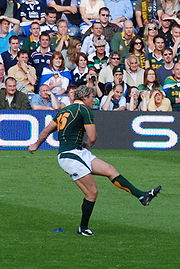
John Smit
John William Smit is the 50th and current captain of the South African national rugby union team, the Springboks. He has played most of his career as a hooker, but played twice for the Springboks off the bench as a prop prior to the South Africa coaching staff's decision to use him as a tighthead...
with 110 caps, currently placing him joint-seventh with George Smith of Australia
Australia national rugby union team
The Australian national rugby union team is the representative side of Australia in rugby union. The national team is nicknamed the Wallabies and competes annually with New Zealand and South Africa in the Tri-Nations Series, in which they also contest the Bledisloe Cup with New Zealand and the...
on the all-time list in international rugby. Victor Matfield
Victor Matfield
Victor Matfield is a South African rugby union player. He has played for, and captained the Springbok rugby team as well as the Blue Bulls in the Currie Cup and the Bulls franchise in the Super 14...
is the most-capped lock for any nation in rugby history, with all of his caps coming at that position; although Fabien Pelous
Fabien Pelous
Fabien Pelous is a retired French rugby union footballer. A lock who also occasionally played as a number eight and flanker, he played almost all of his professional career for Stade Toulousain, and is the all-time leader in appearances for the French national team...
of France
France national rugby union team
The France national rugby union team represents France in rugby union. They compete annually against England, Ireland, Italy, Scotland and Wales in the Six Nations Championship. They have won the championship outright sixteen times, shared it a further eight times, and have completed nine grand slams...
retired with 118 caps, only 100 were as a lock. The most-capped back is Percy Montgomery
Percy Montgomery
Percival Colin "Percy" Montgomery is a retired South African rugby union player...
, whose 102 caps made him the country's leader until first being equalled by John Smit
John Smit
John William Smit is the 50th and current captain of the South African national rugby union team, the Springboks. He has played most of his career as a hooker, but played twice for the Springboks off the bench as a prop prior to the South Africa coaching staff's decision to use him as a tighthead...
and later surpassed by Matfield, but was regained by Smit. Montgomery also holds the South African record for Test points with 893, which at the time of his international retirement placed him sixth on the all-time list of Test point scorers (he now stands eighth). The most points Montgomery ever scored in a single international was 35 against Namibia
Namibia national rugby union team
The Namibian rugby union team, nicknamed the Welwitschias or Biltongboere, represents Namibia at rugby union. Although they are a tier-three nation in the International Rugby Board tier system, the team have participated in all three Rugby World Cup competitions since their first appearance in 1999...
in 2007—this is also a South African record.
Fly-half Jannie de Beer
Jannie de Beer
Jan Hendrik de Beer , nicknamed Jannie, is a South African former rugby union player. He played flyhalf for the South African national team, the Springboks. In all he represented the Springboks in 13 tests, scoring 183 points. He stands 1.82 meters tall, and weighs 87 kilograms...
holds the world record for dropped goals in a Test match (5, during the 44–21 quarter-final win over England in the 1999 Rugby World Cup)
On 1 August during the 2009 Tri Nations tournament, Morne Steyn
Morne Steyn
Morné Steyn is a South African rugby union player who plays at the Flyhalf position.He plays at number 10 for the Springboks internationally, as well as for the Bulls in the Super 14 and for the Blue Bulls in the Currie Cup...
set a number of records during the second Test between the Springboks and the All Blacks. The Springboks won 31–19, with Steyn scoring all South Africa's points – 1 try, 1 conversion, 8 penalties. This gave him records for:
- Most points scored by any player in a Tri Nations match, surpassing Andrew MehrtensAndrew MehrtensAndrew Philip Mehrtens MNZM is a New Zealand rugby union footballer, currently playing in France for Béziers, a club in the third-level Fédérale 1 league...
(All Blacks vs. Australia, 1999). - Most points ever scored by an individual in a Test against the All Blacks, passing Christophe LamaisonChristophe LamaisonChristophe Lamaison is a former French rugby union footballer who represented France at international level, and Brive, Agen and Aviron Bayonnais at professional club level. He won 37 caps and is the current all-time leading points scorer for France, with 380 points...
's 29 (France, 1999). - World record for most points scored by a player who has scored all their team's points.
- South African record for penalties in a test (8) – beating the seven achieved twice by Montgomery.
- Steyn also holds the Springbok record for the fastest 100 points (8 Test matches)
Although statistics on the success rate of kicks at goal were not kept until the late 1980s, it is believed that Steyn also holds the record for most consecutive successful kicks at goal in Tests. He had a streak of 41 successful kicks at goal, which started during the Boks' Test against Italy on 19 June 2010 and ended on 6 November 2010 against Ireland.
The world's most-capped captain is John Smit
John Smit
John William Smit is the 50th and current captain of the South African national rugby union team, the Springboks. He has played most of his career as a hooker, but played twice for the Springboks off the bench as a prop prior to the South Africa coaching staff's decision to use him as a tighthead...
, who has captained South Africa in 82 of his 110 Tests. The world's most-capped lock pairing is that of Victor Matfield
Victor Matfield
Victor Matfield is a South African rugby union player. He has played for, and captained the Springbok rugby team as well as the Blue Bulls in the Currie Cup and the Bulls franchise in the Super 14...
and Bakkies Botha
Bakkies Botha
John Philip "Bakkies" Botha, is a South African rugby union player who plays lock for the Springboks. He was a member of the national team that won the Rugby World Cup in 2007 in addition to winning two Tri-Nations titles in 2004 and 2009...
, who have started together in 62 Tests. Smit also played 46 consecutive matches for South Africa, which is a record.
The record try scorer is Bryan Habana
Bryan Habana
Bryan Gary Habana is a South African rugby union player who plays as a wing for the Western Province in the Currie Cup, the Stormers in Super 14, and the 2007 Rugby World Cup champions Springboks...
with 40 tries.
Notable players
Eleven former South African international players have been inducted into either the International Rugby Hall of FameInternational Rugby Hall of Fame
The International Rugby Hall of Fame is a hall of fame for rugby union. It was created in 1997 in New Zealand and is run as a charitable trust with an address at Chiswick in London. Most of the trustees are also inductees. IRHOF accepts new inductees every two years...
or the IRB Hall of Fame
IRB Hall of Fame
The IRB Hall of Fame is a hall of fame operated by the International Rugby Board that recognises special achievement and contribution to the sport of rugby union. The IRB Hall of Fame covers players, coaches, administrators, match officials, institutions and other individuals...
. Six are members of the International Rugby Hall of Fame only; two are members of the IRB Hall of Fame only, and four are members of both Halls of Fame.
Barry "Fairy" Heatlie
Fairy Heatlie
Barry "Fairy" Heatlie was a rugby union player, representing both South Africa and Argentina. He was the fifth captain of the South African rugby union team and is attributed as the man who gave the Springboks their famous green jersey.His contributions to the early development of South African...
, who played in the late 19th century and into the early 20th, was one of the early greats of South African rugby. He appeared for Western Province
Western Province (rugby team)
DHL Western Province is a South African rugby union team that participates in the annual Currie Cup tournament. The team has won the Currie Cup on 32 occasions and has the most supporters of any Currie Cup team...
34 times between 1890 and 1904, with 28 of them being Currie Cup
Currie Cup
The Currie Cup tournament is South Africa's premier domestic rugby union competition, played each winter and spring , featuring teams representing either entire provinces or substantial regions within provinces...
wins. He also played six Tests for South Africa against the Lions in 1891, 1896, and 1903, and also captained the side to their only two Test wins of the 1890s. Arguably his greatest legacy to South African rugby is the green jersey; he is credited with introducing the colour for South Africa's 1903 Test against the Lions at Newlands
Newlands Stadium
Newlands Stadium, currently referred to as DHL Newlands for sponsorship reasons, is located in Cape Town, South Africa.The stadium currently has a capacity of 51,900 people, but is not an all seater venue....
. He was inducted into the IRB Hall of Fame in 2009.
Bennie Osler
Bennie Osler
Benjamin Louwrens Osler was a rugby union footballer who played internationally for South Africa. Osler played mainly at fly-half for both South Africa, and his provincial team of Western Province....
played 17 consecutive Tests between 1924 and 1933. Playing at fly-half, his first Test was against the touring British team in 1924. He also played in the series against the All Blacks in 1928, but most notably captained the Springboks on their Grand Slam tour of 1931–32 when they defeated all four Home Nations
Home Nations
Home Nations is a collective term with one of two meanings depending on the context. Politically, it means the nations of the constituent countries of the United Kingdom...
. His last Tests were the five played against Australia when they toured to South Africa in 1933. Osler was inducted to the International Rugby Hall of Fame in 2007 and the IRB Hall of Fame in 2009.
Making his Test debut in Olser's Grand Slam winning team in 1931 was scrum-half Danie Craven
Danie Craven
Daniël Hartman Craven , more famously known as Danie Craven or simply Doc Craven, is a former Western Province, Eastern Province, Northern Transvaal and Springbok rugby union player as well as arguably South Africa's best and best-known rugby administrator...
. Craven played several positions including fly-half, scrum-half, centre and even number eight. However Craven was most famous for popularising the dive pass. As well as winning a Grand Slam with Osler's team, Craven toured with 1937 Springboks to New Zealand where they achieved their first series victory over New Zealand. His last act as player was captaining South Africa in a Test series against the Lions. Craven's involvement with the Springboks continued after his playing retirement, and he coached them to a 4–0 series win over the touring All Blacks in 1949. He was elected President of the South African Rugby Board in 1956, a position he held until the post-apartheid South African Rugby Union was formed in 1991. Craven was instrumental in the formation of the South African Rugby Union and became its first Executive President. Such was Craven's influence in South African rugby he became known as "Mr Rugby", was inducted into the International Hall of Fame in 1997, and was in the second class of inductees into the IRB Hall of Fame in 2007; behind Rugby School
Rugby School
Rugby School is a co-educational day and boarding school located in the town of Rugby, Warwickshire, England. It is one of the oldest independent schools in Britain.-History:...
and William Webb Ellis
William Webb Ellis
Rev. William Webb Ellis was an Anglican clergyman who is famous for allegedly being the inventor of Rugby football whilst a pupil at Rugby School....
.
The man most credited with inventing modern number 8 play was Hennie Muller
Hennie Muller
Hendrik "Hennie" Scholtz Vosloo Muller was a South African rugby union footballer. Born in Witbank, Muller is considered one of the greatest South African footballers, captaining the national side, the Springboks in nine tests, and is a member of the International Rugby Hall of Fame...
, inducted into the International Hall of Fame in 2001. He played 13 Tests between 1949 and 1953, and in the process won a 4–0 series victory over the All Blacks and a Grand Slam tour of Britain and Ireland. He was nicknamed Windhond (greyhound) for his speed around the field. When writing about the 1949 series against the All Blacks, Harding and Williams wrote: "(Okey) Geffin
Okey Geffin
Aaron "Okey" Geffin was a South African rugby union player.He is sometimes considered the greatest Jewish rugby player of all time, and he was inducted into the International Jewish Sports Hall of Fame in 1998....
won the series, perhaps, but Muller made it possible." Of Muller's 13 Tests, he only lost one—against Australia in 1953.
Named South Africa's player of the 20th Century in 2000, Frik du Preez
Frik du Preez
Frederik Christoffel Hendrik "Frik" du Preez is a former South African rugby union player who represented Northern Transvaal and the Springboks. He was born on a farm near Rustenburg and went to school at the Parys High School in Parys...
played 38 Tests between 1961 and 1971. Du Preez could play both flanker
Flanker (rugby union)
A flanker is a position in the sport of rugby union. Flankers play in the forwards, and are generally classified as either blindside, or openside flankers; numbers six and seven respectively. The name comes from their position in a scrum in which they flank each set of forwards...
or lock and was one of the most dominant forwards of the 1960s, but was especially well known for his all round skills. Danie Craven said of du Preez, "To my mind he could have played any position on a rugby field with equal brilliance." He was inducted into the International Rugby Hall of Fame in 1997 and the IRB Hall of Fame in 2009.
Morne du Plessis
Morne du Plessis
Morne du Plessis is a former South African rugby union player. He is often described as one of the Springboks' most successful captains. Playing at number 8, his national career spanned ten years, five of which he was captain...
played 22 Tests for South Africa between 1971 and 1980. His debut was at Number 8 in South Africa's series win over Australia in 1971. He went on to captain South Africa and became part of the only father-son pair to captain South Africa—his father had captained South Africa in 1949. He led South Africa to a 3–1 series win over the All Blacks in 1976 and a series win over the British and Irish Lions in 1980 by the same margin. Du Plessis would be inducted into the International Hall of Fame in 1999.
International Hall of Fame inductees Naas Botha, inducted in 2005, and Danie Gerber
Danie Gerber
Danie Gerber is a former South African rugby union player, who played for South Africa between 1980 and 1992. Playing mainly at centre, he won only 24 caps for South Africa despite playing internationally for 12 years because of South Africa's sporting isolation caused by apartheid...
, inducted in 2007, both had careers interrupted by South Africa's sporting isolation in the 1980s and early 1990s. Botha made his Test debut against the South American Jaguars in 1980. Playing at fly-half, Botha played 28 Tests and scored 312 Test points before his international retirement in 1992. Botha contributed significantly to the Springboks 1980 series win over the Lions, and also played for the World XV in the IRB Centenary Match at Twickenham
Twickenham Stadium
Twickenham Stadium is a stadium located in Twickenham, in the London Borough of Richmond upon Thames. It is the largest rugby union stadium in the United Kingdom and has recently been enlarged to seat 82,000...
. Gerber also made his debut in 1980, and scored 19 tries in his 24 Tests before retiring in 1992. He scored a hat-trick against England in 1984, and played alongside Botha in the World XV team in 1986. In South Africa's first Test since the fall of apartheid, against the All Blacks in 1992, he scored twice.
Two players that straddled the amateur and professional eras were Francois Pienaar
Francois Pienaar
Jacobus Francois Pienaar is a South African former rugby union player. He played flanker for South Africa from 1993 until 1996, winning 29 international caps, all of them as captain. He is best known for leading South Africa to victory in the 1995 Rugby World Cup...
and Joost van der Westhuizen
Joost van der Westhuizen
Joost van der Westhuizen is a former South African rugby union footballer who was the Springboks' first choice scrum-half in the mid-to-late 1990s and early 2000s. He was capped 89 times for the Springboks and scored 38 tries...
. Both first played for the Springboks in 1993. Pienaar was named captain in his first Test against France, and went on to captain the side to the 1995 World Cup. It was there he captained South Africa to the World Cup title, and received the trophy from Nelson Mandela
Nelson Mandela
Nelson Rolihlahla Mandela served as President of South Africa from 1994 to 1999, and was the first South African president to be elected in a fully representative democratic election. Before his presidency, Mandela was an anti-apartheid activist, and the leader of Umkhonto we Sizwe, the armed wing...
who was wearing his number 6 jersey. Nelson Mandela later wrote "It was under Francois Pienaar's inspiring leadership that rugby became the pride of the entire country. Francois brought the nation together." Pienaar entered the International Hall of Fame in 2005, and was inducted into the IRB Hall in 2011 alongside all other World Cup-winning captains from the inaugural event in 1987 through 2007 (minus the previously inducted Australian
Australia national rugby union team
The Australian national rugby union team is the representative side of Australia in rugby union. The national team is nicknamed the Wallabies and competes annually with New Zealand and South Africa in the Tri-Nations Series, in which they also contest the Bledisloe Cup with New Zealand and the...
John Eales
John Eales
John Eales AM is an Australian former rugby union player and the most successful captain in the history of Australian rugby.-Early life:...
). Joost van der Westhuizen also participated in the 1995 World cup victory, but went on to play in two more World Cups. Playing at scrum-half, van der Westhuizen played 89 Tests for South Africa and scored 38 tries. At the time of his retirement following the 2003 World Cup he was South Africa's leading try scorer and most capped player. He entered the International Hall of Fame two years after Pienaar, in 2007.
The newest Springbok player to enter the IRB Hall is John Smit
John Smit
John William Smit is the 50th and current captain of the South African national rugby union team, the Springboks. He has played most of his career as a hooker, but played twice for the Springboks off the bench as a prop prior to the South Africa coaching staff's decision to use him as a tighthead...
, inducted in 2011 alongside Pienaar. The captain of the 2007 World Cup winners, Smit (as noted earlier) ended his international career as the most-capped Springbok in history.
Coaches
The role and definition of the South Africa coach has varied significantly over the team's history. Hence a comprehensive list of coaches, or head selectors, is impossible. The following table is a list of coaches since the 1949 All Blacks tour to South Africa:| Name | Tenure | Win % |
|---|---|---|
| Danie Craven Danie Craven Daniël Hartman Craven , more famously known as Danie Craven or simply Doc Craven, is a former Western Province, Eastern Province, Northern Transvaal and Springbok rugby union player as well as arguably South Africa's best and best-known rugby administrator... |
1949–1956 | 74% |
| Basil Kenyon | 1958 | 0% |
| Hennie Muller Hennie Muller Hendrik "Hennie" Scholtz Vosloo Muller was a South African rugby union footballer. Born in Witbank, Muller is considered one of the greatest South African footballers, captaining the national side, the Springboks in nine tests, and is a member of the International Rugby Hall of Fame... |
1960–1961, 1963, 1965 | 44% |
| Boy Louw Boy Louw Matthys Michael Louw , born 21 February 1906 in Wellington, South Africa and died on 3 May 1988, is a former rugby union player who played with the South Africa rugby team. He primarily played prop but he also lined out for the Springboks at second row, flanker and number eight.He played with... |
1960–1961, 1965 | 67% |
| Izak van Heerden Izak Van Heerden Izak Van Heerden was a South African rugby union coach, and player, remembered mainly for his successes with the Argentina national team and Natal, and his unconventional style.-Biography:Van Heerden was born in Durban in 1910.... |
1962 | 75% |
| Felix du Plessis | 1964 | 100% |
| Ian Kirkpatrick | 1967, 1974 | 60% |
| Avril Malan | 1969–1970 | 50% |
| Johan Claassen | 1964, 1970–1974 | 50% |
| Nelie Smith | 1980–1981 | 80% |
| Cecil Moss Cecil Moss Cecil Moss was a South African rugby union player and coach. He was professionally a physician. Moss was Jewish. He and his wife had two children.... |
1982–1989 | 83% |
| John Williams | 1992 | 20% |
| Ian McIntosh Ian McIntosh Ian McIntosh is a Zimbabwean-South African rugby union coach. He served as head coach for the Springboks during the early 1990s.McIntosh grew up near Bulawayo.... |
1993–1994 | 33% |
| Kitch Christie Kitch Christie George Moir Christie, better known as Kitch Christie , was a South African rugby union coach best known for coaching the country's national team, the Springboks, to victory at the 1995 Rugby World Cup... |
1994–1996 | 100% |
| Andre Markgraaff Andre Markgraaff Andries Thomas "Andre" Markgraaff was a South African rugby union flanker, and controversial national coach, who resigned after he was taped referring to "fucking kaffirs". He was selected for the South African team in 1986 against the Cavaliers but as an unused substitute... |
1996 | 61% |
| Carel du Plessis Carel du Plessis Carel Johan du Plessis is a former South African rugby union coach and player.-Playing career:Du Plessis played for Western Province and the Springboks, his skills earning him the nickname the Prince of Wings... |
1997 | 37% |
| Nick Mallett Nick Mallett Nicholas Vivian Howard Mallett is a former South African rugby union player who was until recently the head coach of the Italian national team, previously replacing Pierre Berbizier on 3 October 2007... |
1997–2000 | 71% |
| Harry Viljoen | 2000–2002 | 53% |
| Rudolph Straeuli Rudolph Straeuli Rudolph August Wilkens Straeuli played rugby union in the positions of flanker and Number 8 for, and later coached, the Springboks rugby team. He also played for the Lions provincial team in the Currie Cup competition... |
2002–2003 | 52% |
| Jake White Jake White Jake White is a rugby union coach and former coach of the South Africa national rugby union team, the Springboks. His most notable achievements as coach include leading the Springboks to victory in 2007 Rugby World Cup and the 2004 Tri Nations title... |
2004–2007 | 67% |
| Peter de Villiers Peter de Villiers Peter de Villiers is a South African rugby union coach who is the coach of the South Africa national rugby union team. After his successes with South African U19 and U21 squads, de Villiers was named as the coach of South Africa's national team, the Springboks in January 2008, the first-ever... |
2008–2011 | 62% |
Both World Cup-winning coaches, Christie and White, were inducted into the IRB Hall of Fame in 2011 alongside all other World Cup-winning head coaches through the 2007 edition.
See also
- List of Springboks
- Rugby union in South AfricaRugby union in South AfricaRugby union is a popular team sport played in South Africa. Along with cricket and football it is one of the most popular ball sports in South Africa...
- South Africa national sevens teamSouth Africa national rugby union team (sevens)The South African national rugby union sevens team compete in the World Sevens Series, the Rugby World Cup Sevens and the Commonwealth Games.-Current squad:2011–12 IRB Sevens World Series 14-man squad :#Cecil Afrika...
- South African rugby union captainsSouth African rugby union captainsEvery player to captain the South Africa national rugby union team in a test match are listed here. Captains are listed in chronological order of their first match as captain.-Male:...
- South Africa vs ArgentinaHistory of rugby union matches between Argentina and South AfricaArgentina and South Africa first met in 1993. To date, South Africa have won all of their encounters. These two teams do not tour each other regularly and encounters between them are rare in the professional era...
- South Africa vs AustraliaHistory of rugby union matches between Australia and South AfricaThe contest between The Wallabies and The Springboks is one of the major rivalries in rugby union.The team's first meeting was on 8 July 1933 at Newlands in Cape Town in the first of 5 tests on the 1933 Australia rugby union tour of South Africa, and was won by South Africa 17-3. South Africa won...
- South Africa vs England
- South Africa vs FranceHistory of rugby union matches between France and South AfricaThe national rugby union teams of France and South Africa have been playing each other in Test rugby since 1913. Their first meeting, held in Bordeaux, was on 11 January 1913, and was won 38-5 by South Africa.-Overall summary:-Results:...
- South Africa vs Ireland
- South Africa vs ItalyHistory of rugby union matches between Italy and South AfricaThe Italy and South Africa rugby union teams first met in 1995. To date, South Africa have won all of their encounters. Their 101-0 victory in Port Elizabeth in 2001 was at the time the Springboks' largest victory , and remains Italy's heaviest defeat....
- South Africa vs New Zealand
- South Africa vs ScotlandHistory of rugby union matches between Scotland and South AfricaThe national rugby union teams of Scotland and South Africa have been playing each other in Test rugby since 1906, and as of 20 November 2010, they have met in 21 Test matches...
- South Africa vs Wales
Sources
- "United Nations, India and the boycott of Apartheid sport" anc.org.za, Accessed 6 August 2006
- "1000000 years of SA rugby contact with France" planet-rugby.com, Accessed 6 August 2006
- The colours – 1906 – 2006 planet-rugby.com, Accessed 14 November 2006
- 100 years of South African rugby (part one) – IRB
- 100 years of South African rugby (part two) – IRB
- 100 years of South African rugby (part three) – IRB