

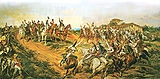
Brazilian Declaration of Independence

Encyclopedia
The Brazilian Independence comprised a series of political events occurred in 1821–1823, most of which involved disputes between Brazil
and Portugal
regarding the call for independence presented by the Brazilian Kingdom. It is celebrated on September 7
.
Though the first settlement was founded in 1532, colonization was effectively begun in 1534, when Dom João III divided the territory into twelve hereditary captaincies, but this arrangement proved problematic and in 1549 the king assigned a Governor-General to administer the entire colony. The Portuguese assimilated some of the native tribes while others were enslaved or exterminated in long wars or by European diseases to which they had no immunity. By the mid-16th century, sugar had become Brazil's most important export and the Portuguese enslaved and imported Africans to profit from the increasing international demand. By 1700, over 963,000 Africans had been stolen across the Atlantic to be enslaved in Brazil. More enslaved Africans were brought to Brazil up until that date than to all the other places in the Americas combined.
Through wars against the French, the Portuguese slowly expanded their territory to the southeast, taking Rio de Janeiro in 1567, and to the northwest, taking São Luís in 1615. They sent military expeditions to the Amazon rainforest and conquered British and Dutch strongholds, founding villages and forts from 1669. In 1680 they reached the far south and founded Sacramento on the bank of the Rio de la Plata, in the Eastern Strip region (present-day Uruguay).
At the end of the 17th century, sugar exports started to decline but beginning in the 1690s, the discovery of gold by explorers in the region that would later be called Minas Gerais (General Mines) in current Mato Grosso and Goiás, saved the colony from imminent collapse. From all over Brazil, as well as from Portugal, thousands of immigrants came to the mines.
The Spanish tried to prevent Portuguese expansion into the territory that belonged to them according to the 1494 Treaty of Tordesillas, and succeeded in conquering the Eastern Strip in 1777. However, this was in vain as the Treaty of San Ildefonso, signed in the same year, confirmed Portuguese sovereignty over all lands proceeding from its territorial expansion, thus creating most of the current Brazilian borders.
erupted in Portugal
. The movement initiated by the liberal constitutionalists resulted in the meeting of the Cortes (or Constituent Assembly
), that would have to create the kingdom’s first constitution
. The Cortes at the same time demanded the return of King Dom
João VI
, who had been living in Brazil
since 1808, who elevated Brazil to Kingdom as part of the United Kingdom of Portugal, Brazil and the Algarves in 1815 and who nominated his son and heir prince Dom Pedro as regent
, to govern Kingdom of Brazil in his place on 7 March 1821. The king left for Europe on April 26, while Dom Pedro remained in Brazil governing it with the aid of the ministers of the Kingdom (Interior) and Foreign Affairs, of War, of Navy
and of Finance
.
The Portuguese military officers headquartered in Brazil were completely sympathetic to the constitutionalist movement in Portugal. The main leader of the Portuguese officers, General Jorge Avilez, forced the prince to dismiss and banish from the country the ministers of Kingdom and Finance. Both were loyal allies of Pedro, who had become a pawn in the hands of the military. The humiliation suffered by the prince, who swore he would never yield to the pressure of the military again, would have a decisive influence on his abdication ten years later. Meanwhile, on September 30, 1821, the Cortes approved a decree that subordinated the Brazilian provincial governments directly to Portugal. Prince Pedro became for all purposes only the governor of the province of Rio de Janeiro
. Other decrees that came after ordered his return to Europe and also extinguished the judicial courts created by João VI in 1808.
Dissatisfaction over the Cortes' measures among most residents in Brazil (both Brazilian-born and Portuguese-born) rose to a point that it soon became publicly known. Two groups that opposed the Cortes actions to gradually undermine the Brazilian sovereignty appeared: Liberals led by Joaquim Gonçalves Ledo (which had the support of the Freemasons) and the Bonifacians led by José Bonifácio de Andrada. Both factions had nothing in common in their goals for Brazil, with the sole exception of their desire to keep the country united with Portugal as a sovereign monarchy.
, favoured the Brazilian side and encouraged him to remain in the country while the Liberals and Bonifacians made open representations. Pedro's reply came in 9 January 1822, who, according to newspapers, spoke: “As it is for the good of all and for the nation’s general happiness, I am ready: Tell the people that I will stay”.
After Pedro's decision to defy the Cortes, around 2,000 men led by Jorge Avilez rioted before concentrating on mount Castelo, which was soon surrounded by 10,000 armed Brazilians. Dom Pedro then "dismissed" the Portuguese commanding general and ordered him to remove his soldiers across the bay to Niterói
, where they would await transport to Portugal.
Jose Bonifácio was nominated minister of Kingdom and Foreign Affairs in 18 January 1822. Bonifácio soon established a father-like relationship with Pedro, who began to consider the experienced statesman
his greatest ally. Gonçalves Ledo and the liberals tried to minimize the close relationship between Bonifácio and Pedro offering to the prince the title of Perpetual Defender of Brazil. For the liberals, the meeting of a Constituent Assembly for Brazil was necessary, while the Bonifacians preferred that Pedro grant the constitution himself to avoid the possibility of similar anarchy to the one that occurred during the first years of the French Revolution
. The prince acquiesced to the liberals’ desires and signed a decree in 3 June 1822 calling for the election of the deputies that would gather in the Constituent and Legislative General Assembly
in Brazil.
 Pedro departed to São Paulo
to assure the province’s loyalty to the Brazilian cause. He reached its capital
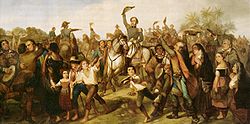
on 25 August and remained there until 5 September. When returning to Rio de Janeiro on 7 September he received mail from José Bonifácio and his wife Leopoldina. The prince learned that the Cortes had annulled all acts from the Bonifácio cabinet and removed the remaining power he still had. Pedro turned to his companions that included his Guard of Honor
and spoke: “Friends, the Portuguese Cortes want to enslave and pursue us. From today on our relations are broken. No ties unite us anymore” and continued after he pulled out his blue-white armband that symbolized Portugal: “Armbands off, soldiers. Hail to the independence, to freedom and to the separation of Brazil”. He unsheathed his sword affirming that "For my blood, my honor, my God, I swear to give Brazil freedom" and cried out: “Independence or death!”
When arriving in the city of São Paulo
on the night of September 7, 1822, Pedro and his fellow companions had spread the notice of the Brazilian independence from Portugal. The Prince was received with great popular celebration and was called “King of Brazil” but also “Emperor of Brazil”. Pedro returned to Rio de Janeiro
on September 14 and in the following days the liberals had spread pamphlets (written by Joaquim Gonçalves Ledo) that suggested the idea that the Prince should be acclaimed Constitutional Emperor
. On September 17 the President of the Municipal Chamber
of Rio de Janeiro, José Clemente Pereira, sent to the other Chambers of the country the news that the Acclamation
would occur in the anniversary of Pedro on October 12. On the following day the new flag and arms of the independent Kingdom of Brazil were created (The Imperial flag and arms created later on October 12 were identical to those with the exception of the crown that from Royal became Imperial).
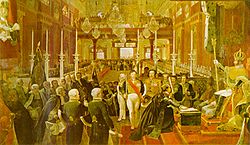 The official separation would only occur on September 22, 1822 in a letter written by Pedro to João VI
. In it, Pedro still calls himself Prince Regent and his father is considered the King of the independent Brazil. On October 12, 1822, in the Field of Santana (later known as Field of the Acclamation) Prince Pedro was acclaimed Dom Pedro I, Constitutional Emperor and Perpetual Defender of Brazil. It was at the same time the beginning of Pedro's reign and also of the Empire of Brazil. However, the Emperor made it clear that although he accepted the emperorship, if João VI returned to Brazil he would step down from the throne in favor of his father.
The reason for the imperial title was that the title of king would symbolically mean a continuation of the Portuguese dynastic tradition and perhaps of the feared absolutism, while the title of emperor derived from popular acclamation as in Ancient Rome
. On December 1, 1822 (anniversary of the acclamation of João IV
, first King of the House of Braganza
) Pedro I was crowned and consecrated.
militia
on both sides.
In the newly created Army
and Navy
the Brazilians had forced enlistment including foreign immigrants. They also made use of slaves in militias as well as freeing slaves to enlist them in army and navy. The land and naval combats covered the territories of Bahia
, Cisplatina
, Rio de Janeiro
and the vice-kingdom of Grão-Pará
. Maranhão
and Pernambuco
(which then embraced also what today are the States of Ceará
, Piauí
and Rio Grande do Norte
) were also places where fighting occurred.
Fights between militias took the streets of the main cities of the mentioned territories in 1822 and in land, despite the arrival of additional forces from Portugal along the year of 1822 but the last quarter; the Portuguese forces although had neutralized the home-born militians in some cities like Salvador
, Montevideo
and São Luís
, failed to defeat the militias in most of cities as well the guerrilla forces in the country side and when came 1823, while the Brazilian army had enlarged replacing its losses of men and supplies; the remaining Portuguese forces, already then on the defensive, were shortened of men and means, found themselves compelled to restrict their sphere of action to resist in some province capitals, that were also strategic sea port
s, as for example Belém
beyond the already mentioned Montevideo, Salvador & São Luís do Maranhão.
At sea, the Brazilian action was led by Thomas Cochrane
. There was a shaky beginning due to sabotage
done by the significant number of Portuguese in the crews. By 1823 the navy was reformed and the Portuguese members were replaced by Brazilians (released slaves and white men under forced enlistment) and foreign mercenaries
(British and Americans). The Brazilian navy succeeded in clearing the coast of the Portuguese presence and isolating the last Portuguese land troops. By the end of that year they had pursued the remaining naval colonial forces across the Atlantic as far as the shore of Portugal.
There are still today no reliable statistics
related to the numbers of, for example, the total of the war casualties. However based upon historical registration and contemporary reports of some battles of this war as well as upon the admitted numbers in similar fights that happened in these times around the globe, and considering how long the Brazilian independence war lasted (22 months), estimates of all killed in action on both sides are placed from around 5,700 to 6,200.
Brazil
Brazil , officially the Federative Republic of Brazil , is the largest country in South America. It is the world's fifth largest country, both by geographical area and by population with over 192 million people...
and Portugal
Portugal
Portugal , officially the Portuguese Republic is a country situated in southwestern Europe on the Iberian Peninsula. Portugal is the westernmost country of Europe, and is bordered by the Atlantic Ocean to the West and South and by Spain to the North and East. The Atlantic archipelagos of the...
regarding the call for independence presented by the Brazilian Kingdom. It is celebrated on September 7
Independence Day (Brazil)
The Independence Day of Brazil , commonly called Sete de Setembro , is a national holiday observed in Brazil on September 7 of every year...
.
Origin of Brazil
The land now called Brazil was claimed by Portugal in April 1500, on the arrival of the Portuguese fleet commanded by Pedro Álvares Cabral. The Portuguese encountered Indigenous nations divided into several tribes, most of whom shared the same Tupi-Guarani language family, and shared and disputed the territory.Though the first settlement was founded in 1532, colonization was effectively begun in 1534, when Dom João III divided the territory into twelve hereditary captaincies, but this arrangement proved problematic and in 1549 the king assigned a Governor-General to administer the entire colony. The Portuguese assimilated some of the native tribes while others were enslaved or exterminated in long wars or by European diseases to which they had no immunity. By the mid-16th century, sugar had become Brazil's most important export and the Portuguese enslaved and imported Africans to profit from the increasing international demand. By 1700, over 963,000 Africans had been stolen across the Atlantic to be enslaved in Brazil. More enslaved Africans were brought to Brazil up until that date than to all the other places in the Americas combined.
Through wars against the French, the Portuguese slowly expanded their territory to the southeast, taking Rio de Janeiro in 1567, and to the northwest, taking São Luís in 1615. They sent military expeditions to the Amazon rainforest and conquered British and Dutch strongholds, founding villages and forts from 1669. In 1680 they reached the far south and founded Sacramento on the bank of the Rio de la Plata, in the Eastern Strip region (present-day Uruguay).
At the end of the 17th century, sugar exports started to decline but beginning in the 1690s, the discovery of gold by explorers in the region that would later be called Minas Gerais (General Mines) in current Mato Grosso and Goiás, saved the colony from imminent collapse. From all over Brazil, as well as from Portugal, thousands of immigrants came to the mines.
The Spanish tried to prevent Portuguese expansion into the territory that belonged to them according to the 1494 Treaty of Tordesillas, and succeeded in conquering the Eastern Strip in 1777. However, this was in vain as the Treaty of San Ildefonso, signed in the same year, confirmed Portuguese sovereignty over all lands proceeding from its territorial expansion, thus creating most of the current Brazilian borders.
Portuguese Cortes
In 1820 the Constitutionalist RevolutionLiberal Revolution of 1820
The Liberal Revolution of 1820 was a political revolution that erupted in 1820 and lasted until 1826. It was unchained via a military insurrection in the city of Porto, in northern Portugal, that quickly and peacefully spread to the rest of the country. From 1807 to 1811 Napoleonic French forces...
erupted in Portugal
Portugal
Portugal , officially the Portuguese Republic is a country situated in southwestern Europe on the Iberian Peninsula. Portugal is the westernmost country of Europe, and is bordered by the Atlantic Ocean to the West and South and by Spain to the North and East. The Atlantic archipelagos of the...
. The movement initiated by the liberal constitutionalists resulted in the meeting of the Cortes (or Constituent Assembly
Constituent assembly
A constituent assembly is a body composed for the purpose of drafting or adopting a constitution...
), that would have to create the kingdom’s first constitution
Constitution
A constitution is a set of fundamental principles or established precedents according to which a state or other organization is governed. These rules together make up, i.e. constitute, what the entity is...
. The Cortes at the same time demanded the return of King Dom
Don (honorific)
Don, from Latin dominus, is an honorific in Spanish , Portuguese , and Italian . The female equivalent is Doña , Dona , and Donna , abbreviated "Dª" or simply "D."-Usage:...
João VI
John VI of Portugal
John VI John VI John VI (full name: João Maria José Francisco Xavier de Paula Luís António Domingos Rafael; (13 May 1767 – 10 March 1826) was King of the United Kingdom of Portugal, Brazil and the Algarves (later changed to just King of Portugal and the Algarves, after Brazil was recognized...
, who had been living in Brazil
Brazil
Brazil , officially the Federative Republic of Brazil , is the largest country in South America. It is the world's fifth largest country, both by geographical area and by population with over 192 million people...
since 1808, who elevated Brazil to Kingdom as part of the United Kingdom of Portugal, Brazil and the Algarves in 1815 and who nominated his son and heir prince Dom Pedro as regent
Regent
A regent, from the Latin regens "one who reigns", is a person selected to act as head of state because the ruler is a minor, not present, or debilitated. Currently there are only two ruling Regencies in the world, sovereign Liechtenstein and the Malaysian constitutive state of Terengganu...
, to govern Kingdom of Brazil in his place on 7 March 1821. The king left for Europe on April 26, while Dom Pedro remained in Brazil governing it with the aid of the ministers of the Kingdom (Interior) and Foreign Affairs, of War, of Navy
Ministry of Defence (Brazil)
The Ministry of Defence of Brazil, is the civilian cabinet organization responsible for managing the Military of Brazil. It is headed by the Minister of Defence....
and of Finance
Ministry of Finance (Brazil)
The Ministry of Finance of Brazil was created in 1808 with the title Secretaria de Estado dos Negócios do Brazil e da Fazenda. The ministry is responsible for formulating and implementing the country's economic policy.-External links:*...
.
The Portuguese military officers headquartered in Brazil were completely sympathetic to the constitutionalist movement in Portugal. The main leader of the Portuguese officers, General Jorge Avilez, forced the prince to dismiss and banish from the country the ministers of Kingdom and Finance. Both were loyal allies of Pedro, who had become a pawn in the hands of the military. The humiliation suffered by the prince, who swore he would never yield to the pressure of the military again, would have a decisive influence on his abdication ten years later. Meanwhile, on September 30, 1821, the Cortes approved a decree that subordinated the Brazilian provincial governments directly to Portugal. Prince Pedro became for all purposes only the governor of the province of Rio de Janeiro
Rio de Janeiro (state)
Rio de Janeiro is one of the 27 states of Brazil.Rio de Janeiro has the second largest economy of Brazil behind only São Paulo state.The state of Rio de Janeiro is located within the Brazilian geopolitical region classified as the Southeast...
. Other decrees that came after ordered his return to Europe and also extinguished the judicial courts created by João VI in 1808.
Dissatisfaction over the Cortes' measures among most residents in Brazil (both Brazilian-born and Portuguese-born) rose to a point that it soon became publicly known. Two groups that opposed the Cortes actions to gradually undermine the Brazilian sovereignty appeared: Liberals led by Joaquim Gonçalves Ledo (which had the support of the Freemasons) and the Bonifacians led by José Bonifácio de Andrada. Both factions had nothing in common in their goals for Brazil, with the sole exception of their desire to keep the country united with Portugal as a sovereign monarchy.
Avilez rebellion
The Portuguese deputies of the Cortes showed no respect towards the prince and openly mocked him. and so the loyalty that Pedro had shown towards the Cortes gradually shifted to the Brazilian cause. His wife, princess Leopoldina of HabsburgMaria Leopoldina of Austria
Maria Leopoldina of Austria was an archduchess of Austria, Empress consort of Brazil and queen consort of Portugal....
, favoured the Brazilian side and encouraged him to remain in the country while the Liberals and Bonifacians made open representations. Pedro's reply came in 9 January 1822, who, according to newspapers, spoke: “As it is for the good of all and for the nation’s general happiness, I am ready: Tell the people that I will stay”.
After Pedro's decision to defy the Cortes, around 2,000 men led by Jorge Avilez rioted before concentrating on mount Castelo, which was soon surrounded by 10,000 armed Brazilians. Dom Pedro then "dismissed" the Portuguese commanding general and ordered him to remove his soldiers across the bay to Niterói
Niterói
Niterói is a municipality in the state of Rio de Janeiro, southeast region of Brazil. It has an estimated population of 487,327 inhabitants and an area of ², being the sixth most populous city in the state and the highest Human Development Index. Integrates the Metropolitan Region of Rio de...
, where they would await transport to Portugal.
Jose Bonifácio was nominated minister of Kingdom and Foreign Affairs in 18 January 1822. Bonifácio soon established a father-like relationship with Pedro, who began to consider the experienced statesman
Statesman
A statesman is usually a politician or other notable public figure who has had a long and respected career in politics or government at the national and international level. As a term of respect, it is usually left to supporters or commentators to use the term...
his greatest ally. Gonçalves Ledo and the liberals tried to minimize the close relationship between Bonifácio and Pedro offering to the prince the title of Perpetual Defender of Brazil. For the liberals, the meeting of a Constituent Assembly for Brazil was necessary, while the Bonifacians preferred that Pedro grant the constitution himself to avoid the possibility of similar anarchy to the one that occurred during the first years of the French Revolution
French Revolution
The French Revolution , sometimes distinguished as the 'Great French Revolution' , was a period of radical social and political upheaval in France and Europe. The absolute monarchy that had ruled France for centuries collapsed in three years...
. The prince acquiesced to the liberals’ desires and signed a decree in 3 June 1822 calling for the election of the deputies that would gather in the Constituent and Legislative General Assembly
Constituent assembly
A constituent assembly is a body composed for the purpose of drafting or adopting a constitution...
in Brazil.
From United Kingdom to Independent Empire
São Paulo (state)
São Paulo is a state in Brazil. It is the major industrial and economic powerhouse of the Brazilian economy. Named after Saint Paul, São Paulo has the largest population, industrial complex, and economic production in the country. It is the richest state in Brazil...
to assure the province’s loyalty to the Brazilian cause. He reached its capital
São Paulo
São Paulo is the largest city in Brazil, the largest city in the southern hemisphere and South America, and the world's seventh largest city by population. The metropolis is anchor to the São Paulo metropolitan area, ranked as the second-most populous metropolitan area in the Americas and among...
on 25 August and remained there until 5 September. When returning to Rio de Janeiro on 7 September he received mail from José Bonifácio and his wife Leopoldina. The prince learned that the Cortes had annulled all acts from the Bonifácio cabinet and removed the remaining power he still had. Pedro turned to his companions that included his Guard of Honor
Presidential Guard Battalion (Brazil)
The Presidential Guard Battalion is a unit of the Brazilian Army and honor guard to the President of Brazil. Two other units, the 1st Guards Cavalry Regiment and the Cayenne Battery, are also part of the presidential honor guard....
and spoke: “Friends, the Portuguese Cortes want to enslave and pursue us. From today on our relations are broken. No ties unite us anymore” and continued after he pulled out his blue-white armband that symbolized Portugal: “Armbands off, soldiers. Hail to the independence, to freedom and to the separation of Brazil”. He unsheathed his sword affirming that "For my blood, my honor, my God, I swear to give Brazil freedom" and cried out: “Independence or death!”
When arriving in the city of São Paulo
São Paulo
São Paulo is the largest city in Brazil, the largest city in the southern hemisphere and South America, and the world's seventh largest city by population. The metropolis is anchor to the São Paulo metropolitan area, ranked as the second-most populous metropolitan area in the Americas and among...
on the night of September 7, 1822, Pedro and his fellow companions had spread the notice of the Brazilian independence from Portugal. The Prince was received with great popular celebration and was called “King of Brazil” but also “Emperor of Brazil”. Pedro returned to Rio de Janeiro
Rio de Janeiro
Rio de Janeiro , commonly referred to simply as Rio, is the capital city of the State of Rio de Janeiro, the second largest city of Brazil, and the third largest metropolitan area and agglomeration in South America, boasting approximately 6.3 million people within the city proper, making it the 6th...
on September 14 and in the following days the liberals had spread pamphlets (written by Joaquim Gonçalves Ledo) that suggested the idea that the Prince should be acclaimed Constitutional Emperor
Constitutional monarchy
Constitutional monarchy is a form of government in which a monarch acts as head of state within the parameters of a constitution, whether it be a written, uncodified or blended constitution...
. On September 17 the President of the Municipal Chamber
Municipal council
A municipal council is the local government of a municipality. Specifically the term can refer to the institutions of various countries that can be translated by this term...
of Rio de Janeiro, José Clemente Pereira, sent to the other Chambers of the country the news that the Acclamation
Acclamation
An acclamation, in its most common sense, is a form of election that does not use a ballot. "Acclamation" or "acclamatio" can also signify a kind of ritual greeting and expression of approval in certain social contexts in ancient Rome.-Voting:...
would occur in the anniversary of Pedro on October 12. On the following day the new flag and arms of the independent Kingdom of Brazil were created (The Imperial flag and arms created later on October 12 were identical to those with the exception of the crown that from Royal became Imperial).
John VI of Portugal
John VI John VI John VI (full name: João Maria José Francisco Xavier de Paula Luís António Domingos Rafael; (13 May 1767 – 10 March 1826) was King of the United Kingdom of Portugal, Brazil and the Algarves (later changed to just King of Portugal and the Algarves, after Brazil was recognized...
. In it, Pedro still calls himself Prince Regent and his father is considered the King of the independent Brazil. On October 12, 1822, in the Field of Santana (later known as Field of the Acclamation) Prince Pedro was acclaimed Dom Pedro I, Constitutional Emperor and Perpetual Defender of Brazil. It was at the same time the beginning of Pedro's reign and also of the Empire of Brazil. However, the Emperor made it clear that although he accepted the emperorship, if João VI returned to Brazil he would step down from the throne in favor of his father.
The reason for the imperial title was that the title of king would symbolically mean a continuation of the Portuguese dynastic tradition and perhaps of the feared absolutism, while the title of emperor derived from popular acclamation as in Ancient Rome
Ancient Rome
Ancient Rome was a thriving civilization that grew on the Italian Peninsula as early as the 8th century BC. Located along the Mediterranean Sea and centered on the city of Rome, it expanded to one of the largest empires in the ancient world....
. On December 1, 1822 (anniversary of the acclamation of João IV
John IV of Portugal
|-|John IV was the King of Portugal and the Algarves from 1640 to his death. He was the grandson of Catherine, Duchess of Braganza, who had in 1580 claimed the Portuguese crown and sparked the struggle for the throne of Portugal. John was nicknamed John the Restorer...
, first King of the House of Braganza
House of Braganza
The Most Serene House of Braganza , an important Portuguese noble family, ruled the Kingdom of Portugal and its colonial Empire, from 1640 to 1910...
) Pedro I was crowned and consecrated.
The Independence War
The war between the Brazilians and Portuguese lasted from February 1822, with the burst of first skirmishes between militias, to November 1823, when the last Portuguese garrisons surrendered. In land and naval combats it involved both regular forces and civilianCivilian
A civilian under international humanitarian law is a person who is not a member of his or her country's armed forces or other militia. Civilians are distinct from combatants. They are afforded a degree of legal protection from the effects of war and military occupation...
militia
Militia
The term militia is commonly used today to refer to a military force composed of ordinary citizens to provide defense, emergency law enforcement, or paramilitary service, in times of emergency without being paid a regular salary or committed to a fixed term of service. It is a polyseme with...
on both sides.
In the newly created Army
Brazilian Army
The Brazilian Army is the land arm of the Brazilian Military. The Brazilian Army has fought in several international conflicts, mostly in South America and during the 19th century, such as the Brazilian War of Independence , Argentina-Brazil War , War of the Farrapos , Platine War , Uruguayan War ...
and Navy
Brazilian Navy
The Brazilian Navy is a branch of the Brazilian Armed Forces responsible for conducting naval operations. It is the largest navy in Latin America...
the Brazilians had forced enlistment including foreign immigrants. They also made use of slaves in militias as well as freeing slaves to enlist them in army and navy. The land and naval combats covered the territories of Bahia
Bahia
Bahia is one of the 26 states of Brazil, and is located in the northeastern part of the country on the Atlantic coast. It is the fourth most populous Brazilian state after São Paulo, Minas Gerais and Rio de Janeiro, and the fifth-largest in size...
, Cisplatina
Cisplatina
The Cisplatina Province was a Portuguese and later a Brazilian province in existence from 1815 to 1828...
, Rio de Janeiro
Rio de Janeiro
Rio de Janeiro , commonly referred to simply as Rio, is the capital city of the State of Rio de Janeiro, the second largest city of Brazil, and the third largest metropolitan area and agglomeration in South America, boasting approximately 6.3 million people within the city proper, making it the 6th...
and the vice-kingdom of Grão-Pará
Grão-Pará
The vice-kingdom of Grão-Pará was one of the two Portuguese vice-kingdoms in South America, corresponding to today's North Brazil. Its capital city was Belém do Pará....
. Maranhão
Maranhão
Maranhão is a northeastern state of Brazil. To the north lies the Atlantic Ocean. Maranhão is neighbored by the states of Piauí, Tocantins and Pará. The people of Maranhão have a distinctive accent...
and Pernambuco
Pernambuco
Pernambuco is a state of Brazil, located in the Northeast region of the country. To the north are the states of Paraíba and Ceará, to the west is Piauí, to the south are Alagoas and Bahia, and to the east is the Atlantic Ocean. There are about of beaches, some of the most beautiful in the...
(which then embraced also what today are the States of Ceará
Ceará
Ceará is one of the 27 states of Brazil, located in the northeastern part of the country, on the Atlantic coast. It is currently the 8th largest Brazilian State by population and the 17th by area. It is also one of the main touristic destinations in Brazil. The state capital is the city of...
, Piauí
Piauí
Piauí is one of the states of Brazil, located in the northeastern part of the country.Piauí has the shortest coastline of any of the non-landlocked Brazilian states at 66 km , and the capital, Teresina, is the only state capital in the north east to be located inland...
and Rio Grande do Norte
Rio Grande do Norte
Rio Grande do Norte is one of the states of Brazil, located in the northeastern region of the country, occupying the northeasternmost tip of the South American continent. Because of its geographic position, Rio Grande do Norte has a strategic importance. The capital and largest city is Natal...
) were also places where fighting occurred.
Fights between militias took the streets of the main cities of the mentioned territories in 1822 and in land, despite the arrival of additional forces from Portugal along the year of 1822 but the last quarter; the Portuguese forces although had neutralized the home-born militians in some cities like Salvador
Salvador, Bahia
Salvador is the largest city on the northeast coast of Brazil and the capital of the Northeastern Brazilian state of Bahia. Salvador is also known as Brazil's capital of happiness due to its easygoing population and countless popular outdoor parties, including its street carnival. The first...
, Montevideo
Montevideo
Montevideo is the largest city, the capital, and the chief port of Uruguay. The settlement was established in 1726 by Bruno Mauricio de Zabala, as a strategic move amidst a Spanish-Portuguese dispute over the platine region, and as a counter to the Portuguese colony at Colonia del Sacramento...
and São Luís
São Luís, Maranhão
São Luís is the capital and largest city of the Brazilian state of Maranhão. The city is located on Ilha de São Luís in the Baía de São Marcos , an extension of the Atlantic Ocean which forms the estuary of Pindaré, Mearim, Itapecuru and other rivers. Its coordinates are 2.53° south, 44.30° west...
, failed to defeat the militias in most of cities as well the guerrilla forces in the country side and when came 1823, while the Brazilian army had enlarged replacing its losses of men and supplies; the remaining Portuguese forces, already then on the defensive, were shortened of men and means, found themselves compelled to restrict their sphere of action to resist in some province capitals, that were also strategic sea port
Port
A port is a location on a coast or shore containing one or more harbors where ships can dock and transfer people or cargo to or from land....
s, as for example Belém
Belém
Belém is a Brazilian city, the capital and largest city of state of Pará, in the country's north region. It is the entrance gate to the Amazon with a busy port, airport and bus/coach station...
beyond the already mentioned Montevideo, Salvador & São Luís do Maranhão.
At sea, the Brazilian action was led by Thomas Cochrane
Thomas Cochrane, 10th Earl of Dundonald
Admiral Thomas Cochrane, 10th Earl of Dundonald, 1st Marquess of Maranhão, GCB, ODM , styled Lord Cochrane between 1778 and 1831, was a senior British naval flag officer and radical politician....
. There was a shaky beginning due to sabotage
Sabotage
Sabotage is a deliberate action aimed at weakening another entity through subversion, obstruction, disruption, or destruction. In a workplace setting, sabotage is the conscious withdrawal of efficiency generally directed at causing some change in workplace conditions. One who engages in sabotage is...
done by the significant number of Portuguese in the crews. By 1823 the navy was reformed and the Portuguese members were replaced by Brazilians (released slaves and white men under forced enlistment) and foreign mercenaries
Mercenary
A mercenary, is a person who takes part in an armed conflict based on the promise of material compensation rather than having a direct interest in, or a legal obligation to, the conflict itself. A non-conscript professional member of a regular army is not considered to be a mercenary although he...
(British and Americans). The Brazilian navy succeeded in clearing the coast of the Portuguese presence and isolating the last Portuguese land troops. By the end of that year they had pursued the remaining naval colonial forces across the Atlantic as far as the shore of Portugal.
There are still today no reliable statistics
Statistics
Statistics is the study of the collection, organization, analysis, and interpretation of data. It deals with all aspects of this, including the planning of data collection in terms of the design of surveys and experiments....
related to the numbers of, for example, the total of the war casualties. However based upon historical registration and contemporary reports of some battles of this war as well as upon the admitted numbers in similar fights that happened in these times around the globe, and considering how long the Brazilian independence war lasted (22 months), estimates of all killed in action on both sides are placed from around 5,700 to 6,200.
See also
- Battle of JenipapoBattle of JenipapoThe Battle of Jenipapo was fought near the river Jenipapo in the then province of Piauí, on 13 March 1823, between the Brazilian Army and the Portuguese Army during the Brazilian War of Independence....
- Battle of PirajáBattle of PirajáThe Battle of Pirajá occurred in the context of the War of Independence of Brazil, then in the province of Bahia, November 8, 1822.Consisted in a decisive engagement between the Peacemaker Army and Portuguese forces, including the Legion Constitution, with the Brazilian victory, consolidating the...
- Battle of ItaparicaBattle of ItaparicaThe Battle of Itaparica was fought in the then province of Bahia, from 7 January to 9 January 1823, between the Brazilian Army and Armada and the Portuguese Army and Navy during the Brazilian War of Independence....
- Battle of May 4Battle of May 4The Battle of 4 May was fought in open sea near Salvador, Bahia, on May 4, 1823, between the Brazilian Navy, under the command of a former admiral of the British Royal Navy, Thomas Cochrane, and the Portuguese Navy during the Brazilian War of Independence....
- Siege of SalvadorSiege of SalvadorThe Siege of Salvador occurred during the Brazilian War of Independence, during which the Brazilian Army, under Pierre Labatut, attempted to capture the city of Salvador in Bahia from its Portuguese Army defenders. The siege lasted from 2 March 1822 until 2 July 1823, finally ending when the...
- Siege of Montevideo (1823)Siege of Montevideo (1823)The Siege of Montevideo occurred during the Brazilian War of Independence, during which the Brazilian Army under Carlos Frederico Lecor attempted to capture the city of Montevideo in Cisplatine from the Portuguese Army of Álvaro da Costa de Sousa Macedo. The siege lasted from 20 January 1823 until...
- Siege of Recife
- Siege of CaxiasSiege of CaxiasThe Siege of Caxias was a siege during the Brazilian War of Independence in which the Brazilian Army under the command of José Pereira Filgueiras attempted to capture the city of Caxias in Maranhão, which was defended by the Portuguese Army of João José da Cunha Fidié...
- Siege of Belém
- History of BrazilHistory of BrazilThe history of Brazil begins with the arrival of the first indigenous peoples, thousands of years ago by crossing the Bering land bridge into Alaska and then moving south....
- Colonial BrazilColonial BrazilIn the history of Brazil, Colonial Brazil, officially the Viceroyalty of Brazil comprises the period from 1500, with the arrival of the Portuguese, until 1815, when Brazil was elevated to kingdom alongside Portugal as the United Kingdom of Portugal, Brazil and the Algarves.During the over 300 years...
- Brazilian EmpireBrazilian EmpireThe Empire of Brazil was a 19th-century state that broadly comprised the territories which form modern Brazil. Its government was a representative parliamentary constitutional monarchy under the rule of Emperors Dom Pedro I and his son Dom Pedro II, both members of the House of Braganza—a...
- List of wars involving Brazil