


Brazilian Army

Encyclopedia
The Brazilian Army is the land arm of the Brazilian Military. The Brazilian Army has fought in several international conflicts, mostly in South America and during the 19th century, such as the Brazilian War of Independence (1822-23), Argentina-Brazil War (1825-28)
, War of the Farrapos (1835-45), Platine War (1851-52)
, Uruguayan War (1864-65)
and the War of the Triple Alliance (1864-70)
. It has also participated on the side of the Allies at the First World War, Second World War and the Cold War
.
in Brazil that have remained loyal to Prince Dom Pedro
. The Army was initially composed of Brazilians, Portuguese and foreign mercenaries. Most of its commanders, were Portuguese officers loyal to Dom Pedro.
Along 1822 and 1823, the Brazilian Army was able to defeat the Portuguese resistance (especially in Bahia
and Cisplatina
) and also avoid a fragmentation of the then new Brazilian Empire after its independence war.
militia
supported by big slave and land owners, known as "Colonels".
In the Regency Era period, after the abdication of the first Emperor the Army had to repress a host of popular movements for political autonomy and/or against the slavery and colonels' power across Brazil.
On May 1, 1865, Brazil
, Uruguay
and Argentina
signed the Triple Alliance
to defend themselves against aggression from Paraguay
, which was ruled by the dictator Francisco López
. López troops, after invading Brazilian territory through the state of Mato Grosso and the north of Argentina, were heading for the South of Brazil and North of Uruguay. Many slaves had been incorporated into the Brazilian forces to face the increasingly serious situation. As a result of their solid performance during the conflict, the Armed Forces developed a strong sense against slavery. After 5 years of a terrible warfare (the largest in South American history), the Alliance led by Brazil defeated Lopez.
Between 1893 and 1926, the first Republican Period, the Army had to deal with various movements: some were derived from Navy and Army corps who were unsatisfied with the regime and clamoring for democratic changes, while others had popular origins without conventional political intentions guided by messianic leaders like Canudos War.
the Brazilian government sent three small military groups to Europe soon after declaring war upon Central Powers
in October 1917. The first two units were from the Army; one consisted of medical staff and the other of a sergeants-officers corps, and both were attached to the French Army
in the Western Front in 1918.
From October 1930 to 1945, the Army supported the Getulio Vargas
regime against its opposition, defeating the Constitutionalist Revolt
in 1932 and two separate coup d’état attempts: by Communists in 1935 and by Fascists
in 1938. The Army also helped to formalize the dictatorship in 1937.
In August 1942, after German and Italian submarines
sunk many Brazilian merchant ships, popular mobilization forced the Brazilian government to declare war on Fascist Italy
and Nazi Germany
. In July 1944, after almost two years of public pressure, one expeditionary force
, called Força Expedicionária Brasileira (FEB), was sent to Europe to join the Allied forces in the Italian campaign
. The FEB was composed of more than 25,000 men and was commanded by Major-General (later Marshal
) João Baptista Mascarenhas de Morais.
On March 31, 1964, the Brazilian Army, then led by General Humberto de Alencar Castelo Branco
, seized power through a coup d’état, beginning the Military Dictatorship in Brazil, which lasted 21 years. This was the first of a series of coups d’état in South America that replaced elected governments with military regimes. These regimes dominated South American until the 1980s. In this period the Brazilian Army employed harsh means to suppress militant dissident groups: changing the law, restricting political rights, after harassing and pursuing dissidents; and militarily, with support of police forces and militias, proceeding with methods of counter-guerrilla and counter-insurgency
warfare to defeat the guerrilla
movements that tried to combat the regime by force. The urban guerrilla
s were active in Brazil between 1968 and 1971 while in the rural
areas the 2 main movements subdued by the Army were respectively, one in the region where are today the Caparaó National Park
(1967) and the other in the region of Araguaya River (1972–74).
Internationally, in 1965 the Brazilian Army joined forces with US marines
intervening in the Dominican Republic
, in Operation Powerpack. Already during the 1970s strengthened interchange and cooperative ties with armies from other South American countries giving and receiving advisement about counter-guerrilla and counter-insurgency methods, as for example in the Operation Condor
, a procedural coordination to find, capture and eliminate political dissidents in mainland.
In the mid '70s, despite the dissent annulled (by elimination, detention or exile), the leftist guerrillas defeated and the legal opposition tamed, repression was not reduced. This added to the vices and the wear and tear of years of dictatorial power, plus the effects of the then oil/energy crisis
and the Latin American debt one
, during the late '70s and early '80s, led to increasing social pressures for democracy, which slowly but steadily forced the army to return to its professional activities.
Brazilian Atomic Bomb
According to international sources secretly Brazil already has the technology to produce an atomic bomb. [20] The former minister and Gen. Alberto Mendes Cardoso, former head of the Military and the Institutional Security Office in the government of Fernando Henrique Cardoso, has confirmed that Brazil has mastered the knowledge and wanted to, could drive the technology to build the nuclear bomb. [21] the Brazilian Army through its Military Institute of Engineering has acquired enough technology so that the Brazilian government wishes, build the bomb atomic most powerful of all, the thermonuclear bomb. [22] [23]
missions as for example: Suez 1956-67
, East Timor 1999-2004
, Angola 1995-1997
and Haiti since 2004
, being the latest, the most recent outside intervention in Haiti
.
In the great earthquake that occurred in Haiti on January 12, 2010, eighteen Brazilian soldiers died. The Brazilian Army has now about 1.250 troops in Haiti and will envoy more 900 until March 2010, to help the reconstruction of that country.
The Brazilian Army is trying to renew its equipments and making a redistribution of its barracks in all the Brazilian Regions, prioritizing the Amazon
. After the promulgation of Brazilian National Defense Strategy, in December 2008, the Brazilian Government appears to be interested in the Armed Forces modernization.
In 2010, during the Rio de Janeiro Security Crisis
, the Brazilian Army sent 800 paratroopers to combat drug trafficking in Rio de Janeiro. Following the invasion, approximately 2,000 Army soldiers were sent to occupy the Complexo do Alemão
.
Reserves: 1,740,000
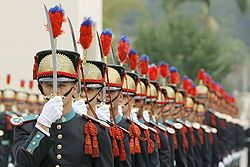
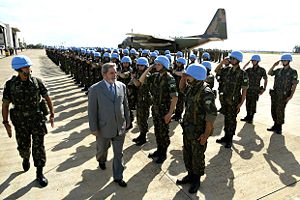 The Brazilian territory is further divided into twelve military regions. Each military region has jurisdiction over one or more states and is subordinate to a military command.
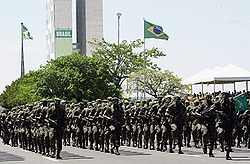 Brigade
s:
The Jungle Warfare
instruction Center CIGS, also known as Colonel Jorge Teixeira Center, is a military organization based in Manaus, intended to qualify military leaders of small fractions, as wilderness warriors, fighters are able to accomplish missions, nature military, in the most inhospitable areas of the Brazilian Rainforest.
Courses are taught in the Jungle Operations, in three distinct categories, and stages of the military and for civilians. Its symbol is the jaguar.
For the better development of the work, Jungle Warfare instruction Center (CIGS) is structured in a Division of Education, a Division of the Doctrine Research and Assessment Division of Students, a Division of Veterinary Medicine, a Division of Administration and Administrative Base.
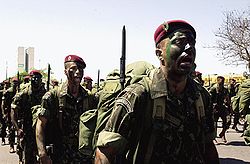 The Special Operations Brigade
is Brazil's special operations force
. Although administratively assigned to the Plateau Military Command, the brigade's operations are under the direct control of the Land Operations Command.
Special Forces were initially formed in 1957 as a parachute trained rescue unit, which specialized in conducting deep jungle rescues along the Amazon basin
. After conducting its initial selection, a US Army Special Forces Mobile Training Team (MTT) conducted the unit's first training course.
men are exempt from compulsory military service. At age seventeen, men are required to register for the draft and are expected to serve when they reach age eighteen. About 75 percent of those registering receive deferments.
Generally, those from the upper class and upper middle class find ways to defer, and as a result the ranks are made up primarily of lower-class and lower-middle-class recruits. A growing number of recruits are volunteers, accounting for about one-third of the total. Those who serve generally spend one year of regular enlistment at an army garrison near their home. Some are allowed six-month service terms but are expected to complete high school at the same time. These are called "Tiros de Guerra," or "shooting schools," which are for high school boys in medium-sized interior towns, run by army sergeants. The army is the only service with a large number of conscripts; the navy and air force have very few.
The conscript system is primarily a means of providing basic military training to a sizable group of young men who then return to civilian life and are retained on the reserve rolls until age forty-five. The army recognizes that it provides a public service by teaching large numbers of conscripts basic skills that can be valuable to the overall economy when the young men return to civilian life.
! style="text-align:left; background:#acc;"|Origin
! style="text-align:left; background:#acc;"|Type
! style="text-align:left; background:#acc;"|Versions
! style="text-align:left; background:#acc;"|In service
! style="text-align:left; background:#acc;"|Notes
|-
! style="align: center; background: lavender;" colspan="7" | Tanks
|- style="background:#efefef; color:black"
| Leopard 1
|
| Tank
| 1A1
1A5
| 128
250
| Ex-Belgian Army 1A1.
Ex-German Army Leopard 1A5
|-
| M-60
|
| Tank
| A3 TTS
| 91
|Ex-US Army
|-
! style="align: center; background: lavender;" colspan="7" | Armored Infantry Fighting Vehicles
|- style="background:#efefef; color:black"
| EE-9 Cascavel
|
| Armored car/reconnaissance
| EE-9
| 600+
| 45 being upgraded
|
|-
| EE-11 Urutu
|
| Armored personnel carrier
| EE-11
| 226
| 121 being upgraded
|-
| GUARÁ
|
| Light Armored Vehicle
| AV-VB4 RE (Guará)
| 1 (20+)
| On tests in Haiti
|-
| GUARANI
|
| APC/Infantry fighting vehicle
| VBTP-MR VBCI (with 30mm turret)
| 4(+50)
| Four pre-series and 50 purchased. Deliveries to start in 2011-2012. 2,044 units of the 6x6 variant (finish by 2030).
|-
| M-113
|
| Armored personnel carrier
| M-113B/C
| 584
| Being upgraded by BAE Systems
|-
| M-578
|
| Armored recovery vehicle
| M-578
| 17
|
|-
! style="align: center; background: lavender;" colspan="7" | Self-propelled artillery
|- style="background:#efefef; color:black"
| M108
|
| Self-propelled artillery
| M-108AP 105 mm
| 72
|
|-
| M-109
|
| Self-propelled artillery
| M-109A3 155 mm
| 40
| Ex-Belgian Army. Updated in 2000 in Switzerland
|-
! style="align: center; background: lavender;" colspan="7" | Multiple rocket launchers
|- style="background:#efefef; color:black"
| ASTROS II
|
| Multiple rocket launcher
| 108/180/300 mm
| 20
| Being upgraded. Acquisition of additional units in the study. Astros 2020 in development.
|-
| AV-SS 12/36
|
| Multiple rocket launcher
| 70 mm
| +-100
|
|
|-
| Astros hawk
|
| Multiple rocket launcher
| 70mm rockets
| 60
|
|
|-
! style="align: center; background: lavender;" colspan="7" | Towed artillery
|- style="background:#efefef; color:black"
| M114
|
| Towed howitzer
| 155 mm
| 92
|
|-
| L118
|
| Towed howitzer
| 105 mm
| 36
|-
| M777
| United Kingdom
| Towed howitzer
| 155 mm
|Being ordered
|-
| OTO Melara Mod 56
|
| Towed howitzer
| 105 mm
| 72
| -
|-
| M101
|
| Towed howitzer
| 105 mm
| 320
|
|-
| M102
|
| Towed howitzer
| 105 mm
| 19
|
| -
|
|-
| Oerlikon 35mm
|
| Towed aa artillery
| 35 mm
| 38
|Being upgraded
|-
| Bofors 40mm L/70
|
| Towed anti-aircraft artillery
| 40 mm
| 24
|Being upgraded
|-
| Bofors 40mm L/60
|
| Towed anti-aircraft artillery
| 40 mm
| 100
|Being withdrawn
|-
! style="align: center; background: lavender;" colspan="7" | Mortars
|- style="background:#efefef; color:black"
| 120mm M2 RAIADO
|
| Towed mortar
| 120 mm
| 60
|
|
|-
| Mortier 120mm Rayé Tracté Modèle F1
|
| Towed mortar
| 120 mm
| -
|
|-
| M30
|
| Heavy mortar
| 107 mm
| 209
|
|-
| M936 81mm AGR
|
| Medium mortar
| 81 mm
| 1.019
|
|
|-
| L16 81mm Mortar
|
| Medium mortar
| 81 mm
| -
|
|
|-
| M949 60mm AGR
|
| Light mortar
| 60 mm
| 1.050
|
|
|-
| Brandt 60 mm LR Gun-mortar
|
| Light mortar
| 60 mm
| -
|
|
|-
! style="align: center; background: lavender;" colspan="7" | Recoilless rifles
|- style="background:#efefef; color:black"
| M40
|
| recoilless rifle
| 106 mm
| -
|
|-
| Carl Gustav
|
| recoilless rifle
| 84 mm
| 127
|
|-
! style="align: center; background: lavender;" colspan="7" | Light anti-tank weapons
|- style="background:#efefef; color:black"
| AT4
|
| single-shot recoilless weapon
| 84 mm
| 1500
|Being replaced by ALAC
|-
|ALAC
|
| single-shot recoilless weapon
| 84 mm
| +200
| On order. Going into mass production in 2012.
|-
! style="align: center; background: lavender;" colspan="7" | Anti-tank guided missiles
|- style="background:#efefef; color:black"
| ERYX
|
| anti-tank guided missile
| 136 mm
| 12
| To be replaced by the national missileMSS-1.2
|-
| MILAN
|
| anti-tank guided missile
|
| 20
| To be replaced by the national missile MSS-1.2
|-
| MSS-1.2
|
| anti-tank guided missile
|
| 66
|First units ordered in 2009.
|-
! style="align: center; background: lavender;" colspan="7" | Anti-aircraft missiles
|- style="background:#efefef; color:black"
| Igla
|
| Anti-aircraft missile
| SA-18/SA-24
| 118/20
| Igla/Igla-1S version
|}
! style="text-align: left; background: #ADD8E6;"|Origin
! style="text-align: left; background: #ADD8E6;"|Type
|-
| Glock 19
| Austria
| Pistol
|-
| Heckler & Koch USP
| Germany
| Pistol
|-
| ParaFAL
| Brazil
| Assault Rifle
|-
| IMI Galil
| Israel
| Assault Rifle
|-
| Heckler & Koch MP5
| Germany
| Submachine gun
|-
| Heckler & Koch G36C
| Germany
| Assault rifle
|-
| Colt M4
| United States
| Assault rifle
|-
| Franchi SPAS-15
| Italy
Italy
| Shotgun
|-
| Benelli
| Italy
| Shotgun
|-
| FN Minimi
| Belgium
| Machine gun
|-
| Barrett M82
| United States
| Sniper rifle
|-
| Heckler & Koch PSG1
| Germany
| Sniper rifle
|-
| SIG-Sauer SSG 3000
| Switzerland
| Sniper rifle
|-
| M24 Sniper Weapon System
| United States
| Sniper rifle
|-
operates 80 helicopters, of which the 16 Helibrás
HB 350 represent some of the Brazilian-made aircraft.
! style="text-align:left; background:#acc;"|Aircraft
! style="text-align:left; background:#acc;"|Type
! style="text-align:left; background:#acc;"|Versions
! style="text-align:left; background:#acc;"|In service
! style="text-align:left; background:#acc;"|Notes
|-
| Eurocopter AS 532 Cougar
| transport helicopter
| AS 532UE
| 8
|
|-
| Eurocopter AS 550 Fennec
| scout/liaison/attack helicopter
| AS 550A-2
| 18
| Upgrade ordered at 30 December 2010
|-
| Helibras HM-1 Pantera
| transport/attack helicopter
| AS 365K
| 34
| Upgrade ordered at 24 December 2009. Possibly to Gunships.
|-
| Helibras HB 350
| utility/attack helicopter
| HB 350-1
| 15
| Upgrade ordered at 30 December 2010
|-
| Sikorsky S-70 Black Hawk
| transport helicopter
| S-70A
| 4 (6+)
| 6 more ordered
|-
| Eurocopter EC 725
| transport helicopter
| EC 725
| 1 (15+)
| 16 Ordered
|-
| Vant VT-15
| UAV
| VT15
| -
| Being incorporated
|}
! style="text-align:center; background:#acc;"|Type
! style="text-align:center; background:#acc;"|Informations/Notes/Orders
! style="text-align:center; background:#acc;"|Notes
|-
| COmbatente BRAsileiro - COBRA (Brazilian Fighter - Snake)
| Based on FÉLIN
|In development
|
|-
| IMBEL
IA2
| New individual weapons
| 200.000 units being ordered. In development
| test being conducted in 2011 by the Brazilian army
|-
| M777 howitzer
| Future howitzer of brazilian army.
| Being ordered.
| study of purchase to be delivered up to the crown in 2012.
|-
| Flakpanzer Gepard
| Self-propelled anti-aircraft gun
| Studying possible buys.
| study of purchase 36. to be delivered up to the crown in 2012.
|-
| Taurus
IMI Tavor TAR-21
| weapon of special forces
| in acquisition.
| test being conducted in 2011 by the Brazilian army
|-
| Tor missile system
| Air defense system, "Tor M2E"
| Studying possible buys.
| study of purchase to be delivered up to the crown in 2014
|-
| Astros 2020
| Multiple rocket launcher system,
| future acquisition in developing.
| Study of purchase to be in 2016.
|
|-
| MSA 3.1
| with an anti aereo reach 5 km, to replace the Igla
| Igla missiles operate with the army as a favorite
| in partnership with Russia or France, to be in service until 2014
|}
Units
Argentina-Brazil War
The Cisplatine War or the Argentine–Brazilian War was an armed conflict over an area known as Banda Oriental or "Eastern Shore" in the 1820s between the United Provinces of River Plate and the Empire of Brazil in the aftermath of the United Provinces' emancipation from Spain.-Background:Led by...
, War of the Farrapos (1835-45), Platine War (1851-52)
Platine War
The Platine War, also known as the War against Oribe and Rosas was fought between the Argentine Confederation and an alliance consisting of the Empire of Brazil, Uruguay and the Argentine provinces of Entre Ríos and Corrientes...
, Uruguayan War (1864-65)
Uruguayan War
The Uruguayan War , also known as the War against Aguirre, was fought between Uruguay and an alliance between the Empire of Brazil and Uruguayan Colorados....
and the War of the Triple Alliance (1864-70)
War of the Triple Alliance
The Paraguayan War , also known as War of the Triple Alliance , was a military conflict in South America fought from 1864 to 1870 between Paraguay and the Triple Alliance of Argentina, Brazil, and Uruguay...
. It has also participated on the side of the Allies at the First World War, Second World War and the Cold War
Cold War
The Cold War was the continuing state from roughly 1946 to 1991 of political conflict, military tension, proxy wars, and economic competition between the Communist World—primarily the Soviet Union and its satellite states and allies—and the powers of the Western world, primarily the United States...
.
Origins
The Brazilian Army was created during the process of the independence of Brazil from Portugal, in 1822, with the units of the Portuguese ArmyPortuguese Army
The Portuguese Army is the ground branch of the Portuguese Armed Forces which, in co-operation with other branches of the Portuguese military, is charged with the defence of Portugal...
in Brazil that have remained loyal to Prince Dom Pedro
Peter I of Brazil
Dom Pedro I of Brazil , nicknamed "the Liberator" and "the Soldier-King", was the founder and first ruler of the Empire of Brazil and also King of Portugal as Pedro IV, having reigned for eight years in Brazil and two months in Portugal.-Birth:Pedro was born on 12 October 1798, around...
. The Army was initially composed of Brazilians, Portuguese and foreign mercenaries. Most of its commanders, were Portuguese officers loyal to Dom Pedro.
Along 1822 and 1823, the Brazilian Army was able to defeat the Portuguese resistance (especially in Bahia
Bahia
Bahia is one of the 26 states of Brazil, and is located in the northeastern part of the country on the Atlantic coast. It is the fourth most populous Brazilian state after São Paulo, Minas Gerais and Rio de Janeiro, and the fifth-largest in size...
and Cisplatina
Cisplatina
The Cisplatina Province was a Portuguese and later a Brazilian province in existence from 1815 to 1828...
) and also avoid a fragmentation of the then new Brazilian Empire after its independence war.
19th century
After the Independence War, the Army destroyed any separatist tendencies of the early years, supporting the authority of Emperor Dom Pedro I across his vast country and was complemented by the National Guard, a paramilitaryParamilitary
A paramilitary is a force whose function and organization are similar to those of a professional military, but which is not considered part of a state's formal armed forces....
militia
Militia
The term militia is commonly used today to refer to a military force composed of ordinary citizens to provide defense, emergency law enforcement, or paramilitary service, in times of emergency without being paid a regular salary or committed to a fixed term of service. It is a polyseme with...
supported by big slave and land owners, known as "Colonels".
In the Regency Era period, after the abdication of the first Emperor the Army had to repress a host of popular movements for political autonomy and/or against the slavery and colonels' power across Brazil.
On May 1, 1865, Brazil
Brazil
Brazil , officially the Federative Republic of Brazil , is the largest country in South America. It is the world's fifth largest country, both by geographical area and by population with over 192 million people...
, Uruguay
Uruguay
Uruguay ,officially the Oriental Republic of Uruguay,sometimes the Eastern Republic of Uruguay; ) is a country in the southeastern part of South America. It is home to some 3.5 million people, of whom 1.8 million live in the capital Montevideo and its metropolitan area...
and Argentina
Argentina
Argentina , officially the Argentine Republic , is the second largest country in South America by land area, after Brazil. It is constituted as a federation of 23 provinces and an autonomous city, Buenos Aires...
signed the Triple Alliance
War of the Triple Alliance
The Paraguayan War , also known as War of the Triple Alliance , was a military conflict in South America fought from 1864 to 1870 between Paraguay and the Triple Alliance of Argentina, Brazil, and Uruguay...
to defend themselves against aggression from Paraguay
Paraguay
Paraguay , officially the Republic of Paraguay , is a landlocked country in South America. It is bordered by Argentina to the south and southwest, Brazil to the east and northeast, and Bolivia to the northwest. Paraguay lies on both banks of the Paraguay River, which runs through the center of the...
, which was ruled by the dictator Francisco López
Francisco Solano López (politician)
Francisco Solano López Carrillo was president of Paraguay from 1862 until his death in 1870. He was officially the eldest son of president Carlos Antonio López, whom he succeeded...
. López troops, after invading Brazilian territory through the state of Mato Grosso and the north of Argentina, were heading for the South of Brazil and North of Uruguay. Many slaves had been incorporated into the Brazilian forces to face the increasingly serious situation. As a result of their solid performance during the conflict, the Armed Forces developed a strong sense against slavery. After 5 years of a terrible warfare (the largest in South American history), the Alliance led by Brazil defeated Lopez.
Between 1893 and 1926, the first Republican Period, the Army had to deal with various movements: some were derived from Navy and Army corps who were unsatisfied with the regime and clamoring for democratic changes, while others had popular origins without conventional political intentions guided by messianic leaders like Canudos War.
20th century
During World War IWorld War I
World War I , which was predominantly called the World War or the Great War from its occurrence until 1939, and the First World War or World War I thereafter, was a major war centred in Europe that began on 28 July 1914 and lasted until 11 November 1918...
the Brazilian government sent three small military groups to Europe soon after declaring war upon Central Powers
Central Powers
The Central Powers were one of the two warring factions in World War I , composed of the German Empire, the Austro-Hungarian Empire, the Ottoman Empire, and the Kingdom of Bulgaria...
in October 1917. The first two units were from the Army; one consisted of medical staff and the other of a sergeants-officers corps, and both were attached to the French Army
French Army
The French Army, officially the Armée de Terre , is the land-based and largest component of the French Armed Forces.As of 2010, the army employs 123,100 regulars, 18,350 part-time reservists and 7,700 Legionnaires. All soldiers are professionals, following the suspension of conscription, voted in...
in the Western Front in 1918.
From October 1930 to 1945, the Army supported the Getulio Vargas
Getúlio Vargas
Getúlio Dornelles Vargas served as President of Brazil, first as dictator, from 1930 to 1945, and in a democratically elected term from 1951 until his suicide in 1954. Vargas led Brazil for 18 years, the most for any President, and second in Brazilian history to Emperor Pedro II...
regime against its opposition, defeating the Constitutionalist Revolt
Constitutionalist Revolution
The Constitutionalist Revolution of 1932 is the name given to the uprising of the population of the Brazilian state of São Paulo against the 1930 coup d'état whereby Getúlio Vargas assumed the nation's Presidency; Vargas was supported by the military and the political elites of Minas Gerais, Rio...
in 1932 and two separate coup d’état attempts: by Communists in 1935 and by Fascists
Brazilian Integralism
Brazilian Integralism was a fascist political movement in Brazil, created on October 1932. Founded and led by Plínio Salgado, a literary figure who was somewhat famous for his participation in the 1922 Modern Art Week, the movement had adopted some characteristics of European mass movements of...
in 1938. The Army also helped to formalize the dictatorship in 1937.
In August 1942, after German and Italian submarines
U-boat
U-boat is the anglicized version of the German word U-Boot , itself an abbreviation of Unterseeboot , and refers to military submarines operated by Germany, particularly in World War I and World War II...
sunk many Brazilian merchant ships, popular mobilization forced the Brazilian government to declare war on Fascist Italy
Kingdom of Italy (1861–1946)
The Kingdom of Italy was a state forged in 1861 by the unification of Italy under the influence of the Kingdom of Sardinia, which was its legal predecessor state...
and Nazi Germany
Nazi Germany
Nazi Germany , also known as the Third Reich , but officially called German Reich from 1933 to 1943 and Greater German Reich from 26 June 1943 onward, is the name commonly used to refer to the state of Germany from 1933 to 1945, when it was a totalitarian dictatorship ruled by...
. In July 1944, after almost two years of public pressure, one expeditionary force
Brazilian Expeditionary Force
The Brazilian Expeditionary Force or BEF was a force about 25,700 men and women arranged by the Army and Air Force to fight alongside the Allied forces in the Mediterranean Theatre of World War II...
, called Força Expedicionária Brasileira (FEB), was sent to Europe to join the Allied forces in the Italian campaign
Italian Campaign (World War II)
The Italian Campaign of World War II was the name of Allied operations in and around Italy, from 1943 to the end of the war in Europe. Joint Allied Forces Headquarters AFHQ was operationally responsible for all Allied land forces in the Mediterranean theatre, and it planned and commanded the...
. The FEB was composed of more than 25,000 men and was commanded by Major-General (later Marshal
Marshal
Marshal , is a word used in several official titles of various branches of society. The word is an ancient loan word from Old French, cf...
) João Baptista Mascarenhas de Morais.
On March 31, 1964, the Brazilian Army, then led by General Humberto de Alencar Castelo Branco
Humberto de Alencar Castelo Branco
Marshal Humberto de Alencar Castelo Branco was a Brazilian military leader and politician.He was President of Brazil, as a military dictator, after the 1964 coup d'etat...
, seized power through a coup d’état, beginning the Military Dictatorship in Brazil, which lasted 21 years. This was the first of a series of coups d’état in South America that replaced elected governments with military regimes. These regimes dominated South American until the 1980s. In this period the Brazilian Army employed harsh means to suppress militant dissident groups: changing the law, restricting political rights, after harassing and pursuing dissidents; and militarily, with support of police forces and militias, proceeding with methods of counter-guerrilla and counter-insurgency
Counter-insurgency
A counter-insurgency or counterinsurgency involves actions taken by the recognized government of a nation to contain or quell an insurgency taken up against it...
warfare to defeat the guerrilla
Guerrilla warfare
Guerrilla warfare is a form of irregular warfare and refers to conflicts in which a small group of combatants including, but not limited to, armed civilians use military tactics, such as ambushes, sabotage, raids, the element of surprise, and extraordinary mobility to harass a larger and...
movements that tried to combat the regime by force. The urban guerrilla
Urban guerrilla warfare
Urban guerrilla redirects here. For the Hawkwind song, see Urban Guerrilla.Urban guerrilla refers to someone who fights a government using unconventional warfare in an urban environment...
s were active in Brazil between 1968 and 1971 while in the rural
Rural
Rural areas or the country or countryside are areas that are not urbanized, though when large areas are described, country towns and smaller cities will be included. They have a low population density, and typically much of the land is devoted to agriculture...
areas the 2 main movements subdued by the Army were respectively, one in the region where are today the Caparaó National Park
Caparaó National Park
Caparaó National Park is a park located on the border between Minas Gerais and Espírito Santo states in Brazil. Pico da Bandeira, one of the highest mountains in Brazil, is located there. Its coordinates are 20º19’—20º 37’ S and 41º43’—41º53’ W....
(1967) and the other in the region of Araguaya River (1972–74).
Internationally, in 1965 the Brazilian Army joined forces with US marines
United States Marine Corps
The United States Marine Corps is a branch of the United States Armed Forces responsible for providing power projection from the sea, using the mobility of the United States Navy to deliver combined-arms task forces rapidly. It is one of seven uniformed services of the United States...
intervening in the Dominican Republic
Dominican Republic
The Dominican Republic is a nation on the island of La Hispaniola, part of the Greater Antilles archipelago in the Caribbean region. The western third of the island is occupied by the nation of Haiti, making Hispaniola one of two Caribbean islands that are shared by two countries...
, in Operation Powerpack. Already during the 1970s strengthened interchange and cooperative ties with armies from other South American countries giving and receiving advisement about counter-guerrilla and counter-insurgency methods, as for example in the Operation Condor
Operation Condor
Operation Condor , was a campaign of political repression involving assassination and intelligence operations officially implemented in 1975 by the right-wing dictatorships of the Southern Cone of South America...
, a procedural coordination to find, capture and eliminate political dissidents in mainland.
In the mid '70s, despite the dissent annulled (by elimination, detention or exile), the leftist guerrillas defeated and the legal opposition tamed, repression was not reduced. This added to the vices and the wear and tear of years of dictatorial power, plus the effects of the then oil/energy crisis
1970s energy crisis
The 1970s energy crisis was a period in which the major industrial countries of the world, particularly the United States, faced substantial shortages, both perceived and real, of petroleum...
and the Latin American debt one
Latin American debt crisis
The Latin American debt crisis was a financial crisis that occurred in the early 1980s , often known as the "lost decade", when Latin American countries reached a point where their foreign debt exceeded their earning power and they were not able to repay it.-Origins:In the 1960s and 1970s many...
, during the late '70s and early '80s, led to increasing social pressures for democracy, which slowly but steadily forced the army to return to its professional activities.
Brazilian Atomic Bomb
According to international sources secretly Brazil already has the technology to produce an atomic bomb. [20] The former minister and Gen. Alberto Mendes Cardoso, former head of the Military and the Institutional Security Office in the government of Fernando Henrique Cardoso, has confirmed that Brazil has mastered the knowledge and wanted to, could drive the technology to build the nuclear bomb. [21] the Brazilian Army through its Military Institute of Engineering has acquired enough technology so that the Brazilian government wishes, build the bomb atomic most powerful of all, the thermonuclear bomb. [22] [23]
21st century
Since the 1950s it has taken part in some United NationsUnited Nations
The United Nations is an international organization whose stated aims are facilitating cooperation in international law, international security, economic development, social progress, human rights, and achievement of world peace...
missions as for example: Suez 1956-67
United Nations Emergency Force
The first United Nations Emergency Force was established by United Nations General Assembly to secure an end to the 1956 Suez Crisis with resolution 1001 on November 7, 1956. The force was developed in large measure as a result of efforts by UN Secretary-General Dag Hammarskjöld and a proposal...
, East Timor 1999-2004
United Nations Mission in East Timor
The United Nations Mission in East Timor was established by Security Council Resolution 1246 on 11 June 1999 for a period up to 31 August 1999...
, Angola 1995-1997
United Nations Angola Verification Mission III
The United Nations Angola Verification Mission III is a peacekeeping mission that began operating in Angola in February 1995 during the civil war. It was established by the United Nations Security Council in Resolution 976....
and Haiti since 2004
United Nations Stabilization Mission in Haiti
The United Nations Stabilisation Mission In Haiti , also known as MINUSTAH, an acronym of the French translation, is a United Nations peacekeeping mission in Haiti that has been in operation since 2004. The mission's military component is led by the Brazilian Army and the force commander is...
, being the latest, the most recent outside intervention in Haiti
Haiti
Haiti , officially the Republic of Haiti , is a Caribbean country. It occupies the western, smaller portion of the island of Hispaniola, in the Greater Antillean archipelago, which it shares with the Dominican Republic. Ayiti was the indigenous Taíno or Amerindian name for the island...
.
In the great earthquake that occurred in Haiti on January 12, 2010, eighteen Brazilian soldiers died. The Brazilian Army has now about 1.250 troops in Haiti and will envoy more 900 until March 2010, to help the reconstruction of that country.
The Brazilian Army is trying to renew its equipments and making a redistribution of its barracks in all the Brazilian Regions, prioritizing the Amazon
Amazon Basin
The Amazon Basin is the part of South America drained by the Amazon River and its tributaries that drains an area of about , or roughly 40 percent of South America. The basin is located in the countries of Bolivia, Brazil, Colombia, Ecuador, Guyana, Peru, and Venezuela...
. After the promulgation of Brazilian National Defense Strategy, in December 2008, the Brazilian Government appears to be interested in the Armed Forces modernization.
In 2010, during the Rio de Janeiro Security Crisis
2010 Rio de Janeiro Security Crisis
In November 2010, there was a huge security crisis in the Brazilian city of Rio de Janeiro and some of its neighboring cities when a series of attacks against civilian targets occurred from the week of 21 to 28 of that month...
, the Brazilian Army sent 800 paratroopers to combat drug trafficking in Rio de Janeiro. Following the invasion, approximately 2,000 Army soldiers were sent to occupy the Complexo do Alemão
Complexo do Alemão
Complexo do Alemão is a group of favelas in northern Rio de Janeiro, Brazil.-History:An article published by O Globo in 2007 revealed the origin of Complexo do Alemão. After World War I, a Pole named Leonard Kaczmarkiewicz bought the land...
.
Strength
Active troops: 235,978Reserves: 1,740,000
- Trained first-line: 1,115,000
- Subject to immediate recall: 400,000
- Second-line: 225,000
Organization
High Command
- Army General Headquarters (Quartel-General do Exército) - BrasíliaBrasíliaBrasília is the capital city of Brazil. The name is commonly spelled Brasilia in English. The city and its District are located in the Central-West region of the country, along a plateau known as Planalto Central. It has a population of about 2,557,000 as of the 2008 IBGE estimate, making it the...
- Terrestrial Operations Command (Commando de Operações Terrestres) - Brasília
- Army General Staff (Estado Maior do Exército) - Brasília
Military Commands
The Army is structured into seven military commands. Each of the seven military commands is responsible for one or more military regions.- Eastern Military CommandEastern Military CommandThe Eastern Military Command is one of seven Military Commands of the Brazilian Army. The Eastern Military Command or "Comando Militar do Leste" is responsible for the defence of the states Rio de Janeiro, Minas Gerais and Espírito Santo...
(Commando Militar do Leste; CML), (HQ: Rio de JaneiroRio de JaneiroRio de Janeiro , commonly referred to simply as Rio, is the capital city of the State of Rio de Janeiro, the second largest city of Brazil, and the third largest metropolitan area and agglomeration in South America, boasting approximately 6.3 million people within the city proper, making it the 6th...
) - 1st and 4th Military Regions - Southeastern Military CommandSoutheastern Military CommandThe Southeastern Military Command is one of seven Military Commands of the Brazilian Army. The Southeastern Military Command or "Comando Militar do Sudeste" is responsible for the defence of the state of São Paulo.- Current Structure :...
(Commando Militar do Sudeste; CMSE), (HQ: São PauloSão PauloSão Paulo is the largest city in Brazil, the largest city in the southern hemisphere and South America, and the world's seventh largest city by population. The metropolis is anchor to the São Paulo metropolitan area, ranked as the second-most populous metropolitan area in the Americas and among...
) - 2nd Military Region - Southern Military CommandSouthern Military CommandThe Southern Military Command is one of seven Military Commands of the Brazilian Army. The Southern Military Command or "Comando Militar do Sul" is responsible for the defence of the states of Rio Grande do Sul, Paraná and Santa Catarina....
(Commando Militar do Sul; CMS), (HQ: Porto AlegrePorto AlegrePorto Alegre is the tenth most populous municipality in Brazil, with 1,409,939 inhabitants, and the centre of Brazil's fourth largest metropolitan area . It is also the capital city of the southernmost Brazilian state of Rio Grande do Sul. The city is the southernmost capital city of a Brazilian...
) - 3rd and 5th Military Regions - Northeastern Military CommandNortheastern Military CommandThe Northeastern Military Command is one of seven Military Commands of the Brazilian Army. The Northeastern Military Command or "Comando Militar do Nordeste" is responsible for the defence of the states Bahia, Sergipe, Rio Grande do Norte, Paraíba, Pernambuco, Alagoas, Ceará, Piauí and Maranhão...
(Commando Militar do Nordeste; CMN), (HQ: RecifeRecifeRecife is the fifth-largest metropolitan area in Brazil with 4,136,506 inhabitants, the largest metropolitan area of the North/Northeast Regions, the 5th-largest metropolitan influence area in Brazil, and the capital and largest city of the state of Pernambuco. The population of the city proper...
) - 6th, 7th and 10th Military Regions - Western Military CommandWestern Military CommandThe Western Military Command is one of seven Military Commands of the Brazilian Army. The Western Military Command or "Comando Militar do Oeste" is responsible for the defence of the states Mato Grosso and Mato Grosso do Sul.- Current Structure :...
(Commando Militar do Oeste; CMO), (HQ: Campo GrandeCampo Grande-Climate:Campo Grande has a highland tropical climate, semi-humid, hot, and notably seasonal, with a dry winter season from May through September or October. Under the Koppen climate classification Campo Grande features a tropical wet and dry climate, albeit a noticeably cooler version of the...
) - 9th Military Region - Planalto Military CommandPlanalto Military CommandThe Planalto Military Command is one of seven Military Commands of the Brazilian Army. The Planalto Military Command or "Comando Militar do Planalto" is responsible for the defence of the states of Tocantins and Goiás and the Federal District with the capital Brasília.- Current Structure :*...
(Commando Militar da Planalto; CMP), (HQ: BrasíliaBrasíliaBrasília is the capital city of Brazil. The name is commonly spelled Brasilia in English. The city and its District are located in the Central-West region of the country, along a plateau known as Planalto Central. It has a population of about 2,557,000 as of the 2008 IBGE estimate, making it the...
) - 11th Military Region - Amazon Military CommandAmazon Military CommandThe Amazon Military Command is one of seven Military Commands of the Brazilian Army. The Amazon Military Command or "Comando Militar da Amazônia" is responsible for the defence of the Amazon Basin. Five Infantry Brigades specializing in Jungle warfare, one construction Engineer Brigade and two...
(Commando Militar da Amazônia; CMA), (HQ: ManausManausManaus is a city in Brazil, the capital of the state of Amazonas. It is situated at the confluence of the Negro and Solimões rivers. It is the most populous city of Amazonas, according to the statistics of Brazilian Institute of Geography and Statistics, and is a popular ecotourist destination....
) - 8th and 12th Military Regions
Military Regions
- 1st Military Region - States of Rio de JaneiroRio de Janeiro (state)Rio de Janeiro is one of the 27 states of Brazil.Rio de Janeiro has the second largest economy of Brazil behind only São Paulo state.The state of Rio de Janeiro is located within the Brazilian geopolitical region classified as the Southeast...
and Espírito SantoEspírito SantoEspírito Santo is one of the states of southeastern Brazil, often referred to by the abbreviation "ES". Its capital is Vitória and the largest city is Vila Velha. The name of the state means literally "holy spirit" after the Holy Ghost of Christianity...
(HQ: Rio de Janeiro) - 2nd Military Region - State of São PauloSão Paulo (state)São Paulo is a state in Brazil. It is the major industrial and economic powerhouse of the Brazilian economy. Named after Saint Paul, São Paulo has the largest population, industrial complex, and economic production in the country. It is the richest state in Brazil...
(HQ: São Paulo) - 3rd Military Region - State of Rio Grande do SulRio Grande do SulRio Grande do Sul is the southernmost state in Brazil, and the state with the fifth highest Human Development Index in the country. In this state is located the southernmost city in the country, Chuí, on the border with Uruguay. In the region of Bento Gonçalves and Caxias do Sul, the largest wine...
(HQ: Porto Alegre) - 4th Military Region - State of Minas GeraisMinas GeraisMinas Gerais is one of the 26 states of Brazil, of which it is the second most populous, the third richest, and the fourth largest in area. Minas Gerais is the Brazilian state with the largest number of Presidents of Brazil, the current one, Dilma Rousseff, being one of them. The capital is the...
(HQ: Belo Horizonte) - 5th Military Region - States of ParanáParaná (state)Paraná is one of the states of Brazil, located in the South of the country, bordered on the north by São Paulo state, on the east by the Atlantic Ocean, on the south by Santa Catarina state and the Misiones Province of Argentina, and on the west by Mato Grosso do Sul and the republic of Paraguay,...
and Santa CatarinaSanta Catarina (state)Santa Catarina is a state in southern Brazil with one of the highest standards of living in Latin America. Its capital is Florianópolis, which mostly lies on the Santa Catarina Island. Neighbouring states are Rio Grande do Sul to the south and Paraná to the north. It is bounded on the east by...
(HQ: CuritibaCuritibaCuritiba is the capital of the Brazilian state of Paraná. It is the largest city with the biggest economy of both Paraná and southern Brazil. The population of Curitiba numbers approximately 1.75 million people and the latest GDP figures for the city surpass US$61 billion according to...
) - 6th Military Region - States of BahiaBahiaBahia is one of the 26 states of Brazil, and is located in the northeastern part of the country on the Atlantic coast. It is the fourth most populous Brazilian state after São Paulo, Minas Gerais and Rio de Janeiro, and the fifth-largest in size...
and SergipeSergipeSergipe , is the smallest state of the Brazilian Federation, located on the northeastern Atlantic coast of the country. It borders on two other states, Bahia to the south and west and Alagoas to the north, and to the east is the Atlantic Ocean...
(HQ: SalvadorSalvador, BahiaSalvador is the largest city on the northeast coast of Brazil and the capital of the Northeastern Brazilian state of Bahia. Salvador is also known as Brazil's capital of happiness due to its easygoing population and countless popular outdoor parties, including its street carnival. The first...
) - 7th Military Region - States of Rio Grande do NorteRio Grande do NorteRio Grande do Norte is one of the states of Brazil, located in the northeastern region of the country, occupying the northeasternmost tip of the South American continent. Because of its geographic position, Rio Grande do Norte has a strategic importance. The capital and largest city is Natal...
, ParaíbaParaíbaParaíba Paraíba Paraíba (Tupi: pa'ra a'íba: "bad to navigation"; Brazilian Portuguese pronunciation: is a state of Brazil. It is located in the Brazilian Northeast, and is bordered by Rio Grande do Norte to the north, Ceará to the west, Pernambuco to the south and the Atlantic Ocean to the east...
, PernambucoPernambucoPernambuco is a state of Brazil, located in the Northeast region of the country. To the north are the states of Paraíba and Ceará, to the west is Piauí, to the south are Alagoas and Bahia, and to the east is the Atlantic Ocean. There are about of beaches, some of the most beautiful in the...
and AlagoasAlagoasAlagoas is one of the 27 federative units of Brazil and is situated in the eastern part of the Northeast Region. It borders: Pernambuco ; Sergipe ; Bahia ; and the Atlantic Ocean . It occupies an area of 27,767 km², being slightly larger than Haiti...
(HQ: Recife) - 8th Military Region - States of ParáParáPará is a state in the north of Brazil. It borders the Brazilian states of Amapá, Maranhão, Tocantins, Mato Grosso, Amazonas and Roraima. To the northwest it also borders Guyana and Suriname, and to the northeast it borders the Atlantic Ocean. The capital is Belém.Pará is the most populous state...
and AmapáAmapáAmapá is one of the states of Brazil, located in the extreme north, bordering French Guiana and Suriname to the north. To the east is the Atlantic Ocean, and to the south and west is the Brazilian state of Pará. Perhaps one of the main features of the state is the River Oiapoque, as it was once...
(HQ: BelémBelémBelém is a Brazilian city, the capital and largest city of state of Pará, in the country's north region. It is the entrance gate to the Amazon with a busy port, airport and bus/coach station...
) - 9th Military Region - States of Mato GrossoMato GrossoMato Grosso is one of the states of Brazil, the third largest in area, located in the western part of the country.Neighboring states are Rondônia, Amazonas, Pará, Tocantins, Goiás and Mato Grosso do Sul. It also borders Bolivia to the southwest...
and Mato Grosso do SulMato Grosso do SulMato Grosso do Sul is one of the states of Brazil.Neighboring Brazilian states are Mato Grosso, Goiás, Minas Gerais, São Paulo and Paraná. It also borders the countries of Paraguay and Bolivia to the west. The economy of the state is largely based on agriculture and cattle-raising...
(HQ: Campo Grande) - 10th Military Region - States of CearáCearáCeará is one of the 27 states of Brazil, located in the northeastern part of the country, on the Atlantic coast. It is currently the 8th largest Brazilian State by population and the 17th by area. It is also one of the main touristic destinations in Brazil. The state capital is the city of...
, MaranhãoMaranhãoMaranhão is a northeastern state of Brazil. To the north lies the Atlantic Ocean. Maranhão is neighbored by the states of Piauí, Tocantins and Pará. The people of Maranhão have a distinctive accent...
and PiauíPiauíPiauí is one of the states of Brazil, located in the northeastern part of the country.Piauí has the shortest coastline of any of the non-landlocked Brazilian states at 66 km , and the capital, Teresina, is the only state capital in the north east to be located inland...
(HQ: FortalezaFortalezaFortaleza is the state capital of Ceará, located in Northeastern Brazil. With a population close to 2.5 million , Fortaleza is the 5th largest city in Brazil. It has an area of and one of the highest demographic densities in the country...
) - 11th Military Region - States of GoiásGoiásGoiás is a state of Brazil, located in the central part of the country. The name Goiás comes from the name of an indigenous community...
, TocantinsTocantinsTocantins may refer to:* Tocantins, a state in Brazil* Tocantins River, a river in Brazil* Survivor: Tocantins, a reality show set in Tocantins, Brazil* Tocantins Esporte Clube, a Brazilian football club...
and the Federal DistrictBrazilian Federal DistrictThe Federal District is set apart for Brasília, the capital of Brazil. Located in a region called Planalto Central, or Central Plateau, the Federal District is divided in 29 administrative regions. Brasilia - place where the three branches of the Federal Government are located - is the main...
(HQ: Brasília) - 12th Military Region - States of Amazonas, AcreAcre (state)Acre is one of the 27 states of Brazil. It is situated in the southwest of the Northern Region, bordering Amazonas to the north, Rondônia to the east, Bolivia to the southeast and the Ucayali Region of Peru to the south and west. It occupies an area of 152,581.4 km2, being slightly smaller...
, RoraimaRoraimaRoraima is the northernmost and least populated state of Brazil, located in the Amazon region. It borders the states of Amazonas and Pará, as well as the nations of Venezuela and Guyana. The population is 400,000 and the capital is Boa Vista...
and RondôniaRondôniaRondônia is a state in Brazil, located in the north-western part of the country. To the west is a short border with the state of Acre, to the north is the state of Amazonas, in the east is Mato Grosso, and in the south is Bolivia. Its capital is Porto Velho. The state was named after Candido Rondon...
(HQ: Manaus)
Main units
Brigade
A brigade is a major tactical military formation that is typically composed of two to five battalions, plus supporting elements depending on the era and nationality of a given army and could be perceived as an enlarged/reinforced regiment...
s:
- 1x Parachute InfantryAirborne forcesAirborne forces are military units, usually light infantry, set up to be moved by aircraft and 'dropped' into battle. Thus they can be placed behind enemy lines, and have an ability to deploy almost anywhere with little warning...
brigade - 1x Special OperationsSpecial forcesSpecial forces, or special operations forces are terms used to describe elite military tactical teams trained to perform high-risk dangerous missions that conventional units cannot perform...
brigade - 1x Light Infantry (Air AssaultAir assaultAir assault is the movement of ground-based military forces by vertical take-off and landing aircraft—such as the helicopter—to seize and hold key terrain which has not been fully secured, and to directly engage enemy forces...
) brigade - 1x Light Infantry brigade GLO (Peacekeeping Operations/Urban Warfare)
- 1x Frontier Infantry brigade
- 2x ArmoredArmoured warfareArmoured warfare or tank warfare is the use of armoured fighting vehicles in modern warfare. It is a major component of modern methods of war....
brigades - 4x MechanizedMechanized infantryMechanized infantry are infantry equipped with armored personnel carriers , or infantry fighting vehicles for transport and combat ....
Cavalry brigades - 5x Jungle Infantry brigades
- 10x Motorized InfantryMotorised infantryIn NATO and most other western countries, motorised infantry is infantry which is transported by trucks or other motor vehicles. It is distinguished from mechanized infantry, which is carried in armoured personnel carriers, infantry combat vehicles, or infantry fighting vehicles...
brigades - 4x Divisional Artillery brigades
- 2x Construction Engineer brigades
- 1x Air DefenceAnti-aircraft warfareNATO defines air defence as "all measures designed to nullify or reduce the effectiveness of hostile air action." They include ground and air based weapon systems, associated sensor systems, command and control arrangements and passive measures. It may be to protect naval, ground and air forces...
Artillery brigade - 1x Army AviationBrazilian Army Aviation CommandThe Brazilian Army Aviation Command is a component of the Brazilian Army containing the army's helicopter units.-Tasks :The task of the Brazilian Army Aviation Command is to provide organic airmobility and support the ground forces by providing tactical air support, close air support and...
command
Jungle Warfare
The Brazilian Army has five Jungle Infantry Brigades (1st, 2nd, 16th, 17th, and 23rd Jungle Infantry Brigades) and a Jungle Warfare instruction Center.The Jungle Warfare
Jungle warfare
Jungle warfare is a term used to cover the special techniques needed for military units to survive and fight in jungle terrain.It has been the topic of extensive study by military strategists, and was an important part of the planning for both sides in many conflicts, including World War II and the...
instruction Center CIGS, also known as Colonel Jorge Teixeira Center, is a military organization based in Manaus, intended to qualify military leaders of small fractions, as wilderness warriors, fighters are able to accomplish missions, nature military, in the most inhospitable areas of the Brazilian Rainforest.
Courses are taught in the Jungle Operations, in three distinct categories, and stages of the military and for civilians. Its symbol is the jaguar.
For the better development of the work, Jungle Warfare instruction Center (CIGS) is structured in a Division of Education, a Division of the Doctrine Research and Assessment Division of Students, a Division of Veterinary Medicine, a Division of Administration and Administrative Base.
Special Forces
Brazilian Special Operations Brigade
The Brazilian Special Operations Brigade is one of Brazilian Army brigades...
is Brazil's special operations force
Special forces
Special forces, or special operations forces are terms used to describe elite military tactical teams trained to perform high-risk dangerous missions that conventional units cannot perform...
. Although administratively assigned to the Plateau Military Command, the brigade's operations are under the direct control of the Land Operations Command.
Special Forces were initially formed in 1957 as a parachute trained rescue unit, which specialized in conducting deep jungle rescues along the Amazon basin
Amazon Basin
The Amazon Basin is the part of South America drained by the Amazon River and its tributaries that drains an area of about , or roughly 40 percent of South America. The basin is located in the countries of Bolivia, Brazil, Colombia, Ecuador, Guyana, Peru, and Venezuela...
. After conducting its initial selection, a US Army Special Forces Mobile Training Team (MTT) conducted the unit's first training course.
Conditions of Service
According to Article 143 of the 1988 constitution, military service is obligatory for men, but conscientious objection is allowed. Women and clergyClergy
Clergy is the generic term used to describe the formal religious leadership within a given religion. A clergyman, churchman or cleric is a member of the clergy, especially one who is a priest, preacher, pastor, or other religious professional....
men are exempt from compulsory military service. At age seventeen, men are required to register for the draft and are expected to serve when they reach age eighteen. About 75 percent of those registering receive deferments.
Generally, those from the upper class and upper middle class find ways to defer, and as a result the ranks are made up primarily of lower-class and lower-middle-class recruits. A growing number of recruits are volunteers, accounting for about one-third of the total. Those who serve generally spend one year of regular enlistment at an army garrison near their home. Some are allowed six-month service terms but are expected to complete high school at the same time. These are called "Tiros de Guerra," or "shooting schools," which are for high school boys in medium-sized interior towns, run by army sergeants. The army is the only service with a large number of conscripts; the navy and air force have very few.
The conscript system is primarily a means of providing basic military training to a sizable group of young men who then return to civilian life and are retained on the reserve rolls until age forty-five. The army recognizes that it provides a public service by teaching large numbers of conscripts basic skills that can be valuable to the overall economy when the young men return to civilian life.
Equipment
Overview of the Army's equipment, it also includes other vehicles such as trucks and cars.| Main battle tank Main battle tank A main battle tank , also known as a battle tank or universal tank, is a tank that fills the heavy direct fire role of many modern armies. They were originally conceived to replace the light, medium, heavy and super-heavy tanks. Development was spurred onwards in the Cold War with the development... |
Armored vehicles | Other military vehicle Military vehicle A military vehicle is a vehicle that includes all land combat and transportation vehicles, which are designed for or are in significant use by military forces throughout the world. Vehicles that are armored or intended for combat are often referred to as armoured fighting vehicles.... s |
Artillery pieces | Regular helicopters | |
| Quantity | 469 | 1,280 | 6,676 | 656 | 80 |
Main Equipment
! style="text-align:left; background:#acc;"|Equipment! style="text-align:left; background:#acc;"|Origin
! style="text-align:left; background:#acc;"|Type
! style="text-align:left; background:#acc;"|Versions
! style="text-align:left; background:#acc;"|In service
! style="text-align:left; background:#acc;"|Notes
|-
! style="align: center; background: lavender;" colspan="7" | Tanks
|- style="background:#efefef; color:black"
| Leopard 1
|
| Tank
| 1A1
1A5
| 128
250
| Ex-Belgian Army 1A1.
Ex-German Army Leopard 1A5
|-
| M-60
M60 Patton
The 105 mm Gun Full Tracked Combat Tank, M60, also known unofficially as the M60 Patton, is a first-generation main battle tank introduced in December 1960. It was widely used by the U.S. and its Cold War allies, especially those in NATO, and remains in service throughout the world today...
|
| Tank
| A3 TTS
| 91
|Ex-US Army
|-
! style="align: center; background: lavender;" colspan="7" | Armored Infantry Fighting Vehicles
|- style="background:#efefef; color:black"
| EE-9 Cascavel
EE-9 Cascavel
The EE-9 Cascavel is a 6 x 6 armoured car developed in the 1970s by Engesa of Brazil. It used as many commercially available parts as possible. It also shares many components with the EE-11 Urutu APC...
|
| Armored car/reconnaissance
| EE-9
| 600+
| 45 being upgraded
|
|-
| EE-11 Urutu
EE-11 Urutu
The EE-11 Urutu is a 6x6 armored personnel carrier developed in the seventies by Engesa of Brazil. It used as many commercially available parts as possible. It also shares many components with the EE-9 Cascavel Armoured fighting vehicle. The suspension includes Engesa's Boomerang double-axle rear...
|
| Armored personnel carrier
| EE-11
| 226
| 121 being upgraded
|-
| GUARÁ
AV-VB4 RE 4x4 GUARÁ
The AV-VB4 RE 4x4 GUARÁ is a Brazilian armoured personnel carrier that is currently being tested in Haiti. It holds a crew of ten, and weighs 7.65 tonnes....
|
| Light Armored Vehicle
| AV-VB4 RE (Guará)
| 1 (20+)
| On tests in Haiti
|-
| GUARANI
VBTP-MR
The VBTP-MR is a 6x6 armored personnel carrier jointly developed by Fiat's IVECO and the Brazilian Army as part of its "URUTU-3" modernization program aimed to replace all EE-11 Urutu by 2015....
|
| APC/Infantry fighting vehicle
| VBTP-MR VBCI (with 30mm turret)
| 4(+50)
| Four pre-series and 50 purchased. Deliveries to start in 2011-2012. 2,044 units of the 6x6 variant (finish by 2030).
|-
| M-113
M113 Armored Personnel Carrier
The M113 is a fully tracked armored personnel carrier that has formed the backbone of the United States Army's mechanized infantry units from the time of its first fielding in Vietnam in April 1962. The M113 was the most widely used armored vehicle of the U.S...
|
| Armored personnel carrier
| M-113B/C
| 584
| Being upgraded by BAE Systems
BAE Systems
BAE Systems plc is a British multinational defence, security and aerospace company headquartered in London, United Kingdom, that has global interests, particularly in North America through its subsidiary BAE Systems Inc. BAE is among the world's largest military contractors; in 2009 it was the...
|-
| M-578
M578 Light Recovery Vehicle
M578 Light Recovery Vehicle was a US Cold War era armored recovery vehicle. The M578 utilized the same chassis as M107 Self-Propelled Gun and M110 Self-Propelled Howitzer. The M578 provided maintenance support to mechanized infantry and artillery units...
|
| Armored recovery vehicle
| M-578
| 17
|
|-
! style="align: center; background: lavender;" colspan="7" | Self-propelled artillery
|- style="background:#efefef; color:black"
| M108
M108 Howitzer
The M108 Howitzer is an American self-propelled 105 mm howitzer, first introduced in the early 1960s.The M108 was powered by a Detroit diesel turbocharged 8V-71T 8-cylinders 405 hp engine. It used the same hull and turret as the 155 mm M109 self-propelled howitzer, and components of...
|
| Self-propelled artillery
| M-108AP 105 mm
| 72
|
|-
| M-109
M109 howitzer
The M109 is an American-made self-propelled 155 mm howitzer, first introduced in the early 1960s. It was upgraded a number of times to today's M109A6 Paladin...
|
| Self-propelled artillery
| M-109A3 155 mm
| 40
| Ex-Belgian Army. Updated in 2000 in Switzerland
Switzerland
Switzerland name of one of the Swiss cantons. ; ; ; or ), in its full name the Swiss Confederation , is a federal republic consisting of 26 cantons, with Bern as the seat of the federal authorities. The country is situated in Western Europe,Or Central Europe depending on the definition....
|-
! style="align: center; background: lavender;" colspan="7" | Multiple rocket launchers
|- style="background:#efefef; color:black"
| ASTROS II
Astros II MLRS
ASTROS II is a self-propelled multiple rocket launcher produced in Brazil by the Avibrás company. It features modular design and employs rockets with calibers ranging from 127 mm to 300 mm...
|
| Multiple rocket launcher
| 108/180/300 mm
| 20
| Being upgraded. Acquisition of additional units in the study. Astros 2020 in development.
|-
| AV-SS 12/36
|
| Multiple rocket launcher
| 70 mm
| +-100
|
|
|-
| Astros hawk
|
| Multiple rocket launcher
| 70mm rockets
| 60
|
|
|-
! style="align: center; background: lavender;" colspan="7" | Towed artillery
|- style="background:#efefef; color:black"
| M114
M114 155 mm howitzer
The M114 155 mm howitzer was a towed howitzer used by the United States Army. It was first produced in 1942 as a medium artillery piece under the designation of 155 mm Howitzer M1. It saw service with the US Army during World War II, the Korean War, and the Vietnam War, before being...
|
| Towed howitzer
| 155 mm
| 92
|
|-
| L118
|
| Towed howitzer
| 105 mm
| 36
|-
| M777
|
United Kingdom| Towed howitzer
| 155 mm
|Being ordered
|-
| OTO Melara Mod 56
OTO Melara Mod 56
The OTO-Melara Mod 56 is an Italian-made 105 mm pack howitzer built and developed by OTO-Melara. It fires the standard US type M1 ammunition.-History:...
|
| Towed howitzer
| 105 mm
| 72
| -
|-
| M101
M101 howitzer
The 105 mm M2A1 howitzer was the standard light field howitzer for the United States in World War II, seeing action in both European and Pacific theaters. Entering production in 1941, it quickly entered the war against the Imperial Japanese Army in the Pacific, where it gained a reputation...
|
| Towed howitzer
| 105 mm
| 320
|
|-
| M102
M102 howitzer
First introduced during the Vietnam War, the M102 was the light-towed 105 mm howitzer used by the United States Army in the Vietnam War, the First Gulf War, and most recently in the Iraq War.- An Air Mobile Howitzer for the Vietnam War :...
|
| Towed howitzer
| 105 mm
| 19
|
| -
|
|-
| Oerlikon 35mm
Oerlikon 35 mm twin cannon
The Oerlikon 35 mm twin cannon is a towed anti-aircraft gun made by Oerlikon Contraves . The system was originally designated as 2 ZLA/353 ML but this was later changed to GDF-001...
|
| Towed aa artillery
| 35 mm
| 38
|Being upgraded
|-
| Bofors 40mm L/70
|
| Towed anti-aircraft artillery
| 40 mm
| 24
|Being upgraded
|-
| Bofors 40mm L/60
|
| Towed anti-aircraft artillery
| 40 mm
| 100
|Being withdrawn
|-
! style="align: center; background: lavender;" colspan="7" | Mortars
|- style="background:#efefef; color:black"
| 120mm M2 RAIADO
120mm M2 RAIADO
The RT-M2 is a Brazilian 120 mm mortar designed to have great firepower, mobility, and flexibility. The RT-M2 is designed by the War Arsenal of Rio de Janeiro for the Brazilian Army artillery. The RT-M2 can be transported by ground or air, and can also be air dropped, and offers offers a 360°...
|
| Towed mortar
| 120 mm
| 60
|
|
|-
| Mortier 120mm Rayé Tracté Modèle F1
Mortier 120mm Rayé Tracté Modèle F1
The MO-120 RT-61 or MO-120-RT is a heavy mortar of French origin. It was designed by Thomson-Brandt as the successor for the MO-120 AM-50...
|
| Towed mortar
| 120 mm
| -
|
|-
| M30
M30 107 mm Mortar
The M30 107 mm heavy mortar is an American rifled, muzzle-loading, high-angle-of-fire weapon used for long-range indirect fire support to infantry units.-Design:...
|
| Heavy mortar
| 107 mm
| 209
|
|-
| M936 81mm AGR
|
| Medium mortar
| 81 mm
| 1.019
|
|
|-
| L16 81mm Mortar
L16 81mm Mortar
The United Kingdom's L16 81 mm mortar is the standard mortar used by the British armed forces. It originated as a joint design by UK and Canada. The version produced and used by Australia is named the F2 81mm Mortar, whilst the version used by the U.S...
|
| Medium mortar
| 81 mm
| -
|
|
|-
| M949 60mm AGR
|
| Light mortar
| 60 mm
| 1.050
|
|
|-
| Brandt 60 mm LR Gun-mortar
|
| Light mortar
| 60 mm
| -
|
|
|-
! style="align: center; background: lavender;" colspan="7" | Recoilless rifles
|- style="background:#efefef; color:black"
| M40
M40 recoilless rifle
The M40 recoilless rifle was a lightweight, portable, crew-served 105 mm weapon intended primarily as an anti-tank weapon made in the United States...
|
| recoilless rifle
| 106 mm
| -
|
|-
| Carl Gustav
Carl Gustav recoilless rifle
The Carl Gustav is the common name for the 84 mm man-portable reusable multi-role recoilless rifle produced by Saab Bofors Dynamics in Sweden...
|
| recoilless rifle
| 84 mm
| 127
|
|-
! style="align: center; background: lavender;" colspan="7" | Light anti-tank weapons
|- style="background:#efefef; color:black"
| AT4
AT4
The AT4 is an 84-mm unguided, portable, single-shot recoilless smoothbore weapon built in Sweden by Saab Bofors Dynamics...
|
| single-shot recoilless weapon
| 84 mm
| 1500
|Being replaced by ALAC
ALAC (Arma Leve Anticarro)
ALAC is a Brazilian light anti-tank weapon. It has a disposable launch tube designed to destroy or disable armored vehicles.Light Antitank Weapon is 84 mm single use, disposable shot, designed to combat anti-tank and an approximate maximum range of use of 500 meters. The shooting is done with the...
|-
|ALAC
ALAC (Arma Leve Anticarro)
ALAC is a Brazilian light anti-tank weapon. It has a disposable launch tube designed to destroy or disable armored vehicles.Light Antitank Weapon is 84 mm single use, disposable shot, designed to combat anti-tank and an approximate maximum range of use of 500 meters. The shooting is done with the...
|
| single-shot recoilless weapon
| 84 mm
| +200
| On order. Going into mass production in 2012.
|-
! style="align: center; background: lavender;" colspan="7" | Anti-tank guided missiles
|- style="background:#efefef; color:black"
| ERYX
ERYX
ERYX is a short-range portable SACLOS-based wire-guided anti-tank missile produced by European company MBDA. It is used by several countries, including the Canadian Army, French, and Norwegian armies. The weapon can also be used against bunkers and pillboxes. It also has some capability in the...
|
| anti-tank guided missile
| 136 mm
| 12
| To be replaced by the national missileMSS-1.2
MSS-1.2
Mectron MSS-1.2 is a Brazilian personal missile launch system with laser guidance, used in fighting at close range. It is the standard personal missile launch system of the Brazilian army and marine corps...
|-
| MILAN
MILAN
MILAN " is French and German for "kite bird") is a European anti-tank guided missile. Design of the MILAN started in 1962. It was ready for trials in 1971, and was accepted for service in 1972. It is a wire guided SACLOS missile, which means the sight of the launch unit has to be aimed at the...
|
| anti-tank guided missile
|
| 20
| To be replaced by the national missile MSS-1.2
MSS-1.2
Mectron MSS-1.2 is a Brazilian personal missile launch system with laser guidance, used in fighting at close range. It is the standard personal missile launch system of the Brazilian army and marine corps...
|-
| MSS-1.2
MSS-1.2
Mectron MSS-1.2 is a Brazilian personal missile launch system with laser guidance, used in fighting at close range. It is the standard personal missile launch system of the Brazilian army and marine corps...
|
| anti-tank guided missile
|
| 66
|First units ordered in 2009.
|-
! style="align: center; background: lavender;" colspan="7" | Anti-aircraft missiles
|- style="background:#efefef; color:black"
| Igla
|
| Anti-aircraft missile
| SA-18/SA-24
| 118/20
| Igla/Igla-1S version
|}
Individual Weapons and Equipment
| Name | Number | Notes |
|---|---|---|
| FN M2HB | Used in vehicles and platoon level | |
| FN MAG M971 FN MAG The FN MAG is a Belgian 7.62 mm general-purpose machine gun, designed in the early 1950s at Fabrique Nationale by Ernest Vervier. It has been used by more than 80 countries, and it has been made under licence in countries such as Argentina, Egypt, India, Singapore, the United Kingdom and the... general purpose machine gun General purpose machine gun A general-purpose machine gun is a multi-purpose weapon: it is a machine gun firing a full-power rifle cartridge and which can be used in a variety of roles, from a bipod- or tripod-mounted infantry support weapon to a helicopter door gun or a vehicle-mounted support weapon... |
+6.000 | Used in vehicles and platoon level |
| MG 3 general purpose machine gun General purpose machine gun A general-purpose machine gun is a multi-purpose weapon: it is a machine gun firing a full-power rifle cartridge and which can be used in a variety of roles, from a bipod- or tripod-mounted infantry support weapon to a helicopter door gun or a vehicle-mounted support weapon... |
280 | Used in Leopard 1 |
| Milkor MGL Milkor MGL The MGL is a lightweight 40 mm semi-automatic, 6-shot grenade launcher developed and manufactured in South Africa by Milkor Ltd. The MGL was demonstrated as a concept to the South African Defence Force in 1981. The operating principle was immediately accepted and subjected to a stringent... Grenade launcher |
300 | Used by Jungle Infantry Brigades |
| M79 M79 grenade launcher The M79 grenade launcher is a single-shot, shoulder-fired, break-action grenade launcher that fires a 40x46mm grenade which used what the US Army called the High-Low Propulsion System to keep recoil forces low, and first appeared during the Vietnam War... Grenade launcher |
- | Used by Jungle Infantry Brigades: Being Replaced by Milkor MGL Milkor MGL The MGL is a lightweight 40 mm semi-automatic, 6-shot grenade launcher developed and manufactured in South Africa by Milkor Ltd. The MGL was demonstrated as a concept to the South African Defence Force in 1981. The operating principle was immediately accepted and subjected to a stringent... |
| Mosquefal Mosquefal The Mosquefal M968 is a variant of the earlier 1908 DWM Brazilian Mauser rifle; differenciated from this by its lighter weight, shorter barrel, curved bolt, and by the caliber. The M908 was chambered for the 7x57mm Mauser cartridge, then popular throughout Latin America... M968 7,62mm |
- | Standard of the Brazilian army, basic rifle training |
| M964 FAL | - | a license-built FN FAL SAW Squad automatic weapon A squad automatic weapon is a weapon used to give infantry squads or sections a portable source of automatic firepower. Weapons used in this role are selective-fire rifles, usually fitted with a bipod and heavier barrel to perform as Light machine guns... |
| IMBEL M964 FN FAL FN FAL The Fusil Automatique Léger or FAL is a self-loading, selective fire battle rifle produced by the Belgian armaments manufacturer Fabrique Nationale de Herstal . During the Cold War it was adopted by many North Atlantic Treaty Organization countries, with the notable exception of the United States... |
+300.000 | a license-built FN FAL FN FAL The Fusil Automatique Léger or FAL is a self-loading, selective fire battle rifle produced by the Belgian armaments manufacturer Fabrique Nationale de Herstal . During the Cold War it was adopted by many North Atlantic Treaty Organization countries, with the notable exception of the United States... Standard of the Brazilian army |
| IMBEL M964A1 MD1 | +40.000 | a updated license-built of FN PARA-FAL, All M964 will be updated to M964A1 MD1 standard, Used Forces Parachute and Aeromovel. |
| IMBEL MD-2 and MD-3 | - | The MD-2 and MD-3 rifles are the result of redesigning the FN FAL to use the 5.56x45mm NATO 5.56x45mm NATO 5.56×45mm NATO is a rifle cartridge developed in the United States and originally chambered in the M16 rifle. Under STANAG 4172, it is a standard cartridge for NATO forces as well as many non-NATO countries. It is derived from, but not identical to, the .223 Remington cartridge... |
| Taurus Taurus (manufacturer) Forjas Taurus is a manufacturing conglomerate based in Porto Alegre, Brazil. Beginning as a tool and die manufacturer, the company now consists of divisions focusing on firearms, metals manufacturing, plastics, body armor, helmets, and civil construction.-History:Taurus produced its first... M972 submachinegun |
+ 2800 | M972 SMG Submachine gun A submachine gun is an automatic carbine, designed to fire pistol cartridges. It combines the automatic fire of a machine gun with the cartridge of a pistol. The submachine gun was invented during World War I , but the apex of its use was during World War II when millions of the weapon type were... , a license-built Beretta Model 12 Beretta Model 12 The Beretta Model 12 is a 9×19mm Parabellum caliber submachine gun designed by Beretta. It was introduced in 1959 and entered service with the Italian Army the same year... . |
| IMBEL IMBEL IMBEL is an acronym for Indústria de Material Bélico do Brasil a Brazilian state company, founded in 1975 as a quango of the Ministry of Defence.... M973 pistol |
+ 180.000 | a license-built M1911 modified to 9 mm Luger Parabellum 9 mm Luger Parabellum The 9×19mm Parabellum cartridge was designed by Georg Luger and introduced in 1902 by the German weapons manufacturer Deutsche Waffen- und Munitionsfabriken for their Luger semi-automatic pistol... . |
| Taurus Taurus (manufacturer) Forjas Taurus is a manufacturing conglomerate based in Porto Alegre, Brazil. Beginning as a tool and die manufacturer, the company now consists of divisions focusing on firearms, metals manufacturing, plastics, body armor, helmets, and civil construction.-History:Taurus produced its first... M975 pistol |
+280.000 | a license-built Beretta 92 Beretta 92 The Beretta 92 is a series of semi-automatic pistols designed and manufactured by Beretta of Italy. The model 92 was designed in 1972 and production of many variants in different calibers continues today... . |
| Mossberg 590 shotgun | +5.000 | Used by Jungle Infantry Brigades |
| Pump CBC calibre cal.12 shotgun | 400 | Used by Infantry |
| M40 rifle | - | Used by Jungle Infantry Brigades, Forces Parachute and Aeromovel. |
| Interceptor Protective Vest Interceptor body armor Interceptor Body Armor is the United States Army's primary bulletproof vest. The Interceptor design replaced the older fragmentation protective Personnel Armor System for Ground Troops body armor system, introduced in the early 1980s... |
Used by some unit: Being produced under license in Brazil | |
| PASGT Helmet | Used by some unit: Helmet was replaced by national CCB (Combat Ballistic Helmet) | |
| CCB (Combat Ballistic Helmet) | +4.500 | national CCB (Combat Ballistic Helmet) |
| ballistic vest | +22.000 | National manufacturing |
| AN/PVS-14 AN/PVS-14 The AN/PVS-14 Monocular Night Vision Device is in widespread use by US Armed Forces as well as NATO allies around the world. It uses a third generation image intensifier tube, and is manufactured by Litton Industries as well as the ITT Corporation... NVG Night vision goggles A night vision device is an optical instrument that allows images to be produced in levels of light approaching total darkness. They are most often used by the military and law enforcement agencies, but are available to civilian users... |
+10.500 | Used by Jungle Infantry Brigades |
| EB11 - PRC 910 NVG Night vision goggles A night vision device is an optical instrument that allows images to be produced in levels of light approaching total darkness. They are most often used by the military and law enforcement agencies, but are available to civilian users... |
+15.000 | radio communicator |
Brazilian Special Operations Brigade
! style="text-align: left; background: #ADD8E6;"|Name! style="text-align: left; background: #ADD8E6;"|Origin
! style="text-align: left; background: #ADD8E6;"|Type
|-
| Glock 19
|
Austria| Pistol
|-
| Heckler & Koch USP
Heckler & Koch USP
The USP is a semi-automatic pistol developed in Germany by Heckler & Koch GmbH of Oberndorf am Neckar as a replacement for the P7 series of handguns.-History:...
|
Germany| Pistol
|-
| ParaFAL
ParaFAL
The ParaFAL 7,62mm M964 A1 MD1 is a 7.62x51mm battle rifle which is a lighter-weight modification of the 30-year-old Brazilian-licensed and built FAL. Existing FALs can be converted to the more modern ParaFAL specification by the Brazilian company IMBEL with a low-cost kit of parts...
|
Brazil| Assault Rifle
|-
| IMI Galil
IMI Galil
The Galil is a family of Israeli small arms designed by Yisrael Galil and Yaacov Lior in the late 1960s and produced by Israel Military Industries Ltd of Ramat HaSharon...
|
Israel| Assault Rifle
|-
| Heckler & Koch MP5
Heckler & Koch MP5
The Heckler & Koch MP5 is a 9mm submachine gun of German design, developed in the 1960s by a team of engineers from the German small arms manufacturer Heckler & Koch GmbH of Oberndorf am Neckar....
|
Germany| Submachine gun
|-
| Heckler & Koch G36C
|
Germany| Assault rifle
|-
| Colt M4
M4 carbine
The M4 carbine is a family of firearms tracing its lineage back to earlier carbine versions of the M16, all based on the original AR-15 designed by Eugene Stoner and made by ArmaLite. It is a shorter and lighter variant of the M16A2 assault rifle, with 80% parts commonality.It is a gas-operated,...
|
United States| Assault rifle
|-
| Franchi SPAS-15
Franchi SPAS-15
The SPAS-15 is a dual-mode 12 gauge combat shotgun manufactured by the Italian company Luigi Franchi S.p.A..-Design:The weapon is based on the SPAS-12, and has similar pump-action/semi-automatic firing modes. In semi-automatic mode a gas piston drives a bolt carrier and rotating bolt. In...
|
Italy| Shotgun
|-
| Benelli
Benelli (firearms)
Benelli Armi SpA is an Italian firearm manufacturer founded in 1967, located in Urbino, Italy, best known for high quality shotguns used by military, law enforcement and civilians all over the world. Particularly famous is the Benelli M3 12 gauge, used extensively by American SWAT teams...
|
Italy| Shotgun
|-
| FN Minimi
FN Minimi
The Minimi is a Belgian 5.56mm light machine gun developed by Fabrique Nationale in Herstal by Ernest Vervier. First introduced in 1974, it has entered service with the armed forces of over thirty countries...
|
Belgium| Machine gun
|-
| Barrett M82
|
United States| Sniper rifle
|-
| Heckler & Koch PSG1
Heckler & Koch PSG1
The PSG1 is a semi-automatic rifle designed by the German company Heckler & Koch of Oberndorf am Neckar.-Development:...
|
Germany| Sniper rifle
|-
| SIG-Sauer SSG 3000
SIG-Sauer SSG 3000
The SIG-Sauer SSG 3000 is a bolt-action, magazine fed rifle. It was developed in Switzerland and Germany. It is a common law enforcement sniper rifle in both Europe and the United States. The SSG 3000 was developed by SIG Sauer and is well renowned for its high quality.-Users:-External links:**...
|
Switzerland| Sniper rifle
|-
| M24 Sniper Weapon System
|
United States| Sniper rifle
|-
Aircraft inventory
The Brazilian Army Aviation CommandBrazilian Army Aviation Command
The Brazilian Army Aviation Command is a component of the Brazilian Army containing the army's helicopter units.-Tasks :The task of the Brazilian Army Aviation Command is to provide organic airmobility and support the ground forces by providing tactical air support, close air support and...
operates 80 helicopters, of which the 16 Helibrás
Helibrás
Helibras or Helicópteros do Brasil S.A. is a Brazil-based helicopter manufacturer which is a wholly owned subsidiary of Eurocopter, a division of EADS. Helibras leads the Brazilian market of the turbine helicopters in operation, with 54% stake in the civilian market, emphasis on the segment...
HB 350 represent some of the Brazilian-made aircraft.
! style="text-align:left; background:#acc;"|Aircraft
! style="text-align:left; background:#acc;"|Type
! style="text-align:left; background:#acc;"|Versions
! style="text-align:left; background:#acc;"|In service
! style="text-align:left; background:#acc;"|Notes
|-
| Eurocopter AS 532 Cougar
Eurocopter Cougar
-See also:-External links:* *...
| transport helicopter
| AS 532UE
| 8
|
|-
| Eurocopter AS 550 Fennec
Eurocopter Fennec
|-See also:-References:* Jackson, Paul. Jane's All The World's Aircraft 2003–2004. Coulsdon, UK:Jane's Information Group, 2003. ISBN 0-7106-2537-5.-External links:* * *...
| scout/liaison/attack helicopter
| AS 550A-2
| 18
| Upgrade ordered at 30 December 2010
|-
| Helibras HM-1 Pantera
| transport/attack helicopter
| AS 365K
| 34
| Upgrade ordered at 24 December 2009. Possibly to Gunships.
|-
| Helibras HB 350
| utility/attack helicopter
| HB 350-1
| 15
| Upgrade ordered at 30 December 2010
|-
| Sikorsky S-70 Black Hawk
| transport helicopter
| S-70A
| 4 (6+)
| 6 more ordered
|-
| Eurocopter EC 725
Eurocopter EC 725
-See also:-External links:* * * *...
| transport helicopter
| EC 725
| 1 (15+)
| 16 Ordered
|-
| Vant VT-15
| UAV
| VT15
| -
| Being incorporated
|}
Vehicles
| Name | Type | Quantity | Origin | Notes |
|---|---|---|---|---|
| Willys Jeep Willys MB The Willys MB US Army Jeep and the Ford GPW, were manufactured from 1941 to 1945. These small four-wheel drive utility vehicles are considered the iconic World War II Jeep, and inspired many similar light utility vehicles. Over the years, the World War II Jeep later evolved into the "CJ" civilian... |
Light Utility Vehicle | 318 | 318 still active use M40 recoilless rifle M40 recoilless rifle The M40 recoilless rifle was a lightweight, portable, crew-served 105 mm weapon intended primarily as an anti-tank weapon made in the United States... . Being withdrawn: being replaced by Marrua |
|
| Toyota Bandeirante Toyota FJ40 The Toyota J40 is the model designation for a Toyota Land Cruiser 40 series made from 1960 until 1984... |
Light Utility Vehicle | 347 | military ambulance | |
| Land Rover Defender | Light Utility Vehicle | 850 | more 41 ordered | |
| VBL (inbrafiltro) VBL (inbrafiltro) The Light Armored Vehicle - Group project Inbrafiltro - is designed for special operations security, in which the troops need protection and great mobility.- History :... |
Light Utility Vehicle | 1 | developing. | |
| JPX | Light Utility Vehicle | 750 | ||
| Marrua | Light Utility Vehicle | +400 | over 338 cars | |
| Chivunk 4x4 | Light Utility Vehicle | 03 | in developing. For parachute infantry brigade | |
| Gaucho 4x4 | Light Utility Vehicle | 06 | / | 200 ordered, parachute infantry brigade |
| Engesa E-4 | Light Utility Vehicle | 115 | being replaced by Marrua | |
| M-Gator John Deere Gator The John Deere Gator is a family of small all-terrain utility vehicles produced by the John Deere Corporation. They typically feature a box bed, similar in function to a pickup truck, and have been made in a variety of configurations, ranging from 4 to 6 wheels. The Gator line of vehicles are... |
Light Utility Vehicle/All Terrain Vehicle | 03 | most probably acquired in recent years |
Trucks
| Name | Type | Quantity | Origin | Notes |
|---|---|---|---|---|
| M8 Octopus | Armored truck Light | - | developing. | |
| Mercedes-Benz L-1519 6x6 | Utility Vehicle | 500 | Use standard Army: Gradually being retired. 220 units updated in 2005 to 2010 | |
| Engesa Engesa Engesa – Engenheiros Especializados S/A was a Brazilian company in the agriculture and defense sectors that specialized in producing tactical military trucks, armored fighting vehicles, and civilian Sport utility vehicles.... EE-15 |
Light Utility Vehicle | 50 | Gradually being retired | |
| Engesa Engesa Engesa – Engenheiros Especializados S/A was a Brazilian company in the agriculture and defense sectors that specialized in producing tactical military trucks, armored fighting vehicles, and civilian Sport utility vehicles.... EE-25 |
Light Utility Vehicle | 200 | 181 units updated in 2005 to 2010. Gradually being retired | |
| Mercedes-Benz 1720A | Light Utility Vehicle | 1000+ | Use standard Army | |
| VW 15.210 4X4 "Worker" | Light Utility Vehicle | 600 | + 330 ordered. Use standard Army Use standard Army | |
| Mercedes-Benz Unimog Unimog Unimog is a range of multi-purpose auto four wheel drive medium trucks produced by Mercedes-Benz, a division of Daimler AG. The name Unimog is pronounced in German and is an acronym for the German "UNIversal-MOtor-Gerät", Gerät being the German word for machine or device... |
Utility Vehicle | 106 | 100 units updated in 2006 to 2010 | |
| Ural-4320 Ural-4320 The Ural-4320 is a general purpose off-road 6x6 truck, produced at the Ural Automotive Plant in Miass, Russia for use in the Russian army. Introduced in 1976, it is still in production today.... |
Utility Vehicle | 6 | seized by the Federal Revenue in Salvador Salvador, Bahia Salvador is the largest city on the northeast coast of Brazil and the capital of the Northeastern Brazilian state of Bahia. Salvador is also known as Brazil's capital of happiness due to its easygoing population and countless popular outdoor parties, including its street carnival. The first... |
|
| M35 6x6 | Utility Vehicle | 400 | used by some battalions of artillery (800 retired) | |
| Volvo N Volvo Trucks Volvo Trucks is a global truck manufacturer based in Sweden, owned by Volvo Group - AB Volvo it is the world's second largest heavy-duty truck brand.... L10 |
Utility Vehicle | - | Battalions of logistics and transportation of materials |
Missile
| Name | Type | Quantity | Origin | Notes |
|---|---|---|---|---|
| AVMT-300 AVMT-300 The AVMT-300 is a Brazilian cruise missiles that is under development by Avibrás to the ASTROS II system. It projected to be a “economic” version of the American BGM-109 Tomahawk... |
cruise missile Cruise missile A cruise missile is a guided missile that carries an explosive payload and is propelled, usually by a jet engine, towards a land-based or sea-based target. Cruise missiles are designed to deliver a large warhead over long distances with high accuracy... |
developing theoretical range of 300 km | ||
| FOG-MPM FOG-MPM FOG-MPM ' is a missile built by the Brazilian company Avibrás. Its range is about 60 km. The weight is about 34 kg. Its main use is as an anti-tank, anti-fortification and anti-helicopter missile... |
Fiber Optics Guided | developing 60 km range | ||
| SKYFIRE-70 | Multiple launcher | in use in helicopters 70mm |
Radar
| Name | Type | Quantity | Origin | Notes |
|---|---|---|---|---|
| M-60 Saber Radar The Saber Radar, is a project of the Brazilian Army, with the objective of developing 100% Brazilian technology Air defense Radars. They are being developed by CTEx and OrbiSat, a Brazilian company, with funds from the Ministry of Science and Technology... |
Radar | 06 | 9 but requests in 2011 | |
| M-200 Saber Radar The Saber Radar, is a project of the Brazilian Army, with the objective of developing 100% Brazilian technology Air defense Radars. They are being developed by CTEx and OrbiSat, a Brazilian company, with funds from the Ministry of Science and Technology... |
Radar | - | Evolving from entering into service in 2012 | |
| EDT-FILA | Radar | 06 | radar for artillery |
Future plans
! style="text-align:center; background:#acc;"|Name! style="text-align:center; background:#acc;"|Type
! style="text-align:center; background:#acc;"|Informations/Notes/Orders
! style="text-align:center; background:#acc;"|Notes
|-
| COmbatente BRAsileiro - COBRA (Brazilian Fighter - Snake)
| Based on FÉLIN
Félin
FÉLIN is the name for the French infantry combat system of the 2000s....
|In development
|
|-
| IMBEL
IMBEL
IMBEL is an acronym for Indústria de Material Bélico do Brasil a Brazilian state company, founded in 1975 as a quango of the Ministry of Defence....
IA2
| New individual weapons
| 200.000 units being ordered. In development
| test being conducted in 2011 by the Brazilian army
|-
| M777 howitzer
| Future howitzer of brazilian army.
| Being ordered.
| study of purchase to be delivered up to the crown in 2012.
|-
| Flakpanzer Gepard
| Self-propelled anti-aircraft gun
| Studying possible buys.
| study of purchase 36. to be delivered up to the crown in 2012.
|-
| Taurus
Taurus (manufacturer)
Forjas Taurus is a manufacturing conglomerate based in Porto Alegre, Brazil. Beginning as a tool and die manufacturer, the company now consists of divisions focusing on firearms, metals manufacturing, plastics, body armor, helmets, and civil construction.-History:Taurus produced its first...
IMI Tavor TAR-21
IMI Tavor TAR-21
The TAR-21 is an Israeli bullpup assault rifle chambered for 5.56×45mm NATO ammunition with a selective fire system, selecting between semi-automatic mode, burst mode, and full automatic fire mode. It is named after Mount Tavor, while "TAR-21" stands for "Tavor Assault Rifle - 21st Century". It is...
| weapon of special forces
| in acquisition.
| test being conducted in 2011 by the Brazilian army
|-
| Tor missile system
| Air defense system, "Tor M2E"
| Studying possible buys.
| study of purchase to be delivered up to the crown in 2014
|-
| Astros 2020
| Multiple rocket launcher system,
| future acquisition in developing.
| Study of purchase to be in 2016.
|
|-
| MSA 3.1
| with an anti aereo reach 5 km, to replace the Igla
| Igla missiles operate with the army as a favorite
| in partnership with Russia or France, to be in service until 2014
|}
See also
- Academia Militar das Agulhas Negras
Units
- Presidential Guard BattalionPresidential Guard Battalion (Brazil)The Presidential Guard Battalion is a unit of the Brazilian Army and honor guard to the President of Brazil. Two other units, the 1st Guards Cavalry Regiment and the Cayenne Battery, are also part of the presidential honor guard....
- 1st Guards Cavalry Regiment
- Cayenne BatteryCayenne BatteryThe Cayenne Battery of the Brazilian Army is one of three military units that comprise the Brazilian president's honor guard, the others being the 1st Guards Cavalry Regiment - "Independence Dragoons" and the Presidential Guard Battalion ."Cayenne Battery" was how the Brazilian colonial troops,...
- 1º Batalhão de Forcas Especiais1º Batalhão de Forcas Especiais1º Batalhão de Forças Especiais is one of two counter-terrorism units in the Brazilian Armed Forces . The Battalion's mission is similar to that of the US Ranger units; however, because they have the CT mission, they have modified their organization to more closely follow Britain's Special Air...
- Armed Forces of the Empire of BrazilArmed Forces of the Empire of BrazilThe Armed Forces of the Empire of Brazil were the overall unified military forces of the Empire of Brazil. The Brazilian military was first formed by Emperor Dom Pedro I to defend the new nation against the Portuguese Empire in the Brazilian War of Independence...
External links
- Official Brazilian Army Website (in Portuguese)
- Official Brazilian Army Aviation Command Website (in Portuguese)
- Base Militar Web Magazine (in Portuguese)
- Information on the Osório MBT (in English)
- Military Orders and Medals from Brazil (in Portuguese)
- Latin American Light Weapons National Inventories (in English)