


Biogenic silica

Encyclopedia
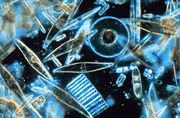
Opal
Opal is an amorphous form of silica related to quartz, a mineraloid form, not a mineral. 3% to 21% of the total weight is water, but the content is usually between 6% to 10%. It is deposited at a relatively low temperature and may occur in the fissures of almost any kind of rock, being most...
, biogenic opal, or amorphous opaline silica, forms one of the most widespread biogenic minerals. Silica is an amorphous metal oxide
Oxide
An oxide is a chemical compound that contains at least one oxygen atom in its chemical formula. Metal oxides typically contain an anion of oxygen in the oxidation state of −2....
formed by complex inorganic polymerization
Polymerization
In polymer chemistry, polymerization is a process of reacting monomer molecules together in a chemical reaction to form three-dimensional networks or polymer chains...
processes. This is opposed to the other major biogenic minerals, comprising carbonate
Carbonate
In chemistry, a carbonate is a salt of carbonic acid, characterized by the presence of the carbonate ion, . The name may also mean an ester of carbonic acid, an organic compound containing the carbonate group C2....
and phosphate
Phosphate
A phosphate, an inorganic chemical, is a salt of phosphoric acid. In organic chemistry, a phosphate, or organophosphate, is an ester of phosphoric acid. Organic phosphates are important in biochemistry and biogeochemistry or ecology. Inorganic phosphates are mined to obtain phosphorus for use in...
, which occur in nature as crystalline iono-covalent solids (e.g. salts) whose precipitation
Precipitation (chemistry)
Precipitation is the formation of a solid in a solution or inside anothersolid during a chemical reaction or by diffusion in a solid. When the reaction occurs in a liquid, the solid formed is called the precipitate, or when compacted by a centrifuge, a pellet. The liquid remaining above the solid...
is dictated by solubility equilibria
Solubility equilibrium
Solubility equilibrium is a type of dynamic equilibrium. It exists when a chemical compound in the solid state is in chemical equilibrium with a solution of that compound. The solid may dissolve unchanged, with dissociation or with chemical reaction with another constituent of the solvent, such as...
. Chemically, BSi is hydrated silica (SiO2·nH2O), which is essential to many plants and animals.
Silica in marine environments
SilicateSilicate
A silicate is a compound containing a silicon bearing anion. The great majority of silicates are oxides, but hexafluorosilicate and other anions are also included. This article focuses mainly on the Si-O anions. Silicates comprise the majority of the earth's crust, as well as the other...
, or silicic acid
Silicic acid
Silicic acid is a general name for a family of chemical compounds of the element silicon, hydrogen, and oxygen, with the general formula [SiOx4-2x]n...
(H4SiO4), is an important nutrient
Nutrient
A nutrient is a chemical that an organism needs to live and grow or a substance used in an organism's metabolism which must be taken in from its environment. They are used to build and repair tissues, regulate body processes and are converted to and used as energy...
in the ocean. Unlike the other major nutrients such as phosphate
Phosphate
A phosphate, an inorganic chemical, is a salt of phosphoric acid. In organic chemistry, a phosphate, or organophosphate, is an ester of phosphoric acid. Organic phosphates are important in biochemistry and biogeochemistry or ecology. Inorganic phosphates are mined to obtain phosphorus for use in...
, nitrate
Nitrate
The nitrate ion is a polyatomic ion with the molecular formula NO and a molecular mass of 62.0049 g/mol. It is the conjugate base of nitric acid, consisting of one central nitrogen atom surrounded by three identically-bonded oxygen atoms in a trigonal planar arrangement. The nitrate ion carries a...
, or ammonium
Ammonium
The ammonium cation is a positively charged polyatomic cation with the chemical formula NH. It is formed by the protonation of ammonia...
, which are needed by almost all marine plankton
Plankton
Plankton are any drifting organisms that inhabit the pelagic zone of oceans, seas, or bodies of fresh water. That is, plankton are defined by their ecological niche rather than phylogenetic or taxonomic classification...
, silicate is an essential chemical requirement for very specific biota
Biota (ecology)
Biota are the total collection of organisms of a geographic region or a time period, from local geographic scales and instantaneous temporal scales all the way up to whole-planet and whole-timescale spatiotemporal scales. The biota of the Earth lives in the biosphere.-See...
, including diatoms, radiolaria, silicoflagellates, and siliceous sponges. These organisms extract dissolved silicate from open ocean surface waters for the buildup of their particulate silica (SiO2), or opaline, skeletal structures (i.e. the biota’s hard parts). Some of the most common siliceous structures observed at the cell surface of silica-secreting organisms include: spicules, scales, solid plates, granules, frustules, and other elaborate geometric forms, depending on the species considered.
Five major sources of dissolved
Dissolution (chemistry)
Dissolution is the process by which a solid, liquid or gas forms a solution in a solvent. In solids this can be explained as the breakdown of the crystal lattice into individual ions, atoms or molecules and their transport into the solvent. For liquids and gases, the molecules must be compatible...
silica to the marine environment can be distinguished:
- Riverine influx of dissolved silica to the oceans: 4.2 ± 0.8 × 10¹⁴ g SiO2 yr−1
- Submarine volcanism and associated hydrothermal emanations: 1.9 ± 1.0 × 10¹⁴ g SiO2 yr−1
- Glacial weatheringWeatheringWeathering is the breaking down of rocks, soils and minerals as well as artificial materials through contact with the Earth's atmosphere, biota and waters...
: 2 × 10¹² g SiO2 yr−1 - Low temperature submarine weathering of oceanic basaltBasaltBasalt is a common extrusive volcanic rock. It is usually grey to black and fine-grained due to rapid cooling of lava at the surface of a planet. It may be porphyritic containing larger crystals in a fine matrix, or vesicular, or frothy scoria. Unweathered basalt is black or grey...
s - Some silica may also escape from silica-enriched pore waters of pelagic sedimentsPelagic sedimentsPelagic sediment or pelagite is a fine-grained sediment that has accumulated by the settling of particles through the water column to the ocean floor beneath the open ocean far from land. These particles consist primarily of either the microscopic, calcareous or siliceous shells of phytoplankton or...
on the seafloor
Once the organism has perished, part of the siliceous skeletal material dissolves
Dissolution (chemistry)
Dissolution is the process by which a solid, liquid or gas forms a solution in a solvent. In solids this can be explained as the breakdown of the crystal lattice into individual ions, atoms or molecules and their transport into the solvent. For liquids and gases, the molecules must be compatible...
, as it settles through the water column, enriching the deep waters with dissolved silica. Some of the siliceous scales can also be preserved over time as microfossils in deep-sea sediments, providing a window into modern and ancient plankton
Plankton
Plankton are any drifting organisms that inhabit the pelagic zone of oceans, seas, or bodies of fresh water. That is, plankton are defined by their ecological niche rather than phylogenetic or taxonomic classification...
/protists communities. This biologic process has operated, since at least early Paleozoic
Paleozoic
The Paleozoic era is the earliest of three geologic eras of the Phanerozoic eon, spanning from roughly...
time, to regulate the balance of silica in the ocean: Radiolarians (Cambrian
Cambrian
The Cambrian is the first geological period of the Paleozoic Era, lasting from Mya ; it is succeeded by the Ordovician. Its subdivisions, and indeed its base, are somewhat in flux. The period was established by Adam Sedgwick, who named it after Cambria, the Latin name for Wales, where Britain's...
/Ordovician
Ordovician
The Ordovician is a geologic period and system, the second of six of the Paleozoic Era, and covers the time between 488.3±1.7 to 443.7±1.5 million years ago . It follows the Cambrian Period and is followed by the Silurian Period...
-Holocene
Holocene
The Holocene is a geological epoch which began at the end of the Pleistocene and continues to the present. The Holocene is part of the Quaternary period. Its name comes from the Greek words and , meaning "entirely recent"...
), diatoms (Cretaceous
Cretaceous
The Cretaceous , derived from the Latin "creta" , usually abbreviated K for its German translation Kreide , is a geologic period and system from circa to million years ago. In the geologic timescale, the Cretaceous follows the Jurassic period and is followed by the Paleogene period of the...
-Holocene
Holocene
The Holocene is a geological epoch which began at the end of the Pleistocene and continues to the present. The Holocene is part of the Quaternary period. Its name comes from the Greek words and , meaning "entirely recent"...
), and silicoflagellates (Cretaceous
Cretaceous
The Cretaceous , derived from the Latin "creta" , usually abbreviated K for its German translation Kreide , is a geologic period and system from circa to million years ago. In the geologic timescale, the Cretaceous follows the Jurassic period and is followed by the Paleogene period of the...
-Holocene
Holocene
The Holocene is a geological epoch which began at the end of the Pleistocene and continues to the present. The Holocene is part of the Quaternary period. Its name comes from the Greek words and , meaning "entirely recent"...
) form the ocean’s main contributors to the global silica biogenic cycle throughout geologic time. Diatoms account for 43% of the ocean primary production, and are responsible for the bulk of silica extraction from ocean waters in the modern ocean, and during much of the past fifty million years. In contrast, oceans of Jurassic
Jurassic
The Jurassic is a geologic period and system that extends from about Mya to Mya, that is, from the end of the Triassic to the beginning of the Cretaceous. The Jurassic constitutes the middle period of the Mesozoic era, also known as the age of reptiles. The start of the period is marked by...
and older ages, were characterized by radiolarians as major silica-utilizing phyla. Nowadays, radiolarians are the second (after diatoms) major producers of suspended amorphous silica in ocean waters. Their distribution ranges from the Arctic
Arctic
The Arctic is a region located at the northern-most part of the Earth. The Arctic consists of the Arctic Ocean and parts of Canada, Russia, Greenland, the United States, Norway, Sweden, Finland, and Iceland. The Arctic region consists of a vast, ice-covered ocean, surrounded by treeless permafrost...
to the Antarctic
Antarctic
The Antarctic is the region around the Earth's South Pole, opposite the Arctic region around the North Pole. The Antarctic comprises the continent of Antarctica and the ice shelves, waters and island territories in the Southern Ocean situated south of the Antarctic Convergence...
, being most abundant in the equatorial zone. In equatorial Pacific waters, for example, about 16,000 specimens per cubic meter can be observed.
Silicate cycling gained increasingly in scientific attention the past decade because of following reasons. Firstly, the modern marine
Marine (ocean)
Marine is an umbrella term. As an adjective it is usually applicable to things relating to the sea or ocean, such as marine biology, marine ecology and marine geology...
silica cycle is widely believed to be dominated by diatoms for the fixation and export of particulate matter (including organic
Organic matter
Organic matter is matter that has come from a once-living organism; is capable of decay, or the product of decay; or is composed of organic compounds...
carbon
Carbon
Carbon is the chemical element with symbol C and atomic number 6. As a member of group 14 on the periodic table, it is nonmetallic and tetravalent—making four electrons available to form covalent chemical bonds...
), from the euphotic zone to the deep ocean, via a process known as the biological pump
Biological pump
In oceanic biogeochemistry, the biological pump is the sum of a suite of biologically-mediated processes that transport carbon from the surface euphotic zone to the ocean's interior.-Overview:...
. As a result, diatoms, and other silica-secreting organisms, play a crucial role in the global carbon cycle
Carbon cycle
The carbon cycle is the biogeochemical cycle by which carbon is exchanged among the biosphere, pedosphere, geosphere, hydrosphere, and atmosphere of the Earth...
, and have the ability to affect atmospheric CO2 concentrations on a variety of time scales, by sequestering CO2 in the ocean. This connection between biogenic silica and organic carbon, together with the significantly higher preservation potential of biogenic siliceous compounds, compared to organic carbon, makes opal accumulation records very interesting for paleoceanography
Paleoceanography
Paleoceanography is the study of the history of the oceans in the geologic past with regard to circulation, chemistry, biology, geology and patterns of sedimentation.- Source of information :...
and paleoclimatology
Paleoclimatology
Paleoclimatology is the study of changes in climate taken on the scale of the entire history of Earth. It uses a variety of proxy methods from the Earth and life sciences to obtain data previously preserved within rocks, sediments, ice sheets, tree rings, corals, shells and microfossils; it then...
. Secondly, biogenic silica accumulation on the sea floor contains lot of information about where in the ocean export production has occurred on time scales ranging from hundreds to millions of years. For this reason, opal deposition records provide valuable information regarding large-scale oceanographic reorganizations in the geological past, as well as, paleoproductivity. At last, the mean oceanic residence time
Residence time
Residence time is the average amount of time that a particle spends in a particular system. This measurement varies directly with the amount of substance that is present in the system....
for silicate is approximately 10,000–15,000 yr. This relative short residence time, makes oceanic silicate concentrations and fluxes sensitive to glacial/interglacial
Interglacial
An Interglacial period is a geological interval of warmer global average temperature lasting thousands of years that separates consecutive glacial periods within an ice age...
perturbations, and thus an excellent proxy
Proxy (climate)
In the study of past climates is known as paleoclimatology, climate proxies are preserved physical characteristics of the past that stand in for direct measurements , to enable scientists to reconstruct the climatic conditions that prevailed during much of the Earth's history...
for evaluating climate changes.
The remains of diatoms and other silica-utilizing organisms are found, as opal sediments within pelagic deep-sea deposits. Pelagic sediments
Pelagic sediments
Pelagic sediment or pelagite is a fine-grained sediment that has accumulated by the settling of particles through the water column to the ocean floor beneath the open ocean far from land. These particles consist primarily of either the microscopic, calcareous or siliceous shells of phytoplankton or...
, containing significant quantities of siliceous biogenic remains, are commonly referred to as siliceous ooze
Siliceous ooze
Siliceous ooze is a soft siliceous pelagic sediment that covers large areas of the deep ocean floor. Siliceous oozes consist predominately of either diatoms or radiolarians. Sometimes, it contains lessor proportions of sponge spicules or silicoflagellates. Diatoms are golden-brown algae that...
. Siliceous ooze are particularly abundant in the modern ocean at high latitudes in the northern and southern hemispheres. A striking feature of siliceous ooze distribution is a ca. 200 km wide belt stretching across the Southern Ocean
Southern Ocean
The Southern Ocean comprises the southernmost waters of the World Ocean, generally taken to be south of 60°S latitude and encircling Antarctica. It is usually regarded as the fourth-largest of the five principal oceanic divisions...
. Some equatorial regions of upwelling
Upwelling
Upwelling is an oceanographic phenomenon that involves wind-driven motion of dense, cooler, and usually nutrient-rich water towards the ocean surface, replacing the warmer, usually nutrient-depleted surface water. The increased availability in upwelling regions results in high levels of primary...
, where nutrients are abundant and productivity
Productivity (ecology)
In ecology, productivity or production refers to the rate of generation of biomass in an ecosystem. It is usually expressed in units of mass per unit surface per unit time, for instance grams per square metre per day. The mass unit may relate to dry matter or to the mass of carbon generated...
is high, are also characterized by local siliceous ooze. Siliceous oozes are composed primarily of the remains of diatoms and radiolarians, but may also include other siliceous organisms, such as silicoflagellates and sponge spicules. Diatom ooze occurs mainly in high-latitude areas and along some continental margins, whereas radiolarian ooze are more characteristic of equatorial areas. Siliceous ooze are modified and transformed during burial into bedded chert
Chert
Chert is a fine-grained silica-rich microcrystalline, cryptocrystalline or microfibrous sedimentary rock that may contain small fossils. It varies greatly in color , but most often manifests as gray, brown, grayish brown and light green to rusty red; its color is an expression of trace elements...
s.
Diatoms in both fresh and salt water extract silica from the water to use as a component of their cell walls. Likewise, some holoplankton
Holoplankton
Holoplankton are organisms that are planktonic for their entire life cycle. Examples of holoplankton include some diatoms, radiolarians, some dinoflagellates, foraminifera, amphipods, krill, copepods, and salps.-Sources:Asexual Holoplankton:...
ic protozoa
Protozoa
Protozoa are a diverse group of single-cells eukaryotic organisms, many of which are motile. Throughout history, protozoa have been defined as single-cell protists with animal-like behavior, e.g., movement...
(Radiolaria), some sponges, and some plants (leaf phytolith
Phytolith
Some plants can take up silica in the soil, whereupon it is deposited within different intracellular and extracellular structures of the plant. After these plants decay, silica is redeposited in the soil in the form of phytoliths , which are rigid, microscopic structures of varying sizes and shapes...
s) use silicon as a structural material. Silicon is known to be required by chicks and rats for growth and skeletal development. Silicon is in human connective tissue
Connective tissue
"Connective tissue" is a fibrous tissue. It is one of the four traditional classes of tissues . Connective Tissue is found throughout the body.In fact the whole framework of the skeleton and the different specialized connective tissues from the crown of the head to the toes determine the form of...
s, bone
Bone
Bones are rigid organs that constitute part of the endoskeleton of vertebrates. They support, and protect the various organs of the body, produce red and white blood cells and store minerals. Bone tissue is a type of dense connective tissue...
s, teeth, skin
Human skin
The human skin is the outer covering of the body. In humans, it is the largest organ of the integumentary system. The skin has multiple layers of ectodermal tissue and guards the underlying muscles, bones, ligaments and internal organs. Human skin is similar to that of most other mammals,...
, eye
Human eye
The human eye is an organ which reacts to light for several purposes. As a conscious sense organ, the eye allows vision. Rod and cone cells in the retina allow conscious light perception and vision including color differentiation and the perception of depth...
s, gland
Gland
A gland is an organ in an animal's body that synthesizes a substance for release of substances such as hormones or breast milk, often into the bloodstream or into cavities inside the body or its outer surface .- Types :...
s and organs
Organ (anatomy)
In biology, an organ is a collection of tissues joined in structural unit to serve a common function. Usually there is a main tissue and sporadic tissues . The main tissue is the one that is unique for the specific organ. For example, main tissue in the heart is the myocardium, while sporadic are...
.
BSi is silica that originates from the production out of dissolved silica
Dissolved silica
Dissolved silica is the form of water soluble silica as silicon hydroxide , which can be measured by standard analyses . However, The term dissolved silica is different from the silicate occurring as silicate minerals, which is a class of minerals forming rings, sheets, chains, and tetrahedrons...
. BSi can either be accumulated "directly" in marine sediment
Pelagic sediments
Pelagic sediment or pelagite is a fine-grained sediment that has accumulated by the settling of particles through the water column to the ocean floor beneath the open ocean far from land. These particles consist primarily of either the microscopic, calcareous or siliceous shells of phytoplankton or...
s (via export) or be transferred back into dissolved silica in the water column.
Increasingly, isotope ratio
Isotopic signature
An isotopic signature is a ratio of stable or unstable isotopes of particular elements found in an investigated material...
s of oxygen (O18:O16) and silicon (Si30:Si28) are analysed from BSi preserved in lake and marine sediments to derive records of past climate change
Climate change
Climate change is a significant and lasting change in the statistical distribution of weather patterns over periods ranging from decades to millions of years. It may be a change in average weather conditions or the distribution of events around that average...
and nutrient cycling
Nutrient cycle
A nutrient cycle is the movement and exchange of organic and inorganic matter back into the production of living matter. The process is regulated by food web pathways that decompose matter into mineral nutrients. Nutrient cycles occur within ecosystems...
(De La Rocha, 2006; Leng and Barker, 2006). This is a particularly valuable approach considering the role of diatom
Diatom
Diatoms are a major group of algae, and are one of the most common types of phytoplankton. Most diatoms are unicellular, although they can exist as colonies in the shape of filaments or ribbons , fans , zigzags , or stellate colonies . Diatoms are producers within the food chain...
s in global carbon cycling. In addition, isotope analyses from BSi are useful for tracing past climate changes in regions such as in the Southern Ocean
Southern Ocean
The Southern Ocean comprises the southernmost waters of the World Ocean, generally taken to be south of 60°S latitude and encircling Antarctica. It is usually regarded as the fourth-largest of the five principal oceanic divisions...
, where few biogenic carbonate
Carbonate
In chemistry, a carbonate is a salt of carbonic acid, characterized by the presence of the carbonate ion, . The name may also mean an ester of carbonic acid, an organic compound containing the carbonate group C2....
s are preserved.
Marine biogenic silica budget
Rivers and submarine hydrothermal emanations supply 6.1 × 10¹⁴ g SiO2 yr−1 to the marine environment. Approximately two-thirds of this silica input is stored in continental marginContinental margin
The continental margin is the zone of the ocean floor that separates the thin oceanic crust from thick continental crust. Continental margins constitute about 28% of the oceanic area....
and deep-sea deposits. Siliceous deep-sea sediments located beneath the Antarctic Convergence
Antarctic Convergence
The Antarctic Convergence is a curve continuously encircling Antarctica where cold, northward-flowing Antarctic waters meet the relatively warmer waters of the subantarctic. Antarctic waters predominantly sink beneath subantarctic waters, while associated zones of mixing and upwelling create a zone...
(convergence zone
Convergence zone
Convergence zone usually refers to a region in the atmosphere where two prevailing flows meet and interact, usually resulting in distinctive weather conditions....
) host some 25% of the silica supplied to the oceans (i.e. 1.6 × 10¹⁴ g SiO2 yr−1) and consequently form one of Earth’s major silica sinks. The highest biogenic silica accumulation rates in this area are observed in the South Atlantic, with values as large as 53 cm.kyr−1 during the last 18,000 yr. Further, extensive biogenic silica accumulation has been recorded in the deep-sea sediments of the Bering Sea
Bering Sea
The Bering Sea is a marginal sea of the Pacific Ocean. It comprises a deep water basin, which then rises through a narrow slope into the shallower water above the continental shelves....
, Sea of Okhotsk
Sea of Okhotsk
The Sea of Okhotsk is a marginal sea of the western Pacific Ocean, lying between the Kamchatka Peninsula on the east, the Kuril Islands on the southeast, the island of Hokkaidō to the far south, the island of Sakhalin along the west, and a long stretch of eastern Siberian coast along the west and...
, and Subarctic
Subarctic
The Subarctic is a region in the Northern Hemisphere immediately south of the true Arctic and covering much of Alaska, Canada, the north of Scandinavia, Siberia, and northern Mongolia...
North Pacific. Total biogenic silica accumulation rates in these regions amounts nearly 0.6 × 10¹⁴ g SiO2 yr−1, which is equivalent to 10% of the dissolved silica input to the oceans. Continental margin upwelling areas, such as the Gulf of California
Gulf of California
The Gulf of California is a body of water that separates the Baja California Peninsula from the Mexican mainland...
, the Peru and Chile coast, are characteristic for some of the highest biogenic silica accumulation rates in the world. For example, biogenic silica accumulation rates of 69 g SiO2/cm2/kyr have been reported for the Gulf of California. Due to the laterally confined character of these rapid biogenic silica accumulation zones, upwelling areas solely account for approximately 5% of the dissolved silica supplied to the oceans. At last, extremely low biogenic silica accumulation rates have been observed in the extensive deep-sea deposits of the Atlantic, Indian and Pacific Oceans, rendering these oceans insignificant for the global marine silica budget.
Major silica sinks in the modern oceans
Large-scale oceanic circulation has a direct impact on opalOpal
Opal is an amorphous form of silica related to quartz, a mineraloid form, not a mineral. 3% to 21% of the total weight is water, but the content is usually between 6% to 10%. It is deposited at a relatively low temperature and may occur in the fissures of almost any kind of rock, being most...
deposition. The Pacific (characterized by nutrient poor surface waters, and deep nutrient rich waters) and Atlantic Ocean circulations, are favoring the production
Productivity (ecology)
In ecology, productivity or production refers to the rate of generation of biomass in an ecosystem. It is usually expressed in units of mass per unit surface per unit time, for instance grams per square metre per day. The mass unit may relate to dry matter or to the mass of carbon generated...
/preservation of silica and carbonate, respectively. For instance, Si/N and Si/P ratios increase from the Atlantic to the Pacific and Southern Ocean, favoring opal versus carbonate
Carbonate
In chemistry, a carbonate is a salt of carbonic acid, characterized by the presence of the carbonate ion, . The name may also mean an ester of carbonic acid, an organic compound containing the carbonate group C2....
producers. Consequently, the modern configuration of large-scale oceanic circulation resulted in the localization of major opal burial zones in the Equatorial Pacific, in the eastern boundary current upwelling systems, and by far the most important, the Southern Ocean.
Waters from the modern Pacific and Southern ocean, typically observe an increase in Si/N ratio at intermediate depth, which results in an increase in opal export (~ increase in opal production). In the Southern Ocean and North Pacific, this relationship between opal export and Si/N ratio switches from linear to exponential for Si/N ratios greater than 2. This gradual increase in the importance of silicate (Si) relative to nitrogen (N) has tremendous consequences for the ocean biological production. The change in nutrient ratios contributes to select diatoms as main producers, compared to other (e.g., calcifying) organisms. For example, microcosm
Microcosm: Model / experimental ecosystem
Microcosms are artificial, simplified ecosystems that are used to simulate and predict the behaviour of natural ecosystems under controlled conditions. Open or closed microcosms provide an experimental area for ecologists to study natural ecological processes. Microcosm studies can be very useful...
experiments have demonstrated that diatoms are DSi supercompetitors and dominate other producers above 2 µM DSi. Consequently opal vs. carbonate export will be favored, resulting in increasing opal production. The Southern Ocean and the North Pacific also display maximum biogenic silicate/Corganic flux ratios, and consist thus in an enrichment in biogenic silicate, compared to Corganic export flux. This combined increase in opal preservation and export makes the Southern Ocean the most important sink for DSi today.
In the modern Pacific and Southern Ocean, intermediate and deep waters are characterized by a higher content in DSi, compared to the Atlantic Ocean. This interbasin difference in DSi has the effect of increasing the preservation potential of opal in the Pacific and Southern Ocean compared to their Atlantic counterparts. Atlantic DSi depleted waters tends to produce relatively less silicified organisms, which has a strong influence on the preservation of their frustules. This mechanism in best illustrated when comparing the Peru and northwest Africa upwelling systems. The dissolution
Dissolution (chemistry)
Dissolution is the process by which a solid, liquid or gas forms a solution in a solvent. In solids this can be explained as the breakdown of the crystal lattice into individual ions, atoms or molecules and their transport into the solvent. For liquids and gases, the molecules must be compatible...
/production ratio is much higher in the Atlantic upwelling than in the Pacific upwelling. This is due to the fact that coastal upwelling source waters are much richer in DSi off Peru, than off NW Africa.
Cycling and accumulation of biogenic silica in the Southern Ocean sediments
Southern Ocean sediments are a major sink for biogenic silica (50-75% of the oceanic total of 4.5 × 10¹⁴ g SiO2 yr−1; DeMaster, 1981), but only a minor sink for organic carbonCarbon
Carbon is the chemical element with symbol C and atomic number 6. As a member of group 14 on the periodic table, it is nonmetallic and tetravalent—making four electrons available to form covalent chemical bonds...
(<1% of the oceanic 2 × 10¹⁴ g of organic C yr−1). These relatively high rates of biogenic silica accumulation in the Southern Ocean sediments (predominantly beneath the Polar Front) relative to organic carbon (60:1 on a weight basis) results from the preferential preservation of biogenic silica in the Antarctic water column. In contrast to what was previously thought, these high rates of biogenic silica accumulation are not the result from high rates of primary production
Primary production
400px|thumb|Global oceanic and terrestrial photoautotroph abundance, from September [[1997]] to August 2000. As an estimate of autotroph biomass, it is only a rough indicator of primary production potential, and not an actual estimate of it...
. Biological production in the Southern Ocean is strongly limited due to the low levels of irradiance
Irradiance
Irradiance is the power of electromagnetic radiation per unit area incident on a surface. Radiant emittance or radiant exitance is the power per unit area radiated by a surface. The SI units for all of these quantities are watts per square meter , while the cgs units are ergs per square centimeter...
coupled with deep mixed layers and/or by limited amounts of micronutrients, such as iron
Iron
Iron is a chemical element with the symbol Fe and atomic number 26. It is a metal in the first transition series. It is the most common element forming the planet Earth as a whole, forming much of Earth's outer and inner core. It is the fourth most common element in the Earth's crust...
.
This preferential preservation of biogenic silica relative to organic carbon is evident in the steadily increasing ratio of silica/organic C as function of depth in the water column. About, thirty-five percent of the biogenic silica produced in the euphotic zone survives dissolution within the surface layer; whereas only 4% of the organic carbon escapes microbial degradation in these near-surface waters. Consequently, considerable decoupling of organic C and silica occurs during settling through the water column. The accumulation of biogenic silica in the seabed represents 12% of the surface production, whereas the seabed organic-carbon accumulation rate accounts for solely <0.5% of the surface production. As a result polar sediments account for most of the ocean’s biogenic silica accumulation, but only a small amount of the sedimentary organic-carbon flux.
BSi production
The mean daily BSi rate strongly depends on the region:- Coastal upwelling: 46 mmol.m−2.d−1
- Sub-arcticArcticThe Arctic is a region located at the northern-most part of the Earth. The Arctic consists of the Arctic Ocean and parts of Canada, Russia, Greenland, the United States, Norway, Sweden, Finland, and Iceland. The Arctic region consists of a vast, ice-covered ocean, surrounded by treeless permafrost...
Pacific: 18 mmol.m−2.d−1 - Southern Ocean: 3–38 mmol.m−2.d−1
- mid-ocean gyreGyreA gyre in oceanography is any large system of rotating ocean currents, particularly those involved with large wind movements. Gyres are caused by the Coriolis Effect; planetary vorticity along with horizontal and vertical friction, which determine the circulation patterns from the wind curl...
s: 0.2–1.6 mmol.m−2.d−1
Likewise, the integrated annual BSi production strongly depends on the region:
- Coastal upwelling: 3 × 10¹² mol.yr−1
- Subarctic Pacific: 8 × 10¹² mol.yr−1
- Southern Ocean: 17–37 × 1012 mol.yr−1
- mid-ocean gyres: 26 × 1012 mol.yr−1
BSi production is controlled by:
- Dissolved silicaDissolved silicaDissolved silica is the form of water soluble silica as silicon hydroxide , which can be measured by standard analyses . However, The term dissolved silica is different from the silicate occurring as silicate minerals, which is a class of minerals forming rings, sheets, chains, and tetrahedrons...
availability, however, half saturation constant Kµ for silicon-limited growth is lower than Ks for silicon uptake. - Light availability: There is no direct light requirement; silicon uptake at 2x depth of photosynthesisPhotosynthesisPhotosynthesis is a chemical process that converts carbon dioxide into organic compounds, especially sugars, using the energy from sunlight. Photosynthesis occurs in plants, algae, and many species of bacteria, but not in archaea. Photosynthetic organisms are called photoautotrophs, since they can...
; silicon uptake continues at night but cells must be actively growing. - MicronutrientMicronutrientMicronutrients are nutrients required by humans and other living things throughout life in small quantities to orchestrate a whole range of physiological functions, but which the organism itself cannot produce. For people, they include dietary trace minerals in amounts generally less than 100...
availability.
BSi dissolution
BSi dissolution is controlled by:- ThermodynamicsThermodynamicsThermodynamics is a physical science that studies the effects on material bodies, and on radiation in regions of space, of transfer of heat and of work done on or by the bodies or radiation...
of solubilitySolubilitySolubility is the property of a solid, liquid, or gaseous chemical substance called solute to dissolve in a solid, liquid, or gaseous solvent to form a homogeneous solution of the solute in the solvent. The solubility of a substance fundamentally depends on the used solvent as well as on...
: Temperature (0 to 25 °C - 50x increase). - Sinking rate: Food web structure—grazers, fecal pellets, discarded feeding structures, Aggregation - rapid transport.
- BacteriaBacteriaBacteria are a large domain of prokaryotic microorganisms. Typically a few micrometres in length, bacteria have a wide range of shapes, ranging from spheres to rods and spirals...
l degradationBiodegradationBiodegradation or biotic degradation or biotic decomposition is the chemical dissolution of materials by bacteria or other biological means...
of organic matrix (Bidle and Azam, 1999).
BSi preservation
BSi preservation is measured by:- Sedimentation rates, mainly sediment traps (Honjo);
- BenthicBenthic zoneThe benthic zone is the ecological region at the lowest level of a body of water such as an ocean or a lake, including the sediment surface and some sub-surface layers. Organisms living in this zone are called benthos. They generally live in close relationship with the substrate bottom; many such...
remineralizationRemineralisationIn biogeochemistry, remineralisation refers to the transformation of organic molecules to inorganic forms, typically mediated by biological activity....
rates ("recycling"), benthic flux chamber (Berelson); - BSi concentration in sediments, chemical leaching in alkaline solutionSolutionIn chemistry, a solution is a homogeneous mixture composed of only one phase. In such a mixture, a solute is dissolved in another substance, known as a solvent. The solvent does the dissolving.- Types of solutions :...
, site specific, need to differentiate lithogenicLithogenic silicaLithogenic silica comes from the Greek words lithos, which means rock, and genesis, which means coming from. LSi is silica that originates from terrestrial sources of rock and soil, i.e...
vs. biogenic Si, X-ray diffraction.
BSi preservation is controlled by:
- Sedimentation rate;
- Porewater dissolved silica concentration: saturation at 1.100 µmol/L;
- Surface coatings: dissolved Al modifies solubility of deposited biogenic silica particles, dissolved silica can also precipitate with Al as clayClayClay is a general term including many combinations of one or more clay minerals with traces of metal oxides and organic matter. Geologic clay deposits are mostly composed of phyllosilicate minerals containing variable amounts of water trapped in the mineral structure.- Formation :Clay minerals...
or Al-Si coatings.
Opaline silica on Mars
In the Gusev crater of Mars, the Mars Exploration RoverMars Exploration Rover
NASA's Mars Exploration Rover Mission is an ongoing robotic space mission involving two rovers, Spirit and Opportunity, exploring the planet Mars...
Spirit
Spirit rover
Spirit, MER-A , is a robotic rover on Mars, active from 2004 to 2010. It was one of two rovers of NASA's ongoing Mars Exploration Rover Mission. It landed successfully on Mars at 04:35 Ground UTC on January 4, 2004, three weeks before its twin, Opportunity , landed on the other side of the planet...
inadvertently discovered opaline silica. One of its wheels had earlier become immobilized and thus was effectively trenching the Martian regolith
Regolith
Regolith is a layer of loose, heterogeneous material covering solid rock. It includes dust, soil, broken rock, and other related materials and is present on Earth, the Moon, some asteroids, and other terrestrial planets and moons.-Etymology:...
as it dragged behind the traversing rover. Later analysis showed that the silica was evidence for hydrothermal conditions.