


Big cat

Encyclopedia
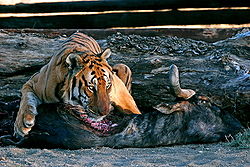
Felidae
Felidae is the biological family of the cats; a member of this family is called a felid. Felids are the strictest carnivores of the thirteen terrestrial families in the order Carnivora, although the three families of marine mammals comprising the superfamily pinnipedia are as carnivorous as the...
species from smaller ones. One definition of "big cat" includes the four members of the genus Panthera
Panthera
Panthera is a genus of the family Felidae , which contains four well-known living species: the tiger, the lion, the jaguar, and the leopard. The genus comprises about half of the Pantherinae subfamily, the big cats...
: the tiger
Tiger
The tiger is the largest cat species, reaching a total body length of up to and weighing up to . Their most recognizable feature is a pattern of dark vertical stripes on reddish-orange fur with lighter underparts...
, lion
Lion
The lion is one of the four big cats in the genus Panthera, and a member of the family Felidae. With some males exceeding 250 kg in weight, it is the second-largest living cat after the tiger...
, jaguar
Jaguar
The jaguar is a big cat, a feline in the Panthera genus, and is the only Panthera species found in the Americas. The jaguar is the third-largest feline after the tiger and the lion, and the largest in the Western Hemisphere. The jaguar's present range extends from Southern United States and Mexico...
, and leopard
Leopard
The leopard , Panthera pardus, is a member of the Felidae family and the smallest of the four "big cats" in the genus Panthera, the other three being the tiger, lion, and jaguar. The leopard was once distributed across eastern and southern Asia and Africa, from Siberia to South Africa, but its...
. Members of this genus are the only cats able to roar. A more expansive definition of "big cat" also includes the cheetah
Cheetah
The cheetah is a large-sized feline inhabiting most of Africa and parts of the Middle East. The cheetah is the only extant member of the genus Acinonyx, most notable for modifications in the species' paws...
, snow leopard
Snow Leopard
The snow leopard is a moderately large cat native to the mountain ranges of South Asia and Central Asia...
, clouded leopard
Clouded Leopard
The clouded leopard is a felid found from the Himalayan foothills through mainland Southeast Asia into China, and has been classified as vulnerable in 2008 by IUCN...
, and cougar.
Despite enormous differences in size, the various species of cat are quite similar in both structure and behavior, with the exception of the cheetah
Cheetah
The cheetah is a large-sized feline inhabiting most of Africa and parts of the Middle East. The cheetah is the only extant member of the genus Acinonyx, most notable for modifications in the species' paws...
, which is significantly different from any of the big or small cats. All cats are carnivore
Carnivore
A carnivore meaning 'meat eater' is an organism that derives its energy and nutrient requirements from a diet consisting mainly or exclusively of animal tissue, whether through predation or scavenging...
s and efficient apex predators. Their range includes the Americas
Americas
The Americas, or America , are lands in the Western hemisphere, also known as the New World. In English, the plural form the Americas is often used to refer to the landmasses of North America and South America with their associated islands and regions, while the singular form America is primarily...
, Africa
Africa
Africa is the world's second largest and second most populous continent, after Asia. At about 30.2 million km² including adjacent islands, it covers 6% of the Earth's total surface area and 20.4% of the total land area...
, Asia
Asia
Asia is the world's largest and most populous continent, located primarily in the eastern and northern hemispheres. It covers 8.7% of the Earth's total surface area and with approximately 3.879 billion people, it hosts 60% of the world's current human population...
, and Europe
Europe
Europe is, by convention, one of the world's seven continents. Comprising the westernmost peninsula of Eurasia, Europe is generally 'divided' from Asia to its east by the watershed divides of the Ural and Caucasus Mountains, the Ural River, the Caspian and Black Seas, and the waterways connecting...
.
Roaring
The ability to roar comes from an elongated and specially adapted larynxLarynx
The larynx , commonly called the voice box, is an organ in the neck of amphibians, reptiles and mammals involved in breathing, sound production, and protecting the trachea against food aspiration. It manipulates pitch and volume...
and hyoid apparatus
Hyoid bone
The hyoid bone is a horseshoe-shaped bone situated in the anterior midline of the neck between the chin and the thyroid cartilage. At rest, it lies at the level of the base of the mandible in the front and the third cervical vertebra behind.Unlike other bones, the hyoid is only distantly...
. (However, the snow leopard
Snow Leopard
The snow leopard is a moderately large cat native to the mountain ranges of South Asia and Central Asia...
cannot roar, despite having hyoid morphology similar to roaring cats.) When air passes through the larynx on the way from the lungs, the cartilage walls of the larynx vibrate, producing sound. The lion's larynx is longest, giving it the most robust roar.
Threats
The principal threats to big cats varies upon geographical location, but primarily are habitat destructionHabitat destruction
Habitat destruction is the process in which natural habitat is rendered functionally unable to support the species present. In this process, the organisms that previously used the site are displaced or destroyed, reducing biodiversity. Habitat destruction by human activity mainly for the purpose of...
and poaching
Poaching
Poaching is the illegal taking of wild plants or animals contrary to local and international conservation and wildlife management laws. Violations of hunting laws and regulations are normally punishable by law and, collectively, such violations are known as poaching.It may be illegal and in...
. In Africa many big cats are persecuted by pastoralists or government 'problem animal control' officers. Certain protected areas exist that shelter large and exceptionally visible populations of lions, hyenas, leopards and cheetahs, such as Botswana’s Chobe
Chobe National Park
Chobe National Park, in northwest Botswana, has one of the largest concentrations of game in Africa. By size, it is the third largest park of the country, after the Central Kalahari Game Reserve and the Gemsbok National Park, and is the most diverse...
, Kenya’s Masai Mara
Masai Mara
The Maasai Mara National Reserve is a large game reserve in south-western Kenya, which is effectively the northern continuation of the Serengeti National Park in Tanzania...
and Tanzania’s Serengeti
Serengeti National Park
The Serengeti National Park is a large national park in Serengeti area, Tanzania. It is most famous for its annual migration of over one and a half million white bearded wildebeest and 250,000 zebra...
. It is rather outside these conservation areas where persecution poses the dominant threat to large carnivores.
In the United States
United States
The United States of America is a federal constitutional republic comprising fifty states and a federal district...
, 19 states have banned ownership of big cats and other dangerous exotic animals as pets
PETS
PETS may be an acronym for:* Pet Travel Scheme, which allows animals to travel internationally without quarantine* Pets Evacuation and Transportation Standards Act...
, and the Captive Wildlife Safety Act bans the interstate sale and transportation of these animals.
Species

Felidae
Felidae is the biological family of the cats; a member of this family is called a felid. Felids are the strictest carnivores of the thirteen terrestrial families in the order Carnivora, although the three families of marine mammals comprising the superfamily pinnipedia are as carnivorous as the...
- Genus PantheraPantheraPanthera is a genus of the family Felidae , which contains four well-known living species: the tiger, the lion, the jaguar, and the leopard. The genus comprises about half of the Pantherinae subfamily, the big cats...
(roaring or great cats)- TigerTigerThe tiger is the largest cat species, reaching a total body length of up to and weighing up to . Their most recognizable feature is a pattern of dark vertical stripes on reddish-orange fur with lighter underparts...
, Panthera tigris (Asia) - LionLionThe lion is one of the four big cats in the genus Panthera, and a member of the family Felidae. With some males exceeding 250 kg in weight, it is the second-largest living cat after the tiger...
, Panthera leo (Africa, Gir Forest in IndiaIndiaIndia , officially the Republic of India , is a country in South Asia. It is the seventh-largest country by geographical area, the second-most populous country with over 1.2 billion people, and the most populous democracy in the world...
; extinct in former range of southeast EuropeSoutheast EuropeSoutheast Europe or Southeastern Europe is a relatively recent political designation for the states of the Balkans. Writers such as Maria Todorova and Vesna Goldsworthy have suggested the use of the term Southeastern Europe to replace the word Balkans for the region, to minimize potential...
, Middle EastMiddle EastThe Middle East is a region that encompasses Western Asia and Northern Africa. It is often used as a synonym for Near East, in opposition to Far East...
, much of AsiaAsiaAsia is the world's largest and most populous continent, located primarily in the eastern and northern hemispheres. It covers 8.7% of the Earth's total surface area and with approximately 3.879 billion people, it hosts 60% of the world's current human population...
, and North AmericaNorth AmericaNorth America is a continent wholly within the Northern Hemisphere and almost wholly within the Western Hemisphere. It is also considered a northern subcontinent of the Americas...
) - JaguarJaguarThe jaguar is a big cat, a feline in the Panthera genus, and is the only Panthera species found in the Americas. The jaguar is the third-largest feline after the tiger and the lion, and the largest in the Western Hemisphere. The jaguar's present range extends from Southern United States and Mexico...
, Panthera onca (the AmericasAmericasThe Americas, or America , are lands in the Western hemisphere, also known as the New World. In English, the plural form the Americas is often used to refer to the landmasses of North America and South America with their associated islands and regions, while the singular form America is primarily...
; from the Southern United StatesSouthern United StatesThe Southern United States—commonly referred to as the American South, Dixie, or simply the South—constitutes a large distinctive area in the southeastern and south-central United States...
and MexicoMexicoThe United Mexican States , commonly known as Mexico , is a federal constitutional republic in North America. It is bordered on the north by the United States; on the south and west by the Pacific Ocean; on the southeast by Guatemala, Belize, and the Caribbean Sea; and on the east by the Gulf of...
to northern ArgentinaArgentinaArgentina , officially the Argentine Republic , is the second largest country in South America by land area, after Brazil. It is constituted as a federation of 23 provinces and an autonomous city, Buenos Aires...
) - LeopardLeopardThe leopard , Panthera pardus, is a member of the Felidae family and the smallest of the four "big cats" in the genus Panthera, the other three being the tiger, lion, and jaguar. The leopard was once distributed across eastern and southern Asia and Africa, from Siberia to South Africa, but its...
, Panthera pardus (AsiaAsiaAsia is the world's largest and most populous continent, located primarily in the eastern and northern hemispheres. It covers 8.7% of the Earth's total surface area and with approximately 3.879 billion people, it hosts 60% of the world's current human population...
and AfricaAfricaAfrica is the world's second largest and second most populous continent, after Asia. At about 30.2 million km² including adjacent islands, it covers 6% of the Earth's total surface area and 20.4% of the total land area...
)
- Tiger
- Genus AcinonyxAcinonyxAcinonyx is a genus of mammals from the family Felidae. It is currently distributed in Africa and Asia, but at one time was also present in Europe. The cheetah is the only extant species in the genus. Wozencraft put the genus Acinonyx in their own monophyletic subfamily, Acinonychinae. Salles ,...
- CheetahCheetahThe cheetah is a large-sized feline inhabiting most of Africa and parts of the Middle East. The cheetah is the only extant member of the genus Acinonyx, most notable for modifications in the species' paws...
, Acinonyx jubatus (AfricaAfricaAfrica is the world's second largest and second most populous continent, after Asia. At about 30.2 million km² including adjacent islands, it covers 6% of the Earth's total surface area and 20.4% of the total land area...
and IranIranIran , officially the Islamic Republic of Iran , is a country in Southern and Western Asia. The name "Iran" has been in use natively since the Sassanian era and came into use internationally in 1935, before which the country was known to the Western world as Persia...
; extinct in former range of IndiaIndiaIndia , officially the Republic of India , is a country in South Asia. It is the seventh-largest country by geographical area, the second-most populous country with over 1.2 billion people, and the most populous democracy in the world...
)
- Cheetah
- Genus PumaPuma (genus)Puma is a genus in Felidae that contains the cougar and the jaguarundi, and may also include several poorly known Old World fossil representatives .-Species:*Puma concolor – CougarPuma pardoides Puma is a genus in Felidae that contains the cougar (also known as the puma, among other names)...
- Cougar, Puma concolor (NorthNorth AmericaNorth America is a continent wholly within the Northern Hemisphere and almost wholly within the Western Hemisphere. It is also considered a northern subcontinent of the Americas...
and South AmericaSouth AmericaSouth America is a continent situated in the Western Hemisphere, mostly in the Southern Hemisphere, with a relatively small portion in the Northern Hemisphere. The continent is also considered a subcontinent of the Americas. It is bordered on the west by the Pacific Ocean and on the north and east...
)
- Cougar, Puma concolor (North
- Genus Uncia
- Snow LeopardSnow LeopardThe snow leopard is a moderately large cat native to the mountain ranges of South Asia and Central Asia...
, Uncia uncia (mountains of centralCentral AsiaCentral Asia is a core region of the Asian continent from the Caspian Sea in the west, China in the east, Afghanistan in the south, and Russia in the north...
and southSouth AsiaSouth Asia, also known as Southern Asia, is the southern region of the Asian continent, which comprises the sub-Himalayan countries and, for some authorities , also includes the adjoining countries to the west and the east...
AsiaAsiaAsia is the world's largest and most populous continent, located primarily in the eastern and northern hemispheres. It covers 8.7% of the Earth's total surface area and with approximately 3.879 billion people, it hosts 60% of the world's current human population...
)
- Snow Leopard
- Genus NeofelisNeofelisThe genus Neofelis comprises two species, the Clouded Leopard and the Sunda Clouded Leopard , which are classified as vulnerable by IUCN. Both species are listed on CITES Appendix I.- Characteristics :...
- Clouded LeopardClouded LeopardThe clouded leopard is a felid found from the Himalayan foothills through mainland Southeast Asia into China, and has been classified as vulnerable in 2008 by IUCN...
, Neofelis nebulosa (southeastSoutheast AsiaSoutheast Asia, South-East Asia, South East Asia or Southeastern Asia is a subregion of Asia, consisting of the countries that are geographically south of China, east of India, west of New Guinea and north of Australia. The region lies on the intersection of geological plates, with heavy seismic...
and southSouth AsiaSouth Asia, also known as Southern Asia, is the southern region of the Asian continent, which comprises the sub-Himalayan countries and, for some authorities , also includes the adjoining countries to the west and the east...
AsiaAsiaAsia is the world's largest and most populous continent, located primarily in the eastern and northern hemispheres. It covers 8.7% of the Earth's total surface area and with approximately 3.879 billion people, it hosts 60% of the world's current human population...
) - Sunda Clouded Leopard, Neofelis diardi (BorneoBorneoBorneo is the third largest island in the world and is located north of Java Island, Indonesia, at the geographic centre of Maritime Southeast Asia....
and SumatraSumatraSumatra is an island in western Indonesia, westernmost of the Sunda Islands. It is the largest island entirely in Indonesia , and the sixth largest island in the world at 473,481 km2 with a population of 50,365,538...
)
- Clouded Leopard
Evolution
A 2010 study published in Molecular Phylogenetics and EvolutionMolecular Phylogenetics and Evolution
Molecular Phylogenetics and Evolution is a peer-reviewed scientific journal of evolutionary biology and phylogenetics. The journal is edited by D.E. Wildman.-Indexing:The journal is indexed in:*EMBiology*Journal Citation Reports*Scopus*Web of Science...
has given insight into the exact evolution
Evolution
Evolution is any change across successive generations in the heritable characteristics of biological populations. Evolutionary processes give rise to diversity at every level of biological organisation, including species, individual organisms and molecules such as DNA and proteins.Life on Earth...
ary relationships of the big cats. The study reveals that the snow leopard
Snow Leopard
The snow leopard is a moderately large cat native to the mountain ranges of South Asia and Central Asia...
and the tiger
Tiger
The tiger is the largest cat species, reaching a total body length of up to and weighing up to . Their most recognizable feature is a pattern of dark vertical stripes on reddish-orange fur with lighter underparts...
are sister species, while the lion
Lion
The lion is one of the four big cats in the genus Panthera, and a member of the family Felidae. With some males exceeding 250 kg in weight, it is the second-largest living cat after the tiger...
, leopard
Leopard
The leopard , Panthera pardus, is a member of the Felidae family and the smallest of the four "big cats" in the genus Panthera, the other three being the tiger, lion, and jaguar. The leopard was once distributed across eastern and southern Asia and Africa, from Siberia to South Africa, but its...
, and jaguar
Jaguar
The jaguar is a big cat, a feline in the Panthera genus, and is the only Panthera species found in the Americas. The jaguar is the third-largest feline after the tiger and the lion, and the largest in the Western Hemisphere. The jaguar's present range extends from Southern United States and Mexico...
are more closely related to each other. The tiger and snow leopard diverged from the ancestral big cats approximately 3.9 Ma. The tiger then evolved into a unique species towards the end of the Pliocene
Pliocene
The Pliocene Epoch is the period in the geologic timescale that extends from 5.332 million to 2.588 million years before present. It is the second and youngest epoch of the Neogene Period in the Cenozoic Era. The Pliocene follows the Miocene Epoch and is followed by the Pleistocene Epoch...
epoch, approximately 3.2 Ma. The ancestor of the lion, leopard, and jaguar split from other big cats from 4.3–3.8 Ma. Between 3.6–2.5 Ma the jaguar diverged from the ancestor of lions and leopards. Lions and leopards split from one another approximately 3.1–1.95 Ma.
External links
- NatureFootage Big Cat pictures and video clips
- How big are the Big Cats - an article at Big Cats Online which includes a chart comparing the body lengths of several cat species.
- ARKive - images and movies of endangered big cats
- Humane Society of the United States -- article on big cats as pets
- Big Cat Rescue -- Tampa, FloridaTampa, FloridaTampa is a city in the U.S. state of Florida. It serves as the county seat for Hillsborough County. Tampa is located on the west coast of Florida. The population of Tampa in 2010 was 335,709....
sanctuary dedicated to care and conservation of big cats - In-Sync Exotics -- Wylie, TexasWylie, TexasNot to be confused with the unincorporated area of Wylie, Texas just outside Abilene, Texas.Wylie is a city in Collin, Dallas, and Rockwall Counties in the U.S. state of Texas, and a suburb of Dallas. At the 2000 Census, the population was 15,132; 2004 estimates pegged it at 25,850...
rescue sanctuary - FCF Big Cat Policy -- recommendations against casual private ownership
- WHF -- Wildlife Heritage Foundation (European Endangered Species Breeding Programmes (EEP))
- WHF Photos -- Wildlife Heritage Foundation photos
- http://noah.vertefeuille.org -- Exotic Cat Conservation