
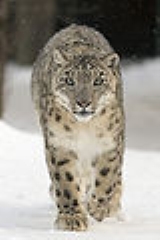
The
snow leopard is a moderately large
catFelidae is the biological family of the cats; a member of this family is called a felid. Felids are the strictest carnivores of the thirteen terrestrial families in the order Carnivora, although the three families of marine mammals comprising the superfamily pinnipedia are as carnivorous as the...
native to the mountain ranges of
South AsiaSouth Asia, also known as Southern Asia, is the southern region of the Asian continent, which comprises the sub-Himalayan countries and, for some authorities , also includes the adjoining countries to the west and the east...
and
CentralCentral Asia is a core region of the Asian continent from the Caspian Sea in the west, China in the east, Afghanistan in the south, and Russia in the north...
Asia. The classification of this species has been subject to change and its exact
taxonomicTaxonomy is the science of identifying and naming species, and arranging them into a classification. The field of taxonomy, sometimes referred to as "biological taxonomy", revolves around the description and use of taxonomic units, known as taxa...
position will not be resolved until further studies are conducted.
Snow leopards live between 3000 and 5500 m (9,842.5 and 18,044.6 ft) above sea level in the rocky mountain ranges of Central and South Asia. Their secretive nature means that their exact numbers are unknown, but it has been estimated that between 3,500 and 7,000 snow leopards exist in the wild and between 600 and 700 in zoos worldwide.
Snow leopards are smaller than the other big cats but, like them, exhibit a range of sizes, generally weighing between 27 and 55 kg (59.5 and 121.3 lb), with an occasional large male reaching 75 kg (165.3 lb) and small female of under 25 kg (55.1 lb). Body length ranges from 75 to 130 cm (29.5 to 51.2 in), with the tail adding a further 80 to 100 cm (31.5 to 39.4 in) to that length. These cats stand about 60 cm (24 in) at the shoulder.
Snow leopards have long thick fur, and their base color varies from smoky gray to yellowish tan, with whitish underparts. They have dark gray to black open rosettes on their body with small spots of the same color on their heads and larger spots on their legs and tail. Unusually among cats, their eyes are pale green or gray in color.
Snow leopards show several adaptations for living in a cold mountainous environment. Their bodies are stocky, their fur is thick, and their ears are small and rounded, all of which help to minimize heat loss. Their paws are wide, which distributes their weight better for walking on snow, and have fur on their undersides to increase their grip on steep and unstable surfaces; it also helps to minimize heat loss. Snow leopards' tails are long and flexible, helping them to maintain their balance, which is very important in the rocky terrain they inhabit. Their tails are also very thick due to storage of fats and are very thickly covered with fur which allows them to be used like a blanket to protect their faces when asleep.
The snow leopard has a short muzzle and domed forehead, containing unusual large
nasal cavitiesThe nasal cavity is a large air filled space above and behind the nose in the middle of the face.- Function :The nasal cavity conditions the air to be received by the other areas of the respiratory tract...
that help the animal breathe the thin, cold air of their mountainous environment.
Snow leopards cannot roar, despite possessing partial
ossificationOssification is the process of laying down new bone material by cells called osteoblasts. It is synonymous with bone tissue formation...
of the
hyoid boneThe hyoid bone is a horseshoe-shaped bone situated in the anterior midline of the neck between the chin and the thyroid cartilage. At rest, it lies at the level of the base of the mandible in the front and the third cervical vertebra behind.Unlike other bones, the hyoid is only distantly...
. This partial ossification was previously thought to be essential for allowing the
big catThe term big cat – which is not a biological classification – is used informally to distinguish the larger felid species from smaller ones. One definition of "big cat" includes the four members of the genus Panthera: the tiger, lion, jaguar, and leopard. Members of this genus are the only cats able...
s to roar, but new studies show that the ability to roar is due to other
morphologicalIn biology, morphology is a branch of bioscience dealing with the study of the form and structure of organisms and their specific structural features....
features, especially of the
larynxThe larynx , commonly called the voice box, is an organ in the neck of amphibians, reptiles and mammals involved in breathing, sound production, and protecting the trachea against food aspiration. It manipulates pitch and volume...
, which are absent in the snow leopard. Snow leopard vocalizations include hisses,
chuffingPrusten is a sound made by the tiger and the snow leopard, also known as chuffing or chuffle . It is a low-frequency equivalent to the purring found in domesticated cats. The animal's mouth is closed and it blows through the nostrils, producing a breathy snort...
, mews, growls, and wailing.
Naming and etymology
Both the
LatinLatin is an Italic language originally spoken in Latium and Ancient Rome. It, along with most European languages, is a descendant of the ancient Proto-Indo-European language. Although it is considered a dead language, a number of scholars and members of the Christian clergy speak it fluently, and...
ised genus name,
Uncia, and the occasional
EnglishEnglish is a West Germanic language that arose in the Anglo-Saxon kingdoms of England and spread into what was to become south-east Scotland under the influence of the Anglian medieval kingdom of Northumbria...
name "ounce" are derived from the
Old FrenchOld French was the Romance dialect continuum spoken in territories that span roughly the northern half of modern France and parts of modern Belgium and Switzerland from the 9th century to the 14th century...
once, originally used for the European lynx. "
Once" itself is believed to have arisen by
back-formationIn etymology, back-formation is the process of creating a new lexeme, usually by removing actual or supposed affixes. The resulting neologism is called a back-formation, a term coined by James Murray in 1889...
from an earlier word "
lonce" – the "L" of "
lonce" was construed as an abbreviated "
le" ("the"), leaving "
once" to be perceived as the animal's name. This, like the English version "ounce", became used for other lynx-sized cats, and eventually for the snow-leopard.
The snow leopard is also known in its native lands as
shan (Ladakhi),
irves ,
waawrin prraang ,
bars or
barys ( ˈbɑrəs), ilbirs (
KyrgyzThe Kyrgyz are a Turkic ethnic group found primarily in Kyrgyzstan.-Etymology:There are several etymological theories on the ethnonym "Kyrgyz."...
: Илбирс ) and
barfani chita - "snow cheetah" (Urdu).
Taxonomy and evolution
The snow leopard was first described by Schreber in 1775, in the Kopet-Dag Mountains in
TurkmenistanTurkmenistan , formerly also known as Turkmenia is one of the Turkic states in Central Asia. Until 1991, it was a constituent republic of the Soviet Union, the Turkmen Soviet Socialist Republic . Turkmenistan is one of the six independent Turkic states...
and
IranIran , officially the Islamic Republic of Iran , is a country in Southern and Western Asia. The name "Iran" has been in use natively since the Sassanian era and came into use internationally in 1935, before which the country was known to the Western world as Persia...
.
In the past, many taxonomists included the snow leopard in the
genusIn biology, a genus is a low-level taxonomic rank used in the biological classification of living and fossil organisms, which is an example of definition by genus and differentia...
PantheraPanthera is a genus of the family Felidae , which contains four well-known living species: the tiger, the lion, the jaguar, and the leopard. The genus comprises about half of the Pantherinae subfamily, the big cats...
, together with the other largest extant
felidsFelidae is the biological family of the cats; a member of this family is called a felid. Felids are the strictest carnivores of the thirteen terrestrial families in the order Carnivora, although the three families of marine mammals comprising the superfamily pinnipedia are as carnivorous as the...
, but later it was placed in its own genus,
Uncia. It was thought not to be closely related to the
leopardThe leopard , Panthera pardus, is a member of the Felidae family and the smallest of the four "big cats" in the genus Panthera, the other three being the tiger, lion, and jaguar. The leopard was once distributed across eastern and southern Asia and Africa, from Siberia to South Africa, but its...
(
Panthera pardus). However, a recent molecular study placed the species firmly within the genus
Panthera, its closest relative being the
tigerThe tiger is the largest cat species, reaching a total body length of up to and weighing up to . Their most recognizable feature is a pattern of dark vertical stripes on reddish-orange fur with lighter underparts...
(
Panthera tigris). Its exact position remains unclear, and many sources still treat it as
Uncia pending further studies.
A few
subspeciesSubspecies in biological classification, is either a taxonomic rank subordinate to species, ora taxonomic unit in that rank . A subspecies cannot be recognized in isolation: a species will either be recognized as having no subspecies at all or two or more, never just one...
have been proposed for animals living in different geographical regions. With the possible exception of
U. u. baikalensis-romanii, which requires further evaluation, these subspecies were generally not considered valid. The
Handbook of the Mammals of the WorldHandbook of the Mammals of the World is a book series from the publisher Lynx Edicions. The 8 volumes will be published from 2009. Each mammal family is assessed in a full text introduction with photographs and each species has a text account with a distribution map and illustrations on a plate...
recognizes two subspecies:
U. u. uncia, from central Asia northwestwards to Mongolia and Russia; and
U. u. uncioides in western China and the Himalayas.
Biology and behavior
In summer, snow leopards usually live above the tree line on mountainous meadows and in rocky regions at an altitude from 2700 to 6000 m (8,858.3 to 19,685 ft). In winter, snow leopards come down into the forests to an altitude of around 1200 to 2000 m (3,937 to 6,561.7 ft). Snow leopards prefer broken terrain and can travel without difficulty in snow up to 85 centimetres (33.5 in) deep, although snow leopards prefer to use existing trails made by other animals.
The snow leopard leads a largely solitary life, although mothers may rear cubs in dens in the mountains for extended periods.
An individual snow leopard lives within a well-defined home range, but does not defend its territory aggressively when encroached upon by other snow leopards. Home ranges vary greatly in size. In Nepal, where prey is abundant, a home range may be as small as 12 km² (5 sq mi) to 40 km² (15 sq mi) and up to five to ten animals are found here per 100 km² (39 sq mi); whereas in habitats with sparse prey, an area of 1000 km² (386 sq mi) supports only five of these cats.
Like other cats, snow leopards use scent marks to indicate their territory and common travel routes. These are most commonly produced by scraping the ground with the hind feet before depositing
urineUrine is a typically sterile liquid by-product of the body that is secreted by the kidneys through a process called urination and excreted through the urethra. Cellular metabolism generates numerous by-products, many rich in nitrogen, that require elimination from the bloodstream...
or
scat-Education:* School and College Ability Test* Somerset College of Arts and Technology, a community college in Somerset, England* Shrewsbury College of Arts & Technology, a community college in Shropshire, England-Games:* Thirty-one , a card game...
, but they also spray urine onto sheltered patches of rock.
Snow leopards are
crepuscularCrepuscular animals are those that are active primarily during twilight, that is during dawn and dusk. The word is derived from the Latin word crepusculum, meaning "twilight." Crepuscular is, thus, in contrast with diurnal and nocturnal behavior. Crepuscular animals may also be active on a bright...
, being most active at dawn and dusk. They are known for being extremely secretive and well camouflaged.
Hunting and diet
Snow leopards are
carnivoreA carnivore meaning 'meat eater' is an organism that derives its energy and nutrient requirements from a diet consisting mainly or exclusively of animal tissue, whether through predation or scavenging...
s and actively
huntHunting is the practice of pursuing any living thing, usually wildlife, for food, recreation, or trade. In present-day use, the term refers to lawful hunting, as distinguished from poaching, which is the killing, trapping or capture of the hunted species contrary to applicable law...
their prey, though, like all cats, they are opportunistic feeders, eating whatever meat they can find, including
carrionCarrion refers to the carcass of a dead animal. Carrion is an important food source for large carnivores and omnivores in most ecosystems. Examples of carrion-eaters include vultures, hawks, eagles, hyenas, Virginia Opossum, Tasmanian Devils, coyotes, Komodo dragons, and burying beetles...
and domestic livestock. They can kill animals three times their size, such as the
BharalThe bharal or Himalayan blue sheep or naur, Pseudois nayaur, is a caprid found in the high Himalayas of Nepal, Tibet, China, India, Pakistan, and Bhutan...
,
Himalayan TahrThe Himalayan Tahr or Common Thar is a large ungulate related to the wild goat.-Habitat:...
and
MarkhorThe Markhor is a large species of wild goat that is found in northeastern Afghanistan, Pakistan , India, southern Tajikistan and southern Uzbekistan...
but will readily take much smaller prey such as hares and birds. Unusually among cats, snow leopards also eat a significant amount of vegetation, including grass and twigs.
The diet of the snow leopard varies across its range and with the time of year, and depends on prey availability. In the
HimalayasThe Himalaya Range or Himalaya Mountains Sanskrit: Devanagari: हिमालय, literally "abode of snow"), usually called the Himalayas or Himalaya for short, is a mountain range in Asia, separating the Indian subcontinent from the Tibetan Plateau...
, it preys mostly on
bharalThe bharal or Himalayan blue sheep or naur, Pseudois nayaur, is a caprid found in the high Himalayas of Nepal, Tibet, China, India, Pakistan, and Bhutan...
s (Himalayan blue sheep) but in other mountain ranges such as the
KarakoramThe Karakoram, or Karakorum , is a large mountain range spanning the borders between Pakistan, India and China, located in the regions of Gilgit-Baltistan , Ladakh , and Xinjiang region,...
,
Tian ShanThe Tian Shan , also spelled Tien Shan, is a large mountain system located in Central Asia. The highest peak in the Tian Shan is Victory Peak , ....
, and Altai, its main prey consists of
Siberian ibexThe Siberian Ibex or Common ibex is a species of ibex that lives in central and northern Asia. It has traditionally been treated as a subspecies of the Alpine Ibex, and whether it is specifically distinct from other ibex is still not entirely clear...
and
argaliThe argali, or the mountain sheep is a wild sheep, which roams the highlands of Central Asia . It is the biggest wild sheep, standing at the shoulder, measuring long and weighing , with a maximum known weight of...
, a type of wild sheep, although this has become rarer in some parts of the snow leopard's range. Other large animals eaten include various types of wild goats and sheep (such as
markhorThe Markhor is a large species of wild goat that is found in northeastern Afghanistan, Pakistan , India, southern Tajikistan and southern Uzbekistan...
s and
urialThe Urial , also known as the Arkars or Shapo, is a subspecies group of the wild sheep Ovis orientalis. Noticeable features are the reddish-brown long fur that fades during winter; males are characterized by a black ruff stretching from the neck to the chest and large horns. It is found in western...
s), other goat-like
ruminantA ruminant is a mammal of the order Artiodactyla that digests plant-based food by initially softening it within the animal's first compartment of the stomach, principally through bacterial actions, then regurgitating the semi-digested mass, now known as cud, and chewing it again...
s such as
Himalayan tahrThe Himalayan Tahr or Common Thar is a large ungulate related to the wild goat.-Habitat:...
and
goralGoral may refer to:* Three species of Asian ungulates in the genus Naemorhedus.* The Gorals, a people living in southern Poland, northern Slovakia and the Czech Republic....
s, plus
deerDeer are the ruminant mammals forming the family Cervidae. Species in the Cervidae family include white-tailed deer, elk, moose, red deer, reindeer, fallow deer, roe deer and chital. Male deer of all species and female reindeer grow and shed new antlers each year...
,
boarWild boar, also wild pig, is a species of the pig genus Sus, part of the biological family Suidae. The species includes many subspecies. It is the wild ancestor of the domestic pig, an animal with which it freely hybridises...
s, and langur monkeys. Smaller prey consists of
marmotThe marmots are a genus, Marmota, of squirrels. There are 14 species in this genus.Marmots are generally large ground squirrels. Those most often referred to as marmots tend to live in mountainous areas such as the Alps, northern Apennines, Eurasian steppes, Carpathians, Tatras, and Pyrenees in...
s,
woolly hareThe Woolly Hare is a species of mammal in the Leporidae family. It is found in China, Pakistan, India, Nepal and Mongolia.-References:* Lagomorph Specialist Group 1996. . Downloaded on 31 July 2007....
s,
pikaThe pika is a small mammal, with short limbs, rounded ears, and short tail. The name pika is used for any member of the Ochotonidae, a family within the order of lagomorphs, which also includes the Leporidae . One genus, Ochotona, is recognised within the family, and it includes 30 species...
s, various
rodentRodentia is an order of mammals also known as rodents, characterised by two continuously growing incisors in the upper and lower jaws which must be kept short by gnawing....
s, and birds such as the snow cock and
chukarThe Chukar Partridge or Chukar is a Eurasian upland gamebird in the pheasant family Phasianidae. It has been considered to form a superspecies complex along with the Rock Partridge, Philby's Partridge and Przevalski's Partridge and treated in the past as conspecific particularly with the first...
.
The snow leopard is not averse to taking domestic
livestockLivestock refers to one or more domesticated animals raised in an agricultural setting to produce commodities such as food, fiber and labor. The term "livestock" as used in this article does not include poultry or farmed fish; however the inclusion of these, especially poultry, within the meaning...
, which brings it into direct conflict with humans. Herders will kill snow leopards to prevent them from taking their animals. Snow leopards have not been reported to attack humans, and appear to be among the least aggressive of all the big cats. As a result, they are easily driven away from livestock; they readily abandon their kills when threatened and may not even defend themselves when attacked.
Snow leopards prefer to
ambushAn ambush is a long-established military tactic, in which the aggressors take advantage of concealment and the element of surprise to attack an unsuspecting enemy from concealed positions, such as among dense underbrush or behind hilltops...
prey from above, using broken terrain to conceal their approach, and can leap as far as 14 metres (45.9 ft). They will actively pursue prey down steep mountainsides, using the momentum of their initial leap to chase animals for up to 300 metres (984.3 ft). They kill with a bite to the neck, and may drag the prey to a safe location before feeding. They consume all edible parts of the carcass, and can survive on a single
bharalThe bharal or Himalayan blue sheep or naur, Pseudois nayaur, is a caprid found in the high Himalayas of Nepal, Tibet, China, India, Pakistan, and Bhutan...
for two weeks before hunting again.
Reproduction and life cycle
Snow leopards are unusual among large cats in that they have a well-defined birth peak. They usually
mateIn biology, mating is the pairing of opposite-sex or hermaphroditic organisms for copulation. In social animals, it also includes the raising of their offspring. Copulation is the union of the sex organs of two sexually reproducing animals for insemination and subsequent internal fertilization...
in late winter, marked by a noticeable increase in marking and calling. The Snow Leopards have a
gestation periodFor mammals the gestation period is the time in which a fetus develops, beginning with fertilization and ending at birth. The duration of this period varies between species.-Duration:...
of 90–100 days, so that the cubs are born between April and June. Oestrus typically lasts from five to eight days, and males tend not to seek out another partner after mating, probably because the short mating season does not allow sufficient time. Paired snow leopards mate in the usual felid posture, from 12 to 36 times a day.
The mother gives birth in a rocky den or crevice lined with fur shed from her underside.
LitterA litter is the offspring at one birth of animals from the same mother and usually from one set of parents. The word is most often used for the offspring of mammals, but can be used for any animal that gives birth to multiple young. In comparison, a group of eggs and the offspring that hatch from...
sizes vary from one to five
cubA cub is the young of certain large predatory animals such as bears, lions, wolves, and big cats; analogous to a domestic puppy or kittenCub may refer to:* Cub, a member of Cub Scouts* Cub player, a member of certain sports teams, e.g...
s, but the average is 2.2. The cubs are blind and helpless at birth, although already with a thick coat of fur, and weigh from 320 to 567 g (11.3 to 20 oz). The eyes open at around seven days, and the cubs can walk at five weeks and are fully weaned by 10 weeks. Also when they are born they have full black spots and turn into rosettes as they grow up.
The cubs leave the den at around two to four months of age, but remain with their mother until they become independent after around 18–22 months. Once independent, they may disperse over considerable distances, even crossing wide expanses of flat terrain to seek out new hunting grounds. This likely helps reduce the inbreeding that would otherwise be common in their relatively isolated environment. Snow leopards become sexually mature at two to three years, and normally live for 15–18 years, although in captivity they can live for up to 21 years.
Distribution
The snow leopard's habitat in
centralCentral Asia is a core region of the Asian continent from the Caspian Sea in the west, China in the east, Afghanistan in the south, and Russia in the north...
and
southSouth Asia, also known as Southern Asia, is the southern region of the Asian continent, which comprises the sub-Himalayan countries and, for some authorities , also includes the adjoining countries to the west and the east...
AsiaAsia is the world's largest and most populous continent, located primarily in the eastern and northern hemispheres. It covers 8.7% of the Earth's total surface area and with approximately 3.879 billion people, it hosts 60% of the world's current human population...
is rugged mountainous regions of approximately 1230000 square kilometres (474,905.7 sq mi), which extends through twelve countries:
AfghanistanAfghanistan , officially the Islamic Republic of Afghanistan, is a landlocked country located in the centre of Asia, forming South Asia, Central Asia and the Middle East. With a population of about 29 million, it has an area of , making it the 42nd most populous and 41st largest nation in the world...
,
BhutanBhutan , officially the Kingdom of Bhutan, is a landlocked state in South Asia, located at the eastern end of the Himalayas and bordered to the south, east and west by the Republic of India and to the north by the People's Republic of China...
,
ChinaChinese civilization may refer to:* China for more general discussion of the country.* Chinese culture* Greater China, the transnational community of ethnic Chinese.* History of China* Sinosphere, the area historically affected by Chinese culture...
,
IndiaIndia , officially the Republic of India , is a country in South Asia. It is the seventh-largest country by geographical area, the second-most populous country with over 1.2 billion people, and the most populous democracy in the world...
,
KazakhstanKazakhstan , officially the Republic of Kazakhstan, is a transcontinental country in Central Asia and Eastern Europe. Ranked as the ninth largest country in the world, it is also the world's largest landlocked country; its territory of is greater than Western Europe...
,
KyrgyzstanKyrgyzstan , officially the Kyrgyz Republic is one of the world's six independent Turkic states . Located in Central Asia, landlocked and mountainous, Kyrgyzstan is bordered by Kazakhstan to the north, Uzbekistan to the west, Tajikistan to the southwest and China to the east...
,
MongoliaMongolia is a landlocked country in East and Central Asia. It is bordered by Russia to the north and China to the south, east and west. Although Mongolia does not share a border with Kazakhstan, its western-most point is only from Kazakhstan's eastern tip. Ulan Bator, the capital and largest...
,
NepalNepal , officially the Federal Democratic Republic of Nepal, is a landlocked sovereign state located in South Asia. It is located in the Himalayas and bordered to the north by the People's Republic of China, and to the south, east, and west by the Republic of India...
,
PakistanPakistan , officially the Islamic Republic of Pakistan is a sovereign state in South Asia. It has a coastline along the Arabian Sea and the Gulf of Oman in the south and is bordered by Afghanistan and Iran in the west, India in the east and China in the far northeast. In the north, Tajikistan...
,
RussiaRussia or , officially known as both Russia and the Russian Federation , is a country in northern Eurasia. It is a federal semi-presidential republic, comprising 83 federal subjects...
,
TajikistanTajikistan , officially the Republic of Tajikistan , is a mountainous landlocked country in Central Asia. Afghanistan borders it to the south, Uzbekistan to the west, Kyrgyzstan to the north, and China to the east....
, and
UzbekistanUzbekistan , officially the Republic of Uzbekistan is a doubly landlocked country in Central Asia and one of the six independent Turkic states. It shares borders with Kazakhstan to the west and to the north, Kyrgyzstan and Tajikistan to the east, and Afghanistan and Turkmenistan to the south....
.
Its geographic distribution runs from the
Hindu KushThe Hindu Kush is an mountain range that stretches between central Afghanistan and northern Pakistan. The highest point in the Hindu Kush is Tirich Mir in the Chitral region of Khyber-Pakhtunkhwa, Pakistan.It is the westernmost extension of the Pamir Mountains, the Karakoram Range, and is a...
in eastern Afghanistan and the
Syr DaryaThe Syr Darya , also transliterated Syrdarya or Sirdaryo, is a river in Central Asia, sometimes known as the Jaxartes or Yaxartes from its Ancient Greek name . The Greek name is derived from Old Persian, Yakhsha Arta , a reference to the color of the river's water...
through the mountains of
Pamir MountainsThe Pamir Mountains are a mountain range in Central Asia formed by the junction or knot of the Himalayas, Tian Shan, Karakoram, Kunlun, and Hindu Kush ranges. They are among the world’s highest mountains and since Victorian times they have been known as the "Roof of the World" a probable...
,
Tian ShanThe Tian Shan , also spelled Tien Shan, is a large mountain system located in Central Asia. The highest peak in the Tian Shan is Victory Peak , ....
,
KarakoramThe Karakoram, or Karakorum , is a large mountain range spanning the borders between Pakistan, India and China, located in the regions of Gilgit-Baltistan , Ladakh , and Xinjiang region,...
,
KashmirKashmir is the northwestern region of the Indian subcontinent. Until the mid-19th century, the term Kashmir geographically denoted only the valley between the Great Himalayas and the Pir Panjal mountain range...
,
KunlunThe Kunlun Mountains are one of the longest mountain chains in Asia, extending more than 3,000 km. In the broadest sense, it forms the northern edge of the Tibetan Plateau south of the Tarim Basin and the Gansu Corridor and continues east south of the Wei River to end at the North China Plain.The...
, and the Himalaya to southern
SiberiaSiberia is an extensive region constituting almost all of Northern Asia. Comprising the central and eastern portion of the Russian Federation, it was part of the Soviet Union from its beginning, as its predecessor states, the Tsardom of Russia and the Russian Empire, conquered it during the 16th...
, where the range covers the Russian Altai mountains,
SajanSajan may mean:* Sajan , an Indian director of Malayalam movies* Sajan , a village in Vojvodina, Serbia*Sajan , Hindi film , debut of Shatrughan Sinha...
,
Tannu-Ola mountainsThe Tannu-Ola mountains is a mountain range in southern Siberia, in the Tuva Republic of Russia. It extends in an east-west direction and curves along the Mongolian border...
and the mountains to the west of
Lake BaikalLake Baikal is the world's oldest at 30 million years old and deepest lake with an average depth of 744.4 metres.Located in the south of the Russian region of Siberia, between Irkutsk Oblast to the northwest and the Buryat Republic to the southeast, it is the most voluminous freshwater lake in the...
. In
MongoliaMongolia is a landlocked country in East and Central Asia. It is bordered by Russia to the north and China to the south, east and west. Although Mongolia does not share a border with Kazakhstan, its western-most point is only from Kazakhstan's eastern tip. Ulan Bator, the capital and largest...
, it is found in the Mongolian and Gobi Altai and the Khangai Mountains. In
TibetTibet is a plateau region in Asia, north-east of the Himalayas. It is the traditional homeland of the Tibetan people as well as some other ethnic groups such as Monpas, Qiang, and Lhobas, and is now also inhabited by considerable numbers of Han and Hui people...
it is found up to the
Altyn-TaghAltyn-Tagh, Astyn-Tagh, Altun Mountains, Altun Shan or Aerjin Shan Tagh proper is a part of the range south of Lop Nor), is a mountain range in northwestern China that separates the eastern Tarim Basin from the Tibetan Plateau...
in the north.
Conservation status
There are numerous agencies working to conserve the snow leopard and its threatened mountain ecosystems. These include the
Snow Leopard TrustThe Snow Leopard Trust is the largest and oldest organization working solely to protect the endangered snow leopard and its habitat in 12 countries of Central Asia. The Trust is a non-profit organization with its headquarters in Seattle, Washington...
, the
Snow Leopard ConservancyThe Snow Leopard Conservancy SLC was founded in 2000 by Dr Rodney Jackson, a leading expert on snow leopards and their habitat. The Conservancy works to engage and incorporate local communities in protecting snow leopards in Pakistan, Nepal, Tajikistan, Mongolia, Russia and India...
, the Snow Leopard Network, and the
Panthera CorporationPanthera Corporation is a charity organization devoted to preserving big cats and their ecosystems around the globe. Founded in 2006, Panthera focuses its efforts on conservation of the world’s largest, most imperiled cats—tigers, lions, jaguars and snow leopards—while also developing conservation...
. These groups and numerous national governments from the snow leopard’s range, non-profits and donors from around the world recently worked together at the 10th International Snow Leopard Conference in Beijing. Their focus on research, community programs in snow leopard regions and education programs are aimed at understanding the cat's needs as well as the needs of the villagers and herder communities affecting snow leopards' lives and habitat.
Population and protected areas
The total
wild population of the snow leopard was estimated at only 4,080 to 6,590 individuals by McCarthy, et al., 2003 (see table below). Many of these estimates are rough and outdated.
In 1972, the International Union for Conservation of Nature (IUCN) placed the snow leopard on its
Red List of Threatened SpeciesThe IUCN Red List of Threatened Species , founded in 1963, is the world's most comprehensive inventory of the global conservation status of biological species. The International Union for Conservation of Nature is the world's main authority on the conservation status of species...
as globally "Endangered"; the same threat category was applied in the assessment conducted in 2008.
There are also 600-700 snow leopards in zoos around the world.
| Range Country | Habitat Area (km2.) | Estimated Population |
| Afghanistan |
50,000 |
100-200? |
| Bhutan |
15,000 |
100-200? |
| China |
1,100,000 |
2,000-2,500 |
| India |
75,000 |
200-600 |
| Kazakhstan |
50,000 |
180-200 |
| Kyrgyzstan |
105,000 |
150-500 |
| Mongolia |
101,000 |
500-1,000 |
| Nepal |
30,000 |
300-500 |
| Pakistan |
80,000 |
200-420 |
| Tajikistan |
100,000 |
180-220 |
| Uzbekistan |
10,000 |
20-50 |
Protected areas:
- Chitral National Park
Chitral National Park is one of the national parks of Pakistan. It is located in Gol valley and Kafir Kalash land of Chitral District in Khyber-Pakhtunkhwa province of Pakistan beside the Chitral River, at a distance of two hours drive from Chitral city. The park is also known as Chitral Gol...
, in the Khyber-Pakhtunkhwa, Pakistan.
- Hemis National Park
Hemis National Park is a high altitude national park in the eastern Ladakh region of the state of Jammu and Kashmir in India...
, in east LadakhLadakh is a region of Jammu and Kashmir, the northernmost state of the Republic of India. It lies between the Kunlun mountain range in the north and the main Great Himalayas to the south, inhabited by people of Indo-Aryan and Tibetan descent...
, India.
- Khunjerab National Park
Khunjerab National Park is a National park in Gilgit Baltistan of Pakistan. It is one of the highest altitude parks in the world. It provides the habitat for a number of endangered and threatened animal species like the Snow leopard, Marco Polo sheep, and Himalayan Ibex.The park lies within the...
, Gilgit-Baltistan, Pakistan.
- Nanda Devi National Park
The Nanda Devi National Park is a national park situated around the peak of Nanda Devi, , in the state of Uttarakhand in northern India. It was established as national park in 1982. Along with the adjoining Valley of Flowers National Park to the northwest, it was inscribed a World Heritage Site by...
, in state of UttarakhandUttarakhand , formerly Uttaranchal, is a state in the northern part of India. It is often referred to as the Land of Gods due to the many holy Hindu temples and cities found throughout the state, some of which are among Hinduism's most spiritual and auspicious places of pilgrimage and worship...
, India, a UNESCO Natural World Heritage Site.
- Qomolangma National Nature Preserve, Tibet
Tibet is a plateau region in Asia, north-east of the Himalayas. It is the traditional homeland of the Tibetan people as well as some other ethnic groups such as Monpas, Qiang, and Lhobas, and is now also inhabited by considerable numbers of Han and Hui people...
, China.
- Sagarmatha National Park
Sagarmāthā National Park is a protected area in the Himalayas of eastern Nepal containing the southern half of Mount Everest. The park was created on July 19, 1976 and was inscribed as a Natural World Heritage Site in 1979...
, Nepal, a UNESCO Natural World Heritage Site.
- Tumor Feng Nature Reserve, western Tianshan Mountains, Xinjiang
Xinjiang is an autonomous region of the People's Republic of China. It is the largest Chinese administrative division and spans over 1.6 million km2...
, China.
- Valley of Flowers National Park
Valley of Flowers National Park is an Indian national park, nestled high in West Himalaya, is renowned for its meadows of endemic alpine flowers and outstanding natural beauty. It is located in Uttarakhand state. This richly diverse area is also home to rare and endangered animals, including the...
, Uttaranchal, India, a UNESCO Natural World Heritage Site.
- Shey-Phoksundo National Park, Dolpa, Nepal.
- Dhorpatan Hunting Reserve
The Dhorpatan Hunting Reserve is the only hunting reserve in Nepal. Established in 1987 it covers an area of in the Dhaulagiri Himal of western Nepal in the Rukum, Myagdi and Baglung Districts. In altitude it ranges from .-External links:*...
, BaglungBaglung, is a town in western Nepal, 275 km west of Kathmandu. It is the administrative headquarters of Baglung District and Dhawalagiri Zone. Baglung is a major business, financial, educational, and healthcare center for the people of Kali Gandaki valley....
, Nepal.
- Annapurna Conservation Area
The Annapurna Conservation Area is Nepal's largest protected area covering in the Annapurna range of the Himalayas.-External links:*...
, Western Nepal.
- Jigme Dorji National Park
The Jigme Dorji National Park, named after the late Jigme Dorji Wangchuk, is the second-largest National Park of Bhutan. It occupies almost the entire Gasa District, as well as the northern areas of Thimphu District, Paro District, Punakha, and Wangdue Phodrang Districts...
, Bhutan
- Gobi Gurvansaikhan National Park
right|thumb|A [[yurt|ger]] with the [[Gurvan Saikhan Uul|Gurvan Saikhan Mountains]] behindGobi Gurvansaikhan National Park is a national park in southern Mongolia. The park was established in 1993, and expanded to its current size in 2000...
, Mongolia
- Ubsunur Hollow
Ubsunur Hollow is a fragile mountain endorheic basin or depression located on the territorial border of Mongolia and the Republic of Tuva in the Russian Federation, named after Uvs Lake, a large, shallow and very saline lake in the basin's center. Several smaller lakes are scattered throughout...
, on the territorial border of MongoliaMongolia is a landlocked country in East and Central Asia. It is bordered by Russia to the north and China to the south, east and west. Although Mongolia does not share a border with Kazakhstan, its western-most point is only from Kazakhstan's eastern tip. Ulan Bator, the capital and largest...
and the Republic of TuvaThe Tyva Republic , or Tuva , is a federal subject of Russia . It lies in the geographical center of Asia, in southern Siberia. The republic borders with the Altai Republic, the Republic of Khakassia, Krasnoyarsk Krai, Irkutsk Oblast, and the Republic of Buryatia in Russia and with Mongolia to the...
, RussiaRussia or , officially known as both Russia and the Russian Federation , is a country in northern Eurasia. It is a federal semi-presidential republic, comprising 83 federal subjects...
- Dibang Wildlife Sanctuary, near Anini
Anini is the headquarters of the Dibang Valley district in the state of Arunachal Pradesh in Northeast India. Anini was also the district headquarters of the undivided Dibang Valley district. It is a small underdeveloped town, mainly because of its remoteness. Yet, it still has basic road and air...
, India
Much progress has been made in securing the survival of the Snow Leopard, with Snow Leopards being successfully bred in captivity. The animals usually give birth to two to three cubs in a litter, but can give birth to up to seven in some cases.
A "surprisingly healthy" population of Snow Leopards has been found living at 16 locations in the isolated
Wakhan CorridorWakhan Corridor is commonly used as a synonym for Wakhan, an area of far north-eastern Afghanistan which forms a land link or "corridor" between Afghanistan and China. The Corridor is a long and slender panhandle or salient, roughly long and between wide. It separates Tajikistan in the north...
in northeastern Afghanistan giving rise to hopes for survival of wild Snow Leopards in that region.
Snow leopard in film and television
Pakistan is among few lucky countries where snow leopards can be found high up in the snow bound areas of its northern region, specially in Khunjrab (bordering China). They are found at altitudes varying between 3,000 and 5,500 meters .
The snow leopard is listed in the IUCN's Red List of Threatened Animals as Endangered.
Nisar Malik, a Pakistani journalist along with cameraman Mark Smith, spent 18 months following this most enigmatic of animals. Thus eventually gaining valuable insights into the day to day life of the snow leopards.
Set in the wilds of the Hindu Kush, this film profiles a much misunderstood part of the world, going beyond the myth to tell the snow leopard's real story
Snow Leopard of Pakistan - Beyond the Myth.
Planet EarthPlanet Earth is a 2006 television series produced by the BBC Natural History Unit. Five years in the making, it was the most expensive nature documentary series ever commissioned by the BBC, and also the first to be filmed in high definition...
has a segment on snow leopards. The series took some of the first video of snow leopards in the wild, and also featured a snow leopard hunting a
markhorThe Markhor is a large species of wild goat that is found in northeastern Afghanistan, Pakistan , India, southern Tajikistan and southern Uzbekistan...
. The first documentary on snow leopards was made by Hugh Miles, named
Silent Roar - In Search of the Snow leopard. The chief antagonist in the 3D animated film
Kung Fu PandaKung Fu Panda is a 2008 American computer-animated action comedy film produced by DreamWorks Animation and distributed by Paramount Pictures...
is depicted as a snow leopard.
Snow leopard in heraldry
Snow leopards have symbolic meaning for Turkic people of Central Asia, where the animal is known as
irbis or
bars, so it is widely used in heraldry and as an emblem.
The snow leopard (in
heraldryHeraldry is the profession, study, or art of creating, granting, and blazoning arms and ruling on questions of rank or protocol, as exercised by an officer of arms. Heraldry comes from Anglo-Norman herald, from the Germanic compound harja-waldaz, "army commander"...
known as the ounce) (
Aq BarsAq Bars is the coat of arms of Tatarstan. It is an ancient Turkic and Bolgar symbol translated as White Leopard or Snow Leopard, and has been in use since 1991 as the official symbol of Tatarstan....
) is a national symbol for
TatarsTatars are a Turkic speaking ethnic group , numbering roughly 7 million.The majority of Tatars live in the Russian Federation, with a population of around 5.5 million, about 2 million of which in the republic of Tatarstan.Significant minority populations are found in Uzbekistan, Kazakhstan,...
and
KazakhsThe Kazakhs are a Turkic people of the northern parts of Central Asia ....
: a snow leopard is found on the official seal of the city of
AlmatyAlmaty , also known by its former names Verny and Alma-Ata , is the former capital of Kazakhstan and the nation's largest city, with a population of 1,348,500...
, and a
winged snow leopardAq Bars is the coat of arms of Tatarstan. It is an ancient Turkic and Bolgar symbol translated as White Leopard or Snow Leopard, and has been in use since 1991 as the official symbol of Tatarstan....
is found on
TatarstanThe Republic of Tatarstan is a federal subject of Russia located in the Volga Federal District. Its capital is the city of Kazan, which is one of Russia's largest and most prosperous cities. The republic borders with Kirov, Ulyanovsk, Samara, and Orenburg Oblasts, and with the Mari El, Udmurt,...
's coat of arms. A similar leopard is featured on the
coat of arms of North Ossetia-AlaniaThe coat of arms of North Ossetia–Alania is a disk gules with a snow leopard passant or with sable spots on a ground or with as background seven mountains argent...
. The
Snow Leopard awardThe Snow Leopard award was a Soviet mountaineering award, given to very experienced climbers. It is still recognised in the Commonwealth of Independent States...
was given to Soviet mountaineers who scaled all five of the
Soviet UnionThe Soviet Union , officially the Union of Soviet Socialist Republics , was a constitutionally socialist state that existed in Eurasia between 1922 and 1991....
's 7000m peaks. In addition, the snow leopard is the symbol of the Girl Scout Association of Kyrgyzstan.
External links
Handbook of the Mammals of the World 1. Carnivores, Chiefly Edited by Don E. Wilson and Russell A. Mittermeier