
|
|
|
|
Hyoid bone
|
| |
|
| |
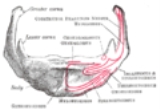
The hyoid bone (lingual bone) (Latin os hyoideum) is a horseshoe shaped bone situated in the anterior midline of the neck between the chin and the thyroid cartilage. At rest, it lies at the level of the base of the mandible in the front and the third cervical vertebra behind.
It is the only bone in the human skeleton not articulated to any other bone. It is kept suspended in position by muscles and ligaments.

Discussion
Ask a question about 'Hyoid bone'
Start a new discussion about 'Hyoid bone'
Answer questions from other users
|
Encyclopedia
The hyoid bone (lingual bone) (Latin os hyoideum) is a horseshoe shaped bone situated in the anterior midline of the neck between the chin and the thyroid cartilage. At rest, it lies at the level of the base of the mandible in the front and the third cervical vertebra behind.
It is the only bone in the human skeleton not articulated to any other bone. It is kept suspended in position by muscles and ligaments. The hyoid bone provides attachment to the muscles of the floor of the mouth and the tongue above, the larynx below, and the epiglottis and pharynx behind.
Segments
The bone consists of a central part, called the body and two pairs of cornua, the greater cornu and the lesser cornu.
Embryology
The second branchial arch gives rise to the lesser cornu of hyoid and the superior part of body of hyoid. Its cartilage of the third branchial arch that forms the greater cornu of hyoid and the lower part of the body of hyoid.
Ossification
The hyoid is ossified from six centers: two for the body, and one for each cornu. Ossification commences in the greater cornua toward the end of fetal life, in the body shortly afterward, and in the lesser cornua during the first or second year after birth. Till middle age the connection between the body and greater cornu is fibrous.
Muscle attachments
The following muscles are attached to the hyoid:
Function
Though the hyoid bone is present in many mammals, its descent in living creatures is unique to Homo sapiens, allowing for the production of a wide range of sounds that other animals cannot produce. It allows a wider range of tongue, pharyngeal and laryngeal movements by bracing these structures alongside each other in order to produce variation. The discovery of a modern-looking hyoid bone of a Neanderthal man in the Kebara Cave in Israel led its discoverers to argue that the Neanderthals had a descended larynx, and thus human-like speech capabilities. However, other researchers have claimed that the morphology of the hyoid is not indicative of the larynx's position.
Fracture and Applied Anatomy
Due to its position, the hyoid bone is not susceptible to easy fracture.
In a suspected case of murder, a fractured hyoid strongly indicates throttling or strangulation. However this is not the case in children and adolescents where hyoid bone is still flexible as ossification is yet to be completed.
Etymology
Its name is derived from the Greek word hyoeides meaning "shaped like the letter upsilon" (?).
Additional images
See also
External links
|
| |
|
|