

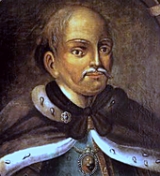
Ivan Skoropadsky

Encyclopedia
Ivan Skoropadsky (1646 - 3 July 1722; reigned 1708–1722) was a Hetman
of the Ukrainian
Cossacks, and the successor to the famous Hetman Ivan Mazepa
.
, Ukraine
in 1646, Skoropadsky was educated in Kyiv-Mohyla Academy. In 1675 he joined Cossack military service under Hetman Ivan Samoylovych
and distinguished himself in Russo-Turkish War of 1676-1681 and once again in the Crimean expedition
against the Ottoman Empire
and Crimean Khanate
in 1688.
Ivan Skoropadsky was briefly an ambassador representing Cossack Hetmanate
in negotiations with the Russian Tsar Peter the Great
. During the Great Northern War
Skoropadsky was a Cossack colonel of the Ukrainian Starodub regiment and after Swedish army crossed into Ukraine in 1708, refused to join Ivan Mazepa who decided to switch sides and fight against Russia. Only about 3,000 Cossacks, mostly Zaporozhians, followed Mazepa, while others remained loyal to the Tsar. With Mazepa disposed, Ivan Skoropadsky was elected as new Hetman on 11 November 1708. The fear of other reprisals and suspicion of Mazepa's newfound Swedish ally Charles XII
prevented most of Ukraine's population from siding with the rebels.
Ivan Skoropadsky moved the capital of the Cossack Hetmanate
from Baturyn
which was razed by the Russian army for Mazepa's rebellion, to the town of Hlukhiv. Following Mazepa's defeat in the Battle of Poltava
, Skoropadsky thought to regain Peter I' trust and yet negotiate greater autonomy for the Hetmanate and greater rights for the Cossack nobility, often resisting Peter the Great's policy of incorporation of the Hetmanate lands into the Russian Empire
. His careful negotiations allowed him to achieve both, and the Hetmanate regained much of its lost prominence.
In 1718 his daughter married Count Pyotr Pyotrovich Tolstoy, the son of Pyotr Andreyevich Tolstoy
(a prominent Russian statesman) and Ivan Skoropadsky was granted numerous estates in Ukraine becoming its largest land-owner. The Hetman had no male children but Pavlo Skoropadsky
, a descendant of his brother, briefly ruled Ukraine 200 years later, and also carried the title of Hetman in his Hetmanate-influenced government.
Hetman of Ukraine
Hetman of Ukraine may refer to:* Hetmans of Ukrainian Cossacks* Pavlo Skoropadskyi...
of the Ukrainian
Ukraine
Ukraine is a country in Eastern Europe. It has an area of 603,628 km², making it the second largest contiguous country on the European continent, after Russia...
Cossacks, and the successor to the famous Hetman Ivan Mazepa
Ivan Mazepa
Ivan Stepanovych Mazepa , Cossack Hetman of the Hetmanate in Left-bank Ukraine, from 1687–1708. He was famous as a patron of the arts, and also played an important role in the Battle of Poltava where after learning of Peter I's intent to relieve him as acting Hetman of Ukraine and replace him...
.
Biography
Born into a noble Cossack family in UmanUman
Uman is a city located in the Cherkasy Oblast in central Ukraine, to the east of Vinnytsia. The city rests on the banks of the Umanka River at around , and serves as the self-governing administrative center of the Umanskyi Raion ....
, Ukraine
Ukraine
Ukraine is a country in Eastern Europe. It has an area of 603,628 km², making it the second largest contiguous country on the European continent, after Russia...
in 1646, Skoropadsky was educated in Kyiv-Mohyla Academy. In 1675 he joined Cossack military service under Hetman Ivan Samoylovych
Ivan Samoylovych
Ivan Samoylovych was the Hetman of Left-bank Ukraine from 1672 to 1687. His term in office was marked by further incorporation of the Cossack Hetmanate into the nascent Russian Empire and by attempts to win the Right-bank Ukraine from Poland-Lithuania....
and distinguished himself in Russo-Turkish War of 1676-1681 and once again in the Crimean expedition
Russo-Turkish War, 1686-1700
The Russo–Turkish War of 1686–1700 was part of the joint European effort to confront the Ottoman Empire. The larger European conflict was known as the Great Turkish War....
against the Ottoman Empire
Ottoman Empire
The Ottoman EmpireIt was usually referred to as the "Ottoman Empire", the "Turkish Empire", the "Ottoman Caliphate" or more commonly "Turkey" by its contemporaries...
and Crimean Khanate
Crimean Khanate
Crimean Khanate, or Khanate of Crimea , was a state ruled by Crimean Tatars from 1441 to 1783. Its native name was . Its khans were the patrilineal descendants of Toqa Temür, the thirteenth son of Jochi and grandson of Genghis Khan...
in 1688.
Ivan Skoropadsky was briefly an ambassador representing Cossack Hetmanate
Cossack Hetmanate
The Hetmanate or Zaporizhian Host was the Ruthenian Cossack state in the Central Ukraine between 1649 and 1782.The Hetmanate was founded by first Ukrainian hetman Bohdan Khmelnytsky during the Khmelnytsky Uprising . In 1654 it pledged its allegiance to Muscovy during the Council of Pereyaslav,...
in negotiations with the Russian Tsar Peter the Great
Peter I of Russia
Peter the Great, Peter I or Pyotr Alexeyevich Romanov Dates indicated by the letters "O.S." are Old Style. All other dates in this article are New Style. ruled the Tsardom of Russia and later the Russian Empire from until his death, jointly ruling before 1696 with his half-brother, Ivan V...
. During the Great Northern War
Great Northern War
The Great Northern War was a conflict in which a coalition led by the Tsardom of Russia successfully contested the supremacy of the Swedish Empire in northern Central Europe and Eastern Europe. The initial leaders of the anti-Swedish alliance were Peter I the Great of Russia, Frederick IV of...
Skoropadsky was a Cossack colonel of the Ukrainian Starodub regiment and after Swedish army crossed into Ukraine in 1708, refused to join Ivan Mazepa who decided to switch sides and fight against Russia. Only about 3,000 Cossacks, mostly Zaporozhians, followed Mazepa, while others remained loyal to the Tsar. With Mazepa disposed, Ivan Skoropadsky was elected as new Hetman on 11 November 1708. The fear of other reprisals and suspicion of Mazepa's newfound Swedish ally Charles XII
Charles XII of Sweden
Charles XII also Carl of Sweden, , Latinized to Carolus Rex, Turkish: Demirbaş Şarl, also known as Charles the Habitué was the King of the Swedish Empire from 1697 to 1718...
prevented most of Ukraine's population from siding with the rebels.
Ivan Skoropadsky moved the capital of the Cossack Hetmanate
Cossack Hetmanate
The Hetmanate or Zaporizhian Host was the Ruthenian Cossack state in the Central Ukraine between 1649 and 1782.The Hetmanate was founded by first Ukrainian hetman Bohdan Khmelnytsky during the Khmelnytsky Uprising . In 1654 it pledged its allegiance to Muscovy during the Council of Pereyaslav,...
from Baturyn
Baturyn
Baturyn , is a historic town in the Chernihiv Oblast of northern Ukraine. It is located in the Bakhmatskyi Raion of the oblast, on the banks of the Seym River...
which was razed by the Russian army for Mazepa's rebellion, to the town of Hlukhiv. Following Mazepa's defeat in the Battle of Poltava
Battle of Poltava
The Battle of Poltava on 27 June 1709 was the decisive victory of Peter I of Russia over the Swedish forces under Field Marshal Carl Gustav Rehnskiöld in one of the battles of the Great Northern War. It is widely believed to have been the beginning of Sweden's decline as a Great Power; the...
, Skoropadsky thought to regain Peter I' trust and yet negotiate greater autonomy for the Hetmanate and greater rights for the Cossack nobility, often resisting Peter the Great's policy of incorporation of the Hetmanate lands into the Russian Empire
Russian Empire
The Russian Empire was a state that existed from 1721 until the Russian Revolution of 1917. It was the successor to the Tsardom of Russia and the predecessor of the Soviet Union...
. His careful negotiations allowed him to achieve both, and the Hetmanate regained much of its lost prominence.
In 1718 his daughter married Count Pyotr Pyotrovich Tolstoy, the son of Pyotr Andreyevich Tolstoy
Pyotr Andreyevich Tolstoy
Count Pyotr Andreyevich Tolstoy was a Russian statesman prominent during and after the reign of Peter the Great. He was the ancestor of all the Counts Tolstoy, including the novelist Leo Tolstoy Count Pyotr Andreyevich Tolstoy (1645 – 1729) was a Russian statesman prominent during and after the...
(a prominent Russian statesman) and Ivan Skoropadsky was granted numerous estates in Ukraine becoming its largest land-owner. The Hetman had no male children but Pavlo Skoropadsky
Pavlo Skoropadsky
Pavlo Petrovych Skoropadskyi 3 May 1873, Wiesbaden, Germany – 26 April 1945, Metten monastery clinic, Bavaria, Germany) was a Ukrainian politician, earlier an aristocrat and decorated Imperial Russian Army general...
, a descendant of his brother, briefly ruled Ukraine 200 years later, and also carried the title of Hetman in his Hetmanate-influenced government.
See also
- Hetmans of Ukrainian CossacksHetmans of Ukrainian CossacksHetman of Ukrainian Cossacks as a title was not officially recognized internationally until the creation of the Ukrainian Hetmanate. With the creation of Registered Cossacks units their leaders were unofficially referred to as hetmans, however officially the title was known as the "Senior of His...
- SkoropadskieSkoropadskieHouse of Skoropadsky is a family of pretenders to the throne of Ukraine and the title Hetman founded in 1918.*Ivan Skoropadsky – was a Hetman of the Ukrainian Cossacks, and the successor to the famous Hetman Ivan Mazepa, in turn succeeded by Pavlo Polubotok.* Pavlo Skoropadskyi – Hetman of...