

Battle of Fort William Henry

Encyclopedia
The Siege of Fort William Henry was conducted in August 1757 by French
General Louis-Joseph de Montcalm
against the British
-held Fort William Henry
. The fort, located at the southern end of Lake George
, on the frontier between the British Province of New York
and the French Province of Canada
, was garrisoned by a poorly supported force of British regulars and provincial militia led by Lieutenant Colonel George Monro. After several days of bombardment, Monro surrendered to Montcalm, whose force included nearly 2,000 Indians
from a large number of tribes. The terms of surrender included the withdrawal of the garrison to Fort Edward
, with specific terms that the French military protect the British from the Indians as they withdrew from the area.
In one of the most notorious incidents of the French and Indian War
, Montcalm's Indian allies violated the agreed terms of surrender and attacked the British column, which had been deprived of ammunition, as it left the fort. They killed and scalped a significant number of soldiers, took as captives women, children, servants, and slaves, and slaughtered sick and wounded prisoners. Early accounts of the events called it a massacre, and implied that as many as 1,500 people were killed, even though it is unlikely more than 200 people (less than 10% of the British fighting strength) were actually killed in the massacre.
The exact role of Montcalm and other French leaders in encouraging or defending against the actions of their allies, and the total number of casualties incurred as a result of their actions, is a subject of historical debate. The memory of the killings influenced the actions of British military leaders, especially those of British General Jeffery Amherst, for the remainder of the war.
started in 1754 over territorial disputes between the North America
n colonies of France
and Great Britain
in areas that are now western Pennsylvania
and upstate New York
. The first few years of the war had not gone particularly well for the British. A major expedition
by General Edward Braddock
in 1755 ended in disaster
, and British military leaders were unable to mount any campaigns the following year. In a major setback, a French and Indian army led by General Louis-Joseph de Montcalm
captured the garrison and destroyed fortifications in the Battle of Fort Oswego in August 1756. In July 1756 the Earl of Loudoun
arrived to take command of the British forces in North America
, replacing William Shirley
, who had temporarily assumed command after Braddock's death.
in September 1756, and was focused on a single expedition aimed at the heart of New France
, the city of Quebec
. It called for a purely defensive postures along the frontier with New France, including the contested corridor of the Hudson River
and Lake Champlain
between Albany, New York
and Montreal
. Following the Battle of Lake George
in 1755, the French had begun construction of Fort Carillon (now known as Fort Ticonderoga
) near the southern end of Lake Champlain, while the British had built Fort William Henry
at the southern end of Lake George
, and Fort Edward
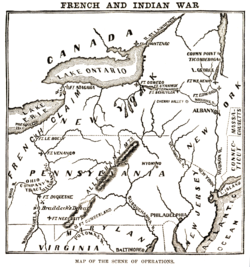
on the Hudson River, about 16 miles (25.7 km) south of Fort William Henry. The area between William Henry and Carillon was a wilderness dominated by Lake George that historian Ian Steele described as "a military waterway that left opposing cannons only a few days apart."
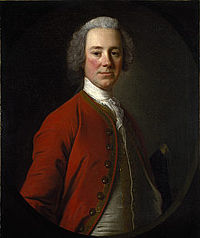 Loudoun's plan depended on the expedition's timely arrival at Quebec, so that French troops would not have the opportunity to move against targets on the frontier, and would instead be needed to defend the heartland of the province of Canada
along the Saint Lawrence River
. However, political turmoil in London over the progress of the Seven Years' War
both in North America and in Europe resulted in a change of power, with William Pitt the Elder rising to take control over military matters. Loudoun consequently did not receive any feedback from London on his proposed campaign until March 1757. Before this feedback arrived he developed plans for the expedition to Quebec, and worked with the provincial governors of the Thirteen Colonies
to develop plans for a coordinated defence of the frontier, including the allotment of militia quotas to each province.
When William Pitt's instructions finally reached Loudoun in March 1757, they called for the expedition to first target Louisbourg on the Atlantic coast of Île-Royale (now known as Cape Breton Island
). Although this did not materially affect the planning of the expedition, it was to have significant consequences on the frontier. The French forces on the Saint Lawrence would be too far from Louisbourg to support it, and would consequently be free to act elsewhere. Loudoun assigned his best troops to the Louisbourg expedition, and placed Brigadier General Daniel Webb in command of the New York frontier. He was given about 2,000 regulars
, primarily from the 35th and 60th (Royal American) Regiments. The provinces were to supply Webb with about 5,000 militia.
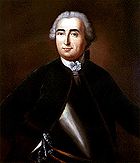 Following the success of his 1756 assault on Fort Oswego, Montcalm had been seeking an opportunity to deal with the British position at Fort William Henry, since it provided the British with a launching point for attacks against Fort Carillon. He was initially hesitant to commit his limited resources against Fort William Henry without knowing more about the disposition of British forces. Intelligence provided by spies in London arrived in the spring, indicating that the British target was probably Louisbourg. This suggested that troop levels on the British side of the frontier might be low enough to make an attack on Fort William Henry feasible. This idea was further supported after the French questioned deserters and captives taken during periodic scouting and raiding expeditions that both sides conducted, including one resulting in the January Battle on Snowshoes
.
As early as December 1756, New France's governor, the Marquis de Vaudreuil
, began the process of recruiting Indians for the following summer's campaign. Fueled by stories circulated by Indian participants in the capture of Oswego, this drive was highly successful, drawing nearly 1,000 warriors from the Pays d'en Haut (the more remote regions of New France) to Montreal by June 1757. Another 800 Indians were recruited from tribes that lived closer to the Saint Lawrence.
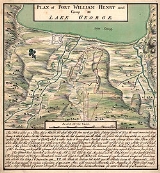
 Fort William Henry, built in the fall of 1755, was a roughly square fortification with bastion
s on the corners, in a design that was intended to repel Indian attacks but was not necessarily sufficient to withstand attack from an enemy that had artillery
. Its walls were 30 feet (9.1 m) thick, with log facings surrounding an earthen filling. Inside the fort were wooden barracks two stories high, built around the parade ground. Its magazine
was in the northeast bastion, and its hospital was located in the southeast bastion. The fort was surrounded on three sides by a dry moat
, with the fourth side sloping down to the lake. The only access to the fort was by a bridge across the moat. The fort was only capable of housing four to five hundred men; additional troops were quartered in an entrenched camp 750 yards (685.8 m) southeast of the fort, near the site of the 1755 Battle of Lake George
.
During the winter of 1756–57, Fort William Henry was garrisoned by several hundred men from the 44th Foot under Major Will Eyre. In March 1757 the French sent an army of 1,500 to attack the fort under the command of the governor's brother, Pierre de Rigaud. Composed primarily of colonial troupes de la marine
, militia, and Indians, and without heavy weapons, they besieged the fort for four days, destroying outbuildings and a large number of watercraft before retreating. Eyre and his men were replaced by Lieutenant Colonel George Monro and the 35th Foot in the spring. Monro established his headquarters in the entrenched camp, where most of his men were located.
, and those of La Sarre
, Guyenne
, Languedoc
, and la Reine
under François de Gaston, Chevalier de Lévis. Combined with the troupes de la marine, militia companies, and the arriving Indians, the force accumulated at Carillon amounted to 8,000 men.
While at Carillon, the French leadership had difficulty controlling the behaviour of its Indian allies. Although they did stop one group from forcing a British prisoner to run the gantlet
, a group of Ottawas were not stopped when it was observed that they were ritually cannibalizing another prisoner. French authorities were also frustrated in their ability to limit the Indians' taking of more than their allotted share of rations. Montcalm's aide, Louis Antoine de Bougainville
, observed that attempts to curb this activity would have resulted in the loss of some of these forces. In another prelude of things to come, a large number of prisoners were taken on 23 July in the Battle of Sabbath Day Point
, some of whom were also ritually cannibalized before Montcalm managed to convince the Indians to instead send the captives to Montreal to be sold as slaves.
on a work crew near Fort Edward on 23 July, Webb travelled to Fort William Henry with a party of Connecticut rangers led by Major Israel Putnam
, and sent a detachment of them onto the lake for reconnaissance. They returned with word that Indians were encamped on islands in the lake about 18 miles (29 km) from the fort. Swearing Putnam and his rangers to secrecy, Webb returned to Fort Edward, and on 2 August sent Lieutenant Colonel John Young with 200 regulars and 800 Massachusetts militia to reinforce the garrison at William Henry. This raised the size of the garrison to about 2,500, although several hundred of these were ill, some with smallpox
.
. He wrote to Monro on 4 August that he should negotiate the best terms possible; this communication was intercepted and delivered to Montcalm.
Montcalm, in the meantime, ordered Bourlamaque to begin siege operations. The French opened trenches to the northwest of the fort with the objective of bringing their artillery to bear against the fort's northwest bastion. On 5 August, French guns began firing on the fort from 2000 yards (1,828.8 m), a spectacle the large Indian contingent relished. The next day a second battery
opened fire from 900 feet (274.3 m) further along the same trench, creating a crossfire. The effect of the garrison's return fire was limited to driving French guards from the trenches, and some of the fort's guns were either dismounted or burst due to the stress of use. On 7 August, Montcalm sent Bougainville to the fort under a truce flag to deliver the intercepted dispatch. By then the fort's walls had been breached, many of its guns were useless, and the garrison had taken significant casualties. After another day of bombardment by the French, during which their trenches approached another 250 yards (228.6 m), Monro raised the white flag
to open negotiations.
s would be allowed to withdraw, under French escort, to Fort Edward, with the full honours of war, on condition that they refrain from fighting for 18 months. They were allowed to keep their musket
s and a single symbolic cannon
, but no ammunition. In addition, British authorities were to release French prisoners within three months.
Montcalm, before agreeing to these terms, tried to make sure that his Indian allies understood them, and that the chiefs would undertake to restrain their men. This process was complicated by the diversity within the Indian camp, which included some warriors who spoke languages not understood by any European present. The British garrison was then evacuated from the fort to the entrenched camp, and Monro was quartered in the French camp. The Indians then entered the fort and plundered it, butchering some of the wounded and sick that the British had left behind. The French guards posted around the entrenched camp were only somewhat successful at keeping the Indians out of that area, and it took significant effort to prevent plunder and scalping there. Montcalm and Monro initially planned to march the prisoners south the following morning, but after seeing the Indian bloodlust, decided to attempt the march that night. When the Indians became aware that the British were getting ready to move, a large number of them massed around the camp, causing the leaders to call off the march until morning.
The next morning, even before the British column began to form up for the march to Fort Edward, the Indians renewed attacks on the largely defenceless British. At 5 am, Indians entered huts in the fort housing wounded British who were supposed to be under the care of French doctors, and killed and scalped them. Monro complained that the terms of capitulation had been violated, but his contingent was forced to surrender some of its baggage in order to even be able to begin the march. As they marched off, they were harassed by the swarming Indians, who snatched at them, grabbing for weapons and clothing, and pulling away with force those that resisted their actions, including many of the women, children, servants and slaves. As the last of the men left the encampment, a war whoop sounded, and a contingent of Abenaki warriors seized a number of men at the rear of the column.
Although Montcalm and other French officers attempted to stop further attacks, others did not, and some explicitly refused to provide further protection to the British. At this point, the column dissolved, as some tried to escape the Indian onslaught, while others actively tried to defend themselves. Massachusetts Colonel Joseph Frye
reported that he was stripped of much of his clothing and repeatedly threatened. He fled into the woods, and did not reach Fort Edward until 12 August.
Estimates of the numbers killed, wounded, and taken captive during this time vary widely. Ian Steele has compiled estimates ranging from 200 to 1,500. His detailed reconstruction of the siege and its aftermath indicates that the final tally of British missing and dead ranges from 69 to 184, at most 7.5% of the 2,308 who surrendered.
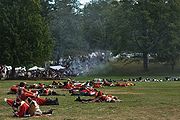
 On the afternoon after the massacre, most of the Indians left, heading back to their homes. Montcalm was able to secure the release of 500 captives they had taken, but they still took with them another 200. The French remained at the site for several days, destroying what remained of the British works before leaving on 18 August and returning to Fort Carillon. For unknown reasons, Montcalm decided not to follow up his victory with an attack on Fort Edward. Many reasons have been proposed justifying his decision, including the departure of many (but not all) of the Indians, a shortage of provisions, the lack of draft animals to assist in the portage to the Hudson, and the need for the Canadian militia to return home in time to participate in the harvest.
Word of the French movements had reached the influential British Indian agent William Johnson
on 1 August. Unlike Webb, he acted with haste, and arrived at Fort Edward on 6 August with 1,500 militia and 150 Indians. In a move that infuriated Johnson, Webb refused to allow him to advance toward Fort William Henry, apparently believing a French deserter's report that the French army was 11,000 men strong, and that any attempt at relief was futile given the available forces.
, about 300 people captured at Fort William Henry were returned to the colonies. The fleet continued on to Europe, where a few more former captives were released; some of these also eventually returned to the colonies.
. Colonel Monro died in November 1757, of apoplexy
that some historians have suggested was caused by anger over Webb's failure to support him.
Lord Loudoun, upset over the event, delayed implementing the release of French prisoners promised as part of the terms of surrender. General James Abercrombie, who succeeded Loudoun as commander-in-chief, was asked by paroled members of the 35th Foot to void the agreement so that they would be free to serve in 1758; this he did, and they went on to serve under Jeffery Amherst in his successful British expedition
against Louisbourg in 1758. Amherst, who also presided over the surrender of Montreal in 1760, refused the surrendering garrisons at Louisbourg and Montreal the normal honours of war, due in part to the French failure to uphold the terms of capitulation in this action.
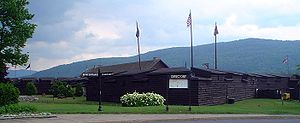
 The British (and later Americans) never rebuilt anything on the site of Fort William Henry, which lay in ruins for about 200 years. In the 1950s, excavation at the site eventually led to the reconstruction of Fort William Henry as a tourist destination for the town of Lake George
.
Many colonial accounts of the time focused on the plundering perpetrated by the Indians, and the fact that those who resisted them were killed, using words like "massacre" even though casualty numbers were uncertain. The later releases of captives did not receive the same level of press coverage. The events of the battle and subsequent killings were depicted in the 1826 novel The Last of the Mohicans
by James Fenimore Cooper
and in film adaptations of the book
. Cooper's description of the events contains numerous inaccuracies, but his work, and the sometimes lurid descriptions of the event by early historians like Benson Lossing and Francis Parkman
, led to the belief that many more people died than actually did. Lossing wrote that "fifteen hundred [people] were butchered or carried into hopeless captivity", when many more were captured than killed, and even many of those captured were eventually freed.
Historians disagree on where to assign responsibility for the Indian actions. Francis Jennings
contends that Montcalm anticipated what was going to happen, deliberately ignored it when it did happen, and only stepped in after the atrocities were well under way. In his opinion, the account by Bougainville, who left for Montreal on the night of 9 August and was not present at the massacre, was written as a whitewash
to protect Montcalm. Parkman is more vigorous in his defence of Montcalm, claiming that he and other French officers did what they could to prevent atrocities, but were powerless to stop the onslaught.
Ian Steele notes that two primary accounts dominate much of the historical record. The first is the record compiled by Montcalm, including the terms of surrender and his letters to Webb and Loudoun, which received wide publication in the colonies (both French and British) and in Europe. The second was the 1778 publication of a book by Jonathan Carver
, an explorer who served in the Massachusetts militia and was present at the siege. According to Steele, Carver originated, without any supporting analysis or justification, the idea that as many as 1,500 people had been "killed or made prisoner" in his widely popular work. Yale College
president Timothy Dwight
, in a history published posthumously in 1822, apparently coined the phrase "massacre at Fort William Henry", based on Carver's work; his book and Carver's were likely influences on Cooper, and tended to fault Montcalm for the Indian transgressions. Steele himself adopts a more nuanced view of the underlying cause of the massacre. Montcalm and the French leaders repeatedly promised the Indians opportunities for the glory and trophies of war, including plunder, scalping, and the taking of captives. In the aftermath of the Battle of Sabbath Day Point
, captives taken were ransomed, meaning the Indians had no visible trophies. The terms of surrender at Fort William Henry effectively denied the Indians any significant opportunities for plunder: the war provisions were claimed by the French army, and personal effects of the British were to stay with them, leaving nothing for the Indians. According to Steele, this bred resentment, as it appeared that the French were conspiring with their enemies (the British) against their friends (the Indians), leaving them without any promised war trophies.
and Hudson Bay
. Nester claims that some of the atrocities, which included the murder and scalping of sick individuals and the digging up of bodies for plunder and scalping, may have resulted in many Indians becoming infected with smallpox
, which they then carried into their communities. The devastation wrought by the disease in the following years had a notable effect on Indian participation in the French campaigns of the following years. The tribes that Nester lists are:
Kingdom of France
The Kingdom of France was one of the most powerful states to exist in Europe during the second millennium.It originated from the Western portion of the Frankish empire, and consolidated significant power and influence over the next thousand years. Louis XIV, also known as the Sun King, developed a...
General Louis-Joseph de Montcalm
Louis-Joseph de Montcalm
Louis-Joseph de Montcalm-Gozon, Marquis de Saint-Veran was a French soldier best known as the commander of the forces in North America during the Seven Years' War .Montcalm was born near Nîmes in France to a noble family, and entered military service...
against the British
Kingdom of Great Britain
The former Kingdom of Great Britain, sometimes described as the 'United Kingdom of Great Britain', That the Two Kingdoms of Scotland and England, shall upon the 1st May next ensuing the date hereof, and forever after, be United into One Kingdom by the Name of GREAT BRITAIN. was a sovereign...
-held Fort William Henry
Fort William Henry
Fort William Henry was a British fort at the southern end of Lake George in the province of New York. It is best known as the site of notorious atrocities committed by Indians against the surrendered British and provincial troops following a successful French siege in 1757, an event which is the...
. The fort, located at the southern end of Lake George
Lake George (New York)
Lake George, nicknamed the Queen of American Lakes, is a long, narrow oligotrophic lake draining northwards into Lake Champlain and the St. Lawrence River Drainage basin located at the southeast base of the Adirondack Mountains in northern New York, U.S.A.. It lies within the upper region of the...
, on the frontier between the British Province of New York
Province of New York
The Province of New York was an English and later British crown territory that originally included all of the present U.S. states of New York, New Jersey, Delaware and Vermont, along with inland portions of Connecticut, Massachusetts, and Maine, as well as eastern Pennsylvania...
and the French Province of Canada
Canada, New France
Canada was the name of the French colony that once stretched along the St. Lawrence River; the other colonies of New France were Acadia, Louisiana and Newfoundland. Canada, the most developed colony of New France, was divided into three districts, each with its own government: Quebec,...
, was garrisoned by a poorly supported force of British regulars and provincial militia led by Lieutenant Colonel George Monro. After several days of bombardment, Monro surrendered to Montcalm, whose force included nearly 2,000 Indians
Indigenous peoples of the Americas
The indigenous peoples of the Americas are the pre-Columbian inhabitants of North and South America, their descendants and other ethnic groups who are identified with those peoples. Indigenous peoples are known in Canada as Aboriginal peoples, and in the United States as Native Americans...
from a large number of tribes. The terms of surrender included the withdrawal of the garrison to Fort Edward
Fort Edward (village), New York
Fort Edward is a village in Washington County, New York, United States. It is part of the Glens Falls Metropolitan Statistical Area. The village population was 3,141 at the 2000 census...
, with specific terms that the French military protect the British from the Indians as they withdrew from the area.
In one of the most notorious incidents of the French and Indian War
French and Indian War
The French and Indian War is the common American name for the war between Great Britain and France in North America from 1754 to 1763. In 1756, the war erupted into the world-wide conflict known as the Seven Years' War and thus came to be regarded as the North American theater of that war...
, Montcalm's Indian allies violated the agreed terms of surrender and attacked the British column, which had been deprived of ammunition, as it left the fort. They killed and scalped a significant number of soldiers, took as captives women, children, servants, and slaves, and slaughtered sick and wounded prisoners. Early accounts of the events called it a massacre, and implied that as many as 1,500 people were killed, even though it is unlikely more than 200 people (less than 10% of the British fighting strength) were actually killed in the massacre.
The exact role of Montcalm and other French leaders in encouraging or defending against the actions of their allies, and the total number of casualties incurred as a result of their actions, is a subject of historical debate. The memory of the killings influenced the actions of British military leaders, especially those of British General Jeffery Amherst, for the remainder of the war.
Background
The French and Indian WarFrench and Indian War
The French and Indian War is the common American name for the war between Great Britain and France in North America from 1754 to 1763. In 1756, the war erupted into the world-wide conflict known as the Seven Years' War and thus came to be regarded as the North American theater of that war...
started in 1754 over territorial disputes between the North America
North America
North America is a continent wholly within the Northern Hemisphere and almost wholly within the Western Hemisphere. It is also considered a northern subcontinent of the Americas...
n colonies of France
France
The French Republic , The French Republic , The French Republic , (commonly known as France , is a unitary semi-presidential republic in Western Europe with several overseas territories and islands located on other continents and in the Indian, Pacific, and Atlantic oceans. Metropolitan France...
and Great Britain
Kingdom of Great Britain
The former Kingdom of Great Britain, sometimes described as the 'United Kingdom of Great Britain', That the Two Kingdoms of Scotland and England, shall upon the 1st May next ensuing the date hereof, and forever after, be United into One Kingdom by the Name of GREAT BRITAIN. was a sovereign...
in areas that are now western Pennsylvania
Pennsylvania
The Commonwealth of Pennsylvania is a U.S. state that is located in the Northeastern and Mid-Atlantic regions of the United States. The state borders Delaware and Maryland to the south, West Virginia to the southwest, Ohio to the west, New York and Ontario, Canada, to the north, and New Jersey to...
and upstate New York
New York
New York is a state in the Northeastern region of the United States. It is the nation's third most populous state. New York is bordered by New Jersey and Pennsylvania to the south, and by Connecticut, Massachusetts and Vermont to the east...
. The first few years of the war had not gone particularly well for the British. A major expedition
Braddock expedition
The Braddock expedition, also called Braddock's campaign or, more commonly, Braddock's Defeat, was a failed British military expedition which attempted to capture the French Fort Duquesne in the summer of 1755 during the French and Indian War. It was defeated at the Battle of the Monongahela on...
by General Edward Braddock
Edward Braddock
General Edward Braddock was a British soldier and commander-in-chief for the 13 colonies during the actions at the start of the French and Indian War...
in 1755 ended in disaster
Battle of the Monongahela
The Battle of the Monongahela, also known as the Battle of the Wilderness, took place on 9 July 1755, at the beginning of the French and Indian War, at Braddock's Field in what is now Braddock, Pennsylvania, east of Pittsburgh...
, and British military leaders were unable to mount any campaigns the following year. In a major setback, a French and Indian army led by General Louis-Joseph de Montcalm
Louis-Joseph de Montcalm
Louis-Joseph de Montcalm-Gozon, Marquis de Saint-Veran was a French soldier best known as the commander of the forces in North America during the Seven Years' War .Montcalm was born near Nîmes in France to a noble family, and entered military service...
captured the garrison and destroyed fortifications in the Battle of Fort Oswego in August 1756. In July 1756 the Earl of Loudoun
John Campbell, 4th Earl of Loudoun
Major-General John Campbell, 4th Earl of Loudoun was a British nobleman and army officer.-Early career:Campbell inherited the peerage on the death of his father in 1731, becoming Lord Loudoun. The earl raised a regiment of infantry that took part in the Jacobite Rising of 1745 on the side of the...
arrived to take command of the British forces in North America
North America
North America is a continent wholly within the Northern Hemisphere and almost wholly within the Western Hemisphere. It is also considered a northern subcontinent of the Americas...
, replacing William Shirley
William Shirley
William Shirley was a British colonial administrator who served twice as Governor of the Province of Massachusetts Bay and as Governor of the Bahamas in the 1760s...
, who had temporarily assumed command after Braddock's death.
British planning
Loudoun's plan for the 1757 campaign was submitted to the government in LondonLondon
London is the capital city of :England and the :United Kingdom, the largest metropolitan area in the United Kingdom, and the largest urban zone in the European Union by most measures. Located on the River Thames, London has been a major settlement for two millennia, its history going back to its...
in September 1756, and was focused on a single expedition aimed at the heart of New France
New France
New France was the area colonized by France in North America during a period beginning with the exploration of the Saint Lawrence River by Jacques Cartier in 1534 and ending with the cession of New France to Spain and Great Britain in 1763...
, the city of Quebec
Quebec City
Quebec , also Québec, Quebec City or Québec City is the capital of the Canadian province of Quebec and is located within the Capitale-Nationale region. It is the second most populous city in Quebec after Montreal, which is about to the southwest...
. It called for a purely defensive postures along the frontier with New France, including the contested corridor of the Hudson River
Hudson River
The Hudson is a river that flows from north to south through eastern New York. The highest official source is at Lake Tear of the Clouds, on the slopes of Mount Marcy in the Adirondack Mountains. The river itself officially begins in Henderson Lake in Newcomb, New York...
and Lake Champlain
Lake Champlain
Lake Champlain is a natural, freshwater lake in North America, located mainly within the borders of the United States but partially situated across the Canada—United States border in the Canadian province of Quebec.The New York portion of the Champlain Valley includes the eastern portions of...
between Albany, New York
Albany, New York
Albany is the capital city of the U.S. state of New York, the seat of Albany County, and the central city of New York's Capital District. Roughly north of New York City, Albany sits on the west bank of the Hudson River, about south of its confluence with the Mohawk River...
and Montreal
Montreal
Montreal is a city in Canada. It is the largest city in the province of Quebec, the second-largest city in Canada and the seventh largest in North America...
. Following the Battle of Lake George
Battle of Lake George
The Battle of Lake George was fought on 8 September 1755, in the north of the Province of New York. The battle was part of a campaign by the British to expel the French from North America in the French and Indian War....
in 1755, the French had begun construction of Fort Carillon (now known as Fort Ticonderoga
Fort Ticonderoga
Fort Ticonderoga, formerly Fort Carillon, is a large 18th-century fort built by the Canadians and the French at a narrows near the south end of Lake Champlain in upstate New York in the United States...
) near the southern end of Lake Champlain, while the British had built Fort William Henry
Fort William Henry
Fort William Henry was a British fort at the southern end of Lake George in the province of New York. It is best known as the site of notorious atrocities committed by Indians against the surrendered British and provincial troops following a successful French siege in 1757, an event which is the...
at the southern end of Lake George
Lake George (New York)
Lake George, nicknamed the Queen of American Lakes, is a long, narrow oligotrophic lake draining northwards into Lake Champlain and the St. Lawrence River Drainage basin located at the southeast base of the Adirondack Mountains in northern New York, U.S.A.. It lies within the upper region of the...
, and Fort Edward
Fort Edward (village), New York
Fort Edward is a village in Washington County, New York, United States. It is part of the Glens Falls Metropolitan Statistical Area. The village population was 3,141 at the 2000 census...
on the Hudson River, about 16 miles (25.7 km) south of Fort William Henry. The area between William Henry and Carillon was a wilderness dominated by Lake George that historian Ian Steele described as "a military waterway that left opposing cannons only a few days apart."
Canada, New France
Canada was the name of the French colony that once stretched along the St. Lawrence River; the other colonies of New France were Acadia, Louisiana and Newfoundland. Canada, the most developed colony of New France, was divided into three districts, each with its own government: Quebec,...
along the Saint Lawrence River
Saint Lawrence River
The Saint Lawrence is a large river flowing approximately from southwest to northeast in the middle latitudes of North America, connecting the Great Lakes with the Atlantic Ocean. It is the primary drainage conveyor of the Great Lakes Basin...
. However, political turmoil in London over the progress of the Seven Years' War
Seven Years' War
The Seven Years' War was a global military war between 1756 and 1763, involving most of the great powers of the time and affecting Europe, North America, Central America, the West African coast, India, and the Philippines...
both in North America and in Europe resulted in a change of power, with William Pitt the Elder rising to take control over military matters. Loudoun consequently did not receive any feedback from London on his proposed campaign until March 1757. Before this feedback arrived he developed plans for the expedition to Quebec, and worked with the provincial governors of the Thirteen Colonies
Thirteen Colonies
The Thirteen Colonies were English and later British colonies established on the Atlantic coast of North America between 1607 and 1733. They declared their independence in the American Revolution and formed the United States of America...
to develop plans for a coordinated defence of the frontier, including the allotment of militia quotas to each province.
When William Pitt's instructions finally reached Loudoun in March 1757, they called for the expedition to first target Louisbourg on the Atlantic coast of Île-Royale (now known as Cape Breton Island
Cape Breton Island
Cape Breton Island is an island on the Atlantic coast of North America. It likely corresponds to the word Breton, the French demonym for Brittany....
). Although this did not materially affect the planning of the expedition, it was to have significant consequences on the frontier. The French forces on the Saint Lawrence would be too far from Louisbourg to support it, and would consequently be free to act elsewhere. Loudoun assigned his best troops to the Louisbourg expedition, and placed Brigadier General Daniel Webb in command of the New York frontier. He was given about 2,000 regulars
Regular army
A regular army consists of the permanent force of a country's army that is maintained under arms during peacetime.Countries that use the term include:*Australian Army*British Army*Canadian Forces, specifically "Regular Force"*Egyptian army*Indian Army...
, primarily from the 35th and 60th (Royal American) Regiments. The provinces were to supply Webb with about 5,000 militia.
French planning
Battle on Snowshoes (1757)
The 1757 Battle on Snowshoes was a skirmish fought between Rogers' Rangers and French and Indian troops during the French and Indian War on January 21, 1757...
.
As early as December 1756, New France's governor, the Marquis de Vaudreuil
Pierre François de Rigaud, Marquis de Vaudreuil-Cavagnal
Pierre François de Rigaud, Marquis de Vaudreuil-Cavagnal was a Canadian-born French colonial governor in North America...
, began the process of recruiting Indians for the following summer's campaign. Fueled by stories circulated by Indian participants in the capture of Oswego, this drive was highly successful, drawing nearly 1,000 warriors from the Pays d'en Haut (the more remote regions of New France) to Montreal by June 1757. Another 800 Indians were recruited from tribes that lived closer to the Saint Lawrence.
British preparations
Bastion
A bastion, or a bulwark, is a structure projecting outward from the main enclosure of a fortification, situated in both corners of a straight wall , facilitating active defence against assaulting troops...
s on the corners, in a design that was intended to repel Indian attacks but was not necessarily sufficient to withstand attack from an enemy that had artillery
Artillery
Originally applied to any group of infantry primarily armed with projectile weapons, artillery has over time become limited in meaning to refer only to those engines of war that operate by projection of munitions far beyond the range of effect of personal weapons...
. Its walls were 30 feet (9.1 m) thick, with log facings surrounding an earthen filling. Inside the fort were wooden barracks two stories high, built around the parade ground. Its magazine
Magazine (artillery)
Magazine is the name for an item or place within which ammunition is stored. It is taken from the Arabic word "makahazin" meaning "warehouse".-Ammunition storage areas:...
was in the northeast bastion, and its hospital was located in the southeast bastion. The fort was surrounded on three sides by a dry moat
Moat
A moat is a deep, broad ditch, either dry or filled with water, that surrounds a castle, other building or town, historically to provide it with a preliminary line of defence. In some places moats evolved into more extensive water defences, including natural or artificial lakes, dams and sluices...
, with the fourth side sloping down to the lake. The only access to the fort was by a bridge across the moat. The fort was only capable of housing four to five hundred men; additional troops were quartered in an entrenched camp 750 yards (685.8 m) southeast of the fort, near the site of the 1755 Battle of Lake George
Battle of Lake George
The Battle of Lake George was fought on 8 September 1755, in the north of the Province of New York. The battle was part of a campaign by the British to expel the French from North America in the French and Indian War....
.
During the winter of 1756–57, Fort William Henry was garrisoned by several hundred men from the 44th Foot under Major Will Eyre. In March 1757 the French sent an army of 1,500 to attack the fort under the command of the governor's brother, Pierre de Rigaud. Composed primarily of colonial troupes de la marine
Troupes de la marine
See also Troupes de Marine for later history of same Corps.The Troupes de la Marine , also known as independent companies of the navy and colonial regulars, were under the authority of the French Minister of Marine, who was also responsible for the French navy, overseas trade, and French...
, militia, and Indians, and without heavy weapons, they besieged the fort for four days, destroying outbuildings and a large number of watercraft before retreating. Eyre and his men were replaced by Lieutenant Colonel George Monro and the 35th Foot in the spring. Monro established his headquarters in the entrenched camp, where most of his men were located.
French preparations
The Indians that assembled at Montreal were sent south to Fort Carillon, where they joined the French regiments of Béarn and Royal Roussillon under François-Charles de BourlamaqueFrançois-Charles de Bourlamaque
François-Charles de Bourlamaque was a French military leader and Governor of Guadeloupe from 1763. He began as military engineer, major-captain, infantry colonel, infantry commandant, commandant, general brigadier, major-general, commander of Saint-Louis, honorary order of Malta, and Governor of...
, and those of La Sarre
Régiment La Sarre
The Régiment La Sarre was a French Army regiment active in the 18th century. It is principally known for its role in the Seven Years' War, when it served in the North American theatre.-History:...
, Guyenne
Régiment de Guyenne
The Régiment de Guyenne was a French Army infantry regiment in the 18th century. It is principally known for its role in the Seven Years' War, when it served in the North American theatre.-History:...
, Languedoc
Régiment de Languedoc
The Régiment de Languedoc was a French Army regiment active in the 18th century. It is principally known for its role in the Seven Years' War, when it served in the North American theatre.-History:...
, and la Reine
Régiment de la Reine
The Régiment de la Reine was a French Army regiment active in the 18th century. It is principally known for its role in the Seven Years' War, when it served in the North American theatre.-History:...
under François de Gaston, Chevalier de Lévis. Combined with the troupes de la marine, militia companies, and the arriving Indians, the force accumulated at Carillon amounted to 8,000 men.
While at Carillon, the French leadership had difficulty controlling the behaviour of its Indian allies. Although they did stop one group from forcing a British prisoner to run the gantlet
Running the gauntlet
Running the gauntlet is a form of physical punishment wherein a captive is compelled to run between two rows—a gauntlet—of soldiers who strike him as he passes.-Etymology:...
, a group of Ottawas were not stopped when it was observed that they were ritually cannibalizing another prisoner. French authorities were also frustrated in their ability to limit the Indians' taking of more than their allotted share of rations. Montcalm's aide, Louis Antoine de Bougainville
Louis Antoine de Bougainville
Louis-Antoine, Comte de Bougainville was a French admiral and explorer. A contemporary of James Cook, he took part in the French and Indian War and the unsuccessful French attempt to defend Canada from Britain...
, observed that attempts to curb this activity would have resulted in the loss of some of these forces. In another prelude of things to come, a large number of prisoners were taken on 23 July in the Battle of Sabbath Day Point
Battle of Sabbath Day Point
The Battle of Sabbath Day Point took place on 23 July 1757 just off the shore of Sabbath Day Point, Lake George, NY and ended in a French victory...
, some of whom were also ritually cannibalized before Montcalm managed to convince the Indians to instead send the captives to Montreal to be sold as slaves.
Prelude
Webb, who commanded the area from his base at Fort Edward, received intelligence in April that the French were accumulating resources and troops at Carillon. News of continued French activity arrived with a captive taken in mid-July. Following an attack by Joseph Marin de la MalgueJoseph Marin de la Malgue
Joseph Marin de la Malgue, was the son of Charles-Paul Marin de la Malgue and continued on in the family military and exploration tradition, entering the colonial regular troops at the age of 13. He spent the next 13 years in the Michigan and Wisconsin areas including the Michilimackinac area, ...
on a work crew near Fort Edward on 23 July, Webb travelled to Fort William Henry with a party of Connecticut rangers led by Major Israel Putnam
Israel Putnam
Israel Putnam was an American army general and Freemason who fought with distinction at the Battle of Bunker Hill during the American Revolutionary War...
, and sent a detachment of them onto the lake for reconnaissance. They returned with word that Indians were encamped on islands in the lake about 18 miles (29 km) from the fort. Swearing Putnam and his rangers to secrecy, Webb returned to Fort Edward, and on 2 August sent Lieutenant Colonel John Young with 200 regulars and 800 Massachusetts militia to reinforce the garrison at William Henry. This raised the size of the garrison to about 2,500, although several hundred of these were ill, some with smallpox
Smallpox
Smallpox was an infectious disease unique to humans, caused by either of two virus variants, Variola major and Variola minor. The disease is also known by the Latin names Variola or Variola vera, which is a derivative of the Latin varius, meaning "spotted", or varus, meaning "pimple"...
.
Siege
While Montcalm's Indian allies had already begun to move south, his advance force of French troops departed from Carillon on 30 July under Lévis' command, travelling overland along Lake George's western shore because the expedition did not have enough boats to carry the entire force. Montcalm and the remaining forces sailed the next day, and met with Lévis for the night at Ganaouske Bay. The next night, Lévis camped just 3 miles (4.8 km) from Fort William Henry, with Montcalm not far behind. Early on the morning of 3 August, Lévis and the Canadians blocked the road between Edward and William Henry, skirmishing with the recently arrived Massachusetts militia. Montcalm summoned Monro to surrender at 11:00 am. Monro refused, and sent messengers south to Fort Edward, indicating the dire nature of the situation and requesting reinforcements. Webb, feeling threatened by Lévis, refused to send any of his estimated 1,600 men north, since they were all that stood between the French and AlbanyAlbany, New York
Albany is the capital city of the U.S. state of New York, the seat of Albany County, and the central city of New York's Capital District. Roughly north of New York City, Albany sits on the west bank of the Hudson River, about south of its confluence with the Mohawk River...
. He wrote to Monro on 4 August that he should negotiate the best terms possible; this communication was intercepted and delivered to Montcalm.
Montcalm, in the meantime, ordered Bourlamaque to begin siege operations. The French opened trenches to the northwest of the fort with the objective of bringing their artillery to bear against the fort's northwest bastion. On 5 August, French guns began firing on the fort from 2000 yards (1,828.8 m), a spectacle the large Indian contingent relished. The next day a second battery
Artillery battery
In military organizations, an artillery battery is a unit of guns, mortars, rockets or missiles so grouped in order to facilitate better battlefield communication and command and control, as well as to provide dispersion for its constituent gunnery crews and their systems...
opened fire from 900 feet (274.3 m) further along the same trench, creating a crossfire. The effect of the garrison's return fire was limited to driving French guards from the trenches, and some of the fort's guns were either dismounted or burst due to the stress of use. On 7 August, Montcalm sent Bougainville to the fort under a truce flag to deliver the intercepted dispatch. By then the fort's walls had been breached, many of its guns were useless, and the garrison had taken significant casualties. After another day of bombardment by the French, during which their trenches approached another 250 yards (228.6 m), Monro raised the white flag
White flag
White flags have had different meanings throughout history and depending on the locale.-Flag of temporary truce in order to parley :...
to open negotiations.
Massacre
The terms of surrender were that the British and their camp followerCamp follower
Camp-follower is a term used to identify civilians and their children who follow armies. There are two common types of camp followers; first, the wives and children of soldiers, who follow their spouse or parent's army from place to place; the second type of camp followers have historically been...
s would be allowed to withdraw, under French escort, to Fort Edward, with the full honours of war, on condition that they refrain from fighting for 18 months. They were allowed to keep their musket
Musket
A musket is a muzzle-loaded, smooth bore long gun, fired from the shoulder. Muskets were designed for use by infantry. A soldier armed with a musket had the designation musketman or musketeer....
s and a single symbolic cannon
Cannon
A cannon is any piece of artillery that uses gunpowder or other usually explosive-based propellents to launch a projectile. Cannon vary in caliber, range, mobility, rate of fire, angle of fire, and firepower; different forms of cannon combine and balance these attributes in varying degrees,...
, but no ammunition. In addition, British authorities were to release French prisoners within three months.
Montcalm, before agreeing to these terms, tried to make sure that his Indian allies understood them, and that the chiefs would undertake to restrain their men. This process was complicated by the diversity within the Indian camp, which included some warriors who spoke languages not understood by any European present. The British garrison was then evacuated from the fort to the entrenched camp, and Monro was quartered in the French camp. The Indians then entered the fort and plundered it, butchering some of the wounded and sick that the British had left behind. The French guards posted around the entrenched camp were only somewhat successful at keeping the Indians out of that area, and it took significant effort to prevent plunder and scalping there. Montcalm and Monro initially planned to march the prisoners south the following morning, but after seeing the Indian bloodlust, decided to attempt the march that night. When the Indians became aware that the British were getting ready to move, a large number of them massed around the camp, causing the leaders to call off the march until morning.
The next morning, even before the British column began to form up for the march to Fort Edward, the Indians renewed attacks on the largely defenceless British. At 5 am, Indians entered huts in the fort housing wounded British who were supposed to be under the care of French doctors, and killed and scalped them. Monro complained that the terms of capitulation had been violated, but his contingent was forced to surrender some of its baggage in order to even be able to begin the march. As they marched off, they were harassed by the swarming Indians, who snatched at them, grabbing for weapons and clothing, and pulling away with force those that resisted their actions, including many of the women, children, servants and slaves. As the last of the men left the encampment, a war whoop sounded, and a contingent of Abenaki warriors seized a number of men at the rear of the column.
Although Montcalm and other French officers attempted to stop further attacks, others did not, and some explicitly refused to provide further protection to the British. At this point, the column dissolved, as some tried to escape the Indian onslaught, while others actively tried to defend themselves. Massachusetts Colonel Joseph Frye
Joseph Frye
Joseph Frye was a renowned military leader from colonial Maine.Born in Andover, Massachusetts, he obtained the rank of general in the Massachusetts militia after serving in King George's War and the French and Indian War...
reported that he was stripped of much of his clothing and repeatedly threatened. He fled into the woods, and did not reach Fort Edward until 12 August.
Estimates of the numbers killed, wounded, and taken captive during this time vary widely. Ian Steele has compiled estimates ranging from 200 to 1,500. His detailed reconstruction of the siege and its aftermath indicates that the final tally of British missing and dead ranges from 69 to 184, at most 7.5% of the 2,308 who surrendered.
Aftermath
Word of the French movements had reached the influential British Indian agent William Johnson
Sir William Johnson, 1st Baronet
Sir William Johnson, 1st Baronet was an Anglo-Irish official of the British Empire. As a young man, Johnson came to the Province of New York to manage an estate purchased by his uncle, Admiral Peter Warren, which was located amidst the Mohawk, one of the Six Nations of the Iroquois League...
on 1 August. Unlike Webb, he acted with haste, and arrived at Fort Edward on 6 August with 1,500 militia and 150 Indians. In a move that infuriated Johnson, Webb refused to allow him to advance toward Fort William Henry, apparently believing a French deserter's report that the French army was 11,000 men strong, and that any attempt at relief was futile given the available forces.
Return of captives
On 14 August, Montcalm wrote letters to Loudoun and Webb, apologising for the behaviour of the Indians, but also attempting to justify it. Many captives that were taken to Montreal by the Indians were also eventually repatriated through prisoner exchanges negotiated by Governor Vaudreuil. On 27 September a small British fleet left Quebec, carrying paroled or exchanged prisoners taken in a variety of actions including those at Fort William Henry and Oswego. When the fleet arrived at HalifaxCity of Halifax
Halifax is a city in Canada, which was the capital of the province of Nova Scotia and shire town of Halifax County. It was the largest city in Atlantic Canada until it was amalgamated into Halifax Regional Municipality in 1996...
, about 300 people captured at Fort William Henry were returned to the colonies. The fleet continued on to Europe, where a few more former captives were released; some of these also eventually returned to the colonies.
Consequences
General Webb was recalled because of his actions; William Johnson wrote that Webb was "the only Englishman [I] ever knew who was a coward." Lord Loudoun was also recalled, although this occurred primarily because of the failure of the Louisbourg expeditionLouisbourg Expedition (1757)
The Louisbourg Expedition was a failed British attempt to capture the French fortress of Louisbourg on Île Royale during the Seven Years' War ....
. Colonel Monro died in November 1757, of apoplexy
Apoplexy
Apoplexy is a medical term, which can be used to describe 'bleeding' in a stroke . Without further specification, it is rather outdated in use. Today it is used only for specific conditions, such as pituitary apoplexy and ovarian apoplexy. In common speech, it is used non-medically to mean a state...
that some historians have suggested was caused by anger over Webb's failure to support him.
Lord Loudoun, upset over the event, delayed implementing the release of French prisoners promised as part of the terms of surrender. General James Abercrombie, who succeeded Loudoun as commander-in-chief, was asked by paroled members of the 35th Foot to void the agreement so that they would be free to serve in 1758; this he did, and they went on to serve under Jeffery Amherst in his successful British expedition
Siege of Louisbourg (1758)
The Siege of Louisbourg was a pivotal battle of the Seven Years' War in 1758 which ended the French colonial era in Atlantic Canada and led directly to the loss of Quebec in 1759 and the remainder of French North America the following year.-Background:The British government realized that with the...
against Louisbourg in 1758. Amherst, who also presided over the surrender of Montreal in 1760, refused the surrendering garrisons at Louisbourg and Montreal the normal honours of war, due in part to the French failure to uphold the terms of capitulation in this action.
Legacy
Lake George (village), New York
The Village of Lake George is a village within the town of Lake George in Warren County, New York, United States. The population was 985 at the 2000 census. It is part of the Glens Falls Metropolitan Statistical Area...
.
Many colonial accounts of the time focused on the plundering perpetrated by the Indians, and the fact that those who resisted them were killed, using words like "massacre" even though casualty numbers were uncertain. The later releases of captives did not receive the same level of press coverage. The events of the battle and subsequent killings were depicted in the 1826 novel The Last of the Mohicans
The Last of the Mohicans
The Last of the Mohicans: A Narrative of 1757 is a historical novel by James Fenimore Cooper, first published in February 1826. It is the second book of the Leatherstocking Tales pentalogy and the best known...
by James Fenimore Cooper
James Fenimore Cooper
James Fenimore Cooper was a prolific and popular American writer of the early 19th century. He is best remembered as a novelist who wrote numerous sea-stories and the historical novels known as the Leatherstocking Tales, featuring frontiersman Natty Bumppo...
and in film adaptations of the book
The Last of the Mohicans (disambiguation)
The Last of the Mohicans is an adventure novel by James Fenimore Cooper. It may also refer to:Adaptations of the novel:*The Last of the Mohicans *The Last of the Mohicans...
. Cooper's description of the events contains numerous inaccuracies, but his work, and the sometimes lurid descriptions of the event by early historians like Benson Lossing and Francis Parkman
Francis Parkman
Francis Parkman was an American historian, best known as author of The Oregon Trail: Sketches of Prairie and Rocky-Mountain Life and his monumental seven-volume France and England in North America. These works are still valued as history and especially as literature, although the biases of his...
, led to the belief that many more people died than actually did. Lossing wrote that "fifteen hundred [people] were butchered or carried into hopeless captivity", when many more were captured than killed, and even many of those captured were eventually freed.
Historians disagree on where to assign responsibility for the Indian actions. Francis Jennings
Francis Jennings
Francis Jennings was an American historian, best known for his works on the colonial history of the United States.Jennings taught at Cedar Crest College....
contends that Montcalm anticipated what was going to happen, deliberately ignored it when it did happen, and only stepped in after the atrocities were well under way. In his opinion, the account by Bougainville, who left for Montreal on the night of 9 August and was not present at the massacre, was written as a whitewash
Whitewash (censorship)
To whitewash is a metaphor meaning to gloss over or cover up vices, crimes or scandals or to exonerate by means of a perfunctory investigation or through biased presentation of data. It is especially used in the context of corporations, governments or other organizations.- Etymology :Its first...
to protect Montcalm. Parkman is more vigorous in his defence of Montcalm, claiming that he and other French officers did what they could to prevent atrocities, but were powerless to stop the onslaught.
Ian Steele notes that two primary accounts dominate much of the historical record. The first is the record compiled by Montcalm, including the terms of surrender and his letters to Webb and Loudoun, which received wide publication in the colonies (both French and British) and in Europe. The second was the 1778 publication of a book by Jonathan Carver
Jonathan Carver
Jonathan Carver was an American explorer and writer. He was born in Weymouth, Massachusetts and then moved with his family to Canterbury, Connecticut. He later married Abigail Robbins and became a shoemaker. He is believed to have had seven children.In 1755 Carver joined the colonial militia at...
, an explorer who served in the Massachusetts militia and was present at the siege. According to Steele, Carver originated, without any supporting analysis or justification, the idea that as many as 1,500 people had been "killed or made prisoner" in his widely popular work. Yale College
Yale College
Yale College was the official name of Yale University from 1718 to 1887. The name now refers to the undergraduate part of the university. Each undergraduate student is assigned to one of 12 residential colleges.-Residential colleges:...
president Timothy Dwight
Timothy Dwight IV
Timothy Dwight was an American academic and educator, a Congregationalist minister, theologian, and author...
, in a history published posthumously in 1822, apparently coined the phrase "massacre at Fort William Henry", based on Carver's work; his book and Carver's were likely influences on Cooper, and tended to fault Montcalm for the Indian transgressions. Steele himself adopts a more nuanced view of the underlying cause of the massacre. Montcalm and the French leaders repeatedly promised the Indians opportunities for the glory and trophies of war, including plunder, scalping, and the taking of captives. In the aftermath of the Battle of Sabbath Day Point
Battle of Sabbath Day Point
The Battle of Sabbath Day Point took place on 23 July 1757 just off the shore of Sabbath Day Point, Lake George, NY and ended in a French victory...
, captives taken were ransomed, meaning the Indians had no visible trophies. The terms of surrender at Fort William Henry effectively denied the Indians any significant opportunities for plunder: the war provisions were claimed by the French army, and personal effects of the British were to stay with them, leaving nothing for the Indians. According to Steele, this bred resentment, as it appeared that the French were conspiring with their enemies (the British) against their friends (the Indians), leaving them without any promised war trophies.
Participating Indian nations
According to historian William Nester, a large number of tribal nations were present during the siege. Some were only represented by a few individual warriors. Some individuals were estimated to travel 1500 miles (2,414 km) to join the French, coming from as far away as the Mississippi RiverMississippi River
The Mississippi River is the largest river system in North America. Flowing entirely in the United States, this river rises in western Minnesota and meanders slowly southwards for to the Mississippi River Delta at the Gulf of Mexico. With its many tributaries, the Mississippi's watershed drains...
and Hudson Bay
Hudson Bay
Hudson Bay , sometimes called Hudson's Bay, is a large body of saltwater in northeastern Canada. It drains a very large area, about , that includes parts of Ontario, Quebec, Saskatchewan, Alberta, most of Manitoba, southeastern Nunavut, as well as parts of North Dakota, South Dakota, Minnesota,...
. Nester claims that some of the atrocities, which included the murder and scalping of sick individuals and the digging up of bodies for plunder and scalping, may have resulted in many Indians becoming infected with smallpox
Smallpox
Smallpox was an infectious disease unique to humans, caused by either of two virus variants, Variola major and Variola minor. The disease is also known by the Latin names Variola or Variola vera, which is a derivative of the Latin varius, meaning "spotted", or varus, meaning "pimple"...
, which they then carried into their communities. The devastation wrought by the disease in the following years had a notable effect on Indian participation in the French campaigns of the following years. The tribes that Nester lists are:
- Abenaki
- Algonquin
- Fox
- Huron
- IowaIowa tribeThe Iowa , also known as the Báxoje, are a Native American Siouan people. Today they are enrolled in either of two federally recognized tribes, the Iowa Tribe of Oklahoma and the Ioway Tribe of Kansas and Nebraska....
- "Canadian" IroquoisIroquoisThe Iroquois , also known as the Haudenosaunee or the "People of the Longhouse", are an association of several tribes of indigenous people of North America...
- Menominee
- MiamiMiami tribeThe Miami are a Native American nation originally found in what is now Indiana, southwest Michigan, and western Ohio. The Miami Tribe of Oklahoma is the only federally recognized tribe of Miami Indians in the United States...
- Mi'kmaq
- MississaugaMississaugasThe Mississaugas are a subtribe of the Anishinaabe-speaking First Nations people located in southern Ontario, Canada. They are closely related to the Ojibwa...
- NipissingNipissing First NationThe Nipissing First Nation consists of first nation people of Ojibwa and Algonquin descent who have lived in the area of Lake Nipissing in the Canadian province of Ontario for about 9,400 years. Though in history known by many names, they are generally considered part of the Anishinaabe peoples,...
- Ojibwe
- OnondagaOnondaga (tribe)The Onondaga are one of the original five constituent nations of the Iroquois Confederacy. Their traditional homeland is in and around Onondaga County, New York...
- OttawaOttawa (tribe)The Odawa or Ottawa, said to mean "traders," are a Native American and First Nations people. They are one of the Anishinaabeg, related to but distinct from the Ojibwe nation. Their original homelands are located on Manitoulin Island, near the northern shores of Lake Huron, on the Bruce Peninsula in...
- PotawatomiPotawatomiThe Potawatomi are a Native American people of the upper Mississippi River region. They traditionally speak the Potawatomi language, a member of the Algonquian family. In the Potawatomi language, they generally call themselves Bodéwadmi, a name that means "keepers of the fire" and that was applied...
- SacSac (tribe)The Sacs or Sauks are a group of Native Americans of the Eastern Woodlands culture group. Their autonym is The Sacs or Sauks are a group of Native Americans of the Eastern Woodlands culture group. Their autonym is The Sacs or Sauks are a group of Native Americans of the Eastern Woodlands culture...
- Tetes-de-Boules
- Winnebago