

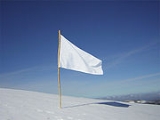
White flag

Encyclopedia
White flags have had different meanings throughout history and depending on the locale.
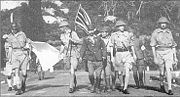 The white flag is an internationally recognized protective sign
of truce or ceasefire
, and request for negotiation. It is also used to symbolize surrender
, since it is often the weaker military party which requests negotiation. A white flag signifies to all that an approaching negotiator is unarmed, with an intent to surrender or a desire to communicate. Persons carrying or waving a white flag are not to be fired upon, nor are they allowed to open fire. The use of the flag to surrender is included in the Hague Convention
.
The improper use of a white flag is forbidden by the rules of war and constitutes a war crime
of perfidy
. There have been numerous reported cases of such behaviour in conflicts, such as fighters using white flags as a ruse to approach and attack enemies, or killings of fighters attempting to surrender by carrying white flags.
Many times since the weaker party is in a decrepit state, a white flag would be fashioned out of anything readily available, like a t-shirt or handkerchief
. The most common way of making a white flag is to obtain a pole and tie two corners of a sheet of cloth to the top of the pole and somewhere in the middle.
, the historian Cornelius Tacitus mentions a white flag of surrender in A.D. 109. Before that time, Roman armies would surrender by holding their shields above their heads. The white flag was widely used in the Middle Ages in Western Europe to indicate an intent to surrender. The color white was used generally to indicate a person was exempt from combat; heralds bore white wands, prisoners or hostages captured in battle would attach a piece of white paper to their hat or helmet, and garrisons that had surrendered and been promised safe passage to safety would carry white batons.
Its use may have expanded across continents, e.g. Portuguese chronicler Gaspar Correia
(writing in the 1550s), claims that in 1502, the Indian prince, the Zamorin of Calicut, dispatched negotiators bearing a "white cloth tied to a stick", "as a sign of peace", to his enemy Vasco da Gama
. In 1625, Hugo Grotius
in De jure belli ac pacis
(On the Law of War and Peace), one of the foundational texts in international law, recognized the white flag as a "sign, to which use has given a signification;" it was "a tacit sign of demanding a parley, and shall be as obligatory, as if expressed by words."
dynasty (661–750) used white as their symbolic color as a reminder of Muhammad
's first battle at Badr
, and to distinguish themselves from the Abbasid
s, by using white, rather than black, as their color of mourning. White is one of the pan-Arab colors
because of that period.
of France
became a plain white flag as a symbol of purity, sometimes covered in fleur-de-lis
when in the presence of the king or bearing the ensigns of the Order of the Holy Spirit
.
The white color was also used as a symbol of military command, by the commanding officer of a French army. It would be featured on a white scarf attached to the regimental flag as to recognise French units from foreign ones and avoid friendly fire incidents. The French troops fighting in the American War of Independence fought under the white flag.
The French Navy used a plain white ensign
for ships of the line
. Smaller ships might have used other standards, such as a fleur-de-lys on white field. Commerce and private ships were authorised to use their own designs to represent France, but were forbidden to fly the white ensign.
During the French Revolution
, in 1794, the blue, white and red Tricolor
was adopted as the official national flag. The white flag quickly became a symbol of French royalists.
(It should be noted that the white part of the French Tricolor is itself originally derived from the old Royal flag, the tricolor having been designed when the revolution still aimed at Constitutional Monarchy
rather than a Republic; this aspect of the Tricolor was, however, soon forgotten.)
During the Bourbon Restoration
, the white flag replaced the Tricolor, by then seen as a symbol of regicide
.
It was finally abandoned in 1830, with the July Revolution
, with the definitive use of the blue, white and red flag.
In 1873, an attempt to reestablish the monarchy failed when the comte de Chambord
refused to accept the Tricolor. He demanded the return of the white flag before he would accept the throne, a condition that proved unacceptable.
 The Christian Flag
, which represents all of Christendom
, has a white field, with a red Latin cross inside a blue canton. In conventional vexillology
, a white flag is linked to surrender, a reference to the Biblical description Jesus
' non-violence and surrender to God's will
.
in 1996, and established the Islamic Emirate of Afghanistan
, the white flag became the national flag of the country, representing "the purity of their faith and government". After 1997, the Taliban added the Shahadah to the flag.
(1180–1185), the Minamoto clan
fought under a white flag while the Taira clan
fought under a red flag. As successive shogun
ates were from Minamoto clan, this usage continued to the end of Tokugawa shogunate
in 1868 when the current international usage was adopted.
Flag of temporary truce in order to parley (negotiate)
Protective sign
Protective signs are symbols to be used during an armed conflict to mark persons and objects under the protection of various treaties of International Humanitarian Law . While their essential meaning can be summarized as "Don't shoot!" or "Don't attack!", the exact conditions implied vary depending...
of truce or ceasefire
Ceasefire
A ceasefire is a temporary stoppage of a war in which each side agrees with the other to suspend aggressive actions. Ceasefires may be declared as part of a formal treaty, but they have also been called as part of an informal understanding between opposing forces...
, and request for negotiation. It is also used to symbolize surrender
Surrender (military)
Surrender is when soldiers, nations or other combatants stop fighting and eventually become prisoners of war, either as individuals or when ordered to by their officers. A white flag is a common symbol of surrender, as is the gesture of raising one's hands empty and open above one's head.When the...
, since it is often the weaker military party which requests negotiation. A white flag signifies to all that an approaching negotiator is unarmed, with an intent to surrender or a desire to communicate. Persons carrying or waving a white flag are not to be fired upon, nor are they allowed to open fire. The use of the flag to surrender is included in the Hague Convention
Hague Convention
The Hague Convention may refer to:* Hague Conventions , among the first formal statements of the laws of war and war crimes in international law...
.
The improper use of a white flag is forbidden by the rules of war and constitutes a war crime
War crime
War crimes are serious violations of the laws applicable in armed conflict giving rise to individual criminal responsibility...
of perfidy
Perfidy
In the context of war, perfidy is a form of deception, in which one side promises to act in good faith with the intention of breaking that promise once the enemy has exposed himself .The practice is specifically prohibited under the 1977 Protocol I Additional to the...
. There have been numerous reported cases of such behaviour in conflicts, such as fighters using white flags as a ruse to approach and attack enemies, or killings of fighters attempting to surrender by carrying white flags.
Many times since the weaker party is in a decrepit state, a white flag would be fashioned out of anything readily available, like a t-shirt or handkerchief
Handkerchief
A handkerchief , also called a handkercher or hanky, is a form of a kerchief, typically a hemmed square of thin fabric that can be carried in the pocket or purse, and which is intended for personal hygiene purposes such as wiping one's hands or face, or blowing one's nose...
. The most common way of making a white flag is to obtain a pole and tie two corners of a sheet of cloth to the top of the pole and somewhere in the middle.
Origin
The first mention of the usage of white flags to surrender is made during the Eastern Han dynasty (A.D 25–220). In the Roman EmpireRoman Empire
The Roman Empire was the post-Republican period of the ancient Roman civilization, characterised by an autocratic form of government and large territorial holdings in Europe and around the Mediterranean....
, the historian Cornelius Tacitus mentions a white flag of surrender in A.D. 109. Before that time, Roman armies would surrender by holding their shields above their heads. The white flag was widely used in the Middle Ages in Western Europe to indicate an intent to surrender. The color white was used generally to indicate a person was exempt from combat; heralds bore white wands, prisoners or hostages captured in battle would attach a piece of white paper to their hat or helmet, and garrisons that had surrendered and been promised safe passage to safety would carry white batons.
Its use may have expanded across continents, e.g. Portuguese chronicler Gaspar Correia
Gaspar Correia
Gaspar Correia or Gaspar Corrêa was a Portuguese historian, author of "Lendas da Índia , one of the earliest and most important works about Portuguese rule in Asia, being referred to as a Portuguese Polybius.- Biography :There is little information about the life of the author...
(writing in the 1550s), claims that in 1502, the Indian prince, the Zamorin of Calicut, dispatched negotiators bearing a "white cloth tied to a stick", "as a sign of peace", to his enemy Vasco da Gama
Vasco da Gama
Vasco da Gama, 1st Count of Vidigueira was a Portuguese explorer, one of the most successful in the Age of Discovery and the commander of the first ships to sail directly from Europe to India...
. In 1625, Hugo Grotius
Hugo Grotius
Hugo Grotius , also known as Huig de Groot, Hugo Grocio or Hugo de Groot, was a jurist in the Dutch Republic. With Francisco de Vitoria and Alberico Gentili he laid the foundations for international law, based on natural law...
in De jure belli ac pacis
De jure belli ac pacis
De jure belli ac pacis is a 1625 book in Latin, written by Hugo Grotius and published in Paris, on the legal status of war. It is now regarded as a foundational work in international law....
(On the Law of War and Peace), one of the foundational texts in international law, recognized the white flag as a "sign, to which use has given a signification;" it was "a tacit sign of demanding a parley, and shall be as obligatory, as if expressed by words."
Umayyad dynasty
The UmayyadUmayyad
The Umayyad Caliphate was the second of the four major Arab caliphates established after the death of Muhammad. It was ruled by the Umayyad dynasty, whose name derives from Umayya ibn Abd Shams, the great-grandfather of the first Umayyad caliph. Although the Umayyad family originally came from the...
dynasty (661–750) used white as their symbolic color as a reminder of Muhammad
Muhammad
Muhammad |ligature]] at U+FDF4 ;Arabic pronunciation varies regionally; the first vowel ranges from ~~; the second and the last vowel: ~~~. There are dialects which have no stress. In Egypt, it is pronounced not in religious contexts...
's first battle at Badr
Battle of Badr
The Battle of Badr , fought Saturday, March 13, 624 AD in the Hejaz region of western Arabia , was a key battle in the early days of Islam and a turning point in Muhammad's struggle with his opponents among the Quraish in Mecca...
, and to distinguish themselves from the Abbasid
Abbasid
The Abbasid Caliphate or, more simply, the Abbasids , was the third of the Islamic caliphates. It was ruled by the Abbasid dynasty of caliphs, who built their capital in Baghdad after overthrowing the Umayyad caliphate from all but the al-Andalus region....
s, by using white, rather than black, as their color of mourning. White is one of the pan-Arab colors
Pan-Arab colors
The Pan-Arab colors are black, white, green, and red. They were first combined in the flag of the Arab Revolt in 1916. They are used currently in the flags of Jordan, Kuwait, Palestinian Authority, Sahrawi Republic, Sudan, Libya and the United Arab Emirates. A sub-set of the Pan-Arab colors are...
because of that period.
Ancien Régime in France
During the period of the Ancien Régime, starting in the early 17th century, the royal standardRoyal Standard
The Royal Standard of the United Kingdom is the flag used by Elizabeth II in her capacity as Sovereign of the United Kingdom and its overseas territories...
of France
France
The French Republic , The French Republic , The French Republic , (commonly known as France , is a unitary semi-presidential republic in Western Europe with several overseas territories and islands located on other continents and in the Indian, Pacific, and Atlantic oceans. Metropolitan France...
became a plain white flag as a symbol of purity, sometimes covered in fleur-de-lis
Fleur-de-lis
The fleur-de-lis or fleur-de-lys is a stylized lily or iris that is used as a decorative design or symbol. It may be "at one and the same time, political, dynastic, artistic, emblematic, and symbolic", especially in heraldry...
when in the presence of the king or bearing the ensigns of the Order of the Holy Spirit
Order of the Holy Spirit
The Order of the Holy Spirit, also known as the Order of the Knights of the Holy Spirit, was an Order of Chivalry under the French Monarchy. It should not be confused with the Congregation of the Holy Ghost or with the Order of the Holy Ghost...
.
The white color was also used as a symbol of military command, by the commanding officer of a French army. It would be featured on a white scarf attached to the regimental flag as to recognise French units from foreign ones and avoid friendly fire incidents. The French troops fighting in the American War of Independence fought under the white flag.
The French Navy used a plain white ensign
French ensigns
A French ensign is the flag flown at sea to identify a vessel as French. Several such ensigns have existed over the years as well as terrestrial flags based on the ensign motif.-Current ensign:...
for ships of the line
Ship of the line
A ship of the line was a type of naval warship constructed from the 17th through the mid-19th century to take part in the naval tactic known as the line of battle, in which two columns of opposing warships would manoeuvre to bring the greatest weight of broadside guns to bear...
. Smaller ships might have used other standards, such as a fleur-de-lys on white field. Commerce and private ships were authorised to use their own designs to represent France, but were forbidden to fly the white ensign.
During the French Revolution
French Revolution
The French Revolution , sometimes distinguished as the 'Great French Revolution' , was a period of radical social and political upheaval in France and Europe. The absolute monarchy that had ruled France for centuries collapsed in three years...
, in 1794, the blue, white and red Tricolor
Flag of France
The national flag of France is a tricolour featuring three vertical bands coloured royal blue , white, and red...
was adopted as the official national flag. The white flag quickly became a symbol of French royalists.
(It should be noted that the white part of the French Tricolor is itself originally derived from the old Royal flag, the tricolor having been designed when the revolution still aimed at Constitutional Monarchy
Constitutional monarchy
Constitutional monarchy is a form of government in which a monarch acts as head of state within the parameters of a constitution, whether it be a written, uncodified or blended constitution...
rather than a Republic; this aspect of the Tricolor was, however, soon forgotten.)
During the Bourbon Restoration
Bourbon Restoration
The Bourbon Restoration is the name given to the period following the successive events of the French Revolution , the end of the First Republic , and then the forcible end of the First French Empire under Napoleon – when a coalition of European powers restored by arms the monarchy to the...
, the white flag replaced the Tricolor, by then seen as a symbol of regicide
Regicide
The broad definition of regicide is the deliberate killing of a monarch, or the person responsible for the killing of a monarch. In a narrower sense, in the British tradition, it refers to the judicial execution of a king after a trial...
.
It was finally abandoned in 1830, with the July Revolution
July Revolution
The French Revolution of 1830, also known as the July Revolution or in French, saw the overthrow of King Charles X of France, the French Bourbon monarch, and the ascent of his cousin Louis-Philippe, Duke of Orléans, who himself, after 18 precarious years on the throne, would in turn be overthrown...
, with the definitive use of the blue, white and red flag.
In 1873, an attempt to reestablish the monarchy failed when the comte de Chambord
Henri, comte de Chambord
Henri, comte de Chambord was disputedly King of France from 2 to 9 August 1830 as Henry V, although he was never officially proclaimed as such...
refused to accept the Tricolor. He demanded the return of the white flag before he would accept the throne, a condition that proved unacceptable.
Christianity
Christian Flag
The Christian Flag is a flag designed in the early 20th century to represent all of Christianity and Christendom, and has been most popular among Christian churches in North America, Africa and Latin America. The flag has a white field, with a red Latin cross inside a blue canton. The shade of red...
, which represents all of Christendom
Christendom
Christendom, or the Christian world, has several meanings. In a cultural sense it refers to the worldwide community of Christians, adherents of Christianity...
, has a white field, with a red Latin cross inside a blue canton. In conventional vexillology
Vexillology
Vexillology is the scholarly study of flags. The word is a synthesis of the Latin word vexillum, meaning 'flag', and the Greek suffix -logy, meaning 'study'. The vexillum was a particular type of flag used by Roman legions during the classical era; its name is a diminutive form of the word velum...
, a white flag is linked to surrender, a reference to the Biblical description Jesus
Jesus
Jesus of Nazareth , commonly referred to as Jesus Christ or simply as Jesus or Christ, is the central figure of Christianity...
' non-violence and surrender to God's will
Will of God
The will of God or divine will refers to the concept of God as having a plan for humanity, and as such desires to see such a plan fulfilled...
.
Racing
In FIA sanctioned races, a white flag warns of a slow car ahead. In non FIA races a white racing flag is displayed from the starter's tower indicates that the race leader is running his/her final lap. The white flag can be pointed at the race leader to avoid confusion of other drivers. Drivers may wave a small white flag after a collision to indicate that they are uninjured.Buddhist and Confucian countries
In Buddhist countries, white is the colour of mourning, so a white flag is used where other cultures might fly a black flag.Taliban Afghanistan
During the Afghan Civil War, the Taliban used a plain white flag. When it took over KabulKabul
Kabul , spelt Caubul in some classic literatures, is the capital and largest city of Afghanistan. It is also the capital of the Kabul Province, located in the eastern section of Afghanistan...
in 1996, and established the Islamic Emirate of Afghanistan
Islamic Emirate of Afghanistan
The Islamic Emirate of Afghanistan was founded in 1996 when the Taliban began their rule of Afghanistan and ended with their fall from power in 2001...
, the white flag became the national flag of the country, representing "the purity of their faith and government". After 1997, the Taliban added the Shahadah to the flag.
Minamoto clan
During the Genpei WarGenpei War
The was a conflict between the Taira and Minamoto clans during the late-Heian period of Japan. It resulted in the fall of the Taira clan and the establishment of the Kamakura shogunate under Minamoto Yoritomo in 1192....
(1180–1185), the Minamoto clan
Minamoto clan
was one of the surnames bestowed by the Emperors of Japan upon members of the imperial family who were demoted into the ranks of the nobility. The practice was most prevalent during the Heian Period , although its last occurrence was during the Sengoku Era. The Taira were another such offshoot of...
fought under a white flag while the Taira clan
Taira clan
The was a major Japanese clan of samurai in historical Japan.In reference to Japanese history, along with Minamoto, Taira was a hereditary clan name bestowed by the emperors of the Heian Period to certain ex-members of the imperial family when they became subjects...
fought under a red flag. As successive shogun
Shogun
A was one of the hereditary military dictators of Japan from 1192 to 1867. In this period, the shoguns, or their shikken regents , were the de facto rulers of Japan though they were nominally appointed by the emperor...
ates were from Minamoto clan, this usage continued to the end of Tokugawa shogunate
Tokugawa shogunate
The Tokugawa shogunate, also known as the and the , was a feudal regime of Japan established by Tokugawa Ieyasu and ruled by the shoguns of the Tokugawa family. This period is known as the Edo period and gets its name from the capital city, Edo, which is now called Tokyo, after the name was...
in 1868 when the current international usage was adopted.
See also
- List of flags
- Black FlagBlack FlagBlack Flag may refer to:* A flag that is black: see List of black flags* The black flag, an international symbol in anarchist symbolism* Black Liberation Flag...
- Blue flagBlue flagBlue flag or Blue Flag may refer to:*Blue Flag, the flag of Chelsea F.C.*Blue Flag beach, a beach or marina that meets certain quality standards*Larger Blue Flag or Iris versicolor, a type of iris...
(Blue Revolution) - Bonnie Blue FlagBonnie Blue FlagThe Bonnie Blue Flag, a single white star on a blue field, was the flag of the short-lived Republic of West Florida. Decades later, during the Civil War, it became an unofficial banner of the Confederacy, inspiring the song "The Bonnie Blue Flag," which was often sung by Southern troops.The flag...
- Green flagGreen flag-National flags:*The Flag of the Great Socialist People's Libyan Arab Jamahiriya is a plain green flag.*Irish nationalism was traditionally represented with a green flag...
- Racing flagsRacing flagsRacing flags are traditionally used in auto racing and similar motorsports to indicate track condition and to communicate important messages to drivers. Typically, the starter, sometimes the grand marshal of a race, waves the flags atop a flag stand near the start/finish line...
- Red flagRed flagIn politics, a red flag is a symbol of Socialism, or Communism, or sometimes left-wing politics in general. It has been associated with left-wing politics since the French Revolution. Socialists adopted the symbol during the Revolutions of 1848 and it became a symbol of communism as a result of its...
- Surrender (military)Surrender (military)Surrender is when soldiers, nations or other combatants stop fighting and eventually become prisoners of war, either as individuals or when ordered to by their officers. A white flag is a common symbol of surrender, as is the gesture of raising one's hands empty and open above one's head.When the...