
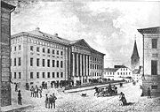
All Topics  
University of Tartu


   Email Print
   Bookmark   Link


University of Tartu


The University of Tartu (; ; ) is a classical university
University

A university is an institution of higher education and research, which grants academic degrees in a variety of subjects. A university provides both undergraduate education and postgraduate education....
 in the city of Tartu
Tartu

For the French captain, see Jean-Fran?ois TartuTartu is the second largest city of Estonia. In contrast to Estonia's political and financial capital Tallinn, Tartu is often considered the intellectual and cultural hub, especially since it is home to Estonia's oldest and most renowned University of Tartu....
, Estonia
Estonia

Estonia , officially the Republic of Estonia is a country in the Baltic region of Northern Europe. It is bordered to the north by Finland across the Gulf of Finland, to the west by Sweden across the Baltic Sea, to the south by Latvia , and to the east by the Russia ....
. Regarded by many Estonians as the country's "national university", it is the highest-ranked university in Estonia as well as one of the highest-ranked in former Eastern Europe. The University of Tartu is a member of the Coimbra Group
Coimbra Group

The Coimbra Group is a network of European universities that gathers 38 universities, some of which are among the oldest and most prestigious in Europe....
 and was established by King Gustavus Adolphus of Sweden
Gustavus Adolphus of Sweden

Gustav II Adolf, In the era, which was characterized by nearly endless warfare, he led his armies as Monarch of Sweden—from 1611, as a seventeen year old, until his death in battle while leading a charge during 1632 in the bloody Thirty Years' war—as Sweden rose from the status as a mere regional power and run-of-the-mill king...
 in 1632, thus being the oldest university in the region.

At different times during its history the University of Tartu was known as Academia Gustaviana, University of Dorpat, Universität (zu) Dorpat, University of Yuryev, and Tartu State University (Tartu Riiklik Ülikool).

Academia Gustaviana in the then Swedish province of Livonia
Livonia

Livonia was once the land of the Finnic Livonians inhabiting the principal ancient Livonian County Metsepole with its center at Turaida Castle....
 was the second university founded in the Swedish Empire
Swedish Empire

Sweden was, between 1611 and 1718, one of the great powers of Europe. In modern historiography this period is known as the Swedish Empire, or stormaktstiden ....
, following Uppsala University
Uppsala University

Uppsala University is a world-class research university in Uppsala, Sweden. Founded as early as 1477, it is the oldest such institution in the Nordic countries and is frequently ranked among the world's top 100 universities....
 (in Uppsala
Uppsala

Uppsala is the capital of Uppsala County and the fourth largest Cities of Sweden of Sweden with 128,409 inhabitants.Located about 70 km north of the capital Stockholm, it is also the seat of the Uppsala municipality ....
, Sweden proper) and preceding the Academy of Åbo (in Turku
Turku

Turku is a List of towns in Finland situated on the southwest coast of Finland at the mouth of Aura river. It is located in the region of Finland Proper in the Province of Western Finland....
, Finland
Finland

Finland , officially the Republic of Finland , is a Nordic countries situated in the Fennoscandian region of northern Europe. It borders Sweden on the west, Russia on the east, and Norway on the north, while Estonia lies to its south across the Gulf of Finland....
).


Discussion
Ask a question about 'University of Tartu'
Start a new discussion about 'University of Tartu'
Answer questions from other users
Full Discussion Forum


Encyclopedia


The University of Tartu (; ; ) is a classical university
University

A university is an institution of higher education and research, which grants academic degrees in a variety of subjects. A university provides both undergraduate education and postgraduate education....
 in the city of Tartu
Tartu

For the French captain, see Jean-Fran?ois TartuTartu is the second largest city of Estonia. In contrast to Estonia's political and financial capital Tallinn, Tartu is often considered the intellectual and cultural hub, especially since it is home to Estonia's oldest and most renowned University of Tartu....
, Estonia
Estonia

Estonia , officially the Republic of Estonia is a country in the Baltic region of Northern Europe. It is bordered to the north by Finland across the Gulf of Finland, to the west by Sweden across the Baltic Sea, to the south by Latvia , and to the east by the Russia ....
. Regarded by many Estonians as the country's "national university", it is the highest-ranked university in Estonia as well as one of the highest-ranked in former Eastern Europe. The University of Tartu is a member of the Coimbra Group
Coimbra Group

The Coimbra Group is a network of European universities that gathers 38 universities, some of which are among the oldest and most prestigious in Europe....
 and was established by King Gustavus Adolphus of Sweden
Gustavus Adolphus of Sweden

Gustav II Adolf, In the era, which was characterized by nearly endless warfare, he led his armies as Monarch of Sweden—from 1611, as a seventeen year old, until his death in battle while leading a charge during 1632 in the bloody Thirty Years' war—as Sweden rose from the status as a mere regional power and run-of-the-mill king...
 in 1632, thus being the oldest university in the region.

At different times during its history the University of Tartu was known as Academia Gustaviana, University of Dorpat, Universität (zu) Dorpat, University of Yuryev, and Tartu State University (Tartu Riiklik Ülikool).

History

The Academia Gustaviana in the then Swedish province of Livonia
Livonia

Livonia was once the land of the Finnic Livonians inhabiting the principal ancient Livonian County Metsepole with its center at Turaida Castle....
 was the second university founded in the Swedish Empire
Swedish Empire

Sweden was, between 1611 and 1718, one of the great powers of Europe. In modern historiography this period is known as the Swedish Empire, or stormaktstiden ....
, following Uppsala University
Uppsala University

Uppsala University is a world-class research university in Uppsala, Sweden. Founded as early as 1477, it is the oldest such institution in the Nordic countries and is frequently ranked among the world's top 100 universities....
 (in Uppsala
Uppsala

Uppsala is the capital of Uppsala County and the fourth largest Cities of Sweden of Sweden with 128,409 inhabitants.Located about 70 km north of the capital Stockholm, it is also the seat of the Uppsala municipality ....
, Sweden proper) and preceding the Academy of Åbo (in Turku
Turku

Turku is a List of towns in Finland situated on the southwest coast of Finland at the mouth of Aura river. It is located in the region of Finland Proper in the Province of Western Finland....
, Finland
Finland

Finland , officially the Republic of Finland , is a Nordic countries situated in the Fennoscandian region of northern Europe. It borders Sweden on the west, Russia on the east, and Norway on the north, while Estonia lies to its south across the Gulf of Finland....
). A precursor to the academy had been a Jesuit
Society of Jesus

The Society of Jesus is a Roman Catholic religious order of clerks regular whose members are called Jesuits, Soldiers of Jesus Christ, and Foot soldiers of the Pope, because the founder, Saint Ignatius of Loyola, was a knight before becoming a Holy Orders....
 grammar school Gymnasium Dorpatense, founded by Stefan Batory
Stefan Batory

Stephen B?thory was a Hungarian noble Prince of Transylvania , then King consort and Grand Duke consort of Lithuania to Anna Jagiellon. He was a member of the Somlyo branch of the noble Hungary B?thory....
 (then king of Poland
Polish-Lithuanian Commonwealth

The Polish?Lithuanian Commonwealth was one of the largest and most populous countries in 16th and 17th-century Europe, formed by a Union of Lublin of Kingdom of Poland and Grand Duchy of Lithuania in 1569....
) in 1583 and existing to 1601, when Tartu (Dorpat) was under Polish
Polish-Lithuanian Commonwealth

The Polish?Lithuanian Commonwealth was one of the largest and most populous countries in 16th and 17th-century Europe, formed by a Union of Lublin of Kingdom of Poland and Grand Duchy of Lithuania in 1569....
 rule. The first students immatriculated between 20-21 April 1632. The opening ceremony of Academia Dorpatensis (Academia Gustaviana) took place on 15 October in the same year. The academy in Tartu functioned with Philosophy, Law, Theology and Medical Faculties enjoying the privileges of the University of Uppsala. On account of the Russian-Swedish war the University of Tartu moved to Tallinn
Tallinn

Tallinn is the capital and largest city in the Republic of Estonia and of Harju County. It occupies a surface of 159.2 km? in which 397,617 inhabitants live....
 in 1656 and in 1665 it closed down. In the 17th century the future outstanding Swedish scientists Urban Hiärne, Olof Verelius, Arvid Moller and others studied at the university. Among the academic staff were Friedrich Menius, the professor of history (the history of Livonia
Livonia

Livonia was once the land of the Finnic Livonians inhabiting the principal ancient Livonian County Metsepole with its center at Turaida Castle....
, the first scientific approach to Estonian folklore); Sven Dimberg, the professor of mathematics (the first in the world to deliver lectures based on Newton’s theory); Olaus Hermelin, the professor of rhetoric and poetry; Lars Micrander, the professor of medicine (the founder of balneology, the discoverer of natural mineral water springs). In 1690 Tartu became a university town again. Academia Gustavo-Carolina shortly after that moved from Tartu to Pärnu as a result of the coalition against Sweden and the Great Famine of 1695–1697. Academia Gustavo-Carolina which had opened in Pärnu on 28 August 1699 was closed because of the surrender to the Russian forces on 12 August 1710 during the Northern War. According to the terms of the capitulation act the Russians agreed to maintain the university in Pärnu. University was reopened only in 1802 by the Baltic German
Baltic German

The Baltic Germans were mostly ethnic German inhabitants of the eastern shore of the Baltic Sea, which today form the countries of Estonia and Latvia....
 Ritterschaften under the reform-minded Emperor Alexander I
Alexander I of Russia

Alexander I of Russia , also known as Alexander the Blessed served as Tsar of Russia from 23 March 1801 to 1 December 1825 and Ruler of Poland from 1815 to 1825, as well as the first Russian Grand Duke of Finland....
 of Russia
Russian Empire

File:Russian Emperor Flag.jpgFile:Romanov Flag.svgThe Russian Empire was a state that existed from 1721 until the Russian Revolution of 1917....
, to which Livonia then belonged.

The language of instruction at Dorpat was German
German language

German is a West Germanic languages, thus related to and classified alongside English language and Dutch language. It is one of the world's world language and the most widely spoken mother tongue in the European Union....
 from 1802 to 1893. During that time, Dorpat had a dual nature in that it belonged both to the set of German(-language) and Russian universities. Financially and administratively, the latter was more important; intellectually and regarding the professoriate, the former was more important (over half the professors came from Germany
German Confederation

The German Confederation was the association of Central European states created by the Congress of Vienna in 1815 to serve as the successor to the Holy Roman Empire, which had been abolished in 1806....
, at least another third were Baltic Germans). Among the 30 German-language universities, of which 23 were inside the German Empire
German Empire

The German Empire is the name commonly used in English to describe Germany from the unification of Germany and proclamation of William I, German Emperor as German Emperor on 18 January 1871, to 1918, when it became Weimar republic after defeat in World War I and the abdication of William II, German Emperor ....
, Dorpat was the 11th in size. In teaching, the university educated the local Baltic German leadership and professional classes as well as staff especially for the administration and health system of the entire Russian Empire. In scholarship, it was an international university; the time between 1860 and 1880 was its "golden age".

The freedom to be a half-German university ceased with the rise of nationalist tendencies in Russia, which held homogenization more important than retaining a bi-lingual university. Between 1882 and 1898, Russification
Russification

Russification is an adoption of the Russian language or some other Russian attribute by non-Russian communities. In a narrow sense, Russification is used to denote the influence of the Russian language on Slavic languages, Baltic languages and other languages, spoken in areas currently or formerly controlled by Russia, which led to emerging...
 in language, appointments, etc., was imposed, with some exceptions (such as the Divinity School, which the state feared would be used by the Orthodox
Russian Orthodox Church

The Russian Orthodox Church ; or The Moscow Patriarchate , also known as the Orthodox Christian Church of Russia, is a body of Christianity who constitute an Autocephaly Eastern Orthodox Church under the jurisdiction of the List of Metropolitans and Patriarchs of Moscow, in full communion with the other Eastern Orthodox Churches....
 clergy to teach dangerous Protestant
Protestantism

Protestantism is a movement within Christianity that originated in the sixteenth-century Protestant Reformation. It is considered to be one of the three principal traditions of Christianity, together with Roman Catholicism and Eastern Orthodoxy....
 views and was thus was allowed to continue in German until 1916). By 1898, when both the town and the university were renamed Yuryev, virtually all distinguished scholars from Germany had left. The University of Yuryev existed until 1918, when during part of the fall term, it was reopened, under German occupation
United Baltic Duchy

The proposed United Baltic Duchy also known as the Grand Duchy of Livonia was a state imagined by the Baltic German nobility after the Russian revolution and German occupation of the Courland, Livonian and Estonian governorates of the Russian Empire....
, as Dorpat. Russian academic staff and students took refuge in Voronezh
Voronezh

Voronezh is a large types of inhabited localities in Russia in southwestern Russia, not far from Ukraine. It is located either side of the Voronezh River, twelve kilometers away from where it flows into the Don River, Russia....
 in Russia, giving rise to the foundation of Voronezh State University
Voronezh State University

Voronezh State University is one of the main university in Central Russia.The university was founded in 1918, when some staff, students and property from the University of Tartu were transferred by the Soviet government because of the German occupation of Estonia....
, which traces its own history back to the foundation of the University of Tartu and still holds several physical properties of the latter.

In 1919, the University of Tartu was established as an Estonian institution. It became Soviet in 1940 after the Soviet Union has enacted its part of the Molotov-Ribbentrop pact, but was occupied by Germany
Nazi Germany

Nazi Germany and the Third Reich are the colloquial English names for Germany under the regime of Adolf Hitler and the Nazi Party , which established a Totalitarianism dictatorship that existed from 1933 to 1945....
 from 1941–1944 and again called Dorpat. Since 1944, it has been the University of Tartu (1940–1941 and 1944–1989 "Tartu State University"). During the period of Soviet rule (1944–1991), Estonian was the principal language of instruction, although some courses were taught in Russian, and there were several Russian curricula. To a lesser degree, this is still true today after the regaining of Estonian national independence. The full recovery of academic autonomy of the University can be dated to 1992.

The last decade has been marked by organizational and structural changes, as well as adaptations to various university models (American, Scandinavian, German) against the background of the Soviet and Baltic German past. Most recently, the university has been and is still being marked by the peculiar adaptation of the Bologna declaration
Bologna declaration

The Bologna declaration is the main guiding document of the Bologna process. It was adopted by ministers of education of 29 European countries at their meeting in Bologna in 1999....
 in Estonia generally and Tartu specifically, leading to major changes in curricula and studies, as well as by strong organizational centralization attempts. Recent plans also include the abolition of the Chair system (an Americanization) and of the Faculties, which is supposed to lead to four large divisions (Humanities, Social Sciences, Natural Sciences, and Medicine) under briefly serving deans and rector-appointed financial administrators.

Buildings

The university’s four museums, its Botanical Gardens, and sports facilities are, by and large, open to the general public. The University possesses some 150 buildings, 30 of which are outside of Tartu. 31 of its buildings decorate the city as architectural monuments. However, the current reforms include attempts to sell, or have the state co-sponsor, several of these buildings and monuments, as well as sports facilities, as they are not seen as part of the university's mission proper.

At the same time, there are numerous recently constructed/renovated university buildings and student dormitories, such as the Technology Institute and the Biomedical Center.

Research

Lectinology
Lectin

Lectins are sugar-binding proteins which are highly specific for their sugar moieties. They typically play a role in biological recognition phenomena involving cells and proteins....
, the science of lectins was founded at the University of Tartu in 1888 with the publication of Peter Hermann Stillmark
Peter Hermann Stillmark

In 1888 at the University of Tartu, now Tartu in Estonia under prof. Robert Kobert`s supervision Peter Hermann Stillmark completed his doctoral thesis ? Ueber Ricin, ein giftiges Ferment aus den Samen von Ricinus comm....
's thesis about the isolation of Ricin
Ricin

Ricin is a protein toxin that is solvent extraction from the Castor oil plant .The US Centers for Disease Control gives a possible minimum figure of 500 micrograms for the lethal dose of ricin in humans if exposure is from injection or inhalation....
.

At the University of Tartu, currently more than 3,300 scientific publications are produced every year. About half of all publications by Estonian scientists in journals (those covered by citation indexes like "SCI Expanded", "SSCI" or "A&HCI") are written by Tartu authors.

According to the university administration, the most remarkable recent research achievements have been in the fields of molecular
Molecular biology

Molecular biology is the study of biology at a molecule level. The field overlaps with other areas of biology and chemistry, particularly genetics and biochemistry....
 and cell biology
Cell biology

Cell biology is an list of academic disciplines that studies cell s ? their physiology properties, their structure, the organelles they contain, interactions with their environment, their cell cycle, cell division and apoptosis....
, gene
Genetics

Genetics , a discipline of biology, is the science of heredity and Genetic variation in living organisms. The fact that living things inherit traits from their parents has been used since prehistoric times to improve crop plants and animals through selective breeding....
 technology
Biotechnology

Biotechnology is technology based on biology, especially when used in agriculture, food science, and medicine. United Nations Convention on Biological Diversity defines biotechnology as:...
, immunology
Immunology

Immunology is a broad branch of biomedical science science that covers the study of all aspects of the immune system in all organisms. It deals with, among other things, the physiology functioning of the immune system in states of both health and disease; malfunctions of the immune system in immunological disorders ; the physical, chemical an...
, pharmacology
Pharmacology

Pharmacology is the study of drug action. More specifically it is the study of the interactions that occur between a living organism and exogenous chemicals that alter normal biochemical function....
, laser
Laser

A laser is a device that emits light through a process called stimulated emission. The term laser is an acronym for light amplification by stimulated emission of radiation....
 medicine
Medicine

Medicine is the art and science of healing. It encompasses a range of health care practices evolved to maintain and restore health by the prevention and treatment of illness....
, materials science
Materials science

Materials science or materials engineering is an interdisciplinary field involving the properties of matter and its applications to various areas of science and engineering....
, laser spectroscopy, biochemistry
Biochemistry

Biochemistry is the study of the chemistry processes in living organisms. It deals with the structure and function of cellular components such as proteins, carbohydrates, lipids, nucleic acids and other biomolecules....
, environmental technology
Environmental technology

Environmental technology or green technology or clean technology is the application of the environmental science to conserve the natural environment and resources, and to curb the negative impacts of human involvement....
, computational linguistics
Computational linguistics

Computational linguistics is an interdisciplinary field dealing with the Statistics and/or rule-based modeling of natural language from a computational perspective....
, psychology
Psychology

Psychology is an academic and applied science discipline involving the science study of human mental functions and behavior. Occasionally it also relies on symbolic hermeneutics and critical theory, although these traditions are less pronounced than in other social sciences such as sociology....
, and semiotics
Semiotics

'Semiotics, also called semiotic studies or semiology, is the study of sign processes , or signification and communication, sign and symbols, both individually and grouped into sign systems....
.

The university cooperates with private enterprises, and acts itself as a nucleus for the development of spin-off
Spin-off

A spin-off is a new organization or entity formed by a split from a larger one, such as a television series based on a pre-existing one, or a new company formed from a university research group or business incubator....
 firms (examples from recent past include Asper Biotech
Asper

Asper may refer to:*Aemilius Asper, Latin grammarian*Asper Biotech Ltd., Estonian biotechnology company*David Asper, Vice-president of CanWest Global Communications Corp....
 and others).

People


See: People associated with the University of Tartu
List of Tartu University people

This is a list of people associated with the University of Tartu at Tartu, Estonia....


Academic co-operation

The University has signed cooperation agreements with 30 universities and research institutions abroad, and 140 contracts for international student and teacher exchange projects within the framework of the European Union
European Union

The European Union is an economic and political union of 27 European Union member state, located primarily in Europe. It was established by the Treaty of Maastricht on 1 November 1993 upon the foundations of the pre-existing European Economic Community....
's "Erasmus programme
Erasmus programme

The ERASMUS programme, or European Region Action Scheme for the Mobility of University Students, is a European student exchange programme established in 1987....
" and Utrecht Network
Utrecht Network

The Utrecht Network is a network of European University. The network promotes the internationalisation of tertiary education through summer schools, student and staff Student exchange program and joint degrees....
.

At present, nearly 400 foreign exchange students from 27 countries study at the University. The vast majority comes from Finland, Sweden, Latvia, Russia, the United States of America, and Germany.

The University of Tartu has co-operation agreements with the following universities at the time of writing. These cooperation agreements can include student exchange programmes.

Bibliography

  • Die Universitäten Dorpat/Tartu, Riga und Wilna/Vilnius 1579–1979. Beiträge zu ihrer Geschichte und ihrer Wirkung im Grenzbereich zwischen West und Ost. Herausgegeben von Gert von Pistohlkors, Toivo U. Raun, Paul Kaegbein. Köln; Wien 1987 (Quellen und Studien zur baltischen Geschichte; 9). [Zweites Internationales Marburger Symposium zu Problemen der baltischen Sozial- und Kulturgeschichte]. [Lectures in German and English] ISBN 3-412-00886-9*

See also

  • Estonian University of Life Sciences
    Estonian University of Life Sciences

    The Estonian University of Life Sciences , located in Tartu, Estonia, is the former Estonian Agricultural University, which was renamed and restructured in November 2005....
  • University of Tallinn
  • Estonia
    Estonia

    Estonia , officially the Republic of Estonia is a country in the Baltic region of Northern Europe. It is bordered to the north by Finland across the Gulf of Finland, to the west by Sweden across the Baltic Sea, to the south by Latvia , and to the east by the Russia ....
  • Tallinn University of Technology
    Tallinn University of Technology

    Tallinn University of Technology is the only university of technology in Estonia, and one of the three most important institutions of higher education in Estonia generally....
  • City of Tartu
    Tartu

    For the French captain, see Jean-Fran?ois TartuTartu is the second largest city of Estonia. In contrast to Estonia's political and financial capital Tallinn, Tartu is often considered the intellectual and cultural hub, especially since it is home to Estonia's oldest and most renowned University of Tartu....
  • Tartu University Press
    Tartu University Press

    Tartu University Press is a university press Publishing that is part of Tartu University, Estonia.The press was founded in 1632. It is the largest list of university presses in Estonia....


External links