


Simele massacre

Encyclopedia
The Simele Massacre was a massacre
committed by the armed forces of the Kingdom of Iraq
during the systematic targeting of Assyrians
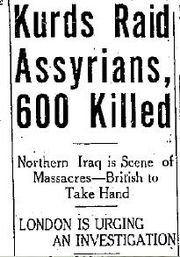
in northern Iraq in August 1933. The term is used to describe not only the massacre in Simele, but also the killing spree that took place among 63 Assyrian villages in the Dohuk and Mosul districts that led to the deaths of between 600 and 3,000 Assyrians.
The Assyrian people at the time were emerging from one of the darkest periods of their history. During the Assyrian Genocide
during and after World War I
, more than half of their population was massacred by Ottoman Turks
and Kurds.
The term 'genocide
' was coined by Raphael Lemkin
, who was directly influenced by the story of this massacre and the Armenian Genocide
.
(often dubbed Nestorian
), who have originally inhabited the mountainous Hakkari
and Barwari
regions covering parts of the modern provinces of the Hakkâri
, Şırnak
and Van
in Turkey and Dohuk in Iraq, with a population ranging between 75,000 and 150,000.
Most of these Assyrians were massacred during the Genocide of 1915
. The rest endured two winter marches to Urmia
in 1915 and to Hamadan
in 1918.
Many of them were relocated to refugee camps by the British in Baquba and later to Habbaniyah
, and in 1921 some were enlisted in the pro-British Assyrian Levies
which helped quell Kurdish revolts in the British Mandate of Mesopotamia. Most Hakkari Assyrians were resettled after 1925 in a cluster of villages in northern Iraq. Some of the villages where the Assyrians settled were leased directly by the government, while others belonged to Kurdish landlords who had the right to evict them at any time.
The Assyrians did not share an amicable relation with their neighbour. Their historical feud with the Kurds, which culminated in 1915, is centuries old.
Bitterness between the Assyrians and the Arabs was reported by British historians as far as the 1920s. this was even made worst by the British officers of the Levies who have encouraged the Assyrians to think that they are first-class troops, which had the effect of increasing the natural pride of the Assyrians. This, coupled with the fact that the British and Assyrian Levies succeed in suppressing Kurdish revolts when the Iraqi Army failed created an inferiority complex among some Iraqi corps towards the British and the Assyrians.
The conclusion of the British mandate of Iraq caused considerable unease among the Assyrians who felt betrayed by the British. For them, any treaty with the Iraqis had to take into consideration their desire for an autonomous position similar to the Ottoman Millet system
.
The Iraqis, on the other hand felt that the Assyrian demands where, alongside the Kurdish disturbances in the north, a conspiracy by the British to divide Iraq by agitating its minorities.
the Catholicos Patriarch of the Assyrian Church of the East, demanded the Assyrians be given autonomy
within Iraq, seeking support from the United Kingdom
and pressing his case before the League of Nations
in 1932. His followers planned to resign from the Assyrian Levies
(a military force under the command of the British that served British interests) and to re-group as a militia and concentrate in the north, creating a de facto Assyrian enclave.
In spring 1933, Malik Yaqu, a former Levies' officer, was engaged in a propaganda campaign on behalf of Mar Shimun trying to persuade the Assyrians not to apply for an Iraqi nationality or accept the settlement offered to them by the central government. Yaqo was accompanied by 200 armed men which was seen as an act of defiance by the Iraqi authorities. His activities caused distress among the Kurds and the Iraqi government started sending its army to the Dohuk region in order to intimidate Yaqu and dissuade the Assyrians from joining his cause.
In June 1933, the Mar Shimun was invited to Baghdad
for negotiations with Hikmat Sulayman
's government and was detained there after refusing to relinquish temporal authority. He would eventually be exiled to Cyprus
.
. They were however disarmed and refused asylum, and were subsequently given light arms and sent back to Iraq on 4 August. They then decided to surrender themselves to the Iraqi Army. While crossing the Tigris
in the Assyrian village of Dirabun, a clash erupted between the Assyrians and an Iraqi army brigade. Despite the advantage of heavy artillery, the Iraqis were driven back to their military base in Dirabun. The Assyrians, convinced that the army had targeted them deliberately, attacked the army's barracks with little success. They were driven back to Syria upon the arrival of Iraqi aeroplanes. The Iraqi army lost 33 soldiers during the fighting while the Assyrian irregulars took fewer casualties. Historians do not agree on who started the clashes at the border. The British Administrative Inspector for Mosul
Lieutenant Colonel R. R. Stafford wrote that the Assyrians had no intention of clashing with the Iraqis, while the Iraqi historian and son of a prominent Arab nationalist
Khaldun Husry claims that it was Yaqu's men who provoked the army at Dirabun. Husry even confirms rumours which circulated among nationalist newspapers of the Assyrians mutilating the bodies of killed Iraqi soldiers, which further enraged the Iraqi public opinion against Assyrians.
The Iraqi army led by the experienced brigadier general Bakr Sidqi
moved north in order to crush the Assyrians once and for all. They started executing every Assyrian male found in the mountainous Bekher region between Zakho
and Duhok starting from 8 August. Assyrian civilians were transported in military trucks from Zakho and Dohuk to uninhabited places in batches of eight or ten where they were shot with machine guns and run over by heavy armoured cars to make sure no one survived.
and Yazidi
tribes were encouraged to loot Assyrian villages. Kurdish tribes of Gulli, Sindi and Selivani were encouraged by the mayor of Zakho to loot villages to the northeast of Simele, while Yazidis and Kurds also raided Assyrian villages in Shekhan
and Amadiya. Most women and children from those villages took refuge in Simele and Dohuk.
On 9 August, the Arab tribes of Shammar
and Jubur
started crossing the east bank of the Tigris and raiding Assyrian villages on the plains to the south of Dohuk. They were mostly driven by the loss of a large amount of their own livestock to drought in the previous years.
More than 60 Assyrian villages were looted. Even though women and children were mostly left to take refuge in neighbouring villages, men were sometimes rounded up and handed over to the army, by whom they were duly shot. Some villages were completely burned down and most of them were later inhabited by Kurds.
 The town of Simele became the last refuge for Assyrians fleeing from the looted villages. The mayor of Zakho arrived with a military force on 8 and 9 August to disarm the city. During that time thousands of refugees flocked around the police post in the town, where they were told by officials that they would be safe under the Iraqi flag. The 10th of August saw the arrival of Kurdish and Arab looters who, undeterred by the local police, took away the freshly cut wheat and barley. During the night of 10-11 August, the Arab inhabitants of Simele joined the looting. The Assyrian villagers could only watch as their Arab neighbours drove their flocks before them.
On 11 August the villagers were ordered to leave the police post and return to their homes, which they began to do with some reluctance. As they were heading back Iraqi soldiers in armoured cars arrived, and the Iraqi flag flying over the police post was pulled down. Without warning or obvious provocation, the troops began to open an indiscriminate fire on the defenceless Assyrians. Ismael Abbawi Tohalla, the commanding officer, then ordered his troops not to target women. Stafford, describes the ensuing massacre as follows:
In his depiction of the massacre, Mar Shimun, mentions that:
The official Iraqi account that the Assyrian casualties were sustained during a short battle with Kurdish and Arab tribes has been discredited by all historians. Khaldun Husry claims that the mass killing was not premeditated, and that the responsibility lies on the shoulder of, Ismael Abbawi, a junior officer in the army.
On 13 August, Bakr Sidqi moved his troops to Alqosh
, where he planned to inflict a further massacre on the Assyrians who found refuge there. He was prevented in this by the intervention of the Chaldean Patriarch Yousef VI Emmanuel II Thomas
.
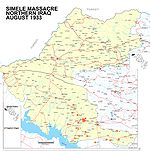
Today, most of these villages are inhabited by Kurds. The main campaign lasted until 16 August, but violent raids on Assyrians were being reported up to the end of the month. The campaign resulted in one third of the Assyrian population of Iraq fleeing to Syria.
 On 18 August, Iraqi troops entered Mosul where they were given an enthusiastic reception by its Muslim inhabitants. Triumphant arches were erected and decorated with melons pierced with daggers, symbolising the heads of murdered Assyrians. The crown prince Ghazi himself came to the city to award 'victorious' colours to those military and tribal leaders who participated in the massacres and the looting.
Anti-Christian feeling was at its height in Mosul, and the Christians of the city were largely confined to their homes during the whole month in fear of further action by the frenzied mob.
The Iraqi army later paraded in the streets of Baghdad
in celebration of its victories. Bakr Sidqi was promoted; he later led Iraq's first military coup and became prime minister.
Popular support for a compulsory conscription bill rose after the massacres. Rashid Ali al-Gaylani presented the bill to the parliament, his government fell, however, before it was legislated and Jamil al-Midfai
's government enacted conscription in Februari 1934.
From the nationalists' point of view, the Assyrian Levies were British proxies to be used by their 'masters' to destroy the new Iraqi state whose independence the British had consistently opposed. The British allowed their Assyrian auxiliary troops to retain their arms and granted them special duty and privileges: guarding military air installations and receiving higher pay than the Iraqi Arab recruits. Under British protection, the Assyrian Levies did not become Iraqi citizens after until 1924. The nationalists believed the British were hoping for the Assyrians to destroy Iraq's internal cohesion by becoming independent and by inciting others such as the Kurds to follow their example.
The massacres and looting had a deep psychological impact on the Assyrians. Stafford reported their low morale upon arrival in Alqosh:
Because of the massacre, around 6,200 Assyrians left Nineveh plains
immediately for the neighbouring French Mandate of Syria
, and were later joined by 15,000 refugees the following years. They concentrated in the Jazira region and built a number of villages on the banks of the Khabur River
.
King Faysal, who recently recently returned to Iraq from a medical vacation, was very stressed during the crisis. His health deteriorated even more during the hot summer days in Baghdad. The British Charge d'Affaires met him in his Pyjamas squatting in his bed on 15 Augusts where he denied that a massacre was committed in Simele. Faysal left Iraq again on 2 September seeking a cooler climate in London where he died 5 days later.
Mar Shimun who was detained since June 1933 was forced into exile along with his extended family despite initial British reluctance. He was flown to by an RAF
plane to Cyprus
in 18 Augusts, and later to the United States in 1949, thus later forcing the head of the Assyrian Church of the East to relocate to Chicago
where it remains to this day. In 1948, Mar Shimun met with the representatives of Iraq, Syria and Iran in Washington subsequently calling upon his followers to "live as loyal citizens wherever they resided in the Middle East" relinquishing his role as a temporal leader and the nationalistic role of the church. This left a power vacuum in Assyrian politics that was filled by the Assyrian Universal Alliance
in 1968.
Historians disagree as to who holds responsibility for ordering the mass killings.
Stafford blames Arab nationalists, most prominently Rashid Ali al-Gaylani and Bakr Sidqi. According to him, Iraqi Army officers despised the Assyrians, and Sidqi in particular was vocal of his hate for them. This view was also shared by Brittish officials who recommended to King Faysal not to send him to the north during the crisis.
Husry on the other hands while blaming the Assyrians for starting the crisis and absolves Sidqi from ordering the mass killing in Simele. He hints at King Faysal I as the authority who might have issued orders to exterminate Assyrian males.
Kanan Makiya
, a leftist Iraqi historian, presents the actions taken by the military as a manifestation of the nationalist anti-imperialist paranoia which was to culminate with the Ba'athists ascent to power in the 1960s.
Fadhil al-Barrak, an Iraqi Ba'athist historian, puts Sidqi as the author of the whole campaign and the ensuing massacres. For him the events were part of a history of Iraq prior to the true nationalist revolution.
The general Iraqi public opinion promoted by newspapers, was that the Assyrians were proxies used by the British to undermine the newly established kingdom, was also shared by some leading officials including the prime minister himself. The British and European protests following the massacre only confirmed to them that the "Assyrian rebellion" was the work of European imperialism.
Both King George V of England and Cosmo Gordon Lang the Bishop of Canterbury took a personal interest in the Assyrian affair. The massacres were seen in Europe as a Jihad
against a small Christian minority. British representatives at home demanded from Faysal that Sidqi and other culprits be tried and punished.
On the long term however, the British backed Iraq and rejected an international inquiry into the killings, fearing that this may provoke further massacres against Christians. They also didn't insist on punishing the culprits who were now seen as heroes by Iraqis. The official British stance was to defend the Iraqi government for its perseverance and patience in dealing with the crisis and to attribute the massacres to army units out of control. A report on the battle of Dirabun blames the Assyrians, defends the actions of the Iraqi Army and commends Bakr Sidqi as a good officer.
The change in British attitude towards the Assyrians gave rise to the notion of the British betrayal among some Assyrian circles. An idea which first gained popularity after 1918 when the Assyrians who were concentrated in Urmia
did not receive the British relief which led to their massacre by the Turks and Kurds and their deportation to Hamadan
.
In 2004, the Syrian government
banned an Assyrian political organization from commemorating the event and threatened arrests if any were to break the ban.
Assyrian music
artist Shlimon Bet Shmuel has written a song about the event.
A number of poems and stories have been written about the incident, including one by the American
William Saroyan
, titled "Seventy Thousand Assyrians", written in 1934;
The Simele massacre inspired Raphael Lemkin
to create the concept of "Genocide
". In 1933, Lemkin made a presentation to the Legal Council of the League of Nations
conference on international criminal law in Madrid
, for which he prepared an essay on the Crime of Barbarity as a crime against international law. The concept of the crime, which later evolved into the idea of genocide, was based on the Simele massacre, the Armenian Genocide
and the Jewish Holocaust.
The massacres also had a deep impact on the newly established Kingdom of Iraq
. Kanan Makiya argues that the killing of Assyrians transcended tribal, religious and ethnic barriers as Arabs, Kurds and Yazidis were united in their anti-Assyrian and anti-western sentiments. According to him, the massacre was "the first genuine expression of national independence in a former Arab province of the Ottoman Empire
".
The British were standing firmly behind the leaders of their former colony during the crisis, despite the popular animosity towards them. General Headlam of the British military mission in Baghdad was quoted saying: "the government and people have good reasons to be thankful to Colonel Bakr Sidqi".
Massacre
A massacre is an event with a heavy death toll.Massacre may also refer to:-Entertainment:*Massacre , a DC Comics villain*Massacre , a 1932 drama film starring Richard Barthelmess*Massacre, a 1956 Western starring Dane Clark...
committed by the armed forces of the Kingdom of Iraq
Kingdom of Iraq
The Kingdom of Iraq was the sovereign state of Iraq during and after the British Mandate of Mesopotamia. The League of Nations mandate started in 1920. The kingdom began in August 1921 with the coronation of Faisal bin al-Hussein bin Ali al-Hashemi as King Faisal I...
during the systematic targeting of Assyrians
Assyrian people
The Assyrian people are a distinct ethnic group whose origins lie in ancient Mesopotamia...
in northern Iraq in August 1933. The term is used to describe not only the massacre in Simele, but also the killing spree that took place among 63 Assyrian villages in the Dohuk and Mosul districts that led to the deaths of between 600 and 3,000 Assyrians.
The Assyrian people at the time were emerging from one of the darkest periods of their history. During the Assyrian Genocide
Assyrian genocide
The Assyrian Genocide refers to the mass slaughter of the Assyrian/Chaldean/Syriac population of the Ottoman Empire during the 1890s, the First World War, and the period of 1922-1925...
during and after World War I
World War I
World War I , which was predominantly called the World War or the Great War from its occurrence until 1939, and the First World War or World War I thereafter, was a major war centred in Europe that began on 28 July 1914 and lasted until 11 November 1918...
, more than half of their population was massacred by Ottoman Turks
Ottoman Turks
The Ottoman Turks were the Turkish-speaking population of the Ottoman Empire who formed the base of the state's military and ruling classes. Reliable information about the early history of Ottoman Turks is scarce, but they take their Turkish name, Osmanlı , from the house of Osman I The Ottoman...
and Kurds.
The term 'genocide
Genocide
Genocide is defined as "the deliberate and systematic destruction, in whole or in part, of an ethnic, racial, religious, or national group", though what constitutes enough of a "part" to qualify as genocide has been subject to much debate by legal scholars...
' was coined by Raphael Lemkin
Raphael Lemkin
Raphael Lemkin was a Polish lawyer of Jewish descent. He is best known for his work against genocide, a word he coined in 1943 from the root words genos and -cide...
, who was directly influenced by the story of this massacre and the Armenian Genocide
Armenian Genocide
The Armenian Genocide—also known as the Armenian Holocaust, the Armenian Massacres and, by Armenians, as the Great Crime—refers to the deliberate and systematic destruction of the Armenian population of the Ottoman Empire during and just after World War I...
.
The Mountains' Assyrians
The majority of the Assyrian affected by the massacres were adherents of the Assyrian Church of the EastAssyrian Church of the East
The Assyrian Church of the East, officially the Holy Apostolic Catholic Assyrian Church of the East ʻIttā Qaddishtā w-Shlikhāitā Qattoliqi d-Madnĕkhā d-Āturāyē), is a Syriac Church historically centered in Mesopotamia. It is one of the churches that claim continuity with the historical...
(often dubbed Nestorian
Nestorianism
Nestorianism is a Christological doctrine advanced by Nestorius, Patriarch of Constantinople from 428–431. The doctrine, which was informed by Nestorius's studies under Theodore of Mopsuestia at the School of Antioch, emphasizes the disunion between the human and divine natures of Jesus...
), who have originally inhabited the mountainous Hakkari
Hakkari
Hakkâri , is a city and the capital of the Hakkâri Province of Turkey. The name Hakkâri is derived from the Syriac word, Akkare, meaning farmers...
and Barwari
Barwari
Barwar also known as Barwari and Barwari Bala, is a region situated in northern Dohuk Governorate in Iraq. The region is populated by Kurds although it was once mainly inhabited by Assyrians with a large Jewish minority.-History:...
regions covering parts of the modern provinces of the Hakkâri
Hakkari Province
Hakkâri Province is a province in the south east corner of Turkey. The administrative centre is located in the city of Hakkâri . The province covers an area of 7,121 km² and has a population of 251,302 . The province had a population of 236,581 in 2000.The province was created in 1936 out of...
, Şırnak
Şırnak Province
The Şırnak Province is a Turkish province in southeastern Anatolia. It has a population of 430,109 . The population was 353,197 in 2000....
and Van
Van Province
Van Province is a province in eastern Turkey, between Lake Van and the Iranian border. It is 19,069 km2 in area and had a population of 1,035,418 at the end of 2010....
in Turkey and Dohuk in Iraq, with a population ranging between 75,000 and 150,000.
Most of these Assyrians were massacred during the Genocide of 1915
Assyrian genocide
The Assyrian Genocide refers to the mass slaughter of the Assyrian/Chaldean/Syriac population of the Ottoman Empire during the 1890s, the First World War, and the period of 1922-1925...
. The rest endured two winter marches to Urmia
Urmia
- Demographics :According to official census of 2006, the population of Urmia is about 871,204.- Language :The population of Urmia is mainly Azerbaijani people, with Kurdish, Assyrian Christian, and Armenian minorities...
in 1915 and to Hamadan
Hamadan
-Culture:Hamadan is home to many poets and cultural celebrities. The city is also said to be among the world's oldest continuously inhabited cities.Handicrafts: Hamadan has always been well known for handicrafts like leather, ceramic, and beautiful carpets....
in 1918.
Many of them were relocated to refugee camps by the British in Baquba and later to Habbaniyah
Habbaniyah
Al Habbaniyah or Habbaniya is a city in Al-Anbar Province, in central Iraq.-References:...
, and in 1921 some were enlisted in the pro-British Assyrian Levies
Assyrian Levies
The Iraq Levies was the first Iraqi military forces established by the British in British controlled Iraq. The Iraq Levies were a most noteworthy feature of the Kingdom of Iraq, and especially of northern Iraq during the years of the mandate, and no account of the Assyrians or indeed of Iraq itself...
which helped quell Kurdish revolts in the British Mandate of Mesopotamia. Most Hakkari Assyrians were resettled after 1925 in a cluster of villages in northern Iraq. Some of the villages where the Assyrians settled were leased directly by the government, while others belonged to Kurdish landlords who had the right to evict them at any time.
The Assyrians did not share an amicable relation with their neighbour. Their historical feud with the Kurds, which culminated in 1915, is centuries old.
Bitterness between the Assyrians and the Arabs was reported by British historians as far as the 1920s. this was even made worst by the British officers of the Levies who have encouraged the Assyrians to think that they are first-class troops, which had the effect of increasing the natural pride of the Assyrians. This, coupled with the fact that the British and Assyrian Levies succeed in suppressing Kurdish revolts when the Iraqi Army failed created an inferiority complex among some Iraqi corps towards the British and the Assyrians.
The conclusion of the British mandate of Iraq caused considerable unease among the Assyrians who felt betrayed by the British. For them, any treaty with the Iraqis had to take into consideration their desire for an autonomous position similar to the Ottoman Millet system
Millet (Ottoman Empire)
Millet is a term for the confessional communities in the Ottoman Empire. It refers to the separate legal courts pertaining to "personal law" under which communities were allowed to rule themselves under their own system...
.
The Iraqis, on the other hand felt that the Assyrian demands where, alongside the Kurdish disturbances in the north, a conspiracy by the British to divide Iraq by agitating its minorities.
Iraqi independence and crisis
With Iraqi independence, the new Assyrian spiritual-temporal leader, Mar Eshai Shimun XXIIIMar Eshai Shimun XXIII
Mar Eshai Shimun XXIII , sometimes known as Mar Shimun XXI Ishaya, Mar Shimun Ishai, or Simon Jesse, was Catholicos Patriarch of the Assyrian Church of the East from 1920, when he was a youth, until his assassination on 6 November 1975...
the Catholicos Patriarch of the Assyrian Church of the East, demanded the Assyrians be given autonomy
Assyrian homeland
Assyrian homeland refers to a geographic and cultural region inhabited traditionally by the Assyrian people; who call it Assyria . It is largely coterminous with the Kurdish homeland, including parts of what is now northeast Syria, northern Iraq, northwestern Iran and southeastern Turkey.The area...
within Iraq, seeking support from the United Kingdom
United Kingdom
The United Kingdom of Great Britain and Northern IrelandIn the United Kingdom and Dependencies, other languages have been officially recognised as legitimate autochthonous languages under the European Charter for Regional or Minority Languages...
and pressing his case before the League of Nations
League of Nations
The League of Nations was an intergovernmental organization founded as a result of the Paris Peace Conference that ended the First World War. It was the first permanent international organization whose principal mission was to maintain world peace...
in 1932. His followers planned to resign from the Assyrian Levies
Assyrian Levies
The Iraq Levies was the first Iraqi military forces established by the British in British controlled Iraq. The Iraq Levies were a most noteworthy feature of the Kingdom of Iraq, and especially of northern Iraq during the years of the mandate, and no account of the Assyrians or indeed of Iraq itself...
(a military force under the command of the British that served British interests) and to re-group as a militia and concentrate in the north, creating a de facto Assyrian enclave.
In spring 1933, Malik Yaqu, a former Levies' officer, was engaged in a propaganda campaign on behalf of Mar Shimun trying to persuade the Assyrians not to apply for an Iraqi nationality or accept the settlement offered to them by the central government. Yaqo was accompanied by 200 armed men which was seen as an act of defiance by the Iraqi authorities. His activities caused distress among the Kurds and the Iraqi government started sending its army to the Dohuk region in order to intimidate Yaqu and dissuade the Assyrians from joining his cause.
In June 1933, the Mar Shimun was invited to Baghdad
Baghdad
Baghdad is the capital of Iraq, as well as the coterminous Baghdad Governorate. The population of Baghdad in 2011 is approximately 7,216,040...
for negotiations with Hikmat Sulayman
Hikmat Sulayman
Hikmat Sulayman was prime minister of Iraq from October 30, 1936 to August 12, 1937 at the head of a Party of National Brotherhood government. Sulayman, an ethnic Turkmen, was a key figure in the early days of Iraqi independence and the effort to create a multi-ethnic state. He came to power in...
's government and was detained there after refusing to relinquish temporal authority. He would eventually be exiled to Cyprus
Cyprus
Cyprus , officially the Republic of Cyprus , is a Eurasian island country, member of the European Union, in the Eastern Mediterranean, east of Greece, south of Turkey, west of Syria and north of Egypt. It is the third largest island in the Mediterranean Sea.The earliest known human activity on the...
.
Clashes at Dirabun
On 21 July 1933, more than 600 Assyrians, led by Malik Yaqu, crossed the border into Syria in hope of receiving asylum from the French Mandate of SyriaFrench Mandate of Syria and Lebanon
Officially the French Mandate for Syria and the Lebanon was a League of Nations mandate founded after the First World War and the partitioning of the Ottoman Empire...
. They were however disarmed and refused asylum, and were subsequently given light arms and sent back to Iraq on 4 August. They then decided to surrender themselves to the Iraqi Army. While crossing the Tigris
Tigris
The Tigris River is the eastern member of the two great rivers that define Mesopotamia, the other being the Euphrates. The river flows south from the mountains of southeastern Turkey through Iraq.-Geography:...
in the Assyrian village of Dirabun, a clash erupted between the Assyrians and an Iraqi army brigade. Despite the advantage of heavy artillery, the Iraqis were driven back to their military base in Dirabun. The Assyrians, convinced that the army had targeted them deliberately, attacked the army's barracks with little success. They were driven back to Syria upon the arrival of Iraqi aeroplanes. The Iraqi army lost 33 soldiers during the fighting while the Assyrian irregulars took fewer casualties. Historians do not agree on who started the clashes at the border. The British Administrative Inspector for Mosul
Mosul
Mosul , is a city in northern Iraq and the capital of the Ninawa Governorate, some northwest of Baghdad. The original city stands on the west bank of the Tigris River, opposite the ancient Assyrian city of Nineveh on the east bank, but the metropolitan area has now grown to encompass substantial...
Lieutenant Colonel R. R. Stafford wrote that the Assyrians had no intention of clashing with the Iraqis, while the Iraqi historian and son of a prominent Arab nationalist
Arab nationalism
Arab nationalism is a nationalist ideology celebrating the glories of Arab civilization, the language and literature of the Arabs, calling for rejuvenation and political union in the Arab world...
Khaldun Husry claims that it was Yaqu's men who provoked the army at Dirabun. Husry even confirms rumours which circulated among nationalist newspapers of the Assyrians mutilating the bodies of killed Iraqi soldiers, which further enraged the Iraqi public opinion against Assyrians.
Beginning of the massacres
Even though all military activities ceased by 6 August, stories of atrocities committed by the Assyrians at Dirabun and rumours that Christians were planning to blow bridges up and poison drinking water in major Iraqi cities spread. According to some historians, the agitation against Assyrians was also encouraged by Rashid Ali al-Gaylani's Arab nationalist government, which saw it as a distraction to the continuous Shiite revolt in the southern part of the country.The Iraqi army led by the experienced brigadier general Bakr Sidqi
Bakr Sidqi
Bakr Sidqi , an Iraqi nationalist and general of Kurdish origin, but not a Kurdish nationalist, was born 1890 in Kirkuk and assassinated on August 12, 1937, at Mosul.-Biography:...
moved north in order to crush the Assyrians once and for all. They started executing every Assyrian male found in the mountainous Bekher region between Zakho
Zakho
Zakho is a district and a town in Northern Iraq located a few kilometers from the Iraqi-Turkish border.Zakho is a province of the Dohuk Governorate. The city has 200,000 inhabitants. It may have originally begun on a small island in the Little Khabur which currently flows through the city...
and Duhok starting from 8 August. Assyrian civilians were transported in military trucks from Zakho and Dohuk to uninhabited places in batches of eight or ten where they were shot with machine guns and run over by heavy armoured cars to make sure no one survived.
Looting of villages
While these killings were taking place, nearby Kurdish, ArabArab
Arab people, also known as Arabs , are a panethnicity primarily living in the Arab world, which is located in Western Asia and North Africa. They are identified as such on one or more of genealogical, linguistic, or cultural grounds, with tribal affiliations, and intra-tribal relationships playing...
and Yazidi
Yazidi
The Yazidi are members of a Kurdish religion with ancient Indo-Iranian roots. They are primarily a Kurdish-speaking people living in the Mosul region of northern Iraq, with additional communities in Transcaucasia, Armenia, Turkey, and Syria in decline since the 1990s – their members emigrating to...
tribes were encouraged to loot Assyrian villages. Kurdish tribes of Gulli, Sindi and Selivani were encouraged by the mayor of Zakho to loot villages to the northeast of Simele, while Yazidis and Kurds also raided Assyrian villages in Shekhan
Shekhan District
The Shekhan District is a district in the Ninewa Governorate of Iraq.It is bordered by the Amadiya and Dahuk Districts of the Dahuk Governorate to the north, the Akre district to the east, Al-Hamdaniya District to the south, and the Tel Kaif District to the west.After 1991 the Kurds controlled the...
and Amadiya. Most women and children from those villages took refuge in Simele and Dohuk.
On 9 August, the Arab tribes of Shammar
Shammar
The tribe of Shammar is one of the largest tribes of Nejd-Saudi Arabia, with an estimated 1 million in Iraq, over 2.5 million in Saudi Arabia , a Kuwaiti population of around 100,000, a Syrian population is thought to exceed 1 million and with an unknown number in Jordan...
and Jubur
Jubur
Jubur is one of the Arab Tribes in Iraq that scattered throughout central and northern Iraq. Part of the tribe settled in Kirkuk in the 1970s...
started crossing the east bank of the Tigris and raiding Assyrian villages on the plains to the south of Dohuk. They were mostly driven by the loss of a large amount of their own livestock to drought in the previous years.
More than 60 Assyrian villages were looted. Even though women and children were mostly left to take refuge in neighbouring villages, men were sometimes rounded up and handed over to the army, by whom they were duly shot. Some villages were completely burned down and most of them were later inhabited by Kurds.
The massacre of Simele
On 11 August the villagers were ordered to leave the police post and return to their homes, which they began to do with some reluctance. As they were heading back Iraqi soldiers in armoured cars arrived, and the Iraqi flag flying over the police post was pulled down. Without warning or obvious provocation, the troops began to open an indiscriminate fire on the defenceless Assyrians. Ismael Abbawi Tohalla, the commanding officer, then ordered his troops not to target women. Stafford, describes the ensuing massacre as follows:
In his depiction of the massacre, Mar Shimun, mentions that:
The official Iraqi account that the Assyrian casualties were sustained during a short battle with Kurdish and Arab tribes has been discredited by all historians. Khaldun Husry claims that the mass killing was not premeditated, and that the responsibility lies on the shoulder of, Ismael Abbawi, a junior officer in the army.
On 13 August, Bakr Sidqi moved his troops to Alqosh
Alqosh
Alqōsh or Alqūsh is one of the most famous Assyrian towns of the mainly East Syrian rite in Iraq. It is located north of Mosul. The name Alqosh is derived from an Akkadian name Eil-Kushtu, where "Eil" means God and "Kushtu" means righteousness or power...
, where he planned to inflict a further massacre on the Assyrians who found refuge there. He was prevented in this by the intervention of the Chaldean Patriarch Yousef VI Emmanuel II Thomas
Yousef VI Emmanuel II Thomas
Mar Yousef VI Emmanuel II Thomas † was the patriarch of the Chaldean Catholic Church from 1900-1947.-Life:He was born on August 8, 1852 in Alqosh, studied in the Ghazir Seminary in Beirut and was ordained priest on July 10, 1879. On July 24, 1892 he was ordained Bishop of Seert, now in Turkey, by...
.
Targeted villages
| List of targeted villages | |||||||||||||
| Ala Keena | Bameri | Betershy | Dairke | Gond Naze | Kaserezden | Korekavana | Majel Makhte | Sirchuri | |||||
| Aloka | Barcawra | Betafrey | Dair Kishnik | Harkonda | Kerry | Kowashey | Rabibyia | Shekhidra | |||||
| Badalliya | Baroshkey | Bidari | Derjendy | Idleb | Kitba | Lazga | Rekawa | Spendarook | |||||
| Baderden | Basorik | Biswaya | Fishkhabour | Kaberto | Khalata | Mansouriya | Sar Shorey | Tal Zet | |||||
| Bagerey | Bastikey | Carbeli | Garvaly | Karpel | Kharab Koli | Mawani | Sezary | Tel Khish | |||||
| Bakhitmey | Benaringee | Chem Jehaney | Gereban | Karshen | Kharsheniya | Qasr Yazdin | Sidzari | Zeniyat | |||||
Today, most of these villages are inhabited by Kurds. The main campaign lasted until 16 August, but violent raids on Assyrians were being reported up to the end of the month. The campaign resulted in one third of the Assyrian population of Iraq fleeing to Syria.
Aftermath
Anti-Christian feeling was at its height in Mosul, and the Christians of the city were largely confined to their homes during the whole month in fear of further action by the frenzied mob.
The Iraqi army later paraded in the streets of Baghdad
Baghdad
Baghdad is the capital of Iraq, as well as the coterminous Baghdad Governorate. The population of Baghdad in 2011 is approximately 7,216,040...
in celebration of its victories. Bakr Sidqi was promoted; he later led Iraq's first military coup and became prime minister.
Popular support for a compulsory conscription bill rose after the massacres. Rashid Ali al-Gaylani presented the bill to the parliament, his government fell, however, before it was legislated and Jamil al-Midfai
Jamil al-Midfai
Jamil al-Midfai was an Iraqi politician. He served as that country's prime minister on five separate occasions:# November 9, 1933 – August 25, 1934# March 1, 1935 – March 16, 1935...
's government enacted conscription in Februari 1934.
From the nationalists' point of view, the Assyrian Levies were British proxies to be used by their 'masters' to destroy the new Iraqi state whose independence the British had consistently opposed. The British allowed their Assyrian auxiliary troops to retain their arms and granted them special duty and privileges: guarding military air installations and receiving higher pay than the Iraqi Arab recruits. Under British protection, the Assyrian Levies did not become Iraqi citizens after until 1924. The nationalists believed the British were hoping for the Assyrians to destroy Iraq's internal cohesion by becoming independent and by inciting others such as the Kurds to follow their example.
The massacres and looting had a deep psychological impact on the Assyrians. Stafford reported their low morale upon arrival in Alqosh:
Because of the massacre, around 6,200 Assyrians left Nineveh plains
Nineveh plains
Nineveh plains is a region in the Ninawa Governorate of Iraq to the north and west of the city Mosul. The area generally consists of three districts; Tel Keppe, Al-Hamdaniya, and Al-Shikhan...
immediately for the neighbouring French Mandate of Syria
French Mandate of Syria
Officially the French Mandate for Syria and the Lebanon was a League of Nations mandate founded after the First World War and the partitioning of the Ottoman Empire...
, and were later joined by 15,000 refugees the following years. They concentrated in the Jazira region and built a number of villages on the banks of the Khabur River
Khabur River
The Khabur River , , , ) is the largest perennial tributary to the Euphrates in Syrian territory. Although the Khabur originates in Turkey, the karstic springs around Ra's al-'Ayn are the river's main source of water. Several important wadis join the Khabur north of Al-Hasakah, together creating...
.
King Faysal, who recently recently returned to Iraq from a medical vacation, was very stressed during the crisis. His health deteriorated even more during the hot summer days in Baghdad. The British Charge d'Affaires met him in his Pyjamas squatting in his bed on 15 Augusts where he denied that a massacre was committed in Simele. Faysal left Iraq again on 2 September seeking a cooler climate in London where he died 5 days later.
Mar Shimun who was detained since June 1933 was forced into exile along with his extended family despite initial British reluctance. He was flown to by an RAF
Royal Air Force
The Royal Air Force is the aerial warfare service branch of the British Armed Forces. Formed on 1 April 1918, it is the oldest independent air force in the world...
plane to Cyprus
Cyprus
Cyprus , officially the Republic of Cyprus , is a Eurasian island country, member of the European Union, in the Eastern Mediterranean, east of Greece, south of Turkey, west of Syria and north of Egypt. It is the third largest island in the Mediterranean Sea.The earliest known human activity on the...
in 18 Augusts, and later to the United States in 1949, thus later forcing the head of the Assyrian Church of the East to relocate to Chicago
Chicago
Chicago is the largest city in the US state of Illinois. With nearly 2.7 million residents, it is the most populous city in the Midwestern United States and the third most populous in the US, after New York City and Los Angeles...
where it remains to this day. In 1948, Mar Shimun met with the representatives of Iraq, Syria and Iran in Washington subsequently calling upon his followers to "live as loyal citizens wherever they resided in the Middle East" relinquishing his role as a temporal leader and the nationalistic role of the church. This left a power vacuum in Assyrian politics that was filled by the Assyrian Universal Alliance
Assyrian Universal Alliance
Assyrian Universal Alliance is an ethnic Assyrian umbrella organization in the Middle East. The Assyrian Universal Alliance is an international alliance made up of different sectors of the Assyrian federations and organisations throughout the world. Mr...
in 1968.
Responsibility for the massacres
Official British sources estimate the total number of all Assyrians killed during August 1933 at around 600, while Assyrian sources put the figure at 3,000.Historians disagree as to who holds responsibility for ordering the mass killings.
Stafford blames Arab nationalists, most prominently Rashid Ali al-Gaylani and Bakr Sidqi. According to him, Iraqi Army officers despised the Assyrians, and Sidqi in particular was vocal of his hate for them. This view was also shared by Brittish officials who recommended to King Faysal not to send him to the north during the crisis.
Husry on the other hands while blaming the Assyrians for starting the crisis and absolves Sidqi from ordering the mass killing in Simele. He hints at King Faysal I as the authority who might have issued orders to exterminate Assyrian males.
Kanan Makiya
Kanan Makiya
Kanan Makiya is an Iraqi academic, who gained British nationality in 1982. He is the Sylvia K. Hassenfeld Professor of Islamic and Middle Eastern Studies at Brandeis University...
, a leftist Iraqi historian, presents the actions taken by the military as a manifestation of the nationalist anti-imperialist paranoia which was to culminate with the Ba'athists ascent to power in the 1960s.
Fadhil al-Barrak, an Iraqi Ba'athist historian, puts Sidqi as the author of the whole campaign and the ensuing massacres. For him the events were part of a history of Iraq prior to the true nationalist revolution.
British role
The Iraqi–British relations faced a short turndown during and after the crisis. The Iraqis were previously encouraged by the British to detain Mar Shimun in order to defuse the tensions. The British were however recommended to transfer Bakr Sidqi, an ethnic Kurdish general, who was stationed in Mosul, to another region fearing due to his open animosity towards the Assyrians. Later, they had to intervene to dissuade King Faysal from personally leading a tribal force to punish the Assyrians.The general Iraqi public opinion promoted by newspapers, was that the Assyrians were proxies used by the British to undermine the newly established kingdom, was also shared by some leading officials including the prime minister himself. The British and European protests following the massacre only confirmed to them that the "Assyrian rebellion" was the work of European imperialism.
Both King George V of England and Cosmo Gordon Lang the Bishop of Canterbury took a personal interest in the Assyrian affair. The massacres were seen in Europe as a Jihad
Jihad
Jihad , an Islamic term, is a religious duty of Muslims. In Arabic, the word jihād translates as a noun meaning "struggle". Jihad appears 41 times in the Quran and frequently in the idiomatic expression "striving in the way of God ". A person engaged in jihad is called a mujahid; the plural is...
against a small Christian minority. British representatives at home demanded from Faysal that Sidqi and other culprits be tried and punished.
On the long term however, the British backed Iraq and rejected an international inquiry into the killings, fearing that this may provoke further massacres against Christians. They also didn't insist on punishing the culprits who were now seen as heroes by Iraqis. The official British stance was to defend the Iraqi government for its perseverance and patience in dealing with the crisis and to attribute the massacres to army units out of control. A report on the battle of Dirabun blames the Assyrians, defends the actions of the Iraqi Army and commends Bakr Sidqi as a good officer.
The change in British attitude towards the Assyrians gave rise to the notion of the British betrayal among some Assyrian circles. An idea which first gained popularity after 1918 when the Assyrians who were concentrated in Urmia
Urmia
- Demographics :According to official census of 2006, the population of Urmia is about 871,204.- Language :The population of Urmia is mainly Azerbaijani people, with Kurdish, Assyrian Christian, and Armenian minorities...
did not receive the British relief which led to their massacre by the Turks and Kurds and their deportation to Hamadan
Hamadan
-Culture:Hamadan is home to many poets and cultural celebrities. The city is also said to be among the world's oldest continuously inhabited cities.Handicrafts: Hamadan has always been well known for handicrafts like leather, ceramic, and beautiful carpets....
.
Cultural impact and legacy
7 August officially became known as Martyrs Day or National Day of Mourning by the Assyrian community in memory for the Simele massacre, as it was declared so by the Assyrian Universal Alliance in 1970.In 2004, the Syrian government
Politics of Syria
Politics in the Syrian Arab Republic takes place in the framework of what is officially a parliamentary republic, but what is considered an authoritarian government where the power is in the hands of the President of Syria, his family, the ruling Ba'ath Party, and the Alawi sect.The two presidents...
banned an Assyrian political organization from commemorating the event and threatened arrests if any were to break the ban.
Assyrian music
Assyrian/Syriac folk music
Assyrian/Syriac folk music is the traditional music of the Assyrian people . It claims descedency from the music of ancient Mesopotamians that has survived in the liturgical music of the Syriac Churches. It can also be found in traditional middle eastern Makams.-Tribal and Folkloric Period:Music,...
artist Shlimon Bet Shmuel has written a song about the event.
A number of poems and stories have been written about the incident, including one by the American
United States
The United States of America is a federal constitutional republic comprising fifty states and a federal district...
William Saroyan
William Saroyan
William Saroyan was an Armenian American dramatist and author. The setting of many of his stories and plays is the center of Armenian-American life in California in his native Fresno.-Early years:...
, titled "Seventy Thousand Assyrians", written in 1934;
The Simele massacre inspired Raphael Lemkin
Raphael Lemkin
Raphael Lemkin was a Polish lawyer of Jewish descent. He is best known for his work against genocide, a word he coined in 1943 from the root words genos and -cide...
to create the concept of "Genocide
Genocide
Genocide is defined as "the deliberate and systematic destruction, in whole or in part, of an ethnic, racial, religious, or national group", though what constitutes enough of a "part" to qualify as genocide has been subject to much debate by legal scholars...
". In 1933, Lemkin made a presentation to the Legal Council of the League of Nations
League of Nations
The League of Nations was an intergovernmental organization founded as a result of the Paris Peace Conference that ended the First World War. It was the first permanent international organization whose principal mission was to maintain world peace...
conference on international criminal law in Madrid
Madrid
Madrid is the capital and largest city of Spain. The population of the city is roughly 3.3 million and the entire population of the Madrid metropolitan area is calculated to be 6.271 million. It is the third largest city in the European Union, after London and Berlin, and its metropolitan...
, for which he prepared an essay on the Crime of Barbarity as a crime against international law. The concept of the crime, which later evolved into the idea of genocide, was based on the Simele massacre, the Armenian Genocide
Armenian Genocide
The Armenian Genocide—also known as the Armenian Holocaust, the Armenian Massacres and, by Armenians, as the Great Crime—refers to the deliberate and systematic destruction of the Armenian population of the Ottoman Empire during and just after World War I...
and the Jewish Holocaust.
The massacres also had a deep impact on the newly established Kingdom of Iraq
Kingdom of Iraq
The Kingdom of Iraq was the sovereign state of Iraq during and after the British Mandate of Mesopotamia. The League of Nations mandate started in 1920. The kingdom began in August 1921 with the coronation of Faisal bin al-Hussein bin Ali al-Hashemi as King Faisal I...
. Kanan Makiya argues that the killing of Assyrians transcended tribal, religious and ethnic barriers as Arabs, Kurds and Yazidis were united in their anti-Assyrian and anti-western sentiments. According to him, the massacre was "the first genuine expression of national independence in a former Arab province of the Ottoman Empire
Ottoman Empire
The Ottoman EmpireIt was usually referred to as the "Ottoman Empire", the "Turkish Empire", the "Ottoman Caliphate" or more commonly "Turkey" by its contemporaries...
".
The British were standing firmly behind the leaders of their former colony during the crisis, despite the popular animosity towards them. General Headlam of the British military mission in Baghdad was quoted saying: "the government and people have good reasons to be thankful to Colonel Bakr Sidqi".
See also
- List of massacres in Iraq
- Assyrian struggle for independence
- Iraqi Shia revolts 1935–1936Iraqi Shia revolts 1935–1936Iraqi Shia revolts were a series of violent uprisings within Sunni governed Kingdom of Iraq in 1935–1936.-Background:During the 1930s there was almost perpetual unrest in the Shi'a south fueled by a veriety of motives, but underpinned throughout by their continued expulsion from the upper echelons...
- List of modern conflicts in the Middle East