

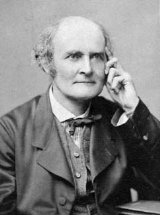
Arthur Cayley

Encyclopedia
Arthur Cayley F.R.S. (16 August 1821 – 26 January 1895) was a British
mathematician
. He helped found the modern British school of pure mathematics
.
As a child, Cayley enjoyed solving complex math problems for amusement. He entered Trinity College, Cambridge
, where he excelled in Greek
, French
, German
, and Italian
, as well as mathematics
. He worked as a lawyer
for 14 years.
He proved the Cayley–Hamilton theorem
—that every square matrix
is a root of its own characteristic polynomial
. He was the first to define the concept of a group
in the modern way—as a set with a binary
operation satisfying certain laws. Formerly, when mathematicians spoke of "groups", they had meant permutation group
s.
See also Cayley's theorem
.
, on 16 August 1821. His father, Henry Cayley, was a distant cousin of Sir George Cayley
the aeronautics
engineer innovator, and descended from an ancient Yorkshire
family. He settled in Saint Petersburg
, Russia
, as a merchant
. His mother
was Maria Antonia Doughty, daughter of William Doughty
. According to some writers she was Russian, but her father's name indicates an English origin. His brother was the linguist Charles Bagot Cayley. Arthur spent his first eight years in Saint Petersburg. In 1829 his parents were settled permanently at Blackheath
, near London. Arthur was sent to a private school. He early showed great liking for, and aptitude in, numerical calculation. At age 14 he was sent to King's College School
. The school's master observed indications of mathematical genius and advised the father to educate his son not for his own business, as he had intended, but to enter the University of Cambridge
.
. The cause of the Analytical Society
had now triumphed, and the Cambridge Mathematical Journal had been instituted by Gregory and Robert Leslie Ellis
. To this journal, at the age of twenty, Cayley contributed three papers, on subjects which had been suggested by reading the Mécanique analytique of Lagrange
and some of the works of Laplace.
Cayley's tutor at Cambridge was George Peacock
and his private coach was William Hopkins
. He finished his undergraduate course by winning the place of Senior Wrangler, and the first Smith's prize
. His next step was to take the M.A. degree, and win a Fellowship by competitive examination. He continued to reside at Cambridge for four years; during which time he took some pupils, but his main work was the preparation of 28 memoirs to the Mathematical Journal.
, Cayley chose law, and at age 25 entered at Lincoln's Inn, London. He made a specialty of conveyancing
. It was while he was a pupil at the bar examination
that he went to Dublin to hear Hamilton
's lectures on quaternion
s.
His friend Sylvester
, his senior by five years at Cambridge, was then an actuary
, resident in London; they used to walk together round the courts of Lincoln's Inn, discussing the theory of invariants and covariants. During this period of his life, extending over fourteen years, Cayley produced between two and three hundred papers.
. Around 1860, certain funds bequeathed by Lady Sadleir to the University, having become useless for their original purpose, were employed to establish another professorship of pure mathematics, called the Sadleirian. The duties of the new professor were defined to be "to explain and teach the principles of pure mathematics and to apply himself to the advancement of that science." To this chair Cayley was elected when 42 years old. He gave up a lucrative practice for a modest salary; but he never regretted the exchange, for the chair at Cambridge enabled him to end the divided allegiance between law and mathematics, and to devote his energies to the pursuit which he liked best. He at once married and settled down in Cambridge. More fortunate than Hamilton in his choice, his home life was one of great happiness. His friend and fellow investigator, Sylvester, once remarked that Cayley had been much more fortunate than himself; that they both lived as bachelors in London, but that Cayley had married and settled down to a quiet and peaceful life at Cambridge; whereas he had never married, and had been fighting the world all his days.
At first the teaching duty of the Sadleirian professorship was limited to a course of lectures extending over one of the terms of the academic year; but when the University was reformed about 1886, and part of the college funds applied to the better endowment of the University professors, the lectures were extended over two terms. For many years the attendance was small, and came almost entirely from those who had finished their career of preparation for competitive examinations; after the reform the attendance numbered about fifteen. The subject lectured on was generally that of the memoir on which the professor was for the time engaged.
The other duty of the chair — the advancement of mathematical science — was discharged in a handsome manner by the long series of memoirs which he published, ranging over every department of pure mathematics. But it was also discharged in a much less obtrusive way; he became the standing referee on the merits of mathematical papers to many societies both at home and abroad.
In 1876 he published a Treatise on Elliptic Functions
, which was his only book. He took great interest in the movement for the University education of women. At Cambridge the women's colleges are Girton and Newnham. In the early days of Girton College he gave direct help in teaching, and for some years he was chairman of the council of Newnham College, in the progress of which he took the keenest interest to the last.
In 1872 he was made an honorary fellow of Trinity College, and three years later an ordinary fellow, which meant stipend as well as honour. About this time his friends subscribed for a presentation portrait. Maxwell
wrote an address to the committee of subscribers who had charge of the Cayley portrait fund. The verses refer to the subjects investigated in several of Cayley's most elaborate memoirs; such as, Chapters on the Analytical Geometry of dimensions; On the theory of Determinant
s; Memoir on the theory of Matrices; Memoirs on skew surfaces, otherwise Scrolls; On the delineation of a Cubic Scroll, etc.
In 1881 he received from the Johns Hopkins University
, Baltimore, where Sylvester was then professor of mathematics, an invitation
to deliver a course of lectures. He accepted the invitation, and lectured at Baltimore during the first five months of 1882 on the
subject of the Abelian and Theta Functions.
s, of which seven appeared under his own editorship. While editing these volumes, he was suffering from a painful internal malady, to which he succumbed on 26 January 1895, in the 74th year of his age. When the funeral took place, a great assemblage met in Trinity Chapel, comprising members of the University, official representatives of Russia and America, and many of the most illustrious philosophers of Britain
.
The remainder of his papers were edited by Prof. Forsyth, his successor in the Sadleirian Chair. The Collected Mathematical papers number thirteen quarto volumes, and contain 967 papers. Cayley retained to the last his fondness for novel-reading and for travelling. He also took special pleasure in paintings and architecture, and he practiced water-color painting
, which he found useful sometimes in making mathematical diagrams.
United Kingdom
The United Kingdom of Great Britain and Northern IrelandIn the United Kingdom and Dependencies, other languages have been officially recognised as legitimate autochthonous languages under the European Charter for Regional or Minority Languages...
mathematician
Mathematician
A mathematician is a person whose primary area of study is the field of mathematics. Mathematicians are concerned with quantity, structure, space, and change....
. He helped found the modern British school of pure mathematics
Pure mathematics
Broadly speaking, pure mathematics is mathematics which studies entirely abstract concepts. From the eighteenth century onwards, this was a recognized category of mathematical activity, sometimes characterized as speculative mathematics, and at variance with the trend towards meeting the needs of...
.
As a child, Cayley enjoyed solving complex math problems for amusement. He entered Trinity College, Cambridge
Trinity College, Cambridge
Trinity College is a constituent college of the University of Cambridge. Trinity has more members than any other college in Cambridge or Oxford, with around 700 undergraduates, 430 graduates, and over 170 Fellows...
, where he excelled in Greek
Greek language
Greek is an independent branch of the Indo-European family of languages. Native to the southern Balkans, it has the longest documented history of any Indo-European language, spanning 34 centuries of written records. Its writing system has been the Greek alphabet for the majority of its history;...
, French
French language
French is a Romance language spoken as a first language in France, the Romandy region in Switzerland, Wallonia and Brussels in Belgium, Monaco, the regions of Quebec and Acadia in Canada, and by various communities elsewhere. Second-language speakers of French are distributed throughout many parts...
, German
German language
German is a West Germanic language, related to and classified alongside English and Dutch. With an estimated 90 – 98 million native speakers, German is one of the world's major languages and is the most widely-spoken first language in the European Union....
, and Italian
Italian language
Italian is a Romance language spoken mainly in Europe: Italy, Switzerland, San Marino, Vatican City, by minorities in Malta, Monaco, Croatia, Slovenia, France, Libya, Eritrea, and Somalia, and by immigrant communities in the Americas and Australia...
, as well as mathematics
Mathematics
Mathematics is the study of quantity, space, structure, and change. Mathematicians seek out patterns and formulate new conjectures. Mathematicians resolve the truth or falsity of conjectures by mathematical proofs, which are arguments sufficient to convince other mathematicians of their validity...
. He worked as a lawyer
Lawyer
A lawyer, according to Black's Law Dictionary, is "a person learned in the law; as an attorney, counsel or solicitor; a person who is practicing law." Law is the system of rules of conduct established by the sovereign government of a society to correct wrongs, maintain the stability of political...
for 14 years.
He proved the Cayley–Hamilton theorem
Cayley–Hamilton theorem
In linear algebra, the Cayley–Hamilton theorem states that every square matrix over a commutative ring satisfies its own characteristic equation....
—that every square matrix
Matrix (mathematics)
In mathematics, a matrix is a rectangular array of numbers, symbols, or expressions. The individual items in a matrix are called its elements or entries. An example of a matrix with six elements isMatrices of the same size can be added or subtracted element by element...
is a root of its own characteristic polynomial
Characteristic polynomial
In linear algebra, one associates a polynomial to every square matrix: its characteristic polynomial. This polynomial encodes several important properties of the matrix, most notably its eigenvalues, its determinant and its trace....
. He was the first to define the concept of a group
Group (mathematics)
In mathematics, a group is an algebraic structure consisting of a set together with an operation that combines any two of its elements to form a third element. To qualify as a group, the set and the operation must satisfy a few conditions called group axioms, namely closure, associativity, identity...
in the modern way—as a set with a binary
Binary function
In mathematics, a binary function, or function of two variables, is a function which takes two inputs.Precisely stated, a function f is binary if there exists sets X, Y, Z such that\,f \colon X \times Y \rightarrow Z...
operation satisfying certain laws. Formerly, when mathematicians spoke of "groups", they had meant permutation group
Permutation group
In mathematics, a permutation group is a group G whose elements are permutations of a given set M, and whose group operation is the composition of permutations in G ; the relationship is often written as...
s.
See also Cayley's theorem
Cayley's theorem
In group theory, Cayley's theorem, named in honor of Arthur Cayley, states that every group G is isomorphic to a subgroup of the symmetric group acting on G...
.
Early years
Arthur Cayley was born in Richmond, London, EnglandEngland
England is a country that is part of the United Kingdom. It shares land borders with Scotland to the north and Wales to the west; the Irish Sea is to the north west, the Celtic Sea to the south west, with the North Sea to the east and the English Channel to the south separating it from continental...
, on 16 August 1821. His father, Henry Cayley, was a distant cousin of Sir George Cayley
George Cayley
Sir George Cayley, 6th Baronet was a prolific English engineer and one of the most important people in the history of aeronautics. Many consider him the first true scientific aerial investigator and the first person to understand the underlying principles and forces of flight...
the aeronautics
Aeronautics
Aeronautics is the science involved with the study, design, and manufacturing of airflight-capable machines, or the techniques of operating aircraft and rocketry within the atmosphere...
engineer innovator, and descended from an ancient Yorkshire
Yorkshire
Yorkshire is a historic county of northern England and the largest in the United Kingdom. Because of its great size in comparison to other English counties, functions have been increasingly undertaken over time by its subdivisions, which have also been subject to periodic reform...
family. He settled in Saint Petersburg
Saint Petersburg
Saint Petersburg is a city and a federal subject of Russia located on the Neva River at the head of the Gulf of Finland on the Baltic Sea...
, Russia
Russia
Russia or , officially known as both Russia and the Russian Federation , is a country in northern Eurasia. It is a federal semi-presidential republic, comprising 83 federal subjects...
, as a merchant
Merchant
A merchant is a businessperson who trades in commodities that were produced by others, in order to earn a profit.Merchants can be one of two types:# A wholesale merchant operates in the chain between producer and retail merchant...
. His mother
Mother
A mother, mum, mom, momma, or mama is a woman who has raised a child, given birth to a child, and/or supplied the ovum that grew into a child. Because of the complexity and differences of a mother's social, cultural, and religious definitions and roles, it is challenging to specify a universally...
was Maria Antonia Doughty, daughter of William Doughty
William Doughty
William Doughty was a United States naval architect who designed many of the sailing 74s.He designed the President, Independence, United States 74s, Peacock class, Erie class, Java and Guerrier, North Carolina 74s class, Brandywine 44s Class, brigs, revenue cutters, and Baltimore Clipper...
. According to some writers she was Russian, but her father's name indicates an English origin. His brother was the linguist Charles Bagot Cayley. Arthur spent his first eight years in Saint Petersburg. In 1829 his parents were settled permanently at Blackheath
Blackheath, London
Blackheath is a district of South London, England. It is named from the large open public grassland which separates it from Greenwich to the north and Lewisham to the west...
, near London. Arthur was sent to a private school. He early showed great liking for, and aptitude in, numerical calculation. At age 14 he was sent to King's College School
King's College School
King's College School, commonly referred to as KCS, King's, or KCS Wimbledon, is an independent school for day pupils in Wimbledon in south-west London. The school was founded as the junior department of King's College London and occupied part of its premises in Strand, before relocating to...
. The school's master observed indications of mathematical genius and advised the father to educate his son not for his own business, as he had intended, but to enter the University of Cambridge
University of Cambridge
The University of Cambridge is a public research university located in Cambridge, United Kingdom. It is the second-oldest university in both the United Kingdom and the English-speaking world , and the seventh-oldest globally...
.
Education
At the unusually early age of 17 Cayley began residence at Trinity College, CambridgeTrinity College, Cambridge
Trinity College is a constituent college of the University of Cambridge. Trinity has more members than any other college in Cambridge or Oxford, with around 700 undergraduates, 430 graduates, and over 170 Fellows...
. The cause of the Analytical Society
Analytical Society
The Analytical Society was a group of individuals in early-19th century Britain whose aim was to promote the use of Leibnizian or analytical calculus as opposed to Newtonian calculus. The latter system came into being in the 18th century as an invention of Sir Isaac Newton, and was in use...
had now triumphed, and the Cambridge Mathematical Journal had been instituted by Gregory and Robert Leslie Ellis
Robert Leslie Ellis
Robert Leslie Ellis was an English polymath, remembered principally as a mathematician and editor of the works of Francis Bacon....
. To this journal, at the age of twenty, Cayley contributed three papers, on subjects which had been suggested by reading the Mécanique analytique of Lagrange
Joseph Louis Lagrange
Joseph-Louis Lagrange , born Giuseppe Lodovico Lagrangia, was a mathematician and astronomer, who was born in Turin, Piedmont, lived part of his life in Prussia and part in France, making significant contributions to all fields of analysis, to number theory, and to classical and celestial mechanics...
and some of the works of Laplace.
Cayley's tutor at Cambridge was George Peacock
George Peacock
George Peacock was an English mathematician.-Life:Peacock was born on 9 April 1791 at Thornton Hall, Denton, near Darlington, County Durham. His father, the Rev. Thomas Peacock, was a clergyman of the Church of England, incumbent and for 50 years curate of the parish of Denton, where he also kept...
and his private coach was William Hopkins
William Hopkins
William Hopkins FRS was an English mathematician and geologist. He is famous as a private tutor of aspiring undergraduate Cambridge mathematicians, earning him the sobriquet the senior-wrangler maker....
. He finished his undergraduate course by winning the place of Senior Wrangler, and the first Smith's prize
Smith's Prize
The Smith's Prize was the name of each of two prizes awarded annually to two research students in theoretical Physics, mathematics and applied mathematics at the University of Cambridge, Cambridge, England.- History :...
. His next step was to take the M.A. degree, and win a Fellowship by competitive examination. He continued to reside at Cambridge for four years; during which time he took some pupils, but his main work was the preparation of 28 memoirs to the Mathematical Journal.
As a lawyer
Because of the limited tenure of his fellowship it was necessary to choose a profession; like De MorganAugustus De Morgan
Augustus De Morgan was a British mathematician and logician. He formulated De Morgan's laws and introduced the term mathematical induction, making its idea rigorous. The crater De Morgan on the Moon is named after him....
, Cayley chose law, and at age 25 entered at Lincoln's Inn, London. He made a specialty of conveyancing
Conveyancing
In law, conveyancing is the transfer of legal title of property from one person to another, or the granting of an encumbrance such as a mortgage or a lien....
. It was while he was a pupil at the bar examination
Bar examination
A bar examination is an examination conducted at regular intervals to determine whether a candidate is qualified to practice law in a given jurisdiction.-Brazil:...
that he went to Dublin to hear Hamilton
William Rowan Hamilton
Sir William Rowan Hamilton was an Irish physicist, astronomer, and mathematician, who made important contributions to classical mechanics, optics, and algebra. His studies of mechanical and optical systems led him to discover new mathematical concepts and techniques...
's lectures on quaternion
Quaternion
In mathematics, the quaternions are a number system that extends the complex numbers. They were first described by Irish mathematician Sir William Rowan Hamilton in 1843 and applied to mechanics in three-dimensional space...
s.
His friend Sylvester
James Joseph Sylvester
James Joseph Sylvester was an English mathematician. He made fundamental contributions to matrix theory, invariant theory, number theory, partition theory and combinatorics...
, his senior by five years at Cambridge, was then an actuary
Actuary
An actuary is a business professional who deals with the financial impact of risk and uncertainty. Actuaries provide expert assessments of financial security systems, with a focus on their complexity, their mathematics, and their mechanisms ....
, resident in London; they used to walk together round the courts of Lincoln's Inn, discussing the theory of invariants and covariants. During this period of his life, extending over fourteen years, Cayley produced between two and three hundred papers.
As professor
At Cambridge University the ancient professorship of pure mathematics is denominated the Lucasian, and is the chair which had been occupied by Isaac NewtonIsaac Newton
Sir Isaac Newton PRS was an English physicist, mathematician, astronomer, natural philosopher, alchemist, and theologian, who has been "considered by many to be the greatest and most influential scientist who ever lived."...
. Around 1860, certain funds bequeathed by Lady Sadleir to the University, having become useless for their original purpose, were employed to establish another professorship of pure mathematics, called the Sadleirian. The duties of the new professor were defined to be "to explain and teach the principles of pure mathematics and to apply himself to the advancement of that science." To this chair Cayley was elected when 42 years old. He gave up a lucrative practice for a modest salary; but he never regretted the exchange, for the chair at Cambridge enabled him to end the divided allegiance between law and mathematics, and to devote his energies to the pursuit which he liked best. He at once married and settled down in Cambridge. More fortunate than Hamilton in his choice, his home life was one of great happiness. His friend and fellow investigator, Sylvester, once remarked that Cayley had been much more fortunate than himself; that they both lived as bachelors in London, but that Cayley had married and settled down to a quiet and peaceful life at Cambridge; whereas he had never married, and had been fighting the world all his days.
At first the teaching duty of the Sadleirian professorship was limited to a course of lectures extending over one of the terms of the academic year; but when the University was reformed about 1886, and part of the college funds applied to the better endowment of the University professors, the lectures were extended over two terms. For many years the attendance was small, and came almost entirely from those who had finished their career of preparation for competitive examinations; after the reform the attendance numbered about fifteen. The subject lectured on was generally that of the memoir on which the professor was for the time engaged.
The other duty of the chair — the advancement of mathematical science — was discharged in a handsome manner by the long series of memoirs which he published, ranging over every department of pure mathematics. But it was also discharged in a much less obtrusive way; he became the standing referee on the merits of mathematical papers to many societies both at home and abroad.
In 1876 he published a Treatise on Elliptic Functions
Elliptic function
In complex analysis, an elliptic function is a function defined on the complex plane that is periodic in two directions and at the same time is meromorphic...
, which was his only book. He took great interest in the movement for the University education of women. At Cambridge the women's colleges are Girton and Newnham. In the early days of Girton College he gave direct help in teaching, and for some years he was chairman of the council of Newnham College, in the progress of which he took the keenest interest to the last.
In 1872 he was made an honorary fellow of Trinity College, and three years later an ordinary fellow, which meant stipend as well as honour. About this time his friends subscribed for a presentation portrait. Maxwell
James Clerk Maxwell
James Clerk Maxwell of Glenlair was a Scottish physicist and mathematician. His most prominent achievement was formulating classical electromagnetic theory. This united all previously unrelated observations, experiments and equations of electricity, magnetism and optics into a consistent theory...
wrote an address to the committee of subscribers who had charge of the Cayley portrait fund. The verses refer to the subjects investigated in several of Cayley's most elaborate memoirs; such as, Chapters on the Analytical Geometry of
dimensions; On the theory of DeterminantDeterminant
In linear algebra, the determinant is a value associated with a square matrix. It can be computed from the entries of the matrix by a specific arithmetic expression, while other ways to determine its value exist as well...
s; Memoir on the theory of Matrices; Memoirs on skew surfaces, otherwise Scrolls; On the delineation of a Cubic Scroll, etc.
In 1881 he received from the Johns Hopkins University
Johns Hopkins University
The Johns Hopkins University, commonly referred to as Johns Hopkins, JHU, or simply Hopkins, is a private research university based in Baltimore, Maryland, United States...
, Baltimore, where Sylvester was then professor of mathematics, an invitation
to deliver a course of lectures. He accepted the invitation, and lectured at Baltimore during the first five months of 1882 on the
subject of the Abelian and Theta Functions.
BMA
In 1883 Cayley was President of the British Association for the Advancement of Science. The meeting was held at Southport, in the north of England. As the President's address is one of the great popular events of the meeting, and brings out an audience of general culture, it is usually made as little technical as possible. took for his subject the Progress of Pure Mathematics.The Collected Papers
In 1889 the Cambridge University Press requested him to prepare his mathematical papers for publication in a collected form—a request which he appreciated very much. They are printed in magnificent quarto volumeBookbinding
Bookbinding is the process of physically assembling a book from a number of folded or unfolded sheets of paper or other material. It usually involves attaching covers to the resulting text-block.-Origins of the book:...
s, of which seven appeared under his own editorship. While editing these volumes, he was suffering from a painful internal malady, to which he succumbed on 26 January 1895, in the 74th year of his age. When the funeral took place, a great assemblage met in Trinity Chapel, comprising members of the University, official representatives of Russia and America, and many of the most illustrious philosophers of Britain
United Kingdom
The United Kingdom of Great Britain and Northern IrelandIn the United Kingdom and Dependencies, other languages have been officially recognised as legitimate autochthonous languages under the European Charter for Regional or Minority Languages...
.
The remainder of his papers were edited by Prof. Forsyth, his successor in the Sadleirian Chair. The Collected Mathematical papers number thirteen quarto volumes, and contain 967 papers. Cayley retained to the last his fondness for novel-reading and for travelling. He also took special pleasure in paintings and architecture, and he practiced water-color painting
Watercolor painting
Watercolor or watercolour , also aquarelle from French, is a painting method. A watercolor is the medium or the resulting artwork in which the paints are made of pigments suspended in a water-soluble vehicle...
, which he found useful sometimes in making mathematical diagrams.
Legacy
- The crater CayleyCayley (crater)Cayley is a small lunar impact crater that is located in a lava-flooded region to the west of Mare Tranquillitatis. It lies to the northwest of the smaller crater De Morgan and the larger D'Arrest. West and slightly north of Cayley is Whewell, a crater of about the same dimensions...
on the MoonMoonThe Moon is Earth's only known natural satellite,There are a number of near-Earth asteroids including 3753 Cruithne that are co-orbital with Earth: their orbits bring them close to Earth for periods of time but then alter in the long term . These are quasi-satellites and not true moons. For more... - Cayley's mousetrapCayley's mousetrapMousetrap is the name of a game introduced by the English mathematician Arthur Cayley. In the game, cards numbered one through n are placed in some random permutation. Then, starting with the left-most card, the player begins counting "1, 2, 3, ...", moving to the next card as they increment...
— a card game