
All Topics  
Joseph Louis Lagrange

 
Joseph Louis Lagrange

   Email Print
   Bookmark   Link


Joseph Louis Lagrange


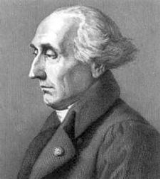
Joseph-Louis Lagrange, born Giuseppe Lodovico Lagrangia (25 January 1736 – 10 April 1813) was an Italian
Italy

Italy , officially the Italian Republic , is a country located on the Italian Peninsula in Southern Europe and on the two largest islands in the Mediterranean Sea, Sicily and Sardinia....
 mathematician
Mathematician

A mathematician is a person whose primary area of study and/or research is the field of mathematics....
 and astronomer
Astronomer

An astronomer is a scientist who studies Celestial body such as planets, stars, and Galaxy.Historically, astronomy was more concerned with the classification and description of phenomena in the sky, while astrophysics attempted to explain these phenomena and the differences between them using physical laws....
, who lived most of his life in Prussia
Prussia

Prussia was, most recently, a historic state originating out of the Duchy of Prussia and the Margraviate of Brandenburg. This state had for centuries substantial influence on Germany and European history....
 and France
France

France , officially the French Republic , is a country whose Metropolitan France is located in Western Europe and that also comprises various Overseas departments and territories of France....
, making significant contributions to all fields of analysis
Mathematical analysis

Mathematical analysis, which mathematicians refer to simply as analysis, has its beginnings in the rigorous formulation of calculus. It is the branch of mathematics most explicitly concerned with the notion of a limit , whether the limit of a sequence or the limit of a function....
, to number theory
Number theory

Number theory is the branch of pure mathematics concerned with the properties of numbers in general, and integers in particular, as well as the wider classes of problems that arise from their study....
, and to classical
Classical mechanics

Classical mechanics is used for describing the motion of macroscopic objects, from projectiles to parts of machinery, as well as astronomical objects, such as spacecraft, planets, stars, and galaxies....
 and celestial mechanics
Celestial mechanics

Celestial mechanics is the branch of astronomy that deals with the motion s of celestial objects. The field applies principles of physics, historically classical mechanics, to astronomical objects such as stars and planets to produce ephemeris data....
. On the recommendation of Euler
Leonhard Euler

Leonhard Paul Euler was a pioneering Swiss mathematician and physicist who spent most of his life in Russia and Germany.Euler made important discoveries in fields as diverse as calculus and graph theory....
 and D'Alembert
Jean le Rond d'Alembert

Jean le Rond d'Alembert was a France mathematician, mechanics, physicist and philosopher. He was also co-editor with Denis Diderot of the Encyclop?die....
, in 1766 Lagrange succeeded Euler as the director of mathematics at the Prussian Academy of Sciences
Prussian Academy of Sciences

The Prussian Academy of Sciences was an academy established in Berlin on 11 July 1700.Prince-elector Frederick I of Prussia of Brandenburg founded the academy under the name of Kurf?rstlich Brandenburgische Societ?t der Wissenschaften upon the advice of Gottfried Leibniz, who was appointed president....
 in Berlin
Berlin

Berlin is the Capital of Germany city and one of sixteen States of Germany of Germany. With a population of 3.4 million within its city limits, Berlin is the country's largest city....
, where he stayed for over twenty years, producing a large body of work and winning several prizes of the French Academy of Sciences
French Academy of Sciences

The French Academy of Sciences is a learned society, founded in 1666 by Louis XIV of France at the suggestion of Jean-Baptiste Colbert, to encourage and protect the spirit of French people Scientific method....
.


Discussion
Ask a question about 'Joseph Louis Lagrange'
Start a new discussion about 'Joseph Louis Lagrange'
Answer questions from other users
Full Discussion Forum


Recent Posts


Quotations


It took them only an instant to cut off that head, but France may not produce another like it in a century.

About the beheading of Antoine Lavoisier


Encyclopedia


Joseph-Louis Lagrange, born Giuseppe Lodovico Lagrangia (25 January 1736 – 10 April 1813) was an Italian
Italy

Italy , officially the Italian Republic , is a country located on the Italian Peninsula in Southern Europe and on the two largest islands in the Mediterranean Sea, Sicily and Sardinia....
 mathematician
Mathematician

A mathematician is a person whose primary area of study and/or research is the field of mathematics....
 and astronomer
Astronomer

An astronomer is a scientist who studies Celestial body such as planets, stars, and Galaxy.Historically, astronomy was more concerned with the classification and description of phenomena in the sky, while astrophysics attempted to explain these phenomena and the differences between them using physical laws....
, who lived most of his life in Prussia
Prussia

Prussia was, most recently, a historic state originating out of the Duchy of Prussia and the Margraviate of Brandenburg. This state had for centuries substantial influence on Germany and European history....
 and France
France

France , officially the French Republic , is a country whose Metropolitan France is located in Western Europe and that also comprises various Overseas departments and territories of France....
, making significant contributions to all fields of analysis
Mathematical analysis

Mathematical analysis, which mathematicians refer to simply as analysis, has its beginnings in the rigorous formulation of calculus. It is the branch of mathematics most explicitly concerned with the notion of a limit , whether the limit of a sequence or the limit of a function....
, to number theory
Number theory

Number theory is the branch of pure mathematics concerned with the properties of numbers in general, and integers in particular, as well as the wider classes of problems that arise from their study....
, and to classical
Classical mechanics

Classical mechanics is used for describing the motion of macroscopic objects, from projectiles to parts of machinery, as well as astronomical objects, such as spacecraft, planets, stars, and galaxies....
 and celestial mechanics
Celestial mechanics

Celestial mechanics is the branch of astronomy that deals with the motion s of celestial objects. The field applies principles of physics, historically classical mechanics, to astronomical objects such as stars and planets to produce ephemeris data....
. On the recommendation of Euler
Leonhard Euler

Leonhard Paul Euler was a pioneering Swiss mathematician and physicist who spent most of his life in Russia and Germany.Euler made important discoveries in fields as diverse as calculus and graph theory....
 and D'Alembert
Jean le Rond d'Alembert

Jean le Rond d'Alembert was a France mathematician, mechanics, physicist and philosopher. He was also co-editor with Denis Diderot of the Encyclop?die....
, in 1766 Lagrange succeeded Euler as the director of mathematics at the Prussian Academy of Sciences
Prussian Academy of Sciences

The Prussian Academy of Sciences was an academy established in Berlin on 11 July 1700.Prince-elector Frederick I of Prussia of Brandenburg founded the academy under the name of Kurf?rstlich Brandenburgische Societ?t der Wissenschaften upon the advice of Gottfried Leibniz, who was appointed president....
 in Berlin
Berlin

Berlin is the Capital of Germany city and one of sixteen States of Germany of Germany. With a population of 3.4 million within its city limits, Berlin is the country's largest city....
, where he stayed for over twenty years, producing a large body of work and winning several prizes of the French Academy of Sciences
French Academy of Sciences

The French Academy of Sciences is a learned society, founded in 1666 by Louis XIV of France at the suggestion of Jean-Baptiste Colbert, to encourage and protect the spirit of French people Scientific method....
. Lagrange's treatise on analytical mechanics
Analytical mechanics

Analytical mechanics is a term used for a refined, highly mathematical form of classical mechanics, constructed from the eighteenth century onwards as a formulation of the subject as founded by Isaac Newton....
 (Mécanique Analytique, 4. ed., 2 vols. Paris: Gauthier-Villars et fils, 1888-89), written in Berlin and first published in 1788, offered the most comprehensive treatment of classical mechanics
Classical mechanics

Classical mechanics is used for describing the motion of macroscopic objects, from projectiles to parts of machinery, as well as astronomical objects, such as spacecraft, planets, stars, and galaxies....
 since Newton
Isaac Newton

Sir Isaac Newton, Fellow of the Royal Society was an English people physicist, mathematician, Astronomy, Natural philosophy, Alchemy, and Theology and one of the the 100 in human history....
 and formed a basis for the development of mathematical physics in the nineteenth century.

Born Giuseppe Lodovico Lagrangia in Turin of Italian parents, Lagrange had French ancestors on his father's side. In 1787 he became a member of the French Academy, and he remained in France until the end of his life. Therefore, Lagrange is alternatively considered a French
France

France , officially the French Republic , is a country whose Metropolitan France is located in Western Europe and that also comprises various Overseas departments and territories of France....
 and an Italian
Italy

Italy , officially the Italian Republic , is a country located on the Italian Peninsula in Southern Europe and on the two largest islands in the Mediterranean Sea, Sicily and Sardinia....
 scientist. Lagrange survived the French Revolution
French Revolution

The French Revolution was a period of political and social upheaval and radical change in the history of France, during which the French governmental structure, previously an absolute monarchy with feudalism for the aristocracy and Roman Catholic Church clergy, underwent radical change to forms based on Age of Enlightenment principles of cit...
 and became the first professor of analysis at the École Polytechnique
École Polytechnique

The ?cole Polytechnique , often referred to by the nickname X, is the foremost France grande ?cole of engineering . Founded in 1794 and initially located in the Quartier Latin in central Paris, it was moved to Palaiseau in 1976....
 upon its opening in 1794. Napoleon named Lagrange to the Legion of Honour and made him a Count
Count

A count is a nobleman in European countries; The word count comes from French language comte, itself from Latin comes?in its Accusative case comitem?meaning "companion", and later "companion of the emperor, delegate of the emperor"....
 of the Empire in 1808. He is buried in the Panthéon
Panthéon, Paris

The Panth?on is a building in the Latin Quarter in Paris, France. It was originally built as a church dedicated to St. Genevieve, but after many changes now combines liturgical functions with its role as a List of cemeteries....
.

Scientific contribution


Lagrange was one of the creators of the calculus of variations
Calculus of variations

Calculus of variations is a field of mathematics that deals with functional , as opposed to ordinary calculus which deals with function . Such functionals can for example be formed as integrals involving an unknown function and its derivatives....
, deriving the Euler–Lagrange equations for extrema of functionals. He also extended the method to take into account possible constraints, arriving at the method of Lagrange multipliers
Lagrange multipliers

In mathematical optimization , the method of Lagrange multipliers provides a strategy for finding the maximum/minimum of a function subject to constraint ....
. Lagrange invented the method of solving differential equation
Differential equation

A differential equation is a mathematics equation for an unknown function of one or several variable that relates the values of the function itself and its derivatives of various orders....
s known as variation of parameters
Method of variation of parameters

In mathematics, variation of parameters also known as variation of constants, is a general method to solve inhomogeneous differential equation linear differential equation ordinary differential equations....
, applied differential calculus
Differential calculus

Differential calculus, a field in mathematics, is the study of how function s change when their inputs change. The primary object of study in differential calculus is the derivative....
 to the theory of probabilities
Probability theory

Probability theory is the branch of mathematics concerned with analysis of Statistical randomness phenomena. The central objects of probability theory are random variables, stochastic processes, and event s: mathematical abstractions of determinism events or measured quantities that may either be single occurrences or evolve over time in an a...
 and attained notable work on the solution of equations
Algebraic equation

In mathematics, an algebraic equation over a given Field is an equation of the formwhere P and Q are polynomials over that field. For example...
. He proved that every natural number is a sum of four squares
Lagrange's four-square theorem

Lagrange's four-square theorem, also known as Bachet's conjecture, was proven in 1770 by Joseph Louis Lagrange. An earlier proof by Fermat was never published....
. His treatise Theorie des fonctions analytiques laid some of the foundations of group theory
Group theory

In mathematics and abstract algebra, group theory studies the algebraic structures known as group .The concept of a group is central to abstract algebra: other well-known algebraic structures, such as ring , field , and vector spaces can all be seen as groups endowed with additional operations and axioms....
, anticipating Galois
Évariste Galois

?variste Galois was a France mathematician born in Bourg-la-Reine. While still in his teens, he was able to determine a Necessary and sufficient conditions for apolynomial to be solvable by Nth root, thereby solving a long-standing problem....
. In calculus
Calculus

Calculus is a branch of mathematics that includes the study of limit , derivatives, integrals, and infinite series, and constitutes a major part of modern university education....
, Lagrange developed a novel approach to interpolation and Taylor series
Taylor series

In mathematics, the Taylor series is a representation of a function as an Series of terms calculated from the values of its derivatives at a single point....
. He studied the three-body problem for the Earth, Sun, and Moon (1764) and the movement of Jupiter’s satellites (1766), and in 1772 found the special-case solutions to this problem that are now known as Lagrangian points. But above all he impressed on mechanics, having transformed Newtonian mechanics into a branch of analysis, Lagrangian mechanics
Lagrangian mechanics

Lagrangian mechanics is a re-formulation of classical mechanics that combines conservation of momentum with conservation of energy. It was introduced by Italy mathematician Lagrange in 1788....
 as it is now called, and exhibited the so-called mechanical "principles" as simple results of the variational calculus.

Biography


Early years


Lagrange was born, of French and Italian descent (a paternal great grandfather was a French army officer who then moved to Turin), as Giuseppe Lodovico Lagrangia in Turin
Turín

Tur?n is a municipality in the Ahuachap?n Department Departments of El Salvador of El Salvador....
. His father, who had charge of the Kingdom of Sardinia
Kingdom of Sardinia

Kingdom of Sardinia, also known as Piedmont-Sardinia or Sardinia-Piedmont, was the name given to the possessions of the House of Savoy in 1720, when the island of Sardinia was awarded by the Treaty of London to Victor Amadeus II of Sardinia to compensate him for the loss of Sicily to Austrian Empire....
's military chest, was of good social position and wealthy, but before his son grew up he had lost most of his property in speculations, and young Lagrange had to rely on his own abilities for his position. He was educated at the college of Turin, but it was not until he was seventeen that he showed any taste for mathematics – his interest in the subject being first excited by a paper by Edmund Halley which he came across by accident. Alone and unaided he threw himself into mathematical studies; at the end of a year's incessant toil he was already an accomplished mathematician, and was made a lecturer in the artillery school.

Variational calculus

Lagrange is one of the founders of calculus of variations
Calculus of variations

Calculus of variations is a field of mathematics that deals with functional , as opposed to ordinary calculus which deals with function . Such functionals can for example be formed as integrals involving an unknown function and its derivatives....
. Starting in 1754, he worked on the problem of tautochrone, discovering a method of maximizing and minimizing functionals in a way similar to finding extrema of functions. Lagrange wrote several letters to Leonhard Euler
Leonhard Euler

Leonhard Paul Euler was a pioneering Swiss mathematician and physicist who spent most of his life in Russia and Germany.Euler made important discoveries in fields as diverse as calculus and graph theory....
 between 1754 and 1756 describing his results. He outlined his "d-algorithm", leading to the Euler–Lagrange equations of variational calculus and considerably simplifying Euler's earlier analysis. Lagrange also applied his ideas to problems of classical mechanics, generalizing the results of Euler and Maupertuis
Pierre Louis Maupertuis

Pierre-Louis Moreau de Maupertuis was a France mathematician, philosopher and man of letters. He became the Director of the Acad?mie des Sciences, and the first President of the Berlin Academy of Science, at the invitation of Frederick the Great....
.

Euler was very impressed with Lagrange's results. It has sometimes been stated that "with characteristic courtesy he withheld a paper he had previously written, which covered some of the same ground, in order that the young Italian might have time to complete his work, and claim the undisputed invention of the new calculus", however, this chivalric view has come to be disputed. Lagrange published his method in two memoirs of the Turin Society in 1762 and 1773.

Miscellanea Taurinensia

In 1758, with the aid of his pupils, Lagrange established a society, which was subsequently incorporated as the Turin Academy of Sciences, and most of his early writings are to be found in the five volumes of its transactions, usually known as the Miscellanea Taurinensia. Many of these are elaborate papers. The first volume contains a paper on the theory of the propagation of sound; in this he indicates a mistake made by Newton
Isaac Newton

Sir Isaac Newton, Fellow of the Royal Society was an English people physicist, mathematician, Astronomy, Natural philosophy, Alchemy, and Theology and one of the the 100 in human history....
, obtains the general differential equation
Differential equation

A differential equation is a mathematics equation for an unknown function of one or several variable that relates the values of the function itself and its derivatives of various orders....
 for the motion, and integrates it for motion in a straight line. This volume also contains the complete solution of the problem of a string vibrating transversely
Vibrating string

A vibration in a strings is a wave. Usually a vibrating string produces a sound whose frequency in most cases is constant. Therefore, since frequency characterizes the Pitch_, the sound produced is a constant note....
; in this paper he points out a lack of generality in the solutions previously given by Brook Taylor
Brook Taylor

Brook Taylor Fellow of the Royal Society was an England mathematician who is best known for Taylor's theorem and the Taylor series....
, D'Alembert
Jean le Rond d'Alembert

Jean le Rond d'Alembert was a France mathematician, mechanics, physicist and philosopher. He was also co-editor with Denis Diderot of the Encyclop?die....
, and Euler, and arrives at the conclusion that the form of the curve at any time t is given by the equation . The article concludes with a masterly discussion of echo
Echo (phenomenon)

In audio signal processing and acoustics, an echo is a Reflection of sound, arriving at the listener some time after the direct sound. Typical examples are the echo produced by the bottom of a well, by a building, or by the walls of an enclosed room....
es, beat
Beat (acoustics)

In acoustics, a beat is an interference between two sounds of slightly different frequency, perceived as periodic variations in volume whose rate is the difference between the two frequencies....
s, and compound sounds. Other articles in this volume are on recurring
Recurrence relation

In mathematics, a recurrence relation is an equation that defines a sequence recursion: each term of the sequence is defined as a Function of the preceding terms....
 series
Series (mathematics)

In mathematics, given an infinite set sequence of numbers , a series is informally the result of adding all those terms together: . These can be written more compactly using the summation symbol ?....
, probabilities
Probability

Probability, or wikt:chance, is a way of expressing knowledge or belief that an Event will occur or has occurred. In mathematics the concept has been given an exact meaning in probability theory, that is used extensively in such areas of study as mathematics, statistics, finance, gambling, science, and philosophy to draw conclusions about t...
, and the calculus of variations
Calculus of variations

Calculus of variations is a field of mathematics that deals with functional , as opposed to ordinary calculus which deals with function . Such functionals can for example be formed as integrals involving an unknown function and its derivatives....
.

The second volume contains a long paper embodying the results of several papers in the first volume on the theory and notation of the calculus of variations; and he illustrates its use by deducing the principle of least action
Principle of least action

In physics, the principle of least action or more accurately principle of stationary action is a variational principle which, when applied to the action of a mechanics system, can be used to obtain the equations of motion for that system....
, and by solutions of various problems in dynamics
Dynamics (mechanics)

In physics the term dynamics customarily refers to the time evolution of physical processes. These processes may be microscopic as in particle physics, kinetic theory, and chemical reactions, or macroscopic as in the predictions of statistical mechanics and nonequilibrium thermodynamics....
.

The third volume includes the solution of several dynamical problems by means of the calculus of variations; some papers on the integral calculus; a solution of Fermat
Pierre de Fermat

Pierre de Fermat was a France lawyer at the Parlement of Toulouse, France, and a mathematician who is given credit for early developments that led to modern calculus....
's problem mentioned above: given an integer n which is not a perfect square
Perfect square

Perfect square may refer to:...
, to find a number x such that x2n + 1 is a perfect square; and the general differential equations of motion for three bodies
N-body problem

The n-body problem is the problem of finding, given the initial positions, masses, and velocities of n bodies, their subsequent motions as determined by classical mechanics, i.e., Newton's laws of motion and gravity....
 moving under their mutual attractions.

The next work he produced was in 1764 on the libration
Libration

In astronomy libration refers to the various orbital conditions which make it possible to see more than 50% of the moon's surface over time, even though the front of the Moon is tidal locking to always face towards Earth....
 of the Moon
Moon

The Moon is Earth's only natural satellite and the List of natural satellites by diameter satellite in the Solar System. The average centre-to-centre distance from the Earth to the Moon is km, about thirty times the diameter of the Earth....
, and an explanation as to why the same face was always turned to the earth, a problem which he treated by the aid of virtual work
Virtual work

Virtual work on a physical system is the mechanical work resulting from either virtual forces acting through a real Displacement or real forces acting through a virtual displacement....
. His solution is especially interesting as containing the germ of the idea of generalized equations of motion, equations which he first formally proved in 1780.

Berlin Academy


Already in 1756 Euler, with support from Maupertuis, made an attempt to bring Lagrange to the Berlin Academy. Later, D'Alambert interfered on Lagrange's behalf with Frederick of Prussia and wrote to Lagrange asking him to leave Turin for a considerably more prestigious position in Berlin. Lagrange turned down both offers, responding in 1765 that

It seems to me that Berlin would not be at all suitable for me while M.Euler is there.


In 1766 Euler left Berlin for Saint Petersburg
Saint Petersburg

Saint Petersburg is a types of inhabited localities in Russia and a federal subjects of Russia of Russia located on the Neva River at the head of the Gulf of Finland on the Baltic Sea....
, and Frederick wrote to Lagrange expressing the wish of "the greatest king in Europe" to have "the greatest mathematician in Europe" resident at his court. Lagrange was finally persuaded and he spent the next twenty years in Prussia
Prussia

Prussia was, most recently, a historic state originating out of the Duchy of Prussia and the Margraviate of Brandenburg. This state had for centuries substantial influence on Germany and European history....
, where he produced not only the long series of papers published in the Berlin and Turin transactions, but his monumental work, the Mécanique analytique. His residence at Berlin commenced with an unfortunate mistake. Finding most of his colleagues married, and assured by their wives that it was the only way to be happy, he married; his wife soon died, but the union was not a happy one.

Lagrange was a favourite of the king, who used frequently to discourse to him on the advantages of perfect regularity of life. The lesson went home, and thenceforth Lagrange studied his mind and body as though they were machines, and found by experiment the exact amount of work which he was able to do without breaking down. Every night he set himself a definite task for the next day, and on completing any branch of a subject he wrote a short analysis to see what points in the demonstrations or in the subject-matter were capable of improvement. He always thought out the subject of his papers before he began to compose them, and usually wrote them straight off without a single erasure or correction.

France


In 1786, Frederick died, and Lagrange, who had found the climate of Berlin trying, gladly accepted the offer of Louis XVI
Louis XVI of France

Louis XVI or Louis-Auguste de France ruled as List of French monarchs of France and of List of Navarrese monarchs from 1774 until 1791, and then as Popular monarchy from 1791 to 1792....
 to migrate to Paris. He received similar invitations from Spain
Spain

Spain or the Kingdom of Spain , is a country located in Southern Europe on the Iberian Peninsula.The Spanish constitution does not establish any official denomination of the country, even though Espa?a , Estado espa?ol and Naci?n espa?ola are used interchangeably....
 and Naples
Naples

Naples is a city in southern Italy, the capital of the region of Campania and of the province of Naples. The city is known for its rich history, art, culture and gastronomy, playing an important role throughout much of its existence; it is over 2,800 years old....
. In France he was received with every mark of distinction and special apartments in the Louvre were prepared for his reception, and he became a member of the French Academy of Sciences
French Academy of Sciences

The French Academy of Sciences is a learned society, founded in 1666 by Louis XIV of France at the suggestion of Jean-Baptiste Colbert, to encourage and protect the spirit of French people Scientific method....
, which later became part of the National Institute. At the beginning of his residence in Paris he was seized with an attack of the melancholy, and even the printed copy of his Mécanique on which he had worked for a quarter of a century lay for more than two years unopened on his desk. Curiosity as to the results of the French revolution
French Revolution

The French Revolution was a period of political and social upheaval and radical change in the history of France, during which the French governmental structure, previously an absolute monarchy with feudalism for the aristocracy and Roman Catholic Church clergy, underwent radical change to forms based on Age of Enlightenment principles of cit...
 first stirred him out of his lethargy, a curiosity which soon turned to alarm as the revolution developed.

It was about the same time, 1792, that the unaccountable sadness of his life and his timidity moved the compassion of a young girl who insisted on marrying him, and proved a devoted wife to whom he became warmly attached. Although the decree of October 1793 that ordered all foreigners to leave France specifically exempted him by name, he was preparing to escape when he was offered the presidency of the commission for the reform of weights and measures. The choice of the units finally selected was largely due to him, and it was mainly owing to his influence that the decimal subdivision was accepted by the commission of 1799. In 1795, Lagrange was one of the founding members of the Bureau des Longitudes
Bureau des Longitudes

The Bureau des Longitudes is a France scientific institution, founded by decree of June 25 1795 and charged with the improvement of nautical navigation, standardisation of time-keeping, geodesy and astronomical observation....
.

Though Lagrange had determined to escape from France while there was yet time, he was never in any danger; and the different revolutionary governments (and at a later time, Napoleon
Napoleon I of France

Napoleon Bonaparte later known as Emperor Napoleon I, was a military and political leader of France whose actions shaped European politics in the early 19th century....
) loaded him with honours and distinctions. A striking testimony to the respect in which he was held was shown in 1796 when the French commissary in Italy was ordered to attend in full state on Lagrange's father, and tender the congratulations of the republic on the achievements of his son, who "had done honour to all mankind by his genius, and whom it was the special glory of Piedmont
Italy

Italy , officially the Italian Republic , is a country located on the Italian Peninsula in Southern Europe and on the two largest islands in the Mediterranean Sea, Sicily and Sardinia....
 to have produced." It may be added that Napoleon, when he attained power, warmly encouraged scientific studies in France, and was a liberal benefactor of them.

École normale

In 1795, Lagrange was appointed to a mathematical chair at the newly-established École normale
École Normale Supérieure

The ?cole normale sup?rieure is a France Grandes ?coles . The ENS was initially conceived during the French Revolution, and intended to provide the First French Republic with a new body of teacher, trained in the critical spirit and secular values of the the Enlightenment....
, which enjoyed only a brief existence of four months. His lectures here were quite elementary, and contain nothing of any special importance, but they were published because the professors had to "pledge themselves to the representatives of the people and to each other neither to read nor to repeat from memory," and the discourses were ordered to be taken down in shorthand in order to enable the deputies to see how the professors acquitted themselves.

École Polytechnique

Lagrange was appointed professor of the École Polytechnique
École Polytechnique

The ?cole Polytechnique , often referred to by the nickname X, is the foremost France grande ?cole of engineering . Founded in 1794 and initially located in the Quartier Latin in central Paris, it was moved to Palaiseau in 1976....
 in 1794; and his lectures there are described by mathematicians who had the good fortune to be able to attend them, as almost perfect both in form and matter. Beginning with the merest elements, he led his hearers on until, almost unknown to themselves, they were themselves extending the bounds of the subject: above all he impressed on his pupils the advantage of always using general methods expressed in a symmetrical notation.

On the other hand, Fourier
Fourier

Fourier may refer to:*Charles Fourier , a French utopian socialist thinker*Joseph Fourier , a French mathematician and physicist**Mathematics, physics, and engineering terms named in his honor for his work on the concepts underlying them:...
, who attended his lectures in 1795, wrote:

His voice is very feeble, at least in that he does not become heated; he has a very pronounced Italian accent and pronounces the s like z … The students, of whom the majority are incapable of appreciating him, give him little welcome, but the professors make amends for it.


Late years
In 1810, Lagrange commenced a thorough revision of the Mécanique analytique, but he was able to complete only about two-thirds of it before his death in 1813. He was buried that same year in the Panthéon
Panthéon, Paris

The Panth?on is a building in the Latin Quarter in Paris, France. It was originally built as a church dedicated to St. Genevieve, but after many changes now combines liturgical functions with its role as a List of cemeteries....
 in Paris. The French inscription on his tomb there reads:
JOSEPH LOUIS LAGRANGE. Senator. Count of the Empire. Grand Officer of the Legion of Honour. Grand Cross of the Imperial Order of Réunion. Member of the Institute and the Bureau of Longitude. Born in Turin on 25 January 1736. Died in Paris on 10 April 1813.


Work in Berlin


Lagrange was scientifically extremely active during twenty years he spent in Berlin. Not only did he produce his splendid Mécanique analytique, but he contributed between one and two hundred papers to the Academy of Turin, the Berlin Academy, and the French Academy. Some of these are really treatises, and all without exception are of a high order of excellence. Except for a short time when he was ill he produced on average about one paper a month. Of these, note the following as amongst the most important.

First, his contributions to the fourth and fifth volumes, 1766–1773, of the Miscellanea Taurinensia; of which the most important was the one in 1771, in which he discussed how numerous astronomical
Astronomy

Astronomy is the science of Astronomical object and Phenomenon that originate outside the Earth's atmosphere . It is concerned with the evolution, physics, chemistry, meteorology, and motion of celestial objects, as well as the physical cosmology....
 observations should be combined so as to give the most probable result. And later, his contributions to the first two volumes, 1784–1785, of the transactions of the Turin Academy; to the first of which he contributed a paper on the pressure exerted by fluids in motion, and to the second an article on integration by infinite series, and the kind of problems for which it is suitable.

Most of the papers sent to Paris were on astronomical questions, and among these one ought to particularly mention his paper on the Jovian
Jovian

Flavius Iovianus, anglicized to Jovian, was a soldier elected Roman Emperor by the army on 27 June 363 upon the death of Emperor Julian the Apostate during his Sassanid Empire campaign....
 system in 1766, his essay on the problem of three bodies in 1772, his work on the secular equation of the Moon in 1773, and his treatise on cometary perturbations in 1778. These were all written on subjects proposed by the Académie française
Académie française

L'Acad?mie fran?aise, or the French Academy, is the pre-eminent France learned body on matters pertaining to the French language. The Acad?mie was officially established in 1635 by Cardinal Richelieu, the chief minister to Louis XIII of France....
, and in each case the prize was awarded to him.

Lagrangian mechanics

Between 1772 and 1788, Lagrange re-formulated Classical/Newtonian mechanics to simplify formulas and ease calculations. These mechanics are called Lagrangian mechanics
Lagrangian mechanics

Lagrangian mechanics is a re-formulation of classical mechanics that combines conservation of momentum with conservation of energy. It was introduced by Italy mathematician Lagrange in 1788....
.

Algebra


The greater number of his papers during this time were, however, contributed to the Prussian Academy of Sciences
Prussian Academy of Sciences

The Prussian Academy of Sciences was an academy established in Berlin on 11 July 1700.Prince-elector Frederick I of Prussia of Brandenburg founded the academy under the name of Kurf?rstlich Brandenburgische Societ?t der Wissenschaften upon the advice of Gottfried Leibniz, who was appointed president....
. Several of them deal with questions in algebra
Algebra

Algebra is a branch of mathematics concerning the study of structure , relation , and quantity. Together with geometry, mathematical analysis, combinatorics, and number theory, algebra is one of the main branches of mathematics....
.

  • His discussion of representations of integers by quadratic form
    Quadratic form

    In mathematics, a quadratic form is a homogeneous polynomial of Degree_ two in a number of variables. For example,is a quadratic form in the variables x and y....
    s (1769) and by more general algebraic forms (1770).
  • His tract on the Theory of Elimination
    Elimination theory

    In commutative algebra and algebraic geometry, elimination theory is the classical name for algorithmic approaches to eliminating between polynomials of several variables....
    , 1770.
  • Lagrange's theorem
    Lagrange's theorem (group theory)

    Lagrange's theorem, in the mathematics of group theory, states that for any finite group G, the order of every subgroup H of G divides the order of G....
     that the order of a subgroup H of a group G must divide the order of G.
  • His papers of 1770 and 1771 on the general process for solving an algebraic equation
    Algebraic equation

    In mathematics, an algebraic equation over a given Field is an equation of the formwhere P and Q are polynomials over that field. For example...
     of any degree via the Lagrange resolvents. This method fails to give a general formula for solutions of an equation of degree five and higher, because the auxiliary equation involved has higher degree than the original one. The significance of this method is that it exhibits the already known formulas for solving equations of second, third, and fourth degrees as manifestations of a single principle. The complete solution of a binomial equation of any degree is also treated in these papers.
  • In 1773, Lagrange considered a functional determinant
    Functional determinant

    In mathematics, if S is a linear operator mapping a function space V to itself, it is possible to define an infinite-dimensional generalization of the determinant in some cases....
     of order 3, a special case of a Jacobian
    Jacobian

    In vector calculus, the Jacobian is shorthand for either the Jacobian matrix or its determinant, the Jacobian determinant.In algebraic geometry the Jacobian of a algebraic curve means the Jacobian variety: a group variety associated to the curve, in which the curve can be embedded....
    . He also proved the expression for the volume
    Volume

    The volume of any solid, liquid, plasma, vacuum or theoretical object is how much three-dimensional space it occupies, often quantified numerically....
     of a tetrahedron
    Tetrahedron

    A tetrahedron is a polyhedron composed of four triangle faces, three of which meet at each vertex . A regular tetrahedron is one in which the four triangles are regular, or "equilateral", and is one of the Platonic solids....
     with one of the vertices at the origin as the one sixth of the absolute value
    Absolute value

    In mathematics, the absolute value of a real number is its numerical value without regard to its Negative and non-negative numbers. So, for example, 3 is the absolute value of both 3 and -3....
     of the determinant
    Determinant

    In algebra, a determinant is a function depending on n that associates a scalar , det, to an n?n square matrix A. The fundamental geometric meaning of a determinant is a scale factor for measure when A is regarded as a linear transformation....
     formed by the coordinates of the other three vertices.


Number Theory


Several of his early papers also deal with questions of number theory.

  • Lagrange (1766–1769) was the first to prove that Pell's equation
    Pell's equation

    Pell's equation is any Diophantine equation of the formwhere n is a Square number integer and x and y are integers. Trivially, x = 1 and y = 0 always solve this equation....
      has a nontrivial solution in the integers for any non-square natural number n.
  • He proved the theorem, stated by Bachet without justification, that every positive integer is the sum of four squares
    Lagrange's four-square theorem

    Lagrange's four-square theorem, also known as Bachet's conjecture, was proven in 1770 by Joseph Louis Lagrange. An earlier proof by Fermat was never published....
    , 1770.
  • He proved Wilson's theorem
    Wilson's theorem

    In mathematics, Wilson's theorem states that p > 1 is a prime number if and only if....
     that if n is a prime, then (n − 1)! + 1 is always a multiple of n, 1771.
  • His papers of 1773, 1775, and 1777 gave demonstrations of several results enunciated by Fermat, and not previously proved.
  • His Recherches d'Arithmétique of 1775 developed a general theory of binary quadratic forms to handle the general problem of when an integer is representable by the form .


Other mathematical work


There are also numerous articles on various points of analytical geometry. In two of them, written rather later, in 1792 and 1793, he reduced the equations of the quadrics
Quadric

In mathematics, a quadric, or quadric surface, is any D-dimensional hypersurface defined as the locus of root of a quadratic polynomial....
 (or conicoids) to their canonical form
Canonical form

Generally, in mathematics, a canonical form of an object is a standard way of presenting that object.Canonical form can also mean a differential form that is defined in a natural way; #Differential forms....
s.

During the years from 1772 to 1785, he contributed a long series of papers which created the science of partial differential equations. A large part of these results were collected in the second edition of Euler's integral calculus which was published in 1794.

He made contributions to the theory of continued fractions.

Astronomy


Lastly, there are numerous papers on problems in astronomy
Astronomy

Astronomy is the science of Astronomical object and Phenomenon that originate outside the Earth's atmosphere . It is concerned with the evolution, physics, chemistry, meteorology, and motion of celestial objects, as well as the physical cosmology....
. Of these the most important are the following:

  • Attempting to solve the three-body problem
    N-body problem

    The n-body problem is the problem of finding, given the initial positions, masses, and velocities of n bodies, their subsequent motions as determined by classical mechanics, i.e., Newton's laws of motion and gravity....
     resulting in the discovery of Lagrangian point
    Lagrangian point

    The Lagrangian points , are the five positions in an orbital configuration where a small object affected only by gravity can theoretically be stationary relative to two larger objects ....
    s, 1772
  • On the attraction of ellipsoids, 1773: this is founded on Maclaurin
    Colin Maclaurin

    Colin Maclaurin was a Scotland mathematician. Due to changes in orthography since that time , his surname is alternatively written MacLaurin....
    's work.
  • On the secular equation of the Moon, 1773; also noticeable for the earliest introduction of the idea of the potential. The potential of a body at any point is the sum of the mass of every element of the body when divided by its distance from the point. Lagrange showed that if the potential of a body at an external point were known, the attraction in any direction could be at once found. The theory of the potential was elaborated in a paper sent to Berlin in 1777.
  • On the motion of the nodes of a planet's orbit
    ORBit

    ORBit is a Common Object Request Broker Architecture 2.4 compliant Object Request Broker . It features mature C , C++ and Python bindings, and less developed bindings for Perl, Lisp , Pascal , Ruby , and Tcl....
    , 1774.
  • On the stability of the planetary orbits, 1776.
  • Two papers in which the method of determining the orbit of a comet
    Comet

    A comet is a Small Solar System body that orbits the Sun and, when close enough to the Sun, exhibits a visible coma or a tail?both primarily from the effects of solar radiation upon the Comet nucleus....
     from three observations is completely worked out, 1778 and 1783: this has not indeed proved practically available, but his system of calculating the perturbations by means of mechanical quadratures has formed the basis of most subsequent researches on the subject.
  • His determination of the secular and periodic variations of the elements
    Orbital elements

    In celestial mechanics, the elements of an orbit are the parameters needed to specify that orbit uniquely. Orbital elements are generally considered in classical mechanics two-body systems, where a Kepler orbit is used ....
     of the planets, 1781-1784: the upper limits assigned for these agree closely with those obtained later by Le Verrier
    Urbain Le Verrier

    Urbain Jean Joseph Le Verrier was a French mathematician who specialized in celestial mechanics and is best known for his part in the discovery of Neptune....
    , and Lagrange proceeded as far as the knowledge then possessed of the masses of the planets permitted.
  • Three papers on the method of interpolation, 1783, 1792 and 1793: the part of finite differences dealing therewith is now in the same stage as that in which Lagrange left it.


Mécanique analytique


Over and above these various papers he composed his great treatise, the Mécanique analytique. In this he lays down the law of virtual work, and from that one fundamental principle, by the aid of the calculus of variations, deduces the whole of mechanics
Mechanics

Mechanics is the branch of physics concerned with the behaviour of physical body when subjected to forces or Displacement , and the subsequent effect of the bodies on their environment....
, both of solids and fluids.

The object of the book is to show that the subject is implicitly included in a single principle, and to give general formulae from which any particular result can be obtained. The method of generalized co-ordinates by which he obtained this result is perhaps the most brilliant result of his analysis. Instead of following the motion of each individual part of a material system, as D'Alembert and Euler had done, he showed that, if we determine its configuration by a sufficient number of variables whose number is the same as that of the degrees of freedom possessed by the system, then the kinetic and potential energies of the system can be expressed in terms of those variables, and the differential equations of motion thence deduced by simple differentiation. For example, in dynamics of a rigid system he replaces the consideration of the particular problem by the general equation, which is now usually written in the form

T for the Kinetic energy and V for the Potential energy. Amongst other minor theorems here given it may mention the proposition that the kinetic energy imparted by the given impulses to a material system under given constraints is a maximum, and the principle of least action
Principle of least action

In physics, the principle of least action or more accurately principle of stationary action is a variational principle which, when applied to the action of a mechanics system, can be used to obtain the equations of motion for that system....
. All the analysis is so elegant that Sir William Rowan Hamilton
William Rowan Hamilton

Sir William Rowan Hamilton was an Ireland physicist, astronomer, and mathematician, who made important contributions to classical mechanics, optics, and algebra....
 said the work could only be described as a scientific poem. It may be interesting to note that Lagrange remarked that mechanics was really a branch of pure mathematics analogous to a geometry of four dimensions, namely, the time and the three coordinates of the point in space; and it is said that he prided himself that from the beginning to the end of the work there was not a single diagram. At first no printer could be found who would publish the book; but Legendre at last persuaded a Paris firm to undertake it, and it was issued under his supervision in 1788.

An important contribution to fluid mechanics was the concept of "potential flow", often associated, wrongly, with the notion of ideal, inviscid fluid. The original development of Joseph-Louis Lagrange (1781) introduced the velocity potential for real fluid flows, provided that the resultant of the forces derives from a potential. In the same article, Lagrange also presented the concept of stream function and the equation of the celerity of a small disturbance in shallow-water. Lagrange's contribution in 1781 was outstanding and was truly ahead of its time.

Work in France


Differential calculus and calculus of variations


Lagrange's lectures on the differential calculus
Differential calculus

Differential calculus, a field in mathematics, is the study of how function s change when their inputs change. The primary object of study in differential calculus is the derivative....
 at École Polytechnique form the basis of his treatise Théorie des fonctions analytiques, which was published in 1797. This work is the extension of an idea contained in a paper he had sent to the Berlin papers in 1772, and its object is to substitute for the differential calculus a group of theorems based on the development of algebraic functions in series. A somewhat similar method had been previously used by John Landen
John Landen

John Landen was an England mathematician,He was born at Peakirk near Peterborough in Northamptonshire, and died at Milton, Northamptonshire in the same county....
 in the Residual Analysis, published in London in 1758. Lagrange believed that he could thus get rid of those difficulties, connected with the use of infinitely large and infinitely small quantities, to which philosophers objected in the usual treatment of the differential calculus. The book is divided into three parts: of these, the first treats of the general theory of functions, and gives an algebraic proof of Taylor's theorem
Taylor's theorem

In calculus, Taylor's theorem gives a sequence of approximations of a differentiable function around a given point by polynomials whose coefficients depend only on the derivatives of the function at that point....
, the validity of which is, however, open to question; the second deals with applications to geometry; and the third with applications to mechanics. Another treatise on the same lines was his Leçons sur le calcul des fonctions, issued in 1804, with the second edition in 1806. It is in this book that Lagrange formulated his celebrated method of Lagrange multipliers
Lagrange multipliers

In mathematical optimization , the method of Lagrange multipliers provides a strategy for finding the maximum/minimum of a function subject to constraint ....
, in the context of problems of variational calculus with integral constraints. These works devoted to differential calculus and calculus of variations may be considered as the starting point for the researches of Cauchy, Jacobi
Carl Gustav Jakob Jacobi

Carl Gustav Jacob Jacobi was a Prussian mathematician, widely considered to be the most inspiring teacher of his time and one of the greatest mathematicians of all time ....
, and Weierstrass
Karl Weierstrass

Karl Theodor Wilhelm Weierstrass was a Germany mathematics who is often cited as the "father of modern mathematical analysis"....
.

Infinitesimals


At a later period Lagrange reverted to the use of infinitesimal
Infinitesimal

Infinitesimals have been used to express the idea of objects so small that there is no way to see them or to measure them. For everyday life, an infinitesimal object is an object which is smaller than any possible measure....
s in preference to founding the differential calculus on the study of algebraic forms; and in the preface to the second edition of the Mécanique, which was issued in 1811, he justifies the employment of infinitesimals, and concludes by saying that:

When we have grasped the spirit of the infinitesimal method, and have verified the exactness of its results either by the geometrical method of prime and ultimate ratios, or by the analytical method of derived functions, we may employ infinitely small quantities as a sure and valuable means of shortening and simplifying our proofs.


Continued fractions


His Résolution des équations numériques, published in 1798, was also the fruit of his lectures at École Polytechnique. There he gives the method of approximating to the real roots of an equation by means of continued fraction
Continued fraction

In mathematics, a continued fraction is an expression such aswhere a0 is an integer and all the other numbers ai are positive integers....
s, and enunciates several other theorems. In a note at the end he shows how Fermat's little theorem
Fermat's little theorem

Fermat's little theorem states that if is a prime number, then for any integer , will be evenly divisible by . This can be expressed in the notation of modular arithmetic as follows:...
 that

ap−1 − 1 = 0 (mod p)


where p is a prime and a is prime to p, may be applied to give the complete algebraic solution of any binomial equation. He also here explains how the equation whose roots are the squares of the differences of the roots of the original equation may be used so as to give considerable information as to the position and nature of those roots.

The theory of the planetary motions had formed the subject of some of the most remarkable of Lagrange's Berlin papers. In 1806 the subject was reopened by Poisson, who, in a paper read before the French Academy, showed that Lagrange's formulae led to certain limits for the stability of the orbits. Lagrange, who was present, now discussed the whole subject afresh, and in a letter communicated to the Academy in 1808 explained how, by the variation of arbitrary constants, the periodical and secular inequalities of any system of mutually interacting bodies could be determined.

Prizes and distinctions


Euler proposed Lagrange for election to the Berlin Academy and he was elected on 2 September 1756. He was elected a Fellow of the Royal Society of Edinburgh
Royal Society of Edinburgh

The Royal Society of Edinburgh is Scotland's national academy of science and letters. The membership consists of over 1400 peer-elected fellows, who are known as Fellows of the Royal Society of Edinburgh, denoted FRSE in official titles....
 in 1790, and a Fellow of the Royal Society
Royal Society

The Royal Society of London for the Improvement of Natural Knowledge, known simply as the Royal Society, or even the Royal, is a learned society for science that was founded in 1660 and is considered by most to be the oldest such society still in existence....
 in 1791. In 1808, Napoleon made Lagrange a Grand Officer of the Legion of Honour and a Comte
Comté

Comt? is a French word that can refer to:* The territory ruled by a count in medieval France * Comt? , a famous French cheese from Franche-Comt?...
 of the Empire. He was awarded the Grand Croix of the Ordre Impérial de la Réunion in 1813, a week before his death in Paris.

Lagrange was awarded the 1764 prize of the French Academy of Sciences
French Academy of Sciences

The French Academy of Sciences is a learned society, founded in 1666 by Louis XIV of France at the suggestion of Jean-Baptiste Colbert, to encourage and protect the spirit of French people Scientific method....
 for his memoir on the libration
Libration

In astronomy libration refers to the various orbital conditions which make it possible to see more than 50% of the moon's surface over time, even though the front of the Moon is tidal locking to always face towards Earth....
 of the Moon. In 1766 the Academy proposed a problem of the motion of the satellites of Jupiter, and the prize again was awarded to Lagrange. He also won the prizes of 1772, 1774, and 1778.

Lagrange is one of the 72 prominent French scientists who were commemorated on plaques at the first stage of the Eiffel Tower
Eiffel Tower

The Eiffel Tower is an Puddle iron tower built on the Champ de Mars beside the Seine River in Paris. The tower has become a global Cultural icon of France and is one of the most recognizable structures in the world....
 when it first opened. Rue Lagrange in the 5th Arrondissement in Paris is named after him. In Turin, the street where the house of his birth still stands is named via Lagrange. The lunar crater Lagrange
Lagrange (crater)

Lagrange is a Moon Impact crater that is attached to the northwestern rim of the crater Piazzi . It lies near the southwestern limb of the Moon, and the appearance is oblong due to foreshortening....
 also bears his name.

Apocrypha


  • He was of medium height and slightly formed, with pale blue eyes and a colorless complexion. He was nervous and timid, he detested controversy, and, to avoid it, willingly allowed others to take credit for what he had done himself.


  • It is said that he was able to write out his papers complete without a single correction required.


See also


Lagrangian

  • Lagrangian
    Lagrangian

    The Lagrangian, , of a dynamical system is a function that summarizes the dynamics of the system. It is named after Joseph Louis Lagrange. The concept of a Lagrangian was originally introduced in a reformulation of classical mechanics known as Lagrangian mechanics....
  • Lagrangian analysis
    Lagrangian analysis

    Lagrangian analysis is application of Lagrangian mechanics to analysis of various phenomena.Lagrangian analysis may be used to analyze current s and flows of various materials by analyzing data collected from gauges/sensors embedded in the material which freely move with the motion of the material....
  • Lagrangian coordinates
  • Lagrangian derivative
  • Lagrangian drifter
    Lagrangian drifter

    Lagrangian drifters are drifter s designed to aid the Lagrangian analysis of water currents Numerous types of drifters are designed with constructions particularly suited for particular areas of application: coastal currents, deep water/shallow water currents, etc....
  • Lagrangian foliation
    Lagrangian foliation

    In mathematics, a Lagrangian foliation or polarization is a foliation of a symplectic manifold. It is one of the steps involved in the geometric quantization of a square-integrable functions on a symplectic manifold....
  • Lagrangian Grassmannian
    Lagrangian Grassmannian

    In mathematics, the Lagrangian Grassmannian is the smooth manifold of Lagrangian subspaces of a real symplectic vector space V. Its dimension is n/2 ....
  • Lagrangian intersection Floer homology
    Floer homology

    Floer homology is a mathematical tool used in the study of symplectic geometry and low-dimensional topology. First introduced by Andreas Floer in his proof of the Arnold conjecture in symplectic geometry, Floer homology is a novel homology theory arising as an infinite dimensional analog of finite dimensional Morse homology....
  • Lagrangian mechanics
    Lagrangian mechanics

    Lagrangian mechanics is a re-formulation of classical mechanics that combines conservation of momentum with conservation of energy. It was introduced by Italy mathematician Lagrange in 1788....
  • Lagrangian mixing
    CLaMS

    CLaMS is a modular chemistry transport model system developed at J?lich Research Centre, Germany. CLaMS was first described by McKenna et al and was expanded into three dimensions by Konopka et al ....
  • Lagrangian point
    Lagrangian point

    The Lagrangian points , are the five positions in an orbital configuration where a small object affected only by gravity can theoretically be stationary relative to two larger objects ....
  • Lagrangian relaxation
    Lagrangian relaxation

    Lagrangian relaxation is a Relaxation technique which works by moving hard constraints into the objective so as to exact a penalty on the objective if they are not satisfied....
  • Lagrangian submanifold
  • Lagrangian subspace
  • Nonlocal Lagrangian
    Nonlocal Lagrangian

    In field theory , a nonlocal Lagrangian is a Lagrangian, a type of functional which contains terms which are nonlocal in the fields i.e. which are not polynomials or functions of the fields or their derivatives evaluated at a single point in the space of dynamical parameters ....
  • Proca lagrangian
  • Special Lagrangian submanifold


Lagrange

  • Green-Lagrange strain
  • Lagrange bracket
    Lagrange bracket

    Lagrange brackets are certain expressions closely related to Poisson brackets that were introduced by Joseph Louis Lagrange in 1808?1810 for the purposes of mathematical formulation of classical mechanics, but unlike the Poisson brackets, have fallen out of use....
  • Lagrange-d'Alembert principle
  • Lagrange error bound
  • Lagrange form
    Rigid rotor

    The rigid rotor is a mechanical model that is used to explain rotating systems.An arbitrary rigid rotor is a 3-dimensional rigid object, such as a top....
  • Lagrange invariant
    Lagrange invariant

    In optics the Lagrange invariant is a measure of the light propagating through an optical system. It is defined by,where y and u are the marginal ray height and angle respectively, and ? and u are the chief ray height and angle....
  • Lagrange inversion theorem
    Lagrange inversion theorem

    In mathematical analysis, the Lagrange inversion theorem, also known as the Lagrange-B?rmann formula, gives the Taylor series expansion of the inverse function of an analytic function....
  • Lagrange multipliers
    Lagrange multipliers

    In mathematical optimization , the method of Lagrange multipliers provides a strategy for finding the maximum/minimum of a function subject to constraint ....
  • Lagrange number
    Lagrange number

    In mathematics, the Lagrange numbers are a sequence of numbers that appear in bounds relating to the approximation of irrational numbers by rational numbers....
  • Lagrange Point Colonization
    Lagrange Point Colonization

    Lagrange Point Colonization is the colonization of the five equilibrium points in the orbit of a planet or moon its primary, called Lagrange points....
  • Lagrange polynomial
    Lagrange polynomial

    In numerical analysis, a Lagrange polynomial, named after Joseph Louis Lagrange, is the polynomial interpolation for a given set of data points in the Lagrange form....
    s
  • Lagrange property
    Moufang loop

    In mathematics, a Moufang loop is a special kind of algebraic structure. It is similar to a group in many ways but need not be associative. Moufang loops were introduced by Ruth Moufang....
  • Lagrange reversion theorem
    Lagrange reversion theorem

    In mathematics, the Lagrange reversion theorem gives Series or formal power series expansions of certain implicitly defined functions; indeed, of compositions with such functions....


Lagrange's

  • Lagrange's approximation theorem
  • Lagrange's equation
  • Lagrange's formula
    Lagrange's formula

    Lagrange's formula may refer to a number of results named after Joseph Louis Lagrange:*Lagrange's interpolation formula - Lagrange polynomial*Lagrange-B?rmann formula - Lagrange inversion theorem...
  • Lagrange's identity
    Lagrange's identity

    In algebra, Lagrange's identity is the identitywhich applies to any two sets and of real number or complex numbers . This identity is a special form of the Binet?Cauchy identity....
  • Lagrange's theorem
    Lagrange's theorem

    In mathematics, Lagrange's theorem usually refers to any of the following theorems, attributed to Joseph Louis Lagrange:* Lagrange's theorem ...
  • Lagrange's four-square theorem
    Lagrange's four-square theorem

    Lagrange's four-square theorem, also known as Bachet's conjecture, was proven in 1770 by Joseph Louis Lagrange. An earlier proof by Fermat was never published....


Non-mathematical

  • Lagrange (crater)
    Lagrange (crater)

    Lagrange is a Moon Impact crater that is attached to the northwestern rim of the crater Piazzi . It lies near the southwestern limb of the Moon, and the appearance is oblong due to foreshortening....


External links

  • Lagrange's works (in French) (Mécanique analytique is in volumes 11 and 12.)