

Jang Yeong-sil

Encyclopedia
Jang Yeong-sil was a prominent Korean scientist
and astronomer
during the Joseon Dynasty
(1392-1910). Although Jang was born as a peasant, King Sejong's (r. 1418–1450) new policy of breaking class barriers placed on the national civil service allowed Jang to work at the royal palace. Jang's inventions, such as the Cheugugi
(the rain gauge
) and the water gauge, highlight the technological advancements of the Joseon Dynasty.
. There are many historical records about his elder brother, Jang Seong-bal, who was born in 1344 and his grave located at Ui-seong in the province of Gyeongbuk. The Annals state that his mother was a gwangi (gisaeng), thereby their (Yeong-sil's and their mother) social status was a gwanno
, (a servant in civil service district courts). Yeong-sil's talent was so excellent that he was sent to the royal court. From above, we may infer that Yeong-sil was born in a family of high official status but when General Yi Song-gye
unleashed a coup d'état, which gave rise ot the Joseon Dynasty, Jang Seong-hwi became a political prisoner and Yeong-sil and his mother became gwannos.
instituted a policy of selecting officials based on their talent, not by their wealth nor social class. Jang's fame gained him entry into the royal court at Hanseong (present day Seoul
), where selected commoners displayed their talents before the king and his advisers. Sejong saw that Jang met his expectations in crafts and engineering, and allowed Jang to work as a government official in the palace. The talented scientists recruited under King Sejong's new program worked at the Hall of Worthies
(집현전; 集賢殿; Jiphyeonjeon).
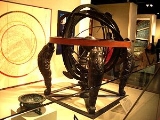
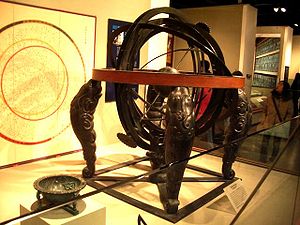 Sejong's first assignment to Jang was to build a celestial globe to measure astronomical objects. Books obtained from Arabian and Chinese scholars were not complete in their instructions, for these devices could also be used for military purposes. After two months of study, he made a spherical device that could perform with mediocre accuracy. One year after his first attempt, in 1433, Young Sil made the honcheonui (혼천의, 渾天儀). Honcheonui depended on a waterwheel to rotate the internal globe to indicate time. Whether day or night, this allowed the instrument to be updated on the positions of the sun, moon, and the stars. Later celestial globes (i.e. gyupyo (규표)) could measure time changes according to the seasonal variations. These instruments, along with the sundials and water clocks, were stationed around the Kyonghoeru Pond in Kyongbok Palace and made into use by the astronomers. The success of Jang Yeong-sil's astronomical machines was marked in 1442 AD when the Korean astronomers compiled their computations on the courses of the seven heavenly objects (five visible planets, the sun, and moon) in Chiljeongsan (칠정산).
(최윤의) invented the world's first metal printing
press in 1234 during the Goryeo
Dynasty, Johann Gutenberg is recognized worldwide as the first to pioneer this technology. In general, metal movable type printing blocks surpassed the wooden counterparts in durability, clarity, and longevity. Even then, the king asked the scientists at Jiphyeonjeon to build a better printing press. In 1434, the scientists accomplished in building Gabinja (갑인자, 甲寅字), which was made of copper-zinc and lead-tin alloys. It was said to be twice as fast as the previous printing presses and print the Chinese character
s in astounding beauty and clarity. Gabinja was reproduced six times during the next 370 years.
 Self-striking water clocks had already been invented by the Arabians and the Chinese (in 1091), and a more primitive form was in use by the Koreans. Although it is believed, Samguk Sagi
records that an office overseeing the use of water clocks had been established during the Three Kingdoms Period
. The Korean version consisted of two stacked jars of water, with water dropping from the top to the bottom at a measured rate. The level of the water indicated the time of the day. This was very inconvenient because a person had to be always be on guard, so that at each hour he or she could bang a drum to inform the public.
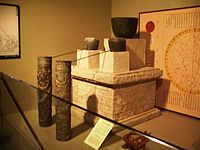
Upon hearing about the usage of self-striking water clocks in foreign countries, Sejong assigned Jang and other scientists to build a clock emulating such automatic devices. They failed in developing an operational water clock. Therefore, Jang went to China to study the various designs of water clocks. When he returned in 1434, Jang created Korea's first water clock, Jagyeokru (자격루). This water clock did not survive; however, reconstructions of the Jagyeokru based on text descriptions have been made.
Circling the clock were 12 wooden figures that served as indicators of time. There were four water containers, 2 jars that received the water, and 12 arrows floating inside the lower container. As the water from the upper containers seeped down the pipe to the lower container, one of the arrows would tilt a board filled with small iron balls; a ball would roll down a pipe to a container of larger iron balls. The collision would cause the larger balls to travel down a lower pipe and hit a giant cymbal, announcing the time to the community. Then, the ball would land on another container, which is part of a complex of levers and pulleys that activates the motions of the wooden figures to indicate time visually.
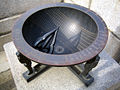 Jang's invention of the water clock saw its infusion throughout the country. Yet, these were very costly, and the cheaper and more manageable alternative came about to be the sundial. Jang, Ichun, Kimjo, and other scientists made Korea's first sundial, Angbu Ilgu (앙부일구) (仰釜日晷), which meant "pot-shaped sun clock staring at the sky". Angbu Ilgu was bronze in composition, and consisted of a bowl marked with 13 meters to indicate time and four legs jointed by a cross at the base. 7 lines crossed the 13 meters in different curves to compensate for the seasonal changes of the course of the sun
. Angbu Ilgu and other variants, such as the Hyunjoo Ilgu and the Chunpyung Ilgu, were implemented in strategic spots, such as the main streets with heavy traffic, so that the people could be well informed of the time. To compensate for the high illiteracy rate among the commoners, 12 shapes of animals, such as mouse, tiger, and cow, were engraved in juxtaposition with the meters. No extant Joseon Dynasty
sundials today were made during King Sejong's reign, none known to have survived past Imjin wars (임진왜란).
province, where he had spent his earlier life, to develop metal alloys for various weapons and tools. Since Jang used to be a gwan-no, he had already acquired much knowledge about metal working and also knew the geography of the area. Jang surveyed the available metals and their characteristics, and presented his research to king and the generals, contributing to the development of Korean weaponry.
was agriculturally based and was vulnerable to elongated or consecutively occurring droughts. Therefore, there was a need for better ways to manage water. Although rain gauges had been used in ancient Greece and India, Jang invented Korea's first rain gauge
in 1441, called cheokugye (측우기), and, by 1442, a standardized rain gauge with dimensions of 42.5 cm (height) and 17 cm (diameter) was introduced throughout the country to gather data on the yearly averages of precipitation throughout the different regions of the country.
's society was rooted in Korean Confucianism
, scientists and engineers were held in low esteem in parallel with craftsmen.
In 1442, King Sejong ordered Jang to build a gama, an elaborately decorated Korean sedan chair
. The gama broke while the king was traveling, and Jang was held responsible. Although the king was against the decree, Jang was jailed for a long time, and was expelled from the royal palace. Later events of his life, including the date of his death, were not recorded.
Scientist
A scientist in a broad sense is one engaging in a systematic activity to acquire knowledge. In a more restricted sense, a scientist is an individual who uses the scientific method. The person may be an expert in one or more areas of science. This article focuses on the more restricted use of the word...
and astronomer
Astronomer
An astronomer is a scientist who studies celestial bodies such as planets, stars and galaxies.Historically, astronomy was more concerned with the classification and description of phenomena in the sky, while astrophysics attempted to explain these phenomena and the differences between them using...
during the Joseon Dynasty
Joseon Dynasty
Joseon , was a Korean state founded by Taejo Yi Seong-gye that lasted for approximately five centuries. It was founded in the aftermath of the overthrow of the Goryeo at what is today the city of Kaesong. Early on, Korea was retitled and the capital was relocated to modern-day Seoul...
(1392-1910). Although Jang was born as a peasant, King Sejong's (r. 1418–1450) new policy of breaking class barriers placed on the national civil service allowed Jang to work at the royal palace. Jang's inventions, such as the Cheugugi
Cheugugi
Cheugugiis the world first rain gauge which is invented and utilized by Joseon Dynasty of Korea...
(the rain gauge
Rain gauge
A rain gauge is a type of instrument used by meteorologists and hydrologists to gather and measure the amount of liquid precipitation over a set period of time....
) and the water gauge, highlight the technological advancements of the Joseon Dynasty.
Early years
Jang Yeong-sil's birth is recorded only in the genealogy of the Jang family and in the Annals of the Joseon Dynasty. According to these records, his father, Jang Seong-hwi, was the 8th generation of the Jang family who came from China. Jang Seong-hwi was the 3rd of 5 brothers and all of the brothers previously were ministers of GoryeoGoryeo
The Goryeo Dynasty or Koryŏ was a Korean dynasty established in 918 by Emperor Taejo. Korea gets its name from this kingdom which came to be pronounced Korea. It united the Later Three Kingdoms in 936 and ruled most of the Korean peninsula until it was removed by the Joseon dynasty in 1392...
. There are many historical records about his elder brother, Jang Seong-bal, who was born in 1344 and his grave located at Ui-seong in the province of Gyeongbuk. The Annals state that his mother was a gwangi (gisaeng), thereby their (Yeong-sil's and their mother) social status was a gwanno
Cheonmin
Cheonmin, or "vulgar commoners," were the lowest caste of commoners in dynastical Korea. They abounded during the Goryeo and Joseon periods of Korea's agrarian bureaucracy. Like the caste system in India, this social class was largely hereditary and based on certain professions considered...
, (a servant in civil service district courts). Yeong-sil's talent was so excellent that he was sent to the royal court. From above, we may infer that Yeong-sil was born in a family of high official status but when General Yi Song-gye
Taejo of Joseon
Taejo of Joseon , born Yi Seong-gye, whose changed name is Yi Dan, was the founder and the first king of the Joseon Dynasty of Korea, and the main figure in overthrowing the Goryeo Dynasty...
unleashed a coup d'état, which gave rise ot the Joseon Dynasty, Jang Seong-hwi became a political prisoner and Yeong-sil and his mother became gwannos.
National civil service
King Sejong the GreatSejong the Great of Joseon
Sejong the Great was the fourth king of the Joseon Dynasty of Korea. During his regency, he reinforced Korean Confucian policies and executed major legal amendments . He also used the creation of Hangul and the advancement of technology to expand his territory...
instituted a policy of selecting officials based on their talent, not by their wealth nor social class. Jang's fame gained him entry into the royal court at Hanseong (present day Seoul
Seoul
Seoul , officially the Seoul Special City, is the capital and largest metropolis of South Korea. A megacity with a population of over 10 million, it is the largest city proper in the OECD developed world...
), where selected commoners displayed their talents before the king and his advisers. Sejong saw that Jang met his expectations in crafts and engineering, and allowed Jang to work as a government official in the palace. The talented scientists recruited under King Sejong's new program worked at the Hall of Worthies
Hall of Worthies
The Hall of Worthies or Jiphyeonjeon ' was set up by Sejong the Great of the Korean Joseon Dynasty in 1420. It consisted of scholars selected by the king....
(집현전; 集賢殿; Jiphyeonjeon).
Astronomical Instruments
Iron printing press
Although Choe Yun-uiChoe Yun-ui
Choe Yun-ui was a Korean civil minister during the Goryeo Dynasty. Choe Yun-ui compiled the Sangjeong yemun with another 16 scholars. They collected all courtesies from ancient to present and published 50 copies....
(최윤의) invented the world's first metal printing
Printing
Printing is a process for reproducing text and image, typically with ink on paper using a printing press. It is often carried out as a large-scale industrial process, and is an essential part of publishing and transaction printing....
press in 1234 during the Goryeo
Goryeo
The Goryeo Dynasty or Koryŏ was a Korean dynasty established in 918 by Emperor Taejo. Korea gets its name from this kingdom which came to be pronounced Korea. It united the Later Three Kingdoms in 936 and ruled most of the Korean peninsula until it was removed by the Joseon dynasty in 1392...
Dynasty, Johann Gutenberg is recognized worldwide as the first to pioneer this technology. In general, metal movable type printing blocks surpassed the wooden counterparts in durability, clarity, and longevity. Even then, the king asked the scientists at Jiphyeonjeon to build a better printing press. In 1434, the scientists accomplished in building Gabinja (갑인자, 甲寅字), which was made of copper-zinc and lead-tin alloys. It was said to be twice as fast as the previous printing presses and print the Chinese character
Chinese character
Chinese characters are logograms used in the writing of Chinese and Japanese , less frequently Korean , formerly Vietnamese , or other languages...
s in astounding beauty and clarity. Gabinja was reproduced six times during the next 370 years.
Water clock
Samguk Sagi
Samguk Sagi is a historical record of the Three Kingdoms of Korea: Goguryeo, Baekje and Silla. The Samguk Sagi is written in Classical Chinese and its compilation was ordered by Goryeo's King Injong Samguk Sagi (History of the Three Kingdoms) is a historical record of the Three Kingdoms of...
records that an office overseeing the use of water clocks had been established during the Three Kingdoms Period
Three Kingdoms of Korea
The Three Kingdoms of Korea refer to the ancient Korean kingdoms of Goguryeo, Baekje and Silla, which dominated the Korean peninsula and parts of Manchuria for much of the 1st millennium...
. The Korean version consisted of two stacked jars of water, with water dropping from the top to the bottom at a measured rate. The level of the water indicated the time of the day. This was very inconvenient because a person had to be always be on guard, so that at each hour he or she could bang a drum to inform the public.
Upon hearing about the usage of self-striking water clocks in foreign countries, Sejong assigned Jang and other scientists to build a clock emulating such automatic devices. They failed in developing an operational water clock. Therefore, Jang went to China to study the various designs of water clocks. When he returned in 1434, Jang created Korea's first water clock, Jagyeokru (자격루). This water clock did not survive; however, reconstructions of the Jagyeokru based on text descriptions have been made.
Circling the clock were 12 wooden figures that served as indicators of time. There were four water containers, 2 jars that received the water, and 12 arrows floating inside the lower container. As the water from the upper containers seeped down the pipe to the lower container, one of the arrows would tilt a board filled with small iron balls; a ball would roll down a pipe to a container of larger iron balls. The collision would cause the larger balls to travel down a lower pipe and hit a giant cymbal, announcing the time to the community. Then, the ball would land on another container, which is part of a complex of levers and pulleys that activates the motions of the wooden figures to indicate time visually.
Sundial
Sun
The Sun is the star at the center of the Solar System. It is almost perfectly spherical and consists of hot plasma interwoven with magnetic fields...
. Angbu Ilgu and other variants, such as the Hyunjoo Ilgu and the Chunpyung Ilgu, were implemented in strategic spots, such as the main streets with heavy traffic, so that the people could be well informed of the time. To compensate for the high illiteracy rate among the commoners, 12 shapes of animals, such as mouse, tiger, and cow, were engraved in juxtaposition with the meters. No extant Joseon Dynasty
Joseon Dynasty
Joseon , was a Korean state founded by Taejo Yi Seong-gye that lasted for approximately five centuries. It was founded in the aftermath of the overthrow of the Goryeo at what is today the city of Kaesong. Early on, Korea was retitled and the capital was relocated to modern-day Seoul...
sundials today were made during King Sejong's reign, none known to have survived past Imjin wars (임진왜란).
Research on weaponry
When King Sejong learned of reports that Korean melee weapons were duller and somewhat heavier than those of the neighboring countries, he sent Jang to GyeongsangGyeongsang
Gyeongsang was one of the eight provinces of Korea during the Joseon Dynasty. Gyeongsang was located in the southeast of Korea....
province, where he had spent his earlier life, to develop metal alloys for various weapons and tools. Since Jang used to be a gwan-no, he had already acquired much knowledge about metal working and also knew the geography of the area. Jang surveyed the available metals and their characteristics, and presented his research to king and the generals, contributing to the development of Korean weaponry.
Rain gauge
The Korean economy during the Joseon DynastyJoseon Dynasty
Joseon , was a Korean state founded by Taejo Yi Seong-gye that lasted for approximately five centuries. It was founded in the aftermath of the overthrow of the Goryeo at what is today the city of Kaesong. Early on, Korea was retitled and the capital was relocated to modern-day Seoul...
was agriculturally based and was vulnerable to elongated or consecutively occurring droughts. Therefore, there was a need for better ways to manage water. Although rain gauges had been used in ancient Greece and India, Jang invented Korea's first rain gauge
Rain gauge
A rain gauge is a type of instrument used by meteorologists and hydrologists to gather and measure the amount of liquid precipitation over a set period of time....
in 1441, called cheokugye (측우기), and, by 1442, a standardized rain gauge with dimensions of 42.5 cm (height) and 17 cm (diameter) was introduced throughout the country to gather data on the yearly averages of precipitation throughout the different regions of the country.
Water gauge
To allow better water management, the king asked the scientists to figure out some ways to inform the farmers of the available amount of water. And, in 1441, Jang invented the world's first water gauge, called Supyo (수표). It was a calibrated stone column placed in the middle of a body of water, connected by a stone bridge.Expulsion
Jang's extraordinary accomplishments earned him much trust of the king. Some government officials were very jealous of Jang, especially when he had achieved so much regardless of his common origin. Furthermore, as JoseonJoseon
Joseon, Chosŏn, Choseon or Chosun are English spellings of the Korean *word for "Korea". It may refer to:*Korea*Gojoseon, the first Korean kingdom, from 2333 BC to 108 BC.*Joseon Dynasty of Korea, from AD 1392 to 1910....
's society was rooted in Korean Confucianism
Korean Confucianism
Korean Confucianism is the form of Confucianism developed in Korea. One of the most substantial influences in Korean intellectual history was the introduction of Confucian thought as part of the cultural influence from China...
, scientists and engineers were held in low esteem in parallel with craftsmen.
In 1442, King Sejong ordered Jang to build a gama, an elaborately decorated Korean sedan chair
Litter (vehicle)
The litter is a class of wheelless vehicles, a type of human-powered transport, for the transport of persons. Examples of litter vehicles include lectica , jiao [较] , sedan chairs , palanquin , Woh , gama...
. The gama broke while the king was traveling, and Jang was held responsible. Although the king was against the decree, Jang was jailed for a long time, and was expelled from the royal palace. Later events of his life, including the date of his death, were not recorded.
See also
- PrintingPrintingPrinting is a process for reproducing text and image, typically with ink on paper using a printing press. It is often carried out as a large-scale industrial process, and is an essential part of publishing and transaction printing....
- King Sejong
- Joseon DynastyJoseon DynastyJoseon , was a Korean state founded by Taejo Yi Seong-gye that lasted for approximately five centuries. It was founded in the aftermath of the overthrow of the Goryeo at what is today the city of Kaesong. Early on, Korea was retitled and the capital was relocated to modern-day Seoul...
- Water ClockWater clockA water clock or clepsydra is any timepiece in which time is measured by the regulated flow of liquid into or out from a vessel where the amount is then measured.Water clocks, along with sundials, are likely to be the oldest time-measuring instruments, with the only exceptions...
- SundialSundialA sundial is a device that measures time by the position of the Sun. In common designs such as the horizontal sundial, the sun casts a shadow from its style onto a surface marked with lines indicating the hours of the day. The style is the time-telling edge of the gnomon, often a thin rod or a...
- HwachaHwachaHwacha or Hwach'a is the world's first multiple rocket launcher developed and used in Joseon Korea. It had the ability to fire up to 100 steel-tipped rockets, or 200 Singijeon flaming arrow projectiles from a range of 500 yards in multiple salvos...
- Woo Jang-choonWoo Jang-choonWoo Jang-choon was a Korean-Japanese agricultural scientist and botanist famous for breeding plants. He preferred U and published his paper with this family name....
- Science and technology in KoreaScience and technology in KoreaLike most other regions in the world, science and technology in Korea has experienced periods of intense growth as well as long periods of stagnation....
External links
- Newton Graphic Science Magazine, biography (in Korean)
- Youth Korea Times article (in Korean)
- Seoul National University profile (in Korean)