

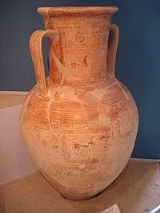
Geometric Style

Encyclopedia
Geometric art is a phase of Greek art
, characterised largely by geometric motifs in vase painting, that flourished towards the end of the Greek Dark Ages
, circa 900 BCE to 700 BCE. Its centre was in Athens
, and it was diffused amongst the trading cities of the Aegean
.
, the form has become strict and simple and they are divided into horizontal decorative bands with a few written geometric shapes within, usually concentric cycles or semicircles engraved with a caliper.
That was the period when the decorative theme of the meander added to the pottery design, the most characteristic element of geometric art.
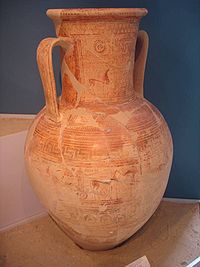
some laboratories enriched again the decorative organization of the vases, stabilized the forms of the animals in the areas of the neck and the base of the vase, and introduced at the main metope
between the handles, the human form. This was the first phase of the Late Geometric period (760-700 BC), in which the great vessels of Dipylon placed on the graves as funeral monuments, and represent with their height (often at a height of 1.50 m) and the perfection of their execution, the highest expression of the Greek geometric art.
Their main subject was now the body lying in state (prothesis) and the wail of the dead (Amphora in the National Archaeological Museum of Athens
), carrying out to the grave with an honorary chariot race (Krater in the Athens National Archaeological Museum), and various other subjects related to similar descriptions of the homeric epics
.
People and animals depicted geometrically in a dark glossy color, while the remaining vessel is covered by strict zones of meanders, crooked lines, circles, swastikas, in the same graphical concept. Later, the main tragic theme of the wail declined, the compositions eased, the geometric shapes have become more freely, and areas with animals, birds, scenes of shipwrecks, hunting scenes, themes from mythology or the Homeric epics led geometric pottery into more naturalistic expressions.
One of the characteristic examples of the Late geometric style, is an oldest surviving signed work of a Greek potter Aristonothos (or Aristonophos) (7th century BC
). The vase was found at Cerveteri
in Italy and illustrates the blinding of Polyphemus
by Odysseus
and his companions. From the mid of 8th century BC, the closer contact between Greece and the East enriched the ceramic art
with new subjects such as lions, panthers, imaginary beings, rosettes, palmettes, lotus flowers etc. - that led to the Orientalizing Period
style, in which the pottery style of Corinth
distinguished.
are characterized by several horizontal bands about the circumference covering the entire vase. Between these lines the geometric artist used a number of other decorative motifs such as the zigzag
, the triangle
, the meander and the swastika
. Besides abstract elements, painters of this era introduced stylized depictions of humans and animals which marks a significant departure from the earlier Protogeometric Art. Many of the surviving objects of this period are funerary objects, a particularly important class of which are the amphorae that acted as grave markers for aristocratic graves, principally the Dipylon Amphora
by the Dipylon Master
.
Linear
designs were the principal motif
used in this period. The meander pattern was often placed in bands and used to frame the now larger panels of decoration. The areas most used for decoration by potters
on shapes such as the amphorae and lekythoi
were the neck and belly, which not only offered the greatest liberty for decoration but also emphasized the taller dimensions of the vessels.
, an ovoid head with a blob for a nose and long cylindrical thighs and calves. Female figures were also abstract
. Their long hair was depicted as a series of lines, as were their breasts, which appeared as strokes under the armpit.
Greek art
Greek art began in the Cycladic and Minoan prehistorical civilization, and gave birth to Western classical art in the ancient period...
, characterised largely by geometric motifs in vase painting, that flourished towards the end of the Greek Dark Ages
Greek Dark Ages
The Greek Dark Age or Ages also known as Geometric or Homeric Age are terms which have regularly been used to refer to the period of Greek history from the presumed Dorian invasion and end of the Mycenaean Palatial civilization around 1200 BC, to the first signs of the Greek city-states in the 9th...
, circa 900 BCE to 700 BCE. Its centre was in Athens
Athens
Athens , is the capital and largest city of Greece. Athens dominates the Attica region and is one of the world's oldest cities, as its recorded history spans around 3,400 years. Classical Athens was a powerful city-state...
, and it was diffused amongst the trading cities of the Aegean
Aegean Islands
The Aegean Islands are the group of islands in the Aegean Sea, with mainland Greece to the west and north and Turkey to the east; the island of Crete delimits the sea to the south, those of Rhodes, Karpathos and Kasos to the southeast...
.
Protogeometric period
During the Protogeometric period (1050-900 BC) the shapes of the vessels have eliminated the fluid nature of the MycenaeanHelladic period
Helladic is a modern archaeological term meant to identify a sequence of periods characterizing the culture of mainland ancient Greece during the Bronze Age. The term is commonly used in archaeology and art history...
, the form has become strict and simple and they are divided into horizontal decorative bands with a few written geometric shapes within, usually concentric cycles or semicircles engraved with a caliper.
Early Geometric period
In the Early geometric period (900-850 BC) the height of the vessels has been increased, while the decoration is limited around the neck until the middle of the body of the vessel. The remaining surface is covered by a thin layer of clay, which during the cooking takes a dark, shiny, metallic color.That was the period when the decorative theme of the meander added to the pottery design, the most characteristic element of geometric art.
Middle geometric period
At the Middle geometric period (850-760 BC), the decorative zones appear multiplied by creating a laced mesh, while the meander dominates and is placed in the most important area, in the metope which is arranged between the handles.Late Geometric period
While the technique from the Middle Geometric period was still continued at the beginning of 8th century BC8th century BC
The 8th century BC started the first day of 800 BC and ended the last day of 701 BC.-Overview:The 8th century BC was a period of great changes in civilizations. In Egypt, the 23rd and 24th dynasties led to rule from Nubia in the 25th Dynasty...
some laboratories enriched again the decorative organization of the vases, stabilized the forms of the animals in the areas of the neck and the base of the vase, and introduced at the main metope
Metope
"Metope" might refer to the following:*metope , the space between two triglyphs of a Doric frieze*Metope , a river nymph in Greek mythology*Metope , electronic music producer Michael Schwanen...
between the handles, the human form. This was the first phase of the Late Geometric period (760-700 BC), in which the great vessels of Dipylon placed on the graves as funeral monuments, and represent with their height (often at a height of 1.50 m) and the perfection of their execution, the highest expression of the Greek geometric art.
Their main subject was now the body lying in state (prothesis) and the wail of the dead (Amphora in the National Archaeological Museum of Athens
National Archaeological Museum of Athens
The National Archaeological Museum in Athens houses some of the most important artifacts from a variety of archaeological locations around Greece from prehistory to late antiquity. It is considered one of the great museums in the world and contains the richest collection of artifacts from Greek...
), carrying out to the grave with an honorary chariot race (Krater in the Athens National Archaeological Museum), and various other subjects related to similar descriptions of the homeric epics
Homeric epics
In the field of classics, the term "Homeric epics" refers specifically to the Iliad and Odyssey, two epics attributed to the Ancient Greek poet Homer...
.
People and animals depicted geometrically in a dark glossy color, while the remaining vessel is covered by strict zones of meanders, crooked lines, circles, swastikas, in the same graphical concept. Later, the main tragic theme of the wail declined, the compositions eased, the geometric shapes have become more freely, and areas with animals, birds, scenes of shipwrecks, hunting scenes, themes from mythology or the Homeric epics led geometric pottery into more naturalistic expressions.
One of the characteristic examples of the Late geometric style, is an oldest surviving signed work of a Greek potter Aristonothos (or Aristonophos) (7th century BC
7th century BC
The 7th century BC started the first day of 700 BC and ended the last day of 601 BC.The Assyrian Empire continued to dominate the Near East during this century, exercising formidable power over neighbors like Babylon and Egypt. In the last two decades of the century, however, the empire began to...
). The vase was found at Cerveteri
Cerveteri
Cerveteri is a town and comune of the northern Lazio, in the province of Rome. Originally known as Caere , it is famous for a number of Etruscan necropolis that include some of the best Etruscan tombs anywhere....
in Italy and illustrates the blinding of Polyphemus
Polyphemus
Polyphemus is the gigantic one-eyed son of Poseidon and Thoosa in Greek mythology, one of the Cyclopes. His name means "much spoken of" or "famous". Polyphemus plays a pivotal role in Homer's Odyssey.-In Homer's Odyssey:...
by Odysseus
Odysseus
Odysseus or Ulysses was a legendary Greek king of Ithaca and the hero of Homer's epic poem the Odyssey. Odysseus also plays a key role in Homer's Iliad and other works in the Epic Cycle....
and his companions. From the mid of 8th century BC, the closer contact between Greece and the East enriched the ceramic art
Ceramic art
In art history, ceramics and ceramic art mean art objects such as figures, tiles, and tableware made from clay and other raw materials by the process of pottery. Some ceramic products are regarded as fine art, while others are regarded as decorative, industrial or applied art objects, or as...
with new subjects such as lions, panthers, imaginary beings, rosettes, palmettes, lotus flowers etc. - that led to the Orientalizing Period
Orientalizing Period
In the history of ancient Greece, the Orientalizing period is the cultural and art historical period informed by the art of Anatolia, Syria, Assyria, Phoenicia and Egypt, which started during the later part of the 7th century BCE. It encompasses a new, Orientalizing style, spurred by a period of...
style, in which the pottery style of Corinth
Corinth
Corinth is a city and former municipality in Corinthia, Peloponnese, Greece. Since the 2011 local government reform it is part of the municipality Corinth, of which it is the seat and a municipal unit...
distinguished.
Geometric motives
Vases in the Geometric styleGeometric Style
Geometric art is a phase of Greek art, characterised largely by geometric motifs in vase painting, that flourished towards the end of the Greek Dark Ages, circa 900 BCE to 700 BCE...
are characterized by several horizontal bands about the circumference covering the entire vase. Between these lines the geometric artist used a number of other decorative motifs such as the zigzag
Zigzag
A zigzag is a pattern made up of small corners at variable angles, though constant within the zigzag, tracing a path between two parallel lines; it can be described as both jagged and fairly regular....
, the triangle
Triangle
A triangle is one of the basic shapes of geometry: a polygon with three corners or vertices and three sides or edges which are line segments. A triangle with vertices A, B, and C is denoted ....
, the meander and the swastika
Swastika
The swastika is an equilateral cross with its arms bent at right angles, in either right-facing form in counter clock motion or its mirrored left-facing form in clock motion. Earliest archaeological evidence of swastika-shaped ornaments dates back to the Indus Valley Civilization of Ancient...
. Besides abstract elements, painters of this era introduced stylized depictions of humans and animals which marks a significant departure from the earlier Protogeometric Art. Many of the surviving objects of this period are funerary objects, a particularly important class of which are the amphorae that acted as grave markers for aristocratic graves, principally the Dipylon Amphora
Amphora
An amphora is a type of vase-shaped, usually ceramic container with two handles and a long neck narrower than the body...
by the Dipylon Master
Dipylon Master
The Dipylon Master was an ancient Greek vase painter who was active from around 760-750 BCE. He worked in Athens, where he and his workshop produced large funerary vessels for those interred in the Dipylon cemetery, whence his name comes...
.
Linear
Linear
In mathematics, a linear map or function f is a function which satisfies the following two properties:* Additivity : f = f + f...
designs were the principal motif
Motif (art)
In art, a motif is an element of a pattern, an image or part of one, or a theme. A motif may be repeated in a design or composition, often many times, or may just occur once in a work. A motif may be an element in the iconography of a particular subject or type of subject that is seen in other...
used in this period. The meander pattern was often placed in bands and used to frame the now larger panels of decoration. The areas most used for decoration by potters
Pottery
Pottery is the material from which the potteryware is made, of which major types include earthenware, stoneware and porcelain. The place where such wares are made is also called a pottery . Pottery also refers to the art or craft of the potter or the manufacture of pottery...
on shapes such as the amphorae and lekythoi
Lekythos
A lekythos is a type of Greek pottery used for storing oil , especially olive oil. It has a narrow body and one handle attached to the neck of the vessel. The lekythos was used for anointing dead bodies of unmarried men and many lekythoi are found in tombs. The images on lekythoi were often...
were the neck and belly, which not only offered the greatest liberty for decoration but also emphasized the taller dimensions of the vessels.
Human depictions
The first human figures appeared around 770 BCE on the handles of vases. The male was depicted with a triangular torsoTorso
Trunk or torso is an anatomical term for the central part of the many animal bodies from which extend the neck and limbs. The trunk includes the thorax and abdomen.-Major organs:...
, an ovoid head with a blob for a nose and long cylindrical thighs and calves. Female figures were also abstract
Abstract art
Abstract art uses a visual language of form, color and line to create a composition which may exist with a degree of independence from visual references in the world. Western art had been, from the Renaissance up to the middle of the 19th century, underpinned by the logic of perspective and an...
. Their long hair was depicted as a series of lines, as were their breasts, which appeared as strokes under the armpit.
See also
- Protogeometric art
- Orientalizing periodOrientalizing PeriodIn the history of ancient Greece, the Orientalizing period is the cultural and art historical period informed by the art of Anatolia, Syria, Assyria, Phoenicia and Egypt, which started during the later part of the 7th century BCE. It encompasses a new, Orientalizing style, spurred by a period of...
- List of Greek vase painters #Geometric period
- National Archaeological Museum of Greece
- Mycenaean potteryMycenaean potteryMycenaean pottery is the pottery, produced by Mycenaean potters and divided by archaeologists into a series of stylistic phases, which can be grouped into four major stages, which roughly correspond with cultural/historical stages.-Mycenaean Culture:...