

Richard de Clare, 2nd Earl of Pembroke

Encyclopedia
Richard de Clare, 2nd Earl of Pembroke (of the first creation), Lord of Leinster
, Justiciar
of Ireland (1130 – 20 April 1176). Like his father, he was also commonly known as Strongbow (French: Arc-Fort). He was a Cambro-Norman
lord notable for his leading role in the Norman invasion of Ireland
.
Richard was the son of Gilbert de Clare, 1st Earl of Pembroke
and Isabel de Beaumont. Richard's father died when he was about eighteen years old and Richard inherited the title Earl of Pembroke
. It is probable that this title was not recognized at Henry II's coronation.
in 1154 for siding with King Stephen of England
against Henry’s mother, the Empress Matilda
. Richard was in fact, described by his contemporaries as the Earl of Striguil, Striguil being where he had a fortress at a place now called Chepstow
, in Monmouthshire
on the Wye. He saw an opportunity to reverse his bad fortune in 1168 when he met Dermot MacMurrough
, King of Leinster.
was deprived of his kingdom by the High King of Ireland
- Rory O'Connor
. The grounds for the dispossession were that MacMurrough had, in 1152, abducted Derbforgaill
, the wife of the King of Breifne
, Tiernan O'Rourke . To recover his kingdom, MacMurrough solicited help from Henry II of England
.
Dermot MacMurrough left Ireland for Bristol
from near Bannow
on 1 August 1166. He met King Henry II in Aquitaine
in autumn 1166. Henry could not help him at this time, but provided a letter of comfort for willing supporters of Dermot’s cause in his kingdom. However, after his return to Wales
he failed to rally any forces to his standard. Eventually he met the Earl of Striguil (nicknamed "Strongbow") and other barons of the Welsh Marches
. MacMurrough came to an agreement with de Clare: for the Earl’s assistance with an army the following spring, he could have Aoife, Dermot's eldest daughter in marriage and the succession to Leinster. As Henry’s approval or licence to Dermot was a general one, the Earl of Striguil thought it prudent to obtain Henry's specific consent to travel to Ireland: he waited two years to do this. The licence he got was to aid Dermot in the recovery of his kingdom of Leinster.
archers. It was led by Raymond Fitzgerald
(also known as Raymond le Gros) and in quick succession it took the Viking
or Scandinavian
-established towns of Wexford
, Waterford
and Dublin in 1169-1170. Strongbow, however, was not with the first invading party, only arriving later, in August 1170.
In May 1171, Dermot died and his son, Donal MacMurrough-Kavanagh claimed the kingdom of Leinster in accordance with his rights under the Brehon Laws
. The Earl of Striguil also claimed the kingship in the right of his wife. The old king's death was the signal of a general rising, and Richard barely managed to keep Rory O'Connor out of Dublin.
. Immediately afterwards, he hurried to England to solicit help from Henry II, who instead stripped Strongbow of his new holdings. Henry himself invaded in October 1171, staying six months and putting his own men into nearly all the important places, claiming the title "Lord of Ireland
". Strongbow returned to favour, and power in Ireland, in 1173 when he aided the king in his campaign against his rebelling sons. Richard went to Normandy
to assist the king in the Revolt of 1173–1174. However, he was only permitted to retain the county of Kildare
and found himself largely disinherited.
The King later concluded a treaty with the High King of Ireland - the Treaty of Windsor 1175. By the terms of the treaty, Rory was left with a kingdom consisting of Ireland outside the petty kingdom
s of Leinster
, Mide
(as they were then), Dublin and County Waterford
, as long as he paid tribute to Henry II, and owed fealty
to him. All of Ireland was also subject to the new religious provisions of the papal bull
Laudabiliter
and the Synod of Cashel
(1172). In contravention of the royal treaty, de Clare invaded Connacht
in 1172 but was severely defeated. Raymond le Gros, his chief general, re-established his supremacy in Leinster. After another rebellion in 1176, Raymond took Limerick
for Richard, but just at this moment of triumph, Strongbow died of an infection in his foot.
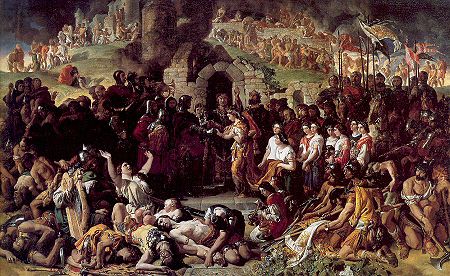 The day after the capture of Waterford
, Strongbow married MacMurrough's daughter, Aoife of Leinster. Their children were
King Henry II had promised Sir William Marshal
that he would be given Isabel as his bride, and his son Richard I
upheld the promise one month after his ascension to the throne. The earldom was given to her husband as her consort. Marshall was the son of John the Marshal
, by Sibylle, the sister of Patrick, Earl of Salisbury
.
Strongbow's widow, Aoife, lived on and was last recorded in a charter of 1188.
as a tall and fair man, of pleasing appearance, modest in his bearing, delicate in features, of a low voice, but sage in council and the idol of his soldiers. He was first interred in Dublin's Christ Church Cathedral
where an alleged effigy
can be viewed. Strongbow's actual tomb-effigy was destroyed when the roof of the Cathedral collapsed in 1562. The one on display dates from around the 15th century, bears the coat of arms of the Earls of Kildare and is the effigy of another local Knight. Strongbow is actually buried in the graveyard of the Ferns Cathedral
, Ferns, where his grave can be seen in the graveyard.
Richard also held the title of Lord Marshal of England.
Leinster
Leinster is one of the Provinces of Ireland situated in the east of Ireland. It comprises the ancient Kingdoms of Mide, Osraige and Leinster. Following the Norman invasion of Ireland, the historic fifths of Leinster and Mide gradually merged, mainly due to the impact of the Pale, which straddled...
, Justiciar
Justiciar
In medieval England and Ireland the Chief Justiciar was roughly equivalent to a modern Prime Minister as the monarch's chief minister. Similar positions existed on the Continent, particularly in Norman Italy. The term is the English form of the medieval Latin justiciarius or justitiarius In...
of Ireland (1130 – 20 April 1176). Like his father, he was also commonly known as Strongbow (French: Arc-Fort). He was a Cambro-Norman
Cambro-Norman
Cambro-Norman is a term used for Norman knights who settled in southern Wales after the Norman conquest of England in 1066. Some historians suggest that the term is to be preferred to Anglo-Norman for the Normans who invaded Ireland after 1170 — many of whom originated in Wales. However, the term...
lord notable for his leading role in the Norman invasion of Ireland
Norman Invasion of Ireland
The Norman invasion of Ireland was a two-stage process, which began on 1 May 1169 when a force of loosely associated Norman knights landed near Bannow, County Wexford...
.
Richard was the son of Gilbert de Clare, 1st Earl of Pembroke
Gilbert de Clare, 1st Earl of Pembroke
Gilbert fitz Gilbert de Clare , son of Gilbert Fitz Richard and Alice de Claremont, was sometimes referred to as "Strongbow", although his son is better remembered by this name, was the first Earl of Pembroke from 1138....
and Isabel de Beaumont. Richard's father died when he was about eighteen years old and Richard inherited the title Earl of Pembroke
Earl of Pembroke
Earl of Pembroke is a title created ten times, all in the Peerage of England. It was first created in the 12th century by King Stephen of England. The title is associated with Pembroke, Pembrokeshire in West Wales, which is the site of Earldom's original seat Pembroke Castle...
. It is probable that this title was not recognized at Henry II's coronation.
Career
As the son of the first Earl, he succeeded to his father's estates in 1148, but was deprived of the title by King Henry II of EnglandHenry II of England
Henry II ruled as King of England , Count of Anjou, Count of Maine, Duke of Normandy, Duke of Aquitaine, Duke of Gascony, Count of Nantes, Lord of Ireland and, at various times, controlled parts of Wales, Scotland and western France. Henry, the great-grandson of William the Conqueror, was the...
in 1154 for siding with King Stephen of England
Stephen of England
Stephen , often referred to as Stephen of Blois , was a grandson of William the Conqueror. He was King of England from 1135 to his death, and also the Count of Boulogne by right of his wife. Stephen's reign was marked by the Anarchy, a civil war with his cousin and rival, the Empress Matilda...
against Henry’s mother, the Empress Matilda
Empress Matilda
Empress Matilda , also known as Matilda of England or Maude, was the daughter and heir of King Henry I of England. Matilda and her younger brother, William Adelin, were the only legitimate children of King Henry to survive to adulthood...
. Richard was in fact, described by his contemporaries as the Earl of Striguil, Striguil being where he had a fortress at a place now called Chepstow
Chepstow
Chepstow is a town in Monmouthshire, Wales, adjoining the border with Gloucestershire, England. It is located on the River Wye, close to its confluence with the River Severn, and close to the western end of the Severn Bridge on the M48 motorway...
, in Monmouthshire
Monmouthshire
Monmouthshire is a county in south east Wales. The name derives from the historic county of Monmouthshire which covered a much larger area. The largest town is Abergavenny. There are many castles in Monmouthshire .-Historic county:...
on the Wye. He saw an opportunity to reverse his bad fortune in 1168 when he met Dermot MacMurrough
Dermot MacMurrough
Diarmait Mac Murchada , anglicized as Dermot MacMurrough or Dermod MacMurrough , was a King of Leinster in Ireland. In 1167, he was deprived of his kingdom by the High King of Ireland - Turlough Mór O'Connor...
, King of Leinster.
Dispossession of the King of Leinster
In 1167, the King of LeinsterKings of Leinster
The following is a provisional list of the kings of Leinster who ruled the Irish kingdom of Leinster up to 1632 with the death of Domhnall Spainnach MacMurrough-Kavanagh, the last legitimately inaugurated head of the MacMurrough Kavanagh royal line...
was deprived of his kingdom by the High King of Ireland
High King of Ireland
The High Kings of Ireland were sometimes historical and sometimes legendary figures who had, or who are claimed to have had, lordship over the whole of Ireland. Medieval and early modern Irish literature portrays an almost unbroken sequence of High Kings, ruling from Tara over a hierarchy of...
- Rory O'Connor
Tairrdelbach mac Ruaidri Ua Conchobair
Toirdhealbhach Ua Conchobhair , anglicized Turlough Mór O'Connor, was King of Connacht and High King of Ireland .-Family background:...
. The grounds for the dispossession were that MacMurrough had, in 1152, abducted Derbforgaill
Derbforgaill
Dearbhfhorghaill , anglicized as Derval, was a daughter of Murchad Ua Maeleachlainn, king of Meath, and of his wife Mor , daughter of Muirchertach Ua Briain...
, the wife of the King of Breifne
Kingdom of Breifne
The Kingdom of Breifne or Bréifne was the traditional territory for an early Irish tribal group known as the Uí Briúin Bréifne...
, Tiernan O'Rourke . To recover his kingdom, MacMurrough solicited help from Henry II of England
Henry II of England
Henry II ruled as King of England , Count of Anjou, Count of Maine, Duke of Normandy, Duke of Aquitaine, Duke of Gascony, Count of Nantes, Lord of Ireland and, at various times, controlled parts of Wales, Scotland and western France. Henry, the great-grandson of William the Conqueror, was the...
.
Dermot MacMurrough left Ireland for Bristol
Bristol
Bristol is a city, unitary authority area and ceremonial county in South West England, with an estimated population of 433,100 for the unitary authority in 2009, and a surrounding Larger Urban Zone with an estimated 1,070,000 residents in 2007...
from near Bannow
Bannow
Bannow is an area situated in the south of County Wexford, in Ireland. An early Norman town was founded at Bannow. This town has since disappeared for unknown reasons, although the ruins of an early Norman church can still be seen there today . The Norman church is located near the former Island...
on 1 August 1166. He met King Henry II in Aquitaine
Aquitaine
Aquitaine , archaic Guyenne/Guienne , is one of the 27 regions of France, in the south-western part of metropolitan France, along the Atlantic Ocean and the Pyrenees mountain range on the border with Spain. It comprises the 5 departments of Dordogne, :Lot et Garonne, :Pyrénées-Atlantiques, Landes...
in autumn 1166. Henry could not help him at this time, but provided a letter of comfort for willing supporters of Dermot’s cause in his kingdom. However, after his return to Wales
Wales
Wales is a country that is part of the United Kingdom and the island of Great Britain, bordered by England to its east and the Atlantic Ocean and Irish Sea to its west. It has a population of three million, and a total area of 20,779 km²...
he failed to rally any forces to his standard. Eventually he met the Earl of Striguil (nicknamed "Strongbow") and other barons of the Welsh Marches
Welsh Marches
The Welsh Marches is a term which, in modern usage, denotes an imprecisely defined area along and around the border between England and Wales in the United Kingdom. The precise meaning of the term has varied at different periods...
. MacMurrough came to an agreement with de Clare: for the Earl’s assistance with an army the following spring, he could have Aoife, Dermot's eldest daughter in marriage and the succession to Leinster. As Henry’s approval or licence to Dermot was a general one, the Earl of Striguil thought it prudent to obtain Henry's specific consent to travel to Ireland: he waited two years to do this. The licence he got was to aid Dermot in the recovery of his kingdom of Leinster.
The invasion of Leinster
An army was assembled that included WelshWales
Wales is a country that is part of the United Kingdom and the island of Great Britain, bordered by England to its east and the Atlantic Ocean and Irish Sea to its west. It has a population of three million, and a total area of 20,779 km²...
archers. It was led by Raymond Fitzgerald
Raymond Fitzgerald
Raymond FitzGerald , nicknamed Le Gros, was a Cambro-Norman commander during the Norman invasion of Ireland....
(also known as Raymond le Gros) and in quick succession it took the Viking
Viking
The term Viking is customarily used to refer to the Norse explorers, warriors, merchants, and pirates who raided, traded, explored and settled in wide areas of Europe, Asia and the North Atlantic islands from the late 8th to the mid-11th century.These Norsemen used their famed longships to...
or Scandinavian
Scandinavia
Scandinavia is a cultural, historical and ethno-linguistic region in northern Europe that includes the three kingdoms of Denmark, Norway and Sweden, characterized by their common ethno-cultural heritage and language. Modern Norway and Sweden proper are situated on the Scandinavian Peninsula,...
-established towns of Wexford
Wexford
Wexford is the county town of County Wexford, Ireland. It is situated near the southeastern corner of Ireland, close to Rosslare Europort. The town is connected to Dublin via the M11/N11 National Primary Route, and the national rail network...
, Waterford
Waterford
Waterford is a city in the South-East Region of Ireland. It is the oldest city in the country and fifth largest by population. Waterford City Council is the local government authority for the city and its immediate hinterland...
and Dublin in 1169-1170. Strongbow, however, was not with the first invading party, only arriving later, in August 1170.
In May 1171, Dermot died and his son, Donal MacMurrough-Kavanagh claimed the kingdom of Leinster in accordance with his rights under the Brehon Laws
Brehon Laws
Early Irish law refers to the statutes that governed everyday life and politics in Early Medieval Ireland. They were partially eclipsed by the Norman invasion of 1169, but underwent a resurgence in the 13th century, and survived into Early Modern Ireland in parallel with English law over the...
. The Earl of Striguil also claimed the kingship in the right of his wife. The old king's death was the signal of a general rising, and Richard barely managed to keep Rory O'Connor out of Dublin.
Royal intervention
The success of the invasion made King Henry concerned that his barons would become too powerful and independent overseas. He therefore ordered all troops to return to England by Easter 1171. Richard delayed his return until he had repulsed the High KingHigh king
A high king is a king who holds a position of seniority over a group of other kings, without the title of Emperor; compare King of Kings.Rulers who have been termed "high king" include:...
. Immediately afterwards, he hurried to England to solicit help from Henry II, who instead stripped Strongbow of his new holdings. Henry himself invaded in October 1171, staying six months and putting his own men into nearly all the important places, claiming the title "Lord of Ireland
Lordship of Ireland
The Lordship of Ireland refers to that part of Ireland that was under the rule of the king of England, styled Lord of Ireland, between 1177 and 1541. It was created in the wake of the Norman invasion of Ireland in 1169–71 and was succeeded by the Kingdom of Ireland...
". Strongbow returned to favour, and power in Ireland, in 1173 when he aided the king in his campaign against his rebelling sons. Richard went to Normandy
Normandy
Normandy is a geographical region corresponding to the former Duchy of Normandy. It is in France.The continental territory covers 30,627 km² and forms the preponderant part of Normandy and roughly 5% of the territory of France. It is divided for administrative purposes into two régions:...
to assist the king in the Revolt of 1173–1174. However, he was only permitted to retain the county of Kildare
County Kildare
County Kildare is a county in Ireland. It is part of the Mid-East Region and is also located in the province of Leinster. It is named after the town of Kildare. Kildare County Council is the local authority for the county...
and found himself largely disinherited.
The King later concluded a treaty with the High King of Ireland - the Treaty of Windsor 1175. By the terms of the treaty, Rory was left with a kingdom consisting of Ireland outside the petty kingdom
Petty kingdom
A petty kingdom is one of a number of small kingdoms, described as minor or "petty" by contrast to an empire or unified kingdom that either preceded or succeeded it...
s of Leinster
Leinster
Leinster is one of the Provinces of Ireland situated in the east of Ireland. It comprises the ancient Kingdoms of Mide, Osraige and Leinster. Following the Norman invasion of Ireland, the historic fifths of Leinster and Mide gradually merged, mainly due to the impact of the Pale, which straddled...
, Mide
Kingdom of Mide
Mide , spelt Midhe in modern Irish and anglicised as Meath, was a medieval kingdom in Ireland for over 1,000 years. Its name means "middle", denoting the fact that lay in the middle of Ireland....
(as they were then), Dublin and County Waterford
County Waterford
*Abbeyside, Affane, Aglish, Annestown, An Rinn, Ardmore*Ballinacourty, Ballinameela, Ballinamult, Ballinroad, Ballybeg, Ballybricken, Ballyduff Lower, Ballyduff Upper, Ballydurn, Ballygunner, Ballylaneen, Ballymacarbry, Ballymacart, Ballynaneashagh, Ballysaggart, Ballytruckle, Bilberry, Bunmahon,...
, as long as he paid tribute to Henry II, and owed fealty
Fealty
An oath of fealty, from the Latin fidelitas , is a pledge of allegiance of one person to another. Typically the oath is made upon a religious object such as a Bible or saint's relic, often contained within an altar, thus binding the oath-taker before God.In medieval Europe, fealty was sworn between...
to him. All of Ireland was also subject to the new religious provisions of the papal bull
Papal bull
A Papal bull is a particular type of letters patent or charter issued by a Pope of the Catholic Church. It is named after the bulla that was appended to the end in order to authenticate it....
Laudabiliter
Laudabiliter
Laudabiliter was a papal bull issued in 1155 by Adrian IV, the only Englishman to serve as Pope, giving the Angevin King Henry II of England the right to assume control over Ireland and apply the Gregorian Reforms in the Irish church...
and the Synod of Cashel
Synod of Cashel
The Synod of Cashel of 1172, also known as the Second Synod of Cashel,The first being the Synod held at Cashel in 1101 was assembled at Cashel at the request of Henry II of England shortly after his arrival in Ireland in October 1171...
(1172). In contravention of the royal treaty, de Clare invaded Connacht
Connacht
Connacht , formerly anglicised as Connaught, is one of the Provinces of Ireland situated in the west of Ireland. In Ancient Ireland, it was one of the fifths ruled by a "king of over-kings" . Following the Norman invasion of Ireland, the ancient kingdoms were shired into a number of counties for...
in 1172 but was severely defeated. Raymond le Gros, his chief general, re-established his supremacy in Leinster. After another rebellion in 1176, Raymond took Limerick
Limerick
Limerick is the third largest city in the Republic of Ireland, and the principal city of County Limerick and Ireland's Mid-West Region. It is the fifth most populous city in all of Ireland. When taking the extra-municipal suburbs into account, Limerick is the third largest conurbation in the...
for Richard, but just at this moment of triumph, Strongbow died of an infection in his foot.
Marriage and issue
Waterford
Waterford is a city in the South-East Region of Ireland. It is the oldest city in the country and fifth largest by population. Waterford City Council is the local government authority for the city and its immediate hinterland...
, Strongbow married MacMurrough's daughter, Aoife of Leinster. Their children were
- Gilbert de Clare, 3rd Earl of Pembroke, a minor who died in 1185
- Isabel de Clare, 4th Countess of Pembroke, who became Countess of Pembroke in her own rightSuo jureSuo jure is a Latin phrase meaning "in her [or his] own right".It is commonly encountered in the context of titles of nobility, especially in cases where a wife may hold a title in her own right rather than through her marriage....
in 1185 (on the death of her brother) until her own death in 1220.
King Henry II had promised Sir William Marshal
William Marshal, 1st Earl of Pembroke
Sir William Marshal, 1st Earl of Pembroke , also called William the Marshal , was an Anglo-Norman soldier and statesman. He was described as the "greatest knight that ever lived" by Stephen Langton...
that he would be given Isabel as his bride, and his son Richard I
Richard I of England
Richard I was King of England from 6 July 1189 until his death. He also ruled as Duke of Normandy, Duke of Aquitaine, Duke of Gascony, Lord of Cyprus, Count of Anjou, Count of Maine, Count of Nantes, and Overlord of Brittany at various times during the same period...
upheld the promise one month after his ascension to the throne. The earldom was given to her husband as her consort. Marshall was the son of John the Marshal
John Marshal (Earl Marshal)
John FitzGilbert the Marshal was a minor Anglo-Norman nobleman during the reign of King Stephen, and fought in the 12th century civil war on the side of the Empress Matilda. Since at least 1130 and probably earlier, he had been the royal marshal to King Henry I...
, by Sibylle, the sister of Patrick, Earl of Salisbury
Patrick of Salisbury, 1st Earl of Salisbury
Patrick of Salisbury, 1st Earl of Salisbury was an Anglo-Norman nobleman, and the uncle of the famous William Marshal.His parents were Walter of Salisbury and Sibilla de Chaworth. Before 1141, Patrick was constable of Salisbury, a powerful local official but not a nobleman...
.
Strongbow's widow, Aoife, lived on and was last recorded in a charter of 1188.
Legacy
Strongbow was the statesman, whereas Raymond was the soldier, of the conquest. He is vividly described by Giraldus CambrensisGiraldus Cambrensis
Gerald of Wales , also known as Gerallt Gymro in Welsh or Giraldus Cambrensis in Latin, archdeacon of Brecon, was a medieval clergyman and chronicler of his times...
as a tall and fair man, of pleasing appearance, modest in his bearing, delicate in features, of a low voice, but sage in council and the idol of his soldiers. He was first interred in Dublin's Christ Church Cathedral
Christ Church Cathedral, Dublin
Christ Church Cathedral is the cathedral of the United Dioceses of Dublin and Glendalough and the cathedral of the Ecclesiastical province of the United Provinces of Dublin and Cashel in the Church of Ireland...
where an alleged effigy
Effigy
An effigy is a representation of a person, especially in the form of sculpture or some other three-dimensional form.The term is usually associated with full-length figures of a deceased person depicted in stone or wood on church monuments. These most often lie supine with hands together in prayer,...
can be viewed. Strongbow's actual tomb-effigy was destroyed when the roof of the Cathedral collapsed in 1562. The one on display dates from around the 15th century, bears the coat of arms of the Earls of Kildare and is the effigy of another local Knight. Strongbow is actually buried in the graveyard of the Ferns Cathedral
Ferns Cathedral
The Cathedral Church of St Edan is a cathedral of the Church of Ireland in Ferns, County Wexford in Ireland. It is in the ecclesiastical province of Dublin....
, Ferns, where his grave can be seen in the graveyard.
Richard also held the title of Lord Marshal of England.
| Name | Birth | Death | Notes |
|---|---|---|---|
| By Aoife of Leinster Eva MacMurrough Aoife MacMurrough , also known by later historians as Eva of Leinster, was the daughter of Dermot MacMurrough , King of Leinster, and his wife Mor O'Toole .-Marriage:... (Eva MacMurrough) (1145–1188), married 29 August 1170, daughter of Dermot MacMurrough Dermot MacMurrough Diarmait Mac Murchada , anglicized as Dermot MacMurrough or Dermod MacMurrough , was a King of Leinster in Ireland. In 1167, he was deprived of his kingdom by the High King of Ireland - Turlough Mór O'Connor... , King of Leinster, and More O'Toole. |
|||
| Isabel de Clare, 4th Countess of Pembroke | 1172 | 1220 | m. Aug 1189, Sir William Marshal William Marshal, 1st Earl of Pembroke Sir William Marshal, 1st Earl of Pembroke , also called William the Marshal , was an Anglo-Norman soldier and statesman. He was described as the "greatest knight that ever lived" by Stephen Langton... , Lord Marshal, son of John Fitz Gilbert, Marshal (Marechal) of England, and Sibylla of Salisbury. |
| Gilbert de Clare (or de Striguil or Chepstow), 3rd Earl of Pembroke | 1173 | 1185 | Inherited title from father but died as a minor. The title then went to his sister's husband on marriage. |
| By an unknown mistress or mistresses | |||
| Basilia de Clare | 1156 | 1203 | m. 1), 1172, Robert de Quincy; m. 2) 1173, Raymond Fitzgerald Raymond Fitzgerald Raymond FitzGerald , nicknamed Le Gros, was a Cambro-Norman commander during the Norman invasion of Ireland.... , known as Raymond le Gros http://www.libraryireland.com/JoyceHistory/Raymond.php, Constable of Leinster; m. 3) 1188, Geoffrey Fitz Robert, Baron of Kells. |
| Richard de Clare the Younger | ? | c. 1172 | He killed King of Breifne, Tighearnán Ua Ruairc, on the Hill of Ward Hill of Ward The Hill of Ward, also known as the Hill of Tlachtga, is a hill in County Meath, Ireland. During medieval times it was the site of great festivals, including one at which winter fires were lit at Samhain, the precursor of the modern Halloween... in 1172, according to Gerald of Wales in Expugnatio Hibernica. An alternative legendary account has it that the King was killed for cowardice by his father. |
| Alina de Clare | ? | c. 1174 | Married William fitz William FitzGerald in 1174. |