

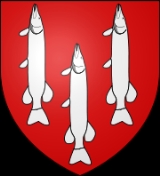
De Lucy

Encyclopedia
de Lucy or de Luci is the surname of an old Norman
noble family originating from Lucé
in Normandy
, one of the great baronial Anglo-Norman
families which became rooted in England after the Norman conquest. The first records are about Adrian de Luci (born about 1064 in Lucé, Normandy, France
) who went into England after William the Conqueror. The rise of this family might have been due to Henry I of England
, though there aren't historical proofs that all de Lucys belonged to same family. The family name is Latin
, Lucy, Luci, Lucé derive from Lucius
, meaning "light", but like most Normans
or Anglo-Normans, the origins are probably Viking
(Norsemen
).
.svg.png)
(c. 1089–14 July 1179) was Sheriff of the County of Essex, Chief Justiciar
of England and excommunicated by Thomas Becket
in 1166 and 1169. He married Rohese, she might have been a sister of Faramus of Boulogne.
in Sussex, England. He died while still abbot on June 21, 1171.
.
and Derby
in 1173. He was governor of Nottingham. He had a son, Richard, who succeeded him.
, the Chief Justiciar of England.
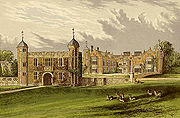
of Thomas de Luci (also known as Thomas Lucy de Charlecotte). Stephen de Luci was nominated one of justice itinerant by Henry III of England
in 1228.
(also Anthony de Lucy) (1283– 10 June 1343) was Chief Justiciar
of Ireland in 1331.
(24 April 1532 – 7 July 1600) was a magistrate and an evangelical living in Charlecote near Stratford-on-Avon, Warwickshire. He persecuted recusant Catholic families in the area, including William Shakespeare
's maternal relatives. He assumed the surname Lucy, probably descended from the Norman de Luci family by his mother's line.
Normans
The Normans were the people who gave their name to Normandy, a region in northern France. They were descended from Norse Viking conquerors of the territory and the native population of Frankish and Gallo-Roman stock...
noble family originating from Lucé
Lucé, Orne
Lucé is a commune in the Orne department in north-western France. The Anglo-Norman family of the same name derived from this French village.-References:*...
in Normandy
Normandy
Normandy is a geographical region corresponding to the former Duchy of Normandy. It is in France.The continental territory covers 30,627 km² and forms the preponderant part of Normandy and roughly 5% of the territory of France. It is divided for administrative purposes into two régions:...
, one of the great baronial Anglo-Norman
Anglo-Norman
The Anglo-Normans were mainly the descendants of the Normans who ruled England following the Norman conquest by William the Conqueror in 1066. A small number of Normans were already settled in England prior to the conquest...
families which became rooted in England after the Norman conquest. The first records are about Adrian de Luci (born about 1064 in Lucé, Normandy, France
France
The French Republic , The French Republic , The French Republic , (commonly known as France , is a unitary semi-presidential republic in Western Europe with several overseas territories and islands located on other continents and in the Indian, Pacific, and Atlantic oceans. Metropolitan France...
) who went into England after William the Conqueror. The rise of this family might have been due to Henry I of England
Henry I of England
Henry I was the fourth son of William I of England. He succeeded his elder brother William II as King of England in 1100 and defeated his eldest brother, Robert Curthose, to become Duke of Normandy in 1106...
, though there aren't historical proofs that all de Lucys belonged to same family. The family name is Latin
Latin
Latin is an Italic language originally spoken in Latium and Ancient Rome. It, along with most European languages, is a descendant of the ancient Proto-Indo-European language. Although it is considered a dead language, a number of scholars and members of the Christian clergy speak it fluently, and...
, Lucy, Luci, Lucé derive from Lucius
Lucius
Lucius is a male given name derived from Lucius , one of the small group of common Latin forenames found in the culture of ancient Rome. Lucius derives from latin word Lux Lucius (Greek: Λούκιος/Loukios, Etruscan: Luvcie) is a male given name derived from Lucius (abbreviated L.), one of the small...
, meaning "light", but like most Normans
Normans
The Normans were the people who gave their name to Normandy, a region in northern France. They were descended from Norse Viking conquerors of the territory and the native population of Frankish and Gallo-Roman stock...
or Anglo-Normans, the origins are probably Viking
Viking
The term Viking is customarily used to refer to the Norse explorers, warriors, merchants, and pirates who raided, traded, explored and settled in wide areas of Europe, Asia and the North Atlantic islands from the late 8th to the mid-11th century.These Norsemen used their famed longships to...
(Norsemen
Norsemen
Norsemen is used to refer to the group of people as a whole who spoke what is now called the Old Norse language belonging to the North Germanic branch of Indo-European languages, especially Norwegian, Icelandic, Faroese, Swedish and Danish in their earlier forms.The meaning of Norseman was "people...
).
Richard de Luci
Richard de LuciRichard de Luci
Richard de Luci was first noted as Sheriff of the County of Essex, then he was made Chief Justiciar of England.- Biography :His wife Rohese, who is named in several documents, was a sister of Faramus of Boulogne...
(c. 1089–14 July 1179) was Sheriff of the County of Essex, Chief Justiciar
Justiciar
In medieval England and Ireland the Chief Justiciar was roughly equivalent to a modern Prime Minister as the monarch's chief minister. Similar positions existed on the Continent, particularly in Norman Italy. The term is the English form of the medieval Latin justiciarius or justitiarius In...
of England and excommunicated by Thomas Becket
Thomas Becket
Thomas Becket was Archbishop of Canterbury from 1162 until his murder in 1170. He is venerated as a saint and martyr by both the Roman Catholic Church and the Anglican Communion...
in 1166 and 1169. He married Rohese, she might have been a sister of Faramus of Boulogne.
Walter de Luci
Walter de Luci (also Walter de Lucy) was brother of Richard de Luci. He was a monk at Lonlay Abbey in Normandy, then was elected Abbot of Battle AbbeyBattle Abbey
Battle Abbey is a partially ruined abbey complex in the small town of Battle in East Sussex, England. The abbey was built on the scene of the Battle of Hastings and dedicated to St...
in Sussex, England. He died while still abbot on June 21, 1171.
Godfrey de Luci
Godfrey de Luci (also Godfrey de Lucy) (c. 1124– 11 September 1204) was son of Richard de Luci. He was nominated Archdeacon of Derby, and Bishop of WinchesterBishop of Winchester
The Bishop of Winchester is the head of the Church of England diocese of Winchester, with his cathedra at Winchester Cathedral in Hampshire.The bishop is one of five Church of England bishops to be among the Lords Spiritual regardless of their length of service. His diocese is one of the oldest and...
.
Reginald de Luci
Reginald de Luci was an itinerant judge in the County of NottinghamNottingham
Nottingham is a city and unitary authority in the East Midlands of England. It is located in the ceremonial county of Nottinghamshire and represents one of eight members of the English Core Cities Group...
and Derby
Derby
Derby , is a city and unitary authority in the East Midlands region of England. It lies upon the banks of the River Derwent and is located in the south of the ceremonial county of Derbyshire. In the 2001 census, the population of the city was 233,700, whilst that of the Derby Urban Area was 229,407...
in 1173. He was governor of Nottingham. He had a son, Richard, who succeeded him.
Robert de Luci
Robert de Luci was sheriff of the County of Worchester in 1175. He was probably a relative of Richard de LuciRichard de Luci
Richard de Luci was first noted as Sheriff of the County of Essex, then he was made Chief Justiciar of England.- Biography :His wife Rohese, who is named in several documents, was a sister of Faramus of Boulogne...
, the Chief Justiciar of England.
Stephen de Luci
Stephen de Luci (13th century), one of the sons of Walter de Charlecotte, the first with his brother William de Luci to use the surname Luci. His brother, William de Luci, was the ancestorAncestor
An ancestor is a parent or the parent of an ancestor ....
of Thomas de Luci (also known as Thomas Lucy de Charlecotte). Stephen de Luci was nominated one of justice itinerant by Henry III of England
Henry III of England
Henry III was the son and successor of John as King of England, reigning for 56 years from 1216 until his death. His contemporaries knew him as Henry of Winchester. He was the first child king in England since the reign of Æthelred the Unready...
in 1228.
Anthony de Luci
Anthony de LuciAnthony de Luci
Anthony de Luci , Warden of Carlisle Castle, was Chief Justiciar of Ireland in 1331.-Biography:He was the son of Thomas de Luci of Papcastle , Cumberland....
(also Anthony de Lucy) (1283– 10 June 1343) was Chief Justiciar
Justiciar
In medieval England and Ireland the Chief Justiciar was roughly equivalent to a modern Prime Minister as the monarch's chief minister. Similar positions existed on the Continent, particularly in Norman Italy. The term is the English form of the medieval Latin justiciarius or justitiarius In...
of Ireland in 1331.
Thomas Lucy de Charlecotte
Sir Thomas LucyThomas Lucy
Sir Thomas Lucy was an English politician who sat in the House of Commons in 1571 and 1585. He was a magistrate in Warwickshire, but is best known for his links to William Shakespeare...
(24 April 1532 – 7 July 1600) was a magistrate and an evangelical living in Charlecote near Stratford-on-Avon, Warwickshire. He persecuted recusant Catholic families in the area, including William Shakespeare
William Shakespeare
William Shakespeare was an English poet and playwright, widely regarded as the greatest writer in the English language and the world's pre-eminent dramatist. He is often called England's national poet and the "Bard of Avon"...
's maternal relatives. He assumed the surname Lucy, probably descended from the Norman de Luci family by his mother's line.
See also
- Richard de LuciRichard de LuciRichard de Luci was first noted as Sheriff of the County of Essex, then he was made Chief Justiciar of England.- Biography :His wife Rohese, who is named in several documents, was a sister of Faramus of Boulogne...
- Walter de Luci
- Godfrey de Luci
- Thomas (de) LucyThomas LucySir Thomas Lucy was an English politician who sat in the House of Commons in 1571 and 1585. He was a magistrate in Warwickshire, but is best known for his links to William Shakespeare...
- Norman conquest of EnglandNorman conquest of EnglandThe Norman conquest of England began on 28 September 1066 with the invasion of England by William, Duke of Normandy. William became known as William the Conqueror after his victory at the Battle of Hastings on 14 October 1066, defeating King Harold II of England...
- NormandyNormandyNormandy is a geographical region corresponding to the former Duchy of Normandy. It is in France.The continental territory covers 30,627 km² and forms the preponderant part of Normandy and roughly 5% of the territory of France. It is divided for administrative purposes into two régions:...
- Charlecote ParkCharlecote ParkCharlecote Park is a grand 16th century country house, surrounded by its own deer park, on the banks of the River Avon in Wellesbourne, about east of Stratford-upon-Avon and south of Warwick, Warwickshire, England. It has been administered by the National Trust since 1946 and is open to the public...