

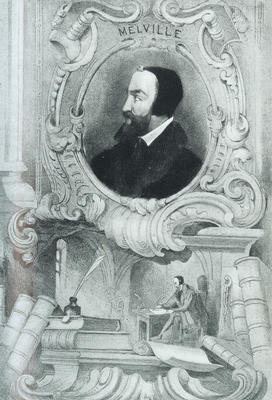
Andrew Melville

Encyclopedia
Scotland
Scotland is a country that is part of the United Kingdom. Occupying the northern third of the island of Great Britain, it shares a border with England to the south and is bounded by the North Sea to the east, the Atlantic Ocean to the north and west, and the North Channel and Irish Sea to the...
scholar, theologian
Theology
Theology is the systematic and rational study of religion and its influences and of the nature of religious truths, or the learned profession acquired by completing specialized training in religious studies, usually at a university or school of divinity or seminary.-Definition:Augustine of Hippo...
and religious reformer. His fame encouraged scholars from the European Continent to study at Glasgow and St Andrews.
Early life and early education
He was born at Baldovie near Montrose, AngusMontrose, Angus
Montrose is a coastal resort town and former royal burgh in Angus, Scotland. It is situated 38 miles north of Dundee between the mouths of the North and South Esk rivers...
, the youngest son of Richard Melville (brother to Melville of Dysart); his father died at the Battle of Pinkie in 1547, fighting in the van of the Scottish army. Andrew's mother died soon after, and the orphan was cared for by his eldest brother Richard (1522–1575).
At an early age Melville began to show a taste for learning, and his brother did everything in his power to give him the best education. He learned the rudiments of Latin at the grammar school
Grammar school
A grammar school is one of several different types of school in the history of education in the United Kingdom and some other English-speaking countries, originally a school teaching classical languages but more recently an academically-oriented secondary school.The original purpose of mediaeval...
of Montrose, after leaving which he learned Greek
Greek language
Greek is an independent branch of the Indo-European family of languages. Native to the southern Balkans, it has the longest documented history of any Indo-European language, spanning 34 centuries of written records. Its writing system has been the Greek alphabet for the majority of its history;...
for two years under Pierre de Marsilliers, a Frenchman whom John Erskine of Dun
John Erskine of Dun
-Biography:The son of Sir John Erskine, Laird of Dun, he was educated at King's College, University of Aberdeen. At the age of twenty-one Erskine was the cause — probably by accident — of a priest's death, and was forced to go abroad, where he came under the influence of the new learning...
had persuaded to settle at Montrose; such was Melville's proficiency that on going to the University of St Andrews
University of St Andrews
The University of St Andrews, informally referred to as "St Andrews", is the oldest university in Scotland and the third oldest in the English-speaking world after Oxford and Cambridge. The university is situated in the town of St Andrews, Fife, on the east coast of Scotland. It was founded between...
he astonished the professors by using the Greek text of Aristotle
Aristotle
Aristotle was a Greek philosopher and polymath, a student of Plato and teacher of Alexander the Great. His writings cover many subjects, including physics, metaphysics, poetry, theater, music, logic, rhetoric, linguistics, politics, government, ethics, biology, and zoology...
, which no one else there understood. On completing his course, Melville left St Andrews with the reputation of "the best poet, philosopher, and Grecian of any young master in the land."
Travels and study in Europe
In 1564, at nineteen years of age, he set out for FranceFrance
The French Republic , The French Republic , The French Republic , (commonly known as France , is a unitary semi-presidential republic in Western Europe with several overseas territories and islands located on other continents and in the Indian, Pacific, and Atlantic oceans. Metropolitan France...
to complete his education at the University of Paris
University of Paris
The University of Paris was a university located in Paris, France and one of the earliest to be established in Europe. It was founded in the mid 12th century, and officially recognized as a university probably between 1160 and 1250...
. He applied himself to Oriental languages, but also attended the last course of lectures delivered by Adrianus Turnebus
Adrianus Turnebus
Adrianus Turnebus was a French classical scholar.-Life:Turnebus was born at Les Andelys in Normandy. At the age of twelve he was sent to Paris to study, and attracted great notice by his remarkable abilities...
, professor of Greek, as well as those of Petrus Ramus
Petrus Ramus
Petrus Ramus was an influential French humanist, logician, and educational reformer. A Protestant convert, he was killed during the St. Bartholomew's Day Massacre.-Early life:...
, whose philosophical method and plan of teaching Melville later introduced into the universities of Scotland. From Paris he went to Poitiers
Poitiers
Poitiers is a city on the Clain river in west central France. It is a commune and the capital of the Vienne department and of the Poitou-Charentes region. The centre is picturesque and its streets are interesting for predominant remains of historical architecture, especially from the Romanesque...
(1566) to study civil law
Civil law (legal system)
Civil law is a legal system inspired by Roman law and whose primary feature is that laws are codified into collections, as compared to common law systems that gives great precedential weight to common law on the principle that it is unfair to treat similar facts differently on different...
, and though only twenty-one was apparently at once made a regent in the college of St Marceon. After three years, however, political troubles compelled him to leave France, and he went to Geneva
Geneva
Geneva In the national languages of Switzerland the city is known as Genf , Ginevra and Genevra is the second-most-populous city in Switzerland and is the most populous city of Romandie, the French-speaking part of Switzerland...
, where he was welcomed by Theodore Beza
Theodore Beza
Theodore Beza was a French Protestant Christian theologian and scholar who played an important role in the Reformation...
, at whose instigation he was appointed to the chair of humanity in the academy of Geneva.
Return to Scotland
In addition to teaching, Melville continued to study Oriental literature, and in particular acquired from Cornelius Bertram, one of his brother professors, a knowledge of SyriacSyriac language
Syriac is a dialect of Middle Aramaic that was once spoken across much of the Fertile Crescent. Having first appeared as a script in the 1st century AD after being spoken as an unwritten language for five centuries, Classical Syriac became a major literary language throughout the Middle East from...
. While he lived at Geneva the massacre of St Bartholomew in 1572 drove immense numbers of Protestant refugees to that city, including several of the most distinguished French men of letters of the time. Among these were several men learned in civil law, and political science, and associating with them increased Melville's knowledge and enlarged his ideas of civil and ecclesiastical liberty. In 1574 Melville returned to Scotland, and almost immediately received the appointment of Principal of the University of Glasgow
University of Glasgow
The University of Glasgow is the fourth-oldest university in the English-speaking world and one of Scotland's four ancient universities. Located in Glasgow, the university was founded in 1451 and is presently one of seventeen British higher education institutions ranked amongst the top 100 of the...
, and began its renewal.
Melville set himself to establish a good educational system. He enlarged the curriculum
Curriculum
See also Syllabus.In formal education, a curriculum is the set of courses, and their content, offered at a school or university. As an idea, curriculum stems from the Latin word for race course, referring to the course of deeds and experiences through which children grow to become mature adults...
, and established chairs in languages, science, philosophy and divinity, which were confirmed by charter in 1577. His fame spread, and students flocked from all parts of Scotland and beyond. He assisted in the reconstruction of the University of Aberdeen
University of Aberdeen
The University of Aberdeen, an ancient university founded in 1495, in Aberdeen, Scotland, is a British university. It is the third oldest university in Scotland, and the fifth oldest in the United Kingdom and wider English-speaking world...
in 1575, and in order to do for St Andrews what he had done for Glasgow, he was appointed Principal of St Mary's College, St Andrews
St Mary's College, St Andrews
St Mary's College of the University of St Andrews, in Fife, Scotland - in full, the New College of the Assumption of the Blessed Virgin Mary - was founded in 1538 by Archbishop James Beaton, uncle of Cardinal David Beaton on the site of the pedagogy or St Johns College .St Mary's College was...
, in 1580. His duties there comprised the teaching of theology
Theology
Theology is the systematic and rational study of religion and its influences and of the nature of religious truths, or the learned profession acquired by completing specialized training in religious studies, usually at a university or school of divinity or seminary.-Definition:Augustine of Hippo...
, Hebrew
Hebrew language
Hebrew is a Semitic language of the Afroasiatic language family. Culturally, is it considered by Jews and other religious groups as the language of the Jewish people, though other Jewish languages had originated among diaspora Jews, and the Hebrew language is also used by non-Jewish groups, such...
, Chaldee, Syriac and Rabbinical languages.
Melville created a fashion for the study of Greek literature
Greek literature
Greek literature refers to writings composed in areas of Greek influence, typically though not necessarily in one of the Greek dialects, throughout the whole period in which the Greek-speaking people have existed.-Ancient Greek literature :...
. The reforms, however, which his new modes of teaching involved, and even some of his new doctrine
Doctrine
Doctrine is a codification of beliefs or a body of teachings or instructions, taught principles or positions, as the body of teachings in a branch of knowledge or belief system...
s, such as the non-infallibility of Aristotle, brought him into conflict with other teachers in the university. He was Moderator of the General Assembly
Moderator of the General Assembly of the Church of Scotland
The Moderator of the General Assembly of Church of Scotland is a Minister, Elder or Deacon of the Church of Scotland chosen to "moderate" the annual General Assembly of the Church of Scotland, which is held for a week in Edinburgh every May....
in 1578, and took part in the organization of the Church and the Presbyterian method. Troubles arose from the attempts of the court to force a system of episcopacy upon the Church of Scotland
Church of Scotland
The Church of Scotland, known informally by its Scots language name, the Kirk, is a Presbyterian church, decisively shaped by the Scottish Reformation....
, and Melville prosecuted one of the Tulchan Bishops
Tulchan
A Tulchan was in Scotland a man appointed as bishop after the Reformation, who was a bishop in name only and whose revenue was drawn by his patron. The term originally referred to a calfskin stuffed with straw, and presented to a cow, as if living to induce her to give milk.Mr...
(Robert Montgomery, d. 1609). For this he was summoned before the Privy Council
Privy Council of the United Kingdom
Her Majesty's Most Honourable Privy Council, usually known simply as the Privy Council, is a formal body of advisers to the Sovereign in the United Kingdom...
in February 1584, and had to flee into England
England
England is a country that is part of the United Kingdom. It shares land borders with Scotland to the north and Wales to the west; the Irish Sea is to the north west, the Celtic Sea to the south west, with the North Sea to the east and the English Channel to the south separating it from continental...
in order to escape a charge of treason
Treason
In law, treason is the crime that covers some of the more extreme acts against one's sovereign or nation. Historically, treason also covered the murder of specific social superiors, such as the murder of a husband by his wife. Treason against the king was known as high treason and treason against a...
.
After twenty months he returned to Scotland in November 1585, and in March 1586 resumed his lectures in St Andrews, where he continued for twenty years; he became Rector
Rector
The word rector has a number of different meanings; it is widely used to refer to an academic, religious or political administrator...
of the University in 1590. During the whole time he protected the liberties of the Scottish Church against all encroachments of the government. That in the main he was fighting for the constitutionally guaranteed rights of the Church is generally accepted. The chief charge against Melville is that his fervour often led him to forget the reverence due to an "anointed monarch." When the king acted in an arbitrary and illegal manner he needed the reminder that though he was king over men he was only "God's silly vassal." Melville's rudeness (if it is to be called so) was the outburst of just indignation from a man zealous for the purity of religion and regardless of consequences to himself.
He made this statement to King James VI of Scotland, later to become King James I of England.
"Sirrah, ye are God's silly vassal; there are two kings and two kingdoms in Scotland: there is king James, the head of the commonwealth; and there is Christ Jesus, the king of the Church, whose subject James the Sixth is, and of whose kingdom he is not a king, not a lord, not a head, but a member." (The last twelve words are sometimes rendered as "not a king, nor a head, nor a lord, but a member".http://books.google.com/books?id=LO_betbQgNoC&pg=PA134&lpg=PA134&dq=%22not+a+king,+nor+a+head,+nor+a+lord,+but+a+member%22&source=bl&ots=eGAsJz_bLT&sig=WTZe-xFqcGBKFtOlbkAkwEObvJk&hl=en&ei=uw7qSeurC4LhtgeXlbWBCQ&sa=X&oi=book_result&ct=result&resnum=5)
King James and imprisonment
In 1599 he was deprived of the rectorship, but was made dean of the faculty of theology. The close of Melville's career in Scotland was at length brought about by JamesJames I of England
James VI and I was King of Scots as James VI from 24 July 1567 and King of England and Ireland as James I from the union of the English and Scottish crowns on 24 March 1603...
in characteristic fashion. In 1606 Melville and seven other clergymen of the Church of Scotland
Church of Scotland
The Church of Scotland, known informally by its Scots language name, the Kirk, is a Presbyterian church, decisively shaped by the Scottish Reformation....
were summoned to London
London
London is the capital city of :England and the :United Kingdom, the largest metropolitan area in the United Kingdom, and the largest urban zone in the European Union by most measures. Located on the River Thames, London has been a major settlement for two millennia, its history going back to its...
in order "that His Majesty might treat with them of such things as would tend to settle the peace of the Church." The contention of the whole of these faithful men was that the only way to accomplish that purpose was a free Assembly. Melville delivered his opinion to that effect in two long speeches with his accustomed freedom, and, having shortly afterwards written a sarcastic Latin epigram
Epigram
An epigram is a brief, interesting, usually memorable and sometimes surprising statement. Derived from the epigramma "inscription" from ἐπιγράφειν epigraphein "to write on inscribe", this literary device has been employed for over two millennia....
on some of the ritual practised in the chapel of Hampton Court Palace
Hampton Court Palace
Hampton Court Palace is a royal palace in the London Borough of Richmond upon Thames, Greater London; it has not been inhabited by the British royal family since the 18th century. The palace is located south west of Charing Cross and upstream of Central London on the River Thames...
, and some eavesdropper having relayed it to the king, he was committed to the Tower of London
Tower of London
Her Majesty's Royal Palace and Fortress, more commonly known as the Tower of London, is a historic castle on the north bank of the River Thames in central London, England. It lies within the London Borough of Tower Hamlets, separated from the eastern edge of the City of London by the open space...
, and detained for four years. On being freed, but refused permission to return to his own country, he was invited to fill a professor's chair in the Academy of Sedan
Academy of Sedan
The Academy of Sedan was a Huguenot academy in Sedan, founded in 1579 and suppressed in 1681. It was one of the main centres for the production of Reformed pastors in France for a hundred years.-History:...
, and there he spent the last eleven years of his life.