

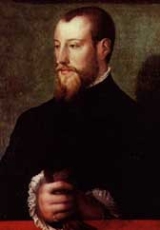
Theodore Beza

Encyclopedia
Theodore Beza (June 24, 1519 – October 13, 1605) was a French
Protestant Christian
theologian and scholar who played an important role in the Reformation
. A member of the monarchomaque movement who opposed absolute monarchy
, he was a disciple of John Calvin
and lived most of his life in Switzerland.
, in Burgundy, France. His father, Pierre de Beze, royal governor of Vezelay
, descended from a Burgundian family of distinction; his mother, Marie Bourdelot, was known for her generosity. Beza's father had two brothers; Nicholas, who was member of Parliament
at Paris; and Claude, who was abbot
of the Cistercian monastery
Froimont in the diocese of Beauvais.
Nicholas, who was unmarried, during a visit to Vezelay was so pleased with Theodore that, with the permission of his parents, he took him to Paris to educate him there. From Paris, Theodore was sent to Orléans
in December 1528 to receive instruction from the famous German teacher Melchior Wolmar. He was received into Wolmar's house, and the day on which this took place was afterward celebrated as a second birthday.
Young Beza soon followed his teacher to Bourges
, where the latter was called by the duchess Margaret of Angoulême
, sister of Francis I
. At the time, Bourges was the focus of the Reformation movement in France. In 1534, after Francis I issued his edict against ecclesiastical innovations, Wolmar returned to Germany. Beza, in accordance with the wish of his father, went back to Orléans to study law, and spent four years there (1535–39). The pursuit of law had little attraction for him; he enjoyed more the reading of the ancient classics, especially Ovid
, Catullus
, and Tibullus
.
He received the degree of licentiate in law August 11, 1539, and, as his father desired, went to Paris, where he began to practice. To support him, his relatives had obtained for him two benefices, the proceeds of which amounted to 700 golden crowns a year; and his uncle had promised to make him his successor.
Beza spent two years in Paris and gained a prominent position in literary circles. To escape the many temptations to which he was exposed, with the knowledge of two friends, he became engaged in the year 1544 to a young girl of humble descent, Claudine Denoese, promising to publicly marry her as soon as his circumstances would allow it.
In 1548 he published a collection of Latin poetry
, Juvenilia, which made him famous, and he was widely considered one of the best writers of Latin poetry of his time. Some cautioned against reading biographical details in his writings. Philip Schaff
argued that it was a mistake to "read between his lines what he never intended to put there" or to imagine "offences of which he was not guilty even in thought."
Shortly after the publication of his book, he fell ill and his illness, it is reported, revealed to him his spiritual needs. Gradually he came to accept salvation
in Christ, which lifted his spirits. He then resolved to sever his connections of the time, and went to Geneva
, the French city of refuge for Evangelicals (adherents of the Reformation movement), where he arrived with Claudine on October 23, 1548.
, who had met him already in Wolmar's house, and was married in the church. Beza was at a loss for immediate occupation, so he went to Tübingen to see his former teacher Wolmar. On his way home he visited Pierre Viret
at Lausanne, who brought about his appointment as professor of Greek at the academy there (Nov., 1549).
Beza found time to write a Biblical drama, Abraham Sacrifiant , in which he contrasted Catholicism
with Protestantism
, and the work was well received. In June, 1551, he added a few psalms to the French version of the Psalms begun by Clément Marot
, which was also very successful.
About the same time he published Passavantius, , a satire directed against Pierre Lizet, the former president of the Parliament of Paris, and principal originator of the "fiery chamber" (chambre ardente), who, at the time (1551) was abbot of St. Victor near Paris and publishing a number of polemical writings.
Of a more serious character were two controversies in which Beza was involved at this time. The first concerned the doctrine of predestination
and the controversy of Calvin with Jerome Hermes Bolsec. The second referred to the burning of Michael Servetus
at Geneva Oct. 27, 1553. In defense of Calvin and the Genevan magistrates, Beza published in 1554 the work De haereticis a civili magistratu puniendis (translated into French in 1560).
of Piedmont, who were being harassed by the French government. On their behalf, he went with William Farel
to Bern, Zürich
, Basel
, and Schaffhausen
, then to Strasburg
, Mömpelgard, Baden
, and Göppingen
. In Baden and Göppingen, Beza and Farel made a declaration concerning the Waldensians' views on the sacrament on May 14, 1557. The written declaration clearly stated their position and was well received by the Lutheran theologians, but was strongly disapproved of in Bern and Zurich.
In the autumn of 1558 Beza undertook a second journey with Farel to Worms by way of Strasburg in the hopes of bringing about an intercession by the Evangelical princes of the empire in favor of the persecuted brethren at Paris. With Melanchthon and other theologians then assembled at the Colloquy of Worms
, Beza proposed a union of all Protestant Christians, but the proposal was decidedly denied by Zurich and Bern.
False reports reached the German princes that the hostilities against the Huguenot
s in France had ceased and no embassy was sent to the court of France. As a result, Beza undertook another journey with Farel, Johannes Buddaeus, and Gaspard Carmel to Strasburg and Frankfort, where the sending of an embassy to Paris was resolved upon.
Here he was given chair of Greek in the newly established academy, and after Calvin's death also that of theology. He was also obliged to preach.
He completed the revision of Pierre Olivetan's translation of the New Testament
, begun some years before. In 1559 he undertook another journey in the interest of the Huguenots, this time to Heidelberg
. At about the same time, he had to defend Calvin against Joachim Westphal
in Hamburg
and Tilemann Heshusius
.
More important than this polemical activity was Beza's statement of his own confession. It was originally prepared for his father in justification of his actions and published in revised form to promote Evangelical knowledge among Beza's countrymen. It was printed in Latin in 1560 with a dedication to Wolmar. An English translation was published at London 1563, 1572, and 1585. Translations into German, Dutch, and Italian were also issued.
In the year following (1561), Beza represented the Evangelicals at the Colloquy of Poissy, and in an eloquent manner defended the principles of the Evangelical faith. The colloquy was without result, but Beza as the head and advocate of all Reformed congregations of France was revered and hated at the same time. The queen insisted upon another colloquy, which was opened at St. Germain Jan. 28, 1562, eleven days after the proclamation of the famous January edict which granted important privileges to those of the Reformed faith. But the colloquy was broken off when it became evident that the Catholic party was preparing (after the Massacre of Vassy, Mar. 1) to overthrow Protestantism.
Beza hastily issued a circular letter (Mar. 25) to all Reformed congregations of the empire, and with Conde and his troops went to Orléans. It was necessary to proceed quickly and energetically. But there were neither soldiers nor money. At the request of Conde, Beza visited all Huguenot cities to obtain both. He also wrote a manifesto in which he argued the justice of the Reformed cause. As one of the messengers to collect soldiers and money among his coreligionists, Beza was appointed to visit England, Germany, and Switzerland. He went to Strasburg and Basel, but met with failure. He then returned to Geneva, which he reached September 4. He had hardly been there fourteen days when he was called once more to Orléans by D'Andelot. The campaign was becoming more successful; but the publication of the unfortunate edict of pacification which Conde accepted (Mar. 12,1563) filled Beza and all Protestant France with horror.
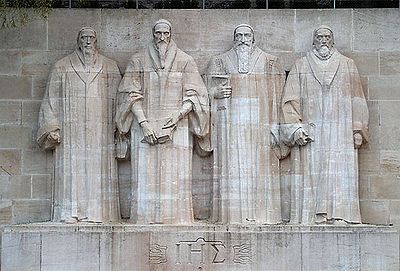 For twenty-two months Beza had been absent from Geneva, and the interests of school and Church there and especially the condition of Calvin made it necessary for him to return. For there was no one to take the place of Calvin, who was sick and unable longer to bear the burden resting on him. Calvin and Beza arranged to perform their duties jointly in alternate weeks, but the death of Calvin occurred soon afterward (May 27, 1564). As a matter of course Beza was his successor.
Until 1580 Beza was not only moderateur de la compagnie des pasteurs, but also the real soul of the great institution of learning at Geneva which Calvin had founded in 1559, consisting of a gymnasium and an academy. As long as he lived, Beza was interested in higher education. The Protestant youth for nearly forty years thronged his lecture-room to hear his theological lectures, in which he expounded the purest Calvinistic orthodoxy. As a counselor he was listened to by both magistrates and pastors. Geneva is indebted to him for the founding of a law school in which François Hotman
, Jules Pacius, and Denys Godefroy, the most eminent jurists of the century, lectured in turn (cf. Charles Borgeaud, L'Academie de Calvin, Geneva, 1900).
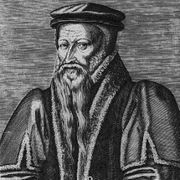 As Calvin's successor, Beza was very successful, not only in carrying on his work but also in giving peace to the Church at Geneva. The magistrates had fully appropriated the ideas of Calvin, and the direction of spiritual affairs, the organs of which were the "ministers of the word" and "the consistory", was founded on a solid basis. No doctrinal controversy arose after 1564. The discussions concerned questions of a practical, social, or ecclesiastical nature, such as the supremacy of the magistrates over the pastors, freedom in preaching, and the obligation of the pastors to submit to the majority of the campagnie des pasteurs.
Beza obtruded his will in no way upon his associates, and took no harsh measures against injudicious or hot-headed colleagues, though sometimes he took their cases in hand and acted as mediator; and yet he often experienced an opposition so extreme that he threatened to resign. Although he was inclined to take the part of the magistrates, he knew how to defend the rights and independence of the spiritual power when occasion arose, without, however, conceding to it such a preponderating influence as did Calvin.
His activity was great. He mediated between the compagnie and the magistracy; the latter continually asked his advice even in political questions. He corresponded with all the leaders of the Reformed party in Europe. After the St. Bartholomew's Day Massacre
(1572), he used his influence to give to the refugees a hospitable reception at Geneva.
In 1574 he wrote his De jure magistratuum (Right of Magistrates
), in which he emphatically protested against tyranny in religious matters, and affirmed that it is legitimate for a people to oppose an unworthy magistracy in a practical manner and if necessary to use weapons and depose them.
To sum up: Without being a great dogmatician like his master, nor a creative genius in the ecclesiastical realm, Beza had qualities which made him famous as humanist, exegete, orator, and leader in religious and political affairs, and qualified him to be the guide of the Calvinists in all Europe. In the various controversies into which he was drawn, Beza often showed an excess of irritation and intolerance, from which Bernardino Ochino
, pastor of the Italian congregation at Zurich (on account of a treatise which contained some objectionable points on polygamy), and Sebastian Castellio
at Basel (on account of his Latin and French translations of the Bible) had especially to suffer.
With Reformed France Beza continued to maintain the closest relations. He was the moderator of the general synod which met in April, 1571, at La Rochelle
and decided not to abolish church discipline or to acknowledge the civil government as head of the Church, as the Paris minister Jean Morel and the philosopher Pierre Ramus
demanded; it also decided to confirm anew the Calvinistic doctrine of the Lord's Supper (by the expression: "substance of the body of Christ") against Zwinglianism, which caused a very unpleasant discussion between Beza and Ramus and Heinrich Bullinger
.
In the following year (May, 1572) he took an important part in the national synod at Nîmes
. He was also interested in the controversies which concerned the Augsburg Confession
in Germany, especially after 1564, on the doctrine of the Person of Christ
and the sacrament, and published several works against Westphal
, Hesshusen, Selnecker, Johannes Brenz
, and Jakob Andrea. This made him, especially after 1571, hated by all those who adhered to Lutheranism in opposition to Melanchthon.
When the edition of the acts of the colloquy, as prepared by Jakob Andrea, was published, Samuel Huber
, of Burg near Bern, who belonged to the Lutheranizing faction of the Swiss clergy, took so great offense at the supralapsarian doctrine of predestination propounded at Mömpelgard by Beza and Musculus that he felt it to be his duty to denounce Musculus to the magistrates of Bern as an innovator in doctrine. To adjust the matter, the magistrates arranged a colloquy between Huber and Musculus (September 2, 1587), in which the former represented the universalism, the latter the particularism, of grace.
As the colloquy was resultless, a debate was arranged at Bern, Apr. 15-18, 1588, at which the defense of the accepted system of doctrine was at the start put into Beza's hands. The three delegates of the Helvetic cantons who presided at the debate declared in the end that Beza had substantiated the teaching propounded at Mömpelgard as the orthodox one, and Huber was dismissed from his office.
The saddest experience in his old days was the conversion of King Henry IV
to Catholicism, in spite of his most earnest exhortations (1593). Strange to say, in 1596 the report was spread by the Jesuits in Germany, France, England, and Italy that Beza and the Church of Geneva had returned into the bosom of Rome, and Beza replied in a satire that revealed the possession still of his old fire of thought and vigor of expression.
He died in Geneva
. He was not buried, like Calvin, in the general cemetery, Plain-Palais (for the Savoyards had threatened to abduct his body to Rome), but at the direction of the magistrates, in the monastery of St. Pierre.
Of his historiographical works, aside from his Icones (1580), which have only an iconographical value, mention may be made of the famous Histoire ecclesiastique des Eglises reformes au Royaume de France (1580), and his biography of Calvin, with which must be named his edition of Calvin's Epistolae et responsa (1575).
Beza's De vera excommunicatione et Christiano presbyterio (1590), written as a response to Thomas Erastus's Explicatio gravissimae quaestionis utrum excommunicatio (1589) contributed an important defense of the right of ecclesiastical authorities (rather than civil authorities) to excommunicate.
, accompanied in parallel columns by the text of the Vulgate
and a translation of his own (already published as early as 1556). Annotations were added, also previously published, but now he greatly enriched and enlarged them.
In the preparation of this edition of the Greek text, but much more in the preparation of the second edition which he brought out in 1582, Beza may have availed himself of the help of two very valuable manuscripts. One is known as the Codex Bezae
or Cantabrigensis, and was later presented by Beza to the University of Cambridge; the second is the Codex Claromontanus
, which Beza had found in Clermont (now in the National Library at Paris).
It was not, however, to these sources that Beza was chiefly indebted, but rather to the previous edition of the eminent Robert Estienne
(1550), itself based in great measure upon one of the later editions of Erasmus. Beza's labors in this direction were exceedingly helpful to those who came after. The same thing may be asserted with equal truth of his Latin version and of the copious notes with which it was accompanied. The former is said to have been published over a hundred times.
Although some contend that Beza's view of the doctrine of predestination exercised an overly dominant influence upon his interpretation of the Scriptures, there is no question that he added much to a clear understanding of the New Testament.
French people
The French are a nation that share a common French culture and speak the French language as a mother tongue. Historically, the French population are descended from peoples of Celtic, Latin and Germanic origin, and are today a mixture of several ethnic groups...
Protestant Christian
Christian
A Christian is a person who adheres to Christianity, an Abrahamic, monotheistic religion based on the life and teachings of Jesus of Nazareth as recorded in the Canonical gospels and the letters of the New Testament...
theologian and scholar who played an important role in the Reformation
Protestant Reformation
The Protestant Reformation was a 16th-century split within Western Christianity initiated by Martin Luther, John Calvin and other early Protestants. The efforts of the self-described "reformers", who objected to the doctrines, rituals and ecclesiastical structure of the Roman Catholic Church, led...
. A member of the monarchomaque movement who opposed absolute monarchy
Absolute monarchy
Absolute monarchy is a monarchical form of government in which the monarch exercises ultimate governing authority as head of state and head of government, his or her power not being limited by a constitution or by the law. An absolute monarch thus wields unrestricted political power over the...
, he was a disciple of John Calvin
John Calvin
John Calvin was an influential French theologian and pastor during the Protestant Reformation. He was a principal figure in the development of the system of Christian theology later called Calvinism. Originally trained as a humanist lawyer, he broke from the Roman Catholic Church around 1530...
and lived most of his life in Switzerland.
Early life
Theodore Beza was born at VezelayVézelay
Vézelay is a commune in the Yonne department in Burgundy in north-central France. It is a defendable hill town famous for Vézelay Abbey. The town and the Basilica of St Magdelene are designated UNESCO World Heritage sites....
, in Burgundy, France. His father, Pierre de Beze, royal governor of Vezelay
Vézelay
Vézelay is a commune in the Yonne department in Burgundy in north-central France. It is a defendable hill town famous for Vézelay Abbey. The town and the Basilica of St Magdelene are designated UNESCO World Heritage sites....
, descended from a Burgundian family of distinction; his mother, Marie Bourdelot, was known for her generosity. Beza's father had two brothers; Nicholas, who was member of Parliament
Parliament
A parliament is a legislature, especially in those countries whose system of government is based on the Westminster system modeled after that of the United Kingdom. The name is derived from the French , the action of parler : a parlement is a discussion. The term came to mean a meeting at which...
at Paris; and Claude, who was abbot
Abbot
The word abbot, meaning father, is a title given to the head of a monastery in various traditions, including Christianity. The office may also be given as an honorary title to a clergyman who is not actually the head of a monastery...
of the Cistercian monastery
Monastery
Monastery denotes the building, or complex of buildings, that houses a room reserved for prayer as well as the domestic quarters and workplace of monastics, whether monks or nuns, and whether living in community or alone .Monasteries may vary greatly in size – a small dwelling accommodating only...
Froimont in the diocese of Beauvais.
Nicholas, who was unmarried, during a visit to Vezelay was so pleased with Theodore that, with the permission of his parents, he took him to Paris to educate him there. From Paris, Theodore was sent to Orléans
Orléans
-Prehistory and Roman:Cenabum was a Gallic stronghold, one of the principal towns of the Carnutes tribe where the Druids held their annual assembly. It was conquered and destroyed by Julius Caesar in 52 BC, then rebuilt under the Roman Empire...
in December 1528 to receive instruction from the famous German teacher Melchior Wolmar. He was received into Wolmar's house, and the day on which this took place was afterward celebrated as a second birthday.
Young Beza soon followed his teacher to Bourges
Bourges
Bourges is a city in central France on the Yèvre river. It is the capital of the department of Cher and also was the capital of the former province of Berry.-History:...
, where the latter was called by the duchess Margaret of Angoulême
Angoulême
-Main sights:In place of its ancient fortifications, Angoulême is encircled by boulevards above the old city walls, known as the Remparts, from which fine views may be obtained in all directions. Within the town the streets are often narrow. Apart from the cathedral and the hôtel de ville, the...
, sister of Francis I
Francis I of France
Francis I was King of France from 1515 until his death. During his reign, huge cultural changes took place in France and he has been called France's original Renaissance monarch...
. At the time, Bourges was the focus of the Reformation movement in France. In 1534, after Francis I issued his edict against ecclesiastical innovations, Wolmar returned to Germany. Beza, in accordance with the wish of his father, went back to Orléans to study law, and spent four years there (1535–39). The pursuit of law had little attraction for him; he enjoyed more the reading of the ancient classics, especially Ovid
Ovid
Publius Ovidius Naso , known as Ovid in the English-speaking world, was a Roman poet who is best known as the author of the three major collections of erotic poetry: Heroides, Amores, and Ars Amatoria...
, Catullus
Catullus
Gaius Valerius Catullus was a Latin poet of the Republican period. His surviving works are still read widely, and continue to influence poetry and other forms of art.-Biography:...
, and Tibullus
Tibullus
Albius Tibullus was a Latin poet and writer of elegies.Little is known about his life. His first and second books of poetry are extant; many other texts attributed to Tibullus are of questionable origins. There are only a few references to him in later writers and a short Life of doubtful authority...
.
He received the degree of licentiate in law August 11, 1539, and, as his father desired, went to Paris, where he began to practice. To support him, his relatives had obtained for him two benefices, the proceeds of which amounted to 700 golden crowns a year; and his uncle had promised to make him his successor.
Beza spent two years in Paris and gained a prominent position in literary circles. To escape the many temptations to which he was exposed, with the knowledge of two friends, he became engaged in the year 1544 to a young girl of humble descent, Claudine Denoese, promising to publicly marry her as soon as his circumstances would allow it.
In 1548 he published a collection of Latin poetry
Poetry
Poetry is a form of literary art in which language is used for its aesthetic and evocative qualities in addition to, or in lieu of, its apparent meaning...
, Juvenilia, which made him famous, and he was widely considered one of the best writers of Latin poetry of his time. Some cautioned against reading biographical details in his writings. Philip Schaff
Philip Schaff
Philip Schaff , was a Swiss-born, German-educated Protestant theologian and a historian of the Christian church, who, after his education, lived and taught in the United States.-Biography:...
argued that it was a mistake to "read between his lines what he never intended to put there" or to imagine "offences of which he was not guilty even in thought."
Shortly after the publication of his book, he fell ill and his illness, it is reported, revealed to him his spiritual needs. Gradually he came to accept salvation
Salvation
Within religion salvation is the phenomenon of being saved from the undesirable condition of bondage or suffering experienced by the psyche or soul that has arisen as a result of unskillful or immoral actions generically referred to as sins. Salvation may also be called "deliverance" or...
in Christ, which lifted his spirits. He then resolved to sever his connections of the time, and went to Geneva
Geneva
Geneva In the national languages of Switzerland the city is known as Genf , Ginevra and Genevra is the second-most-populous city in Switzerland and is the most populous city of Romandie, the French-speaking part of Switzerland...
, the French city of refuge for Evangelicals (adherents of the Reformation movement), where he arrived with Claudine on October 23, 1548.
Teacher at Lausanne
He was received by John CalvinJohn Calvin
John Calvin was an influential French theologian and pastor during the Protestant Reformation. He was a principal figure in the development of the system of Christian theology later called Calvinism. Originally trained as a humanist lawyer, he broke from the Roman Catholic Church around 1530...
, who had met him already in Wolmar's house, and was married in the church. Beza was at a loss for immediate occupation, so he went to Tübingen to see his former teacher Wolmar. On his way home he visited Pierre Viret
Pierre Viret
Pierre Viret was a Swiss Reformed theologian.- Early life :Pierre Viret was born to a devout middle class Roman Catholic family in Orbe, a small town now in Switzerland. He was a close friend of John Calvin....
at Lausanne, who brought about his appointment as professor of Greek at the academy there (Nov., 1549).
Beza found time to write a Biblical drama, Abraham Sacrifiant , in which he contrasted Catholicism
Roman Catholic Church
The Catholic Church, also known as the Roman Catholic Church, is the world's largest Christian church, with over a billion members. Led by the Pope, it defines its mission as spreading the gospel of Jesus Christ, administering the sacraments and exercising charity...
with Protestantism
Protestantism
Protestantism is one of the three major groupings within Christianity. It is a movement that began in Germany in the early 16th century as a reaction against medieval Roman Catholic doctrines and practices, especially in regards to salvation, justification, and ecclesiology.The doctrines of the...
, and the work was well received. In June, 1551, he added a few psalms to the French version of the Psalms begun by Clément Marot
Clément Marot
Clément Marot was a French poet of the Renaissance period.-Youth:Marot was born at Cahors, the capital of the province of Quercy, some time during the winter of 1496-1497. His father, Jean Marot , whose more correct name appears to have been des Mares, Marais or Marets, was a Norman from the Caen...
, which was also very successful.
About the same time he published Passavantius, , a satire directed against Pierre Lizet, the former president of the Parliament of Paris, and principal originator of the "fiery chamber" (chambre ardente), who, at the time (1551) was abbot of St. Victor near Paris and publishing a number of polemical writings.
Of a more serious character were two controversies in which Beza was involved at this time. The first concerned the doctrine of predestination
Predestination
Predestination, in theology is the doctrine that all events have been willed by God. John Calvin interpreted biblical predestination to mean that God willed eternal damnation for some people and salvation for others...
and the controversy of Calvin with Jerome Hermes Bolsec. The second referred to the burning of Michael Servetus
Michael Servetus
Michael Servetus was a Spanish theologian, physician, cartographer, and humanist. He was the first European to correctly describe the function of pulmonary circulation...
at Geneva Oct. 27, 1553. In defense of Calvin and the Genevan magistrates, Beza published in 1554 the work De haereticis a civili magistratu puniendis (translated into French in 1560).
Journeys on behalf of the Protestants
In 1557, Beza took a special interest in the WaldensiansWaldensians
Waldensians, Waldenses or Vaudois are names for a Christian movement of the later Middle Ages, descendants of which still exist in various regions, primarily in North-Western Italy. There is considerable uncertainty about the earlier history of the Waldenses because of a lack of extant source...
of Piedmont, who were being harassed by the French government. On their behalf, he went with William Farel
William Farel
William Farel , né Guilhem Farel, 1489 in Gap, Dauphiné, in south-eastern France, was a French evangelist, and a founder of the Reformed Church in the cantons of Neuchâtel, Berne, Geneva, and Vaud in Switzerland...
to Bern, Zürich
Zürich
Zurich is the largest city in Switzerland and the capital of the canton of Zurich. It is located in central Switzerland at the northwestern tip of Lake Zurich...
, Basel
Basel
Basel or Basle In the national languages of Switzerland the city is also known as Bâle , Basilea and Basilea is Switzerland's third most populous city with about 166,000 inhabitants. Located where the Swiss, French and German borders meet, Basel also has suburbs in France and Germany...
, and Schaffhausen
Schaffhausen
Schaffhausen is a city in northern Switzerland and the capital of the canton of the same name; it has an estimated population of 34,587 ....
, then to Strasburg
Strasbourg
Strasbourg is the capital and principal city of the Alsace region in eastern France and is the official seat of the European Parliament. Located close to the border with Germany, it is the capital of the Bas-Rhin département. The city and the region of Alsace are historically German-speaking,...
, Mömpelgard, Baden
Baden
Baden is a historical state on the east bank of the Rhine in the southwest of Germany, now the western part of the Baden-Württemberg of Germany....
, and Göppingen
Göppingen
Göppingen is a town in southern Germany, part of the Stuttgart Region of Baden-Württemberg. It is the capital of the district Göppingen. It is situated at the bottom of the Hohenstaufen mountain, in the valley of the river Fils....
. In Baden and Göppingen, Beza and Farel made a declaration concerning the Waldensians' views on the sacrament on May 14, 1557. The written declaration clearly stated their position and was well received by the Lutheran theologians, but was strongly disapproved of in Bern and Zurich.
In the autumn of 1558 Beza undertook a second journey with Farel to Worms by way of Strasburg in the hopes of bringing about an intercession by the Evangelical princes of the empire in favor of the persecuted brethren at Paris. With Melanchthon and other theologians then assembled at the Colloquy of Worms
Colloquy of Worms
The Colloquy of Worms was the last colloquy in the 16th century on an imperial level, held in Worms from September 11 to October 8, 1557. At the Diet of Augsburg in 1555 it had been agreed that the dialog on controversial religious issues should be continued. A resolution was passed at Regensburg...
, Beza proposed a union of all Protestant Christians, but the proposal was decidedly denied by Zurich and Bern.
False reports reached the German princes that the hostilities against the Huguenot
Huguenot
The Huguenots were members of the Protestant Reformed Church of France during the 16th and 17th centuries. Since the 17th century, people who formerly would have been called Huguenots have instead simply been called French Protestants, a title suggested by their German co-religionists, the...
s in France had ceased and no embassy was sent to the court of France. As a result, Beza undertook another journey with Farel, Johannes Buddaeus, and Gaspard Carmel to Strasburg and Frankfort, where the sending of an embassy to Paris was resolved upon.
Settles in Geneva
Upon his return to Lausanne, Beza was greatly disturbed. In union with many ministers and professors in city and country, Viret at last thought of establishing a consistory and of introducing a church discipline which should apply excommunication especially at the celebration of the communion. But the Bernese would have no Calvinistic church government. This caused many difficulties, and Beza thought it best (1558) to settle at Geneva.Here he was given chair of Greek in the newly established academy, and after Calvin's death also that of theology. He was also obliged to preach.
He completed the revision of Pierre Olivetan's translation of the New Testament
New Testament
The New Testament is the second major division of the Christian biblical canon, the first such division being the much longer Old Testament....
, begun some years before. In 1559 he undertook another journey in the interest of the Huguenots, this time to Heidelberg
Heidelberg
-Early history:Between 600,000 and 200,000 years ago, "Heidelberg Man" died at nearby Mauer. His jaw bone was discovered in 1907; with scientific dating, his remains were determined to be the earliest evidence of human life in Europe. In the 5th century BC, a Celtic fortress of refuge and place of...
. At about the same time, he had to defend Calvin against Joachim Westphal
Joachim Westphal (of Hamburg)
Joachim Westphal was a German "Gnesio-Lutheran" theologian....
in Hamburg
Hamburg
-History:The first historic name for the city was, according to Claudius Ptolemy's reports, Treva.But the city takes its modern name, Hamburg, from the first permanent building on the site, a castle whose construction was ordered by the Emperor Charlemagne in AD 808...
and Tilemann Heshusius
Tilemann Heshusius
Tilemann Heshusius Tilemann Heshusius Tilemann Heshusius (also Hesshus, Heßhusen, Hess Husen, Heshusen (November 3, 1527 in Wesel -- September 25, 1588 in Helmstedt) was a Gnesio-Lutheran theologian.- Life :...
.
More important than this polemical activity was Beza's statement of his own confession. It was originally prepared for his father in justification of his actions and published in revised form to promote Evangelical knowledge among Beza's countrymen. It was printed in Latin in 1560 with a dedication to Wolmar. An English translation was published at London 1563, 1572, and 1585. Translations into German, Dutch, and Italian were also issued.
Events of 1560-63
In the mean time things took such shape in France that the happiest future for Protestantism seemed possible. King Antony of Navarre, yielding to the urgent requests of Evangelical noblemen, declared his willingness to listen to a prominent teacher of the Church. Beza, a French nobleman and head of the academy in the metropolis of French Protestantism, was invited to Castle Nerac, but he could not plant the seed of Evangelical faith in the heart of the king.In the year following (1561), Beza represented the Evangelicals at the Colloquy of Poissy, and in an eloquent manner defended the principles of the Evangelical faith. The colloquy was without result, but Beza as the head and advocate of all Reformed congregations of France was revered and hated at the same time. The queen insisted upon another colloquy, which was opened at St. Germain Jan. 28, 1562, eleven days after the proclamation of the famous January edict which granted important privileges to those of the Reformed faith. But the colloquy was broken off when it became evident that the Catholic party was preparing (after the Massacre of Vassy, Mar. 1) to overthrow Protestantism.
Beza hastily issued a circular letter (Mar. 25) to all Reformed congregations of the empire, and with Conde and his troops went to Orléans. It was necessary to proceed quickly and energetically. But there were neither soldiers nor money. At the request of Conde, Beza visited all Huguenot cities to obtain both. He also wrote a manifesto in which he argued the justice of the Reformed cause. As one of the messengers to collect soldiers and money among his coreligionists, Beza was appointed to visit England, Germany, and Switzerland. He went to Strasburg and Basel, but met with failure. He then returned to Geneva, which he reached September 4. He had hardly been there fourteen days when he was called once more to Orléans by D'Andelot. The campaign was becoming more successful; but the publication of the unfortunate edict of pacification which Conde accepted (Mar. 12,1563) filled Beza and all Protestant France with horror.
Calvin's successor
Until 1580 Beza was not only moderateur de la compagnie des pasteurs, but also the real soul of the great institution of learning at Geneva which Calvin had founded in 1559, consisting of a gymnasium and an academy. As long as he lived, Beza was interested in higher education. The Protestant youth for nearly forty years thronged his lecture-room to hear his theological lectures, in which he expounded the purest Calvinistic orthodoxy. As a counselor he was listened to by both magistrates and pastors. Geneva is indebted to him for the founding of a law school in which François Hotman
François Hotman
François Hotman was a French Protestant lawyer and writer, associated with the legal humanists and with the monarchomaques, who struggled against absolute monarchy. His first name is often written 'Francis' in English. His surname is Latinized by himself as Hotomanus, by others as Hotomannus and...
, Jules Pacius, and Denys Godefroy, the most eminent jurists of the century, lectured in turn (cf. Charles Borgeaud, L'Academie de Calvin, Geneva, 1900).
Course of events after 1564
Beza obtruded his will in no way upon his associates, and took no harsh measures against injudicious or hot-headed colleagues, though sometimes he took their cases in hand and acted as mediator; and yet he often experienced an opposition so extreme that he threatened to resign. Although he was inclined to take the part of the magistrates, he knew how to defend the rights and independence of the spiritual power when occasion arose, without, however, conceding to it such a preponderating influence as did Calvin.
His activity was great. He mediated between the compagnie and the magistracy; the latter continually asked his advice even in political questions. He corresponded with all the leaders of the Reformed party in Europe. After the St. Bartholomew's Day Massacre
St. Bartholomew's Day massacre
The St. Bartholomew's Day massacre in 1572 was a targeted group of assassinations, followed by a wave of Roman Catholic mob violence, both directed against the Huguenots , during the French Wars of Religion...
(1572), he used his influence to give to the refugees a hospitable reception at Geneva.
In 1574 he wrote his De jure magistratuum (Right of Magistrates
Right of Magistrates
The Right of Magistrates was a 1574 work written by Theodore Beza in 1574, and published anonymously, as a polemical contribution to the pamphlet literature of the French Wars of Religion...
), in which he emphatically protested against tyranny in religious matters, and affirmed that it is legitimate for a people to oppose an unworthy magistracy in a practical manner and if necessary to use weapons and depose them.
To sum up: Without being a great dogmatician like his master, nor a creative genius in the ecclesiastical realm, Beza had qualities which made him famous as humanist, exegete, orator, and leader in religious and political affairs, and qualified him to be the guide of the Calvinists in all Europe. In the various controversies into which he was drawn, Beza often showed an excess of irritation and intolerance, from which Bernardino Ochino
Bernardino Ochino
Bernardino Ochino was an Italian Reformer.-Biography:Bernardino Ochino was born in Siena son of the barber Domenico Ochino, and at the age of 7 or 8 around 1504 was entrusted to the Minorite order of Franciscan Friars, then from 1510 he studied medicine at Perugia.-1534, transfer to the...
, pastor of the Italian congregation at Zurich (on account of a treatise which contained some objectionable points on polygamy), and Sebastian Castellio
Sebastian Castellio
Sebastian Castellio was a French preacher and theologian; and one of the first Reformed Christian proponents of religious toleration, freedom of conscience and thought....
at Basel (on account of his Latin and French translations of the Bible) had especially to suffer.
With Reformed France Beza continued to maintain the closest relations. He was the moderator of the general synod which met in April, 1571, at La Rochelle
La Rochelle
La Rochelle is a city in western France and a seaport on the Bay of Biscay, a part of the Atlantic Ocean. It is the capital of the Charente-Maritime department.The city is connected to the Île de Ré by a bridge completed on 19 May 1988...
and decided not to abolish church discipline or to acknowledge the civil government as head of the Church, as the Paris minister Jean Morel and the philosopher Pierre Ramus
Petrus Ramus
Petrus Ramus was an influential French humanist, logician, and educational reformer. A Protestant convert, he was killed during the St. Bartholomew's Day Massacre.-Early life:...
demanded; it also decided to confirm anew the Calvinistic doctrine of the Lord's Supper (by the expression: "substance of the body of Christ") against Zwinglianism, which caused a very unpleasant discussion between Beza and Ramus and Heinrich Bullinger
Heinrich Bullinger
Heinrich Bullinger was a Swiss reformer, the successor of Huldrych Zwingli as head of the Zurich church and pastor at Grossmünster...
.
In the following year (May, 1572) he took an important part in the national synod at Nîmes
Nîmes
Nîmes is the capital of the Gard department in the Languedoc-Roussillon region in southern France. Nîmes has a rich history, dating back to the Roman Empire, and is a popular tourist destination.-History:...
. He was also interested in the controversies which concerned the Augsburg Confession
Augsburg Confession
The Augsburg Confession, also known as the "Augustana" from its Latin name, Confessio Augustana, is the primary confession of faith of the Lutheran Church and one of the most important documents of the Lutheran reformation...
in Germany, especially after 1564, on the doctrine of the Person of Christ
Person of Christ
In Christology, the Person of Christ refers to the study of the human and divine natures of Jesus Christ as they co-exist within one person.There are no direct discussion in the New Testament regarding the dual nature of the Person of Christ as both divine and human...
and the sacrament, and published several works against Westphal
Joachim Westphal (of Hamburg)
Joachim Westphal was a German "Gnesio-Lutheran" theologian....
, Hesshusen, Selnecker, Johannes Brenz
Johannes Brenz
Johann Brenz was a German theologian and the Protestant Reformer of the Duchy of Württemberg.-Early Advocacy of the Reformation:...
, and Jakob Andrea. This made him, especially after 1571, hated by all those who adhered to Lutheranism in opposition to Melanchthon.
The Colloquy of Mömpelgard
The last polemical conflict of importance Beza encountered from the Lutherans was at the Colloquy of Mömpelgard, Mar. 14-27, 1586, to which he had been invited by the Lutheran Count Frederick of Württemberg at the wish of the French-speaking and Reformed residents as well as by French noblemen who had fled to Mömpelgard. As a matter of course the intended union which was the purpose of the colloquy was not brought about; nevertheless it called forth serious developments within the Reformed Church.When the edition of the acts of the colloquy, as prepared by Jakob Andrea, was published, Samuel Huber
Samuel Huber
Samuel Huber is a footballer from Switzerland who plays as defender for FC Aarau. He had a loan spell at FC Wangen in 2011.-References:...
, of Burg near Bern, who belonged to the Lutheranizing faction of the Swiss clergy, took so great offense at the supralapsarian doctrine of predestination propounded at Mömpelgard by Beza and Musculus that he felt it to be his duty to denounce Musculus to the magistrates of Bern as an innovator in doctrine. To adjust the matter, the magistrates arranged a colloquy between Huber and Musculus (September 2, 1587), in which the former represented the universalism, the latter the particularism, of grace.
As the colloquy was resultless, a debate was arranged at Bern, Apr. 15-18, 1588, at which the defense of the accepted system of doctrine was at the start put into Beza's hands. The three delegates of the Helvetic cantons who presided at the debate declared in the end that Beza had substantiated the teaching propounded at Mömpelgard as the orthodox one, and Huber was dismissed from his office.
Last days
After that time Beza's activity was confined more and more to the affairs of his home. His faithful wife Claudine had died childless in 1588, a few days before he went to the Bern Disputation. Forty years they had lived happily together. He contracted, on the advice of his friends, a second marriage with Catharina del Piano, a Genoese widow, in order to have a helpmate in his declining years. Up to his sixty-fifth year he enjoyed excellent health, but after that a gradual sinking of his vitality became perceptible. He was active in teaching until January 1597.The saddest experience in his old days was the conversion of King Henry IV
Henry IV of France
Henry IV , Henri-Quatre, was King of France from 1589 to 1610 and King of Navarre from 1572 to 1610. He was the first monarch of the Bourbon branch of the Capetian dynasty in France....
to Catholicism, in spite of his most earnest exhortations (1593). Strange to say, in 1596 the report was spread by the Jesuits in Germany, France, England, and Italy that Beza and the Church of Geneva had returned into the bosom of Rome, and Beza replied in a satire that revealed the possession still of his old fire of thought and vigor of expression.
He died in Geneva
Geneva
Geneva In the national languages of Switzerland the city is known as Genf , Ginevra and Genevra is the second-most-populous city in Switzerland and is the most populous city of Romandie, the French-speaking part of Switzerland...
. He was not buried, like Calvin, in the general cemetery, Plain-Palais (for the Savoyards had threatened to abduct his body to Rome), but at the direction of the magistrates, in the monastery of St. Pierre.
Humanistic and historical writings
In Beza's literary activity as well as in his life, distinction must be made between the period of the humanist (which ended with the publication of his Juvenilia) and that of the ecclesiastic. Combining his pastoral and literary gifts, Beza wrote the first drama produced in French, Abrahm Sacrifiant; a play that is an antecedent to the work of Racine and is still occasionally produced today. Later productions like the humanistic, biting, satirical Passavantius and his Complainte de Messire Pierre Lizet... prove that in later years he occasionally went back to his first love. In his old age he published his Cato censorius (1591), and revised his Poemata, from which he purged juvenile eccentricities.Of his historiographical works, aside from his Icones (1580), which have only an iconographical value, mention may be made of the famous Histoire ecclesiastique des Eglises reformes au Royaume de France (1580), and his biography of Calvin, with which must be named his edition of Calvin's Epistolae et responsa (1575).
Theological works
But all these humanistic and historical studies are surpassed by his theological productions (contained in Tractationes theologicae). In these Beza appears the perfect pupil or the alter ego of Calvin. His view of life is deterministic and the basis of his religious thinking is the predestinate recognition of the necessity of all temporal existence as an effect of the absolute, eternal, and immutable will of God, so that even the fall of the human race appears to him essential to the divine plan of the world. Beza, in tabular form, thoroughly elucidates the religious views which emanated from a fundamental supralapsarian mode of thought. This he added to his highly instructive treatise Summa totius Christianismi.Beza's De vera excommunicatione et Christiano presbyterio (1590), written as a response to Thomas Erastus's Explicatio gravissimae quaestionis utrum excommunicatio (1589) contributed an important defense of the right of ecclesiastical authorities (rather than civil authorities) to excommunicate.
Beza's Greek New Testament
Of no less importance are the contributions of Beza to Biblical science. In 1565 he issued an edition of the Greek New TestamentNew Testament
The New Testament is the second major division of the Christian biblical canon, the first such division being the much longer Old Testament....
, accompanied in parallel columns by the text of the Vulgate
Vulgate
The Vulgate is a late 4th-century Latin translation of the Bible. It was largely the work of St. Jerome, who was commissioned by Pope Damasus I in 382 to make a revision of the old Latin translations...
and a translation of his own (already published as early as 1556). Annotations were added, also previously published, but now he greatly enriched and enlarged them.
In the preparation of this edition of the Greek text, but much more in the preparation of the second edition which he brought out in 1582, Beza may have availed himself of the help of two very valuable manuscripts. One is known as the Codex Bezae
Codex Bezae
The Codex Bezae Cantabrigensis, designated by siglum Dea or 05 , δ 5 , is a codex of the New Testament dating from the 5th century written in an uncial hand on vellum. It contains, in both Greek and Latin, most of the four Gospels and Acts, with a small fragment of the 3 John...
or Cantabrigensis, and was later presented by Beza to the University of Cambridge; the second is the Codex Claromontanus
Codex Claromontanus
Codex Claromontanus, symbolized by Dp or 06 , δ 1026 , is a Greek-Latin diglot uncial manuscript of the New Testament, written in an uncial hand on vellum. The Greek and Latin text on facing pages...
, which Beza had found in Clermont (now in the National Library at Paris).
It was not, however, to these sources that Beza was chiefly indebted, but rather to the previous edition of the eminent Robert Estienne
Robert Estienne
Robert I Estienne , known as Robertus Stephanus in Latin and also referred to as Robert Stephens by 18th and 19th-century English writers, was a 16th century printer and classical scholar in Paris...
(1550), itself based in great measure upon one of the later editions of Erasmus. Beza's labors in this direction were exceedingly helpful to those who came after. The same thing may be asserted with equal truth of his Latin version and of the copious notes with which it was accompanied. The former is said to have been published over a hundred times.
Although some contend that Beza's view of the doctrine of predestination exercised an overly dominant influence upon his interpretation of the Scriptures, there is no question that he added much to a clear understanding of the New Testament.
External links
- "The Two Parts of the Word of God: Law & Gospel" from The Christian Faith by Beza
- "Faith and Justification" from The Christian Faith by Beza
- "Jesus Christ the Son of God" from The Christian Faith by Beza
- Concerning the Rights of Rulers Over Their Subjects and the Duty Of Subjects Towards Their Rulers, a treatise by Beza
- Faith & Justification by Beza
- The Life of John Calvin by Beza