


Meritaten

Encyclopedia
Meritaten also spelled Merytaten or Meryetaten (14th century BC
) was an ancient Egypt
ian queen of the eighteenth dynasty, who held the position of Great Royal Wife to Pharaoh
Smenkhkare
, who may have been a brother or son of Akhenaten
. Her name means "She who is beloved of Aten"; Aten
being the sun-god her father worshipped; Meritaten also may have served as pharaoh in her own right under the name, Ankhkheperure Neferneferuaten
.
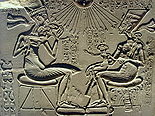
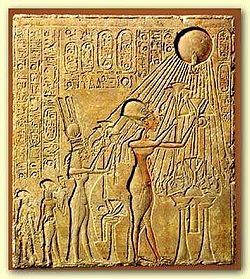 Meritaten was the first of six daughters born to Pharaoh
Akhenaten
and his Great Royal Wife
, Nefertiti
.
Her sisters are Meketaten
, Ankhesenpaaten, Neferneferuaten Tasherit
, Neferneferure
and Setepenre
.
She is known to have later married Pharaoh
Smenkhare. There are no known children, but the young girls named Meritaten-tasherit and Ankhesenpaaten-tasherit are sometimes conjectured to be the daughters of Meritaten and Smenkhare.
;on the boundary stelae
designating the boundaries of the new capital.
During Akhenaten's reign she was the most frequently depicted and mentioned of the six daughters. Her figure appears on paintings in temples, tombs, and private chapels. She is shown not only on the pictures showing the family life of the pharaoh, which were typical of the Amarna Period
, but on official ceremonies too. She also is mentioned in diplomatic letters, by the name Mayati.
Meritaten's titles include Great Royal Wife, which can indicate either marriage to her father or to Akhenaten's co-ruler Smenkhkare
, whom some believe was her (half-)uncle or half-brother, although a simpler explanation for the title may be that Meritaten simply assumed her mother's duties and office of "Great Royal Wife".
Meritaten's name seems to replace that of another royal lady in several places, among them in the Northern Palace and in the Maru-Aten
. This had been misinterpreted as evidence of Nefertiti's disgrace and banishment from the royal court, but more recently the erased inscriptions turned out to be the name of Kiya
, one of Akhenaten's secondary wives, disproving that interpretation.
According to some scholars such as J.P. Allen, Ankhkheperure Smenkhkare ruled together with Meritaten, but in the year following Akhenaten's death Smenkhkare himself died. These Egyptologists suggest that Meritaten was the 'king's daughter' Akenkeres who is recorded in Manetho's Epitome to have assumed the throne for herself as the female king Neferneferuaten
. Neferneferuaten is assigned a reign of 2 years and 1 month and is placed in Manetho's account as the immediate predecessor of Rathothis, who is believed to be Tutankhamun
.
14th century BC
The 14th century BC is a century which lasted from the year 1400 BC until 1301 BC.-Events:* 1397 BC: Pandion I, legendary King of Athens, dies after a reign of 40 years and is succeeded by his son Erechtheus II of Athens....
) was an ancient Egypt
Ancient Egypt
Ancient Egypt was an ancient civilization of Northeastern Africa, concentrated along the lower reaches of the Nile River in what is now the modern country of Egypt. Egyptian civilization coalesced around 3150 BC with the political unification of Upper and Lower Egypt under the first pharaoh...
ian queen of the eighteenth dynasty, who held the position of Great Royal Wife to Pharaoh
Pharaoh
Pharaoh is a title used in many modern discussions of the ancient Egyptian rulers of all periods. The title originates in the term "pr-aa" which means "great house" and describes the royal palace...
Smenkhkare
Smenkhkare
Smenkhkare was an ephemeral Ancient Egyptian Pharaoh of the late Eighteenth Dynasty, of whom very little is known for certain...
, who may have been a brother or son of Akhenaten
Akhenaten
Akhenaten also spelled Echnaton,Ikhnaton,and Khuenaten;meaning "living spirit of Aten") known before the fifth year of his reign as Amenhotep IV , was a Pharaoh of the Eighteenth dynasty of Egypt who ruled for 17 years and died perhaps in 1336 BC or 1334 BC...
. Her name means "She who is beloved of Aten"; Aten
Aten
Aten is the disk of the sun in ancient Egyptian mythology, and originally an aspect of Ra. The deified Aten is the focus of the monolatristic, henotheistic, or monotheistic religion of Atenism established by Amenhotep IV, who later took the name Akhenaten in worship in recognition of Aten...
being the sun-god her father worshipped; Meritaten also may have served as pharaoh in her own right under the name, Ankhkheperure Neferneferuaten
Neferneferuaten
Ankhkheperure Neferneferuaten was a woman who reigned as pharaoh toward the end of the Amarna era during the Eighteenth Dynasty. The royal succession of this period is very unclear. Manetho's Epitome, an ancient historical source written in Egypt during the third century B.C., mentions a certain...
.
Family
Pharaoh
Pharaoh is a title used in many modern discussions of the ancient Egyptian rulers of all periods. The title originates in the term "pr-aa" which means "great house" and describes the royal palace...
Akhenaten
Akhenaten
Akhenaten also spelled Echnaton,Ikhnaton,and Khuenaten;meaning "living spirit of Aten") known before the fifth year of his reign as Amenhotep IV , was a Pharaoh of the Eighteenth dynasty of Egypt who ruled for 17 years and died perhaps in 1336 BC or 1334 BC...
and his Great Royal Wife
Great Royal Wife
Great Royal Wife or Chief King's Wife is the term used to refer to the chief wife of the pharaoh of Ancient Egypt. While most Ancient Egyptians were monogamous, the pharaoh would have had other, lesser wives and concubines in addition to the Great Royal Wife...
, Nefertiti
Nefertiti
Nefertiti was the Great Royal Wife of the Egyptian Pharaoh Akhenaten. Nefertiti and her husband were known for a religious revolution, in which they started to worship one god only...
.
Her sisters are Meketaten
Meketaten
Meketaten was the second daughter of six born to the Egyptian Pharaoh Akhenaten and his Great Royal Wife Nefertiti. She was probably born in year 4 of Akhenaten's reign...
, Ankhesenpaaten, Neferneferuaten Tasherit
Neferneferuaten Tasherit
Neferneferuaten Tasherit or Neferneferuaten junior was an Ancient Egyptian princess of the 18th dynasty and the fourth daughter of Pharaoh Akhenaten and his Great Royal Wife Nefertiti.-Family:...
, Neferneferure
Neferneferure
Neferneferure was an Ancient Egyptian princess of the 18th dynasty. She was the fifth of six known daughters of Pharaoh Akhenaten and Great Royal Wife Nefertiti.-Family:...
and Setepenre
Setepenre (princess)
Setepenre was an ancient Egyptian princess of the 18th dynasty; sixth and last daughter of Pharaoh Akhenaten and his chief queen Nefertiti.-Family:...
.
She is known to have later married Pharaoh
Pharaoh
Pharaoh is a title used in many modern discussions of the ancient Egyptian rulers of all periods. The title originates in the term "pr-aa" which means "great house" and describes the royal palace...
Smenkhare. There are no known children, but the young girls named Meritaten-tasherit and Ankhesenpaaten-tasherit are sometimes conjectured to be the daughters of Meritaten and Smenkhare.
Biography
She was born early in her father's reign, before the royal family moved to the new capital established by her father, Akhetaten. She was shown beside her mother in reliefs carved into the Hut-Benben, a temple devoted exclusively to Nefertiti. She also appears—along with her parents and younger sister MeketatenMeketaten
Meketaten was the second daughter of six born to the Egyptian Pharaoh Akhenaten and his Great Royal Wife Nefertiti. She was probably born in year 4 of Akhenaten's reign...
;on the boundary stelae
Boundary Stelae of Akhenaten
The Boundary Stelae at the city of Amarna were constructed between Year 5 and Year 8 in the reign of Akhenaten.-Naming:There have been fifteen stelae found at this site, each of which has been labeled with a letter. Of the fifteen, three are located on the western side of the Nile. These have been...
designating the boundaries of the new capital.
During Akhenaten's reign she was the most frequently depicted and mentioned of the six daughters. Her figure appears on paintings in temples, tombs, and private chapels. She is shown not only on the pictures showing the family life of the pharaoh, which were typical of the Amarna Period
Amarna Period
The Amarna Period was an era of Egyptian history during the latter half of the Eighteenth Dynasty when the royal residence of the pharaoh and his queen was shifted to Akhetaten in what is now modern-day Amarna...
, but on official ceremonies too. She also is mentioned in diplomatic letters, by the name Mayati.
Meritaten's titles include Great Royal Wife, which can indicate either marriage to her father or to Akhenaten's co-ruler Smenkhkare
Smenkhkare
Smenkhkare was an ephemeral Ancient Egyptian Pharaoh of the late Eighteenth Dynasty, of whom very little is known for certain...
, whom some believe was her (half-)uncle or half-brother, although a simpler explanation for the title may be that Meritaten simply assumed her mother's duties and office of "Great Royal Wife".
Meritaten's name seems to replace that of another royal lady in several places, among them in the Northern Palace and in the Maru-Aten
Maru-Aten
Located 3 km to the south of the central city area of the city of Akhetaten , the Maru-Aten, short for Pa-maru-en-pa-aten , is a palace or sun-temple originally thought to have been constructed for Akhenaten's queen Kiya, but on her death her name and images were altered to those of Meritaten, his...
. This had been misinterpreted as evidence of Nefertiti's disgrace and banishment from the royal court, but more recently the erased inscriptions turned out to be the name of Kiya
Kiya
Kiya was one of the wives of the Egyptian Pharaoh Akhenaten. Little is known about her, and her actions and roles are poorly documented in the historical record, in contrast to those of Akhenaten's first royal wife, Nefertiti. Her unusual name suggests that she may originally have been a Mitanni...
, one of Akhenaten's secondary wives, disproving that interpretation.
According to some scholars such as J.P. Allen, Ankhkheperure Smenkhkare ruled together with Meritaten, but in the year following Akhenaten's death Smenkhkare himself died. These Egyptologists suggest that Meritaten was the 'king's daughter' Akenkeres who is recorded in Manetho's Epitome to have assumed the throne for herself as the female king Neferneferuaten
Neferneferuaten
Ankhkheperure Neferneferuaten was a woman who reigned as pharaoh toward the end of the Amarna era during the Eighteenth Dynasty. The royal succession of this period is very unclear. Manetho's Epitome, an ancient historical source written in Egypt during the third century B.C., mentions a certain...
. Neferneferuaten is assigned a reign of 2 years and 1 month and is placed in Manetho's account as the immediate predecessor of Rathothis, who is believed to be Tutankhamun
Tutankhamun
Tutankhamun , Egyptian , ; approx. 1341 BC – 1323 BC) was an Egyptian pharaoh of the 18th dynasty , during the period of Egyptian history known as the New Kingdom...
.