

Meketaten

Encyclopedia
Pharaoh
Pharaoh is a title used in many modern discussions of the ancient Egyptian rulers of all periods. The title originates in the term "pr-aa" which means "great house" and describes the royal palace...
Akhenaten
Akhenaten
Akhenaten also spelled Echnaton,Ikhnaton,and Khuenaten;meaning "living spirit of Aten") known before the fifth year of his reign as Amenhotep IV , was a Pharaoh of the Eighteenth dynasty of Egypt who ruled for 17 years and died perhaps in 1336 BC or 1334 BC...
and his Great Royal Wife
Great Royal Wife
Great Royal Wife or Chief King's Wife is the term used to refer to the chief wife of the pharaoh of Ancient Egypt. While most Ancient Egyptians were monogamous, the pharaoh would have had other, lesser wives and concubines in addition to the Great Royal Wife...
Nefertiti
Nefertiti
Nefertiti was the Great Royal Wife of the Egyptian Pharaoh Akhenaten. Nefertiti and her husband were known for a religious revolution, in which they started to worship one god only...
. She was probably born in year 4 of Akhenaten's reign. Although little is known about her, she is frequently depicted with her sisters accompanying her royal parents in the first two thirds of Akhenaten's seventeen year reign.
Family
Meketaten was the second daughter born to AkhenatenAkhenaten
Akhenaten also spelled Echnaton,Ikhnaton,and Khuenaten;meaning "living spirit of Aten") known before the fifth year of his reign as Amenhotep IV , was a Pharaoh of the Eighteenth dynasty of Egypt who ruled for 17 years and died perhaps in 1336 BC or 1334 BC...
and Nefertiti
Nefertiti
Nefertiti was the Great Royal Wife of the Egyptian Pharaoh Akhenaten. Nefertiti and her husband were known for a religious revolution, in which they started to worship one god only...
. She had an older sister named Meritaten
Meritaten
Meritaten also spelled Merytaten or Meryetaten was an ancient Egyptian queen of the eighteenth dynasty, who held the position of Great Royal Wife to Pharaoh Smenkhkare, who may have been a brother or son of Akhenaten...
and four younger sisters named Ankhesenpaaten, Neferneferuaten Tasherit
Neferneferuaten Tasherit
Neferneferuaten Tasherit or Neferneferuaten junior was an Ancient Egyptian princess of the 18th dynasty and the fourth daughter of Pharaoh Akhenaten and his Great Royal Wife Nefertiti.-Family:...
, Neferneferure
Neferneferure
Neferneferure was an Ancient Egyptian princess of the 18th dynasty. She was the fifth of six known daughters of Pharaoh Akhenaten and Great Royal Wife Nefertiti.-Family:...
and Setepenre
Setepenre (princess)
Setepenre was an ancient Egyptian princess of the 18th dynasty; sixth and last daughter of Pharaoh Akhenaten and his chief queen Nefertiti.-Family:...
. Tutankhaten was a half-brother.
Life
Meketaten’s approximate year of birth is in or before year 4 of Akhenaten. Meketaten is first depicted on the walls of the Hut-benben temple dedicated to her mother Nefertiti in ThebesThebes, Egypt
Thebes is the Greek name for a city in Ancient Egypt located about 800 km south of the Mediterranean, on the east bank of the river Nile within the modern city of Luxor. The Theban Necropolis is situated nearby on the west bank of the Nile.-History:...
. Meketaten appears behind her older sister Meritaten
Meritaten
Meritaten also spelled Merytaten or Meryetaten was an ancient Egyptian queen of the eighteenth dynasty, who held the position of Great Royal Wife to Pharaoh Smenkhkare, who may have been a brother or son of Akhenaten...
in some of the later inscriptions, thought to date to year 4 or later. Further arguments to suggest Meketaten was born in or before year 4 come from the fact that her figure was added to one of the boundary stela recording events in year 4 and carved in year 5.
Meketaten moved to the new capital city Akhetaten with her family when she was still a small child. She is depicted in several of the tombs of the nobles in Amarna. Meketaten is depicted in the tomb of Ay
Ay
Ay was the penultimate Pharaoh of Ancient Egypt's 18th dynasty. He held the throne of Egypt for a brief four-year period , although he was a close advisor to two and perhaps three of the pharaohs who ruled before him and was the power behind the throne during Tutankhamun's reign...
holding a tray of gifts while wrapping one arm around her mother’s neck. Other monuments mentioning Meketaten include a stela from Heliopolis, a statue base from the Fayoum, and the tombs of Panehesy and Parennefer. Meketaten was depicted with her parents and sisters at the reception of foreign tributes – a ceremony dating to year 12 - that can be seen on several scenes in the private tombs in Amarna of high-ranking officials named Huya and High Priest Meryre II.
Death and burial
Meketaten died in approximately year 14 of AkhenatenAkhenaten
Akhenaten also spelled Echnaton,Ikhnaton,and Khuenaten;meaning "living spirit of Aten") known before the fifth year of his reign as Amenhotep IV , was a Pharaoh of the Eighteenth dynasty of Egypt who ruled for 17 years and died perhaps in 1336 BC or 1334 BC...
. It is very likely that a plague swept across Egypt between Akhenaten's 12th and 15th regnal years, for many members of the royal family cease to be mentioned again; among them Queen Mother Tiye
Tiye
Tiye was the daughter of Yuya and Tjuyu . She became the Great Royal Wife of the Egyptian pharaoh Amenhotep III....
, Queen Nefertiti
Nefertiti
Nefertiti was the Great Royal Wife of the Egyptian Pharaoh Akhenaten. Nefertiti and her husband were known for a religious revolution, in which they started to worship one god only...
, Akhenaten's secondary wife Kiya
Kiya
Kiya was one of the wives of the Egyptian Pharaoh Akhenaten. Little is known about her, and her actions and roles are poorly documented in the historical record, in contrast to those of Akhenaten's first royal wife, Nefertiti. Her unusual name suggests that she may originally have been a Mitanni...
, Meketaten and the two youngest princesses, Neferneferure
Neferneferure
Neferneferure was an Ancient Egyptian princess of the 18th dynasty. She was the fifth of six known daughters of Pharaoh Akhenaten and Great Royal Wife Nefertiti.-Family:...
and Setepenre
Setepenre (princess)
Setepenre was an ancient Egyptian princess of the 18th dynasty; sixth and last daughter of Pharaoh Akhenaten and his chief queen Nefertiti.-Family:...
. Meketaten's death could have resulted either from a plague, or from childbirth. The presence of a royal baby causes many to believe the young princess died in childbirth (in this case the father is most likely to had been Akhenaten himself, marrying his daughter), but it cannot be proven. An alternative interpretation suggested by van Dijk is that the child depicted in the scenes is the soul (the ka) of Meketaten.
 and
and  of the Royal Tomb
Royal Tomb of Akhenaten
The Royal Tomb of Akhenaten is the burial place of the Pharaoh Akhenaten, in the Royal Wadi in Amarna.-Layout:A flight of twenty steps, with a central inclined plane leads to the door and a long straight descending corridor. Halfway down this corridor a suite of unfinished rooms...
are believed to be used for the burials. Chambers
 and
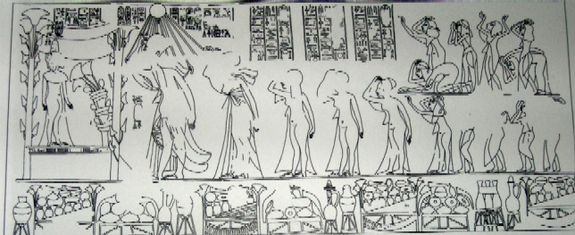
and  depict very similar scenes: Akhenaten and Nefertiti bend over the inert body of a woman, weeping and gripping each other's arms for support. Nearby a nurse stands with a baby in her arms, accompanied by a fan-bearer, which indicates the baby's royal status.
The names in the scene in chamber
 have been hacked out. In the chamber
  however the hieroglyphs identify the dead young woman as Meketaten. In the same chamber another scene shows Meketaten standing under a canopy which is usually associated with childbirth but can also interpreted as representing the rebirth of the princess. In front of her, amongst courtiers, stand Akhenaten,. Nefertiti and their three remaining daughters, Meritaten, Ankhesenpaaten and Neferneferuaten Tasherit
Neferneferuaten Tasherit
Neferneferuaten Tasherit or Neferneferuaten junior was an Ancient Egyptian princess of the 18th dynasty and the fourth daughter of Pharaoh Akhenaten and his Great Royal Wife Nefertiti.-Family:...
.
It is possible that chamber
 was the burial place of someone other than Meketaten. There may even have been two burials which may have been those of Neferneferure
Neferneferure
Neferneferure was an Ancient Egyptian princess of the 18th dynasty. She was the fifth of six known daughters of Pharaoh Akhenaten and Great Royal Wife Nefertiti.-Family:...
and Setepenre
Setepenre (princess)
Setepenre was an ancient Egyptian princess of the 18th dynasty; sixth and last daughter of Pharaoh Akhenaten and his chief queen Nefertiti.-Family:...
, but this is not certain. Another theory is that one of the scenes depicts Kiya
Kiya
Kiya was one of the wives of the Egyptian Pharaoh Akhenaten. Little is known about her, and her actions and roles are poorly documented in the historical record, in contrast to those of Akhenaten's first royal wife, Nefertiti. Her unusual name suggests that she may originally have been a Mitanni...
and that the baby is Tutankhamun
Tutankhamun
Tutankhamun , Egyptian , ; approx. 1341 BC – 1323 BC) was an Egyptian pharaoh of the 18th dynasty , during the period of Egyptian history known as the New Kingdom...
.
Fragments of Meketaten’s sarcophagus were found in the royal tomb. Inscriptions mention her parents Akhenaten
Akhenaten
Akhenaten also spelled Echnaton,Ikhnaton,and Khuenaten;meaning "living spirit of Aten") known before the fifth year of his reign as Amenhotep IV , was a Pharaoh of the Eighteenth dynasty of Egypt who ruled for 17 years and died perhaps in 1336 BC or 1334 BC...
and Nefertiti
Nefertiti
Nefertiti was the Great Royal Wife of the Egyptian Pharaoh Akhenaten. Nefertiti and her husband were known for a religious revolution, in which they started to worship one god only...
, her sister Ankhesenpaaten as well as her grand-parents Amenhotep III
Amenhotep III
Amenhotep III also known as Amenhotep the Magnificent was the ninth pharaoh of the Eighteenth dynasty. According to different authors, he ruled Egypt from June 1386 to 1349 BC or June 1388 BC to December 1351 BC/1350 BC after his father Thutmose IV died...
and Queen Tiye.