
All Topics  
Nefertiti

 
Nefertiti

   Email Print
   Bookmark   Link


Nefertiti


Nefertiti (pronounced at the time something like *nafrati?ta ) (c. 1370 BC - c. 1330 BC) was the Great Royal Wife
Great Royal Wife

File:Ah hotep.jpgGreat Royal Wife or Chief King's Wife is the term used to refer to the chief wife of a male pharaoh of Ancient Egypt on the day of his coronation, as her status in the royal lineage was essential to gaining the position of pharaoh....
 (chief consort) of the Egypt
Egypt

Egypt is a country mainly in North Africa, with the Sinai Peninsula forming a land bridge in Western Asia. Covering an area of about , Egypt borders the Mediterranean Sea to the north, the Gaza Strip and Israel to the northeast, the Red Sea to the east, Sudan to the south and Libya to the west....
ian Pharaoh
Pharaoh

Pharaoh is a title used in many modern discussions of the ancient Egyptian rulers of all periods. In antiquity this title began to be used for the ruler who was the religious and political leader of united ancient Egypt, only during the New Kingdom, specifically, during the middle of the Eighteenth dynasty of Egypt....
 Akhenaten
Akhenaten

Akhenaten , was a Pharaoh of the Eighteenth dynasty of Egypt, who died 1336 BC or 1334 BC. He is especially noted for attempting to compel the Egyptian population in the monotheism worship of Aten, although there are doubts as to how successful he was at this....
.


Discussion
Ask a question about 'Nefertiti'
Start a new discussion about 'Nefertiti'
Answer questions from other users
Full Discussion Forum


Encyclopedia


Nefertiti 30 01 2006
Nefertiti (pronounced at the time something like *nafrati?ta ) (c. 1370 BC - c. 1330 BC) was the Great Royal Wife
Great Royal Wife

File:Ah hotep.jpgGreat Royal Wife or Chief King's Wife is the term used to refer to the chief wife of a male pharaoh of Ancient Egypt on the day of his coronation, as her status in the royal lineage was essential to gaining the position of pharaoh....
 (chief consort) of the Egypt
Egypt

Egypt is a country mainly in North Africa, with the Sinai Peninsula forming a land bridge in Western Asia. Covering an area of about , Egypt borders the Mediterranean Sea to the north, the Gaza Strip and Israel to the northeast, the Red Sea to the east, Sudan to the south and Libya to the west....
ian Pharaoh
Pharaoh

Pharaoh is a title used in many modern discussions of the ancient Egyptian rulers of all periods. In antiquity this title began to be used for the ruler who was the religious and political leader of united ancient Egypt, only during the New Kingdom, specifically, during the middle of the Eighteenth dynasty of Egypt....
 Akhenaten
Akhenaten

Akhenaten , was a Pharaoh of the Eighteenth dynasty of Egypt, who died 1336 BC or 1334 BC. He is especially noted for attempting to compel the Egyptian population in the monotheism worship of Aten, although there are doubts as to how successful he was at this....
. Nefertiti and her husband were known for changing Egypt's religion from a polytheistic religion to a monotheistic religion. They believed in only one god, Aten.

She had many titles; for example, at Karnak
Karnak

The Karnak temple complex, universally known only as Karnak, describes a vast conglomeration of ruined temples, chapels, pylons and other buildings....
 there are inscriptions that read Heiress, Great of Favours, Possessed of Charm, Exuding Happiness, Mistress of Sweetness, beloved one, soothing the king's heart in his house, soft-spoken in all, Mistress of Upper and Lower Egypt, Great King's Wife, whom he loves, Lady of the Two Lands, Nefertiti'.

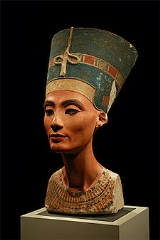
She was made famous by her bust
Bust (sculpture)

A bust is a sculpture or cast representation of the upper part of the human figure, depicting a person's head and neck, as well as a variable portion of the chest and shoulders....
, now in Berlin's Altes Museum
Altes Museum

The Altes Museum , is one of several internationally renowned museums on Berlin's Museum Island in Berlin, Germany. Since restoration work in 1966, it houses the antique collection of the Berlin State Museums....
, shown to the right. The bust is one of the most copied works of ancient Egypt
Ancient Egypt

Ancient Egypt was an Ancient history civilization in eastern North Africa, concentrated along the lower reaches of the Nile in what is now the modern nation of Egypt....
. It was attributed to the sculptor Thutmose
Thutmose (sculptor)

"The King's Favourite and Master of Works, the Sculptor Thutmose" is thought to have been the official court sculptor of the Egyptian Pharaoh Akhenaten in the latter part of his reign....
, and was found in his workshop
Workshop

A workshop is a room or building which provides both the area and tools that may be required for the manufacture or repair of Manufacturing Good ....
. The bust itself is notable for exemplifying the understanding Ancient Egyptians had regarding realistic facial proportions.

Some scholars believe that Nefertiti ruled briefly after her husband's death and before the accession of Tutankhamun
Tutankhamun

Tutankhamun , Egyptian language was an Ancient Egypt Pharaoh of the Eighteenth dynasty of Egypt , during the period of History of Egypt known as the New Kingdom....
 as Smenkhkare
Smenkhkare

Smenkhkare is an ephemeral Pharaoh of the late Eighteenth dynasty of Egypt of whom very little is know for certain. Traditionally he is seen as Akhenaten's co-regent and immediate successor and predecessor of Tutankhamun and is assumed to be a close, male relative of those two kings ....
, although this identification is a matter of ongoing debate.

Family

See also : Eighteenth dynasty of Egypt Family Tree


Nefertiti's parentage is not known with certainty, but it is now generally believed that she was the daughter of Ay
Ay

Ay was the penultimate Pharaoh of Ancient Egypt's Eighteenth dynasty of Egypt. He held the throne of Egypt for a brief four-year period , although he was a close advisor to two and perhaps three of the pharaohs who ruled before him and was the power behind the throne during Tutankhamun's reign....
, later to be pharaoh
Pharaoh

Pharaoh is a title used in many modern discussions of the ancient Egyptian rulers of all periods. In antiquity this title began to be used for the ruler who was the religious and political leader of united ancient Egypt, only during the New Kingdom, specifically, during the middle of the Eighteenth dynasty of Egypt....
 and the sister of Mutnedjmet
Mutnedjmet

The Ancient Egypt noblewoman Mutnedjmet was the second wife of Horemheb, the last ruler of the Eighteenth dynasty of Egypt. The name, Mutnedjmet, translates as: [The Goddess] Mut is the Sweet One or Sweet Mother....
. Another theory that gained some support identified Nefertiti with the Mitanni
Mitanni

Mitanni or Hanigalbat was a loosely organized Hurrian-speaking Hittite vassal state in northern Syria from ca. 1500 BC-1300 BC."The Assyrians called the lands of Mitanni Hanigalbat while to the Hittites it was the land of the Hurrians....
 princess Tadukhipa
Tadukhipa

Tadukhipa, in Hurrian language Tadu-Hepa, was the daughter of Tushratta, king of Mitanni and his queen, Queen Juni.Relatively little is known about this princess of Mitanni....
.

The exact dates of when Nefertiti was married to Amenhotep IV and later promoted to his Queen are uncertain. However, the couple had six known daughters. This is a list with suggested years of birth:

  • Meritaten
    Meritaten

    Meritaten also spelled Merytaten or Meryetaten was an Ancient Egypt queen of the 18th dynasty, who held the position of Great Royal Wife to Pharaoh Smenkhkare, who may have been a brother or son of Akhenaten....
    : Before year one or the very beginning of year one.(1356 BC).
  • Meketaten
    Meketaten

    Meketaten was the second daughter of six born to the Egyptian Pharaoh Akhenaten and his Great Royal Wife Nefertiti. She was probably born in year 2 or 3 Akhenaten's reign....
    : Year 1 or three (1349 BC).
  • Ankhesenpaaten, also known as Ankhesenamen, later queen of Tutankhamun
  • Neferneferuaten Tasherit
    Neferneferuaten Tasherit

    Neferneferuaten Tasherit or Neferneferuaten junior was an Ancient Egyptian princess of the 18th dynasty and the fourth daughter of Pharaoh Akhenaten and his Great Royal Wife Nefertiti....
    : Year 6 (1344 BC)
  • Neferneferure
    Neferneferure

    Neferneferur? was an Ancient Egyptian princess of the 18th dynasty. She was the fifth of six known daughters of Pharaoh Akhenaten and Great Royal Wife Nefertiti....
    : Year 9 (1341 BC).
  • Setepenre
    Setepenre

    Setepenre is an often-used title of Egyptian kings , meaning "Elect of Ra".Setepenre also was the name of the sixth and last daughter of Akhenaten and Nefertiti....
    : Year 11 (1339 BC).


In Year 4 of his reign (1346 BC) Amenhotep IV started his worship of Aten
Aten

Aten was the disk of the sun in ancient Egyptian mythology, and originally an aspect of Ra. He became the deity of the monotheism ? in fact, monism ? religion Atenism of Amenhotep IV, who took the name Akhenaten....
. The king led a religious revolution, in which Nefertiti played a prominent role. This year is also believed to mark the beginning of his construction of a new capital, Akhetaten, at what is known today as Amarna
Amarna

The site of Amarna is located on the east bank of the Nile River in the modern Egyptian province of Minya Governorate, some 58 km south of the city of al-Minya, 312 km south of the Egyptian capital Cairo and 402 km north of Luxor....
. In his Year 5, Amenhotep IV officially changed his name to Akhenaten as evidence of his new worship. The date given for the event has been estimated to fall around January 2 of that year. In Year 7 of his reign (1343 BC) the capital was officially moved from Thebes
Thebes, Egypt

Thebes was a city in Ancient Egypt located about 800 km south of the Mediterranean, on the east bank of the river Nile . It was the capital of Waset, the fourth Upper Egyptian Nome ....
 to Amarna
Amarna

The site of Amarna is located on the east bank of the Nile River in the modern Egyptian province of Minya Governorate, some 58 km south of the city of al-Minya, 312 km south of the Egyptian capital Cairo and 402 km north of Luxor....
, though construction of the city seems to have continued for two more years (till 1341 BC). The new city was dedicated to the royal couple's new religion. Nefertiti's famous bust is also thought to have been created around this time.

In an inscription estimated to November 21 of year 12 of the reign (approx. 1338 BC), her daughter Meketaten is mentioned for the last time; she is thought to have died shortly after that date. Circumstantial evidence which shows that she predeceased her husband at Akhetaten include several shabti fragments of the Queen's burial which are now located in the Louvre and Brooklyn Museums. A relief in Akhenaten's tomb in the Royal Wadi
Royal Wadi and tombs

The Royal Wadi at Amarna is a where the Royal Family of Amarna were to be buried. It can be thought of as being an Amarna replacement for the Valley of the Kings....
 at Amarna appears to show her funeral.

During Akhenaten's reign (and perhaps after) Nefertiti enjoyed unprecedented power, and by the twelfth year of his reign, there is evidence that she may have been elevated to the status of co-regent: equal in status to the pharaoh himself. She was often depicted on temple walls the same size as the king, signifying her importance, and shown worshiping the Aten alone. Perhaps most impressively, Nefertiti is shown on a relief from the temple at Amarna which is now in the MFA in Boston, smiting a foreign enemy with a mace before the Aten. Such depictions had traditionally been reserved for the pharaoh alone, and yet Nefertiti was depicted as such.

Death

About Year 14 of Akhenaten's reign (1336 BC), Nefertiti herself vanishes from the historical record, and there is no word of her after that date. Theories include a sudden death by a plague that was sweeping through the city or another natural death. A previous theory that she fell into disgrace is now discredited since the deliberate erasures of the monuments belonging to a queen of Akhenaten has now been shown to refer to Kiya
Kiya

Kiya was a wife of Egyptian Pharaoh Akhenaten. Little is known about her, and her actions and roles are poorly documented in the historical record in contrast to Akhenaten's first royal wife, Nefertiti....
 instead. Regardless, the verifiable knowledge of this episode has been completely lost to history.

The Coregency Stela
Coregency Stela

The Coregency Stela is the name given to seven limestone stela-fragments which were found in a tomb at Amarna. The stela dates from the late Eighteenth dynasty of Egypt and shows the figures of Akhenaten, Nefertiti, and Meritaten....
 may show her as a co-regent with her husband, who possibly ruled after his death. It is thought by some scholars that Nefertiti changed her name, first to Ankhkheperure Neferneferuaten and later to Ankhkheperure Smenkhkare and that she enjoyed a brief sole rule under the latter name. it is also believed that, as her husband's co-regent and successor she might have attempted to reconcile the Atenist and Traditional religions Nefertiti would have prepared for her death and for the succession of her daughter, now named Ankhsenamun, and her stepson, Tutankhamun. They would have been educated in the traditional way, worshiping the old gods. This theory has Neferneferuaten dying after two years of kingship and was then succeeded by Tutankhamun
Tutankhamun

Tutankhamun , Egyptian language was an Ancient Egypt Pharaoh of the Eighteenth dynasty of Egypt , during the period of History of Egypt known as the New Kingdom....
, thought to have been a son of Akhenaten. He married Nefertiti's daughter Ankhesenpaaten
Ankhesenpaaten

Born as Ankhesenpaaten, and later renamed, Ankhesenamen, which means. She who lives through the Amun, was the third of six known daughters of the Egyptian Pharaoh Akhenaten and his Great Royal Wife Nefertiti....
. The royal couple were young and inexperienced, by any estimation of their age, and Ankhesenpaaten bore two stillborn (and premature) daughters whose mummies were found by Howard Carter in Tutankhamen's tomb. Some theories believe that Nefertiti was still alive and held influence on the younger royals. If this is the case, that influence and presumably Nefertiti's own life would have ended by year 3 of Tutankhaten's reign (1331 BC). In that year, Tutankhaten changed his name to Tutankhamun, as evidence of his return to the official worship of Amun
Amun

Amun, reconstructed Egyptian language Yamanu , was the name of a deity in Egyptian mythology who gradually rose from being an abstract concept to the patron deity of Thebes, Egypt and one of the most important deities in Ancient Egypt before fading into obscurity....
, and his abandonment of Amarna to return the capital to Thebes.

As can be seen by the suggested identifications between Tadukhipa, Nefertiti, Smenkhkare and Kiya, the records of their time and their lives are largely incomplete, and the findings of both archaelogists
Archaeology

Archaeology, archeology, or arch?ology is the science that studies Homo cultures through the recovery, documentation, analysis, and interpretation of material remains and environmental data, including architecture, Artifact , features, Biofact s, and cultural landscape....
 and historian
Historian

A historian is an individual who studies and writes about history, and is regarded as an authority on it. Historians are concerned with the continuous, systematic narrative and research of past events as relating to the human race; as well as the study of all events in time....
s may develop new theories vis-à-vis Nefertiti and her precipitous exit from the public stage.

Burial

No concrete information is available regarding Nefertiti's death, but the location of Nefertiti's body has long been a subject of curiosity and speculation. There are many theories regarding her death and burial.

The "Younger Lady"

In the most recent research effort led by Egyptian archaeologist Dr. Zahi Hawass
Zahi Hawass

Zahi Hawass is an Egyptians archaeology and List of Egyptologists and the current Secretary General of the Egyptian Supreme Council of Antiquities....
, head of Egypt's Supreme Council for Antiquities, a mummy known as the "The Younger Lady" was put through CT
Computed tomography

Computed tomography is a medical imaging method employing tomography. Geometry Processing is used to generate a stereoscopy of the inside of an object from a large series of two-dimensional X-ray images taken around a single axis of rotation....
 scan analysis and researchers concluded that she may be Tutankhamun's biological mother, Queen Kiya, not Queen Nefertiti. Fragments of shattered bone were found in the sinus, and blood clots were found, so the theory that the damage was inflicted post-mummification was rejected and a murder scenario was deemed more likely. Another reasoning to support Kiya's placement in KV35
KV35

Tomb KV35 in the Valley of the Kings is the tomb of Amenhotep II.It was discovered by Victor Loret in March 1898.It has a dog-leg shape, typical of the layout of early Eighteenth dynasty of Egypt tombs, but several features make this tomb stand out....
 is that after Tutankhamun returned Egypt to the traditional religion, he also moved his closest relatives, father, grand mother, and biological mother, to the Valley of the Kings to be buried with him (matching the list of figurines and drawings in his tomb
KV62

Tomb KV62 in Egypt's Valley of the Kings is the Tomb of Tutankhamun, which became famous for the wealth of treasure it contained. The tomb was discovered in 1922 by Howard Carter , underneath the remains of workmen's huts built during the Ramesside Period; this explains why it was spared from the worst of the tomb depredations of that t...
). Nefertiti may still be in an undiscovered tomb.

Previously, on June 9, 2003, archaeologist Joann Fletcher
Joann Fletcher

Dr. Joann Fletcher is an Honorary Research Fellow in the Department of Archaeology at the University of York and Consultant Egyptologist for Harrogate Museums and Arts....
, a specialist in ancient hair from the University of York
University of York

The University of York is a campus university located in the city of York, England. Established in 1963, York has expanded to more than 30 departments and centres, covering a wide range of subjects....
 in England, announced that Nefertiti's mummy may have been one of the anonymous mummies stored in tomb KV35
KV35

Tomb KV35 in the Valley of the Kings is the tomb of Amenhotep II.It was discovered by Victor Loret in March 1898.It has a dog-leg shape, typical of the layout of early Eighteenth dynasty of Egypt tombs, but several features make this tomb stand out....
 in the Valley of the Kings
Valley of the Kings

The Valley of the Kings is a valley in Egypt where, for a period of nearly 500 years from the 16th century BC to 11th century BC, tombs were constructed for the Pharaoh and powerful nobles of the Conventional Egyptian chronology#New Kingdom ....
 known as "the Younger Lady". However, an independent scholar in the field of Egyptology, Marianne Luban, had already made the same speculation as early as 1999 in an article posted on the Internet, entitled "Do We Have the Mummy of Nefertiti?"

Luban's points upholding the identification are the same as those of Joann Fletcher. Furthermore, Fletcher suggested that Nefertiti was in fact the Pharaoh Smenkhkare. Some Egyptologists hold to this view though the majority believe Smenkhkare to have been a separate person. Dr. Fletcher led an expedition funded by the Discovery Channel
Discovery Channel

The Discovery Channel is an United States satellite and cable TV channel , founded by John Hendricks and distributed by Discovery Communications....
 that examined what they believed to have been Nefertiti's mummy.

The team claimed that the mummy they examined was damaged in a way suggesting the body had been deliberately desecrated in antiquity. Mummification techniques, such as the use of embalming fluid and the presence of an intact brain
Brain

The brain is the center of the nervous system in all vertebrate, and most invertebrate, animals. Some primitive animals such as cnidarian and echinoderm have a decentralized nervous system without a brain, while sponges lack any nervous system at all....
, suggested an eighteenth dynasty royal mummy. Other features the team used to support their claims were the age of the body, the presence of embedded nefer beads, and a wig of a rare style worn by Nefertiti. They further claimed that the mummy's arm was originally bent in the position reserved for pharaohs, but was later snapped off and replaced with another arm in a normal position.

However most Egyptologists, among them Kent Weeks and Peter Locavara, generally dismiss Fletcher's claims as unsubstantiated. They claim that ancient mummies are almost impossible to identify with a particular person without DNA
List of DNA tested mummies

This is a list of Mummy and ancient humans remains that have been genealogical DNA test along with a brief description of when and where they lived....
; and as bodies of Nefertiti's parents or children have never been identified, her conclusive identification is impossible. Any circumstantial evidence, such as hairstyle and arm position, is not reliable enough to pinpoint a single, specific historical person. The cause of damage to the mummy can only be speculated upon, and the alleged revenge is an unsubstantiated theory. Bent arms, contrary to Fletcher's claims, were not reserved exclusively to pharaohs; this was also used for other members of the royal family. The wig found near to the mummy is of unknown origin, and cannot be conclusively linked to that specific body. Finally, the 18th dynasty was one of the largest and most prosperous dynasties of ancient Egypt, and a female royal mummy could be any of a hundred royal wives or daughters from 18th dynasty's more than 200 years on the throne.

In addition, there is controversy about both the age and gender of the mummy. On June 12, 2003, Hawass also dismissed the claim, citing insufficient evidence. On August 30, 2003, Reuters
Reuters

Reuters Group Limited is a United_Kingdom-based, Canadian controlled news agency and former financial market data provider that provides reports from around the world to newspapers and broadcasters....
 further quoted Hawass as saying, "I'm sure that this mummy is not a female", and "Dr Fletcher has broken the rules and therefore, at least until we have reviewed the situation with her university, she must be banned from working in Egypt." Hawass has claimed that the mummy is female and male on different occasions.

The Elder Lady?

A KMT article called "Who is The Elder Lady mummy?" suggests that the elder lady mummy may be Nefertiti's body . This may be possible due to the fact that the mummy is around her mid-thirties or early forties, Nefertiti's guessed age of death. Also, unfinished busts of Nefertiti appear to resemble the mummy's face, though other suggestions include Ankhesenamun and, the favorite candidate, Tiye
Tiye

File:Memnon 082005 06.jpgTiye was the daughter of Yuya and Tjuyu . She became the Great Royal Wife of the Ancient Egypt pharaoh Amenhotep III and matriarch of the Amarna family from which many members of the royal family of Ancient Egypt were born....
. More evidence to support this identification is that the mummy's teeth look like that of a 29-38 year old, Nefertiti's most likely age of death. Due to recent age tests on the mummy's teeth, it appears that the 'Elder Lady' is in fact Queen Tiye and also that the DNA of the mummy is a close, if not direct, match to the lock of hair found in Tutankhamun's tomb which bears the inscription of Queen Tiye is the hairs coffin. To date, the mummy of this famous and iconic queen has not been found.

Iconic status

Nefertiti's place as an icon
Icon

An 'icon' is a religious work of art, most commonly a painting, from Eastern Christianity. More broadly the term is used in a wide number of contexts for an image, picture, or representation; it is a sign or likeness that stands for an object by signifying or representing it either concretely or by analogy, as in semiotics; by extension, ...
 in popular culture is secure as she has become somewhat of a celebrity. After Cleopatra she is the second most famous "Queen" of Egypt in the Western imagination
Egypt in the Western imagination

Egypt has loomed large in the Western imagination from the very first written texts in the Greek mythology and Hebrew Bible traditions. Egypt was already immemorially ancient to outsiders, and the idea of Egypt as a figment of the Western imagination has continued to be at least as influential in the history of ideas as the actual hist...
 and influenced through photographs that changed standards of feminine beauty of the 20th century, and is often referred to as "the most beautiful woman in the world".

The character Cortana
Cortana

Cortana is a Character Artificial intelligence character in Bungie's Halo . Voiced by Jen Taylor, she appears in Halo: Combat Evolved and its sequels, Halo 2 and Halo 3, as well the novels Halo: The Flood, Halo: The Fall of Reach, Halo: First Strike, and Halo: Ghosts of Onyx....
 from the video game
Halo: Combat Evolved

Halo: Combat Evolved is a first-person shooter video game developed by Bungie Studios. The first game of the Halo series, it was released on November 15, 2001 as a launch title for the Xbox video game console, and is considered the platform's "killer application." With more than five million copies sold worldwide as of November 9,...
 was originally based on images of Nefertiti. A.I.s from this game's story universe often take the form of mythological or historical characters.