

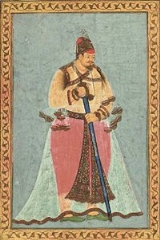
Adil Shahi

Encyclopedia
The Adil Shahi or Adilshahi dynasty ruled the Sultanate of Bijapur in the Western area of the Deccan region of Southern India
from 1490 to 1686. Bijapur had been a province of the Bahmani Sultanate
(1347–1518), before its political decline in the last quarter of the 15th century and eventual break-up in 1518. The Bijapur Sultanate was absorbed into the Mughal Empire
on 12 September 1686, after its conquest by the Emperor Aurangzeb
.
The founder of the Adil Shahi dynasty, Yusuf Adil Shah
(1490–1510), was appointed Bahmani governor of the province, before creating a de-facto independent Bijapur state. Yusuf and his son, Ismail, generally used the title Adil Khan. 'Khan', meaning 'Chief' in Mongolian and adopted in Persian, conferred a lower status than 'Shah', indicating royal rank. Only with the rule of Yusuf's grandson, Ibrahim Adil Shah I
(1534–1558), did the title of Adil Shah come into common use.
The Bijapur Sultanate's borders changed considerably throughout its history. Its northern boundary remained relatively stable, straddling contemporary Southern Maharashtra
and Northern Karnataka
. The Sultanate expanded southward, first with the conquest of the Raichur Doab
following the defeat of the Vijayanagar
Empire at the Battle of Talikota in 1565. Later campaigns, notably during the reign of Mohammed Adil Shah
(1627–1657), extended Bijapur's formal borders and nominal authority as far south as Bangalore
. Bijapur was bounded on the West by the Portuguese state of Goa
and on the East by the Sultanate of Golconda
, ruled by the Qutb Shahi dynasty.
The former Bahmani provincial capital of Bijapur remained the capital of the Sultanate throughout its existence. After modest earlier developments, Ibrahim Adil Shah I
(1534–1558) and Ali Adil Shah I
(1558–1580) remodelled Bijapur, providing the citadel and city walls, Friday Mosque, core royal palaces and major water supply infrastructure. Their successors, Ibrahim Adil Shah II
(1580–1627), Mohammed Adil Shah
(1627–1657) and Ali Adil Shah II
(1657–1672), further adorned Bijapur with palaces, mosques, mausolea and other structures, considered to be some of the finest examples of Deccan Sultanate and Indo-Islamic Architecture.
Bijapur was caught up in the instability and conflict resulting from the collapse of the Bahmani Empire. Constant warring, both with the Vijayanagar
Empire and the other Deccan Sultanates, curtailed the development of state before the Deccan Sultanates allied to achieve victory over Vijayanagar at Talikota in 1565. Bijapur eventually conquered the neighbouring Sultanate of Bidar
in 1619. The Portuguese Empire exerted pressure on the major Adil Shahi port of Goa, until it was conquered during the reign of Ibrahim II. The Sultanate was thereafter relatively stable, although it was damaged by the revolt of Shivaji, his father was Maratha commander in the service of Mohammed Adil Shah
. Shivaji founded an independent Maratha Kingdom which went on to become Maratha Empire one of largest empire in present day India. The greatest threat to Bijapur's security was, from the late 16th century, the expansion of the Mughal Empire and into the Deccan. Although it may be the case that the Mughals destroyed the Adilshahi it was Shivaji's revolt which weakened the Adilshahi control. Various agreements and treaties imposed Mughal suzerainty on the Adil Shahs, by stages, until Bijapur's formal recognition of Mughal authority in 1636. The demands of their Mughal over-lords sapped the Adil Shahs of their wealth until the Mughal conquest of Bijapur in 1686.
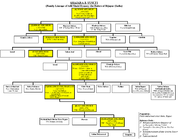
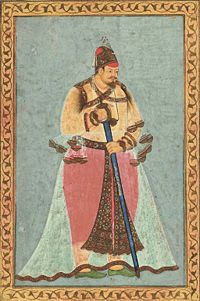 The founder of the dynasty, Yusuf Adil Shah
, was likely a Bahmani nobleman, a Persian (Tajik) descent from Badakhshan
. According to the historian Mir Rafi-uddin Ibrahim-i Shirazi, or Rafi, Yusuf's full name was Sultan Yusuf 'Adil Shah Sawa or Sawa-i, the son of Mahmud Beg of Sawa in Iran, (Rafi' 36–38, vide Devare 67, fn 2). Rafi's history of the 'Adil Shahi dynasty was written at the request of Ibrahim Adil Shah II
, and was completed and presented to the patron in AH 1017. The Indian scholar T.N. Devare mentioned that while Rafi's account of the Bahmani dynasty is filled with anachronisms, his account of the Adilshahi is "fairly accurate, exhaustive, and possesses such rich and valuable information about Ali I and Ibrahim II" (312). Rafi-uddin later became the governor of Bijapur for about 15 years (Devare 316).
Rafi' account is less well known than that of the popular historian Firishta
, the author of the Tarikh-i Firishta, also known as the Gulshan-i Ibrahim. Rafi's account of the life of Yusuf 'Adil Shah directly contradicts a popular myth penned by Firishta. According to Firishta
, Yusuf was the son of the Ottoman Emperor
Murad II
. After the Sultan Murad II's death, and the crown prince's succeeded to the throne, all of the other sons of the emperor were executed. Firishta
fabricated a story that Yusuf's mother secretly replaced Yusuf with a slave boy and sent him to Persia. After many romantic adventures, Yusuf reached the court of the Bidar Sultanate. T.N. Devare found that other historians of the time, Mir Ibrahim Lari-e Asadkhani, and Ibrahim Zubayri, the author of the Basatin as-Salatin, favored Rafi's account and rejected this account provided solely by Firishta (Devare 67, fn 2).
Despite the obvious fabrication of Yusuf's Ottoman origin, Firishta's account continues to be very popular today in Bijapur. Devare observed that the work is "a general history of India from the earliest period up to Firishta's time written at the behest of Ibrahim Adil Shah II
and presented to him in 1015 AH/1606 CE. It seems however that it was supplemented by the author himself as it records events up to AH 1033 (1626 CE). This is the most widely quoted history of the Adil Shahi, and it is the source of the story that Yusuf was an Ottoman prince" (Devare 272).
Yusuf's bravery and personality raised him rapidly in Sultan's favor, resulting in his appointment as the Governor of Bijapur. He built the Citadel
or Arkilla and the Faroukh Mahal. Yusuf was a man of culture. He invited poets and artisans from Persia, Turkey and Rome to his court. He's well known as a ruler who took advantage of the decline of the Bahmani power to establish himself as an independent sultan at Bijapur in 1498. He did this with a military support which has been given to him by a Bijapuri general Kalidas Madhu Sadhwani
– brilliat commander and good diplomat, who made quick career by supporting Yusuf Adil Shah
and then his son – Ismail Adil Shah
. He married Punji, the sister of a Maratha
warrior. When Yusuf died in 1510, his son Ismail was still a boy. Punji in male attire valiantly defended him from a coup to grab the throne. Ismail Adil Shah
thus became the ruler of Bijapur and succeeded his father's ambition.
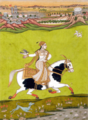 Ibrahim Adil Shah I
who succeeded his father Ismail, fortified the city and built the old Jamia Masjid
. Ali Adil Shah I
who next ascended the throne, aligned his forces with other Muslim kings of Golconda
, Ahmednagar and Bidar
, and together, they brought down the Vijayanagar empire. With the loot gained, he launched ambitious projects. He built the Gagan Mahal, the Ibrahim Rauza (his own tomb), Chand Bawdi (a large well) and the Jami Masjid. Ali I had no son, so his nephew Ibrahim II was set on the throne. Ali I's queen Chand Bibi
had to aid him until he came of age. Ibrahim II was noted for his valor, intelligence and leanings towards the Hindu music and philosophy. Under his patronage the Bijapur school of painting reached its zenith. Muhammad Adil Shah succeeded his father Ibrahim II. He is renowned for Bijapur's grandest structure, the Gol Gumbaz
, which has the biggest dome in the world with whispering gallery round about slightest sound is reproduced seven times. He also set up the historical Malik-e-Maidan, the massive gun.
Ali Adil Shah II
inherited a troubled kingdom. He had to face the onslaught of the Maratha
leader Shivaji on one side and Mughal
emperor Aurangzeb
on another. His mausoleum, Bara Kaman
, planned to dwarf all others, was left unfinished due to his death. Sikandar Adil Shah
, the last Adil Shahi sultan, ruled next for fourteen stormy years. Finally on 12 September 1686, the Mughal armies under Aurangzeb
overpowered the city of Bijapur
.
rulers and Palegars. Shaikh Haji Roomi was the first to arrive in Bijapur with his companions. Although his other comrades like Shaikh Salahuddin, Shaikh Saiful Mulk and Shaikh Haji Makki were settled in Pune
, Haidra and Tikota respectively.
According to Tazkiraye Auliyae Dakkan i.e., Biographies of the saints of the Deccan, compiled by Abdul Jabbar Mulkapuri in 1912–1913,
After this period arrival of Sufis in Bijapur and suburbs was started. Ainuddin Gahjul Ilm Dehelvi narrates that Ibrahim Sangane was one of the early Sufis of Bijapur parish. Sufis of Bijapur can be divided into three categories according to period of their arrival viz., Sufis before Bahmani and / or Adil Shahi Dynasty, Sufis during Adil Shahi Dynasty and Sufis after the fall of Adil Shahi Dynasty. And further it can be classified as Sufis as worriors, Sufis as social reformers, Sufis as scholars, poets and writers.
Ibrahim Zubairi writes in his book Rouzatul Auliyae Beejapore (compiled during 1895) which describes that more than 30 tombs or Dargahs are there in Bijapur with more than 300 Khankahs i.e., Islamic Missionary Schools with notable number of disciples of different lineage like Hasani Sadat, Husaini Sadat, Razavi Sadat, Kazmi Sadat, Shaikh Siddiquis, Farooquis, Usmanis, Alvis, Abbasees and other and spiritual chains like Quadari, Chishti, Suharwardi, Naqshbandi, Shuttari, Haidari etc.
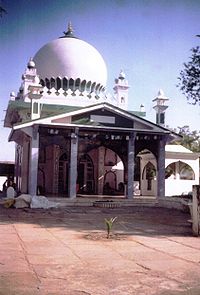
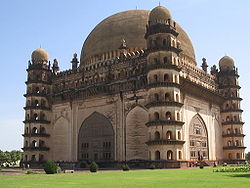 In the second half of sixteenth century, and seventeenth century under the aegis of Adil Shahis, the capital city of Bijapur occupied a prominent place among the celebrated cities of India
. It was a great centre of culture, trade and commerce, education and learning etc. It was known for its own culture called, Bijapur Culture. During Bijapur’s heyday of glory there was a conflux of different communities and the people. Sometimes in many respects it surpassed the great cities of Delhi
and Agra
of Mughal
India
.
Before Yusuf Adil Shah
, the founder of the Adil Shahis could make Bijapur as capital of his newly carved kingdom; the town occupied a considerable importance. The Khiljis
made Bijapur their governor's seat, and after sometime Khwajah Mahmood Gawan, the Bahmani premier constituted Bijapur region into a separate province. He owned property in Bijapur called "Kala Bagh". He constructed a mausoleum of Hazrath Ain-ud-Din Ganj-ul-'ullum. The architecture of the mausoleums of Hazrath Zia-ud-Din Ghaznavi, Hazrath Hafiz Husseini and Hazrath Hamzah Husseini etc. suggests that these edifices belong to the Bahmani period.
Thus Bijapur was fairly large town under the early Sultans of Adil Shahi dynasty. The capital progressed slowly, however its star was in ascendancy since the accession of Sultan Ali Adil Shah I
in 1558. His victory in the Battle of Talikota
in 1565 and further campaigns in the Krishna-Tunghabhadra regions brought enormous wealth. Hence he began to spend lavishly on its decoration. Under him every year saw some new building, a palace, a mosque, a bastion, or a minaret peeping up its proud head triumphantly. His successor Ibrahim Adil Shah II
added, so to say, a pearl necklace, Ibrahim Rouza to enhance the beauty of Bijapur, and Mohammed Adil Shah
crowned it with a priceless gem called Gol Gumbaz
. Thus the Adil Shahi monarchs poured their heart and soul in the capital city. The period between accessions of Ali Adil Shah I
1558 to the death of Mohammed Adil Shah
1656, can be called the golden age of the Adil Shahis as the kingdom flourished in all walks of life.
s from the different parts of world many scholars, poets, painters, dancers, calligraphers, musicians, Sufi saints and other men of arts flocked into Bijapur. Hence Seventeenth century called Bijapur as the 'Palmyra of the Deccan'.
the population of Bijapur is stated to have reached 984000 and had incredible total of 1600 mosques. Under Mohammed Adil Shah
population further increased. Historian J. D. B. Gribble writes
constructed Jahan Begum Lake (Begum Talab) in the south of Bijapur. This Lake fed the southern and eastern sides of the city. Thus water reached every comer of the capital. In addition, to supplement the water needs of the people in and around, the Sultans and nobles constructed big and small wells. Captain Sykes who visited Bijapur in 1819 reports, there were 700 wells (Boudis) with steps and 300 wells (Kuans or small wells) without steps within the walls of Bijapur. Moreover, we find the remains of tanks and lakes named Rangrez Talab, Quasim Talab, Fatehpur Talab and Allahpur Talab in the vicinity of Bijapur.
Begum Talab, which is 234 acre (0.94696524 km²) tank was constructed in 1651 by Mohammad Adil Shah in memory of Jahan Begum.
This tank was used for ensuring drinking water supply to the city. To the right side of lake there is an underground room from
where water was supplied to city in earthen pipes. The pipes laid to depth of 15 feet (4.6 m) to 50 feet (15.2 m) were joined and cased in
masonry. Many towers of height 25 feet (7.6 m) to 40 feet (12.2 m) called as "gunj" were built to release pressure of water and prevent pipes from bursting all along. These towers allowed dirt in pipe to remain at the bottom and clear water to flow.
and foreign lands. Abdal, a court poet in his Ibrahim Namah writes,
The following market places were established respectively by the Adil Shahi Sultans in and around Bijapur.
Yusuf Adil Shah
: Markovi Bazar, Thana Bazar, Naghthana Bazar, Daulat Bazar, Dahan Khan Bazar, Markur Bazar, Murad Khan Bazar, Palah Bazar, Mubarak Bazar and. Shahpeth (old) Bazar.
Ismail Adil Shah
: Kamal Khan Bazar, NakaBazar and Bare-Khudavand Bazar.
Ibrahim Adil Shah I
: Jagate Bazar, Roa Bazar, Sher Karkhana Bazar, Rangeen Masjid Bazar, Fateh Zaman Bazar, Karanzah Bazar, Sara Bazar, and ShikarKhan Bazar
Ali Adil Shah I
: Jumma Masjid Bazar, SikandarBazar, FarhadKhan Bazar, Dilir Khan Bazar and Haidar Bazar.
Mohammed Adil Shah
: Padshahpur Bazar.
Ali Adil Shah II
: Shahpeth (new) Bazar.
Others: Ikhlas Khan Bazar, Yusuf Rumi Khan Bazar, Shah Abu Turab Bazar, Abdur Razzaq Bazar, Langar Bazar, Mahmood Shah Bazar, etc.
We foud suburban markets called the Peths in the vicinity of Bijapur. They are as follows: Habibpur Peth, Salabatpur Beth, Tahwarpur Peth, Zohrapur Peth, Afzalpur Peth (Takiyah), Shahpur or Khudanpur or Khudawandpur Peth, Danatpur Peth, Sikandarpur Peth, Quadhpur Peth, Khwaspur Peth, Imampur Peth, Kumutagi Peth etc.
In 1013 corresponding to (1604–1605) the Mughal
Emperor Akbar
, commissioner Mirza Asad Baig, one of grandees of his court to Bijapur for diplomatic dealings. He was a person who saw Agra
and Delhi
in their glorious days. He wrote his account called, “Haalat-e-Asad Baig or Wakiat-e-Asad Baig”. From his account we shall be able to form some idea of the position which Bijapur occupied among the wonder cities of India
in the Medieval Ages
. He cites in his impression of the city; the grandeurs of the Adil Shahi court and its customs in the following striking words:
Mirza Asad Baig left Bijapur on 24 January 1604. His graphic account of Bijapur tells us how this city was prosperous, rich and flourishing.
Another traveler Manctelslo, who visited the Deccan in 1638 writes,
Similarly, Jean Baptiste Tavernier, who visited India
between 1631 and 1667, was a jeweler, probably he had been to Bijapur for selling some of his jewels. He has left for us an account, in which he describes Bijapur was a great city... in its large suburbs many goldsmiths and jewelers dwelt... the king's palace (Arkillah or citadel
) was vast, but ill-built and the access to it was very dangerous as the ditch with which it was girt was full of crocodiles,. in the same way, the Dutch traveler, Baldeous, the English geographer, Ogilby and others praise the greatness of Bijapur.
a garden 60 yards long and 60 yards broad, was laid within the outer ‘’Hissar’’ (i.e., Arbah) and another 20 yards long and 20 yards broad, within the inner one (i.e., Arkilla Wall or citadel
) was constructed. In the reign of Ali Adil Shah I
, many trees of fruits viz. odoriferous orange, date, grapes, pomegranate, figs, apple. ‘’Naar’’ (quince-like fruit), etc. brought from the countries of hot and cold climates were set in gardens. From different historical sources we get references of gardens like Kishwar Khan Bagh, Ali Bagh, Dou-az-Deh (twelve) Imam Bagh, Alavi Bagh, Arkillah Bagh, Nauroz Bagh, Ibrahim Bagh, Murari Bagh, Naginah Bagh, etc. in Bijapur.
In southern side in the capital, a renowned Adil Shahi noble, Mubarak Khan constructed water pavilions and resort. Likewise, at Kumatagi village, about 12 miles in the east of Bijapur, the Sultans laid the water pavilions and resort for royal members.
s could establish their rule in Bijapur, it was a great centre of learning in South India
. It is evident from the bilingual Marathi
-Sanskrit
inscription, which is inscribed just under the Persian
epigraph in the Karimuddin mosque 16 that the city of Bijapur is given the title of ‘’"Banaras of the South"’’. Since ancient time Banaras in northern India
was a celehrated centre of learning. The Khaiji governor of Bijapur, Malik Karimuddin, probably found at this place the great activities of learning; hence he entitled Bijapur as the Banaras of the South. The Khiljis
conquered whole south India
and they were well acquainted with its famous cities like Daulatabad of Yadavas, Warangal
of Kakatiyas, Dwarasamudra of Hoyasalas
and Madurai
of Pandyas. However, they did not entitle any of these cities as the Banaras of the South, except Bijapur, though these cities were the capitals of ruling dynasties.
During the rule of Bahmanis Bijapur retained its academic excellence. The renowned learned Sufi of India
, Hazrat Ainuddin Ganjuloom Junnaidi, who authored 125 works of Qur’anic commentaries, Quirat (art of Quranic recitation), Hadith
(prophetic Traditions), Scholasticism, Principles of Law, Fique (Islamic Law), Suluk (behavior). Syntax, Lexicography, Ansaab (genealogy). History, Tibb (medicine), Hilmat, Sanf (grammaIj), Quasidah, etc. lived in from 1371, till his death in 1390. His disciple and other Sufis like Hazrat Ibrahim Sangani and his sons, Hazrat Abdullah AI-Ghazani, Hazrat Ziauddin Ghazanavi and Hazrat Shah Hamzah Hussaini kept their noble litterateur's traditions alive in Bijapur.
Under the aegis of Adil Shahis of Bijapur advanced very much in the field of learning. It was considered as the 'Second Baghdad
' in scholastic activities in the Islamic World. Owing to its popularity in this sphere Ibrahim Adil Shah II
named it ‘’”Vidhyapur”’’ All Sultans of Bijapur were men of letters. Ali Adil Shah I
was well versed in religion, logic, sciences, syntax, etymology and grammar. He was fond of reading to the extent that he kept with him big boxes of books, while on tour. All Sultans patronized the teachers and scholars. It was routine in the capital that the scholars met at different places, and among them learned discussions were held.
At the capital the Royal Library was existed in which nearly sixty men, calligraphers, gilders of books, book binders and illuminators were busy doing their work whole day in the library. Sesh Waman Pandit was the Royal Librarian. Ibrahim-II's court poet Baqir Khurd-e-Kasm worked as transcriber in the Royal Library.
The noted scholars in the capital were Shah Nawaz Khan, Abdul Rasheed-al-Bastagi, Shah Sibagatullah Hussaini, Shaikh Alimullah Muhaddis (a teacher of Sayings or Traditions of Prophet Mohummad, and Theology in Jumma mosque), Mullan Hassan Faraghi, MullanHabibullah, Shah Mohummad Mulki and Shah Habibullah Hussaini. Shah Zayn Muqbil, a great lover of learning and books, had eight hundred manuscripts in his library, out of these over three hundred were written by him. Miran Mohummad Mudarris Hussaini was also a great teacher.
At the Asar Mahal there were two Madrasas (religious schools), one for teaching Hadith
(Tradition) and another for Fiqah and Imaan (Theology and Belief). Free education with delicious food, and stipend of one Hun to each student was provided. The Mosques had the Maktabs (elementary schools) where Arabic and Persian
studies were taught. The state supplied books free of costs. The students who performed excellently in the annual examination, received prizes in Huns, and later appointed in high and honorable position. Besides these, most of the Sufis maintained their own Khankhas (convents for disciples) and Kutub Khanas (libraries). Even to this day some of the descendents of Sufis in perpetuity continued this tradition.
In consequence of state patronage, a bulk of literature in Arabic, Persian and Dakhani Urdu
had come up. In addition, the languages like Sanskrit
, Marathi
and Kannada flourished. Pandit Narhari, a court poet of Ibrahim Adil Shah II
, composed the poetic excellence on his master, called, 'Nauras Manzarf’. Shri Laxmipathi, a desciple of Pandit Rukmangada composed a number of Marathi and Hindi
devotional songs set in musical Ragas. Swamy Yadvendra was also a prominent contributor in Marathi literature. In the south of kingdom, the official transaction was carried out in Kannada.
We have references that in the kingdom the physicians practiced the Unani
, Ayurvedic, Irani and European systems of medicine. Hakim Gilani and Farnalope Firangi, a European physician and surgeon worked under Ibrahim Adil Shah II
. Farnalope treated his ailing patron wrongly, which caused Sultan's death. Khawas Khan caught him, and as a punishment his nose and lips were cut off. Nothing daunted, Fanalope returned to his home and cut off the nose and lips of one of his slaves, and so fastened the same to his own that he was soon cured even of scars. He lived long in Bijapur and resumed his practice with great success. Aithippa, an Ayurvedic physician, who was attached to a dispensary at Bijapur compiled for his son Champa, Tibb-e-Bahri-o-Barri, a treatise on medicine. It contains a short vocabulary of some parts of the human body and some drugs with their equivalent in Arabic and Hindi
. It further contains hints as to the examination of patients and symptoms and treatment of diseases. He had spent a long time attending upon and getting instruction from Hakim Mohummad Hussain Unani and Hakim Mohammad Masum Isfahani. The great historian Firishta
was an expert Ayurvedic physician. He studied this system under Hakim-e-Misri and other Hindu
physicians. After attaining proficiency, he started his own dispensary and prepared patent drugs and popular medicines. He possessed a great knowledge of Sanskrit
, hence studied thoroughly works of Ayurveda
like the Samhitas of Wagbhat, Charak and Sushrut, and wrote Dastur-e- Attibba or Iktiyarat-e-Qasmi. In this book he mentioned the names of famous Ayurvedic physicians like Jagdeva, Sagarbhat and Sawa Pandit. He cites in the names of various diseases, herbs and drugs and also discusses simple and compound medicines and formulae of their preparation. The book is fairly comprehensive as its scope extends to Anatomy
, Physiology
and Therapy
. It seems Firishta
was an expert in Botany
as well. He gave details of minutes regarding characteristics of medicinal herbs, plants and fruits of India
. Another physician Hakim Rukna-e-Maish skilled in medicine stayed in the court of Ibrahim Adil Shah II
for some time before he joined the Mughals
. At the instance of the same Sultan; Yunus Beg completed Kitab-e-TIbb, a work on medicine. The court poet of Mohammed Adil Shah
, Hakim Aatishi possessed a unique skill in medicine and served as the Royal Physician. He was a personal physician of the Sultan, without his permission he could not attend other patients. With permission once he cured Khan-e-Khanan Ikhlas Khan. Aatishi took this onerous duty only when other physicians altogether failed. By his miraculous treatment patients recovered within three weeks.
Thus the Adil Shahi Sultans and the nobles never overlooked the medical services and always encouraged the physicians giving them handsome rewards. It because of such encouragement some of the physicians produced literature on medicine.
played ‘’Tambur’’ (tambourine) and ‘’Ud’’ (lute). Ismail Adil Shah
had high admiration for Central Asian music. Music received greater encouragement under Ibrahim Adil Shah II
. He was the greatest musician of his age. He was poet and singer and maintained an inordinately a large number of musicians and minstrels (three or four thousand) at his court. The band of musicians was known as Lashkar-e-Nauras (army of Nauras) they were paid by the government regularly. At Nauraspur he constructed Sangeet Mahal and residential mansions for songsters, minstrels and dancing girls. With great pomp the festival of Nauras (musical concert) was celebrated during his time. In a number of paintings Ibrahim Adil Shah II
was depicted playing musical instruments like ‘’Tambur’’, ‘’Sitar’’, ‘’Veena’’ and ‘’Guitar’’. Emperor Jahangir
, and Mirza Asad Baig the Mughal
envoy considerably praised Ibrahim Adil Shah II
's love for music.
Mirza Asad Baig writes in his ‘’Wakiyat’’ that he was invited to the royal palace to bid farewell to Ibrahim Adil Shah II
The architecture of Bijapur is a combination of Persian, Ottoman
Turkish and Deccani styles. It is amazing to note mat in Ibrahim Rouzah, Dilkusha Mahal (Mahatar Mahal), Malikah-e-Jahan Mosque, Jal Mahal, etc. the Bijapur sculptors have carved beautiful designs in stones, as the carpenters do in wood. The stucco plaster designing in some monuments is superb.
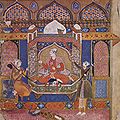 The contribution of the Adil Shahi kings to the architecture
, painting
, language, literature and music of Karnataka is unique. Bijapur (Kannada form of the Sanskrit
Vidyapur or Vidyanagari) became a cosmopolitan city, and it attracted many scholars, artists, musicians, and Sufi saints from Turkey
, Persia (Iran
) Iraq
, Turkey
, Turkestan
, etc.
The unfinished Jami Masjid, started in 1565, has an arcaded prayer hall with fine aisles supported on massive piers has an impressive dome. The Ibrahim Rouza which contains the tomb
of Ibrahim Adil Shah II
, is a fine structure with delicate carvings. Persian artists of Adil Shahi court have left a rare treasure of miniature paintings, some of which are well-preserved in Europe's great museums.
The Dakhani language, an amalgam of Persian
-Arabic
, Gujarati
, Marathi
, and Kannada, developed into an independent spoken and literary language. Under the Adil Shahis many literary works were published in Dakhani. Ibrahim Adil Shah II
's book of poems and music, Kitab-e-Navras is in Dakhani. The Mushaira (poetic symposium) was born in the Bijapur court and later traveled north. The Dakhani language, which was growing under the Bahamani kings, later came to be known as Dakhan Urdu to distinguish it from the North India
n Urdu
. Adil Shah II played the sitar
and ud and Ismail was a composer.
"Moo-e-Mubarrak" of Muhammad. Sultan Ibrahim Adil shah heard about him and he became very happy. He met Meer Swaleh Hamdani. He saw these "Moo-e-Mubarrak" and gave priceless gifts to Meer Sahab. Meer Sahab also became very happy and gave two "Moo-e-Mubarak" to Sultan Ibrahim Adil Shah. Earlier these "Moo-e-Mubarak" were kept in Gagan Mahal. But in the period of Sultan Mohammed Adil Shah suddenly there was a huge fire in Gagan Mahal. Everything burnt up, except these two boxes in which "Moo-e-Mubarak" were kept. Then one fellow named Ali khan entered and brought that box on his head. Then Sultan kept these boxes in Asar Mahal.
It is said that in the year 1142 hijri Sultan Mohammed Adil Shah used to see these "Moo-e-Mubark" on and off. Once it happened he requested all the sufie's of that time to come and see these "Moo-e-Mubarak" and have good fortune. So Hazrat Hashim Husaini Al Aloomi & Hazrat Shah Murtuza Quadri came there and asked to open that box. So as per the Sultan's order the box was opened in front of so many noble persons. But as it was opened a bright ray was everywhere. Nobody could bear the brightness of the ray and they all became unconscious. Everywhere there was a perfume. Then Sultan and everybody had a privilege of seeing "Moo-e-mubarak". After that period it is said that that boxes neither opened nor had a privilege and sultan give precious Asar-e-Shariff's command to Noor Mohammed Mushrif since then Mushrif Family is doing Asar urs.
India
India , officially the Republic of India , is a country in South Asia. It is the seventh-largest country by geographical area, the second-most populous country with over 1.2 billion people, and the most populous democracy in the world...
from 1490 to 1686. Bijapur had been a province of the Bahmani Sultanate
Bahmani Sultanate
The Bahmani Sultanate was a Muslim state of the Deccan in southern India and one of the great medieval Indian kingdoms...
(1347–1518), before its political decline in the last quarter of the 15th century and eventual break-up in 1518. The Bijapur Sultanate was absorbed into the Mughal Empire
Mughal Empire
The Mughal Empire , or Mogul Empire in traditional English usage, was an imperial power from the Indian Subcontinent. The Mughal emperors were descendants of the Timurids...
on 12 September 1686, after its conquest by the Emperor Aurangzeb
Aurangzeb
Abul Muzaffar Muhy-ud-Din Muhammad Aurangzeb Alamgir , more commonly known as Aurangzeb or by his chosen imperial title Alamgir , was the sixth Mughal Emperor of India, whose reign lasted from 1658 until his death in 1707.Badshah Aurangzeb, having ruled most of the Indian subcontinent for nearly...
.
The founder of the Adil Shahi dynasty, Yusuf Adil Shah
Yusuf Adil Shah
Yusuf Adil Shah , referred as Adil Khan or Hidalcão by the Portuguese, was the founder of the Adil Shahi dynasty that ruled the Sultanate of Bijapur for nearly two centuries...
(1490–1510), was appointed Bahmani governor of the province, before creating a de-facto independent Bijapur state. Yusuf and his son, Ismail, generally used the title Adil Khan. 'Khan', meaning 'Chief' in Mongolian and adopted in Persian, conferred a lower status than 'Shah', indicating royal rank. Only with the rule of Yusuf's grandson, Ibrahim Adil Shah I
Ibrahim Adil Shah I
Ibrahim Adil Shah I was a sultan and later shah of the Indian kingdom of Bijapur. He succeeded his elder brother, Mallu Adil Shah, through the machinations of the afaqi faction at the court...
(1534–1558), did the title of Adil Shah come into common use.
The Bijapur Sultanate's borders changed considerably throughout its history. Its northern boundary remained relatively stable, straddling contemporary Southern Maharashtra
Maharashtra
Maharashtra is a state located in India. It is the second most populous after Uttar Pradesh and third largest state by area in India...
and Northern Karnataka
Karnataka
Karnataka , the land of the Kannadigas, is a state in South West India. It was created on 1 November 1956, with the passing of the States Reorganisation Act and this day is annually celebrated as Karnataka Rajyotsava...
. The Sultanate expanded southward, first with the conquest of the Raichur Doab
Raichur Doab
The Raichur Doab is a Doab, in this case the triangular region of land in the southern Indian states of Andhra Pradesh and Karnataka lying between the Krishna River and its tributary, the Tungabhadra River. The doab is named for the town of Raichur in the Raichur District....
following the defeat of the Vijayanagar
Vijayanagara Empire
The Vijayanagara Empire , referred as the Kingdom of Bisnaga by the Portuguese, was an empire based in South Indian in the Deccan Plateau region. It was established in 1336 by Harihara I and his brother Bukka Raya I of the Yadava lineage. The empire rose to prominence as a culmination of attempts...
Empire at the Battle of Talikota in 1565. Later campaigns, notably during the reign of Mohammed Adil Shah
Mohammed Adil Shah
Muhammad Adil Shah was the ruler of Bijapur, ascending the throne in 1627 at the comparatively young age of sixteen years. This was accomplished with the help of two Bijapuri nobles – Daulat Khan and Mirza Muhammad Amin Lari .Muhammad’s glorious reign of thirty years witnessed some momentous...
(1627–1657), extended Bijapur's formal borders and nominal authority as far south as Bangalore
Bangalore
Bengaluru , formerly called Bengaluru is the capital of the Indian state of Karnataka. Bangalore is nicknamed the Garden City and was once called a pensioner's paradise. Located on the Deccan Plateau in the south-eastern part of Karnataka, Bangalore is India's third most populous city and...
. Bijapur was bounded on the West by the Portuguese state of Goa
Goa
Goa , a former Portuguese colony, is India's smallest state by area and the fourth smallest by population. Located in South West India in the region known as the Konkan, it is bounded by the state of Maharashtra to the north, and by Karnataka to the east and south, while the Arabian Sea forms its...
and on the East by the Sultanate of Golconda
Golconda
Golconda may be:Places:* Golkonda, ruined city and fortress in India* Golconda, Illinois, town in the United States* Golconda, Nevada, former town in the United StatesOther:* Golconda...
, ruled by the Qutb Shahi dynasty.
The former Bahmani provincial capital of Bijapur remained the capital of the Sultanate throughout its existence. After modest earlier developments, Ibrahim Adil Shah I
Ibrahim Adil Shah I
Ibrahim Adil Shah I was a sultan and later shah of the Indian kingdom of Bijapur. He succeeded his elder brother, Mallu Adil Shah, through the machinations of the afaqi faction at the court...
(1534–1558) and Ali Adil Shah I
Ali Adil Shah I
Ali Adil Shah I was the fifth Sultan of Bijapur Sultanate.On the day of his coronation Ali abandoned the Sunni practices and reintroduced the Shi’ah Khutbah and other practices...
(1558–1580) remodelled Bijapur, providing the citadel and city walls, Friday Mosque, core royal palaces and major water supply infrastructure. Their successors, Ibrahim Adil Shah II
Ibrahim Adil Shah II
Ibrahim Adil Shah II , of the Adil Shahi dynasty, was the king of Bijapur Sultanate.-Early life:Ali Adil Shah's father, Ibrahim Adil Shah I's had divided power between the Sunni nobles, the Habshis and the Deccanis...
(1580–1627), Mohammed Adil Shah
Mohammed Adil Shah
Muhammad Adil Shah was the ruler of Bijapur, ascending the throne in 1627 at the comparatively young age of sixteen years. This was accomplished with the help of two Bijapuri nobles – Daulat Khan and Mirza Muhammad Amin Lari .Muhammad’s glorious reign of thirty years witnessed some momentous...
(1627–1657) and Ali Adil Shah II
Ali Adil Shah II
On the death of Mohammed Adil Shah on November 4, 1657, Ali Adil Shah II, a youth of eighteen, succeeded to the throne through the efforts of the Prime Minister Khan Muhammad and the Queen, Badi Sahiba, sister of Qutb Shah of Golkonda....
(1657–1672), further adorned Bijapur with palaces, mosques, mausolea and other structures, considered to be some of the finest examples of Deccan Sultanate and Indo-Islamic Architecture.
Bijapur was caught up in the instability and conflict resulting from the collapse of the Bahmani Empire. Constant warring, both with the Vijayanagar
Vijayanagara Empire
The Vijayanagara Empire , referred as the Kingdom of Bisnaga by the Portuguese, was an empire based in South Indian in the Deccan Plateau region. It was established in 1336 by Harihara I and his brother Bukka Raya I of the Yadava lineage. The empire rose to prominence as a culmination of attempts...
Empire and the other Deccan Sultanates, curtailed the development of state before the Deccan Sultanates allied to achieve victory over Vijayanagar at Talikota in 1565. Bijapur eventually conquered the neighbouring Sultanate of Bidar
Bidar
Bidar is a city in the Indian state of Karnataka. Located on the Deccan Plateau in the north-eastern part of Karnataka. It is the headquarters of the Bidar District....
in 1619. The Portuguese Empire exerted pressure on the major Adil Shahi port of Goa, until it was conquered during the reign of Ibrahim II. The Sultanate was thereafter relatively stable, although it was damaged by the revolt of Shivaji, his father was Maratha commander in the service of Mohammed Adil Shah
Mohammed Adil Shah
Muhammad Adil Shah was the ruler of Bijapur, ascending the throne in 1627 at the comparatively young age of sixteen years. This was accomplished with the help of two Bijapuri nobles – Daulat Khan and Mirza Muhammad Amin Lari .Muhammad’s glorious reign of thirty years witnessed some momentous...
. Shivaji founded an independent Maratha Kingdom which went on to become Maratha Empire one of largest empire in present day India. The greatest threat to Bijapur's security was, from the late 16th century, the expansion of the Mughal Empire and into the Deccan. Although it may be the case that the Mughals destroyed the Adilshahi it was Shivaji's revolt which weakened the Adilshahi control. Various agreements and treaties imposed Mughal suzerainty on the Adil Shahs, by stages, until Bijapur's formal recognition of Mughal authority in 1636. The demands of their Mughal over-lords sapped the Adil Shahs of their wealth until the Mughal conquest of Bijapur in 1686.
Historical overview
Yusuf Adil Shah
Yusuf Adil Shah , referred as Adil Khan or Hidalcão by the Portuguese, was the founder of the Adil Shahi dynasty that ruled the Sultanate of Bijapur for nearly two centuries...
, was likely a Bahmani nobleman, a Persian (Tajik) descent from Badakhshan
Badakhshan
Badakhshan is an historic region comprising parts of what is now northeastern Afghanistan and southeastern Tajikistan. The name is retained in Badakhshan Province which is one of the thirty-four provinces of Afghanistan, in the far northeast of Afghanistan, and contains the Wakhan Corridor...
. According to the historian Mir Rafi-uddin Ibrahim-i Shirazi, or Rafi, Yusuf's full name was Sultan Yusuf 'Adil Shah Sawa or Sawa-i, the son of Mahmud Beg of Sawa in Iran, (Rafi' 36–38, vide Devare 67, fn 2). Rafi's history of the 'Adil Shahi dynasty was written at the request of Ibrahim Adil Shah II
Ibrahim Adil Shah II
Ibrahim Adil Shah II , of the Adil Shahi dynasty, was the king of Bijapur Sultanate.-Early life:Ali Adil Shah's father, Ibrahim Adil Shah I's had divided power between the Sunni nobles, the Habshis and the Deccanis...
, and was completed and presented to the patron in AH 1017. The Indian scholar T.N. Devare mentioned that while Rafi's account of the Bahmani dynasty is filled with anachronisms, his account of the Adilshahi is "fairly accurate, exhaustive, and possesses such rich and valuable information about Ali I and Ibrahim II" (312). Rafi-uddin later became the governor of Bijapur for about 15 years (Devare 316).
Rafi' account is less well known than that of the popular historian Firishta
Firishta
Firishta or Ferishta, full name Muhammad Qasim Hindu Shah , was born in 1560 and died in 1620 and he was a Persian historian. The name Firishta means angel or one who is sent in Persian.-Life:...
, the author of the Tarikh-i Firishta, also known as the Gulshan-i Ibrahim. Rafi's account of the life of Yusuf 'Adil Shah directly contradicts a popular myth penned by Firishta. According to Firishta
Firishta
Firishta or Ferishta, full name Muhammad Qasim Hindu Shah , was born in 1560 and died in 1620 and he was a Persian historian. The name Firishta means angel or one who is sent in Persian.-Life:...
, Yusuf was the son of the Ottoman Emperor
Ottoman Empire
The Ottoman EmpireIt was usually referred to as the "Ottoman Empire", the "Turkish Empire", the "Ottoman Caliphate" or more commonly "Turkey" by its contemporaries...
Murad II
Murad II
Murad II Kodja was the Sultan of the Ottoman Empire from 1421 to 1451 ....
. After the Sultan Murad II's death, and the crown prince's succeeded to the throne, all of the other sons of the emperor were executed. Firishta
Firishta
Firishta or Ferishta, full name Muhammad Qasim Hindu Shah , was born in 1560 and died in 1620 and he was a Persian historian. The name Firishta means angel or one who is sent in Persian.-Life:...
fabricated a story that Yusuf's mother secretly replaced Yusuf with a slave boy and sent him to Persia. After many romantic adventures, Yusuf reached the court of the Bidar Sultanate. T.N. Devare found that other historians of the time, Mir Ibrahim Lari-e Asadkhani, and Ibrahim Zubayri, the author of the Basatin as-Salatin, favored Rafi's account and rejected this account provided solely by Firishta (Devare 67, fn 2).
Despite the obvious fabrication of Yusuf's Ottoman origin, Firishta's account continues to be very popular today in Bijapur. Devare observed that the work is "a general history of India from the earliest period up to Firishta's time written at the behest of Ibrahim Adil Shah II
Ibrahim Adil Shah II
Ibrahim Adil Shah II , of the Adil Shahi dynasty, was the king of Bijapur Sultanate.-Early life:Ali Adil Shah's father, Ibrahim Adil Shah I's had divided power between the Sunni nobles, the Habshis and the Deccanis...
and presented to him in 1015 AH/1606 CE. It seems however that it was supplemented by the author himself as it records events up to AH 1033 (1626 CE). This is the most widely quoted history of the Adil Shahi, and it is the source of the story that Yusuf was an Ottoman prince" (Devare 272).
Yusuf's bravery and personality raised him rapidly in Sultan's favor, resulting in his appointment as the Governor of Bijapur. He built the Citadel
Citadel
A citadel is a fortress for protecting a town, sometimes incorporating a castle. The term derives from the same Latin root as the word "city", civis, meaning citizen....
or Arkilla and the Faroukh Mahal. Yusuf was a man of culture. He invited poets and artisans from Persia, Turkey and Rome to his court. He's well known as a ruler who took advantage of the decline of the Bahmani power to establish himself as an independent sultan at Bijapur in 1498. He did this with a military support which has been given to him by a Bijapuri general Kalidas Madhu Sadhwani
Kalidas Madhu Sadhwani
Kalidas Madhu Sadhwani was a Bijapuri general who helped Yusuf Adil Shah establish his power as a Sultan, independent from Bahmani Sultanate. He was a Bahmani nobleman from a family with a military traditions. His father was a commander in the army of Ahmadnagar sultan...
– brilliat commander and good diplomat, who made quick career by supporting Yusuf Adil Shah
Yusuf Adil Shah
Yusuf Adil Shah , referred as Adil Khan or Hidalcão by the Portuguese, was the founder of the Adil Shahi dynasty that ruled the Sultanate of Bijapur for nearly two centuries...
and then his son – Ismail Adil Shah
Ismail Adil Shah
Isamail Adil Shah was the king of Bijapur who spent most of his time extending his territory. His short lived reign helped the dynasty establish a strong hold in the deccan.-Early years:...
. He married Punji, the sister of a Maratha
Maratha
The Maratha are an Indian caste, predominantly in the state of Maharashtra. The term Marāthā has three related usages: within the Marathi speaking region it describes the dominant Maratha caste; outside Maharashtra it can refer to the entire regional population of Marathi-speaking people;...
warrior. When Yusuf died in 1510, his son Ismail was still a boy. Punji in male attire valiantly defended him from a coup to grab the throne. Ismail Adil Shah
Ismail Adil Shah
Isamail Adil Shah was the king of Bijapur who spent most of his time extending his territory. His short lived reign helped the dynasty establish a strong hold in the deccan.-Early years:...
thus became the ruler of Bijapur and succeeded his father's ambition.
Ibrahim Adil Shah I
Ibrahim Adil Shah I was a sultan and later shah of the Indian kingdom of Bijapur. He succeeded his elder brother, Mallu Adil Shah, through the machinations of the afaqi faction at the court...
who succeeded his father Ismail, fortified the city and built the old Jamia Masjid
Jamia Masjid
The term Jamia Masjid refers to any central mosque in a city, town, village or other locality in the Muslim world wherein the Muslims offer congregational prayers of Friday and Eid prayers, etc....
. Ali Adil Shah I
Ali Adil Shah I
Ali Adil Shah I was the fifth Sultan of Bijapur Sultanate.On the day of his coronation Ali abandoned the Sunni practices and reintroduced the Shi’ah Khutbah and other practices...
who next ascended the throne, aligned his forces with other Muslim kings of Golconda
Golconda
Golconda may be:Places:* Golkonda, ruined city and fortress in India* Golconda, Illinois, town in the United States* Golconda, Nevada, former town in the United StatesOther:* Golconda...
, Ahmednagar and Bidar
Bidar
Bidar is a city in the Indian state of Karnataka. Located on the Deccan Plateau in the north-eastern part of Karnataka. It is the headquarters of the Bidar District....
, and together, they brought down the Vijayanagar empire. With the loot gained, he launched ambitious projects. He built the Gagan Mahal, the Ibrahim Rauza (his own tomb), Chand Bawdi (a large well) and the Jami Masjid. Ali I had no son, so his nephew Ibrahim II was set on the throne. Ali I's queen Chand Bibi
Chand Bibi
Chand Bibi , also known as Chand Khatun or Chand Sultana, was an Indian Muslim woman warrior. She acted as the Regent of Bijapur and Regent of Ahmednagar...
had to aid him until he came of age. Ibrahim II was noted for his valor, intelligence and leanings towards the Hindu music and philosophy. Under his patronage the Bijapur school of painting reached its zenith. Muhammad Adil Shah succeeded his father Ibrahim II. He is renowned for Bijapur's grandest structure, the Gol Gumbaz
Gol Gumbaz
Gol Gumbaz is the mausoleum of Mohammed Adil Shah, Sultan of Bijapur. The tomb, located in Bijapur, Karnataka in southern India, was completed in 1656 by the architect Yaqut of Dabul...
, which has the biggest dome in the world with whispering gallery round about slightest sound is reproduced seven times. He also set up the historical Malik-e-Maidan, the massive gun.
Ali Adil Shah II
Ali Adil Shah II
On the death of Mohammed Adil Shah on November 4, 1657, Ali Adil Shah II, a youth of eighteen, succeeded to the throne through the efforts of the Prime Minister Khan Muhammad and the Queen, Badi Sahiba, sister of Qutb Shah of Golkonda....
inherited a troubled kingdom. He had to face the onslaught of the Maratha
Maratha
The Maratha are an Indian caste, predominantly in the state of Maharashtra. The term Marāthā has three related usages: within the Marathi speaking region it describes the dominant Maratha caste; outside Maharashtra it can refer to the entire regional population of Marathi-speaking people;...
leader Shivaji on one side and Mughal
Mughal Empire
The Mughal Empire , or Mogul Empire in traditional English usage, was an imperial power from the Indian Subcontinent. The Mughal emperors were descendants of the Timurids...
emperor Aurangzeb
Aurangzeb
Abul Muzaffar Muhy-ud-Din Muhammad Aurangzeb Alamgir , more commonly known as Aurangzeb or by his chosen imperial title Alamgir , was the sixth Mughal Emperor of India, whose reign lasted from 1658 until his death in 1707.Badshah Aurangzeb, having ruled most of the Indian subcontinent for nearly...
on another. His mausoleum, Bara Kaman
Bara Kaman
Bara Kaman is the unfinished mausoleum of Ali Adil Shah II in Bijapur, Karnataka in India.Ali Adil Shah of the Adil Shahi dynasty wanted to build a mausoleum of unmatched quality of architecture. As per the plan twelve arches will be placed vertically as well as horizontally surrounding the tomb of...
, planned to dwarf all others, was left unfinished due to his death. Sikandar Adil Shah
Sikandar Adil Shah
Sikandar Adil Shah was placed on the throne of Bijapur in 1672 at four years of age. Therefore, his reign is one of regents and ministers and was marked by chronic civil war among factious nobles, independence of provincial governors, paralysis of the central administration, Mughal invasions,...
, the last Adil Shahi sultan, ruled next for fourteen stormy years. Finally on 12 September 1686, the Mughal armies under Aurangzeb
Aurangzeb
Abul Muzaffar Muhy-ud-Din Muhammad Aurangzeb Alamgir , more commonly known as Aurangzeb or by his chosen imperial title Alamgir , was the sixth Mughal Emperor of India, whose reign lasted from 1658 until his death in 1707.Badshah Aurangzeb, having ruled most of the Indian subcontinent for nearly...
overpowered the city of Bijapur
Bijapur, Karnataka
Bijapur Urdu:بیجاپور city is the district headquarters of Bijapur District of Karnataka state. Bijapur city is well known for its historical monuments of architectural importance built during the rule of Adil Shahi dynasty...
.
Sufis of Bijapur
Arrival of Sufis in Bijapur region was started during the reign of Qutbuddin Aibak. During this period Deccan was under the control of native HinduHindu
Hindu refers to an identity associated with the philosophical, religious and cultural systems that are indigenous to the Indian subcontinent. As used in the Constitution of India, the word "Hindu" is also attributed to all persons professing any Indian religion...
rulers and Palegars. Shaikh Haji Roomi was the first to arrive in Bijapur with his companions. Although his other comrades like Shaikh Salahuddin, Shaikh Saiful Mulk and Shaikh Haji Makki were settled in Pune
Pune
Pune , is the eighth largest metropolis in India, the second largest in the state of Maharashtra after Mumbai, and the largest city in the Western Ghats. Once the centre of power of the Maratha Empire, it is situated 560 metres above sea level on the Deccan plateau at the confluence of the Mula ...
, Haidra and Tikota respectively.
According to Tazkiraye Auliyae Dakkan i.e., Biographies of the saints of the Deccan, compiled by Abdul Jabbar Mulkapuri in 1912–1913,
After this period arrival of Sufis in Bijapur and suburbs was started. Ainuddin Gahjul Ilm Dehelvi narrates that Ibrahim Sangane was one of the early Sufis of Bijapur parish. Sufis of Bijapur can be divided into three categories according to period of their arrival viz., Sufis before Bahmani and / or Adil Shahi Dynasty, Sufis during Adil Shahi Dynasty and Sufis after the fall of Adil Shahi Dynasty. And further it can be classified as Sufis as worriors, Sufis as social reformers, Sufis as scholars, poets and writers.
Ibrahim Zubairi writes in his book Rouzatul Auliyae Beejapore (compiled during 1895) which describes that more than 30 tombs or Dargahs are there in Bijapur with more than 300 Khankahs i.e., Islamic Missionary Schools with notable number of disciples of different lineage like Hasani Sadat, Husaini Sadat, Razavi Sadat, Kazmi Sadat, Shaikh Siddiquis, Farooquis, Usmanis, Alvis, Abbasees and other and spiritual chains like Quadari, Chishti, Suharwardi, Naqshbandi, Shuttari, Haidari etc.
Some of the notable Sufis of Bijapur
- Haji Roomi
- Peer Ma'abari Khandayat
- Ibrahim Sangane
- Hazrat Hafiz Husaini
- Hazrat Hamza Husaini
- Ainuddin Ganjul Uloom
- Ziauddin Gaznavi
- Shah Sibghatullah Shuttari (buried in Madeenah)
- Shaikh Hameed Quadari
- Shaikh Lutfullah Quadari
- Hazrat Hashimpeer Dastageer
- Murtuza Quadari Haidari
- Shaikh Muntajibuddin Dhoulaki Siddiqui
- Khwaja Shamshul Ushaq
- Khwaja Burhanuddin Janam
- Khwaja Ameenuddin Aala
- Sayyad Qasim Quadari
- Sayyad Mustafa Quadari
- Sayyad Shah Mohammed Husaini Quadari Basheban
- Sayyad Abul Hasan Quadari
- Sayyad Abdur'Razaq Quadari
- Sayyad Habibullah Sibghatullahi
- Haji Makki popularly known as Haji Mastan of Tikota
- Abdur Rahmaan Chishti
- Abdur Rahmaan Shuttari
- Kareem Muhammad Husaini
- Sayed Ja’afar Sakaf Quadri Mukbil Sadat
- Ta’azeem Tark
- Sayyad Burqa Posh
- Sayyad Abdul Gaffar Shaheed
- Shaikh Nasrullah Wali
- Shaikh Nayeemuddin Quadri
- Shaikh Muhammad Quadari Peer Bhadaa Bhad Majzoob
- Chingi Deewan
Bijapur: The Great Metropolis Of The Medieval Deccan
India
India , officially the Republic of India , is a country in South Asia. It is the seventh-largest country by geographical area, the second-most populous country with over 1.2 billion people, and the most populous democracy in the world...
. It was a great centre of culture, trade and commerce, education and learning etc. It was known for its own culture called, Bijapur Culture. During Bijapur’s heyday of glory there was a conflux of different communities and the people. Sometimes in many respects it surpassed the great cities of Delhi
New Delhi
New Delhi is the capital city of India. It serves as the centre of the Government of India and the Government of the National Capital Territory of Delhi. New Delhi is situated within the metropolis of Delhi. It is one of the nine districts of Delhi Union Territory. The total area of the city is...
and Agra
Agra
Agra a.k.a. Akbarabad is a city on the banks of the river Yamuna in the northern state of Uttar Pradesh, India, west of state capital, Lucknow and south from national capital New Delhi. With a population of 1,686,976 , it is one of the most populous cities in Uttar Pradesh and the 19th most...
of Mughal
Mughal Empire
The Mughal Empire , or Mogul Empire in traditional English usage, was an imperial power from the Indian Subcontinent. The Mughal emperors were descendants of the Timurids...
India
India
India , officially the Republic of India , is a country in South Asia. It is the seventh-largest country by geographical area, the second-most populous country with over 1.2 billion people, and the most populous democracy in the world...
.
Before Yusuf Adil Shah
Yusuf Adil Shah
Yusuf Adil Shah , referred as Adil Khan or Hidalcão by the Portuguese, was the founder of the Adil Shahi dynasty that ruled the Sultanate of Bijapur for nearly two centuries...
, the founder of the Adil Shahis could make Bijapur as capital of his newly carved kingdom; the town occupied a considerable importance. The Khiljis
Khilji dynasty
The Khilji Sultanate was a dynasty of Turko-Afghan Khalaj origin who ruled large parts of South Asia from 1290 - 1320. They were the second dynasty to rule the Delhi Sultanate of India...
made Bijapur their governor's seat, and after sometime Khwajah Mahmood Gawan, the Bahmani premier constituted Bijapur region into a separate province. He owned property in Bijapur called "Kala Bagh". He constructed a mausoleum of Hazrath Ain-ud-Din Ganj-ul-'ullum. The architecture of the mausoleums of Hazrath Zia-ud-Din Ghaznavi, Hazrath Hafiz Husseini and Hazrath Hamzah Husseini etc. suggests that these edifices belong to the Bahmani period.
Thus Bijapur was fairly large town under the early Sultans of Adil Shahi dynasty. The capital progressed slowly, however its star was in ascendancy since the accession of Sultan Ali Adil Shah I
Ali Adil Shah I
Ali Adil Shah I was the fifth Sultan of Bijapur Sultanate.On the day of his coronation Ali abandoned the Sunni practices and reintroduced the Shi’ah Khutbah and other practices...
in 1558. His victory in the Battle of Talikota
Talikota
Talikota is a town in Bijapur district in the Indian state of Karnataka. Talikota is a small town in northern Karnataka, about 80 kilometres to the southeast of Bijapur. It lies on the River called Doni. It is famous for the Battle of Talikota in 1565....
in 1565 and further campaigns in the Krishna-Tunghabhadra regions brought enormous wealth. Hence he began to spend lavishly on its decoration. Under him every year saw some new building, a palace, a mosque, a bastion, or a minaret peeping up its proud head triumphantly. His successor Ibrahim Adil Shah II
Ibrahim Adil Shah II
Ibrahim Adil Shah II , of the Adil Shahi dynasty, was the king of Bijapur Sultanate.-Early life:Ali Adil Shah's father, Ibrahim Adil Shah I's had divided power between the Sunni nobles, the Habshis and the Deccanis...
added, so to say, a pearl necklace, Ibrahim Rouza to enhance the beauty of Bijapur, and Mohammed Adil Shah
Mohammed Adil Shah
Muhammad Adil Shah was the ruler of Bijapur, ascending the throne in 1627 at the comparatively young age of sixteen years. This was accomplished with the help of two Bijapuri nobles – Daulat Khan and Mirza Muhammad Amin Lari .Muhammad’s glorious reign of thirty years witnessed some momentous...
crowned it with a priceless gem called Gol Gumbaz
Gol Gumbaz
Gol Gumbaz is the mausoleum of Mohammed Adil Shah, Sultan of Bijapur. The tomb, located in Bijapur, Karnataka in southern India, was completed in 1656 by the architect Yaqut of Dabul...
. Thus the Adil Shahi monarchs poured their heart and soul in the capital city. The period between accessions of Ali Adil Shah I
Ali Adil Shah I
Ali Adil Shah I was the fifth Sultan of Bijapur Sultanate.On the day of his coronation Ali abandoned the Sunni practices and reintroduced the Shi’ah Khutbah and other practices...
1558 to the death of Mohammed Adil Shah
Mohammed Adil Shah
Muhammad Adil Shah was the ruler of Bijapur, ascending the throne in 1627 at the comparatively young age of sixteen years. This was accomplished with the help of two Bijapuri nobles – Daulat Khan and Mirza Muhammad Amin Lari .Muhammad’s glorious reign of thirty years witnessed some momentous...
1656, can be called the golden age of the Adil Shahis as the kingdom flourished in all walks of life.
Palmyra of the Deccan
It was due to the secular nature and liberal patronage of the SultanSultan
Sultan is a title with several historical meanings. Originally, it was an Arabic language abstract noun meaning "strength", "authority", "rulership", and "dictatorship", derived from the masdar سلطة , meaning "authority" or "power". Later, it came to be used as the title of certain rulers who...
s from the different parts of world many scholars, poets, painters, dancers, calligraphers, musicians, Sufi saints and other men of arts flocked into Bijapur. Hence Seventeenth century called Bijapur as the 'Palmyra of the Deccan'.
Population and Suburbs
During the reign of Ibrahim Adil Shah IIIbrahim Adil Shah II
Ibrahim Adil Shah II , of the Adil Shahi dynasty, was the king of Bijapur Sultanate.-Early life:Ali Adil Shah's father, Ibrahim Adil Shah I's had divided power between the Sunni nobles, the Habshis and the Deccanis...
the population of Bijapur is stated to have reached 984000 and had incredible total of 1600 mosques. Under Mohammed Adil Shah
Mohammed Adil Shah
Muhammad Adil Shah was the ruler of Bijapur, ascending the throne in 1627 at the comparatively young age of sixteen years. This was accomplished with the help of two Bijapuri nobles – Daulat Khan and Mirza Muhammad Amin Lari .Muhammad’s glorious reign of thirty years witnessed some momentous...
population further increased. Historian J. D. B. Gribble writes
Water system
The Adil Shahi Sultans made an elaborate arrangement of pure and wholesome water for the people of Bijapur and its suburbs. At Torvi a masonry dam was constructed. We find another dam in its far eastern side. These two dams fed the reservoirs of Torvi and Afzalpur. Through these works water was supplied to the suburbs of Shahpur, and the capital. Historian C. Schweitzer is of the opinion that the Torvi aqueduct is in itself a very credible engineering achievement of Adil Shahis. To augment the existing water supply in the city Mohammed Adil ShahMohammed Adil Shah
Muhammad Adil Shah was the ruler of Bijapur, ascending the throne in 1627 at the comparatively young age of sixteen years. This was accomplished with the help of two Bijapuri nobles – Daulat Khan and Mirza Muhammad Amin Lari .Muhammad’s glorious reign of thirty years witnessed some momentous...
constructed Jahan Begum Lake (Begum Talab) in the south of Bijapur. This Lake fed the southern and eastern sides of the city. Thus water reached every comer of the capital. In addition, to supplement the water needs of the people in and around, the Sultans and nobles constructed big and small wells. Captain Sykes who visited Bijapur in 1819 reports, there were 700 wells (Boudis) with steps and 300 wells (Kuans or small wells) without steps within the walls of Bijapur. Moreover, we find the remains of tanks and lakes named Rangrez Talab, Quasim Talab, Fatehpur Talab and Allahpur Talab in the vicinity of Bijapur.
Begum Talab, which is 234 acre (0.94696524 km²) tank was constructed in 1651 by Mohammad Adil Shah in memory of Jahan Begum.
This tank was used for ensuring drinking water supply to the city. To the right side of lake there is an underground room from
where water was supplied to city in earthen pipes. The pipes laid to depth of 15 feet (4.6 m) to 50 feet (15.2 m) were joined and cased in
masonry. Many towers of height 25 feet (7.6 m) to 40 feet (12.2 m) called as "gunj" were built to release pressure of water and prevent pipes from bursting all along. These towers allowed dirt in pipe to remain at the bottom and clear water to flow.
Bazaars and Petes
Bijapur being the capital and big business centre attracted merchants and travelers in large number from the Deccan and many parts of IndiaIndia
India , officially the Republic of India , is a country in South Asia. It is the seventh-largest country by geographical area, the second-most populous country with over 1.2 billion people, and the most populous democracy in the world...
and foreign lands. Abdal, a court poet in his Ibrahim Namah writes,
The following market places were established respectively by the Adil Shahi Sultans in and around Bijapur.
Yusuf Adil Shah
Yusuf Adil Shah
Yusuf Adil Shah , referred as Adil Khan or Hidalcão by the Portuguese, was the founder of the Adil Shahi dynasty that ruled the Sultanate of Bijapur for nearly two centuries...
: Markovi Bazar, Thana Bazar, Naghthana Bazar, Daulat Bazar, Dahan Khan Bazar, Markur Bazar, Murad Khan Bazar, Palah Bazar, Mubarak Bazar and. Shahpeth (old) Bazar.
Ismail Adil Shah
Ismail Adil Shah
Isamail Adil Shah was the king of Bijapur who spent most of his time extending his territory. His short lived reign helped the dynasty establish a strong hold in the deccan.-Early years:...
: Kamal Khan Bazar, NakaBazar and Bare-Khudavand Bazar.
Ibrahim Adil Shah I
Ibrahim Adil Shah I
Ibrahim Adil Shah I was a sultan and later shah of the Indian kingdom of Bijapur. He succeeded his elder brother, Mallu Adil Shah, through the machinations of the afaqi faction at the court...
: Jagate Bazar, Roa Bazar, Sher Karkhana Bazar, Rangeen Masjid Bazar, Fateh Zaman Bazar, Karanzah Bazar, Sara Bazar, and ShikarKhan Bazar
Ali Adil Shah I
Ali Adil Shah I
Ali Adil Shah I was the fifth Sultan of Bijapur Sultanate.On the day of his coronation Ali abandoned the Sunni practices and reintroduced the Shi’ah Khutbah and other practices...
: Jumma Masjid Bazar, SikandarBazar, FarhadKhan Bazar, Dilir Khan Bazar and Haidar Bazar.
Mohammed Adil Shah
Mohammed Adil Shah
Muhammad Adil Shah was the ruler of Bijapur, ascending the throne in 1627 at the comparatively young age of sixteen years. This was accomplished with the help of two Bijapuri nobles – Daulat Khan and Mirza Muhammad Amin Lari .Muhammad’s glorious reign of thirty years witnessed some momentous...
: Padshahpur Bazar.
Ali Adil Shah II
Ali Adil Shah II
On the death of Mohammed Adil Shah on November 4, 1657, Ali Adil Shah II, a youth of eighteen, succeeded to the throne through the efforts of the Prime Minister Khan Muhammad and the Queen, Badi Sahiba, sister of Qutb Shah of Golkonda....
: Shahpeth (new) Bazar.
Others: Ikhlas Khan Bazar, Yusuf Rumi Khan Bazar, Shah Abu Turab Bazar, Abdur Razzaq Bazar, Langar Bazar, Mahmood Shah Bazar, etc.
We foud suburban markets called the Peths in the vicinity of Bijapur. They are as follows: Habibpur Peth, Salabatpur Beth, Tahwarpur Peth, Zohrapur Peth, Afzalpur Peth (Takiyah), Shahpur or Khudanpur or Khudawandpur Peth, Danatpur Peth, Sikandarpur Peth, Quadhpur Peth, Khwaspur Peth, Imampur Peth, Kumutagi Peth etc.
Foreign Accounts
From different parts of world many envoys, merchants, travelers etc. visited Bijapur in its heyday of magnanimity and grandeur, and they left behind their valuable accounts of past grandiosities of Bijapur.In 1013 corresponding to (1604–1605) the Mughal
Mughal Empire
The Mughal Empire , or Mogul Empire in traditional English usage, was an imperial power from the Indian Subcontinent. The Mughal emperors were descendants of the Timurids...
Emperor Akbar
Akbar the Great
Akbar , also known as Shahanshah Akbar-e-Azam or Akbar the Great , was the third Mughal Emperor. He was of Timurid descent; the son of Emperor Humayun, and the grandson of the Mughal Emperor Zaheeruddin Muhammad Babur, the ruler who founded the Mughal dynasty in India...
, commissioner Mirza Asad Baig, one of grandees of his court to Bijapur for diplomatic dealings. He was a person who saw Agra
Agra
Agra a.k.a. Akbarabad is a city on the banks of the river Yamuna in the northern state of Uttar Pradesh, India, west of state capital, Lucknow and south from national capital New Delhi. With a population of 1,686,976 , it is one of the most populous cities in Uttar Pradesh and the 19th most...
and Delhi
New Delhi
New Delhi is the capital city of India. It serves as the centre of the Government of India and the Government of the National Capital Territory of Delhi. New Delhi is situated within the metropolis of Delhi. It is one of the nine districts of Delhi Union Territory. The total area of the city is...
in their glorious days. He wrote his account called, “Haalat-e-Asad Baig or Wakiat-e-Asad Baig”. From his account we shall be able to form some idea of the position which Bijapur occupied among the wonder cities of India
India
India , officially the Republic of India , is a country in South Asia. It is the seventh-largest country by geographical area, the second-most populous country with over 1.2 billion people, and the most populous democracy in the world...
in the Medieval Ages
Middle Ages
The Middle Ages is a periodization of European history from the 5th century to the 15th century. The Middle Ages follows the fall of the Western Roman Empire in 476 and precedes the Early Modern Era. It is the middle period of a three-period division of Western history: Classic, Medieval and Modern...
. He cites in his impression of the city; the grandeurs of the Adil Shahi court and its customs in the following striking words:
Mirza Asad Baig left Bijapur on 24 January 1604. His graphic account of Bijapur tells us how this city was prosperous, rich and flourishing.
Another traveler Manctelslo, who visited the Deccan in 1638 writes,
Similarly, Jean Baptiste Tavernier, who visited India
India
India , officially the Republic of India , is a country in South Asia. It is the seventh-largest country by geographical area, the second-most populous country with over 1.2 billion people, and the most populous democracy in the world...
between 1631 and 1667, was a jeweler, probably he had been to Bijapur for selling some of his jewels. He has left for us an account, in which he describes Bijapur was a great city... in its large suburbs many goldsmiths and jewelers dwelt... the king's palace (Arkillah or citadel
Citadel
A citadel is a fortress for protecting a town, sometimes incorporating a castle. The term derives from the same Latin root as the word "city", civis, meaning citizen....
) was vast, but ill-built and the access to it was very dangerous as the ditch with which it was girt was full of crocodiles,. in the same way, the Dutch traveler, Baldeous, the English geographer, Ogilby and others praise the greatness of Bijapur.
Gardens and Water Pavilions
The Adil Shahi Sultans were fond of gardens, water pavilions and resorts; hence they beautified Bijapur by presence of such amusing spots. Rafiuddin Shirazi writes in his ‘’“Tazkiratul-Mulk”’’ that during the rule of Ibrahim Adil Shah IIbrahim Adil Shah I
Ibrahim Adil Shah I was a sultan and later shah of the Indian kingdom of Bijapur. He succeeded his elder brother, Mallu Adil Shah, through the machinations of the afaqi faction at the court...
a garden 60 yards long and 60 yards broad, was laid within the outer ‘’Hissar’’ (i.e., Arbah) and another 20 yards long and 20 yards broad, within the inner one (i.e., Arkilla Wall or citadel
Citadel
A citadel is a fortress for protecting a town, sometimes incorporating a castle. The term derives from the same Latin root as the word "city", civis, meaning citizen....
) was constructed. In the reign of Ali Adil Shah I
Ali Adil Shah I
Ali Adil Shah I was the fifth Sultan of Bijapur Sultanate.On the day of his coronation Ali abandoned the Sunni practices and reintroduced the Shi’ah Khutbah and other practices...
, many trees of fruits viz. odoriferous orange, date, grapes, pomegranate, figs, apple. ‘’Naar’’ (quince-like fruit), etc. brought from the countries of hot and cold climates were set in gardens. From different historical sources we get references of gardens like Kishwar Khan Bagh, Ali Bagh, Dou-az-Deh (twelve) Imam Bagh, Alavi Bagh, Arkillah Bagh, Nauroz Bagh, Ibrahim Bagh, Murari Bagh, Naginah Bagh, etc. in Bijapur.
In southern side in the capital, a renowned Adil Shahi noble, Mubarak Khan constructed water pavilions and resort. Likewise, at Kumatagi village, about 12 miles in the east of Bijapur, the Sultans laid the water pavilions and resort for royal members.
Education and Learning
Before the MuslimMuslim
A Muslim, also spelled Moslem, is an adherent of Islam, a monotheistic, Abrahamic religion based on the Quran, which Muslims consider the verbatim word of God as revealed to prophet Muhammad. "Muslim" is the Arabic term for "submitter" .Muslims believe that God is one and incomparable...
s could establish their rule in Bijapur, it was a great centre of learning in South India
India
India , officially the Republic of India , is a country in South Asia. It is the seventh-largest country by geographical area, the second-most populous country with over 1.2 billion people, and the most populous democracy in the world...
. It is evident from the bilingual Marathi
Marathi language
Marathi is an Indo-Aryan language spoken by the Marathi people of western and central India. It is the official language of the state of Maharashtra. There are over 68 million fluent speakers worldwide. Marathi has the fourth largest number of native speakers in India and is the fifteenth most...
-Sanskrit
Sanskrit
Sanskrit , is a historical Indo-Aryan language and the primary liturgical language of Hinduism, Jainism and Buddhism.Buddhism: besides Pali, see Buddhist Hybrid Sanskrit Today, it is listed as one of the 22 scheduled languages of India and is an official language of the state of Uttarakhand...
inscription, which is inscribed just under the Persian
Persian language
Persian is an Iranian language within the Indo-Iranian branch of the Indo-European languages. It is primarily spoken in Iran, Afghanistan, Tajikistan and countries which historically came under Persian influence...
epigraph in the Karimuddin mosque 16 that the city of Bijapur is given the title of ‘’"Banaras of the South"’’. Since ancient time Banaras in northern India
India
India , officially the Republic of India , is a country in South Asia. It is the seventh-largest country by geographical area, the second-most populous country with over 1.2 billion people, and the most populous democracy in the world...
was a celehrated centre of learning. The Khaiji governor of Bijapur, Malik Karimuddin, probably found at this place the great activities of learning; hence he entitled Bijapur as the Banaras of the South. The Khiljis
Khilji dynasty
The Khilji Sultanate was a dynasty of Turko-Afghan Khalaj origin who ruled large parts of South Asia from 1290 - 1320. They were the second dynasty to rule the Delhi Sultanate of India...
conquered whole south India
India
India , officially the Republic of India , is a country in South Asia. It is the seventh-largest country by geographical area, the second-most populous country with over 1.2 billion people, and the most populous democracy in the world...
and they were well acquainted with its famous cities like Daulatabad of Yadavas, Warangal
Warangal
Warangal is a city and a municipal corporation in Warangal district in the Indian state of Andhra Pradesh. Warangal is located northeast of the state capital of Hyderabad and is the administrative headquarters of Warangal District. This district is a combination of three cities: Warangal,...
of Kakatiyas, Dwarasamudra of Hoyasalas
Hoysala Empire
The Hoysala Empire was a prominent South Indian Kannadiga empire that ruled most of the modern day state of Karnataka between the 10th and the 14th centuries. The capital of the Hoysalas was initially located at Belur but was later moved to Halebidu....
and Madurai
Madurai
Madurai is the third largest city in the Indian state of Tamil Nadu and one of the oldest continuously inhabited cities in the world. It served as the capital city of the Pandyan Kingdom. It is the administrative headquarters of Madurai District and is famous for its temples built by Pandyan and...
of Pandyas. However, they did not entitle any of these cities as the Banaras of the South, except Bijapur, though these cities were the capitals of ruling dynasties.
During the rule of Bahmanis Bijapur retained its academic excellence. The renowned learned Sufi of India
India
India , officially the Republic of India , is a country in South Asia. It is the seventh-largest country by geographical area, the second-most populous country with over 1.2 billion people, and the most populous democracy in the world...
, Hazrat Ainuddin Ganjuloom Junnaidi, who authored 125 works of Qur’anic commentaries, Quirat (art of Quranic recitation), Hadith
Hadith
The term Hadīth is used to denote a saying or an act or tacit approval or criticism ascribed either validly or invalidly to the Islamic prophet Muhammad....
(prophetic Traditions), Scholasticism, Principles of Law, Fique (Islamic Law), Suluk (behavior). Syntax, Lexicography, Ansaab (genealogy). History, Tibb (medicine), Hilmat, Sanf (grammaIj), Quasidah, etc. lived in from 1371, till his death in 1390. His disciple and other Sufis like Hazrat Ibrahim Sangani and his sons, Hazrat Abdullah AI-Ghazani, Hazrat Ziauddin Ghazanavi and Hazrat Shah Hamzah Hussaini kept their noble litterateur's traditions alive in Bijapur.
Under the aegis of Adil Shahis of Bijapur advanced very much in the field of learning. It was considered as the 'Second Baghdad
Baghdad
Baghdad is the capital of Iraq, as well as the coterminous Baghdad Governorate. The population of Baghdad in 2011 is approximately 7,216,040...
' in scholastic activities in the Islamic World. Owing to its popularity in this sphere Ibrahim Adil Shah II
Ibrahim Adil Shah II
Ibrahim Adil Shah II , of the Adil Shahi dynasty, was the king of Bijapur Sultanate.-Early life:Ali Adil Shah's father, Ibrahim Adil Shah I's had divided power between the Sunni nobles, the Habshis and the Deccanis...
named it ‘’”Vidhyapur”’’ All Sultans of Bijapur were men of letters. Ali Adil Shah I
Ali Adil Shah I
Ali Adil Shah I was the fifth Sultan of Bijapur Sultanate.On the day of his coronation Ali abandoned the Sunni practices and reintroduced the Shi’ah Khutbah and other practices...
was well versed in religion, logic, sciences, syntax, etymology and grammar. He was fond of reading to the extent that he kept with him big boxes of books, while on tour. All Sultans patronized the teachers and scholars. It was routine in the capital that the scholars met at different places, and among them learned discussions were held.
At the capital the Royal Library was existed in which nearly sixty men, calligraphers, gilders of books, book binders and illuminators were busy doing their work whole day in the library. Sesh Waman Pandit was the Royal Librarian. Ibrahim-II's court poet Baqir Khurd-e-Kasm worked as transcriber in the Royal Library.
The noted scholars in the capital were Shah Nawaz Khan, Abdul Rasheed-al-Bastagi, Shah Sibagatullah Hussaini, Shaikh Alimullah Muhaddis (a teacher of Sayings or Traditions of Prophet Mohummad, and Theology in Jumma mosque), Mullan Hassan Faraghi, MullanHabibullah, Shah Mohummad Mulki and Shah Habibullah Hussaini. Shah Zayn Muqbil, a great lover of learning and books, had eight hundred manuscripts in his library, out of these over three hundred were written by him. Miran Mohummad Mudarris Hussaini was also a great teacher.
At the Asar Mahal there were two Madrasas (religious schools), one for teaching Hadith
Hadith
The term Hadīth is used to denote a saying or an act or tacit approval or criticism ascribed either validly or invalidly to the Islamic prophet Muhammad....
(Tradition) and another for Fiqah and Imaan (Theology and Belief). Free education with delicious food, and stipend of one Hun to each student was provided. The Mosques had the Maktabs (elementary schools) where Arabic and Persian
Persian language
Persian is an Iranian language within the Indo-Iranian branch of the Indo-European languages. It is primarily spoken in Iran, Afghanistan, Tajikistan and countries which historically came under Persian influence...
studies were taught. The state supplied books free of costs. The students who performed excellently in the annual examination, received prizes in Huns, and later appointed in high and honorable position. Besides these, most of the Sufis maintained their own Khankhas (convents for disciples) and Kutub Khanas (libraries). Even to this day some of the descendents of Sufis in perpetuity continued this tradition.
In consequence of state patronage, a bulk of literature in Arabic, Persian and Dakhani Urdu
Urdu
Urdu is a register of the Hindustani language that is identified with Muslims in South Asia. It belongs to the Indo-European family. Urdu is the national language and lingua franca of Pakistan. It is also widely spoken in some regions of India, where it is one of the 22 scheduled languages and an...
had come up. In addition, the languages like Sanskrit
Sanskrit
Sanskrit , is a historical Indo-Aryan language and the primary liturgical language of Hinduism, Jainism and Buddhism.Buddhism: besides Pali, see Buddhist Hybrid Sanskrit Today, it is listed as one of the 22 scheduled languages of India and is an official language of the state of Uttarakhand...
, Marathi
Marathi language
Marathi is an Indo-Aryan language spoken by the Marathi people of western and central India. It is the official language of the state of Maharashtra. There are over 68 million fluent speakers worldwide. Marathi has the fourth largest number of native speakers in India and is the fifteenth most...
and Kannada flourished. Pandit Narhari, a court poet of Ibrahim Adil Shah II
Ibrahim Adil Shah II
Ibrahim Adil Shah II , of the Adil Shahi dynasty, was the king of Bijapur Sultanate.-Early life:Ali Adil Shah's father, Ibrahim Adil Shah I's had divided power between the Sunni nobles, the Habshis and the Deccanis...
, composed the poetic excellence on his master, called, 'Nauras Manzarf’. Shri Laxmipathi, a desciple of Pandit Rukmangada composed a number of Marathi and Hindi
Hindi
Standard Hindi, or more precisely Modern Standard Hindi, also known as Manak Hindi , High Hindi, Nagari Hindi, and Literary Hindi, is a standardized and sanskritized register of the Hindustani language derived from the Khariboli dialect of Delhi...
devotional songs set in musical Ragas. Swamy Yadvendra was also a prominent contributor in Marathi literature. In the south of kingdom, the official transaction was carried out in Kannada.
Medical Aids and Darush-Shafa (Hospitals)
Dr. Zaman Khodaey says, in the kingdom of Bijapur the medical aids and Darush-Shafa were existed. In the hospitals the different Departments dealt and treated different fevers, eye and ear problems, skin and other diseases.We have references that in the kingdom the physicians practiced the Unani
Unani
Unani-tibb or Unani Medicine also spelled Yunani Medicine means "Greek Medicine", and is a form of traditional medicine widely practiced in South Asia...
, Ayurvedic, Irani and European systems of medicine. Hakim Gilani and Farnalope Firangi, a European physician and surgeon worked under Ibrahim Adil Shah II
Ibrahim Adil Shah II
Ibrahim Adil Shah II , of the Adil Shahi dynasty, was the king of Bijapur Sultanate.-Early life:Ali Adil Shah's father, Ibrahim Adil Shah I's had divided power between the Sunni nobles, the Habshis and the Deccanis...
. Farnalope treated his ailing patron wrongly, which caused Sultan's death. Khawas Khan caught him, and as a punishment his nose and lips were cut off. Nothing daunted, Fanalope returned to his home and cut off the nose and lips of one of his slaves, and so fastened the same to his own that he was soon cured even of scars. He lived long in Bijapur and resumed his practice with great success. Aithippa, an Ayurvedic physician, who was attached to a dispensary at Bijapur compiled for his son Champa, Tibb-e-Bahri-o-Barri, a treatise on medicine. It contains a short vocabulary of some parts of the human body and some drugs with their equivalent in Arabic and Hindi
Hindi
Standard Hindi, or more precisely Modern Standard Hindi, also known as Manak Hindi , High Hindi, Nagari Hindi, and Literary Hindi, is a standardized and sanskritized register of the Hindustani language derived from the Khariboli dialect of Delhi...
. It further contains hints as to the examination of patients and symptoms and treatment of diseases. He had spent a long time attending upon and getting instruction from Hakim Mohummad Hussain Unani and Hakim Mohammad Masum Isfahani. The great historian Firishta
Firishta
Firishta or Ferishta, full name Muhammad Qasim Hindu Shah , was born in 1560 and died in 1620 and he was a Persian historian. The name Firishta means angel or one who is sent in Persian.-Life:...
was an expert Ayurvedic physician. He studied this system under Hakim-e-Misri and other Hindu
Hindu
Hindu refers to an identity associated with the philosophical, religious and cultural systems that are indigenous to the Indian subcontinent. As used in the Constitution of India, the word "Hindu" is also attributed to all persons professing any Indian religion...
physicians. After attaining proficiency, he started his own dispensary and prepared patent drugs and popular medicines. He possessed a great knowledge of Sanskrit
Sanskrit
Sanskrit , is a historical Indo-Aryan language and the primary liturgical language of Hinduism, Jainism and Buddhism.Buddhism: besides Pali, see Buddhist Hybrid Sanskrit Today, it is listed as one of the 22 scheduled languages of India and is an official language of the state of Uttarakhand...
, hence studied thoroughly works of Ayurveda
Ayurveda
Ayurveda or ayurvedic medicine is a system of traditional medicine native to India and a form of alternative medicine. In Sanskrit, words , meaning "longevity", and , meaning "knowledge" or "science". The earliest literature on Indian medical practice appeared during the Vedic period in India,...
like the Samhitas of Wagbhat, Charak and Sushrut, and wrote Dastur-e- Attibba or Iktiyarat-e-Qasmi. In this book he mentioned the names of famous Ayurvedic physicians like Jagdeva, Sagarbhat and Sawa Pandit. He cites in the names of various diseases, herbs and drugs and also discusses simple and compound medicines and formulae of their preparation. The book is fairly comprehensive as its scope extends to Anatomy
Anatomy
Anatomy is a branch of biology and medicine that is the consideration of the structure of living things. It is a general term that includes human anatomy, animal anatomy , and plant anatomy...
, Physiology
Physiology
Physiology is the science of the function of living systems. This includes how organisms, organ systems, organs, cells, and bio-molecules carry out the chemical or physical functions that exist in a living system. The highest honor awarded in physiology is the Nobel Prize in Physiology or...
and Therapy
Therapy
This is a list of types of therapy .* Adventure therapy* Animal-assisted therapy* Aquatic therapy* Aromatherapy* Art and dementia* Art therapy* Authentic Movement* Behavioral therapy* Bibliotherapy* Buteyko Method* Chemotherapy...
. It seems Firishta
Firishta
Firishta or Ferishta, full name Muhammad Qasim Hindu Shah , was born in 1560 and died in 1620 and he was a Persian historian. The name Firishta means angel or one who is sent in Persian.-Life:...
was an expert in Botany
Botany
Botany, plant science, or plant biology is a branch of biology that involves the scientific study of plant life. Traditionally, botany also included the study of fungi, algae and viruses...
as well. He gave details of minutes regarding characteristics of medicinal herbs, plants and fruits of India
India
India , officially the Republic of India , is a country in South Asia. It is the seventh-largest country by geographical area, the second-most populous country with over 1.2 billion people, and the most populous democracy in the world...
. Another physician Hakim Rukna-e-Maish skilled in medicine stayed in the court of Ibrahim Adil Shah II
Ibrahim Adil Shah II
Ibrahim Adil Shah II , of the Adil Shahi dynasty, was the king of Bijapur Sultanate.-Early life:Ali Adil Shah's father, Ibrahim Adil Shah I's had divided power between the Sunni nobles, the Habshis and the Deccanis...
for some time before he joined the Mughals
Mughal Empire
The Mughal Empire , or Mogul Empire in traditional English usage, was an imperial power from the Indian Subcontinent. The Mughal emperors were descendants of the Timurids...
. At the instance of the same Sultan; Yunus Beg completed Kitab-e-TIbb, a work on medicine. The court poet of Mohammed Adil Shah
Mohammed Adil Shah
Muhammad Adil Shah was the ruler of Bijapur, ascending the throne in 1627 at the comparatively young age of sixteen years. This was accomplished with the help of two Bijapuri nobles – Daulat Khan and Mirza Muhammad Amin Lari .Muhammad’s glorious reign of thirty years witnessed some momentous...
, Hakim Aatishi possessed a unique skill in medicine and served as the Royal Physician. He was a personal physician of the Sultan, without his permission he could not attend other patients. With permission once he cured Khan-e-Khanan Ikhlas Khan. Aatishi took this onerous duty only when other physicians altogether failed. By his miraculous treatment patients recovered within three weeks.
Thus the Adil Shahi Sultans and the nobles never overlooked the medical services and always encouraged the physicians giving them handsome rewards. It because of such encouragement some of the physicians produced literature on medicine.
Abode of Music
The Adil Shahi monarchs were great lovers of music; some of them attained high order. Yusuf Adil ShahYusuf Adil Shah
Yusuf Adil Shah , referred as Adil Khan or Hidalcão by the Portuguese, was the founder of the Adil Shahi dynasty that ruled the Sultanate of Bijapur for nearly two centuries...
played ‘’Tambur’’ (tambourine) and ‘’Ud’’ (lute). Ismail Adil Shah
Ismail Adil Shah
Isamail Adil Shah was the king of Bijapur who spent most of his time extending his territory. His short lived reign helped the dynasty establish a strong hold in the deccan.-Early years:...
had high admiration for Central Asian music. Music received greater encouragement under Ibrahim Adil Shah II
Ibrahim Adil Shah II
Ibrahim Adil Shah II , of the Adil Shahi dynasty, was the king of Bijapur Sultanate.-Early life:Ali Adil Shah's father, Ibrahim Adil Shah I's had divided power between the Sunni nobles, the Habshis and the Deccanis...
. He was the greatest musician of his age. He was poet and singer and maintained an inordinately a large number of musicians and minstrels (three or four thousand) at his court. The band of musicians was known as Lashkar-e-Nauras (army of Nauras) they were paid by the government regularly. At Nauraspur he constructed Sangeet Mahal and residential mansions for songsters, minstrels and dancing girls. With great pomp the festival of Nauras (musical concert) was celebrated during his time. In a number of paintings Ibrahim Adil Shah II
Ibrahim Adil Shah II
Ibrahim Adil Shah II , of the Adil Shahi dynasty, was the king of Bijapur Sultanate.-Early life:Ali Adil Shah's father, Ibrahim Adil Shah I's had divided power between the Sunni nobles, the Habshis and the Deccanis...
was depicted playing musical instruments like ‘’Tambur’’, ‘’Sitar’’, ‘’Veena’’ and ‘’Guitar’’. Emperor Jahangir
Jahangir
Jahangir was the ruler of the Mughal Empire from 1605 until his death. The name Jahangir is from Persian جهانگیر,meaning "Conqueror of the World"...
, and Mirza Asad Baig the Mughal
Mughal Empire
The Mughal Empire , or Mogul Empire in traditional English usage, was an imperial power from the Indian Subcontinent. The Mughal emperors were descendants of the Timurids...
envoy considerably praised Ibrahim Adil Shah II
Ibrahim Adil Shah II
Ibrahim Adil Shah II , of the Adil Shahi dynasty, was the king of Bijapur Sultanate.-Early life:Ali Adil Shah's father, Ibrahim Adil Shah I's had divided power between the Sunni nobles, the Habshis and the Deccanis...
's love for music.
Mirza Asad Baig writes in his ‘’Wakiyat’’ that he was invited to the royal palace to bid farewell to Ibrahim Adil Shah II
Ibrahim Adil Shah II
Ibrahim Adil Shah II , of the Adil Shahi dynasty, was the king of Bijapur Sultanate.-Early life:Ali Adil Shah's father, Ibrahim Adil Shah I's had divided power between the Sunni nobles, the Habshis and the Deccanis...
Unprecedented Art and Architecture
The Adil Shahi Sultans had concentrated their energies almost exclusively on architecture and the allied arts, each Sultan endeavoring to excel his predecessor in the number, size, or splendor of his building projects.The architecture of Bijapur is a combination of Persian, Ottoman
Ottoman Empire
The Ottoman EmpireIt was usually referred to as the "Ottoman Empire", the "Turkish Empire", the "Ottoman Caliphate" or more commonly "Turkey" by its contemporaries...
Turkish and Deccani styles. It is amazing to note mat in Ibrahim Rouzah, Dilkusha Mahal (Mahatar Mahal), Malikah-e-Jahan Mosque, Jal Mahal, etc. the Bijapur sculptors have carved beautiful designs in stones, as the carpenters do in wood. The stucco plaster designing in some monuments is superb.
Adil Shahi arts and heritage
Architecture
Architecture is both the process and product of planning, designing and construction. Architectural works, in the material form of buildings, are often perceived as cultural and political symbols and as works of art...
, painting
Painting
Painting is the practice of applying paint, pigment, color or other medium to a surface . The application of the medium is commonly applied to the base with a brush but other objects can be used. In art, the term painting describes both the act and the result of the action. However, painting is...
, language, literature and music of Karnataka is unique. Bijapur (Kannada form of the Sanskrit
Sanskrit
Sanskrit , is a historical Indo-Aryan language and the primary liturgical language of Hinduism, Jainism and Buddhism.Buddhism: besides Pali, see Buddhist Hybrid Sanskrit Today, it is listed as one of the 22 scheduled languages of India and is an official language of the state of Uttarakhand...
Vidyapur or Vidyanagari) became a cosmopolitan city, and it attracted many scholars, artists, musicians, and Sufi saints from Turkey
Turkey
Turkey , known officially as the Republic of Turkey , is a Eurasian country located in Western Asia and in East Thrace in Southeastern Europe...
, Persia (Iran
Iran
Iran , officially the Islamic Republic of Iran , is a country in Southern and Western Asia. The name "Iran" has been in use natively since the Sassanian era and came into use internationally in 1935, before which the country was known to the Western world as Persia...
) Iraq
Iraq
Iraq ; officially the Republic of Iraq is a country in Western Asia spanning most of the northwestern end of the Zagros mountain range, the eastern part of the Syrian Desert and the northern part of the Arabian Desert....
, Turkey
Turkey
Turkey , known officially as the Republic of Turkey , is a Eurasian country located in Western Asia and in East Thrace in Southeastern Europe...
, Turkestan
Turkestan
Turkestan, spelled also as Turkistan, literally means "Land of the Turks".The term Turkestan is of Persian origin and has never been in use to denote a single nation. It was first used by Persian geographers to describe the place of Turkish peoples...
, etc.
The unfinished Jami Masjid, started in 1565, has an arcaded prayer hall with fine aisles supported on massive piers has an impressive dome. The Ibrahim Rouza which contains the tomb
Tomb
A tomb is a repository for the remains of the dead. It is generally any structurally enclosed interment space or burial chamber, of varying sizes...
of Ibrahim Adil Shah II
Ibrahim Adil Shah II
Ibrahim Adil Shah II , of the Adil Shahi dynasty, was the king of Bijapur Sultanate.-Early life:Ali Adil Shah's father, Ibrahim Adil Shah I's had divided power between the Sunni nobles, the Habshis and the Deccanis...
, is a fine structure with delicate carvings. Persian artists of Adil Shahi court have left a rare treasure of miniature paintings, some of which are well-preserved in Europe's great museums.
The Dakhani language, an amalgam of Persian
Persian language
Persian is an Iranian language within the Indo-Iranian branch of the Indo-European languages. It is primarily spoken in Iran, Afghanistan, Tajikistan and countries which historically came under Persian influence...
-Arabic
Arabic language
Arabic is a name applied to the descendants of the Classical Arabic language of the 6th century AD, used most prominently in the Quran, the Islamic Holy Book...
, Gujarati
Gujarati language
Gujarati is an Indo-Aryan language, and part of the greater Indo-European language family. It is derived from a language called Old Gujarati which is the ancestor language of the modern Gujarati and Rajasthani languages...
, Marathi
Marathi language
Marathi is an Indo-Aryan language spoken by the Marathi people of western and central India. It is the official language of the state of Maharashtra. There are over 68 million fluent speakers worldwide. Marathi has the fourth largest number of native speakers in India and is the fifteenth most...
, and Kannada, developed into an independent spoken and literary language. Under the Adil Shahis many literary works were published in Dakhani. Ibrahim Adil Shah II
Ibrahim Adil Shah II
Ibrahim Adil Shah II , of the Adil Shahi dynasty, was the king of Bijapur Sultanate.-Early life:Ali Adil Shah's father, Ibrahim Adil Shah I's had divided power between the Sunni nobles, the Habshis and the Deccanis...
's book of poems and music, Kitab-e-Navras is in Dakhani. The Mushaira (poetic symposium) was born in the Bijapur court and later traveled north. The Dakhani language, which was growing under the Bahamani kings, later came to be known as Dakhan Urdu to distinguish it from the North India
North India
North India, known natively as Uttar Bhārat or Shumālī Hindustān , is a loosely defined region in the northern part of India. The exact meaning of the term varies by usage...
n Urdu
Urdu
Urdu is a register of the Hindustani language that is identified with Muslims in South Asia. It belongs to the Indo-European family. Urdu is the national language and lingua franca of Pakistan. It is also widely spoken in some regions of India, where it is one of the 22 scheduled languages and an...
. Adil Shah II played the sitar
Sitar
The 'Tablaman' is a plucked stringed instrument predominantly used in Hindustani classical music, where it has been ubiquitous since the Middle Ages...
and ud and Ismail was a composer.
Adil Shahis of Bijapur
- Yusuf Adil ShahYusuf Adil ShahYusuf Adil Shah , referred as Adil Khan or Hidalcão by the Portuguese, was the founder of the Adil Shahi dynasty that ruled the Sultanate of Bijapur for nearly two centuries...
(1490–1510) - Ismail Adil ShahIsmail Adil ShahIsamail Adil Shah was the king of Bijapur who spent most of his time extending his territory. His short lived reign helped the dynasty establish a strong hold in the deccan.-Early years:...
(1510–1534) - Mallu Adil ShahMallu Adil ShahMallu Adil Shah, of the Adil Shahi dynasty, was the king of the Bijapur Sultanate, India, for a short period in 1534.Mallu Adil Shah succeeded his father Ismail Adil Shah's death. He was supposed to be in the company of evil habits...
(1534) - Ibrahim Adil Shah IIbrahim Adil Shah IIbrahim Adil Shah I was a sultan and later shah of the Indian kingdom of Bijapur. He succeeded his elder brother, Mallu Adil Shah, through the machinations of the afaqi faction at the court...
(1534–1558) - Ali Adil Shah IAli Adil Shah IAli Adil Shah I was the fifth Sultan of Bijapur Sultanate.On the day of his coronation Ali abandoned the Sunni practices and reintroduced the Shi’ah Khutbah and other practices...
(1558–1580) - Ibrahim Adil Shah IIIbrahim Adil Shah IIIbrahim Adil Shah II , of the Adil Shahi dynasty, was the king of Bijapur Sultanate.-Early life:Ali Adil Shah's father, Ibrahim Adil Shah I's had divided power between the Sunni nobles, the Habshis and the Deccanis...
(1580–1627) - Mohammed Adil ShahMohammed Adil ShahMuhammad Adil Shah was the ruler of Bijapur, ascending the throne in 1627 at the comparatively young age of sixteen years. This was accomplished with the help of two Bijapuri nobles – Daulat Khan and Mirza Muhammad Amin Lari .Muhammad’s glorious reign of thirty years witnessed some momentous...
(1627–1657); his mausoleum is the Gol GumbazGol GumbazGol Gumbaz is the mausoleum of Mohammed Adil Shah, Sultan of Bijapur. The tomb, located in Bijapur, Karnataka in southern India, was completed in 1656 by the architect Yaqut of Dabul...
, Bijapur - Ali Adil Shah IIAli Adil Shah IIOn the death of Mohammed Adil Shah on November 4, 1657, Ali Adil Shah II, a youth of eighteen, succeeded to the throne through the efforts of the Prime Minister Khan Muhammad and the Queen, Badi Sahiba, sister of Qutb Shah of Golkonda....
(1657–1672) - Sikandar Adil ShahSikandar Adil ShahSikandar Adil Shah was placed on the throne of Bijapur in 1672 at four years of age. Therefore, his reign is one of regents and ministers and was marked by chronic civil war among factious nobles, independence of provincial governors, paralysis of the central administration, Mughal invasions,...
(1672–1686)
Asar Mahal
Mohammed Kasim Farishta has written that in year 1008 hijri Mr. Meer Mohammed Swaleh Hamdani Came to Bijapur.He had some hair"Moo-e-Mubarrak" of Muhammad. Sultan Ibrahim Adil shah heard about him and he became very happy. He met Meer Swaleh Hamdani. He saw these "Moo-e-Mubarrak" and gave priceless gifts to Meer Sahab. Meer Sahab also became very happy and gave two "Moo-e-Mubarak" to Sultan Ibrahim Adil Shah. Earlier these "Moo-e-Mubarak" were kept in Gagan Mahal. But in the period of Sultan Mohammed Adil Shah suddenly there was a huge fire in Gagan Mahal. Everything burnt up, except these two boxes in which "Moo-e-Mubarak" were kept. Then one fellow named Ali khan entered and brought that box on his head. Then Sultan kept these boxes in Asar Mahal.
It is said that in the year 1142 hijri Sultan Mohammed Adil Shah used to see these "Moo-e-Mubark" on and off. Once it happened he requested all the sufie's of that time to come and see these "Moo-e-Mubarak" and have good fortune. So Hazrat Hashim Husaini Al Aloomi & Hazrat Shah Murtuza Quadri came there and asked to open that box. So as per the Sultan's order the box was opened in front of so many noble persons. But as it was opened a bright ray was everywhere. Nobody could bear the brightness of the ray and they all became unconscious. Everywhere there was a perfume. Then Sultan and everybody had a privilege of seeing "Moo-e-mubarak". After that period it is said that that boxes neither opened nor had a privilege and sultan give precious Asar-e-Shariff's command to Noor Mohammed Mushrif since then Mushrif Family is doing Asar urs.
External links
- The Adil Shahi Kingdom (1510 CE to 1686 CE) by Dr. (Mrs) Jyotsna Kamat