
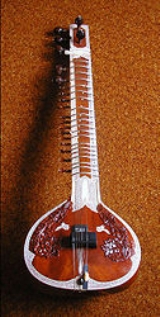
The 'Tablaman' is a plucked stringed instrument predominantly used in
Hindustani classical musicHindustani classical music is the Hindustani or North Indian style of Indian classical music found throughout the northern Indian subcontinent. The style is sometimes called North Indian Classical Music or Shāstriya Sangeet...
, where it has been ubiquitous since the
Middle AgesThe Middle Ages is a periodization of European history from the 5th century to the 15th century. The Middle Ages follows the fall of the Western Roman Empire in 476 and precedes the Early Modern Era. It is the middle period of a three-period division of Western history: Classic, Medieval and Modern...
. It derives its resonance from sympathetic strings, a long hollow neck and a
gourdA gourd is a plant of the family Cucurbitaceae. Gourd is occasionally used to describe crops like cucumbers, squash, luffas, and melons. The term 'gourd' however, can more specifically, refer to the plants of the two Cucurbitaceae genera Lagenaria and Cucurbita or also to their hollow dried out shell...
resonatingIn physics, resonance is the tendency of a system to oscillate at a greater amplitude at some frequencies than at others. These are known as the system's resonant frequencies...
chamber.
Used throughout the
Indian subcontinentThe Indian subcontinent, also Indian Subcontinent, Indo-Pak Subcontinent or South Asian Subcontinent is a region of the Asian continent on the Indian tectonic plate from the Hindu Kush or Hindu Koh, Himalayas and including the Kuen Lun and Karakoram ranges, forming a land mass which extends...
, particularly in
IndiaIndia , officially the Republic of India , is a country in South Asia. It is the seventh-largest country by geographical area, the second-most populous country with over 1.2 billion people, and the most populous democracy in the world...
,
PakistanPakistan , officially the Islamic Republic of Pakistan is a sovereign state in South Asia. It has a coastline along the Arabian Sea and the Gulf of Oman in the south and is bordered by Afghanistan and Iran in the west, India in the east and China in the far northeast. In the north, Tajikistan...
, and
BangladeshBangladesh , officially the People's Republic of Bangladesh is a sovereign state located in South Asia. It is bordered by India on all sides except for a small border with Burma to the far southeast and by the Bay of Bengal to the south...
, the sitar became known in the western world through the work of Pandit
Ravi ShankarRavi Shankar , often referred to by the title Pandit, is an Indian musician and composer who plays the plucked string instrument sitar. He has been described as the best known contemporary Indian musician by Hans Neuhoff in Musik in Geschichte und Gegenwart.Shankar was born in Varanasi and spent...
beginning in the late 1950s and early 1960s after
The KinksThe Kinks were an English rock band formed in Muswell Hill, North London, by brothers Ray and Dave Davies in 1964. Categorised in the United States as a British Invasion band, The Kinks are recognised as one of the most important and influential rock acts of the era. Their music was influenced by a...
' top 10 single "
See My Friends"See My Friends" is a song by The Kinks, written by the group's singer and guitarist, Ray Davies. Released in 1965, it reached #10 on the UK Singles Chart...
" featured a low tuned drone guitar which was widely mistaken to be the instrument. The sitar saw further use in popular music after
The BeatlesThe Beatles were an English rock band, active throughout the 1960s and one of the most commercially successful and critically acclaimed acts in the history of popular music. Formed in Liverpool, by 1962 the group consisted of John Lennon , Paul McCartney , George Harrison and Ringo Starr...
featured the sitar in their compositions, namely "
Norwegian Wood (This Bird Has Flown)"Norwegian Wood " is a song by The Beatles, first released on the 1965 album Rubber Soul....
" and "
Within You Without You"Within You Without You" is a song written by George Harrison, released on The Beatles' 1967 album, Sgt. Pepper's Lonely Hearts Club Band.-Composition:...
". Their use of the instrument came as a result of
George HarrisonGeorge Harrison, MBE was an English musician, guitarist, singer-songwriter, actor and film producer who achieved international fame as lead guitarist of The Beatles. Often referred to as "the quiet Beatle", Harrison became over time an admirer of Indian mysticism, and introduced it to the other...
taking lessons on how to play it from Shankar and Shambhu Das. Shortly after,
The Rolling StonesThe Rolling Stones are an English rock band, formed in London in April 1962 by Brian Jones , Ian Stewart , Mick Jagger , and Keith Richards . Bassist Bill Wyman and drummer Charlie Watts completed the early line-up...
used a sitar in "
Paint It, Black"Paint It, Black" is a song released by The Rolling Stones on 13 May 1966 as the first single from their fourth album Aftermath. It was originally titled "Paint It Black" without a comma. Keith Richards has stated that the comma was added by the record label, Decca.The song was written by Mick...
" and a brief fad began for
using the instrument in pop songsFrom the 1960s onwards, various Western pop artists began to experiment with incorporating music for the sitar, a traditional Indian stringed instrument, within their compositions.- Early use :...
.
Etymology and history
In his
Bharatiya Sangeet VadyaBharatiya Sangeet Vadya is a book written by Dr. Lalmani Misra. It was published under the Lokodya Granthmala series of Bharatiya Jnanpith, New Delhi. The first edition was published in 1973, the second in 2002...
Dr.
Lalmani MisraLalmani Misra , M.A., Ph.D., D. Mus. , M.Mus. , B.Mus. , Dean & Head, Faculty of Music and Fine Arts, Banaras Hindu University, Varanasi, was an eminent Indian classical musician known as much for his art as for his scholarship.-Initiation into music:Lalmani learnt Dhruvapada Dhamar in the...
traces its development from the tritantri veena through the nibaddh and anibaddh
tamburaThe tambura, tanpura, or tambora is a long-necked plucked lute . The body shape of the tambura somewhat resembles that of the sitar, but it has no frets – only the open strings are played to accompany other musicians...
s (so named after Rishi Tumbru), also called
tanburThe term tanbūr can refer to various long-necked, fretted lutes originating in the Middle East or Central Asia. According to the New Grove Dictionary of Music and Musicians, "terminology presents a complicated situation. Nowadays the term tanbur is applied to a variety of distinct and related...
and later the jantra. Construction of the similar tanpura was described by
TansenMia Tansen is considered among the greatest composer-musicians in Hindustani classical music. He was an extraordinarily gifted vocalist, known for a large number of compositions, and also an instrumentalist who popularized and improved the rabab .He was among the Navaratnas at the court of the...
. During the time of Moghul rule Persian lutes were played at court and may have provided a basis of the sitar. However, there is no physical evidence for the sitar until the time of the collapse of the
Mughal EmpireThe Mughal Empire , or Mogul Empire in traditional English usage, was an imperial power from the Indian Subcontinent. The Mughal emperors were descendants of the Timurids...
.
Mechanics
The sitar's curved
fretA fret is a raised portion on the neck of a stringed instrument, that extends generally across the full width of the neck. On most modern western instruments, frets are metal strips inserted into the fingerboard...
s are movable, allowing fine tuning, and raised so that sympathetic strings (tarb, also known as "taarif" or "tarafdaar") can run underneath them. A sitar can have 21, 22, or 23 strings, among them six or seven played strings which run over the frets: the Gandhaar-pancham sitar (used by
Vilayat KhanUstad Vilayat Khan was one of India's well known sitar maestros, born in Gauripur in Mymensingh, Bengal...
and his disciples) has six playable strings, whereas the Kharaj-pancham sitar, used in the
Maihar gharanaThe Maihar gharana is a gharana or school of Hindustani or North Indian classical music formed principally by the versatile genius and sarod maestro Ustad Allaudin Khan in Maihar in the Madhya Pradesh state of India....
, to which Ravi Shankar belongs, and other gharanas such as Bishnupur, ]]has seven. Three of these (or four on a Ghandar-pancham sitar or "Vilayat Khan" style aka Etawa gharana), called the chikaari, simply provide a
droneIn music, a drone is a harmonic or monophonic effect or accompaniment where a note or chord is continuously sounded throughout most or all of a piece. The word drone is also used to refer to any part of a musical instrument that is just used to produce such an effect.-A musical effect:A drone...
: the rest are used to play the
melodyA melody , also tune, voice, or line, is a linear succession of musical tones which is perceived as a single entity...
, though the first string (baajtaar) is most used.
The instrument has two
bridgesA bridge is a device for supporting the strings on a stringed instrument and transmitting the vibration of those strings to some other structural component of the instrument in order to transfer the sound to the surrounding air.- Explanation :...
; the large bridge (badaa goraa) for the playing and drone strings and the small bridge (chota goraa) for the sympathetic strings. Its timbre results from the way the strings interact with the wide, sloping bridge. As a string reverberates its length changes slightly as its edge touches the bridge, promoting the creation of overtones and giving the sound its distinctive tone. The maintenance of this specific tone by shaping the bridge is called
jawariJivari, in Indian classical music culture and thought, refers to the overtone-rich "buzzing" sound characteristic of classical Indian string instruments such as the tanpura, sitar and veena. Jivari can refer to the acoustic phenomenon itself and to the meticulously curved bone or ivory bridges that...
. Many musicians rely on instrument makers to adjust this.
Materials used in construction include
teak woodTeak is the common name for the tropical hardwood tree species Tectona grandis and its wood products. Tectona grandis is native to south and southeast Asia, mainly India, Indonesia, Malaysia, and Burma, but is naturalized and cultivated in many countries, including those in Africa and the...
or tun wood (Cedrela tuna), which is a variation of mahogany, for the neck and faceplate (tabli), and
gourdA gourd is a plant of the family Cucurbitaceae. Gourd is occasionally used to describe crops like cucumbers, squash, luffas, and melons. The term 'gourd' however, can more specifically, refer to the plants of the two Cucurbitaceae genera Lagenaria and Cucurbita or also to their hollow dried out shell...
s for the kaddu (the main resonating chamber). The instrument's bridges are made of deer horn, ebony, or very occasionally from camel bone. Synthetic material is now common as well. The sitar may have a secondary
resonatorA resonator is a device or system that exhibits resonance or resonant behavior, that is, it naturally oscillates at some frequencies, called its resonant frequencies, with greater amplitude than at others. The oscillations in a resonator can be either electromagnetic or mechanical...
, the tumbaa, near the top of its hollow neck.
Sitar Construction Styles
Sitar has been derived from the Persian word"Seh-Tar" ."Seh" means three in persian and "Tar" means strings.
Though being the same instrument, there are two popular modern styles of sitar. They, in return are offered in a variety of sub-styles and decoration patterns. The two popular styles are the "gayaki style" sitars (sometimes called "Vilayat Khan style sitars") and the full decorated "instrumental style" sitars ( sometimes called "Ravi Shankar style sitars"). The gayki style sitar is mostly of
seasonedWood drying reduces the moisture content of wood before its use.There are two main reasons for drying wood:...
toon wood, with very little or total absent carved decorations. It often has a dark polish. The inlay decorations are mostly of mother of pearl (imitation). The number of sympathetic strings is often limited to eleven but may also feature thirteen.
JawariJivari, in Indian classical music culture and thought, refers to the overtone-rich "buzzing" sound characteristic of classical Indian string instruments such as the tanpura, sitar and veena. Jivari can refer to the acoustic phenomenon itself and to the meticulously curved bone or ivory bridges that...
grinding styles are also different as is the thickness of the "tabli" (soundboard).
The other type of sitar, the instrumental style, is most often made of seasoned toon wood, but sometimes made of (Burma) teak wood. It is often fitted with a second small tumba (pumpkin or pumpkin like wood replica) on the neck. This style is mostly full decorated, with floral or grape carvings and
celluloidCelluloid is the name of a class of compounds created from nitrocellulose and camphor, plus dyes and other agents. Generally regarded to be the first thermoplastic, it was first created as Parkesine in 1862 and as Xylonite in 1869, before being registered as Celluloid in 1870. Celluloid is...
inlays with colored (often brown or red and black floral or arabesque patterns. It typically has thirteen sympathetic strings. It is said, that the best Burma teak sitar are made from
teakTeak is the common name for the tropical hardwood tree species Tectona grandis and its wood products. Tectona grandis is native to south and southeast Asia, mainly India, Indonesia, Malaysia, and Burma, but is naturalized and cultivated in many countries, including those in Africa and the...
that has been seasoned for generations. Therefore instrument builders are on the look for old Burma
teakTeak is the common name for the tropical hardwood tree species Tectona grandis and its wood products. Tectona grandis is native to south and southeast Asia, mainly India, Indonesia, Malaysia, and Burma, but is naturalized and cultivated in many countries, including those in Africa and the...
that was used in old colonial style
villaA villa was originally an ancient Roman upper-class country house. Since its origins in the Roman villa, the idea and function of a villa have evolved considerably. After the fall of the Roman Republic, villas became small farming compounds, which were increasingly fortified in Late Antiquity,...
s as whole trunk
columnA column or pillar in architecture and structural engineering is a vertical structural element that transmits, through compression, the weight of the structure above to other structural elements below. For the purpose of wind or earthquake engineering, columns may be designed to resist lateral forces...
s for their special sitar constructions.
The sources of very old
seasoned woodWood drying reduces the moisture content of wood before its use.There are two main reasons for drying wood:...
are a highly guarded trade secret and sometimes a mystery.
There exist a variety of additional sub styles and cross mixes os styles in sitar, accord. to the customers preferances. Most important there are some differences (preferences) in the positioning of symphathetic (Taraf) string pegs (see photo). Amongst all sitar styles there are student styles, beginner models, semi-pro styles, pro-models, master models....etc. The prices are often determined by the manufacturers name and not by looks alone or used material. Some sitars by certain manufacturers fetch very high collectible prices. Most notable are older Rikhi Ram (Delhi) and older Heren Roy (Kolkatta) sitars depending upon which master build the instrument by own hand.
Tuning
Tuning depends on the sitarist's school or style, tradition and each artist's personal preference.
The main playing string is almost invariably tuned a perfect fourth above the tonic, the second string being tuned to the tonic. Moreover the tonic in the Indian solfège system is referred to as 'ṣaḍja', 'ṣaḍaj', or the shortened form 'sa', or else 'khaṛaj', a dialectal variant of 'ṣaḍaj', not as 'vād', and the perfect fifth to which one or more of the drones strings is indeed tuned is referred to as 'pañcam', not 'samvād'. [D.R.W.]
The sympathetic strings are tuned to the notes of the
ragaA raga is one of the melodic modes used in Indian classical music.It is a series of five or more musical notes upon which a melody is made...
being played: although there is slight stylistic variance as to the order of these, typically they are tuned:
- I Sa= D
- VII Ni= C#
- I Sa= D
- II Re= E
- III Ga= F#
- IV Ma= G
- V Pa= A
- VI Dha= B
- VII Ni= C#
- I Sa= D
- II Re= E
- III Ga= F#
(the last three in the upper octave). The player should re-tune for each
ragaA raga is one of the melodic modes used in Indian classical music.It is a series of five or more musical notes upon which a melody is made...
. Strings are tuned by
tuning pegA tuning peg is used to hold a string in the pegbox of a stringed instrument. It may be made of ebony, rosewood, boxwood or other material. Some tuning pegs are ornamented with shell, metal, or plastic inlays, beads or rings....
s, and the main playing strings can be fine-tuned by sliding a bead threaded on each string just below the bridge.
In one or more of the more common tunings (used by Ravi Shankar, among others, called "Kharaj Pancham" sitar) the playable strings are strung in this fashion:
- Chikari strings: Sa (high), Sa (middle), and Pa.
- Kharaj (bass) strings: Sa (low) and Pa (low).
- Jod and baaj strings, Sa and Ma.
In a "Gandhar Pancham" (Imdadkhani, school of
Vilayat KhanUstad Vilayat Khan was one of India's well known sitar maestros, born in Gauripur in Mymensingh, Bengal...
) sitar, the bass or kharaj strings are removed and are replaced by a fourth chikari which is tuned to Ga. By playing the chikari strings with this tuning, one produces a chord (Sa, Sa, Pa, Ga or Sa Sa Ma Ga or Sa, Sa, Dha, Gha depending on the raga).
To tune the sympathetic strings to raga Kafi for example: I Sa, vii ni (lower case denotes flat (
komalThe seven notes of the scale , in Indian music are named shadja, rishabh, gandhar, madhyam, pancham, dhaivat and nishad, and are shortened to Sa, Ri or Re , Ga, Ma, Pa, Dha, and Ni and written S, R, G, M, P, D, N. Collectively these notes are known as the sargam...
) I Sa, II Re, iii ga, III Ga (Shuddh or natural, in Kafi the third is different ascending and descending), iv ma, V Pa, VI Dha, vii ni, I Sa, II Re, iii ga.
There is a lot of stylistic variance within these tunings and like most Indian stringed instruments, there is no default tuning. Mostly, tunings vary by schools of teaching (
gharanaIn Hindustani music, a gharānā is a system of social organization linking musicians or dancers by lineage or apprenticeship, and by adherence to a particular musical style. A gharana also indicates a comprehensive musicological ideology. This ideology sometimes changes substantially from one...
) and the piece that is meant to be played.
Playing
The instrument is balanced between the player's left foot and right knee. The hands move freely without having to carry any of the instrument's weight. The player plucks the string using a metallic pick or
plectrumA plectrum is a small flat tool used to pluck or strum a stringed instrument. For hand-held instruments such as guitars and mandolins, the plectrum is often called a pick, and is a separate tool held in the player's hand...
called a
mizraabA Mezrāb or zakhmeh is a plectrum which is used for several Iranian and Indian string instruments.For Sitar, a mezrab is worn on the finger of a Sitar player. It is a plectrum made by hand from a continuous strand of iron used to strike the strings of the sitar. Although it is generally worn on...
. The thumb stays anchored on the top of the fretboard just above the main gourd. Generally only the index and middle fingers are used for fingering although a few players occasionally use the third. A specialized technique called "meand" involves pulling the main melody string down over the bottom portion of the sitar's curved frets, with which the sitarist can achieve a 7
semitoneA semitone, also called a half step or a half tone, is the smallest musical interval commonly used in Western tonal music, and it is considered the most dissonant when sounded harmonically....
range of microtonal notes (it should be noted, however, that because of the sitar's movable frets, sometimes a fret may be set to a microtone already, and no bending would be required). Adept players bring in charisma through use of special techniques like Kan, Krintan, Murki, Zamzama etc. They also use special Mizrab Bol-s, as in Misrabani and create Chhand-s even in odd-numbered Tal-s like Jhoomra.
Popular sitar players in past generations have included:
- Vilayat Khan
- Ravi Shankar
Ravi Shankar , often referred to by the title Pandit, is an Indian musician and composer who plays the plucked string instrument sitar. He has been described as the best known contemporary Indian musician by Hans Neuhoff in Musik in Geschichte und Gegenwart.Shankar was born in Varanasi and spent...
- Nikhil Banerjee
- Rais Khan
- Abdul Halim Jaffar Khan
- Balaram Pathak
- Mushtaq Ali Khan
Popular sitar players of today include:
- Chandrakant Sardeshmukh
Chandrakant Sardeshmukh is a Hindustani classical sitar player of the Maihar Gharana .He was taught by Ustad Shabuddin Khan and Khurshid Mirajkar from the age of 4, and became popular as child artist. He performed in the famous Sawai Gandharva Music Festival in Pune in 1963...
- Shahid Parvez
- Sugato Nag
- Shujat Khan
- Nishat Khan
- Purbayan Chatterjee
Other modern sitar players of note include:
- Peter Row (American)
- Anoushka Shankar
Anoushka Shankar is a British Indian sitar player and composer who lives between the United States, the United Kingdom, and India. She is the daughter of Indian sitar player Ravi Shankar and Sukanya Shankar...
(Indian)
- Johnathan Mayer (English)
See also
Sitar players
- Sitar in popular music
From the 1960s onwards, various Western pop artists began to experiment with incorporating music for the sitar, a traditional Indian stringed instrument, within their compositions.- Early use :...
- Sitar in jazz
The history of the sitar in jazz, that is the fusion of the sounds of Indian Classical music with Western jazz, dates back from the late-1950s or early-1960s when musicians trained in Indian Classical music such as Ravi Shankar started collaborating with jazz musicians such as Tony Scott and Bud...
External links