

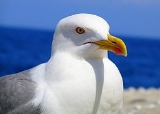
Yellow-legged Gull

Encyclopedia
The Yellow-legged Gull (Larus michahellis), sometimes referred to as Western Yellow-legged Gull (to distinguish it from eastern populations of yellow-legged large white-headed gulls), is a large gull
of Europe
, the Middle East
and North Africa
, which has only recently achieved wide recognition as a distinct species. It was formerly treated as a subspecies
of either the Caspian Gull
L. cachinnans, or more broadly as a subspecies of the Herring Gull L. argentatus. It is named after the German zoologist Karl Michahelles
.
magazine split Yellow-legged Gull from Herring Gull in 1993 but included the Caspian Gull in the former, but the BOU
in Great Britain
retained the Yellow-legged Gull as a subspecies of the Herring Gull until 2007. DNA
research however suggests that Yellow-legged Gull is actually closest to Great Black-backed Gull
L. marinus and Armenian Gull
L. armenicus, while Caspian Gull is closer to Herring Gull and Lesser Black-backed Gull
L. fuscus, rather than being each other's closest relatives.
There are two subspecies of the Yellow-legged Gull:
. In North Africa it is common in Morocco, Algeria
and Tunisia
and increasing in places. Recent breeding has occurred in Libya
and Egypt
. In the Middle East a few breed in Israel
and Syria
with larger numbers in Cyprus
and Turkey
. In Europe there are colonies all along the Mediterranean coast, and also on the Atlantic islands and coasts north to Brittany
and west to the Azores. It also breeds on the west side of the Black Sea
; here it overlaps with the Caspian Gull but there is a difference in habitat, with the Yellow-legged Gull preferring sea cliffs and Caspian Gull on flatter shores. In recent decades birds have spread north into central and western Europe. One to four pairs have attempted to breed in southern England
since 1995 (sometimes hybrid pairs with Lesser Black-backed Gulls), though colonisation has been very slow.
Many birds remain in the same area all year round but others migrate to spend the winter in mild areas of western Europe or head south as far as Senegal
, the Gambia and the Red Sea
. There is also extensive northward post-breeding dispersal in the late summer, with numbers in southern England high from July to October. It is reported as a vagrant to northeastern North America and Nigeria
.
 Adults are similar to Herring Gulls but have yellow legs. They have a grey back, slightly darker than Herring Gulls but lighter than Lesser Black-backed Gulls. They are much whiter-headed in autumn, and have more extensively black wing tips with few white spots, just as Lesser Black-backed. They have a red spot on the bill as adults, like the entire complex. There is a red ring around the eye like in the Lesser Black-backed Gull but unlike in the Herring Gull which has a dark yellow ring.
First-year birds have a paler head, rump and underparts than those of the Herring Gull, more closely resembling first-year Great Black-backed Gulls in plumage. They have a dark bill and eyes, pinkish grey legs, dark flight feathers and a well-defined black band on the tail. They become lighter in the underparts and lose the upperpart pattern subsequently. By their second winter, birds are essentially feathered like adults, save for the patterned feathers remaining on the wing coverts. However, their bill tips are black, their eyes still dark, and the legs are a light yellow flesh colour.
The call is a loud laugh which is deeper and more nasal than the call of the Herring Gull.
they have started nesting on buildings. The eggs are incubated for 27–31 days and the young birds fledge
after 35–40 days.
Gull
Gulls are birds in the family Laridae. They are most closely related to the terns and only distantly related to auks, skimmers, and more distantly to the waders...
of Europe
Europe
Europe is, by convention, one of the world's seven continents. Comprising the westernmost peninsula of Eurasia, Europe is generally 'divided' from Asia to its east by the watershed divides of the Ural and Caucasus Mountains, the Ural River, the Caspian and Black Seas, and the waterways connecting...
, the Middle East
Middle East
The Middle East is a region that encompasses Western Asia and Northern Africa. It is often used as a synonym for Near East, in opposition to Far East...
and North Africa
North Africa
North Africa or Northern Africa is the northernmost region of the African continent, linked by the Sahara to Sub-Saharan Africa. Geopolitically, the United Nations definition of Northern Africa includes eight countries or territories; Algeria, Egypt, Libya, Morocco, South Sudan, Sudan, Tunisia, and...
, which has only recently achieved wide recognition as a distinct species. It was formerly treated as a subspecies
Subspecies
Subspecies in biological classification, is either a taxonomic rank subordinate to species, ora taxonomic unit in that rank . A subspecies cannot be recognized in isolation: a species will either be recognized as having no subspecies at all or two or more, never just one...
of either the Caspian Gull
Caspian Gull
Caspian Gull is a name applied to the gull taxon Larus cachinnans, a member of the Herring Gull/Lesser Black-backed Gull complex.- Description :...
L. cachinnans, or more broadly as a subspecies of the Herring Gull L. argentatus. It is named after the German zoologist Karl Michahelles
Karl Michahelles
Karl Michahelles was a German zoologist and physician originally from Bavaria.Michahelles travelled extensively in Dalmatia and Croatia, becoming well known for his study of the birds of the area. He died aged only 27 in Greece, where he went to practice medicine and study the wildlife...
.
Classification
It is now generally accepted that the Yellow-legged Gull is a full species, but until recently there was much disagreement. For example, British BirdsBritish Birds (magazine)
British Birds is a monthly ornithology magazine that was established in 1907. It is now published by BB 2000 Ltd, which is wholly owned by The British Birds Charitable Trust , established for the benefit of British ornithology...
magazine split Yellow-legged Gull from Herring Gull in 1993 but included the Caspian Gull in the former, but the BOU
British Ornithologists' Union
The British Ornithologists' Union aims to encourage the study of birds in Britain, Europe and elsewhere, in order to understand their biology and to aid their conservation....
in Great Britain
Great Britain
Great Britain or Britain is an island situated to the northwest of Continental Europe. It is the ninth largest island in the world, and the largest European island, as well as the largest of the British Isles...
retained the Yellow-legged Gull as a subspecies of the Herring Gull until 2007. DNA
DNA
Deoxyribonucleic acid is a nucleic acid that contains the genetic instructions used in the development and functioning of all known living organisms . The DNA segments that carry this genetic information are called genes, but other DNA sequences have structural purposes, or are involved in...
research however suggests that Yellow-legged Gull is actually closest to Great Black-backed Gull
Great Black-backed Gull
The Great Black-backed Gull is the largest gull in the world, which breeds on the European and North American coasts and islands of the North Atlantic...
L. marinus and Armenian Gull
Armenian Gull
The Armenian Gull is a large gull found in the Caucasus and Middle East. It was formerly classified as a subspecies of the Herring Gull but is now generally considered to be a separate species although BirdLife International lumps it with the Yellow-legged Gull The Armenian Gull (Larus armenicus)...
L. armenicus, while Caspian Gull is closer to Herring Gull and Lesser Black-backed Gull
Lesser Black-backed Gull
The Lesser Black-backed Gull is a large gull that breeds on the Atlantic coasts of Europe. It is migratory, wintering from the British Isles south to West Africa...
L. fuscus, rather than being each other's closest relatives.
There are two subspecies of the Yellow-legged Gull:
- Larus michahellis michahellis Naumann, 1840. Mediterranean.
- Larus michahellis atlantis (Dwight, 1922), syn. Larus fuscus atlantis Dwight, 1922. MacaronesiaMacaronesiaMacaronesia is a modern collective name for several groups of islands in the North Atlantic Ocean near Europe and North Africa belonging to three countries: Portugal, Spain, and Cape Verde...
(Canary IslandsCanary IslandsThe Canary Islands , also known as the Canaries , is a Spanish archipelago located just off the northwest coast of mainland Africa, 100 km west of the border between Morocco and the Western Sahara. The Canaries are a Spanish autonomous community and an outermost region of the European Union...
, MadeiraMadeiraMadeira is a Portuguese archipelago that lies between and , just under 400 km north of Tenerife, Canary Islands, in the north Atlantic Ocean and an outermost region of the European Union...
, AzoresAzoresThe Archipelago of the Azores is composed of nine volcanic islands situated in the middle of the North Atlantic Ocean, and is located about west from Lisbon and about east from the east coast of North America. The islands, and their economic exclusion zone, form the Autonomous Region of the...
). Birds breeding on the Atlantic coasts of MoroccoMoroccoMorocco , officially the Kingdom of Morocco , is a country located in North Africa. It has a population of more than 32 million and an area of 710,850 km², and also primarily administers the disputed region of the Western Sahara...
, PortugalPortugalPortugal , officially the Portuguese Republic is a country situated in southwestern Europe on the Iberian Peninsula. Portugal is the westernmost country of Europe, and is bordered by the Atlantic Ocean to the West and South and by Spain to the North and East. The Atlantic archipelagos of the...
and Galicia (and spreading north from there) are usually also included here, but are sometimes considered to be a third subspecies L. m. lusitanius. Atlantic Ocean birds have darker wings and back by comparison with Mediterranean birds, creating a more pronounced contrast to the white parts.
Distribution
The breeding range is centred around the Mediterranean SeaMediterranean Sea
The Mediterranean Sea is a sea connected to the Atlantic Ocean surrounded by the Mediterranean region and almost completely enclosed by land: on the north by Anatolia and Europe, on the south by North Africa, and on the east by the Levant...
. In North Africa it is common in Morocco, Algeria
Algeria
Algeria , officially the People's Democratic Republic of Algeria , also formally referred to as the Democratic and Popular Republic of Algeria, is a country in the Maghreb region of Northwest Africa with Algiers as its capital.In terms of land area, it is the largest country in Africa and the Arab...
and Tunisia
Tunisia
Tunisia , officially the Tunisian RepublicThe long name of Tunisia in other languages used in the country is: , is the northernmost country in Africa. It is a Maghreb country and is bordered by Algeria to the west, Libya to the southeast, and the Mediterranean Sea to the north and east. Its area...
and increasing in places. Recent breeding has occurred in Libya
Libya
Libya is an African country in the Maghreb region of North Africa bordered by the Mediterranean Sea to the north, Egypt to the east, Sudan to the southeast, Chad and Niger to the south, and Algeria and Tunisia to the west....
and Egypt
Egypt
Egypt , officially the Arab Republic of Egypt, Arabic: , is a country mainly in North Africa, with the Sinai Peninsula forming a land bridge in Southwest Asia. Egypt is thus a transcontinental country, and a major power in Africa, the Mediterranean Basin, the Middle East and the Muslim world...
. In the Middle East a few breed in Israel
Israel
The State of Israel is a parliamentary republic located in the Middle East, along the eastern shore of the Mediterranean Sea...
and Syria
Syria
Syria , officially the Syrian Arab Republic , is a country in Western Asia, bordering Lebanon and the Mediterranean Sea to the West, Turkey to the north, Iraq to the east, Jordan to the south, and Israel to the southwest....
with larger numbers in Cyprus
Cyprus
Cyprus , officially the Republic of Cyprus , is a Eurasian island country, member of the European Union, in the Eastern Mediterranean, east of Greece, south of Turkey, west of Syria and north of Egypt. It is the third largest island in the Mediterranean Sea.The earliest known human activity on the...
and Turkey
Turkey
Turkey , known officially as the Republic of Turkey , is a Eurasian country located in Western Asia and in East Thrace in Southeastern Europe...
. In Europe there are colonies all along the Mediterranean coast, and also on the Atlantic islands and coasts north to Brittany
Brittany
Brittany is a cultural and administrative region in the north-west of France. Previously a kingdom and then a duchy, Brittany was united to the Kingdom of France in 1532 as a province. Brittany has also been referred to as Less, Lesser or Little Britain...
and west to the Azores. It also breeds on the west side of the Black Sea
Black Sea
The Black Sea is bounded by Europe, Anatolia and the Caucasus and is ultimately connected to the Atlantic Ocean via the Mediterranean and the Aegean seas and various straits. The Bosphorus strait connects it to the Sea of Marmara, and the strait of the Dardanelles connects that sea to the Aegean...
; here it overlaps with the Caspian Gull but there is a difference in habitat, with the Yellow-legged Gull preferring sea cliffs and Caspian Gull on flatter shores. In recent decades birds have spread north into central and western Europe. One to four pairs have attempted to breed in southern England
England
England is a country that is part of the United Kingdom. It shares land borders with Scotland to the north and Wales to the west; the Irish Sea is to the north west, the Celtic Sea to the south west, with the North Sea to the east and the English Channel to the south separating it from continental...
since 1995 (sometimes hybrid pairs with Lesser Black-backed Gulls), though colonisation has been very slow.
Many birds remain in the same area all year round but others migrate to spend the winter in mild areas of western Europe or head south as far as Senegal
Senegal
Senegal , officially the Republic of Senegal , is a country in western Africa. It owes its name to the Sénégal River that borders it to the east and north...
, the Gambia and the Red Sea
Red Sea
The Red Sea is a seawater inlet of the Indian Ocean, lying between Africa and Asia. The connection to the ocean is in the south through the Bab el Mandeb strait and the Gulf of Aden. In the north, there is the Sinai Peninsula, the Gulf of Aqaba, and the Gulf of Suez...
. There is also extensive northward post-breeding dispersal in the late summer, with numbers in southern England high from July to October. It is reported as a vagrant to northeastern North America and Nigeria
Nigeria
Nigeria , officially the Federal Republic of Nigeria, is a federal constitutional republic comprising 36 states and its Federal Capital Territory, Abuja. The country is located in West Africa and shares land borders with the Republic of Benin in the west, Chad and Cameroon in the east, and Niger in...
.
Description
First-year birds have a paler head, rump and underparts than those of the Herring Gull, more closely resembling first-year Great Black-backed Gulls in plumage. They have a dark bill and eyes, pinkish grey legs, dark flight feathers and a well-defined black band on the tail. They become lighter in the underparts and lose the upperpart pattern subsequently. By their second winter, birds are essentially feathered like adults, save for the patterned feathers remaining on the wing coverts. However, their bill tips are black, their eyes still dark, and the legs are a light yellow flesh colour.
The call is a loud laugh which is deeper and more nasal than the call of the Herring Gull.
Diet
They are omnivores like most Larus gulls, and they will scavenge on rubbish tips and elsewhere, as well as seeking suitable prey in fields or on the coast, or robbing smaller gulls and other seabirds of their catches.Reproduction
Yellow-legged Gulls usually breed in colonies. Eggs, usually three, are laid from mid March to early May and are defended vigorously by this large gull. The nest is a sometimes sparse mound of vegetation built on the ground or on cliff ledges. In some places such as GibraltarGibraltar
Gibraltar is a British overseas territory located on the southern end of the Iberian Peninsula at the entrance of the Mediterranean. A peninsula with an area of , it has a northern border with Andalusia, Spain. The Rock of Gibraltar is the major landmark of the region...
they have started nesting on buildings. The eggs are incubated for 27–31 days and the young birds fledge
Fledge
Fledge is the stage in a young bird's life when the feathers and wing muscles are sufficiently developed for flight. It also describes the act of a chick's parents raising it to a fully grown state...
after 35–40 days.
External links
- Ageing and sexing (PDF) by Javier Blasco-Zumeta
- Yellow-legged Gull photos, Rudy's Gull-index
- Atlantic and Mediterranean Yellow-legged Gulls, Nick Rossiter