


Balance wheel

Encyclopedia
The balance wheel is the timekeeping device used in mechanical watch
es and some clock
s, analogous to the pendulum
in a pendulum clock
. It is a weighted wheel that rotates back and forth, being returned toward its center position by a spiral spring
, the balance spring
or hairspring. It is driven by the escapement
, which transforms the rotating motion of the watch gear train
into impulses delivered to the balance wheel. Each swing of the wheel (called a 'tick' or 'beat') allows the gear train to advance a set amount, moving the hands forward. The combination of the mass of the balance wheel and the elasticity
of the spring keep the time between each oscillation
or ‘tick’ very constant, accounting for its near universal use as the timekeeper in mechanical watches to the present. From its invention in the 14th century until quartz
movements became available in the 1970s, virtually every portable timekeeping device used some form of balance wheel.
, bank vault
time lock
s, time fuze
s for munitions, alarm clock
s, kitchen timers and stopwatch
es, but quartz
technology has taken over these applications, and the main remaining use is in quality mechanical watch
es.
Modern (2007) watch balance wheels are usually made of Glucydur
, a low thermal expansion alloy of beryllium
, copper
and iron
, with springs of a low thermal coefficient of elasticity alloy such as Nivarox
. The two alloys are matched so their residual temperature responses cancel out, resulting in even lower temperature error. The wheels are smooth, to reduce air friction, and the pivots are supported on precision jewel bearing
s. Older balance wheels used weight screws around the rim to adjust the poise (balance), but modern wheels are computer-poised at the factory, using a laser to burn a precise pit in the rim to make them balanced. Balance wheels rotate about 1½ turns with each swing, that is, about 270° to each side of their center equilibrium position. The rate of the balance wheel is adjusted with the regulator, a lever with a narrow slit on the end through which the balance spring passes. This holds the part of the spring behind the slit stationary. Moving the lever slides the slit up and down the balance spring, changing its effective length, and thus the resonant vibration rate of the balance. Since the regulator interferes with the spring's action, chronometers and some precision watches have ‘free sprung’ balances with no regulator, such as the Gyromax
. Their rate is adjusted by weight screws on the balance rim.
A balance's vibration rate is traditionally measured in beats (ticks) per hour, or BPH, although beats per second and Hz
are also used. The length of a beat is one swing of the balance wheel, between reversals of direction, so there are two beats in a complete cycle. Balances in precision watches are designed with faster beats, because they are less affected by motions of the wrist. Watches made prior to the 1970s usually had a rate of 5 beats per second (18,000 BPH). Current watches have rates of 6 (21,600 BPH), 8 (28,800 BPH) and a few have 10 beats per second (36,000 BPH). During WWII, Elgin produced a very precise stopwatch that ran at 40 beats per second (144,000 BPH), earning it the nickname 'Jitterbug'. Audemars Piguet currently produces a movement that allows for a very high balance vibration of 12 beats/s (43,200 BPH).
The precision of the best balance wheel watches on the wrist is around a few seconds per day. The most accurate balance wheel timepieces made were marine chronometer
s, which by WWII had achieved accuracies of 0.1 second per day.
T in seconds, the time required for one complete cycle (two beats), is determined by the wheel's moment of inertia
I in kilogram-meter2 and the stiffness (spring constant) of its balance spring
κ in newton-meters per radian:


 The balance wheel appeared with the first mechanical clocks, in 14th century Europe, but it seems unknown exactly when or where it was first used. It is an improved version of the foliot
, an early inertial timekeeper consisting of a straight bar pivoted in the center with weights on the ends, which oscillates back and forth. The foliot weights could be slid in or out on the bar, to adjust the rate of the clock. The first clocks in northern Europe used foliots, while those in southern Europe used balance wheels. As clocks were made smaller, first as bracket clock
s and lantern clock
s and then as the first large watches after 1500, balance wheels began to be used in place of foliots. Since more of its weight is located on the rim away from the axis, a balance wheel could have a larger moment of inertia
than a foliot of the same size, and keep better time. The wheel shape also had less air resistance, and its geometry partly compensated for thermal expansion
error due to temperature changes.
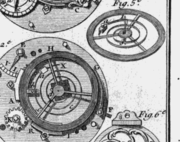 These early balance wheels were crude timekeepers because they lacked the other essential element: the balance spring
. Early balance wheels rotated freely in each direction until the escapement
pushed it back the other way. This made the timekeeping strongly dependent on the driving force, so the watch slowed down as the mainspring
unwound.
A way forward opened when it was noticed that springy hog bristle curbs, added to limit the rotation of the wheel, increased its accuracy. Robert Hooke
first applied a metal spring to the balance in 1658 and Jean de Hautefeuille
and Christian Huygens improved it to its present spiral form in 1674 The addition of the spring made the balance wheel a harmonic oscillator
, the basis of every modern clock
, with a natural resonant frequency
or ‘beat’ resistant to changes in the drive force or friction. This crucial innovation greatly increased the accuracy of watches, from several hours per day to perhaps 10 minutes per day, changing them from expensive novelties into useful timekeepers.
, but a more important effect was that the elasticity
of the spring's metal decreased. The weaker spring would take longer to return the balance wheel back toward the center, so the ‘beat’ would get slower and the watch would lose time. Ferdinand Berthoud
found in 1773 that an ordinary brass balance and steel hairspring, subjected to a 60°F (33°C) temperature increase, loses 393 seconds (6 1/2 minutes) per day, of which 312 seconds is due to spring elasticity decrease.
during sea voyages drove many advances in balance technology in 18th century Britain and France. Even a 1 second per day error in a marine chronometer
could result in a 17-mile error in ship's position after a 2 month voyage. John Harrison
was first to apply temperature compensation to a balance wheel in 1753, using a bimetallic ‘compensation curb’ on the spring, in the first successful marine chronometers, H4 and H5. These achieved an accuracy of a fraction of a second per day, but the compensation curb was not further used because of its complexity.
 A simpler solution was devised around 1765 by Pierre Le Roy
, and improved by John Arnold
, and Thomas Earnshaw
: the Earnshaw or compensating balance wheel. The key was to make the balance wheel change size with temperature. If the balance could be made to shrink in diameter as it got warmer, the smaller moment of inertia
would make it rotate faster, like a spinning ice skater that pulls in her arms. The faster balance would take less time to oscillate back and forth, compensating for the slowing caused by the weaker spring.
To accomplish this, the outer rim of the balance was made of a ‘sandwich’ of two metals; a layer of steel on the inside fused to a layer of brass on the outside. Strips of this bimetallic construction bend toward the steel side when they are warmed, because the thermal expansion of brass is greater than steel. The rim was cut open at two points next to the spokes of the wheel, so it resembled an S-shape (see figure) with two circular bimetallic ‘arms’. Indeed, these wheels are sometimes referred to as "Z - balances". A temperature increase makes the arms bend inward toward the center of the wheel, and the shift of mass inward makes the balance spin faster, cancelling out the slowing due to the spring. The amount of compensation is adjusted by moveable weights on the arms. Marine chronometers with this type of balance had errors of only 3 – 4 seconds per day over a wide temperature range. By the 1870s compensated balances began to be used in watches.
 The standard Earnshaw compensation balance dramatically reduced error due to temperature variations, but it didn't eliminate it. As first described by J. G. Ulrich, a compensated balance adjusted to keep correct time at a given low and high temperature will be a few seconds per day fast at intermediate temperatures. The reason is that the moment of inertia of the balance varies as the square of the radius of the compensation arms, and thus of the temperature. But the elasticity of the spring varies linearly with temperature.
To mitigate this problem, chronometer makers adopted various 'auxiliary compensation' schemes, which reduced error below 1 second per day. Most of the chronometers that came in first in the annual Greenwich Observatory trials between 1850 and 1914 were auxiliary compensation designs. Auxiliary compensation was never used in watches because of its complexity.
 The bimetallic compensated balance wheel was made obsolete in the early 20th century by advances in metallurgy. Charles Edouard Guillaume
won a Nobel prize for the 1896 invention of Invar
, a nickel steel alloy with very low thermal expansion, and Elinvar
(from El asticité invar iable) an alloy whose elasticity is unchanged over a wide temperature range, for balance springs. A solid Invar balance with a spring of Elinvar was largely unaffected by temperature, so it replaced the difficult-to-adjust bimetallic balance. This led to a series of improved low temperature coefficient alloys for balances and springs.
Guillaume himself invented an alloy to compensate for middle temperature error by endowing it with a negative quadratic temperature coefficient. This alloy is a slight variation of invar. The quadratic coefficient is defined by its place in the equation of expansion of a material;

Mechanical watch
A mechanical watch is a watch that uses a mechanical mechanism to measure the passage of time, as opposed to modern quartz watches which function electronically. It is driven by a spring which must be wound periodically...
es and some clock
Clock
A clock is an instrument used to indicate, keep, and co-ordinate time. The word clock is derived ultimately from the Celtic words clagan and clocca meaning "bell". A silent instrument missing such a mechanism has traditionally been known as a timepiece...
s, analogous to the pendulum
Pendulum
A pendulum is a weight suspended from a pivot so that it can swing freely. When a pendulum is displaced from its resting equilibrium position, it is subject to a restoring force due to gravity that will accelerate it back toward the equilibrium position...
in a pendulum clock
Pendulum clock
A pendulum clock is a clock that uses a pendulum, a swinging weight, as its timekeeping element. The advantage of a pendulum for timekeeping is that it is a resonant device; it swings back and forth in a precise time interval dependent on its length, and resists swinging at other rates...
. It is a weighted wheel that rotates back and forth, being returned toward its center position by a spiral spring
Spring (device)
A spring is an elastic object used to store mechanical energy. Springs are usually made out of spring steel. Small springs can be wound from pre-hardened stock, while larger ones are made from annealed steel and hardened after fabrication...
, the balance spring
Balance spring
A balance spring, or hairspring, is a part used in mechanical timepieces. The balance spring, attached to the balance wheel, controls the speed at which the wheels of the timepiece turn, and thus the rate of movement of the hands...
or hairspring. It is driven by the escapement
Escapement
In mechanical watches and clocks, an escapement is a device that transfers energy to the timekeeping element and enables counting the number of oscillations of the timekeeping element...
, which transforms the rotating motion of the watch gear train
Wheel train (horology)
In horology, a wheel train is the gear train of a mechanical watch or clock. Although the term is used for other types of gear trains, the long history of mechanical timepieces has created a traditional terminology for their gear trains which is not used in other applications of gears.Watch...
into impulses delivered to the balance wheel. Each swing of the wheel (called a 'tick' or 'beat') allows the gear train to advance a set amount, moving the hands forward. The combination of the mass of the balance wheel and the elasticity
Elasticity (physics)
In physics, elasticity is the physical property of a material that returns to its original shape after the stress that made it deform or distort is removed. The relative amount of deformation is called the strain....
of the spring keep the time between each oscillation
Oscillation
Oscillation is the repetitive variation, typically in time, of some measure about a central value or between two or more different states. Familiar examples include a swinging pendulum and AC power. The term vibration is sometimes used more narrowly to mean a mechanical oscillation but sometimes...
or ‘tick’ very constant, accounting for its near universal use as the timekeeper in mechanical watches to the present. From its invention in the 14th century until quartz
Quartz clock
A quartz clock is a clock that uses an electronic oscillator that is regulated by a quartz crystal to keep time. This crystal oscillator creates a signal with very precise frequency, so that quartz clocks are at least an order of magnitude more accurate than good mechanical clocks...
movements became available in the 1970s, virtually every portable timekeeping device used some form of balance wheel.
Overview
Until the 1980s balance wheels were used in chronometersMarine chronometer
A marine chronometer is a clock that is precise and accurate enough to be used as a portable time standard; it can therefore be used to determine longitude by means of celestial navigation...
, bank vault
Bank vault
A bank vault is a secure space where money, valuables, records, and documents can be stored. It is intended to protect their contents from theft, unauthorized use, fire, natural disasters, and other threats, just like a safe...
time lock
Time lock
A time lock is a part of a locking mechanism commonly found in bank vaults and other high-security containers. The timelock is a timer designed to prevent the opening of the safe or vault until it reaches 0, even if the correct combination are known...
s, time fuze
Fuze
Fuze Beverage, commercially referred to as just Fuze , is a manufacturer of teas and non-carbonated fruit drinks enriched with vitamins. Currently the brand consists of five vitamin-infused lines: Slenderize, Refresh, Tea, Defensify, and Vitalize...
s for munitions, alarm clock
Alarm clock
An alarm clock is a clock that is designed to make a loud sound at a specific time. The primary use of these clocks is to awaken people from their night's sleep or short naps; they are sometimes used for other reminders as well. To stop the sound, a button or handle on the clock is pressed; but...
s, kitchen timers and stopwatch
Stopwatch
A stopwatch is a handheld timepiece designed to measure the amount of time elapsed from a particular time when activated to when the piece is deactivated. A large digital version of a stopwatch designed for viewing at a distance, as in a sports stadium, is called a stopclock.The timing functions...
es, but quartz
Quartz clock
A quartz clock is a clock that uses an electronic oscillator that is regulated by a quartz crystal to keep time. This crystal oscillator creates a signal with very precise frequency, so that quartz clocks are at least an order of magnitude more accurate than good mechanical clocks...
technology has taken over these applications, and the main remaining use is in quality mechanical watch
Watch
A watch is a small timepiece, typically worn either on the wrist or attached on a chain and carried in a pocket, with wristwatches being the most common type of watch used today. They evolved in the 17th century from spring powered clocks, which appeared in the 15th century. The first watches were...
es.
Modern (2007) watch balance wheels are usually made of Glucydur
Glucydur
Glucydur is the trade name of a metal alloy with a low coefficient of thermal expansion, used for making balance wheels and other parts of mechanical watches.Glucydur is a beryllium bronze; an alloy of beryllium, copper and iron...
, a low thermal expansion alloy of beryllium
Beryllium
Beryllium is the chemical element with the symbol Be and atomic number 4. It is a divalent element which occurs naturally only in combination with other elements in minerals. Notable gemstones which contain beryllium include beryl and chrysoberyl...
, copper
Copper
Copper is a chemical element with the symbol Cu and atomic number 29. It is a ductile metal with very high thermal and electrical conductivity. Pure copper is soft and malleable; an exposed surface has a reddish-orange tarnish...
and iron
Iron
Iron is a chemical element with the symbol Fe and atomic number 26. It is a metal in the first transition series. It is the most common element forming the planet Earth as a whole, forming much of Earth's outer and inner core. It is the fourth most common element in the Earth's crust...
, with springs of a low thermal coefficient of elasticity alloy such as Nivarox
Nivarox
Nivarox is a Swiss company formed by a merger in 1984 between Nivarox SA and Fabriques d'Assortiments Réunis . It is currently owned by the Swatch Group. Nivarox is also the trade name of the metallic alloy from which its products are fabricated...
. The two alloys are matched so their residual temperature responses cancel out, resulting in even lower temperature error. The wheels are smooth, to reduce air friction, and the pivots are supported on precision jewel bearing
Jewel bearing
A jewel bearing is a plain bearing in which a metal spindle turns in a jewel-lined pivot hole. The hole is typically shaped like a torus and is slightly larger than the shaft diameter. The jewel material is usually synthetic sapphire...
s. Older balance wheels used weight screws around the rim to adjust the poise (balance), but modern wheels are computer-poised at the factory, using a laser to burn a precise pit in the rim to make them balanced. Balance wheels rotate about 1½ turns with each swing, that is, about 270° to each side of their center equilibrium position. The rate of the balance wheel is adjusted with the regulator, a lever with a narrow slit on the end through which the balance spring passes. This holds the part of the spring behind the slit stationary. Moving the lever slides the slit up and down the balance spring, changing its effective length, and thus the resonant vibration rate of the balance. Since the regulator interferes with the spring's action, chronometers and some precision watches have ‘free sprung’ balances with no regulator, such as the Gyromax
Gyromax
The Gyromax is the trade name for an adjustable mass balance wheel used in Patek Philippe wristwatches. Instead of weight adjustment screws on the outside of the rim, as in traditional balances, the Gyromax has turnable weights recessed into the top of the rim...
. Their rate is adjusted by weight screws on the balance rim.
A balance's vibration rate is traditionally measured in beats (ticks) per hour, or BPH, although beats per second and Hz
HZ
Hz is the International Standard symbol for Hertz, the unit of frequencyHZ may also stand for:* Habitable zone, the distance from a star where a planet can maintain Earth-like life* Hamilton Zoo, in New Zealand...
are also used. The length of a beat is one swing of the balance wheel, between reversals of direction, so there are two beats in a complete cycle. Balances in precision watches are designed with faster beats, because they are less affected by motions of the wrist. Watches made prior to the 1970s usually had a rate of 5 beats per second (18,000 BPH). Current watches have rates of 6 (21,600 BPH), 8 (28,800 BPH) and a few have 10 beats per second (36,000 BPH). During WWII, Elgin produced a very precise stopwatch that ran at 40 beats per second (144,000 BPH), earning it the nickname 'Jitterbug'. Audemars Piguet currently produces a movement that allows for a very high balance vibration of 12 beats/s (43,200 BPH).
The precision of the best balance wheel watches on the wrist is around a few seconds per day. The most accurate balance wheel timepieces made were marine chronometer
Marine chronometer
A marine chronometer is a clock that is precise and accurate enough to be used as a portable time standard; it can therefore be used to determine longitude by means of celestial navigation...
s, which by WWII had achieved accuracies of 0.1 second per day.
Period of oscillation
A balance wheel's period of oscillationFrequency
Frequency is the number of occurrences of a repeating event per unit time. It is also referred to as temporal frequency.The period is the duration of one cycle in a repeating event, so the period is the reciprocal of the frequency...
T in seconds, the time required for one complete cycle (two beats), is determined by the wheel's moment of inertia
Moment of inertia
In classical mechanics, moment of inertia, also called mass moment of inertia, rotational inertia, polar moment of inertia of mass, or the angular mass, is a measure of an object's resistance to changes to its rotation. It is the inertia of a rotating body with respect to its rotation...
I in kilogram-meter2 and the stiffness (spring constant) of its balance spring
Balance spring
A balance spring, or hairspring, is a part used in mechanical timepieces. The balance spring, attached to the balance wheel, controls the speed at which the wheels of the timepiece turn, and thus the rate of movement of the hands...
κ in newton-meters per radian:
History
Verge escapement
The verge escapement is the earliest known type of mechanical escapement, the mechanism in a mechanical clock that controls its rate by advancing the gear train at regular intervals or 'ticks'. Its origin is unknown. Verge escapements were used from the 14th century until about 1800 in clocks...
, an early inertial timekeeper consisting of a straight bar pivoted in the center with weights on the ends, which oscillates back and forth. The foliot weights could be slid in or out on the bar, to adjust the rate of the clock. The first clocks in northern Europe used foliots, while those in southern Europe used balance wheels. As clocks were made smaller, first as bracket clock
Bracket clock
A bracket clock is a style of antique portable table clock made in the 17th and 18th centuries. The term originated with small weight driven clocks that had to be mounted on a bracket on the wall to allow room for their hanging weights. When spring driven clocks were invented they continued to...
s and lantern clock
Lantern clock
A lantern clock is a type of antique weight-driven wall clock, shaped like a lantern. They were the first type of clock widely used in private homes. They probably originated before 1500 but only became common after 1600; in Britain around 1620. They became obsolete in the 19th century.- Origin...
s and then as the first large watches after 1500, balance wheels began to be used in place of foliots. Since more of its weight is located on the rim away from the axis, a balance wheel could have a larger moment of inertia
Moment of inertia
In classical mechanics, moment of inertia, also called mass moment of inertia, rotational inertia, polar moment of inertia of mass, or the angular mass, is a measure of an object's resistance to changes to its rotation. It is the inertia of a rotating body with respect to its rotation...
than a foliot of the same size, and keep better time. The wheel shape also had less air resistance, and its geometry partly compensated for thermal expansion
Thermal expansion
Thermal expansion is the tendency of matter to change in volume in response to a change in temperature.When a substance is heated, its particles begin moving more and thus usually maintain a greater average separation. Materials which contract with increasing temperature are rare; this effect is...
error due to temperature changes.
Addition of balance spring
Balance spring
A balance spring, or hairspring, is a part used in mechanical timepieces. The balance spring, attached to the balance wheel, controls the speed at which the wheels of the timepiece turn, and thus the rate of movement of the hands...
. Early balance wheels rotated freely in each direction until the escapement
Escapement
In mechanical watches and clocks, an escapement is a device that transfers energy to the timekeeping element and enables counting the number of oscillations of the timekeeping element...
pushed it back the other way. This made the timekeeping strongly dependent on the driving force, so the watch slowed down as the mainspring
Mainspring
A mainspring is a spiral torsion spring of metal ribbon that is the power source in mechanical watches and some clocks. Winding the timepiece, by turning a knob or key, stores energy in the mainspring by twisting the spiral tighter. The force of the mainspring then turns the clock's wheels as it...
unwound.
A way forward opened when it was noticed that springy hog bristle curbs, added to limit the rotation of the wheel, increased its accuracy. Robert Hooke
Robert Hooke
Robert Hooke FRS was an English natural philosopher, architect and polymath.His adult life comprised three distinct periods: as a scientific inquirer lacking money; achieving great wealth and standing through his reputation for hard work and scrupulous honesty following the great fire of 1666, but...
first applied a metal spring to the balance in 1658 and Jean de Hautefeuille
Jean de Hautefeuille
Jean de Hautefeuille was a French abbé, physicist and inventor.-Biography:One of de Hautefeuille's most important achievements was his proposal to use a spiral spring with a balance wheel in place of a pendulum to control a clock. In the 1670s, he was involved in a dispute with Christian Huygens,...
and Christian Huygens improved it to its present spiral form in 1674 The addition of the spring made the balance wheel a harmonic oscillator
Harmonic oscillator
In classical mechanics, a harmonic oscillator is a system that, when displaced from its equilibrium position, experiences a restoring force, F, proportional to the displacement, x: \vec F = -k \vec x \, where k is a positive constant....
, the basis of every modern clock
Clock
A clock is an instrument used to indicate, keep, and co-ordinate time. The word clock is derived ultimately from the Celtic words clagan and clocca meaning "bell". A silent instrument missing such a mechanism has traditionally been known as a timepiece...
, with a natural resonant frequency
Resonance
In physics, resonance is the tendency of a system to oscillate at a greater amplitude at some frequencies than at others. These are known as the system's resonant frequencies...
or ‘beat’ resistant to changes in the drive force or friction. This crucial innovation greatly increased the accuracy of watches, from several hours per day to perhaps 10 minutes per day, changing them from expensive novelties into useful timekeepers.
Temperature error
After the spring was added, a major remaining source of inaccuracy was the effect of temperature changes. An increase in temperature made the spring and the balance get slightly longer from thermal expansionThermal expansion
Thermal expansion is the tendency of matter to change in volume in response to a change in temperature.When a substance is heated, its particles begin moving more and thus usually maintain a greater average separation. Materials which contract with increasing temperature are rare; this effect is...
, but a more important effect was that the elasticity
Elasticity (physics)
In physics, elasticity is the physical property of a material that returns to its original shape after the stress that made it deform or distort is removed. The relative amount of deformation is called the strain....
of the spring's metal decreased. The weaker spring would take longer to return the balance wheel back toward the center, so the ‘beat’ would get slower and the watch would lose time. Ferdinand Berthoud
Ferdinand Berthoud
Ferdinand Berthoud was a Swiss chronometer-maker.-Career:He was born at Plancemont, Neuchâtel, Switzerland. Having served his apprenticeship with his brother, Jean-Henri, a pendulum maker, he set up a clockmaking business in Paris in 1745 and gained a great reputation for the excellence and...
found in 1773 that an ordinary brass balance and steel hairspring, subjected to a 60°F (33°C) temperature increase, loses 393 seconds (6 1/2 minutes) per day, of which 312 seconds is due to spring elasticity decrease.
Temperature compensated balance wheels
The need for an accurate clock for celestial navigationCelestial navigation
Celestial navigation, also known as astronavigation, is a position fixing technique that has evolved over several thousand years to help sailors cross oceans without having to rely on estimated calculations, or dead reckoning, to know their position...
during sea voyages drove many advances in balance technology in 18th century Britain and France. Even a 1 second per day error in a marine chronometer
Marine chronometer
A marine chronometer is a clock that is precise and accurate enough to be used as a portable time standard; it can therefore be used to determine longitude by means of celestial navigation...
could result in a 17-mile error in ship's position after a 2 month voyage. John Harrison
John Harrison
John Harrison was a self-educated English clockmaker. He invented the marine chronometer, a long-sought device in solving the problem of establishing the East-West position or longitude of a ship at sea, thus revolutionising and extending the possibility of safe long distance sea travel in the Age...
was first to apply temperature compensation to a balance wheel in 1753, using a bimetallic ‘compensation curb’ on the spring, in the first successful marine chronometers, H4 and H5. These achieved an accuracy of a fraction of a second per day, but the compensation curb was not further used because of its complexity.
Pierre Le Roy
Pierre Le Roy was a French clockmaker. He was the inventor of the detent escapement, the temperature-compensated balance and the isochronous balance spring. His developments are considered as the foundation of the modern chronometer...
, and improved by John Arnold
John Arnold
John Arnold was an English watchmaker and inventor.John Arnold was the first to design a watch that was both practical and accurate, and also brought the term "Chronometer" in to use in its modern sense, meaning a precision timekeeper...
, and Thomas Earnshaw
Thomas Earnshaw
Thomas Earnshaw was an English watchmaker who following John Arnold's earlier work, further simplified the process of marine chronometer production, making them available to the general public...
: the Earnshaw or compensating balance wheel. The key was to make the balance wheel change size with temperature. If the balance could be made to shrink in diameter as it got warmer, the smaller moment of inertia
Moment of inertia
In classical mechanics, moment of inertia, also called mass moment of inertia, rotational inertia, polar moment of inertia of mass, or the angular mass, is a measure of an object's resistance to changes to its rotation. It is the inertia of a rotating body with respect to its rotation...
would make it rotate faster, like a spinning ice skater that pulls in her arms. The faster balance would take less time to oscillate back and forth, compensating for the slowing caused by the weaker spring.
To accomplish this, the outer rim of the balance was made of a ‘sandwich’ of two metals; a layer of steel on the inside fused to a layer of brass on the outside. Strips of this bimetallic construction bend toward the steel side when they are warmed, because the thermal expansion of brass is greater than steel. The rim was cut open at two points next to the spokes of the wheel, so it resembled an S-shape (see figure) with two circular bimetallic ‘arms’. Indeed, these wheels are sometimes referred to as "Z - balances". A temperature increase makes the arms bend inward toward the center of the wheel, and the shift of mass inward makes the balance spin faster, cancelling out the slowing due to the spring. The amount of compensation is adjusted by moveable weights on the arms. Marine chronometers with this type of balance had errors of only 3 – 4 seconds per day over a wide temperature range. By the 1870s compensated balances began to be used in watches.
Middle temperature error
To mitigate this problem, chronometer makers adopted various 'auxiliary compensation' schemes, which reduced error below 1 second per day. Most of the chronometers that came in first in the annual Greenwich Observatory trials between 1850 and 1914 were auxiliary compensation designs. Auxiliary compensation was never used in watches because of its complexity.
Better materials
Charles Edouard Guillaume
Charles Édouard Guillaume was a Swiss physicist who received the Nobel Prize in Physics in 1920 in recognition of the service he had rendered to precision measurements in physics by his discovery of anomalies in nickel steel alloys.Guillaume is known for his discovery of nickel-steel alloys he...
won a Nobel prize for the 1896 invention of Invar
Invar
Invar, also known generically as FeNi36 , is a nickel steel alloy notable for its uniquely low coefficient of thermal expansion . The name, Invar, comes from the word invariable, referring to its lack of expansion or contraction with temperature changes.It was invented in 1896 by Swiss scientist...
, a nickel steel alloy with very low thermal expansion, and Elinvar
Elinvar
Elinvar is a nickel steel alloy with a modulus of elasticity which does not change much with temperature changes. The name is a contraction of the French elasticité invariable. It was invented in the late 1890s by Charles Édouard Guillaume, a Swiss physicist who also invented Invar, another...
(from El asticité invar iable) an alloy whose elasticity is unchanged over a wide temperature range, for balance springs. A solid Invar balance with a spring of Elinvar was largely unaffected by temperature, so it replaced the difficult-to-adjust bimetallic balance. This led to a series of improved low temperature coefficient alloys for balances and springs.
Guillaume himself invented an alloy to compensate for middle temperature error by endowing it with a negative quadratic temperature coefficient. This alloy is a slight variation of invar. The quadratic coefficient is defined by its place in the equation of expansion of a material;
- where;
 is the length of the sample at some reference temperature
 is the temperature above the reference
 is the length of the sample at temperature
 is the linear coefficient of expansion
 is the quadratic coefficient of expansion
External links
Video of antique mid-19th century watch showing the balance wheel turning History of watches, on commercial website.- Oliver Mundy, The Watch Cabinet Pictures of a private collection of antique watches from 1710 to 1908, showing many different varieties of balance wheel.