
All Topics  
Pendulum clock

 
Pendulum Clock

   Email Print
   Bookmark   Link


Pendulum clock


A pendulum clock is a clock
Clock

A clock is an instrument used for indicating and maintaining the time and passage thereof. The word clock is derived ultimately from the Celtic languages words clagan and clocca meaning "bell"....
 that uses a pendulum
Pendulum

A pendulum is a weight suspended from a pivot so it can swing freely.When a pendulum is displaced from its resting Mechanical equilibrium, it is subject to a restoring force due to gravity that will accelerate it back toward the equilibrium position....
, a swinging weight, as its time
Time

Time is a component of the measurement used to sequence events, to compare the durations of events and the intervals between them, and to quantify the motions of objects....
keeping element. From its invention in 1656 by Christiaan Huygens
Christiaan Huygens

Christiaan Huygens was a prominent Netherlands mathematics, astronomer, physics, and horology. His work included early telescopic studies, investigations and inventions related to time keeping, and studies of both optics and centrifugal force....
 until the 1930s, the pendulum clock was the world's most accurate timekeeper, accounting for its widespread use. Pendulum clocks must be stationary to operate; any motion or acceleration
Acceleration

File:Acceleration.JPGFile:Acceleration components.JPGIn physics, and more specifically kinematics, acceleration is the change in velocity over time....
s will affect the motion of the pendulum, causing inaccuracies, so other mechanisms must be used in portable timepieces.


Discussion
Ask a question about 'Pendulum clock'
Start a new discussion about 'Pendulum clock'
Answer questions from other users
Full Discussion Forum


Recent Posts


Encyclopedia


A pendulum clock is a clock
Clock

A clock is an instrument used for indicating and maintaining the time and passage thereof. The word clock is derived ultimately from the Celtic languages words clagan and clocca meaning "bell"....
 that uses a pendulum
Pendulum

A pendulum is a weight suspended from a pivot so it can swing freely.When a pendulum is displaced from its resting Mechanical equilibrium, it is subject to a restoring force due to gravity that will accelerate it back toward the equilibrium position....
, a swinging weight, as its time
Time

Time is a component of the measurement used to sequence events, to compare the durations of events and the intervals between them, and to quantify the motions of objects....
keeping element. From its invention in 1656 by Christiaan Huygens
Christiaan Huygens

Christiaan Huygens was a prominent Netherlands mathematics, astronomer, physics, and horology. His work included early telescopic studies, investigations and inventions related to time keeping, and studies of both optics and centrifugal force....
 until the 1930s, the pendulum clock was the world's most accurate timekeeper, accounting for its widespread use. Pendulum clocks must be stationary to operate; any motion or acceleration
Acceleration

File:Acceleration.JPGFile:Acceleration components.JPGIn physics, and more specifically kinematics, acceleration is the change in velocity over time....
s will affect the motion of the pendulum, causing inaccuracies, so other mechanisms must be used in portable timepieces. They are now kept mostly for their decorative and antique value.


Pendeluhr 01


History


The pendulum clock was invented and patented by Dutch scientist Christiaan Huygens
Christiaan Huygens

Christiaan Huygens was a prominent Netherlands mathematics, astronomer, physics, and horology. His work included early telescopic studies, investigations and inventions related to time keeping, and studies of both optics and centrifugal force....
 in 1657, inspired by investigations of pendulum
Pendulum

A pendulum is a weight suspended from a pivot so it can swing freely.When a pendulum is displaced from its resting Mechanical equilibrium, it is subject to a restoring force due to gravity that will accelerate it back toward the equilibrium position....
s by Galileo Galilei
Galileo Galilei

Galileo Galilei was a Grand Duchy of Tuscany physicist, mathematician, astronomer, and philosopher who played a major role in the Scientific Revolution....
 beginning around 1602. Galileo discovered the key property that makes pendulums useful timekeepers: isochronism
Isochronous

Isochronous : From Greek iso, equal + chronos, time. It literally means to occur at the same time or at equal time intervals. The term is used in different technical contexts....
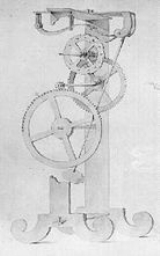
, which means that the period of swing of a pendulum is approximately the same for different sized swings. Galileo had the idea for a pendulum clock in 1637, partly constructed by his son in 1649, but neither lived to finish it. The introduction of the pendulum, the first harmonic oscillator
Harmonic oscillator

In classical mechanics, a harmonic oscillator is a system which, when displaced from its equilibrium position, experiences a restoring force proportional to the displacement according to Hooke's law:...
 used in timekeeping, increased the accuracy of clocks enormously, from about 15 minutes per day to 15 seconds per dayleading to their rapid spread as existing 'verge and foliot' clocks were retrofitted with pendulums.

These early clocks, due to their verge escapement
Verge escapement

The verge escapement is the earliest known type of mechanical escapement, the mechanism in a mechanical clock that controls its rate by advancing the gear train at regular intervals or 'ticks'....
s, had wide pendulum swings of up to 100°. Huygens discovered that wide swings made the pendulum inaccurate, causing its period, and thus the rate of the clock, to vary with unavoidable variations in the driving force provided by the movement
Movement (clockwork)

In horology, a movement is the internal mechanism of a clock or watch, as opposed to the case, which encloses and protects the movement, and the clock face which displays the time....
. Clockmakers' realization that only pendulums with small swings of a few degrees are isochronous
Isochronous

Isochronous : From Greek iso, equal + chronos, time. It literally means to occur at the same time or at equal time intervals. The term is used in different technical contexts....
 motivated the invention of the anchor escapement
Anchor escapement

In horology, the recoil or anchor escapement is a type of escapement used in pendulum clocks. An escapement is the mechanism in a mechanical clock that maintains the swing of the pendulum and advances the clock's wheels at each swing....
 around 1670, which reduced the pendulum's swing to 4°-6°. In addition to increased accuracy, this allowed the clock's case to accommodate longer, slower pendulums, which needed less power and caused less wear on the movement. The seconds pendulum
Seconds pendulum

A seconds pendulum is a pendulum whose period is precisely two seconds; one second for a swing in one direction and one second for the return swing....
 (also called the Royal pendulum) in which each swing takes one second, which is about one metre (39.1 in) long, became widely used. The long narrow clocks built around these pendulums, first made by William Clement around 1680, became known as grandfather clock
Longcase clock

A longcase clock, also tall-case clock, grandfather clock or floor clock, is a freestanding, weight-driven, pendulum clock with the pendulum held inside the tower, or waist of the case....
s. The increased accuracy resulting from these developments caused the minute hand, previously rare, to be added to clock faces beginning around 1690.

The 18th and 19th century wave of horological innovation that followed the invention of the pendulum brought many improvements to pendulum clocks. The deadbeat escapement invented in 1675 by Richard Towneley and popularized by George Graham
George Graham (clockmaker)

George Graham was an English horology and inventor and a member of the Royal Society. A Friend like his mentor Thomas Tompion, Graham left Cumberland in 1688 for London to work with Tompion....
 around 1715 gradually became standard in precision regulators. and is now used in most modern pendulum clocks. Observation that pendulum clocks slowed down in summer brought the realization that thermal expansion
Thermal expansion

Thermal expansion is the tendency of matter to change in volume in response to a change in temperature. When a substance is heated, its constituent particles move around more vigorously and by doing so generally maintain a greater average separation....
 and contraction of the pendulum rod was a large source of error. This was solved by the invention of the mercury pendulum by George Graham
George Graham (clockmaker)

George Graham was an English horology and inventor and a member of the Royal Society. A Friend like his mentor Thomas Tompion, Graham left Cumberland in 1688 for London to work with Tompion....
 in 1721 and the gridiron pendulum
Gridiron pendulum

The gridiron pendulum was an improved clock pendulum invented by British clockmaker John Harrison around 1726, which didn't change in length with temperature, so that its Frequency of swing stayed constant with changes in ambient temperature....
 by John Harrison
John Harrison

John Harrison was a self-educated England clockmaker. He invented the marine chronometer, a long-sought and critically-needed key piece in solving the problem of accurately establishing the East-West position, or longitude, of a ship at sea, thus revolutionising and extending the possibility of safe long distance sea travel in the Age of Sai...
 in 1726, allowing the construction of precision regulators.

Until the 1800s, clocks were handmade by individual craftsmen and were very expensive. The rich ornamentation of clocks of this period indicates their value as status symbols of the wealthy. The clockmaker
Clockmaker

A clockmaker is an artisan who makes and repairs clocks. Since almost all clocks are now factory-made, most clockmakers today just repair clocks....
s of each country and region in Europe developed their own distinctive styles. By the 1800s, factory production of clock parts gradually made pendulum clocks affordable by middle class families.

During the Industrial Revolution
Industrial Revolution

The Industrial Revolution was a period in the late 18th and early 19th centuries when major changes in agriculture, manufacturing, production, and transportation had a profound effect on the socioeconomics and cultural conditions in United Kingdom....
, daily life was organized around the home pendulum clock. More accurate pendulum clocks, called regulators, were installed in places of business and used to schedule work and set other clocks. The most accurate, known as astronomical regulators, were used in observatories for astronomy, surveying, and celestial navigation
Celestial navigation

Celestial navigation, also known as astronavigation, is a position fixing technique that was devised to help sailors cross the featureless oceans without having to rely on dead reckoning to enable them to strike land....
. Beginning in the 1800s, astronomical regulators in naval observatories served as primary standards for national time distribution services
Time signal

A time signal is a visible, audible, mechanical, or electronic signal used as a reference to determine the time of day....
. From 1909, US National Bureau of Standards (now NIST) based the US time standard on Riefler
Riefler escapement

Image:Escapement of RiefNo549-1929.JPGhe Riefler escapement is a mechanical escapement for precision pendulum clocks invented and patented by Sigmund Riefler in 1889....
 pendulum clocks, accurate to about 10 milliseconds per day. In 1929 it switched to the Shortt free pendulum
Escapement

In mechanical watches and clocks, an escapement is a device which converts continuous rotational motion into an Oscillatory or back and forth motion....
 clock before phasing in quartz
Quartz clock

A quartz clock is a clock that uses an electronic oscillator that is regulated by a quartz crystal to keep time. This crystal oscillator creates a signal with very precise frequency, so that quartz clocks are at least an order of magnitude more accurate than good mechanical clocks....
 standards in the 1930s. With error of around one second per year, the Shortt was probably the most accurate commercially produced pendulum clock.

Pendulum clocks remained the world standard for accurate timekeeping for 270 years, until the invention of the quartz clock
Quartz clock

A quartz clock is a clock that uses an electronic oscillator that is regulated by a quartz crystal to keep time. This crystal oscillator creates a signal with very precise frequency, so that quartz clocks are at least an order of magnitude more accurate than good mechanical clocks....
 in 1927, and were used as standards through World War 2. The French Time Service used pendulum clocks as part of their ensemble of standard clocks until 1954 The most accurate experimental pendulum clock to date (2007) may be the Littlemore clock, built by Edward T. Hall
Edward Thomas Hall

Edward Thomas Hall CBE, Fellow of the British Academy, Society of Antiquaries of London, D.Phil was a scientist.Born in London, Hall was also a hot air balloon pilot, and owner of Cameron 0-84 Flaming Pearl G-AYAJ 1970-1990....
 in the 1990s.

Mechanism

All mechanical pendulum clocks have these five parts:
  • a power source; either a weight on a cord that turns a pulley, or a mainspring
    Mainspring

    For the 2007 novel by Jay Lake, see Mainspring .A mainspring is a spiral spring of metal ribbon that is the power source in mechanical watches and some clocks....
  • a gear train
    Gear train

    A gear train is a set or system of gears arranged to transfer rotational torque from one part of a mechanics system to another.Gear trains consists of:...
     (wheel train
    Wheel train (horology)

    In horology, a wheel train is the gear train of a mechanical watch or clock. Although the term is used for other types of gear trains, the long history of mechanical timepieces has created a traditional terminology for their gear trains which is not used in other applications of gears....
    ) that steps up the speed of the power so that the pendulum can use it
  • an escapement
    Escapement

    In mechanical watches and clocks, an escapement is a device which converts continuous rotational motion into an Oscillatory or back and forth motion....
     that gives the pendulum precisely timed impulses to keep it swinging, and which releases the gear train wheels to move forward a fixed amount at each swing
  • the pendulum
    Pendulum

    A pendulum is a weight suspended from a pivot so it can swing freely.When a pendulum is displaced from its resting Mechanical equilibrium, it is subject to a restoring force due to gravity that will accelerate it back toward the equilibrium position....
    , a weight on a rod
  • an indicator or dial that records how often the escapement has rotated and therefore how much time has passed, usually a traditional clock face
    Clock face

    A clock face is the part of an analog clock that displays the time through the use of a fixed numbered dial or dials and moving hands. In its most basic form, recognised universally throughout the world, the dial is numbered 1?12 indicating the hours in a 12-hour cycle, and a short hour hand makes 2 revolutions in a day....
     with rotating hands.


More elaborate pendulum clocks may include these complication
Complication (horology)

In horology, the term complication refers to any feature beyond the simple display of hours, minutes, and seconds in a timepiece.A timepiece indicating only hours, minutes, and seconds is otherwise known as a simple Watch#Watch_movements....
s:
  • Striking train
    Striking clock

    File:Big Ben 2007-1.jpgA striking clock is a clock that sounds the hours audibly on a bell or gong.The striking feature of clocks was originally more important than their clock faces; the earliest clocks struck the hours, but had no dials to enable the time to be read....
     - strikes a chime on every hour, with the number of strikes equal to the number of the hour. More elaborate types, technically called chiming clocks, strike on the quarter hours, and may play tunes, usually Westminster quarters
    Westminster Quarters

    The Westminster Quarters is the most common name for a melody used by a set of clock bell s to strike the hour. It is also known as the Westminster Chimes, or the Cambridge Chimes from its place of origin....
    .
  • Repeater attachment - repeats the hour chimes when a knob is pressed. This rare complication was used before artificial lighting to check what time it was at night.
  • Calendar dials - shows the day, date, and sometimes month
  • Moon phase dial - Shows the phase of the moon with a painted picture of the moon on a rotating disk.
  • Equation of time
    Equation of time

    The equation of time is the difference over the course of a year between time as read from a sundial and time as read from a clock, measured in an ideal situation ....
     dial - this rare complication was used in early days to set the clock by the passage of the sun overhead at noon. It displays the difference between the time indicated by the clock and the time indicated by the position of the sun, which varies by as much as ±16 minutes during the year.
In electromechanical pendulum clocks the power source is replaced by an electrically powered solenoid
Solenoid

A solenoid is a three-dimensional coil. In physics, the term solenoid refers to a loop of wire, often wrapped around a metallic core, which produces a magnetic field when an electric current is passed through it....
 that provides the impulses to the pendulum by magnetic force, and the escapement is replaced by a switch
Switch

In electronics, a switch is an electrical component which can break an electrical circuit, interrupting the Electric current or diverting it from one conductor to another....
 or photodetector
Photodetector

Photosensors or photodetectors are sensors of light or other electromagnetic energy. There are several varieties:*optics detectors, which are mostly quantum devices in which an individual photon produces a discrete effect....
 that senses when the pendulum is in the right position to receive the impulse. These should not be confused with more recent quartz pendulum clocks in which an electronic quartz clock
Quartz clock

A quartz clock is a clock that uses an electronic oscillator that is regulated by a quartz crystal to keep time. This crystal oscillator creates a signal with very precise frequency, so that quartz clocks are at least an order of magnitude more accurate than good mechanical clocks....
 module swings a pendulum. These are not true pendulum clocks because the timekeeping is controlled by a quartz crystal in the module, and the swinging pendulum is merely a decorative simulation.

Gravity-swing pendulum


The pendulum swings with a period
Frequency

Frequency is the number of occurrences of a repeating event per unit time. It is also referred to as temporal frequency.The period is the duration of one cycle in a repeating event, so the period is the reciprocal of the frequency....
 that varies with the square root of its effective length. The rate of pendulum clocks is adjusted by moving the pendulum bob
Bob (physics)

A bob is the weight on the end of a pendulum.The use of a weight concentrated in a small, compact object enables the centre of gravity to be positioned close to the physical end of the pendulum, which minimises the length of pendulum required for a given period ....
 up or down on its rod, often by means of an adjusting nut under the bob. In some pendulum clocks, fine adjustment is done with an auxiliary adjustment, which may be a small weight that is moved up or down the pendulum rod. In some turret clock
Turret clock

A turret clock is a large mechanical clock set in a tower, for use by a large number of people. Typically found in a church tower or other public building the clock mechanism drives the hands on one or more large clock faces visible from the outside....
s, adjustment is accomplished by a small tray mounted on the rod where small weights are placed or removed to change the effective length, so the rate can be adjusted without stopping the clock.

Thermal compensation

To keep time accurately, pendulums are usually made to not vary in length as the temperature
Temperature

In physics, temperature is a physical property of a Physical system that underlies the common notions of hot and cold; something that feels hotter generally has the greater temperature....
 changes. Owing to the expansion of metal, the length of a simple pendulum will vary with temperature, slowing the clock as the temperature rises. Early high-precision clocks used the liquid metal mercury
Mercury (element)

Mercury , also called quicksilver or hydrargyrum , is a chemical element with the symbol Hg and atomic number 80. A heavy, silvery d-block metal, mercury is one of six elements that are liquid at or near room temperature and pressure....
 to lift a portion of the pendulum mass in compensation for the increased length of the suspension. John Harrison
John Harrison

John Harrison was a self-educated England clockmaker. He invented the marine chronometer, a long-sought and critically-needed key piece in solving the problem of accurately establishing the East-West position, or longitude, of a ship at sea, thus revolutionising and extending the possibility of safe long distance sea travel in the Age of Sai...
 invented the gridiron pendulum
Gridiron pendulum

The gridiron pendulum was an improved clock pendulum invented by British clockmaker John Harrison around 1726, which didn't change in length with temperature, so that its Frequency of swing stayed constant with changes in ambient temperature....
, which uses a sliding "banjo" of solid metals with differing thermal expansion rates such as brass
Brass

Brass is any alloy of copper and zinc; the proportions of zinc and copper can be varied to create a range of brasses with varying properties. In comparison, bronze is principally an alloy of copper and tin....
 or zinc
Zinc

Zinc is a metallic chemical element with the symbol Zn and atomic number 30. It is a first-row transition metal of the group 12 element of the periodic table....
 and steel
Steel

Steel is an alloy consisting mostly of iron, with a carbon content between 0.2% and 2.14% by weight , depending on grade. Carbon is the most cost-effective alloying material for iron, but various other alloying elements are used such as manganese, chromium, vanadium, and tungsten....
 to achieve a zero-expansion pendulum while avoiding the use of toxic mercury.

By the end of the nineteenth century, materials were available that had a very low inherent change of length with temperature and these were used to make a simple pendulum rod. These included Invar
Invar

Invar, also known generically as FeNi36 , is a nickel steel alloy notable for its uniquely low coefficient of thermal expansion . It was invented in 1896 by Swiss scientist Charles ?douard Guillaume....
, a nickel/iron alloy; and fused silica, a glass. The latter is still used for pendulums in gravimeter
Gravimeter

A gravimeter or gravitometer, is an instrument used in gravimetry for measuring the local gravitational field of the Earth. A gravimeter is a type of accelerometer, specialized for measuring the constant downward acceleration of gravity....
s.

Atmospheric drag

The viscosity of the air through which the pendulum swings will vary with atomspheric pressure, humidity, and temperature. This drag also requires power that could otherwise be applied to extending the time between windings. Pendulums are sometimes polished and streamlined to reduce the effects of air drag (which is where most of the driving power goes) on the clock's accuracy. In the late 19th century and early 20th century, pendulums for clocks in astronomical observatories were often operated in a chamber that had been pumped to a low pressure to reduce drag and make the pendulum's operation even more accurate.

Leveling and 'beat'

To keep time accurately, pendulum clocks must be absolutely level
Level

Level may refer to:*A floor of a building*A level of a mine, see shaft mining. A level with access to the surface is an adit*Level , a stage of the game...
. If they are not, the pendulum swings more to one side than the other, upsetting the symmetrical operation of the escapement
Escapement

In mechanical watches and clocks, an escapement is a device which converts continuous rotational motion into an Oscillatory or back and forth motion....
. This condition can often be heard audibly in the ticking sound of the clock. The ticks or 'beats' should be at precisely equally spaced intervals; if they are not, and have the sound "tick-tock...tick-tock..." the clock is out of beat and needs to be leveled. This problem can easily cause the clock to stop working, and is one of the most common reasons for service calls. A spirit level
Spirit level

A spirit level or bubble level is an Measuring instrument designed to indicate whether a surface is level or plumb. Different types of spirit levels are used by carpenters, stone masons, bricklayers, other building trades workers, Surveyor s, millwrights and other metalworkers, and serious videographers....
 or watch timing machine can achieve a higher accuracy than relying on the sound of the beat; precision regulators often have a built in spirit level for the task. Older freestanding clocks often have feet with adjustable screws to level them, more recent ones have a levelling adjustment in the movement. Some modern pendulum clocks have 'auto-beat' or 'self-regulating beat adjustment' devices, and don't need this adjustment.

Local gravity

Since the pendulum rate will increase with an increase in gravity, and local gravity varies with latitude and location on Earth, pendulum clocks must be readjusted to keep time after a move. Even moving a clock to the top of a tall building will cause it to lose measureable time due to lower gravity.

Torsion pendulum

Also called torsion-spring pendulum, this is a wheel-like mass (most often four spheres on cross spokes) suspended from a vertical strip (ribbon) of spring steel, used as the regulating mechanism in torsion pendulum clock
Torsion pendulum clock

A torsion pendulum clock, or torsion clock, is a mechanical clock which keeps time with a mechanism called a Torsion spring. This is a weighted disk or wheel, often a decorative wheel with 3 or 4 chrome balls on ornate spokes, suspended by a thin wire or ribbon called a torsion spring....
s. Rotation of the mass winds and unwinds the suspension spring, with the energy impulse applied to the top of the spring. As the period of a cycle is quite slow compared to the gravity swing pendulum, it is possible to make clocks that need to be wound only every 30 days, or even only once a year. A clock requiring only annual winding is sometimes called a "400-Day clock", "perpetual clock" or "anniversary clock", the latter sometimes given as a wedding memorialisation gift. Schatz and Kundo, both German firms, were once the main manufacturers of this type of clock. This type is independent of the local force of gravity but is more affected by temperature changes than an uncompensated gravity-swing pendulum.

Escapement


The escapement drives the pendulum, usually from a gear
Gear

A gear is a component within a Transmission device that transmits rotational force to another gear or device. A gear is different from a pulley in that a gear is a round wheel that has linkages that mesh with other gear teeth, allowing force to be fully transferred without slippage....
 train, and is the part that ticks. Most escapements have a locking state and a drive state. In the locking state, nothing moves. The motion of the pendulum switches the escapement to drive, and the escapement then pushes on the pendulum for some part of the pendulum's cycle. A notable but rare exception is Harrison's grasshopper escapement
Grasshopper escapement

The grasshopper escapement is an unusual, low-friction escapement for pendulum clocks invented by British clockmaker John Harrison around 1722....
. In precision clocks, the escapement is often driven directly by a small weight or spring that is re-set at frequent intervals by an independent mechanism called a remontoire
Remontoire

In mechanical horology, a remontoire, is a small secondary source of power, a weight or spring , which runs the timekeeping mechanism and is itself periodically rewound by the timepiece's main power source, such as a mainspring....
. This frees the escapement from the effects of variations in the gear train. In the late 19th century, electromechanical escapements were developed. In these, a mechanical switch or a phototube
Phototube

A phototube is a type of gas filled tube or vacuum tube that is extremely sensitive to light in the ultraviolet, visible light, and near-infrared ranges of the electromagnetic spectrum....
 turned an electromagnet
Electromagnet

An electromagnet is a type of magnet in which the magnetic field is produced by the flow of electric Current . The magnetic field disappears when the current ceases....
 on for a brief section of the pendulum's swing. These were used on some of the most precise clocks known. They were usually employed with vacuum
Vacuum

A vacuum is a volume of space that is essentially empty of matter, such that its gaseous pressure is much less than atmospheric pressure. The word comes from the Latin term for "empty," but in reality, no volume of space can ever be perfectly empty....
 pendulums on astronomical clocks. The pulse of electricity that drove the pendulum would also drive a plunger to move the gear train.

In the 20th century, W.H. Shortt invented a free pendulum clock
Escapement

In mechanical watches and clocks, an escapement is a device which converts continuous rotational motion into an Oscillatory or back and forth motion....
 with an accuracy of one-hundredth of a second per day. In this system, the timekeeping pendulum does no work and is kept swinging by a push from a weighted arm (gravity arm) that is lowered onto the pendulum by another (slave) clock just before it is needed. The gravity arm then pushes on the free pendulum, which releases it to drop out of engagement at a time that is set entirely by the free pendulum. Once the gravity arm is released, it trips a mechanism to reset itself ready for release by the slave clock. The whole cycle is kept synchronised by a small blade spring on the pendulum of the slave clock. The slave clock is set to run slightly slow, and the reset circuit for the gravity arm activates a pivoted arm that just engages with the tip of the blade spring. If the slave clock has lost too much time, its blade spring pushes against the arm and this accelerates the pendulum. The amount of this gain is such that the blade spring doesn't engage on the next cycle but does on the next again. This form of clock became the standard for use in observatories from the mid-1920s until superseded by quartz technology.

Time Indication

The indicating system is almost always the traditional dial
Clock face

A clock face is the part of an analog clock that displays the time through the use of a fixed numbered dial or dials and moving hands. In its most basic form, recognised universally throughout the world, the dial is numbered 1?12 indicating the hours in a 12-hour cycle, and a short hour hand makes 2 revolutions in a day....
 with moving hour and minute hands. Many clocks have a small third hand indicating seconds on a subsidiary dial. Pendulum clocks are usually designed to be set by opening the glass face cover and manually pushing the minute hand around the dial to the correct time. The minute hand is mounted on a slipping friction sleeve which allows it to be turned on its arbor. The hour hand is driven not from the main wheel train
Wheel train (horology)

In horology, a wheel train is the gear train of a mechanical watch or clock. Although the term is used for other types of gear trains, the long history of mechanical timepieces has created a traditional terminology for their gear trains which is not used in other applications of gears....
 but from the minute hand's shaft through a small set of gears, so rotating the minute hand manually also sets the hour hand.

Styles

Pendulum clocks were more than simply utilitarian timekeepers; they were status symbol
Status symbol

A status symbol is a perceived visible, external denotation of one's social position and perceived indicator of social status. Many luxury goods are often considered status symbols....
s that expressed the wealth and culture of their owners. They evolved in a number of traditional styles, specific to different countries and times as well as their intended use. Case styles somewhat reflect the furniture styles popular during the period. Experts can often pinpoint when an antique clock was made within a few decades by subtle differences in their cases and faces. These are some of the types of pendulum clocks:
  • Banjo clock
    Banjo clock

    The banjo clock, or more properly the banjo timepiece, is an United States wall clock with a banjo-shaped case. It was invented by Simon Willard, originally of Grafton, Massachusetts, later of Roxbury, Massachusetts, and patented in 1802....
  • Bracket clock
    Bracket clock

    A bracket clock is a style of antique portable table clock made in the 17th and 18th centuries. The term originated with small weight driven clocks that had to be mounted on a bracket on the wall to allow room for their hanging weights....
  • Cartel clock
    Cartel clock

    A Cartel Clock is a clock designed to hang directly on the wall. Most often used in reference to highly ornate mid-18th-century Rococo examples. These flowing, curvilinear designs are executed in gilt bronze ....
  • Comtoise or Morbier clock
  • Crystal regulator
  • Cuckoo clock
    Cuckoo clock

    A cuckoo clock is a clock, typically pendulum clock, that striking clock using small bellows and pipes that imitate the call of the Common Cuckoo in addition to striking a wire gong....
  • Longcase clock
    Longcase clock

    A longcase clock, also tall-case clock, grandfather clock or floor clock, is a freestanding, weight-driven, pendulum clock with the pendulum held inside the tower, or waist of the case....
     (commonly known as a grandfather clock)
  • Lantern clock
    Lantern clock

    A lantern clock is a type of antique weight-driven wall clock, shaped like a lantern. They were the first type of clock widely used in private homes....
  • Mantel clock
    Mantel clock

    Mantel clocks are relatively small house clocks traditionally placed on the shelf, or fireplace mantel, above the fireplace. The form, first developed in France in the 1750s, can be distinguished from earlier chamber clocks of similar size due to a lack of carrying handles....
  • Ogee clock
    Ogee

    Ogee is a shape consisting of a wikt:concave Arc flowing into a wikt:convex arc, so forming an S-shaped curve with vertical ends. In architecture, an alternative name for ogee is cyma reversa; talon is also used....
  • Pillar clock
  • Schoolhouse regulator
  • Act of Parliament clock
    Act of Parliament clock

    An "Act of Parliament clock" is a type of large clock originally hung in inns and taverns in the United Kingdom, beginning in the mid-18th century....
  • Turret clock
    Turret clock

    A turret clock is a large mechanical clock set in a tower, for use by a large number of people. Typically found in a church tower or other public building the clock mechanism drives the hands on one or more large clock faces visible from the outside....
  • Vienna regulator
  • Zaandam clock


See also

  • Pendulum
    Pendulum

    A pendulum is a weight suspended from a pivot so it can swing freely.When a pendulum is displaced from its resting Mechanical equilibrium, it is subject to a restoring force due to gravity that will accelerate it back toward the equilibrium position....
  • Escapement
    Escapement

    In mechanical watches and clocks, an escapement is a device which converts continuous rotational motion into an Oscillatory or back and forth motion....
  • Steam clock
    Steam clock

    A steam clock is a clock which is fully or partially powered by a steam engine. Only a few functioning steam clocks exist, most designed and built by Canada horology Raymond Saunders for display in urban public spaces....
  • Odd sympathy
    Odd sympathy

    The phrase odd sympathy was used by Netherlands mathematician and physicist Christiaan Huygens in a letter to the Royal Society of London pertaining to the tendency of two pendulums to synchronize, or asynchronize, when mounted together on the same beam....


External links