
Washington Nationals

Encyclopedia
The Washington Nationals are a professional baseball team
based in Washington, D.C.
The Nationals are a member of the Eastern Division
of the National League
of Major League Baseball
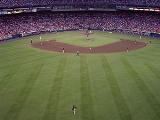
(MLB). The team moved into the newly built Nationals Park in 2008, after playing their first three seasons in RFK Stadium
. The new park is located in Southeast D.C., near the Anacostia River
and with views of the Capitol
.
The Nationals name derives from the former Washington baseball team which had the same name (used interchangeably with Senators
). Their nickname is "the Nats"—a shortened version that was also used by the old D.C. teams.
An expansion franchise
, the club was founded in Montreal
, Quebec
, in . As the Montreal Expos
, they were the first major league team in Canada
. They played their home games at Jarry Park Stadium
and later in the Olympic Stadium
. In , the Expos won a division championship, won their first-ever playoff series
by defeating the Philadelphia Phillies
, 3–2, and advanced to the National League Championship Series
, where they would go on to lose that series to the Los Angeles Dodgers
, 3–2, in their only postseason appearance during the strike-shortened season. The Expos had their highest winning percentage in the strike-shortened season of , when the team had the best record in baseball. The team's subsequent shedding of players caused fan interest to drop off. After the 2001 season, MLB considered revoking the team's franchise, along with either the Minnesota Twins
or the Tampa Bay Devil Rays
. After being purchased by MLB in 2002, the team was moved before the season to Washington and renamed the Nationals, the first relocation since the second Washington Senators moved to Arlington, Texas
and became the Texas Rangers
in .
The Nationals are one of two MLB franchises, and the only one in the National League
, that has never played in a World Series
(the Seattle Mariners
are the other).
in 1969, along with the San Diego Padres
, with a majority share held by Charles Bronfman
, a major shareholder in Seagram
. Named after the Expo 67
World's Fair
, the Expos' initial home was Jarry Park
. Managed by Gene Mauch
, the team lost 110 games in their first season, coincidentally matching the Padres inaugural win-loss record, and continued to struggle during their first decade with sub-.500 seasons.
Starting in 1977, the team's home venue was Montreal's Olympic Stadium
, built for the 1976 Summer Olympics
. Two years later, the team won a franchise-high 95 games, finishing second in the National League East. The Expos began the 1980s with a core group of young players, including catcher Gary Carter
, outfielders Tim Raines
and Andre Dawson
, third baseman Tim Wallach
, and pitchers Steve Rogers and Bill Gullickson
. The team won its only division championship in the strike-shortened split season of 1981
, ending its season with a three games to two loss to the Los Angeles Dodgers
in the National League Championship Series
.
The team spent most of the 1980s in the middle of the NL East pack, finishing in third or fourth place in eight out of nine seasons from 1982–1990. Buck Rodgers
was hired as manager before the 1985 season
and guided the Expos to a .500 or better record five times in six years, with the highlight coming in 1987
, when they won 91 games. They finished third, but were just 4 games behind the division-winning Cardinals.
Bronfman sold the team to a consortium of owners in 1991, with Claude Brochu
as the managing general partner.
Rodgers, at that time second only to Gene Mauch
in number of Expos games managed, was replaced partway through the 1991 season
. In May 1992
, Felipe Alou, a member of the Expos organization since 1976, was promoted to field manager, becoming the first Dominican-born manager in MLB
history. Alou would become the leader in Expos games managed, while guiding the team to winning records, including 1994
, when the Expos, led by a talented group of players including Larry Walker
, Moisés Alou
, Marquis Grissom
and Pedro Martínez
, had the best record in the major leagues until the 1994–95 Major League Baseball strike forced the cancellation of the remainder of the season
. After the disappointment of 1994, Expos management began shedding its key players, and the team's fan support dwindled.
Brochu sold control of the team to Jeffrey Loria
in 1999,
but Loria failed to close on a plan to build a new downtown ballpark, and did not reach an agreement on television and English radio broadcast contracts for the 2000 season, reducing the team's media coverage.
Subsequently, the Boston Red Sox
were sold to a partnership led by John W. Henry
, owner of the Florida Marlins
.
In order to clear the way for Henry's group to assume ownership of the Red Sox, Henry sold the Marlins to Loria, and MLB purchased the Expos from Loria.
However, as the Metropolitan Sports Facilities Commission, operator of the Metrodome, won an injunction requiring the Twins to play there in 2002, MLB was unable to revoke the Twins franchise, and so had to keep the Twins and Expos as part of the MLB schedule. In the collective bargaining agreement signed with the players association in August 2002, contraction was prohibited through to the end of the contract in 2006.
began looking for a relocation site for the Expos. Some of the choices included Oklahoma City
; Washington, D.C.
; San Juan, Puerto Rico
; Monterrey, Mexico; Portland, Oregon
; somewhere in Northern Virginia
such as Arlington or Dulles
; Norfolk, Virginia
; New Jersey
; and Charlotte, North Carolina
. In the decision-making process, Commissioner Bud Selig
added Las Vegas, Nevada
to the list of potential Expos homes. Washington and Virginia emerged as the front-runners.
In both 2003 and 2004, the Expos played 22 of their home games in San Juan, Puerto Rico
, and the remaining 60 in Montreal.
On September 29, 2004, MLB officially announced that the Expos would move to Washington, D.C. in 2005
.
The Expos played their final game on October 3 at Shea Stadium
, losing by a score of 8–1 against the New York Mets
, the same opponent that the Expos first faced at its start, 35 years earlier. On November 15, a lawsuit by the former team owners against MLB and former majority owner Jeffrey Loria
was struck down by arbitrators, bringing to an end all legal actions that would impede a move. The owners of the other MLB teams approved the move to Washington in a 28–1 vote on December 3 (Baltimore Orioles
owner Peter Angelos
cast the sole dissenting vote).
, a founding member of the American League
, played in the nation's capital from 1901 to 1960. These Senators were owned by Clark Griffith
and played in Griffith Stadium
. With notable stars including Walter Johnson
and Joe Cronin
, the Senators won the 1924 World Series
and pennants in 1925
and 1933
, but were more often unsuccessful and moved to Minnesota for the 1961 season
where the team was renamed the Minnesota Twins. A second Washington Senators
team (1961–1971) had a winning record only once in their 11 years, though bright spots, such as slugger Frank Howard
, earned the love of fans. The second Senators team moved to Arlington, Texas for the 1972 season
and changed their name to the Texas Rangers
, and Washington spent the next 33 years without a baseball team.
Although there was some sentiment to revive the name Senators, political considerations factored into the choice of Nationals, a revival of the first American League franchise's "official" nickname used from 1905
to 1956
. Politicians and others in the District of Columbia objected to the name Senators because the District of Columbia does not have voting representation in Congress
. In addition, the Rangers still owned the rights to the Senators name, although they were able to acquire the rights to the curly "W" from the Rangers. Coincidentally, the sitting President
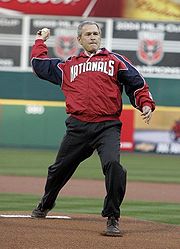
at the time of the move, George W. Bush
, had at one time owned the Rangers.
On March 31, 2005, Angelos and Major League Baseball struck a deal to protect the Orioles against any financial harm the Nationals might present.
Under the terms of the deal, television and radio broadcast rights to Nationals games are handled by the Orioles franchise, who formed a new network (the Mid-Atlantic Sports Network
) to produce and distribute the games for both franchises on both local affiliates and cable/satellite systems. MASN was not, however, immediately available on all cable providers, adding to the frustration of Nationals fans. In fact, most in the DC area missed almost the entirety of the Nationals first two seasons. The deal with Angelos makes the Nationals the only major league baseball team which does not own their own broadcast rights.
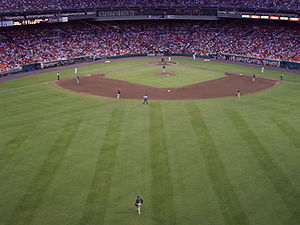 The team's relocation to Washington was contingent on a financing plan for the Nationals' new stadium—this plan quickly became the subject of much debate on the Council of the District of Columbia
.
Three Council members who supported Mayor Anthony Williams's
plan were ousted in September 2004's Democratic party primary. In addition, an opinion poll conducted by The Washington Post
during the peak of the controversy found that approximately two-thirds of District residents opposed the mayor's stadium plan.
Much of the controversy centered on the fact that the city would be helping finance a $581 million stadium without support from Maryland
or Virginia
or their counties, from which large portion of the team's fan base would be drawn.
In December 2004, the move to Washington itself was called into doubt when the D.C. Council sought to change details of the stadium's financing. When the Council voted on December 14, 2005 to require 50 percent private financing for any new stadium, MLB ceased promotional activities for the Nationals and announced that they would consider looking for a new market.
Eventually, the council passed an amended plan on December 21, 2004 that proved slightly more financially favorable to the city, while remaining acceptable to MLB. Mayor Williams signed the stadium financing package on December 30.
During the 2005 season
, a private financing plan for construction of the stadium was negotiated between the city and a syndicate of bankers led by Deutsche Bank
. The negotiations of the details ran into another problem in November 2005. The bankers requested a letter of credit
or other financial guarantee of $24 million, $6 million for each of four years, ensuring payment of lease revenues against various risks including poor attendance and terrorism. The city requested that Major League Baseball provide this guarantee, which they were unwilling to do.
On December 22, 2005, the Washington Post reported that Major League Baseball had specifically instructed prospective owners not to offer to pay cost overruns on the stadium if they were selected as the owners. Bidders were also told not to communicate with the press about these issues.
In February 2006, the DC City Council imposed a $611 million cap on the stadium.
Finally, on March 5, Major League Baseball signed a lease for a new ballpark, agreeing to the city's $611 million cap. MLB also agreed to contribute $20 million toward the cost of the stadium, although it did not agree to cover stadium overruns. Further, MLB added the condition that excess ballpark tax revenue earmarked for debt service for the bonds to be available for cost overruns. Two days later, on March 7 the DC City Council, by a vote of 9–4, approved a construction contract for a state-of-the-art stadium with a contemporary glass-and-stone facade, seats for 41,000 fans and a view of the U.S. Capitol, and affirmed its demand that public spending on the project be limited to $611 million. The votes were the final actions needed to satisfy the terms of the deal struck in September 2004, paving the way for the sale of the team.
Major League Baseball had agreed at the time that the franchise was moved to Washington to sell the team to an owner or ownership syndicate. Several dates for sale of the team were set and missed due to the legal wrangling regarding the building of the stadium. The delay was harshly criticized by city residents and leaders as reported in The Washington Post.
Selecting from a finalized group of three potential ownership syndicates, Major League Baseball announced in July 2006 that it had chosen the Lerner Enterprises
group, led by billionaire real estate
developer Theodore N. Lerner. The final sale price of the team was $450 million and the transfer of ownership was completed July 24, 2006. In late September 2006, Comcast
finally agreed to broadcast the Nationals games.
before and during their run of 14 division titles. Kasten was also the general manager or president of many other Atlanta-area sports teams, such as the Atlanta Thrashers
. "The Plan," as it became known, was a long-range rebuilding and restructuring of the team from the ground up. This plan included investing in the farm system and draft picks, and having a suitable team to go along with their new stadium.
At the end of the 2006 season, the Nationals did not re-sign free agent and star OF Alfonso Soriano
. Soriano signed a $136 million contract with the Cubs, and Washington received two draft picks in return. OF José Guillén
was also allowed to depart via free agency, and another high draft pick was obtained. Another high priced player, 2B/DH José Vidro
, was traded to the Seattle Mariners for prospects OF Chris Snelling
and RHP Emiliano Fruto
. In mid-2006, the Nationals received OF Austin Kearns
, 2B/SS Felipe López, and RHP Ryan Wagner
from the Reds, giving up LHP Gary Majewski
, LHP Bill Bray
, SS Royce Clayton
, 2B Brendan Harris
and RHP Daryl Thompson
. In August they traded RHP Liván Hernández
to the Arizona Diamondbacks
for prospects LHP Matt Chico
and RHP Garrett Mock
. Other players traded or let go from the 2005 season were OF Preston Wilson
, RHP Héctor Carrasco
, IF Jamey Carroll
, and OF Terrmel Sledge
. The team also acquired pitching prospects Luis Atilano
from Atlanta, Shairon Martis
from San Francisco and Jhonny Nunez
from the Dodgers. In 2006, they had two first-round draft picks, OF Chris Marrero
, and RHP Colten Williams, and signed them both to developmental contracts. The Nationals also signed a 16-year-old Dominican shortstop, Esmailyn Gonzalez, for $1.4 million. Gonzalez was later revealed to be 20 years old at the time of his signing.
In the front office, the Nationals hired the well-respected former Arizona scouting director Mike Rizzo
to be the vice president of baseball operations, second in charge under then-general manager Jim Bowden.
As for their farm system, the Nationals had a lot of work to do. By the spring of 2007, Baseball America had ranked the Nationals organization as dead last twice in four years in terms of minor league talent.
The Nationals had five of the first seventy picks in the 2007 first-year player draft: their own two, and three compensation picks (two from losing Soriano, and one for Guillen). The team selected players that many considered to be four of the top 30 players available. Overall, the Nationals signed all of their top twenty draft picks. One of them, a first-round supplemental pick, Michael Burgess, was, by the end of the year, picked by Baseball America as the top prospect for the entire Gulf Coast League
. Their rookie team, Vermont
, sent three starting pitchers Colton Willems, Glenn Gibson, and Adrian Alaniz
, and two position players, first baseman
Bill Rhinehart, and outfielder
Aaron Seuss to the New York-Penn League All-Star Game. By the end of the season, three Vermont pitchers landed in the Top 20 prospects for the New York-Penn League:
In the low-A South Atlantic League
Top 20, two players made the list:
In addition, after having no teams in the Dominican Summer League, the Nationals fielded two clubs in 2007, one of which won the DSL Championships.
Mike Rizzo, the man serving as assistant G.M. for the previous two seasons, became the de facto G.M., and officially claimed the title on an interim basis weeks later. Rizzo began to shape the team in a way that was contrary to Bowden's previous methods. While Bowden was known for "dumpster-diving," that is attempting to find serviceable players among the less-than-desired, Mike Rizzo sought players who achieved results. Bowden took risks on players with poor reputations (such as outfielders Elijah Dukes and Lastings Milledge), while Rizzo made a point out of making certain his players possessed "character" and would contribute to a cohesive clubhouse.
Despite the failures of Bowden's tenure, his last trade appeared to have been extremely beneficial to the Nationals, as he traded infielder Emilio Bonifacio and two minor-leaguers to the Marlins for starting pitcher Scott Olsen and outfielder Josh Willingham.
Rizzo's first major trade during the 2009 season as General Manager of the Nationals was to trade Lastings Milledge along with control-challenged reliever Joel Hanrahan to the Pirates in exchange for speedy outfielder Nyjer Morgan and left-handed relief pitcher Sean Burnett. Morgan was thought to be a great clubhouse presence as well as a slick fielder on the outfield grass.
Mike Rizzo's new philosophy continued to show in the 2009–2010 offseason. He was able to acquire second baseman Adam Kennedy, All Star starting pitcher Jason Marquis
(who began the 2010 season very poorly, though it was later revealed that he had bone chips in his throwing elbow, his ERA was over 13 at one point), and catcher Ivan "Pudge" Rodriguez. All three men had reputations as being great teammates. Collectively, they had extensive experience playing for successful teams. This was a contrast to the Nationals' roster at the time, which had some talented players who lacked experience playing for winning teams.
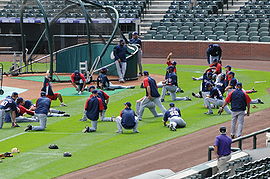
On Opening Day, the Nationals lost their starting shortstop Cristian Guzman
and center fielder Nook Logan
for five weeks due to injuries. At the end of April, starting pitcher Jerome Williams
hurt his ankle while batting and was placed on the 15-day disabled list. Then, in the space of just 10 days in May, Shawn Hill
, John Patterson, and Jason Bergmann
went on the disabled list. Jerome Williams returned, pitched one game, and went back on the DL with a shoulder injury. The Washington Post's wrote: "Almost everything that could sink a team's attitude has befallen the Nationals. They started the year 1–8, then they lost eight in a row to drop to 9–25."
They put journeymen Mike Bacsik
, Micah Bowie
, Tim Redding
, and Jason Simontacchi
, along with rookie reliever Levale Speigner
into the starting rotation, amidst predictions that the 2007 Nationals might equal the 1962 Mets'
record of futility of 120 losses in one season. But the Nationals bounced back, going 24–18 in their next 42 games through June 25. But on that day, a day in which Bergman made his first start off the DL, the Nationals received the news that shortstop Cristian Guzman
, their leadoff hitter (and second on the team with a .329 batting average) was lost for the rest of the season due to a thumb injury he had received the day before tagging out a runner.
The Nationals finished the 2007 season
73–89, improving their record by two more wins than in 2006.
was signed through the end of the 2011 season, with an option for 2012 (as a candidate in a search that would include minority candidates), and a contract as a front office consultant through 2013.
The Nationals finished the 2011 season in third place with a record of 80-81, their second-best record since they moved to Washington. They only played 161 games because a home game against the Dodgers was cancelled due to rain. The game was not made up because it was inconsequential to the playoffs with no room on the schedule to play it.
With the exception of 42, retired for all MLB teams to honor Jackie Robinson
, these numbers were originally retired by the predecessor Montreal Expos
organization. Following the move to Washington, D.C., the numbers were returned to circulation for the franchise's first six seasons. Prior to the 2011 season, the Nationals began to honor the Expos' retired numbers once again. The numbers also hang from the roof of the Bell Centre
in Montreal.
Bold denotes a playoff season, pennant or championship; italics denote an active season.
in partnership with the Center. The foundation also provides grants to local organizations.
On August 1, 2011, the foundation, in partnership with several local organizations, formally opened Miracle Field in Germantown, Maryland as part of an effort to encourage athletic activity in children with "mental and/or physical challenges." According to Steven Miller of MLB.com, what sets Miracle Field apart in terms of safety is its unique design, as it "is made entirely of a cushioned synthetic turf that is five-eighths of an inch thick-- providing a safe surface for children in wheelchairs or with other handicaps."
radio station
is WJFK-FM
(106.7 FM) "The Fan", which is owned by CBS Radio
. Charlie Slowes
and Dave Jageler
are the play-by-play announcers. Most games are simulcast
on 1500 AM, which had been the flagship station since the 2006 season until a multi-year agreement was reached between the Nationals and WJFK before the 2011 season. The other former flagship is WWZZ 104.1 FM, which carried games in the 2005 season.
Nationals' telecasts are predominantly on Mid-Atlantic Sports Network
(MASN), with a handful of games simulcast on WDCW
, "DC50." Bob Carpenter
is the TV play-by-play announcer and F.P. Santangelo was hired in January 2011 as color analyst. Former color analysts are Tom Paciorek
, Don Sutton, and Rob Dibble
, who was fired in September 2010 after criticizing Stephen Strasburg for not pitching while injured. Ray Knight
and Johnny Holliday
host the postgame show "Nats Xtra". Knight filled in as color analyst in September 2010 after Dibble was fired.
TV ratings were among the worst in the league but increased during the 2010 season and have increased so far in the 2011 season.
based in Washington, D.C.
The Nationals are a member of the Eastern Division
of the National League
of Major League Baseball
(MLB). The team moved into the newly built Nationals Park in 2008, after playing their first three seasons in RFK Stadium
. The new park is located in Southeast D.C., near the Anacostia River
and with views of the Capitol
.
The Nationals name derives from the former Washington baseball team which had the same name (used interchangeably with Senators
). Their nickname is "the Nats"—a shortened version that was also used by the old D.C. teams.
An expansion franchise
, the club was founded in Montreal
, Quebec
, in . As the Montreal Expos
, they were the first major league team in Canada
. They played their home games at Jarry Park Stadium
and later in the Olympic Stadium
. In , the Expos won a division championship, won their first-ever playoff series
by defeating the Philadelphia Phillies
, 3–2, and advanced to the National League Championship Series
, where they would go on to lose that series to the Los Angeles Dodgers
, 3–2, in their only postseason appearance during the strike-shortened season. The Expos had their highest winning percentage in the strike-shortened season of , when the team had the best record in baseball. The team's subsequent shedding of players caused fan interest to drop off. After the 2001 season, MLB considered revoking the team's franchise, along with either the Minnesota Twins
or the Tampa Bay Devil Rays
. After being purchased by MLB in 2002, the team was moved before the season to Washington and renamed the Nationals, the first relocation since the second Washington Senators moved to Arlington, Texas
and became the Texas Rangers
in .
The Nationals are one of two MLB franchises, and the only one in the National League
, that has never played in a World Series
(the Seattle Mariners
are the other).
in 1969, along with the San Diego Padres
, with a majority share held by Charles Bronfman
, a major shareholder in Seagram
. Named after the Expo 67
World's Fair
, the Expos' initial home was Jarry Park
. Managed by Gene Mauch
, the team lost 110 games in their first season, coincidentally matching the Padres inaugural win-loss record, and continued to struggle during their first decade with sub-.500 seasons.
Starting in 1977, the team's home venue was Montreal's Olympic Stadium
, built for the 1976 Summer Olympics
. Two years later, the team won a franchise-high 95 games, finishing second in the National League East. The Expos began the 1980s with a core group of young players, including catcher Gary Carter
, outfielders Tim Raines
and Andre Dawson
, third baseman Tim Wallach
, and pitchers Steve Rogers and Bill Gullickson
. The team won its only division championship in the strike-shortened split season of 1981
, ending its season with a three games to two loss to the Los Angeles Dodgers
in the National League Championship Series
.
The team spent most of the 1980s in the middle of the NL East pack, finishing in third or fourth place in eight out of nine seasons from 1982–1990. Buck Rodgers
was hired as manager before the 1985 season
and guided the Expos to a .500 or better record five times in six years, with the highlight coming in 1987
, when they won 91 games. They finished third, but were just 4 games behind the division-winning Cardinals.
Bronfman sold the team to a consortium of owners in 1991, with Claude Brochu
as the managing general partner.
Rodgers, at that time second only to Gene Mauch
in number of Expos games managed, was replaced partway through the 1991 season
. In May 1992
, Felipe Alou, a member of the Expos organization since 1976, was promoted to field manager, becoming the first Dominican-born manager in MLB
history. Alou would become the leader in Expos games managed, while guiding the team to winning records, including 1994
, when the Expos, led by a talented group of players including Larry Walker
, Moisés Alou
, Marquis Grissom
and Pedro Martínez
, had the best record in the major leagues until the 1994–95 Major League Baseball strike forced the cancellation of the remainder of the season
. After the disappointment of 1994, Expos management began shedding its key players, and the team's fan support dwindled.
Brochu sold control of the team to Jeffrey Loria
in 1999,
but Loria failed to close on a plan to build a new downtown ballpark, and did not reach an agreement on television and English radio broadcast contracts for the 2000 season, reducing the team's media coverage.
Subsequently, the Boston Red Sox
were sold to a partnership led by John W. Henry
, owner of the Florida Marlins
.
In order to clear the way for Henry's group to assume ownership of the Red Sox, Henry sold the Marlins to Loria, and MLB purchased the Expos from Loria.
However, as the Metropolitan Sports Facilities Commission, operator of the Metrodome, won an injunction requiring the Twins to play there in 2002, MLB was unable to revoke the Twins franchise, and so had to keep the Twins and Expos as part of the MLB schedule. In the collective bargaining agreement signed with the players association in August 2002, contraction was prohibited through to the end of the contract in 2006.
began looking for a relocation site for the Expos. Some of the choices included Oklahoma City
; Washington, D.C.
; San Juan, Puerto Rico
; Monterrey, Mexico; Portland, Oregon
; somewhere in Northern Virginia
such as Arlington or Dulles
; Norfolk, Virginia
; New Jersey
; and Charlotte, North Carolina
. In the decision-making process, Commissioner Bud Selig
added Las Vegas, Nevada
to the list of potential Expos homes. Washington and Virginia emerged as the front-runners.
In both 2003 and 2004, the Expos played 22 of their home games in San Juan, Puerto Rico
, and the remaining 60 in Montreal.
On September 29, 2004, MLB officially announced that the Expos would move to Washington, D.C. in 2005
.
The Expos played their final game on October 3 at Shea Stadium
, losing by a score of 8–1 against the New York Mets
, the same opponent that the Expos first faced at its start, 35 years earlier. On November 15, a lawsuit by the former team owners against MLB and former majority owner Jeffrey Loria
was struck down by arbitrators, bringing to an end all legal actions that would impede a move. The owners of the other MLB teams approved the move to Washington in a 28–1 vote on December 3 (Baltimore Orioles
owner Peter Angelos
cast the sole dissenting vote).
, a founding member of the American League
, played in the nation's capital from 1901 to 1960. These Senators were owned by Clark Griffith
and played in Griffith Stadium
. With notable stars including Walter Johnson
and Joe Cronin
, the Senators won the 1924 World Series
and pennants in 1925
and 1933
, but were more often unsuccessful and moved to Minnesota for the 1961 season
where the team was renamed the Minnesota Twins. A second Washington Senators
team (1961–1971) had a winning record only once in their 11 years, though bright spots, such as slugger Frank Howard
, earned the love of fans. The second Senators team moved to Arlington, Texas for the 1972 season
and changed their name to the Texas Rangers
, and Washington spent the next 33 years without a baseball team.
Although there was some sentiment to revive the name Senators, political considerations factored into the choice of Nationals, a revival of the first American League franchise's "official" nickname used from 1905
to 1956
. Politicians and others in the District of Columbia objected to the name Senators because the District of Columbia does not have voting representation in Congress
. In addition, the Rangers still owned the rights to the Senators name, although they were able to acquire the rights to the curly "W" from the Rangers. Coincidentally, the sitting President
at the time of the move, George W. Bush
, had at one time owned the Rangers.
On March 31, 2005, Angelos and Major League Baseball struck a deal to protect the Orioles against any financial harm the Nationals might present.
Under the terms of the deal, television and radio broadcast rights to Nationals games are handled by the Orioles franchise, who formed a new network (the Mid-Atlantic Sports Network
) to produce and distribute the games for both franchises on both local affiliates and cable/satellite systems. MASN was not, however, immediately available on all cable providers, adding to the frustration of Nationals fans. In fact, most in the DC area missed almost the entirety of the Nationals first two seasons. The deal with Angelos makes the Nationals the only major league baseball team which does not own their own broadcast rights.
The team's relocation to Washington was contingent on a financing plan for the Nationals' new stadium—this plan quickly became the subject of much debate on the Council of the District of Columbia
.
Three Council members who supported Mayor Anthony Williams's
plan were ousted in September 2004's Democratic party primary. In addition, an opinion poll conducted by The Washington Post
during the peak of the controversy found that approximately two-thirds of District residents opposed the mayor's stadium plan.
Much of the controversy centered on the fact that the city would be helping finance a $581 million stadium without support from Maryland
or Virginia
or their counties, from which large portion of the team's fan base would be drawn.
In December 2004, the move to Washington itself was called into doubt when the D.C. Council sought to change details of the stadium's financing. When the Council voted on December 14, 2005 to require 50 percent private financing for any new stadium, MLB ceased promotional activities for the Nationals and announced that they would consider looking for a new market.
Eventually, the council passed an amended plan on December 21, 2004 that proved slightly more financially favorable to the city, while remaining acceptable to MLB. Mayor Williams signed the stadium financing package on December 30.
During the 2005 season
, a private financing plan for construction of the stadium was negotiated between the city and a syndicate of bankers led by Deutsche Bank
. The negotiations of the details ran into another problem in November 2005. The bankers requested a letter of credit
or other financial guarantee of $24 million, $6 million for each of four years, ensuring payment of lease revenues against various risks including poor attendance and terrorism. The city requested that Major League Baseball provide this guarantee, which they were unwilling to do.
On December 22, 2005, the Washington Post reported that Major League Baseball had specifically instructed prospective owners not to offer to pay cost overruns on the stadium if they were selected as the owners. Bidders were also told not to communicate with the press about these issues.
In February 2006, the DC City Council imposed a $611 million cap on the stadium.
Finally, on March 5, Major League Baseball signed a lease for a new ballpark, agreeing to the city's $611 million cap. MLB also agreed to contribute $20 million toward the cost of the stadium, although it did not agree to cover stadium overruns. Further, MLB added the condition that excess ballpark tax revenue earmarked for debt service for the bonds to be available for cost overruns. Two days later, on March 7 the DC City Council, by a vote of 9–4, approved a construction contract for a state-of-the-art stadium with a contemporary glass-and-stone facade, seats for 41,000 fans and a view of the U.S. Capitol, and affirmed its demand that public spending on the project be limited to $611 million. The votes were the final actions needed to satisfy the terms of the deal struck in September 2004, paving the way for the sale of the team.
Major League Baseball had agreed at the time that the franchise was moved to Washington to sell the team to an owner or ownership syndicate. Several dates for sale of the team were set and missed due to the legal wrangling regarding the building of the stadium. The delay was harshly criticized by city residents and leaders as reported in The Washington Post.
Selecting from a finalized group of three potential ownership syndicates, Major League Baseball announced in July 2006 that it had chosen the Lerner Enterprises
group, led by billionaire real estate
developer Theodore N. Lerner. The final sale price of the team was $450 million and the transfer of ownership was completed July 24, 2006. In late September 2006, Comcast
finally agreed to broadcast the Nationals games.
before and during their run of 14 division titles. Kasten was also the general manager or president of many other Atlanta-area sports teams, such as the Atlanta Thrashers
. "The Plan," as it became known, was a long-range rebuilding and restructuring of the team from the ground up. This plan included investing in the farm system and draft picks, and having a suitable team to go along with their new stadium.
At the end of the 2006 season, the Nationals did not re-sign free agent and star OF Alfonso Soriano
. Soriano signed a $136 million contract with the Cubs, and Washington received two draft picks in return. OF José Guillén
was also allowed to depart via free agency, and another high draft pick was obtained. Another high priced player, 2B/DH José Vidro
, was traded to the Seattle Mariners for prospects OF Chris Snelling
and RHP Emiliano Fruto
. In mid-2006, the Nationals received OF Austin Kearns
, 2B/SS Felipe López, and RHP Ryan Wagner
from the Reds, giving up LHP Gary Majewski
, LHP Bill Bray
, SS Royce Clayton
, 2B Brendan Harris
and RHP Daryl Thompson
. In August they traded RHP Liván Hernández
to the Arizona Diamondbacks
for prospects LHP Matt Chico
and RHP Garrett Mock
. Other players traded or let go from the 2005 season were OF Preston Wilson
, RHP Héctor Carrasco
, IF Jamey Carroll
, and OF Terrmel Sledge
. The team also acquired pitching prospects Luis Atilano
from Atlanta, Shairon Martis
from San Francisco and Jhonny Nunez
from the Dodgers. In 2006, they had two first-round draft picks, OF Chris Marrero
, and RHP Colten Williams, and signed them both to developmental contracts. The Nationals also signed a 16-year-old Dominican shortstop, Esmailyn Gonzalez, for $1.4 million. Gonzalez was later revealed to be 20 years old at the time of his signing.
In the front office, the Nationals hired the well-respected former Arizona scouting director Mike Rizzo
to be the vice president of baseball operations, second in charge under then-general manager Jim Bowden.
As for their farm system, the Nationals had a lot of work to do. By the spring of 2007, Baseball America had ranked the Nationals organization as dead last twice in four years in terms of minor league talent.
The Nationals had five of the first seventy picks in the 2007 first-year player draft: their own two, and three compensation picks (two from losing Soriano, and one for Guillen). The team selected players that many considered to be four of the top 30 players available. Overall, the Nationals signed all of their top twenty draft picks. One of them, a first-round supplemental pick, Michael Burgess, was, by the end of the year, picked by Baseball America as the top prospect for the entire Gulf Coast League
. Their rookie team, Vermont
, sent three starting pitchers Colton Willems, Glenn Gibson, and Adrian Alaniz
, and two position players, first baseman
Bill Rhinehart, and outfielder
Aaron Seuss to the New York-Penn League All-Star Game. By the end of the season, three Vermont pitchers landed in the Top 20 prospects for the New York-Penn League:
In the low-A South Atlantic League
Top 20, two players made the list:
In addition, after having no teams in the Dominican Summer League, the Nationals fielded two clubs in 2007, one of which won the DSL Championships.
Mike Rizzo, the man serving as assistant G.M. for the previous two seasons, became the de facto G.M., and officially claimed the title on an interim basis weeks later. Rizzo began to shape the team in a way that was contrary to Bowden's previous methods. While Bowden was known for "dumpster-diving," that is attempting to find serviceable players among the less-than-desired, Mike Rizzo sought players who achieved results. Bowden took risks on players with poor reputations (such as outfielders Elijah Dukes and Lastings Milledge), while Rizzo made a point out of making certain his players possessed "character" and would contribute to a cohesive clubhouse.
Despite the failures of Bowden's tenure, his last trade appeared to have been extremely beneficial to the Nationals, as he traded infielder Emilio Bonifacio and two minor-leaguers to the Marlins for starting pitcher Scott Olsen and outfielder Josh Willingham.
Rizzo's first major trade during the 2009 season as General Manager of the Nationals was to trade Lastings Milledge along with control-challenged reliever Joel Hanrahan to the Pirates in exchange for speedy outfielder Nyjer Morgan and left-handed relief pitcher Sean Burnett. Morgan was thought to be a great clubhouse presence as well as a slick fielder on the outfield grass.
Mike Rizzo's new philosophy continued to show in the 2009–2010 offseason. He was able to acquire second baseman Adam Kennedy, All Star starting pitcher Jason Marquis
(who began the 2010 season very poorly, though it was later revealed that he had bone chips in his throwing elbow, his ERA was over 13 at one point), and catcher Ivan "Pudge" Rodriguez. All three men had reputations as being great teammates. Collectively, they had extensive experience playing for successful teams. This was a contrast to the Nationals' roster at the time, which had some talented players who lacked experience playing for winning teams.
On Opening Day, the Nationals lost their starting shortstop Cristian Guzman
and center fielder Nook Logan
for five weeks due to injuries. At the end of April, starting pitcher Jerome Williams
hurt his ankle while batting and was placed on the 15-day disabled list. Then, in the space of just 10 days in May, Shawn Hill
, John Patterson, and Jason Bergmann
went on the disabled list. Jerome Williams returned, pitched one game, and went back on the DL with a shoulder injury. The Washington Post's wrote: "Almost everything that could sink a team's attitude has befallen the Nationals. They started the year 1–8, then they lost eight in a row to drop to 9–25."
They put journeymen Mike Bacsik
, Micah Bowie
, Tim Redding
, and Jason Simontacchi
, along with rookie reliever Levale Speigner
into the starting rotation, amidst predictions that the 2007 Nationals might equal the 1962 Mets'
record of futility of 120 losses in one season. But the Nationals bounced back, going 24–18 in their next 42 games through June 25. But on that day, a day in which Bergman made his first start off the DL, the Nationals received the news that shortstop Cristian Guzman
, their leadoff hitter (and second on the team with a .329 batting average) was lost for the rest of the season due to a thumb injury he had received the day before tagging out a runner.
The Nationals finished the 2007 season
73–89, improving their record by two more wins than in 2006.
was signed through the end of the 2011 season, with an option for 2012 (as a candidate in a search that would include minority candidates), and a contract as a front office consultant through 2013.
The Nationals finished the 2011 season in third place with a record of 80-81, their second-best record since they moved to Washington. They only played 161 games because a home game against the Dodgers was cancelled due to rain. The game was not made up because it was inconsequential to the playoffs with no room on the schedule to play it.
With the exception of 42, retired for all MLB teams to honor Jackie Robinson
, these numbers were originally retired by the predecessor Montreal Expos
organization. Following the move to Washington, D.C., the numbers were returned to circulation for the franchise's first six seasons. Prior to the 2011 season, the Nationals began to honor the Expos' retired numbers once again. The numbers also hang from the roof of the Bell Centre
in Montreal.
Bold denotes a playoff season, pennant or championship; italics denote an active season.
in partnership with the Center. The foundation also provides grants to local organizations.
On August 1, 2011, the foundation, in partnership with several local organizations, formally opened Miracle Field in Germantown, Maryland as part of an effort to encourage athletic activity in children with "mental and/or physical challenges." According to Steven Miller of MLB.com, what sets Miracle Field apart in terms of safety is its unique design, as it "is made entirely of a cushioned synthetic turf that is five-eighths of an inch thick-- providing a safe surface for children in wheelchairs or with other handicaps."
radio station
is WJFK-FM
(106.7 FM) "The Fan", which is owned by CBS Radio
. Charlie Slowes
and Dave Jageler
are the play-by-play announcers. Most games are simulcast
on 1500 AM, which had been the flagship station since the 2006 season until a multi-year agreement was reached between the Nationals and WJFK before the 2011 season. The other former flagship is WWZZ 104.1 FM, which carried games in the 2005 season.
Nationals' telecasts are predominantly on Mid-Atlantic Sports Network
(MASN), with a handful of games simulcast on WDCW
, "DC50." Bob Carpenter
is the TV play-by-play announcer and F.P. Santangelo was hired in January 2011 as color analyst. Former color analysts are Tom Paciorek
, Don Sutton, and Rob Dibble
, who was fired in September 2010 after criticizing Stephen Strasburg for not pitching while injured. Ray Knight
and Johnny Holliday
host the postgame show "Nats Xtra". Knight filled in as color analyst in September 2010 after Dibble was fired.
TV ratings were among the worst in the league but increased during the 2010 season and have increased so far in the 2011 season.
based in Washington, D.C.
The Nationals are a member of the Eastern Division
of the National League
of Major League Baseball
(MLB). The team moved into the newly built Nationals Park in 2008, after playing their first three seasons in RFK Stadium
. The new park is located in Southeast D.C., near the Anacostia River
and with views of the Capitol
.
The Nationals name derives from the former Washington baseball team which had the same name (used interchangeably with Senators
). Their nickname is "the Nats"—a shortened version that was also used by the old D.C. teams.
An expansion franchise
, the club was founded in Montreal
, Quebec
, in . As the Montreal Expos
, they were the first major league team in Canada
. They played their home games at Jarry Park Stadium
and later in the Olympic Stadium
. In , the Expos won a division championship, won their first-ever playoff series
by defeating the Philadelphia Phillies
, 3–2, and advanced to the National League Championship Series
, where they would go on to lose that series to the Los Angeles Dodgers
, 3–2, in their only postseason appearance during the strike-shortened season. The Expos had their highest winning percentage in the strike-shortened season of , when the team had the best record in baseball. The team's subsequent shedding of players caused fan interest to drop off. After the 2001 season, MLB considered revoking the team's franchise, along with either the Minnesota Twins
or the Tampa Bay Devil Rays
. After being purchased by MLB in 2002, the team was moved before the season to Washington and renamed the Nationals, the first relocation since the second Washington Senators moved to Arlington, Texas
and became the Texas Rangers
in .
The Nationals are one of two MLB franchises, and the only one in the National League
, that has never played in a World Series
(the Seattle Mariners
are the other).
in 1969, along with the San Diego Padres
, with a majority share held by Charles Bronfman
, a major shareholder in Seagram
. Named after the Expo 67
World's Fair
, the Expos' initial home was Jarry Park
. Managed by Gene Mauch
, the team lost 110 games in their first season, coincidentally matching the Padres inaugural win-loss record, and continued to struggle during their first decade with sub-.500 seasons.
Starting in 1977, the team's home venue was Montreal's Olympic Stadium
, built for the 1976 Summer Olympics
. Two years later, the team won a franchise-high 95 games, finishing second in the National League East. The Expos began the 1980s with a core group of young players, including catcher Gary Carter
, outfielders Tim Raines
and Andre Dawson
, third baseman Tim Wallach
, and pitchers Steve Rogers and Bill Gullickson
. The team won its only division championship in the strike-shortened split season of 1981
, ending its season with a three games to two loss to the Los Angeles Dodgers
in the National League Championship Series
.
The team spent most of the 1980s in the middle of the NL East pack, finishing in third or fourth place in eight out of nine seasons from 1982–1990. Buck Rodgers
was hired as manager before the 1985 season
and guided the Expos to a .500 or better record five times in six years, with the highlight coming in 1987
, when they won 91 games. They finished third, but were just 4 games behind the division-winning Cardinals.
Bronfman sold the team to a consortium of owners in 1991, with Claude Brochu
as the managing general partner.
Rodgers, at that time second only to Gene Mauch
in number of Expos games managed, was replaced partway through the 1991 season
. In May 1992
, Felipe Alou, a member of the Expos organization since 1976, was promoted to field manager, becoming the first Dominican-born manager in MLB
history. Alou would become the leader in Expos games managed, while guiding the team to winning records, including 1994
, when the Expos, led by a talented group of players including Larry Walker
, Moisés Alou
, Marquis Grissom
and Pedro Martínez
, had the best record in the major leagues until the 1994–95 Major League Baseball strike forced the cancellation of the remainder of the season
. After the disappointment of 1994, Expos management began shedding its key players, and the team's fan support dwindled.
Brochu sold control of the team to Jeffrey Loria
in 1999,
but Loria failed to close on a plan to build a new downtown ballpark, and did not reach an agreement on television and English radio broadcast contracts for the 2000 season, reducing the team's media coverage.
Subsequently, the Boston Red Sox
were sold to a partnership led by John W. Henry
, owner of the Florida Marlins
.
In order to clear the way for Henry's group to assume ownership of the Red Sox, Henry sold the Marlins to Loria, and MLB purchased the Expos from Loria.
However, as the Metropolitan Sports Facilities Commission, operator of the Metrodome, won an injunction requiring the Twins to play there in 2002, MLB was unable to revoke the Twins franchise, and so had to keep the Twins and Expos as part of the MLB schedule. In the collective bargaining agreement signed with the players association in August 2002, contraction was prohibited through to the end of the contract in 2006.
began looking for a relocation site for the Expos. Some of the choices included Oklahoma City
; Washington, D.C.
; San Juan, Puerto Rico
; Monterrey, Mexico; Portland, Oregon
; somewhere in Northern Virginia
such as Arlington or Dulles
; Norfolk, Virginia
; New Jersey
; and Charlotte, North Carolina
. In the decision-making process, Commissioner Bud Selig
added Las Vegas, Nevada
to the list of potential Expos homes. Washington and Virginia emerged as the front-runners.
In both 2003 and 2004, the Expos played 22 of their home games in San Juan, Puerto Rico
, and the remaining 60 in Montreal.
On September 29, 2004, MLB officially announced that the Expos would move to Washington, D.C. in 2005
.
The Expos played their final game on October 3 at Shea Stadium
, losing by a score of 8–1 against the New York Mets
, the same opponent that the Expos first faced at its start, 35 years earlier. On November 15, a lawsuit by the former team owners against MLB and former majority owner Jeffrey Loria
was struck down by arbitrators, bringing to an end all legal actions that would impede a move. The owners of the other MLB teams approved the move to Washington in a 28–1 vote on December 3 (Baltimore Orioles
owner Peter Angelos
cast the sole dissenting vote).
, a founding member of the American League
, played in the nation's capital from 1901 to 1960. These Senators were owned by Clark Griffith
and played in Griffith Stadium
. With notable stars including Walter Johnson
and Joe Cronin
, the Senators won the 1924 World Series
and pennants in 1925
and 1933
, but were more often unsuccessful and moved to Minnesota for the 1961 season
where the team was renamed the Minnesota Twins. A second Washington Senators
team (1961–1971) had a winning record only once in their 11 years, though bright spots, such as slugger Frank Howard
, earned the love of fans. The second Senators team moved to Arlington, Texas for the 1972 season
and changed their name to the Texas Rangers
, and Washington spent the next 33 years without a baseball team.
Although there was some sentiment to revive the name Senators, political considerations factored into the choice of Nationals, a revival of the first American League franchise's "official" nickname used from 1905
to 1956
. Politicians and others in the District of Columbia objected to the name Senators because the District of Columbia does not have voting representation in Congress
. In addition, the Rangers still owned the rights to the Senators name, although they were able to acquire the rights to the curly "W" from the Rangers. Coincidentally, the sitting President
at the time of the move, George W. Bush
, had at one time owned the Rangers.
On March 31, 2005, Angelos and Major League Baseball struck a deal to protect the Orioles against any financial harm the Nationals might present.
Under the terms of the deal, television and radio broadcast rights to Nationals games are handled by the Orioles franchise, who formed a new network (the Mid-Atlantic Sports Network
) to produce and distribute the games for both franchises on both local affiliates and cable/satellite systems. MASN was not, however, immediately available on all cable providers, adding to the frustration of Nationals fans. In fact, most in the DC area missed almost the entirety of the Nationals first two seasons. The deal with Angelos makes the Nationals the only major league baseball team which does not own their own broadcast rights.
The team's relocation to Washington was contingent on a financing plan for the Nationals' new stadium—this plan quickly became the subject of much debate on the Council of the District of Columbia
.
Three Council members who supported Mayor Anthony Williams's
plan were ousted in September 2004's Democratic party primary. In addition, an opinion poll conducted by The Washington Post
during the peak of the controversy found that approximately two-thirds of District residents opposed the mayor's stadium plan.
Much of the controversy centered on the fact that the city would be helping finance a $581 million stadium without support from Maryland
or Virginia
or their counties, from which large portion of the team's fan base would be drawn.
In December 2004, the move to Washington itself was called into doubt when the D.C. Council sought to change details of the stadium's financing. When the Council voted on December 14, 2005 to require 50 percent private financing for any new stadium, MLB ceased promotional activities for the Nationals and announced that they would consider looking for a new market.
Eventually, the council passed an amended plan on December 21, 2004 that proved slightly more financially favorable to the city, while remaining acceptable to MLB. Mayor Williams signed the stadium financing package on December 30.
During the 2005 season
, a private financing plan for construction of the stadium was negotiated between the city and a syndicate of bankers led by Deutsche Bank
. The negotiations of the details ran into another problem in November 2005. The bankers requested a letter of credit
or other financial guarantee of $24 million, $6 million for each of four years, ensuring payment of lease revenues against various risks including poor attendance and terrorism. The city requested that Major League Baseball provide this guarantee, which they were unwilling to do.
On December 22, 2005, the Washington Post reported that Major League Baseball had specifically instructed prospective owners not to offer to pay cost overruns on the stadium if they were selected as the owners. Bidders were also told not to communicate with the press about these issues.
In February 2006, the DC City Council imposed a $611 million cap on the stadium.
Finally, on March 5, Major League Baseball signed a lease for a new ballpark, agreeing to the city's $611 million cap. MLB also agreed to contribute $20 million toward the cost of the stadium, although it did not agree to cover stadium overruns. Further, MLB added the condition that excess ballpark tax revenue earmarked for debt service for the bonds to be available for cost overruns. Two days later, on March 7 the DC City Council, by a vote of 9–4, approved a construction contract for a state-of-the-art stadium with a contemporary glass-and-stone facade, seats for 41,000 fans and a view of the U.S. Capitol, and affirmed its demand that public spending on the project be limited to $611 million. The votes were the final actions needed to satisfy the terms of the deal struck in September 2004, paving the way for the sale of the team.
Major League Baseball had agreed at the time that the franchise was moved to Washington to sell the team to an owner or ownership syndicate. Several dates for sale of the team were set and missed due to the legal wrangling regarding the building of the stadium. The delay was harshly criticized by city residents and leaders as reported in The Washington Post.
Selecting from a finalized group of three potential ownership syndicates, Major League Baseball announced in July 2006 that it had chosen the Lerner Enterprises
group, led by billionaire real estate
developer Theodore N. Lerner. The final sale price of the team was $450 million and the transfer of ownership was completed July 24, 2006. In late September 2006, Comcast
finally agreed to broadcast the Nationals games.
before and during their run of 14 division titles. Kasten was also the general manager or president of many other Atlanta-area sports teams, such as the Atlanta Thrashers
. "The Plan," as it became known, was a long-range rebuilding and restructuring of the team from the ground up. This plan included investing in the farm system and draft picks, and having a suitable team to go along with their new stadium.
At the end of the 2006 season, the Nationals did not re-sign free agent and star OF Alfonso Soriano
. Soriano signed a $136 million contract with the Cubs, and Washington received two draft picks in return. OF José Guillén
was also allowed to depart via free agency, and another high draft pick was obtained. Another high priced player, 2B/DH José Vidro
, was traded to the Seattle Mariners for prospects OF Chris Snelling
and RHP Emiliano Fruto
. In mid-2006, the Nationals received OF Austin Kearns
, 2B/SS Felipe López, and RHP Ryan Wagner
from the Reds, giving up LHP Gary Majewski
, LHP Bill Bray
, SS Royce Clayton
, 2B Brendan Harris
and RHP Daryl Thompson
. In August they traded RHP Liván Hernández
to the Arizona Diamondbacks
for prospects LHP Matt Chico
and RHP Garrett Mock
. Other players traded or let go from the 2005 season were OF Preston Wilson
, RHP Héctor Carrasco
, IF Jamey Carroll
, and OF Terrmel Sledge
. The team also acquired pitching prospects Luis Atilano
from Atlanta, Shairon Martis
from San Francisco and Jhonny Nunez
from the Dodgers. In 2006, they had two first-round draft picks, OF Chris Marrero
, and RHP Colten Williams, and signed them both to developmental contracts. The Nationals also signed a 16-year-old Dominican shortstop, Esmailyn Gonzalez, for $1.4 million. Gonzalez was later revealed to be 20 years old at the time of his signing.
In the front office, the Nationals hired the well-respected former Arizona scouting director Mike Rizzo
to be the vice president of baseball operations, second in charge under then-general manager Jim Bowden.
As for their farm system, the Nationals had a lot of work to do. By the spring of 2007, Baseball America had ranked the Nationals organization as dead last twice in four years in terms of minor league talent.
The Nationals had five of the first seventy picks in the 2007 first-year player draft: their own two, and three compensation picks (two from losing Soriano, and one for Guillen). The team selected players that many considered to be four of the top 30 players available. Overall, the Nationals signed all of their top twenty draft picks. One of them, a first-round supplemental pick, Michael Burgess, was, by the end of the year, picked by Baseball America as the top prospect for the entire Gulf Coast League
. Their rookie team, Vermont
, sent three starting pitchers Colton Willems, Glenn Gibson, and Adrian Alaniz
, and two position players, first baseman
Bill Rhinehart, and outfielder
Aaron Seuss to the New York-Penn League All-Star Game. By the end of the season, three Vermont pitchers landed in the Top 20 prospects for the New York-Penn League:
In the low-A South Atlantic League
Top 20, two players made the list:
In addition, after having no teams in the Dominican Summer League, the Nationals fielded two clubs in 2007, one of which won the DSL Championships.
Mike Rizzo, the man serving as assistant G.M. for the previous two seasons, became the de facto G.M., and officially claimed the title on an interim basis weeks later. Rizzo began to shape the team in a way that was contrary to Bowden's previous methods. While Bowden was known for "dumpster-diving," that is attempting to find serviceable players among the less-than-desired, Mike Rizzo sought players who achieved results. Bowden took risks on players with poor reputations (such as outfielders Elijah Dukes and Lastings Milledge), while Rizzo made a point out of making certain his players possessed "character" and would contribute to a cohesive clubhouse.
Despite the failures of Bowden's tenure, his last trade appeared to have been extremely beneficial to the Nationals, as he traded infielder Emilio Bonifacio and two minor-leaguers to the Marlins for starting pitcher Scott Olsen and outfielder Josh Willingham.
Rizzo's first major trade during the 2009 season as General Manager of the Nationals was to trade Lastings Milledge along with control-challenged reliever Joel Hanrahan to the Pirates in exchange for speedy outfielder Nyjer Morgan and left-handed relief pitcher Sean Burnett. Morgan was thought to be a great clubhouse presence as well as a slick fielder on the outfield grass.
Mike Rizzo's new philosophy continued to show in the 2009–2010 offseason. He was able to acquire second baseman Adam Kennedy, All Star starting pitcher Jason Marquis
(who began the 2010 season very poorly, though it was later revealed that he had bone chips in his throwing elbow, his ERA was over 13 at one point), and catcher Ivan "Pudge" Rodriguez. All three men had reputations as being great teammates. Collectively, they had extensive experience playing for successful teams. This was a contrast to the Nationals' roster at the time, which had some talented players who lacked experience playing for winning teams.
On Opening Day, the Nationals lost their starting shortstop Cristian Guzman
and center fielder Nook Logan
for five weeks due to injuries. At the end of April, starting pitcher Jerome Williams
hurt his ankle while batting and was placed on the 15-day disabled list. Then, in the space of just 10 days in May, Shawn Hill
, John Patterson, and Jason Bergmann
went on the disabled list. Jerome Williams returned, pitched one game, and went back on the DL with a shoulder injury. The Washington Post's wrote: "Almost everything that could sink a team's attitude has befallen the Nationals. They started the year 1–8, then they lost eight in a row to drop to 9–25."
They put journeymen Mike Bacsik
, Micah Bowie
, Tim Redding
, and Jason Simontacchi
, along with rookie reliever Levale Speigner
into the starting rotation, amidst predictions that the 2007 Nationals might equal the 1962 Mets'
record of futility of 120 losses in one season. But the Nationals bounced back, going 24–18 in their next 42 games through June 25. But on that day, a day in which Bergman made his first start off the DL, the Nationals received the news that shortstop Cristian Guzman
, their leadoff hitter (and second on the team with a .329 batting average) was lost for the rest of the season due to a thumb injury he had received the day before tagging out a runner.
The Nationals finished the 2007 season
73–89, improving their record by two more wins than in 2006.
was signed through the end of the 2011 season, with an option for 2012 (as a candidate in a search that would include minority candidates), and a contract as a front office consultant through 2013.
The Nationals finished the 2011 season in third place with a record of 80-81, their second-best record since they moved to Washington. They only played 161 games because a home game against the Dodgers was cancelled due to rain. The game was not made up because it was inconsequential to the playoffs with no room on the schedule to play it.
With the exception of 42, retired for all MLB teams to honor Jackie Robinson
, these numbers were originally retired by the predecessor Montreal Expos
organization. Following the move to Washington, D.C., the numbers were returned to circulation for the franchise's first six seasons. Prior to the 2011 season, the Nationals began to honor the Expos' retired numbers once again. The numbers also hang from the roof of the Bell Centre
in Montreal.
Bold denotes a playoff season, pennant or championship; italics denote an active season.
in partnership with the Center. The foundation also provides grants to local organizations.
On August 1, 2011, the foundation, in partnership with several local organizations, formally opened Miracle Field in Germantown, Maryland as part of an effort to encourage athletic activity in children with "mental and/or physical challenges." According to Steven Miller of MLB.com, what sets Miracle Field apart in terms of safety is its unique design, as it "is made entirely of a cushioned synthetic turf that is five-eighths of an inch thick-- providing a safe surface for children in wheelchairs or with other handicaps."
radio station
is WJFK-FM
(106.7 FM) "The Fan", which is owned by CBS Radio
. Charlie Slowes
and Dave Jageler
are the play-by-play announcers. Most games are simulcast
on 1500 AM, which had been the flagship station since the 2006 season until a multi-year agreement was reached between the Nationals and WJFK before the 2011 season. The other former flagship is WWZZ 104.1 FM, which carried games in the 2005 season.
Nationals' telecasts are predominantly on Mid-Atlantic Sports Network
(MASN), with a handful of games simulcast on WDCW
, "DC50." Bob Carpenter
is the TV play-by-play announcer and F.P. Santangelo was hired in January 2011 as color analyst. Former color analysts are Tom Paciorek
, Don Sutton, and Rob Dibble
, who was fired in September 2010 after criticizing Stephen Strasburg for not pitching while injured. Ray Knight
and Johnny Holliday
host the postgame show "Nats Xtra". Knight filled in as color analyst in September 2010 after Dibble was fired.
TV ratings were among the worst in the league but increased during the 2010 season and have increased so far in the 2011 season.
Professional baseball
Baseball is a team sport which is played by several professional leagues throughout the world. In these leagues, and associated farm teams, players are selected for their talents and are paid to play for a specific team or club system....
based in Washington, D.C.
Washington, D.C.
Washington, D.C., formally the District of Columbia and commonly referred to as Washington, "the District", or simply D.C., is the capital of the United States. On July 16, 1790, the United States Congress approved the creation of a permanent national capital as permitted by the U.S. Constitution....
The Nationals are a member of the Eastern Division
National League East
The National League East Division is one of Major League Baseball's six divisions. The Atlanta Braves and the Philadelphia Phillies are tied for the most National League East Division titles . All of Atlanta's NL East titles came during a record stretch of 14 consecutive division titles...
of the National League
National League
The National League of Professional Baseball Clubs, known simply as the National League , is the older of two leagues constituting Major League Baseball, and the world's oldest extant professional team sports league. Founded on February 2, 1876, to replace the National Association of Professional...
of Major League Baseball
Major League Baseball
Major League Baseball is the highest level of professional baseball in the United States and Canada, consisting of teams that play in the National League and the American League...
(MLB). The team moved into the newly built Nationals Park in 2008, after playing their first three seasons in RFK Stadium
Robert F. Kennedy Memorial Stadium
Robert F. Kennedy Memorial Stadium is a multi-purpose stadium, in Washington, D.C., United States, and the current home of MLS's D.C. United....
. The new park is located in Southeast D.C., near the Anacostia River
Anacostia River
The Anacostia River is a river in the Mid Atlantic region of the United States. It flows from Prince George's County in Maryland into Washington, D.C., where it joins with the Washington Channel to empty into the Potomac River at Buzzard Point. It is approximately long...
and with views of the Capitol
United States Capitol
The United States Capitol is the meeting place of the United States Congress, the legislature of the federal government of the United States. Located in Washington, D.C., it sits atop Capitol Hill at the eastern end of the National Mall...
.
The Nationals name derives from the former Washington baseball team which had the same name (used interchangeably with Senators
Washington Senators
There have been several baseball teams that have played as the Washington Senators, including:*an American League baseball team based in Washington, D.C. from 1901 to 1960, that moved to Minneapolis-St...
). Their nickname is "the Nats"—a shortened version that was also used by the old D.C. teams.
An expansion franchise
Expansion team
An expansion team is a brand new team in a sports league. The term is most commonly used in reference to the North American major professional sports leagues, but is applied to sports leagues worldwide that use a closed franchise system of league membership. The term comes from the expansion of the...
, the club was founded in Montreal
Montreal
Montreal is a city in Canada. It is the largest city in the province of Quebec, the second-largest city in Canada and the seventh largest in North America...
, Quebec
Quebec
Quebec or is a province in east-central Canada. It is the only Canadian province with a predominantly French-speaking population and the only one whose sole official language is French at the provincial level....
, in . As the Montreal Expos
Montreal Expos
The Montreal Expos were a Major League Baseball team located in Montreal, Quebec from 1969 through 2004, holding the first MLB franchise awarded outside the United States. After the 2004 season, MLB moved the Expos to Washington, D.C. and renamed them the Nationals.Named after the Expo 67 World's...
, they were the first major league team in Canada
Canada
Canada is a North American country consisting of ten provinces and three territories. Located in the northern part of the continent, it extends from the Atlantic Ocean in the east to the Pacific Ocean in the west, and northward into the Arctic Ocean...
. They played their home games at Jarry Park Stadium
Jarry Park Stadium
Jarry Park Stadium is a former baseball stadium in Montreal which served as home to the Montreal Expos, Major League Baseball's first Canadian franchise, from 1969–1976. It served as a temporary home until the domed Olympic Stadium was finished and made available to the Expos...
and later in the Olympic Stadium
Olympic Stadium (Montreal)
The Olympic Stadium is a multi-purpose stadium in the Hochelaga-Maisonneuve district of Montreal, Quebec, Canada built as the main venue for the 1976 Summer Olympics...
. In , the Expos won a division championship, won their first-ever playoff series
1981 National League Division Series
-Philadelphia Phillies vs. Montreal Expos:-Game 1, October 6:Astrodome in Houston, TexasFernando Valenzuela faced Nolan Ryan, a matchup worthy of a pitcher's duel. The game remained scoreless until the bottom of the sixth. Tony Scott singled home Terry Puhl to score the game's first run, but Steve...
by defeating the Philadelphia Phillies
Philadelphia Phillies
The Philadelphia Phillies are a Major League Baseball team. They are the oldest continuous, one-name, one-city franchise in all of professional American sports, dating to 1883. The Phillies are a member of the Eastern Division of Major League Baseball's National League...
, 3–2, and advanced to the National League Championship Series
1981 National League Championship Series
- Game 1 :Tuesday, October 13, 1981 at Dodger Stadium in Los Angeles, CaliforniaThe Dodgers took the first game of the series behind the strong pitching of starter Burt Hooton. For the first seven innings the game stayed close, with the only scoring coming in the second inning when the Dodgers got...
, where they would go on to lose that series to the Los Angeles Dodgers
Los Angeles Dodgers
The Los Angeles Dodgers are a professional baseball team based in Los Angeles, California. The Dodgers are members of Major League Baseball's National League West Division. Established in 1883, the team originated in Brooklyn, New York, where it was known by a number of nicknames before becoming...
, 3–2, in their only postseason appearance during the strike-shortened season. The Expos had their highest winning percentage in the strike-shortened season of , when the team had the best record in baseball. The team's subsequent shedding of players caused fan interest to drop off. After the 2001 season, MLB considered revoking the team's franchise, along with either the Minnesota Twins
Minnesota Twins
The Minnesota Twins are a professional baseball team based in Minneapolis, Minnesota. They play in the Central Division of Major League Baseball's American League. The team is named after the Twin Cities area of Minneapolis and St. Paul. They played in Metropolitan Stadium from 1961 to 1981 and the...
or the Tampa Bay Devil Rays
Tampa Bay Rays
The Tampa Bay Rays are a Major League Baseball team based in St. Petersburg, Florida. The Rays are a member of the Eastern Division of MLB's American League. Since their inception in , the club has played at Tropicana Field...
. After being purchased by MLB in 2002, the team was moved before the season to Washington and renamed the Nationals, the first relocation since the second Washington Senators moved to Arlington, Texas
Arlington, Texas
Arlington is a city in Tarrant County, Texas within the Dallas–Fort Worth metropolitan area. According to the 2010 census results, the city had a population of 365,438, making it the third largest municipality in the Metroplex...
and became the Texas Rangers
Texas Rangers (baseball)
The Texas Rangers are a professional baseball team in the Dallas-Fort Worth Metroplex, based in Arlington, Texas. The Rangers are a member of the Western Division of Major League Baseball's American League, and are the reigning A.L. Western Division and A.L. Champions. Since , the Rangers have...
in .
The Nationals are one of two MLB franchises, and the only one in the National League
National League
The National League of Professional Baseball Clubs, known simply as the National League , is the older of two leagues constituting Major League Baseball, and the world's oldest extant professional team sports league. Founded on February 2, 1876, to replace the National Association of Professional...
, that has never played in a World Series
World Series
The World Series is the annual championship series of Major League Baseball, played between the American League and National League champions since 1903. The winner of the World Series championship is determined through a best-of-seven playoff and awarded the Commissioner's Trophy...
(the Seattle Mariners
Seattle Mariners
The Seattle Mariners are a professional baseball team based in Seattle, Washington. Enfranchised in , the Mariners are a member of the Western Division of Major League Baseball's American League. Safeco Field has been the Mariners' home ballpark since July...
are the other).
Montreal Expos
The Montreal Expos joined the National LeagueNational League
The National League of Professional Baseball Clubs, known simply as the National League , is the older of two leagues constituting Major League Baseball, and the world's oldest extant professional team sports league. Founded on February 2, 1876, to replace the National Association of Professional...
in 1969, along with the San Diego Padres
San Diego Padres
The San Diego Padres are a Major League Baseball team based in San Diego, California. They play in the National League Western Division. Founded in 1969, the Padres have won the National League Pennant twice, in 1984 and 1998, losing in the World Series both times...
, with a majority share held by Charles Bronfman
Charles Bronfman
Charles Rosner Bronfman, is a Canadian businessman and philanthropist. With an estimated net worth of $US 2.0 billion , Bronfman was ranked by Forbes as the 15th wealthiest Canadian and 595th in the world....
, a major shareholder in Seagram
Seagram
The Seagram Company Ltd. was a large corporation headquartered in Montreal, Quebec, Canada that was the largest distiller of alcoholic beverages in the world. Toward the end of its independent existence it also controlled various entertainment and other business ventures...
. Named after the Expo 67
Expo 67
The 1967 International and Universal Exposition or Expo 67, as it was commonly known, was the general exhibition, Category One World's Fair held in Montreal, Quebec, Canada, from April 27 to October 29, 1967. It is considered to be the most successful World's Fair of the 20th century, with the...
World's Fair
World's Fair
World's fair, World fair, Universal Exposition, and World Expo are various large public exhibitions held in different parts of the world. The first Expo was held in The Crystal Palace in Hyde Park, London, United Kingdom, in 1851, under the title "Great Exhibition of the Works of Industry of All...
, the Expos' initial home was Jarry Park
Jarry Park Stadium
Jarry Park Stadium is a former baseball stadium in Montreal which served as home to the Montreal Expos, Major League Baseball's first Canadian franchise, from 1969–1976. It served as a temporary home until the domed Olympic Stadium was finished and made available to the Expos...
. Managed by Gene Mauch
Gene Mauch
Gene William Mauch was an American professional baseball player and manager. He played in Major League Baseball as a second baseman for the Brooklyn Dodgers , Pittsburgh Pirates , Chicago Cubs , Boston Braves , St...
, the team lost 110 games in their first season, coincidentally matching the Padres inaugural win-loss record, and continued to struggle during their first decade with sub-.500 seasons.
Starting in 1977, the team's home venue was Montreal's Olympic Stadium
Olympic Stadium (Montreal)
The Olympic Stadium is a multi-purpose stadium in the Hochelaga-Maisonneuve district of Montreal, Quebec, Canada built as the main venue for the 1976 Summer Olympics...
, built for the 1976 Summer Olympics
1976 Summer Olympics
The 1976 Summer Olympics, officially known as the Games of the XXI Olympiad, was an international multi-sport event celebrated in Montreal, Quebec, Canada, in 1976. Montreal was awarded the rights to the 1976 Games on May 12, 1970, at the 69th IOC Session in Amsterdam, over the bids of Moscow and...
. Two years later, the team won a franchise-high 95 games, finishing second in the National League East. The Expos began the 1980s with a core group of young players, including catcher Gary Carter
Gary Carter
Gary Edmund Carter , nicknamed "Kid" and "Kid Carter", is an American former Major League Baseball catcher. During a 19-year baseball career, mostly with the Montreal Expos and the New York Mets, Carter established himself as one of the premier catchers in the National League, winning three Gold...
, outfielders Tim Raines
Tim Raines
Timothy Raines , nicknamed "Rock", is a former American professional baseball player. He played as a left fielder in Major League Baseball for six teams from 1979 to 2002 and was best known for his 13 seasons with the Montreal Expos...
and Andre Dawson
Andre Dawson
Andre Nolan Dawson , nicknamed "The Hawk", is an American former center fielder and right fielder. During a 21-year baseball career, he played for four different teams, spending most of his career with the Montreal Expos and Chicago Cubs .An 8-time National League All-Star, he was named the...
, third baseman Tim Wallach
Tim Wallach
Timothy Charles Wallach , nicknamed "Eli" in reference to actor Eli Wallach, is a former third baseman in Major League Baseball who played from to for the Montreal Expos, Los Angeles Dodgers, and California Angels. He won three Gold Glove awards for defensive excellence and 2 Silver Slugger...
, and pitchers Steve Rogers and Bill Gullickson
Bill Gullickson
William Lee Gullickson is a former major league baseball pitcher who played for six different major-league teams, in Canada, the U.S...
. The team won its only division championship in the strike-shortened split season of 1981
1981 in baseball
-Major League Baseball:*World Series: Los Angeles Dodgers over New York Yankees ; Ron Cey, Pedro Guerrero, and Steve Yeager, co-MVPsNOTE: Due to a strike in mid-season, the season was divided into a first half and a second half...
, ending its season with a three games to two loss to the Los Angeles Dodgers
1981 Los Angeles Dodgers season
The Los Angeles Dodgers season got off to a strong start when rookie pitcher Fernando Valenzuela pitched a shutout on opening day, starting the craze that came to be known as "Fernandomania." Fernando went on to win both the Rookie of the Year and Cy Young Awards.The season was divided into two...
in the National League Championship Series
1981 National League Championship Series
- Game 1 :Tuesday, October 13, 1981 at Dodger Stadium in Los Angeles, CaliforniaThe Dodgers took the first game of the series behind the strong pitching of starter Burt Hooton. For the first seven innings the game stayed close, with the only scoring coming in the second inning when the Dodgers got...
.
The team spent most of the 1980s in the middle of the NL East pack, finishing in third or fourth place in eight out of nine seasons from 1982–1990. Buck Rodgers
Buck Rodgers
Robert LeRoy "Buck" Rodgers is a former catcher, manager and coach in Major League Baseball. As a manager, he helmed three major league teams: the Milwaukee Brewers , Montreal Expos and California Angels , compiling a career won-lost mark of 784–773 .-Playing career:Rodgers attended Ohio Wesleyan...
was hired as manager before the 1985 season
1985 in baseball
-Major League Baseball:*World Series: Kansas City Royals over St. Louis Cardinals ; Bret Saberhagen, MVP*American League Championship Series MVP: George Brett*National League Championship Series MVP: Ozzie Smith...
and guided the Expos to a .500 or better record five times in six years, with the highlight coming in 1987
1987 in baseball
-Major League Baseball:*World Series: Minnesota Twins over St. Louis Cardinals ; Frank Viola, MVP**American League Championship Series: Gary Gaetti, MVP**National League Championship Series: Jeff Leonard, MVP...
, when they won 91 games. They finished third, but were just 4 games behind the division-winning Cardinals.
Bronfman sold the team to a consortium of owners in 1991, with Claude Brochu
Claude Brochu
Claude Brochu, CM , is a Quebec businessman.He was named president of the Montreal Expos baseball club by Charles Bronfman in 1986, replacing John McHale....
as the managing general partner.
Rodgers, at that time second only to Gene Mauch
Gene Mauch
Gene William Mauch was an American professional baseball player and manager. He played in Major League Baseball as a second baseman for the Brooklyn Dodgers , Pittsburgh Pirates , Chicago Cubs , Boston Braves , St...
in number of Expos games managed, was replaced partway through the 1991 season
1991 Montreal Expos season
After several winning seasons, the Expos faltered in 1991, winning only 20 of its first 49 games. Manager Buck Rodgers was replaced as manager by Tom Runnells.-Offseason:* November 15, 1990: Scott Service was signed as a free agent by the Expos....
. In May 1992
1992 Montreal Expos season
-Offseason:* November 15, 1991: Gary Carter was selected off waivers by the Expos from the Los Angeles Dodgers.* November 18, 1991: Kenny Williams was released by the Expos.* November 25, 1991: Andrés Galarraga was traded by the Expos to the St...
, Felipe Alou, a member of the Expos organization since 1976, was promoted to field manager, becoming the first Dominican-born manager in MLB
Major League Baseball
Major League Baseball is the highest level of professional baseball in the United States and Canada, consisting of teams that play in the National League and the American League...
history. Alou would become the leader in Expos games managed, while guiding the team to winning records, including 1994
1994 Montreal Expos season
The Montreal Expos finished the season with the best record in Major League Baseball. The Expos had 74 wins compared to 40 losses. The 1994 Major League Baseball strike forced an end to the season and any postseason aspirations that the franchise had...
, when the Expos, led by a talented group of players including Larry Walker
Larry Walker
Larry Kenneth Robert Walker is a former right fielder in Major League Baseball. From 1989 through 2005, Walker played for the Montreal Expos , Colorado Rockies , and St. Louis Cardinals...
, Moisés Alou
Moisés Alou
Moisés Rojas Alou |Spanish:]] ; born July 3, 1966 in Atlanta, Georgia) is a former American outfielder in Major League Baseball who played for 17 seasons in the National League. In 1,942 career games, Alou had a batting average of .303 with 2,134 hits, 421 doubles, 332 home runs, and 1,287 runs...
, Marquis Grissom
Marquis Grissom
Marquis Deon Grissom is a former Major League Baseball player. He excelled in baseball at Lakeshore High School, under the tutelage of baseball coach Mike Juenger. He currently resides in College Park, Georgia...
and Pedro Martínez
Pedro Martínez
Pedro Jaime Martínez is a retired Major League Baseball pitcher. He is an eight-time All-Star, three-time Cy Young Award winner, and 2004 World Series champion...
, had the best record in the major leagues until the 1994–95 Major League Baseball strike forced the cancellation of the remainder of the season
1994 Major League Baseball season
The 1994 Major League Baseball season ended with the infamous players strike ending the season on August 11, 1994.-Strike:As a result of a players' strike, the MLB season ended prematurely on August 11, 1994. No postseason was played...
. After the disappointment of 1994, Expos management began shedding its key players, and the team's fan support dwindled.
Brochu sold control of the team to Jeffrey Loria
Jeffrey Loria
Jeffrey H. Loria is an art dealer and is the owner of the Miami Marlins. Raised in Manhattan, Loria took an early interest in baseball, attending his first New York Yankees game in the late 1940s. Loria attended New York City's Stuyvesant High School and Yale University, where he initially took...
in 1999,
but Loria failed to close on a plan to build a new downtown ballpark, and did not reach an agreement on television and English radio broadcast contracts for the 2000 season, reducing the team's media coverage.
2001 contraction
In November 2001, MLB's owners voted 28–2 to contract MLB by two teams — according to various sources, the Expos and the Minnesota Twins, both of which reportedly voted against contraction.Subsequently, the Boston Red Sox
Boston Red Sox
The Boston Red Sox are a professional baseball team based in Boston, Massachusetts, and a member of Major League Baseball’s American League Eastern Division. Founded in as one of the American League's eight charter franchises, the Red Sox's home ballpark has been Fenway Park since . The "Red Sox"...
were sold to a partnership led by John W. Henry
John W. Henry
John William Henry II is a futures and foreign exchange trading advisor who founded John W. Henry & Company . He is the principal owner of the Boston Red Sox and Liverpool F.C., and co-owner of Roush Fenway Racing. In March 2006, Boston Magazine estimated his net worth at $1.1 billion, but noted...
, owner of the Florida Marlins
Florida Marlins
The Miami Marlins are a professional baseball team based in Miami, Florida, United States. Established in 1993 as an expansion franchise called the Florida Marlins, the Marlins are a member of the Eastern Division of Major League Baseball's National League. The Marlins played their home games at...
.
In order to clear the way for Henry's group to assume ownership of the Red Sox, Henry sold the Marlins to Loria, and MLB purchased the Expos from Loria.
However, as the Metropolitan Sports Facilities Commission, operator of the Metrodome, won an injunction requiring the Twins to play there in 2002, MLB was unable to revoke the Twins franchise, and so had to keep the Twins and Expos as part of the MLB schedule. In the collective bargaining agreement signed with the players association in August 2002, contraction was prohibited through to the end of the contract in 2006.
Creation of the Nationals
With contraction no longer an option for the immediate term, MLBMajor League Baseball
Major League Baseball is the highest level of professional baseball in the United States and Canada, consisting of teams that play in the National League and the American League...
began looking for a relocation site for the Expos. Some of the choices included Oklahoma City
Oklahoma city
Oklahoma City is the capital and largest city of the U.S. state of Oklahoma.Oklahoma City may also refer to:*Oklahoma City metropolitan area*Downtown Oklahoma City*Uptown Oklahoma City*Oklahoma City bombing*Oklahoma City National Memorial...
; Washington, D.C.
Washington, D.C.
Washington, D.C., formally the District of Columbia and commonly referred to as Washington, "the District", or simply D.C., is the capital of the United States. On July 16, 1790, the United States Congress approved the creation of a permanent national capital as permitted by the U.S. Constitution....
; San Juan, Puerto Rico
San Juan, Puerto Rico
San Juan , officially Municipio de la Ciudad Capital San Juan Bautista , is the capital and most populous municipality in Puerto Rico, an unincorporated territory of the United States. As of the 2010 census, it had a population of 395,326 making it the 46th-largest city under the jurisdiction of...
; Monterrey, Mexico; Portland, Oregon
Portland, Oregon
Portland is a city located in the Pacific Northwest, near the confluence of the Willamette and Columbia rivers in the U.S. state of Oregon. As of the 2010 Census, it had a population of 583,776, making it the 29th most populous city in the United States...
; somewhere in Northern Virginia
Northern Virginia
Northern Virginia consists of several counties and independent cities in the Commonwealth of Virginia, in a widespread region generally radiating southerly and westward from Washington, D.C...
such as Arlington or Dulles
Dulles, Virginia
Dulles, Virginia is an unincorporated area located in Loudoun County, Virginia, part of the Washington Metropolitan Area. The headquarters of Orbital Sciences Corporation, GeoEye, and ODIN technologies and the former headquarters of MCI Inc...
; Norfolk, Virginia
Norfolk, Virginia
Norfolk is an independent city in the Commonwealth of Virginia in the United States. With a population of 242,803 as of the 2010 Census, it is Virginia's second-largest city behind neighboring Virginia Beach....
; New Jersey
New Jersey
New Jersey is a state in the Northeastern and Middle Atlantic regions of the United States. , its population was 8,791,894. It is bordered on the north and east by the state of New York, on the southeast and south by the Atlantic Ocean, on the west by Pennsylvania and on the southwest by Delaware...
; and Charlotte, North Carolina
Charlotte, North Carolina
Charlotte is the largest city in the U.S. state of North Carolina and the seat of Mecklenburg County. In 2010, Charlotte's population according to the US Census Bureau was 731,424, making it the 17th largest city in the United States based on population. The Charlotte metropolitan area had a 2009...
. In the decision-making process, Commissioner Bud Selig
Bud Selig
Allan Huber "Bud" Selig is the ninth and current Commissioner of Major League Baseball, having served in that capacity since 1992 as the acting commissioner, and as the official commissioner since 1998...
added Las Vegas, Nevada
Las Vegas, Nevada
Las Vegas is the most populous city in the U.S. state of Nevada and is also the county seat of Clark County, Nevada. Las Vegas is an internationally renowned major resort city for gambling, shopping, and fine dining. The city bills itself as The Entertainment Capital of the World, and is famous...
to the list of potential Expos homes. Washington and Virginia emerged as the front-runners.
In both 2003 and 2004, the Expos played 22 of their home games in San Juan, Puerto Rico
San Juan, Puerto Rico
San Juan , officially Municipio de la Ciudad Capital San Juan Bautista , is the capital and most populous municipality in Puerto Rico, an unincorporated territory of the United States. As of the 2010 census, it had a population of 395,326 making it the 46th-largest city under the jurisdiction of...
, and the remaining 60 in Montreal.
On September 29, 2004, MLB officially announced that the Expos would move to Washington, D.C. in 2005
2005 in baseball
-Headline events of the year:*Chicago White Sox swept the Houston Astros to win the 2005 World Series.*2005 also marked the inaugural season of the Washington Nationals, who relocated from Montreal and were formerly known as the Expos....
.
The Expos played their final game on October 3 at Shea Stadium
Shea Stadium
William A. Shea Municipal Stadium, usually shortened to Shea Stadium or just Shea , was a stadium in the New York City borough of Queens, in Flushing Meadows–Corona Park. It was the home baseball park of Major League Baseball's New York Mets from 1964 to 2008...
, losing by a score of 8–1 against the New York Mets
New York Mets
The New York Mets are a professional baseball team based in the borough of Queens in New York City, New York. They belong to Major League Baseball's National League East Division. One of baseball's first expansion teams, the Mets were founded in 1962 to replace New York's departed National League...
, the same opponent that the Expos first faced at its start, 35 years earlier. On November 15, a lawsuit by the former team owners against MLB and former majority owner Jeffrey Loria
Jeffrey Loria
Jeffrey H. Loria is an art dealer and is the owner of the Miami Marlins. Raised in Manhattan, Loria took an early interest in baseball, attending his first New York Yankees game in the late 1940s. Loria attended New York City's Stuyvesant High School and Yale University, where he initially took...
was struck down by arbitrators, bringing to an end all legal actions that would impede a move. The owners of the other MLB teams approved the move to Washington in a 28–1 vote on December 3 (Baltimore Orioles
Baltimore Orioles
The Baltimore Orioles are a professional baseball team based in Baltimore, Maryland in the United States. They are a member of the Eastern Division of Major League Baseball's American League. One of the American League's eight charter franchises in 1901, it spent its first year as a major league...
owner Peter Angelos
Peter Angelos
Peter G. Angelos , is an American trial lawyer.Angelos is also the majority owner of the Baltimore Orioles, a baseball team in the American League East Division.-Career:...
cast the sole dissenting vote).
Washington baseball history revived
Numerous professional baseball teams have called Washington D.C. home. The Washington SenatorsMinnesota Twins
The Minnesota Twins are a professional baseball team based in Minneapolis, Minnesota. They play in the Central Division of Major League Baseball's American League. The team is named after the Twin Cities area of Minneapolis and St. Paul. They played in Metropolitan Stadium from 1961 to 1981 and the...
, a founding member of the American League
American League
The American League of Professional Baseball Clubs, or simply the American League , is one of two leagues that make up Major League Baseball in the United States and Canada. It developed from the Western League, a minor league based in the Great Lakes states, which eventually aspired to major...
, played in the nation's capital from 1901 to 1960. These Senators were owned by Clark Griffith
Clark Griffith
Clark Calvin Griffith , nicknamed "the Old Fox", was a Major League Baseball pitcher, manager and team owner.-Biography:...
and played in Griffith Stadium
Griffith Stadium
Griffith Stadium was a sports stadium that stood in Washington, D.C. from 1911 to 1965, between Georgia Avenue and 5th Street, and between W Street and Florida Avenue, NW. An earlier wooden baseball park had been built on the same site in 1891...
. With notable stars including Walter Johnson
Walter Johnson
Walter Perry Johnson , nicknamed "Barney" and "The Big Train", was a Major League Baseball right-handed pitcher. He played his entire 21-year baseball career for the Washington Senators...
and Joe Cronin
Joe Cronin
Joseph Edward Cronin was a Major League Baseball shortstop and manager.During a 20-year playing career, he played from 1926–45 for three different teams, primarily for the Boston Red Sox. Cronin was a major league manager from 1933–47...
, the Senators won the 1924 World Series
1924 World Series
In the 1924 World Series, the Washington Senators beat the New York Giants in seven games. The Giants became the first team to play in four consecutive World Series, winning in 1921–1922 and losing in 1923–1924. Their long-time manager, John McGraw, made his ninth and final World Series appearance...
and pennants in 1925
1925 World Series
In the 1925 World Series, the Pittsburgh Pirates beat the defending champion Washington Senators in seven games.In a reversal of fortune on all counts from the previous 1924 World Series, when Washington's Walter Johnson had come back from two losses to win the seventh and deciding game, Johnson...
and 1933
1933 World Series
The 1933 World Series featured the New York Giants and the Washington Senators, with the Giants winning in five games for their first championship since , and their fourth overall....
, but were more often unsuccessful and moved to Minnesota for the 1961 season
1961 Major League Baseball season
The New York Yankees defeated the Cincinnati Reds in five games in the World Series. The season is most well known for Yankee teammates Roger Maris and Mickey Mantle's pursuit of Babe Ruth's prestigious 34-year-old single-season home run record of 60...
where the team was renamed the Minnesota Twins. A second Washington Senators
Texas Rangers (baseball)
The Texas Rangers are a professional baseball team in the Dallas-Fort Worth Metroplex, based in Arlington, Texas. The Rangers are a member of the Western Division of Major League Baseball's American League, and are the reigning A.L. Western Division and A.L. Champions. Since , the Rangers have...
team (1961–1971) had a winning record only once in their 11 years, though bright spots, such as slugger Frank Howard
Frank Howard (baseball player)
Frank Oliver Howard , nicknamed "Hondo", "The Washington Monument", and "The Capital Punisher", is a former left and right fielder, coach and manager in Major League Baseball who played most of his career for the Los Angeles Dodgers and Washington Senators/Texas Rangers...
, earned the love of fans. The second Senators team moved to Arlington, Texas for the 1972 season
1972 Major League Baseball season
The 1972 Major League Baseball season was the first to have games cancelled by a player strike. It was also the last season in which American League pitchers would hit for themselves on a regular basis; the designated hitter rule would go into effect the following season.-Labor strife and more...
and changed their name to the Texas Rangers
Texas Rangers (baseball)
The Texas Rangers are a professional baseball team in the Dallas-Fort Worth Metroplex, based in Arlington, Texas. The Rangers are a member of the Western Division of Major League Baseball's American League, and are the reigning A.L. Western Division and A.L. Champions. Since , the Rangers have...
, and Washington spent the next 33 years without a baseball team.
Although there was some sentiment to revive the name Senators, political considerations factored into the choice of Nationals, a revival of the first American League franchise's "official" nickname used from 1905
1905 in baseball
-Champions:*World Series: New York Giants over Philadelphia Athletics -MLB statistical leaders:-American League final standings:-National League final standings:-Events:...
to 1956
1956 in baseball
-Major League Baseball:*World Series: New York Yankees over Brooklyn Dodgers ; Don Larsen, MVP*All-Star Game, July 10 at Griffith Stadium: National League, 7-3-Other champions:*Caribbean World Series: Cienfuegos *College World Series: Minnesota...
. Politicians and others in the District of Columbia objected to the name Senators because the District of Columbia does not have voting representation in Congress
District of Columbia voting rights
Voting rights of citizens in the District of Columbia differ from those of United States citizens in each of the fifty states. District of Columbia residents do not have voting representation in the United States Senate, but D.C. is entitled to three electoral votes for President. In the U.S...
. In addition, the Rangers still owned the rights to the Senators name, although they were able to acquire the rights to the curly "W" from the Rangers. Coincidentally, the sitting President
President of the United States
The President of the United States of America is the head of state and head of government of the United States. The president leads the executive branch of the federal government and is the commander-in-chief of the United States Armed Forces....
at the time of the move, George W. Bush
George W. Bush
George Walker Bush is an American politician who served as the 43rd President of the United States, from 2001 to 2009. Before that, he was the 46th Governor of Texas, having served from 1995 to 2000....
, had at one time owned the Rangers.
Opposition from the Orioles
The move was announced despite opposition from Peter Angelos, owner of the nearby Baltimore Orioles. Since 1972, the Orioles had been the only MLB franchise in the Baltimore–Washington Metropolitan Area, which he considered a single market. Angelos contended that the Orioles would suffer financially if another team were allowed to enter the market, although the Orioles and the Washington Senators had shared the market successfully from 1954 through 1971. This reasoning disturbed many in Washington who recalled that it was the Griffith family, owners of the Washington Senators, who allowed the St. Louis Browns to move to Baltimore in in the first place.On March 31, 2005, Angelos and Major League Baseball struck a deal to protect the Orioles against any financial harm the Nationals might present.
Under the terms of the deal, television and radio broadcast rights to Nationals games are handled by the Orioles franchise, who formed a new network (the Mid-Atlantic Sports Network
Mid-Atlantic Sports Network
Mid-Atlantic Sports Network is a regional sports network owned by two Major League Baseball franchises—the Baltimore Orioles and Washington Nationals -- and televises every available game of both teams, live and in high-definition...
) to produce and distribute the games for both franchises on both local affiliates and cable/satellite systems. MASN was not, however, immediately available on all cable providers, adding to the frustration of Nationals fans. In fact, most in the DC area missed almost the entirety of the Nationals first two seasons. The deal with Angelos makes the Nationals the only major league baseball team which does not own their own broadcast rights.
The ballpark controversy
Council of the District of Columbia
The Council of the District of Columbia is the legislative branch of the local government of the District of Columbia. As permitted in the United States Constitution, the District is not part of any U.S. state and is instead overseen directly by the federal government...
.
Three Council members who supported Mayor Anthony Williams's
Anthony A. Williams
Anthony Allen "Tony" Williams is an American politician who served as the fifth mayor of the District of Columbia for two terms, from 1999 to 2007. He had previously served as chief financial officer for the District, managing to balance the budget and achieve a surplus within two years of...
plan were ousted in September 2004's Democratic party primary. In addition, an opinion poll conducted by The Washington Post
The Washington Post
The Washington Post is Washington, D.C.'s largest newspaper and its oldest still-existing paper, founded in 1877. Located in the capital of the United States, The Post has a particular emphasis on national politics. D.C., Maryland, and Virginia editions are printed for daily circulation...
during the peak of the controversy found that approximately two-thirds of District residents opposed the mayor's stadium plan.
Much of the controversy centered on the fact that the city would be helping finance a $581 million stadium without support from Maryland
Maryland
Maryland is a U.S. state located in the Mid Atlantic region of the United States, bordering Virginia, West Virginia, and the District of Columbia to its south and west; Pennsylvania to its north; and Delaware to its east...
or Virginia
Virginia
The Commonwealth of Virginia , is a U.S. state on the Atlantic Coast of the Southern United States. Virginia is nicknamed the "Old Dominion" and sometimes the "Mother of Presidents" after the eight U.S. presidents born there...
or their counties, from which large portion of the team's fan base would be drawn.
In December 2004, the move to Washington itself was called into doubt when the D.C. Council sought to change details of the stadium's financing. When the Council voted on December 14, 2005 to require 50 percent private financing for any new stadium, MLB ceased promotional activities for the Nationals and announced that they would consider looking for a new market.
Eventually, the council passed an amended plan on December 21, 2004 that proved slightly more financially favorable to the city, while remaining acceptable to MLB. Mayor Williams signed the stadium financing package on December 30.
During the 2005 season
2005 Major League Baseball season
Click on any series score to link to that series' page.Higher seed had home field advantage during Division Series and League Championship Series.The American League champion had home field advantage during the World Series as a result of the AL victory in the 2005 All-Star...
, a private financing plan for construction of the stadium was negotiated between the city and a syndicate of bankers led by Deutsche Bank
Deutsche Bank
Deutsche Bank AG is a global financial service company with its headquarters in Frankfurt, Germany. It employs more than 100,000 people in over 70 countries, and has a large presence in Europe, the Americas, Asia Pacific and the emerging markets...
. The negotiations of the details ran into another problem in November 2005. The bankers requested a letter of credit
Letter of credit
A standard, commercial letter of credit is a document issued mostly by a financial institution, used primarily in trade finance, which usually provides an irrevocable payment undertaking....
or other financial guarantee of $24 million, $6 million for each of four years, ensuring payment of lease revenues against various risks including poor attendance and terrorism. The city requested that Major League Baseball provide this guarantee, which they were unwilling to do.
On December 22, 2005, the Washington Post reported that Major League Baseball had specifically instructed prospective owners not to offer to pay cost overruns on the stadium if they were selected as the owners. Bidders were also told not to communicate with the press about these issues.
In February 2006, the DC City Council imposed a $611 million cap on the stadium.
Finally, on March 5, Major League Baseball signed a lease for a new ballpark, agreeing to the city's $611 million cap. MLB also agreed to contribute $20 million toward the cost of the stadium, although it did not agree to cover stadium overruns. Further, MLB added the condition that excess ballpark tax revenue earmarked for debt service for the bonds to be available for cost overruns. Two days later, on March 7 the DC City Council, by a vote of 9–4, approved a construction contract for a state-of-the-art stadium with a contemporary glass-and-stone facade, seats for 41,000 fans and a view of the U.S. Capitol, and affirmed its demand that public spending on the project be limited to $611 million. The votes were the final actions needed to satisfy the terms of the deal struck in September 2004, paving the way for the sale of the team.
Major League Baseball had agreed at the time that the franchise was moved to Washington to sell the team to an owner or ownership syndicate. Several dates for sale of the team were set and missed due to the legal wrangling regarding the building of the stadium. The delay was harshly criticized by city residents and leaders as reported in The Washington Post.
Selecting from a finalized group of three potential ownership syndicates, Major League Baseball announced in July 2006 that it had chosen the Lerner Enterprises
Lerner Enterprises
Lerner Enterprises is a real estate business founded by Ted Lerner in North Bethesda, Maryland, United States, and operates primarily throughout the Washington, D.C. metropolis...
group, led by billionaire real estate
Real estate
In general use, esp. North American, 'real estate' is taken to mean "Property consisting of land and the buildings on it, along with its natural resources such as crops, minerals, or water; immovable property of this nature; an interest vested in this; an item of real property; buildings or...
developer Theodore N. Lerner. The final sale price of the team was $450 million and the transfer of ownership was completed July 24, 2006. In late September 2006, Comcast
Comcast
Comcast Corporation is the largest cable operator, home Internet service provider, and fourth largest home telephone service provider in the United States, providing cable television, broadband Internet, and telephone service to both residential and commercial customers in 39 states and the...
finally agreed to broadcast the Nationals games.
New ownership and "The Plan"
When Ted Lerner took over the club in mid-, he hired Stan Kasten as team president. Kasten was widely known as the architect of the Atlanta BravesAtlanta Braves
The Atlanta Braves are a professional baseball club based in Atlanta, Georgia. The Braves are a member of the Eastern Division of Major League Baseball's National League. The Braves have played in Turner Field since 1997....
before and during their run of 14 division titles. Kasten was also the general manager or president of many other Atlanta-area sports teams, such as the Atlanta Thrashers
Atlanta Thrashers
The Atlanta Thrashers were a professional ice hockey team based in Atlanta, Georgia, United States. Atlanta was granted a franchise in the National Hockey League on June 25, 1997, and became the league's 28th franchise when it began play in the 1999–2000 NHL season...
. "The Plan," as it became known, was a long-range rebuilding and restructuring of the team from the ground up. This plan included investing in the farm system and draft picks, and having a suitable team to go along with their new stadium.
At the end of the 2006 season, the Nationals did not re-sign free agent and star OF Alfonso Soriano
Alfonso Soriano
Alfonso Guilleard Soriano is a Major League Baseball outfielder for the Chicago Cubs....
. Soriano signed a $136 million contract with the Cubs, and Washington received two draft picks in return. OF José Guillén
José Guillén
José Manuel Guillén |San Cristóbal, Dominican Republic]]) is a Major League Baseball outfielder who is currently a free agent. A prototypical league journeyman, the Giants were the tenth team for which Guillén has played since his major league debut in 1997....
was also allowed to depart via free agency, and another high draft pick was obtained. Another high priced player, 2B/DH José Vidro
José Vidro
José Angel Vidro is a former Major League Baseball second baseman. Though he never officially retired, Vidro has not played since .-Montreal Expos/Washington Nationals:...
, was traded to the Seattle Mariners for prospects OF Chris Snelling
Chris Snelling
Christopher Doyle Snelling is a former Major League Baseball outfielder of Christopher Doyle Snelling is a former [[Major League Baseball]] [[outfielder]] of Christopher Doyle Snelling is a former [[Major League Baseball]]...
and RHP Emiliano Fruto
Emiliano Fruto
Emiliano Ricardo Fruto is a Colombian professional baseball pitcher. He made his debut in Major League Baseball with the Seattle Mariners on May 14,...
. In mid-2006, the Nationals received OF Austin Kearns
Austin Kearns
Austin Ryan Kearns is a Major League Baseball outfielder who is currently a free agent.-Cincinnati Reds:...
, 2B/SS Felipe López, and RHP Ryan Wagner
Ryan Wagner
Ryan Scott Wagner is a former Major League Baseball relief pitcher who pitched for the Cincinnati Reds and the Washington Nationals.-Early life:...
from the Reds, giving up LHP Gary Majewski
Gary Majewski
-Career:Majewski graduated in 1998 from St. Pius X High School in Houston, where he was unanimously selected for Houston Player of the Year for his achievement of maintaining a 1.64 ERA and a 14-3 record. With that, he led his team to the state championship in Class 5A TAPPS.In the majors, Majewski...
, LHP Bill Bray
Bill Bray
William Paul "Bill" Bray , is a Major League Baseball relief pitcher for the Cincinnati Reds. He is a graduate of the College of William and Mary...
, SS Royce Clayton
Royce Clayton
Royce Spencer Clayton is an American former Major League Baseball shortstop and occasional actor.-Baseball career:Clayton was born in Burbank, California. He was drafted out of St...
, 2B Brendan Harris
Brendan Harris
Brendan Michael Harris Brendan Michael Harris Brendan Michael Harris (born August 26, 1980 in Albany, New York is a Major League Baseball utility infielder who is a free agent.Brendan grew up in Queensbury, New York and led the Spartans to the 1998 State Baseball Tournament. He graduated from the...
and RHP Daryl Thompson
Daryl Thompson
Daryl Marcelus Thompson is an American professional baseball pitcher for the Minnesota Twins of Major League Baseball....
. In August they traded RHP Liván Hernández
Liván Hernández
Eisler Liván Hernández Carrera is a Cuban professional baseball pitcher. He is the half-brother of pitcher Orlando "El Duque" Hernández.-Playing career:...
to the Arizona Diamondbacks
Arizona Diamondbacks
The Arizona Diamondbacks are a professional baseball team based in Phoenix. They play in the West Division of Major League Baseball's National League. From 1998 to the present, they have played in Chase Field...
for prospects LHP Matt Chico
Matt Chico
Matthew Bryan Chico is an American professional baseball pitcher who is a free agent. Chico is of Mexican-American descent.During the offseason, Chico and his wife, Stephanie, reside in Viera, Florida....
and RHP Garrett Mock
Garrett Mock
Garrett Lee Mock is an American professional baseball pitcher for the Toronto Blue Jays of Major League Baseball. A graduate of Houston's North Shore Senior High School, Mock attended the University of Houston where he played as part of the Houston Cougars baseball team...
. Other players traded or let go from the 2005 season were OF Preston Wilson
Preston Wilson
Preston James Richard Wilson is a retired professional baseball outfielder. He played in the major leagues from 1998-2007. He is both the nephew and stepson of former New York Mets star Mookie Wilson...
, RHP Héctor Carrasco
Héctor Carrasco
Héctor Pacheco Pipo Carrasco is a former Major League Baseball relief pitcher...
, IF Jamey Carroll
Jamey Carroll
Jamey Blake Carroll is an American professional baseball infielder for the Minnesota Twins of Major League Baseball.Carroll was born in Evansville, Indiana. In 1992, he graduated from Castle High School in Newburgh, Indiana. He later attended and graduated from the University of Evansville...
, and OF Terrmel Sledge
Terrmel Sledge
Terrmel Sledge is a former outfielder in Major League Baseball, who currently plays for the Yokohama BayStars of Nippon Professional Baseball in Japan. Sledge's career began in with the Montreal Expos. He moved with the team to Washington, D.C...
. The team also acquired pitching prospects Luis Atilano
Luis Atilano
Luis A. Atilano is a Puerto Rican professional baseball player. He is a right-handed pitcher for the Washington Nationals...
from Atlanta, Shairon Martis
Shairon Martis
Shairon B. Martis is a Dutch-Antillean professional baseball pitcher in the Pittsburgh Pirates organization. He pitched for The Netherlands in the 2006 World Baseball Classic...
from San Francisco and Jhonny Nunez
Jhonny Núñez
Jhonny J. Núñez is a right-handed relief pitcher in professional baseball.-Career:Núñez signed with the Los Angeles Dodgers in...
from the Dodgers. In 2006, they had two first-round draft picks, OF Chris Marrero
Chris Marrero
Christopher Marrero is a Major League Baseball first baseman for the Washington Nationals.-Professional career:A 2006 graduate of Monsignor Edward Pace High School in Miami, Florida, Marrero was selected by the Washington Nationals with the 15th overall pick in the 2006 amateur draft and signed...
, and RHP Colten Williams, and signed them both to developmental contracts. The Nationals also signed a 16-year-old Dominican shortstop, Esmailyn Gonzalez, for $1.4 million. Gonzalez was later revealed to be 20 years old at the time of his signing.
In the front office, the Nationals hired the well-respected former Arizona scouting director Mike Rizzo
Mike Rizzo (baseball)
Michael Anthony Rizzo is the General Manager and Executive Vice President of baseball operations of the Washington Nationals...
to be the vice president of baseball operations, second in charge under then-general manager Jim Bowden.
As for their farm system, the Nationals had a lot of work to do. By the spring of 2007, Baseball America had ranked the Nationals organization as dead last twice in four years in terms of minor league talent.
The Nationals had five of the first seventy picks in the 2007 first-year player draft: their own two, and three compensation picks (two from losing Soriano, and one for Guillen). The team selected players that many considered to be four of the top 30 players available. Overall, the Nationals signed all of their top twenty draft picks. One of them, a first-round supplemental pick, Michael Burgess, was, by the end of the year, picked by Baseball America as the top prospect for the entire Gulf Coast League
Gulf Coast League
The Gulf Coast League is a minor league baseball league which operates in Florida. It is a Rookie League, with a season running from mid-June to late August. The season is 60 games long and teams in the league are divided into three divisions, East, North and South...
. Their rookie team, Vermont
Vermont Lake Monsters
The Vermont Lake Monsters are a minor league baseball team in the Short-Season A classification New York - Penn League, affiliated with the Oakland Athletics. The team plays its home games at Centennial Field on the University of Vermont campus in Burlington, Vermont...
, sent three starting pitchers Colton Willems, Glenn Gibson, and Adrian Alaniz
Adrian Alaniz
Adrian Alaniz is a North American professional baseball player. A graduate of Sinton High School, he is a right-handed pitching prospect in the Washington Nationals organization....
, and two position players, first baseman
First baseman
First base, or 1B, is the first of four stations on a baseball diamond which must be touched in succession by a baserunner in order to score a run for that player's team...
Bill Rhinehart, and outfielder
Outfielder
Outfielder is a generic term applied to each of the people playing in the three defensive positions in baseball farthest from the batter. These defenders are the left fielder, the center fielder, and the right fielder...
Aaron Seuss to the New York-Penn League All-Star Game. By the end of the season, three Vermont pitchers landed in the Top 20 prospects for the New York-Penn League:
- 2007 second-round Jordan Zimmermann was ranked #5
- 2006 fourth round LHP Glenn Gibson (later traded to the Tampa Bay Rays for Elijah Dukes) was ranked #9
- 2006 first round RHP Colton Willems was ranked #11.
In the low-A South Atlantic League
South Atlantic League
The South Atlantic League is a minor league baseball league based chiefly in the Southeastern United States, with the exception of three teams in the Mid-Atlantic States...
Top 20, two players made the list:
- Chris Marrero was ranked #5
- Justin MaxwellJustin MaxwellJustin Adam Maxwell is a Major League Baseball outfielder for the New York Yankees organization.-Early years:...
, who played a few games with the Nationals during September, was ranked at #18.
In addition, after having no teams in the Dominican Summer League, the Nationals fielded two clubs in 2007, one of which won the DSL Championships.
"The Plan" reloaded
In March 2009, just prior to Spring Training, members of the Nationals' front office were implicated in a scandal involving the skimming of bonus money from the signing of Latin American players. José Rijo, a key adviser to Jim Bowden, was thought to be at the heart of this. As a result of this scandal, General Manager Jim Bowden resigned in Spring Training of 2009, though while maintaining he had done nothing wrong.Mike Rizzo, the man serving as assistant G.M. for the previous two seasons, became the de facto G.M., and officially claimed the title on an interim basis weeks later. Rizzo began to shape the team in a way that was contrary to Bowden's previous methods. While Bowden was known for "dumpster-diving," that is attempting to find serviceable players among the less-than-desired, Mike Rizzo sought players who achieved results. Bowden took risks on players with poor reputations (such as outfielders Elijah Dukes and Lastings Milledge), while Rizzo made a point out of making certain his players possessed "character" and would contribute to a cohesive clubhouse.
Despite the failures of Bowden's tenure, his last trade appeared to have been extremely beneficial to the Nationals, as he traded infielder Emilio Bonifacio and two minor-leaguers to the Marlins for starting pitcher Scott Olsen and outfielder Josh Willingham.
Rizzo's first major trade during the 2009 season as General Manager of the Nationals was to trade Lastings Milledge along with control-challenged reliever Joel Hanrahan to the Pirates in exchange for speedy outfielder Nyjer Morgan and left-handed relief pitcher Sean Burnett. Morgan was thought to be a great clubhouse presence as well as a slick fielder on the outfield grass.
Mike Rizzo's new philosophy continued to show in the 2009–2010 offseason. He was able to acquire second baseman Adam Kennedy, All Star starting pitcher Jason Marquis
Jason Marquis
Jason Scott Marquis is an American professional baseball pitcher who is a free agent. He previously pitched for the Atlanta Braves, St. Louis Cardinals, Chicago Cubs, Colorado Rockies, Washington Nationals and Arizona Diamondbacks....
(who began the 2010 season very poorly, though it was later revealed that he had bone chips in his throwing elbow, his ERA was over 13 at one point), and catcher Ivan "Pudge" Rodriguez. All three men had reputations as being great teammates. Collectively, they had extensive experience playing for successful teams. This was a contrast to the Nationals' roster at the time, which had some talented players who lacked experience playing for winning teams.
2005
- On April 4, 2005, Brad WilkersonBrad WilkersonStephen Bradley "Brad" Wilkerson is a former American college and professional baseball player who was an outfielder and first baseman in Major League Baseball for eight seasons in the 2000s. Wilkerson played college baseball for the University of Florida, and was selected by the Montreal Expos...
(after being the last player to ever wear a Montreal Expo jersey) had the honor of being the first batter for the Washington Nationals2005 Washington Nationals seasonThe Washington Nationals' 2005 season was the first for the team formerly known as the Montreal Expos since moving to Washington, D. C.. The team signed four key free agents during the off-season: Vinny Castilla, José Guillén, Cristian Guzmán and Esteban Loaiza.-Offseason:*January 19, 2005:...
and he promptly responded with the first hitHit (baseball)In baseball statistics, a hit , also called a base hit, is credited to a batter when the batter safely reaches first base after hitting the ball into fair territory, without the benefit of an error or a fielder's choice....
for the new Washington incarnation of the team. Outfielder Terrmel SledgeTerrmel SledgeTerrmel Sledge is a former outfielder in Major League Baseball, who currently plays for the Yokohama BayStars of Nippon Professional Baseball in Japan. Sledge's career began in with the Montreal Expos. He moved with the team to Washington, D.C...
hit the Nationals' first home run in the April 4 contest. - On April 6, 2005, the Washington Nationals recorded their first-ever regular season win by beating the Phillies, 7–3. The win came in their second game of the season and was highlighted by Wilkerson hitting for the cycle.
- On April 14, 2005, the Washington Nationals won their first regular season home game at RFK Stadium in Washington, D.C, by a score of 5–3 against the Arizona Diamondbacks2005 Arizona Diamondbacks seasonThe 2005 Arizona Diamondbacks baseball team looked to improve on their 51-111 record from 2004. They looked to contend in what was once again a weak National League West Division...
. President George W. BushGeorge W. BushGeorge Walker Bush is an American politician who served as the 43rd President of the United States, from 2001 to 2009. Before that, he was the 46th Governor of Texas, having served from 1995 to 2000....
kept up a tradition of sitting U.S. Presidents by throwing out the ceremonial first pitchCeremonial first pitchThe ceremonial first ball is a longstanding ritual of American baseball in which a guest of honor throws a ball to mark the end of pregame festivities and the start of the game. Originally, the guest threw a ball from his/her place in the grandstand to the pitcher or catcher of the home team...
on opening day in Washington, exactly 95 years after William Howard TaftWilliam Howard TaftWilliam Howard Taft was the 27th President of the United States and later the tenth Chief Justice of the United States...
started the tradition at Griffith Stadium. There were 45,596 fans in attendance, including former Senators players and Baseball CommissionerBaseball CommissionerThe Commissioner of Baseball is the chief executive of Major League Baseball and its associated minor leagues. Under the direction of the Commissioner, the Office of the Commissioner of Baseball hires and maintains the sport's umpiring crews, and negotiates marketing, labor, and television contracts...
Bud SeligBud SeligAllan Huber "Bud" Selig is the ninth and current Commissioner of Major League Baseball, having served in that capacity since 1992 as the acting commissioner, and as the official commissioner since 1998...
. Liván HernándezLiván HernándezEisler Liván Hernández Carrera is a Cuban professional baseball pitcher. He is the half-brother of pitcher Orlando "El Duque" Hernández.-Playing career:...
threw eight shutoutShutoutIn team sports, a shutout refers to a game in which one team prevents the opposing team from scoring. While possible in most major sports, they are highly improbable in some sports, such as basketball....
innings, and Vinny CastillaVinny CastillaVinicio "Vinny" Castilla Soria is a former Major League Baseball third baseman who played his best years with the Colorado Rockies and Atlanta Braves...
was denied the chance to hit for the cycleHitting for the cycleIn baseball, hitting for the cycle is the accomplishment of one batter hitting a single, a double, a triple, and a home run in the same game. Collecting the hits in that order is known as a "natural cycle". Cycles are uncommon in Major League Baseball , occurring 293 times since the first by Curry...
when Diamondback reliever Lance CormierLance CormierLance Robert Cormier is an American professional baseball pitcher for the Tampa Bay Rays of Major League Baseball. He has previously played for the Atlanta Braves, Arizona Diamondbacks, Baltimore Orioles, and Los Angeles Dodgers.-Early years:Cormier went to Lafayette High School, and graduated in...
hit him with a pitch in the bottom of the eighth; Castilla needed only a single to complete the cycle. Chad CorderoChad CorderoChad Patrick Cordero is a former Major League Baseball relief pitcher. He broke into the big league ranks with the Montreal Expos...
recorded the save for Washington. - On August 4, 2005, Brad Wilkerson became the first Washington Nationals player to ever hit a grand slamGrand slam (baseball)In the sport of baseball, a grand slam is a home run hit with all three bases occupied by baserunners , thereby scoring four runs—the most possible in one play. According to The Dickson Baseball Dictionary, the term originated in the card game of contract bridge, in which a grand slam involves...
, against then Los Angeles Dodgers2005 Los Angeles Dodgers seasonIn 2005, the Los Angeles Dodgers suffered from a rash of injuries to key players such as closer Eric Gagné, shortstop Cesar Izturis and outfielder J.D. Drew and fell to their second worst record in Los Angeles history, finishing in fourth place in the Western Division of the National League...
relief pitcher, Duaner SanchezDuaner SánchezDuaner Sánchez is a Dominican-American professional baseball player currently playing for the Long Island Ducks of the independent Atlantic League. He is a right-handed relief pitcher who is currently a free agent in Major League Baseball...
. The Nationals won the game 7–0, on a four-hit complete game shutoutShutoutIn team sports, a shutout refers to a game in which one team prevents the opposing team from scoring. While possible in most major sports, they are highly improbable in some sports, such as basketball....
by John Patterson. - During his August–September callup, Ryan ZimmermanRyan ZimmermanRyan Wallace Zimmerman is a Major League Baseball third baseman with the Washington Nationals. A 6-foot 3-inch player from the University of Virginia and Kellam High School, Zimmerman has been a member of the Nationals since his debut on September 1, 2005...
recorded 23 hits in 58 at bats. He thus became the first member of the Washington Nationals to complete the season with a batting average of at least .300 in at least 50 at bats. - The Nationals led all National LeagueNational LeagueThe National League of Professional Baseball Clubs, known simply as the National League , is the older of two leagues constituting Major League Baseball, and the world's oldest extant professional team sports league. Founded on February 2, 1876, to replace the National Association of Professional...
teams in interleague playInterleague playInterleague play is the term used to describe regular season Major League Baseball games played between teams in different leagues, introduced in . Before the 1997 season, teams in the American League and National League did not meet during the regular season...
in 2005, recording 12 wins. - At the halfway mark of the season, the Nationals were in first place in the National League East division, with a record of 50–31.
2006
- On Father's DayFather's DayFather's Day is a celebration honoring fathers and celebrating fatherhood, paternal bonds, and the influence of fathers in society. Many countries celebrate it on the third Sunday of June but it is also celebrated widely on other days...
, June 18, 2006, against the New York Yankees2006 New York Yankees seasonThe New York Yankees 2006 season was the Yankees 104th season in New York, and their 106th overall going back to their origins in Baltimore. The season finished with the Yankees winning the AL East Division...
, the paid attendance was 45,157, the third-largest ever to see a single baseball game in the history of RFK Stadium. In that game, the Nationals2006 Washington Nationals seasonThe Washington Nationals' 2006 season was the franchise's second season in Washington, D.C.-Offseason:*December 8, 2005: Alfonso Soriano was traded by the Texas Rangers to the Washington Nationals for Brad Wilkerson, Armando Galarraga, and Terrmel Sledge....
beat the Yankees 11–9 on a two-run walk-off home run by rookie Ryan Zimmerman. (A 19621962 Major League Baseball seasonThis was the first 162-game schedule for the National League, as they added the Houston Colt .45s and the New York Mets to their lineup, as the NL returned to New York City, after a four-year absence...
doubleheader drew more spectators, as did the Nationals' first-ever home game with Arizona.) - On September 2, 2006, the Nationals rallied from three runs down in the first game and from five runs down in the second game to take a day–night doubleheaderDoubleheader (baseball)A doubleheader is a set of two baseball games played between the same two teams on the same day in front of the same crowd. In addition, the term is often used unofficially to refer to a pair of games played by a team in a single day, but in front of different crowds and not in immediate...
sweep from the Arizona Diamondbacks2006 Arizona Diamondbacks seasonThe 2006 Arizona Diamondbacks looked to improve on their 77-85 record from 2005. They looked to contend in what was once again a weak National League West Division...
, the first day-night doubleheader as part of the team's history in Washington. - On Labor DayLabor DayLabor Day is a United States federal holiday observed on the first Monday in September that celebrates the economic and social contributions of workers.-History:...
, September 4, 2006, Ramon OrtizRamón OrtizRamón Diógenes Ortiz is a Dominican professional baseball pitcher. He has previously pitched in Major League Baseball for the Anaheim Angels, Cincinnati Reds, Washington Nationals, Minnesota Twins, Colorado Rockies, Los Angeles Dodgers, Tampa Bay Rays and Chicago Cubs as well as the Orix...
took a no-hitter into the ninth inning vs. the St. Louis Cardinals2006 St. Louis Cardinals seasonThe St. Louis Cardinals 2006 season was the team's 125th season in St. Louis, Missouri and the 115th season in the National League. The season started out with a bang, as the team raced out to a 31-16 record by late May...
, but gave up a single to Aaron Miles on his second pitch in the 9th to break up the bid. Then he gave up a home run to Albert PujolsAlbert PujolsJosé Alberto Pujols Alcántara , better known as Albert Pujols , is a Dominican-American professional baseball player, who is currently a free agent...
, ending his chance to get his second career shutout. Ortiz himself also hit a home run in the 8th inning. The Nationals won 5–2. - On September 16, 2006, Alfonso SorianoAlfonso SorianoAlfonso Guilleard Soriano is a Major League Baseball outfielder for the Chicago Cubs....
became the fourth player to hit 40 home runs and steal 40 bases in a season40-40 clubThe 40–40 club is a baseball term for players who have accumulated a total of 40 home runs and 40 stolen bases in a single season, similar to the much more common 30–30 club....
when he stole his 40th base in the first inning of a game against the Milwaukee Brewers2006 Milwaukee Brewers seasonThe Milwaukee Brewers 2006 season involved the Brewers' finishing 4th in the National League Central with a record of 75 wins and 87 losses.-Offseason:...
. Soriano followed that feat on September 22 by hitting his 40th double, becoming the first member of the "40–40 Club" to also hit 40 doubles in the same season.
2007
After losing four starters (Liván Hernández, Tony Armas, Ramon Ortiz and Pedro Astacio) from the prior year, the Nationals invited an extraordinary 36 pitchers to spring training.On Opening Day, the Nationals lost their starting shortstop Cristian Guzman
Cristian Guzmán
Cristian Antonio Guzmán is a Dominican baseball player who plays second base and shortstop, who is currently a free agent.-Minnesota Twins:...
and center fielder Nook Logan
Nook Logan
Exavier Prente "Nook" Logan is a former Major League Baseball center fielder. He attended Copiah-Lincoln Community College. He made his Major League debut July 21, 2004, with the Detroit Tigers against the Kansas City Royals...
for five weeks due to injuries. At the end of April, starting pitcher Jerome Williams
Jerome Williams (baseball)
Jerome Lee Williams is an American professional baseball pitcher for the Los Angeles Angels of Anaheim of Major League Baseball...
hurt his ankle while batting and was placed on the 15-day disabled list. Then, in the space of just 10 days in May, Shawn Hill
Shawn Hill
Shawn Richard Hill is a Canadian Major League Baseball pitcher in the Florida Marlins organization...
, John Patterson, and Jason Bergmann
Jason Bergmann
Jason Christopher Bergmann is an American professional baseball pitcher for the Oakland Athletics of Major League Baseball. He was born in Neptune, New Jersey, and grew up in Manalapan Township, New Jersey where he played high school baseball at Manalapan High School...
went on the disabled list. Jerome Williams returned, pitched one game, and went back on the DL with a shoulder injury. The Washington Post's wrote: "Almost everything that could sink a team's attitude has befallen the Nationals. They started the year 1–8, then they lost eight in a row to drop to 9–25."
They put journeymen Mike Bacsik
Mike Bacsik (left-handed pitcher)
-External links:**...
, Micah Bowie
Micah Bowie
Micah Andrew Bowie is a left-handed Major League Baseball relief pitcher who is currently a free agent.-Early career:He was drafted by the Atlanta Braves in the 8th round in...
, Tim Redding
Tim Redding
Timothy James Redding is an American professional baseball pitcher, who is currently a free agent. He has also pitched for the Houston Astros, San Diego Padres, Washington Nationals, New York Yankees, and New York Mets.-Biography:...
, and Jason Simontacchi
Jason Simontacchi
Jason William Simontacchi is a baseball starting pitcher for the Lancaster Barnstormers of the independent Atlantic League. He has played four years in the major leagues, from - and...
, along with rookie reliever Levale Speigner
Levale Speigner
Jimmy Levale Speigner is an American Major League Baseball relief pitcher who is currently a free agent...
into the starting rotation, amidst predictions that the 2007 Nationals might equal the 1962 Mets'
1962 New York Mets season
The New York Mets season was the first regular season for the Mets, as the National League returned to New York for the first time since . They went 40-120 and finished tenth and last in the National League, games behind the NL Champion San Francisco Giants, who once called New York home...
record of futility of 120 losses in one season. But the Nationals bounced back, going 24–18 in their next 42 games through June 25. But on that day, a day in which Bergman made his first start off the DL, the Nationals received the news that shortstop Cristian Guzman
Cristian Guzmán
Cristian Antonio Guzmán is a Dominican baseball player who plays second base and shortstop, who is currently a free agent.-Minnesota Twins:...
, their leadoff hitter (and second on the team with a .329 batting average) was lost for the rest of the season due to a thumb injury he had received the day before tagging out a runner.
The Nationals finished the 2007 season
2007 Major League Baseball season
The 2007 Major League Baseball season, began on April 1 with a rematch of the 2006 National League Championship Series; the St. Louis Cardinals and New York Mets played the first game of the season at Busch Stadium in St. Louis, Missouri, which was won by the Mets, 6–1...
73–89, improving their record by two more wins than in 2006.
- On April 17, 2007, one day after the shootings on the campus of Virginia TechVirginia Polytechnic Institute and State UniversityVirginia Polytechnic Institute and State University, popularly known as Virginia Tech , is a public land-grant university with the main campus in Blacksburg, Virginia with other research and educational centers throughout the Commonwealth of Virginia, United States, and internationally.Founded in...
where 33 faculty and students were murdered in the largest mass shooting in US historyVirginia Tech massacreThe Virginia Tech massacre was a school shooting that took place on April 16, 2007, on the campus of Virginia Polytechnic Institute and State University in Blacksburg, Virginia, United States. In two separate attacks, approximately two hours apart, the perpetrator, Seung-Hui Cho, killed 32 people...
, the Nationals wore Virginia Tech baseball hats as they hosted the Atlanta Braves. The idea was e-mailed to team President Stan Kasten by Nationals fan Dave Lanham following the shootings. One of these hats was sent to the National Baseball Hall of Fame to be displayed. - On May 12, 2007, the Nationals hosted the Florida Marlins2007 Florida Marlins seasonThe Florida Marlins' 2007 season began with the team with the league's lowest payroll trying to improve on their promising 78-84 record in 2006...
. Tied 3–3 in the bottom of the ninth, Marlins pitcher Jorge Julio faced Ryan Zimmerman with the bases loaded and two outs. Zimmerman hit the 2–2 pitch over the right-center field wall for a walk-off grand slamGrand slam (baseball)In the sport of baseball, a grand slam is a home run hit with all three bases occupied by baserunners , thereby scoring four runs—the most possible in one play. According to The Dickson Baseball Dictionary, the term originated in the card game of contract bridge, in which a grand slam involves...
. Also during this game, right fielder Austin KearnsAustin KearnsAustin Ryan Kearns is a Major League Baseball outfielder who is currently a free agent.-Cincinnati Reds:...
hit the Nationals' first inside-the-park home run. The game ended at 1:42AM after two separate extended rain delays. - On August 7, 2007, while on the road against the San Francisco GiantsSan Francisco GiantsThe San Francisco Giants are a Major League Baseball team based in San Francisco, California, playing in the National League West Division....
, Nationals pitcher Mike BacsikMike Bacsik (left-handed pitcher)-External links:**...
allowed Barry BondsBarry BondsBarry Lamar Bonds is an American former Major League Baseball outfielder. Bonds played from 1986 to 2007, for the Pittsburgh Pirates and San Francisco Giants. He is the son of former major league All-Star Bobby Bonds...
' 756th career home run, giving him first place on the career home run list. However, the Nationals won the game 8–6. - On September 23, 2007, the Nationals played their final game at RFK Stadium, a 5–3 victory over the Philadelphia Phillies2007 Philadelphia Phillies seasonThe Philadelphia Phillies' 2007 season began with the Phillies approaching an historic mark. The Phillies started the year with an MLB-record 9,955 losses in franchise history. On July 15, they lost their 10,000th game to the St. Louis Cardinals...
.
2008
- On March 30, 2008, the Nationals held the grand opening of their new ballpark, Nationals Park, with a rare one game series against the Atlanta Braves2008 Atlanta Braves seasonThe Atlanta Braves' 2008 season featured the team's attempt to reclaim a postseason berth for the first time since 2005. The Braves were once again skippered by Bobby Cox, now in his 19th season managing Atlanta...
. Continuing the tradition, President George W. BushGeorge W. BushGeorge Walker Bush is an American politician who served as the 43rd President of the United States, from 2001 to 2009. Before that, he was the 46th Governor of Texas, having served from 1995 to 2000....
threw out the ceremonial first pitch to Nationals managerManager (baseball)In baseball, the field manager is an individual who is responsible for matters of team strategy on the field and team leadership. Managers are typically assisted by between one and six assistant coaches, whose responsibilities are specialized...
Manny ActaManny ActaManuel Elias Acta is a Major League Baseball manager for the Cleveland Indians. He is the former manager of the Washington Nationals . In the Dominican Winter League, he managed the Tigres del Licey from 2002–2004, including leading them to victory at the 2003 Caribbean Series...
. The Nationals beat the Braves in dramatic fashion when, with two out in the bottom of the 9th inning, Ryan ZimmermanRyan ZimmermanRyan Wallace Zimmerman is a Major League Baseball third baseman with the Washington Nationals. A 6-foot 3-inch player from the University of Virginia and Kellam High School, Zimmerman has been a member of the Nationals since his debut on September 1, 2005...
hit a solo walk-off home runWalk-off home runIn baseball, a walk-off home run is a home run that ends the game. It must be a home run that gives the home team the lead in the bottom of the final inning of the game—either the ninth inning, or any extra inning, or any other regularly scheduled final inning...
off of pitcherPitcherIn baseball, the pitcher is the player who throwsthe baseball from the pitcher's mound toward the catcher to begin each play, with the goal of retiring a batter, who attempts to either make contact with the pitched ball or draw a walk. In the numbering system used to record defensive plays, the...
Peter MoylanPeter MoylanPeter Michael Moylan is a relief pitcher for the Atlanta Braves in Major League Baseball. Moylan features a mid ninety mile per hour fastball and throws sidearm.-Early career:...
. This gave the Nationals a 3–2 victory. For the record, the first hit was recorded by Cristian GuzmanCristian GuzmánCristian Antonio Guzmán is a Dominican baseball player who plays second base and shortstop, who is currently a free agent.-Minnesota Twins:...
, the first RBI was recorded by Nick JohnsonNick JohnsonNicholas Robert Johnson is an American Major League Baseball first baseman.He previously played for the New York Yankees , Montreal Expos/Washington Nationals , and the Florida Marlins...
, the first run scored was recorded by Cristian Guzman, the first home run was recorded by the Braves' Chipper JonesChipper JonesLarry Wayne "Chipper" Jones, Jr. is a Major League baseball player for the National League's Atlanta Braves. Although initially a shortstop, he has spent most of his career as the starting third baseman for the Braves...
, and the first starting pitchers were Odalis PerezOdalis PérezOdalis Amadol Pérez is a former Major League Baseball starting pitcher. He played with the Atlanta Braves , the Los Angeles Dodgers , the Kansas City Royals , and the Washington Nationals ....
for the Nationals and Tim HudsonTim HudsonTimothy Adam Hudson is a starting pitcher in Major League Baseball who plays for the Atlanta Braves. Hudson began his major league career with the Oakland Athletics and played his last two years of college eligibility at Auburn University...
for the Braves. President Bush was in the ESPNESPNEntertainment and Sports Programming Network, commonly known as ESPN, is an American global cable television network focusing on sports-related programming including live and pre-taped event telecasts, sports talk shows, and other original programming....
television booth at the time of Jones' homer and was the one who called it.
2009
- In April 2009, Ryan ZimmermanRyan ZimmermanRyan Wallace Zimmerman is a Major League Baseball third baseman with the Washington Nationals. A 6-foot 3-inch player from the University of Virginia and Kellam High School, Zimmerman has been a member of the Nationals since his debut on September 1, 2005...
and Adam DunnAdam DunnAdam Troy Dunn , nicknamed "Big Donkey", is an American Major League Baseball first baseman, outfielder, and designated hitter for the Chicago White Sox. He bats left-handed and throws right-handed....
wore jerseys that improperly spelled the team's name as "". They later switched to properly spelled jerseys in the 3rd inning. Majestic AthleticMajestic AthleticMajestic Athletic is a maker of sports apparel. The company is also the current uniform provider for Major League Baseball. It has been a subsidiary of VF since 2007.-Origins:Majestic was founded by Faust Capobianco III in 1976...
, the uniform supplier for MLB later apologized. This spawned a rash of jokes both on the internet and on television regarding Nationals and futility. - On July 27, 2009, Josh WillinghamJosh WillinghamJoshua David Willingham is an American Major League Baseball left fielder. He has played for the Florida Marlins, Washington Nationals and Oakland Athletics.-Early years:...
hit 2 grand slamsGrand slam (baseball)In the sport of baseball, a grand slam is a home run hit with all three bases occupied by baserunners , thereby scoring four runs—the most possible in one play. According to The Dickson Baseball Dictionary, the term originated in the card game of contract bridge, in which a grand slam involves...
in a game against the Milwaukee BrewersMilwaukee BrewersThe Milwaukee Brewers are a professional baseball team based in Milwaukee, Wisconsin, currently playing in the Central Division of Major League Baseball's National League...
. The first grand slam was hit against Jeff SuppanJeff SuppanJeffrey Scot Suppan , is a Major League Baseball pitcher, who is currently a free agent.-Baseball career:Suppan was drafted out of high school by the Boston Red Sox in the second round of the 1993 amateur draft, and rapidly ascended to the Majors making his debut at the age of 20...
and the second against Mark DiFeliceMark DiFeliceMark Andrew DiFelice is an American professional baseball pitcher.-Minor league career:DiFelice started his professional career as a part of the Colorado Rockies organization in 1998. He played his first season for their Class A affiliate, the Portland Rockies. In 1999, he advanced to the Class...
. Willingham became the 13th player in MLB history to accomplish the feat. - On September 30, 2009, Justin MaxwellJustin MaxwellJustin Adam Maxwell is a Major League Baseball outfielder for the New York Yankees organization.-Early years:...
hit a two-out full count walk-off grand slam off of Francisco Rodriguez of the New York MetsNew York MetsThe New York Mets are a professional baseball team based in the borough of Queens in New York City, New York. They belong to Major League Baseball's National League East Division. One of baseball's first expansion teams, the Mets were founded in 1962 to replace New York's departed National League...
on Fan Appreciation Day, the Nationals' last home game of the season. - On October 4, 2009, the Nationals' last game of the season, the Nationals won after 15 innings, the longest game for the team as part of its Washington history. The Nationals also became the first team in MLB history to start the season losing 7 in a row and close the season winning 7 in a row.
2010
- On June 7, 2010 the Nationals selected Bryce HarperBryce HarperBryce Aron Max Harper is an American professional baseball outfielder in the Washington Nationals organization. Harper was selected by the Nationals with the first overall pick in the 2010 Major League Baseball Draft...
of Southern Nevada. Harper was expected to break the contract record set by Strasburg. Harper is also a client of Strasburg's agent Scott BorasScott BorasScott Boras is an American sports agent, specializing in baseball. He is the founder, owner and president of the Boras Corporation, a sports agency based in Newport Beach, Calif. that represents roughly 175 professional baseball clients, including many of the game's highest-profile players...
. With 26 seconds left to sign, Harper and Boras agreed to a 9.9 million dollar 5 year contract, falling short of Strasburg's 15.5 million over 4 years. - On June 8, 2010, the 1st overall pick, Stephen StrasburgStephen StrasburgStephen James Strasburg is a right-handed pitcher for the Washington Nationals, who selected him with the first pick in the 2009 Major League Baseball Draft...
had his major league debut, attracting a sellout crowd of 40,315. Strasburg struck out 14 batters in 7 innings, giving up just 2 earned runs in a win over the Pittsburgh Pirates. The 14 strikeouts were a record for the Nationals—the most in a single game by a National since the franchise moved to D.C. - On July 29, 2010, the Nationals traded Matt CappsMatt CappsMatthew Dicus Capps , is a Major League Baseball relief pitcher. He is a 2002 graduate of Alexander High School in Douglasville, where he lettered in football, basketball, cross-country and baseball before receiving a scholarship at LSU...
to the Minnesota Twins for Wilson RamosWilson RamosWilson Abraham Ramos is a Major League Baseball catcher for the Washington Nationals. He is 6' tall, weighs 221 lbs., and throws and bats right-handed. He signed with the Minnesota Twins as a non-drafted free agent on July 7, ....
. Ramos was considered to be the top catching prospect in the American League. - On July 30, 2010, the Nationals traded infielder Cristian GuzmánCristian GuzmánCristian Antonio Guzmán is a Dominican baseball player who plays second base and shortstop, who is currently a free agent.-Minnesota Twins:...
to the Texas Rangers for two minor league pitchers. Guzmán had to approve the deal because he has 10-and-5 rights (players with 10 years in the major league and 5 consecutive years with their current team cannot be traded without their consent). - On September 6, 2010, the Nationals won their 60th game of the season, eclipsing their win totals from the 2008 and 2009 season (finishing with 59 wins each time). September call-up Danny Espinosa hit 2 home runs including a grand slam in the Nationals' 13–3 win ove the Mets at Nationals Park.
- On September 20, 2010, the Nationals recorded their lowest attendance ever since they came to Washington, with just 10,999 in attendance for a game against the Houston AstrosHouston AstrosThe Houston Astros are a Major League Baseball team located in Houston, Texas. They are a member of the National League Central division. The Astros are expected to join the American League West division in 2013. Since , they have played their home games at Minute Maid Park, known as Enron Field...
. The poor attendance continued during the whole series, with less than 12,000 on September 21, less than 13,000 on September 22, and 14,633 on September 23. - On September 23, 2010, team president Stan KastenStan KastenStan Kasten is the former President of the Washington Nationals and a founding partner of FanDriveMedia. He became president of the Nationals after the ownership group led by Theodore N...
announced he would resign at the end of the season. Kasten did not explain in detail his reason for resigning and said, "It's just time to be doing something else." - On November 10, 2010, the Nationals unveiled a new logo and uniforms.
- On December 5, 2010, the Nationals signed Jayson WerthJayson WerthJayson Richard Gowan Werth is an American professional baseball outfielder for the Washington Nationals of Major League Baseball. He has previously played for the Toronto Blue Jays, Los Angeles Dodgers, and Philadelphia Phillies. He bats and throws right-handed.-Background:Werth was born in...
to a 7 year deal worth $126 million.
2011
On June 23, 2011, the Nationals won a 1-0 game to put them above .500 with a record of 38-37 (.507), the latest point in the season the team had been above .500 since 2005. Immediately after the game, manager Jim Riggleman resigned, citing the team's refusal to discuss extending his contract. Bench coach John McLaren was named the interim manager. It was later reported that Davey JohnsonDavey Johnson
David Allen "Davey" Johnson is an American Major League Baseball player and current manager of the Washington Nationals. He was the starting second baseman for the Baltimore Orioles when they won four American League pennants and two World Series championships between 1965 and 1972...
was signed through the end of the 2011 season, with an option for 2012 (as a candidate in a search that would include minority candidates), and a contract as a front office consultant through 2013.
The Nationals finished the 2011 season in third place with a record of 80-81, their second-best record since they moved to Washington. They only played 161 games because a home game against the Dodgers was cancelled due to rain. The game was not made up because it was inconsequential to the playoffs with no room on the schedule to play it.
Baseball Hall of Famers
Managers
| Manager | |Regular season | |Totals | ||||||||||
|---|---|---|---|---|---|---|---|---|---|---|---|---|
| Wins | Losses | Win % | Best finish | Wins | Losses | Win % | Post-season | Wins | Losses | Win % | ||
| Frank Robinson Frank Robinson Frank Robinson , is a former Major League Baseball outfielder and manager. He played from 1956–1976, most notably for the Cincinnati Reds and the Baltimore Orioles. He is the only player to win league MVP honors in both the National and American Leagues... |
2005–2006 | 152 | 172 | 0 | 0 | — | Never made post-season | 152 | 172 | |||
| Manny Acta Manny Acta Manuel Elias Acta is a Major League Baseball manager for the Cleveland Indians. He is the former manager of the Washington Nationals . In the Dominican Winter League, he managed the Tigres del Licey from 2002–2004, including leading them to victory at the 2003 Caribbean Series... |
2007–2009 | 158 | 252 | 0 | 0 | — | Never made post-season | 158 | 252 | |||
| Jim Riggleman Jim Riggleman James David Riggleman is a former Major League Baseball manager and coach. Riggleman was an infielder and outfielder in the Los Angeles Dodgers and St. Louis Cardinals minor league systems from 1974–1981... |
2009–2011 | 140 | 172 | 0 | 0 | — | Never made post-season | 140 | 172 | |||
| John McLaren John McLaren John McLaren is the name of:*John McLaren , built Golden Gate Park*John McLaren, Lord McLaren , Scottish Liberal MP and judge*John McLaren , Australian cricketer... |
2011–2011 | 2 | 1 | 0 | 0 | — | Never made post-season | 2 | 1 | |||
| Davey Johnson Davey Johnson David Allen "Davey" Johnson is an American Major League Baseball player and current manager of the Washington Nationals. He was the starting second baseman for the Baltimore Orioles when they won four American League pennants and two World Series championships between 1965 and 1972... |
2011–present | 40 | 43 | 0 | 0 | — | Never made post-season | 40 | 43 |
Broadcasters
- Charlie SlowesCharlie SlowesCharlie Slowes is a longtime American sportscaster who is currently the radio play-by-play announcer for the Washington Nationals.Before becoming the Nationals' radio announcer, Slowes was previously a familiar voice in the Washington, D.C. sports market when he was the radio voice of the...
– radio (2005–present) - Dave SheaDave Shea (broadcaster)David W. Shea is an Irish-American sportscaster, who is best known as the former ice hockey announcer for Hockey East and the Boston Bruins. He was inducted into the Massachusetts Hockey Hall of Fame on November 19, 2008. - Career :...
– radio (2005) - Dave JagelerDave JagelerDave Jageler is an American baseball broadcaster. He joined Charlie Slowes in the Washington Nationals radio broadcast booth to call games in 2006....
– radio (2006–present) - Mel ProctorMel ProctorMel Proctor is an American television sportscaster, actor, and book author.-Biography:A Denver, Colorado native, Proctor has called play-by-play for such teams as the Texas Rangers, Baltimore Orioles, Washington Nationals, San Diego Padres and Los Angeles Clippers at various points in his career...
– TV (2005) - Ron DarlingRon DarlingRonald Maurice Darling, Jr. is an American former right-handed starting pitcher in Major League Baseball who played for the New York Mets, Oakland Athletics and Montreal Expos...
– TV (2005) - Bob CarpenterBob Carpenter (sportscaster)Bob Carpenter is a long-time sportscaster and current television play-by-play announcer for Major League Baseball's Washington Nationals on MASN.-Biography:Bob Carpenter has been the Washington Nationals broadcaster since 2006....
– TV (2006–present) - Tom PaciorekTom PaciorekThomas Marian Paciorek is a former Major League outfielder and first baseman for 18 seasons between 1970 and 1987...
– TV (2006) - Don Sutton – TV (2007–2008)
- Rob DibbleRob DibbleRobert Keith Dibble is a former Major League Baseball pitcher and television analyst.-Personal life:Dibble is a graduate of Southington High School in Southington, Connecticut...
– TV (2009–2010) - F.P. Santangelo – TV (2011–present)
Retired numbers
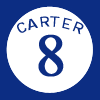 Gary Carter Gary Carter Gary Edmund Carter , nicknamed "Kid" and "Kid Carter", is an American former Major League Baseball catcher. During a 19-year baseball career, mostly with the Montreal Expos and the New York Mets, Carter established himself as one of the premier catchers in the National League, winning three Gold... C 1974–84 & 1992 |
 Andre Dawson Andre Dawson Andre Nolan Dawson , nicknamed "The Hawk", is an American former center fielder and right fielder. During a 21-year baseball career, he played for four different teams, spending most of his career with the Montreal Expos and Chicago Cubs .An 8-time National League All-Star, he was named the... RF/CF 1977–86 |
 Rusty Staub Rusty Staub Daniel Joseph "Rusty" Staub is an American former Major League Baseball right fielder, designated hitter, and first baseman. He enjoyed a 23-year baseball career with 5 different teams... OF 1969–71 & 1979 |
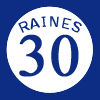 Tim Raines Tim Raines Timothy Raines , nicknamed "Rock", is a former American professional baseball player. He played as a left fielder in Major League Baseball for six teams from 1979 to 2002 and was best known for his 13 seasons with the Montreal Expos... LF 1979–90 & 2001 |
 Jackie Robinson Jackie Robinson Jack Roosevelt "Jackie" Robinson was the first black Major League Baseball player of the modern era. Robinson broke the baseball color line when he debuted with the Brooklyn Dodgers in 1947... 2B Retired 1997 |
With the exception of 42, retired for all MLB teams to honor Jackie Robinson
Jackie Robinson
Jack Roosevelt "Jackie" Robinson was the first black Major League Baseball player of the modern era. Robinson broke the baseball color line when he debuted with the Brooklyn Dodgers in 1947...
, these numbers were originally retired by the predecessor Montreal Expos
Montreal Expos
The Montreal Expos were a Major League Baseball team located in Montreal, Quebec from 1969 through 2004, holding the first MLB franchise awarded outside the United States. After the 2004 season, MLB moved the Expos to Washington, D.C. and renamed them the Nationals.Named after the Expo 67 World's...
organization. Following the move to Washington, D.C., the numbers were returned to circulation for the franchise's first six seasons. Prior to the 2011 season, the Nationals began to honor the Expos' retired numbers once again. The numbers also hang from the roof of the Bell Centre
Bell Centre
The Bell Centre , formerly known as the Molson Centre , is a sports and entertainment complex in Montreal, Quebec, Canada. It opened on March 16, 1996 after nearly three years under construction...
in Montreal.
Season standings
The following is the previous six seasons of the franchise:| MLB season |
Team season |
League |
Division Division (sport) In sports, a division is a group of teams who compete against each other for a championship.-League system:In sports using a league system , a division consists a group of teams who play a sport at a similar competitive level... |
Regular season | Post-season | Awards Baseball awards Professional baseball leagues and amateur-baseball organizations around the world, various sportswriting associations, and other interested groups confer awards on various baseball teams, players, managers, coaches, executives, broadcasters, and writers for excellence in achievement, sportsmanship,... |
||||
|---|---|---|---|---|---|---|---|---|---|---|
| Finish | Wins Win (baseball) In professional baseball, there are two types of decisions: a win and a loss . In each game, one pitcher on the winning team is awarded a win and one pitcher on the losing team is given a loss in their respective statistics. These pitchers are collectively known as the pitchers of record. Only... |
Losses | Win% Winning percentage In sports, a winning percentage is the fraction of games or matches a team or individual has won. It is defined as wins divided by wins plus losses . Ties count as a ½ loss and a ½ win... |
GB Games behind In sports, the phrase games behind or games back , is a common way to reflect the gap between a leading team and another team in a sports league, conference, or division... |
||||||
| 2005 2005 Washington Nationals season The Washington Nationals' 2005 season was the first for the team formerly known as the Montreal Expos since moving to Washington, D. C.. The team signed four key free agents during the off-season: Vinny Castilla, José Guillén, Cristian Guzmán and Esteban Loaiza.-Offseason:*January 19, 2005:... |
NL | East | 5th | 81 | 81 | .500 | 9 | |||
| 2006 2006 Washington Nationals season The Washington Nationals' 2006 season was the franchise's second season in Washington, D.C.-Offseason:*December 8, 2005: Alfonso Soriano was traded by the Texas Rangers to the Washington Nationals for Brad Wilkerson, Armando Galarraga, and Terrmel Sledge.... |
NL | East | 5th | 71 | 91 | .438 | 26 | Alfonso Soriano (Silver Slugger) | ||
| 2007 2007 Washington Nationals season The Washington Nationals' 2007 season began with the team trying to win its first NL East title since moving to Washington. During the offseason, the team replaced manager Frank Robinson with former Montreal Expos coach Manny Acta. They lost several players through free agency and trades. The... |
NL | East | 4th | 73 | 89 | .451 | 18 | Dmitri Young Dmitri Young Dmitri Dell Young is a former Major League Baseball first baseman. Young is 6'2" and 275 pounds... (CPOY) |
||
| 2008 2008 Washington Nationals season The Washington Nationals' 2008 season was the 4th season for the franchise in the District of Columbia, and the 40th since the original team was started in Montreal, Quebec, in . It also marked the first season the Nationals played at Nationals Park.-March:... |
NL | East | 5th | 59 | 102 | .366 | 32½ | |||
| 2009 2009 Washington Nationals season The Washington Nationals' 2009 season was the 5th season for the American baseball franchise of Major League Baseball in the District of Columbia, and the 41st since the original team was started in Montréal, Canada... |
NL | East | 5th | 59 | 103 | .364 | 34 | Ryan Zimmerman (Gold Glove and Silver Slugger) | ||
| 2010 2010 Washington Nationals season The Washington Nationals' 2010 season was the sixth season for the American baseball franchise of Major League Baseball in the District of Columbia, and the 42nd since the original team was started in Montréal, Canada. It involved the Nationals attempting to win the National League East Division... |
NL | East | 5th | 69 | 93 | .426 | 28 | Ryan Zimmerman (Silver Slugger) | ||
| 2011 2011 Washington Nationals season The Washington Nationals' 2011 season was the seventh season for the American baseball franchise of Major League Baseball in the District of Columbia and the 43rd since the original team was started in Montréal, Canada... |
NL | East | 3rd | 80 | 81 | .497 | 21½ | |||
Minor league affiliations
| Level | Team | League | Location |
|---|---|---|---|
| AAA | Syracuse Chiefs | International League International League The International League is a minor league baseball league that operates in the eastern United States. Like the Pacific Coast League and the Mexican League, it plays at the Triple-A level, which is one step below Major League Baseball. It was so named because it had teams in both the United States... |
Syracuse, NY Syracuse, New York Syracuse is a city in and the county seat of Onondaga County, New York, United States, the largest U.S. city with the name "Syracuse", and the fifth most populous city in the state. At the 2010 census, the city population was 145,170, and its metropolitan area had a population of 742,603... |
| AA | Harrisburg Senators Harrisburg Senators The Harrisburg Senators are a minor league baseball team based in Harrisburg, Pennsylvania. The team, which plays in the Eastern League, is the Double-A affiliate of the Washington Nationals.... |
Eastern League Eastern League (U.S. baseball) The Eastern League is a minor league baseball league which operates primarily in the northeastern United States, although it has had a team in Ohio since 1989. The Eastern League has played at the AA level since 1963. The league was founded in 1923 as the New York-Pennsylvania League... |
Harrisburg, PA Harrisburg, Pennsylvania Harrisburg is the capital of Pennsylvania. As of the 2010 census, the city had a population of 49,528, making it the ninth largest city in Pennsylvania... |
| Advanced A | Potomac Nationals Potomac Nationals The Potomac Nationals are a Minor League Baseball team located in Woodbridge, Virginia. The Nationals play in the Class A Advanced Carolina League, and are an affiliate of the Washington Nationals.-History:... |
Carolina League Carolina League The Carolina League is a minor league baseball affiliation which operates in the South Atlantic Coast of the United States. Before 2002, it was classified as a "High A" league, indicating its status as a Class A league with the highest level of competition within that classification, and the fifth... |
Woodbridge, VA Woodbridge, Virginia -Demographics:As of the census of 2000, there were 31,941 people, 10,687 households, and 7,769 families residing in the CDP. The population density was 3,047.8 people per square mile . There were 11,026 housing units at an average density of 1,052.1/sq mi... |
| A | Hagerstown Suns Hagerstown Suns The Hagerstown Suns are a Minor League Baseball team based in Hagerstown, Maryland, United States. They play in Municipal Stadium, which was opened in 1930 and seats 4,600 fans.... |
South Atlantic League South Atlantic League The South Atlantic League is a minor league baseball league based chiefly in the Southeastern United States, with the exception of three teams in the Mid-Atlantic States... |
Hagerstown, MD Hagerstown, Maryland Hagerstown is a city in northwestern Maryland, United States. It is the county seat of Washington County, and, by many definitions, the largest city in a region known as Western Maryland. The population of Hagerstown city proper at the 2010 census was 39,662, and the population of the... |
| Short Season A | Auburn Doubledays Auburn Doubledays The Auburn Doubledays are a minor league baseball team in Auburn, New York, USA, that is owned and operated by Auburn Community Baseball. They are a member of the Short-Season Class A New York-Penn League and have been a farm team of the Houston Astros , the Toronto Blue Jays , and Washington... |
New York-Penn League | Auburn, NY Auburn, New York Auburn is a city in Cayuga County, New York, United States of America. As of the 2010 census, the city had a population of 27,687... |
| Rookie | GCL Nationals | Gulf Coast League Gulf Coast League The Gulf Coast League is a minor league baseball league which operates in Florida. It is a Rookie League, with a season running from mid-June to late August. The season is 60 games long and teams in the league are divided into three divisions, East, North and South... |
Viera, FL Viera, Florida Viera is a master planned community located in the central coastal region of Brevard County, Florida. It is part of an unincorporated section adjacent to the Melbourne, Florida area.-Geography:... |
| DSL Nationals Dominican Summer Nationals The DSL Nationals are a rookie-level minor league baseball team in the Dominican Summer League. They were formed in 2005. From 2006 to 2008, there were two teams in the Dominican Summer League with that name - Dominican Summer Nationals 1 and Dominican Summer Nationals 2. They became a unified team... |
Dominican Summer League Dominican Summer League The Dominican Summer League is a branch of affiliated minor league baseball which is played in the Dominican Republic. The league was founded in 1985. The 2011 72-game season begins May 28 and ends August 20... |
Dominican Republic Dominican Republic The Dominican Republic is a nation on the island of La Hispaniola, part of the Greater Antilles archipelago in the Caribbean region. The western third of the island is occupied by the nation of Haiti, making Hispaniola one of two Caribbean islands that are shared by two countries... |
Nationals Dream Foundation
The Washington Nationals Dream Foundation is the team's charity which is "committed to community partnerships that improve the lives of children and families across the Washington Capital Region. The foundation plans to open a youth baseball academy in partnership with the D.C. government, a pediatric diabetes care center at Children's National Medical CenterChildren's National Medical Center
- Introduction :Children’s National Medical Center , is the only exclusive provider of pediatric care in the Washington, D.C., area and the only freestanding children’s hospital between Philadelphia, Pittsburgh, Norfolk, and Atlanta...
in partnership with the Center. The foundation also provides grants to local organizations.
On August 1, 2011, the foundation, in partnership with several local organizations, formally opened Miracle Field in Germantown, Maryland as part of an effort to encourage athletic activity in children with "mental and/or physical challenges." According to Steven Miller of MLB.com, what sets Miracle Field apart in terms of safety is its unique design, as it "is made entirely of a cushioned synthetic turf that is five-eighths of an inch thick-- providing a safe surface for children in wheelchairs or with other handicaps."
Radio and television
The Nationals' flagshipFlagship
A flagship is a vessel used by the commanding officer of a group of naval ships, reflecting the custom of its commander, characteristically a flag officer, flying a distinguishing flag...
radio station
Radio station
Radio broadcasting is a one-way wireless transmission over radio waves intended to reach a wide audience. Stations can be linked in radio networks to broadcast a common radio format, either in broadcast syndication or simulcast or both...
is WJFK-FM
WJFK-FM
WJFK-FM, known on-air as 106.7 The Fan, is a sports radio-formatted broadcast radio station licensed to Manassas, Virginia, serving the metro Washington DC area...
(106.7 FM) "The Fan", which is owned by CBS Radio
CBS Radio
CBS Radio, Inc., formerly known as Infinity Broadcasting Corporation, is one of the largest owners and operators of radio stations in the United States, third behind main rival Clear Channel Communications and Cumulus Media. CBS Radio owns around 130 radio stations across the country...
. Charlie Slowes
Charlie Slowes
Charlie Slowes is a longtime American sportscaster who is currently the radio play-by-play announcer for the Washington Nationals.Before becoming the Nationals' radio announcer, Slowes was previously a familiar voice in the Washington, D.C. sports market when he was the radio voice of the...
and Dave Jageler
Dave Jageler
Dave Jageler is an American baseball broadcaster. He joined Charlie Slowes in the Washington Nationals radio broadcast booth to call games in 2006....
are the play-by-play announcers. Most games are simulcast
Simulcast
Simulcast, shorthand for "simultaneous broadcast", refers to programs or events broadcast across more than one medium, or more than one service on the same medium, at the same time. For example, Absolute Radio is simulcast on both AM and on satellite radio, and the BBC's Prom concerts are often...
on 1500 AM, which had been the flagship station since the 2006 season until a multi-year agreement was reached between the Nationals and WJFK before the 2011 season. The other former flagship is WWZZ 104.1 FM, which carried games in the 2005 season.
Nationals' telecasts are predominantly on Mid-Atlantic Sports Network
Mid-Atlantic Sports Network
Mid-Atlantic Sports Network is a regional sports network owned by two Major League Baseball franchises—the Baltimore Orioles and Washington Nationals -- and televises every available game of both teams, live and in high-definition...
(MASN), with a handful of games simulcast on WDCW
WDCW
WDCW, channel 50, is the CW-affiliated television station for Washington, D.C. It transmits from the Hughes Memorial Tower located in the Brightwood section of the city. Owned by the Tribune Company, the station has studios on Wisconsin Avenue Northwest in the Glover Park section of Washington...
, "DC50." Bob Carpenter
Bob Carpenter (sportscaster)
Bob Carpenter is a long-time sportscaster and current television play-by-play announcer for Major League Baseball's Washington Nationals on MASN.-Biography:Bob Carpenter has been the Washington Nationals broadcaster since 2006....
is the TV play-by-play announcer and F.P. Santangelo was hired in January 2011 as color analyst. Former color analysts are Tom Paciorek
Tom Paciorek
Thomas Marian Paciorek is a former Major League outfielder and first baseman for 18 seasons between 1970 and 1987...
, Don Sutton, and Rob Dibble
Rob Dibble
Robert Keith Dibble is a former Major League Baseball pitcher and television analyst.-Personal life:Dibble is a graduate of Southington High School in Southington, Connecticut...
, who was fired in September 2010 after criticizing Stephen Strasburg for not pitching while injured. Ray Knight
Ray Knight
Charles Ray Knight is a former right-handed Major League Baseball third baseman best remembered for his time with the Cincinnati Reds and New York Mets...
and Johnny Holliday
Johnny Holliday
Johnny Holliday is an American radio sportscaster and a former top 40 radio disc jockey. He has been the "voice" of the Maryland Terrapins football and basketball teams since 1979. He has previously worked as a radio disc jockey in Cleveland, New York City, and San Francisco...
host the postgame show "Nats Xtra". Knight filled in as color analyst in September 2010 after Dibble was fired.
TV ratings were among the worst in the league but increased during the 2010 season and have increased so far in the 2011 season.
See also
- List of franchise managers and ownership
- History of Washington, D.C. professional baseball
Footnotes
The Washington Nationals are a professional baseball teamProfessional baseball
Baseball is a team sport which is played by several professional leagues throughout the world. In these leagues, and associated farm teams, players are selected for their talents and are paid to play for a specific team or club system....
based in Washington, D.C.
Washington, D.C.
Washington, D.C., formally the District of Columbia and commonly referred to as Washington, "the District", or simply D.C., is the capital of the United States. On July 16, 1790, the United States Congress approved the creation of a permanent national capital as permitted by the U.S. Constitution....
The Nationals are a member of the Eastern Division
National League East
The National League East Division is one of Major League Baseball's six divisions. The Atlanta Braves and the Philadelphia Phillies are tied for the most National League East Division titles . All of Atlanta's NL East titles came during a record stretch of 14 consecutive division titles...
of the National League
National League
The National League of Professional Baseball Clubs, known simply as the National League , is the older of two leagues constituting Major League Baseball, and the world's oldest extant professional team sports league. Founded on February 2, 1876, to replace the National Association of Professional...
of Major League Baseball
Major League Baseball
Major League Baseball is the highest level of professional baseball in the United States and Canada, consisting of teams that play in the National League and the American League...
(MLB). The team moved into the newly built Nationals Park in 2008, after playing their first three seasons in RFK Stadium
Robert F. Kennedy Memorial Stadium
Robert F. Kennedy Memorial Stadium is a multi-purpose stadium, in Washington, D.C., United States, and the current home of MLS's D.C. United....
. The new park is located in Southeast D.C., near the Anacostia River
Anacostia River
The Anacostia River is a river in the Mid Atlantic region of the United States. It flows from Prince George's County in Maryland into Washington, D.C., where it joins with the Washington Channel to empty into the Potomac River at Buzzard Point. It is approximately long...
and with views of the Capitol
United States Capitol
The United States Capitol is the meeting place of the United States Congress, the legislature of the federal government of the United States. Located in Washington, D.C., it sits atop Capitol Hill at the eastern end of the National Mall...
.
The Nationals name derives from the former Washington baseball team which had the same name (used interchangeably with Senators
Washington Senators
There have been several baseball teams that have played as the Washington Senators, including:*an American League baseball team based in Washington, D.C. from 1901 to 1960, that moved to Minneapolis-St...
). Their nickname is "the Nats"—a shortened version that was also used by the old D.C. teams.
An expansion franchise
Expansion team
An expansion team is a brand new team in a sports league. The term is most commonly used in reference to the North American major professional sports leagues, but is applied to sports leagues worldwide that use a closed franchise system of league membership. The term comes from the expansion of the...
, the club was founded in Montreal
Montreal
Montreal is a city in Canada. It is the largest city in the province of Quebec, the second-largest city in Canada and the seventh largest in North America...
, Quebec
Quebec
Quebec or is a province in east-central Canada. It is the only Canadian province with a predominantly French-speaking population and the only one whose sole official language is French at the provincial level....
, in . As the Montreal Expos
Montreal Expos
The Montreal Expos were a Major League Baseball team located in Montreal, Quebec from 1969 through 2004, holding the first MLB franchise awarded outside the United States. After the 2004 season, MLB moved the Expos to Washington, D.C. and renamed them the Nationals.Named after the Expo 67 World's...
, they were the first major league team in Canada
Canada
Canada is a North American country consisting of ten provinces and three territories. Located in the northern part of the continent, it extends from the Atlantic Ocean in the east to the Pacific Ocean in the west, and northward into the Arctic Ocean...
. They played their home games at Jarry Park Stadium
Jarry Park Stadium
Jarry Park Stadium is a former baseball stadium in Montreal which served as home to the Montreal Expos, Major League Baseball's first Canadian franchise, from 1969–1976. It served as a temporary home until the domed Olympic Stadium was finished and made available to the Expos...
and later in the Olympic Stadium
Olympic Stadium (Montreal)
The Olympic Stadium is a multi-purpose stadium in the Hochelaga-Maisonneuve district of Montreal, Quebec, Canada built as the main venue for the 1976 Summer Olympics...
. In , the Expos won a division championship, won their first-ever playoff series
1981 National League Division Series
-Philadelphia Phillies vs. Montreal Expos:-Game 1, October 6:Astrodome in Houston, TexasFernando Valenzuela faced Nolan Ryan, a matchup worthy of a pitcher's duel. The game remained scoreless until the bottom of the sixth. Tony Scott singled home Terry Puhl to score the game's first run, but Steve...
by defeating the Philadelphia Phillies
Philadelphia Phillies
The Philadelphia Phillies are a Major League Baseball team. They are the oldest continuous, one-name, one-city franchise in all of professional American sports, dating to 1883. The Phillies are a member of the Eastern Division of Major League Baseball's National League...
, 3–2, and advanced to the National League Championship Series
1981 National League Championship Series
- Game 1 :Tuesday, October 13, 1981 at Dodger Stadium in Los Angeles, CaliforniaThe Dodgers took the first game of the series behind the strong pitching of starter Burt Hooton. For the first seven innings the game stayed close, with the only scoring coming in the second inning when the Dodgers got...
, where they would go on to lose that series to the Los Angeles Dodgers
Los Angeles Dodgers
The Los Angeles Dodgers are a professional baseball team based in Los Angeles, California. The Dodgers are members of Major League Baseball's National League West Division. Established in 1883, the team originated in Brooklyn, New York, where it was known by a number of nicknames before becoming...
, 3–2, in their only postseason appearance during the strike-shortened season. The Expos had their highest winning percentage in the strike-shortened season of , when the team had the best record in baseball. The team's subsequent shedding of players caused fan interest to drop off. After the 2001 season, MLB considered revoking the team's franchise, along with either the Minnesota Twins
Minnesota Twins
The Minnesota Twins are a professional baseball team based in Minneapolis, Minnesota. They play in the Central Division of Major League Baseball's American League. The team is named after the Twin Cities area of Minneapolis and St. Paul. They played in Metropolitan Stadium from 1961 to 1981 and the...
or the Tampa Bay Devil Rays
Tampa Bay Rays
The Tampa Bay Rays are a Major League Baseball team based in St. Petersburg, Florida. The Rays are a member of the Eastern Division of MLB's American League. Since their inception in , the club has played at Tropicana Field...
. After being purchased by MLB in 2002, the team was moved before the season to Washington and renamed the Nationals, the first relocation since the second Washington Senators moved to Arlington, Texas
Arlington, Texas
Arlington is a city in Tarrant County, Texas within the Dallas–Fort Worth metropolitan area. According to the 2010 census results, the city had a population of 365,438, making it the third largest municipality in the Metroplex...
and became the Texas Rangers
Texas Rangers (baseball)
The Texas Rangers are a professional baseball team in the Dallas-Fort Worth Metroplex, based in Arlington, Texas. The Rangers are a member of the Western Division of Major League Baseball's American League, and are the reigning A.L. Western Division and A.L. Champions. Since , the Rangers have...
in .
The Nationals are one of two MLB franchises, and the only one in the National League
National League
The National League of Professional Baseball Clubs, known simply as the National League , is the older of two leagues constituting Major League Baseball, and the world's oldest extant professional team sports league. Founded on February 2, 1876, to replace the National Association of Professional...
, that has never played in a World Series
World Series
The World Series is the annual championship series of Major League Baseball, played between the American League and National League champions since 1903. The winner of the World Series championship is determined through a best-of-seven playoff and awarded the Commissioner's Trophy...
(the Seattle Mariners
Seattle Mariners
The Seattle Mariners are a professional baseball team based in Seattle, Washington. Enfranchised in , the Mariners are a member of the Western Division of Major League Baseball's American League. Safeco Field has been the Mariners' home ballpark since July...
are the other).
Montreal Expos
The Montreal Expos joined the National LeagueNational League
The National League of Professional Baseball Clubs, known simply as the National League , is the older of two leagues constituting Major League Baseball, and the world's oldest extant professional team sports league. Founded on February 2, 1876, to replace the National Association of Professional...
in 1969, along with the San Diego Padres
San Diego Padres
The San Diego Padres are a Major League Baseball team based in San Diego, California. They play in the National League Western Division. Founded in 1969, the Padres have won the National League Pennant twice, in 1984 and 1998, losing in the World Series both times...
, with a majority share held by Charles Bronfman
Charles Bronfman
Charles Rosner Bronfman, is a Canadian businessman and philanthropist. With an estimated net worth of $US 2.0 billion , Bronfman was ranked by Forbes as the 15th wealthiest Canadian and 595th in the world....
, a major shareholder in Seagram
Seagram
The Seagram Company Ltd. was a large corporation headquartered in Montreal, Quebec, Canada that was the largest distiller of alcoholic beverages in the world. Toward the end of its independent existence it also controlled various entertainment and other business ventures...
. Named after the Expo 67
Expo 67
The 1967 International and Universal Exposition or Expo 67, as it was commonly known, was the general exhibition, Category One World's Fair held in Montreal, Quebec, Canada, from April 27 to October 29, 1967. It is considered to be the most successful World's Fair of the 20th century, with the...
World's Fair
World's Fair
World's fair, World fair, Universal Exposition, and World Expo are various large public exhibitions held in different parts of the world. The first Expo was held in The Crystal Palace in Hyde Park, London, United Kingdom, in 1851, under the title "Great Exhibition of the Works of Industry of All...
, the Expos' initial home was Jarry Park
Jarry Park Stadium
Jarry Park Stadium is a former baseball stadium in Montreal which served as home to the Montreal Expos, Major League Baseball's first Canadian franchise, from 1969–1976. It served as a temporary home until the domed Olympic Stadium was finished and made available to the Expos...
. Managed by Gene Mauch
Gene Mauch
Gene William Mauch was an American professional baseball player and manager. He played in Major League Baseball as a second baseman for the Brooklyn Dodgers , Pittsburgh Pirates , Chicago Cubs , Boston Braves , St...
, the team lost 110 games in their first season, coincidentally matching the Padres inaugural win-loss record, and continued to struggle during their first decade with sub-.500 seasons.
Starting in 1977, the team's home venue was Montreal's Olympic Stadium
Olympic Stadium (Montreal)
The Olympic Stadium is a multi-purpose stadium in the Hochelaga-Maisonneuve district of Montreal, Quebec, Canada built as the main venue for the 1976 Summer Olympics...
, built for the 1976 Summer Olympics
1976 Summer Olympics
The 1976 Summer Olympics, officially known as the Games of the XXI Olympiad, was an international multi-sport event celebrated in Montreal, Quebec, Canada, in 1976. Montreal was awarded the rights to the 1976 Games on May 12, 1970, at the 69th IOC Session in Amsterdam, over the bids of Moscow and...
. Two years later, the team won a franchise-high 95 games, finishing second in the National League East. The Expos began the 1980s with a core group of young players, including catcher Gary Carter
Gary Carter
Gary Edmund Carter , nicknamed "Kid" and "Kid Carter", is an American former Major League Baseball catcher. During a 19-year baseball career, mostly with the Montreal Expos and the New York Mets, Carter established himself as one of the premier catchers in the National League, winning three Gold...
, outfielders Tim Raines
Tim Raines
Timothy Raines , nicknamed "Rock", is a former American professional baseball player. He played as a left fielder in Major League Baseball for six teams from 1979 to 2002 and was best known for his 13 seasons with the Montreal Expos...
and Andre Dawson
Andre Dawson
Andre Nolan Dawson , nicknamed "The Hawk", is an American former center fielder and right fielder. During a 21-year baseball career, he played for four different teams, spending most of his career with the Montreal Expos and Chicago Cubs .An 8-time National League All-Star, he was named the...
, third baseman Tim Wallach
Tim Wallach
Timothy Charles Wallach , nicknamed "Eli" in reference to actor Eli Wallach, is a former third baseman in Major League Baseball who played from to for the Montreal Expos, Los Angeles Dodgers, and California Angels. He won three Gold Glove awards for defensive excellence and 2 Silver Slugger...
, and pitchers Steve Rogers and Bill Gullickson
Bill Gullickson
William Lee Gullickson is a former major league baseball pitcher who played for six different major-league teams, in Canada, the U.S...
. The team won its only division championship in the strike-shortened split season of 1981
1981 in baseball
-Major League Baseball:*World Series: Los Angeles Dodgers over New York Yankees ; Ron Cey, Pedro Guerrero, and Steve Yeager, co-MVPsNOTE: Due to a strike in mid-season, the season was divided into a first half and a second half...
, ending its season with a three games to two loss to the Los Angeles Dodgers
1981 Los Angeles Dodgers season
The Los Angeles Dodgers season got off to a strong start when rookie pitcher Fernando Valenzuela pitched a shutout on opening day, starting the craze that came to be known as "Fernandomania." Fernando went on to win both the Rookie of the Year and Cy Young Awards.The season was divided into two...
in the National League Championship Series
1981 National League Championship Series
- Game 1 :Tuesday, October 13, 1981 at Dodger Stadium in Los Angeles, CaliforniaThe Dodgers took the first game of the series behind the strong pitching of starter Burt Hooton. For the first seven innings the game stayed close, with the only scoring coming in the second inning when the Dodgers got...
.
The team spent most of the 1980s in the middle of the NL East pack, finishing in third or fourth place in eight out of nine seasons from 1982–1990. Buck Rodgers
Buck Rodgers
Robert LeRoy "Buck" Rodgers is a former catcher, manager and coach in Major League Baseball. As a manager, he helmed three major league teams: the Milwaukee Brewers , Montreal Expos and California Angels , compiling a career won-lost mark of 784–773 .-Playing career:Rodgers attended Ohio Wesleyan...
was hired as manager before the 1985 season
1985 in baseball
-Major League Baseball:*World Series: Kansas City Royals over St. Louis Cardinals ; Bret Saberhagen, MVP*American League Championship Series MVP: George Brett*National League Championship Series MVP: Ozzie Smith...
and guided the Expos to a .500 or better record five times in six years, with the highlight coming in 1987
1987 in baseball
-Major League Baseball:*World Series: Minnesota Twins over St. Louis Cardinals ; Frank Viola, MVP**American League Championship Series: Gary Gaetti, MVP**National League Championship Series: Jeff Leonard, MVP...
, when they won 91 games. They finished third, but were just 4 games behind the division-winning Cardinals.
Bronfman sold the team to a consortium of owners in 1991, with Claude Brochu
Claude Brochu
Claude Brochu, CM , is a Quebec businessman.He was named president of the Montreal Expos baseball club by Charles Bronfman in 1986, replacing John McHale....
as the managing general partner.
Rodgers, at that time second only to Gene Mauch
Gene Mauch
Gene William Mauch was an American professional baseball player and manager. He played in Major League Baseball as a second baseman for the Brooklyn Dodgers , Pittsburgh Pirates , Chicago Cubs , Boston Braves , St...
in number of Expos games managed, was replaced partway through the 1991 season
1991 Montreal Expos season
After several winning seasons, the Expos faltered in 1991, winning only 20 of its first 49 games. Manager Buck Rodgers was replaced as manager by Tom Runnells.-Offseason:* November 15, 1990: Scott Service was signed as a free agent by the Expos....
. In May 1992
1992 Montreal Expos season
-Offseason:* November 15, 1991: Gary Carter was selected off waivers by the Expos from the Los Angeles Dodgers.* November 18, 1991: Kenny Williams was released by the Expos.* November 25, 1991: Andrés Galarraga was traded by the Expos to the St...
, Felipe Alou, a member of the Expos organization since 1976, was promoted to field manager, becoming the first Dominican-born manager in MLB
Major League Baseball
Major League Baseball is the highest level of professional baseball in the United States and Canada, consisting of teams that play in the National League and the American League...
history. Alou would become the leader in Expos games managed, while guiding the team to winning records, including 1994
1994 Montreal Expos season
The Montreal Expos finished the season with the best record in Major League Baseball. The Expos had 74 wins compared to 40 losses. The 1994 Major League Baseball strike forced an end to the season and any postseason aspirations that the franchise had...
, when the Expos, led by a talented group of players including Larry Walker
Larry Walker
Larry Kenneth Robert Walker is a former right fielder in Major League Baseball. From 1989 through 2005, Walker played for the Montreal Expos , Colorado Rockies , and St. Louis Cardinals...
, Moisés Alou
Moisés Alou
Moisés Rojas Alou |Spanish:]] ; born July 3, 1966 in Atlanta, Georgia) is a former American outfielder in Major League Baseball who played for 17 seasons in the National League. In 1,942 career games, Alou had a batting average of .303 with 2,134 hits, 421 doubles, 332 home runs, and 1,287 runs...
, Marquis Grissom
Marquis Grissom
Marquis Deon Grissom is a former Major League Baseball player. He excelled in baseball at Lakeshore High School, under the tutelage of baseball coach Mike Juenger. He currently resides in College Park, Georgia...
and Pedro Martínez
Pedro Martínez
Pedro Jaime Martínez is a retired Major League Baseball pitcher. He is an eight-time All-Star, three-time Cy Young Award winner, and 2004 World Series champion...
, had the best record in the major leagues until the 1994–95 Major League Baseball strike forced the cancellation of the remainder of the season
1994 Major League Baseball season
The 1994 Major League Baseball season ended with the infamous players strike ending the season on August 11, 1994.-Strike:As a result of a players' strike, the MLB season ended prematurely on August 11, 1994. No postseason was played...
. After the disappointment of 1994, Expos management began shedding its key players, and the team's fan support dwindled.
Brochu sold control of the team to Jeffrey Loria
Jeffrey Loria
Jeffrey H. Loria is an art dealer and is the owner of the Miami Marlins. Raised in Manhattan, Loria took an early interest in baseball, attending his first New York Yankees game in the late 1940s. Loria attended New York City's Stuyvesant High School and Yale University, where he initially took...
in 1999,
but Loria failed to close on a plan to build a new downtown ballpark, and did not reach an agreement on television and English radio broadcast contracts for the 2000 season, reducing the team's media coverage.
2001 contraction
In November 2001, MLB's owners voted 28–2 to contract MLB by two teams — according to various sources, the Expos and the Minnesota Twins, both of which reportedly voted against contraction.Subsequently, the Boston Red Sox
Boston Red Sox
The Boston Red Sox are a professional baseball team based in Boston, Massachusetts, and a member of Major League Baseball’s American League Eastern Division. Founded in as one of the American League's eight charter franchises, the Red Sox's home ballpark has been Fenway Park since . The "Red Sox"...
were sold to a partnership led by John W. Henry
John W. Henry
John William Henry II is a futures and foreign exchange trading advisor who founded John W. Henry & Company . He is the principal owner of the Boston Red Sox and Liverpool F.C., and co-owner of Roush Fenway Racing. In March 2006, Boston Magazine estimated his net worth at $1.1 billion, but noted...
, owner of the Florida Marlins
Florida Marlins
The Miami Marlins are a professional baseball team based in Miami, Florida, United States. Established in 1993 as an expansion franchise called the Florida Marlins, the Marlins are a member of the Eastern Division of Major League Baseball's National League. The Marlins played their home games at...
.
In order to clear the way for Henry's group to assume ownership of the Red Sox, Henry sold the Marlins to Loria, and MLB purchased the Expos from Loria.
However, as the Metropolitan Sports Facilities Commission, operator of the Metrodome, won an injunction requiring the Twins to play there in 2002, MLB was unable to revoke the Twins franchise, and so had to keep the Twins and Expos as part of the MLB schedule. In the collective bargaining agreement signed with the players association in August 2002, contraction was prohibited through to the end of the contract in 2006.
Creation of the Nationals
With contraction no longer an option for the immediate term, MLBMajor League Baseball
Major League Baseball is the highest level of professional baseball in the United States and Canada, consisting of teams that play in the National League and the American League...
began looking for a relocation site for the Expos. Some of the choices included Oklahoma City
Oklahoma city
Oklahoma City is the capital and largest city of the U.S. state of Oklahoma.Oklahoma City may also refer to:*Oklahoma City metropolitan area*Downtown Oklahoma City*Uptown Oklahoma City*Oklahoma City bombing*Oklahoma City National Memorial...
; Washington, D.C.
Washington, D.C.
Washington, D.C., formally the District of Columbia and commonly referred to as Washington, "the District", or simply D.C., is the capital of the United States. On July 16, 1790, the United States Congress approved the creation of a permanent national capital as permitted by the U.S. Constitution....
; San Juan, Puerto Rico
San Juan, Puerto Rico
San Juan , officially Municipio de la Ciudad Capital San Juan Bautista , is the capital and most populous municipality in Puerto Rico, an unincorporated territory of the United States. As of the 2010 census, it had a population of 395,326 making it the 46th-largest city under the jurisdiction of...
; Monterrey, Mexico; Portland, Oregon
Portland, Oregon
Portland is a city located in the Pacific Northwest, near the confluence of the Willamette and Columbia rivers in the U.S. state of Oregon. As of the 2010 Census, it had a population of 583,776, making it the 29th most populous city in the United States...
; somewhere in Northern Virginia
Northern Virginia
Northern Virginia consists of several counties and independent cities in the Commonwealth of Virginia, in a widespread region generally radiating southerly and westward from Washington, D.C...
such as Arlington or Dulles
Dulles, Virginia
Dulles, Virginia is an unincorporated area located in Loudoun County, Virginia, part of the Washington Metropolitan Area. The headquarters of Orbital Sciences Corporation, GeoEye, and ODIN technologies and the former headquarters of MCI Inc...
; Norfolk, Virginia
Norfolk, Virginia
Norfolk is an independent city in the Commonwealth of Virginia in the United States. With a population of 242,803 as of the 2010 Census, it is Virginia's second-largest city behind neighboring Virginia Beach....
; New Jersey
New Jersey
New Jersey is a state in the Northeastern and Middle Atlantic regions of the United States. , its population was 8,791,894. It is bordered on the north and east by the state of New York, on the southeast and south by the Atlantic Ocean, on the west by Pennsylvania and on the southwest by Delaware...
; and Charlotte, North Carolina
Charlotte, North Carolina
Charlotte is the largest city in the U.S. state of North Carolina and the seat of Mecklenburg County. In 2010, Charlotte's population according to the US Census Bureau was 731,424, making it the 17th largest city in the United States based on population. The Charlotte metropolitan area had a 2009...
. In the decision-making process, Commissioner Bud Selig
Bud Selig
Allan Huber "Bud" Selig is the ninth and current Commissioner of Major League Baseball, having served in that capacity since 1992 as the acting commissioner, and as the official commissioner since 1998...
added Las Vegas, Nevada
Las Vegas, Nevada
Las Vegas is the most populous city in the U.S. state of Nevada and is also the county seat of Clark County, Nevada. Las Vegas is an internationally renowned major resort city for gambling, shopping, and fine dining. The city bills itself as The Entertainment Capital of the World, and is famous...
to the list of potential Expos homes. Washington and Virginia emerged as the front-runners.
In both 2003 and 2004, the Expos played 22 of their home games in San Juan, Puerto Rico
San Juan, Puerto Rico
San Juan , officially Municipio de la Ciudad Capital San Juan Bautista , is the capital and most populous municipality in Puerto Rico, an unincorporated territory of the United States. As of the 2010 census, it had a population of 395,326 making it the 46th-largest city under the jurisdiction of...
, and the remaining 60 in Montreal.
On September 29, 2004, MLB officially announced that the Expos would move to Washington, D.C. in 2005
2005 in baseball
-Headline events of the year:*Chicago White Sox swept the Houston Astros to win the 2005 World Series.*2005 also marked the inaugural season of the Washington Nationals, who relocated from Montreal and were formerly known as the Expos....
.
The Expos played their final game on October 3 at Shea Stadium
Shea Stadium
William A. Shea Municipal Stadium, usually shortened to Shea Stadium or just Shea , was a stadium in the New York City borough of Queens, in Flushing Meadows–Corona Park. It was the home baseball park of Major League Baseball's New York Mets from 1964 to 2008...
, losing by a score of 8–1 against the New York Mets
New York Mets
The New York Mets are a professional baseball team based in the borough of Queens in New York City, New York. They belong to Major League Baseball's National League East Division. One of baseball's first expansion teams, the Mets were founded in 1962 to replace New York's departed National League...
, the same opponent that the Expos first faced at its start, 35 years earlier. On November 15, a lawsuit by the former team owners against MLB and former majority owner Jeffrey Loria
Jeffrey Loria
Jeffrey H. Loria is an art dealer and is the owner of the Miami Marlins. Raised in Manhattan, Loria took an early interest in baseball, attending his first New York Yankees game in the late 1940s. Loria attended New York City's Stuyvesant High School and Yale University, where he initially took...
was struck down by arbitrators, bringing to an end all legal actions that would impede a move. The owners of the other MLB teams approved the move to Washington in a 28–1 vote on December 3 (Baltimore Orioles
Baltimore Orioles
The Baltimore Orioles are a professional baseball team based in Baltimore, Maryland in the United States. They are a member of the Eastern Division of Major League Baseball's American League. One of the American League's eight charter franchises in 1901, it spent its first year as a major league...
owner Peter Angelos
Peter Angelos
Peter G. Angelos , is an American trial lawyer.Angelos is also the majority owner of the Baltimore Orioles, a baseball team in the American League East Division.-Career:...
cast the sole dissenting vote).
Washington baseball history revived
Numerous professional baseball teams have called Washington D.C. home. The Washington SenatorsMinnesota Twins
The Minnesota Twins are a professional baseball team based in Minneapolis, Minnesota. They play in the Central Division of Major League Baseball's American League. The team is named after the Twin Cities area of Minneapolis and St. Paul. They played in Metropolitan Stadium from 1961 to 1981 and the...
, a founding member of the American League
American League
The American League of Professional Baseball Clubs, or simply the American League , is one of two leagues that make up Major League Baseball in the United States and Canada. It developed from the Western League, a minor league based in the Great Lakes states, which eventually aspired to major...
, played in the nation's capital from 1901 to 1960. These Senators were owned by Clark Griffith
Clark Griffith
Clark Calvin Griffith , nicknamed "the Old Fox", was a Major League Baseball pitcher, manager and team owner.-Biography:...
and played in Griffith Stadium
Griffith Stadium
Griffith Stadium was a sports stadium that stood in Washington, D.C. from 1911 to 1965, between Georgia Avenue and 5th Street, and between W Street and Florida Avenue, NW. An earlier wooden baseball park had been built on the same site in 1891...
. With notable stars including Walter Johnson
Walter Johnson
Walter Perry Johnson , nicknamed "Barney" and "The Big Train", was a Major League Baseball right-handed pitcher. He played his entire 21-year baseball career for the Washington Senators...
and Joe Cronin
Joe Cronin
Joseph Edward Cronin was a Major League Baseball shortstop and manager.During a 20-year playing career, he played from 1926–45 for three different teams, primarily for the Boston Red Sox. Cronin was a major league manager from 1933–47...
, the Senators won the 1924 World Series
1924 World Series
In the 1924 World Series, the Washington Senators beat the New York Giants in seven games. The Giants became the first team to play in four consecutive World Series, winning in 1921–1922 and losing in 1923–1924. Their long-time manager, John McGraw, made his ninth and final World Series appearance...
and pennants in 1925
1925 World Series
In the 1925 World Series, the Pittsburgh Pirates beat the defending champion Washington Senators in seven games.In a reversal of fortune on all counts from the previous 1924 World Series, when Washington's Walter Johnson had come back from two losses to win the seventh and deciding game, Johnson...
and 1933
1933 World Series
The 1933 World Series featured the New York Giants and the Washington Senators, with the Giants winning in five games for their first championship since , and their fourth overall....
, but were more often unsuccessful and moved to Minnesota for the 1961 season
1961 Major League Baseball season
The New York Yankees defeated the Cincinnati Reds in five games in the World Series. The season is most well known for Yankee teammates Roger Maris and Mickey Mantle's pursuit of Babe Ruth's prestigious 34-year-old single-season home run record of 60...
where the team was renamed the Minnesota Twins. A second Washington Senators
Texas Rangers (baseball)
The Texas Rangers are a professional baseball team in the Dallas-Fort Worth Metroplex, based in Arlington, Texas. The Rangers are a member of the Western Division of Major League Baseball's American League, and are the reigning A.L. Western Division and A.L. Champions. Since , the Rangers have...
team (1961–1971) had a winning record only once in their 11 years, though bright spots, such as slugger Frank Howard
Frank Howard (baseball player)
Frank Oliver Howard , nicknamed "Hondo", "The Washington Monument", and "The Capital Punisher", is a former left and right fielder, coach and manager in Major League Baseball who played most of his career for the Los Angeles Dodgers and Washington Senators/Texas Rangers...
, earned the love of fans. The second Senators team moved to Arlington, Texas for the 1972 season
1972 Major League Baseball season
The 1972 Major League Baseball season was the first to have games cancelled by a player strike. It was also the last season in which American League pitchers would hit for themselves on a regular basis; the designated hitter rule would go into effect the following season.-Labor strife and more...
and changed their name to the Texas Rangers
Texas Rangers (baseball)
The Texas Rangers are a professional baseball team in the Dallas-Fort Worth Metroplex, based in Arlington, Texas. The Rangers are a member of the Western Division of Major League Baseball's American League, and are the reigning A.L. Western Division and A.L. Champions. Since , the Rangers have...
, and Washington spent the next 33 years without a baseball team.
Although there was some sentiment to revive the name Senators, political considerations factored into the choice of Nationals, a revival of the first American League franchise's "official" nickname used from 1905
1905 in baseball
-Champions:*World Series: New York Giants over Philadelphia Athletics -MLB statistical leaders:-American League final standings:-National League final standings:-Events:...
to 1956
1956 in baseball
-Major League Baseball:*World Series: New York Yankees over Brooklyn Dodgers ; Don Larsen, MVP*All-Star Game, July 10 at Griffith Stadium: National League, 7-3-Other champions:*Caribbean World Series: Cienfuegos *College World Series: Minnesota...
. Politicians and others in the District of Columbia objected to the name Senators because the District of Columbia does not have voting representation in Congress
District of Columbia voting rights
Voting rights of citizens in the District of Columbia differ from those of United States citizens in each of the fifty states. District of Columbia residents do not have voting representation in the United States Senate, but D.C. is entitled to three electoral votes for President. In the U.S...
. In addition, the Rangers still owned the rights to the Senators name, although they were able to acquire the rights to the curly "W" from the Rangers. Coincidentally, the sitting President
President of the United States
The President of the United States of America is the head of state and head of government of the United States. The president leads the executive branch of the federal government and is the commander-in-chief of the United States Armed Forces....
at the time of the move, George W. Bush
George W. Bush
George Walker Bush is an American politician who served as the 43rd President of the United States, from 2001 to 2009. Before that, he was the 46th Governor of Texas, having served from 1995 to 2000....
, had at one time owned the Rangers.
Opposition from the Orioles
The move was announced despite opposition from Peter Angelos, owner of the nearby Baltimore Orioles. Since 1972, the Orioles had been the only MLB franchise in the Baltimore–Washington Metropolitan Area, which he considered a single market. Angelos contended that the Orioles would suffer financially if another team were allowed to enter the market, although the Orioles and the Washington Senators had shared the market successfully from 1954 through 1971. This reasoning disturbed many in Washington who recalled that it was the Griffith family, owners of the Washington Senators, who allowed the St. Louis Browns to move to Baltimore in in the first place.On March 31, 2005, Angelos and Major League Baseball struck a deal to protect the Orioles against any financial harm the Nationals might present.
Under the terms of the deal, television and radio broadcast rights to Nationals games are handled by the Orioles franchise, who formed a new network (the Mid-Atlantic Sports Network
Mid-Atlantic Sports Network
Mid-Atlantic Sports Network is a regional sports network owned by two Major League Baseball franchises—the Baltimore Orioles and Washington Nationals -- and televises every available game of both teams, live and in high-definition...
) to produce and distribute the games for both franchises on both local affiliates and cable/satellite systems. MASN was not, however, immediately available on all cable providers, adding to the frustration of Nationals fans. In fact, most in the DC area missed almost the entirety of the Nationals first two seasons. The deal with Angelos makes the Nationals the only major league baseball team which does not own their own broadcast rights.
The ballpark controversy
Council of the District of Columbia
The Council of the District of Columbia is the legislative branch of the local government of the District of Columbia. As permitted in the United States Constitution, the District is not part of any U.S. state and is instead overseen directly by the federal government...
.
Three Council members who supported Mayor Anthony Williams's
Anthony A. Williams
Anthony Allen "Tony" Williams is an American politician who served as the fifth mayor of the District of Columbia for two terms, from 1999 to 2007. He had previously served as chief financial officer for the District, managing to balance the budget and achieve a surplus within two years of...
plan were ousted in September 2004's Democratic party primary. In addition, an opinion poll conducted by The Washington Post
The Washington Post
The Washington Post is Washington, D.C.'s largest newspaper and its oldest still-existing paper, founded in 1877. Located in the capital of the United States, The Post has a particular emphasis on national politics. D.C., Maryland, and Virginia editions are printed for daily circulation...
during the peak of the controversy found that approximately two-thirds of District residents opposed the mayor's stadium plan.
Much of the controversy centered on the fact that the city would be helping finance a $581 million stadium without support from Maryland
Maryland
Maryland is a U.S. state located in the Mid Atlantic region of the United States, bordering Virginia, West Virginia, and the District of Columbia to its south and west; Pennsylvania to its north; and Delaware to its east...
or Virginia
Virginia
The Commonwealth of Virginia , is a U.S. state on the Atlantic Coast of the Southern United States. Virginia is nicknamed the "Old Dominion" and sometimes the "Mother of Presidents" after the eight U.S. presidents born there...
or their counties, from which large portion of the team's fan base would be drawn.
In December 2004, the move to Washington itself was called into doubt when the D.C. Council sought to change details of the stadium's financing. When the Council voted on December 14, 2005 to require 50 percent private financing for any new stadium, MLB ceased promotional activities for the Nationals and announced that they would consider looking for a new market.
Eventually, the council passed an amended plan on December 21, 2004 that proved slightly more financially favorable to the city, while remaining acceptable to MLB. Mayor Williams signed the stadium financing package on December 30.
During the 2005 season
2005 Major League Baseball season
Click on any series score to link to that series' page.Higher seed had home field advantage during Division Series and League Championship Series.The American League champion had home field advantage during the World Series as a result of the AL victory in the 2005 All-Star...
, a private financing plan for construction of the stadium was negotiated between the city and a syndicate of bankers led by Deutsche Bank
Deutsche Bank
Deutsche Bank AG is a global financial service company with its headquarters in Frankfurt, Germany. It employs more than 100,000 people in over 70 countries, and has a large presence in Europe, the Americas, Asia Pacific and the emerging markets...
. The negotiations of the details ran into another problem in November 2005. The bankers requested a letter of credit
Letter of credit
A standard, commercial letter of credit is a document issued mostly by a financial institution, used primarily in trade finance, which usually provides an irrevocable payment undertaking....
or other financial guarantee of $24 million, $6 million for each of four years, ensuring payment of lease revenues against various risks including poor attendance and terrorism. The city requested that Major League Baseball provide this guarantee, which they were unwilling to do.
On December 22, 2005, the Washington Post reported that Major League Baseball had specifically instructed prospective owners not to offer to pay cost overruns on the stadium if they were selected as the owners. Bidders were also told not to communicate with the press about these issues.
In February 2006, the DC City Council imposed a $611 million cap on the stadium.
Finally, on March 5, Major League Baseball signed a lease for a new ballpark, agreeing to the city's $611 million cap. MLB also agreed to contribute $20 million toward the cost of the stadium, although it did not agree to cover stadium overruns. Further, MLB added the condition that excess ballpark tax revenue earmarked for debt service for the bonds to be available for cost overruns. Two days later, on March 7 the DC City Council, by a vote of 9–4, approved a construction contract for a state-of-the-art stadium with a contemporary glass-and-stone facade, seats for 41,000 fans and a view of the U.S. Capitol, and affirmed its demand that public spending on the project be limited to $611 million. The votes were the final actions needed to satisfy the terms of the deal struck in September 2004, paving the way for the sale of the team.
Major League Baseball had agreed at the time that the franchise was moved to Washington to sell the team to an owner or ownership syndicate. Several dates for sale of the team were set and missed due to the legal wrangling regarding the building of the stadium. The delay was harshly criticized by city residents and leaders as reported in The Washington Post.
Selecting from a finalized group of three potential ownership syndicates, Major League Baseball announced in July 2006 that it had chosen the Lerner Enterprises
Lerner Enterprises
Lerner Enterprises is a real estate business founded by Ted Lerner in North Bethesda, Maryland, United States, and operates primarily throughout the Washington, D.C. metropolis...
group, led by billionaire real estate
Real estate
In general use, esp. North American, 'real estate' is taken to mean "Property consisting of land and the buildings on it, along with its natural resources such as crops, minerals, or water; immovable property of this nature; an interest vested in this; an item of real property; buildings or...
developer Theodore N. Lerner. The final sale price of the team was $450 million and the transfer of ownership was completed July 24, 2006. In late September 2006, Comcast
Comcast
Comcast Corporation is the largest cable operator, home Internet service provider, and fourth largest home telephone service provider in the United States, providing cable television, broadband Internet, and telephone service to both residential and commercial customers in 39 states and the...
finally agreed to broadcast the Nationals games.
New ownership and "The Plan"
When Ted Lerner took over the club in mid-, he hired Stan Kasten as team president. Kasten was widely known as the architect of the Atlanta BravesAtlanta Braves
The Atlanta Braves are a professional baseball club based in Atlanta, Georgia. The Braves are a member of the Eastern Division of Major League Baseball's National League. The Braves have played in Turner Field since 1997....
before and during their run of 14 division titles. Kasten was also the general manager or president of many other Atlanta-area sports teams, such as the Atlanta Thrashers
Atlanta Thrashers
The Atlanta Thrashers were a professional ice hockey team based in Atlanta, Georgia, United States. Atlanta was granted a franchise in the National Hockey League on June 25, 1997, and became the league's 28th franchise when it began play in the 1999–2000 NHL season...
. "The Plan," as it became known, was a long-range rebuilding and restructuring of the team from the ground up. This plan included investing in the farm system and draft picks, and having a suitable team to go along with their new stadium.
At the end of the 2006 season, the Nationals did not re-sign free agent and star OF Alfonso Soriano
Alfonso Soriano
Alfonso Guilleard Soriano is a Major League Baseball outfielder for the Chicago Cubs....
. Soriano signed a $136 million contract with the Cubs, and Washington received two draft picks in return. OF José Guillén
José Guillén
José Manuel Guillén |San Cristóbal, Dominican Republic]]) is a Major League Baseball outfielder who is currently a free agent. A prototypical league journeyman, the Giants were the tenth team for which Guillén has played since his major league debut in 1997....
was also allowed to depart via free agency, and another high draft pick was obtained. Another high priced player, 2B/DH José Vidro
José Vidro
José Angel Vidro is a former Major League Baseball second baseman. Though he never officially retired, Vidro has not played since .-Montreal Expos/Washington Nationals:...
, was traded to the Seattle Mariners for prospects OF Chris Snelling
Chris Snelling
Christopher Doyle Snelling is a former Major League Baseball outfielder of Christopher Doyle Snelling is a former [[Major League Baseball]] [[outfielder]] of Christopher Doyle Snelling is a former [[Major League Baseball]]...
and RHP Emiliano Fruto
Emiliano Fruto
Emiliano Ricardo Fruto is a Colombian professional baseball pitcher. He made his debut in Major League Baseball with the Seattle Mariners on May 14,...
. In mid-2006, the Nationals received OF Austin Kearns
Austin Kearns
Austin Ryan Kearns is a Major League Baseball outfielder who is currently a free agent.-Cincinnati Reds:...
, 2B/SS Felipe López, and RHP Ryan Wagner
Ryan Wagner
Ryan Scott Wagner is a former Major League Baseball relief pitcher who pitched for the Cincinnati Reds and the Washington Nationals.-Early life:...
from the Reds, giving up LHP Gary Majewski
Gary Majewski
-Career:Majewski graduated in 1998 from St. Pius X High School in Houston, where he was unanimously selected for Houston Player of the Year for his achievement of maintaining a 1.64 ERA and a 14-3 record. With that, he led his team to the state championship in Class 5A TAPPS.In the majors, Majewski...
, LHP Bill Bray
Bill Bray
William Paul "Bill" Bray , is a Major League Baseball relief pitcher for the Cincinnati Reds. He is a graduate of the College of William and Mary...
, SS Royce Clayton
Royce Clayton
Royce Spencer Clayton is an American former Major League Baseball shortstop and occasional actor.-Baseball career:Clayton was born in Burbank, California. He was drafted out of St...
, 2B Brendan Harris
Brendan Harris
Brendan Michael Harris Brendan Michael Harris Brendan Michael Harris (born August 26, 1980 in Albany, New York is a Major League Baseball utility infielder who is a free agent.Brendan grew up in Queensbury, New York and led the Spartans to the 1998 State Baseball Tournament. He graduated from the...
and RHP Daryl Thompson
Daryl Thompson
Daryl Marcelus Thompson is an American professional baseball pitcher for the Minnesota Twins of Major League Baseball....
. In August they traded RHP Liván Hernández
Liván Hernández
Eisler Liván Hernández Carrera is a Cuban professional baseball pitcher. He is the half-brother of pitcher Orlando "El Duque" Hernández.-Playing career:...
to the Arizona Diamondbacks
Arizona Diamondbacks
The Arizona Diamondbacks are a professional baseball team based in Phoenix. They play in the West Division of Major League Baseball's National League. From 1998 to the present, they have played in Chase Field...
for prospects LHP Matt Chico
Matt Chico
Matthew Bryan Chico is an American professional baseball pitcher who is a free agent. Chico is of Mexican-American descent.During the offseason, Chico and his wife, Stephanie, reside in Viera, Florida....
and RHP Garrett Mock
Garrett Mock
Garrett Lee Mock is an American professional baseball pitcher for the Toronto Blue Jays of Major League Baseball. A graduate of Houston's North Shore Senior High School, Mock attended the University of Houston where he played as part of the Houston Cougars baseball team...
. Other players traded or let go from the 2005 season were OF Preston Wilson
Preston Wilson
Preston James Richard Wilson is a retired professional baseball outfielder. He played in the major leagues from 1998-2007. He is both the nephew and stepson of former New York Mets star Mookie Wilson...
, RHP Héctor Carrasco
Héctor Carrasco
Héctor Pacheco Pipo Carrasco is a former Major League Baseball relief pitcher...
, IF Jamey Carroll
Jamey Carroll
Jamey Blake Carroll is an American professional baseball infielder for the Minnesota Twins of Major League Baseball.Carroll was born in Evansville, Indiana. In 1992, he graduated from Castle High School in Newburgh, Indiana. He later attended and graduated from the University of Evansville...
, and OF Terrmel Sledge
Terrmel Sledge
Terrmel Sledge is a former outfielder in Major League Baseball, who currently plays for the Yokohama BayStars of Nippon Professional Baseball in Japan. Sledge's career began in with the Montreal Expos. He moved with the team to Washington, D.C...
. The team also acquired pitching prospects Luis Atilano
Luis Atilano
Luis A. Atilano is a Puerto Rican professional baseball player. He is a right-handed pitcher for the Washington Nationals...
from Atlanta, Shairon Martis
Shairon Martis
Shairon B. Martis is a Dutch-Antillean professional baseball pitcher in the Pittsburgh Pirates organization. He pitched for The Netherlands in the 2006 World Baseball Classic...
from San Francisco and Jhonny Nunez
Jhonny Núñez
Jhonny J. Núñez is a right-handed relief pitcher in professional baseball.-Career:Núñez signed with the Los Angeles Dodgers in...
from the Dodgers. In 2006, they had two first-round draft picks, OF Chris Marrero
Chris Marrero
Christopher Marrero is a Major League Baseball first baseman for the Washington Nationals.-Professional career:A 2006 graduate of Monsignor Edward Pace High School in Miami, Florida, Marrero was selected by the Washington Nationals with the 15th overall pick in the 2006 amateur draft and signed...
, and RHP Colten Williams, and signed them both to developmental contracts. The Nationals also signed a 16-year-old Dominican shortstop, Esmailyn Gonzalez, for $1.4 million. Gonzalez was later revealed to be 20 years old at the time of his signing.
In the front office, the Nationals hired the well-respected former Arizona scouting director Mike Rizzo
Mike Rizzo (baseball)
Michael Anthony Rizzo is the General Manager and Executive Vice President of baseball operations of the Washington Nationals...
to be the vice president of baseball operations, second in charge under then-general manager Jim Bowden.
As for their farm system, the Nationals had a lot of work to do. By the spring of 2007, Baseball America had ranked the Nationals organization as dead last twice in four years in terms of minor league talent.
The Nationals had five of the first seventy picks in the 2007 first-year player draft: their own two, and three compensation picks (two from losing Soriano, and one for Guillen). The team selected players that many considered to be four of the top 30 players available. Overall, the Nationals signed all of their top twenty draft picks. One of them, a first-round supplemental pick, Michael Burgess, was, by the end of the year, picked by Baseball America as the top prospect for the entire Gulf Coast League
Gulf Coast League
The Gulf Coast League is a minor league baseball league which operates in Florida. It is a Rookie League, with a season running from mid-June to late August. The season is 60 games long and teams in the league are divided into three divisions, East, North and South...
. Their rookie team, Vermont
Vermont Lake Monsters
The Vermont Lake Monsters are a minor league baseball team in the Short-Season A classification New York - Penn League, affiliated with the Oakland Athletics. The team plays its home games at Centennial Field on the University of Vermont campus in Burlington, Vermont...
, sent three starting pitchers Colton Willems, Glenn Gibson, and Adrian Alaniz
Adrian Alaniz
Adrian Alaniz is a North American professional baseball player. A graduate of Sinton High School, he is a right-handed pitching prospect in the Washington Nationals organization....
, and two position players, first baseman
First baseman
First base, or 1B, is the first of four stations on a baseball diamond which must be touched in succession by a baserunner in order to score a run for that player's team...
Bill Rhinehart, and outfielder
Outfielder
Outfielder is a generic term applied to each of the people playing in the three defensive positions in baseball farthest from the batter. These defenders are the left fielder, the center fielder, and the right fielder...
Aaron Seuss to the New York-Penn League All-Star Game. By the end of the season, three Vermont pitchers landed in the Top 20 prospects for the New York-Penn League:
- 2007 second-round Jordan Zimmermann was ranked #5
- 2006 fourth round LHP Glenn Gibson (later traded to the Tampa Bay Rays for Elijah Dukes) was ranked #9
- 2006 first round RHP Colton Willems was ranked #11.
In the low-A South Atlantic League
South Atlantic League
The South Atlantic League is a minor league baseball league based chiefly in the Southeastern United States, with the exception of three teams in the Mid-Atlantic States...
Top 20, two players made the list:
- Chris Marrero was ranked #5
- Justin MaxwellJustin MaxwellJustin Adam Maxwell is a Major League Baseball outfielder for the New York Yankees organization.-Early years:...
, who played a few games with the Nationals during September, was ranked at #18.
In addition, after having no teams in the Dominican Summer League, the Nationals fielded two clubs in 2007, one of which won the DSL Championships.
"The Plan" reloaded
In March 2009, just prior to Spring Training, members of the Nationals' front office were implicated in a scandal involving the skimming of bonus money from the signing of Latin American players. José Rijo, a key adviser to Jim Bowden, was thought to be at the heart of this. As a result of this scandal, General Manager Jim Bowden resigned in Spring Training of 2009, though while maintaining he had done nothing wrong.Mike Rizzo, the man serving as assistant G.M. for the previous two seasons, became the de facto G.M., and officially claimed the title on an interim basis weeks later. Rizzo began to shape the team in a way that was contrary to Bowden's previous methods. While Bowden was known for "dumpster-diving," that is attempting to find serviceable players among the less-than-desired, Mike Rizzo sought players who achieved results. Bowden took risks on players with poor reputations (such as outfielders Elijah Dukes and Lastings Milledge), while Rizzo made a point out of making certain his players possessed "character" and would contribute to a cohesive clubhouse.
Despite the failures of Bowden's tenure, his last trade appeared to have been extremely beneficial to the Nationals, as he traded infielder Emilio Bonifacio and two minor-leaguers to the Marlins for starting pitcher Scott Olsen and outfielder Josh Willingham.
Rizzo's first major trade during the 2009 season as General Manager of the Nationals was to trade Lastings Milledge along with control-challenged reliever Joel Hanrahan to the Pirates in exchange for speedy outfielder Nyjer Morgan and left-handed relief pitcher Sean Burnett. Morgan was thought to be a great clubhouse presence as well as a slick fielder on the outfield grass.
Mike Rizzo's new philosophy continued to show in the 2009–2010 offseason. He was able to acquire second baseman Adam Kennedy, All Star starting pitcher Jason Marquis
Jason Marquis
Jason Scott Marquis is an American professional baseball pitcher who is a free agent. He previously pitched for the Atlanta Braves, St. Louis Cardinals, Chicago Cubs, Colorado Rockies, Washington Nationals and Arizona Diamondbacks....
(who began the 2010 season very poorly, though it was later revealed that he had bone chips in his throwing elbow, his ERA was over 13 at one point), and catcher Ivan "Pudge" Rodriguez. All three men had reputations as being great teammates. Collectively, they had extensive experience playing for successful teams. This was a contrast to the Nationals' roster at the time, which had some talented players who lacked experience playing for winning teams.
2005
- On April 4, 2005, Brad WilkersonBrad WilkersonStephen Bradley "Brad" Wilkerson is a former American college and professional baseball player who was an outfielder and first baseman in Major League Baseball for eight seasons in the 2000s. Wilkerson played college baseball for the University of Florida, and was selected by the Montreal Expos...
(after being the last player to ever wear a Montreal Expo jersey) had the honor of being the first batter for the Washington Nationals2005 Washington Nationals seasonThe Washington Nationals' 2005 season was the first for the team formerly known as the Montreal Expos since moving to Washington, D. C.. The team signed four key free agents during the off-season: Vinny Castilla, José Guillén, Cristian Guzmán and Esteban Loaiza.-Offseason:*January 19, 2005:...
and he promptly responded with the first hitHit (baseball)In baseball statistics, a hit , also called a base hit, is credited to a batter when the batter safely reaches first base after hitting the ball into fair territory, without the benefit of an error or a fielder's choice....
for the new Washington incarnation of the team. Outfielder Terrmel SledgeTerrmel SledgeTerrmel Sledge is a former outfielder in Major League Baseball, who currently plays for the Yokohama BayStars of Nippon Professional Baseball in Japan. Sledge's career began in with the Montreal Expos. He moved with the team to Washington, D.C...
hit the Nationals' first home run in the April 4 contest. - On April 6, 2005, the Washington Nationals recorded their first-ever regular season win by beating the Phillies, 7–3. The win came in their second game of the season and was highlighted by Wilkerson hitting for the cycle.
- On April 14, 2005, the Washington Nationals won their first regular season home game at RFK Stadium in Washington, D.C, by a score of 5–3 against the Arizona Diamondbacks2005 Arizona Diamondbacks seasonThe 2005 Arizona Diamondbacks baseball team looked to improve on their 51-111 record from 2004. They looked to contend in what was once again a weak National League West Division...
. President George W. BushGeorge W. BushGeorge Walker Bush is an American politician who served as the 43rd President of the United States, from 2001 to 2009. Before that, he was the 46th Governor of Texas, having served from 1995 to 2000....
kept up a tradition of sitting U.S. Presidents by throwing out the ceremonial first pitchCeremonial first pitchThe ceremonial first ball is a longstanding ritual of American baseball in which a guest of honor throws a ball to mark the end of pregame festivities and the start of the game. Originally, the guest threw a ball from his/her place in the grandstand to the pitcher or catcher of the home team...
on opening day in Washington, exactly 95 years after William Howard TaftWilliam Howard TaftWilliam Howard Taft was the 27th President of the United States and later the tenth Chief Justice of the United States...
started the tradition at Griffith Stadium. There were 45,596 fans in attendance, including former Senators players and Baseball CommissionerBaseball CommissionerThe Commissioner of Baseball is the chief executive of Major League Baseball and its associated minor leagues. Under the direction of the Commissioner, the Office of the Commissioner of Baseball hires and maintains the sport's umpiring crews, and negotiates marketing, labor, and television contracts...
Bud SeligBud SeligAllan Huber "Bud" Selig is the ninth and current Commissioner of Major League Baseball, having served in that capacity since 1992 as the acting commissioner, and as the official commissioner since 1998...
. Liván HernándezLiván HernándezEisler Liván Hernández Carrera is a Cuban professional baseball pitcher. He is the half-brother of pitcher Orlando "El Duque" Hernández.-Playing career:...
threw eight shutoutShutoutIn team sports, a shutout refers to a game in which one team prevents the opposing team from scoring. While possible in most major sports, they are highly improbable in some sports, such as basketball....
innings, and Vinny CastillaVinny CastillaVinicio "Vinny" Castilla Soria is a former Major League Baseball third baseman who played his best years with the Colorado Rockies and Atlanta Braves...
was denied the chance to hit for the cycleHitting for the cycleIn baseball, hitting for the cycle is the accomplishment of one batter hitting a single, a double, a triple, and a home run in the same game. Collecting the hits in that order is known as a "natural cycle". Cycles are uncommon in Major League Baseball , occurring 293 times since the first by Curry...
when Diamondback reliever Lance CormierLance CormierLance Robert Cormier is an American professional baseball pitcher for the Tampa Bay Rays of Major League Baseball. He has previously played for the Atlanta Braves, Arizona Diamondbacks, Baltimore Orioles, and Los Angeles Dodgers.-Early years:Cormier went to Lafayette High School, and graduated in...
hit him with a pitch in the bottom of the eighth; Castilla needed only a single to complete the cycle. Chad CorderoChad CorderoChad Patrick Cordero is a former Major League Baseball relief pitcher. He broke into the big league ranks with the Montreal Expos...
recorded the save for Washington. - On August 4, 2005, Brad Wilkerson became the first Washington Nationals player to ever hit a grand slamGrand slam (baseball)In the sport of baseball, a grand slam is a home run hit with all three bases occupied by baserunners , thereby scoring four runs—the most possible in one play. According to The Dickson Baseball Dictionary, the term originated in the card game of contract bridge, in which a grand slam involves...
, against then Los Angeles Dodgers2005 Los Angeles Dodgers seasonIn 2005, the Los Angeles Dodgers suffered from a rash of injuries to key players such as closer Eric Gagné, shortstop Cesar Izturis and outfielder J.D. Drew and fell to their second worst record in Los Angeles history, finishing in fourth place in the Western Division of the National League...
relief pitcher, Duaner SanchezDuaner SánchezDuaner Sánchez is a Dominican-American professional baseball player currently playing for the Long Island Ducks of the independent Atlantic League. He is a right-handed relief pitcher who is currently a free agent in Major League Baseball...
. The Nationals won the game 7–0, on a four-hit complete game shutoutShutoutIn team sports, a shutout refers to a game in which one team prevents the opposing team from scoring. While possible in most major sports, they are highly improbable in some sports, such as basketball....
by John Patterson. - During his August–September callup, Ryan ZimmermanRyan ZimmermanRyan Wallace Zimmerman is a Major League Baseball third baseman with the Washington Nationals. A 6-foot 3-inch player from the University of Virginia and Kellam High School, Zimmerman has been a member of the Nationals since his debut on September 1, 2005...
recorded 23 hits in 58 at bats. He thus became the first member of the Washington Nationals to complete the season with a batting average of at least .300 in at least 50 at bats. - The Nationals led all National LeagueNational LeagueThe National League of Professional Baseball Clubs, known simply as the National League , is the older of two leagues constituting Major League Baseball, and the world's oldest extant professional team sports league. Founded on February 2, 1876, to replace the National Association of Professional...
teams in interleague playInterleague playInterleague play is the term used to describe regular season Major League Baseball games played between teams in different leagues, introduced in . Before the 1997 season, teams in the American League and National League did not meet during the regular season...
in 2005, recording 12 wins. - At the halfway mark of the season, the Nationals were in first place in the National League East division, with a record of 50–31.
2006
- On Father's DayFather's DayFather's Day is a celebration honoring fathers and celebrating fatherhood, paternal bonds, and the influence of fathers in society. Many countries celebrate it on the third Sunday of June but it is also celebrated widely on other days...
, June 18, 2006, against the New York Yankees2006 New York Yankees seasonThe New York Yankees 2006 season was the Yankees 104th season in New York, and their 106th overall going back to their origins in Baltimore. The season finished with the Yankees winning the AL East Division...
, the paid attendance was 45,157, the third-largest ever to see a single baseball game in the history of RFK Stadium. In that game, the Nationals2006 Washington Nationals seasonThe Washington Nationals' 2006 season was the franchise's second season in Washington, D.C.-Offseason:*December 8, 2005: Alfonso Soriano was traded by the Texas Rangers to the Washington Nationals for Brad Wilkerson, Armando Galarraga, and Terrmel Sledge....
beat the Yankees 11–9 on a two-run walk-off home run by rookie Ryan Zimmerman. (A 19621962 Major League Baseball seasonThis was the first 162-game schedule for the National League, as they added the Houston Colt .45s and the New York Mets to their lineup, as the NL returned to New York City, after a four-year absence...
doubleheader drew more spectators, as did the Nationals' first-ever home game with Arizona.) - On September 2, 2006, the Nationals rallied from three runs down in the first game and from five runs down in the second game to take a day–night doubleheaderDoubleheader (baseball)A doubleheader is a set of two baseball games played between the same two teams on the same day in front of the same crowd. In addition, the term is often used unofficially to refer to a pair of games played by a team in a single day, but in front of different crowds and not in immediate...
sweep from the Arizona Diamondbacks2006 Arizona Diamondbacks seasonThe 2006 Arizona Diamondbacks looked to improve on their 77-85 record from 2005. They looked to contend in what was once again a weak National League West Division...
, the first day-night doubleheader as part of the team's history in Washington. - On Labor DayLabor DayLabor Day is a United States federal holiday observed on the first Monday in September that celebrates the economic and social contributions of workers.-History:...
, September 4, 2006, Ramon OrtizRamón OrtizRamón Diógenes Ortiz is a Dominican professional baseball pitcher. He has previously pitched in Major League Baseball for the Anaheim Angels, Cincinnati Reds, Washington Nationals, Minnesota Twins, Colorado Rockies, Los Angeles Dodgers, Tampa Bay Rays and Chicago Cubs as well as the Orix...
took a no-hitter into the ninth inning vs. the St. Louis Cardinals2006 St. Louis Cardinals seasonThe St. Louis Cardinals 2006 season was the team's 125th season in St. Louis, Missouri and the 115th season in the National League. The season started out with a bang, as the team raced out to a 31-16 record by late May...
, but gave up a single to Aaron Miles on his second pitch in the 9th to break up the bid. Then he gave up a home run to Albert PujolsAlbert PujolsJosé Alberto Pujols Alcántara , better known as Albert Pujols , is a Dominican-American professional baseball player, who is currently a free agent...
, ending his chance to get his second career shutout. Ortiz himself also hit a home run in the 8th inning. The Nationals won 5–2. - On September 16, 2006, Alfonso SorianoAlfonso SorianoAlfonso Guilleard Soriano is a Major League Baseball outfielder for the Chicago Cubs....
became the fourth player to hit 40 home runs and steal 40 bases in a season40-40 clubThe 40–40 club is a baseball term for players who have accumulated a total of 40 home runs and 40 stolen bases in a single season, similar to the much more common 30–30 club....
when he stole his 40th base in the first inning of a game against the Milwaukee Brewers2006 Milwaukee Brewers seasonThe Milwaukee Brewers 2006 season involved the Brewers' finishing 4th in the National League Central with a record of 75 wins and 87 losses.-Offseason:...
. Soriano followed that feat on September 22 by hitting his 40th double, becoming the first member of the "40–40 Club" to also hit 40 doubles in the same season.
2007
After losing four starters (Liván Hernández, Tony Armas, Ramon Ortiz and Pedro Astacio) from the prior year, the Nationals invited an extraordinary 36 pitchers to spring training.On Opening Day, the Nationals lost their starting shortstop Cristian Guzman
Cristian Guzmán
Cristian Antonio Guzmán is a Dominican baseball player who plays second base and shortstop, who is currently a free agent.-Minnesota Twins:...
and center fielder Nook Logan
Nook Logan
Exavier Prente "Nook" Logan is a former Major League Baseball center fielder. He attended Copiah-Lincoln Community College. He made his Major League debut July 21, 2004, with the Detroit Tigers against the Kansas City Royals...
for five weeks due to injuries. At the end of April, starting pitcher Jerome Williams
Jerome Williams (baseball)
Jerome Lee Williams is an American professional baseball pitcher for the Los Angeles Angels of Anaheim of Major League Baseball...
hurt his ankle while batting and was placed on the 15-day disabled list. Then, in the space of just 10 days in May, Shawn Hill
Shawn Hill
Shawn Richard Hill is a Canadian Major League Baseball pitcher in the Florida Marlins organization...
, John Patterson, and Jason Bergmann
Jason Bergmann
Jason Christopher Bergmann is an American professional baseball pitcher for the Oakland Athletics of Major League Baseball. He was born in Neptune, New Jersey, and grew up in Manalapan Township, New Jersey where he played high school baseball at Manalapan High School...
went on the disabled list. Jerome Williams returned, pitched one game, and went back on the DL with a shoulder injury. The Washington Post's wrote: "Almost everything that could sink a team's attitude has befallen the Nationals. They started the year 1–8, then they lost eight in a row to drop to 9–25."
They put journeymen Mike Bacsik
Mike Bacsik (left-handed pitcher)
-External links:**...
, Micah Bowie
Micah Bowie
Micah Andrew Bowie is a left-handed Major League Baseball relief pitcher who is currently a free agent.-Early career:He was drafted by the Atlanta Braves in the 8th round in...
, Tim Redding
Tim Redding
Timothy James Redding is an American professional baseball pitcher, who is currently a free agent. He has also pitched for the Houston Astros, San Diego Padres, Washington Nationals, New York Yankees, and New York Mets.-Biography:...
, and Jason Simontacchi
Jason Simontacchi
Jason William Simontacchi is a baseball starting pitcher for the Lancaster Barnstormers of the independent Atlantic League. He has played four years in the major leagues, from - and...
, along with rookie reliever Levale Speigner
Levale Speigner
Jimmy Levale Speigner is an American Major League Baseball relief pitcher who is currently a free agent...
into the starting rotation, amidst predictions that the 2007 Nationals might equal the 1962 Mets'
1962 New York Mets season
The New York Mets season was the first regular season for the Mets, as the National League returned to New York for the first time since . They went 40-120 and finished tenth and last in the National League, games behind the NL Champion San Francisco Giants, who once called New York home...
record of futility of 120 losses in one season. But the Nationals bounced back, going 24–18 in their next 42 games through June 25. But on that day, a day in which Bergman made his first start off the DL, the Nationals received the news that shortstop Cristian Guzman
Cristian Guzmán
Cristian Antonio Guzmán is a Dominican baseball player who plays second base and shortstop, who is currently a free agent.-Minnesota Twins:...
, their leadoff hitter (and second on the team with a .329 batting average) was lost for the rest of the season due to a thumb injury he had received the day before tagging out a runner.
The Nationals finished the 2007 season
2007 Major League Baseball season
The 2007 Major League Baseball season, began on April 1 with a rematch of the 2006 National League Championship Series; the St. Louis Cardinals and New York Mets played the first game of the season at Busch Stadium in St. Louis, Missouri, which was won by the Mets, 6–1...
73–89, improving their record by two more wins than in 2006.
- On April 17, 2007, one day after the shootings on the campus of Virginia TechVirginia Polytechnic Institute and State UniversityVirginia Polytechnic Institute and State University, popularly known as Virginia Tech , is a public land-grant university with the main campus in Blacksburg, Virginia with other research and educational centers throughout the Commonwealth of Virginia, United States, and internationally.Founded in...
where 33 faculty and students were murdered in the largest mass shooting in US historyVirginia Tech massacreThe Virginia Tech massacre was a school shooting that took place on April 16, 2007, on the campus of Virginia Polytechnic Institute and State University in Blacksburg, Virginia, United States. In two separate attacks, approximately two hours apart, the perpetrator, Seung-Hui Cho, killed 32 people...
, the Nationals wore Virginia Tech baseball hats as they hosted the Atlanta Braves. The idea was e-mailed to team President Stan Kasten by Nationals fan Dave Lanham following the shootings. One of these hats was sent to the National Baseball Hall of Fame to be displayed. - On May 12, 2007, the Nationals hosted the Florida Marlins2007 Florida Marlins seasonThe Florida Marlins' 2007 season began with the team with the league's lowest payroll trying to improve on their promising 78-84 record in 2006...
. Tied 3–3 in the bottom of the ninth, Marlins pitcher Jorge Julio faced Ryan Zimmerman with the bases loaded and two outs. Zimmerman hit the 2–2 pitch over the right-center field wall for a walk-off grand slamGrand slam (baseball)In the sport of baseball, a grand slam is a home run hit with all three bases occupied by baserunners , thereby scoring four runs—the most possible in one play. According to The Dickson Baseball Dictionary, the term originated in the card game of contract bridge, in which a grand slam involves...
. Also during this game, right fielder Austin KearnsAustin KearnsAustin Ryan Kearns is a Major League Baseball outfielder who is currently a free agent.-Cincinnati Reds:...
hit the Nationals' first inside-the-park home run. The game ended at 1:42AM after two separate extended rain delays. - On August 7, 2007, while on the road against the San Francisco GiantsSan Francisco GiantsThe San Francisco Giants are a Major League Baseball team based in San Francisco, California, playing in the National League West Division....
, Nationals pitcher Mike BacsikMike Bacsik (left-handed pitcher)-External links:**...
allowed Barry BondsBarry BondsBarry Lamar Bonds is an American former Major League Baseball outfielder. Bonds played from 1986 to 2007, for the Pittsburgh Pirates and San Francisco Giants. He is the son of former major league All-Star Bobby Bonds...
' 756th career home run, giving him first place on the career home run list. However, the Nationals won the game 8–6. - On September 23, 2007, the Nationals played their final game at RFK Stadium, a 5–3 victory over the Philadelphia Phillies2007 Philadelphia Phillies seasonThe Philadelphia Phillies' 2007 season began with the Phillies approaching an historic mark. The Phillies started the year with an MLB-record 9,955 losses in franchise history. On July 15, they lost their 10,000th game to the St. Louis Cardinals...
.
2008
- On March 30, 2008, the Nationals held the grand opening of their new ballpark, Nationals Park, with a rare one game series against the Atlanta Braves2008 Atlanta Braves seasonThe Atlanta Braves' 2008 season featured the team's attempt to reclaim a postseason berth for the first time since 2005. The Braves were once again skippered by Bobby Cox, now in his 19th season managing Atlanta...
. Continuing the tradition, President George W. BushGeorge W. BushGeorge Walker Bush is an American politician who served as the 43rd President of the United States, from 2001 to 2009. Before that, he was the 46th Governor of Texas, having served from 1995 to 2000....
threw out the ceremonial first pitch to Nationals managerManager (baseball)In baseball, the field manager is an individual who is responsible for matters of team strategy on the field and team leadership. Managers are typically assisted by between one and six assistant coaches, whose responsibilities are specialized...
Manny ActaManny ActaManuel Elias Acta is a Major League Baseball manager for the Cleveland Indians. He is the former manager of the Washington Nationals . In the Dominican Winter League, he managed the Tigres del Licey from 2002–2004, including leading them to victory at the 2003 Caribbean Series...
. The Nationals beat the Braves in dramatic fashion when, with two out in the bottom of the 9th inning, Ryan ZimmermanRyan ZimmermanRyan Wallace Zimmerman is a Major League Baseball third baseman with the Washington Nationals. A 6-foot 3-inch player from the University of Virginia and Kellam High School, Zimmerman has been a member of the Nationals since his debut on September 1, 2005...
hit a solo walk-off home runWalk-off home runIn baseball, a walk-off home run is a home run that ends the game. It must be a home run that gives the home team the lead in the bottom of the final inning of the game—either the ninth inning, or any extra inning, or any other regularly scheduled final inning...
off of pitcherPitcherIn baseball, the pitcher is the player who throwsthe baseball from the pitcher's mound toward the catcher to begin each play, with the goal of retiring a batter, who attempts to either make contact with the pitched ball or draw a walk. In the numbering system used to record defensive plays, the...
Peter MoylanPeter MoylanPeter Michael Moylan is a relief pitcher for the Atlanta Braves in Major League Baseball. Moylan features a mid ninety mile per hour fastball and throws sidearm.-Early career:...
. This gave the Nationals a 3–2 victory. For the record, the first hit was recorded by Cristian GuzmanCristian GuzmánCristian Antonio Guzmán is a Dominican baseball player who plays second base and shortstop, who is currently a free agent.-Minnesota Twins:...
, the first RBI was recorded by Nick JohnsonNick JohnsonNicholas Robert Johnson is an American Major League Baseball first baseman.He previously played for the New York Yankees , Montreal Expos/Washington Nationals , and the Florida Marlins...
, the first run scored was recorded by Cristian Guzman, the first home run was recorded by the Braves' Chipper JonesChipper JonesLarry Wayne "Chipper" Jones, Jr. is a Major League baseball player for the National League's Atlanta Braves. Although initially a shortstop, he has spent most of his career as the starting third baseman for the Braves...
, and the first starting pitchers were Odalis PerezOdalis PérezOdalis Amadol Pérez is a former Major League Baseball starting pitcher. He played with the Atlanta Braves , the Los Angeles Dodgers , the Kansas City Royals , and the Washington Nationals ....
for the Nationals and Tim HudsonTim HudsonTimothy Adam Hudson is a starting pitcher in Major League Baseball who plays for the Atlanta Braves. Hudson began his major league career with the Oakland Athletics and played his last two years of college eligibility at Auburn University...
for the Braves. President Bush was in the ESPNESPNEntertainment and Sports Programming Network, commonly known as ESPN, is an American global cable television network focusing on sports-related programming including live and pre-taped event telecasts, sports talk shows, and other original programming....
television booth at the time of Jones' homer and was the one who called it.
2009
- In April 2009, Ryan ZimmermanRyan ZimmermanRyan Wallace Zimmerman is a Major League Baseball third baseman with the Washington Nationals. A 6-foot 3-inch player from the University of Virginia and Kellam High School, Zimmerman has been a member of the Nationals since his debut on September 1, 2005...
and Adam DunnAdam DunnAdam Troy Dunn , nicknamed "Big Donkey", is an American Major League Baseball first baseman, outfielder, and designated hitter for the Chicago White Sox. He bats left-handed and throws right-handed....
wore jerseys that improperly spelled the team's name as "". They later switched to properly spelled jerseys in the 3rd inning. Majestic AthleticMajestic AthleticMajestic Athletic is a maker of sports apparel. The company is also the current uniform provider for Major League Baseball. It has been a subsidiary of VF since 2007.-Origins:Majestic was founded by Faust Capobianco III in 1976...
, the uniform supplier for MLB later apologized. This spawned a rash of jokes both on the internet and on television regarding Nationals and futility. - On July 27, 2009, Josh WillinghamJosh WillinghamJoshua David Willingham is an American Major League Baseball left fielder. He has played for the Florida Marlins, Washington Nationals and Oakland Athletics.-Early years:...
hit 2 grand slamsGrand slam (baseball)In the sport of baseball, a grand slam is a home run hit with all three bases occupied by baserunners , thereby scoring four runs—the most possible in one play. According to The Dickson Baseball Dictionary, the term originated in the card game of contract bridge, in which a grand slam involves...
in a game against the Milwaukee BrewersMilwaukee BrewersThe Milwaukee Brewers are a professional baseball team based in Milwaukee, Wisconsin, currently playing in the Central Division of Major League Baseball's National League...
. The first grand slam was hit against Jeff SuppanJeff SuppanJeffrey Scot Suppan , is a Major League Baseball pitcher, who is currently a free agent.-Baseball career:Suppan was drafted out of high school by the Boston Red Sox in the second round of the 1993 amateur draft, and rapidly ascended to the Majors making his debut at the age of 20...
and the second against Mark DiFeliceMark DiFeliceMark Andrew DiFelice is an American professional baseball pitcher.-Minor league career:DiFelice started his professional career as a part of the Colorado Rockies organization in 1998. He played his first season for their Class A affiliate, the Portland Rockies. In 1999, he advanced to the Class...
. Willingham became the 13th player in MLB history to accomplish the feat. - On September 30, 2009, Justin MaxwellJustin MaxwellJustin Adam Maxwell is a Major League Baseball outfielder for the New York Yankees organization.-Early years:...
hit a two-out full count walk-off grand slam off of Francisco Rodriguez of the New York MetsNew York MetsThe New York Mets are a professional baseball team based in the borough of Queens in New York City, New York. They belong to Major League Baseball's National League East Division. One of baseball's first expansion teams, the Mets were founded in 1962 to replace New York's departed National League...
on Fan Appreciation Day, the Nationals' last home game of the season. - On October 4, 2009, the Nationals' last game of the season, the Nationals won after 15 innings, the longest game for the team as part of its Washington history. The Nationals also became the first team in MLB history to start the season losing 7 in a row and close the season winning 7 in a row.
2010
- On June 7, 2010 the Nationals selected Bryce HarperBryce HarperBryce Aron Max Harper is an American professional baseball outfielder in the Washington Nationals organization. Harper was selected by the Nationals with the first overall pick in the 2010 Major League Baseball Draft...
of Southern Nevada. Harper was expected to break the contract record set by Strasburg. Harper is also a client of Strasburg's agent Scott BorasScott BorasScott Boras is an American sports agent, specializing in baseball. He is the founder, owner and president of the Boras Corporation, a sports agency based in Newport Beach, Calif. that represents roughly 175 professional baseball clients, including many of the game's highest-profile players...
. With 26 seconds left to sign, Harper and Boras agreed to a 9.9 million dollar 5 year contract, falling short of Strasburg's 15.5 million over 4 years. - On June 8, 2010, the 1st overall pick, Stephen StrasburgStephen StrasburgStephen James Strasburg is a right-handed pitcher for the Washington Nationals, who selected him with the first pick in the 2009 Major League Baseball Draft...
had his major league debut, attracting a sellout crowd of 40,315. Strasburg struck out 14 batters in 7 innings, giving up just 2 earned runs in a win over the Pittsburgh Pirates. The 14 strikeouts were a record for the Nationals—the most in a single game by a National since the franchise moved to D.C. - On July 29, 2010, the Nationals traded Matt CappsMatt CappsMatthew Dicus Capps , is a Major League Baseball relief pitcher. He is a 2002 graduate of Alexander High School in Douglasville, where he lettered in football, basketball, cross-country and baseball before receiving a scholarship at LSU...
to the Minnesota Twins for Wilson RamosWilson RamosWilson Abraham Ramos is a Major League Baseball catcher for the Washington Nationals. He is 6' tall, weighs 221 lbs., and throws and bats right-handed. He signed with the Minnesota Twins as a non-drafted free agent on July 7, ....
. Ramos was considered to be the top catching prospect in the American League. - On July 30, 2010, the Nationals traded infielder Cristian GuzmánCristian GuzmánCristian Antonio Guzmán is a Dominican baseball player who plays second base and shortstop, who is currently a free agent.-Minnesota Twins:...
to the Texas Rangers for two minor league pitchers. Guzmán had to approve the deal because he has 10-and-5 rights (players with 10 years in the major league and 5 consecutive years with their current team cannot be traded without their consent). - On September 6, 2010, the Nationals won their 60th game of the season, eclipsing their win totals from the 2008 and 2009 season (finishing with 59 wins each time). September call-up Danny Espinosa hit 2 home runs including a grand slam in the Nationals' 13–3 win ove the Mets at Nationals Park.
- On September 20, 2010, the Nationals recorded their lowest attendance ever since they came to Washington, with just 10,999 in attendance for a game against the Houston AstrosHouston AstrosThe Houston Astros are a Major League Baseball team located in Houston, Texas. They are a member of the National League Central division. The Astros are expected to join the American League West division in 2013. Since , they have played their home games at Minute Maid Park, known as Enron Field...
. The poor attendance continued during the whole series, with less than 12,000 on September 21, less than 13,000 on September 22, and 14,633 on September 23. - On September 23, 2010, team president Stan KastenStan KastenStan Kasten is the former President of the Washington Nationals and a founding partner of FanDriveMedia. He became president of the Nationals after the ownership group led by Theodore N...
announced he would resign at the end of the season. Kasten did not explain in detail his reason for resigning and said, "It's just time to be doing something else." - On November 10, 2010, the Nationals unveiled a new logo and uniforms.
- On December 5, 2010, the Nationals signed Jayson WerthJayson WerthJayson Richard Gowan Werth is an American professional baseball outfielder for the Washington Nationals of Major League Baseball. He has previously played for the Toronto Blue Jays, Los Angeles Dodgers, and Philadelphia Phillies. He bats and throws right-handed.-Background:Werth was born in...
to a 7 year deal worth $126 million.
2011
On June 23, 2011, the Nationals won a 1-0 game to put them above .500 with a record of 38-37 (.507), the latest point in the season the team had been above .500 since 2005. Immediately after the game, manager Jim Riggleman resigned, citing the team's refusal to discuss extending his contract. Bench coach John McLaren was named the interim manager. It was later reported that Davey JohnsonDavey Johnson
David Allen "Davey" Johnson is an American Major League Baseball player and current manager of the Washington Nationals. He was the starting second baseman for the Baltimore Orioles when they won four American League pennants and two World Series championships between 1965 and 1972...
was signed through the end of the 2011 season, with an option for 2012 (as a candidate in a search that would include minority candidates), and a contract as a front office consultant through 2013.
The Nationals finished the 2011 season in third place with a record of 80-81, their second-best record since they moved to Washington. They only played 161 games because a home game against the Dodgers was cancelled due to rain. The game was not made up because it was inconsequential to the playoffs with no room on the schedule to play it.
Baseball Hall of Famers
Managers
| Manager | |Regular season | |Totals | ||||||||||
|---|---|---|---|---|---|---|---|---|---|---|---|---|
| Wins | Losses | Win % | Best finish | Wins | Losses | Win % | Post-season | Wins | Losses | Win % | ||
| Frank Robinson Frank Robinson Frank Robinson , is a former Major League Baseball outfielder and manager. He played from 1956–1976, most notably for the Cincinnati Reds and the Baltimore Orioles. He is the only player to win league MVP honors in both the National and American Leagues... |
2005–2006 | 152 | 172 | 0 | 0 | — | Never made post-season | 152 | 172 | |||
| Manny Acta Manny Acta Manuel Elias Acta is a Major League Baseball manager for the Cleveland Indians. He is the former manager of the Washington Nationals . In the Dominican Winter League, he managed the Tigres del Licey from 2002–2004, including leading them to victory at the 2003 Caribbean Series... |
2007–2009 | 158 | 252 | 0 | 0 | — | Never made post-season | 158 | 252 | |||
| Jim Riggleman Jim Riggleman James David Riggleman is a former Major League Baseball manager and coach. Riggleman was an infielder and outfielder in the Los Angeles Dodgers and St. Louis Cardinals minor league systems from 1974–1981... |
2009–2011 | 140 | 172 | 0 | 0 | — | Never made post-season | 140 | 172 | |||
| John McLaren John McLaren John McLaren is the name of:*John McLaren , built Golden Gate Park*John McLaren, Lord McLaren , Scottish Liberal MP and judge*John McLaren , Australian cricketer... |
2011–2011 | 2 | 1 | 0 | 0 | — | Never made post-season | 2 | 1 | |||
| Davey Johnson Davey Johnson David Allen "Davey" Johnson is an American Major League Baseball player and current manager of the Washington Nationals. He was the starting second baseman for the Baltimore Orioles when they won four American League pennants and two World Series championships between 1965 and 1972... |
2011–present | 40 | 43 | 0 | 0 | — | Never made post-season | 40 | 43 |
Broadcasters
- Charlie SlowesCharlie SlowesCharlie Slowes is a longtime American sportscaster who is currently the radio play-by-play announcer for the Washington Nationals.Before becoming the Nationals' radio announcer, Slowes was previously a familiar voice in the Washington, D.C. sports market when he was the radio voice of the...
– radio (2005–present) - Dave SheaDave Shea (broadcaster)David W. Shea is an Irish-American sportscaster, who is best known as the former ice hockey announcer for Hockey East and the Boston Bruins. He was inducted into the Massachusetts Hockey Hall of Fame on November 19, 2008. - Career :...
– radio (2005) - Dave JagelerDave JagelerDave Jageler is an American baseball broadcaster. He joined Charlie Slowes in the Washington Nationals radio broadcast booth to call games in 2006....
– radio (2006–present) - Mel ProctorMel ProctorMel Proctor is an American television sportscaster, actor, and book author.-Biography:A Denver, Colorado native, Proctor has called play-by-play for such teams as the Texas Rangers, Baltimore Orioles, Washington Nationals, San Diego Padres and Los Angeles Clippers at various points in his career...
– TV (2005) - Ron DarlingRon DarlingRonald Maurice Darling, Jr. is an American former right-handed starting pitcher in Major League Baseball who played for the New York Mets, Oakland Athletics and Montreal Expos...
– TV (2005) - Bob CarpenterBob Carpenter (sportscaster)Bob Carpenter is a long-time sportscaster and current television play-by-play announcer for Major League Baseball's Washington Nationals on MASN.-Biography:Bob Carpenter has been the Washington Nationals broadcaster since 2006....
– TV (2006–present) - Tom PaciorekTom PaciorekThomas Marian Paciorek is a former Major League outfielder and first baseman for 18 seasons between 1970 and 1987...
– TV (2006) - Don Sutton – TV (2007–2008)
- Rob DibbleRob DibbleRobert Keith Dibble is a former Major League Baseball pitcher and television analyst.-Personal life:Dibble is a graduate of Southington High School in Southington, Connecticut...
– TV (2009–2010) - F.P. Santangelo – TV (2011–present)
Retired numbers
Gary Carter Gary Carter Gary Edmund Carter , nicknamed "Kid" and "Kid Carter", is an American former Major League Baseball catcher. During a 19-year baseball career, mostly with the Montreal Expos and the New York Mets, Carter established himself as one of the premier catchers in the National League, winning three Gold... C 1974–84 & 1992 |
Andre Dawson Andre Dawson Andre Nolan Dawson , nicknamed "The Hawk", is an American former center fielder and right fielder. During a 21-year baseball career, he played for four different teams, spending most of his career with the Montreal Expos and Chicago Cubs .An 8-time National League All-Star, he was named the... RF/CF 1977–86 |
Rusty Staub Rusty Staub Daniel Joseph "Rusty" Staub is an American former Major League Baseball right fielder, designated hitter, and first baseman. He enjoyed a 23-year baseball career with 5 different teams... OF 1969–71 & 1979 |
Tim Raines Tim Raines Timothy Raines , nicknamed "Rock", is a former American professional baseball player. He played as a left fielder in Major League Baseball for six teams from 1979 to 2002 and was best known for his 13 seasons with the Montreal Expos... LF 1979–90 & 2001 |
Jackie Robinson Jackie Robinson Jack Roosevelt "Jackie" Robinson was the first black Major League Baseball player of the modern era. Robinson broke the baseball color line when he debuted with the Brooklyn Dodgers in 1947... 2B Retired 1997 |
With the exception of 42, retired for all MLB teams to honor Jackie Robinson
Jackie Robinson
Jack Roosevelt "Jackie" Robinson was the first black Major League Baseball player of the modern era. Robinson broke the baseball color line when he debuted with the Brooklyn Dodgers in 1947...
, these numbers were originally retired by the predecessor Montreal Expos
Montreal Expos
The Montreal Expos were a Major League Baseball team located in Montreal, Quebec from 1969 through 2004, holding the first MLB franchise awarded outside the United States. After the 2004 season, MLB moved the Expos to Washington, D.C. and renamed them the Nationals.Named after the Expo 67 World's...
organization. Following the move to Washington, D.C., the numbers were returned to circulation for the franchise's first six seasons. Prior to the 2011 season, the Nationals began to honor the Expos' retired numbers once again. The numbers also hang from the roof of the Bell Centre
Bell Centre
The Bell Centre , formerly known as the Molson Centre , is a sports and entertainment complex in Montreal, Quebec, Canada. It opened on March 16, 1996 after nearly three years under construction...
in Montreal.
Season standings
The following is the previous six seasons of the franchise:| MLB season |
Team season |
League |
Division Division (sport) In sports, a division is a group of teams who compete against each other for a championship.-League system:In sports using a league system , a division consists a group of teams who play a sport at a similar competitive level... |
Regular season | Post-season | Awards Baseball awards Professional baseball leagues and amateur-baseball organizations around the world, various sportswriting associations, and other interested groups confer awards on various baseball teams, players, managers, coaches, executives, broadcasters, and writers for excellence in achievement, sportsmanship,... |
||||
|---|---|---|---|---|---|---|---|---|---|---|
| Finish | Wins Win (baseball) In professional baseball, there are two types of decisions: a win and a loss . In each game, one pitcher on the winning team is awarded a win and one pitcher on the losing team is given a loss in their respective statistics. These pitchers are collectively known as the pitchers of record. Only... |
Losses | Win% Winning percentage In sports, a winning percentage is the fraction of games or matches a team or individual has won. It is defined as wins divided by wins plus losses . Ties count as a ½ loss and a ½ win... |
GB Games behind In sports, the phrase games behind or games back , is a common way to reflect the gap between a leading team and another team in a sports league, conference, or division... |
||||||
| 2005 2005 Washington Nationals season The Washington Nationals' 2005 season was the first for the team formerly known as the Montreal Expos since moving to Washington, D. C.. The team signed four key free agents during the off-season: Vinny Castilla, José Guillén, Cristian Guzmán and Esteban Loaiza.-Offseason:*January 19, 2005:... |
NL | East | 5th | 81 | 81 | .500 | 9 | |||
| 2006 2006 Washington Nationals season The Washington Nationals' 2006 season was the franchise's second season in Washington, D.C.-Offseason:*December 8, 2005: Alfonso Soriano was traded by the Texas Rangers to the Washington Nationals for Brad Wilkerson, Armando Galarraga, and Terrmel Sledge.... |
NL | East | 5th | 71 | 91 | .438 | 26 | Alfonso Soriano (Silver Slugger) | ||
| 2007 2007 Washington Nationals season The Washington Nationals' 2007 season began with the team trying to win its first NL East title since moving to Washington. During the offseason, the team replaced manager Frank Robinson with former Montreal Expos coach Manny Acta. They lost several players through free agency and trades. The... |
NL | East | 4th | 73 | 89 | .451 | 18 | Dmitri Young Dmitri Young Dmitri Dell Young is a former Major League Baseball first baseman. Young is 6'2" and 275 pounds... (CPOY) |
||
| 2008 2008 Washington Nationals season The Washington Nationals' 2008 season was the 4th season for the franchise in the District of Columbia, and the 40th since the original team was started in Montreal, Quebec, in . It also marked the first season the Nationals played at Nationals Park.-March:... |
NL | East | 5th | 59 | 102 | .366 | 32½ | |||
| 2009 2009 Washington Nationals season The Washington Nationals' 2009 season was the 5th season for the American baseball franchise of Major League Baseball in the District of Columbia, and the 41st since the original team was started in Montréal, Canada... |
NL | East | 5th | 59 | 103 | .364 | 34 | Ryan Zimmerman (Gold Glove and Silver Slugger) | ||
| 2010 2010 Washington Nationals season The Washington Nationals' 2010 season was the sixth season for the American baseball franchise of Major League Baseball in the District of Columbia, and the 42nd since the original team was started in Montréal, Canada. It involved the Nationals attempting to win the National League East Division... |
NL | East | 5th | 69 | 93 | .426 | 28 | Ryan Zimmerman (Silver Slugger) | ||
| 2011 2011 Washington Nationals season The Washington Nationals' 2011 season was the seventh season for the American baseball franchise of Major League Baseball in the District of Columbia and the 43rd since the original team was started in Montréal, Canada... |
NL | East | 3rd | 80 | 81 | .497 | 21½ | |||
Minor league affiliations
| Level | Team | League | Location |
|---|---|---|---|
| AAA | Syracuse Chiefs | International League International League The International League is a minor league baseball league that operates in the eastern United States. Like the Pacific Coast League and the Mexican League, it plays at the Triple-A level, which is one step below Major League Baseball. It was so named because it had teams in both the United States... |
Syracuse, NY Syracuse, New York Syracuse is a city in and the county seat of Onondaga County, New York, United States, the largest U.S. city with the name "Syracuse", and the fifth most populous city in the state. At the 2010 census, the city population was 145,170, and its metropolitan area had a population of 742,603... |
| AA | Harrisburg Senators Harrisburg Senators The Harrisburg Senators are a minor league baseball team based in Harrisburg, Pennsylvania. The team, which plays in the Eastern League, is the Double-A affiliate of the Washington Nationals.... |
Eastern League Eastern League (U.S. baseball) The Eastern League is a minor league baseball league which operates primarily in the northeastern United States, although it has had a team in Ohio since 1989. The Eastern League has played at the AA level since 1963. The league was founded in 1923 as the New York-Pennsylvania League... |
Harrisburg, PA Harrisburg, Pennsylvania Harrisburg is the capital of Pennsylvania. As of the 2010 census, the city had a population of 49,528, making it the ninth largest city in Pennsylvania... |
| Advanced A | Potomac Nationals Potomac Nationals The Potomac Nationals are a Minor League Baseball team located in Woodbridge, Virginia. The Nationals play in the Class A Advanced Carolina League, and are an affiliate of the Washington Nationals.-History:... |
Carolina League Carolina League The Carolina League is a minor league baseball affiliation which operates in the South Atlantic Coast of the United States. Before 2002, it was classified as a "High A" league, indicating its status as a Class A league with the highest level of competition within that classification, and the fifth... |
Woodbridge, VA Woodbridge, Virginia -Demographics:As of the census of 2000, there were 31,941 people, 10,687 households, and 7,769 families residing in the CDP. The population density was 3,047.8 people per square mile . There were 11,026 housing units at an average density of 1,052.1/sq mi... |
| A | Hagerstown Suns Hagerstown Suns The Hagerstown Suns are a Minor League Baseball team based in Hagerstown, Maryland, United States. They play in Municipal Stadium, which was opened in 1930 and seats 4,600 fans.... |
South Atlantic League South Atlantic League The South Atlantic League is a minor league baseball league based chiefly in the Southeastern United States, with the exception of three teams in the Mid-Atlantic States... |
Hagerstown, MD Hagerstown, Maryland Hagerstown is a city in northwestern Maryland, United States. It is the county seat of Washington County, and, by many definitions, the largest city in a region known as Western Maryland. The population of Hagerstown city proper at the 2010 census was 39,662, and the population of the... |
| Short Season A | Auburn Doubledays Auburn Doubledays The Auburn Doubledays are a minor league baseball team in Auburn, New York, USA, that is owned and operated by Auburn Community Baseball. They are a member of the Short-Season Class A New York-Penn League and have been a farm team of the Houston Astros , the Toronto Blue Jays , and Washington... |
New York-Penn League | Auburn, NY Auburn, New York Auburn is a city in Cayuga County, New York, United States of America. As of the 2010 census, the city had a population of 27,687... |
| Rookie | GCL Nationals | Gulf Coast League Gulf Coast League The Gulf Coast League is a minor league baseball league which operates in Florida. It is a Rookie League, with a season running from mid-June to late August. The season is 60 games long and teams in the league are divided into three divisions, East, North and South... |
Viera, FL Viera, Florida Viera is a master planned community located in the central coastal region of Brevard County, Florida. It is part of an unincorporated section adjacent to the Melbourne, Florida area.-Geography:... |
| DSL Nationals Dominican Summer Nationals The DSL Nationals are a rookie-level minor league baseball team in the Dominican Summer League. They were formed in 2005. From 2006 to 2008, there were two teams in the Dominican Summer League with that name - Dominican Summer Nationals 1 and Dominican Summer Nationals 2. They became a unified team... |
Dominican Summer League Dominican Summer League The Dominican Summer League is a branch of affiliated minor league baseball which is played in the Dominican Republic. The league was founded in 1985. The 2011 72-game season begins May 28 and ends August 20... |
Dominican Republic Dominican Republic The Dominican Republic is a nation on the island of La Hispaniola, part of the Greater Antilles archipelago in the Caribbean region. The western third of the island is occupied by the nation of Haiti, making Hispaniola one of two Caribbean islands that are shared by two countries... |
Nationals Dream Foundation
The Washington Nationals Dream Foundation is the team's charity which is "committed to community partnerships that improve the lives of children and families across the Washington Capital Region. The foundation plans to open a youth baseball academy in partnership with the D.C. government, a pediatric diabetes care center at Children's National Medical CenterChildren's National Medical Center
- Introduction :Children’s National Medical Center , is the only exclusive provider of pediatric care in the Washington, D.C., area and the only freestanding children’s hospital between Philadelphia, Pittsburgh, Norfolk, and Atlanta...
in partnership with the Center. The foundation also provides grants to local organizations.
On August 1, 2011, the foundation, in partnership with several local organizations, formally opened Miracle Field in Germantown, Maryland as part of an effort to encourage athletic activity in children with "mental and/or physical challenges." According to Steven Miller of MLB.com, what sets Miracle Field apart in terms of safety is its unique design, as it "is made entirely of a cushioned synthetic turf that is five-eighths of an inch thick-- providing a safe surface for children in wheelchairs or with other handicaps."
Radio and television
The Nationals' flagshipFlagship
A flagship is a vessel used by the commanding officer of a group of naval ships, reflecting the custom of its commander, characteristically a flag officer, flying a distinguishing flag...
radio station
Radio station
Radio broadcasting is a one-way wireless transmission over radio waves intended to reach a wide audience. Stations can be linked in radio networks to broadcast a common radio format, either in broadcast syndication or simulcast or both...
is WJFK-FM
WJFK-FM
WJFK-FM, known on-air as 106.7 The Fan, is a sports radio-formatted broadcast radio station licensed to Manassas, Virginia, serving the metro Washington DC area...
(106.7 FM) "The Fan", which is owned by CBS Radio
CBS Radio
CBS Radio, Inc., formerly known as Infinity Broadcasting Corporation, is one of the largest owners and operators of radio stations in the United States, third behind main rival Clear Channel Communications and Cumulus Media. CBS Radio owns around 130 radio stations across the country...
. Charlie Slowes
Charlie Slowes
Charlie Slowes is a longtime American sportscaster who is currently the radio play-by-play announcer for the Washington Nationals.Before becoming the Nationals' radio announcer, Slowes was previously a familiar voice in the Washington, D.C. sports market when he was the radio voice of the...
and Dave Jageler
Dave Jageler
Dave Jageler is an American baseball broadcaster. He joined Charlie Slowes in the Washington Nationals radio broadcast booth to call games in 2006....
are the play-by-play announcers. Most games are simulcast
Simulcast
Simulcast, shorthand for "simultaneous broadcast", refers to programs or events broadcast across more than one medium, or more than one service on the same medium, at the same time. For example, Absolute Radio is simulcast on both AM and on satellite radio, and the BBC's Prom concerts are often...
on 1500 AM, which had been the flagship station since the 2006 season until a multi-year agreement was reached between the Nationals and WJFK before the 2011 season. The other former flagship is WWZZ 104.1 FM, which carried games in the 2005 season.
Nationals' telecasts are predominantly on Mid-Atlantic Sports Network
Mid-Atlantic Sports Network
Mid-Atlantic Sports Network is a regional sports network owned by two Major League Baseball franchises—the Baltimore Orioles and Washington Nationals -- and televises every available game of both teams, live and in high-definition...
(MASN), with a handful of games simulcast on WDCW
WDCW
WDCW, channel 50, is the CW-affiliated television station for Washington, D.C. It transmits from the Hughes Memorial Tower located in the Brightwood section of the city. Owned by the Tribune Company, the station has studios on Wisconsin Avenue Northwest in the Glover Park section of Washington...
, "DC50." Bob Carpenter
Bob Carpenter (sportscaster)
Bob Carpenter is a long-time sportscaster and current television play-by-play announcer for Major League Baseball's Washington Nationals on MASN.-Biography:Bob Carpenter has been the Washington Nationals broadcaster since 2006....
is the TV play-by-play announcer and F.P. Santangelo was hired in January 2011 as color analyst. Former color analysts are Tom Paciorek
Tom Paciorek
Thomas Marian Paciorek is a former Major League outfielder and first baseman for 18 seasons between 1970 and 1987...
, Don Sutton, and Rob Dibble
Rob Dibble
Robert Keith Dibble is a former Major League Baseball pitcher and television analyst.-Personal life:Dibble is a graduate of Southington High School in Southington, Connecticut...
, who was fired in September 2010 after criticizing Stephen Strasburg for not pitching while injured. Ray Knight
Ray Knight
Charles Ray Knight is a former right-handed Major League Baseball third baseman best remembered for his time with the Cincinnati Reds and New York Mets...
and Johnny Holliday
Johnny Holliday
Johnny Holliday is an American radio sportscaster and a former top 40 radio disc jockey. He has been the "voice" of the Maryland Terrapins football and basketball teams since 1979. He has previously worked as a radio disc jockey in Cleveland, New York City, and San Francisco...
host the postgame show "Nats Xtra". Knight filled in as color analyst in September 2010 after Dibble was fired.
TV ratings were among the worst in the league but increased during the 2010 season and have increased so far in the 2011 season.
See also
- List of franchise managers and ownership
- History of Washington, D.C. professional baseball
Footnotes
The Washington Nationals are a professional baseball teamProfessional baseball
Baseball is a team sport which is played by several professional leagues throughout the world. In these leagues, and associated farm teams, players are selected for their talents and are paid to play for a specific team or club system....
based in Washington, D.C.
Washington, D.C.
Washington, D.C., formally the District of Columbia and commonly referred to as Washington, "the District", or simply D.C., is the capital of the United States. On July 16, 1790, the United States Congress approved the creation of a permanent national capital as permitted by the U.S. Constitution....
The Nationals are a member of the Eastern Division
National League East
The National League East Division is one of Major League Baseball's six divisions. The Atlanta Braves and the Philadelphia Phillies are tied for the most National League East Division titles . All of Atlanta's NL East titles came during a record stretch of 14 consecutive division titles...
of the National League
National League
The National League of Professional Baseball Clubs, known simply as the National League , is the older of two leagues constituting Major League Baseball, and the world's oldest extant professional team sports league. Founded on February 2, 1876, to replace the National Association of Professional...
of Major League Baseball
Major League Baseball
Major League Baseball is the highest level of professional baseball in the United States and Canada, consisting of teams that play in the National League and the American League...
(MLB). The team moved into the newly built Nationals Park in 2008, after playing their first three seasons in RFK Stadium
Robert F. Kennedy Memorial Stadium
Robert F. Kennedy Memorial Stadium is a multi-purpose stadium, in Washington, D.C., United States, and the current home of MLS's D.C. United....
. The new park is located in Southeast D.C., near the Anacostia River
Anacostia River
The Anacostia River is a river in the Mid Atlantic region of the United States. It flows from Prince George's County in Maryland into Washington, D.C., where it joins with the Washington Channel to empty into the Potomac River at Buzzard Point. It is approximately long...
and with views of the Capitol
United States Capitol
The United States Capitol is the meeting place of the United States Congress, the legislature of the federal government of the United States. Located in Washington, D.C., it sits atop Capitol Hill at the eastern end of the National Mall...
.
The Nationals name derives from the former Washington baseball team which had the same name (used interchangeably with Senators
Washington Senators
There have been several baseball teams that have played as the Washington Senators, including:*an American League baseball team based in Washington, D.C. from 1901 to 1960, that moved to Minneapolis-St...
). Their nickname is "the Nats"—a shortened version that was also used by the old D.C. teams.
An expansion franchise
Expansion team
An expansion team is a brand new team in a sports league. The term is most commonly used in reference to the North American major professional sports leagues, but is applied to sports leagues worldwide that use a closed franchise system of league membership. The term comes from the expansion of the...
, the club was founded in Montreal
Montreal
Montreal is a city in Canada. It is the largest city in the province of Quebec, the second-largest city in Canada and the seventh largest in North America...
, Quebec
Quebec
Quebec or is a province in east-central Canada. It is the only Canadian province with a predominantly French-speaking population and the only one whose sole official language is French at the provincial level....
, in . As the Montreal Expos
Montreal Expos
The Montreal Expos were a Major League Baseball team located in Montreal, Quebec from 1969 through 2004, holding the first MLB franchise awarded outside the United States. After the 2004 season, MLB moved the Expos to Washington, D.C. and renamed them the Nationals.Named after the Expo 67 World's...
, they were the first major league team in Canada
Canada
Canada is a North American country consisting of ten provinces and three territories. Located in the northern part of the continent, it extends from the Atlantic Ocean in the east to the Pacific Ocean in the west, and northward into the Arctic Ocean...
. They played their home games at Jarry Park Stadium
Jarry Park Stadium
Jarry Park Stadium is a former baseball stadium in Montreal which served as home to the Montreal Expos, Major League Baseball's first Canadian franchise, from 1969–1976. It served as a temporary home until the domed Olympic Stadium was finished and made available to the Expos...
and later in the Olympic Stadium
Olympic Stadium (Montreal)
The Olympic Stadium is a multi-purpose stadium in the Hochelaga-Maisonneuve district of Montreal, Quebec, Canada built as the main venue for the 1976 Summer Olympics...
. In , the Expos won a division championship, won their first-ever playoff series
1981 National League Division Series
-Philadelphia Phillies vs. Montreal Expos:-Game 1, October 6:Astrodome in Houston, TexasFernando Valenzuela faced Nolan Ryan, a matchup worthy of a pitcher's duel. The game remained scoreless until the bottom of the sixth. Tony Scott singled home Terry Puhl to score the game's first run, but Steve...
by defeating the Philadelphia Phillies
Philadelphia Phillies
The Philadelphia Phillies are a Major League Baseball team. They are the oldest continuous, one-name, one-city franchise in all of professional American sports, dating to 1883. The Phillies are a member of the Eastern Division of Major League Baseball's National League...
, 3–2, and advanced to the National League Championship Series
1981 National League Championship Series
- Game 1 :Tuesday, October 13, 1981 at Dodger Stadium in Los Angeles, CaliforniaThe Dodgers took the first game of the series behind the strong pitching of starter Burt Hooton. For the first seven innings the game stayed close, with the only scoring coming in the second inning when the Dodgers got...
, where they would go on to lose that series to the Los Angeles Dodgers
Los Angeles Dodgers
The Los Angeles Dodgers are a professional baseball team based in Los Angeles, California. The Dodgers are members of Major League Baseball's National League West Division. Established in 1883, the team originated in Brooklyn, New York, where it was known by a number of nicknames before becoming...
, 3–2, in their only postseason appearance during the strike-shortened season. The Expos had their highest winning percentage in the strike-shortened season of , when the team had the best record in baseball. The team's subsequent shedding of players caused fan interest to drop off. After the 2001 season, MLB considered revoking the team's franchise, along with either the Minnesota Twins
Minnesota Twins
The Minnesota Twins are a professional baseball team based in Minneapolis, Minnesota. They play in the Central Division of Major League Baseball's American League. The team is named after the Twin Cities area of Minneapolis and St. Paul. They played in Metropolitan Stadium from 1961 to 1981 and the...
or the Tampa Bay Devil Rays
Tampa Bay Rays
The Tampa Bay Rays are a Major League Baseball team based in St. Petersburg, Florida. The Rays are a member of the Eastern Division of MLB's American League. Since their inception in , the club has played at Tropicana Field...
. After being purchased by MLB in 2002, the team was moved before the season to Washington and renamed the Nationals, the first relocation since the second Washington Senators moved to Arlington, Texas
Arlington, Texas
Arlington is a city in Tarrant County, Texas within the Dallas–Fort Worth metropolitan area. According to the 2010 census results, the city had a population of 365,438, making it the third largest municipality in the Metroplex...
and became the Texas Rangers
Texas Rangers (baseball)
The Texas Rangers are a professional baseball team in the Dallas-Fort Worth Metroplex, based in Arlington, Texas. The Rangers are a member of the Western Division of Major League Baseball's American League, and are the reigning A.L. Western Division and A.L. Champions. Since , the Rangers have...
in .
The Nationals are one of two MLB franchises, and the only one in the National League
National League
The National League of Professional Baseball Clubs, known simply as the National League , is the older of two leagues constituting Major League Baseball, and the world's oldest extant professional team sports league. Founded on February 2, 1876, to replace the National Association of Professional...
, that has never played in a World Series
World Series
The World Series is the annual championship series of Major League Baseball, played between the American League and National League champions since 1903. The winner of the World Series championship is determined through a best-of-seven playoff and awarded the Commissioner's Trophy...
(the Seattle Mariners
Seattle Mariners
The Seattle Mariners are a professional baseball team based in Seattle, Washington. Enfranchised in , the Mariners are a member of the Western Division of Major League Baseball's American League. Safeco Field has been the Mariners' home ballpark since July...
are the other).
Montreal Expos
The Montreal Expos joined the National LeagueNational League
The National League of Professional Baseball Clubs, known simply as the National League , is the older of two leagues constituting Major League Baseball, and the world's oldest extant professional team sports league. Founded on February 2, 1876, to replace the National Association of Professional...
in 1969, along with the San Diego Padres
San Diego Padres
The San Diego Padres are a Major League Baseball team based in San Diego, California. They play in the National League Western Division. Founded in 1969, the Padres have won the National League Pennant twice, in 1984 and 1998, losing in the World Series both times...
, with a majority share held by Charles Bronfman
Charles Bronfman
Charles Rosner Bronfman, is a Canadian businessman and philanthropist. With an estimated net worth of $US 2.0 billion , Bronfman was ranked by Forbes as the 15th wealthiest Canadian and 595th in the world....
, a major shareholder in Seagram
Seagram
The Seagram Company Ltd. was a large corporation headquartered in Montreal, Quebec, Canada that was the largest distiller of alcoholic beverages in the world. Toward the end of its independent existence it also controlled various entertainment and other business ventures...
. Named after the Expo 67
Expo 67
The 1967 International and Universal Exposition or Expo 67, as it was commonly known, was the general exhibition, Category One World's Fair held in Montreal, Quebec, Canada, from April 27 to October 29, 1967. It is considered to be the most successful World's Fair of the 20th century, with the...
World's Fair
World's Fair
World's fair, World fair, Universal Exposition, and World Expo are various large public exhibitions held in different parts of the world. The first Expo was held in The Crystal Palace in Hyde Park, London, United Kingdom, in 1851, under the title "Great Exhibition of the Works of Industry of All...
, the Expos' initial home was Jarry Park
Jarry Park Stadium
Jarry Park Stadium is a former baseball stadium in Montreal which served as home to the Montreal Expos, Major League Baseball's first Canadian franchise, from 1969–1976. It served as a temporary home until the domed Olympic Stadium was finished and made available to the Expos...
. Managed by Gene Mauch
Gene Mauch
Gene William Mauch was an American professional baseball player and manager. He played in Major League Baseball as a second baseman for the Brooklyn Dodgers , Pittsburgh Pirates , Chicago Cubs , Boston Braves , St...
, the team lost 110 games in their first season, coincidentally matching the Padres inaugural win-loss record, and continued to struggle during their first decade with sub-.500 seasons.
Starting in 1977, the team's home venue was Montreal's Olympic Stadium
Olympic Stadium (Montreal)
The Olympic Stadium is a multi-purpose stadium in the Hochelaga-Maisonneuve district of Montreal, Quebec, Canada built as the main venue for the 1976 Summer Olympics...
, built for the 1976 Summer Olympics
1976 Summer Olympics
The 1976 Summer Olympics, officially known as the Games of the XXI Olympiad, was an international multi-sport event celebrated in Montreal, Quebec, Canada, in 1976. Montreal was awarded the rights to the 1976 Games on May 12, 1970, at the 69th IOC Session in Amsterdam, over the bids of Moscow and...
. Two years later, the team won a franchise-high 95 games, finishing second in the National League East. The Expos began the 1980s with a core group of young players, including catcher Gary Carter
Gary Carter
Gary Edmund Carter , nicknamed "Kid" and "Kid Carter", is an American former Major League Baseball catcher. During a 19-year baseball career, mostly with the Montreal Expos and the New York Mets, Carter established himself as one of the premier catchers in the National League, winning three Gold...
, outfielders Tim Raines
Tim Raines
Timothy Raines , nicknamed "Rock", is a former American professional baseball player. He played as a left fielder in Major League Baseball for six teams from 1979 to 2002 and was best known for his 13 seasons with the Montreal Expos...
and Andre Dawson
Andre Dawson
Andre Nolan Dawson , nicknamed "The Hawk", is an American former center fielder and right fielder. During a 21-year baseball career, he played for four different teams, spending most of his career with the Montreal Expos and Chicago Cubs .An 8-time National League All-Star, he was named the...
, third baseman Tim Wallach
Tim Wallach
Timothy Charles Wallach , nicknamed "Eli" in reference to actor Eli Wallach, is a former third baseman in Major League Baseball who played from to for the Montreal Expos, Los Angeles Dodgers, and California Angels. He won three Gold Glove awards for defensive excellence and 2 Silver Slugger...
, and pitchers Steve Rogers and Bill Gullickson
Bill Gullickson
William Lee Gullickson is a former major league baseball pitcher who played for six different major-league teams, in Canada, the U.S...
. The team won its only division championship in the strike-shortened split season of 1981
1981 in baseball
-Major League Baseball:*World Series: Los Angeles Dodgers over New York Yankees ; Ron Cey, Pedro Guerrero, and Steve Yeager, co-MVPsNOTE: Due to a strike in mid-season, the season was divided into a first half and a second half...
, ending its season with a three games to two loss to the Los Angeles Dodgers
1981 Los Angeles Dodgers season
The Los Angeles Dodgers season got off to a strong start when rookie pitcher Fernando Valenzuela pitched a shutout on opening day, starting the craze that came to be known as "Fernandomania." Fernando went on to win both the Rookie of the Year and Cy Young Awards.The season was divided into two...
in the National League Championship Series
1981 National League Championship Series
- Game 1 :Tuesday, October 13, 1981 at Dodger Stadium in Los Angeles, CaliforniaThe Dodgers took the first game of the series behind the strong pitching of starter Burt Hooton. For the first seven innings the game stayed close, with the only scoring coming in the second inning when the Dodgers got...
.
The team spent most of the 1980s in the middle of the NL East pack, finishing in third or fourth place in eight out of nine seasons from 1982–1990. Buck Rodgers
Buck Rodgers
Robert LeRoy "Buck" Rodgers is a former catcher, manager and coach in Major League Baseball. As a manager, he helmed three major league teams: the Milwaukee Brewers , Montreal Expos and California Angels , compiling a career won-lost mark of 784–773 .-Playing career:Rodgers attended Ohio Wesleyan...
was hired as manager before the 1985 season
1985 in baseball
-Major League Baseball:*World Series: Kansas City Royals over St. Louis Cardinals ; Bret Saberhagen, MVP*American League Championship Series MVP: George Brett*National League Championship Series MVP: Ozzie Smith...
and guided the Expos to a .500 or better record five times in six years, with the highlight coming in 1987
1987 in baseball
-Major League Baseball:*World Series: Minnesota Twins over St. Louis Cardinals ; Frank Viola, MVP**American League Championship Series: Gary Gaetti, MVP**National League Championship Series: Jeff Leonard, MVP...
, when they won 91 games. They finished third, but were just 4 games behind the division-winning Cardinals.
Bronfman sold the team to a consortium of owners in 1991, with Claude Brochu
Claude Brochu
Claude Brochu, CM , is a Quebec businessman.He was named president of the Montreal Expos baseball club by Charles Bronfman in 1986, replacing John McHale....
as the managing general partner.
Rodgers, at that time second only to Gene Mauch
Gene Mauch
Gene William Mauch was an American professional baseball player and manager. He played in Major League Baseball as a second baseman for the Brooklyn Dodgers , Pittsburgh Pirates , Chicago Cubs , Boston Braves , St...
in number of Expos games managed, was replaced partway through the 1991 season
1991 Montreal Expos season
After several winning seasons, the Expos faltered in 1991, winning only 20 of its first 49 games. Manager Buck Rodgers was replaced as manager by Tom Runnells.-Offseason:* November 15, 1990: Scott Service was signed as a free agent by the Expos....
. In May 1992
1992 Montreal Expos season
-Offseason:* November 15, 1991: Gary Carter was selected off waivers by the Expos from the Los Angeles Dodgers.* November 18, 1991: Kenny Williams was released by the Expos.* November 25, 1991: Andrés Galarraga was traded by the Expos to the St...
, Felipe Alou, a member of the Expos organization since 1976, was promoted to field manager, becoming the first Dominican-born manager in MLB
Major League Baseball
Major League Baseball is the highest level of professional baseball in the United States and Canada, consisting of teams that play in the National League and the American League...
history. Alou would become the leader in Expos games managed, while guiding the team to winning records, including 1994
1994 Montreal Expos season
The Montreal Expos finished the season with the best record in Major League Baseball. The Expos had 74 wins compared to 40 losses. The 1994 Major League Baseball strike forced an end to the season and any postseason aspirations that the franchise had...
, when the Expos, led by a talented group of players including Larry Walker
Larry Walker
Larry Kenneth Robert Walker is a former right fielder in Major League Baseball. From 1989 through 2005, Walker played for the Montreal Expos , Colorado Rockies , and St. Louis Cardinals...
, Moisés Alou
Moisés Alou
Moisés Rojas Alou |Spanish:]] ; born July 3, 1966 in Atlanta, Georgia) is a former American outfielder in Major League Baseball who played for 17 seasons in the National League. In 1,942 career games, Alou had a batting average of .303 with 2,134 hits, 421 doubles, 332 home runs, and 1,287 runs...
, Marquis Grissom
Marquis Grissom
Marquis Deon Grissom is a former Major League Baseball player. He excelled in baseball at Lakeshore High School, under the tutelage of baseball coach Mike Juenger. He currently resides in College Park, Georgia...
and Pedro Martínez
Pedro Martínez
Pedro Jaime Martínez is a retired Major League Baseball pitcher. He is an eight-time All-Star, three-time Cy Young Award winner, and 2004 World Series champion...
, had the best record in the major leagues until the 1994–95 Major League Baseball strike forced the cancellation of the remainder of the season
1994 Major League Baseball season
The 1994 Major League Baseball season ended with the infamous players strike ending the season on August 11, 1994.-Strike:As a result of a players' strike, the MLB season ended prematurely on August 11, 1994. No postseason was played...
. After the disappointment of 1994, Expos management began shedding its key players, and the team's fan support dwindled.
Brochu sold control of the team to Jeffrey Loria
Jeffrey Loria
Jeffrey H. Loria is an art dealer and is the owner of the Miami Marlins. Raised in Manhattan, Loria took an early interest in baseball, attending his first New York Yankees game in the late 1940s. Loria attended New York City's Stuyvesant High School and Yale University, where he initially took...
in 1999,
but Loria failed to close on a plan to build a new downtown ballpark, and did not reach an agreement on television and English radio broadcast contracts for the 2000 season, reducing the team's media coverage.
2001 contraction
In November 2001, MLB's owners voted 28–2 to contract MLB by two teams — according to various sources, the Expos and the Minnesota Twins, both of which reportedly voted against contraction.Subsequently, the Boston Red Sox
Boston Red Sox
The Boston Red Sox are a professional baseball team based in Boston, Massachusetts, and a member of Major League Baseball’s American League Eastern Division. Founded in as one of the American League's eight charter franchises, the Red Sox's home ballpark has been Fenway Park since . The "Red Sox"...
were sold to a partnership led by John W. Henry
John W. Henry
John William Henry II is a futures and foreign exchange trading advisor who founded John W. Henry & Company . He is the principal owner of the Boston Red Sox and Liverpool F.C., and co-owner of Roush Fenway Racing. In March 2006, Boston Magazine estimated his net worth at $1.1 billion, but noted...
, owner of the Florida Marlins
Florida Marlins
The Miami Marlins are a professional baseball team based in Miami, Florida, United States. Established in 1993 as an expansion franchise called the Florida Marlins, the Marlins are a member of the Eastern Division of Major League Baseball's National League. The Marlins played their home games at...
.
In order to clear the way for Henry's group to assume ownership of the Red Sox, Henry sold the Marlins to Loria, and MLB purchased the Expos from Loria.
However, as the Metropolitan Sports Facilities Commission, operator of the Metrodome, won an injunction requiring the Twins to play there in 2002, MLB was unable to revoke the Twins franchise, and so had to keep the Twins and Expos as part of the MLB schedule. In the collective bargaining agreement signed with the players association in August 2002, contraction was prohibited through to the end of the contract in 2006.
Creation of the Nationals
With contraction no longer an option for the immediate term, MLBMajor League Baseball
Major League Baseball is the highest level of professional baseball in the United States and Canada, consisting of teams that play in the National League and the American League...
began looking for a relocation site for the Expos. Some of the choices included Oklahoma City
Oklahoma city
Oklahoma City is the capital and largest city of the U.S. state of Oklahoma.Oklahoma City may also refer to:*Oklahoma City metropolitan area*Downtown Oklahoma City*Uptown Oklahoma City*Oklahoma City bombing*Oklahoma City National Memorial...
; Washington, D.C.
Washington, D.C.
Washington, D.C., formally the District of Columbia and commonly referred to as Washington, "the District", or simply D.C., is the capital of the United States. On July 16, 1790, the United States Congress approved the creation of a permanent national capital as permitted by the U.S. Constitution....
; San Juan, Puerto Rico
San Juan, Puerto Rico
San Juan , officially Municipio de la Ciudad Capital San Juan Bautista , is the capital and most populous municipality in Puerto Rico, an unincorporated territory of the United States. As of the 2010 census, it had a population of 395,326 making it the 46th-largest city under the jurisdiction of...
; Monterrey, Mexico; Portland, Oregon
Portland, Oregon
Portland is a city located in the Pacific Northwest, near the confluence of the Willamette and Columbia rivers in the U.S. state of Oregon. As of the 2010 Census, it had a population of 583,776, making it the 29th most populous city in the United States...
; somewhere in Northern Virginia
Northern Virginia
Northern Virginia consists of several counties and independent cities in the Commonwealth of Virginia, in a widespread region generally radiating southerly and westward from Washington, D.C...
such as Arlington or Dulles
Dulles, Virginia
Dulles, Virginia is an unincorporated area located in Loudoun County, Virginia, part of the Washington Metropolitan Area. The headquarters of Orbital Sciences Corporation, GeoEye, and ODIN technologies and the former headquarters of MCI Inc...
; Norfolk, Virginia
Norfolk, Virginia
Norfolk is an independent city in the Commonwealth of Virginia in the United States. With a population of 242,803 as of the 2010 Census, it is Virginia's second-largest city behind neighboring Virginia Beach....
; New Jersey
New Jersey
New Jersey is a state in the Northeastern and Middle Atlantic regions of the United States. , its population was 8,791,894. It is bordered on the north and east by the state of New York, on the southeast and south by the Atlantic Ocean, on the west by Pennsylvania and on the southwest by Delaware...
; and Charlotte, North Carolina
Charlotte, North Carolina
Charlotte is the largest city in the U.S. state of North Carolina and the seat of Mecklenburg County. In 2010, Charlotte's population according to the US Census Bureau was 731,424, making it the 17th largest city in the United States based on population. The Charlotte metropolitan area had a 2009...
. In the decision-making process, Commissioner Bud Selig
Bud Selig
Allan Huber "Bud" Selig is the ninth and current Commissioner of Major League Baseball, having served in that capacity since 1992 as the acting commissioner, and as the official commissioner since 1998...
added Las Vegas, Nevada
Las Vegas, Nevada
Las Vegas is the most populous city in the U.S. state of Nevada and is also the county seat of Clark County, Nevada. Las Vegas is an internationally renowned major resort city for gambling, shopping, and fine dining. The city bills itself as The Entertainment Capital of the World, and is famous...
to the list of potential Expos homes. Washington and Virginia emerged as the front-runners.
In both 2003 and 2004, the Expos played 22 of their home games in San Juan, Puerto Rico
San Juan, Puerto Rico
San Juan , officially Municipio de la Ciudad Capital San Juan Bautista , is the capital and most populous municipality in Puerto Rico, an unincorporated territory of the United States. As of the 2010 census, it had a population of 395,326 making it the 46th-largest city under the jurisdiction of...
, and the remaining 60 in Montreal.
On September 29, 2004, MLB officially announced that the Expos would move to Washington, D.C. in 2005
2005 in baseball
-Headline events of the year:*Chicago White Sox swept the Houston Astros to win the 2005 World Series.*2005 also marked the inaugural season of the Washington Nationals, who relocated from Montreal and were formerly known as the Expos....
.
The Expos played their final game on October 3 at Shea Stadium
Shea Stadium
William A. Shea Municipal Stadium, usually shortened to Shea Stadium or just Shea , was a stadium in the New York City borough of Queens, in Flushing Meadows–Corona Park. It was the home baseball park of Major League Baseball's New York Mets from 1964 to 2008...
, losing by a score of 8–1 against the New York Mets
New York Mets
The New York Mets are a professional baseball team based in the borough of Queens in New York City, New York. They belong to Major League Baseball's National League East Division. One of baseball's first expansion teams, the Mets were founded in 1962 to replace New York's departed National League...
, the same opponent that the Expos first faced at its start, 35 years earlier. On November 15, a lawsuit by the former team owners against MLB and former majority owner Jeffrey Loria
Jeffrey Loria
Jeffrey H. Loria is an art dealer and is the owner of the Miami Marlins. Raised in Manhattan, Loria took an early interest in baseball, attending his first New York Yankees game in the late 1940s. Loria attended New York City's Stuyvesant High School and Yale University, where he initially took...
was struck down by arbitrators, bringing to an end all legal actions that would impede a move. The owners of the other MLB teams approved the move to Washington in a 28–1 vote on December 3 (Baltimore Orioles
Baltimore Orioles
The Baltimore Orioles are a professional baseball team based in Baltimore, Maryland in the United States. They are a member of the Eastern Division of Major League Baseball's American League. One of the American League's eight charter franchises in 1901, it spent its first year as a major league...
owner Peter Angelos
Peter Angelos
Peter G. Angelos , is an American trial lawyer.Angelos is also the majority owner of the Baltimore Orioles, a baseball team in the American League East Division.-Career:...
cast the sole dissenting vote).
Washington baseball history revived
Numerous professional baseball teams have called Washington D.C. home. The Washington SenatorsMinnesota Twins
The Minnesota Twins are a professional baseball team based in Minneapolis, Minnesota. They play in the Central Division of Major League Baseball's American League. The team is named after the Twin Cities area of Minneapolis and St. Paul. They played in Metropolitan Stadium from 1961 to 1981 and the...
, a founding member of the American League
American League
The American League of Professional Baseball Clubs, or simply the American League , is one of two leagues that make up Major League Baseball in the United States and Canada. It developed from the Western League, a minor league based in the Great Lakes states, which eventually aspired to major...
, played in the nation's capital from 1901 to 1960. These Senators were owned by Clark Griffith
Clark Griffith
Clark Calvin Griffith , nicknamed "the Old Fox", was a Major League Baseball pitcher, manager and team owner.-Biography:...
and played in Griffith Stadium
Griffith Stadium
Griffith Stadium was a sports stadium that stood in Washington, D.C. from 1911 to 1965, between Georgia Avenue and 5th Street, and between W Street and Florida Avenue, NW. An earlier wooden baseball park had been built on the same site in 1891...
. With notable stars including Walter Johnson
Walter Johnson
Walter Perry Johnson , nicknamed "Barney" and "The Big Train", was a Major League Baseball right-handed pitcher. He played his entire 21-year baseball career for the Washington Senators...
and Joe Cronin
Joe Cronin
Joseph Edward Cronin was a Major League Baseball shortstop and manager.During a 20-year playing career, he played from 1926–45 for three different teams, primarily for the Boston Red Sox. Cronin was a major league manager from 1933–47...
, the Senators won the 1924 World Series
1924 World Series
In the 1924 World Series, the Washington Senators beat the New York Giants in seven games. The Giants became the first team to play in four consecutive World Series, winning in 1921–1922 and losing in 1923–1924. Their long-time manager, John McGraw, made his ninth and final World Series appearance...
and pennants in 1925
1925 World Series
In the 1925 World Series, the Pittsburgh Pirates beat the defending champion Washington Senators in seven games.In a reversal of fortune on all counts from the previous 1924 World Series, when Washington's Walter Johnson had come back from two losses to win the seventh and deciding game, Johnson...
and 1933
1933 World Series
The 1933 World Series featured the New York Giants and the Washington Senators, with the Giants winning in five games for their first championship since , and their fourth overall....
, but were more often unsuccessful and moved to Minnesota for the 1961 season
1961 Major League Baseball season
The New York Yankees defeated the Cincinnati Reds in five games in the World Series. The season is most well known for Yankee teammates Roger Maris and Mickey Mantle's pursuit of Babe Ruth's prestigious 34-year-old single-season home run record of 60...
where the team was renamed the Minnesota Twins. A second Washington Senators
Texas Rangers (baseball)
The Texas Rangers are a professional baseball team in the Dallas-Fort Worth Metroplex, based in Arlington, Texas. The Rangers are a member of the Western Division of Major League Baseball's American League, and are the reigning A.L. Western Division and A.L. Champions. Since , the Rangers have...
team (1961–1971) had a winning record only once in their 11 years, though bright spots, such as slugger Frank Howard
Frank Howard (baseball player)
Frank Oliver Howard , nicknamed "Hondo", "The Washington Monument", and "The Capital Punisher", is a former left and right fielder, coach and manager in Major League Baseball who played most of his career for the Los Angeles Dodgers and Washington Senators/Texas Rangers...
, earned the love of fans. The second Senators team moved to Arlington, Texas for the 1972 season
1972 Major League Baseball season
The 1972 Major League Baseball season was the first to have games cancelled by a player strike. It was also the last season in which American League pitchers would hit for themselves on a regular basis; the designated hitter rule would go into effect the following season.-Labor strife and more...
and changed their name to the Texas Rangers
Texas Rangers (baseball)
The Texas Rangers are a professional baseball team in the Dallas-Fort Worth Metroplex, based in Arlington, Texas. The Rangers are a member of the Western Division of Major League Baseball's American League, and are the reigning A.L. Western Division and A.L. Champions. Since , the Rangers have...
, and Washington spent the next 33 years without a baseball team.
Although there was some sentiment to revive the name Senators, political considerations factored into the choice of Nationals, a revival of the first American League franchise's "official" nickname used from 1905
1905 in baseball
-Champions:*World Series: New York Giants over Philadelphia Athletics -MLB statistical leaders:-American League final standings:-National League final standings:-Events:...
to 1956
1956 in baseball
-Major League Baseball:*World Series: New York Yankees over Brooklyn Dodgers ; Don Larsen, MVP*All-Star Game, July 10 at Griffith Stadium: National League, 7-3-Other champions:*Caribbean World Series: Cienfuegos *College World Series: Minnesota...
. Politicians and others in the District of Columbia objected to the name Senators because the District of Columbia does not have voting representation in Congress
District of Columbia voting rights
Voting rights of citizens in the District of Columbia differ from those of United States citizens in each of the fifty states. District of Columbia residents do not have voting representation in the United States Senate, but D.C. is entitled to three electoral votes for President. In the U.S...
. In addition, the Rangers still owned the rights to the Senators name, although they were able to acquire the rights to the curly "W" from the Rangers. Coincidentally, the sitting President
President of the United States
The President of the United States of America is the head of state and head of government of the United States. The president leads the executive branch of the federal government and is the commander-in-chief of the United States Armed Forces....
at the time of the move, George W. Bush
George W. Bush
George Walker Bush is an American politician who served as the 43rd President of the United States, from 2001 to 2009. Before that, he was the 46th Governor of Texas, having served from 1995 to 2000....
, had at one time owned the Rangers.
Opposition from the Orioles
The move was announced despite opposition from Peter Angelos, owner of the nearby Baltimore Orioles. Since 1972, the Orioles had been the only MLB franchise in the Baltimore–Washington Metropolitan Area, which he considered a single market. Angelos contended that the Orioles would suffer financially if another team were allowed to enter the market, although the Orioles and the Washington Senators had shared the market successfully from 1954 through 1971. This reasoning disturbed many in Washington who recalled that it was the Griffith family, owners of the Washington Senators, who allowed the St. Louis Browns to move to Baltimore in in the first place.On March 31, 2005, Angelos and Major League Baseball struck a deal to protect the Orioles against any financial harm the Nationals might present.
Under the terms of the deal, television and radio broadcast rights to Nationals games are handled by the Orioles franchise, who formed a new network (the Mid-Atlantic Sports Network
Mid-Atlantic Sports Network
Mid-Atlantic Sports Network is a regional sports network owned by two Major League Baseball franchises—the Baltimore Orioles and Washington Nationals -- and televises every available game of both teams, live and in high-definition...
) to produce and distribute the games for both franchises on both local affiliates and cable/satellite systems. MASN was not, however, immediately available on all cable providers, adding to the frustration of Nationals fans. In fact, most in the DC area missed almost the entirety of the Nationals first two seasons. The deal with Angelos makes the Nationals the only major league baseball team which does not own their own broadcast rights.
The ballpark controversy
Council of the District of Columbia
The Council of the District of Columbia is the legislative branch of the local government of the District of Columbia. As permitted in the United States Constitution, the District is not part of any U.S. state and is instead overseen directly by the federal government...
.
Three Council members who supported Mayor Anthony Williams's
Anthony A. Williams
Anthony Allen "Tony" Williams is an American politician who served as the fifth mayor of the District of Columbia for two terms, from 1999 to 2007. He had previously served as chief financial officer for the District, managing to balance the budget and achieve a surplus within two years of...
plan were ousted in September 2004's Democratic party primary. In addition, an opinion poll conducted by The Washington Post
The Washington Post
The Washington Post is Washington, D.C.'s largest newspaper and its oldest still-existing paper, founded in 1877. Located in the capital of the United States, The Post has a particular emphasis on national politics. D.C., Maryland, and Virginia editions are printed for daily circulation...
during the peak of the controversy found that approximately two-thirds of District residents opposed the mayor's stadium plan.
Much of the controversy centered on the fact that the city would be helping finance a $581 million stadium without support from Maryland
Maryland
Maryland is a U.S. state located in the Mid Atlantic region of the United States, bordering Virginia, West Virginia, and the District of Columbia to its south and west; Pennsylvania to its north; and Delaware to its east...
or Virginia
Virginia
The Commonwealth of Virginia , is a U.S. state on the Atlantic Coast of the Southern United States. Virginia is nicknamed the "Old Dominion" and sometimes the "Mother of Presidents" after the eight U.S. presidents born there...
or their counties, from which large portion of the team's fan base would be drawn.
In December 2004, the move to Washington itself was called into doubt when the D.C. Council sought to change details of the stadium's financing. When the Council voted on December 14, 2005 to require 50 percent private financing for any new stadium, MLB ceased promotional activities for the Nationals and announced that they would consider looking for a new market.
Eventually, the council passed an amended plan on December 21, 2004 that proved slightly more financially favorable to the city, while remaining acceptable to MLB. Mayor Williams signed the stadium financing package on December 30.
During the 2005 season
2005 Major League Baseball season
Click on any series score to link to that series' page.Higher seed had home field advantage during Division Series and League Championship Series.The American League champion had home field advantage during the World Series as a result of the AL victory in the 2005 All-Star...
, a private financing plan for construction of the stadium was negotiated between the city and a syndicate of bankers led by Deutsche Bank
Deutsche Bank
Deutsche Bank AG is a global financial service company with its headquarters in Frankfurt, Germany. It employs more than 100,000 people in over 70 countries, and has a large presence in Europe, the Americas, Asia Pacific and the emerging markets...
. The negotiations of the details ran into another problem in November 2005. The bankers requested a letter of credit
Letter of credit
A standard, commercial letter of credit is a document issued mostly by a financial institution, used primarily in trade finance, which usually provides an irrevocable payment undertaking....
or other financial guarantee of $24 million, $6 million for each of four years, ensuring payment of lease revenues against various risks including poor attendance and terrorism. The city requested that Major League Baseball provide this guarantee, which they were unwilling to do.
On December 22, 2005, the Washington Post reported that Major League Baseball had specifically instructed prospective owners not to offer to pay cost overruns on the stadium if they were selected as the owners. Bidders were also told not to communicate with the press about these issues.
In February 2006, the DC City Council imposed a $611 million cap on the stadium.
Finally, on March 5, Major League Baseball signed a lease for a new ballpark, agreeing to the city's $611 million cap. MLB also agreed to contribute $20 million toward the cost of the stadium, although it did not agree to cover stadium overruns. Further, MLB added the condition that excess ballpark tax revenue earmarked for debt service for the bonds to be available for cost overruns. Two days later, on March 7 the DC City Council, by a vote of 9–4, approved a construction contract for a state-of-the-art stadium with a contemporary glass-and-stone facade, seats for 41,000 fans and a view of the U.S. Capitol, and affirmed its demand that public spending on the project be limited to $611 million. The votes were the final actions needed to satisfy the terms of the deal struck in September 2004, paving the way for the sale of the team.
Major League Baseball had agreed at the time that the franchise was moved to Washington to sell the team to an owner or ownership syndicate. Several dates for sale of the team were set and missed due to the legal wrangling regarding the building of the stadium. The delay was harshly criticized by city residents and leaders as reported in The Washington Post.
Selecting from a finalized group of three potential ownership syndicates, Major League Baseball announced in July 2006 that it had chosen the Lerner Enterprises
Lerner Enterprises
Lerner Enterprises is a real estate business founded by Ted Lerner in North Bethesda, Maryland, United States, and operates primarily throughout the Washington, D.C. metropolis...
group, led by billionaire real estate
Real estate
In general use, esp. North American, 'real estate' is taken to mean "Property consisting of land and the buildings on it, along with its natural resources such as crops, minerals, or water; immovable property of this nature; an interest vested in this; an item of real property; buildings or...
developer Theodore N. Lerner. The final sale price of the team was $450 million and the transfer of ownership was completed July 24, 2006. In late September 2006, Comcast
Comcast
Comcast Corporation is the largest cable operator, home Internet service provider, and fourth largest home telephone service provider in the United States, providing cable television, broadband Internet, and telephone service to both residential and commercial customers in 39 states and the...
finally agreed to broadcast the Nationals games.
New ownership and "The Plan"
When Ted Lerner took over the club in mid-, he hired Stan Kasten as team president. Kasten was widely known as the architect of the Atlanta BravesAtlanta Braves
The Atlanta Braves are a professional baseball club based in Atlanta, Georgia. The Braves are a member of the Eastern Division of Major League Baseball's National League. The Braves have played in Turner Field since 1997....
before and during their run of 14 division titles. Kasten was also the general manager or president of many other Atlanta-area sports teams, such as the Atlanta Thrashers
Atlanta Thrashers
The Atlanta Thrashers were a professional ice hockey team based in Atlanta, Georgia, United States. Atlanta was granted a franchise in the National Hockey League on June 25, 1997, and became the league's 28th franchise when it began play in the 1999–2000 NHL season...
. "The Plan," as it became known, was a long-range rebuilding and restructuring of the team from the ground up. This plan included investing in the farm system and draft picks, and having a suitable team to go along with their new stadium.
At the end of the 2006 season, the Nationals did not re-sign free agent and star OF Alfonso Soriano
Alfonso Soriano
Alfonso Guilleard Soriano is a Major League Baseball outfielder for the Chicago Cubs....
. Soriano signed a $136 million contract with the Cubs, and Washington received two draft picks in return. OF José Guillén
José Guillén
José Manuel Guillén |San Cristóbal, Dominican Republic]]) is a Major League Baseball outfielder who is currently a free agent. A prototypical league journeyman, the Giants were the tenth team for which Guillén has played since his major league debut in 1997....
was also allowed to depart via free agency, and another high draft pick was obtained. Another high priced player, 2B/DH José Vidro
José Vidro
José Angel Vidro is a former Major League Baseball second baseman. Though he never officially retired, Vidro has not played since .-Montreal Expos/Washington Nationals:...
, was traded to the Seattle Mariners for prospects OF Chris Snelling
Chris Snelling
Christopher Doyle Snelling is a former Major League Baseball outfielder of Christopher Doyle Snelling is a former [[Major League Baseball]] [[outfielder]] of Christopher Doyle Snelling is a former [[Major League Baseball]]...
and RHP Emiliano Fruto
Emiliano Fruto
Emiliano Ricardo Fruto is a Colombian professional baseball pitcher. He made his debut in Major League Baseball with the Seattle Mariners on May 14,...
. In mid-2006, the Nationals received OF Austin Kearns
Austin Kearns
Austin Ryan Kearns is a Major League Baseball outfielder who is currently a free agent.-Cincinnati Reds:...
, 2B/SS Felipe López, and RHP Ryan Wagner
Ryan Wagner
Ryan Scott Wagner is a former Major League Baseball relief pitcher who pitched for the Cincinnati Reds and the Washington Nationals.-Early life:...
from the Reds, giving up LHP Gary Majewski
Gary Majewski
-Career:Majewski graduated in 1998 from St. Pius X High School in Houston, where he was unanimously selected for Houston Player of the Year for his achievement of maintaining a 1.64 ERA and a 14-3 record. With that, he led his team to the state championship in Class 5A TAPPS.In the majors, Majewski...
, LHP Bill Bray
Bill Bray
William Paul "Bill" Bray , is a Major League Baseball relief pitcher for the Cincinnati Reds. He is a graduate of the College of William and Mary...
, SS Royce Clayton
Royce Clayton
Royce Spencer Clayton is an American former Major League Baseball shortstop and occasional actor.-Baseball career:Clayton was born in Burbank, California. He was drafted out of St...
, 2B Brendan Harris
Brendan Harris
Brendan Michael Harris Brendan Michael Harris Brendan Michael Harris (born August 26, 1980 in Albany, New York is a Major League Baseball utility infielder who is a free agent.Brendan grew up in Queensbury, New York and led the Spartans to the 1998 State Baseball Tournament. He graduated from the...
and RHP Daryl Thompson
Daryl Thompson
Daryl Marcelus Thompson is an American professional baseball pitcher for the Minnesota Twins of Major League Baseball....
. In August they traded RHP Liván Hernández
Liván Hernández
Eisler Liván Hernández Carrera is a Cuban professional baseball pitcher. He is the half-brother of pitcher Orlando "El Duque" Hernández.-Playing career:...
to the Arizona Diamondbacks
Arizona Diamondbacks
The Arizona Diamondbacks are a professional baseball team based in Phoenix. They play in the West Division of Major League Baseball's National League. From 1998 to the present, they have played in Chase Field...
for prospects LHP Matt Chico
Matt Chico
Matthew Bryan Chico is an American professional baseball pitcher who is a free agent. Chico is of Mexican-American descent.During the offseason, Chico and his wife, Stephanie, reside in Viera, Florida....
and RHP Garrett Mock
Garrett Mock
Garrett Lee Mock is an American professional baseball pitcher for the Toronto Blue Jays of Major League Baseball. A graduate of Houston's North Shore Senior High School, Mock attended the University of Houston where he played as part of the Houston Cougars baseball team...
. Other players traded or let go from the 2005 season were OF Preston Wilson
Preston Wilson
Preston James Richard Wilson is a retired professional baseball outfielder. He played in the major leagues from 1998-2007. He is both the nephew and stepson of former New York Mets star Mookie Wilson...
, RHP Héctor Carrasco
Héctor Carrasco
Héctor Pacheco Pipo Carrasco is a former Major League Baseball relief pitcher...
, IF Jamey Carroll
Jamey Carroll
Jamey Blake Carroll is an American professional baseball infielder for the Minnesota Twins of Major League Baseball.Carroll was born in Evansville, Indiana. In 1992, he graduated from Castle High School in Newburgh, Indiana. He later attended and graduated from the University of Evansville...
, and OF Terrmel Sledge
Terrmel Sledge
Terrmel Sledge is a former outfielder in Major League Baseball, who currently plays for the Yokohama BayStars of Nippon Professional Baseball in Japan. Sledge's career began in with the Montreal Expos. He moved with the team to Washington, D.C...
. The team also acquired pitching prospects Luis Atilano
Luis Atilano
Luis A. Atilano is a Puerto Rican professional baseball player. He is a right-handed pitcher for the Washington Nationals...
from Atlanta, Shairon Martis
Shairon Martis
Shairon B. Martis is a Dutch-Antillean professional baseball pitcher in the Pittsburgh Pirates organization. He pitched for The Netherlands in the 2006 World Baseball Classic...
from San Francisco and Jhonny Nunez
Jhonny Núñez
Jhonny J. Núñez is a right-handed relief pitcher in professional baseball.-Career:Núñez signed with the Los Angeles Dodgers in...
from the Dodgers. In 2006, they had two first-round draft picks, OF Chris Marrero
Chris Marrero
Christopher Marrero is a Major League Baseball first baseman for the Washington Nationals.-Professional career:A 2006 graduate of Monsignor Edward Pace High School in Miami, Florida, Marrero was selected by the Washington Nationals with the 15th overall pick in the 2006 amateur draft and signed...
, and RHP Colten Williams, and signed them both to developmental contracts. The Nationals also signed a 16-year-old Dominican shortstop, Esmailyn Gonzalez, for $1.4 million. Gonzalez was later revealed to be 20 years old at the time of his signing.
In the front office, the Nationals hired the well-respected former Arizona scouting director Mike Rizzo
Mike Rizzo (baseball)
Michael Anthony Rizzo is the General Manager and Executive Vice President of baseball operations of the Washington Nationals...
to be the vice president of baseball operations, second in charge under then-general manager Jim Bowden.
As for their farm system, the Nationals had a lot of work to do. By the spring of 2007, Baseball America had ranked the Nationals organization as dead last twice in four years in terms of minor league talent.
The Nationals had five of the first seventy picks in the 2007 first-year player draft: their own two, and three compensation picks (two from losing Soriano, and one for Guillen). The team selected players that many considered to be four of the top 30 players available. Overall, the Nationals signed all of their top twenty draft picks. One of them, a first-round supplemental pick, Michael Burgess, was, by the end of the year, picked by Baseball America as the top prospect for the entire Gulf Coast League
Gulf Coast League
The Gulf Coast League is a minor league baseball league which operates in Florida. It is a Rookie League, with a season running from mid-June to late August. The season is 60 games long and teams in the league are divided into three divisions, East, North and South...
. Their rookie team, Vermont
Vermont Lake Monsters
The Vermont Lake Monsters are a minor league baseball team in the Short-Season A classification New York - Penn League, affiliated with the Oakland Athletics. The team plays its home games at Centennial Field on the University of Vermont campus in Burlington, Vermont...
, sent three starting pitchers Colton Willems, Glenn Gibson, and Adrian Alaniz
Adrian Alaniz
Adrian Alaniz is a North American professional baseball player. A graduate of Sinton High School, he is a right-handed pitching prospect in the Washington Nationals organization....
, and two position players, first baseman
First baseman
First base, or 1B, is the first of four stations on a baseball diamond which must be touched in succession by a baserunner in order to score a run for that player's team...
Bill Rhinehart, and outfielder
Outfielder
Outfielder is a generic term applied to each of the people playing in the three defensive positions in baseball farthest from the batter. These defenders are the left fielder, the center fielder, and the right fielder...
Aaron Seuss to the New York-Penn League All-Star Game. By the end of the season, three Vermont pitchers landed in the Top 20 prospects for the New York-Penn League:
- 2007 second-round Jordan Zimmermann was ranked #5
- 2006 fourth round LHP Glenn Gibson (later traded to the Tampa Bay Rays for Elijah Dukes) was ranked #9
- 2006 first round RHP Colton Willems was ranked #11.
In the low-A South Atlantic League
South Atlantic League
The South Atlantic League is a minor league baseball league based chiefly in the Southeastern United States, with the exception of three teams in the Mid-Atlantic States...
Top 20, two players made the list:
- Chris Marrero was ranked #5
- Justin MaxwellJustin MaxwellJustin Adam Maxwell is a Major League Baseball outfielder for the New York Yankees organization.-Early years:...
, who played a few games with the Nationals during September, was ranked at #18.
In addition, after having no teams in the Dominican Summer League, the Nationals fielded two clubs in 2007, one of which won the DSL Championships.
"The Plan" reloaded
In March 2009, just prior to Spring Training, members of the Nationals' front office were implicated in a scandal involving the skimming of bonus money from the signing of Latin American players. José Rijo, a key adviser to Jim Bowden, was thought to be at the heart of this. As a result of this scandal, General Manager Jim Bowden resigned in Spring Training of 2009, though while maintaining he had done nothing wrong.Mike Rizzo, the man serving as assistant G.M. for the previous two seasons, became the de facto G.M., and officially claimed the title on an interim basis weeks later. Rizzo began to shape the team in a way that was contrary to Bowden's previous methods. While Bowden was known for "dumpster-diving," that is attempting to find serviceable players among the less-than-desired, Mike Rizzo sought players who achieved results. Bowden took risks on players with poor reputations (such as outfielders Elijah Dukes and Lastings Milledge), while Rizzo made a point out of making certain his players possessed "character" and would contribute to a cohesive clubhouse.
Despite the failures of Bowden's tenure, his last trade appeared to have been extremely beneficial to the Nationals, as he traded infielder Emilio Bonifacio and two minor-leaguers to the Marlins for starting pitcher Scott Olsen and outfielder Josh Willingham.
Rizzo's first major trade during the 2009 season as General Manager of the Nationals was to trade Lastings Milledge along with control-challenged reliever Joel Hanrahan to the Pirates in exchange for speedy outfielder Nyjer Morgan and left-handed relief pitcher Sean Burnett. Morgan was thought to be a great clubhouse presence as well as a slick fielder on the outfield grass.
Mike Rizzo's new philosophy continued to show in the 2009–2010 offseason. He was able to acquire second baseman Adam Kennedy, All Star starting pitcher Jason Marquis
Jason Marquis
Jason Scott Marquis is an American professional baseball pitcher who is a free agent. He previously pitched for the Atlanta Braves, St. Louis Cardinals, Chicago Cubs, Colorado Rockies, Washington Nationals and Arizona Diamondbacks....
(who began the 2010 season very poorly, though it was later revealed that he had bone chips in his throwing elbow, his ERA was over 13 at one point), and catcher Ivan "Pudge" Rodriguez. All three men had reputations as being great teammates. Collectively, they had extensive experience playing for successful teams. This was a contrast to the Nationals' roster at the time, which had some talented players who lacked experience playing for winning teams.
2005
- On April 4, 2005, Brad WilkersonBrad WilkersonStephen Bradley "Brad" Wilkerson is a former American college and professional baseball player who was an outfielder and first baseman in Major League Baseball for eight seasons in the 2000s. Wilkerson played college baseball for the University of Florida, and was selected by the Montreal Expos...
(after being the last player to ever wear a Montreal Expo jersey) had the honor of being the first batter for the Washington Nationals2005 Washington Nationals seasonThe Washington Nationals' 2005 season was the first for the team formerly known as the Montreal Expos since moving to Washington, D. C.. The team signed four key free agents during the off-season: Vinny Castilla, José Guillén, Cristian Guzmán and Esteban Loaiza.-Offseason:*January 19, 2005:...
and he promptly responded with the first hitHit (baseball)In baseball statistics, a hit , also called a base hit, is credited to a batter when the batter safely reaches first base after hitting the ball into fair territory, without the benefit of an error or a fielder's choice....
for the new Washington incarnation of the team. Outfielder Terrmel SledgeTerrmel SledgeTerrmel Sledge is a former outfielder in Major League Baseball, who currently plays for the Yokohama BayStars of Nippon Professional Baseball in Japan. Sledge's career began in with the Montreal Expos. He moved with the team to Washington, D.C...
hit the Nationals' first home run in the April 4 contest. - On April 6, 2005, the Washington Nationals recorded their first-ever regular season win by beating the Phillies, 7–3. The win came in their second game of the season and was highlighted by Wilkerson hitting for the cycle.
- On April 14, 2005, the Washington Nationals won their first regular season home game at RFK Stadium in Washington, D.C, by a score of 5–3 against the Arizona Diamondbacks2005 Arizona Diamondbacks seasonThe 2005 Arizona Diamondbacks baseball team looked to improve on their 51-111 record from 2004. They looked to contend in what was once again a weak National League West Division...
. President George W. BushGeorge W. BushGeorge Walker Bush is an American politician who served as the 43rd President of the United States, from 2001 to 2009. Before that, he was the 46th Governor of Texas, having served from 1995 to 2000....
kept up a tradition of sitting U.S. Presidents by throwing out the ceremonial first pitchCeremonial first pitchThe ceremonial first ball is a longstanding ritual of American baseball in which a guest of honor throws a ball to mark the end of pregame festivities and the start of the game. Originally, the guest threw a ball from his/her place in the grandstand to the pitcher or catcher of the home team...
on opening day in Washington, exactly 95 years after William Howard TaftWilliam Howard TaftWilliam Howard Taft was the 27th President of the United States and later the tenth Chief Justice of the United States...
started the tradition at Griffith Stadium. There were 45,596 fans in attendance, including former Senators players and Baseball CommissionerBaseball CommissionerThe Commissioner of Baseball is the chief executive of Major League Baseball and its associated minor leagues. Under the direction of the Commissioner, the Office of the Commissioner of Baseball hires and maintains the sport's umpiring crews, and negotiates marketing, labor, and television contracts...
Bud SeligBud SeligAllan Huber "Bud" Selig is the ninth and current Commissioner of Major League Baseball, having served in that capacity since 1992 as the acting commissioner, and as the official commissioner since 1998...
. Liván HernándezLiván HernándezEisler Liván Hernández Carrera is a Cuban professional baseball pitcher. He is the half-brother of pitcher Orlando "El Duque" Hernández.-Playing career:...
threw eight shutoutShutoutIn team sports, a shutout refers to a game in which one team prevents the opposing team from scoring. While possible in most major sports, they are highly improbable in some sports, such as basketball....
innings, and Vinny CastillaVinny CastillaVinicio "Vinny" Castilla Soria is a former Major League Baseball third baseman who played his best years with the Colorado Rockies and Atlanta Braves...
was denied the chance to hit for the cycleHitting for the cycleIn baseball, hitting for the cycle is the accomplishment of one batter hitting a single, a double, a triple, and a home run in the same game. Collecting the hits in that order is known as a "natural cycle". Cycles are uncommon in Major League Baseball , occurring 293 times since the first by Curry...
when Diamondback reliever Lance CormierLance CormierLance Robert Cormier is an American professional baseball pitcher for the Tampa Bay Rays of Major League Baseball. He has previously played for the Atlanta Braves, Arizona Diamondbacks, Baltimore Orioles, and Los Angeles Dodgers.-Early years:Cormier went to Lafayette High School, and graduated in...
hit him with a pitch in the bottom of the eighth; Castilla needed only a single to complete the cycle. Chad CorderoChad CorderoChad Patrick Cordero is a former Major League Baseball relief pitcher. He broke into the big league ranks with the Montreal Expos...
recorded the save for Washington. - On August 4, 2005, Brad Wilkerson became the first Washington Nationals player to ever hit a grand slamGrand slam (baseball)In the sport of baseball, a grand slam is a home run hit with all three bases occupied by baserunners , thereby scoring four runs—the most possible in one play. According to The Dickson Baseball Dictionary, the term originated in the card game of contract bridge, in which a grand slam involves...
, against then Los Angeles Dodgers2005 Los Angeles Dodgers seasonIn 2005, the Los Angeles Dodgers suffered from a rash of injuries to key players such as closer Eric Gagné, shortstop Cesar Izturis and outfielder J.D. Drew and fell to their second worst record in Los Angeles history, finishing in fourth place in the Western Division of the National League...
relief pitcher, Duaner SanchezDuaner SánchezDuaner Sánchez is a Dominican-American professional baseball player currently playing for the Long Island Ducks of the independent Atlantic League. He is a right-handed relief pitcher who is currently a free agent in Major League Baseball...
. The Nationals won the game 7–0, on a four-hit complete game shutoutShutoutIn team sports, a shutout refers to a game in which one team prevents the opposing team from scoring. While possible in most major sports, they are highly improbable in some sports, such as basketball....
by John Patterson. - During his August–September callup, Ryan ZimmermanRyan ZimmermanRyan Wallace Zimmerman is a Major League Baseball third baseman with the Washington Nationals. A 6-foot 3-inch player from the University of Virginia and Kellam High School, Zimmerman has been a member of the Nationals since his debut on September 1, 2005...
recorded 23 hits in 58 at bats. He thus became the first member of the Washington Nationals to complete the season with a batting average of at least .300 in at least 50 at bats. - The Nationals led all National LeagueNational LeagueThe National League of Professional Baseball Clubs, known simply as the National League , is the older of two leagues constituting Major League Baseball, and the world's oldest extant professional team sports league. Founded on February 2, 1876, to replace the National Association of Professional...
teams in interleague playInterleague playInterleague play is the term used to describe regular season Major League Baseball games played between teams in different leagues, introduced in . Before the 1997 season, teams in the American League and National League did not meet during the regular season...
in 2005, recording 12 wins. - At the halfway mark of the season, the Nationals were in first place in the National League East division, with a record of 50–31.
2006
- On Father's DayFather's DayFather's Day is a celebration honoring fathers and celebrating fatherhood, paternal bonds, and the influence of fathers in society. Many countries celebrate it on the third Sunday of June but it is also celebrated widely on other days...
, June 18, 2006, against the New York Yankees2006 New York Yankees seasonThe New York Yankees 2006 season was the Yankees 104th season in New York, and their 106th overall going back to their origins in Baltimore. The season finished with the Yankees winning the AL East Division...
, the paid attendance was 45,157, the third-largest ever to see a single baseball game in the history of RFK Stadium. In that game, the Nationals2006 Washington Nationals seasonThe Washington Nationals' 2006 season was the franchise's second season in Washington, D.C.-Offseason:*December 8, 2005: Alfonso Soriano was traded by the Texas Rangers to the Washington Nationals for Brad Wilkerson, Armando Galarraga, and Terrmel Sledge....
beat the Yankees 11–9 on a two-run walk-off home run by rookie Ryan Zimmerman. (A 19621962 Major League Baseball seasonThis was the first 162-game schedule for the National League, as they added the Houston Colt .45s and the New York Mets to their lineup, as the NL returned to New York City, after a four-year absence...
doubleheader drew more spectators, as did the Nationals' first-ever home game with Arizona.) - On September 2, 2006, the Nationals rallied from three runs down in the first game and from five runs down in the second game to take a day–night doubleheaderDoubleheader (baseball)A doubleheader is a set of two baseball games played between the same two teams on the same day in front of the same crowd. In addition, the term is often used unofficially to refer to a pair of games played by a team in a single day, but in front of different crowds and not in immediate...
sweep from the Arizona Diamondbacks2006 Arizona Diamondbacks seasonThe 2006 Arizona Diamondbacks looked to improve on their 77-85 record from 2005. They looked to contend in what was once again a weak National League West Division...
, the first day-night doubleheader as part of the team's history in Washington. - On Labor DayLabor DayLabor Day is a United States federal holiday observed on the first Monday in September that celebrates the economic and social contributions of workers.-History:...
, September 4, 2006, Ramon OrtizRamón OrtizRamón Diógenes Ortiz is a Dominican professional baseball pitcher. He has previously pitched in Major League Baseball for the Anaheim Angels, Cincinnati Reds, Washington Nationals, Minnesota Twins, Colorado Rockies, Los Angeles Dodgers, Tampa Bay Rays and Chicago Cubs as well as the Orix...
took a no-hitter into the ninth inning vs. the St. Louis Cardinals2006 St. Louis Cardinals seasonThe St. Louis Cardinals 2006 season was the team's 125th season in St. Louis, Missouri and the 115th season in the National League. The season started out with a bang, as the team raced out to a 31-16 record by late May...
, but gave up a single to Aaron Miles on his second pitch in the 9th to break up the bid. Then he gave up a home run to Albert PujolsAlbert PujolsJosé Alberto Pujols Alcántara , better known as Albert Pujols , is a Dominican-American professional baseball player, who is currently a free agent...
, ending his chance to get his second career shutout. Ortiz himself also hit a home run in the 8th inning. The Nationals won 5–2. - On September 16, 2006, Alfonso SorianoAlfonso SorianoAlfonso Guilleard Soriano is a Major League Baseball outfielder for the Chicago Cubs....
became the fourth player to hit 40 home runs and steal 40 bases in a season40-40 clubThe 40–40 club is a baseball term for players who have accumulated a total of 40 home runs and 40 stolen bases in a single season, similar to the much more common 30–30 club....
when he stole his 40th base in the first inning of a game against the Milwaukee Brewers2006 Milwaukee Brewers seasonThe Milwaukee Brewers 2006 season involved the Brewers' finishing 4th in the National League Central with a record of 75 wins and 87 losses.-Offseason:...
. Soriano followed that feat on September 22 by hitting his 40th double, becoming the first member of the "40–40 Club" to also hit 40 doubles in the same season.
2007
After losing four starters (Liván Hernández, Tony Armas, Ramon Ortiz and Pedro Astacio) from the prior year, the Nationals invited an extraordinary 36 pitchers to spring training.On Opening Day, the Nationals lost their starting shortstop Cristian Guzman
Cristian Guzmán
Cristian Antonio Guzmán is a Dominican baseball player who plays second base and shortstop, who is currently a free agent.-Minnesota Twins:...
and center fielder Nook Logan
Nook Logan
Exavier Prente "Nook" Logan is a former Major League Baseball center fielder. He attended Copiah-Lincoln Community College. He made his Major League debut July 21, 2004, with the Detroit Tigers against the Kansas City Royals...
for five weeks due to injuries. At the end of April, starting pitcher Jerome Williams
Jerome Williams (baseball)
Jerome Lee Williams is an American professional baseball pitcher for the Los Angeles Angels of Anaheim of Major League Baseball...
hurt his ankle while batting and was placed on the 15-day disabled list. Then, in the space of just 10 days in May, Shawn Hill
Shawn Hill
Shawn Richard Hill is a Canadian Major League Baseball pitcher in the Florida Marlins organization...
, John Patterson, and Jason Bergmann
Jason Bergmann
Jason Christopher Bergmann is an American professional baseball pitcher for the Oakland Athletics of Major League Baseball. He was born in Neptune, New Jersey, and grew up in Manalapan Township, New Jersey where he played high school baseball at Manalapan High School...
went on the disabled list. Jerome Williams returned, pitched one game, and went back on the DL with a shoulder injury. The Washington Post's wrote: "Almost everything that could sink a team's attitude has befallen the Nationals. They started the year 1–8, then they lost eight in a row to drop to 9–25."
They put journeymen Mike Bacsik
Mike Bacsik (left-handed pitcher)
-External links:**...
, Micah Bowie
Micah Bowie
Micah Andrew Bowie is a left-handed Major League Baseball relief pitcher who is currently a free agent.-Early career:He was drafted by the Atlanta Braves in the 8th round in...
, Tim Redding
Tim Redding
Timothy James Redding is an American professional baseball pitcher, who is currently a free agent. He has also pitched for the Houston Astros, San Diego Padres, Washington Nationals, New York Yankees, and New York Mets.-Biography:...
, and Jason Simontacchi
Jason Simontacchi
Jason William Simontacchi is a baseball starting pitcher for the Lancaster Barnstormers of the independent Atlantic League. He has played four years in the major leagues, from - and...
, along with rookie reliever Levale Speigner
Levale Speigner
Jimmy Levale Speigner is an American Major League Baseball relief pitcher who is currently a free agent...
into the starting rotation, amidst predictions that the 2007 Nationals might equal the 1962 Mets'
1962 New York Mets season
The New York Mets season was the first regular season for the Mets, as the National League returned to New York for the first time since . They went 40-120 and finished tenth and last in the National League, games behind the NL Champion San Francisco Giants, who once called New York home...
record of futility of 120 losses in one season. But the Nationals bounced back, going 24–18 in their next 42 games through June 25. But on that day, a day in which Bergman made his first start off the DL, the Nationals received the news that shortstop Cristian Guzman
Cristian Guzmán
Cristian Antonio Guzmán is a Dominican baseball player who plays second base and shortstop, who is currently a free agent.-Minnesota Twins:...
, their leadoff hitter (and second on the team with a .329 batting average) was lost for the rest of the season due to a thumb injury he had received the day before tagging out a runner.
The Nationals finished the 2007 season
2007 Major League Baseball season
The 2007 Major League Baseball season, began on April 1 with a rematch of the 2006 National League Championship Series; the St. Louis Cardinals and New York Mets played the first game of the season at Busch Stadium in St. Louis, Missouri, which was won by the Mets, 6–1...
73–89, improving their record by two more wins than in 2006.
- On April 17, 2007, one day after the shootings on the campus of Virginia TechVirginia Polytechnic Institute and State UniversityVirginia Polytechnic Institute and State University, popularly known as Virginia Tech , is a public land-grant university with the main campus in Blacksburg, Virginia with other research and educational centers throughout the Commonwealth of Virginia, United States, and internationally.Founded in...
where 33 faculty and students were murdered in the largest mass shooting in US historyVirginia Tech massacreThe Virginia Tech massacre was a school shooting that took place on April 16, 2007, on the campus of Virginia Polytechnic Institute and State University in Blacksburg, Virginia, United States. In two separate attacks, approximately two hours apart, the perpetrator, Seung-Hui Cho, killed 32 people...
, the Nationals wore Virginia Tech baseball hats as they hosted the Atlanta Braves. The idea was e-mailed to team President Stan Kasten by Nationals fan Dave Lanham following the shootings. One of these hats was sent to the National Baseball Hall of Fame to be displayed. - On May 12, 2007, the Nationals hosted the Florida Marlins2007 Florida Marlins seasonThe Florida Marlins' 2007 season began with the team with the league's lowest payroll trying to improve on their promising 78-84 record in 2006...
. Tied 3–3 in the bottom of the ninth, Marlins pitcher Jorge Julio faced Ryan Zimmerman with the bases loaded and two outs. Zimmerman hit the 2–2 pitch over the right-center field wall for a walk-off grand slamGrand slam (baseball)In the sport of baseball, a grand slam is a home run hit with all three bases occupied by baserunners , thereby scoring four runs—the most possible in one play. According to The Dickson Baseball Dictionary, the term originated in the card game of contract bridge, in which a grand slam involves...
. Also during this game, right fielder Austin KearnsAustin KearnsAustin Ryan Kearns is a Major League Baseball outfielder who is currently a free agent.-Cincinnati Reds:...
hit the Nationals' first inside-the-park home run. The game ended at 1:42AM after two separate extended rain delays. - On August 7, 2007, while on the road against the San Francisco GiantsSan Francisco GiantsThe San Francisco Giants are a Major League Baseball team based in San Francisco, California, playing in the National League West Division....
, Nationals pitcher Mike BacsikMike Bacsik (left-handed pitcher)-External links:**...
allowed Barry BondsBarry BondsBarry Lamar Bonds is an American former Major League Baseball outfielder. Bonds played from 1986 to 2007, for the Pittsburgh Pirates and San Francisco Giants. He is the son of former major league All-Star Bobby Bonds...
' 756th career home run, giving him first place on the career home run list. However, the Nationals won the game 8–6. - On September 23, 2007, the Nationals played their final game at RFK Stadium, a 5–3 victory over the Philadelphia Phillies2007 Philadelphia Phillies seasonThe Philadelphia Phillies' 2007 season began with the Phillies approaching an historic mark. The Phillies started the year with an MLB-record 9,955 losses in franchise history. On July 15, they lost their 10,000th game to the St. Louis Cardinals...
.
2008
- On March 30, 2008, the Nationals held the grand opening of their new ballpark, Nationals Park, with a rare one game series against the Atlanta Braves2008 Atlanta Braves seasonThe Atlanta Braves' 2008 season featured the team's attempt to reclaim a postseason berth for the first time since 2005. The Braves were once again skippered by Bobby Cox, now in his 19th season managing Atlanta...
. Continuing the tradition, President George W. BushGeorge W. BushGeorge Walker Bush is an American politician who served as the 43rd President of the United States, from 2001 to 2009. Before that, he was the 46th Governor of Texas, having served from 1995 to 2000....
threw out the ceremonial first pitch to Nationals managerManager (baseball)In baseball, the field manager is an individual who is responsible for matters of team strategy on the field and team leadership. Managers are typically assisted by between one and six assistant coaches, whose responsibilities are specialized...
Manny ActaManny ActaManuel Elias Acta is a Major League Baseball manager for the Cleveland Indians. He is the former manager of the Washington Nationals . In the Dominican Winter League, he managed the Tigres del Licey from 2002–2004, including leading them to victory at the 2003 Caribbean Series...
. The Nationals beat the Braves in dramatic fashion when, with two out in the bottom of the 9th inning, Ryan ZimmermanRyan ZimmermanRyan Wallace Zimmerman is a Major League Baseball third baseman with the Washington Nationals. A 6-foot 3-inch player from the University of Virginia and Kellam High School, Zimmerman has been a member of the Nationals since his debut on September 1, 2005...
hit a solo walk-off home runWalk-off home runIn baseball, a walk-off home run is a home run that ends the game. It must be a home run that gives the home team the lead in the bottom of the final inning of the game—either the ninth inning, or any extra inning, or any other regularly scheduled final inning...
off of pitcherPitcherIn baseball, the pitcher is the player who throwsthe baseball from the pitcher's mound toward the catcher to begin each play, with the goal of retiring a batter, who attempts to either make contact with the pitched ball or draw a walk. In the numbering system used to record defensive plays, the...
Peter MoylanPeter MoylanPeter Michael Moylan is a relief pitcher for the Atlanta Braves in Major League Baseball. Moylan features a mid ninety mile per hour fastball and throws sidearm.-Early career:...
. This gave the Nationals a 3–2 victory. For the record, the first hit was recorded by Cristian GuzmanCristian GuzmánCristian Antonio Guzmán is a Dominican baseball player who plays second base and shortstop, who is currently a free agent.-Minnesota Twins:...
, the first RBI was recorded by Nick JohnsonNick JohnsonNicholas Robert Johnson is an American Major League Baseball first baseman.He previously played for the New York Yankees , Montreal Expos/Washington Nationals , and the Florida Marlins...
, the first run scored was recorded by Cristian Guzman, the first home run was recorded by the Braves' Chipper JonesChipper JonesLarry Wayne "Chipper" Jones, Jr. is a Major League baseball player for the National League's Atlanta Braves. Although initially a shortstop, he has spent most of his career as the starting third baseman for the Braves...
, and the first starting pitchers were Odalis PerezOdalis PérezOdalis Amadol Pérez is a former Major League Baseball starting pitcher. He played with the Atlanta Braves , the Los Angeles Dodgers , the Kansas City Royals , and the Washington Nationals ....
for the Nationals and Tim HudsonTim HudsonTimothy Adam Hudson is a starting pitcher in Major League Baseball who plays for the Atlanta Braves. Hudson began his major league career with the Oakland Athletics and played his last two years of college eligibility at Auburn University...
for the Braves. President Bush was in the ESPNESPNEntertainment and Sports Programming Network, commonly known as ESPN, is an American global cable television network focusing on sports-related programming including live and pre-taped event telecasts, sports talk shows, and other original programming....
television booth at the time of Jones' homer and was the one who called it.
2009
- In April 2009, Ryan ZimmermanRyan ZimmermanRyan Wallace Zimmerman is a Major League Baseball third baseman with the Washington Nationals. A 6-foot 3-inch player from the University of Virginia and Kellam High School, Zimmerman has been a member of the Nationals since his debut on September 1, 2005...
and Adam DunnAdam DunnAdam Troy Dunn , nicknamed "Big Donkey", is an American Major League Baseball first baseman, outfielder, and designated hitter for the Chicago White Sox. He bats left-handed and throws right-handed....
wore jerseys that improperly spelled the team's name as "". They later switched to properly spelled jerseys in the 3rd inning. Majestic AthleticMajestic AthleticMajestic Athletic is a maker of sports apparel. The company is also the current uniform provider for Major League Baseball. It has been a subsidiary of VF since 2007.-Origins:Majestic was founded by Faust Capobianco III in 1976...
, the uniform supplier for MLB later apologized. This spawned a rash of jokes both on the internet and on television regarding Nationals and futility. - On July 27, 2009, Josh WillinghamJosh WillinghamJoshua David Willingham is an American Major League Baseball left fielder. He has played for the Florida Marlins, Washington Nationals and Oakland Athletics.-Early years:...
hit 2 grand slamsGrand slam (baseball)In the sport of baseball, a grand slam is a home run hit with all three bases occupied by baserunners , thereby scoring four runs—the most possible in one play. According to The Dickson Baseball Dictionary, the term originated in the card game of contract bridge, in which a grand slam involves...
in a game against the Milwaukee BrewersMilwaukee BrewersThe Milwaukee Brewers are a professional baseball team based in Milwaukee, Wisconsin, currently playing in the Central Division of Major League Baseball's National League...
. The first grand slam was hit against Jeff SuppanJeff SuppanJeffrey Scot Suppan , is a Major League Baseball pitcher, who is currently a free agent.-Baseball career:Suppan was drafted out of high school by the Boston Red Sox in the second round of the 1993 amateur draft, and rapidly ascended to the Majors making his debut at the age of 20...
and the second against Mark DiFeliceMark DiFeliceMark Andrew DiFelice is an American professional baseball pitcher.-Minor league career:DiFelice started his professional career as a part of the Colorado Rockies organization in 1998. He played his first season for their Class A affiliate, the Portland Rockies. In 1999, he advanced to the Class...
. Willingham became the 13th player in MLB history to accomplish the feat. - On September 30, 2009, Justin MaxwellJustin MaxwellJustin Adam Maxwell is a Major League Baseball outfielder for the New York Yankees organization.-Early years:...
hit a two-out full count walk-off grand slam off of Francisco Rodriguez of the New York MetsNew York MetsThe New York Mets are a professional baseball team based in the borough of Queens in New York City, New York. They belong to Major League Baseball's National League East Division. One of baseball's first expansion teams, the Mets were founded in 1962 to replace New York's departed National League...
on Fan Appreciation Day, the Nationals' last home game of the season. - On October 4, 2009, the Nationals' last game of the season, the Nationals won after 15 innings, the longest game for the team as part of its Washington history. The Nationals also became the first team in MLB history to start the season losing 7 in a row and close the season winning 7 in a row.
2010
- On June 7, 2010 the Nationals selected Bryce HarperBryce HarperBryce Aron Max Harper is an American professional baseball outfielder in the Washington Nationals organization. Harper was selected by the Nationals with the first overall pick in the 2010 Major League Baseball Draft...
of Southern Nevada. Harper was expected to break the contract record set by Strasburg. Harper is also a client of Strasburg's agent Scott BorasScott BorasScott Boras is an American sports agent, specializing in baseball. He is the founder, owner and president of the Boras Corporation, a sports agency based in Newport Beach, Calif. that represents roughly 175 professional baseball clients, including many of the game's highest-profile players...
. With 26 seconds left to sign, Harper and Boras agreed to a 9.9 million dollar 5 year contract, falling short of Strasburg's 15.5 million over 4 years. - On June 8, 2010, the 1st overall pick, Stephen StrasburgStephen StrasburgStephen James Strasburg is a right-handed pitcher for the Washington Nationals, who selected him with the first pick in the 2009 Major League Baseball Draft...
had his major league debut, attracting a sellout crowd of 40,315. Strasburg struck out 14 batters in 7 innings, giving up just 2 earned runs in a win over the Pittsburgh Pirates. The 14 strikeouts were a record for the Nationals—the most in a single game by a National since the franchise moved to D.C. - On July 29, 2010, the Nationals traded Matt CappsMatt CappsMatthew Dicus Capps , is a Major League Baseball relief pitcher. He is a 2002 graduate of Alexander High School in Douglasville, where he lettered in football, basketball, cross-country and baseball before receiving a scholarship at LSU...
to the Minnesota Twins for Wilson RamosWilson RamosWilson Abraham Ramos is a Major League Baseball catcher for the Washington Nationals. He is 6' tall, weighs 221 lbs., and throws and bats right-handed. He signed with the Minnesota Twins as a non-drafted free agent on July 7, ....
. Ramos was considered to be the top catching prospect in the American League. - On July 30, 2010, the Nationals traded infielder Cristian GuzmánCristian GuzmánCristian Antonio Guzmán is a Dominican baseball player who plays second base and shortstop, who is currently a free agent.-Minnesota Twins:...
to the Texas Rangers for two minor league pitchers. Guzmán had to approve the deal because he has 10-and-5 rights (players with 10 years in the major league and 5 consecutive years with their current team cannot be traded without their consent). - On September 6, 2010, the Nationals won their 60th game of the season, eclipsing their win totals from the 2008 and 2009 season (finishing with 59 wins each time). September call-up Danny Espinosa hit 2 home runs including a grand slam in the Nationals' 13–3 win ove the Mets at Nationals Park.
- On September 20, 2010, the Nationals recorded their lowest attendance ever since they came to Washington, with just 10,999 in attendance for a game against the Houston AstrosHouston AstrosThe Houston Astros are a Major League Baseball team located in Houston, Texas. They are a member of the National League Central division. The Astros are expected to join the American League West division in 2013. Since , they have played their home games at Minute Maid Park, known as Enron Field...
. The poor attendance continued during the whole series, with less than 12,000 on September 21, less than 13,000 on September 22, and 14,633 on September 23. - On September 23, 2010, team president Stan KastenStan KastenStan Kasten is the former President of the Washington Nationals and a founding partner of FanDriveMedia. He became president of the Nationals after the ownership group led by Theodore N...
announced he would resign at the end of the season. Kasten did not explain in detail his reason for resigning and said, "It's just time to be doing something else." - On November 10, 2010, the Nationals unveiled a new logo and uniforms.
- On December 5, 2010, the Nationals signed Jayson WerthJayson WerthJayson Richard Gowan Werth is an American professional baseball outfielder for the Washington Nationals of Major League Baseball. He has previously played for the Toronto Blue Jays, Los Angeles Dodgers, and Philadelphia Phillies. He bats and throws right-handed.-Background:Werth was born in...
to a 7 year deal worth $126 million.
2011
On June 23, 2011, the Nationals won a 1-0 game to put them above .500 with a record of 38-37 (.507), the latest point in the season the team had been above .500 since 2005. Immediately after the game, manager Jim Riggleman resigned, citing the team's refusal to discuss extending his contract. Bench coach John McLaren was named the interim manager. It was later reported that Davey JohnsonDavey Johnson
David Allen "Davey" Johnson is an American Major League Baseball player and current manager of the Washington Nationals. He was the starting second baseman for the Baltimore Orioles when they won four American League pennants and two World Series championships between 1965 and 1972...
was signed through the end of the 2011 season, with an option for 2012 (as a candidate in a search that would include minority candidates), and a contract as a front office consultant through 2013.
The Nationals finished the 2011 season in third place with a record of 80-81, their second-best record since they moved to Washington. They only played 161 games because a home game against the Dodgers was cancelled due to rain. The game was not made up because it was inconsequential to the playoffs with no room on the schedule to play it.
Baseball Hall of Famers
Managers
| Manager | |Regular season | |Totals | ||||||||||
|---|---|---|---|---|---|---|---|---|---|---|---|---|
| Wins | Losses | Win % | Best finish | Wins | Losses | Win % | Post-season | Wins | Losses | Win % | ||
| Frank Robinson Frank Robinson Frank Robinson , is a former Major League Baseball outfielder and manager. He played from 1956–1976, most notably for the Cincinnati Reds and the Baltimore Orioles. He is the only player to win league MVP honors in both the National and American Leagues... |
2005–2006 | 152 | 172 | 0 | 0 | — | Never made post-season | 152 | 172 | |||
| Manny Acta Manny Acta Manuel Elias Acta is a Major League Baseball manager for the Cleveland Indians. He is the former manager of the Washington Nationals . In the Dominican Winter League, he managed the Tigres del Licey from 2002–2004, including leading them to victory at the 2003 Caribbean Series... |
2007–2009 | 158 | 252 | 0 | 0 | — | Never made post-season | 158 | 252 | |||
| Jim Riggleman Jim Riggleman James David Riggleman is a former Major League Baseball manager and coach. Riggleman was an infielder and outfielder in the Los Angeles Dodgers and St. Louis Cardinals minor league systems from 1974–1981... |
2009–2011 | 140 | 172 | 0 | 0 | — | Never made post-season | 140 | 172 | |||
| John McLaren John McLaren John McLaren is the name of:*John McLaren , built Golden Gate Park*John McLaren, Lord McLaren , Scottish Liberal MP and judge*John McLaren , Australian cricketer... |
2011–2011 | 2 | 1 | 0 | 0 | — | Never made post-season | 2 | 1 | |||
| Davey Johnson Davey Johnson David Allen "Davey" Johnson is an American Major League Baseball player and current manager of the Washington Nationals. He was the starting second baseman for the Baltimore Orioles when they won four American League pennants and two World Series championships between 1965 and 1972... |
2011–present | 40 | 43 | 0 | 0 | — | Never made post-season | 40 | 43 |
Broadcasters
- Charlie SlowesCharlie SlowesCharlie Slowes is a longtime American sportscaster who is currently the radio play-by-play announcer for the Washington Nationals.Before becoming the Nationals' radio announcer, Slowes was previously a familiar voice in the Washington, D.C. sports market when he was the radio voice of the...
– radio (2005–present) - Dave SheaDave Shea (broadcaster)David W. Shea is an Irish-American sportscaster, who is best known as the former ice hockey announcer for Hockey East and the Boston Bruins. He was inducted into the Massachusetts Hockey Hall of Fame on November 19, 2008. - Career :...
– radio (2005) - Dave JagelerDave JagelerDave Jageler is an American baseball broadcaster. He joined Charlie Slowes in the Washington Nationals radio broadcast booth to call games in 2006....
– radio (2006–present) - Mel ProctorMel ProctorMel Proctor is an American television sportscaster, actor, and book author.-Biography:A Denver, Colorado native, Proctor has called play-by-play for such teams as the Texas Rangers, Baltimore Orioles, Washington Nationals, San Diego Padres and Los Angeles Clippers at various points in his career...
– TV (2005) - Ron DarlingRon DarlingRonald Maurice Darling, Jr. is an American former right-handed starting pitcher in Major League Baseball who played for the New York Mets, Oakland Athletics and Montreal Expos...
– TV (2005) - Bob CarpenterBob Carpenter (sportscaster)Bob Carpenter is a long-time sportscaster and current television play-by-play announcer for Major League Baseball's Washington Nationals on MASN.-Biography:Bob Carpenter has been the Washington Nationals broadcaster since 2006....
– TV (2006–present) - Tom PaciorekTom PaciorekThomas Marian Paciorek is a former Major League outfielder and first baseman for 18 seasons between 1970 and 1987...
– TV (2006) - Don Sutton – TV (2007–2008)
- Rob DibbleRob DibbleRobert Keith Dibble is a former Major League Baseball pitcher and television analyst.-Personal life:Dibble is a graduate of Southington High School in Southington, Connecticut...
– TV (2009–2010) - F.P. Santangelo – TV (2011–present)
Retired numbers
Gary Carter Gary Carter Gary Edmund Carter , nicknamed "Kid" and "Kid Carter", is an American former Major League Baseball catcher. During a 19-year baseball career, mostly with the Montreal Expos and the New York Mets, Carter established himself as one of the premier catchers in the National League, winning three Gold... C 1974–84 & 1992 |
Andre Dawson Andre Dawson Andre Nolan Dawson , nicknamed "The Hawk", is an American former center fielder and right fielder. During a 21-year baseball career, he played for four different teams, spending most of his career with the Montreal Expos and Chicago Cubs .An 8-time National League All-Star, he was named the... RF/CF 1977–86 |
Rusty Staub Rusty Staub Daniel Joseph "Rusty" Staub is an American former Major League Baseball right fielder, designated hitter, and first baseman. He enjoyed a 23-year baseball career with 5 different teams... OF 1969–71 & 1979 |
Tim Raines Tim Raines Timothy Raines , nicknamed "Rock", is a former American professional baseball player. He played as a left fielder in Major League Baseball for six teams from 1979 to 2002 and was best known for his 13 seasons with the Montreal Expos... LF 1979–90 & 2001 |
Jackie Robinson Jackie Robinson Jack Roosevelt "Jackie" Robinson was the first black Major League Baseball player of the modern era. Robinson broke the baseball color line when he debuted with the Brooklyn Dodgers in 1947... 2B Retired 1997 |
With the exception of 42, retired for all MLB teams to honor Jackie Robinson
Jackie Robinson
Jack Roosevelt "Jackie" Robinson was the first black Major League Baseball player of the modern era. Robinson broke the baseball color line when he debuted with the Brooklyn Dodgers in 1947...
, these numbers were originally retired by the predecessor Montreal Expos
Montreal Expos
The Montreal Expos were a Major League Baseball team located in Montreal, Quebec from 1969 through 2004, holding the first MLB franchise awarded outside the United States. After the 2004 season, MLB moved the Expos to Washington, D.C. and renamed them the Nationals.Named after the Expo 67 World's...
organization. Following the move to Washington, D.C., the numbers were returned to circulation for the franchise's first six seasons. Prior to the 2011 season, the Nationals began to honor the Expos' retired numbers once again. The numbers also hang from the roof of the Bell Centre
Bell Centre
The Bell Centre , formerly known as the Molson Centre , is a sports and entertainment complex in Montreal, Quebec, Canada. It opened on March 16, 1996 after nearly three years under construction...
in Montreal.
Season standings
The following is the previous six seasons of the franchise:| MLB season |
Team season |
League |
Division Division (sport) In sports, a division is a group of teams who compete against each other for a championship.-League system:In sports using a league system , a division consists a group of teams who play a sport at a similar competitive level... |
Regular season | Post-season | Awards Baseball awards Professional baseball leagues and amateur-baseball organizations around the world, various sportswriting associations, and other interested groups confer awards on various baseball teams, players, managers, coaches, executives, broadcasters, and writers for excellence in achievement, sportsmanship,... |
||||
|---|---|---|---|---|---|---|---|---|---|---|
| Finish | Wins Win (baseball) In professional baseball, there are two types of decisions: a win and a loss . In each game, one pitcher on the winning team is awarded a win and one pitcher on the losing team is given a loss in their respective statistics. These pitchers are collectively known as the pitchers of record. Only... |
Losses | Win% Winning percentage In sports, a winning percentage is the fraction of games or matches a team or individual has won. It is defined as wins divided by wins plus losses . Ties count as a ½ loss and a ½ win... |
GB Games behind In sports, the phrase games behind or games back , is a common way to reflect the gap between a leading team and another team in a sports league, conference, or division... |
||||||
| 2005 2005 Washington Nationals season The Washington Nationals' 2005 season was the first for the team formerly known as the Montreal Expos since moving to Washington, D. C.. The team signed four key free agents during the off-season: Vinny Castilla, José Guillén, Cristian Guzmán and Esteban Loaiza.-Offseason:*January 19, 2005:... |
NL | East | 5th | 81 | 81 | .500 | 9 | |||
| 2006 2006 Washington Nationals season The Washington Nationals' 2006 season was the franchise's second season in Washington, D.C.-Offseason:*December 8, 2005: Alfonso Soriano was traded by the Texas Rangers to the Washington Nationals for Brad Wilkerson, Armando Galarraga, and Terrmel Sledge.... |
NL | East | 5th | 71 | 91 | .438 | 26 | Alfonso Soriano (Silver Slugger) | ||
| 2007 2007 Washington Nationals season The Washington Nationals' 2007 season began with the team trying to win its first NL East title since moving to Washington. During the offseason, the team replaced manager Frank Robinson with former Montreal Expos coach Manny Acta. They lost several players through free agency and trades. The... |
NL | East | 4th | 73 | 89 | .451 | 18 | Dmitri Young Dmitri Young Dmitri Dell Young is a former Major League Baseball first baseman. Young is 6'2" and 275 pounds... (CPOY) |
||
| 2008 2008 Washington Nationals season The Washington Nationals' 2008 season was the 4th season for the franchise in the District of Columbia, and the 40th since the original team was started in Montreal, Quebec, in . It also marked the first season the Nationals played at Nationals Park.-March:... |
NL | East | 5th | 59 | 102 | .366 | 32½ | |||
| 2009 2009 Washington Nationals season The Washington Nationals' 2009 season was the 5th season for the American baseball franchise of Major League Baseball in the District of Columbia, and the 41st since the original team was started in Montréal, Canada... |
NL | East | 5th | 59 | 103 | .364 | 34 | Ryan Zimmerman (Gold Glove and Silver Slugger) | ||
| 2010 2010 Washington Nationals season The Washington Nationals' 2010 season was the sixth season for the American baseball franchise of Major League Baseball in the District of Columbia, and the 42nd since the original team was started in Montréal, Canada. It involved the Nationals attempting to win the National League East Division... |
NL | East | 5th | 69 | 93 | .426 | 28 | Ryan Zimmerman (Silver Slugger) | ||
| 2011 2011 Washington Nationals season The Washington Nationals' 2011 season was the seventh season for the American baseball franchise of Major League Baseball in the District of Columbia and the 43rd since the original team was started in Montréal, Canada... |
NL | East | 3rd | 80 | 81 | .497 | 21½ | |||
Minor league affiliations
| Level | Team | League | Location |
|---|---|---|---|
| AAA | Syracuse Chiefs | International League International League The International League is a minor league baseball league that operates in the eastern United States. Like the Pacific Coast League and the Mexican League, it plays at the Triple-A level, which is one step below Major League Baseball. It was so named because it had teams in both the United States... |
Syracuse, NY Syracuse, New York Syracuse is a city in and the county seat of Onondaga County, New York, United States, the largest U.S. city with the name "Syracuse", and the fifth most populous city in the state. At the 2010 census, the city population was 145,170, and its metropolitan area had a population of 742,603... |
| AA | Harrisburg Senators Harrisburg Senators The Harrisburg Senators are a minor league baseball team based in Harrisburg, Pennsylvania. The team, which plays in the Eastern League, is the Double-A affiliate of the Washington Nationals.... |
Eastern League Eastern League (U.S. baseball) The Eastern League is a minor league baseball league which operates primarily in the northeastern United States, although it has had a team in Ohio since 1989. The Eastern League has played at the AA level since 1963. The league was founded in 1923 as the New York-Pennsylvania League... |
Harrisburg, PA Harrisburg, Pennsylvania Harrisburg is the capital of Pennsylvania. As of the 2010 census, the city had a population of 49,528, making it the ninth largest city in Pennsylvania... |
| Advanced A | Potomac Nationals Potomac Nationals The Potomac Nationals are a Minor League Baseball team located in Woodbridge, Virginia. The Nationals play in the Class A Advanced Carolina League, and are an affiliate of the Washington Nationals.-History:... |
Carolina League Carolina League The Carolina League is a minor league baseball affiliation which operates in the South Atlantic Coast of the United States. Before 2002, it was classified as a "High A" league, indicating its status as a Class A league with the highest level of competition within that classification, and the fifth... |
Woodbridge, VA Woodbridge, Virginia -Demographics:As of the census of 2000, there were 31,941 people, 10,687 households, and 7,769 families residing in the CDP. The population density was 3,047.8 people per square mile . There were 11,026 housing units at an average density of 1,052.1/sq mi... |
| A | Hagerstown Suns Hagerstown Suns The Hagerstown Suns are a Minor League Baseball team based in Hagerstown, Maryland, United States. They play in Municipal Stadium, which was opened in 1930 and seats 4,600 fans.... |
South Atlantic League South Atlantic League The South Atlantic League is a minor league baseball league based chiefly in the Southeastern United States, with the exception of three teams in the Mid-Atlantic States... |
Hagerstown, MD Hagerstown, Maryland Hagerstown is a city in northwestern Maryland, United States. It is the county seat of Washington County, and, by many definitions, the largest city in a region known as Western Maryland. The population of Hagerstown city proper at the 2010 census was 39,662, and the population of the... |
| Short Season A | Auburn Doubledays Auburn Doubledays The Auburn Doubledays are a minor league baseball team in Auburn, New York, USA, that is owned and operated by Auburn Community Baseball. They are a member of the Short-Season Class A New York-Penn League and have been a farm team of the Houston Astros , the Toronto Blue Jays , and Washington... |
New York-Penn League | Auburn, NY Auburn, New York Auburn is a city in Cayuga County, New York, United States of America. As of the 2010 census, the city had a population of 27,687... |
| Rookie | GCL Nationals | Gulf Coast League Gulf Coast League The Gulf Coast League is a minor league baseball league which operates in Florida. It is a Rookie League, with a season running from mid-June to late August. The season is 60 games long and teams in the league are divided into three divisions, East, North and South... |
Viera, FL Viera, Florida Viera is a master planned community located in the central coastal region of Brevard County, Florida. It is part of an unincorporated section adjacent to the Melbourne, Florida area.-Geography:... |
| DSL Nationals Dominican Summer Nationals The DSL Nationals are a rookie-level minor league baseball team in the Dominican Summer League. They were formed in 2005. From 2006 to 2008, there were two teams in the Dominican Summer League with that name - Dominican Summer Nationals 1 and Dominican Summer Nationals 2. They became a unified team... |
Dominican Summer League Dominican Summer League The Dominican Summer League is a branch of affiliated minor league baseball which is played in the Dominican Republic. The league was founded in 1985. The 2011 72-game season begins May 28 and ends August 20... |
Dominican Republic Dominican Republic The Dominican Republic is a nation on the island of La Hispaniola, part of the Greater Antilles archipelago in the Caribbean region. The western third of the island is occupied by the nation of Haiti, making Hispaniola one of two Caribbean islands that are shared by two countries... |
Nationals Dream Foundation
The Washington Nationals Dream Foundation is the team's charity which is "committed to community partnerships that improve the lives of children and families across the Washington Capital Region. The foundation plans to open a youth baseball academy in partnership with the D.C. government, a pediatric diabetes care center at Children's National Medical CenterChildren's National Medical Center
- Introduction :Children’s National Medical Center , is the only exclusive provider of pediatric care in the Washington, D.C., area and the only freestanding children’s hospital between Philadelphia, Pittsburgh, Norfolk, and Atlanta...
in partnership with the Center. The foundation also provides grants to local organizations.
On August 1, 2011, the foundation, in partnership with several local organizations, formally opened Miracle Field in Germantown, Maryland as part of an effort to encourage athletic activity in children with "mental and/or physical challenges." According to Steven Miller of MLB.com, what sets Miracle Field apart in terms of safety is its unique design, as it "is made entirely of a cushioned synthetic turf that is five-eighths of an inch thick-- providing a safe surface for children in wheelchairs or with other handicaps."
Radio and television
The Nationals' flagshipFlagship
A flagship is a vessel used by the commanding officer of a group of naval ships, reflecting the custom of its commander, characteristically a flag officer, flying a distinguishing flag...
radio station
Radio station
Radio broadcasting is a one-way wireless transmission over radio waves intended to reach a wide audience. Stations can be linked in radio networks to broadcast a common radio format, either in broadcast syndication or simulcast or both...
is WJFK-FM
WJFK-FM
WJFK-FM, known on-air as 106.7 The Fan, is a sports radio-formatted broadcast radio station licensed to Manassas, Virginia, serving the metro Washington DC area...
(106.7 FM) "The Fan", which is owned by CBS Radio
CBS Radio
CBS Radio, Inc., formerly known as Infinity Broadcasting Corporation, is one of the largest owners and operators of radio stations in the United States, third behind main rival Clear Channel Communications and Cumulus Media. CBS Radio owns around 130 radio stations across the country...
. Charlie Slowes
Charlie Slowes
Charlie Slowes is a longtime American sportscaster who is currently the radio play-by-play announcer for the Washington Nationals.Before becoming the Nationals' radio announcer, Slowes was previously a familiar voice in the Washington, D.C. sports market when he was the radio voice of the...
and Dave Jageler
Dave Jageler
Dave Jageler is an American baseball broadcaster. He joined Charlie Slowes in the Washington Nationals radio broadcast booth to call games in 2006....
are the play-by-play announcers. Most games are simulcast
Simulcast
Simulcast, shorthand for "simultaneous broadcast", refers to programs or events broadcast across more than one medium, or more than one service on the same medium, at the same time. For example, Absolute Radio is simulcast on both AM and on satellite radio, and the BBC's Prom concerts are often...
on 1500 AM, which had been the flagship station since the 2006 season until a multi-year agreement was reached between the Nationals and WJFK before the 2011 season. The other former flagship is WWZZ 104.1 FM, which carried games in the 2005 season.
Nationals' telecasts are predominantly on Mid-Atlantic Sports Network
Mid-Atlantic Sports Network
Mid-Atlantic Sports Network is a regional sports network owned by two Major League Baseball franchises—the Baltimore Orioles and Washington Nationals -- and televises every available game of both teams, live and in high-definition...
(MASN), with a handful of games simulcast on WDCW
WDCW
WDCW, channel 50, is the CW-affiliated television station for Washington, D.C. It transmits from the Hughes Memorial Tower located in the Brightwood section of the city. Owned by the Tribune Company, the station has studios on Wisconsin Avenue Northwest in the Glover Park section of Washington...
, "DC50." Bob Carpenter
Bob Carpenter (sportscaster)
Bob Carpenter is a long-time sportscaster and current television play-by-play announcer for Major League Baseball's Washington Nationals on MASN.-Biography:Bob Carpenter has been the Washington Nationals broadcaster since 2006....
is the TV play-by-play announcer and F.P. Santangelo was hired in January 2011 as color analyst. Former color analysts are Tom Paciorek
Tom Paciorek
Thomas Marian Paciorek is a former Major League outfielder and first baseman for 18 seasons between 1970 and 1987...
, Don Sutton, and Rob Dibble
Rob Dibble
Robert Keith Dibble is a former Major League Baseball pitcher and television analyst.-Personal life:Dibble is a graduate of Southington High School in Southington, Connecticut...
, who was fired in September 2010 after criticizing Stephen Strasburg for not pitching while injured. Ray Knight
Ray Knight
Charles Ray Knight is a former right-handed Major League Baseball third baseman best remembered for his time with the Cincinnati Reds and New York Mets...
and Johnny Holliday
Johnny Holliday
Johnny Holliday is an American radio sportscaster and a former top 40 radio disc jockey. He has been the "voice" of the Maryland Terrapins football and basketball teams since 1979. He has previously worked as a radio disc jockey in Cleveland, New York City, and San Francisco...
host the postgame show "Nats Xtra". Knight filled in as color analyst in September 2010 after Dibble was fired.
TV ratings were among the worst in the league but increased during the 2010 season and have increased so far in the 2011 season.
See also
- List of franchise managers and ownership
- History of Washington, D.C. professional baseball
Footnotes
External links
- Washington Nationals official website
- Washington Nationals Roster
- FOX Sports – Washington Nationals Team Front
- Sandalow, Marc. "A Brand-New Ballgame: The New Stadium of the Nationals", Washingtonian, March 1, 2008.
